
Asphaltene Inhibitor Market Size, Share, Growth & Forecast By Product Type (Polymeric Inhibitor: Alkylphenol Formaldehyde Resin, Polyolefin Based, Polyester Based, Other Polymeric Inhibitor), By Application Location (Reservoir, Wellbore, and others), By Application Method (Continuous Injection, Batch Treatment, and others), and By Customer Type (National Oil Company, Independent Operator, Oilfield Service Company, Midstream Operator) — Global Analysis 2025–2035
Industry: Materials and Chemical | Publishing Date: July 6, 2026 | Last Updated: September 30, 2026 | No of Pages: N/A | No. of Tables: N/A | No. of Figures: N/A | Format: PDF | Report Code: MC4979
What Is the Asphaltene Inhibitor Market Size?
The global asphaltene inhibitor market was valued at USD 1.92 billion in 2025 and is estimated to reach USD 2.01 billion in 2026. Driven by rising deep-water production, expanding crude-oil output from asphaltene-prone reservoirs, and tightening flow assurance standards, the market is projected to reach USD 3.02 billion by 2035, advancing at a CAGR of 4.6% from 2026 to 2035. Key growth drivers include increasing upstream capital expenditure in the Middle East and North America, the proliferation of subsea tiebacks that require continuous chemical injection, growing adoption of hybrid and bio-based inhibitor formulations, and heightened focus on production-efficiency optimization by national oil companies and independent operators worldwide.
|
Parameters |
Details |
|
Market Size in 2025 |
USD 1.92 Billion |
|
Market Size in 2026 |
USD 2.01 Billion |
|
Revenue Forecast in 2035 |
USD 3.02 Billion |
|
Growth Rate |
CAGR of 4.6% from 2026 to 2035 |
|
Analysis Period |
2025–2035 |
|
Base Year Considered |
2025 |
|
Forecast Period |
2026–2035 |
|
Market Size Estimation |
Billion USD |
|
Companies Profiled |
20 |
|
Countries Covered |
33 |
|
Market Share |
Top 10 |
Asphaltene Inhibitor Market Overview
What Is the Asphaltene Inhibitor Market?
The asphaltene inhibitor market encompasses specialty chemicals designed to prevent the deposition of asphaltenic compounds during crude oil production, transportation, and refining. Asphaltenes are high-molecular-weight aromatic macromolecules that can precipitate from crude oil when subjected to changes in pressure, temperature, or composition, causing severe plugging in wellbores, flowlines, subsea equipment, and surface facilities. Asphaltene inhibitors — including polymeric, dispersant, solvent, hybrid, and bio-based chemistries — adsorb onto nascent asphaltene particles or modify crude oil polarity to sustain asphaltene molecules in a stable colloidal suspension, thereby preserving flow assurance across the entire production value chain.
How Has the Asphaltene Inhibitor Market Evolved?
The asphaltene inhibitor market has progressed through three distinct technological phases since its commercial inception in the 1980s. The first phase relied primarily on aromatic solvent packages such as xylene and toluene applied as batch or off-line treatments to dissolve existing deposits. The second phase introduced alkylphenol formaldehyde resin-based polymeric inhibitors and fatty acid amide dispersants capable of providing continuous protection in injection systems. From our research, we found that the current phase is characterized by the emergence of hybrid formulations combining polymeric and dispersant chemistries, purpose-engineered bio-based inhibitors aligned with ESG mandates, and digitally monitored continuous injection systems equipped with real-time dosage optimization.
How Do Regulations Influence the Asphaltene Inhibitor Market?
Regulatory frameworks at the national and regional levels are increasingly shaping procurement and formulation decisions within the asphaltene inhibitor market. The U.S. Environmental Protection Agency (EPA) regulates oilfield chemical discharge under the Oil and Gas Extraction Effluent Guidelines (40 CFR Part 435), compelling operators in the Gulf of Mexico to use offshore chemical selection guidelines that evaluate ecotoxicity, biodegradability, and bioaccumulation potential. The European Chemicals Agency (ECHA) REACH regulation drives reformulation away from restricted aromatic solvents. Norway's OSPAR Convention on marine environment protection further elevates environmental requirements for offshore chemical applications, accelerating the shift toward green chemistry and bio-based asphaltene inhibitor formulations across European and North Sea operations.
How Is Technology Adoption Expanding Across the Asphaltene Inhibitor Market?
Technology adoption across the asphaltene inhibitor market is accelerating as operators prioritize production efficiency and asset integrity in increasingly complex reservoir environments. Continuous injection systems equipped with chemical metering pumps, downhole injection mandrels, and remote telemetry have become standard practice in deep-water and subsea operations. Through our market assessment, we observed that digital flow assurance platforms integrating thermodynamic asphaltene onset pressure modeling with real-time injection rate adjustments are being deployed by major oilfield service companies to optimize chemical dosage and reduce intervention costs. Simultaneously, laboratory characterization techniques including near-infrared spectroscopy and high-pressure high-temperature autoclave testing are enabling formulators to develop field-specific asphaltene inhibitor blends with greater precision.
|
Key Takeaways |
|
By product type, Polymeric Asphaltene Inhibitors held the largest share in the Asphaltene Inhibitor Market at USD 0.72 billion in 2025, driven by their proven effectiveness in preventing asphaltene precipitation across a wide range of crude oil production environments. Hybrid Asphaltene Inhibitors are the fastest-growing product segment at a CAGR of 5.6% from 2026 to 2035, supported by their ability to combine multiple inhibition mechanisms and deliver improved performance in complex reservoirs. |
|
By application location, Wellbore and Near-Wellbore applications accounted for the largest market share at USD 0.58 billion in 2025, reflecting the critical need to prevent production disruptions caused by asphaltene deposition close to the reservoir. Subsea Equipment and Flowlines represent the fastest-growing application location at a CAGR of 5.0% from 2026 to 2035, driven by increasing deepwater and offshore production activity. |
|
By application method, Continuous Injection held the dominant position in 2025 at USD 0.82 billion, owing to its widespread use in maintaining uninterrupted flow assurance during production operations. Off-Line Treatment is the fastest-growing application method at a CAGR of 5.2% from 2026 to 2035, supported by growing adoption in targeted remediation and maintenance programs. |
|
By distribution channel, Direct Sales generated the largest revenue contribution at USD 0.78 billion in 2025, reflecting the highly technical nature of inhibitor selection and deployment. Integrated Service Contracts are the fastest-growing distribution channel at a CAGR of 5.1% from 2026 to 2035, driven by increasing demand for bundled chemical management and production optimization services. |
|
By customer type, National Oil Companies (NOCs) represented the largest customer segment at USD 0.72 billion in 2025, supported by extensive upstream production operations and long-term investments in flow assurance programs. Midstream Operators are the fastest-growing customer category at a CAGR of 5.0% from 2026 to 2035, reflecting rising investments in crude transportation, storage infrastructure, and pipeline integrity management. |
|
North America held the largest regional share in the Asphaltene Inhibitor Market at USD 0.58 billion in 2025, projected to reach approximately USD 0.90 billion by 2035 at a CAGR of 4.5%, supported by extensive unconventional oil production, Gulf of Mexico offshore activity, and strong adoption of production chemistry solutions. |
|
Asia-Pacific is the fastest-growing region in the Asphaltene Inhibitor Market at a CAGR of 5.1% from 2026 to 2035, driven by increasing upstream investments, expanding offshore exploration activities, and rising crude oil production across emerging energy-producing economies. |
|
The United States is the largest country market in the Asphaltene Inhibitor Market, supported by substantial shale oil production, mature flow assurance practices, and significant investment in upstream oilfield operations. |
|
India is the fastest-growing country market within Asia-Pacific, driven by increasing exploration and production activities, expanding refining infrastructure, growing energy demand, and rising investment in production optimization technologies. |
Key Emerging Trends in the Asphaltene Inhibitor Market
How Is the Transition to Hybrid Inhibitor Formulations Reshaping the Asphaltene Inhibitor Market?
From our research, we found that the asphaltene inhibitor market is undergoing a formulation shift from single-mechanism chemistries toward multi-mechanism hybrid packages that combine polymeric, dispersant, and solvent functionalities. Operators in the deep-water Gulf of Mexico and West Africa increasingly specify polymeric dispersant blends that provide both adsorption-based crystal modification and steric stabilization of asphaltene aggregates. Halliburton's WellLife asphaltene management programs and Baker Hughes' asphaltene inhibitor portfolios exemplify this hybrid approach. The commercial advantage is a broader performance envelope across variable crude blends and operating pressures, reducing the risk of field-specific treatment failures.
How Is Digital Flow Assurance Technology Transforming Asphaltene Inhibitor Deployment?
NMSC's analysis indicates that digital flow assurance platforms are fundamentally altering the operational model for asphaltene inhibitor application. Operators are increasingly integrating thermodynamic asphaltene onset pressure (AOP) modeling with real-time downhole sensor data to dynamically adjust inhibitor dosage rates and avoid both under-treatment and wasteful over-injection. SLB's PIPESIM flow assurance simulator and Halliburton's WELLCAT software platforms support real-time treatment optimization. This trend reduces chemical expenditure, lowers intervention risk, and supports the broader industry shift toward data-driven production chemistry management across complex multi-well asphaltene inhibitor programs.
How Are Bio-Based Asphaltene Inhibitor Formulations Gaining Traction in Response to ESG Mandates?
Based on NMSC's research, we found that environmental, social, and governance (ESG) commitments by major oil and gas operators are accelerating demand for bio-based and environmentally preferred asphaltene inhibitor formulations. Plant-derived inhibitors based on natural resin acids, terpene-modified polymers, and biosurfactant dispersants offer reduced aquatic toxicity and improved biodegradability relative to conventional aromatic solvent packages. Croda International and Nouryon Chemicals have expanded their bio-based oilfield chemistry portfolios targeting OSPAR-regulated North Sea operations and offshore Brazil. Regulatory pressure under EU REACH and EPA's offshore chemical guidelines is expected to make bio-based asphaltene inhibitors a mainstream segment by 2030.
How Is the Expansion of Deep-Water and Ultra-Deep-Water Production Driving Asphaltene Inhibitor Innovation?
Through NMSC's assessment, we found that the expansion of deep-water and ultra-deep-water fields represents the most significant structural demand driver for advanced asphaltene inhibitor technologies. At water depths exceeding 1,500 meters, the pressure-temperature profile through subsea flowlines creates severe asphaltene destabilization conditions that cannot be managed with conventional batch treatments alone. Continuous injection through chemical injection umbilicals has become the engineering standard for ultra-deep-water operations. Operators such as Petrobras in the Brazilian pre-salt and TotalEnergies in West Africa are driving vendor innovation in high-pressure stable inhibitor formulations capable of withstanding umbilical delivery conditions.
Supply Chain Structure of the Asphaltene Inhibitor Market
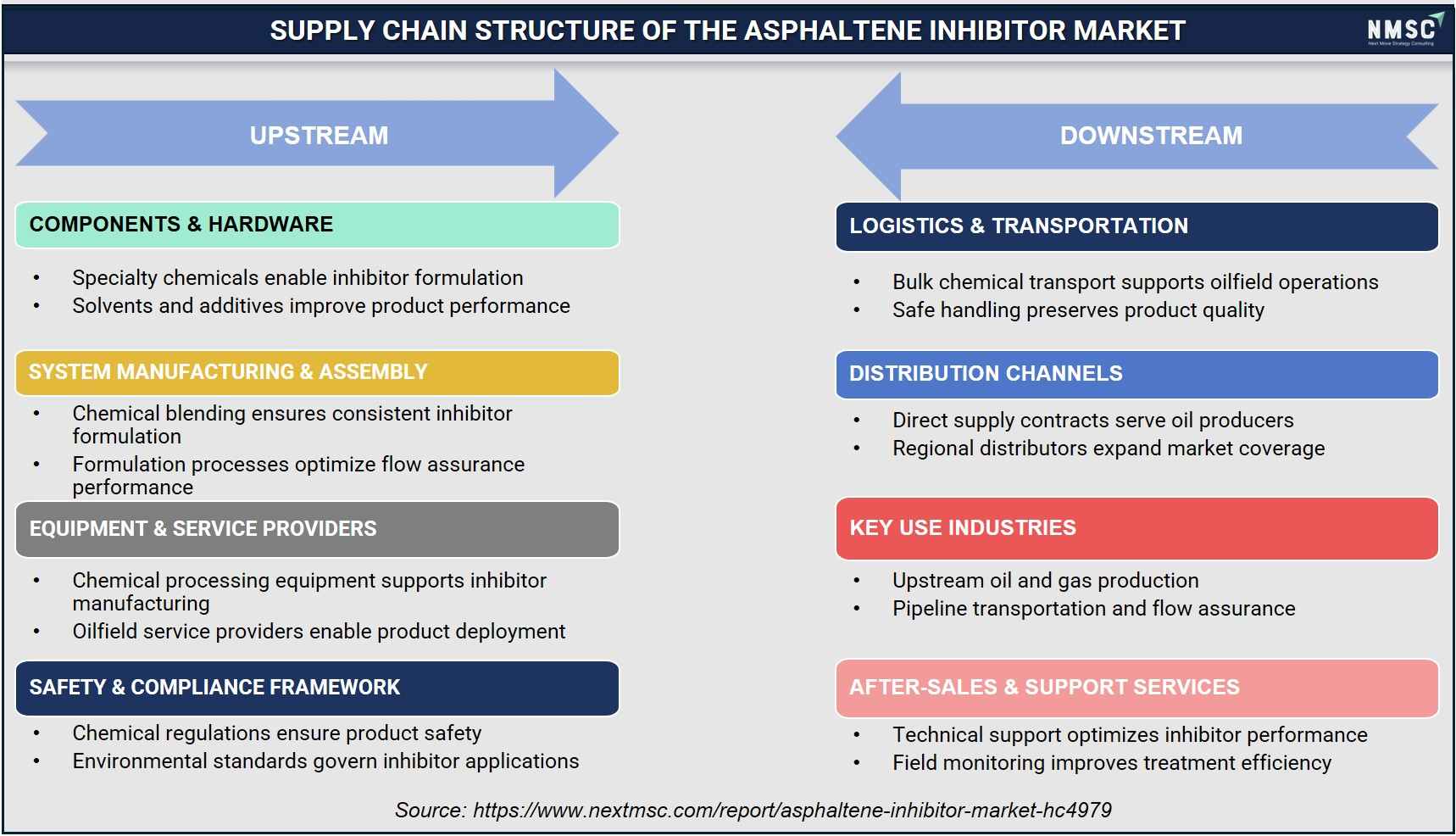
Based on our comprehensive assessment, we found that the asphaltene inhibitor supply chain begins with specialty chemical suppliers providing solvents, dispersants, and formulation ingredients. Manufacturers develop inhibitor formulations and collaborate with oilfield service providers for deployment. Distribution networks support delivery to production sites, pipelines, and processing facilities. Technical service teams provide monitoring and optimization, while regulatory frameworks ensure safe chemical handling and environmental compliance.
What Are the Key Market Drivers, Breakthroughs, and Investment Opportunities that Will Shape the Asphaltene Inhibitor Market in the Next Decade?
|
Drivers / Trends / Restraints |
(+/-) % Impact on CAGR Forecast |
Geographic Relevance |
Impact Timeline |
|
Deepwater and Ultra-Deepwater Production Expansion |
+1.2% |
Global (led by Brazil, GoM, West Africa) |
2025–2035 |
|
Rising National Oil Company Upstream Capital Expenditure |
+0.9% |
MEA, Latin America |
2025–2032 |
|
Adoption of Continuous Chemical Injection Systems |
+0.7% |
Global |
2025–2030 |
|
Shift to Hybrid and Bio-Based Inhibitor Formulations |
+0.5% |
Europe, North America, APAC |
2026–2035 |
|
Digital Flow Assurance and Dosage Optimization Platforms |
+0.4% |
North America, Europe, APAC |
2026–2035 |
|
Crude Oil Price Volatility Dampening Capex |
-0.8% |
Global |
Ongoing |
|
Aromatic Solvent Regulatory Restrictions (REACH, OSPAR) |
-0.4% |
Europe, North Sea |
Ongoing |
|
Energy Transition and Declining Long-Cycle Upstream Investment |
-0.6% |
Europe, North America |
2028–2035 |
|
Expansion of Unconventional Tight Oil Production in North America |
+0.6% |
U.S., Canada |
2025–2032 |
|
Emerging Market Upstream Monetization in APAC and MEA |
+0.5% |
Southeast Asia, Africa |
2026–2035 |
What Are the Growth Drivers of the Asphaltene Inhibitor Market?
How Is the Global Expansion of Deep-Water and Ultra-Deep-Water Oil Production Driving Asphaltene Inhibitor Demand?
Deep-water and ultra-deep-water oil production represents the most critical structural demand driver for the asphaltene inhibitor market. The International Energy Agency (IEA) notes that offshore oil production accounts for approximately 30% of global crude supply, with deep-water fields representing a growing proportion. High-pressure, low-temperature flowline conditions encountered in subsea systems at depths exceeding 1,000 meters create thermodynamic conditions highly favorable for asphaltene precipitation. Our findings suggest that continuous chemical injection through asphaltene inhibitor systems is now considered a fundamental engineering requirement rather than an optional treatment for all new deep-water field developments globally, driving sustained demand growth across the forecast period.
How Is Increasing National Oil Company Capital Expenditure on Mature Field Revitalization Expanding Asphaltene Inhibitor Adoption?
National oil companies (NOCs) in the Middle East, Latin America, and Southeast Asia are accelerating capital expenditure on mature field revitalization programs that increasingly require asphaltene inhibitor solutions. Saudi Aramco's Ma'aden and Zuluf megafield development programs, ADNOC's unconventional resource development initiatives, and Petrobras's pre-salt expansion plans represent billions of dollars in upstream investment directed toward reservoirs with confirmed asphaltene deposition challenges. The U.S. Energy Information Administration (EIA) projects global crude oil and liquid fuels production to increase through 2035, indicating sustained upstream activity that underpins asphaltene inhibitor demand across NOC-operated assets worldwide.
How Is the Proliferation of Subsea Tieback Infrastructure Creating Sustained Demand for Asphaltene Inhibitors?
The rapid expansion of subsea tieback infrastructure, connecting new satellite wells and tie-back developments to existing host platforms, is generating sustained incremental demand for asphaltene inhibitor solutions. Subsea tiebacks, particularly those extending beyond 20 kilometers, operate under thermodynamic conditions that maximize asphaltene deposition risk along the entire flowline length. Our assessment indicates that the International Association of Oil and Gas Producers (IOGP) has documented growing industry reliance on chemical injection systems as a primary flow assurance management strategy for subsea tieback developments, reinforcing the long-term demand trajectory for continuous-injection asphaltene inhibitor programs.
What Are the Growth Inhibitors of the Asphaltene Inhibitor Market?
How Is Crude Oil Price Volatility Constraining Investment in Asphaltene Inhibitor Programs?
Crude oil price volatility represents the most persistent demand-side constraint on the asphaltene inhibitor market. When crude oil prices decline below operator breakeven thresholds, production chemistry budgets are among the first operational expenditure line items reduced or deferred. The U.S. Energy Information Administration (EIA) has documented multiple cycles of upstream spending reductions during periods of sustained low crude oil prices, with oilfield chemical programs experiencing 15% to 25% budget contractions during severe downturns. Our analysis shows that price-sensitive independent operators often defer non-critical asphaltene inhibitor programs or reduce dosage rates below optimal levels, creating both short-term revenue risk and long-term asset integrity consequences for the asphaltene inhibitor market.
How Do Regulatory Restrictions on Aromatic Solvents Limit Formulation Flexibility in the Asphaltene Inhibitor Market?
Regulatory restrictions on aromatic solvents, particularly toluene, xylene, and benzene-containing packages, are constraining the formulation options available to asphaltene inhibitor manufacturers operating in European and offshore regulatory jurisdictions. The European Chemicals Agency (ECHA) classifies several aromatic solvents as substances of very high concern (SVHC) under REACH, imposing authorization requirements that increase compliance costs and reformulation timelines. Norway's OSPAR Commission and the UK's Offshore Chemicals Regulations require environmental hazard assessment of all offshore chemicals, limiting the use of conventional aromatic solvent inhibitors. These regulatory constraints restrict market access for legacy solvent-based asphaltene inhibitor formulations and increase time-to-market for replacement chemistries.
What Are the Growth Opportunities in the Asphaltene Inhibitor Market?
How Does the Expansion of Unconventional Tight Oil Production in North America Create New Opportunities for Asphaltene Inhibitors?
The sustained expansion of unconventional tight oil production in North American shale basins is creating a growing and underserved addressable market for asphaltene inhibitor solutions. Crude oils produced from Permian Basin tight formations, Eagle Ford Shale, and Bakken Shale exhibit highly variable asphaltene content and instability characteristics that are becoming increasingly evident as field production profiles mature. The U.S. Energy Information Administration (EIA) projects U.S. crude oil production to remain above 13 million barrels per day through the late 2020s, indicating sustained tight oil output that necessitates flow assurance chemical programs. Our assessment indicates that asphaltene management in the mid-life and tail-end phases of unconventional plays represents a significant and expanding commercial opportunity for asphaltene inhibitor suppliers.
How Does the Growing Adoption of Integrated Service Contracts Create a Commercial Opportunity in the Asphaltene Inhibitor Market?
The shift by oil and gas operators from transactional chemical procurement toward integrated production chemistry service contracts represents a structurally significant opportunity for asphaltene inhibitor market participants. Under integrated service models, vendors supply asphaltene inhibitors bundled with flow assurance monitoring, performance analytics, and dosage optimization services under performance-guarantee arrangements. Based on our market evaluation, we noticed that this model provides operators with reduced operational complexity and predictable chemical expenditure while enabling vendors to capture higher revenue per unit and build longer-term customer relationships. Leading service providers including SLB, Halliburton, and Baker Hughes are actively expanding integrated chemistry service contract offerings in the Gulf of Mexico and Middle Eastern markets.
How Does the Emerging Market Upstream Development in Southeast Asia and Africa Present an Asphaltene Inhibitor Market Opportunity?
Emerging market upstream development programs in Southeast Asia, East Africa, and Sub-Saharan Africa represent a significant long-term structural opportunity for the asphaltene inhibitor market. The U.S. Geological Survey (USGS) has identified substantial undeveloped hydrocarbon resources in offshore East Africa, Gulf of Guinea, and Southeast Asian deepwater acreage. National oil company-led development programs in Mozambique, Tanzania, Senegal, and Guyana are bringing new asphaltene-sensitive deepwater reservoirs into production over the 2025 to 2035 forecast period. Our findings suggest that early engagement by asphaltene inhibitor suppliers in reservoir characterization and field planning phases creates preferred-vendor positioning that generates durable revenue streams across the full life cycle of these emerging market field developments.
How Is the Asphaltene Inhibitor Market Segmented in This Report, and What Are the Key Insights from the Segmentation Analysis?
How Does Product Type Segmentation Reveal the Structural Composition of the Asphaltene Inhibitor Market?
|
Product Type Segment |
2025 (USD Bn) |
2035 (USD Bn) |
CAGR (%) |
|
Polymeric Inhibitor |
0.72 |
1.12 |
4.5% |
|
Dispersant Inhibitor |
0.54 |
0.86 |
4.8% |
|
Solvent Inhibitor |
0.36 |
0.54 |
4.2% |
|
Hybrid Inhibitor |
0.22 |
0.38 |
5.6% |
|
Bio-Based Inhibitor |
0.08 |
0.12 |
4.1% |
Based on our analysis of oilfield chemical procurement trends and reservoir chemistry data, we found that the asphaltene inhibitor market is segmented into polymeric inhibitors, dispersant inhibitors, solvent inhibitors, hybrid inhibitors, and bio-based inhibitors. The polymeric inhibitor segment dominates with USD 0.72 billion in 2025, driven by the widely proven performance of alkylphenol formaldehyde resin chemistries in high-pressure deep-water and carbonate reservoir applications; polyolefin-based and polyester-based sub-segments deliver complementary performance in crude-specific environments. Dispersant inhibitors, particularly fatty acid ester and amide variants, represent the second-largest segment as they offer effective steric stabilization with improved environmental profiles. Hybrid inhibitors constitute the fastest-growing segment at a CAGR of 5.6%, with dispersant solvent blends recording the highest sub-segment growth at 6.1%, reflecting operator preference for multi-mechanism protection in ultra-deep-water and thermally stressed flowline environments.
How Does Application Location Define the Demand Distribution Within the Asphaltene Inhibitor Market?
|
Application Location |
2025 (USD Bn) |
2035 (USD Bn) |
CAGR (%) |
|
Wellbore |
0.58 |
0.92 |
4.7% |
|
Topside Facility |
0.38 |
0.59 |
4.5% |
|
Reservoir |
0.46 |
0.73 |
4.7% |
|
Subsea Equipment |
0.29 |
0.47 |
5.0% |
|
Transport and Storage |
0.21 |
0.31 |
3.9% |
Through our market assessment, we observed that application location segmentation spans the wellbore, reservoir, subsea equipment, topside facility, and transport and storage segments. The wellbore segment leads with USD 0.58 billion in 2025, given that the bottomhole assembly and production tubing represent the primary locus of asphaltene onset pressure crossings in most producing wells. Reservoir injection of asphaltene inhibitor solutions, delivered via conformance waterfloods or selective inhibitor squeezes, commands significant share as operators address near-wellbore deposition in carbonated and sandstone reservoirs. Subsea equipment represents the fastest-growing application location at a CAGR of 5.0%, driven by the proliferation of subsea manifolds, trees, and flowline infrastructure in deep-water developments that present continuous asphaltene deposition risks along extended tieback distances.
How Do Application Methods Influence Treatment Efficacy and Revenue Distribution in the Asphaltene Inhibitor Market?
|
Application Method |
2025 (USD Bn) |
2035 (USD Bn) |
CAGR (%) |
|
Continuous Injection |
0.82 |
1.28 |
4.6% |
|
Batch Treatment |
0.54 |
0.84 |
4.5% |
|
Squeeze Treatment |
0.38 |
0.60 |
4.7% |
|
Off-Line Treatment |
0.18 |
0.30 |
5.2% |
In our observation, the asphaltene inhibitor market by application method is segmented into continuous injection, batch treatment, squeeze treatment, and off-line treatment programs. Continuous injection dominates with USD 0.82 billion in 2025, as offshore and subsea production facilities require uninterrupted chemical protection to prevent flow assurance failures in high-consequence environments. Batch treatment remains widely adopted in mature onshore fields where periodic intervention is cost-effective. Squeeze treatment, which involves injecting concentrated asphaltene inhibitor solutions into the near-wellbore formation for sustained slow release, is preferred for wells with limited topside infrastructure. Off-line treatment is the fastest-growing method at a CAGR of 5.2%, reflecting its increasing application in unconventional tight oil wells across North America where well-level asphaltene management has become essential during production decline.
How Do Distribution Channels Shape Commercial Dynamics in the Asphaltene Inhibitor Market?
|
Distribution Channel |
2025 (USD Bn) |
2035 (USD Bn) |
CAGR (%) |
|
Direct Sales |
0.78 |
1.21 |
4.5% |
|
Distributor |
0.62 |
0.97 |
4.6% |
|
Integrated Service Contract |
0.38 |
0.62 |
5.1% |
|
Private Label |
0.14 |
0.22 |
4.6% |
Based on our market evaluation, the asphaltene inhibitor market distribution channel segmentation encompasses direct sales, distributor networks, integrated service contracts, and private label supply arrangements. Direct sales lead with USD 0.78 billion in 2025, as large NOCs and major independent operators prefer direct vendor relationships for customized formulation development, technical service support, and strategic supply security. Distributor channels remain critical for regional and independent operator access to standardized asphaltene inhibitor products in onshore markets across North America, the Middle East, and APAC. Integrated service contracts represent the fastest-growing channel at a CAGR of 5.1%, driven by operator preference for bundled supply-and-service arrangements that transfer performance risk to the chemical service provider.
How Does Customer Type Segmentation Reflect Procurement Behavior in the Asphaltene Inhibitor Market?
|
Customer Type |
2025 (USD Bn) |
2035 (USD Bn) |
CAGR (%) |
|
National Oil Company |
0.72 |
1.14 |
4.7% |
|
Independent Operator |
0.58 |
0.89 |
4.4% |
|
Oilfield Service Company |
0.42 |
0.67 |
4.8% |
|
Midstream Operator |
0.20 |
0.32 |
5.0% |
Our findings suggest that the asphaltene inhibitor market is served across four distinct customer segments: national oil companies, independent operators, oilfield service companies, and midstream operators. National oil companies represent the dominant customer segment at USD 0.72 billion in 2025, given their large-scale upstream operations in asphaltene-prone carbonate and sandstone reservoirs across Saudi Arabia, the UAE, Kuwait, Mexico, Venezuela, and Nigeria. Independent operators constitute a significant and commercially diverse demand base, particularly in North American unconventional basins and emerging market deepwater plays. Oilfield service companies purchase asphaltene inhibitors to formulate and deliver production chemistry services to operator clients under service contracts. Midstream operators represent the fastest-growing segment at 5.0% CAGR as pipeline and terminal operators expand their use of asphaltene management chemistry to preserve heavy crude transport economics.
Regional Outlook
Geographic Performance Snapshot
|
Region |
2025 (USD Bn) |
2035 (USD Bn) |
CAGR (%) |
Key Driver |
|
North America |
0.58 |
0.90 |
4.5% |
Deepwater GoM, unconventional tight oil |
|
Europe |
0.29 |
0.43 |
3.9% |
North Sea field life extension, OSPAR compliance |
|
Asia Pacific |
0.46 |
0.76 |
5.1% |
Offshore APAC expansion, NOC investment |
|
Middle East & Africa |
0.48 |
0.76 |
4.7% |
NOC megafield programs, carbonate reservoirs |
|
Latin America |
0.11 |
0.17 |
4.5% |
Brazilian pre-salt, heavy crude transport |
North America Asphaltene Inhibitor Market
North America is the largest regional market for asphaltene inhibitors, valued at USD 0.58 billion in 2025, and is projected to reach USD 0.90 billion by 2035 The region benefits from an extensive Gulf of Mexico deep-water production base where asphaltene deposition management is a fundamental flow assurance requirement, complemented by a growing application footprint in the Permian, Eagle Ford, and Bakken tight oil basins. Through our analysis, we found that mature North American oilfield service infrastructure, stringent EPA offshore chemical guidelines, and the widespread adoption of digital production chemistry monitoring systems collectively support sustained asphaltene inhibitor demand and high technical service standards.
U.S. Asphaltene Inhibitor Market
Based on our engagements with the upstream oil and gas sector, we found that the United States represents the dominant asphaltene inhibitor market within North America. The Gulf of Mexico's deep-water production, operated by Shell, BP, Chevron, and numerous independent operators, constitutes the highest-value application segment for premium polymeric and hybrid asphaltene inhibitor formulations. Simultaneously, the scale of tight oil production in the Permian Basin, as tracked by the U.S. Energy Information Administration (EIA), is generating increasing mid-life flow assurance challenges that drive asphaltene inhibitor adoption. EPA's Offshore Chemical Selection Guidelines and OCS regulations ensure that environmental compliance considerations remain integral to product qualification in U.S. waters.
Canada Asphaltene Inhibitor Market
Through our analysis, we observed that Canada's asphaltene inhibitor market is primarily driven by offshore eastern Canadian developments, oil sands surface upgrading operations, and heavy crude pipeline transport requirements. The Newfoundland offshore, including Hibernia, Terra Nova, and White Rose fields, produces asphaltenic crude oils requiring continuous inhibitor injection programs. In Alberta, oil sands producers employ asphaltene inhibitors and dispersants in heavy crude blending and transport operations. The National Energy Board of Canada and the Canada-Newfoundland Offshore Petroleum Board (CNLOPB) provide the regulatory framework governing offshore chemical use, supporting demand for environmentally assessed asphaltene inhibitor formulations.
Mexico Asphaltene Inhibitor Market
From our assessment, Mexico represents a growing asphaltene inhibitor market underpinned by Pemex's shallow-water and deep-water operations in the Gulf of Mexico. Mexican crude production from prolific fields including Ku-Maloob-Zaap and Cantarell involves highly asphaltenic crude compositions that require continuous inhibitor treatment programs across wellbore, subsea, and surface facilities. The Comisión Nacional de Hidrocarburos (CNH) has approved a growing number of deep-water exploration and production licenses that will require asphaltene management chemistry as these fields come online. Energy reform initiatives and private sector participation in Mexican upstream development are expected to broaden the asphaltene inhibitor customer base beyond Pemex.
Europe Asphaltene Inhibitor Market
The European asphaltene inhibitor market was valued at USD 0.29 billion in 2025 and is projected to reach USD 0.43 billion by 2035 at a CAGR of 3.9%. The North Sea remains the principal demand center, where mature field life extension programs in the UK Continental Shelf and Norwegian Continental Shelf drive sustained asphaltene inhibitor adoption. Stringent OSPAR Convention chemical regulations and the EU REACH regulation significantly influence product qualification and formulation strategy, accelerating the market transition toward environmentally preferred polymeric and bio-based asphaltene inhibitor chemistries. NMSC's analysis indicates that Europe's below-average CAGR relative to global peers reflects production maturity rather than reduced per-unit inhibitor application intensity.
UK Asphaltene Inhibitor Market
Based on our engagements, the United Kingdom represents the largest national asphaltene inhibitor market in Europe. The UK Continental Shelf (UKCS), overseen by the North Sea Transition Authority (NSTA), hosts a mature production base where asphaltene management has become integral to field life extension economics. UK North Sea crude oils, particularly waxy and aromatic crude blends from central and northern UKCS fields, exhibit significant asphaltene deposition tendencies at late-field pressure depletion stages. The Offshore Chemicals Regulations 2002 require environmental hazard assessment of all chemicals used offshore, ensuring that asphaltene inhibitor suppliers maintain compliance-ready product portfolios for UK market access.
Germany Asphaltene Inhibitor Market
Through our analysis, we found that Germany's asphaltene inhibitor market is relatively modest in scale, serving primarily its domestic onshore oil production industry concentrated in Lower Saxony and Bavaria, supplemented by demand from chemical manufacturers supplying formulated oilfield chemistry to export markets. The Federal Environment Agency (Umweltbundesamt) and REACH implementation by ECHA govern chemical safety standards relevant to asphaltene inhibitor formulation and production. Germany hosts significant chemical manufacturing operations for major asphaltene inhibitor suppliers including BASF SE, Evonik Industries, and Arkema S.A., making it a key production hub for the European asphaltene inhibitor supply chain.
France Asphaltene Inhibitor Market
From our assessment, France's role in the asphaltene inhibitor market is primarily as a chemical manufacturing and technology development hub rather than a direct end-user market, given France's limited domestic oil production. TotalEnergies SE, headquartered in France, drives significant asphaltene inhibitor demand through its global upstream operations in West Africa, the North Sea, the Middle East, and Brazil, where its production chemistry programs specify and procure asphaltene inhibitor solutions at scale. Arkema S.A. and Rhodia (now Solvay) represent key French-based chemical producers with relevant oilfield chemistry portfolios, and the asphaltene inhibitor market in France benefits from strong research and development ecosystem supporting advanced formulation innovation.
Italy Asphaltene Inhibitor Market
According to our evaluation, Italy's asphaltene inhibitor market is anchored by ENI S.p.A.'s domestic and international upstream operations. ENI's Italian onshore and offshore Adriatic Sea production, combined with its extensive international upstream portfolio in North Africa, West Africa, and the Middle East, generates substantial asphaltene inhibitor procurement. Italy's Ministry of Environment and Energy Security regulates offshore chemical use in Italian waters under EU environmental directives. ENI's significant upstream capital expenditure, particularly in Mozambique, Libya, and Congo, which involve asphaltene-sensitive reservoir conditions, creates cross-border demand that is ultimately coordinated through its Italian procurement operations.
Spain Asphaltene Inhibitor Market
Based on our engagements, Spain's asphaltene inhibitor market demand is principally generated through Repsol S.A.'s upstream operations in Spain and internationally across Latin America and Southeast Asia. Spain's domestic crude production is limited, but Repsol's global upstream portfolio in Ecuador, Bolivia, Vietnam, and Gulf of Mexico positions Spain as a significant procurement hub for asphaltene inhibitor programs. The Spanish Ministry of Ecological Transition and Demographic Challenge provides regulatory oversight governing onshore chemical use, while EU REACH compliance requirements apply across all production chemistry procurement in Spanish-domiciled operations.
Sweden Asphaltene Inhibitor Market
Through our analysis, Sweden's asphaltene inhibitor market is primarily driven by the domestic operations of specialty chemical producers with relevant product lines for oilfield applications, including Nouryon Chemicals Holding B.V., which maintains significant manufacturing operations in Sweden. Direct upstream oil and gas operations in Sweden are minimal, but Sweden hosts important chemical R&D facilities and serves as a regional supply base for Nordic offshore operators. Sweden's strong environmental regulatory framework, aligned with REACH and EU environmental policy, supports the development and qualification of environmentally preferred asphaltene inhibitor formulations by Swedish-based chemical producers.
Denmark Asphaltene Inhibitor Market
From our assessment, Denmark's asphaltene inhibitor market is shaped by offshore oil production in the Danish North Sea, operated primarily by TotalEnergies' Danish subsidiary and the state-linked Nordsøfonden. Danish North Sea crude production, while declining from historical peaks, includes fields with documented asphaltene deposition challenges that require continuous inhibitor programs. The Danish Environmental Protection Agency and Denmark's implementation of OSPAR recommendations govern offshore chemical use in Danish waters, ensuring that asphaltene inhibitor suppliers comply with environmental assessment requirements. Denmark's Energy Agency monitors and regulates the production chemistry practices of offshore operators under the Subsoil Act.
Finland Asphaltene Inhibitor Market
According to our evaluation, Finland does not host significant oil and gas production operations, and its contribution to the asphaltene inhibitor market is principally through specialty chemical manufacturing and supply chain functions. Finnish chemical companies supply specialty additives and intermediate chemicals used in oilfield chemistry formulations, and Finland's advanced materials science and process chemistry capabilities support technology development activities relevant to asphaltene inhibitor innovation. Neste Oyj, the Finnish refining and renewable fuels company, represents a relevant downstream customer for flow improvers and related chemistry, though its specific asphaltene inhibitor consumption is limited relative to upstream oil producers.
Netherlands Asphaltene Inhibitor Market
Based on our engagements, the Netherlands is a strategically important market node for the asphaltene inhibitor market as a key logistics, distribution, and chemical manufacturing hub for Northwestern Europe. Rotterdam's port infrastructure serves as a primary import and distribution point for oilfield chemicals supplied to North Sea operators. Shell's Dutch headquarters historically anchored significant domestic procurement of asphaltene inhibitor solutions for North Sea and international operations. Nouryon Chemicals Holding B.V., headquartered in Amsterdam, is a significant manufacturer of surfactants and specialty chemicals relevant to asphaltene dispersant formulations, while BASF's Rotterdam manufacturing operations supply intermediates used in oilfield chemistry production.
Asia Pacific Asphaltene Inhibitor Market
Asia Pacific is the fastest-growing regional market for asphaltene inhibitors, valued at USD 0.46 billion in 2025 and projected to reach USD 0.76 billion by 2035 at a CAGR of 5.1%. Rising offshore production in Malaysia, Indonesia, Vietnam, Australia, and the Philippines, combined with China's sustained upstream investment and India's heavy oil field development programs, drives robust demand. Our analysis shows that APAC's diverse reservoir base encompasses asphaltene-sensitive deepwater discoveries in the South China Sea, Browse Basin, and Makassar Strait, all requiring advanced asphaltene inhibitor programs. Growing local chemical manufacturing capability is improving supply chain resilience and cost competitiveness in the regional asphaltene inhibitor market.
China Asphaltene Inhibitor Market
Based on our engagements, China is the largest asphaltene inhibitor market in Asia Pacific, driven by CNOOC's offshore operations in the South China Sea and Bohai Bay, complemented by CNPC and Sinopec's onshore enhanced oil recovery programs in Xinjiang and other western China basins. Chinese offshore crude oils from the Pearl River Mouth Basin and Liwan deepwater fields include compositions with significant asphaltene deposition tendencies. The National Energy Administration (NEA) oversees upstream oil and gas production that drives asphaltene inhibitor demand, while local Chinese chemical producers including Luoyang Pacific United Petrochemical and Deshi Energy Technology Group serve as both suppliers and competitors to international chemical companies.
India Asphaltene Inhibitor Market
Through our analysis, India is the fastest-growing national market for asphaltene inhibitors within Asia Pacific, advancing at a CAGR of approximately 5.8%. ONGC's Mumbai High offshore production, heavy oil developments in Rajasthan operated by Cairn India (Vedanta), and deep-water exploration programs in the KG Basin and Andaman Sea involve asphaltene-sensitive crude compositions requiring treatment programs. Imperial Oilfield Chemicals Private Limited and Dorf Ketal Chemicals India Private Limited represent significant Indian-based asphaltene inhibitor market participants serving both domestic and export markets. The Ministry of Petroleum and Natural Gas (MoPNG) and the Directorate General of Hydrocarbons (DGH) oversee regulatory frameworks governing production chemistry in Indian upstream operations.
Japan Asphaltene Inhibitor Market
From our assessment, Japan's asphaltene inhibitor market is driven primarily by the international upstream investments of INPEX Corporation and ENEOS Holdings rather than domestic crude production, which is minimal. INPEX's Ichthys LNG project in Australia and its Middle Eastern concessions require asphaltene management programs sourced through Japanese procurement channels. Japan's sophisticated chemical industry supports asphaltene inhibitor manufacturing activities by companies with relevant specialty surfactant and polymer product lines. The Agency for Natural Resources and Energy (ANRE) under Japan's Ministry of Economy, Trade and Industry (METI) provides regulatory context for energy sector chemical use and domestic production chemistry applications.
South Korea Asphaltene Inhibitor Market
According to our evaluation, South Korea's asphaltene inhibitor market is primarily supplied through the international upstream operations of Korea National Oil Corporation (KNOC) and private sector E&P companies active in Kazakhstan, Iraq, UAE, and Southeast Asia. South Korea's domestic crude production is negligible, but its role as a major crude oil refining hub generates some downstream flow assurance chemistry demand. Korean petrochemical majors including LG Chem and Lotte Chemical produce specialty chemicals relevant to asphaltene inhibitor formulation intermediates, contributing to South Korea's overall position as a regional chemical supply chain participant in the asphaltene inhibitor market.
Taiwan Asphaltene Inhibitor Market
Based on our engagements, Taiwan's participation in the asphaltene inhibitor market is primarily through chemical manufacturing and specialty additive supply chain activities rather than direct upstream oil production demand. CPC Corporation, Taiwan's state-owned energy company, manages a modest domestic oil production program complemented by international upstream investment activities that generate some asphaltene inhibitor procurement requirements. Taiwan's robust petrochemical industry, anchored by Formosa Plastics Group and other major chemical producers, contributes to the regional supply of specialty chemical intermediates relevant to oilfield chemistry formulation used across Asia Pacific asphaltene inhibitor applications.
Indonesia Asphaltene Inhibitor Market
Through our analysis, Indonesia represents a significant and growing asphaltene inhibitor market within Asia Pacific, driven by Pertamina's onshore mature field programs, offshore deepwater exploration in the Kutei Basin and Makassar Strait, and the production chemistry requirements of major international operators including Chevron, Eni, and ConocoPhillips. Indonesian crude oils from East Kalimantan and offshore Java Sea fields include compositions with variable asphaltene content that require treatment programs across wellbore and surface facilities. The Indonesian government's upstream oil production targets and Pertamina's enhanced oil recovery programs create sustained demand for asphaltene inhibitor solutions, supported by a growing domestic oilfield chemical distribution network.
Vietnam Asphaltene Inhibitor Market
From our assessment, Vietnam is an emerging growth market for asphaltene inhibitors within Asia Pacific, driven by PetroVietnam's offshore production programs in the Cuu Long Basin, Nam Con Son Basin, and offshore central Vietnam. Vietnamese offshore crude oils, particularly from the Bach Ho and Rang Dong fields, are characterized by high wax content and moderate asphaltene deposition tendencies that require integrated flow assurance treatment programs. Through NMSC's assessment, we found that PetroVietnam's expansion of offshore production and its joint venture programs with international operators including Gazprom, ONGC Videsh, and PTTEP are expanding the addressable market for asphaltene inhibitor solutions in Vietnamese offshore developments.
Australia Asphaltene Inhibitor Market
According to our evaluation, Australia is a technically mature and growing asphaltene inhibitor market, anchored by the nation's extensive offshore oil production in the Carnarvon Basin, Browse Basin, and Timor Sea. Woodside Energy's Pluto and Scarborough projects, Inpex's Ichthys field, and Santos's offshore operations represent significant asphaltene inhibitor demand generators. The National Offshore Petroleum Safety and Environmental Management Authority (NOPSEMA) regulates chemical use in Australian offshore operations, supporting demand for environmentally assessed asphaltene inhibitor formulations. Australia's proximity to Southeast Asian supplier networks and its strong oilfield service infrastructure support efficient asphaltene inhibitor supply chain management.
Philippines Asphaltene Inhibitor Market
Based on our engagements, the Philippines represents an early-stage but developing asphaltene inhibitor market within Asia Pacific, linked primarily to the nation's offshore oil and gas production in the Malampaya gas condensate field operated by Shell Philippines Exploration and the Galoc oil field operated by PNOC Exploration Corporation. Philippine upstream regulatory oversight by the Department of Energy governs production chemistry requirements. Growing interest in offshore exploration in the West Philippine Sea, as supported by the Philippine government's upstream licensing rounds, is expected to create incremental asphaltene inhibitor demand as new field developments progress from exploration toward production over the forecast period.
Malaysia Asphaltene Inhibitor Market
Through our analysis, Malaysia is a significant and technically sophisticated asphaltene inhibitor market within Asia Pacific, driven by PETRONAS's extensive offshore production program across Sarawak, Sabah, and the Peninsular Malaysia offshore. Malaysian crude oils from the Kikeh, Gumusut-Kakap, and Kebabangan deepwater fields include asphaltene-prone compositions requiring continuous inhibitor programs delivered through complex subsea infrastructure. PETRONAS's Production Sharing Contract framework and its technical specifications for production chemistry define the procurement standards for asphaltene inhibitor suppliers operating in the Malaysian market. The growing development of mature field enhanced oil recovery programs by PETRONAS further supports sustained asphaltene inhibitor demand in Malaysia.
Middle East and Africa Asphaltene Inhibitor Market
The Middle East and Africa (MEA) region represents the second-largest regional market for asphaltene inhibitors, valued at USD 0.48 billion in 2025, and projected to reach USD 0.76 billion by 2035 at a CAGR of 4.7%. MEA hosts the world's highest concentration of asphaltene-prone carbonate reservoirs, combined with the largest national oil company procurement organizations globally, making it the most strategically important regional market. Saudi Aramco, ADNOC, KPC, and QatarEnergy drive massive asphaltene inhibitor consumption volumes across mature and new field developments. Our assessment indicates that MEA's asphaltene inhibitor market will benefit from accelerating upstream investment through the forecast period despite global energy transition pressures.
Saudi Arabia Asphaltene Inhibitor Market
Based on our engagements, Saudi Arabia is the largest individual country market for asphaltene inhibitors in the MEA region, driven by Saudi Aramco's massive upstream operations across supergiant carbonate reservoirs including Ghawar, Abqaiq, Khurais, and the Zuluf and Marjan offshore fields. Saudi carbonate crude oils are characteristically prone to asphaltene deposition under pressure depletion conditions, requiring sophisticated continuous inhibitor injection programs across thousands of producing wells. Saudi Aramco's technical specifications for asphaltene inhibitor qualification are considered among the most rigorous in the global industry, setting de facto standards that asphaltene inhibitor suppliers must meet to access this dominant market.
UAE Asphaltene Inhibitor Market
Through our analysis, the UAE represents the second-largest asphaltene inhibitor market in MEA, anchored by ADNOC's onshore and offshore upstream programs across Abu Dhabi's supergiant carbonate reservoirs. ADNOC's Zakum, Umm Shaif, and Upper Zakum fields, among others, involve crude compositions with documented asphaltene deposition challenges. ADNOC's ambitious production expansion program targeting 5 million barrels per day by 2030, as announced by ADNOC and tracked by the UAE Ministry of Energy and Infrastructure, represents a significant and growing demand driver for asphaltene inhibitor solutions. Dubai's free zone infrastructure also positions the UAE as a regional logistics and distribution hub for asphaltene inhibitor supply across the Gulf region.
Egypt Asphaltene Inhibitor Market
From our assessment, Egypt's asphaltene inhibitor market is driven by upstream oil production programs operated by EGPC, ENI, BP, Shell, and international E&P companies across the Western Desert, Gulf of Suez, and Mediterranean offshore Egypt. Egyptian crude oils, particularly from the Gulf of Suez producing fields, include compositions with variable but often significant asphaltene deposition tendencies. The Egyptian General Petroleum Corporation (EGPC) and the Egyptian Natural Gas Holding Company (EGAS) provide regulatory oversight for upstream chemical programs. ENI's expansive Zohr deepwater gas discovery and associated condensate production are generating new flow assurance chemistry requirements in Egyptian offshore operations.
Israel Asphaltene Inhibitor Market
According to our evaluation, Israel's asphaltene inhibitor market is emerging in scale, primarily driven by deep-water natural gas production in the Leviathan and Tamar fields operated by Chevron and NewMed Energy in the Israeli exclusive economic zone. While natural gas condensate compositions at Leviathan and Tamar include some asphaltenic fractions, the primary production chemistry focus involves flow assurance for condensate stabilization and subsea infrastructure protection. The Israeli Ministry of Energy and Infrastructure provides the regulatory framework governing offshore chemical use, and the growing maturity of Israeli offshore gas production is expected to create increasing asphaltene inhibitor demand over the forecast period.
Turkey Asphaltene Inhibitor Market
Based on our engagements, Turkey's asphaltene inhibitor market is supported by TPAO's onshore and offshore upstream production programs, supplemented by the transit function of Turkish pipeline infrastructure carrying crude oil from Iraq, the Caspian, and Central Asia. The Black Sea TPAO offshore exploration program and domestic production from southeastern Turkey's oil fields generate domestic asphaltene inhibitor demand. The Energy Market Regulatory Authority (EMRA) and the Ministry of Energy and Natural Resources oversee Turkey's energy sector, and Turkey's ambition to expand domestic hydrocarbon production is expected to modestly increase asphaltene inhibitor procurement requirements over the 2025 to 2035 forecast period.
Nigeria Asphaltene Inhibitor Market
Through our analysis, Nigeria is a significant and growing asphaltene inhibitor market in Sub-Saharan Africa, driven by NNPC's joint venture operations with Shell, TotalEnergies, ExxonMobil, and Chevron across shallow-water, deep-water, and onshore Niger Delta production systems. Nigerian crude oils, including Bonny Light and Forcados blends, contain asphaltenic fractions that require management particularly in deep-water subsea systems operated under challenging thermodynamic conditions. Nigeria's deep-water assets including Bonga, Egina, Agbami, and Usan fields generate sustained high-value asphaltene inhibitor demand. The Nigerian Upstream Petroleum Regulatory Commission (NUPRC) under the Petroleum Industry Act 2021 governs production chemistry and chemical use in Nigerian upstream operations.
South Africa Asphaltene Inhibitor Market
From our assessment, South Africa's asphaltene inhibitor market is supported by PetroSA's offshore production at the FA-EM gas condensate fields offshore Mossel Bay and by international upstream exploration activity in the Orange Basin. TotalEnergies' Brulpadda and Luiperd deepwater gas and condensate discoveries in the Outeniqua Basin represent significant potential future sources of asphaltene inhibitor demand as these fields progress toward development. South Africa's Department of Mineral Resources and Energy (DMRE) oversees the upstream regulatory environment, and the country's advanced refining and petrochemical infrastructure positions it as a key regional distribution hub for oilfield chemicals across Southern Africa.
Latin America Asphaltene Inhibitor Market
Latin America's asphaltene inhibitor market was valued at USD 0.11 billion in 2025 and is forecast to reach USD 0.17 billion by 2035 at a CAGR of 4.5%. The region's demand is anchored by Petrobras's Brazilian pre-salt deep-water operations, which involve some of the world's most technically challenging asphaltene management environments. Heavy crude transport across pipeline systems in Colombia, Peru, and Ecuador additionally drives asphaltene inhibitor demand in midstream applications. Our analysis indicates that Latin America's market will benefit from accelerating NOC upstream investment, expanding deep-water tieback infrastructure, and growing adoption of integrated production chemistry service contracts over the forecast period.
Brazil Asphaltene Inhibitor Market
Based on our engagements, Brazil is by far the dominant asphaltene inhibitor market in Latin America, driven by Petrobras's massive deep-water and ultra-deep-water pre-salt production program in the Santos and Campos basins. Brazilian pre-salt crude oils contain significant asphaltene concentrations that are highly sensitive to pressure depletion conditions during subsea production, requiring sophisticated continuous injection systems across complex FPSO-connected subsea networks. The Agência Nacional do Petróleo, Gás Natural e Biocombustíveis (ANP) regulates upstream chemical use in Brazil, and Petrobras's production chemistry programs specify rigorous performance and environmental standards for asphaltene inhibitor qualification in Brazilian deepwater operations.
Argentina Asphaltene Inhibitor Market
Through our analysis, Argentina's asphaltene inhibitor market is primarily driven by conventional onshore production in Neuquén, Mendoza, and Santa Cruz provinces, complemented by the rapidly expanding Vaca Muerta unconventional shale play that is generating new asphaltene management challenges in its liquids-rich window. YPF S.A., Argentina's national oil company, and international operators including Shell, TotalEnergies, and Vista Energy drive asphaltene inhibitor procurement for Vaca Muerta operations. The Secretaría de Energía governs upstream production chemistry requirements in Argentina. Our assessment indicates that Vaca Muerta's unconventional crude compositions will drive growing asphaltene inhibitor adoption as liquids-rich production volumes increase through the forecast period.
Chile Asphaltene Inhibitor Market
From our assessment, Chile's asphaltene inhibitor market is limited in scale, reflecting the country's modest domestic oil production concentrated in the Magallanes region of southern Chile operated by ENAP. Chile's primary energy sector focus on copper mining and the emerging lithium and renewable energy sectors means that upstream petroleum activity represents a relatively small portion of the national energy economy. ENAP's onshore Magallanes operations and some offshore exploration activity in the Biobío Basin generate domestic asphaltene inhibitor demand. The Comisión Nacional de Energía (CNE) oversees energy sector regulatory matters relevant to production chemistry standards in Chilean upstream operations.
Colombia Asphaltene Inhibitor Market
According to our evaluation, Colombia is a significant and growing asphaltene inhibitor market within Latin America, driven by Ecopetrol's heavy oil production programs in the Llanos Basin, Magdalena Medio, and the Putumayo region, where crude oil compositions with high asphaltene content create severe deposition challenges in wellbores, flow lines, and pipeline transport systems. Ecopetrol's investments in enhanced oil recovery and mature field production maintenance, supported by the Agencia Nacional de Hidrocarburos (ANH), drive sustained asphaltene inhibitor demand. Colombia's role as a major heavy crude exporter and the corresponding need for asphaltene management across its export pipeline infrastructure further amplify midstream asphaltene inhibitor requirements.
Strategic Framework Impacting the Asphaltene Inhibitor Market
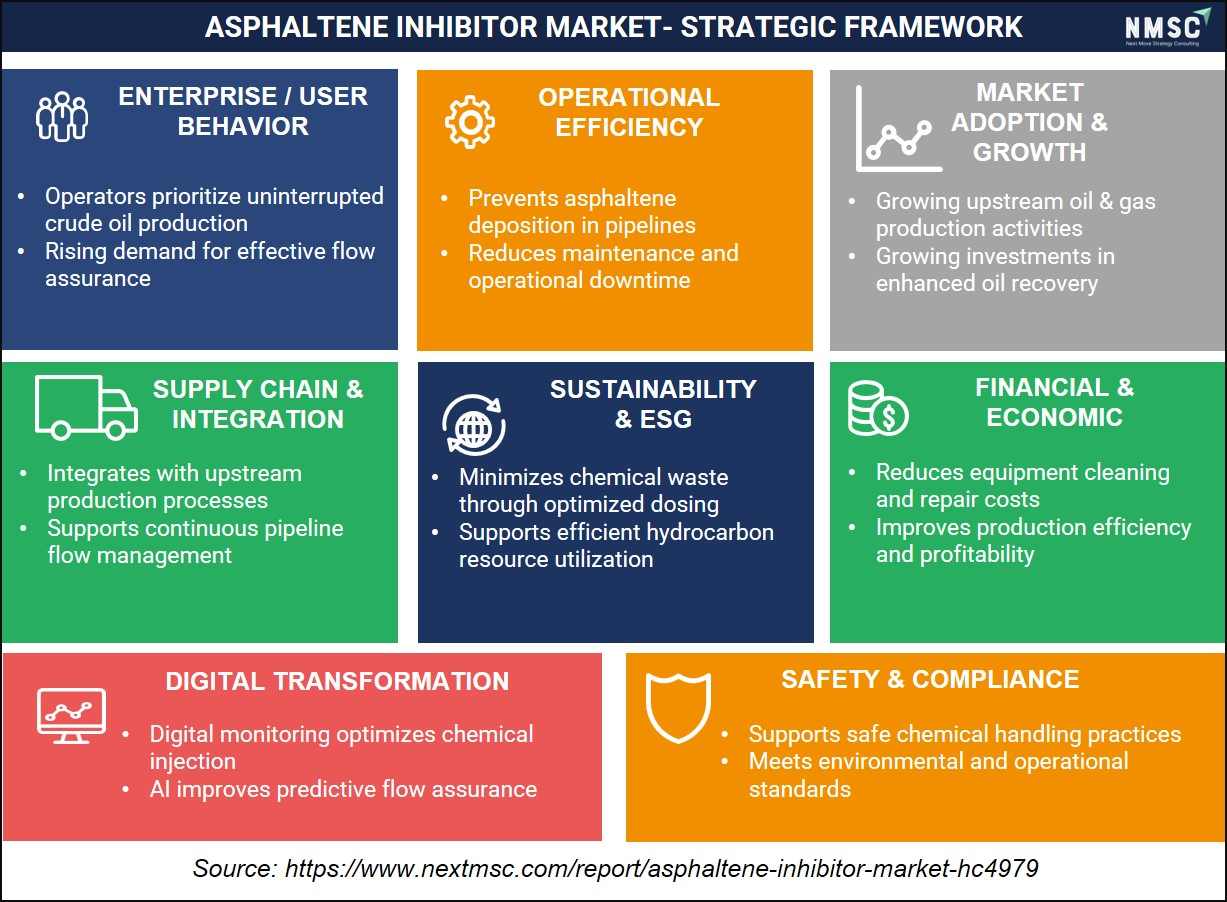
Based on our comprehensive assessment, we found that the asphaltene inhibitor market supports uninterrupted hydrocarbon production by preventing deposition and maintaining flow assurance. Rising oil and gas exploration activities drive adoption, while digital monitoring enhances treatment effectiveness. Operators benefit from reduced maintenance costs, improved production efficiency, and optimized asset performance. Sustainability objectives, regulatory compliance requirements, and predictive analytics further strengthen long-term market growth.
Competitive Landscape
Competitive Dynamics and M&A Landscape
|
Key Takeaways |
Details |
|
Market Structure |
Moderately consolidated; dominated by three global oilfield service majors (SLB, Halliburton, Baker Hughes) alongside a second tier of specialty chemical companies (BASF, Clariant, Dow, Arkema, Evonik, Nouryon). Regional and local suppliers serve price-sensitive onshore segments. |
|
Innovation Focus |
Hybrid inhibitor formulations, digital dosage optimization platforms, bio-based and OSPAR-compliant chemistries, high-pressure stable formulations for ultra-deep-water umbilical delivery, and real-time asphaltene onset pressure modeling integration. |
|
M&A Activity |
Strategic acquisitions of specialty oilfield chemistry businesses by service majors; consolidation of regional chemical distributors by mid-tier players; technology licensing agreements between inhibitor formulators and digital flow assurance platform providers. |
How Do Companies Compete in the Asphaltene Inhibitor Market?
The asphaltene inhibitor market is characterized by differentiated competitive dynamics across three strategic tiers. SLB, Halliburton, and Baker Hughes compete through fully integrated production chemistry service offerings that bundle asphaltene inhibitor supply with flow assurance engineering, real-time monitoring, and performance guarantees, enabling them to command premium pricing and establish long-term customer relationships with major operators. The second tier of specialty chemical companies including BASF, Clariant, Dow, Arkema, Evonik, and Nouryon competes primarily on formulation innovation, environmental compliance credentials, and technical service support for specific reservoir chemistries. Pricing strategies among service majors emphasize value-based models tied to measurable production uplift, while specialty chemical suppliers compete on formulation performance-per-cost ratios in competitive tender processes.
Which Kind of Companies Dominate the Asphaltene Inhibitor Market?
Our analysis shows that integrated oilfield service companies dominate the high-value deep-water and subsea segments of the asphaltene inhibitor market, leveraging their capabilities in flow assurance engineering, chemical formulation, and digital monitoring to capture full-service contracts. Specialty chemical manufacturers dominate the mid-market onshore and distributor-served segments, where technical specifications are standardized and price competition is more intense. National and regional chemical companies including Dorf Ketal Chemicals India, Imperial Oilfield Chemicals, Luoyang Pacific United Petrochemical, Deshi Energy Technology Group, and First Petrochemicals serve growing emerging market demand with cost-competitive formulations adapted to local crude chemistries and regulatory requirements.
AI-Native Differentiation and Digital Standards Drive Market Success in the Asphaltene Inhibitor Market
NMSC's analysis indicates that asphaltene inhibitor market leaders are increasingly differentiating through digital capabilities embedded within their service delivery models. Real-time asphaltene risk prediction algorithms, integrated with downhole pressure and temperature sensor data, enable dynamic inhibitor dosage adjustments that reduce chemical consumption by 15% to 25% without compromising flow assurance performance. SLB's digital production chemistry platforms and Halliburton's chemical management systems exemplify the integration of data analytics into asphaltene inhibitor program management. Vendors that can deliver both chemical expertise and digital optimization platforms are gaining structural competitive advantages that create switching cost barriers for major operator clients.
Market Players to Opt for Merger and Acquisition Strategies to Expand Their Presence in the Asphaltene Inhibitor Market
The asphaltene inhibitor market has been shaped by targeted mergers, acquisitions, and strategic partnerships that enable participants to broaden their product portfolio, access new geographic markets, and integrate digital capabilities into chemical service offerings. Major oilfield service companies have historically acquired specialty oilfield chemistry businesses to vertically integrate their production chemistry service lines. Specialty chemical majors have pursued strategic alliances with regional distributors and national oil company preferred vendors to strengthen their market positions in fast-growing MEA and APAC markets. Our findings suggest that M&A activity in the asphaltene inhibitor market will continue through 2035, driven by the strategic imperative to combine formulation expertise with digital monitoring capabilities and ESG-compliant product portfolios.
Who Are the Key Market Players in the Asphaltene Inhibitor Market?
-
SLB (Schlumberger Limited)
-
Halliburton Company
-
Baker Hughes Company
-
SNF S.A.S.
-
Clariant AG
-
BASF SE
-
Dow Inc.
-
Arkema S.A.
-
Nouryon Chemicals Holding B.V.
-
Evonik Industries AG
-
Innospec Inc.
-
The Lubrizol Corporation
-
Stepan Company
-
Dorf Ketal Chemicals India Private Limited
-
Croda International Plc
-
Vink Chemicals GmbH & Co. KG
-
Imperial Oilfield Chemicals Private Limited
-
Luoyang Pacific United Petrochemical Co., Ltd.
-
Deshi Energy Technology Group Co., Ltd.
-
First Petrochemicals L.L.C.
What Are the Latest Developments in the Asphaltene Inhibitor Industry?
|
Date |
Event |
|
May 2026 |
Following broader trends in offshore energy support, major service providers like Baker Hughes have expanded their integrated service contracts with partners such as Equinor (North Sea) and Petrobras (Brazil). These long-term agreements emphasize integrated chemical management, including advanced flow assurance and asphaltene deposition control in deepwater environments. |
|
May 2026 |
Dorf Ketal Chemicals India Private Limited acquired the water treatment business of Vasu Chemicals. This move marks a strategic diversification into high-value industrial water treatment, leveraging Dorf Ketal’s global specialty chemical footprint to scale integrated dosing and flow assurance solutions for global energy and industrial clients. |
What Are the Investment Opportunities in the Asphaltene Inhibitor Market?
Capital Inflows and Strategic Investment in Asphaltene Inhibitor Market Innovation
Capital inflows into the asphaltene inhibitor market are being directed toward formulation innovation, digital technology development, and geographic market expansion. Leading specialty chemical companies are allocating R&D budgets to develop hybrid and bio-based inhibitor formulations that address both technical performance and environmental regulatory requirements. From our research, we found that integrated oilfield service companies are investing in digital flow assurance platforms and sensor-integrated injection systems that create proprietary data advantages. Private equity investment in mid-tier oilfield chemistry companies is enabling technology bolt-on acquisitions that strengthen product portfolios and expand geographic reach across MEA and APAC growth markets.
Infrastructure Investments Supporting Asphaltene Inhibitor Market Expansion
Deepwater and ultra-deep-water production infrastructure investments globally are creating parallel demand for asphaltene inhibitor delivery infrastructure, including subsea chemical injection umbilicals, multi-service umbilical systems, and topside chemical storage and metering facilities. Petrobras's pre-salt production expansion, Saudi Aramco's offshore field development programs, and ADNOC's Abu Dhabi offshore expansion all involve significant chemical injection infrastructure capital expenditure that underpins long-term asphaltene inhibitor supply contracts. Through NMSC's assessment, we found that vendors securing preferred supplier status during field development planning phases capture 10- to 20-year chemical supply relationships that provide high revenue visibility across the forecast period.
ESG Considerations and Green Chemistry Investment in the Asphaltene Inhibitor Market
ESG investment frameworks are increasingly influencing capital allocation decisions within the asphaltene inhibitor market, driving investment toward environmentally preferred formulation development. Companies developing OSPAR-assessed, biodegradable, and low-ecotoxicity asphaltene inhibitor products are accessing preferential procurement pathways in European offshore and increasingly in international operations of ESG-committed international oil companies. Croda International, Nouryon, and BASF are investing in bio-based feedstock procurement, green chemistry synthesis processes, and environmental certification capabilities as commercial differentiators. Our analysis shows that ESG-aligned asphaltene inhibitor products are commanding premium pricing in regulated markets, providing a sustainable revenue uplift opportunity for environmentally focused market participants.
Digital Transformation Investment Opportunities in the Asphaltene Inhibitor Market
Digital transformation is creating a distinct investment opportunity layer within the asphaltene inhibitor market. Companies that invest in proprietary real-time asphaltene risk modeling software, downhole sensor data integration platforms, and AI-driven dosage optimization algorithms are creating defensible competitive moats beyond chemistry formulation alone. Our findings suggest that the integration of cloud-based production chemistry management platforms with operator digital oilfield systems represents a high-growth investment focus for leading asphaltene inhibitor service providers. These digital investments reduce chemical waste and intervention costs for operators while creating differentiated service value that is difficult for commodity chemical suppliers to replicate.
Private Equity and Venture Capital Activity in the Asphaltene Inhibitor Market
Private equity and venture capital activity within the broader oilfield chemistry market, which encompasses the asphaltene inhibitor segment, has been characterized by consolidation of mid-tier specialty chemical suppliers and investment in technology-enabled service businesses. PE investors have identified asphaltene inhibitor market participants as attractive targets given the non-discretionary nature of chemical programs in producing field operations, the long-term supply contract structures typical of integrated service arrangements, and the resilient demand profile of production chemistry relative to more capex-sensitive oilfield service segments. Emerging market-focused specialty chemical distributors serving MEA and APAC asphaltene inhibitor demand are attracting growth equity investment to finance geographic expansion and supply chain infrastructure development.
Key Benefits for Stakeholders
For Oil and Gas Operators
Oil and gas operators gain comprehensive insights into the Asphaltene Inhibitors Market, including technology adoption trends, treatment methodologies, formulation advancements, and regional demand patterns. The report supports informed decision-making regarding flow assurance strategies, production optimization initiatives, and chemical management programs across offshore and onshore operations. Detailed analysis of inhibitor technologies and service models enables operators to improve production reliability, reduce unplanned downtime, optimize chemical dosage requirements, and enhance overall asset performance while minimizing operational risks associated with asphaltene deposition.
For Chemical Manufacturers and Formulators
Chemical manufacturers and formulators benefit from detailed market sizing, growth forecasts, competitive intelligence, and emerging formulation technology trends across the Asphaltene Inhibitors Market. The report provides visibility into demand patterns, customer requirements, and evolving environmental considerations, supporting research and development prioritization as well as product portfolio expansion strategies. Insights into bio-based formulations, advanced polymer technologies, and sustainable chemistry trends further help manufacturers align innovation efforts with future market requirements and regulatory expectations.
For Oilfield Service Companies
Oilfield service providers gain actionable intelligence regarding customer adoption trends, regional growth opportunities, competitive positioning, and evolving service delivery models within the Asphaltene Inhibitors Market. The analysis highlights opportunities across integrated production chemistry services, digital monitoring solutions, and performance optimization programs, enabling service companies to strengthen market positioning and expand value-added offerings. Regional assessments further support geographic expansion planning, partnership development, and strategic investment decisions across major oil and gas producing regions.
For Investors and Private Equity Firms
Investors, private equity sponsors, and financial institutions gain access to a structured assessment of the Asphaltene Inhibitors Market’s growth outlook, competitive landscape, and long-term revenue opportunities through 2035. Detailed market forecasts, CAGR analysis, segment-level insights, and regional outlooks support investment screening, valuation modeling, and portfolio development activities. Competitive benchmarking and industry trend analysis provide visibility into consolidation opportunities, emerging market leaders, and attractive investment themes across production chemistry and specialty oilfield chemical markets.
For Regulators and Industry Bodies
Government agencies, regulatory authorities, and industry organizations gain a structured understanding of market trends, chemical technology developments, and environmental considerations shaping the Asphaltene Inhibitors Market. The report provides insights into evolving industry practices, sustainability initiatives, and regulatory influences affecting production chemistry applications. These findings support evidence-based policy development, offshore chemical assessment programs, environmental compliance frameworks, and industry best-practice initiatives aimed at improving operational safety and environmental stewardship.
For Raw Material Suppliers
Raw material suppliers gain valuable visibility into downstream demand trends for specialty chemicals, polymers, solvents, surfactants, fatty acid derivatives, aromatic compounds, and bio-based feedstocks utilized in asphaltene inhibitor production. The report helps suppliers anticipate evolving formulation requirements, identify emerging growth opportunities, and align production planning with future market demand. Regional demand assessments further support supply chain optimization and strategic sourcing initiatives across global oilfield chemical value chains.
For Logistics and Distribution Companies
Logistics providers, chemical distributors, and supply chain operators benefit from detailed analysis of regional demand patterns, production activity trends, and supply chain structures within the Asphaltene Inhibitors Market. The report supports distribution network planning, inventory management strategies, and infrastructure investment decisions by identifying high-growth markets and evolving customer requirements. Geographic market intelligence further enables logistics organizations to optimize service coverage and strengthen support capabilities across key oil and gas producing regions worldwide.
Key Market Segments
By Product Type
-
Polymeric Inhibitor
-
Alkylphenol Formaldehyde Resin
-
Polyolefin Based
-
Polyester Based
-
Other Polymeric Inhibitor
-
-
Dispersant Inhibitor
-
Fatty Acid Ester and Amide
-
Sulfonate Based Surfactant
-
Alkoxylate Non-ionic Dispersant
-
Other Dispersant Inhibitor
-
-
Solvent Inhibitor
-
Aromatic Solvent
-
Aliphatic Solvent
-
Mixed Solvent Package
-
-
Hybrid Inhibitor
-
Polymeric Dispersant Blend
-
Polymer Solvent Blend
-
Dispersant Solvent Blend
-
Other Hybrid Inhibitor
-
-
Bio-Based Inhibitor
-
Plant Derived
-
Biosurfactant Based
-
Other Bio-Based Inhibitor
-
By Application Location
-
Reservoir
-
Wellbore
-
Subsea Equipment
-
Topside Facility
-
Transport and Storage
By Application Method
-
Continuous Injection
-
Batch Treatment
-
Squeeze Treatment
-
Off-Line Treatment
By Distribution Channel
-
Direct Sales
-
Distributor
-
Integrated Service Contract
-
Private Label
By Customer Type
-
National Oil Company
-
Independent Operator
-
Oilfield Service Company
-
Midstream Operator
By Region
-
North America: U.S., Canada, and Mexico
-
Europe: UK, Germany, France, Italy, Spain, Sweden, Denmark, Finland, the Netherlands, and the Rest of Europe
-
Asia Pacific: China, India, Japan, South Korea, Taiwan, Indonesia, Vietnam, Australia, Philippines, Malaysia, and the Rest of APAC
-
Middle East and Africa (MEA): Saudi Arabia, UAE, Egypt, Israel, Turkey, Nigeria, South Africa, and the Rest of MEA
-
Latin America: Brazil, Argentina, Chile, Colombia, and the Rest of LATAM
Conclusion and Recommendations
Long-Term Outlook for the Asphaltene Inhibitor Market
The asphaltene inhibitor market is positioned for steady and sustained growth through 2035, supported by the structural continuity of global crude oil production from asphaltene-prone reservoirs in the Middle East, deep-water basins, unconventional tight oil plays, and emerging market offshore developments. NMSC's analysis indicates that despite energy transition pressures, the hydrocarbon production base supporting asphaltene inhibitor demand remains robust across the forecast period, with global crude production sustained by OPEC+ policy, national oil company investment, and the long production life cycles of existing deep-water and mature field assets. The market's CAGR of 4.6% from 2026 to 2035 reflects a blend of stable base demand growth and premium expansion driven by deepwater and digital service model adoption.
Strategic Positioning in the Asphaltene Inhibitor Market
Market participants seeking to strengthen strategic positioning in the asphaltene inhibitor market should prioritize investment across three dimensions. First, formulation innovation toward hybrid and bio-based asphaltene inhibitor chemistries that meet evolving ESG and regulatory requirements while delivering superior performance in deepwater and high-asphaltene-content crude environments. Second, digital service capability development that enables real-time asphaltene risk monitoring, automated dosage optimization, and performance-guarantee service contract delivery. Third, geographic expansion into high-growth MEA and APAC markets through preferred supplier agreements with national oil companies, distributor partnerships, and localized manufacturing or blending capabilities that reduce supply chain costs and improve market responsiveness.
Investment Attractiveness Assessment of the Asphaltene Inhibitor Market
The asphaltene inhibitor market offers attractive risk-adjusted investment characteristics relative to broader oilfield services and chemical market segments. The non-discretionary nature of asphaltene management in producing oil fields, the long-term supply contract structures typical of integrated service arrangements, and the recurring revenue profile of chemical consumption programs provide investment return predictability. Our assessment indicates that the specialty chemical segment of the asphaltene inhibitor market, particularly companies with differentiated hybrid formulation capabilities and established national oil company preferred supplier relationships in MEA and APAC, presents the most attractive long-term investment thesis within the market.
Market Shifts and Key Risks in the Asphaltene Inhibitor Market
Key structural shifts and risks that will shape the asphaltene inhibitor market through 2035 include accelerating energy transition policy that may reduce long-cycle upstream capital commitments by international oil companies, crude oil price volatility that continues to create capex cycle risk for production chemistry budgets, regulatory tightening on aromatic solvent formulations that require reformulation investment, and the potential market disruption associated with nanotechnology-based or ionic liquid asphaltene inhibitor technologies that could challenge conventional polymer and dispersant chemistries. Vendors that proactively address these risk factors through balanced portfolio strategies, diversified geographic exposure, and continuous formulation innovation are best positioned for long-term market leadership.
Growth Pathways for the Asphaltene Inhibitor Market Through 2035
The primary growth pathways for the asphaltene inhibitor market through 2035 include expansion in deepwater and ultra-deepwater chemical injection programs as new tieback developments are brought on-stream globally, growth of integrated service contract revenue models that command premium pricing and create long-term customer relationships, adoption of hybrid and bio-based asphaltene inhibitor formulations that open new market access in ESG-regulated offshore jurisdictions, expansion into emerging APAC and African upstream markets where asphaltene-sensitive reservoir development is accelerating, and the incremental demand from mature field life extension programs in North America, the North Sea, and the Middle East where production chemistry optimization supports incremental production economics.
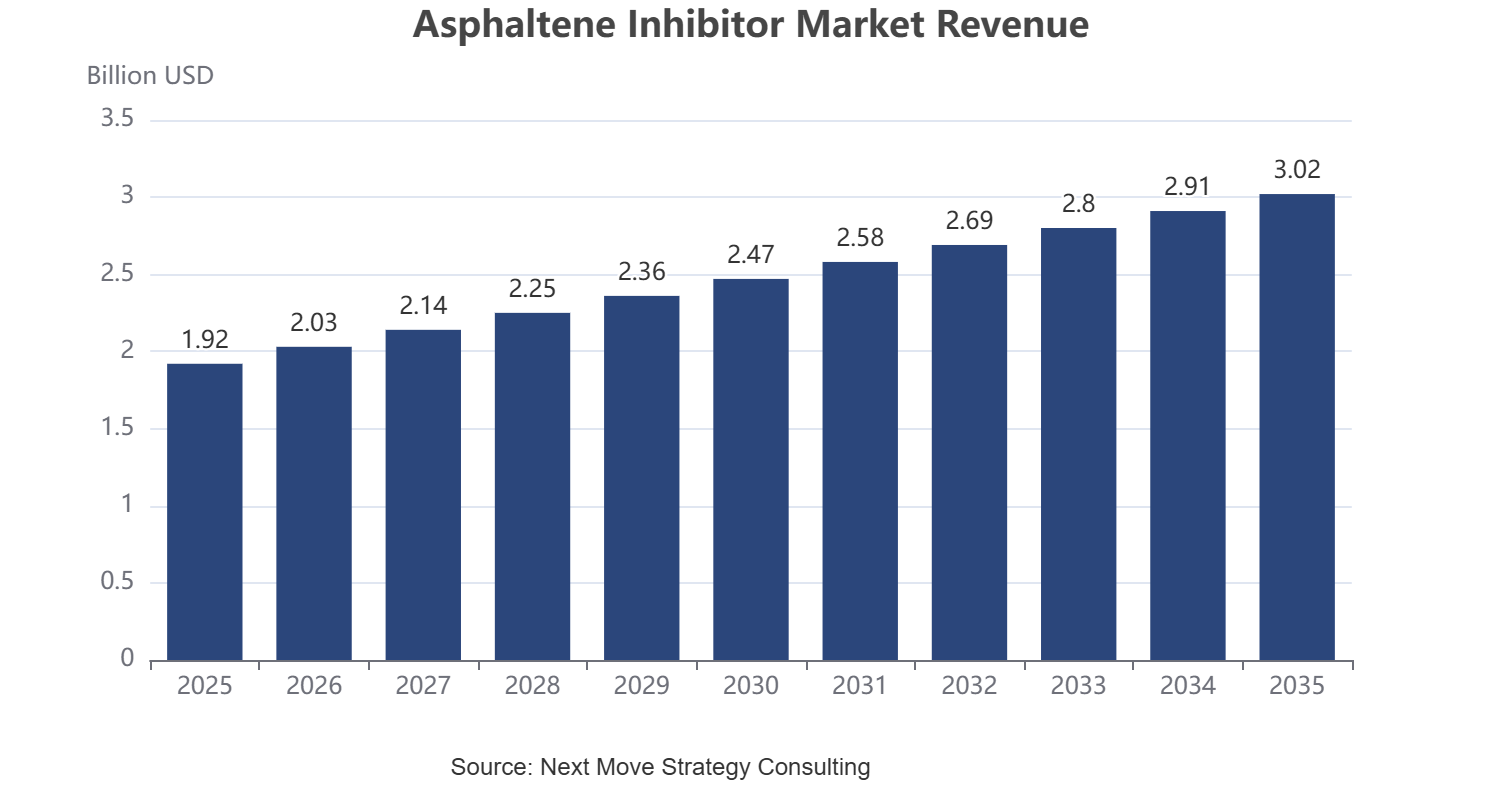
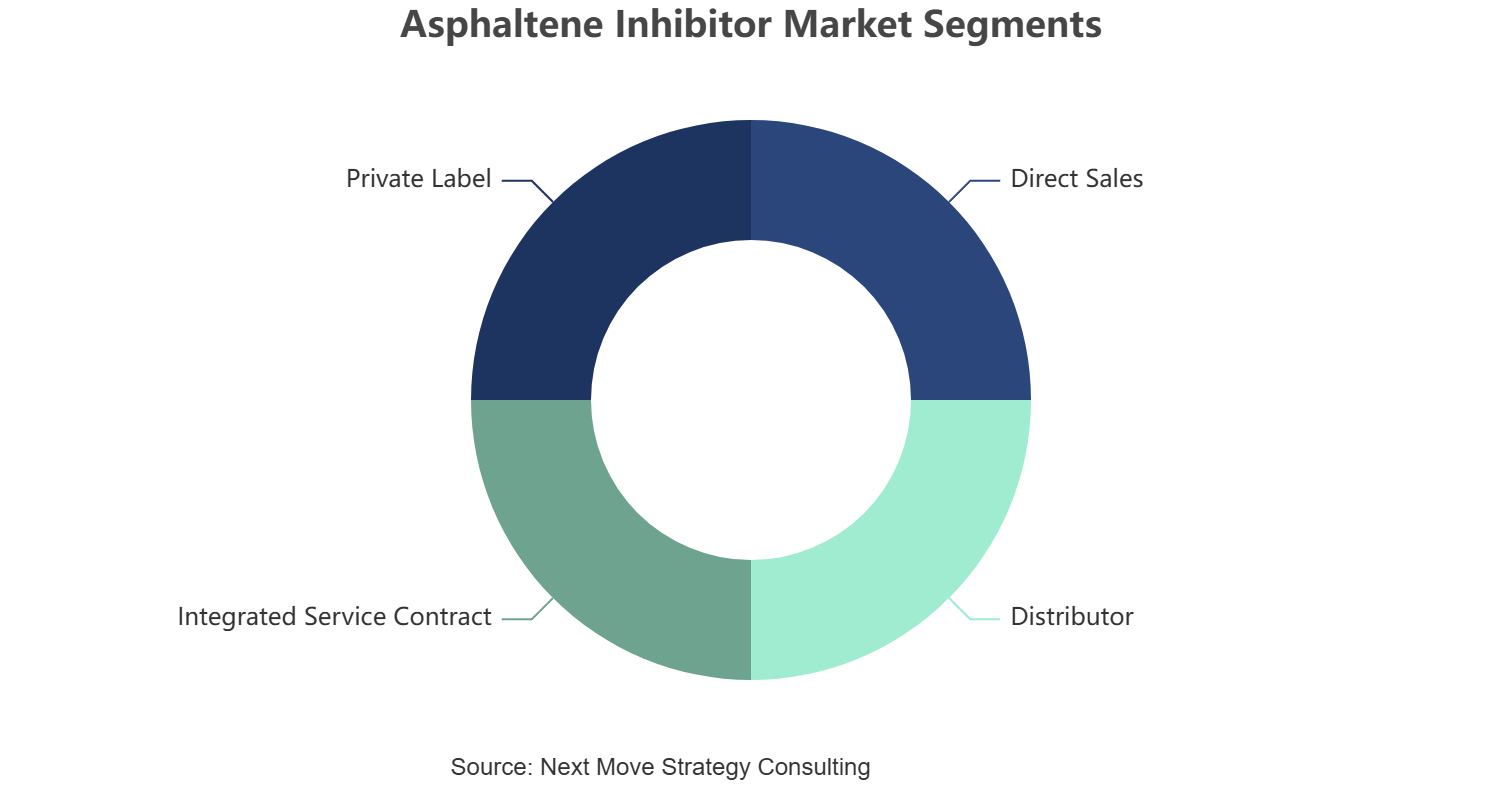
About the Author
 Saista Faiyaz
— Saista Faiyaz is Research Associate at Next Move Strategy Consulting, where she has covered consumer markets and healthcare technologies for 3 years. Her work includes primary interview review, secondary-source validation, market sizing, and structured analysis of company and industry data. She supports research by comparing evidence across sources, organizing findings into market narratives, and documenting assumptions used in analysis. Her scope includes cross-market benchmarking, and reports.
Saista Faiyaz
— Saista Faiyaz is Research Associate at Next Move Strategy Consulting, where she has covered consumer markets and healthcare technologies for 3 years. Her work includes primary interview review, secondary-source validation, market sizing, and structured analysis of company and industry data. She supports research by comparing evidence across sources, organizing findings into market narratives, and documenting assumptions used in analysis. Her scope includes cross-market benchmarking, and reports.
About the Reviewer
 Supradip Baul
— Supradip Baul is an accomplished business consultant and strategist with over a decade of rich experience in market intelligence, strategy, technology, and business transformation. His work has included rigorous qualitative and quantitative analysis across multiple industries, helping clients shape investment decisions and long-term roadmaps. Earlier in his career, he was associated with Gartner, where he contributed to industry-leading reports and market share analyses. He has worked with leading global companies and holds an MBA with a dual specialization in Marketing and Finance.
Supradip Baul
— Supradip Baul is an accomplished business consultant and strategist with over a decade of rich experience in market intelligence, strategy, technology, and business transformation. His work has included rigorous qualitative and quantitative analysis across multiple industries, helping clients shape investment decisions and long-term roadmaps. Earlier in his career, he was associated with Gartner, where he contributed to industry-leading reports and market share analyses. He has worked with leading global companies and holds an MBA with a dual specialization in Marketing and Finance.
At Next Move Strategy Consulting, we understand that insightful market research is the cornerstone of successful business decisions. That's why we employ a robust and multifaceted approach, combining various methodologies to deliver the most accurate and actionable data for our clients.

Research Landscape
We navigate the world of research with two primary approaches:
Qualitative Approach
Our qualitative research methodologies involve immersive techniques such as in-depth interviews, focus groups, and observational studies. By engaging directly with individuals and stakeholders, we uncover valuable insights that quantitative data alone may overlook.

Quantitative Research
In tandem with qualitative methodologies, NMSC leverages the power of Quantitative Research to provide a robust foundation of numerical insights. Through systematic data collection and analysis, we quantify patterns, preferences, and market trends, offering a comprehensive view of the business landscape.
Our quantitative research approach employs diverse tools, including surveys, experiments, and statistical modelling. These methodologies enable us to gather data from a large and representative sample, ensuring the statistical significance of our findings. By employing structured questionnaires and standardized data collection methods, we guarantee the reliability and validity of the information we present to our clients.
Quantitative research is particularly effective in measuring the prevalence of trends, assessing market size, and gauging the impact of various factors on consumer behavior. The numerical precision attained through this approach equips our clients with actionable insights, facilitating data-driven decision-making and strategy formulation.


Our Specialized Toolbox for Industry-Specific Market Research
We deploy a specialized arsenal of techniques tailored to meet your unique requirements. Here's a glimpse into our comprehensive toolbox:

Information Procurement
The stage entails acquiring market data or relevant information through various sources and methodologies.


Market Research Approach
We utilize both top-down and bottom-up approaches in market research analysis to achieve a comprehensive understanding of the market dynamics, leveraging the broad perspective of industry trends and macroeconomic factors alongside detailed insights from specific segments and individual companies.

Porters Five Forces Analysis
We conduct Porter's Five Forces analysis to evaluate the competitive landscape of an industry, providing us with insights into factors that affect profitability and strategic positioning.

SWOT Analysis

Forecasting
We utilize a forecasting model to predict future consumption by considering parameters like population, economics, regulations, market competition, drivers, constraints, technology, and pricing. We also employ statistical techniques such as multilinear regression, exponential smoothing, moving average, ARIMA, and Monte Carlo simulations for accurate predictions. In econometric forecasting, we analyzed short-term and long-term event impacts, attributing values based on regulatory frameworks, economic factors, and market events.





 Speak to Our Analyst