Germany Liquid Cooled EV Charging Cable Market, By Product Type (Integrated & Detachable Cable Assemblies), By Compatibility (Open Standard & OEM-Proprietary Locked), By Power Rating (400 to 599 A, 600 to 799 A, & ≥ 800 A), By Connector Standard (CCS1, CCS2, GB/T DC, CHAdeMO, & Others), By End Use (Public Charging, Commercial Fleet Charging, & Others), and By Buyer Type (Charging Network Operators, Charging Equipment OEMs, Automotive OEMs, & Others) – Analysis & Forecast, 2025–2035
Industry: Automotive & Transportation | Latest Edition: September 30, 2026 | No of Pages: 244 | No. of Tables: 122 | No. of Figures: 108 | Format: PDF | Report Code: AT5384
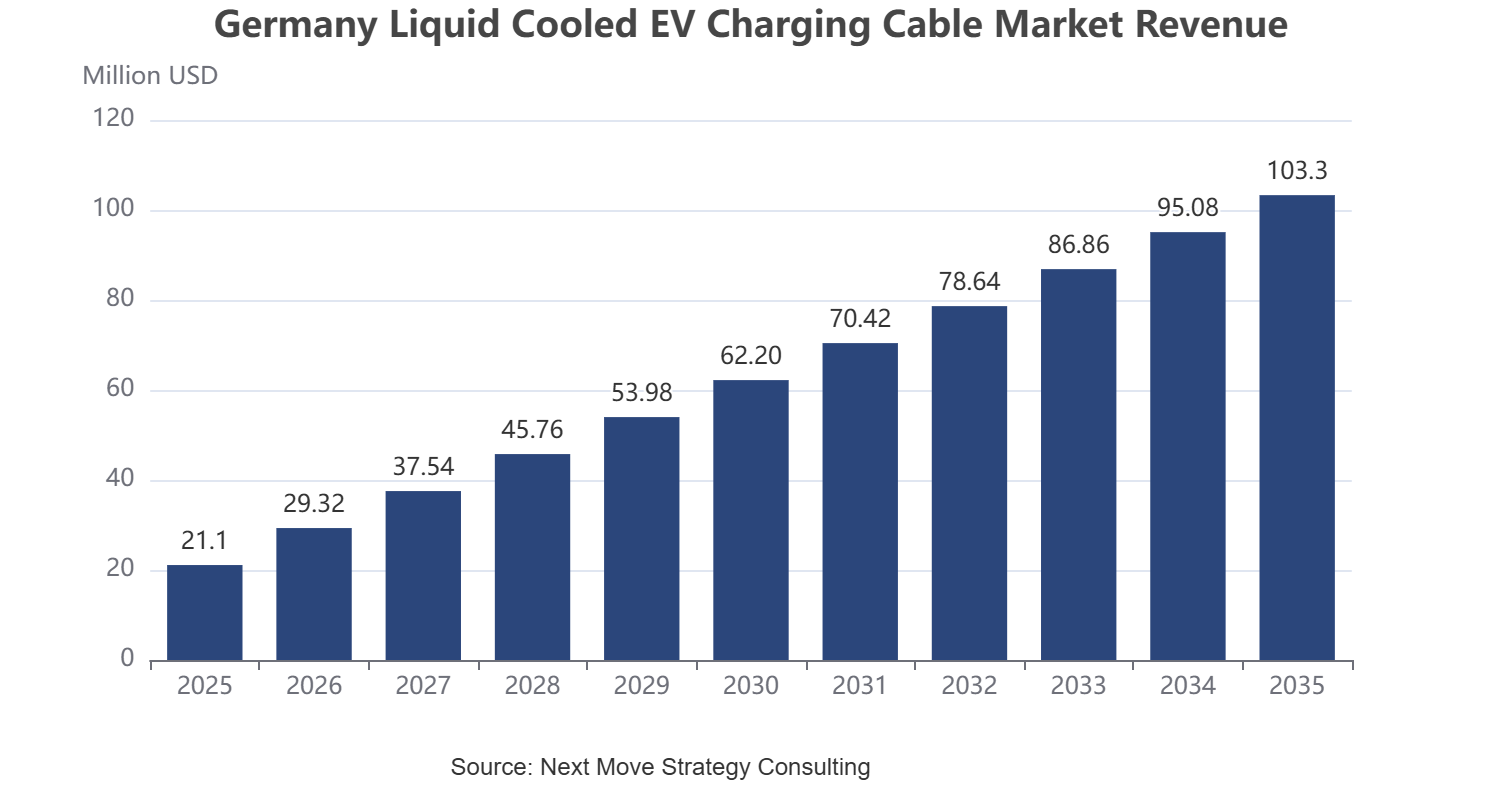
Germany Liquid Cooled EV Charging Cable Market Size & Forecast
|
Parameters |
Details |
|
Market Size in 2025 |
USD 21.1 million |
|
Market Size in 2026 |
USD 29.1 million |
|
Revenue Forecast in 2035 |
USD 103.3 million |
|
Growth Rate |
CAGR of 15.1% from 2026 to 2035 |
|
Market Volume in 2025 |
9,909 units |
|
Market Volume in 2026 |
14,101 units |
|
Volume Forecast in 2035 |
63,692 units |
|
Growth Rate |
CAGR of 18.2% from 2026 to 2035 |
|
Analysis Period |
2025–2035 |
|
Base Year Considered |
2025 |
|
Forecast Period |
2026–2035 |
|
Market Size Estimation |
Million (USD) |
|
Companies Profiled |
15 |
|
Market Share |
Available for 10 companies |
Industry Outlook
The Germany Liquid Cooled EV Charging Cable Market was valued at USD 21.1 million in 2025 and is anticipated to reach USD 29.1 million by the end of 2026. The market is projected to sustain robust expansion, achieving USD 103.3 million by 2035, driven by a revenue CAGR of 15.1% between 2026 and 2035. In volume terms, the market recorded 9,909 units in 2025, with projections indicating growth to 14,101 units by 2026 and further to 63,692 units by 2035, reflecting a volume CAGR of 18.2% over the same forecast period.
Ecosystem Analysis of the Germany Liquid Cooled EV Charging Cable Market
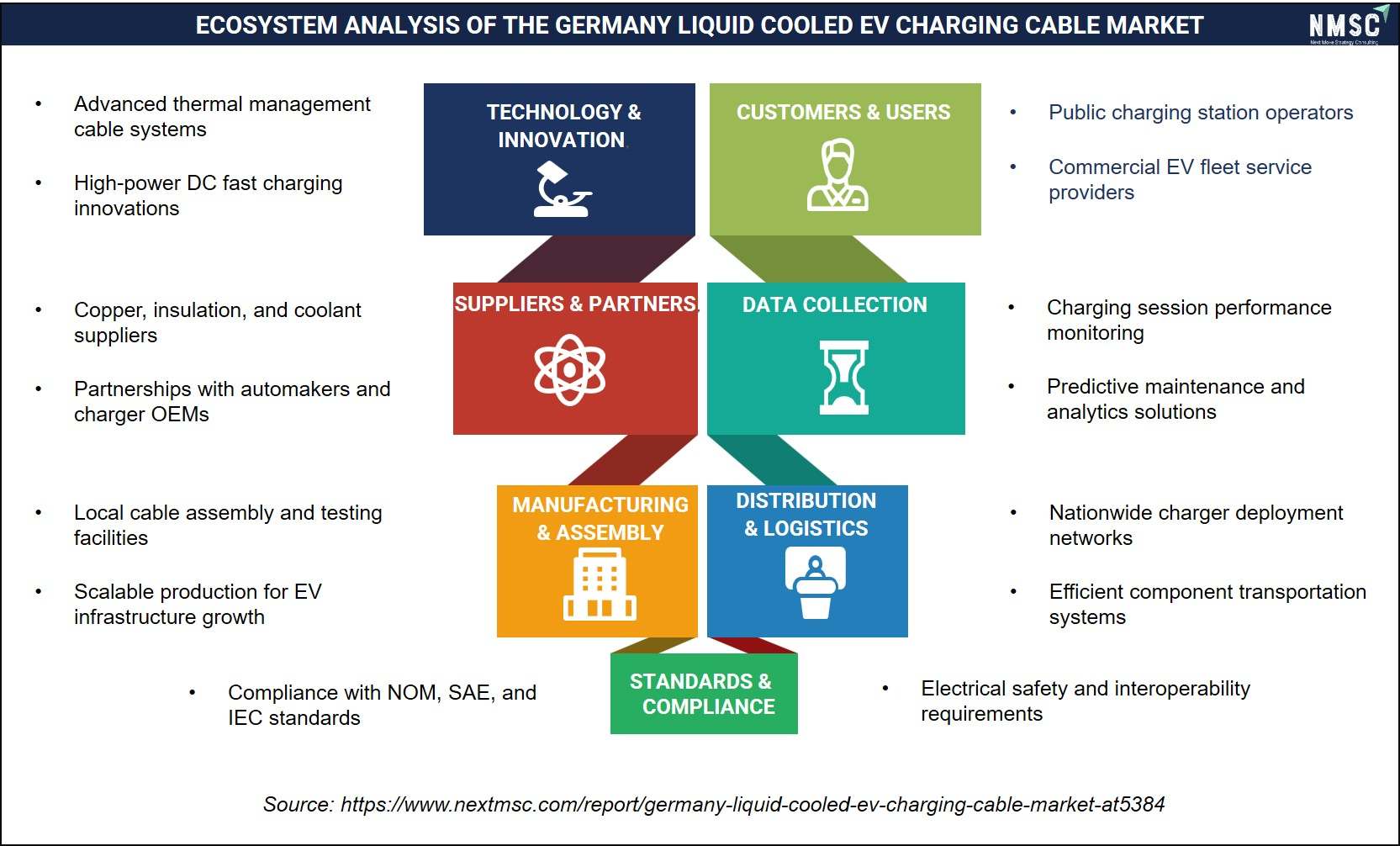
The above infographic presents an ecosystem analysis of the Germany liquid-cooled EV charging cable market, illustrating the interconnected stakeholders and value chain components that support industry development. The framework highlights the roles of technology and innovation, suppliers, manufacturing and assembly, distribution networks, data management, customers and end users, and standards and compliance requirements. Together, these elements provide insights into the collaborative ecosystem driving product innovation, supply chain efficiency, regulatory adherence, and the expansion of Germany’s high-power EV charging infrastructure.
What are the Key Market Drivers, Restraints, and Opportunities that will Shape the Germany Liquid Cooled EV Charging Cable Industry in the Next Decade?
Growth Catalyst & Risk Assessment Matrix
|
Drivers / Trends / Restraints |
(+/-) % Impact on CAGR Forecast |
Geographic Relevance |
Impact Timeline |
|
Germany's advanced automotive OEM ecosystem accelerating 800V platform adoption and high-power charging infrastructure deployment at scale |
+5.02% |
Bavaria, Baden-Württemberg, Lower Saxony (primary OEM and Tier-1 clusters) |
Medium to Long term (3–6 years) |
|
Aggressive national and EU-backed public fast charging network expansion mandates driving procurement of thermally managed cable assemblies |
+4.58% |
Nationwide, with concentration in urban agglomerations and Autobahn corridors |
Medium term (2–5 years) |
|
Large-scale commercial fleet and logistics electrification programs at major depot and distribution hubs increasing recurring cable demand |
+4.11% |
North Rhine-Westphalia, Hamburg, Bayern (logistics and fleet electrification leaders) |
Medium to Long term (3–6 years) |
|
Energy cost volatility and grid infrastructure constraints in certain regions slowing ultra-fast charging station rollout |
-3.52% |
Eastern Germany (grid modernisation gaps), rural regions nationwide |
Short to Medium term (1–4 years) |
|
Heavy-duty truck corridor and freight electrification initiatives under EU Green Deal creating demand for MCS-compatible high-amperage liquid-cooled cables |
+3.87% |
Rhine-Ruhr corridor, A1 and A9 Autobahn freight routes (primary TEN-T corridors) |
Long term (4–8 years) |
The Germany Liquid Cooled EV Charging Cable Market is positioned at the convergence of Europe's most advanced automotive engineering ecosystem, stringent EU climate policy mandates, and a rapidly expanding high-power public and commercial charging infrastructure base. Our analysis indicates that Germany's established OEM platform transition toward 800V architectures and Megawatt Charging System compatibility is the primary structural driver elevating demand for liquid-cooled cable technology. Simultaneously, energy transition pressures, fleet electrification mandates, and EU-wide charging infrastructure directives collectively reinforce a multi-channel, policy-supported demand environment that underpins the market's sustained double-digit growth trajectory.
Growth Drivers:
How is Germany's Automotive OEM Ecosystem Driving Adoption of High-Power Liquid Cooled Charging Cable Technologies?
Germany's position as the global headquarters for leading automotive OEMs and their Tier-1 supplier networks is the most decisive structural driver for liquid-cooled EV charging cable adoption in the country. The accelerating transition of OEM platforms toward 800V high-voltage architectures, ultra-fast DC charging compatibility, and Megawatt Charging System integration is directly elevating specifications for thermally managed cable assemblies across public charging, fleet depot, and automotive test infrastructure environments. Furthermore, OEM procurement cycles are embedding liquid-cooled cable standards into next-generation vehicle charging ecosystem requirements, creating sustained and contract-driven demand anchored in Bavaria, Baden-Württemberg, and Lower Saxony's automotive manufacturing and R&D clusters.
How are EU and National Charging Infrastructure Mandates Accelerating Demand for Liquid Cooled Cables in Germany?
The European Alternative Fuels Infrastructure Regulation and Germany's national charging infrastructure expansion programs are compelling charging network operators and infrastructure developers to deploy high-power fast charging stations at scale across urban centres, retail destinations, and Autobahn corridors. These regulatory mandates specifically target high-power output thresholds that necessitate liquid-cooled cable solutions to maintain safe and reliable performance under sustained load conditions. Our assessment confirms that compliance-driven procurement is creating structured, recurring cable demand across all major charging operator and infrastructure developer buyer segments, with public fast charging hubs representing the highest-volume application channel in the near-to-medium term forecast horizon.
How is Commercial Fleet and Logistics Electrification Generating Recurring Demand for Liquid Cooled Charging Solutions in Germany?
Germany's large commercial vehicle fleet base, encompassing logistics operators, last-mile delivery networks, municipal transit systems, and ride-hailing fleets, is undergoing accelerated electrification underpinned by EU fleet emission standards and national sustainability commitments. Depot charging installations at major logistics and distribution hubs across North Rhine-Westphalia, Hamburg, and Bavaria require high-throughput, thermally managed cable assemblies capable of delivering fast charge cycles across large vehicle inventories with minimal degradation. Additionally, transit and bus depot electrification programs in major German cities are generating procurement for durable, high-amperage liquid-cooled cable solutions engineered for intensive duty cycles and long operational lifespans.
Growth Inhibitor:
How are Energy Cost Volatility and Grid Infrastructure Constraints Limiting Market Expansion in Germany?
Elevated industrial energy costs and grid infrastructure limitations in parts of eastern Germany and rural regions represent a meaningful structural constraint on the pace of ultra-fast charging station deployment across the country. High energy procurement costs reduce the economic viability of operating high-power charging stations at commercially sustainable utilisation rates, dampening investment confidence among charging network operators in secondary markets. Additionally, grid reinforcement requirements for high-power charging installations in areas with limited distribution capacity involve lengthy planning and approval cycles that delay project timelines. These factors collectively moderate the speed of liquid-cooled cable procurement outside Germany's primary urban and highway infrastructure corridors.
Growth Opportunity:
How is Heavy-Duty Truck Corridor and Freight Electrification Creating Strategic Opportunities for MCS-Compatible Liquid Cooled Cables in Germany?
The progressive electrification of heavy-duty freight transport along Germany's core Autobahn and TEN-T logistics corridors, underpinned by EU Green Deal commitments and national hydrogen and e-mobility strategy frameworks, represents a high-specification, high-value growth opportunity for liquid cooled EV charging cable manufacturers. Megawatt Charging System installations at truck corridor charging hubs require cables engineered for extreme amperage ratings, thermal durability, and continuous operational reliability under commercial freight duty cycles. Germany's central position within European freight logistics networks positions it as the primary deployment market for MCS-compatible liquid-cooled cable infrastructure, offering manufacturers early-mover advantage in a premium and rapidly scaling application segment.
How is the Germany Liquid Cooled EV Charging Cable Market Segmented in this Report, and What are the Key Insights from the Segmentation Analysis?
By Connector Standard Insights
How does the Connector Standard Segmentation Reflect Technology Priorities in the Germany Liquid Cooled EV Charging Cable Market?
Based on connector standard, the Germany Liquid Cooled EV Charging Cable Market is segmented into CCS1, CCS2, GB/T DC, CHAdeMO, NACS, MCS, and ChaoJi.
Connector standard segmentation in Germany reveals a market strongly aligned with CCS2 as the dominant open standard, reflecting the European automotive OEM ecosystem's standardisation on Combined Charging System Type 2 across all major passenger and commercial EV platforms. MCS is emerging as the critical growth connector for heavy-duty truck corridor and port charging applications, representing a high-value, specification-intensive demand channel. NACS adoption is growing incrementally through international EV brands entering the European market. CHAdeMO penetration is declining as legacy installations are replaced, while ChaoJi and GB/T DC standards are gaining minor but increasing relevance through Chinese EV brand market entry into Germany.
By End Use Insights
How do End Use Segments Define Demand Concentration in the Germany Liquid Cooled EV Charging Cable Market?
Based on end use, the Germany Liquid Cooled EV Charging Cable Market is segmented into Public Charging, Commercial Fleet Charging, Heavy Duty Charging, and Mobile Charging.
End use segmentation highlights that Germany's liquid cooled cable demand is driven by parallel growth across multiple high-power charging categories simultaneously. Public fast charging hubs along Autobahn corridors and in major urban centres constitute the primary volume channel, supported by EU infrastructure mandates and charging network operator investment. Commercial fleet charging at logistics and transit depots represents a growing structural demand layer reinforced by fleet emission compliance requirements. Heavy-duty charging at truck corridors and port facilities is the highest-specification emerging segment, while mobile charging solutions provide flexible deployment capacity for temporary infrastructure and emergency backup applications across the country.
Strategic Analysis of the Germany Liquid Cooled EV Charging Cable Market
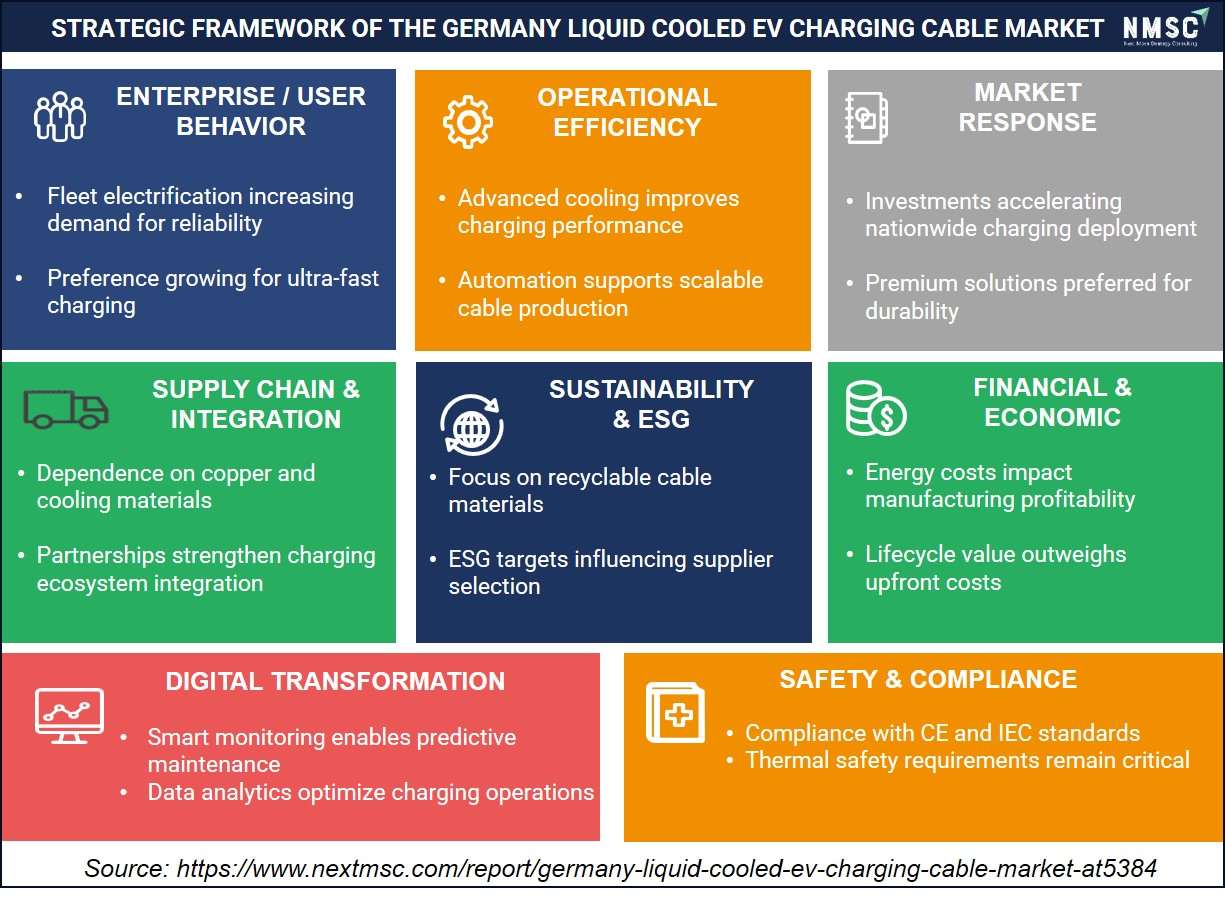
The above infographic presents a strategic framework of the Germany liquid-cooled EV charging cable market. Fleet electrification is increasing demand for reliability and ultra-fast charging, which is supported by advanced cooling that improves performance and automation that enables scalable production. Investments are accelerating nationwide deployment, though supply chains remain dependent on copper and cooling materials. At the same time, sustainability goals are driving demand for recyclable materials, and lifecycle value is increasingly prioritized over upfront costs. Looking ahead, we observed that smart monitoring and data analytics are enabling predictive maintenance, while compliance with CE and IEC standards and thermal safety requirements remain foundational to market operations.
Key Segments
By Product Type
-
Integrated Cable Assemblies
-
Fixed Length
-
Retractable
-
-
Detachable Cable Assemblies
By Compatibility
-
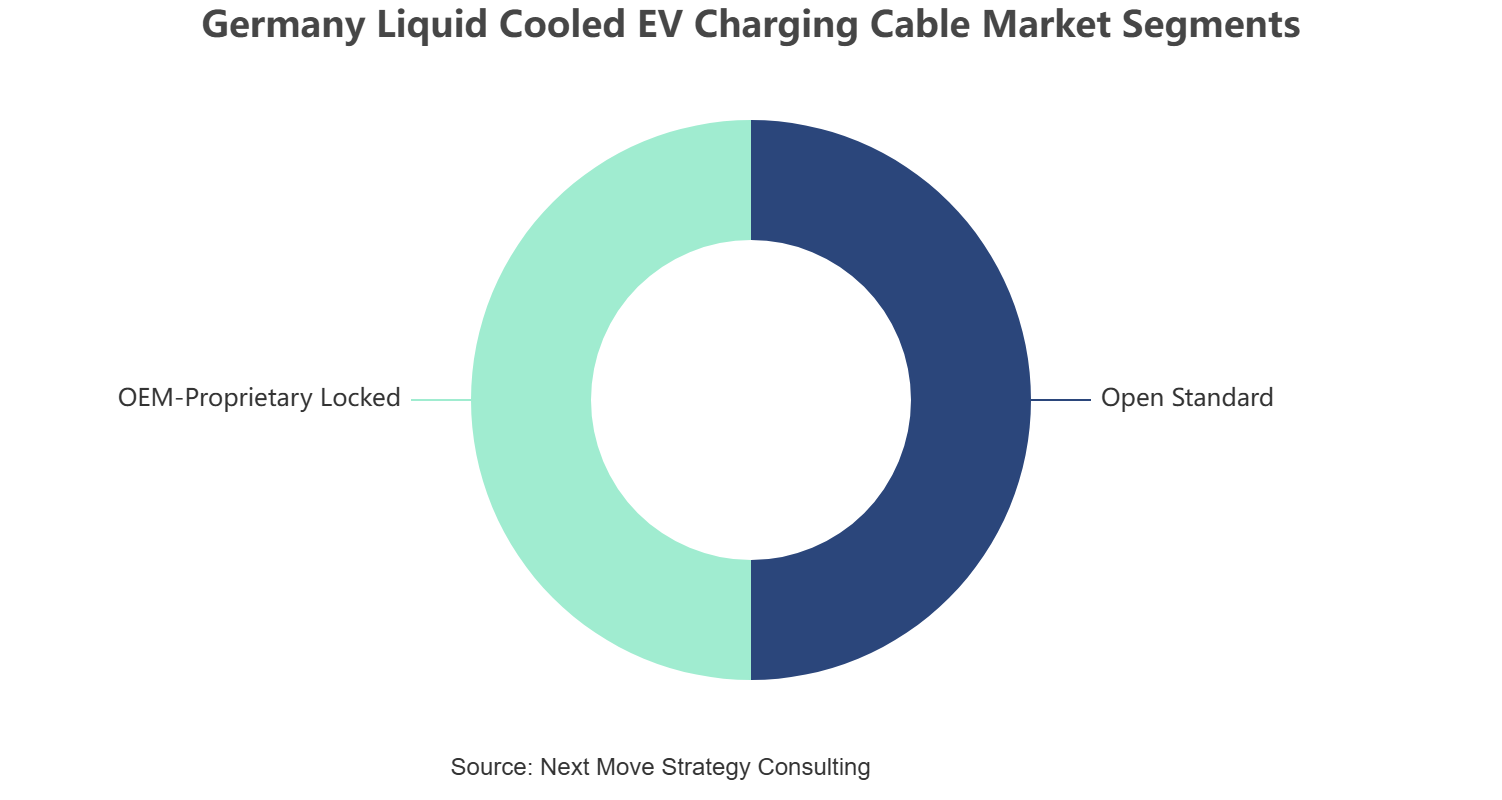
Open Standard
-
OEM-Proprietary Locked
By Power Rating
-
400 to 599 A
-
600 to 799 A
-
≥ 800 A
By Voltage Class
-
400V Systems
-
800V Systems
-
≥ 1,000V Systems
By Connector Standard
-
CCS1
-
CCS2
-
GB/T DC
-
CHAdeMO
-
NACS
-
MCS
-
ChaoJi
By End Use
-
Public Charging
-
Public Fast Charging Hubs
-
Retail and Destination Charging
-
Workplace Charging
-
High-Performance Residential Charging
-
-
Commercial Fleet Charging
-
Fleet Depots
-
Logistics and Last Mile Depots
-
Transit and Bus Depots
-
Ride Hailing and Taxi Depots
-
-
Heavy Duty Charging
-
Truck Corridor Charging
-
Mining and Off Highway Charging
-
Marine and Port Charging
-
Aviation and Ground Support Charging
-
-
Mobile Charging
-
Mobile Charging Units
-
Temporary Charging Sites
-
Emergency Backup Charging
-
By Buyer Type
-
Charging Network Operators
-
Charging Equipment OEMs
-
Automotive OEMs
-
Fleet Operators
-
Infrastructure Developers
-
EPC Companies
Competitive Landscape
The competitive landscape of the Germany Liquid Cooled EV Charging Cable Market is defined by a highly concentrated ecosystem of globally recognised connector, cable, and interconnect technology specialists, many of which maintain their primary engineering, manufacturing, and R&D operations within Germany itself. Competition is anchored in deep application expertise across CCS2 and MCS connector standards, superior thermal management engineering, and the ability to meet stringent European automotive OEM qualification requirements. Our analysis indicates that the market's technical sophistication and close OEM integration create high barriers to entry, while sustainability-aligned product development and certification compliance increasingly differentiate leading suppliers.
Key Players of the Germany Liquid Cooled EV Charging Cable Market:
-
HUBER+SUHNER GmbH
-
Phoenix Contact GmbH & Co. KG
-
Leoni AG
-
Amphenol-Tuchel Industrial GmbH
-
TE Connectivity Germany GmbH
-
SINBON Europe GmbH
-
Fujikura Technology Europe GmbH
-
GuangDong OMG Transmission Technology Co., Ltd.
-
Chinaevse
-
Teison Energy Technology GmbH
-
Shanghai Mida EV Power Co., Ltd.
-
ITT Cannon GmbH / ITT Bornemann GmbH
-
Kempower GmbH
-
Shanghai Aein Wire & Cable Co., Ltd.
Key players shaping the Germany Liquid Cooled EV Charging Cable Market include HUBER+SUHNER GmbH, Phoenix Contact GmbH & Co. KG, Leoni AG, Amphenol-Tuchel Industrial GmbH, TE Connectivity Germany GmbH, SINBON Europe GmbH, and others, all of which compete through differentiated thermal management capabilities, multi-standard connector portfolios, OEM qualification depth, and strong European manufacturing and distribution infrastructure aligned with Germany's high-performance EV charging ecosystem.
Key Benefits for Stakeholders
Next Move Strategy Consulting (NMSC) presents a comprehensive analysis of the Germany Liquid Cooled EV Charging Cable Market, covering historical trends from 2020 through 2025 and offering detailed forecasts through 2035. Our study examines the market through revenue and volume dimensions, providing quantitative projections and insights into key growth drivers, restraints, and investment opportunities across all major liquid cooled EV charging cable segments, including product type, compatibility, power rating, voltage class, connector standard, end use, and buyer type, specifically calibrated for Germany's advanced automotive and EV charging infrastructure environment.
Investors and stakeholders in the Germany Liquid Cooled EV Charging Cable Market benefit from NMSC's structured intelligence anchored in OEM platform transition timelines, EU regulatory charging infrastructure requirements, and fleet electrification demand trajectories. Our assessment equips charging network operators, automotive OEMs, EPC companies, and infrastructure developers with actionable insights into connector standard adoption, power rating segment evolution, and competitive positioning across Germany's high-sophistication EV charging ecosystem. Additionally, the report supports technology investment decisions, supply chain partnerships, and market entry strategies for suppliers seeking to capitalise on Germany's role as Europe's largest and most technically advanced liquid-cooled charging cable market.
|
Parameters |
Details |
|
Customization Scope |
Free customization (equivalent to up to 80 analyst-working hours) after purchase. |
|
Pricing and Purchase Options |
Avail customized purchase options to meet your exact research needs. |
|
Approach |
In-depth primary and secondary research; proprietary databases; rigorous quality control and validation measures. |
|
Analytical Tools |
Porter's Five Forces, SWOT, value chain, and Harvey ball analysis to assess competitive intensity, stakeholder roles, and relative impact of key factors. |
Conclusion
The Germany Liquid Cooled EV Charging Cable Market is positioned for sustained and technically sophisticated growth over the 2025–2035 forecast period, underpinned by the country's leading automotive OEM 800V platform transition, EU-mandated high-power charging infrastructure expansion, large-scale commercial fleet electrification programs, and emerging heavy-duty truck corridor charging requirements. Valued at USD 21.1 million in 2025 and projected to reach USD 103.3 million by 2035 at a revenue CAGR of 15.1%, Germany stands as Europe's most strategically significant liquid-cooled EV charging cable market, combining premium demand specifications with a world-class domestic supplier ecosystem.
About the Author
 Mayurima Roy
— Mayurima Roy is Research Analyst at Next Move Strategy Consulting, where she has spent 4 years working across the firm's full industry coverage rather than a single fixed vertical. Her work centers on structured research, ongoing trend tracking, competitive assessment, and insight-led content development, translating complex market data into clear, decision-ready narratives that support informed client decision-making across diverse global industries, market sectors, and world regions every day.
Mayurima Roy
— Mayurima Roy is Research Analyst at Next Move Strategy Consulting, where she has spent 4 years working across the firm's full industry coverage rather than a single fixed vertical. Her work centers on structured research, ongoing trend tracking, competitive assessment, and insight-led content development, translating complex market data into clear, decision-ready narratives that support informed client decision-making across diverse global industries, market sectors, and world regions every day.
About the Reviewer
 Supradip Baul
— Supradip Baul is an accomplished business consultant and strategist with over a decade of rich experience in market intelligence, strategy, technology, and business transformation. His work has included rigorous qualitative and quantitative analysis across multiple industries, helping clients shape investment decisions and long-term roadmaps. Earlier in his career, he was associated with Gartner, where he contributed to industry-leading reports and market share analyses. He has worked with leading global companies and holds an MBA with a dual specialization in Marketing and Finance.
Supradip Baul
— Supradip Baul is an accomplished business consultant and strategist with over a decade of rich experience in market intelligence, strategy, technology, and business transformation. His work has included rigorous qualitative and quantitative analysis across multiple industries, helping clients shape investment decisions and long-term roadmaps. Earlier in his career, he was associated with Gartner, where he contributed to industry-leading reports and market share analyses. He has worked with leading global companies and holds an MBA with a dual specialization in Marketing and Finance.
At Next Move Strategy Consulting, we understand that insightful market research is the cornerstone of successful business decisions. That's why we employ a robust and multifaceted approach, combining various methodologies to deliver the most accurate and actionable data for our clients.

Research Landscape
We navigate the world of research with two primary approaches:
Qualitative Approach
Our qualitative research methodologies involve immersive techniques such as in-depth interviews, focus groups, and observational studies. By engaging directly with individuals and stakeholders, we uncover valuable insights that quantitative data alone may overlook.

Quantitative Research
In tandem with qualitative methodologies, NMSC leverages the power of Quantitative Research to provide a robust foundation of numerical insights. Through systematic data collection and analysis, we quantify patterns, preferences, and market trends, offering a comprehensive view of the business landscape.
Our quantitative research approach employs diverse tools, including surveys, experiments, and statistical modelling. These methodologies enable us to gather data from a large and representative sample, ensuring the statistical significance of our findings. By employing structured questionnaires and standardized data collection methods, we guarantee the reliability and validity of the information we present to our clients.
Quantitative research is particularly effective in measuring the prevalence of trends, assessing market size, and gauging the impact of various factors on consumer behavior. The numerical precision attained through this approach equips our clients with actionable insights, facilitating data-driven decision-making and strategy formulation.


Our Specialized Toolbox for Industry-Specific Market Research
We deploy a specialized arsenal of techniques tailored to meet your unique requirements. Here's a glimpse into our comprehensive toolbox:

Information Procurement
The stage entails acquiring market data or relevant information through various sources and methodologies.


Market Research Approach
We utilize both top-down and bottom-up approaches in market research analysis to achieve a comprehensive understanding of the market dynamics, leveraging the broad perspective of industry trends and macroeconomic factors alongside detailed insights from specific segments and individual companies.

Porters Five Forces Analysis
We conduct Porter's Five Forces analysis to evaluate the competitive landscape of an industry, providing us with insights into factors that affect profitability and strategic positioning.

SWOT Analysis

Forecasting
We utilize a forecasting model to predict future consumption by considering parameters like population, economics, regulations, market competition, drivers, constraints, technology, and pricing. We also employ statistical techniques such as multilinear regression, exponential smoothing, moving average, ARIMA, and Monte Carlo simulations for accurate predictions. In econometric forecasting, we analyzed short-term and long-term event impacts, attributing values based on regulatory frameworks, economic factors, and market events.





 Speak to Our Analyst