Essential Skills Organizations Should Consider When Outsourcing a Ruby on Rails Developer

Ruby on Rails, Python, TypeScript the language on a job posting used to be the main filter for evaluating a software engineer. That filter is changing fast: a growing share of code shipped in 2026 is written, reviewed, or tested with an AI agent doing part of the work, and the tools that make that possible have become a market in their own right. The AI Augmented Software Engineering Market was valued at USD 2.1 billion in 2023 and is projected to reach USD 26.8 billion by 2030, a 37.5% compound annual growth rate, according to NMSC.
That growth is being driven by a specific set of vendors. Microsoft, Google, OpenAI, IBM, and GitLab are racing to turn coding assistants into autonomous agents, while ServiceNow, Databricks, Tricentis, Snyk, and SmartBear build the governance and quality layers that keep those agents from creating more risk than they remove. This refresh looks at where that competition stands and since evaluating engineering talent is now inseparable from evaluating AI fluency what it means for hiring and outsourcing software engineers.
What "AI-Augmented" Software Engineering Means Now
The category has moved past autocomplete, now covering AI use across the development lifecycle generating code, fixing bugs, understanding legacy systems, testing, and managing projects. The vendors that built chat-based assistants are now shipping agents that plan a task, write the code, run tests, and open a pull request with limited human involvement, handing the oversight problem to a new generation of governance and quality tools.
Key Trends Reshaping the AI Augmented Software Engineering Market
From Autocomplete to Autonomous, Multi-Agent Development
The defining shift of 2026 is agents working in parallel rather than one assistant answering one question at a time. Microsoft's GitHub unveiled the Copilot app at Build 2026, a desktop environment where developers supervise several AI agents running simultaneously; Nadella has since said Microsoft will fold GitHub Copilot, Copilot Chat, Copilot Cowork, and its Autopilot agents into one app later in 2026. Google took a similar path, retiring Gemini Code Assist and Gemini CLI in June 2026 for Antigravity, its unified agent-first platform, then bundling it into Gemini Enterprise at no extra cost in August. OpenAI's Codex, recognized as a Leader in Gartner's 2026 Magic Quadrant for Enterprise AI Coding Agents, followed the same arc inside OpenAI itself: by June 2026 Codex accounted for more than 85% of the company's own output tokens.
Testing and Governance Become the New Bottleneck
As code generation gets faster, the bottleneck shifts to verifying it. GitLab calls this the ‘AI paradox’: coding is only about 20% of a developer's time, so faster generation does little for delivery speed unless testing keeps pace. That is the gap Tricentis targets with its July 2026 acquisition of Tabnine, folding its Enterprise Context Engine a knowledge graph of an organization's systems into its Agentic Quality Engineering Platform. SmartBear took a similar path, releasing autonomous testing tool BearQ in March and extending its AI testing tools into Claude, GitHub, and Atlassian in July. Snyk updated its AI Security platform in September to fix vulnerabilities in AI-generated code in real time, echoing trends NMSC tracks in its broader generative AI market research.
Enterprise Governance for Agents Is Becoming Its Own Market
A parallel trend is governing the agents themselves, not just their output. ServiceNow made Build Agent generally available at Knowledge 2026 and extended it into Cursor, Windsurf, Claude Code, and GitHub Copilot, arguing that AI-written apps built outside governed platforms create “shadow development”; it backed that with a ~USD 1.2 billion acquisition of identity-security firm Veza Technologies in March 2026. Databricks made a comparable move at its June Data + AI Summit, expanding Unity AI Gateway into the governance backbone for its Genie agent suite, while acquiring Quotient AI and Panther.
In short: the competitive fight has moved from who can generate code fastest to who can verify, secure, and govern that code at the same speed.
-
Coding assistants from Microsoft, Google, and OpenAI are consolidating into multi-agent platforms rather than single chat tools.
-
Enterprise governance for AI agents (ServiceNow, Databricks) is emerging as its own fast-growing sub-market.
Industry Leader Moves Across the AI Augmented Software Engineering Market
Of the market's 15 named leaders, ten made material, primary-sourced moves in the past six months.
AI Augmented Software Engineering Industry Leader Moves, 2026
|
Company |
Date |
Move |
|
Microsoft / GitHub |
Jun 2026 |
Launched agent-native GitHub Copilot app; unifying Copilot products into one app |
|
|
May–Aug 2026 |
Retired Gemini Code Assist/CLI for Antigravity; bundled it into Gemini Enterprise |
|
OpenAI |
May 2026 |
Codex named a Leader in Gartner's AI Coding Agents Magic Quadrant |
|
IBM |
Apr 2026 |
Replaced watsonx Code Assistant with agentic platform Bob |
|
GitLab |
Jan–Aug 2026 |
Duo Agent Platform reached GA; iterated to Claude Sonnet 5 default |
|
ServiceNow |
Mar 2026 |
Acquired identity-security firm Veza for ~USD 1.2 billion |
|
Databricks |
Jun 2026 |
Expanded Genie agent suite; acquired Quotient AI and Panther |
|
Tricentis / Tabnine |
Jul 2026 |
Tricentis acquired Tabnine for testing-agent context engine |
|
Snyk |
Sep 2026 |
Real-time detection/fixes for AI-generated code vulnerabilities |
|
SmartBear |
Mar/Jul 2026 |
Launched BearQ autonomous testing agent; expanded AI ecosystem |
Microsoft's AI push runs through GitHub. Beyond the Copilot app, Build 2026 introduced the GitHub Copilot SDK and new sandboxes to contain agent execution; Nadella's July announcement signals Microsoft wants one AI surface across chat, code, and long-running work.
Google's Antigravity, launched November 2025, became its primary agent-first platform in 2026: Gemini Code Assist and CLI were retired June 18, Antigravity 2.0 launched at I/O in May, and by September it was a managed agent inside the Gemini API.
OpenAI's Codex was named a Leader in Gartner's 2026 Magic Quadrant for Enterprise AI Coding Agents in May, cited for governance, sandboxing, and deployment flexibility. OpenAI's own data shows Codex usage spreading well beyond engineering non-developer use grew 137-fold since August 2025.
IBM replaced watsonx Code Assistant with Bob, an agentic, model-agnostic platform routing tasks to Claude, Mistral, or IBM's Granite models, made generally available April 28. IBM says 80,000 employees now use Bob with an average 45% productivity gain.
GitLab's Duo Agent Platform, generally available since January, kept iterating through summer including switching its default Code Review Flow model to Claude Sonnet 5 in August positioning agentic orchestration as the fix for what it calls the AI paradox.
ServiceNow, Databricks, Tricentis, Snyk, and SmartBear build the layer around those coding agents rather than competing with them directly. ServiceNow made Build Agent generally available across every major AI coding tool at Knowledge 2026, backed by the ~USD 1.2 billion Veza acquisition. Databricks expanded its Genie agent suite in June and acquired Quotient AI and Panther. Tricentis acquired Tabnine in July terms undisclosed to ground its testing agents in Tabnine's knowledge-graph technology. Snyk shipped a September update for real-time AI-code vulnerability fixes, and SmartBear extended BearQ into Claude, GitHub, Atlassian, and Kiro in July.
NMSC found no comparably material, primary-sourced developments in the past six months for four other named leaders SonarSource, CircleCI, Diffblue, and DeepSource and has flagged them for the next refresh.
In short: the five largest platform vendors are converging on the same agentic, multi-model architecture, while a second tier of specialists races to build the governance and quality tools that determine whether those agents can be trusted in production.
-
Microsoft, Google, OpenAI, IBM, and GitLab have all shipped or announced unified, multi-agent coding platforms in 2026.
-
M&A is consolidating the governance and quality layer: ServiceNow–Veza, Tricentis–Tabnine, and Databricks' acquisitions all closed within the past six months.
What This Means for Hiring and Outsourcing Software Engineers
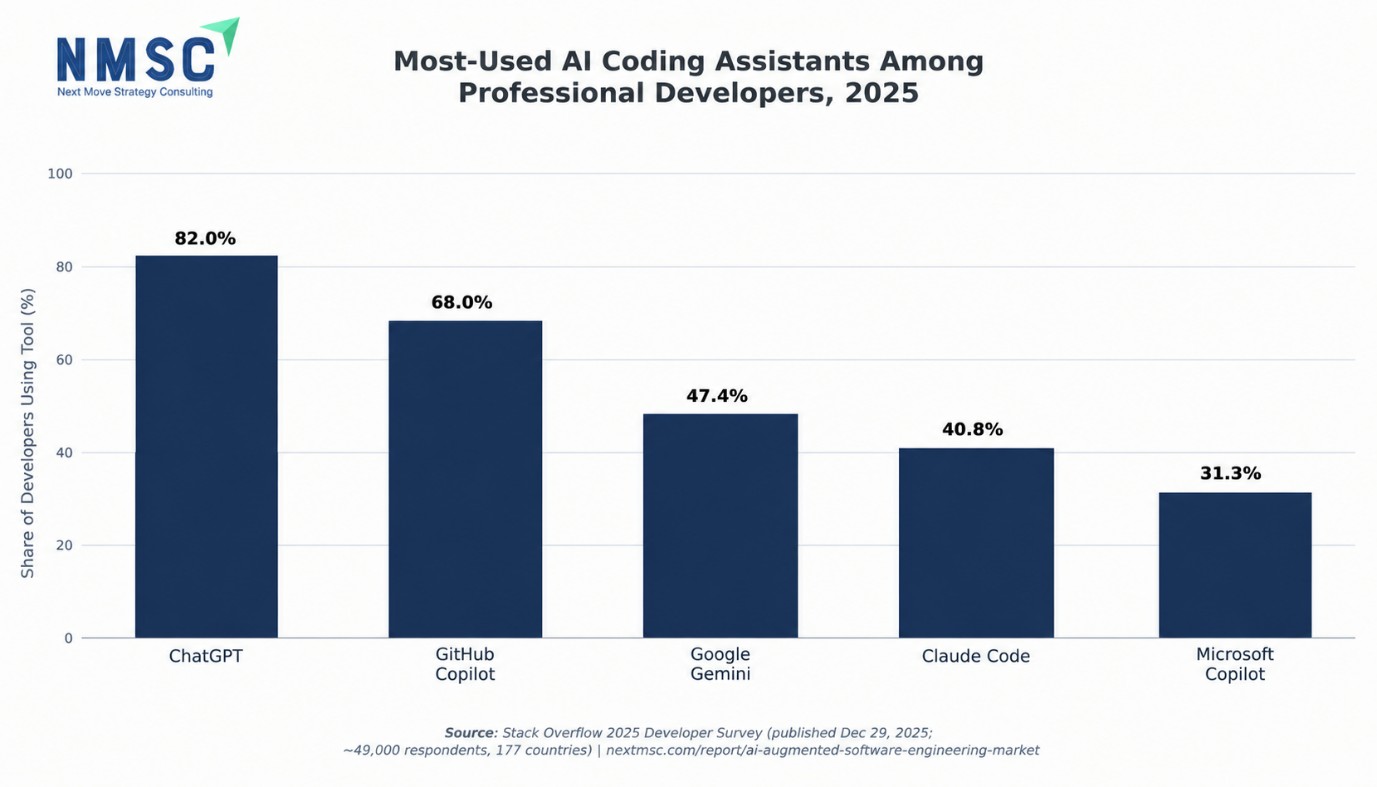
For organizations evaluating engineering talent in-house or outsourced AI fluency has become as important a screening criterion as language expertise. Developer survey data shows how fast that baseline has shifted, and how far trust still lags behind adoption.
Company-Disclosed AI Engineering Adoption Metrics, 2026
|
Company |
Disclosed Metric |
Figure |
Disclosed |
|
IBM |
Average employee productivity gain using Bob (80,000 employees) |
~45% |
May 2026 |
|
OpenAI |
Share of OpenAI's own output tokens generated via Codex |
>85% |
Jun 2026 |
|
OpenAI |
Growth in non-developer Codex use since Aug 2025 |
137x |
Jun 2026 |
|
Databricks |
Agents built on the Agent Bricks platform since launch |
100,000+ |
Jun 2026 |
|
Tricentis |
Orgs trusting AI agents on release decisions, 2026 (down from 48% in 2025) |
34% |
2026 |
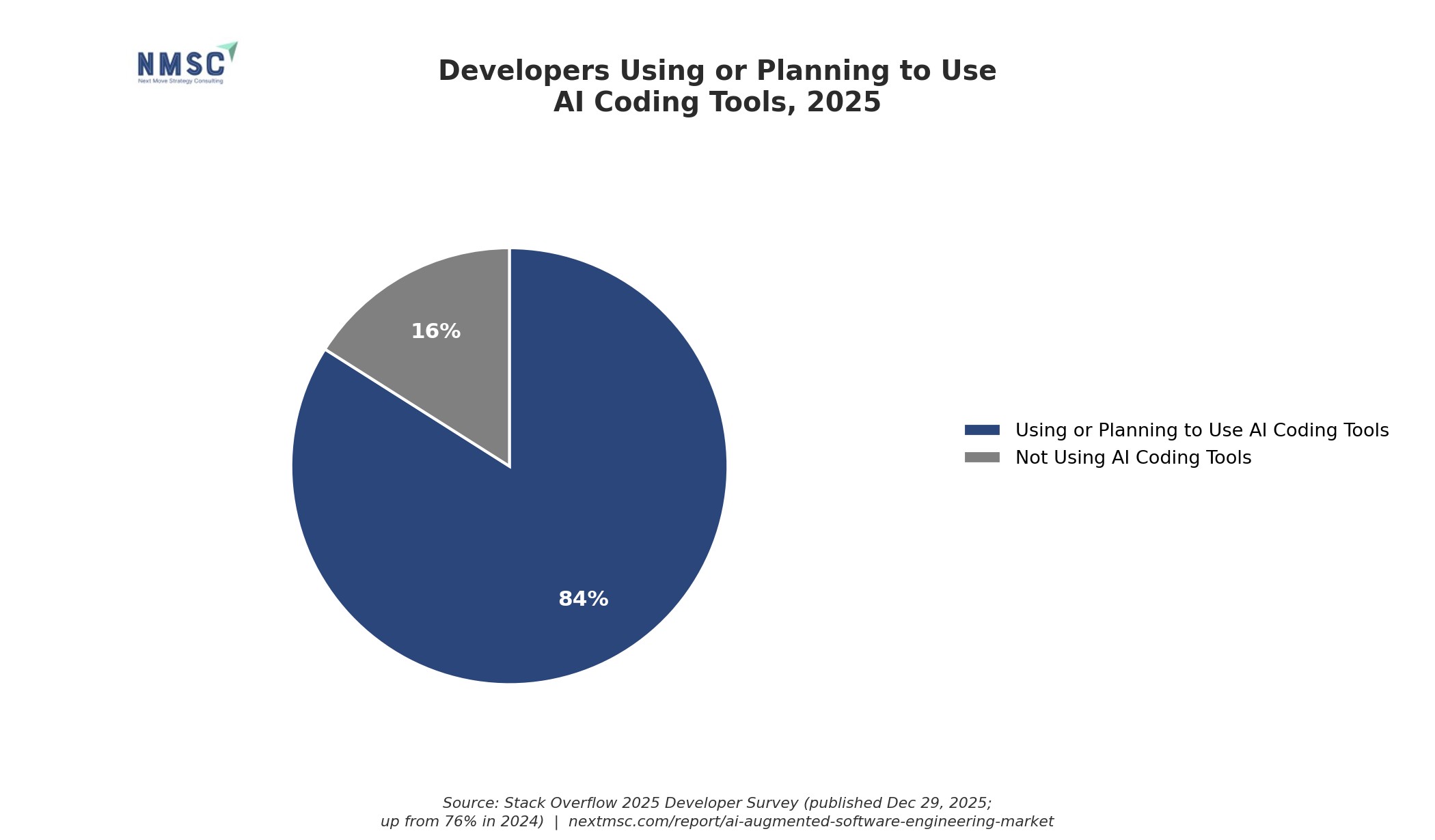
That shift changes what a good outsourcing evaluation looks like. A Rails developer, or any specialist vetted through a partner such as RubyroidLabs' Ruby on Rails hiring service, should now be expected to show fluency with an AI pair-programming tool reviewing and correcting agent-generated code, not just writing it from scratch because that is increasingly the job itself. The trust gap above is exactly why that evaluation still needs a human: 66% of developers spend more hours reviewing AI-generated code each week than writing new code, even as adoption climbed to 84%. An outsourced developer's value increasingly lies in knowing when to override the agent, not merely how to prompt it.
Risks and Open Questions
The market's growth is not without friction. Tricentis' own research found confidence in AI agents making release-impacting decisions fell from 48% in 2025 to 34% in 2026, even as usage rose. Consolidation is a second risk: as vendors bundle agentic coding into subscriptions customers already pay for, such as Antigravity inside Gemini Enterprise, independent point-solution vendors face pressure to sell, as Tabnine did, or specialize sharply, as Snyk and SmartBear are doing.
Outlook Through 2030
NMSC's own analysis puts the market on a path from USD 2.1 billion in 2023 to USD 26.8 billion by 2030, a 37.5% CAGR. Reaching that scale depends on closing the trust gap visible in this year's developer data: agents will need to demonstrate reliability in production, not just benchmarks, before organizations extend them further into testing, security, and deployment decisions without a human in the loop. Expect the M&A pace seen this year Tricentis–Tabnine, ServiceNow–Veza, Databricks' acquisitions to continue as platform vendors buy the governance and context layers they cannot build fast enough themselves.
Curious how these figures break down by solution type, deployment model, and region? Download Free Sample of NMSC's full AI Augmented Software Engineering Market report.
Conclusion
AI-augmented software engineering has moved from a developer convenience to a boardroom-level infrastructure decision in about eighteen months, and the market's projected growth to USD 26.8 billion by 2030 reflects that shift. The vendors winning right now are the ones building the governance, testing, and context layers that let organizations trust what their agents produce a lesson that applies as much to a five-person outsourcing engagement as to a Fortune 500 rollout.
About the Author
 Sanyukta Deb
— Sanyukta Deb is Digital Marketing Team Lead at Next Move Strategy Consulting, where she has led content strategy and technical SEO for the firm's B2B market research publications for over 2 years. Her editorial process translates NextMSC's primary and secondary research — spanning technology, industrial, and consumer sectors — into commercial narratives, backed by search-intent, keyword, and competitive analysis. She brings 5 years of overall experience in digital marketing and content strategy.
Sanyukta Deb
— Sanyukta Deb is Digital Marketing Team Lead at Next Move Strategy Consulting, where she has led content strategy and technical SEO for the firm's B2B market research publications for over 2 years. Her editorial process translates NextMSC's primary and secondary research — spanning technology, industrial, and consumer sectors — into commercial narratives, backed by search-intent, keyword, and competitive analysis. She brings 5 years of overall experience in digital marketing and content strategy.
About the Reviewer
 Debashree Dey
— Debashree Dey is Assistant Manager at Next Move Strategy Consulting, where she supports cross-vertical market content and communications across diverse industries for 6 years. Her professional background includes senior content writing, communications, and published manuscript authorship, with experience developing audience-focused business narratives and maintaining clear, consistent messaging. Her role supports research-led content development and editorial quality across NextMSC publications.
Debashree Dey
— Debashree Dey is Assistant Manager at Next Move Strategy Consulting, where she supports cross-vertical market content and communications across diverse industries for 6 years. Her professional background includes senior content writing, communications, and published manuscript authorship, with experience developing audience-focused business narratives and maintaining clear, consistent messaging. Her role supports research-led content development and editorial quality across NextMSC publications.


















Add Comment