Graphene Ink Market Size, Share, Trends and Growth Analysis, By Product Type (Conductive Graphene Ink, Functional Graphene Ink, & Others), By Graphene Material, By Formulation Base, By Printing Technology, By Revenue Stream, By Sales Channel, By Application (Printed Electronics, Sensors, Heating Elements, Energy Storage, EMI Shielding, Smart Packaging, & Anticorrosion Coatings), By End User Industry, and Region — Global Industry Report and Forecast, 2026–2035
Industry: Materials and Chemical | Publishing Date: July 27, 2026 | Last Updated: September 30, 2026 | No of Pages: N/A | No. of Tables: N/A | No. of Figures: N/A | Format: PDF | Report Code: MC5407
What Is the Graphene Ink Market Size?
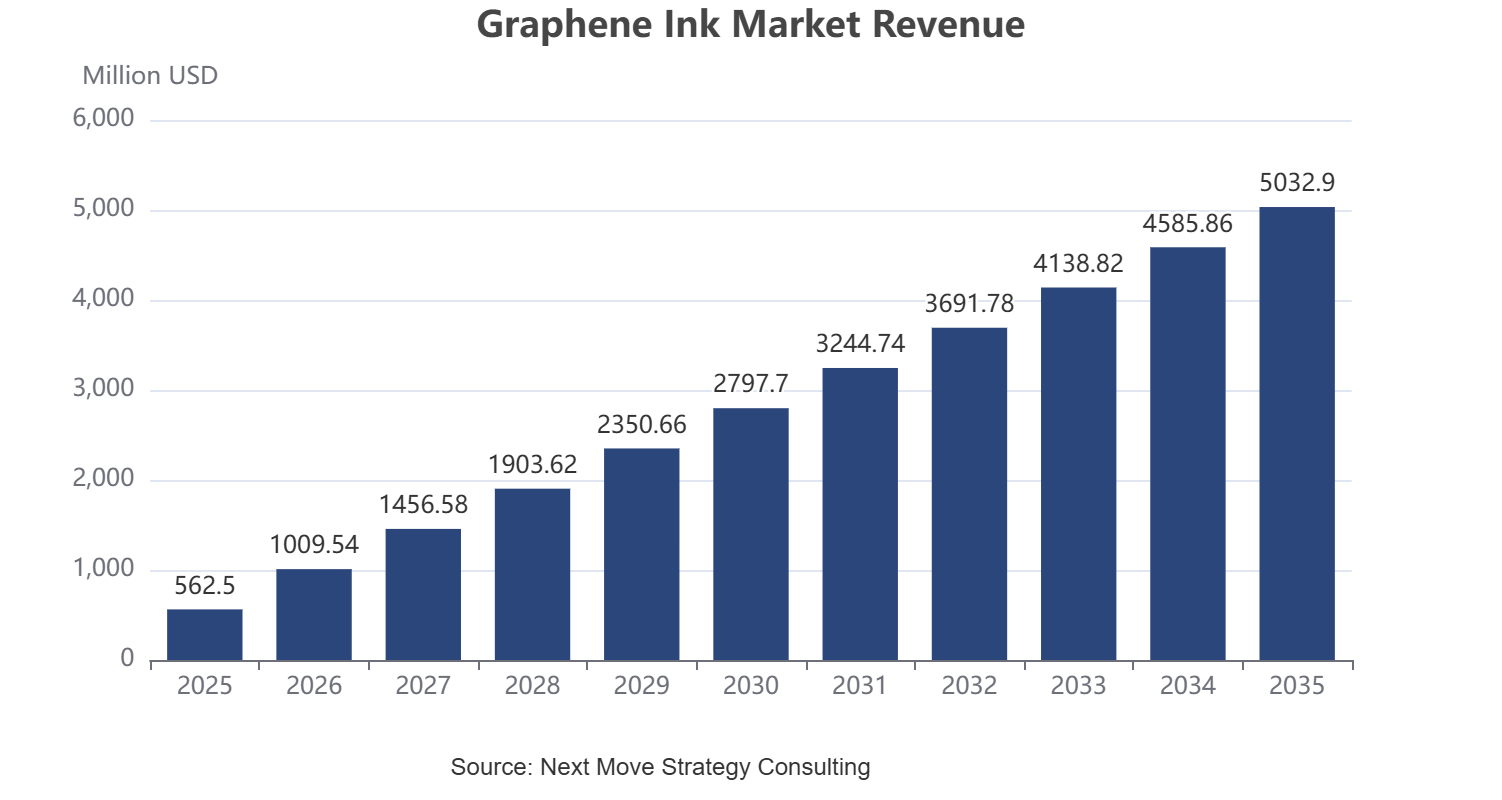
The global graphene ink market size was valued at USD 562.5 million in 2025 and is estimated at USD 700.3 million in 2026, forecast to reach USD 5,032.9 million by 2035, expanding at a 24.5% CAGR between 2026 and 2035. Asia-Pacific leads with approximately a 37% share, while Conductive Graphene Ink dominates all other product types with approximately a 44% share.
We observed that growth is broad-based across every segmentation axis, with printed electronics demand and energy storage ink adoption driving the dominant structural shifts through 2035.
|
Key Takeaways |
|
By Product Type: Conductive Graphene Ink held the largest share of approximately 44% (USD 247.5 million) in 2025; Custom Formulated Graphene Ink is the fastest-growing sub-segment at 29.0% CAGR from 2026–2035. |
|
By Graphene Material: Graphene Oxide held the largest share of approximately 28% (USD 157.5 million) in 2025; Hybrid Graphene is the fastest-growing sub-segment at 33.5% CAGR from 2026–2035. |
|
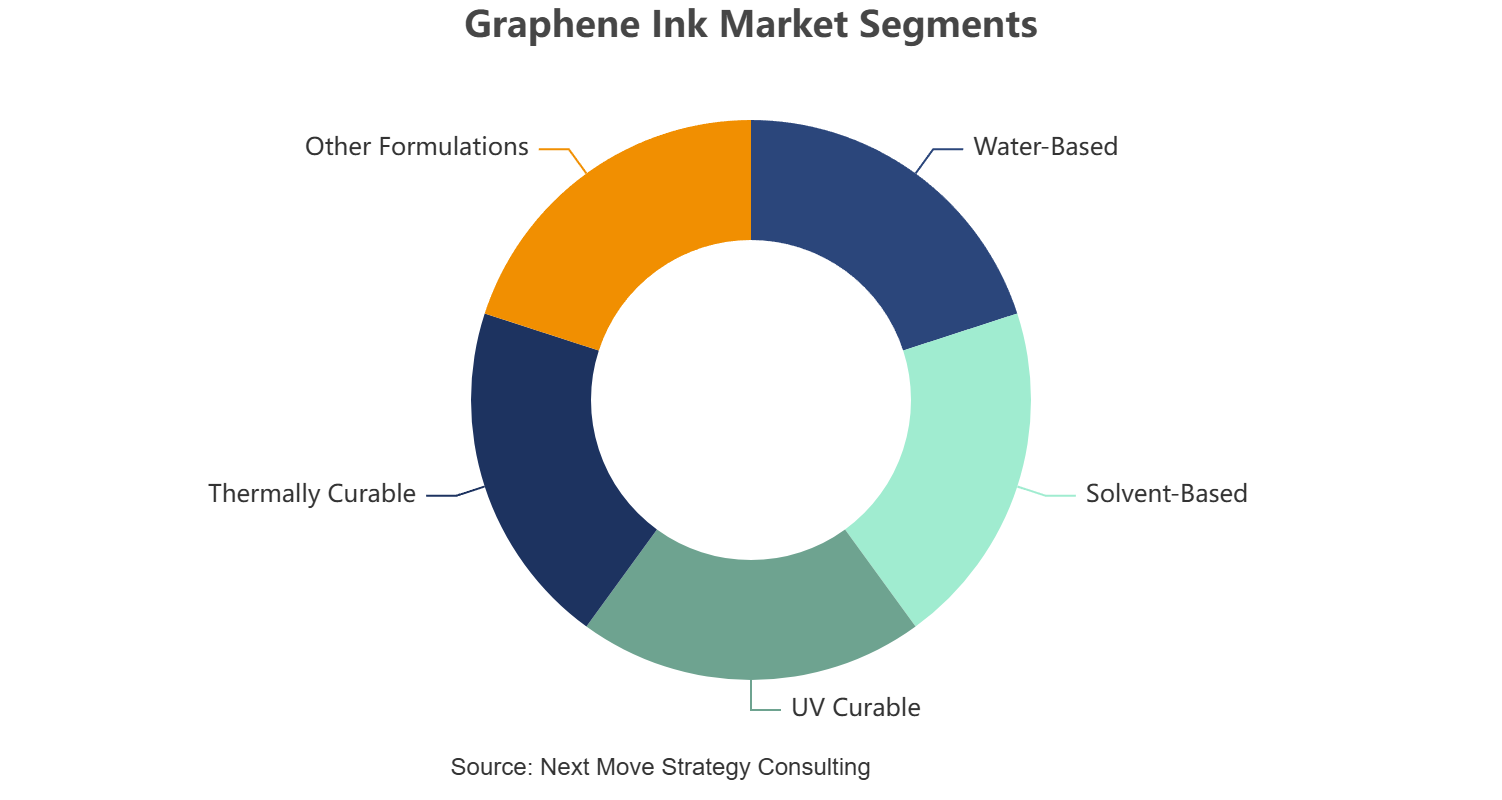
By Formulation Base: Water-Based held the largest share of approximately 38% (USD 213.8 million) in 2025; UV Curable is the fastest-growing sub-segment at 26.8% CAGR from 2026–2035. |
|
By Printing Technology: Screen Printing held the largest share of approximately 36% (USD 202.5 million) in 2025; Aerosol Jet Printing is the fastest-growing sub-segment at 33.5% CAGR from 2026–2035. |
|
By Revenue Stream: Standard Products held the largest share of approximately 46% (USD 258.8 million) in 2025; Licensing is the fastest-growing sub-segment at 29.2% CAGR from 2026–2035. |
|
By Sales Channel: Direct Sales held the largest share of approximately 52% (USD 292.5 million) in 2025; Project Sales is the fastest-growing sub-segment at 29.0% CAGR from 2026–2035. |
|
By Application: Printed Electronics held the largest share of approximately 29% (USD 163.1 million) in 2025; Biomedical Devices is the fastest-growing sub-segment at 29.2% CAGR from 2026–2035. |
|
By End User Industry: Consumer Electronics held the largest share of approximately 30% (USD 168.8 million) in 2025; Healthcare is the fastest-growing sub-segment at 26.8% CAGR from 2026–2035. |
|
Dominant Region: Asia-Pacific dominated with approximately 37% revenue share (USD 208.1 million) in 2025. |
|
Fastest-Growing Region: Middle East & Africa is expected to register the highest CAGR of 27.0% during 2026–2035. |
|
Dominant Country: China led with approximately USD 79.1 million in 2025. |
|
Fastest-Growing Country: India is the fastest-growing country at approximately 29.9% CAGR from 2026–2035. |
Market Opportunity: The graphene ink market is expected to create an absolute dollar opportunity of USD 4,332.6 million between 2026 and 2035, presenting significant investment potential across the printed electronics and energy storage ink value chain.
According to NMSC analysis, ink formulators are increasingly consolidating conductive and functional product lines under single custom-formulation platforms to serve OEM customers demanding application-specific rheology and conductivity profiles, a shift that favors diversified suppliers offering both standard and custom-formulated products over single-application specialists as printed electronics adoption scales through 2035.
What Does the Graphene Ink Market Encompass?
The graphene ink market encompasses conductive and functional ink and paste formulations incorporating graphene, graphene oxide, and hybrid graphene materials that are printed or coated onto substrates to create electronic, sensing, heating, and protective functionality. Our assessment indicates that the scope spans screen printing, inkjet, flexographic, gravure, and aerosol jet printable formulations supplied to printed electronics, sensor, energy storage, and EMI shielding manufacturers across consumer electronics, automotive, healthcare, and industrial end markets.
Regulatory frameworks such as the European Chemicals Agency's nanomaterial registration requirements shape formulation and labeling practices, while environmental health and safety guidance increasingly influences water-based ink adoption over solvent-based alternatives. We observed that technology adoption is shifting toward hybrid graphene formulations that combine conductivity with printability, a structural change that NMSC's analysis indicates is redefining formulation sourcing criteria across the market.
|
Parameters |
Details |
|
Market Size in 2025 |
USD 562.5 Million |
|
Market Size in 2026 |
USD 700.3 Million |
|
Revenue Forecast in 2035 |
USD 5,032.9 Million |
|
Growth Rate |
CAGR of 24.5% from 2026 to 2035 |
|
Analysis Period |
2025–2035 |
|
Base Year Considered |
2025 |
|
Forecast Period |
2026–2035 |
|
Market Size Estimation |
USD Million |
|
Companies Profiled |
20 |
|
Countries Covered |
38 |
|
Market Share |
Available for Top 10 Companies |
Key Emerging Trends
Based on research conducted by NMSC, we found that four structural trends are reshaping formulation development, printing adoption, and stakeholder engagement across the industry.
How Is Graphene-Enhanced Heating Technology Transforming Building and Energy Applications?
Low-power graphene ink heating elements are gaining commercial traction as utilities and manufacturers seek alternatives to conventional resistive heating. We observed that Haydale Graphene Industries' JustHeat system, developed through graphene ink-based heater collaborations, is being deployed with UK energy network partners and integrated into flooring systems through a distribution agreement with Interfloor, illustrating how functional heating ink is moving from pilot projects into commercial-scale deployment across residential and industrial settings.
Why Are Ink Formulators Scaling Compounding Partner Programs?
Graphene ink and masterbatch producers are formalizing certified partner programs to accelerate commercial-scale adoption across downstream manufacturers. Our findings suggest that HydroGraph Clean Power's Compounding Partner Program for its Fractal Graphene in thermoplastics, launched with initial certified partners in the automotive and packaging sectors, reflects how producers are structuring formal qualification pathways to standardize graphene incorporation across diverse polymer and ink applications.
How Is Energy Storage Ink Adoption Accelerating Within Printed Electronics?
Printed battery and supercapacitor electrode inks are gaining adoption as manufacturers seek lightweight, flexible energy storage formats for wearable and IoT devices. We found that graphene oxide and reduced graphene oxide formulations are increasingly specified for supercapacitor electrode printing, supporting thinner, higher-capacitance printed energy storage components across consumer electronics and industrial sensing applications.
What Role Does Diversified Revenue Structuring Play in Graphene Ink Commercialization?
Ink producers are diversifying beyond standard product sales into custom formulation, contract development, and licensing revenue streams to capture value from application-specific customer requirements. Our analysis shows that Directa Plus's reported 15% first-half 2025 revenue growth alongside a 38% EBITDA improvement reflects how disciplined cost management and diversified revenue structuring are improving unit economics across environmental and industrial ink and material product lines.
Growth Drivers and Restraints
Growth Catalyst and Risk Assessment Matrix
|
Factors |
Type |
(+/−) % Impact on CAGR |
Geographic Relevance |
Impact Timeline |
|
Rising printed electronics and flexible sensor demand |
Driver |
+3.1% |
Global |
2026–2035 |
|
Expanding energy storage and printed battery applications |
Driver |
+2.6% |
Asia-Pacific, North America |
2026–2033 |
|
Growing preference for water-based, low-VOC ink formulations |
Driver |
+1.9% |
Europe, North America |
2026–2032 |
|
Rising consumer electronics manufacturing investment in Asia |
Driver |
+1.7% |
Asia-Pacific |
2026–2035 |
|
Expanding EMI shielding demand in automotive electrification |
Driver |
+1.3% |
Global |
2026–2035 |
|
Scaling graphene production capacity reducing input costs |
Driver |
+1.1% |
Global |
2026–2035 |
|
High graphene material and formulation production costs |
Restraint |
−1.6% |
Global |
2026–2035 |
|
Inconsistent graphene quality and batch-to-batch variability |
Restraint |
−1.2% |
Global |
2026–2033 |
|
Evolving nanomaterial regulatory and safety compliance requirements |
Restraint |
−0.8% |
Europe, North America |
2026–2032 |
|
Limited standardization across printing equipment and substrates |
Restraint |
−0.5% |
Global |
2028–2035 |
What Is the Primary Growth Driver of the Graphene Ink Market?
Rising printed electronics and flexible sensor demand is the primary driver of the market. HydroGraph Clean Power's launch of a Compounding Partner Program for its Fractal Graphene in thermoplastics, with certified partners already active in the automotive and packaging sectors, reflects sustained downstream demand for standardized graphene material formats. We observed that this commercialization momentum, reinforced by expanding flexible electronics manufacturing, continues to anchor baseline demand for conductive and functional graphene ink across developed and emerging markets alike.
How Is Energy Storage Demand Driving the Market Growth?
Expanding demand for printed batteries and supercapacitors is accelerating graphene ink adoption as manufacturers seek lightweight, flexible energy storage formats. Directa Plus's reported first-half 2025 revenue growth of 15% reflects the pace at which environmental and industrial customers are contracting graphene-based materials. Our assessment indicates that this demand-side pressure, combined with rising energy storage infrastructure investment, is compressing formulation qualification timelines across global ink supplier programs.
What Is Restraining Graphene Ink Market Expansion?
High graphene material and formulation production costs restrain broader adoption, particularly among smaller manufacturers seeking to replace conventional silver or carbon-based conductive inks. Evolving nanomaterial regulatory and safety compliance requirements, including registration obligations under European Union chemical safety frameworks, add further cost and timeline pressure for formulators expanding across multiple regulatory jurisdictions. We found that inconsistent graphene quality and batch-to-batch variability further slow qualification cycles for OEMs requiring reproducible electrical performance.
Segmentation Analysis
Segment Sizing: By Product Type
|
Segment |
2025 (USD) |
2035 (USD) |
CAGR% (2026–2035) |
|
Conductive Graphene Ink |
USD 247.5 Million |
USD 1,912.5 Million |
22.5% |
|
Functional Graphene Ink |
USD 174.4 Million |
USD 1,761.5 Million |
26.2% |
|
Graphene Paste |
USD 95.6 Million |
USD 805.3 Million |
23.7% |
|
Custom Formulated Graphene Ink |
USD 45.0 Million |
USD 553.6 Million |
29.0% |
|
Total |
USD 562.5 Million |
USD 5,032.9 Million |
24.5% |
Which Product Type Segment Dominates the Market?
Conductive Graphene Ink led the market with USD 247.5 million in 2025, supported by established demand across screen printing and inkjet applications for printed circuits and antennas. Our findings suggest that Custom Formulated Graphene Ink is the fastest-growing segment, registering a 29.0% CAGR from 2026 to 2035, as OEMs increasingly specify application-tailored conductivity, viscosity, and cure profiles that standard product lines cannot address.
Segment Sizing: By Application
|
Segment |
2025 (USD) |
2035 (USD) |
CAGR% (2026–2035) |
|
Printed Electronics |
USD 163.1 Million |
USD 1,207.9 Million |
21.9% |
|
Sensors |
USD 112.5 Million |
USD 1,006.6 Million |
24.5% |
|
Heating Elements |
USD 61.9 Million |
USD 453.0 Million |
21.8% |
|
Energy Storage |
USD 73.1 Million |
USD 905.9 Million |
29.1% |
|
EMI Shielding |
USD 50.6 Million |
USD 503.3 Million |
26.0% |
|
Smart Packaging |
USD 33.8 Million |
USD 352.3 Million |
26.7% |
|
Biomedical Devices |
USD 28.1 Million |
USD 352.3 Million |
29.2% |
|
Anticorrosion Coatings |
USD 28.1 Million |
USD 201.3 Million |
21.5% |
|
Other Applications |
USD 11.3 Million |
USD 50.3 Million |
15.3% |
|
Total |
USD 562.5 Million |
USD 5,032.9 Million |
24.5% |
Which Application Segment Leads Graphene Ink Market Demand?
Printed Electronics remained the leading application within the market, valued at USD 163.1 million in 2025 on sustained demand for flexible circuits, RFID tags, and printed antennas. Based on research conducted by NMSC, we found that Biomedical Devices is the fastest-growing application, registering a 29.2% CAGR from 2026 to 2035, as graphene ink adoption expands within biosensor and diagnostic device manufacturing requiring biocompatible, high-sensitivity conductive layers.
Segment Sizing: By End User Industry
|
Segment |
2025 (USD) |
2035 (USD) |
CAGR% (2026–2035) |
|
Consumer Electronics |
USD 168.8 Million |
USD 1,308.6 Million |
22.5% |
|
Automotive |
USD 90.0 Million |
USD 855.6 Million |
25.3% |
|
Healthcare |
USD 61.9 Million |
USD 654.3 Million |
26.8% |
|
Aerospace and Defense |
USD 45.0 Million |
USD 453.0 Million |
26.1% |
|
Industrial Manufacturing |
USD 73.1 Million |
USD 603.9 Million |
23.4% |
|
Energy |
USD 67.5 Million |
USD 704.6 Million |
26.7% |
|
Packaging |
USD 33.8 Million |
USD 251.6 Million |
22.0% |
|
Research and Academia |
USD 22.4 Million |
USD 201.3 Million |
24.5% |
|
Total |
USD 562.5 Million |
USD 5,032.9 Million |
24.5% |
Which End User Industry Segment Is Most Significant in the Graphene Ink Market?
Consumer Electronics remained the dominant end user industry across the market, reaching USD 168.8 million in 2025 as device manufacturers integrate flexible printed circuits and sensors into wearable and portable products. Our analysis shows that Healthcare is the fastest-growing end user industry at a 26.8% CAGR from 2026 to 2035, reflecting expanding biomedical device and diagnostic sensor manufacturing demand for biocompatible conductive ink formulations.
Supply Chain Structure of the Graphene Ink Industry
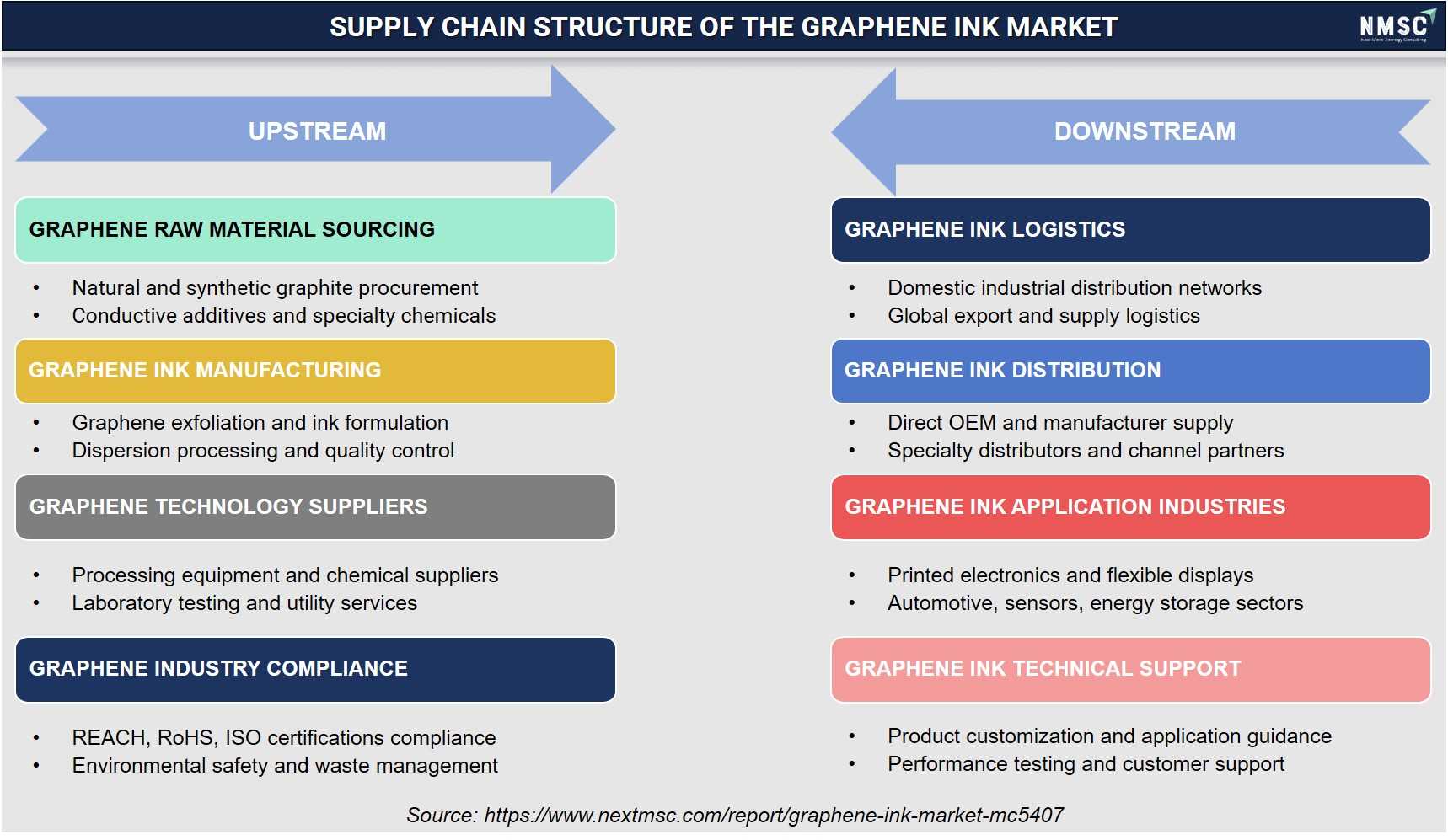
The above infographic presents the supply chain structure of the graphene ink market, segmented into upstream and downstream activities. Upstream begins with natural and synthetic graphite and additives, moving into exfoliation, ink formulation, and dispersion processing. Technology suppliers provide equipment and testing services, while compliance with REACH, RoHS, and ISO standards ensures safety and quality. Moving downstream, logistics enable distribution through OEMs and distributors to industries like printed electronics, automotive, sensors, and energy storage. Looking ahead, we observed that customization, application guidance, and performance testing ensure effective integration and customer support across the market.
Growth Opportunities
Our analysis shows that three forward-looking opportunities stand out for stakeholders positioning within the graphene ink market over the 2026–2035 forecast period.
How Can Formulators Capture Printed Energy Storage Demand?
Printed battery and supercapacitor manufacturing represents a whitespace opportunity for formulators developing graphene oxide and reduced graphene oxide electrode inks optimized for high-capacitance, flexible energy storage formats. Suppliers that commercialize standardized, screen-printable energy storage ink stand to capture recurring procurement across wearable device and IoT sensor manufacturers scaling production through 2035.
Where Does Biomedical Sensor Manufacturing Create New Graphene Ink Demand?
Biomedical device manufacturing represents an underpenetrated opportunity for ink formulators developing biocompatible, high-sensitivity conductive layers for diagnostic and wearable health sensors. Companies that qualify graphene ink formulations for gas sensors-adjacent biosensor and chemical sensor manufacturing can secure long-term supply agreements with medical device OEMs scaling diagnostic sensor production.
How Can Compounding Partner Programs Expand Downstream Adoption?
Certified compounding and partner programs create a sustained opportunity for graphene producers seeking to standardize downstream ink and masterbatch incorporation. Early movers that develop formal qualification pathways, similar to HydroGraph's Compounding Partner Program, can secure multi-year supply relationships with automotive and packaging manufacturers scaling graphene-enhanced material adoption across new product lines.
Regional Outlook
Geographic Performance Snapshot
|
Region |
2025 (USD) |
2035 (USD) |
CAGR% (2026–2035) |
Key Driver |
|
North America |
USD 157.5 Million |
USD 1,207.9 Million |
22.4% |
Advanced materials innovation and printed electronics manufacturing investment |
|
Europe |
USD 135.0 Million |
USD 1,006.6 Million |
22.0% |
Established graphene research base and nanomaterial regulatory framework |
|
Asia-Pacific |
USD 208.1 Million |
USD 2,214.5 Million |
26.9% |
Expanding consumer electronics manufacturing and graphene production capacity |
|
Middle East & Africa |
USD 28.1 Million |
USD 302.0 Million |
27.0% |
Emerging advanced materials manufacturing and diversification initiatives |
|
Latin America |
USD 33.8 Million |
USD 301.9 Million |
24.5% |
Growing electronics assembly and industrial coatings demand |
|
Total |
USD 562.5 Million |
USD 5,032.9 Million |
24.5% |
— |
North America
North America's graphene ink market is shaped by advanced materials innovation and growing printed electronics manufacturing investment among consumer and industrial device makers. Regulatory influence from federal nanomaterial safety guidance is developing, technology adoption favors conductive and energy storage ink formulations among premium electronics manufacturers, and competitive intensity remains high given the concentration of specialized graphene producers headquartered domestically.
Europe
Europe's market benefits from an established graphene research base and structured nanomaterial regulatory framework under European Union chemical safety rules. Regulatory influence from registration and safety compliance requirements is substantial, technology adoption is advanced across functional and heating ink applications, and competitive intensity remains high among long-established UK and Italian formulators.
Asia-Pacific
Asia-Pacific is the fastest-growing major region, driven by expanding consumer electronics manufacturing and rapidly scaling domestic graphene production capacity across China, Japan, and South Korea. Regulatory influence varies significantly by market maturity, technology adoption is accelerating through vertically integrated production, and competitive intensity is rising as regional formulators expand alongside established global suppliers.
Middle East & Africa
The Middle East & Africa market is the fastest-growing region overall, shaped by emerging advanced materials manufacturing initiatives tied to national economic diversification strategies. Regulatory influence remains developing, technology adoption favors conductive ink applications suited to electronics assembly, and competitive intensity is limited as regional manufacturers rely primarily on imported formulations from global suppliers.
Latin America
Latin America's graphene ink market is supported by growing electronics assembly activity and expanding industrial coatings demand across Brazil and Argentina. Regulatory influence stems from national industrial and environmental standards, technology adoption favors anticorrosion and heating ink applications aligned with existing manufacturing bases, and competitive intensity remains moderate among regional distributors serving domestic industrial customers.
U.S.
Based on our estimates, the U.S. market was valued at approximately USD 126.0 million in 2025, projected to reach USD 989.5 million by 2035 at a 22.9% CAGR. Demand is supported by advanced materials innovation and growing printed electronics manufacturing among consumer and defense electronics producers. Regulatory influence from federal nanomaterial safety guidance is developing, technology penetration is advanced, and competitive intensity remains high given the concentration of global graphene material producers headquartered domestically.
Canada
The market in Canada was valued at roughly USD 20.5 million in 2025, projected to reach USD 154.4 million by 2035 at a 22.4% CAGR. Demand is driven by domestic graphene production capacity and growing industrial coatings and composite applications. Regulatory influence stems from national chemical safety standards, technology penetration favors conductive and functional ink applications, and competitive intensity remains moderate among domestic and North American suppliers.
UK
As per our estimate, the UK market was valued at around USD 21.6 million in 2025, projected to reach USD 164.4 million by 2035 at a 22.5% CAGR. Demand structure reflects the UK's established graphene research and commercialization base, anchored by domestic advanced materials producers. Regulatory influence from UK chemical safety frameworks is notable, and technology penetration favors heating and functional ink applications among energy and building products manufacturers.
Germany
According to our analysis, Germany's market was valued at close to USD 32.4 million in 2025, projected to reach USD 236.7 million by 2035 at a 22.0% CAGR. Demand is fueled by Germany's advanced automotive and industrial manufacturing base and strong printed electronics research activity. Regulatory influence is well established under European Union nanomaterial rules, technology penetration is advanced, and competitive intensity remains high among domestic and pan-European formulators.
France
The market in France was valued at approximately USD 17.6 million in 2025, projected to reach USD 128.2 million by 2035 at a 22.0% CAGR. Demand is supported by France's established aerospace and industrial manufacturing base and growing sensor application development. Regulatory influence from national and European Union chemical safety standards is notable, and competitive intensity remains moderate given a concentrated base of domestic and regional formulators.
China
The market in China was valued at roughly USD 79.1 million in 2025, projected to reach USD 1,003.1 million by 2035 at a 28.9% CAGR. Demand is fueled by rapidly scaling domestic graphene production capacity and expanding consumer electronics manufacturing investment. Regulatory influence is increasing gradually, technology penetration is accelerating through vertically integrated production, and competitive intensity remains elevated among numerous China-based graphene material producers.
India
As per our estimate, India's market was valued at about USD 27.1 million in 2025, projected to reach USD 370.7 million by 2035 at a 29.9% CAGR. Demand structure reflects India's expanding electronics manufacturing base and growing domestic graphene material research activity. Regulatory influence remains developing, while technology penetration is rising quickly as domestic manufacturers scale conductive and functional ink production to serve regional electronics assembly demand.
Japan
According to our analysis, Japan's market was valued at close to USD 31.2 million in 2025, projected to reach USD 325.5 million by 2035 at a 26.4% CAGR. Demand is supported by Japan's precision electronics manufacturing heritage and growing sensor and energy storage ink adoption among domestic device makers. Regulatory influence is well established, technology penetration is advanced, and competitive intensity remains high among long-standing domestic and multinational suppliers.
South Korea
Based on our estimates, South Korea's market was valued at approximately USD 25.0 million in 2025, projected to reach USD 304.7 million by 2035 at a 28.4% CAGR. Demand structure benefits from the country's globally competitive consumer electronics and display manufacturing industry. Technology penetration is high, with domestic suppliers scaling conductive ink capacity, and competitive intensity remains pronounced amid rapid product innovation cycles.
Australia
The graphene ink market in Australia was valued at USD 10.4 million in 2025, projected to reach USD 117.4 million by 2035 at a 27.4% CAGR. Demand is supported by domestic graphene production capability and growing industrial coatings and composite applications. Regulatory influence stems from national chemical safety frameworks, while technology penetration favors functional ink applications amid moderate competitive intensity among domestic producers.
UAE
As per our estimate, the UAE market was valued near was valued at USD 6.8 million in 2025, projected to reach USD 76.9 million by 2035 at a 27.5% CAGR. Demand structure is shaped by the UAE's role as a regional advanced materials distribution and manufacturing hub. Regulatory influence remains moderate, technology penetration is improving through imported formulations, and competitive intensity is rising as distributors expand regional supply capacity.
Saudi Arabia
According to our analysis, Saudi Arabia's market was valued at roughly USD 7.3 million in 2025, projected to reach USD 83.3 million by 2035 at a 27.5% CAGR. Demand is driven by Vision 2030-linked industrial diversification and growing advanced materials manufacturing investment. Regulatory influence is developing under national industrial guidelines, and technology penetration is advancing as domestic distributors build supply capacity.
South Africa
Based on our estimates, South Africa's market was valued at about USD 4.5 million in 2025, projected to reach USD 51.3 million by 2035 at a 27.5% CAGR. Demand structure reflects South Africa's established industrial coatings and electronics assembly base serving regional markets. Regulatory influence remains moderate, technology penetration is gradually improving, and competitive intensity is limited given reliance on imported formulations from global suppliers.
Brazil
The market in Brazil was valued at approximately USD 14.8 million in 2025, projected to reach USD 132.9 million by 2035 at a 24.5% CAGR. Demand is underpinned by Brazil's growing electronics assembly base and expanding industrial coatings investment. Regulatory influence stems from national industrial and environmental standards, technology penetration favors anticorrosion ink applications, and competitive intensity remains moderate among regional distributors.
Argentina
As per our estimate, Argentina's market was valued at USD 6.4 million in 2025, projected to reach USD 59.7 million by 2035 at a 25.0% CAGR. Demand structure is supported by steady industrial coatings and electronics assembly investment despite macroeconomic volatility. Regulatory influence remains limited, technology penetration is modest, and competitive intensity is centered on a small number of regional distributors serving domestic manufacturers.
Porter's Five Forces Analysis of the Graphene Ink Industry
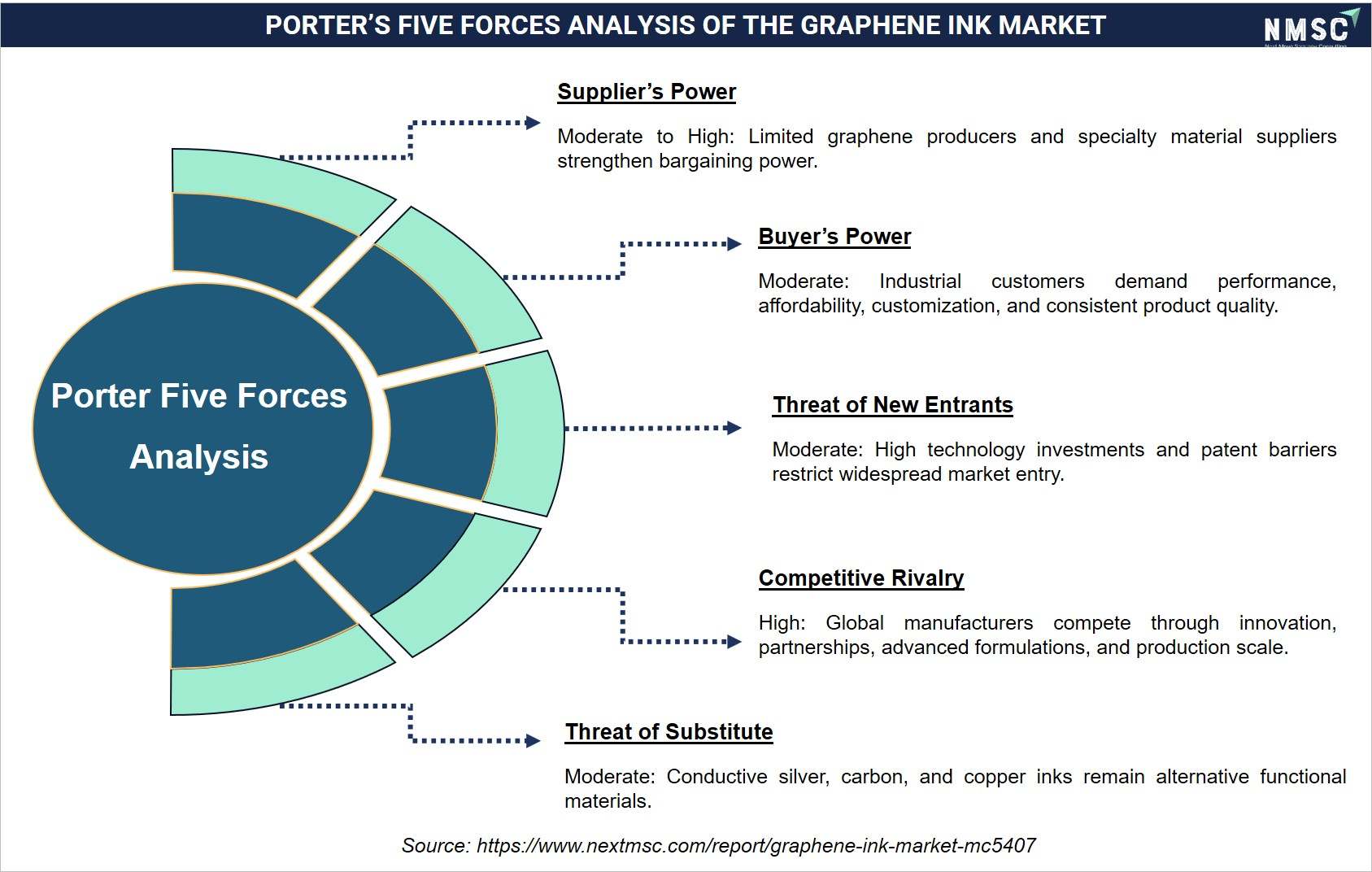
The above infographic presents a Porter's Five Forces analysis of the graphene ink market, where supplier power remains moderate to high due to limited producers and specialty material suppliers. At the same time, buyer power is moderate as industrial customers demand performance, affordability, and consistent quality. The threat of new entrants is moderate, constrained by high technology investments and patent barriers, though competitive rivalry is intense among global manufacturers competing through innovation and production scale. Looking ahead, we observed that the threat of substitutes stays moderate, as conductive silver, carbon, and copper inks continue to offer alternative functional materials.
Competitive Landscape
We observed that the graphene ink market features a fragmented competitive landscape, with specialized UK and European formulators competing alongside North American and Asia-Pacific graphene producers on material quality, formulation breadth, and application-specific certification.
|
Key Takeaways |
Details |
|
Market Structure |
Fragmented; the top companies profiled in this report collectively account for a meaningful share of global market revenue, while numerous regional and application-specialist producers serve localized demand. |
|
Innovation Focus |
Functional heating and energy storage ink formulations, hybrid graphene material blends, and certified compounding partner programs dominate current innovation pipelines across leading suppliers. |
|
M&A Activity |
Selective capability and platform acquisitions, exemplified by Haydale Graphene Industries' acquisition of SaveMoneyCutCarbon to embed its JustHeat ink-based heating technology within a national delivery and installation platform. |
How Do Companies Compete in the Graphene Ink Market?
Companies compete primarily on graphene material quality, formulation breadth, and application-specific certification track record across the industry. Specialized formulators such as Haydale Graphene Industries plc and Dycotec Materials Ltd leverage proprietary functionalization and formulation expertise to serve printed electronics and heating ink customers, while diversified producers such as Heraeus Holding GmbH compete by bundling graphene ink capability within broader conductive materials portfolios.
Which Competitive Archetypes Dominate the Market?
Two archetypes dominate the market: specialized functionalization and formulation technology providers, and vertically integrated graphene material producers extending into ink and paste products. Haydale Graphene Industries plc exemplifies the specialized formulation archetype through its patented plasma functionalization process, while NanoXplore Inc. and HydroGraph Clean Power Inc. exemplify the vertically integrated archetype controlling graphene production through to downstream material formats.
How Are Companies Differentiating Through Innovation in Graphene Ink?
Innovation and differentiation strategy increasingly center on functional applications beyond basic conductivity, including heating, energy storage, and biomedical formulations. Haydale's graphene-enhanced thermal transfer fluid launch and HydroGraph's Compounding Partner Program both illustrate how suppliers extend graphene material relevance into new product categories and downstream qualification pathways. Our analysis shows that suppliers unable to demonstrate application-specific certification risk exclusion from OEM formulation shortlists.
What M&A and Expansion Activity Is Shaping the Graphene Ink Market?
Mergers, acquisitions, and commercial partnership activity continue to reshape go-to-market capabilities within the industry. Haydale Graphene Industries' acquisition of SaveMoneyCutCarbon strengthens its national delivery and installation capability for ink-based heating products, while NanoXplore Inc.'s new supply agreements, including with Chevron Phillips, illustrate how producers pursue customer diversification to offset demand concentration risk among top accounts.
Key Market Players
Our assessment indicates that the following 20 companies are actively shaping formulation innovation, production capacity expansion, and downstream partnership strategy within the global graphene ink market.
-
Haydale Graphene Industries plc
-
Directa Plus S.p.A.
-
Dycotec Materials Ltd
-
Vorbeck Materials Corp.
-
HydroGraph Clean Power Inc.
-
Graphenea S.A.
-
Nanotech Energy Inc.
-
Heraeus Holding GmbH
-
Nanografi Nano Teknoloji A.Ş.
-
Universal Matter Inc.
-
Perpetuus Advanced Materials Ltd
-
Versarien plc
-
NanoXplore Inc.
-
G6 Materials Corp.
-
Global Graphene Group, Inc.
-
First Graphene Ltd
-
Saralon GmbH
-
Adnano Technologies Pvt. Ltd.
-
Techinstro
-
Shilpa Enterprises
Latest Developments
We found that recent activity within the graphene ink market is concentrated on functional heating product commercialization, compounding partner qualification, and customer diversification, reflecting the industry's response to accelerating downstream adoption.
|
Date |
Event |
|
January 2026 |
Haydale Graphene Industries completed its acquisition of SaveMoneyCutCarbon, raising USD 7.74 million to fund integration and expand its energy efficiency delivery platform. |
|
November 2025 |
Haydale Graphene Industries launched its second commercial graphene-enhanced product, a super-efficient thermal transfer fluid, now undergoing industrial commercial testing. |
Expert Insights
 “Shaping graphitic materials into complex geometries for advanced applications has long been a critical challenge that has limited their widespread adoption. With our proposed methods, we can 3D-print graphene into any shape.”
Dr. Milad Kamkar, Professor of Chemical Engineering, University of Waterloo
Statement made following research on an all-graphene water-based ink developed for direct ink writing 3D printing.
Market Interpretation
The insight highlights the importance of printability and formulation flexibility in expanding graphene's commercial applications. NMSC's analysis indicates that the development of water-based, printable graphene inks capable of producing complex geometries could broaden adoption across 3D-printed electronics, electromagnetic interference shielding, sensors, and advanced functional components. By addressing the challenge of converting graphene into application-ready printable forms, such innovations can support the transition of graphene ink technologies from specialized applications toward scalable commercial use.
Investment Opportunities
What Capital Inflows Are Fueling Graphene Ink Market Development?
Capital investment is flowing into functional ink commercialization and platform integration, exemplified by Haydale Graphene Industries' GBP 5.75 million fundraise supporting its SaveMoneyCutCarbon acquisition. Our findings suggest that this capital inflow is validating functional graphene ink as a durable, revenue-generating product category rather than an early-stage research material, attracting continued investor interest in commercialization-stage formulators.
How Is Infrastructure Investment Shaping the Market Expansion?
Production capacity and delivery infrastructure investment is shaping how graphene ink producers scale commercial supply globally. We observed that HydroGraph Clean Power's Compounding Partner Program reflects sustained infrastructure investment in downstream qualification capacity to support automotive and packaging manufacturers adopting graphene-enhanced materials without requiring large customer-side capital commitments.
What ESG Considerations Influence Graphene Ink Market Investment?
Environmental, social, and governance considerations increasingly influence graphene ink investment as formulators prioritize water-based and low-VOC alternatives to solvent-based conductive inks. Our analysis shows that graphene-enhanced heating and energy efficiency products, such as Haydale's JustHeat platform supporting vulnerable households, align with social impact goals alongside emissions-reduction objectives, strengthening the investment case for functional ink suppliers with demonstrated deployment track records.
Key Benefits for Stakeholders
How Does This Report Benefit Industry Leaders?
This report equips materials and electronics industry leaders with segmented revenue forecasts, formulation adoption trends, and competitive benchmarking needed to prioritize graphene ink sourcing across application categories. Our findings suggest that leaders can use the segmentation analysis and regional outlook to align procurement roadmaps with the fastest-growing product type, application, and end-user segments identified in this report.
How Does This Report Benefit Investors and Financial Analysts?
Investors and financial analysts gain a data-driven view of market sizing, CAGR trajectories, and company-level competitive positioning to evaluate capital allocation across the graphene ink value chain. We found that the investment opportunities and competitive landscape sections provide the forecast granularity needed to assess formulator and graphene producer M&A opportunities.
How Does This Report Benefit Technology Vendors and Product Teams?
Technology vendors and product teams benefit from detailed segmentation across product type, graphene material, and application axes that clarify where formulation development investment will generate the strongest returns. Our assessment indicates that the growth opportunities and emerging trends sections help product teams prioritize energy storage and biomedical ink roadmaps ahead of competitors.
Key Market Segments
By Product Type
-
Conductive Graphene Ink
-
Screen Printing Ink
-
Inkjet Ink
-
Flexographic Ink
-
Gravure Ink
-
Aerosol Jet Ink
-
Other Conductive Ink
-
-
Functional Graphene Ink
-
Heating Ink
-
Sensor Ink
-
EMI Shielding Ink
-
Energy Storage Ink
-
Anticorrosion Ink
-
Biomedical Ink
-
Other Functional Ink
-
-
Graphene Paste
-
Conductive Paste
-
Functional Paste
-
-
Custom Formulated Graphene Ink
By Graphene Material
-
Pristine Graphene
-
Few-Layer Graphene
-
Graphene Oxide
-
Reduced Graphene Oxide
-
Hybrid Graphene
-
Other Graphene Materials
By Formulation Base
-
Water-Based
-
Solvent-Based
-
UV Curable
-
Thermally Curable
-
Other Formulations
By Printing Technology
-
Screen Printing
-
Inkjet Printing
-
Flexographic Printing
-
Gravure Printing
-
Aerosol Jet Printing
-
Other Printing Technologies
By Revenue Stream
-
Standard Products
-
Custom Formulation
-
Contract Development
-
Technical Services
-
Licensing
-
Sample Sales
By Sales Channel
-
Direct Sales
-
Authorized Distributor
-
Online Sales
-
Project Sales
By Application
-
Printed Electronics
-
Flexible Electronics
-
Printed Circuits
-
RFID
-
Printed Antennas
-
Printed Interconnects
-
-
Sensors
-
Biosensors
-
Gas Sensors
-
Pressure Sensors
-
Strain Sensors
-
Chemical Sensors
-
Other Sensors
-
-
Heating Elements
-
Energy Storage
-
Printed Batteries
-
Supercapacitors
-
-
EMI Shielding
-
Smart Packaging
-
Biomedical Devices
-
Anticorrosion Coatings
-
Other Applications
By End User Industry
-
Consumer Electronics
-
Automotive
-
Healthcare
-
Aerospace and Defense
-
Industrial Manufacturing
-
Energy
-
Packaging
-
Research and Academia
By Region
-
North America: U.S., Canada, Mexico.
-
Europe: UK, Germany, France, Italy, Spain, Sweden, Denmark, Finland, Netherlands, Rest of Europe.
-
Asia-Pacific: China, India, Japan, South Korea, Taiwan, Indonesia, Vietnam, Australia, Philippines, Malaysia, Rest of APAC.
-
Middle East & Africa: Saudi Arabia, UAE, Egypt, Israel, Turkey, Nigeria, South Africa, Rest of MEA.
-
Latin America: Brazil, Argentina, Chile, Colombia, Rest of LATAM.
Conclusion and Recommendations
What Is the Long-Term Outlook for the Graphene Ink Market?
The long-term outlook remains strongly positive, with the market projected to expand from USD 700.3 million in 2026 to USD 5,032.9 million by 2035 at a 24.5% CAGR. We observed that sustained printed electronics demand and functional ink commercialization provide durable, structural tailwinds that extend well beyond the current forecast window, supporting continued producer investment across conductive, functional, and custom formulation segments.
What Strategic Positioning Should Suppliers Pursue?
Suppliers should prioritize diversified conductive and functional ink portfolios that reduce customer qualification complexity across multiple application categories. Our assessment indicates that formulators combining proprietary functionalization technology with named commercial partnerships will be best positioned to win recurring OEM contracts, particularly as customers consolidate ink sourcing relationships to simplify long-term supply chain management.
How Attractive Is the Graphene Ink Market for New Investment?
The graphene ink industry presents an attractive investment case, supported by a USD 4,332.6 million absolute dollar opportunity between 2026 and 2035 and above-average growth in Middle East & Africa and biomedical application categories. We found that investment attractiveness is highest for suppliers combining functionalization depth with diversified revenue streams, positioning them to serve both established conductive ink customers and emerging functional application programs simultaneously.
What Market Shifts and Key Risks Should Stakeholders Monitor?
Stakeholders should monitor production cost pressure, batch-to-batch quality variability, and evolving nanomaterial regulatory compliance requirements as key risks to the graphene ink market. Our analysis shows that suppliers unable to demonstrate consistent material quality and regulatory readiness risk losing OEM qualification status, particularly within Europe's increasingly structured nanomaterial safety compliance environment.
What Are the Key Growth Pathways for the Graphene Ink Market?
Key growth pathways include expanding energy storage and biomedical ink formulations, scaling certified compounding partner programs, and deepening penetration into custom formulation and licensing revenue streams. NMSC's analysis indicates that suppliers pursuing these pathways while maintaining cost competitiveness in standard conductive ink categories will be best positioned to capture the graphene ink market's projected growth through 2035.
About the Author
 Mayurima Roy
— Mayurima Roy is Research Analyst at Next Move Strategy Consulting, where she has spent 4 years working across the firm's full industry coverage rather than a single fixed vertical. Her work centers on structured research, ongoing trend tracking, competitive assessment, and insight-led content development, translating complex market data into clear, decision-ready narratives that support informed client decision-making across diverse global industries, market sectors, and world regions every day.
Mayurima Roy
— Mayurima Roy is Research Analyst at Next Move Strategy Consulting, where she has spent 4 years working across the firm's full industry coverage rather than a single fixed vertical. Her work centers on structured research, ongoing trend tracking, competitive assessment, and insight-led content development, translating complex market data into clear, decision-ready narratives that support informed client decision-making across diverse global industries, market sectors, and world regions every day.
About the Reviewer
 Supradip Baul
— Supradip Baul is an accomplished business consultant and strategist with over a decade of rich experience in market intelligence, strategy, technology, and business transformation. His work has included rigorous qualitative and quantitative analysis across multiple industries, helping clients shape investment decisions and long-term roadmaps. Earlier in his career, he was associated with Gartner, where he contributed to industry-leading reports and market share analyses. He has worked with leading global companies and holds an MBA with a dual specialization in Marketing and Finance.
Supradip Baul
— Supradip Baul is an accomplished business consultant and strategist with over a decade of rich experience in market intelligence, strategy, technology, and business transformation. His work has included rigorous qualitative and quantitative analysis across multiple industries, helping clients shape investment decisions and long-term roadmaps. Earlier in his career, he was associated with Gartner, where he contributed to industry-leading reports and market share analyses. He has worked with leading global companies and holds an MBA with a dual specialization in Marketing and Finance.
At Next Move Strategy Consulting, we understand that insightful market research is the cornerstone of successful business decisions. That's why we employ a robust and multifaceted approach, combining various methodologies to deliver the most accurate and actionable data for our clients.

Research Landscape
We navigate the world of research with two primary approaches:
Qualitative Approach
Our qualitative research methodologies involve immersive techniques such as in-depth interviews, focus groups, and observational studies. By engaging directly with individuals and stakeholders, we uncover valuable insights that quantitative data alone may overlook.

Quantitative Research
In tandem with qualitative methodologies, NMSC leverages the power of Quantitative Research to provide a robust foundation of numerical insights. Through systematic data collection and analysis, we quantify patterns, preferences, and market trends, offering a comprehensive view of the business landscape.
Our quantitative research approach employs diverse tools, including surveys, experiments, and statistical modelling. These methodologies enable us to gather data from a large and representative sample, ensuring the statistical significance of our findings. By employing structured questionnaires and standardized data collection methods, we guarantee the reliability and validity of the information we present to our clients.
Quantitative research is particularly effective in measuring the prevalence of trends, assessing market size, and gauging the impact of various factors on consumer behavior. The numerical precision attained through this approach equips our clients with actionable insights, facilitating data-driven decision-making and strategy formulation.


Our Specialized Toolbox for Industry-Specific Market Research
We deploy a specialized arsenal of techniques tailored to meet your unique requirements. Here's a glimpse into our comprehensive toolbox:

Information Procurement
The stage entails acquiring market data or relevant information through various sources and methodologies.


Market Research Approach
We utilize both top-down and bottom-up approaches in market research analysis to achieve a comprehensive understanding of the market dynamics, leveraging the broad perspective of industry trends and macroeconomic factors alongside detailed insights from specific segments and individual companies.

Porters Five Forces Analysis
We conduct Porter's Five Forces analysis to evaluate the competitive landscape of an industry, providing us with insights into factors that affect profitability and strategic positioning.

SWOT Analysis

Forecasting
We utilize a forecasting model to predict future consumption by considering parameters like population, economics, regulations, market competition, drivers, constraints, technology, and pricing. We also employ statistical techniques such as multilinear regression, exponential smoothing, moving average, ARIMA, and Monte Carlo simulations for accurate predictions. In econometric forecasting, we analyzed short-term and long-term event impacts, attributing values based on regulatory frameworks, economic factors, and market events.





 Speak to Our Analyst