Nonwoven Weed Control Fabric Market Size, Share, Trends and Growth Analysis, By Material Type (Polypropylene, Polyester, and Polyethylene), By Application (Agricultural, Landscaping and Gardening, and Horticulture and Nursery), By Distribution Channel (Direct and Institutional, and Retail and DIY), and By Region — Global Industry Report and Forecast, 2026–2035
Industry: Materials and Chemical | Publishing Date: August 12, 2026 | Last Updated: August 12, 2026 | No of Pages: N/A | No. of Tables: N/A | No. of Figures: N/A | Format: PDF | Report Code: MC5687
What Is the Nonwoven Weed Control Fabric Market Size?
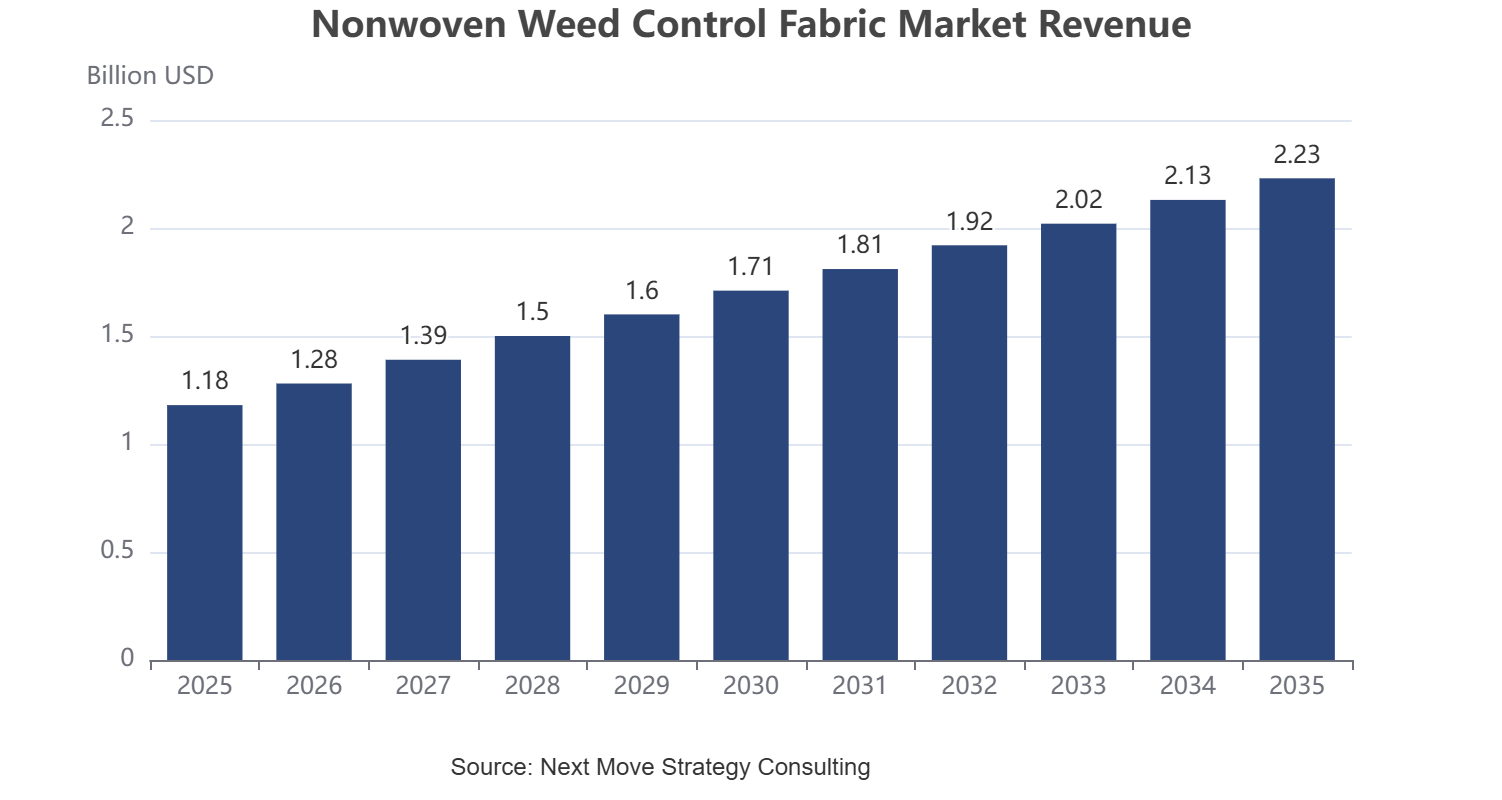
The global Nonwoven Weed Control Fabric Market size was valued at USD 1.18 billion in 2025 and is estimated at USD 1.26 billion in 2026, projected to reach USD 2.23 billion by 2035, expanding at a CAGR of 6.55% between 2026 and 2035, with North America holding approximately 32.2% share and Polypropylene accounting for nearly 55.1% of 2025 revenue.
We observed that demand is broadening across commercial landscaping, agricultural row-crop management, and residential gardening as growers and contractors adopt nonwoven ground covers for sustained weed suppression without repeated herbicide application.
|
Key Takeaways |
|
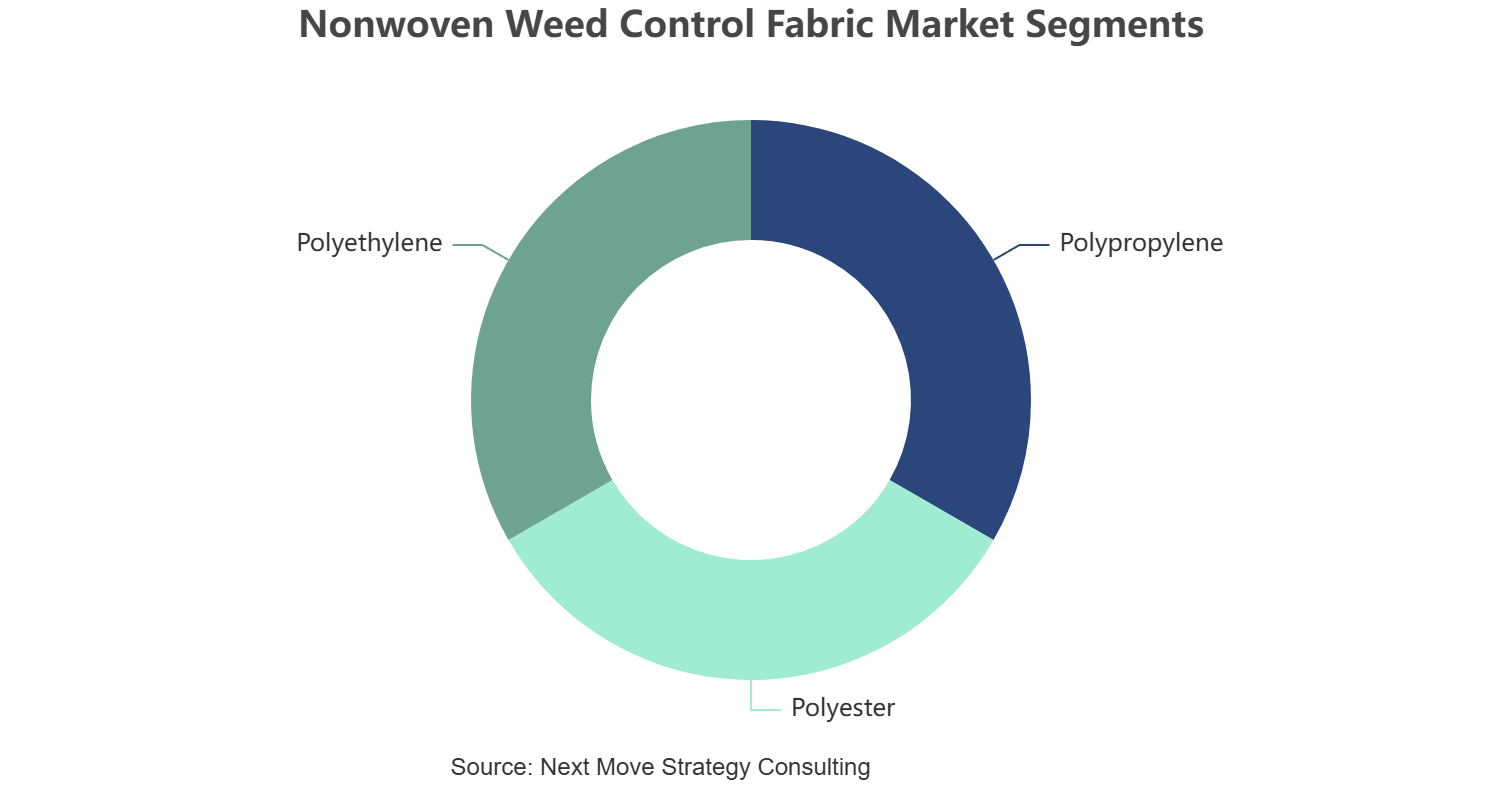
By Material Type: Polypropylene held the largest share of approximately 55.1% (USD 0.65 Billion) in 2025; Polyester is the fastest-growing sub-segment at 7.2% CAGR from 2026-2035. |
|
By Application: Agricultural held the largest share of approximately 52.5% (USD 0.62 Billion) in 2025; Horticulture & Nursery is the fastest-growing sub-segment at 7.2% CAGR from 2026-2035. |
|
By Distribution Channel: Direct/Institutional held the largest share of approximately 61% (USD 0.72 Billion) in 2025; Retail/DIY is the fastest-growing sub-segment at 7.1% CAGR from 2026-2035. |
|
Dominant Region: North America dominated with approximately 32.2% revenue share (USD 0.38 Billion) in 2025. |
|
Fastest-Growing Region: Asia-Pacific is expected to register the highest CAGR of 8.6% during 2026-2035. |
|
Dominant Country: U.S. led with approximately USD 0.27 Billion in 2025. |
|
Fastest-Growing Country: India is the fastest-growing country at approximately 11.1% CAGR from 2026-2035. |
Market Opportunity: The nonwoven weed control fabric market is expected to create an absolute dollar opportunity of USD 0.97 billion between 2026 and 2035, positioning polypropylene and polyester fabric manufacturers as priority allocations for agricultural and landscaping input suppliers.
According to Next Move Strategy Consulting analysis, commercial landscaping contractors are increasingly specifying heavier-weight nonwoven fabrics for multi-season durability, reflecting stakeholder demand for reduced replacement frequency across managed properties.
What Does the Nonwoven Weed Control Fabric Market Encompass?
The nonwoven weed control fabric market encompasses spunbond and needle-punched fabrics manufactured from polypropylene, polyester, and polyethylene fibers, engineered to suppress weed growth while permitting water and air permeability across agricultural, landscaping, and horticultural applications. Our analysis shows that the market has evolved from basic woven ground covers toward engineered nonwoven fabrics offering ultraviolet stabilization, higher tensile strength, and multi-year durability ratings.
Regulatory frameworks including the U.S. Department of Agriculture's organic certification standards and the European Union's packaging and plastics directives shape permissible fiber compositions within agricultural fabric applications. We found that technology adoption trends, including biodegradable fiber blends and UV-stabilized polymer formulations, are accelerating differentiation among established nonwoven manufacturers and specialty geotextile vendors.
|
Parameters |
Details |
|
Market Size in 2025 |
USD 1.18 Billion |
|
Market Size in 2026 |
USD 1.26 Billion |
|
Revenue Forecast in 2035 |
USD 2.23 Billion |
|
Growth Rate |
CAGR of 6.55% from 2026 to 2035 |
|
Analysis Period |
2025-2035 |
|
Base Year Considered |
2025 |
|
Forecast Period |
2026-2035 |
|
Market Size Estimation |
Revenue (USD Billion) |
|
Companies Profiled |
20 |
|
Countries Covered |
33 |
|
Market Share |
Available for Top 10 Companies |
Key Emerging Trends
Based on research conducted by Next Move Strategy Consulting, we found that four structural trends are reshaping how growers and landscaping contractors select nonwoven weed control fabric.
How Are Biodegradable Fiber Blends Transforming Fabric Formulations?
Biodegradable fiber blends are transforming fabric formulations by replacing conventional polypropylene with plant-based or compostable polymer alternatives that reduce post-season removal labor. We observed that Fibertex Nonwovens A/S has expanded its biodegradable product line for agricultural applications, reducing landfill disposal concerns among commercial growers. This transformation is reshaping procurement criteria across regulated horticultural markets.
Why Is Demand for UV-Stabilized Fabric Accelerating Among Landscaping Contractors?
Demand for UV-stabilized fabric is accelerating as commercial landscaping contractors seek multi-year ground cover durability under prolonged sun exposure. Our assessment indicates that municipal and commercial property managers increasingly specify UV-resistant fabric grades, directly impacting formulation complexity and vendor differentiation strategies across managed landscaping contracts.
How Is Heavier-Weight Fabric Adoption Expanding Among Commercial Growers?
Heavier-weight fabric adoption is expanding among commercial growers seeking extended service life across multi-season row-crop and orchard applications. Our findings suggest that agricultural operators increasingly favor fabrics offering higher tensile strength, with Propex Operating Company, LLC reporting expanded heavy-duty fabric volumes tied to perennial crop ground cover requirements.
What Role Does Water Permeability Engineering Play in Fabric Innovation?
Water permeability engineering is emerging within nonwoven fabric formulations to balance weed suppression with irrigation efficiency for drip-irrigated crops. We noticed that Berry Global Group, Inc. has expanded permeability testing across its agricultural fabric portfolio, reflecting broader stakeholder demand for fabrics that support both weed control and water conservation outcomes.
PESTEL Analysis of the Nonwoven Weed Control Fabric Market
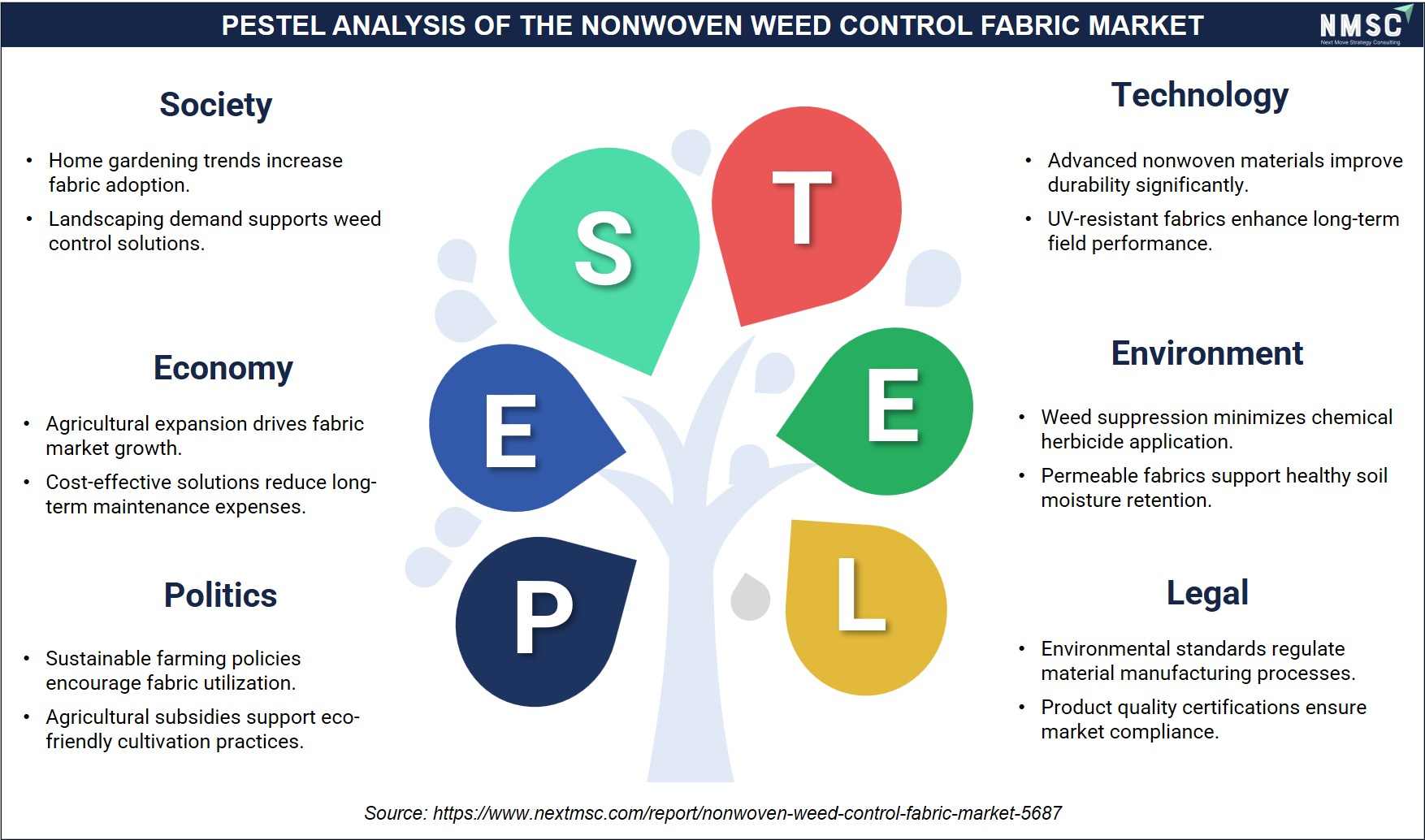
NMSC's analysis indicates that growing home gardening trends, agricultural expansion, and supportive government subsidies are accelerating growth in the Nonwoven Weed Control Fabric Market. Furthermore, advanced UV-resistant nonwoven technologies improve long-term durability and soil moisture retention while minimizing chemical herbicide use. Concurrently, strict environmental regulations and product quality certifications ensure manufacturing compliance and sustainable cultivation practices nationwide.
Growth Drivers and Restraints
Growth Catalyst and Risk Assessment Matrix
|
Factors |
Type |
(+/-) % Impact on CAGR |
Geographic Relevance |
Impact Timeline |
|
Rising commercial landscaping expenditure |
Driver |
+1.8% |
North America, Europe |
2026-2035 |
|
Growing organic farming adoption reducing herbicide reliance |
Driver |
+1.5% |
North America, Asia-Pacific |
2026-2033 |
|
Expanding perennial and orchard crop cultivation |
Driver |
+1.2% |
Asia-Pacific, Latin America |
2026-2032 |
|
Government water conservation and irrigation efficiency programs |
Driver |
+1.0% |
Asia-Pacific, MEA |
2026-2031 |
|
Rising residential gardening and DIY landscaping activity |
Driver |
+0.8% |
North America, Europe |
2026-2035 |
|
Regulatory restrictions on single-use plastic fabrics |
Restraint |
-1.1% |
Europe, North America |
2026-2030 |
|
High cost of UV-stabilized and biodegradable fabric grades |
Restraint |
-0.7% |
Latin America, MEA |
2026-2029 |
|
Volatility in polypropylene resin raw material prices |
Restraint |
-0.6% |
Global |
2026-2030 |
|
Limited farmer awareness in developing regions |
Restraint |
-0.5% |
MEA, Latin America |
2026-2028 |
What Is the Primary Growth Driver of the Nonwoven Weed Control Fabric Market?
Rising commercial landscaping expenditure is the primary driver of the market, as municipal and commercial property managers increasingly budget for durable ground cover solutions. The U.S. Department of Agriculture reports expanding commercial horticultural services activity across major metropolitan regions, prompting fabric manufacturers to fund research aimed at improving multi-season durability performance.
How Is Organic Farming Adoption Driving Market Growth?
Growing organic farming adoption is driving market growth as certified growers seek mechanical weed suppression alternatives to synthetic herbicides. The U.S. Department of Agriculture's organic certification program has expanded certified organic cropland acreage, industry-derived estimate indicating meaningful nonwoven fabric demand growth across organic row-crop and orchard operations.
What Is Restraining Nonwoven Weed Control Fabric Market Expansion?
Regulatory restrictions on single-use plastic fabrics are restraining market expansion, particularly across jurisdictions restricting non-biodegradable polypropylene ground covers. The European Union's packaging and plastics directive has narrowed permissible fabric compositions, and industry-derived estimates indicate that compliance reformulation disproportionately affects smaller fabric manufacturers.
Segmentation Analysis
Segment Sizing: By Material Type
|
Segment |
2025 (USD) |
2035 (USD) |
CAGR% (2026-2035) |
|
Polypropylene |
USD 0.65 Billion |
USD 1.18 Billion |
6.1% |
|
Polyester |
USD 0.33 Billion |
USD 0.66 Billion |
7.2% |
|
Polyethylene |
USD 0.20 Billion |
USD 0.39 Billion |
6.9% |
|
Total |
USD 1.18 Billion |
USD 2.23 Billion |
6.55% |
Which Material Type Segment Dominates the Nonwoven Weed Control Fabric Market?
Polypropylene led the market, valued at USD 0.65 billion in 2025 and projected to reach USD 1.18 billion by 2035, supported by its low cost and established manufacturing infrastructure across spunbond production lines. Polyester is the fastest-growing sub-segment at a CAGR of 7.2%, driven by rising demand for higher tensile strength and improved UV resistance among commercial landscaping applications.
Segment Sizing: By Application
|
Segment |
2025 (USD) |
2035 (USD) |
CAGR% (2026-2035) |
|
Agricultural |
USD 0.62 Billion |
USD 1.12 Billion |
6.0% |
|
Landscaping & Gardening |
USD 0.38 Billion |
USD 0.75 Billion |
7.1% |
|
Horticulture & Nursery |
USD 0.18 Billion |
USD 0.36 Billion |
7.2% |
|
Total |
USD 1.18 Billion |
USD 2.23 Billion |
6.55% |
Which Application Segment Is Growing Fastest?
Horticulture & Nursery is the fastest-growing application segment, expanding at a CAGR of 7.2% between 2026 and 2035, driven by rising container and nursery bed weed suppression adoption. Agricultural remains the dominant segment given its established row-crop ground cover volumes, while Landscaping & Gardening continues to expand steadily across commercial property management contracts.
Segment Sizing: By Distribution Channel
|
Segment |
2025 (USD) |
2035 (USD) |
CAGR% (2026-2035) |
|
Direct/Institutional |
USD 0.72 Billion |
USD 1.32 Billion |
6.2% |
|
Retail/DIY |
USD 0.46 Billion |
USD 0.91 Billion |
7.1% |
|
Total |
USD 1.18 Billion |
USD 2.23 Billion |
6.55% |
Why Does Direct/Institutional Distribution Lead the Market?
Direct/Institutional distribution dominated the market, reaching USD 0.72 billion in 2025 due to bulk procurement contracts between fabric manufacturers and commercial landscaping or agricultural service providers. Retail/DIY is expanding at a faster CAGR of 7.1% as residential gardening activity drives higher retail shelf placement across home improvement and garden center channels.
Growth Opportunities
Our analysis shows that three forward-looking opportunities stand out for stakeholders positioning within the nonwoven weed control fabric market.
How Can Biodegradable Fabric Formulations Unlock Value for Organic Growers?
Biodegradable fabric formulations that decompose within a single growing season present a whitespace opportunity for certified organic growers seeking to eliminate post-harvest fabric removal labor while maintaining compliance with organic certification standards.
Where Does Drip-Irrigation-Compatible Fabric Create Demand in Water-Scarce Regions?
Fabric engineered for optimal water permeability under drip-irrigation systems creates an underpenetrated opportunity across water-scarce agricultural regions, where irrigation efficiency mandates are prompting growers to reconsider conventional ground cover materials.
How Can Extended-Warranty Fabric Programs Benefit Commercial Landscaping Contractors?
Extended-warranty fabric programs guaranteeing multi-year UV and tensile performance create an opportunity for commercial landscaping contractors to justify premium fabric specification through measurable maintenance-cost reduction for property management clients.
Regional Outlook
Geographic Performance Snapshot
|
Region |
2025 (USD) |
2035 (USD) |
CAGR% (2026-2035) |
Key Driver |
|
North America |
USD 0.38 Billion |
USD 0.64 Billion |
5.2% |
Commercial landscaping expenditure |
|
Europe |
USD 0.28 Billion |
USD 0.48 Billion |
5.4% |
Regulatory-driven biodegradable fabric adoption |
|
Asia-Pacific |
USD 0.32 Billion |
USD 0.72 Billion |
8.6% |
Expanding perennial crop cultivation |
|
Middle East & Africa |
USD 0.11 Billion |
USD 0.21 Billion |
6.7% |
Water conservation and irrigation programs |
|
Latin America |
USD 0.09 Billion |
USD 0.18 Billion |
7.2% |
Expanding row-crop cultivation area |
|
Total |
USD 1.18 Billion |
USD 2.23 Billion |
6.55% |
|
North America Nonwoven Weed Control Fabric Market Outlook
North America leads the market with a mature commercial landscaping ecosystem and established vendor base spanning Berry Global Group, Inc. and DuPont de Nemours, Inc. Regulatory emphasis on organic certification under U.S. Department of Agriculture guidance shapes fabric specification, while widespread residential gardening activity continues to anchor demand across the region.
Europe Nonwoven Weed Control Fabric Market Outlook
Europe's market reflects a regulation-intensive landscape shaped by the European Union's packaging and plastics directive, requiring rigorous fiber-composition compliance across fabric vendors. Strategic outlook favors vendors demonstrating biodegradable formulation readiness, with Freudenberg Group maintaining a strong regional institutional footprint across Germany and continental Europe.
Asia-Pacific Nonwoven Weed Control Fabric Market Outlook
Asia-Pacific is the fastest-growing region, propelled by expanding perennial crop cultivation in China and India alongside rising commercial horticulture investment. Technology adoption is accelerating among row-crop and orchard operators as regional governments prioritize water conservation within national agricultural strategies.
Middle East & Africa Nonwoven Weed Control Fabric Market Outlook
The market in Middle East & Africa is expanding as Gulf Cooperation Council economies invest in water conservation and controlled-environment agriculture initiatives. Regulatory support for irrigation efficiency standards in Saudi Arabia and South Africa is accelerating institutional fabric adoption across the region.
Latin America Nonwoven Weed Control Fabric Market Outlook
Latin America's market is supported by expanding row-crop cultivation area alongside growing commercial fruit and vegetable production in Brazil and Argentina. Strategic outlook favors vendors offering cost-efficient polypropylene formulations tailored to the region's large-scale mechanized farming operations.
U.S. Nonwoven Weed Control Fabric Market
Based on our estimates, the U.S. market was valued at approximately USD 0.27 billion in 2025 and is projected to reach USD 0.44 billion by 2035, expanding at a CAGR of 4.8%. Demand structure reflects strong commercial landscaping adoption, high technology penetration, and competitive intensity among established nonwoven manufacturers, supported by a favorable regulatory environment for organic-certified ground cover materials.
Canada Nonwoven Weed Control Fabric Market
The market in Canada reached roughly USD 0.07 billion in 2025 and is forecast to hit USD 0.12 billion by 2035 at a CAGR of 5.4%. Adoption levels are rising within commercial nursery and orchard operations, supported by federal organic certification programs and growing competitive intensity among regional and multinational fabric vendors.
UK Nonwoven Weed Control Fabric Market
As per our estimate, the UK market stood at about USD 0.07 billion in 2025, advancing toward USD 0.115 billion by 2035 at a CAGR of 4.9%. Regulatory influence from plastics directive statutes shapes vendor selection, while commercial landscaping contractors show strong demand structure for UV-stabilized fabric grades amid rising technology penetration.
Germany Nonwoven Weed Control Fabric Market
According to our analysis, Germany's market was valued near USD 0.08 billion in 2025 and is set to reach USD 0.135 billion by 2035, growing at a CAGR of 5.2%. Strategic outlook favors vendors offering compliance-ready biodegradable formulations, with commercial nursery operators showing strong adoption levels amid rising competitive intensity.
France Nonwoven Weed Control Fabric Market
Based on our estimates, France's market reached approximately USD 0.05 billion in 2025, projected to climb to USD 0.085 billion by 2035 at a CAGR of 5.3%. Demand structure reflects growing horticultural adoption of UV-resistant fabric grades, supported by national agricultural funding and moderate competitive intensity.
China Nonwoven Weed Control Fabric Market
The market in China was valued at approximately USD 0.12 billion in 2025 and is projected to reach USD 0.30 billion by 2035 at a CAGR of 9.9%. Adoption levels are accelerating rapidly across orchard and perennial crop systems, supported by strong government agricultural funding and intense competitive activity among domestic fabric vendors.
India Nonwoven Weed Control Fabric Market
As per our estimate, India's market stood at roughly USD 0.08 billion in 2025, advancing toward USD 0.22 billion by 2035 at a CAGR of 11.1%, the fastest among covered countries. Demand structure reflects rapid horticulture-driven adoption, strong government agricultural policy support, and rising competitive intensity among domestic and multinational vendors.
Japan Nonwoven Weed Control Fabric Market
According to our analysis, Japan's market reached approximately USD 0.05 billion in 2025 and is forecast to reach USD 0.09 billion by 2035 at a CAGR of 6.0%. Technology penetration remains high, with commercial nursery adoption supported by precision horticulture initiatives amid a shrinking farmer population and moderate regulatory influence.
South Korea Nonwoven Weed Control Fabric Market
Based on our estimates, South Korea's market was valued at about USD 0.03 billion in 2025, projected to reach USD 0.055 billion by 2035 at a CAGR of 6.2%. Strong government agricultural modernization funding and strategic outlook favoring quality-certified fabric programs support rising adoption levels across horticultural segments.
Australia Nonwoven Weed Control Fabric Market
The market in Australia reached roughly USD 0.025 billion in 2025 and is expected to reach USD 0.045 billion by 2035 at a CAGR of 6.0%. Demand structure reflects growing viticulture and orchard adoption, supported by favorable regulatory environment and moderate competitive intensity among regional vendors.
UAE Nonwoven Weed Control Fabric Market
As per our estimate, the UAE market stood at approximately USD 0.02 billion in 2025, advancing toward USD 0.04 billion by 2035 at a CAGR of 7.2%. Strategic outlook favors fabric aligned with national food security goals, supported by strong government funding and rising technology penetration across controlled-environment agriculture.
Saudi Arabia Nonwoven Weed Control Fabric Market
According to our analysis, Saudi Arabia's market reached approximately USD 0.03 billion in 2025 and is projected to reach USD 0.06 billion by 2035 at a CAGR of 7.2%. Demand structure is shaped by Vision 2030 agricultural modernization funding, supporting rising adoption levels across water-efficient cropping programs.
South Africa Nonwoven Weed Control Fabric Market
Based on our estimates, South Africa's market was valued at about USD 0.02 billion in 2025, advancing toward USD 0.04 billion by 2035 at a CAGR of 7.2%. Adoption levels remain constrained by infrastructure gaps, though rising commercial farming investment and government agricultural programs support gradual demand structure growth.
Brazil Nonwoven Weed Control Fabric Market
The market in Brazil reached approximately USD 0.06 billion in 2025 and is forecast to reach USD 0.125 billion by 2035 at a CAGR of 7.7%. Demand structure reflects growing fruit and vegetable production adoption, supported by expanding cultivation area and moderate competitive intensity among regional fabric vendors.
Argentina Nonwoven Weed Control Fabric Market
As per our estimate, Argentina's market stood at roughly USD 0.02 billion in 2025, advancing toward USD 0.04 billion by 2035 at a CAGR of 7.2%. Technology penetration is rising steadily, with row-crop producers showing increasing adoption of nonwoven ground covers amid a stabilizing regulatory environment.
Supply Chain Structure of the Nonwoven Weed Control Fabric Market
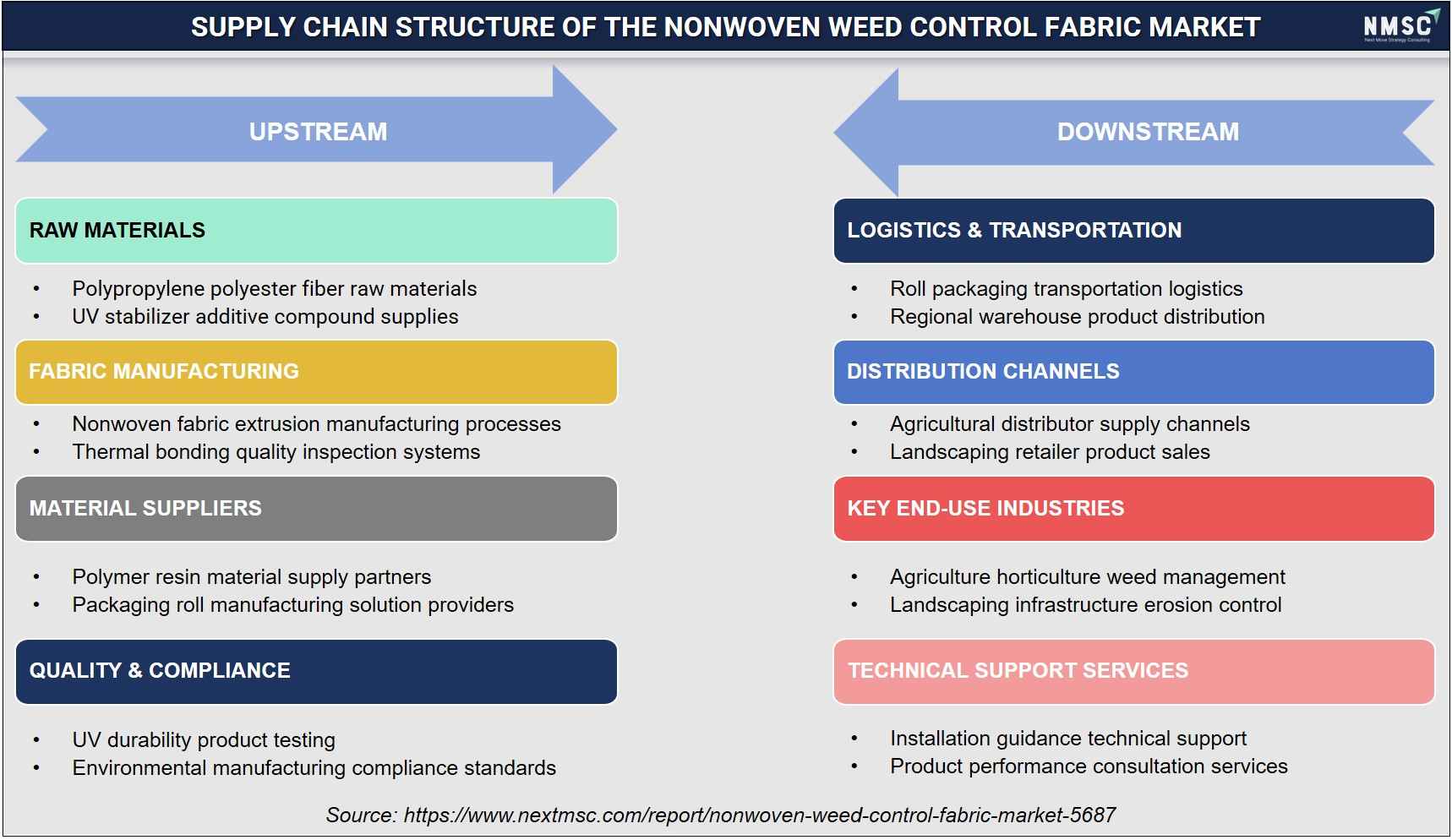
Based on research conducted by NMSC, we found that the supply chain structure of the Nonwoven Weed Control Fabric Market connects polypropylene fibers, extrusion manufacturing, and thermal bonding quality inspections with downstream distribution. Regional warehouses and agricultural supply channels deliver packaged rolls to horticulture and erosion control projects. Ultimately, expert installation guidance and technical performance consultation services ensure effective field application.
Competitive Landscape
We found that the competitive landscape is moderately consolidated, with global nonwoven fabric conglomerates competing alongside specialized geotextile vendors across distinct application verticals.
|
Dimension |
Details |
|
Market Structure |
Moderately consolidated, with 20 profiled vendors spanning diversified nonwoven manufacturers and specialized geotextile providers |
|
Innovation Focus |
Biodegradable fiber blends, UV-stabilized formulations, and water-permeable fabric engineering |
|
M&A Activity |
Selective acquisitions of specialty geotextile and biodegradable fiber technology firms by larger nonwoven fabric manufacturers |
How Do Companies Compete in the Nonwoven Weed Control Fabric Market?
Companies compete primarily on fabric durability ratings, regulatory compliance breadth across covered geographies, and depth of technical support services offered to landscaping and agricultural customers. Pricing strategies increasingly favor volume-based supply agreements tied to multi-year institutional contracts.
Which Competitive Archetypes Dominate the Industry?
Three archetypes dominate the Industry: diversified nonwoven conglomerates such as Freudenberg Group offering integrated fabric portfolios, specialty geotextile formulators such as Solmax International Inc. focused on engineered polymer chemistry, and agricultural fabric specialists such as DeWitt Company emphasizing grower-focused product lines.
What Innovation and Differentiation Strategies Are Vendors Pursuing?
Vendors are differentiating through proprietary biodegradable fiber chemistries, expanded UV-stabilization technology, and technical support partnerships with commercial landscaping contractors, aiming to strengthen defensibility against commoditized generic fabric offerings from smaller entrants.
What M&A Activity Is Shaping the Competitive Landscape?
M&A activity has concentrated on acquisitions of specialty geotextile and biodegradable fiber technology firms by larger nonwoven fabric vendors seeking to accelerate proprietary formulation capability development rather than build such functionality internally, reflecting broader industry consolidation trends.
Key Market Players
We found that the following companies represent the leading providers of nonwoven weed control fabric based on market-specific revenue and scale of operations as of 2026.
-
Freudenberg Group
-
Berry Global Group, Inc.
-
Fibertex Nonwovens A/S
-
Propex Operating Company, LLC
-
Toray Industries, Inc.
-
Suominen Corporation
-
Sandler AG
-
Milliken & Company
-
Hanesbrands Inc.
-
Thrace Group S.A.
-
Don & Low Limited
-
DeWitt Company
-
Geofabrics Australasia Pty Ltd
-
Mattex Geosynthetics
-
Texel Technical Materials Inc.
-
Officine Maccaferri S.p.A.
-
Easy Gardener Products, LLC
-
Global Synthetics Pty Ltd
Latest Developments
|
Date |
Event |
|
May 2026 |
Solmax began construction of a flagship European geosynthetics manufacturing center in Les Mureaux, France. The eight-hectare facility will consolidate Solmax's European nonwoven geotextile operations and integrate advanced manufacturing with laboratory, sales and marketing functions, creating a more efficient manufacturing environment and strengthening technical capabilities across geosynthetic applications, including landscaping and agricultural uses. |
Expert Insights
 "Studies are being performed worldwide to quantify the environmental impact of geotextiles. Those of us in the industry for some time recognize that geotextiles are a critical component for long-lasting infrastructure, which can serve several different functional applications, including filtration, separation, and protection of adjacent materials and/or subgrade.."
— Anthony Johnson, Vice President – Technical Services, AGRU America
Statement made during an interview with Geosynthetics Magazine discussing emerging trends and the growing role of geotextiles in enhancing infrastructure performance and durability.
Market Interpretation
The statement highlights the expanding role of engineered geotextiles in applications requiring durability, separation, filtration, and ground protection. These performance characteristics are equally essential for nonwoven weed control fabrics used across agricultural fields, commercial landscapes, and erosion control projects, where effective weed suppression, soil stabilization, moisture management, and permeability are critical. As infrastructure development, sustainable land management, and precision agriculture continue to advance, manufacturers are increasingly developing high-performance nonwoven polypropylene and polyester fabrics with improved mechanical strength, UV resistance, and extended service life. This trend is expected to support sustained demand for nonwoven weed control fabrics across landscaping, agriculture, and construction applications.
Investment Opportunities
What Capital Inflows Are Supporting Market Expansion?
Corporate and manufacturing investment continue to flow into biodegradable fiber and UV-stabilization formulation startups. Our findings suggest that investor interest is concentrated on formulations demonstrating measurable durability improvements alongside recurring multi-year supply agreements.
How Is Infrastructure Investment Shaping Fabric Manufacturing Scalability?
Manufacturing capacity investment by established nonwoven producers, including Toray Industries, Inc. and Suominen Corporation, underpins fabric scalability for expanding agricultural and landscaping demand. This infrastructure investment supports consistent formulation quality across geographically distributed production facilities.
What ESG Considerations Are Relevant to Market Investment?
Environmental, Social, and Governance considerations increasingly influence procurement, with commercial customers evaluating vendor biodegradability commitments and plastic-reduction practices. Government funding programs in several regions now require ESG disclosure as a condition of institutional landscaping contract eligibility.
Key Benefits for Stakeholders
How Does This Report Benefit Industry Leaders?
Industry leaders gain access to detailed segmentation, regional forecasts, and competitive benchmarking that support formulation investment and supply agreement decisions across agricultural, landscaping, and horticultural fabric markets.
How Does This Report Benefit Investors and Financial Analysts?
Investors and financial analysts benefit from validated market sizing, CAGR forecasts, and company-level competitive positioning that inform capital allocation decisions across the nonwoven weed control fabric value chain.
How Does This Report Benefit Technology Vendors and Product Teams?
Technology vendors and product teams gain insight into emerging trends, growth opportunities, and regional demand patterns that inform fabric formulation prioritization and go-to-market strategy across covered geographies.
Key Market Segments
By Material Type
-
Polypropylene
-
Polyester
-
Polyethylene
By Application
-
Agricultural
-
Landscaping & Gardening
-
Horticulture & Nursery
By Distribution Channel
-
Direct/Institutional
-
Retail/DIY
By Region
-
North America: U.S., Canada, Mexico
-
Europe: UK, Germany, France, Italy, Spain, Sweden, Denmark, Finland, Netherlands, Rest of Europe
-
Asia-Pacific: China, India, Japan, South Korea, Taiwan, Indonesia, Vietnam,Australia, Philippines, Malaysia, Rest of APAC
-
Middle East & Africa: Saudi Arabia, UAE, Egypt, Israel, Turkey, Nigeria, South Africa, Rest of MEA
-
Latin America: Brazil, Argentina, Chile, Colombia, Rest of LATAM
Conclusion and Recommendations
What Is the Long-Term Outlook for the Market?
The long-term outlook remains positive, with the market projected to expand from USD 1.26 billion in 2026 to USD 2.23 billion by 2035 as commercial landscaping contractors and growers deepen reliance on durable nonwoven fabric solutions.
What Strategic Positioning Should Vendors Pursue?
Vendors should prioritize biodegradable formulation readiness and regulatory compliance breadth to differentiate against commoditized generic fabrics, while pursuing strategic partnerships with commercial landscaping and agricultural customers to strengthen supply agreement credibility.
How Attractive Is the Market for Investment?
Investment attractiveness remains moderate given steady mid-single-digit CAGR expectations and expanding organic farming adoption, though investors should weigh regulatory compliance costs and raw material price volatility affecting margin stability.
What Market Shifts and Key Risks Should Stakeholders Monitor?
Stakeholders should monitor tightening single-use plastic regulation, polypropylene raw material price volatility, and potential shifts in commercial landscaping budgets, each of which could affect procurement timelines across covered geographies.
What Are the Primary Growth Pathways for Market Participants?
Primary growth pathways include expansion into underpenetrated horticultural nursery markets, deeper biodegradable fiber integration, and strategic acquisition of specialty geotextile startups to accelerate proprietary formulation capability development.
About the Author
 Mayurima Roy
— Mayurima Roy is Research Analyst at Next Move Strategy Consulting, where she has spent 4 years working across the firm's full industry coverage rather than a single fixed vertical. Her work centers on structured research, ongoing trend tracking, competitive assessment, and insight-led content development, translating complex market data into clear, decision-ready narratives that support informed client decision-making across diverse global industries, market sectors, and world regions every day.
Mayurima Roy
— Mayurima Roy is Research Analyst at Next Move Strategy Consulting, where she has spent 4 years working across the firm's full industry coverage rather than a single fixed vertical. Her work centers on structured research, ongoing trend tracking, competitive assessment, and insight-led content development, translating complex market data into clear, decision-ready narratives that support informed client decision-making across diverse global industries, market sectors, and world regions every day.
About the Reviewer
 Supradip Baul
— Supradip Baul is an accomplished business consultant and strategist with over a decade of rich experience in market intelligence, strategy, technology, and business transformation. His work has included rigorous qualitative and quantitative analysis across multiple industries, helping clients shape investment decisions and long-term roadmaps. Earlier in his career, he was associated with Gartner, where he contributed to industry-leading reports and market share analyses. He has worked with leading global companies and holds an MBA with a dual specialization in Marketing and Finance.
Supradip Baul
— Supradip Baul is an accomplished business consultant and strategist with over a decade of rich experience in market intelligence, strategy, technology, and business transformation. His work has included rigorous qualitative and quantitative analysis across multiple industries, helping clients shape investment decisions and long-term roadmaps. Earlier in his career, he was associated with Gartner, where he contributed to industry-leading reports and market share analyses. He has worked with leading global companies and holds an MBA with a dual specialization in Marketing and Finance.
At Next Move Strategy Consulting, we understand that insightful market research is the cornerstone of successful business decisions. That's why we employ a robust and multifaceted approach, combining various methodologies to deliver the most accurate and actionable data for our clients.

Research Landscape
We navigate the world of research with two primary approaches:
Qualitative Approach
Our qualitative research methodologies involve immersive techniques such as in-depth interviews, focus groups, and observational studies. By engaging directly with individuals and stakeholders, we uncover valuable insights that quantitative data alone may overlook.

Quantitative Research
In tandem with qualitative methodologies, NMSC leverages the power of Quantitative Research to provide a robust foundation of numerical insights. Through systematic data collection and analysis, we quantify patterns, preferences, and market trends, offering a comprehensive view of the business landscape.
Our quantitative research approach employs diverse tools, including surveys, experiments, and statistical modelling. These methodologies enable us to gather data from a large and representative sample, ensuring the statistical significance of our findings. By employing structured questionnaires and standardized data collection methods, we guarantee the reliability and validity of the information we present to our clients.
Quantitative research is particularly effective in measuring the prevalence of trends, assessing market size, and gauging the impact of various factors on consumer behavior. The numerical precision attained through this approach equips our clients with actionable insights, facilitating data-driven decision-making and strategy formulation.


Our Specialized Toolbox for Industry-Specific Market Research
We deploy a specialized arsenal of techniques tailored to meet your unique requirements. Here's a glimpse into our comprehensive toolbox:

Information Procurement
The stage entails acquiring market data or relevant information through various sources and methodologies.


Market Research Approach
We utilize both top-down and bottom-up approaches in market research analysis to achieve a comprehensive understanding of the market dynamics, leveraging the broad perspective of industry trends and macroeconomic factors alongside detailed insights from specific segments and individual companies.

Porters Five Forces Analysis
We conduct Porter's Five Forces analysis to evaluate the competitive landscape of an industry, providing us with insights into factors that affect profitability and strategic positioning.

SWOT Analysis

Forecasting
We utilize a forecasting model to predict future consumption by considering parameters like population, economics, regulations, market competition, drivers, constraints, technology, and pricing. We also employ statistical techniques such as multilinear regression, exponential smoothing, moving average, ARIMA, and Monte Carlo simulations for accurate predictions. In econometric forecasting, we analyzed short-term and long-term event impacts, attributing values based on regulatory frameworks, economic factors, and market events.





 Speak to Our Analyst