Horse Trailers Market Global Industry Analysis and Forecast (2026–2035)

The global horse trailers market was valued at USD 1.06 billion in 2025 and is projected to reach USD 1.74 billion by 2035, registering a CAGR of 5.1% from 2026 to 2035. Key demand factors include equestrian transportation requirements, replacement purchases, and demand for lightweight trailer construction, with North America accounting for the largest regional share.

Download Free Sample PDF
Base Year (2025)
$1.06 Billion
Forecast (2035)
$1.74 Billion
CAGR (2026-2035)
5.1%
Top Region
North America

What Is the Horse Trailers Market Size?

The global horse trailers market was valued at USD 1.06 billion in 2025 and is estimated to reach USD 1.11 billion in 2026, before increasing to USD 1.74 billion by 2035 at a CAGR of 5.1% from 2026 to 2035. North America accounted for approximately 34% of global revenue in 2025, making it the leading regional market. The straight-load segment represented approximately 34% of global revenue, according to the current market estimation model.

Based on our analysis, we observed that material selection is an important consideration in horse trailer design because it influences trailer weight, durability, maintenance requirements, and purchase cost. Aluminum construction offers weight and corrosion-resistance advantages, while steel remains an alternative for buyers prioritizing initial affordability and structural requirements. Manufacturers also differentiate their products through flooring systems, ramp mechanisms, hitch configurations, and interior fittings suited to recreational and professional equestrian applications.

Horse Trailers Market Global Industry Analysis and Forecast (2026–2035) Revenue Forecast

Values in USD Billion

2025 $1.06 Billion
2025
2026 $1.11 Billion
2026
2027 $1.17 Billion
2027
2028 $1.23 Billion
2028
2029 $1.29 Billion
2029
2030 $1.35 Billion
2030
2031 $1.42 Billion
2031
2032 $1.50 Billion
2032
2033 $1.57 Billion
2033
2034 $1.65 Billion
2034
2035 $1.74 Billion
2035

Key Takeaways

By Trailer Type: Straight Load trailers held the largest share, expanding from USD 0.36 Billion in 2025 to USD 0.57 Billion by 2035; Other Configurations is the fastest-growing at 7.32% CAGR from 2026–2035.

By Material: Aluminum held the largest share, expanding from USD 0.51 Billion in 2025 to USD 0.73 Billion by 2035; Composite and Other is the fastest-growing at 7.23% CAGR from 2026–2035.

By End User: Individual Equestrians held the largest share, expanding from USD 0.48 Billion in 2025 to USD 0.71 Billion by 2035; Racing and Show Operations is the fastest-growing at 6.42% CAGR from 2026–2035.

By Distribution Channel: Authorized Dealerships held the largest share, expanding from USD 0.48 Billion in 2025 to USD 0.69 Billion by 2035; Online and Used Marketplaces is the fastest-growing at 7.05% CAGR from 2026–2035.

Dominant Region: North America dominated the market with approximately 34% revenue share (USD 0.36 billion) in 2025, supported by established horse ownership, breeding operations, recreational riding, competitive equestrian activities, and established manufacturer and dealer networks.

Fastest-Growing Region: Asia-Pacific is expected to register the highest CAGR of 8.2% during 2026–2035, supported by potential demand associated with equestrian participation, horse breeding, racing, and the development of riding facilities in selected markets.

Dominant Country: The U.S. led the market with an estimated USD 0.27 billion in 2025 (~75% of North America), supported by established horse ownership, recreational riding, breeding, and competitive equestrian activities.

Fastest-Growing Country: India is among the fastest-growing major country markets, with revenue projected to increase from USD 0.06 billion in 2025 to USD 0.14 billion by 2035 at a modelled CAGR of approximately 9.87%. Potential demand is associated with horse breeding, polo, racing, and organized equestrian activities.

The horse trailers market is expected to generate an absolute dollar opportunity of USD 0.63 billion between 2026 and 2035, rising from USD 1.11 billion to USD 1.74 billion. This increase reflects the market model's assumptions regarding replacement purchases, demand from existing equestrian owners, and potential acquisitions by new buyers. Suppliers that broaden their configuration portfolios and strengthen dealer networks can convert this expansion into durable revenue gains across mature and emerging geographies.

The competitive landscape of horse trailers includes established manufacturers such as Featherlite Inc., Sundowner trailers, Inc., Exiss specialized systems Ltd, Bloomer Trailer Mfg., Inc., and Sooner trailers Inc. Titan trailers, Inc., Miller Industries, Inc., Wilson Trailer Company, and Hart trailers Inc. further shape supply dynamics. Partnerships with towing vehicle makers, dealer alliances, and component suppliers help firms secure axles, lighting systems, and flooring materials at scale, reinforcing their competitive positions.

Ecosystem Analysis of the Horse Trailers Industry

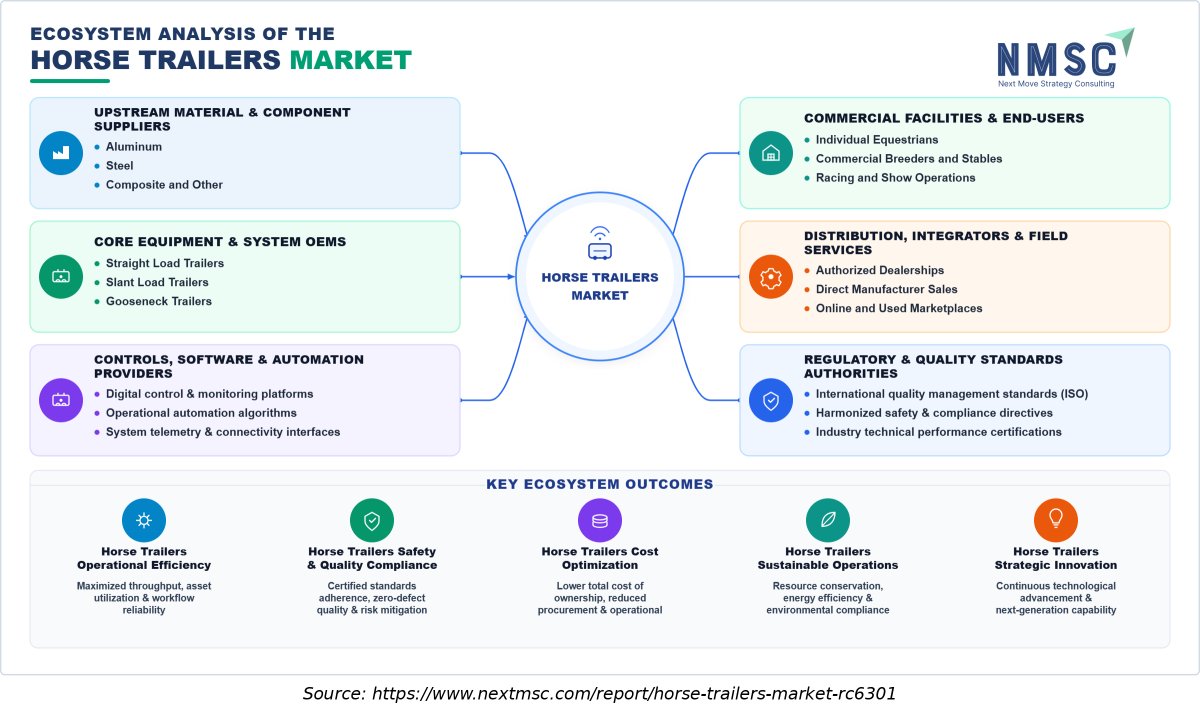
The infographic presents the horse trailers market ecosystem through six stakeholder groups: raw material and component suppliers, horse trailer manufacturers, equipment and subsystem suppliers, equestrian end users, dealerships and service providers, and regulatory authorities. It illustrates how these participants contribute to trailer design, manufacturing, distribution, maintenance, transportation safety, and animal welfare.

What Does the Horse Trailers Market Encompass?

The horse trailers market encompasses purpose-built towable trailers designed to transport horses over road networks. These products include enclosed and stock-style configurations, with different loading arrangements and hitch systems to accommodate individual owners, breeding operations, stables, and competitive equestrian activities. Core product configurations include straight-load and slant-load arrangements, which determine horse positioning inside the trailer, and bumper-pull and gooseneck hitch systems, which determine how the trailer connects to the towing vehicle. These configurations influence loading convenience, trailer capacity, towing requirements, and vehicle compatibility. Coverage extends to living quarter variants, bumper pull models, and specialized designs for racing, trail riding, and breeding operations, with frames built from steel or aluminum and fitted with ramps, dividers, and ventilation systems.
Design specifications in horse trailers center on axle ratings, tire load capacity, floor strength, and interior dimensions that meet animal welfare expectations. Material innovations include aluminum framing, composite flooring panels, and corrosion-resistant hardware that extend service life in wet or saline environments. Applicable regulatory requirements vary by country and may cover trailer dimensions, braking systems, lighting, towing capacity, roadworthiness, and animal transport welfare. Manufacturers and buyers must consider the requirements of the destination market when selecting trailer specifications and preparing products for cross-border distribution.

Market Drivers & Dynamics

Interactive Dataset
Growing Equestrian Participation driver High Expanding recreational and competitive riding sustains baseline demand for enclosed horse trailers. Immediate
Fleet Replacement Cycles driver High Aging trailers prompt upgrades toward safer flooring, improved ventilation, and modern axle systems. Immediate
Lightweight Aluminum Adoption driver Medium Lighter frames broaden compatibility with mid-size towing vehicles and improve handling. Medium-term
Raw Material Cost Volatility restraint High Fluctuating steel and aluminum prices compress manufacturer margins on horse trailers. Immediate
Towing Vehicle Compatibility Limits restraint Medium Trailer weight and loaded towing requirements can restrict the range of compatible towing vehicles, particularly for buyers using vehicles with lower rated towing capacities Medium-term
Skilled Labor Availability restraint Low Shortages of experienced welders and trailer fabricators can slow capacity expansion over time. Long-term
Source: Next Move Strategy Consulting

Growth Drivers

What Is the Primary Growth Driver in the Horse Trailers Industry?

Equestrian transportation requirements vary according to horse ownership, riding activities, event participation, and the frequency of travel. Owners involved in competitions, breeding, trail riding, and other equestrian activities may require dedicated trailers with appropriate loading arrangements, ventilation, and interior safety features. These requirements contribute to demand for both first-time purchases and upgrades to specialized configurations.

How Do Transportation Safety and Animal Welfare Requirements Influence the Horse Trailers Market?

Regulatory requirements influence horse trailer design through provisions concerning trailer construction, braking systems, lighting, towing limits, roadworthiness, and animal transportation. These requirements differ across countries and can affect product specifications, operating conditions, and compliance obligations. Manufacturers serving multiple markets must therefore consider the relevant national transportation and animal welfare requirements when developing their products.

Growth Inhibitors

What Is Restraining the Horse Trailers Market?

Raw material cost volatility is an important commercial restraint for horse trailer manufacturers because fluctuations in steel, aluminum, and other component prices can increase production expenses and affect pricing decisions. Producers that rely on fixed-price contracts with dealers face margin pressure during periods of sharp input cost increases, which can delay purchase decisions among price-sensitive buyers.

What Are the Growth Opportunities?

Can Lightweight Premium Trailers Address Demand Among Weight-Conscious Buyers?

Lightweight premium configurations offer manufacturers an opportunity to serve buyers seeking trailers with improved towing characteristics and reduced structural weight. Aluminum-framed models, including selected living-quarter and multi-horse configurations, can appeal to owners balancing payload requirements, durability, and towing vehicle compatibility. Manufacturers can differentiate these products through construction quality, interior customization, and after-sales service.

How Can Riding Schools and Regional Equestrian Facilities Create Additional Demand?

Riding schools, boarding facilities, breeding establishments, and regional equestrian clubs represent potential commercial customers for horse trailers. Their requirements may include transporting horses to competitions, breeding facilities, veterinary appointments, and external riding locations. Manufacturers and dealerships can address these requirements through appropriate trailer capacities, financing arrangements, maintenance support, and fleet purchasing options.

Can Specialized Horse Trailer Configurations Create Premium Market Opportunities?

Specialized configurations for breeding, racing, and show operations offer potential premium opportunities within the horse trailers market. Professional buyers may prioritize suitable stall dimensions, ventilation, interior padding, storage arrangements, and convenient loading access. Manufacturers that offer application-specific configurations can differentiate their products and address the needs of buyers with specialized transportation requirements.

Segmentation Analysis

2025 (USD Billion)
2035 (USD Billion)
Straight Load Trailers 2025: $0.36 Billion | 2035: $0.38 Billion
Straight Loa
Slant Load Trailers 2025: $0.28 Billion | 2035: $0.29 Billion
Slant Load T
Gooseneck Trailers 2025: $0.20 Billion | 2035: $0.21 Billion
Gooseneck Tr
Bumper Pull Trailers 2025: $0.13 Billion | 2035: $0.14 Billion
Bumper Pull
Other Configurations 2025: $0.09 Billion | 2035: $0.09 Billion
Other Config
Straight Load Trailers $0.36 Billion $0.38 Billion USD 0.57 Billion
Slant Load Trailers $0.28 Billion $0.29 Billion USD 0.42 Billion
Gooseneck Trailers $0.20 Billion $0.21 Billion USD 0.34 Billion
Bumper Pull Trailers $0.13 Billion $0.14 Billion USD 0.24 Billion
Other Configurations $0.09 Billion $0.09 Billion USD 0.17 Billion

Segment Sizing: By Trailer Type

2025 (USD Billion)
2035 (USD Billion)
Category A
Category B
Category C
Category D
Segment Item 2025 (USD Billion) 2035 (USD Billion) CAGR
Category A $10.0 USD Billion $40.0 USD Billion 25.0%
Category B $17.1 USD Billion $51.1 USD Billion 11.0%
Category C $24.2 USD Billion $62.2 USD Billion 25.0%
Category D $31.3 USD Billion $73.3 USD Billion 11.0%

Segment-wise data is locked

Unlock complete segment-wise numbers for By Material.

Unlock Full Data
2025 (USD Billion)
2035 (USD Billion)
Category A
Category B
Category C
Category D
Segment Item 2025 (USD Billion) 2035 (USD Billion) CAGR
Category A $10.0 USD Billion $40.0 USD Billion 27.0%
Category B $17.1 USD Billion $51.1 USD Billion 9.0%
Category C $24.2 USD Billion $62.2 USD Billion 19.0%
Category D $31.3 USD Billion $73.3 USD Billion 17.0%

Segment-wise data is locked

Unlock complete segment-wise numbers for By End User.

Unlock Full Data
2025 (USD Billion)
2035 (USD Billion)
Category A
Category B
Category C
Category D
Segment Item 2025 (USD Billion) 2035 (USD Billion) CAGR
Category A $10.0 USD Billion $40.0 USD Billion 14.0%
Category B $17.1 USD Billion $51.1 USD Billion 24.0%
Category C $24.2 USD Billion $62.2 USD Billion 22.0%
Category D $31.3 USD Billion $73.3 USD Billion 12.0%

Segment-wise data is locked

Unlock complete segment-wise numbers for By Distribution Channel.

Unlock Full Data

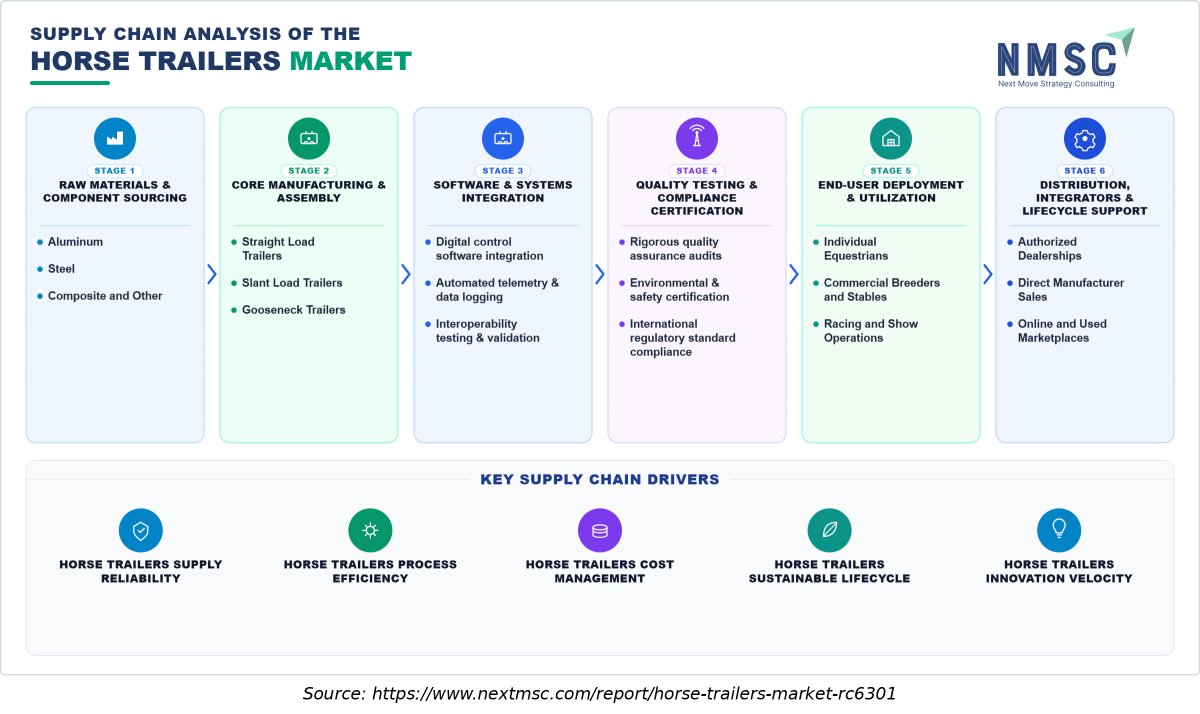
Supply Chain Analysis of the Horse Trailers Industry

Supply Chain Analysis of the Horse Trailers Industry
The infographic maps the horse trailers market supply chain through six stages, beginning with raw material and component sourcing, followed by trailer fabrication, equipment integration, product inspection, dealership distribution, and end-user utilization. It illustrates how these activities support manufacturing quality, component reliability, product delivery, operational safety, and lifecycle maintenance.

Growth Opportunities

Our analysis shows that three structural whitespace opportunities are positioned to generate disproportionate commercial returns in the Horse Trailers Market through 2035:

Can Lightweight Premium Trailers Address Demand Among Weight-Conscious Buyers?

Lightweight premium configurations offer manufacturers an opportunity to serve buyers seeking trailers with improved towing characteristics and reduced structural weight. Aluminum-framed models, including selected living-quarter and multi-horse configurations, can appeal to owners balancing payload requirements, durability, and towing vehicle compatibility. Manufacturers can differentiate these products through construction quality, interior customization, and after-sales service.

How Can Riding Schools and Regional Equestrian Facilities Create Additional Demand?

Riding schools, boarding facilities, breeding establishments, and regional equestrian clubs represent potential commercial customers for horse trailers. Their requirements may include transporting horses to competitions, breeding facilities, veterinary appointments, and external riding locations. Manufacturers and dealerships can address these requirements through appropriate trailer capacities, financing arrangements, maintenance support, and fleet purchasing options.

Can Specialized Horse Trailer Configurations Create Premium Market Opportunities?

Specialized configurations for breeding, racing, and show operations offer potential premium opportunities within the horse trailers market. Professional buyers may prioritize suitable stall dimensions, ventilation, interior padding, storage arrangements, and convenient loading access. Manufacturers that offer application-specific configurations can differentiate their products and address the needs of buyers with specialized transportation requirements.

Regional Outlook

2025 (USD Billion)
2035 (USD Billion)
North Americ
Europe
Asia-Pacific
Latin Americ
Middle East
Region 2025 (USD Billion) 2035 (USD Billion) CAGR (%)
North America $10.0 USD Billion $40.0 USD Billion 9.0%
Europe $17.1 USD Billion $51.1 USD Billion 27.0%
Asia-Pacific $24.2 USD Billion $62.2 USD Billion 25.0%
Latin America $31.3 USD Billion $73.3 USD Billion 23.0%
Middle East & Africa $38.4 USD Billion $84.4 USD Billion 12.0%

Regional data is locked

Unlock complete regional numbers for this market.

Unlock Full Data

Competitive Landscape

The horse trailers market includes established manufacturers, specialist builders, and regional fabricators competing across different trailer configurations, materials, and price categories. Companies such as Featherlite, Sundowner, Exiss-Sooner, Bloomer, Cimarron, and Merhow participate in the market through differentiated product portfolios and dealership or direct-sales arrangements. Competition is influenced by product durability, configuration options, customer service, and distribution reach. Regional builders and specialized fabricators compete alongside larger producers, creating a layered environment. Competitive intensity is shaped by product configuration breadth, dealer network density, and the ability to meet evolving safety and build quality expectations among equestrian buyers.

How Do Companies Compete in the Horse Trailers Market?

Manufacturers differentiate primarily through configuration variety, build quality, and warranty commitments rather than aggressive price competition. Pricing strategies reflect material choice, with aluminum and steel models occupying distinct value tiers. Distribution relies heavily on authorized dealerships that provide inspection, financing, and service support, while direct manufacturer sales and online channels increasingly serve buyers seeking transparent pricing and configurable orders.

Which Competitive Archetypes Dominate the Horse Trailers Market?

Market participants in the horse trailers market fall into three principal archetypes. Full-line manufacturers such as Featherlite, Sundowner, and Exiss-Sooner offer a range of horse trailer configurations catering to different equestrian requirements. Specialist manufacturers and regional builders compete through customization, interior features, material selection, product durability, and customer service. These differences influence their positioning among individual horse owners, breeding establishments, and professional competition operators. Regional and niche producers such as Titan trailers, Inc. and Hart trailers Inc. serve localized demand and custom specifications.

What Innovation and Differentiation Strategies Are Companies Pursuing?

Sustainable advantage in the horse trailers market stems from proven structural integrity, dependable safety features, and well established service networks. Manufacturers that combine certified build standards with responsive dealer support build durable customer loyalty. Configuration flexibility and the ability to tailor interiors for specific animal care needs further reinforce brand preference, particularly among commercial stables and show operators with demanding utilization patterns.

What M&A and Partnership Activity Is Shaping the Market?

Company-level ownership changes and product portfolio developments should be evaluated through individual transactions rather than characterized as a broader consolidation trend. For example, Kiefer Mfg & Sales was acquired by Southern Resolution Services in 2024 and the business was relaunched as KieferBilt Trailers. This transaction represents a documented ownership and brand development within the trailer industry. Larger participants pursue selective acquisitions to broaden configuration portfolios and access new geographic demand pockets. Smaller specialist builders represent attractive targets because they hold established brand recognition, skilled fabrication talent, and loyal customer bases within niche equestrian segments.

Key Market Players

Based on research conducted by NMSC, The following companies represent selected manufacturers and participants in the global horse trailers market:

Featherlite Inc. Sundowner Trailers, Inc. Exiss Horse Trailers Ltd Bloomer Trailer Mfg., Inc Sooner Trailers Inc. Titan Trailers, Inc. Miller Industries, Inc. Wilson Trailer Company Sundowner Trailers LLC Hart Trailers Inc. Bison Trailers Ltd Logan Coach, Inc. Kiefer Built Inc. Trails West Manufacturing Inc. Elite Trailers LLC Thoroughbred Trailers Inc. Hallmark Trailers LLC Adam Trailers Inc. Platinum Trailers Inc. Trailers Unlimited Co., Inc.

Latest Developments

During our market evaluation, we noticed that recent commercial activities, platform introductions, and partnerships within the industry reflect the latest market developments:

Date Event
February 2025 Double D Trailers released The Honest to Goodness Truth About Horse Trailers, a buyer-oriented publication covering trailer configurations, maintenance, towing safety, and horse transportation. | https:/​/​thehorse.​com/​1134447/​double-​d-​trailers-​new-​book-​release-​the-​honest-​to-​goodness-​truth-​about-​horse-​trailers/​

Investment Opportunities

Where Are Capital Inflows Concentrating in the Horse Trailers Market?

Potential investment areas in the horse trailers market include manufacturing capacity, product customization, lightweight material processing, and improvements in dealership and after-sales service networks. Manufacturers seeking to expand their market presence may evaluate these areas according to regional demand, production economics, and customer requirements. Producers are directing funds toward configuration development, including specialized layouts that address mixed use and niche equestrian requirements. Investment in lightweight material processing is also advancing, as manufacturers seek to improve towing efficiency and extend the commercial appeal of their product portfolios.

How Is Infrastructure Investment Shaping Market Capacity?

Manufacturing-related investment opportunities include fabrication facilities, welding and finishing equipment, component assembly, and quality inspection capabilities. Dealers may also invest in product display facilities, servicing infrastructure, and spare-parts availability to improve customer support. Manufacturers are upgrading production lines to improve dimensional accuracy and throughput while maintaining build quality. Distribution hubs and service centers are being strengthened to shorten delivery timelines and support authorized dealerships that handle inspection, financing, and after sales service.

What ESG Considerations Are Influencing Market Investment?

Environmental and safety considerations are increasingly shaping investment priorities across the horse trailers ecosystem. Environmental considerations in horse trailer manufacturing include material recyclability, efficient material utilization, product durability, and the potential benefits of lightweight construction. Safety-related investment priorities include reliable braking systems, lighting, reinforced structural components, and secure interior fittings that support animal transportation. Safety compliance remains a central obligation, with investment directed toward reinforced frames, reliable braking and lighting components, and secure interior fittings that protect animals during transport.

Key Benefits for Stakeholders

How Does This Report Benefit Industry Leaders and Enterprise Operators?

Operational executives, procurement directors, and commercial operators in the horse trailers market gain access to empirical benchmarks that inform fleet planning and capital allocation. Segment level analysis clarifies where Straight Load trailers anchor installed demand and where Other Configurations offer accelerated expansion. These insights help enterprise operators align purchasing strategies with evolving utilization patterns and total cost of ownership considerations.

How Does This Report Benefit Investors and Financial Analysts?

Investors and financial analysts can evaluate the horse trailers market using a clear valuation trajectory, expanding from USD 1.06 billion in 2025 to USD 1.74 billion by 2035. The 5.1% CAGR and USD 0.63 billion absolute opportunity provide a measurable framework for assessing growth potential. Margin trends tied to material selection and distribution channel mix further support disciplined valuation and portfolio positioning decisions.

How Does This Report Benefit Trailer Component Suppliers and Dealerships?

Component suppliers and dealerships can use this analysis to understand demand across trailer materials, configurations, and end-user categories. Identifying demand for aluminum construction, specialized trailer designs, braking systems, flooring, lighting, and ventilation components can help suppliers refine their product portfolios. Dealerships can use the findings to assess regional demand, customer purchasing preferences, and after-sales service opportunities.

Key Market Segments Evaluated

By Trailer Type

  • Straight Load Trailers
  • Slant Load Trailers
  • Gooseneck Trailers 
    • Living Quarters Gooseneck
    • Stock Gooseneck
  • Bumper Pull Trailers 
    • Two-Horse Bumper Pull
    • Three-Horse Bumper Pull
  • Other Configurations

By Material

  • Aluminum 
    • Welded Aluminum
    • Extruded Aluminum Frame
  • Steel 
    • Galvanized Steel
    • Painted Steel
  • Composite and Other

By End User

  • Individual Equestrians
  • Commercial Breeders and Stables
  • Racing and Show Operations

By Distribution Channel

  • Authorized Dealerships
  • Direct Manufacturer Sales
  • Online and Used Marketplaces

By Region

  • North America 
    • U.S.
    • Canada
    • Mexico.
  • Europe 
    • UK
    • Germany
    • France
    • Italy
    • Rest of Europe.
  • Asia-Pacific 
    • China
    • India
    • Japan
    • South Korea
    • Australia
    • Rest of APAC.
  • Latin America 
    • Brazil
    • Argentina
    • Colombia
    • Rest of Latin America.
  • Middle East & Africa 
    • UAE
    • Saudi Arabia
    • South Africa
    • Rest of MEA.

Conclusion & Recommendations

What Is the Long-Term Outlook for the Horse Trailers Market?

The global horse trailers market is projected to grow from USD 1.11 billion in 2026 to USD 1.74 billion by 2035, registering a CAGR of 5.1% during the forecast period. The projected expansion reflects assumptions regarding equestrian transportation requirements, replacement purchases, and demand for different trailer configurations and materials. Growth is underpinned by durable commercial demand expansion, the structural shift toward high-performance specialized solutions, and continuous technological innovation across core operational workflows. Buyers increasingly favor configurations that balance payload, safety, and animal welfare, reinforcing sustained demand across installed and emerging segments.

What Strategic Positioning Recommendations Does NMSC Offer?

Market participants should prioritize configuration breadth, particularly within Other Configurations, to capture the fastest expanding trailer type. Manufacturers should evaluate investment in aluminum and composite construction capabilities that address buyer requirements for lower trailer weight, durability, and manageable maintenance. Product development should also consider towing compatibility, loading convenience, flooring performance, and animal comfort.

How Attractive Is the Horse Trailers Market for Investment?

The horse trailers market presents a forecast revenue opportunity of USD 0.63 billion between 2026 and 2035, based on the projected increase from USD 1.11 billion to USD 1.74 billion. Investment attractiveness depends on the realization of these projections, regional demand conditions, production costs, competitive positioning, and the ability of manufacturers to maintain product quality and dealer relationships. Demand is anchored by a mature installed base among individual equestrians and reinforced by accelerating commercial activity in racing and show operations. Margin profiles benefit from premium material specifications and service revenue tied to dealership networks, making the segment appealing for disciplined capital deployment.

What Are the Key Market Shifts and Risks in the Horse Trailers Market?

Structural shifts in the horse trailers market include a move toward lighter materials, broader configuration options, and greater buyer reliance on transparent digital information. Primary risks arise from raw material price volatility, particularly for aluminum and steel inputs, which can compress manufacturer margins. Supply chain disruptions affecting axles, lighting components, and specialized fittings may also delay production schedules and affect delivery reliability for dealers and end users.

What Are the Primary Growth Pathways Through 2035?

Capturing a disproportionate share of the USD 0.63 billion absolute growth opportunity in the horse trailers market requires focus on targeted pathways. Manufacturers can pursue growth by expanding specialized trailer configurations and developing material options that address weight, durability, cost, and maintenance requirements. Opportunities across individual equestrians, commercial stables, and racing and show operations should be assessed according to their respective purchasing requirements. Strengthening presence within Racing and Show Operations and Online and Used Marketplaces provides additional routes to scale, particularly for producers that combine build quality with responsive digital engagement.

Delivered Customizations

We have successfully delivered the following deep-dive customizations:

Client Request Customization Delivered Value Adds
Country-Level Trade Assessment
  • Country-wise import and export analysis for horse trailers and related trailer categories using UN Comtrade and national customs data.
  • Identifies sourcing hubs, export-led markets and import dependence to guide sourcing, localization and market entry decisions.
Historical Market Growth Analysis
  • Historical revenue and unit shipment analysis of the horse trailer market across major regions, 2020 onward.
  • Establishes the baseline growth trajectory and cyclical patterns needed to validate the 2026-2035 forecast.
Company-Level Product Share Analysis
  • Company-level share analysis by trailer type (e.g., bumper pull, gooseneck, straight-load, and luxury living quarters) based on public filings and company disclosures.
  • Reveals competitive positioning and white-space trailer types to inform product portfolio and pricing strategy.
Material-Based Price Positioning Analysis
  • Benchmarking of aluminum, steel and composite trailer construction by price band, weight and warranty across leading manufacturers.
  • Shows the premium and cost trade-offs of each material, supporting product design, cost engineering and price positioning decisions.
Equestrian Demand Mapping by End User
  • Mapping of horse population and equestrian activity by country against trailer demand across professional, racing, commercial stable and recreational end users.
  • Prioritizes high-potential end-user segments and countries for targeted sales, marketing and channel investment.
Distribution Channel Footprint Benchmarking
  • Benchmarking of dealer network density, direct-sales and online channel presence across key trailer manufacturers and distributors.
  • Highlights channel coverage gaps and supports dealer expansion, partnership and direct-to-customer strategy.

FAQs

About the Author

Mihul Sharma

Mihul Sharma

Mihul Sharma is Research Associate at Next Move Strategy Consulting, where he has covered technology, industrial, and healthcare markets for 3 years. His work applies structured business research, market analysis, and secondary-source review to assess market trends, competitive developments, and growth opportunities. He supports report development by fully synthesizing industry data, company information, and market signals into concise findings for strategy and investment-focused research teams.

About the Reviewer

Supradip Baul

Supradip Baul

Supradip Baul is an accomplished business consultant and strategist with over a decade of rich experience in market intelligence, strategy, technology, and business transformation. His work has included rigorous qualitative and quantitative analysis across multiple industries, helping clients shape investment decisions and long-term roadmaps. Earlier in his career, he was associated with Gartner, where he contributed to industry-leading reports and market share analyses. He has worked with leading global companies and holds an MBA with a dual specialization in Marketing and Finance.

Download Free Sample

Henri Knyphausen

HENRI KNYPHAUSEN

Partner at Singulier [Ex-BCG]

Singulier

I recently engaged NEXTMSC.com for a commercial due diligence project within the intralogistics sector, and I am pleased to provide a reference based on my experience. In utilizing NEXTMSC.com's services, I found their report to offer valuable insights into market dynamics and key industry players. The initial report provided a solid foundation for our analysis. However, as we were investigating a smaller target in the market, and I had specific customization requests requiring additional research. These requests included detailed information on product portfolios of various players and sub-market sizes, both inclusive and exclusive of certain product categories. NEXTMSC.com demonstrated commendable responsiveness and agility in accommodating these customization requests. Within a timeframe of 1-2 weeks, they delivered a revised report that met our specific needs. Furthermore, they were receptive to my follow-up inquiries, ensuring clarity and understanding of the data provided. The final deliverable significantly contributed to our due diligence efforts. One of NEXTMSC.com's notable strengths lies in their qualitative research capabilities. However, for future engagements, I would recommend the inclusion of a quantified market model in Excel format. Such a model would offer the ability to conduct in-depth analyses and explore various market segments, including country-specific data and subcomponent breakdowns. Based on my positive experience, I would not hesitate to work with NEXTMSC.com again. Their responsiveness, willingness to accommodate customization requests, and commitment to delivering actionable insights make them a reliable partner for commercial research projects.


Ross J Mckenzie

ROSS J MCKENZIE

Business Insight Manager

Staysure Group

“Next MSC have been incredibly helpful in providing detailed & robust information on our market, alongside quantifying growth by different segments. The process to procure was simple and easy, with sample reports and regular contact to ensure we had what we needed. Succinct detail on their sources & methodologies is also greatly received, allowing transparency in this respect helps build trust in the detail you pay for. Joseph in particular was fantastic, and helped ensure efficient provision of the insight pack – thank you NMSC!”.

Kishu Kanda

KISHU KANDA

Strategy Analyst

Accenture

We purchased the AI Consumer Market Report from this company. Not only did they customize the report to meet our specific requirements, but they also showed great flexibility in accommodating our budget. The report we received fully met our expectations. Additionally, they provided prompt and thorough responses to both our pre-purchase and follow-up questions. We look forward to working with this company again in the future.

Amos Chang

AMOS CHANG

Strategy Consultant

Kardex Group

I have bought the intralogistics market reports from NMSC two times so far. Joseph and his team are always very helpful and flexible in responding to any customization requirements on the report. Their expertise in market reports really helps us steer the day-to-day business. I will definitely recommend and come back myself whenever there is a need.

Nishant Awate

NISHANT AWATE

Business Development Global Sales

Zehnder Group Deutschland GmbH

Our experience working with Next Move Strategy Consulting was positive. The team was responsive, professional, and open to incorporating our specific requirements throughout the project. The India AHU market study was comprehensive and well structured, covering market value and volume forecasts, product and application segments, and key industry trends. The inclusion of both AHU and residential MVHR market insights made the study particularly relevant for our strategic market assessment. Overall, the report provides a solid foundation for evaluating market potential, identifying priority segments, and supporting business-development decisions in India.

Custom Market Research Services

We will customize the research for you if the listed report does not fully match your requirements.

Get 30% Free Customization

Select License

This website uses cookies to ensure you get the best experience on our website. Learn more

✖