Hydrogen Fuel Cells Market Global Industry Analysis and Forecast (2026-2035)

Hydrogen Fuel Cells Market size was USD 9.20 billion in 2025, projected to reach USD 66.36 billion by 2035, growing at a CAGR of 21.5% from 2026 to 2035. Key drivers include rising data center and utility power demand, increasing heavy-duty vehicle decarbonization, and expanding government hydrogen infrastructure investments, with Asia-Pacific leading the market.

Download Free Sample PDF
Base Year (2025)
$9.20 Billion
Forecast (2035)
$66.36 Billion
CAGR (2026-2035)
21.5%
Top Region
Asia-Pacific

What Is the Hydrogen Fuel Cells Market Size?

The global hydrogen fuel cells market size was valued at USD 9.20 billion in 2025 and is estimated at USD 11.50 billion in 2026, forecast to reach USD 66.36 billion by 2035, expanding at a 21.5% CAGR between 2026 and 2035. Asia-Pacific leads with approximately 44% share, while transportation dominates all other applications with approximately 52% share.

We observed that growth is broad-based across every segmentation axis, with stationary power capacity expansion and SOFC technology adoption driving the dominant structural shifts through 2035.

Hydrogen Fuel Cells Market Global Industry Analysis and Forecast (2026-2035) Revenue Forecast

Values in USD Billion

2025 $9.20 Billion
2025
2026 $11.50 Billion
2026
2027 $13.97 Billion
2027
2028 $16.98 Billion
2028
2029 $20.63 Billion
2029
2030 $25.06 Billion
2030
2031 $30.45 Billion
2031
2032 $37.00 Billion
2032
2033 $44.95 Billion
2033
2034 $54.61 Billion
2034
2035 $66.36 Billion
2035

Key Takeaways

By Application: Transportation held the largest share of approximately 52% (USD 4.78 billion) in 2025; Stationary Power is the fastest-growing sub-segment at 23.8% CAGR from 2026–2035.

By Fuel Cell Technology: PEMFC held the largest share of approximately 58% (USD 5.34 billion) in 2025; SOFC is the fastest-growing sub-segment at 26.6% CAGR from 2026–2035.

By Power Output: Above 100 kW to 500 kW held the largest share of approximately 28% (USD 2.58 billion) in 2025; Above 500 kW is the fastest-growing sub-segment at 24.7% CAGR from 2026–2035.

By Product: Complete Fuel Cell System held the largest share of approximately 62% (USD 5.70 billion) in 2025; Fuel Cell Stack is the fastest-growing sub-segment at 24.6% CAGR from 2026–2035.

By Fuel Supply Mode: Compressed Hydrogen held the largest share of approximately 68% (USD 6.26 billion) in 2025; Liquid Hydrogen is the fastest-growing sub-segment at 25.3% CAGR from 2026–2035.

By Distribution Channel: Direct Sales held the largest share of approximately 52% (USD 4.78 billion) in 2025; System Integrators is the fastest-growing sub-segment at 23.6% CAGR from 2026–2035.

By End User: Transportation held the largest share of approximately 40% (USD 3.68 billion) in 2025; Utilities is the fastest-growing sub-segment at 25.2% CAGR from 2026–2035.

Dominant Region: Asia-Pacific dominated with approximately 44% revenue share (USD 4.05 billion) in 2025.

Fastest-Growing Region: North America is expected to register the highest CAGR of 23.4% during 2026–2035.

Dominant Country: U.S. led with approximately USD 2.15 billion in 2025.

Fastest-Growing Country: China is the fastest-growing country at approximately 25.8% CAGR from 2026–2035.

Market Opportunity: The hydrogen fuel cells market is expected to create an absolute dollar opportunity of USD 54.86 billion between 2026 and 2035, presenting significant investment potential across the stationary power and SOFC technology value chain.

According to Next Move Strategy Consulting analysis, stationary power developers are increasingly securing multi-year data center and utility capacity agreements rather than relying on project-by-project sales, a shift that favors manufacturers with proven large-scale system deployment capability over smaller providers as hyperscale computing demand accelerates baseload and backup power procurement through 2035.

What Does the Hydrogen Fuel Cells Market Encompass?

The hydrogen fuel cells market encompasses PEMFC, SOFC, PAFC, MCFC, AFC, DMFC, and RFC technologies deployed across transportation, stationary power, and portable power applications ranging from up to 1 kW to above 500 kW output. Our assessment indicates that the scope spans fuel cell stacks, modules, and complete systems supplied through direct sales, system integrators, and authorized distributors to transportation, utility, industrial, commercial, government, and defense end users powered by compressed, liquid, or on-site reformed hydrogen worldwide.
Regulatory frameworks such as the U.S. Department of Energy's Regional Clean Hydrogen Hubs program and Japan's Basic Hydrogen Strategy increasingly shape deployment incentives and technology certification across the industry. We observed that technology adoption is shifting from pilot-scale transportation and residential deployments toward multi-megawatt stationary power installations serving data centers and utility-scale grid applications. Next Move Strategy Consulting's analysis indicates that this structural shift, combined with expanding heavy-duty vehicle and material handling adoption, is redefining commercial strategy across the hydrogen fuel cells market.

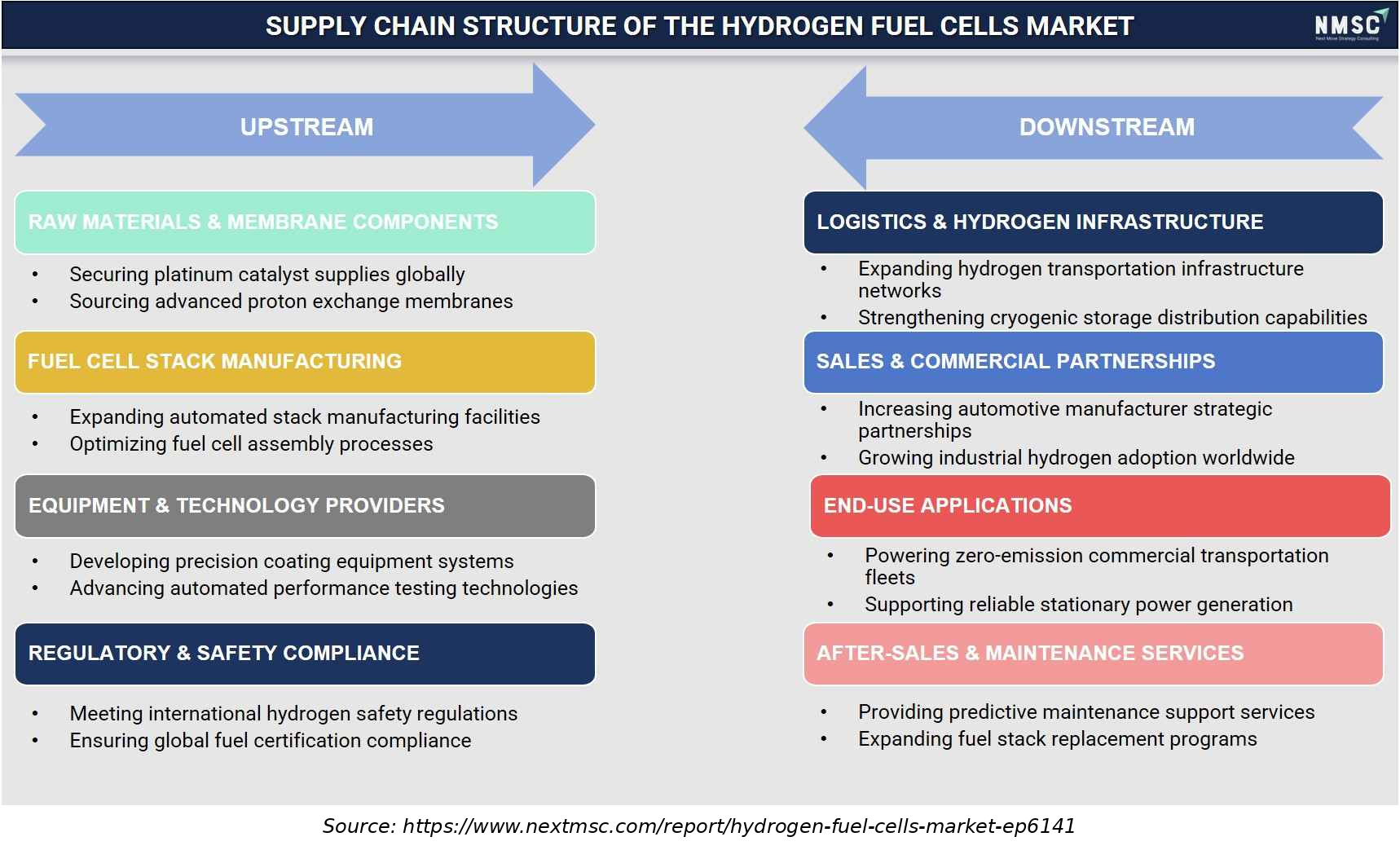
Supply Chain Structure of the Hydrogen Fuel Cells Market

Supply Chain Structure of the Hydrogen Fuel Cells Market
Based on our supply chain assessment, we identified that the hydrogen fuel cells market value chain begins with platinum catalysts, proton exchange membranes, and other critical raw materials, followed by fuel cell stack manufacturing, equipment providers, regulatory compliance, hydrogen logistics, commercial partnerships, end-use deployment, and after-sales maintenance services. Furthermore, our industry evaluation indicates that advanced manufacturing capabilities, expanding hydrogen transportation infrastructure, strategic industry collaborations, stringent safety standards, and predictive maintenance programs strengthen operational efficiency, ensure product reliability, accelerate commercial adoption, and support sustainable market growth.

Market Drivers & Dynamics

Interactive Dataset
Expanding data center and utility stationary power demand driver +3.2% North America, Asia-Pacific 2026-2035
Rising heavy-duty vehicle and commercial fleet decarbonization mandates driver +2.6% Global 2026-2035
Growing government hydrogen hub and infrastructure funding programs driver +2.0% North America, Asia-Pacific 2026-2035
Expanding material handling fleet electrification in logistics operations driver +1.5% North America, Europe 2026-2035
Rising Chinese commercial vehicle subsidy-driven manufacturing scale driver +1.2% Asia-Pacific 2026-2032
Growing residential combined heat and power adoption in Japan driver +0.8% Asia-Pacific 2026-2032
High hydrogen fuel production and distribution infrastructure costs restraint -1.8% Global 2026-2035
Competitive pressure from battery-electric alternatives in select applications restraint -1.2% Global 2026-2032
Limited hydrogen refueling infrastructure constraining vehicle adoption restraint -0.8% North America, Europe 2026-2032
Source: Next Move Strategy Consulting

Growth Drivers

What Is the Primary Growth Driver of the Hydrogen Fuel Cells Market?

Expanding data center and utility stationary power demand is the primary driver of the market. The U.S. Department of Energy continues to fund Regional Clean Hydrogen Hubs across multiple states, supporting infrastructure investment tied to stationary power and industrial hydrogen demand. We observed that this power-driven demand, reinforced by Bloom Energy Corporation's continued solid oxide fuel cell deployment expansion for data center customers, continues to anchor baseline consumption of large-scale stationary systems across developed and emerging power markets alike.

How Is Heavy-Duty Vehicle Adoption Driving Hydrogen Fuel Cells Market Growth?

Rising heavy-duty vehicle and commercial fleet decarbonization mandates are accelerating demand for high-power transportation fuel cell systems. Next Move Strategy Consulting's analysis indicates that this fleet-driven demand, combined with Hyundai Motor Company and Toyota Motor Corporation's continued heavy-duty truck program expansion, is compressing adoption timelines for fuel cell powertrains across logistics operators pursuing zero-emission long-haul transport alternatives.

Growth Inhibitors

What Is Restraining Hydrogen Fuel Cells Market Expansion?

High hydrogen fuel production and distribution infrastructure costs restrain adoption speed across the industry, particularly for transportation applications requiring dedicated refueling networks. We found that operators pursuing vehicle fleet electrification face particular cost exposure, as limited refueling station density substantially increases total cost of ownership compared with battery-electric alternatives benefiting from more mature charging infrastructure.

What Are the Growth Opportunities?

How Can Multi-Megawatt Data Center Systems Unlock Value for Stationary Power Manufacturers?

Multi-megawatt data center power systems present a whitespace opportunity for stationary power manufacturers positioning ahead of accelerating hyperscale computing demand. Manufacturers that commercialize rapidly deployable, grid-independent fuel cell installations stand to capture premium contract value as data center operators increasingly prioritize power availability timelines over traditional utility interconnection processes.

Where Do Heavy-Duty Refueling Corridors Create New Demand?

Long-haul freight operators pursuing zero-emission fleet conversion represent an underpenetrated opportunity for coordinated heavy-duty refueling corridor development. Companies that develop validated high-throughput hydrogen refueling infrastructure along major freight routes can secure fleet operator commitments, benefiting from first-mover positioning as commercial vehicle decarbonization mandates accelerate adoption.

How Can Component-Level Stack Supply Benefit System Integrators?

System integrators assembling application-specific fuel cell products create an opportunity for suppliers offering validated, standardized fuel cell stack components. Early movers that establish reliable, cost-competitive stack manufacturing capability can differentiate with integrators pursuing faster time-to-market, benefiting from expanding demand as more companies specialize in application engineering rather than core stack production.
Segmentation Analysis

2025 (USD Billion)
2035 (USD Billion)
Transportation 2025: $4.78 Billion | 2035: $30.30 Billion
Transportati
Stationary Power 2025: $3.86 Billion | 2035: $32.89 Billion
Stationary P
Portable Power 2025: $0.55 Billion | 2035: $3.17 Billion
Portable Pow
Transportation $4.78 Billion $30.30 Billion 19.8%
Stationary Power $3.86 Billion $32.89 Billion 23.8%
Portable Power $0.55 Billion $3.17 Billion 18.5%

Which Application Dominates the Hydrogen Fuel Cells Market?

Transportation led the market with USD 4.78 billion in 2025, supported by established fuel cell electric vehicle programs across passenger cars, buses, and material handling equipment. We observed that Stationary Power is the fastest-growing application, expanding at a 23.8% CAGR from 2026 to 2035, as data center and utility operators increasingly deploy multi-megawatt fuel cell systems to secure reliable, rapidly available power capacity.

2025 (USD Billion)
2035 (USD Billion)
PEMFC
Low Temperat
High Tempera
SOFC
Planar SOFC
Segment Item 2025 (USD Billion) 2035 (USD Billion) CAGR
PEMFC $10.0 USD Billion $40.0 USD Billion 12.0%
Low Temperature PEMFC $17.1 USD Billion $51.1 USD Billion 10.0%
High Temperature PEMFC $24.2 USD Billion $62.2 USD Billion 24.0%
SOFC $31.3 USD Billion $73.3 USD Billion 14.0%
Planar SOFC $38.4 USD Billion $84.4 USD Billion 17.0%

Segment-wise data is locked

Unlock complete segment-wise numbers for By Fuel Cell Technology.

Unlock Full Data

Which Fuel Cell Technology Leads Hydrogen Fuel Cells Market Demand?

PEMFC remained the leading fuel cell technology within the market, valued at USD 5.34 billion in 2025 on its established versatility across transportation, portable power, and smaller stationary applications. Our findings suggest that SOFC is the fastest-growing fuel cell technology, registering a 26.6% CAGR from 2026 to 2035, as large-scale stationary power deployments increasingly favor its higher electrical efficiency for continuous baseload and data center applications.

2025 (USD Billion)
2035 (USD Billion)
Up to 1 kW
Above 1 kW t
Above 10 kW
Above 100 kW
Above 500 kW
Segment Item 2025 (USD Billion) 2035 (USD Billion) CAGR
Up to 1 kW $10.0 USD Billion $40.0 USD Billion 26.0%
Above 1 kW to 10 kW $17.1 USD Billion $51.1 USD Billion 16.0%
Above 10 kW to 100 kW $24.2 USD Billion $62.2 USD Billion 10.0%
Above 100 kW to 500 kW $31.3 USD Billion $73.3 USD Billion 24.0%
Above 500 kW $38.4 USD Billion $84.4 USD Billion 27.0%

Segment-wise data is locked

Unlock complete segment-wise numbers for By Power Output.

Unlock Full Data
2025 (USD Billion)
2035 (USD Billion)
Fuel Cell St
Fuel Cell Mo
Complete Fue
Segment Item 2025 (USD Billion) 2035 (USD Billion) CAGR
Fuel Cell Stack $10.0 USD Billion $40.0 USD Billion 27.0%
Fuel Cell Module $17.1 USD Billion $51.1 USD Billion 17.0%
Complete Fuel Cell System $24.2 USD Billion $62.2 USD Billion 23.0%

Segment-wise data is locked

Unlock complete segment-wise numbers for By Product.

Unlock Full Data
2025 (USD Billion)
2035 (USD Billion)
Compressed H
Liquid Hydro
On-Site Refo
Segment Item 2025 (USD Billion) 2035 (USD Billion) CAGR
Compressed Hydrogen $10.0 USD Billion $40.0 USD Billion 15.0%
Liquid Hydrogen $17.1 USD Billion $51.1 USD Billion 25.0%
On-Site Reformed Hydrogen $24.2 USD Billion $62.2 USD Billion 19.0%

Segment-wise data is locked

Unlock complete segment-wise numbers for By Fuel Supply Mode.

Unlock Full Data
2025 (USD Billion)
2035 (USD Billion)
Direct Sales
System Integ
Authorized D
Segment Item 2025 (USD Billion) 2035 (USD Billion) CAGR
Direct Sales $10.0 USD Billion $40.0 USD Billion 25.0%
System Integrators $17.1 USD Billion $51.1 USD Billion 19.0%
Authorized Distributors $24.2 USD Billion $62.2 USD Billion 25.0%

Segment-wise data is locked

Unlock complete segment-wise numbers for By Distribution Channel.

Unlock Full Data
2025 (USD Billion)
2035 (USD Billion)
Transportati
Utilities
Industrial
Commercial
Residential
Segment Item 2025 (USD Billion) 2035 (USD Billion) CAGR
Transportation $10.0 USD Billion $40.0 USD Billion 26.0%
Utilities $17.1 USD Billion $51.1 USD Billion 16.0%
Industrial $24.2 USD Billion $62.2 USD Billion 18.0%
Commercial $31.3 USD Billion $73.3 USD Billion 8.0%
Residential $38.4 USD Billion $84.4 USD Billion 23.0%

Segment-wise data is locked

Unlock complete segment-wise numbers for By End User.

Unlock Full Data

Which End User Is Most Widely Served by Hydrogen Fuel Cells?

Transportation remained the dominant end user, reaching USD 3.68 billion in 2025 due to established fuel cell vehicle programs across passenger, commercial, and material handling fleets. Based on research conducted by Next Move Strategy Consulting, we found that Utilities is the fastest-growing end user at a 25.2% CAGR from 2026 to 2035, reflecting expanding grid-scale and data center power procurement from fuel cell operators.

Growth Opportunities

Our analysis shows that three forward-looking opportunities stand out for stakeholders positioning within the hydrogen fuel cells market over the 2026-2035 forecast period.

How Can Multi-Megawatt Data Center Systems Unlock Value for Stationary Power Manufacturers?

Multi-megawatt data center power systems present a whitespace opportunity for stationary power manufacturers positioning ahead of accelerating hyperscale computing demand. Manufacturers that commercialize rapidly deployable, grid-independent fuel cell installations stand to capture premium contract value as data center operators increasingly prioritize power availability timelines over traditional utility interconnection processes.

Where Do Heavy-Duty Refueling Corridors Create New Demand?

Long-haul freight operators pursuing zero-emission fleet conversion represent an underpenetrated opportunity for coordinated heavy-duty refueling corridor development. Companies that develop validated high-throughput hydrogen refueling infrastructure along major freight routes can secure fleet operator commitments, benefiting from first-mover positioning as commercial vehicle decarbonization mandates accelerate adoption.

How Can Component-Level Stack Supply Benefit System Integrators?

System integrators assembling application-specific fuel cell products create an opportunity for suppliers offering validated, standardized fuel cell stack components. Early movers that establish reliable, cost-competitive stack manufacturing capability can differentiate with integrators pursuing faster time-to-market, benefiting from expanding demand as more companies specialize in application engineering rather than core stack production.
Regional Outlook

2025 (USD Billion)
2035 (USD Billion)
Asia-Pacific
North Americ
Europe
Middle East
Latin Americ
Region 2025 (USD Billion) 2035 (USD Billion) CAGR (%)
Asia-Pacific $10.0 USD Billion $40.0 USD Billion 9.0%
North America $17.1 USD Billion $51.1 USD Billion 27.0%
Europe $24.2 USD Billion $62.2 USD Billion 25.0%
Middle East & Africa $31.3 USD Billion $73.3 USD Billion 23.0%
Latin America $38.4 USD Billion $84.4 USD Billion 12.0%

Regional data is locked

Unlock complete regional numbers for this market.

Unlock Full Data

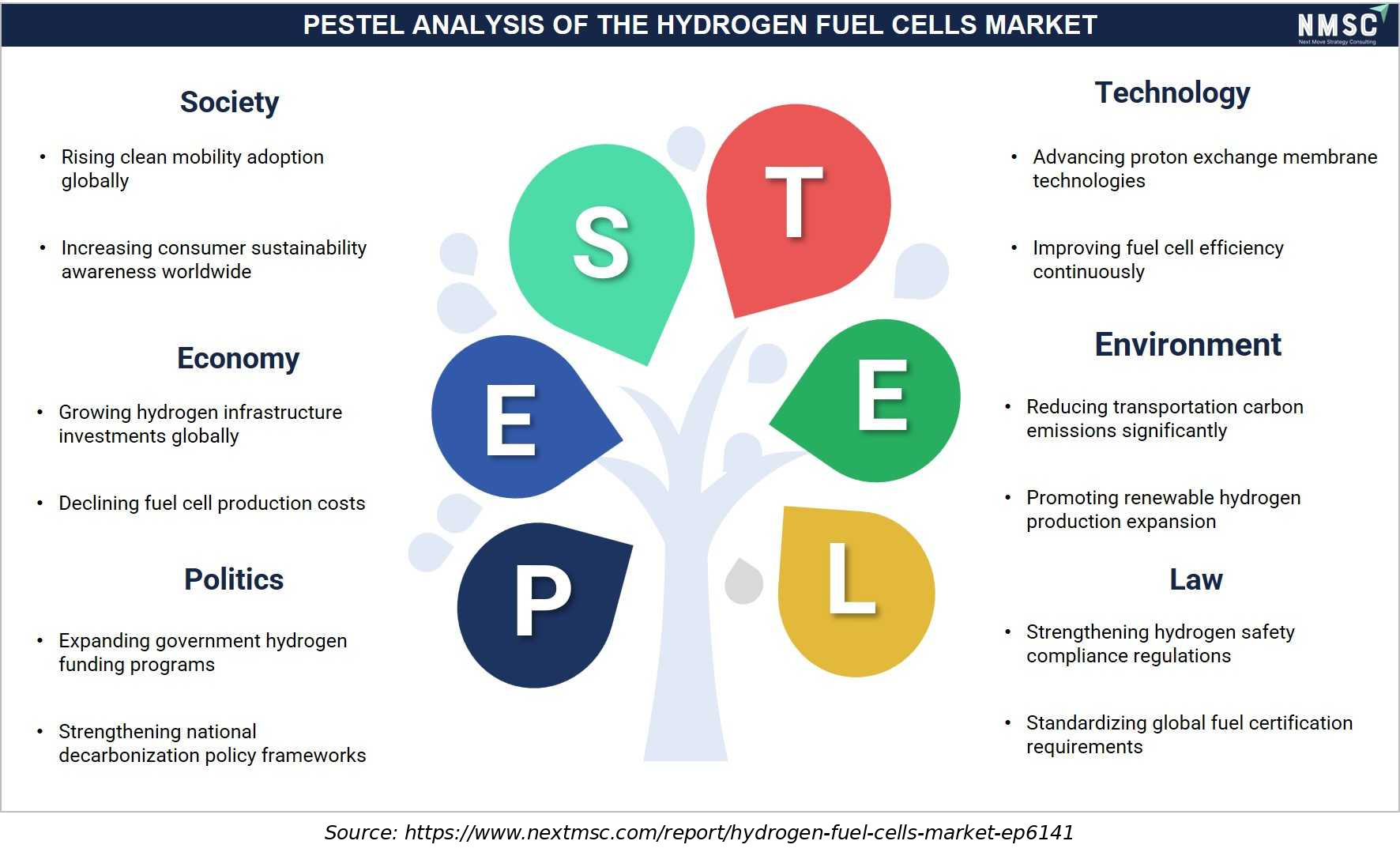
PESTEL Analysis of the Hydrogen Fuel Cells Market

PESTEL Analysis of the Hydrogen Fuel Cells Market
Based on our macroeconomic assessment, we identified that political support, economic investments, social acceptance, technological innovation, environmental priorities, and regulatory frameworks collectively shape the hydrogen fuel cells market. Furthermore, our industry evaluation indicates that clean energy policies, government funding, advancements in fuel cell technologies, increasing environmental awareness, evolving hydrogen safety regulations, and growing industrial decarbonization initiatives accelerate technology adoption, strengthen investment confidence, and support long-term market expansion.

Competitive Landscape

We observed that the hydrogen fuel cells market features a moderately consolidated competitive landscape, with diversified stationary power and automotive manufacturers competing alongside specialized fuel cell technology developers.

Dimension Description
Market Structure Moderately consolidated; diversified stationary power and automotive manufacturers compete alongside specialized fuel cell technology developers, with several Chinese and Korean suppliers concentrated in commercial vehicle and stationary applications respectively.
Innovation Focus Large-scale SOFC data center power systems, heavy-duty transportation fuel cells, and rapid deployment capability dominate current innovation pipelines across leading manufacturers.
M&A Activity Major capital partnership exemplified by Bloom Energy Corporation and Brookfield Asset Management's expansion of their strategic infrastructure financing partnership from USD 5 billion to USD 25 billion in June 2026, reflecting unprecedented capital deployment toward AI data center fuel cell power.

How Do Companies Compete in the Hydrogen Fuel Cells Market?

Companies compete primarily on deployment speed, application-specific engineering, and manufacturing scale across the industry. Diversified manufacturers such as Bloom Energy Corporation and Toyota Motor Corporation leverage established production capacity and multi-application portfolios to serve stationary power and transportation customers respectively, while specialized providers such as Ballard Power Systems Inc. and SFC Energy AG compete on deep technical expertise in specific fuel cell technologies and applications.

Which Competitive Archetypes Dominate the Hydrogen Fuel Cells Market?

Two archetypes dominate the market: diversified stationary power and automotive manufacturers offering integrated fuel cell systems at scale, and specialized fuel cell technology developers focused on specific applications or components. Bloom Energy Corporation and Toyota Motor Corporation exemplify the diversified archetype, while Ballard Power Systems Inc. and Intelligent Energy Limited exemplify the specialized archetype through concentrated transportation and portable power fuel cell expertise.

How Are Companies Differentiating Through Innovation in Hydrogen Fuel Cells?

Innovation and differentiation strategy increasingly center on rapid deployment capability and large-scale manufacturing capacity. Bloom Energy Corporation's expansion of annual production capacity toward 2 gigawatts, driven explicitly by AI data center demand, illustrates how manufacturers are scaling to meet unprecedented power procurement volumes. Our analysis shows that manufacturers unable to demonstrate credible rapid deployment and manufacturing scale risk losing large data center and utility contracts to competitors with proven delivery track records.


What M&A and Expansion Activity Is Shaping the Hydrogen Fuel Cells Market?

Strategic capital partnerships and manufacturing expansion continue to shape competitive dynamics within the industry. Bloom Energy Corporation and Brookfield Asset Management's June 2026 expansion of their AI infrastructure financing partnership to USD 25 billion illustrates the scale of capital now flowing into stationary fuel cell deployment, while Bloom's expanded Oracle agreement covering up to 2.8 gigawatts of fuel cell systems demonstrates growing hyperscaler commitment to on-site power generation.

Key Market Players

Our assessment indicates that the following 20 companies are actively shaping fuel cell technology innovation, manufacturing capacity, and application-specific deployment strategy within the global hydrogen fuel cells market.

Bloom Energy Corporation Plug Power Inc. Ballard Power Systems Inc. Doosan Fuel Cell Co., Ltd. FuelCell Energy, Inc. Cummins Inc. Toyota Motor Corporation Hyundai Motor Company Panasonic Holdings Corporation Weichai Power Co., Ltd. Robert Bosch GmbH SFC Energy AG Intelligent Energy Limited Beijing SinoHytec Co., Ltd. Shanghai REFIRE Group Limited Horizon Fuel Cell Technologies Pte. Ltd. Nedstack Fuel Cell Technology B.V. AISIN Corporation Honda Motor Co., Ltd. Toshiba Energy Systems & Solutions Corporation

Latest Developments

We found that recent capital partnerships and contract expansions within the hydrogen fuel cells market are concentrated on AI data center power deployment.

Date Event
June 2026 Bloom Energy and Brookfield expanded their strategic AI infrastructure partnership, increasing their financing framework fivefold from $5 billion to USD 25 billion to rapidly deploy clean, community-friendly onsite fuel cell power solutions for global data center operators.
June 2026 Ballard Power Systems entered into a definitive agreement to acquire UK-based zero-emission power solutions provider GeoPura for £275.0 million, establishing a vertically integrated energy-as-a-service model spanning hydrogen production, distribution, and fuel cell stationary power.
May 2026 Wrightbus formally nominated Ballard Power Systems as the fuel cell supplier for its next-generation StreetDeck Hydroliner Gen 3.0 hydrogen bus platform, integrating Ballard’s FCmove-SC hydrogen fuel cell engine into the next-generation double-decker FCEV, with series production scheduled to begin in 2027.

Investment Opportunities

What Capital Inflows Are Targeting the Hydrogen Fuel Cells Market?

Capital inflows into the hydrogen fuel cells market are increasingly directed toward large-scale stationary power infrastructure financing. Infrastructure investors continue to commit unprecedented capital, as seen in Brookfield Asset Management's expansion of its Bloom Energy Corporation partnership from USD 5 billion to USD 25 billion within eight months. We observed that investors favor manufacturers demonstrating credible rapid deployment capability, viewing manufacturing scale as a proxy for long-term data center and utility contract capture.

How Is Infrastructure Investment Supporting Hydrogen Fuel Cells Deployment?

Infrastructure investment is expanding manufacturing and deployment capacity across companies to support rising stationary power demand. Our findings suggest that Bloom Energy Corporation's expansion of annual production capacity toward 2 gigawatts illustrates how manufacturers are scaling operations to meet unprecedented procurement volumes from hyperscale data center and utility customers pursuing rapid, grid-independent power capacity.

What ESG Considerations Are Shaping Hydrogen Fuel Cells Investment Decisions?

Environmental, social, and governance considerations are increasingly relevant to investment decisions across the industry, with emissions reduction and grid resilience as key criteria. Government hydrogen hub and infrastructure funding programs continue to inform manufacturer disclosure standards around lifecycle emissions performance. We found that investors increasingly favor manufacturers enabling measurable decarbonization across transportation and industrial applications, treating emissions reduction credentials as a governance indicator alongside deployment reliability.

Key Benefits for Stakeholders

How Does This Report Benefit Enterprise and Industry Leaders?

Enterprise and industry leaders gain access to validated segmentation, competitive benchmarking, and regional demand forecasts that support procurement and product-portfolio decisions across the hydrogen fuel cells industry. Our analysis shows that detailed application, technology, and end user breakdowns help engineering and procurement teams align system specifications with power capacity and deployment timeline requirements while identifying underserved end-use segments for portfolio expansion.

How Does This Report Benefit Investors and Financial Analysts?

Investors and financial analysts benefit from consistent, single-point market size and CAGR estimates that support valuation and capital-allocation decisions across the hydrogen fuel cells market supply chain. We observed that the report's regional and segment-level growth differentials help identify which manufacturers and technology categories are best positioned to capture above-market growth in SOFC and Utilities categories through 2035.

How Does This Report Benefit Technology Vendors and Product Teams?

Technology vendors and product teams gain insight into emerging design requirements, including large-scale SOFC data center systems, heavy-duty transportation powertrains, and rapid deployment engineering, that are reshaping the industry. Our findings suggest that this analysis helps research and development teams prioritize roadmaps around manufacturing scale and deployment speed increasingly required by hyperscale and utility customer procurement processes.

Key Market Segments Evaluated

By Application

  • Transportation 
    • Road Transportation
      • Passenger Cars
      • Light Commercial Vehicles
      • Heavy Duty Trucks
      • Buses
    • Material Handling
      • Forklifts
      • Automated Guided Vehicles
      • Airport Ground Support Equipment
    • Rail Transportation
      • Passenger Rail
      • Freight Rail
    • Marine
      • Commercial Vessels
      • Naval Vessels
      • Inland Waterways
    • Aerospace
      • Unmanned Aerial Vehicles
      • Manned Aircraft
      • Space Applications
  • Stationary Power 
    • Prime Power
      • Utility Scale
      • Distributed Generation
      • Microgrids
    • Backup Power
      • Data Centers
      • Telecommunications
      • Healthcare Facilities
      • Commercial Buildings
      • Critical Infrastructure
    • CHP
      • Residential
      • Commercial
      • Industrial
    • Off-Grid Power
      • Remote Communities
      • Remote Industrial Sites
      • Military Installations
  • Portable Power 
    • Portable Generators
    • Military Portable Systems
    • Remote Monitoring Systems
    • Portable Electronic Devices

By Fuel Cell Technology

  • PEMFC 
    • Low Temperature PEMFC
    • High Temperature PEMFC
  • SOFC 
    • Planar SOFC
    • Tubular SOFC
  • PAFC
  • MCFC
  • AFC
  • DMFC
  • RFC
  • Other Fuel Cell Technologies

By Power Output

  • Up to 1 kW
  • Above 1 kW to 10 kW
  • Above 10 kW to 100 kW
  • Above 100 kW to 500 kW
  • Above 500 kW

By Product

  • Fuel Cell Stack
  • Fuel Cell Module
  • Complete Fuel Cell System

By Fuel Supply Mode

  • Compressed Hydrogen
  • Liquid Hydrogen
  • On-Site Reformed Hydrogen

By Distribution Channel

  • Direct Sales
  • System Integrators
  • Authorized Distributors

By End User

  • Transportation
  • Utilities
  • Industrial
  • Commercial
  • Residential
  • Government
  • Defense
  • Research

By Region

  • North America 
    • U.S.
    • Canada
    • Mexico
  • Europe 
    • UK
    • Germany
    • France
    • Italy
    • Spain
    • Sweden
    • Denmark
    • Finland
    • Netherlands
    • Rest of Europe
  • Asia-Pacific 
    • China
    • India
    • Japan
    • South Korea
    • Taiwan
    • Indonesia
    • Vietnam
    • Australia
    • Philippines
    • Malaysia
    • Rest of APAC
  • Middle East & Africa 
    • Saudi Arabia
    • UAE
    • Egypt
    • Israel
    • Turkey
    • Nigeria
    • South Africa
    • Rest of MEA
  • Latin America 
    • Brazil
    • Argentina
    • Chile
    • Colombia
    • Rest of LATAM

Conclusion & Recommendations

The long-term outlook for the market remains strongly positive, with global revenue projected to expand more than sevenfold from USD 9.20 billion in 2025 to USD 66.36 billion by 2035 at a 21.5% CAGR. We observed that sustained data center power demand, heavy-duty vehicle decarbonization, and expanding government hydrogen infrastructure funding will continue underpinning demand across transportation and stationary power segments through the forecast period.

What Strategic Positioning Should Hydrogen Fuel Cells Suppliers Pursue?

Suppliers should prioritize rapid deployment capability and large-scale manufacturing capacity while pursuing strategic infrastructure financing partnerships to secure long-term data center and utility contracts. Next Move Strategy Consulting's assessment indicates that companies investing early in SOFC technology and heavy-duty transportation systems, similar to Bloom Energy Corporation's Brookfield partnership expansion, will be best positioned to capture premium positioning within the hydrogen fuel cells market.

How Attractive Is the Hydrogen Fuel Cells Market for New Investment?

The hydrogen fuel cells industry presents a highly attractive investment case, supported by a USD 54.86 billion absolute dollar opportunity between 2026 and 2035 and above-average growth in North America and SOFC categories. We found that investment attractiveness is highest for manufacturers combining proven manufacturing scale with rapid deployment track records, positioning them to serve both established transportation and emerging data center power customer segments simultaneously.

What Market Shifts and Key Risks Should Stakeholders Monitor?

Stakeholders should monitor high hydrogen fuel production and distribution infrastructure costs, competitive pressure from battery-electric alternatives, and limited refueling infrastructure as key risks to the hydrogen fuel cells market. Our analysis shows that manufacturers unable to secure reliable, cost-competitive hydrogen fuel supply risk losing transportation customers to competitors with proven integrated fuel supply chain partnerships.

What Are the Key Growth Pathways for the Hydrogen Fuel Cells Market?

Key growth pathways include expanding large-scale SOFC data center power deployment, scaling heavy-duty transportation and material handling adoption, and deepening penetration into North America and China's subsidized commercial vehicle segments. Next Move Strategy Consulting's analysis indicates that suppliers pursuing these pathways while maintaining manufacturing capacity discipline will be best positioned to capture the hydrogen fuel cells market's projected growth through 2035.

FAQs

About the Author

Saista Faiyaz

Saista Faiyaz

Saista Faiyaz is Research Associate at Next Move Strategy Consulting, where she has covered consumer markets and healthcare technologies for 3 years. Her work includes primary interview review, secondary-source validation, market sizing, and structured analysis of company and industry data. She supports research by comparing evidence across sources, organizing findings into market narratives, and documenting assumptions used in analysis. Her scope includes cross-market benchmarking, and reports.

About the Reviewer

Supradip Baul

Supradip Baul

Supradip Baul is an accomplished business consultant and strategist with over a decade of rich experience in market intelligence, strategy, technology, and business transformation. His work has included rigorous qualitative and quantitative analysis across multiple industries, helping clients shape investment decisions and long-term roadmaps. Earlier in his career, he was associated with Gartner, where he contributed to industry-leading reports and market share analyses. He has worked with leading global companies and holds an MBA with a dual specialization in Marketing and Finance.

Download Free Sample

Pratyush Kumar Das

PRATYUSH KUMAR DAS

Assistant Manager

Polycab India Limited

We would like to express our appreciation for the data and insights provided by nextmsc. We are very pleased with the quality and depth of the information, which has proven to be highly valuable and beneficial for our business decision-making.

Gustaf Hummel Burstrom

GUSTAF HUMMEL BURSTROM

Founder

Revline Tools AB

Joseph and the team at Next Move Strategy Consulting have been excellent to work with, in supplying us with relevant market data and forecasts for our specific category. We had some special requirements and they were able to do a custom package to suit our needs. We would definitely recommend them to any other company needing market data and forecasts

Ross J Mckenzie

ROSS J MCKENZIE

Business Insight Manager

Staysure Group

“Next MSC have been incredibly helpful in providing detailed & robust information on our market, alongside quantifying growth by different segments. The process to procure was simple and easy, with sample reports and regular contact to ensure we had what we needed. Succinct detail on their sources & methodologies is also greatly received, allowing transparency in this respect helps build trust in the detail you pay for. Joseph in particular was fantastic, and helped ensure efficient provision of the insight pack – thank you NMSC!”.

Kishu Kanda

KISHU KANDA

Strategy Analyst

Accenture

We purchased the AI Consumer Market Report from this company. Not only did they customize the report to meet our specific requirements, but they also showed great flexibility in accommodating our budget. The report we received fully met our expectations. Additionally, they provided prompt and thorough responses to both our pre-purchase and follow-up questions. We look forward to working with this company again in the future.

Mohit Agarwal

MOHIT AGARWAL

Chief Manager

DryChem India Pvt. Ltd.

Next Move Strategy Consulting is an amazing team of consultants. We required a market study report for our investors on top priority and the team went above and beyond our expectations to deliver the same with ample supporting data within a short time span enabling us to secure the investments and keep our project timeline maintained. Their professionalism, attention to detail, and timely delivery of actionable recommendations have left a lasting impression on our organization.

Custom Market Research Services

We will customize the research for you if the listed report does not fully match your requirements.

Get 30% Free Customization

Select License

This website uses cookies to ensure you get the best experience on our website. Learn more

✖