The global Hydrogen Generation Market was valued at USD 148.6 billion in 2025 and is expected to reach USD 164.5 billion in 2026. Accelerating energy transition commitments, expanding green hydrogen infrastructure, and rising demand from industrial decarbonization programs are projected to propel the market to USD 412.3 billion by 2035, advancing at a CAGR of 10.7% from 2026 to 2035. Key growth drivers include large-scale electrolyzer deployment backed by government subsidies, increasing carbon capture integration within existing reforming assets, rising steel sector demand for low-carbon hydrogen, and expanding mobility applications across heavy transport and shipping segments.
|
Parameters |
Details |
|
Market Size in 2025 |
USD 148.6 Billion |
|
Market Size in 2026 |
USD 164.5 Billion |
|
Revenue Forecast in 2035 |
USD 412.3 Billion |
|
Growth Rate |
CAGR of 10.7% from 2026 to 2035 |
|
Analysis Period |
2025–2035 |
|
Base Year Considered |
2025 |
|
Forecast Period |
2026–2035 |
|
Market Size Estimation |
USD Billion |
|
Companies Profiled |
20 |
|
Countries Covered |
33 |
|
Market Share |
Top 10 |
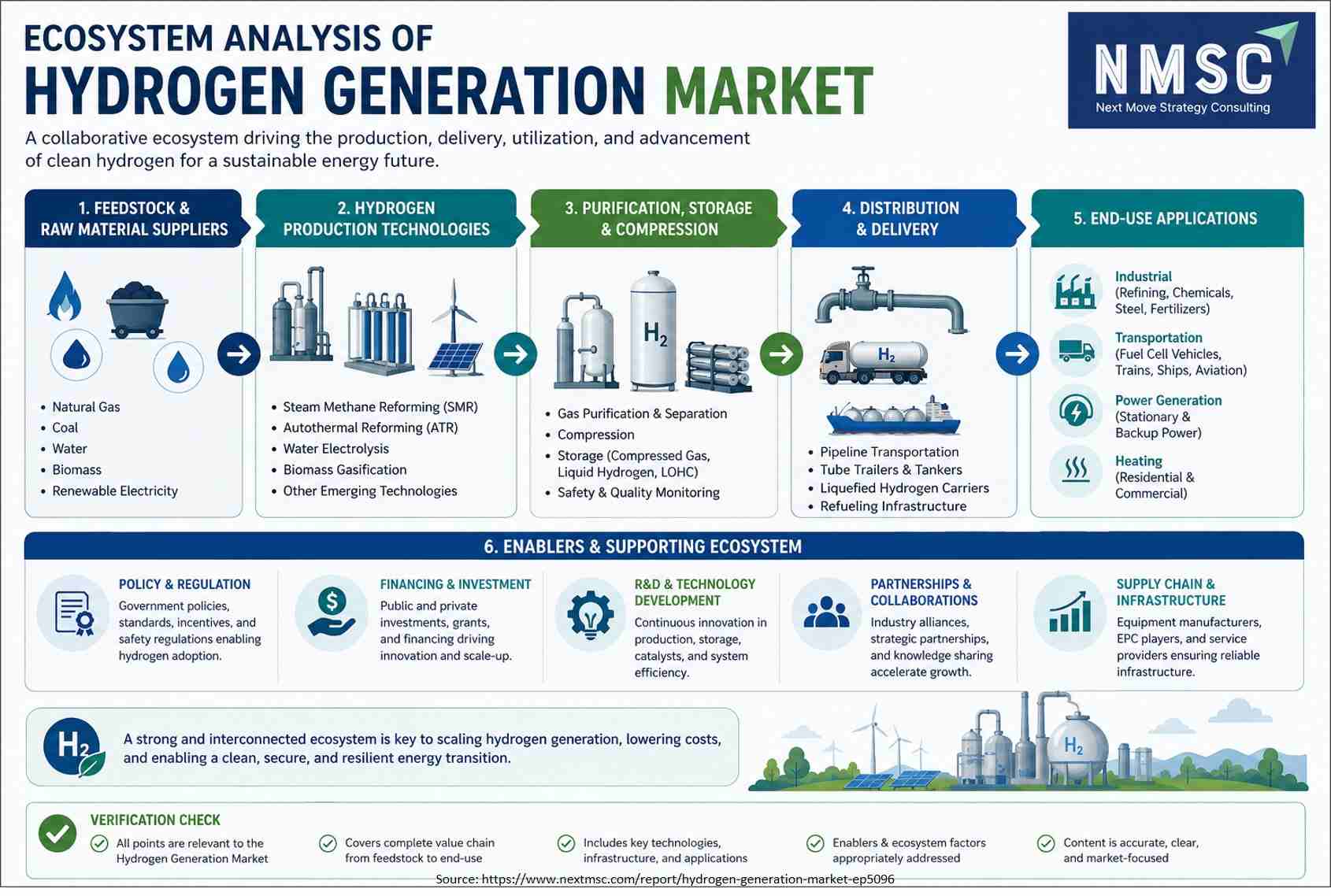
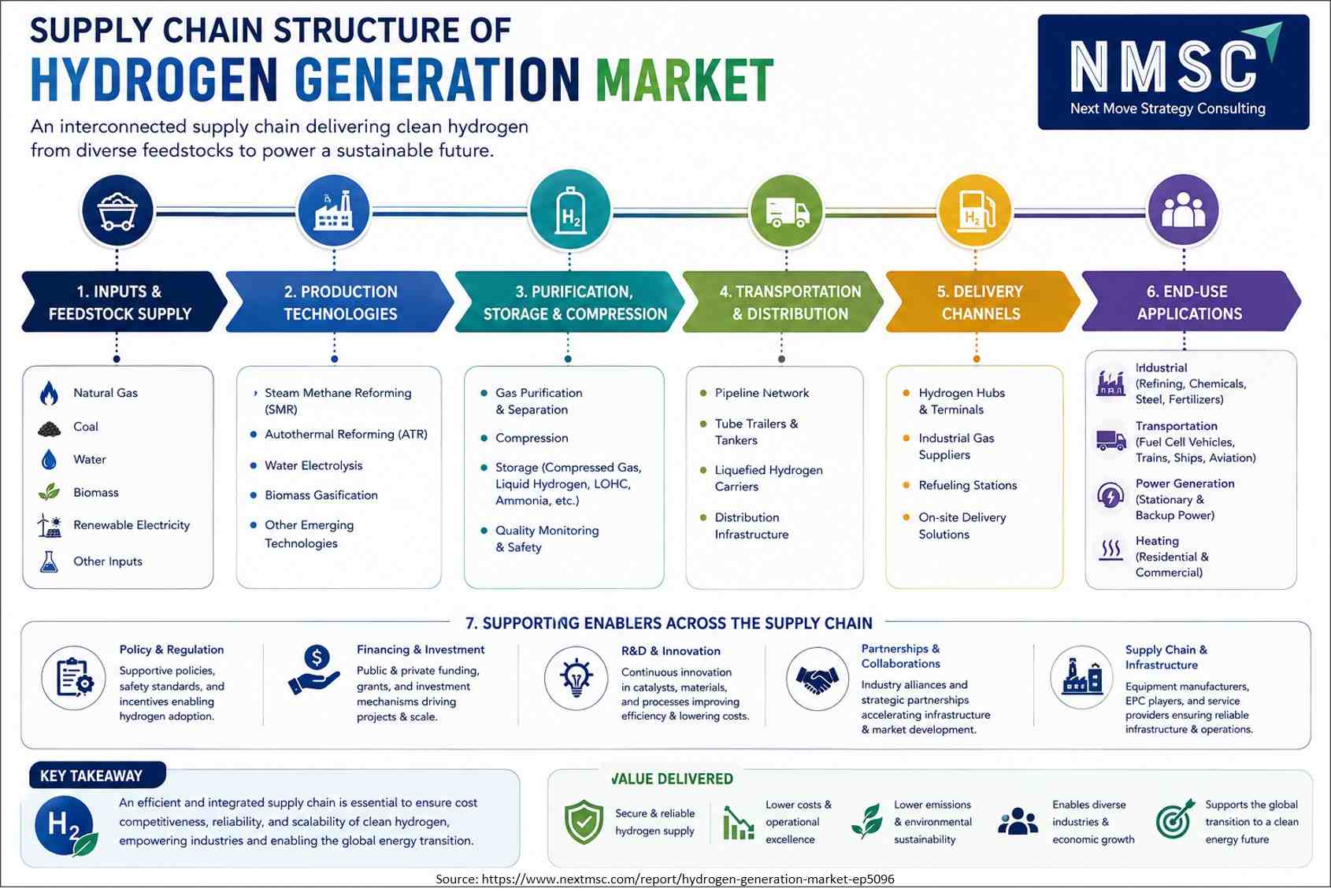
The Hydrogen Generation Market encompasses the technologies, equipment, plants, and services involved in producing hydrogen gas from various feedstocks and energy sources. Hydrogen is produced across a spectrum of carbon intensities ranging from high-emission gray hydrogen derived from unabated steam methane reforming to low-emission green hydrogen generated by water electrolysis powered by renewable electricity. NMSC's analysis indicates that this market spans the full value chain from electrolyzer and reformer manufacturing to engineering procurement and construction, merchant supply, and ongoing plant operations and maintenance services.
The Hydrogen Generation Market has progressed through distinct phases of structural transformation. Historically, the market was dominated by large-scale steam methane reforming plants supplying captive hydrogen to refineries, ammonia plants, and methanol producers. From our research, we found that the past decade has seen a fundamental paradigm shift driven by the green hydrogen agenda, with proton exchange membrane and alkaline electrolyzer manufacturing scaling rapidly as renewable electricity costs decline. The current phase centers on integrating carbon capture with existing reforming assets for blue hydrogen and scaling utility-class electrolysis for industrial decarbonization.
Regulatory frameworks have emerged as one of the most powerful structural forces shaping the Hydrogen Generation Market. The European Union's REPowerEU plan mandates 20 million tonnes of renewable hydrogen production by 2030. The U.S. Inflation Reduction Act provides a production tax credit of up to USD 3 per kilogram for qualifying clean hydrogen. Through our market assessment, we observed that national hydrogen strategies across Japan, South Korea, Germany, and India are allocating multi-billion-dollar public funding to accelerate both green and blue hydrogen deployment at commercial scale, fundamentally reshaping investment patterns across the production technology landscape.
Technology adoption across the Hydrogen Generation Market is accelerating as electrolyzer costs decline and carbon capture integration matures. Alkaline electrolyzers remain the workhorse for large-scale deployments due to their established reliability and lower capital cost, while proton exchange membrane systems are gaining ground in applications requiring dynamic operation alongside variable renewable power. Based on our market evaluation, we noticed that solid oxide electrolysis is transitioning from demonstration to early commercial stages, particularly in high-temperature industrial settings, while anion exchange membrane technology is attracting significant research investment for its potential to reduce platinum group metal dependency.
|
Key Takeaways |
|
By production technology, Steam Methane Reforming (SMR) Hydrogen dominated the Hydrogen Generation Market with a value of USD 72.4 billion in 2025, driven by its established infrastructure, cost competitiveness, and extensive use in refining and ammonia production. |
|
By production technology, Electrolysis-Based Hydrogen is the fastest-growing segment, projected to expand at a CAGR of 21.3% from 2026 to 2035, supported by falling electrolyzer costs, renewable energy integration, and growing green hydrogen mandates across major economies. |
|
By business model, Equipment Sales held the largest market share at USD 51.2 billion in 2025, driven by robust demand for electrolyzer systems, reformers, and hydrogen purification equipment across expanding hydrogen projects. |
|
By business model, Engineering Procurement and Construction (EPC) is anticipated to be the fastest-growing segment, registering a CAGR of 13.6% from 2026 to 2035, as large-scale green hydrogen facilities and blue hydrogen retrofit projects continue to gain momentum. |
|
By end-use industry, Refining accounted for the largest revenue share of the Hydrogen Generation Market at USD 44.2 billion in 2025, reflecting its position as the largest captive consumer of hydrogen for hydrocracking and hydrotreating applications. |
|
By end-use industry, Steel and Metals is expected to be the fastest-growing segment, advancing at a CAGR of 19.8% from 2026 to 2035, driven by increasing adoption of hydrogen-based direct reduced iron (DRI) technologies and industrial decarbonization initiatives. |
|
By end-use industry, Steel and Metals is expected to be the fastest-growing segment, advancing at a CAGR of 19.8% from 2026 to 2035, driven by increasing adoption of hydrogen-based direct reduced iron (DRI) technologies and industrial decarbonization initiatives. |
|
By carbon intensity, Gray Hydrogen held the largest market share at USD 98.7 billion in 2025, reflecting the extensive installed base of conventional steam methane reforming and coal gasification facilities serving industrial demand. |
|
By carbon intensity, Green Hydrogen is projected to be the fastest-growing category, expanding at a CAGR of 28.4% from 2026 to 2035, increasing from USD 6.8 billion in 2025 to approximately USD 62.2 billion by 2035. |
|
Regionally, Asia Pacific dominated the Hydrogen Generation Market share at USD 58.3 billion in 2025, supported by China's large-scale hydrogen production capacity, Japan's hydrogen economy initiatives, and South Korea's fuel-cell and hydrogen mobility programs. |
|
Regionally, Europe is anticipated to be the fastest-growing market, registering a CAGR of 15.2% from 2026 to 2035, driven by REPowerEU targets, electrolyzer manufacturing expansion, and policies promoting low-carbon hydrogen adoption. |
|
By country, China represented the largest national market, accounting for more than 32% of global hydrogen production volume, supported by its extensive coal gasification infrastructure and accelerating electrolysis deployment. |
|
By country, Germany is expected to be the fastest-growing major market, recording a CAGR of 16.8% from 2026 to 2035, supported by substantial investments under the National Hydrogen Strategy and growing international hydrogen partnerships. |
Electrolyzer capital cost reduction is the most consequential technology trend reshaping the economics of the Hydrogen Generation Market. Based on our market assessment, we observed that utility-scale alkaline electrolyzer system costs have declined from over USD 1,000 per kilowatt to below USD 600 per kilowatt in leading Asian manufacturing hubs between 2020 and 2025, with further reductions projected as gigafactory-scale manufacturing matures. Nel ASA, Thyssenkrupp Nucera, and Chinese manufacturers including Sungrow are scaling automated production lines that are expected to push costs below USD 300 per kilowatt by 2030, fundamentally improving the levelized cost of green hydrogen across deployment geographies.
Carbon capture and storage integration with steam methane reforming and autothermal reforming assets is transforming the blue hydrogen segment of the Hydrogen Generation Market. Our findings suggest that autothermal reforming with carbon capture achieves CO₂ capture rates above 95%, significantly outperforming conventional SMR retrofits. Air Products and Air Liquide have committed multi-billion-dollar investments in blue hydrogen mega-projects in North America and the Middle East. The U.S. Department of Energy's Clean Hydrogen Production Standard defines a 2 kg CO₂-equivalent per kg hydrogen threshold, which blue hydrogen producers are actively engineering toward using advanced pre-combustion capture systems.
The emergence of hydrogen valleys and industrial cluster models is creating fundamentally new demand aggregation and offtake dynamics within the Hydrogen Generation Market. From our research, we found that initiatives such as the North Sea Energy Island, HyDeal Europe, and NortH2 are co-locating production, transmission, and end-use infrastructure to achieve economies of scale unavailable to standalone projects. These clusters aggregate demand from steel producers, ammonia plants, and mobility operators, enabling project developers to underwrite large electrolyzer investments with diversified, long-term offtake contracts that reduce project financing risk and compress the levelized cost of green hydrogen delivery.
Emerging production technologies including methane pyrolysis and thermochemical water splitting are attracting growing commercial attention within the Hydrogen Generation Market. NMSC's analysis indicates that methane pyrolysis produces turquoise hydrogen and solid carbon as a co-product rather than CO₂, offering a potentially carbon-negative pathway if biogenic methane feedstock is used. BASF's plasma-assisted methane pyrolysis pilot in Ludwigshafen and Monolith Materials' commercial-scale facility in Nebraska represent the leading edge of this emerging segment. The U.S. Department of Energy has supported thermochemical hydrogen production R&D through its HydroGEN consortium, targeting solar thermochemical water splitting at efficiency targets competitive with electrolysis by 2030.
|
Drivers / Trends / Restraints |
(+/-) % Impact on CAGR Forecast |
Geographic Relevance |
Impact Timeline |
|
Government Production Tax Credits and Subsidies |
+2.4% |
U.S., EU, Japan, India |
2025–2032 |
|
Falling Electrolyzer and Renewable Power Costs |
+2.1% |
Global (led by China, Europe) |
2025–2035 |
|
Industrial Decarbonization Mandates (Steel, Ammonia) |
+1.8% |
Europe, East Asia, North America |
2026–2035 |
|
Blue Hydrogen Scale-Up with Carbon Capture |
+1.3% |
North America, Middle East, Australia |
2025–2030 |
|
Hydrogen Mobility and Fueling Infrastructure Expansion |
+1.1% |
East Asia, Europe |
2025–2033 |
|
High Green Hydrogen Levelized Cost vs. Gray Hydrogen |
-1.6% |
All regions (especially emerging markets) |
2025–2029 |
|
Natural Gas Price Volatility Disrupting Blue Hydrogen Economics |
-1.0% |
Europe, North America |
Ongoing |
|
Limited CO₂ Storage Infrastructure for Blue Hydrogen |
-0.8% |
Europe, Asia Pacific |
2025–2030 |
|
Methane Pyrolysis and Solid Oxide Electrolysis Breakthroughs |
+1.4% |
Global |
2027–2035 |
|
Offshore Wind-Coupled Electrolysis Projects |
+1.6% |
North Sea, Taiwan Strait, Australian coast |
2026–2035 |
Government hydrogen production incentives represent the most powerful near-term demand catalyst for the Hydrogen Generation Market. The U.S. Inflation Reduction Act Section 45V provides a production tax credit of up to USD 3 per kilogram of clean hydrogen depending on life-cycle emissions intensity, with the credit scheduled through 2032. The European Commission's REPowerEU plan targets 10 million tonnes of domestic renewable hydrogen production and 10 million tonnes of imports by 2030. Based on NMSC's research, we found that Japan's Green Innovation Fund allocates over JPY 2 trillion to hydrogen-related projects, including electrolysis scale-up and hydrogen power generation, reflecting the depth of public financial commitment to hydrogen supply chain development globally.
Industrial decarbonization mandates across steel, ammonia, and refining sectors are creating structural and long-duration demand growth within the Hydrogen Generation Market. The European Union's Carbon Border Adjustment Mechanism (CBAM), effective from 2026, directly incentivizes low-carbon hydrogen substitution in steel and ammonia production by equalizing the carbon cost between EU producers and importers. Our assessment indicates that green ammonia produced using green hydrogen is commercially viable in regions with access to low-cost renewable electricity below USD 25 per megawatt-hour. The International Energy Agency (IEA) has documented that hydrogen-based steelmaking could reduce iron and steel sector CO₂ emissions by over 80% compared to conventional blast furnace routes.
The sustained decline in solar photovoltaic and wind power generation costs is fundamentally improving the economics of green hydrogen production within the Hydrogen Generation Market. From our analysis, we found that solar power purchase agreements in the Middle East, Chile, and parts of India have reached below USD 20 per megawatt-hour, a threshold at which green hydrogen production costs approach economic competitiveness with blue hydrogen in favorable geographies. The U.S. National Renewable Energy Laboratory has modeled that green hydrogen costs could reach USD 1 per kilogram in leading renewable resource regions by 2030 under optimistic electrolyzer cost trajectories, underpinning confidence in long-run demand growth.
The current cost differential between green and gray hydrogen remains the primary commercial constraint on demand growth in the Hydrogen Generation Market. Through our market assessment, we observed that green hydrogen produced via electrolysis powered by grid-connected renewable electricity currently costs between USD 4 and USD 9 per kilogram in most geographies, compared to gray hydrogen costs of USD 1 to USD 2 per kilogram from unabated steam methane reforming at prevailing natural gas prices. The U.S. Department of Energy's Hydrogen Energy Earthshots program targets a USD 1 per kilogram green hydrogen cost by 2031, acknowledging that current costs are not yet commercially self-sustaining without policy support. This gap limits unsubsidized green hydrogen project deployment.
The underdevelopment of CO₂ transport and storage infrastructure represents a significant structural constraint on the blue hydrogen segment of the Hydrogen Generation Market. Blue hydrogen projects require reliable access to permanent geological CO₂ storage at commercially viable transport distances. Our analysis shows that Europe faces a particularly acute infrastructure gap, with the European Commission's CO₂ infrastructure studies indicating that a pan-European carbon transport network requires tens of billions of euros of investment through 2030. The U.S. Department of Energy has supported regional direct air capture and carbon storage projects through its Regional Direct Air Capture Hubs program, but commercial CO₂ storage capacity remains insufficient to support all planned blue hydrogen projects on current timelines.
Offshore wind-coupled hydrogen production represents one of the most structurally compelling long-duration opportunities within the Hydrogen Generation Market. Based on NMSC's research, we found that the combination of high offshore wind capacity factors, remoteness from population centers, and access to seawater electrolysis feedstock creates a production pathway with distinct cost and scalability advantages. The Danish Energy Agency has approved the world's first offshore energy island in the North Sea with planned hydrogen production export capacity. The U.S. Bureau of Ocean Energy Management has designated hydrogen-eligible offshore wind lease areas, reflecting regulatory recognition of offshore hydrogen production as a strategic energy supply priority within U.S. clean energy policy.
South and Southeast Asia represent a high-growth frontier opportunity for the Hydrogen Generation Market, particularly in green and blue hydrogen for industrial and export applications. India's National Green Hydrogen Mission, launched under the Ministry of New and Renewable Energy (MNRE), targets 5 million metric tonnes of domestic green hydrogen production capacity by 2030, supported by USD 2.3 billion in public incentive programs. Our assessment indicates that Vietnam, Indonesia, and Malaysia have identified hydrogen export as a component of national energy transition plans, leveraging abundant solar and geothermal resources. These national strategies are creating early-stage but structurally important greenfield project pipelines for electrolyzer manufacturers and EPC contractors across the region.
The maritime and aviation sectors represent a multi-decade decarbonization demand opportunity for the Hydrogen Generation Market through the adoption of hydrogen-derived fuels including green ammonia, green methanol, and synthetic kerosene. The International Maritime Organization's revised GHG Strategy targets net-zero shipping emissions by 2050, creating a structural demand signal for green ammonia production. Through NMSC's assessment, we found that the European Union's FuelEU Maritime Regulation mandates increasing blending of renewable and low-carbon fuels in shipping from 2025, creating near-term demand for commercially available green hydrogen derivatives. Major shipping operators including Maersk and Hapag-Lloyd have announced green methanol-powered vessel orders, translating regulatory mandates into actual hydrogen feedstock demand within the forecast period.
|
Production Technology Segment |
2025 (USD Bn) |
2035 (USD Bn) |
CAGR (%) |
|
Steam Methane Reforming Hydrogen |
72.4 |
135.2 |
6.5% |
|
Electrolysis-Based Hydrogen |
18.6 |
118.4 |
21.3% |
|
Coal Gasification Hydrogen |
32.8 |
48.1 |
3.9% |
|
Autothermal Reforming Hydrogen |
10.2 |
32.6 |
12.3% |
|
By-Product Hydrogen |
8.4 |
16.2 |
6.8% |
|
Biomass-Based Hydrogen |
3.1 |
18.8 |
19.7% |
|
Methane Pyrolysis Hydrogen |
0.8 |
11.4 |
30.5% |
|
Other Emerging Production |
2.3 |
31.6 |
30.0% |
Based on NMSC's research, we found that the Hydrogen Generation Market by production technology spans steam methane reforming, electrolysis-based production, coal gasification, autothermal reforming, by-product recovery, biomass gasification and reforming, methane pyrolysis, and other emerging methods including thermochemical water splitting, photocatalytic hydrogen, and plasma-assisted processes. Steam methane reforming hydrogen continues to dominate due to its established infrastructure base and cost competitiveness in conventional SMR configurations, particularly for captive supply in refining and ammonia production. Electrolysis-based hydrogen, encompassing alkaline, proton exchange membrane, solid oxide, and anion exchange membrane sub-technologies, is the fastest-growing production segment as renewable electricity costs decline, electrolyzer capital costs fall, and green hydrogen policy incentives expand across North America, Europe, and Asia Pacific. Within electrolysis, utility-scale PEM and pressurized alkaline systems are capturing the majority of greenfield project capacity.
|
Business Model Segment |
2025 (USD Bn) |
2035 (USD Bn) |
CAGR (%) |
|
Equipment Sales |
51.2 |
132.4 |
10.0% |
|
Engineering Procurement and Construction |
38.6 |
122.8 |
13.6% |
|
Merchant Hydrogen Supply |
42.1 |
108.6 |
10.0% |
|
Service and Operations |
16.7 |
48.5 |
11.3% |
Our assessment indicates that the Hydrogen Generation Market by business model is structured across equipment sales, engineering procurement and construction (EPC), merchant hydrogen supply, and service and operations segments. Equipment sales, encompassing electrolyzers, reformers, gasifiers, and hydrogen purification systems, represents the largest segment by enabling every hydrogen production project regardless of technology pathway. EPC services for new-build plants and plant expansion projects are the fastest-growing business model segment as pipeline projects in green and blue hydrogen progress from feasibility to final investment decision globally. Merchant hydrogen supply via gaseous and liquid delivery channels remains critical for industrial customers lacking on-site production infrastructure, while service and operations including maintenance contracts, stack replacement, and performance optimization services represent a growing recurring revenue base as the installed electrolyzer fleet expands.
|
End-Use Industry Segment |
2025 (USD Bn) |
2035 (USD Bn) |
CAGR (%) |
|
Refining |
44.2 |
82.4 |
6.4% |
|
Ammonia and Fertilizers |
38.6 |
86.4 |
8.4% |
|
Methanol and Chemicals |
18.4 |
44.8 |
9.3% |
|
Steel and Metals |
8.6 |
52.4 |
19.8% |
|
Mobility and Fueling |
4.8 |
38.8 |
23.3% |
|
Power and Energy Storage |
6.2 |
28.4 |
16.4% |
|
Electronics and Semiconductors |
3.8 |
12.6 |
12.8% |
|
Glass and Industrial Manufacturing |
3.6 |
10.8 |
11.6% |
|
Food and Beverage Processing |
2.8 |
8.2 |
11.4% |
|
Other Industrial Applications |
17.6 |
47.5 |
10.4% |
Through our market assessment, we observed that the Hydrogen Generation Market serves a diverse range of end-use industries spanning refining, ammonia and fertilizers, methanol and chemicals, steel and metals, mobility and fueling, power and energy storage, electronics and semiconductors, glass and industrial manufacturing, food and beverage processing, and other industrial applications. Refining dominates as the largest demand source due to captive hydrogen consumption in hydrocracking and hydrotreating, while ammonia and fertilizers constitute the second-largest segment given hydrogen's role as the primary feedstock for Haber-Bosch synthesis. Steel and metals is the fastest-growing industrial segment as direct reduced iron using hydrogen replaces coal in blast furnaces, and mobility and fueling is expanding rapidly alongside fuel cell electric vehicle and heavy transport infrastructure deployment across Europe and East Asia.
|
Plant Scale Segment |
2025 (USD Bn) |
2035 (USD Bn) |
CAGR (%) |
|
Large Scale |
88.5 |
218.4 |
9.4% |
|
Medium Scale |
41.8 |
118.6 |
11.0% |
|
Small Scale |
18.3 |
75.3 |
15.2% |
Our analysis shows that the Hydrogen Generation Market by plant scale is structured across large-scale, medium-scale, and small-scale production configurations. Large-scale plants, typically centralized SMR complexes and utility-class electrolysis installations exceeding 100 MW capacity, dominate revenue due to economies of scale in both production cost and capital utilization. Medium-scale plants are gaining share as industrial end-users seek on-site hydrogen production to reduce merchant supply dependency and logistics costs. Small-scale systems, including containerized and modular electrolyzers for distributed applications in fueling stations, remote industrial sites, and microgrids, represent the fastest-growing scale segment as portable and distributed hydrogen generation adoption accelerates.
|
Carbon Intensity Segment |
2025 (USD Bn) |
2035 (USD Bn) |
CAGR (%) |
|
Gray Hydrogen |
98.7 |
156.4 |
4.7% |
|
Blue Hydrogen |
24.8 |
92.4 |
14.1% |
|
Green Hydrogen |
6.8 |
62.2 |
28.4% |
|
Turquoise Hydrogen |
0.8 |
11.4 |
30.5% |
|
Other Low-Carbon Hydrogen |
17.5 |
89.9 |
17.9% |
NMSC's analysis indicates that the Hydrogen Generation Market by carbon intensity is segmented into gray, blue, green, turquoise, and other low-carbon hydrogen pathways. Gray hydrogen, produced from unabated fossil fuel reforming and gasification, currently dominates due to the vast existing installed base, but its share is projected to decline as decarbonization policies and carbon pricing mechanisms increase the competitive attractiveness of low-carbon alternatives. Blue hydrogen is scaling as major energy companies integrate post-combustion and pre-combustion carbon capture into existing reforming infrastructure, particularly in North America and the Middle East. Green hydrogen is the fastest-growing segment at a CAGR of 28.4%, while turquoise hydrogen from methane pyrolysis is emerging as a commercially promising pathway given its solid carbon co-product value and absence of CO₂ emissions.
|
Region |
2025 (USD Bn) |
2035 (USD Bn) |
CAGR (%) |
Key Driver |
|
Asia Pacific |
58.3 |
156.4 |
10.4% |
Chinese coal gasification, Japanese H2 policy, South Korean mobility |
|
North America |
36.8 |
108.4 |
11.4% |
IRA tax credits, blue hydrogen mega-projects, refining demand |
|
Europe |
30.6 |
98.2 |
15.2% |
REPowerEU mandates, electrolyzer manufacturing scale-up, CBAM |
|
Middle East & Africa |
14.2 |
34.2 |
9.2% |
Low-cost renewable hydrogen export, blue hydrogen investments |
|
Latin America |
8.7 |
15.1 |
5.7% |
Chile green hydrogen export, Brazil ammonia demand, Colombia SMR |
Asia Pacific dominates the Hydrogen Generation Market at USD 58.3 billion in 2025, forecast to reach USD 156.4 billion by 2035 at a CAGR of 10.4%. China contributes the largest share through its extensive coal gasification and SMR installed base serving captive industrial demand. Japan's Basic Hydrogen Strategy targets 12 million tonnes of annual hydrogen supply by 2040 and has pioneered fuel cell vehicle infrastructure and hydrogen power generation demonstration projects. South Korea's Hydrogen Economy Roadmap supports electrolyzer manufacturing scale-up and hydrogen city fuel cell programs. Australia is emerging as a significant green and blue hydrogen export hub targeting Asian markets.
Based on our engagements with leading market participants across Asia, China is the world's largest hydrogen producer and the dominant national market in the Hydrogen Generation Market, with production volume exceeding 35 million tonnes annually. China's hydrogen production is heavily concentrated in coal gasification, supplemented by chlor-alkali and refinery by-product hydrogen. The Ministry of Industry and Information Technology (MIIT) has designated hydrogen as an industry development priority. Electrolyzer manufacturing capacity in China has expanded rapidly, with domestic producers including Peric and Sungrow achieving significant cost advantages that are reshaping global equipment pricing benchmarks.
Through our analysis, India represents the fastest-growing major national market within Asia Pacific in the Hydrogen Generation Market, driven by the National Green Hydrogen Mission administered by the Ministry of New and Renewable Energy. The mission targets 5 million metric tonnes of annual green hydrogen production by 2030 with an associated electrolyzer manufacturing capacity of 5 GW. India's competitive advantage lies in its declining renewable electricity costs, large existing ammonia and refining sector demand base, and active policy support. State-owned enterprises including NTPC and ONGC are developing greenfield green hydrogen projects, while private players including Reliance and Adani are committing multi-billion-dollar investments to domestic production and export infrastructure.
From our assessment, Japan is the most policy-advanced market for hydrogen economy development within the Hydrogen Generation Market, with a comprehensive framework spanning production, storage, transport, and end-use. The revised Basic Hydrogen Strategy targets 12 million tonnes of domestic supply by 2040 and allocates JPY 15 trillion in cumulative public-private investment. Japan's hydrogen demand is anchored by fuel cell co-generation, hydrogen blending in gas networks, and the world's largest fuel cell vehicle fleet led by Toyota Mirai adoption. Kawasaki Heavy Industries' liquid hydrogen carrier vessel and Chiyoda Corporation's SPERA hydrogen system represent Japan's active role in developing international hydrogen supply chains.
According to evaluation, South Korea is a leading adopter of hydrogen economy policies within Asia Pacific, with the Hydrogen Economy Roadmap targeting 6.2 million hydrogen vehicles and 1,200 refueling stations by 2040. The Hydrogen Generation Market in South Korea is shaped by significant domestic electrolyzer manufacturing investment led by Hyundai, Doosan Fuel Cell, and HD Korea Shipbuilding. The Ministry of Trade, Industry, and Energy oversees a green hydrogen certification scheme and is promoting offshore electrolysis projects leveraging abundant coastal wind resources. South Korea's steel sector decarbonization, particularly POSCO's hydrogen-based DRI ambitions, is creating domestic industrial demand for low-carbon hydrogen.
Based on our engagements, Taiwan's Hydrogen Generation Market is at an early but rapidly maturing stage, driven by the semiconductor industry's requirement for ultra-high-purity hydrogen and the government's net-zero pathway announced under the Climate Change Response Act. The Industrial Technology Research Institute (ITRI) is coordinating hydrogen technology development programs. Taiwan is evaluating offshore green hydrogen production linked to its ambitious offshore wind targets, while the state energy company CPC is investing in hydrogen infrastructure and refinery hydrogen efficiency improvements. Industrial demand from the electronics and chemicals sectors provides a stable near-term demand base for domestic hydrogen supply development.
Through our analysis, Indonesia's Hydrogen Generation Market is driven by its abundant geothermal and renewable energy resources alongside a large industrial demand base in refining, fertilizers, and petrochemicals. Pertamina, Indonesia's state energy company, is developing green hydrogen pilot projects at its refinery facilities. The Ministry of Energy and Mineral Resources has integrated hydrogen into Indonesia's national energy master plan. Geothermal-powered electrolysis represents a distinctive and potentially cost-competitive production pathway for Indonesia given its position as the world's second-largest geothermal resource holder, offering a unique competitive differentiation in ASEAN hydrogen markets.
From our assessment, Vietnam is emerging as a potential green hydrogen export nation within Southeast Asia's Hydrogen Generation Market, leveraging its strong solar and offshore wind resource potential. The Ministry of Industry and Trade has included hydrogen in Vietnam's Power Development Plan 8, targeting hydrogen blending in gas power generation. Several international energy companies including Shell and Equinor have conducted feasibility studies for offshore hydrogen production facilities off the Vietnamese coast. Domestic industrial demand from refining and chemicals provides a foundational hydrogen demand base as Vietnam's broader energy transition policy framework continues to develop.
Based on our engagements, Australia is positioning itself as one of the world's premier green and blue hydrogen export hubs within the Hydrogen Generation Market, with the National Hydrogen Strategy setting a target of being a major hydrogen exporter by 2030. The Australian Renewable Energy Agency (ARENA) and Clean Energy Finance Corporation (CEFC) are jointly funding greenfield green hydrogen projects, with the Yara Pilbara Green Ammonia project and the Port of Darwin hydrogen export terminal representing flagship investments. Australia's proximity to Asian hydrogen import markets, particularly Japan and South Korea, and its extensive renewable energy resource endowment across Western Australia and Queensland underpin its strategic export positioning.
According to evaluation, the Philippines is in the early stages of Hydrogen Generation Market development, with the Department of Energy developing a hydrogen policy roadmap under the broader framework of its Energy Efficiency and Conservation Act. Geothermal energy resources and expanding offshore wind capacity provide potential feedstocks for electrolysis-based hydrogen production. Industrial demand from refining and chemicals sectors in the Batangas and Manila Bay areas provides a near-term hydrogen demand base. Several feasibility studies for hydrogen blending in the natural gas network and hydrogen fueling infrastructure for public transport have been initiated in partnership with Japanese development finance institutions.
Through our analysis, Malaysia's Hydrogen Generation Market is being shaped by its transition from a fossil fuel exporter to an aspiring low-carbon energy exporter. Petronas is investing in blue hydrogen projects at its liquefied natural gas facilities in Sarawak, where geological CO₂ storage potential exists. Malaysia's Hydrogen Economy and Technology Roadmap, developed under the Ministry of Science, Technology and Innovation, targets domestic green hydrogen deployment for transport and industry and positions the country as a regional hydrogen trading hub leveraging existing LNG export infrastructure. Peninsular Malaysia's industrial zones in Penang and Johor are developing hydrogen demand clusters for electronics and chemicals.
North America is the second-largest region in the Hydrogen Generation Market, contributing USD 36.8 billion in 2025 and forecast to reach USD 108.4 billion by 2035 at a CAGR of 11.4%. The region's growth is anchored by the U.S. Inflation Reduction Act's production tax credit regime, which represents the most generous clean hydrogen incentive framework globally. Blue hydrogen mega-projects in the U.S. Gulf Coast and Canadian oil sands regions are advancing toward final investment decision with major energy company sponsorship. Green hydrogen is scaling in Southwest U.S. states leveraging world-class solar resources, while refining and ammonia sector captive demand provides a stable and large base market throughout the forecast period.
Based on our engagements, the United States is the most commercially dynamic market for new hydrogen production investment within the Hydrogen Generation Market globally. The Section 45V clean hydrogen production tax credit provides up to USD 3 per kilogram for qualifying production, and the Department of Energy's Regional Clean Hydrogen Hubs program has awarded USD 7 billion to seven regional hub consortia spanning Gulf Coast, Pacific Northwest, Appalachian, and Mid-Atlantic geographies. Our findings suggest that the refining sector in the Gulf Coast remains the largest single captive demand base, while the expanding green hydrogen project pipeline from developers including Air Products, Plug Power, and Hy Stor is positioning the U.S. as a future hydrogen export country.
Through our analysis, Canada's Hydrogen Generation Market is anchored by its world-class hydropower resources in Quebec and British Columbia and its oil sands infrastructure in Alberta, which provides both feedstock for blue hydrogen and geological CO₂ storage access. Natural Resources Canada's Hydrogen Strategy for Canada targets becoming a top-three global hydrogen producer by 2050. Alberta's Carbon Sequestration and Storage Regulation provides a mature regulatory framework for CO₂ injection, enabling blue hydrogen projects including Air Products' net-zero hydrogen energy complex in Edmonton. Canada's hydrogen export plans to Japan and Europe are underpinned by existing trade relationships and LNG terminal infrastructure convertible for liquid hydrogen and ammonia.
From our assessment, Mexico's Hydrogen Generation Market is anchored by Pemex's large refinery captive hydrogen demand and the developing chemicals sector in the Bajío industrial corridor. Mexico's National Energy Transition Law and the National Electricity System Development Program include hydrogen as a clean energy development priority. The wind energy resources in the Tehuantepec Isthmus represent a compelling renewable energy feedstock for green hydrogen production. International energy companies and development finance institutions are evaluating northern Mexico's proximity to U.S. hydrogen demand centers as an advantage for cross-border green hydrogen supply, potentially leveraging existing gas pipeline infrastructure corridors for hydrogen transport.
Europe is the fastest-growing major region in the Hydrogen Generation Market at a CAGR of 15.2%, advancing from USD 30.6 billion in 2025 to USD 98.2 billion by 2035. The European Green Deal and REPowerEU plan constitute the most comprehensive policy framework for hydrogen market development globally. The Hydrogen Delegated Act defines strict additionality, temporal correlation, and geographic correlation requirements for green hydrogen, shaping electrolyzer siting and renewable procurement strategies. NMSC's analysis indicates that Europe's electrolyzer manufacturing industry, led by Nel ASA, Thyssenkrupp Nucera, ITM Power, and John Cockerill, is scaling production capacity to serve both domestic and international project pipelines.
Based on our engagements, the United Kingdom's Hydrogen Generation Market is shaped by its dual-track hydrogen strategy supporting both green and blue hydrogen under its Low Carbon Hydrogen Standard. The UK government's Net Zero Strategy targets 10 GW of low-carbon hydrogen production capacity by 2030, split between electrolytic and CCUS-enabled reforming. UKRI and Innovate UK fund advanced electrolyzer technology development, while the Acorn CCS project in Scotland and the HyNet North West project in the UK-Ireland energy corridor anchor the blue hydrogen pipeline. ITM Power's Sheffield gigafactory represents the UK's leading electrolyzer manufacturing investment, while Cadent Gas and National Grid are conducting hydrogen blending network trials.
Through our analysis, Germany is the leading European national market for hydrogen demand and industrial decarbonization investment within the Hydrogen Generation Market. The National Hydrogen Strategy and its 2023 update commit EUR 9 billion domestically and EUR 2 billion for international hydrogen partnerships. Germany's industrial demand is anchored by BASF, Thyssenkrupp, and the chemical industry in the Rhine-Ruhr region. Thyssenkrupp Nucera, headquartered in Dortmund, is one of the world's leading alkaline electrolyzer manufacturers. Germany's hydrogen import infrastructure, including the H2Med pipeline from Iberia and ammonia import terminals in Hamburg and Brunsbüttel, reflects its role as the anticipated center of European hydrogen import demand.
From our assessment, France's Hydrogen Generation Market is supported by its France 2030 investment plan, which allocates EUR 9 billion to accelerate hydrogen technology deployment. Engie, Air Liquide, and McPhy Energy are leading French industrial champions in the hydrogen value chain. France's nuclear energy base provides a low-carbon electricity source for electrolysis that is distinct from other European markets and is being evaluated for hydrogen certification under evolving EU rules on nuclear-sourced hydrogen. The French hydrogen strategy targets 6.5 GW of electrolyzer capacity by 2030, and the Normand'Hy project in Normandy represents one of Europe's largest planned industrial green hydrogen complexes.
According to evaluation, Italy's Hydrogen Generation Market is advancing through Snam's national hydrogen infrastructure development strategy and Eni's integration of hydrogen into its energy transition portfolio. Italy's National Recovery and Resilience Plan allocates funding for hydrogen valleys and industrial decarbonization projects in the Po Valley and southern Italy. Snam is conducting hydrogen blending experiments in its natural gas network and is planning a dedicated hydrogen transmission backbone by 2030. Italy's refining sector captive demand and developing renewable energy resources in Sicily and Sardinia provide the foundational production base for domestic hydrogen market development across the forecast period.
Based on our engagements, Spain's Hydrogen Generation Market is positioned for significant growth given the country's world-class solar and wind energy resources and its role as a potential hydrogen export gateway to Northwestern Europe via the H2Med pipeline corridor. Spain's Hydrogen Roadmap targets 4 GW of electrolysis capacity by 2030. Projects including Fertiberia's green ammonia plant in Puertollano, the world's first commercial-scale green hydrogen fertilizer facility, represent Spain's lead in integrating hydrogen into established industrial value chains. Naturgy and Repsol are leading corporate hydrogen strategy actors alongside emerging developers targeting the Iberian Peninsula's renewable energy resource base.
Through our analysis, Sweden's Hydrogen Generation Market is anchored by SSAB's HYBRIT project, which represents the world's most advanced commercial-scale hydrogen direct reduced iron steelmaking initiative. SSAB, LKAB, and Vattenfall's joint venture has successfully produced fossil-free steel using green hydrogen generated by hydropower electrolysis. Sweden's Energimyndigheten energy agency supports hydrogen R&D and demonstration funding. The country's abundant hydropower base provides near-zero-emissions electricity for electrolysis, creating a distinct competitive advantage for green hydrogen production. Sweden's steel sector decarbonization is being cited internationally as a proof-of-concept for hydrogen-based heavy industry transformation.
From our assessment, Denmark is a global innovation leader in offshore wind-to-hydrogen integration within the Hydrogen Generation Market. The Danish Energy Agency's approval of the Bornholm Energy Island and North Sea Energy Island projects, the latter planned as the world's first offshore power hub with electrolysis capacity, positions Denmark at the frontier of large-scale green hydrogen production from offshore renewables. Ørsted and Everfuel are leading Danish corporate investors in hydrogen infrastructure. Denmark's national hydrogen strategy targets hydrogen exports as a pillar of its net-zero energy system by 2050, leveraging North Sea wind resources to supply industrial demand in Germany and the broader EU.
According to evaluation, Finland's Hydrogen Generation Market is developing around its strong industrial base in metals, chemicals, and forestry, combined with access to low-carbon Nordic electricity for green hydrogen production. Fortum and Helen are advancing hydrogen production pilot projects using Nordic hydropower and nuclear electricity. Finland's P2X Solutions is building one of Europe's first commercial-scale green hydrogen and synthetic fuel production facilities in Harjavalta. Finland's position within the Nordic hydrogen corridor and its industrial demand from steel, fertilizer, and refining sectors provide a balanced market development pathway that complements domestic renewable energy expansion under the national energy and climate strategy.
Based on our engagements, the Netherlands occupies a strategically critical position in the European Hydrogen Generation Market as an anticipated hub for hydrogen import, distribution, and industrial demand. The Port of Rotterdam, the largest seaport in Europe, is developing an extensive hydrogen import terminal and pipeline network infrastructure targeting 20 million tonnes of hydrogen throughput annually by 2050. Shell, SBM Offshore, and Gasunie are key infrastructure developers. The Porthos CO₂ transport and storage project beneath the North Sea enables blue hydrogen production for Rotterdam's industrial cluster. The Netherlands' existing dense gas pipeline network is being adapted for hydrogen transport under the Hyway27 and HyNetwork Services programs.
The Middle East and Africa Hydrogen Generation Market contributed USD 14.2 billion in 2025 and is forecast to reach USD 34.2 billion by 2035 at a CAGR of 9.2%. The region's growth is driven by large-scale blue hydrogen projects leveraging abundant natural gas reserves and geological CO₂ storage, alongside rapid expansion of solar-powered green hydrogen export projects targeting European and Asian markets. Saudi Arabia's NEOM project and the UAE's green hydrogen ambitions represent flagship investments. Africa's hydrogen development remains at early stages but is attracting increasing interest from European governments seeking supply chain diversification aligned with Africa's large renewable energy potential.

Based on our engagements, Saudi Arabia is developing the most globally prominent hydrogen export mega-project through ACWA Power and Air Products' NEOM Green Hydrogen complex, which targets 650 tonnes per day of green ammonia production using solar and wind electrolysis. Saudi Aramco is pursuing blue hydrogen projects leveraging its world-class hydrocarbon feedstock access and developing CCS infrastructure under the Kingdom's Vision 2030 energy transition framework. The Saudi Authority for Data and Artificial Intelligence (SDAIA) supports digital infrastructure for energy management. Saudi Arabia's national hydrogen strategy positions the country as a leading future low-carbon hydrogen exporter to both Asian and European markets.
Through our analysis, the UAE's Hydrogen Generation Market is advancing through Abu Dhabi National Energy Company (TAQA), Masdar, and Adnoc's hydrogen portfolios. The UAE National Hydrogen Strategy, launched in 2023, targets 1.4 million tonnes of low-carbon hydrogen production by 2031 and positions the UAE as a global hydrogen trading hub. Masdar's green hydrogen projects leverage the UAE's world-class solar irradiance, while Adnoc's blue hydrogen integration into its refining complex uses CO₂ injection into depleted oil reservoirs. The Dubai World Expo legacy infrastructure supports hydrogen demonstration projects, and the UAE's existing LNG export infrastructure is being evaluated for ammonia and liquid hydrogen export adaptation.

From our assessment, Egypt's Hydrogen Generation Market is gaining momentum through its strategic positioning between African renewable energy resources and European demand. The Egyptian government has designated special economic zones in Suez and the North Coast for green hydrogen and green ammonia production. Egypt's Electricity Ministry and Ministry of Petroleum are coordinating hydrogen strategy under the National Climate Change Strategy 2050. Several international developers including Scatec and ReNew Power have signed MOUs with Egyptian authorities for green hydrogen project development leveraging the country's abundant solar and wind resources at competitive generation costs.
According to evaluation, Israel's Hydrogen Generation Market is shaped by its technology innovation ecosystem and the nation's substantial offshore natural gas discoveries. NewMed Energy's Leviathan and Karish fields provide feedstock for potential blue hydrogen development. The Israel Innovation Authority funds hydrogen electrolysis and fuel cell R&D through its national technology programs. Israel's startup ecosystem is active in advanced electrolyzer materials, hydrogen storage, and fuel cell technology. Domestic industrial demand from chemicals, electronics, and defense applications provides a stable near-term market while the government formulates a comprehensive national hydrogen strategy aligned with its climate commitments under the Paris Agreement framework.
Based on our engagements, Turkey's Hydrogen Generation Market is developing through its Green Deal Action Plan and national hydrogen strategy, which targets 5 GW of electrolysis capacity by 2035. Turkey's abundant solar, wind, and hydropower resources provide the renewable electricity foundation for competitive green hydrogen production. BOTAS, Turkey's natural gas pipeline operator, is conducting feasibility studies for hydrogen blending in the national gas network. Turkey's chemicals and steel industries in the Marmara and Ege regions represent significant captive hydrogen demand. Turkey also positions itself as a potential transit corridor for hydrogen transport between Middle Eastern production centers and European demand, leveraging existing pipeline infrastructure capacity.
Through our analysis, Nigeria is at the earliest stages of Hydrogen Generation Market development within Sub-Saharan Africa, with the Nigerian National Petroleum Corporation (NNPC) evaluating blue hydrogen from its extensive natural gas reserves to reduce gas flaring and generate hydrogen for domestic industrial use and potential export. The Federal Ministry of Environment and the Energy Commission of Nigeria have included hydrogen in the national energy transition plan. Nigeria's large fertilizer sector represents a near-term captive demand base for domestically produced hydrogen. International development finance institutions including the African Development Bank are funding feasibility studies for green hydrogen production in Nigeria's northern solar belt regions.
From our assessment, South Africa's Hydrogen Generation Market is gaining recognition as a future export hub given its world-class platinum group metal mining sector, which is essential for PEM electrolyzer catalysts, and its abundant solar and wind resources. The South African Hydrogen Valley initiative, spanning Limpopo Province, Gauteng, and KwaZulu-Natal, targets the integration of hydrogen across mining, transport, and chemicals sectors. South Africa's Department of Science and Innovation funds hydrogen R&D through Hydrogen South Africa (HySA) centers at Nelson Mandela University and the North-West University. Hydrogen export potential is anchored by ammonia production opportunities targeting European markets aligned with South Africa's Just Energy Transition Investment Plan.
Latin America contributed USD 8.7 billion to the Hydrogen Generation Market in 2025 and is forecast to reach USD 15.1 billion by 2035 at a CAGR of 5.7%. The region's hydrogen development is most advanced in Chile, which has attracted international interest as a potential world-leading low-cost green hydrogen exporter due to its world-class solar resources in the Atacama Desert and wind resources in Patagonia. Brazil's large industrial base in ammonia and refining provides captive demand, while Argentina's Vaca Muerta shale gas reserves offer blue hydrogen potential. Colombia and other Andean nations are developing early-stage hydrogen policies aligned with broader energy transition commitments.
Based on our engagements, Brazil's Hydrogen Generation Market is anchored by its large captive hydrogen demand from Petrobras' extensive refining network and the country's world-leading nitrogenous fertilizer consumption in the agricultural sector. Brazil's National Hydrogen Program, coordinated by the Empresa de Pesquisa Energética (EPE), targets both domestic production scale-up and hydrogen export development. Brazil's offshore pre-salt oil reservoirs offer potential geological CO₂ storage for blue hydrogen, while its abundant bioenergy feedstocks create opportunities for biomass-based and biogas reforming hydrogen. The renewable electricity cost trajectory in Northeast Brazil supports future green hydrogen competitiveness as electrolyzer costs decline.
Through our analysis, Argentina's Hydrogen Generation Market is developing around two parallel tracks: blue hydrogen from Vaca Muerta's world-class unconventional gas resources and green hydrogen from Patagonian wind energy. The Tierra del Fuego and Neuquén provinces are being targeted for large-scale green and blue hydrogen export projects. YPF and TotalEnergies have announced feasibility studies for hydrogen production linked to Vaca Muerta gas monetization. The Argentine government's hydrogen law framework and export promotion policies aim to attract international developers. Argentina's long coastline and deep-water port infrastructure in Ushuaia and Río Negro are being evaluated for liquid hydrogen and ammonia export terminal development.

From our assessment, Chile stands out as the most strategically positioned nation for low-cost green hydrogen production within Latin America and is among the top-ranked global markets in the Hydrogen Generation Market for export potential. Chile's National Green Hydrogen Strategy targets 25 GW of electrolysis capacity by 2030 and positions Chile to achieve under USD 1.50 per kilogram production costs by 2030 in Atacama Desert solar locations. Haru Oni's Power-to-X synthetic fuel project in Punta Arenas, backed by Siemens Energy and Porsche, is operational as one of the world's first commercial e-fuel production facilities. Chile's long-term hydrogen export roadmap targets European and Asian markets through green ammonia and liquid hydrogen shipping routes.

According to evaluation, Colombia's Hydrogen Generation Market is developing through the national hydrogen roadmap coordinated by the Ministry of Mines and Energy. Colombia's renewable energy expansion in wind and solar, primarily in the Guajira Peninsula, provides the renewable electricity foundation for green hydrogen development. Ecopetrol is evaluating blue hydrogen production from its gas processing infrastructure combined with CO₂ enhanced oil recovery as a near-term carbon management strategy. The Colombian government has established hydrogen pilot zones in key industrial regions and is engaging international technology partners for knowledge transfer and project co-development aligned with Colombia's updated Nationally Determined Contribution commitments under the UNFCCC.

The Hydrogen Generation Market is significantly influenced by evolving regulatory frameworks aimed at accelerating decarbonization and clean energy adoption. Government incentives, including tax credits and renewable energy subsidies, are supporting investment in hydrogen production projects. Standardized certification systems and strict safety requirements are enhancing market transparency and operational reliability. Regulatory authorities continue to enforce emissions compliance through stringent monitoring and penalties, while emerging carbon-accounting standards and cross-border trade policies are reshaping global competitiveness. These regulations collectively create a supportive yet highly regulated environment for long-term hydrogen market growth and innovation.

|
Key Takeaways |
Details |
|
Market Structure |
The Hydrogen Generation Market features multi-tiered competition among global industrial gas majors (Linde, Air Liquide, Air Products), pure-play electrolyzer manufacturers (Nel ASA, ITM Power, Thyssenkrupp Nucera), diversified energy companies (Siemens Energy, Mitsubishi Heavy Industries), and specialized technology providers (Plug Power, Bloom Energy, McPhy), each competing on distinct technology, scale, and market access advantages. |

|
Innovation Focus |
Innovation across the Hydrogen Generation Market centers on electrolyzer efficiency and durability improvement, cost-reduction through gigafactory-scale manufacturing, advanced carbon capture integration with reforming assets, high-temperature solid oxide electrolysis for industrial applications, and emerging methane pyrolysis and thermochemical water splitting pathways. |

|
M&A Activity |
Recent M&A activity reflects consolidation around scale and technology breadth. Cummins acquired Hydrogenics in 2019 and has integrated electrolysis across its clean power portfolio. Chart Industries acquired Howden in 2023 to strengthen its hydrogen compression and process equipment capabilities. Siemens Energy has increased its stake in Siemens Gamesa to capture wind-to-hydrogen value chain integration, while private equity activity around electrolyzer component manufacturers and hydrogen software platforms has accelerated. |
The Hydrogen Generation Market is characterized by multi-tiered competitive dynamics spanning established industrial gas majors, pure-play electrolyzer manufacturers, diversified energy companies, and specialized technology developers. Linde, Air Liquide, and Air Products compete on the breadth of their merchant supply networks, EPC capabilities, and long-term offtake contract structures with industrial customers. Electrolyzer specialists including Nel ASA, ITM Power, and Thyssenkrupp Nucera differentiate on stack technology performance, manufacturing scale efficiency, and system integration capabilities. Our assessment indicates that pricing strategies are evolving toward turnkey project delivery and long-term operations contracts, while geographic expansion focuses on proximity to renewable energy development corridors in Europe, North America, the Middle East, and Asia Pacific.

Three distinct categories of companies dominate the Hydrogen Generation Market. First, global industrial gas majors including Linde plc, Air Liquide, and Air Products and Chemicals combine hydrogen production, compression, storage, and distribution across merchant and on-site supply models at global scale. Second, specialized electrolyzer and fuel cell technology companies including Nel ASA, Plug Power, ITM Power, Thyssenkrupp Nucera, Bloom Energy, and Siemens Energy provide the core electrolysis and power conversion equipment driving the green hydrogen transition. Third, diversified energy and engineering companies including Mitsubishi Heavy Industries, Toshiba Energy Systems, and John Cockerill Group deploy integrated solutions across production, storage, and industrial application. Chinese majors Sinopec and CNPC dominate the Asian market through their extensive SMR and coal gasification infrastructure and growing electrolyzer investments.
Innovation across the Hydrogen Generation Market is increasingly differentiated by digital optimization capabilities embedded within hydrogen plant management systems. Advanced process control, AI-driven electrolyzer degradation prediction, and digital twin simulation of large-scale electrolysis plants are emerging as competitive differentiators for equipment vendors. Siemens Energy's electrolysis management software and Nel ASA's remote monitoring platform exemplify this trend toward data-driven operations. Vendors adopting open communication protocols and integrating with industrial IoT ecosystems gain preference in large project procurements where interoperability with existing plant automation infrastructure is a procurement requirement.
Mergers and acquisitions are actively reshaping the competitive structure of the Hydrogen Generation Market. Cummins' acquisition of Hydrogenics in 2019 and subsequent integration of electrolysis technology into its clean power portfolio established a precedent for diversified industrial companies acquiring electrolyzer specialists. Chart Industries' acquisition of Howden Group strengthened its hydrogen compression, cryogenic storage, and processing equipment portfolio. Our assessment indicates that future consolidation is likely to target membrane electrode assembly manufacturers, hydrogen software and digital platform companies, and green hydrogen project developers with advanced-stage project pipelines. Strategic investors from the automotive, utilities, and LNG sectors are increasingly active in direct investments and joint ventures with hydrogen technology companies.
Linde plc
L'Air Liquide S.A.
Air Products and Chemicals, Inc.
China Petroleum & Chemical Corporation (Sinopec Corp.)
China National Petroleum Corporation (CNPC)
thyssenkrupp nucera AG & Co. KGaA
Nel ASA
Siemens Energy AG
Plug Power Inc.
Cummins Inc.
John Cockerill SA
ITM Power plc
Mitsubishi Heavy Industries, Ltd.
Bloom Energy Corporation
Chart Industries, Inc.
Toshiba Energy Systems & Solutions Corporation
McPhy Energy S.A.
Ohmium International, Inc.
FuelCell Energy, Inc.
Xebec Adsorption Inc.
|
Date |
Event |
|
June 2025 |
Linde plc signed a long-term agreement with Blue Point Number One (JV of CF Industries, JERA, and Mitsui & Co.) to supply industrial gases for a world-scale low-carbon ammonia facility in Louisiana. Linde will invest more than USD 400 million to build, own, and operate a large air separation unit supporting hydrogen and ammonia production infrastructure |
|
February 2025 |
Air Liquide and TotalEnergies announced investments exceeding USD 1.1 billion in large-scale electrolyzer projects in the Netherlands, including a 200 MW Rotterdam project and a 250 MW Zeeland green hydrogen project. |
|
February 2025 |
Air Liquide announced the ELYgator 200 MW electrolyzer project, designed to supply renewable hydrogen to industrial users and heavy-duty mobility sectors while supporting European decarbonization objectives. |

“We have seen incredible momentum behind low-emissions hydrogen projects in recent years, which could have an important role to play in energy-intensive sectors such as chemicals, refining and steel.”
— Fatih Birol, Executive Director, IEA
Statement made by Fatih Birol in the International Energy Agency's commentary on the global low-emissions hydrogen sector, discussing the progress of hydrogen project development and the challenges posed by policy uncertainty and rising project costs.
This statement highlights the accelerating investment and development activity occurring across the hydrogen generation market, particularly for low-emissions and green hydrogen projects. The reference to chemicals, refining, and steel underscores the growing role of hydrogen as a decarbonization solution for hard-to-abate industrial sectors where direct electrification is challenging. The insight suggests that future hydrogen demand will increasingly be driven by industrial users seeking to reduce carbon emissions and comply with evolving sustainability regulations. From a market perspective, the comment indicates that hydrogen generation is transitioning from a pilot-stage technology to a strategic industrial energy solution. However, the statement also implies that continued market expansion will depend on supportive government policies, cost reductions in electrolyzer technologies, renewable energy availability, and infrastructure investments. As industrial decarbonization initiatives expand globally, demand for low-carbon hydrogen production technologies is expected to strengthen, creating growth opportunities across electrolyzer manufacturing, hydrogen production facilities, storage systems, and transportation infrastructure.
The Hydrogen Generation Market is attracting capital inflows of a scale unprecedented in clean energy technology history. The U.S. Department of Energy's Regional Clean Hydrogen Hubs program allocated USD 7 billion across seven hub consortia in 2023. The European Clean Hydrogen Alliance has registered over EUR 60 billion in private investment commitments for hydrogen production and infrastructure. Based on NMSC's research, we found that venture capital investment in electrolyzer technology companies, hydrogen software platforms, and advanced production technology developers is accelerating, with firms including Ohmium International and Electric Hydrogen attracting significant Series B and C funding rounds from both strategic and financial investors targeting long-duration infrastructure plays within the energy transition.
Hydrogen transport and storage infrastructure investment represents a critical enabler of the Hydrogen Generation Market's scaling trajectory. The European Hydrogen Backbone initiative proposes a 53,000-km dedicated hydrogen pipeline network across 28 European countries at an estimated investment of EUR 80 to EUR 143 billion by 2040. In the U.S., the DOE's Hydrogen Delivery Infrastructure Analysis identifies the need for USD 100 billion in hydrogen transport and storage infrastructure by 2050. Our assessment indicates that ammonia export terminal conversions and liquid hydrogen shipping vessel orders from Japan, South Korea, and Australia are translating long-term import demand signals into near-term infrastructure capital commitments that are now visible in project financing markets.
Environmental, Social, and Governance investment mandates are creating a structural demand tailwind for green and low-carbon hydrogen within the Hydrogen Generation Market. Corporate net-zero commitments from steel producers, fertilizer companies, and refiners are translating into hydrogen-linked procurement agreements necessary to meet Science-Based Targets and industry-specific sectoral decarbonization standards. The EU Taxonomy Regulation's technical screening criteria for hydrogen define clear performance thresholds for sustainable investment categorization, enabling green bond and sustainability-linked loan issuance for qualifying hydrogen production projects. Our findings suggest that ESG-aligned institutional investors are increasingly incorporating hydrogen infrastructure into net-zero portfolio allocation frameworks alongside solar, wind, and battery storage.
Digital transformation is creating a distinct investment sub-theme within the Hydrogen Generation Market, particularly in plant optimization, predictive maintenance, and real-time process control for large-scale electrolysis and reforming plants. Advanced process control software, digital twin technology for electrolyzer degradation modeling, and AI-driven renewable energy dispatch optimization for variable-load electrolyzers represent commercially deployable solutions attracting enterprise investment. Through NMSC's assessment, we found that cloud-based hydrogen management platforms connecting production, storage, and distribution assets across regional hydrogen supply chains are an emerging software category attracting venture capital and corporate venture investment from established industrial automation and energy management software vendors.
Private equity and strategic investment activity within the Hydrogen Generation Market is intensifying as the technology landscape matures and project pipelines approach final investment decision readiness. Infrastructure-focused PE funds including Macquarie Asset Management and Brookfield Renewable Partners have announced hydrogen infrastructure investment mandates. Strategic investors from the automotive sector including Toyota, Hyundai, and BMW are maintaining direct investments in hydrogen technology and infrastructure companies aligned with their fuel cell vehicle product roadmaps. Our analysis shows that the consolidation of advanced electrolyzer component manufacturers, hydrogen project development companies with shovel-ready permits, and hydrogen software platforms represent the highest-activity M&A opportunity categories within the forecast period.
Energy companies and hydrogen project developers gain access to a comprehensive, data-rich assessment of the Hydrogen Generation Market that spans all production technologies, business models, plant scales, and carbon intensity pathways. This intelligence supports technology selection, project siting analysis, and offtake contract strategy across both green and blue hydrogen development programs. Our competitive landscape analysis enables developers to benchmark their cost structures and technology choices against emerging commercial projects and established industrial competitors, supporting more rigorous investment case development and bankable feasibility study preparation for project financing purposes.
Investors and financial analysts accessing this Hydrogen Generation Market analysis gain structured, forward-looking revenue forecasts through 2035 segmented by production technology, business model, end-use industry, plant scale, and carbon intensity. The CAGR analysis by segment and region enables precise portfolio construction and renewable energy transition investment thesis development. Detailed competitive intelligence on 20 profiled companies, combined with recent developments tracking and M&A landscape analysis, provides an early-signal framework for identifying technology acquisition targets, emerging market leaders, and incumbent producers at risk of margin compression from green hydrogen cost competition.
Electrolyzer and equipment manufacturers gain actionable intelligence on demand pipeline, technology preference trends, and regional market development trajectories within the Hydrogen Generation Market. Production technology segmentation reveals the fastest-growing electrolyzer technology categories and the most commercially active geographies for capacity deployment. Our analysis of end-use industry demand profiles enables manufacturers to align product development roadmaps with the specific hydrogen quality, pressure, and output scale requirements of steel, ammonia, refining, and mobility sector customers. The competitive landscape assessment identifies M&A opportunities and technology gap areas where product portfolio expansion would provide strategic differentiation.
Government agencies and regulatory bodies gain a structured analysis of how national hydrogen strategies, production tax credit frameworks, and industrial decarbonization mandates are influencing the Hydrogen Generation Market's competitive structure and investment flow patterns. Country-level insights provide policymakers with evidence-based perspectives on how incentive design choices affect project development activity, technology selection, and international competitiveness of domestic hydrogen production. The carbon intensity segmentation analysis offers direct relevance to the development of green hydrogen certification standards and carbon pricing frameworks that seek to distinguish low-carbon hydrogen from conventional gray hydrogen in regulatory and procurement contexts.
The Hydrogen Generation Market is influenced by a combination of political support, economic investments, social demand for clean energy, technological advancements, environmental sustainability goals, and evolving legal frameworks. Government decarbonization policies and incentive programs are accelerating market adoption, while continuous innovation in electrolysis and hydrogen storage technologies improves efficiency. Growing environmental concerns and net-zero commitments are strengthening demand for low-carbon hydrogen solutions. At the same time, safety standards, certification requirements, and regulatory compliance remain critical factors shaping market development, competitiveness, and long-term industry growth.
Electrolysis-Based Hydrogen
Alkaline Electrolysis
Atmospheric Alkaline Electrolysis
Pressurized Alkaline Electrolysis
Proton Exchange Membrane Electrolysis
Small-Scale PEM Systems
Utility-Scale PEM Systems
Solid Oxide Electrolysis
Industrial Solid Oxide Systems
High-Temperature Integrated Systems
Anion Exchange Membrane Electrolysis
Steam Methane Reforming Hydrogen
Conventional Steam Methane Reforming
Steam Methane Reforming with Carbon Capture
Autothermal Reforming Hydrogen
Conventional Autothermal Reforming
Autothermal Reforming with Carbon Capture
Coal Gasification Hydrogen
Conventional Coal Gasification
Coal Gasification with Carbon Capture
By-Product Hydrogen
Chlor-Alkali Hydrogen
Refinery Off-Gas Recovery Hydrogen
Petrochemical By-Product Hydrogen
Biomass-Based Hydrogen
Biomass Gasification
Biomass Reforming
Methane Pyrolysis Hydrogen
Other Emerging Hydrogen Production
Thermochemical Water Splitting
Photocatalytic Hydrogen
Plasma-Assisted Hydrogen
Equipment Sales
Electrolyzers
Reformers
Gasifiers
Hydrogen Purification Systems
Engineering Procurement and Construction
New Build Plants
Plant Expansion Projects
Merchant Hydrogen Supply
Gaseous Hydrogen Supply
Liquid Hydrogen Supply
Service and Operations
Maintenance Contracts
Stack Replacement Services
Performance Optimization Services
Refining
Ammonia and Fertilizers
Methanol and Chemicals
Steel and Metals
Mobility and Fueling
Power and Energy Storage
Electronics and Semiconductors
Glass and Industrial Manufacturing
Food and Beverage Processing
Other Industrial Applications
Small Scale
Medium Scale
Large Scale
Gray Hydrogen
Blue Hydrogen
Green Hydrogen
Turquoise Hydrogen
Other Low-Carbon Hydrogen
North America: U.S., Canada, and Mexico.
Europe: UK, Germany, France, Italy, Spain, Sweden, Denmark, Finland, the Netherlands, and the rest of Europe.
Asia Pacific: China, India, Japan, South Korea, Taiwan, Indonesia, Vietnam, Australia, Philippines, Philippines, Malaysia and the rest of APAC.
Middle East & Africa (MEA): Saudi Arabia, UAE, Egypt, Israel, Turkey, Nigeria, South Africa, and the rest of MEA.
Latin America: Brazil, Argentina, Chile, Colombia, and the rest of LATAM.
The Hydrogen Generation Market is entering a decade of transformative structural growth, driven by converging forces of policy support, technology cost reduction, and industrial decarbonization urgency. The market is forecast to grow from USD 164.5 billion in 2026 to USD 412.3 billion by 2035 at a CAGR of 10.7%. Our analysis indicates that this growth reflects both the organic expansion of existing industrial hydrogen demand and the net addition of green and blue hydrogen capacity across new geographic and end-use markets. The market's evolution from a predominantly gray hydrogen commodity market to a diversified, multi-pathway low-carbon production ecosystem represents the defining structural transition of the forecast period.
Equipment manufacturers should prioritize manufacturing scale-up and cost-reduction engineering to achieve sub-USD 300 per kilowatt system costs for alkaline and PEM electrolyzers, which our analysis identifies as the cost threshold at which green hydrogen project economics improve substantially. Industrial gas companies should leverage their existing distribution networks and long-term industrial offtake relationships to anchor merchant green hydrogen supply models alongside their existing gray and blue hydrogen operations. Project developers targeting final investment decision readiness should secure long-term power purchase agreements with renewable energy developers before advancing to project financing to satisfy lender requirements on electricity cost certainty.
The Hydrogen Generation Market presents a compelling multi-decade investment case underpinned by structural decarbonization demand, recurring infrastructure revenue models, and policy commitment across major economies. Our analysis identifies the highest-conviction investment themes as green hydrogen electrolysis equipment manufacturing (CAGR 21.3%), hydrogen-based steel sector demand (CAGR 19.8%), green hydrogen production (CAGR 28.4%), methane pyrolysis as an emerging turquoise hydrogen pathway (CAGR 30.5%), and EPC services for large-scale hydrogen plant construction (CAGR 13.6%). Geographic investment priority markets are the EU, U.S., Chile, Saudi Arabia, Australia, and India based on the combination of policy support, resource endowment, and industrial demand density.
The most significant market shift underway is the progressive replacement of gray hydrogen with low-carbon alternatives in industrial supply chains, driven by carbon pricing mechanisms, corporate net-zero commitments, and regulatory mandates including the EU CBAM. This shift benefits electrolyzer manufacturers, carbon capture technology providers, and renewable energy developers at the expense of conventional SMR operators without CCS capability. Key risks include delays in CO₂ storage infrastructure development constraining blue hydrogen scale-up timelines, natural gas price volatility disrupting the economics of blue hydrogen relative to green alternatives, and policy reversals or implementation delays affecting the IRA tax credit eligibility rules in the U.S.
Organizations seeking to maximize value from the Hydrogen Generation Market should pursue a three-horizon strategy. In the near term from 2025 to 2027, the priority should be securing project permits, power purchase agreements, and industrial offtake contracts to establish project pipeline positions ahead of anticipated electrolysis cost reductions. In the mid-term from 2027 to 2031, the focus should shift to scaling manufacturing capacity, deploying utility-class projects in leading cost geographies, and integrating digital optimization tools to maximize electrolyzer operational performance and asset life. In the long term from 2031 to 2035, building hydrogen export infrastructure and securing international hydrogen supply chain partnerships will define competitive positioning as the global hydrogen trading market matures.