Integrated Risk Management Market

Integrated risk management market size was USD 15.90 bn in 2025, projected to reach USD 46.80 bn by 2035 at an 11.5% CAGR from 2026 to 2035, per this report.

Download Free Sample PDF
Base Year (2025)
$15.90 Billion
Forecast (2035)
$46.80 Billion
CAGR (2026-2035)
11.5%
Top Region
North America

What Is the Integrated Risk Management Market Size?

The global integrated risk management market size was valued at USD 15.90 billion in 2025 and is estimated at USD 17.50 billion in 2026, forecast to reach USD 46.80 billion by 2035, expanding at an 11.5% CAGR between 2026 and 2035. North America leads with approximately 42% share, while software dominates with approximately 69% share of offerings.

We observed that growth is broad-based across every segmentation axis, with cyber and IT risk management and cloud-based deployment driving the dominant structural shifts through 2035.

Integrated Risk Management Market Revenue Forecast
Values in USD Billion

2025 $15.90 Billion
2025
2026 $17.73 Billion
2026
2027 $19.77 Billion
2027
2028 $22.04 Billion
2028
2029 $24.58 Billion
2029
2030 $27.40 Billion
2030
2031 $30.55 Billion
2031
2032 $34.07 Billion
2032
2033 $37.98 Billion
2033
2034 $42.35 Billion
2034
2035 $46.80 Billion
2035

Key Takeaways

By Offering: Software held the largest share of approximately 69% (USD 10.99 billion) in 2025; Services is the fastest-growing sub-segment at approximately 13.8% CAGR from 2026–2035.

By Deployment Mode: Cloud held the largest share of approximately 70% (USD 11.13 billion) in 2025 and is also the fastest-growing sub-segment at approximately 12.9% CAGR from 2026–2035.

By Organization Size: Large Enterprise held the largest share of approximately 69% (USD 10.99 billion) in 2025; Small and Medium Enterprise is the fastest-growing sub-segment at approximately 12.6% CAGR from 2026–2035.

By Industry Vertical: BFSI held the largest share of approximately 30% (USD 4.77 billion) in 2025; Healthcare is the fastest-growing sub-segment at approximately 13.9% CAGR from 2026–2035.

By Risk Type: Compliance Risk held the largest share of approximately 27% (USD 4.29 billion) in 2025; Cyber and IT Risk is the fastest-growing sub-segment at approximately 15.8% CAGR from 2026–2035.

Dominant Region: North America dominated with approximately 42% revenue share (USD 6.68 billion) in 2025.

Fastest-Growing Region: Asia-Pacific is expected to register the highest CAGR of approximately 14.3% during 2026–2035.

Dominant Country: U.S. led with approximately USD 5.40 billion in 2025.

Fastest-Growing Country: India is the fastest-growing country at approximately 19.4% CAGR from 2026–2035.

Market Opportunity: The integrated risk management market is expected to create an absolute dollar opportunity of USD 29.3 billion between 2026 and 2035, presenting significant investment potential across the cyber risk and AI-driven risk analytics value chain.

According to Next Move Strategy Consulting analysis, boards and chief risk officers are increasingly consolidating fragmented governance, risk, and compliance point tools into unified platforms that provide continuous, real-time risk visibility across operational, financial, and third-party domains, a shift that favors vendors with broad module depth over single-function specialists as regulatory complexity and cyber threat exposure intensify through 2035.

What Does the Integrated Risk Management Market Encompass?

The integrated risk management market encompasses software and services that unify risk assessment, compliance management, audit management, policy management, and third-party risk oversight into a single, centralized platform rather than fragmented point solutions. Our assessment indicates that the scope spans cloud and on-premises deployment models supplied to large enterprises and small and medium organizations across banking, healthcare, IT and telecommunications, and a broad range of other industries, reflecting the sector's evolution from siloed governance, risk, and compliance tools toward continuous, Cybersecurity-integrated risk platforms.
Regulatory developments, including expanding data protection and operational resilience requirements across major economies, continue to shape platform functionality and reporting obligations. We observed that technology adoption is shifting toward AI-driven predictive risk analytics capable of identifying emerging risk patterns before they materialize rather than relying solely on retrospective reporting. Next Move Strategy Consulting's analysis indicates that this structural shift, combined with intensifying cyber threat activity, is redefining competitive dynamics across the integrated risk management market.

PESTEL ANALYSIS OF THE INTEGRATED RISK MANAGEMENT MARKET

PESTEL ANALYSIS OF THE INTEGRATED RISK MANAGEMENT MARKET
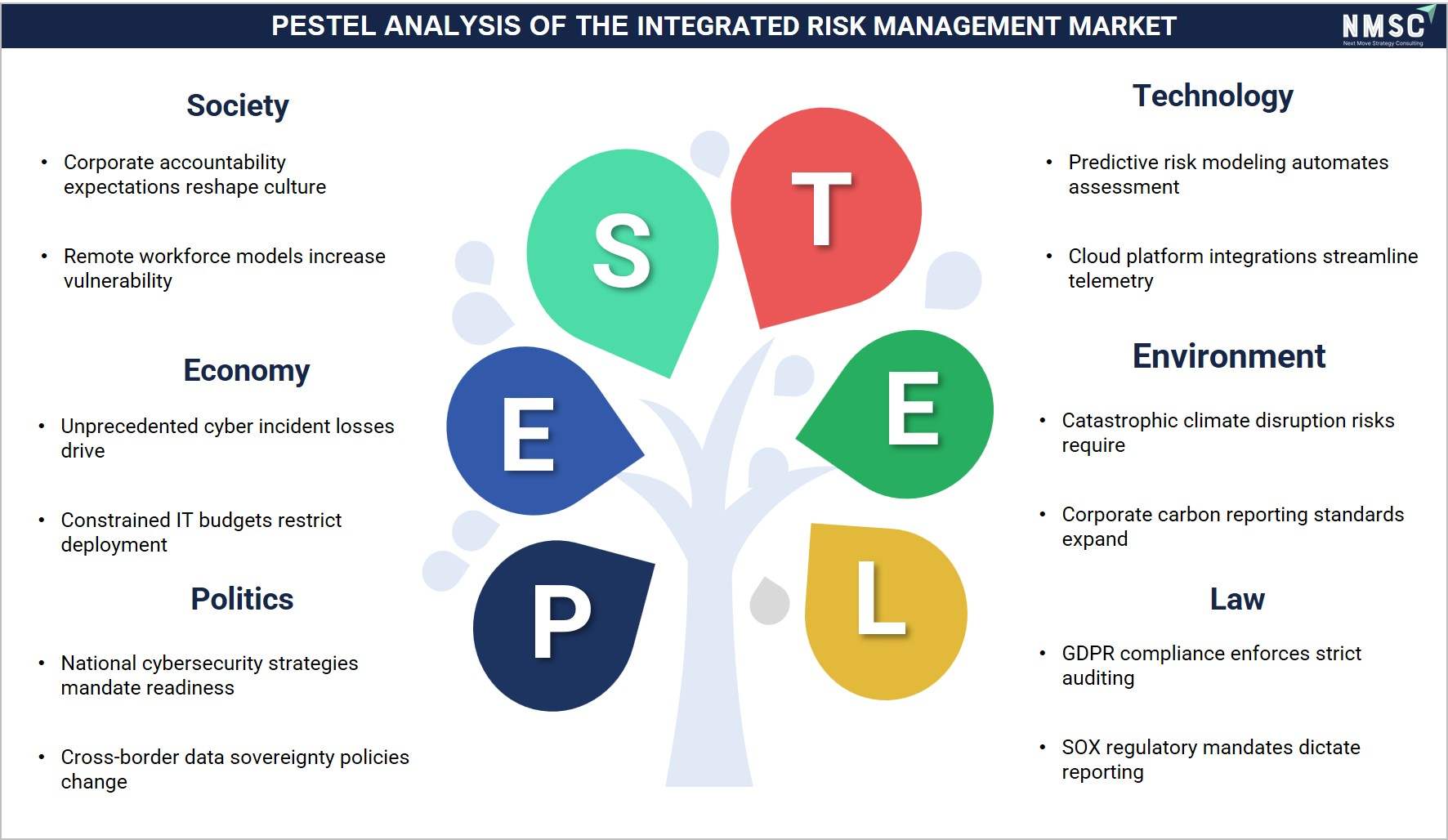
The PESTEL analysis of the Integrated Risk Management (IRM) market highlights the external factors influencing industry growth. Political and legal developments drive compliance requirements, while economic conditions shape enterprise risk investments. Social awareness of data privacy and operational resilience increases adoption, and rapid technological advancements, including AI and cloud computing, enhance risk management capabilities. Environmental sustainability initiatives further encourage organizations to integrate ESG and climate-related risks into enterprise-wide governance and compliance strategies.

Market Drivers & Dynamics

Interactive Dataset
Rising regulatory compliance complexity across multiple jurisdictions driver +2.6% North America, Europe 2026–2035
Escalating cyber threat activity increasing risk platform investment driver +2.2% Global 2026–2035
Growing enterprise consolidation of fragmented GRC point tools driver +1.7% North America, Europe 2026–2035
Expanding third-party and supply chain risk visibility requirements driver +1.3% North America, Europe 2026–2032
Rising AI-driven predictive risk analytics adoption driver +1.0% North America, Asia-Pacific 2026–2035
Growing digital transformation investment in emerging markets driver +0.7% Asia-Pacific 2026–2035
High implementation cost and complexity of enterprise-wide platform deployment restraint −1.2% Global 2026–2035
Persistent shortage of skilled risk and compliance professionals restraint −0.8% Global 2026–2032
Data integration challenges across legacy enterprise systems restraint −0.5% Global 2028–2035
Source: Next Move Strategy Consulting

Growth Drivers

What Is the Primary Growth Driver of the Integrated Risk Management Market?

Rising regulatory compliance complexity across multiple jurisdictions is the primary driver of the market. The U.S. Securities and Exchange Commission continues to expand cybersecurity disclosure requirements for public companies, requiring material incident reporting within four business days. We observed that this expanding disclosure obligation, reinforced by similar regulatory developments across the European Union and Asia-Pacific, continues to anchor baseline demand for integrated compliance and risk reporting platforms across regulated industries.

How Is Cyber Threat Activity Driving Integrated Risk Management Market Growth?
Escalating cyber threat activity is accelerating market growth beyond traditional operational and financial risk management use cases. Our assessment indicates that continued high-profile ransomware and data breach incidents across major industries continue to elevate board-level scrutiny of cyber risk exposure. This threat environment, combined with expanding cyber insurance underwriting requirements, is compressing adoption timelines for integrated cyber and IT risk management capability across enterprise and mid-market buyers.

Growth Inhibitors

What Is Restraining Integrated Risk Management Market Expansion?

High implementation cost and complexity of enterprise-wide platform deployment restrain broader adoption among smaller organizations with limited information technology budgets. Persistent shortages of skilled risk and compliance professionals continue to limit the pace at which enterprises can fully operationalize integrated risk platforms. We found that mid-market organizations face particular exposure, as data integration challenges across legacy enterprise systems limit their ability to realize full platform value without significant implementation investment.

What Are the Growth Opportunities?

How Can AI-Driven Predictive Risk Analytics Unlock Value for Enterprise Risk Teams?

AI-driven predictive risk analytics present a whitespace opportunity for vendors serving risk teams seeking to move from reactive to proactive risk identification. Suppliers that commercialize predictive modeling capability stand to capture recurring platform revenue as boards demand earlier visibility into emerging operational and cyber risk exposure across the Cyber and IT Risk segment.

Where Does Mid-Market Managed Services Adoption Create New Demand?

Mid-market organizations facing skilled workforce shortages represent an underpenetrated opportunity for vendors offering managed risk operations alongside core Cybersecurity and compliance platform licensing. Vendors that scale consumption-based managed services can capture recurring revenue as mid-market buyers seek expert-led platform operation across the Services segment.

How Can Healthcare-Specific Compliance Modules Benefit Platform Vendors?

Healthcare-specific compliance and clinical operational risk modules represent an underpenetrated opportunity given the sector's rapidly expanding data protection and patient safety reporting requirements. Vendors that build healthcare-tailored risk taxonomies can capture recurring platform revenue as hospital systems and healthcare payers accelerate integrated platform adoption across the Healthcare industry vertical segment.

Segmentation Analysis

2025 (USD Billion)
2035 (USD Billion)
Software 2025: $10.99 Billion | 2035: $29.50 Billion
Software
Services 2025: $4.91 Billion | 2035: $17.30 Billion
Services
Software $10.99 Billion $29.50 Billion 10.4%
Services $4.91 Billion $17.30 Billion 13.8%

Which Offering Dominates the Integrated Risk Management Market?

Software led the market with USD 10.99 billion in 2025, supported by its role as the core platform layer providing risk assessment, compliance tracking, and audit management functionality. We observed that Services is the fastest-growing offering, expanding at a 13.8% CAGR from 2026 to 2035, as enterprises increasingly rely on consulting, implementation, and managed services to operationalize complex, enterprise-wide risk platforms amid persistent skilled workforce shortages.

2025 (USD Billion)
2035 (USD Billion)
Cloud
On-Premises
Segment Item 2025 (USD Billion) 2035 (USD Billion) CAGR
Cloud $10.0 USD Billion $40.0 USD Billion 9.0%
On-Premises $17.1 USD Billion $51.1 USD Billion 23.0%

Segment-wise data is locked

Unlock complete segment-wise numbers for By Deployment Mode.

Unlock Full Data
2025 (USD Billion)
2035 (USD Billion)
Large Enterp
Small and Me
Segment Item 2025 (USD Billion) 2035 (USD Billion) CAGR
Large Enterprise $10.0 USD Billion $40.0 USD Billion 10.0%
Small and Medium Enterprise $17.1 USD Billion $51.1 USD Billion 24.0%

Segment-wise data is locked

Unlock complete segment-wise numbers for By Organization Size.

Unlock Full Data
2025 (USD Billion)
2035 (USD Billion)
BFSI
Healthcare
IT and Telec
Manufacturin
Government a
Segment Item 2025 (USD Billion) 2035 (USD Billion) CAGR
BFSI $10.0 USD Billion $40.0 USD Billion 16.0%
Healthcare $17.1 USD Billion $51.1 USD Billion 10.0%
IT and Telecommunications $24.2 USD Billion $62.2 USD Billion 8.0%
Manufacturing $31.3 USD Billion $73.3 USD Billion 22.0%
Government and Public Sector $38.4 USD Billion $84.4 USD Billion 9.0%

Segment-wise data is locked

Unlock complete segment-wise numbers for By Industry Vertical.

Unlock Full Data

Which Industry Vertical Leads the Integrated Risk Management Market?

BFSI remained the dominant industry vertical, reaching USD 4.77 billion in 2025 given the sector's intensive regulatory reporting obligations and long-standing enterprise risk management maturity. Our findings suggest that Healthcare is the fastest-growing vertical at a 13.9% CAGR from 2026 to 2035, as expanding patient data protection requirements and clinical operational risk exposure accelerate integrated platform adoption among hospital systems and healthcare payers.

2025 (USD Billion)
2035 (USD Billion)
Operational
Financial Ri
Compliance R
Cyber and IT
Strategic Ri
Segment Item 2025 (USD Billion) 2035 (USD Billion) CAGR
Operational Risk $10.0 USD Billion $40.0 USD Billion 25.0%
Financial Risk $17.1 USD Billion $51.1 USD Billion 15.0%
Compliance Risk $24.2 USD Billion $62.2 USD Billion 25.0%
Cyber and IT Risk $31.3 USD Billion $73.3 USD Billion 11.0%
Strategic Risk $38.4 USD Billion $84.4 USD Billion 12.0%

Segment-wise data is locked

Unlock complete segment-wise numbers for By Risk Type.

Unlock Full Data

Which Risk Type Leads Integrated Risk Management Market Demand?

Compliance Risk remained the leading risk type, valued at USD 4.29 billion in 2025 as regulatory reporting obligations continue to represent the most universally mandated risk management function across industries. Based on research conducted by Next Move Strategy Consulting, we found that Cyber and IT Risk is the fastest-growing risk type, registering a 15.8% CAGR from 2026 to 2035, as escalating cyber threat activity and expanding breach disclosure requirements accelerate dedicated cyber risk platform investment.

Growth Opportunities

Our analysis shows that three forward-looking opportunities stand out for stakeholders positioning within the integrated risk management market over the 2026–2035 forecast period.

How Can AI-Driven Predictive Risk Analytics Unlock Value for Enterprise Risk Teams?

AI-driven predictive risk analytics present a whitespace opportunity for vendors serving risk teams seeking to move from reactive to proactive risk identification. Suppliers that commercialize predictive modeling capability stand to capture recurring platform revenue as boards demand earlier visibility into emerging operational and cyber risk exposure across the Cyber and IT Risk segment.

Where Does Mid-Market Managed Services Adoption Create New Demand?

Mid-market organizations facing skilled workforce shortages represent an underpenetrated opportunity for vendors offering managed risk operations alongside core Cybersecurity and compliance platform licensing. Vendors that scale consumption-based managed services can capture recurring revenue as mid-market buyers seek expert-led platform operation across the Services segment.

How Can Healthcare-Specific Compliance Modules Benefit Platform Vendors?

Healthcare-specific compliance and clinical operational risk modules represent an underpenetrated opportunity given the sector's rapidly expanding data protection and patient safety reporting requirements. Vendors that build healthcare-tailored risk taxonomies can capture recurring platform revenue as hospital systems and healthcare payers accelerate integrated platform adoption across the Healthcare industry vertical segment.

STRATEGIC FRAMEWORK OF THE INTEGRATED RISK MANAGEMENT MARKET

STRATEGIC FRAMEWORK OF THE INTEGRATED RISK MANAGEMENT MARKET
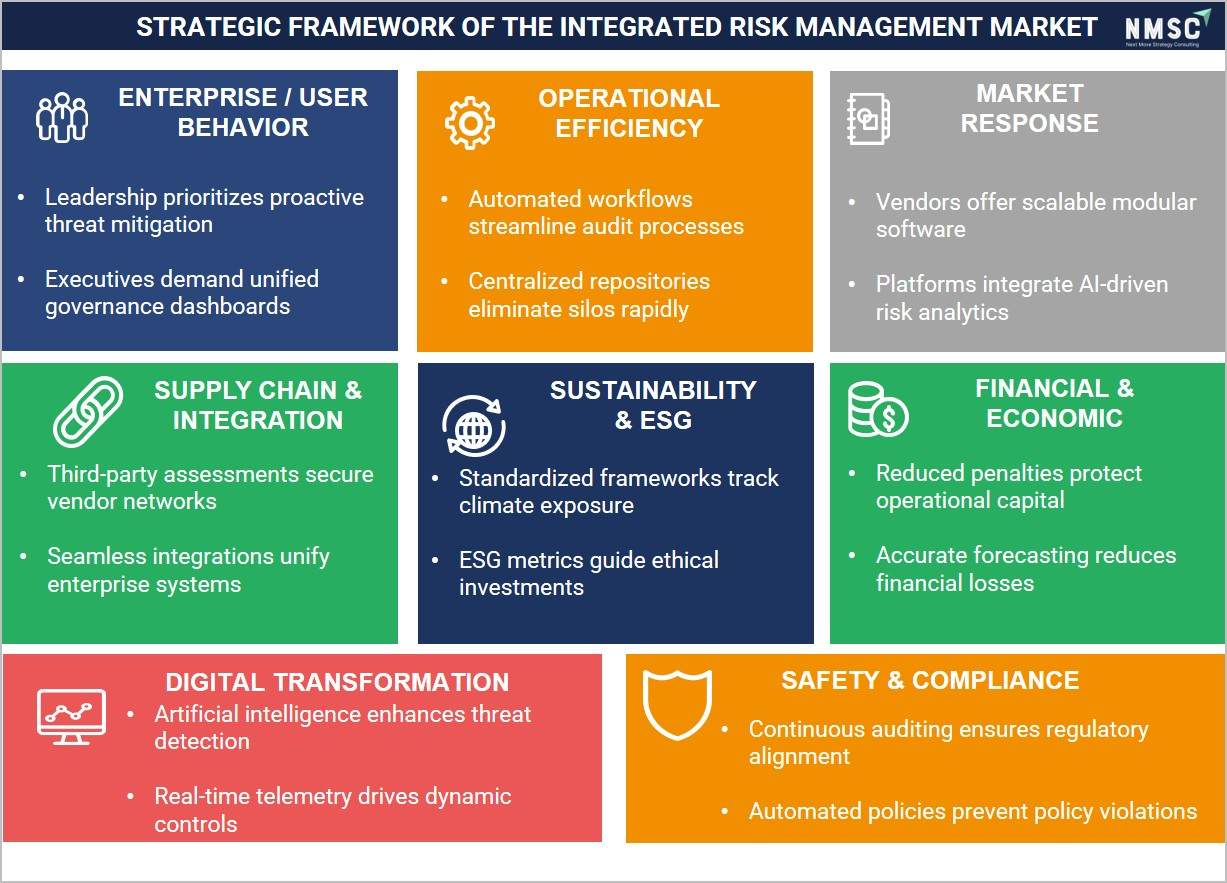
The strategic framework of the Integrated Risk Management (IRM) market illustrates how organizations strengthen governance, operational resilience, and regulatory compliance. Enterprises are adopting AI-powered analytics, centralized risk platforms, and automated workflows to improve decision-making and efficiency. Integration across business systems, ESG-focused risk management, and third-party risk assessments support sustainable operations, while continuous compliance monitoring and predictive risk insights help reduce financial losses, enhance security, and maintain regulatory alignment in dynamic business environments.

Regional Outlook

2025 (USD Billion)
2035 (USD Billion)
North Americ
Europe
Asia-Pacific
Middle East
Latin Americ
Region 2025 (USD Billion) 2035 (USD Billion) CAGR (%)
North America $10.0 USD Billion $40.0 USD Billion 9.0%
Europe $17.1 USD Billion $51.1 USD Billion 27.0%
Asia-Pacific $24.2 USD Billion $62.2 USD Billion 25.0%
Middle East & Africa $31.3 USD Billion $73.3 USD Billion 23.0%
Latin America $38.4 USD Billion $84.4 USD Billion 12.0%

Regional data is locked

Unlock complete regional numbers for this market.

Unlock Full Data

Competitive Landscape

We observed that the integrated risk management market features a moderately consolidated competitive landscape, with diversified enterprise software groups competing alongside specialized GRC platform vendors on module breadth, AI analytics depth, and regulatory reporting capability.

Dimension Description
Market Structure Moderately consolidated; the top companies profiled in this report collectively account for a majority of global integrated risk management market revenue, while numerous specialized vendors serve niche risk-domain demand.
Innovation Focus AI-driven predictive analytics, continuous controls monitoring, and third-party risk visibility dominate current innovation pipelines across leading vendors.
M&A Activity Selective platform and capability acquisitions continue as diversified software groups and specialized GRC vendors expand module breadth to compete for enterprise-wide platform contracts.

How Do Companies Compete in the Integrated Risk Management Market?

Companies compete primarily on module breadth, AI analytics depth, and regulatory reporting capability across the industry. Diversified enterprise software groups such as IBM Corporation and SAP SE leverage broad enterprise system integration to serve large multinational corporations, while specialized GRC platform vendors such as MetricStream, Inc. and Diligent Corporation compete on risk and compliance-specific platform depth.

Which Competitive Archetypes Dominate the Integrated Risk Management Market?

Two archetypes dominate the market: diversified enterprise software groups offering integrated risk modules within broader business platforms, and specialized GRC vendors concentrated in dedicated risk, compliance, or audit management. ServiceNow, Inc. and Oracle Corporation exemplify the diversified archetype through integrated workflow and enterprise resource planning platforms, while RSA Security LLC and AuditBoard, Inc. exemplify the specialized archetype built around dedicated risk and audit platform depth.

How Are Companies Differentiating Through Innovation in Integrated Risk Management?

Innovation and differentiation strategy increasingly center on AI-driven predictive analytics and continuous controls monitoring. Diligent Corporation's expanding AI-powered board and risk analytics capability illustrates how vendors are positioning predictive risk identification as a competitive differentiator against traditional periodic-assessment platforms. Our analysis shows that vendors unable to demonstrate credible AI analytics capability risk losing long-term specification share to platform-diversified competitors.

What M&A and Expansion Activity Is Shaping the Integrated Risk Management Market?

Mergers, acquisitions, and platform expansion continue to consolidate module breadth within the industry. Riskonnect, Inc.'s prior acquisition of Sword GRC broadened its project and enterprise risk management capability, while continued expansion of managed services offerings from vendors including Fusion Risk Management, Inc. reflects ongoing capability broadening to serve enterprises facing internal risk management skills shortages.

Key Market Players

Our assessment indicates that the following 20 companies are actively shaping product innovation, platform consolidation, and AI analytics capability within the global integrated risk management market.

IBM Corporation SAP SE ServiceNow, Inc. Oracle Corporation Wolters Kluwer N.V. RSA Security LLC MetricStream, Inc. Diligent Corporation Riskonnect, Inc. Resolver Inc. AuditBoard, Inc. NAVEX Global, Inc. LogicGate, Inc. OneTrust, LLC Ideagen plc Workiva Inc. Fusion Risk Management, Inc. SAI Global Pty Ltd Sphera Solutions, Inc. ProcessUnity, Inc.

Latest Developments

We found that recent developments within the integrated risk management market are concentrated on AI analytics expansion and platform consolidation, reflecting the industry's broader innovation trajectory.

Date Event
May 2026 IBM launched OpenPages 9.2, introducing AI-powered governance, AI agent oversight, continuous validation, and automated GRC workflows to strengthen enterprise Integrated Risk Management.
March 2026 Workiva unveiled the next generation of its AI-powered GRC platform, integrating audit, enterprise risk, and internal controls into a connected governance platform for real-time risk visibility.
May 2025 OneTrust launched Data Use Governance, providing automated data policy enforcement and governance capabilities to support AI initiatives while strengthening compliance and enterprise risk management.
February 2025 OneTrust expanded its Microsoft Azure OpenAI integration to provide centralized AI agent governance, enabling organizations to manage AI risks and regulatory compliance across enterprise deployments.

Expert Insights

Gaurav Kapoor

Gaurav Kapoor

Co-CEO & Co-Founder | MetricStream

"The GRC landscape is undergoing rapid change with increasing interdependencies of risks, a regulatory focus on operational resilience, and technologies like AI disrupting how we manage risk and compliance. Organizations and practitioners have to move from reactive compliance and security to proactive risk and resilience management."

Analyst Interpretation

The statement reflects a key trend shaping the Integrated Risk Management (IRM) market, as organizations shift from siloed, reactive compliance practices toward proactive, enterprise-wide risk and resilience management. Increasing regulatory complexity, interconnected business risks, and the adoption of AI are driving demand for integrated GRC platforms that enable continuous risk monitoring, enterprise-wide visibility, stronger operational resilience, and more informed strategic decision-making.

Investment Opportunities

What Capital Inflows Are Targeting the Integrated Risk Management Market?

Capital inflows into the integrated risk management market are increasingly directed toward AI-driven analytics and third-party risk visibility capability. Continued platform investment from established vendors including ServiceNow, Inc. and Diligent Corporation illustrate sustained interest in predictive risk analytics expansion. We observed that investors favor platforms demonstrating validated enterprise-scale deployment reliability, viewing broad module adoption as a proxy for long-term customer retention.

How Is Infrastructure Investment Supporting Integrated Risk Management Platform Scaling?

Infrastructure investment is expanding cloud platform capacity to support growing volumes of real-time risk and compliance data across enterprise systems. Our findings suggest that vendors are investing in expanded data integration capability to support continuous controls monitoring at enterprise scale. Manufacturers are increasingly investing in scalable architectures capable of ingesting risk data from multiple enterprise systems simultaneously.

What ESG Considerations Are Shaping Integrated Risk Management Investment Decisions?

Environmental, social, and governance considerations are increasingly relevant to investment decisions across the industry, as ESG reporting itself has become a distinct risk and compliance module within integrated platforms. Expanding sustainability disclosure regulations across Europe and North America continue to shape vendor product roadmaps. We found that investors increasingly favor vendors with validated ESG reporting capability, treating this as both a governance indicator and a growth driver for platform adoption.

Key Benefits for Stakeholders

How Does This Report Benefit Enterprise and Industry Leaders?

Enterprise and industry leaders gain access to validated segmentation, competitive benchmarking, and regional demand forecasts that support platform selection and risk strategy decisions across the integrated risk management industry. Our analysis shows that detailed offering, industry vertical, and risk type breakdowns help technology leaders align investment with organizational risk governance priorities while identifying underserved segments for platform expansion.

How Does This Report Benefit Investors and Financial Analysts?

Investors and financial analysts benefit from consistent, single-point market size and CAGR estimates that support valuation and capital-allocation decisions across the integrated risk management market supply chain. We observed that the report's regional and segment-level growth differentials help identify which vendors are best positioned to capture above-market growth in cyber risk and Asia-Pacific categories through 2035.

How Does This Report Benefit Technology Vendors and Product Teams?

Technology vendors and product teams gain insight into emerging platform requirements, including AI-driven predictive analytics, continuous controls monitoring, and third-party risk visibility, that are reshaping the industry. Our findings suggest that this analysis helps R&D teams prioritize development roadmaps around real-time risk data integration and regulatory reporting automation that are increasingly required by enterprise buyer evaluation processes.

Key Market Segments Evaluated

By Offering

  • Software 
    • Risk Assessment and Analytics
    • Compliance Management
    • Audit Management
    • Policy and Document Management
    • Third-Party Risk Management
    • Business Continuity Management
  • Services 
    • Consulting
    • Implementation
    • Managed Services

By Deployment Mode

  • Cloud
  • On-Premises

By Organization Size

  • Large Enterprise
  • Small and Medium Enterprise

By Industry Vertical

  • BFSI
  • Healthcare
  • IT and Telecommunications
  • Manufacturing
  • Government and Public Sector
  • Energy and Utilities
  • Retail and Consumer Goods
  • Other Industries

By Risk Type

  • Operational Risk
  • Financial Risk
  • Compliance Risk
  • Cyber and IT Risk
  • Strategic Risk
  • Third-Party Risk

By Region

  • North America 
    • U.S.
    • Canada
    • Mexico.
  • Europe 
    • UK
    • Germany
    • France
    • Italy
    • Spain
    • Sweden
    • Denmark
    • Finland
    • Netherlands
    • Rest of Europe.
  • Asia-Pacific 
    • China
    • India
    • Japan
    • South Korea
    • Taiwan
    • Indonesia
    • Vietnam
    • Australia
    • Philippines
    • Malaysia
    • Rest of APAC.
  • Middle East & Africa 
    • Saudi Arabia
    • UAE
    • Egypt
    • Israel
    • Turkey
    • Nigeria
    • South Africa
    • Rest of MEA.
  • Latin America 
    • Brazil
    • Argentina
    • Chile
    • Colombia
    • Rest of LATAM.

Conclusion & Recommendations

The long-term outlook for the market remains strongly positive, with global revenue projected to nearly triple from USD 15.90 billion in 2025 to USD 46.80 billion by 2035 at an 11.5% CAGR. We observed that sustained regulatory compliance complexity, escalating cyber threat activity, and growing AI-driven predictive analytics adoption will continue underpinning demand across large enterprise and small and medium enterprise segments through the forecast period.

What Strategic Positioning Should Integrated Risk Management Suppliers Pursue?

Suppliers should prioritize AI-driven predictive analytics and continuous controls monitoring capability while pursuing managed services expansion to address persistent skilled workforce shortages. Our assessment indicates that vendors investing early in real-time risk data integration and cyber risk module depth will be best positioned to capture premium specification within the integrated risk management market.

How Attractive Is the Integrated Risk Management Market for New Investment?

The integrated risk management industry presents a highly attractive investment case, supported by a USD 29.3 billion absolute dollar opportunity between 2026 and 2035 and above-average growth in Asia-Pacific and cyber risk categories. We found that investment attractiveness is highest for vendors combining validated enterprise-scale deployment reliability with AI-driven analytics capability, positioning them to serve both large enterprise and mid-market segments simultaneously.

What Market Shifts and Key Risks Should Stakeholders Monitor?

Stakeholders should monitor high implementation costs, persistent skilled workforce shortages, and data integration challenges across legacy enterprise systems as key risks to the integrated risk management market. Our analysis shows that vendors unable to demonstrate credible AI-driven analytics capability risk losing specification share to platform-diversified competitors as continuous, real-time risk visibility becomes the expected governance standard.

What Are the Key Growth Pathways for the Integrated Risk Management Market?

Key growth pathways include expanding cyber and IT risk management capability, scaling managed services offerings, and deepening penetration into Asia-Pacific's rapidly digitizing enterprise base. Next Move Strategy Consulting's analysis indicates that suppliers pursuing these pathways while maintaining strength in core compliance management will be best positioned to capture the integrated risk management market's projected growth through 2035.

FAQs

About the Author

Liza Phukan

Liza Phukan

Liza Phukan is Research Associate at Next Move Strategy Consulting, where she has covered emerging industries and market research across sectors for 3.5 years. Her work includes analyzing industry developments, validating market data, and developing structured business content from research findings. She uses secondary research and data-validation practices to turn complex market information into clear decision-useful market analysis for business audiences and support report development and B2B.

About the Reviewer

Supradip Baul

Supradip Baul

Supradip Baul is an accomplished business consultant and strategist with over a decade of rich experience in market intelligence, strategy, technology, and business transformation. His work has included rigorous qualitative and quantitative analysis across multiple industries, helping clients shape investment decisions and long-term roadmaps. Earlier in his career, he was associated with Gartner, where he contributed to industry-leading reports and market share analyses. He has worked with leading global companies and holds an MBA with a dual specialization in Marketing and Finance.

Download Free Sample

Rishabh Jogani

RISHABH JOGANI

Strategy Analyst

Accenture Japan

We are incredibly impressed with the market report on the real estate market in India provided by Next Move Strategy Consulting. The report was thorough, insightful, and well-structured, offering deep analysis and actionable recommendations. It not only captured the current trends and dynamics but also provided a forward-looking perspective that has been invaluable for our strategic planning. Their team demonstrated exceptional professionalism, attention to detail, and a profound understanding of the industry. The data-driven insights and clarity of presentation exceeded our expectations, making complex market trends easy to understand. We highly recommend Next Move Strategy Consulting to anyone looking for reliable and comprehensive market research services. Their expertise has given us the confidence to navigate the complexities of the Indian real estate market with clarity and foresight.

Robert Sean Trevino

ROBERT SEAN TREVINO

Sr. Director, Head of Strategic Insights & Analytics

Foundation Medicine

I realized that it was a reliable source of information. These days, there are many people who are looking for authentic data, and this is one of the only sources that can offer them with what they need;

Diana Trejo

DIANA TREJO

Assistant Manager

Sumitomo Corporation de Mexico, S.A. de C.V.

Recently, we purchased a report on the Mexico Data Center Market from Next Move Strategy Consulting. The service has been excellent, with support that is always timely and thoroughly professional. The information provided is interesting, highly useful, and delivered with clarity. I would highly recommend NextMSC for anyone seeking insightful and dependable analysis.

Ross J Mckenzie

ROSS J MCKENZIE

Business Insight Manager

Staysure Group

“Next MSC have been incredibly helpful in providing detailed & robust information on our market, alongside quantifying growth by different segments. The process to procure was simple and easy, with sample reports and regular contact to ensure we had what we needed. Succinct detail on their sources & methodologies is also greatly received, allowing transparency in this respect helps build trust in the detail you pay for. Joseph in particular was fantastic, and helped ensure efficient provision of the insight pack – thank you NMSC!”.

Semih Kavaklioglu

SEMIH KAVAKLIOGLU

Co-Founder & Sales Manager

Decortie

I work a lot in the marketing industry and I know that research is an essential part of any campaign. I have used Market research reports for my own products and I found them to be very informative and well-researched. The team here produces insightful reports for a good price

Custom Market Research Services

We will customize the research for you if the listed report does not fully match your requirements.

Get 30% Free Customization

Select License

This website uses cookies to ensure you get the best experience on our website. Learn more

✖