Climate Risk Management Market Size, Share, Trends and Growth Analysis, By Component (Software and Platform and Services), By Risk Type (Physical Risk, Transition Risk, and Liability Risk), By Deployment Mode (Cloud and On Premises), By Application (Physical Asset Risk Assessment, Catastrophe and Weather Risk Modeling, Climate Scenario Analysis and Stress Testing), By End User, and Region — Global Industry Report and Forecast, 2026–2035
Industry: ICT & Media | Publishing Date: August 1, 2026 | Last Updated: August 1, 2026 | No of Pages: N/A | No. of Tables: N/A | No. of Figures: N/A | Format: PDF | Report Code: IC5516
What Is the Climate Risk Management Market Size?
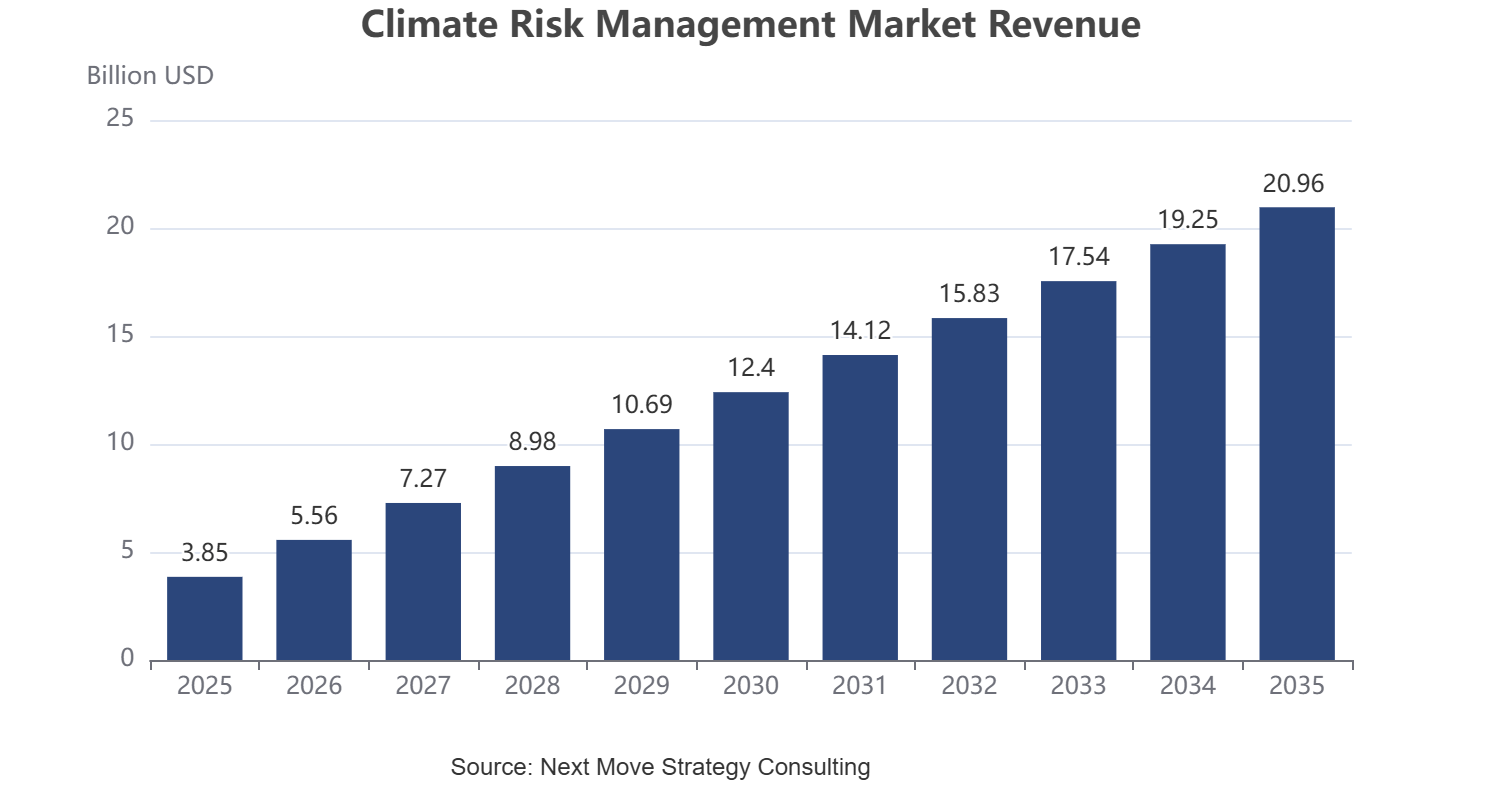
The global climate risk management market size was valued at USD 3.85 billion in 2025 and is estimated at USD 4.55 billion in 2026, forecast to reach USD 20.96 billion by 2035, expanding at an 18.5% CAGR between 2026 and 2035. North America leads with approximately 42% share, while Software and Platform solutions dominate all other components with approximately 62% share.
We observed that growth is broad-based across every segmentation axis, with transition risk disclosure software and cloud-native physical risk analytics driving the dominant structural shifts through 2035.
|
Key Takeaways |
|
By Component: Software and Platform held the largest share of approximately 62% (USD 2.39 billion) in 2025; Software and Platform is also the fastest-growing component at 19.7% CAGR from 2026–2035. |
|
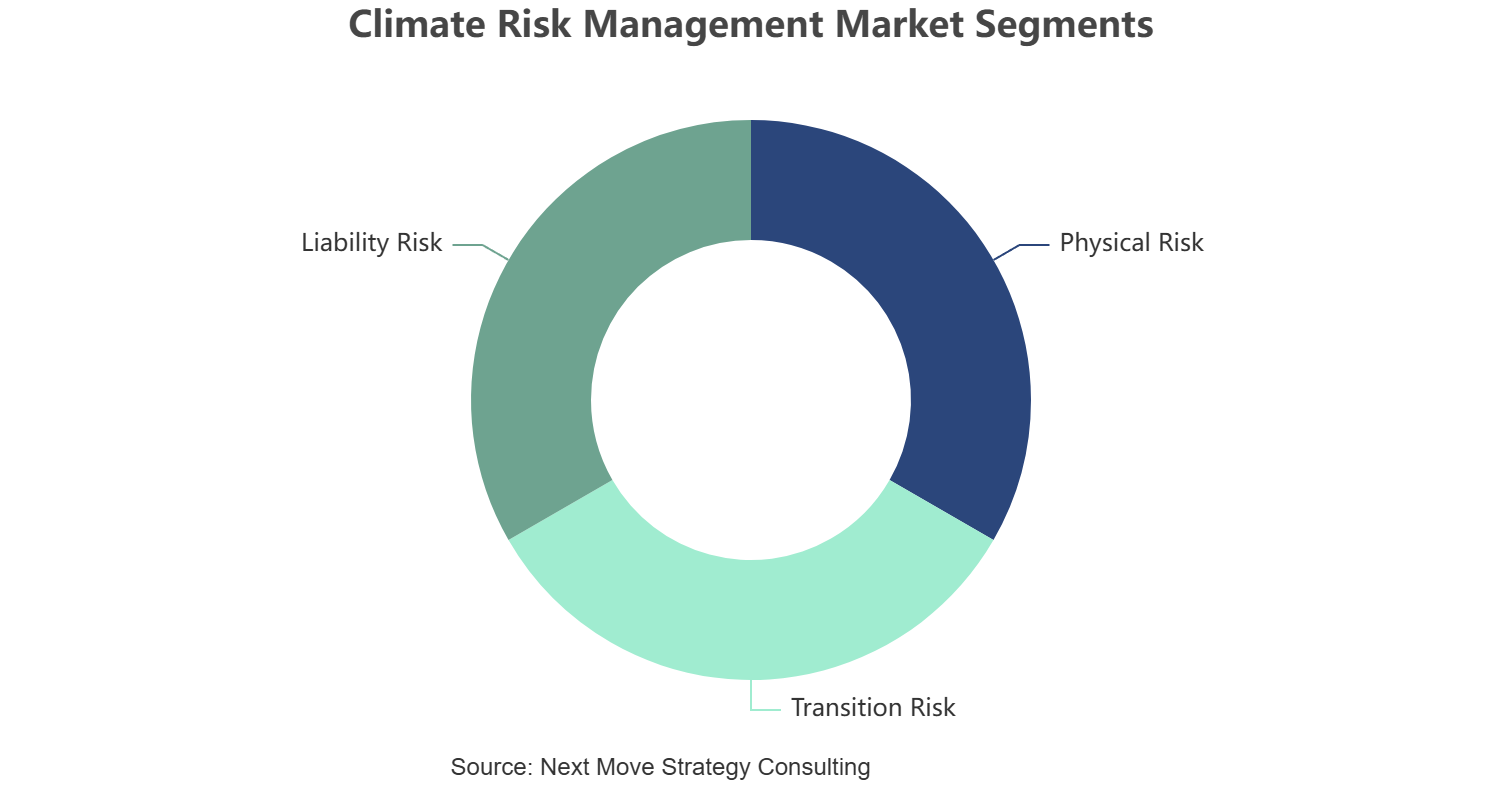
By Risk Type: Physical Risk held the largest share of approximately 66% (USD 2.54 billion) in 2025; Transition Risk is the fastest-growing sub-segment at 20.7% CAGR from 2026–2035. |
|
By Deployment Mode: Cloud held the largest share of approximately 71% (USD 2.73 billion) in 2025; Cloud is also the fastest-growing deployment mode at 20.1% CAGR from 2026–2035. |
|
By End User: Insurance and Reinsurance held the largest share of approximately 27% (USD 1.04 billion) in 2025; Agriculture and Food is the fastest-growing sub-segment at 24.0% CAGR from 2026–2035. |
|
Dominant Region: North America dominated with approximately 42% revenue share (USD 1.62 billion) in 2025. |
|
Fastest-Growing Region: Asia-Pacific is expected to register the highest CAGR of 23.1% during 2026–2035. |
|
Dominant Country: U.S. led with approximately USD 1.29 billion in 2025. |
|
Fastest-Growing Country: India is the fastest-growing country at approximately 25.8% CAGR from 2026–2035. |
Market Opportunity: The climate risk management market is expected to create an absolute dollar opportunity of USD 16.41 billion between 2026 and 2035, presenting significant investment potential across the physical and transition risk analytics value chain.
According to NMSC analysis, financial institutions are increasingly consolidating standalone physical risk data feeds with unified climate scenario analysis and disclosure platforms to reduce audit complexity, a shift that favors vendors offering both asset-level modeling and regulatory reporting capabilities over single-function data providers as supervisory scrutiny intensifies through 2035.
What Does the Climate Risk Management Market Encompass?
The climate risk management market encompasses software, data, and advisory services that help enterprises, financial institutions, and governments identify, quantify, and disclose physical and transition risks arising from a changing climate. Our assessment indicates that the scope spans physical asset risk assessment, catastrophe and weather risk modeling, climate scenario analysis and stress testing, and regulatory disclosure and compliance reporting supplied to banks, insurers, asset managers, and public sector agencies across construction, energy, agriculture, and manufacturing end markets.
Regulatory frameworks such as the Task Force on Climate related Financial Disclosures recommendations and the Network for Greening the Financial System scenario guidance shape climate stress-testing and disclosure obligations, while national supervisors including Canada's Office of the Superintendent of Financial Institutions increasingly mandate standardized climate scenario exercises for regulated financial institutions. We observed that technology adoption is shifting from static, historical hazard maps toward forward-looking, AI enabled physical risk models delivered through cloud computing infrastructure. NMSC's analysis indicates that this structural shift, combined with growing transition risk disclosure requirements, is redefining vendor selection criteria across the climate risk management market.
|
Parameters |
Details |
|
Market Size in 2025 |
USD 3.85 Billion |
|
Market Size in 2026 |
USD 4.55 Billion |
|
Revenue Forecast in 2035 |
USD 20.96 Billion |
|
Growth Rate |
CAGR of 18.5% from 2026 to 2035 |
|
Analysis Period |
2025–2035 |
|
Base Year Considered |
2025 |
|
Forecast Period |
2026–2035 |
|
Market Size Estimation |
Revenue (USD Billion) |
|
Companies Profiled |
20 |
|
Countries Covered |
33 |
|
Market Share |
Available for Top 10 Companies |
Key Emerging Trends
Based on research conducted by NMSC, we found that four structural trends are reshaping product development, deployment, and stakeholder engagement across the industry.
How Is Generative AI Transforming Climate Risk Disclosure Reporting?
Generative AI tools that draft scenario narratives, summarize hazard exposure, and populate disclosure templates are gaining adoption as reporting teams face mounting regulatory workloads. Generative AI copilots embedded within climate platforms have helped banks and insurers reduce manual analyst hours spent compiling Task Force on Climate related Financial Disclosures narratives. Vendors are embedding similar natural-language features into scenario analysis suites to reduce documentation burden across large, multi-entity financial institutions.
Why Is Climate Digital Twin Modeling Gaining Enterprise Adoption?
Climate digital twin platforms that simulate physical asset exposure under multiple future scenarios are gaining traction among banks and asset managers seeking forward-looking risk views. Climate Digital Twin technology developed by riskthinking.AI, selected by Canadian regulators to power national financial-sector climate stress testing, illustrates how digital twin simulation is moving from research concept to regulatory-grade infrastructure. Enterprises increasingly treat scenario-linked digital twin coverage as a procurement requirement when evaluating climate risk vendors.
How Is Machine Learning Improving Catastrophe and Weather Risk Modeling?
Machine learning models trained on satellite imagery, historical loss data, and structural attributes are improving the precision of property-level catastrophe risk scoring beyond traditional statistical models. Machine learning techniques applied by ZestyAI to wildfire, hail, and wind risk have demonstrated measurable lift over legacy actuarial models in underwriting validation. This trend is broadening precision risk scoring beyond insurance into real estate lending and corporate asset management.
What Role Does Satellite Data Play in Physical Risk Intelligence?
Synthetic aperture radar and satellite-derived flood and structural data are emerging as a complement to ground-based sensors, particularly in regions lacking dense historical loss records. Our analysis shows that ICEYE's satellite-based flood and disaster data supports near-real-time damage assessment for insurers and government agencies. This trend is broadening the addressable market beyond data-rich developed economies into emerging markets with limited historical climate data.
Growth Drivers and Restraints
Growth Catalyst and Risk Assessment Matrix
|
Factors |
Type |
(+/−) % Impact on CAGR |
Geographic Relevance |
Impact Timeline |
|
Rising frequency and severity of natural catastrophe losses increasing enterprise scrutiny |
Driver |
+3.4% |
Global |
2026–2035 |
|
Expanding mandatory climate disclosure and scenario-testing regulation |
Driver |
+2.9% |
North America, Europe |
2026–2035 |
|
Falling satellite and AI-based hazard modeling costs |
Driver |
+2.3% |
Global |
2026–2032 |
|
Growing insurer and reinsurer demand for asset-level physical risk pricing tools |
Driver |
+2.1% |
Global |
2026–2035 |
|
Rising investor pressure for portfolio-level transition risk quantification |
Driver |
+1.8% |
Europe, North America |
2027–2035 |
|
Expansion of parametric and index-based climate insurance products |
Driver |
+1.5% |
Global |
2026–2035 |
|
Central bank climate stress-testing mandates for regulated financial institutions |
Driver |
+1.2% |
North America, Europe, Asia-Pacific |
2026–2035 |
|
Data standardization and definitional inconsistency across climate risk metrics |
Restraint |
−1.5% |
Global |
2026–2032 |
|
High cost of asset-level data licensing for smaller financial institutions |
Restraint |
−1.1% |
Global |
2026–2030 |
|
Limited historical loss data availability across emerging markets |
Restraint |
−0.9% |
Middle East & Africa, Latin America |
2026–2033 |
What Is the Primary Growth Driver of the Climate Risk Management Market?
Rising natural catastrophe losses are the primary driver of the market. Verisk's 2025 Global Modeled Catastrophe Losses Report found that global insured average annual property losses from natural catastrophes reached USD 152 billion, a 25% increase from 2024, sustaining enterprise demand for forward-looking risk quantification tools. We observed that this loss trajectory, reinforced by rising reinsurance costs, continues to anchor baseline adoption of physical risk analytics across insurance, banking, and real estate sectors.
How Is Regulatory Disclosure Driving Climate Risk Management Market Growth?
Mandatory climate disclosure requirements are accelerating market growth toward integrated scenario analysis and reporting platforms. Canada's Office of the Superintendent of Financial Institutions has required approximately 400 financial institutions to complete standardized climate scenario exercises, while the Task Force on Climate related Financial Disclosures framework continues to shape voluntary and mandatory reporting globally. Our assessment indicates that this regulatory pressure is compressing adoption timelines for unified physical and transition risk platforms across North America and Europe.
What Is Restraining Climate Risk Management Market Expansion?
Data standardization gaps and definitional inconsistency across climate risk metrics restrain broader market expansion. Vendors continue to apply differing hazard resolutions, emissions scenarios, and financial impact methodologies, complicating cross-platform comparison for enterprise buyers. We found that smaller financial institutions face particular exposure, as limited internal data science resources slow adoption of asset-level physical risk models compared with large, well-resourced banks and insurers.
Segmentation Analysis
Segment Sizing: By Component
|
Segment |
2025 (USD) |
2035 (USD) |
CAGR% (2026–2035) |
|
Software and Platform |
USD 2.39 Billion |
USD 14.26 Billion |
19.7% |
|
Services |
USD 1.46 Billion |
USD 6.71 Billion |
16.3% |
|
Total |
USD 3.85 Billion |
USD 20.96 Billion |
18.5% |
Which Component Dominates the Climate Risk Management Market?
Software and Platform, encompassing physical risk analytics, scenario modeling, and disclosure reporting applications, led the market with USD 2.39 billion in 2025, supported by growing enterprise preference for self-service, cloud-delivered tools. Risk Management Consulting Services remain a meaningful complement for enterprises lacking internal climate science capability, though we observed that Software and Platform is also the fastest-growing component, expanding at a 19.7% CAGR from 2026 to 2035, as vendors embed increasingly automated analytics that reduce dependence on manual consulting engagements.
Segment Sizing: By Risk Type
|
Segment |
2025 (USD) |
2035 (USD) |
CAGR% (2026–2035) |
|
Physical Risk |
USD 2.54 Billion |
USD 12.58 Billion |
17.3% |
|
Transition Risk |
USD 1.08 Billion |
USD 6.92 Billion |
20.7% |
|
Liability Risk |
USD 0.23 Billion |
USD 1.47 Billion |
20.5% |
|
Total |
USD 3.85 Billion |
USD 20.96 Billion |
18.5% |
Which Risk Type Leads Climate Risk Management Market Demand?
Physical Risk remained the dominant risk type, reaching USD 2.54 billion in 2025 due to sustained insurer and lender demand for asset-level catastrophe and weather risk quantification. Our findings suggest that Transition Risk is the fastest-growing risk type, registering a 20.7% CAGR from 2026 to 2035, as portfolio managers and regulators increasingly require quantified exposure to policy, technology, and market shifts tied to the low-carbon transition.
Segment Sizing: By End User
|
Segment |
2025 (USD) |
2035 (USD) |
CAGR% (2026–2035) |
|
Insurance and Reinsurance |
USD 1.04 Billion |
USD 5.03 Billion |
17.0% |
|
Banking and Financial Institutions |
USD 0.92 Billion |
USD 4.61 Billion |
17.4% |
|
Asset Management and Institutional Investors |
USD 0.54 Billion |
USD 3.35 Billion |
20.3% |
|
Government and Public Sector |
USD 0.42 Billion |
USD 2.31 Billion |
18.5% |
|
Energy and Utilities |
USD 0.35 Billion |
USD 2.10 Billion |
19.9% |
|
Real Estate and Construction |
USD 0.27 Billion |
USD 1.68 Billion |
20.3% |
|
Manufacturing and Industrial |
USD 0.19 Billion |
USD 1.05 Billion |
18.5% |
|
Agriculture and Food |
USD 0.08 Billion |
USD 0.63 Billion |
24.0% |
|
Other End Users |
USD 0.04 Billion |
USD 0.21 Billion |
18.5% |
|
Total |
USD 3.85 Billion |
USD 20.96 Billion |
18.5% |
Which End User Leads Climate Risk Management Market Adoption?
Insurance and Reinsurance remained the leading end user, valued at USD 1.04 billion in 2025 on sustained catastrophe modeling and underwriting analytics adoption across carriers writing Property and Casualty (P&C) Insurance books alongside reinsurers. We found that Agriculture and Food is the fastest-growing end user, registering a 24.0% CAGR from 2026 to 2035, as crop-specific climate intelligence platforms gain traction among growers and food and beverage procurement teams managing drought, heat, and precipitation exposure.
Growth Opportunities
Our analysis shows that three forward-looking opportunities stand out for stakeholders positioning within the climate risk management market over the 2026-2035 forecast period.
How Can GRC Platform Integration Unlock Value for Regulated Financial Institutions?
Deeper integration between climate risk analytics and enterprise Governance Risk and Compliance platforms presents a whitespace opportunity for banks and insurers managing overlapping regulatory workflows. Vendors that embed climate scenario outputs directly into existing GRC systems stand to capture recurring subscription revenue as compliance teams consolidate reporting infrastructure.
Where Do Emerging Market Data Gaps Create New Demand?
Emerging markets with limited historical loss data represent an underpenetrated opportunity for satellite-based and machine learning-driven hazard modeling. Vendors that develop cost-effective, remote-sensing-derived risk products for Asia-Pacific, Middle East and Africa, and Latin America can secure long-term data licensing contracts tied to expanding regional financial-sector climate mandates.
How Can Supply Chain Risk Modules Expand Vendor Distribution Reach?
Climate-linked disruption of supplier networks creates an opportunity for vendors to extend physical risk analytics into supply chain management workflows for manufacturers and retailers. Early movers that bundle supplier-location hazard scoring with existing procurement systems can differentiate against point-solution competitors serving only financial-sector buyers.
Regional Outlook
Geographic Performance Snapshot
|
Region |
2025 (USD) |
2035 (USD) |
CAGR% (2026–2035) |
Key Driver |
|
North America |
USD 1.62 Billion |
USD 7.55 Billion |
16.5% |
OSFI and SEC-linked disclosure mandates and mature reinsurance market |
|
Europe |
USD 1.12 Billion |
USD 5.45 Billion |
17.1% |
TCFD-aligned disclosure rules and EU Sustainable Finance Disclosure Regulation |
|
Asia-Pacific |
USD 0.65 Billion |
USD 5.03 Billion |
23.1% |
Expanding financial-sector climate stress testing and manufacturing exposure |
|
Middle East & Africa |
USD 0.23 Billion |
USD 1.68 Billion |
22.3% |
Vision 2030-linked infrastructure resilience and giga-project risk planning |
|
Latin America |
USD 0.23 Billion |
USD 1.26 Billion |
18.5% |
Growing agricultural exposure and expanding reinsurance sector engagement |
|
Total |
USD 3.85 Billion |
USD 20.96 Billion |
18.5% |
– |
North America Climate Risk Management Market Outlook
North America leads the climate risk management market with a mature reinsurance sector and established physical risk analytics vendors headquartered in the region. We observed that Office of the Superintendent of Financial Institutions climate scenario mandates in Canada and growing SEC-linked disclosure expectations in the U.S. sustain demand for scenario analysis platforms. Technology adoption remains advanced, with insurers and banks driving demand for asset-level catastrophe modeling across the region.
Europe Climate Risk Management Market Outlook
Europe's climate risk management market reflects a disclosure-intensive landscape shaped by Task Force on Climate related Financial Disclosures alignment and the EU Sustainable Finance Disclosure Regulation. Our findings suggest that enterprises across Germany, France, and the UK are accelerating adoption of transition risk quantification tools to satisfy investor and supervisory reporting requirements. Technology adoption favors integrated physical and transition risk platforms supported by regional data providers.
Asia-Pacific Climate Risk Management Market Outlook
Asia-Pacific is the fastest-growing climate risk management market region, propelled by expanding financial-sector climate stress testing in China and India and rising manufacturing exposure to physical hazards. We found that regulatory frameworks remain less harmonized than in Europe, giving vendors flexibility to scale analytics deployments rapidly. Technology adoption is accelerating as regional providers expand delivery capacity to serve domestic banks and insurers.
Middle East & Africa Climate Risk Management Market Outlook
The climate risk management market in the Middle East and Africa is expanding as Gulf Cooperation Council economies invest in infrastructure resilience planning tied to large-scale construction programs. Our analysis shows that Saudi Arabia and the UAE are attracting climate analytics investment tied to giga-project risk assessment. Regulatory influence is developing, while technology adoption is shifting toward imported physical risk platforms as regional operators align with global disclosure expectations.
Latin America Climate Risk Management Market Outlook
Latin America's climate risk management market is supported by growing agricultural exposure in Brazil and Argentina and expanding reinsurance sector engagement. We observed that regulatory frameworks are less stringent than in North America or Europe, though multinational insurers operating locally are introducing physical risk specifications. Technology adoption remains centered on cloud-deployed platforms, with competitive intensity increasing as regional insurers partner with global climate analytics vendors.
U.S. Climate Risk Management Market
Based on our estimates, the U.S. market was valued at approximately USD 1.29 billion in 2025 and is projected to reach USD 5.81 billion by 2035, growing at a 16.0% CAGR. Demand is anchored by a mature reinsurance sector, high catastrophe modeling vendor concentration, and growing SEC-linked climate disclosure expectations. Technology penetration favors cloud-deployed platforms, and competitive intensity remains high among well-established analytics vendors serving national insurance and banking accounts.
Canada Climate Risk Management Market
The market in Canada reached roughly USD 323 million in 2025 and is forecast to hit USD 1.67 billion by 2035 at a 17.8% CAGR. Demand structure is shaped by Office of the Superintendent of Financial Institutions mandates requiring standardized climate scenario exercises across regulated institutions. Technology penetration is rising as national banks request integrated physical and transition risk formats, with competitive intensity moderate given a concentration of domestic climate analytics providers.
UK Climate Risk Management Market
As per our estimate, the UK market stood at about USD 268 million in 2025, advancing toward USD 1.16 billion by 2035 at a 15.5% CAGR. Demand is driven by established insurers and asset managers navigating Task Force on Climate related Financial Disclosures alignment requirements. Regulatory influence is significant, technology penetration favors cloud-deployed platforms, and competitive intensity remains steady among domestic and international vendors serving UK financial institutions.
Germany Climate Risk Management Market
According to our analysis, Germany's market was valued near USD 257 million in 2025 and is set to reach USD 1.18 billion by 2035, expanding at a 16.3% CAGR. Demand structure benefits from a strong domestic reinsurance and manufacturing base subject to EU disclosure requirements. Germany's alignment with the EU Sustainable Finance Disclosure Regulation drives regulatory influence, while technology penetration favors integrated physical and transition risk platforms among leading financial institutions.
France Climate Risk Management Market
Based on our estimates, France's market reached approximately USD 156 million in 2025, projected to climb to USD 748 million by 2035 at a 16.8% CAGR. Demand is supported by France's prominent insurance and asset management base, which shapes physical and transition risk analytics adoption. Regulatory influence from national climate disclosure legislation is notable, and competitive intensity remains moderate given a concentration of European vendors serving domestic institutions.
China Climate Risk Management Market
The market in China stood at roughly USD 196 million in 2025 and is forecast to reach USD 1.44 billion by 2035, registering a 22.5% CAGR. Demand is fueled by expanding financial-sector climate stress testing and a dense manufacturing base exposed to physical hazards. Regulatory influence is increasing gradually, technology penetration is accelerating through domestic AI hardware cost declines, and competitive intensity remains elevated among numerous regional providers.
India Climate Risk Management Market
As per our estimate, India's market was valued at about USD 124 million in 2025, projected to reach USD 1.16 billion by 2035 at a 25.8% CAGR, the fastest among covered countries. Demand structure reflects rapidly expanding banking-sector climate risk mandates alongside growing agricultural exposure. Regulatory influence remains developing, while technology penetration is rising quickly as multinational insurers localize physical risk analytics to serve India's expanding financial base.
Japan Climate Risk Management Market
According to our analysis, Japan's market reached close to USD 124 million in 2025 and is expected to hit USD 642 million by 2035, growing at a 17.8% CAGR. Demand is supported by Japan's exposure to typhoon and earthquake risk and a mature domestic reinsurance heritage. Regulatory influence is well established, technology penetration is advanced, and competitive intensity remains high among long-standing domestic risk modeling vendors.
South Korea Climate Risk Management Market
Based on our estimates, South Korea's market stood at approximately USD 85 million in 2025, forecast to reach USD 538 million by 2035 at a 20.5% CAGR. Demand structure benefits from the country's globally influential manufacturing and shipbuilding sectors exposed to physical climate hazards. Technology penetration is high, with domestic institutions adopting premium analytics platforms, and competitive intensity remains pronounced amid rapid product innovation cycles.
Australia Climate Risk Management Market
The climate risk management market in Australia reached about USD 72 million in 2025 and is projected to reach USD 426 million by 2035, expanding at a 19.6% CAGR. Demand is supported by a well-established insurance sector and growing enterprise preference for grid and infrastructure resilience analytics. Regulatory influence stems from Australian Prudential Regulation Authority climate guidance, while technology penetration favors domestic vendors amid moderate competitive intensity.
UAE Climate Risk Management Market
As per our estimate, the UAE market was valued near USD 69 million in 2025, projected to reach USD 536 million by 2035 at a 23.2% CAGR. Demand structure is shaped by the UAE's role as a regional construction and infrastructure investment hub. Regulatory influence remains moderate, technology penetration is improving through imported physical risk platforms, and competitive intensity is rising as providers expand offerings to serve Gulf institutional customers.
Saudi Arabia Climate Risk Management Market
According to our analysis, Saudi Arabia's market reached roughly USD 74 million in 2025 and is expected to hit USD 628 million by 2035, growing at a 24.5% CAGR. Demand is driven by Vision 2030-linked giga-project infrastructure investment and rising physical risk awareness among regional insurers. Regulatory influence is developing under Saudi Central Bank guidelines, and technology penetration is advancing as domestic institutions scale analytics adoption.
South Africa Climate Risk Management Market
Based on our estimates, South Africa's market stood at about USD 30 million in 2025, forecast to reach USD 173 million by 2035 at a 19.2% CAGR. Demand structure reflects a developing insurance and agricultural base serving regional Southern African markets. Regulatory influence remains moderate, technology penetration is gradually improving, and competitive intensity is limited given reliance on imported physical risk data from Europe and North America.
Brazil Climate Risk Management Market
The market in Brazil reached approximately USD 106 million in 2025 and is projected to reach USD 638 million by 2035, registering a 19.8% CAGR. Demand is underpinned by Brazil's large domestic agricultural sector and expanding reinsurance engagement. Regulatory influence stems from Brazil's central bank sustainability guidelines, technology penetration favors cloud-deployed platforms, and competitive intensity remains moderate among regional insurers.
Argentina Climate Risk Management Market
As per our estimate, Argentina's market was valued near USD 35 million in 2025, projected to reach USD 186 million by 2035 at an 18.3% CAGR. Demand structure is supported by steady agricultural and insurance-sector climate risk consumption despite macroeconomic volatility. Regulatory influence remains limited, technology penetration is modest, and competitive intensity is centered on a small number of regional providers serving domestic institutions.
Ecosystem Analysis of the Climate Risk Management Market
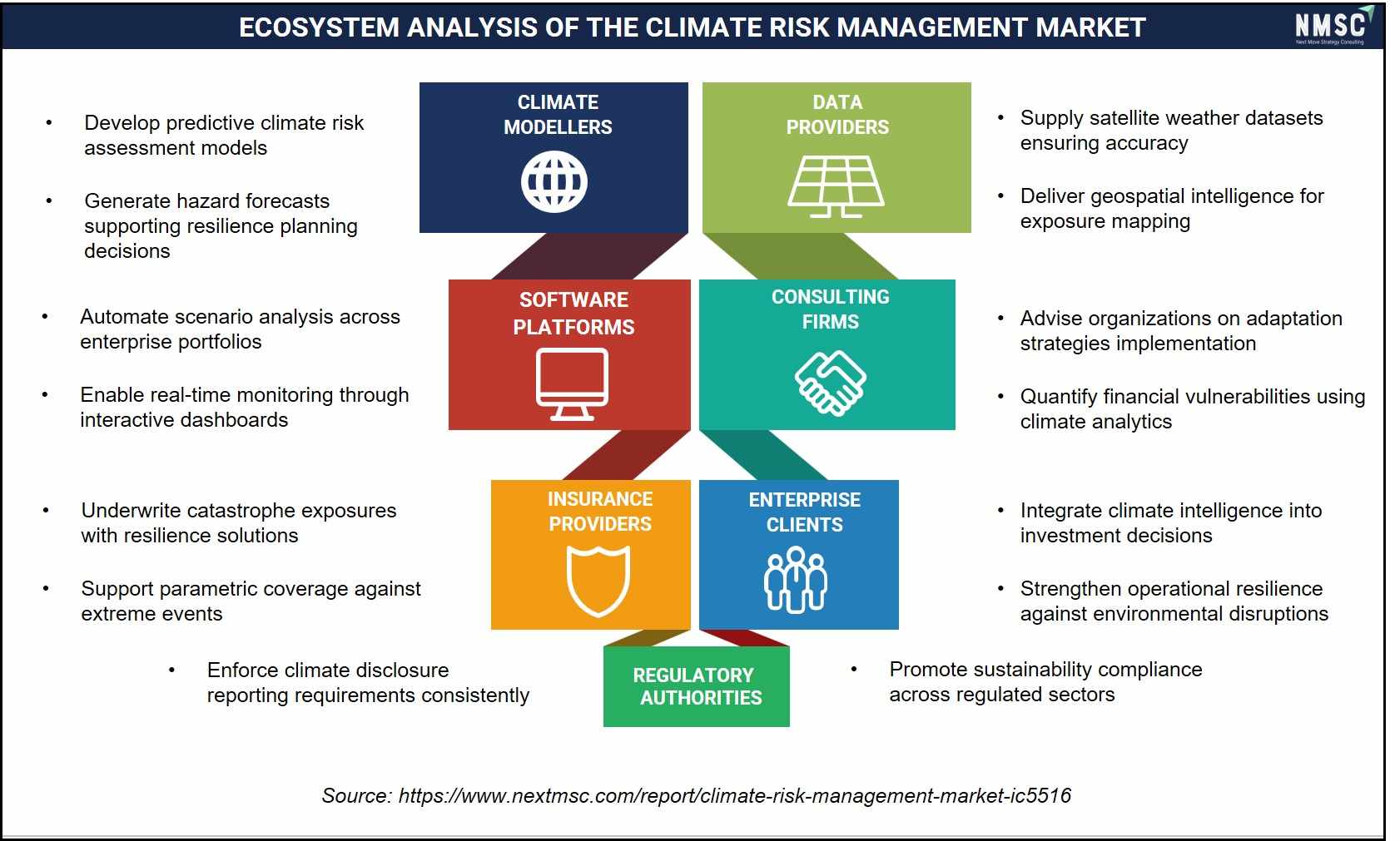
The ecosystem analysis of the Climate Risk Management Market highlights the interconnected roles of climate modelers, data providers, software platform vendors, consulting firms, insurance providers, enterprise clients, and regulatory authorities. These stakeholders collaborate to deliver climate intelligence, risk analytics, compliance solutions, and resilience strategies, supporting informed decision-making and accelerating the adoption of climate risk management solutions.
Competitive Landscape
We observed that the climate risk management market features a moderately consolidated competitive landscape, with diversified financial data and analytics conglomerates competing alongside specialized climate technology vendors on data resolution, scenario depth, and regulatory alignment.
|
Key Takeaways |
Description |
|
Market Structure |
Moderately consolidated; large diversified data and analytics conglomerates account for a significant share of global revenue, while numerous venture-backed specialists serve targeted perils and end-user niches. |
|
Innovation Focus |
AI-enabled catastrophe modeling, climate digital twin simulation, and satellite-derived hazard data dominate current innovation pipelines across leading vendors. |
|
M&A Activity |
Active consolidation through strategic acquisitions, exemplified by MSCI's agreement to acquire First Street to strengthen physical climate risk capabilities for financial decision-making. |
How Do Companies Compete in the Climate Risk Management Market?
Companies compete primarily on data resolution, scenario coverage, and regulatory alignment across the industry. Diversified vendors such as Moody's and Verisk Analytics leverage decades of catastrophe modeling data and broad peril coverage to serve multinational insurers, while specialized vendors such as Jupiter Intelligence and Climate X compete on hyper-local physical risk precision and rapid platform integration for financial-sector clients.
Which Competitive Archetypes Dominate the Climate Risk Management Market?
Two archetypes dominate the market: diversified financial data and analytics conglomerates offering integrated risk, ratings, and disclosure capabilities, and specialized climate technology vendors offering asset-level precision analytics. S&P Global and MSCI exemplify the diversified archetype through integrated climate and ESG data platforms, while ZestyAI and riskthinking.AI exemplify the specialized archetype through peril-specific or scenario-specific modeling depth.
How Are Companies Differentiating Through Innovation in Climate Risk Management?
Innovation and differentiation strategy increasingly center on AI-enabled modeling and climate digital twin simulation. riskthinking.AI's Climate Digital Twin platform and ZestyAI's property-level machine learning models both apply advanced analytics to move beyond static historical hazard maps. Our analysis shows that vendors unable to demonstrate forward-looking, scenario-linked modeling risk exclusion from enterprise procurement shortlists in regulated markets.
What M&A Activity Is Shaping the Climate Risk Management Market?
Mergers and acquisitions continue to consolidate capabilities within the industry. MSCI's agreement to acquire First Street for approximately USD 120 million broadens its physical climate risk and geospatial analytics capabilities, while Moody's earlier acquisition of RMS established the template for integrating catastrophe modeling into a diversified data and analytics platform serving insurers and financial institutions globally.
Key Market Players
Our assessment indicates that the following 20 companies are actively shaping product innovation, capacity expansion, and go-to-market strategy within the global climate risk management market.
-
Moody's Corporation
-
Verisk Analytics, Inc.
-
MSCI Inc.
-
Aon plc
-
WTW plc
-
Marsh & McLennan Companies, Inc.
-
Swiss Re Ltd
-
Münchener Rückversicherungs-Gesellschaft Aktiengesellschaft in München (Munich Re)
-
International Business Machines Corporation
-
Jupiter Intelligence, Inc.
-
ClimateAi, Inc.
-
ICEYE Oy
-
The Cross Dependency Initiative Pty Ltd (XDI)
-
Riskthinking.AI Inc.
-
Climate X Ltd.
-
ZestyAI, Inc.
-
Descartes Underwriting SAS
-
Neara Pty Ltd
-
Reask Pty Ltd
Latest Developments
We found that recent funding, product launches, and M&A activity within the climate risk management market are concentrated on physical risk data expansion and platform consolidation, reflecting the industry's rapid capitalization cycle.
|
Date |
Event |
|
Jun 2026 |
Swiss Re Institute announced that extreme heat is placing increasing pressure on Switzerland's resilience and launched the Resilient Switzerland initiative to strengthen climate adaptation, risk assessment, and resilience planning against escalating climate hazards. |
|
Jun 2026 |
MSCI announced the acquisition of First Street to expand its physical climate risk capabilities by integrating advanced flood, wildfire, heat, and other climate hazard models into its climate analytics and investment risk solutions. |
|
Feb 2026 |
Verisk and S&P Global Energy announced a collaboration to deliver insurance-adjusted climate risk intelligence, combining catastrophe risk analytics and climate exposure data to help insurers, banks, investors, and real estate firms better quantify physical climate risks. |
|
Dec 2025 |
ICEYE partnered with Munich Re's Risk Management Partners to integrate satellite-based flood intelligence into Munich Re's Location Risk Intelligence platform, enhancing climate risk assessment and natural catastrophe analytics for insurers and enterprises. |
Expert Insights
 “We don't make climate policy. But our role is to make sure that the institutions we supervise are operating in a safe and sound way. And that means paying attention to how they're measuring and managing climate-related risks.”
— Michael Barr, Vice Chair for Supervision, U.S. Federal Reserve (June 2025)
Statement made during remarks at the Federal Reserve's Community Development Research Conference, discussing the role of banking regulators in ensuring that financial institutions identify, measure, and manage climate-related financial risks as part of prudent risk management.
Market Interpretation
The statement underscores the growing regulatory expectation that climate risk management be embedded within enterprise risk governance across the financial sector. As central banks and supervisory authorities increasingly require institutions to assess physical and transition climate risks, demand is accelerating for climate risk management platforms, climate scenario analysis, stress-testing solutions, ESG data analytics, and regulatory reporting tools. This regulatory shift is expected to drive sustained growth in the Climate Risk Management Market by encouraging organizations to invest in advanced climate intelligence and resilience capabilities.
Investment Opportunities
What Capital Inflows Are Targeting the Climate Risk Management Market?
Capital inflows into the climate risk management market are increasingly directed toward physical risk data expansion and enterprise platform integration. Strategic acquirers continue to fund consolidation, as seen in MSCI's approximately USD 120 million agreement to acquire First Street. We observed that investors favor vendors demonstrating regulatory-grade scenario coverage, viewing supervisory alignment as a proxy for long-term enterprise contract retention.
How Is Infrastructure Investment Supporting Climate Risk Management Deployment?
Infrastructure investment is expanding satellite data processing and cloud computing capacity to support asset-level physical risk modeling at global scale. Our findings suggest that vendors including ICEYE are investing in satellite constellation capacity to deliver near-real-time flood and disaster data, supporting deployment across insurance, government, and institutional investor use cases lacking dense ground-sensor coverage.
What ESG Considerations Are Shaping Climate Risk Management Investment Decisions?
Environmental, social, and governance considerations are central to investment decisions across the industry, with transition risk transparency and data governance as key criteria. Verisk's catastrophe loss disclosures continue to inform enterprise ESG reporting. We found that investors increasingly favor vendors with transparent, peer-reviewed methodologies, treating scientific credibility as a governance indicator alongside measurable risk-reduction outcomes.
PESTEL Analysis of the Climate Risk Management Market
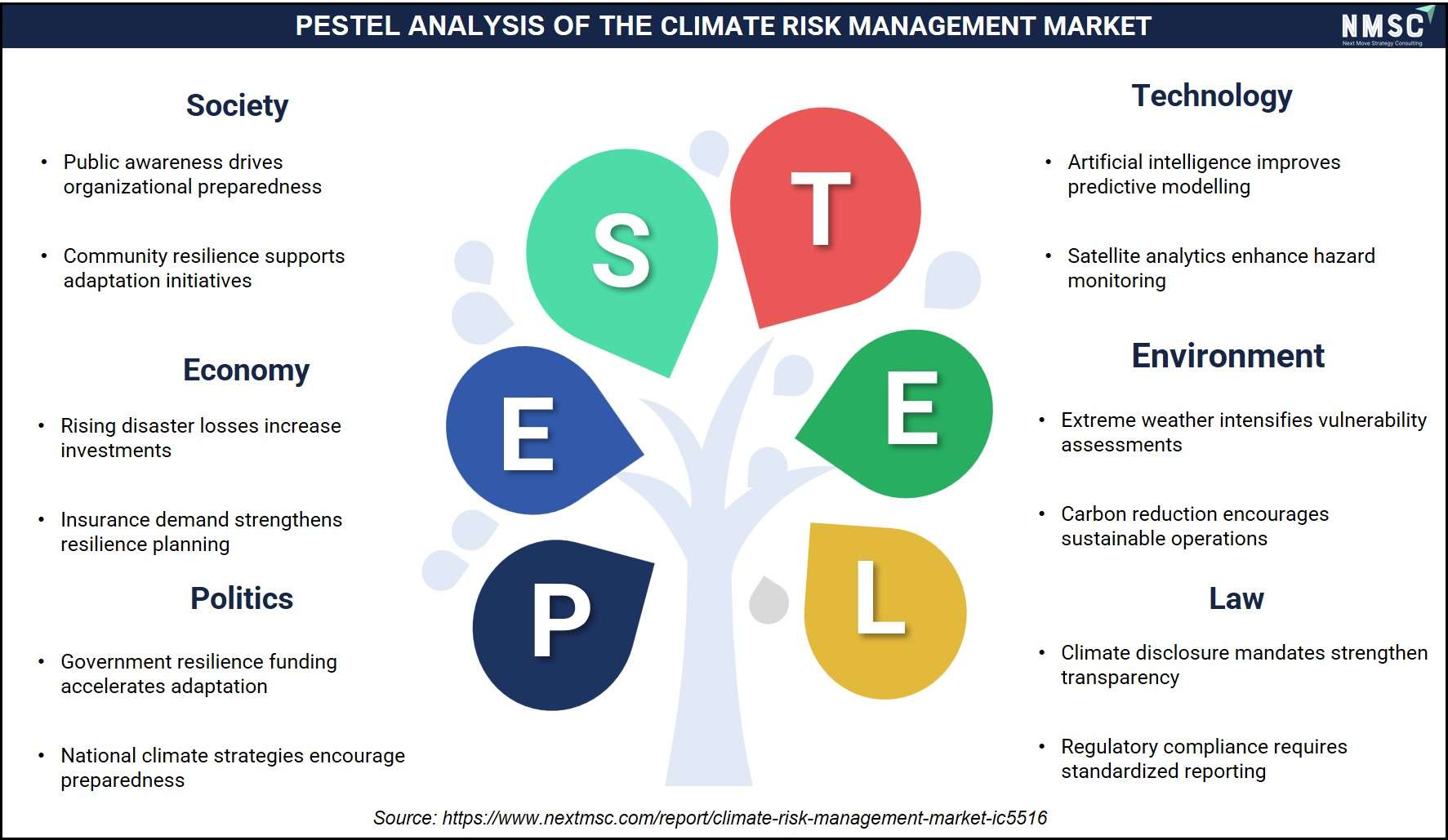
The PESTEL analysis of the Climate Risk Management Market evaluates the external factors influencing market growth, technology adoption, and investment decisions. It examines political policies, economic conditions, social awareness, technological advancements, environmental priorities, and regulatory frameworks that shape climate risk assessment, resilience planning, regulatory compliance, and long-term sustainability strategies across industries.
Key Benefits for Stakeholders
How Does This Report Benefit Enterprise and Industry Leaders?
Enterprise and industry leaders gain access to validated segmentation, competitive benchmarking, and regional demand forecasts that support vendor-selection and climate-technology investment decisions across the climate risk management industry. Our analysis shows that detailed component, risk type, and end-user breakdowns help procurement teams align specifications with regulatory and data requirements while identifying underserved industry segments for platform expansion.
How Does This Report Benefit Investors and Financial Analysts?
Investors and financial analysts benefit from consistent, single-point market size and CAGR estimates that support valuation and capital-allocation decisions across the climate risk management supply chain. We observed that the report's regional and segment-level growth differentials help identify which vendors are best positioned to capture above-market growth in transition risk and Asia-Pacific categories through 2035.
How Does This Report Benefit Technology Vendors and Product Teams?
Technology vendors and product teams gain insight into emerging design requirements, including climate digital twin simulation, generative AI disclosure drafting, and satellite-derived hazard data, that are reshaping the industry. Our findings suggest that this analysis helps R&D teams prioritize development roadmaps around scenario-linked analytics increasingly required by enterprise and regulatory request-for-proposal processes.
Key Market Segments
By Component
-
Software and Platform
-
Physical Risk Analytics Software
-
Climate Scenario Modeling Software
-
Climate Disclosure and Reporting Software
-
Portfolio and Investment Risk Software
-
-
Services
-
Consulting Services
-
Data and Advisory Services
-
Managed Services
-
By Risk Type
-
Physical Risk
-
Acute Physical Risk
-
Chronic Physical Risk
-
-
Transition Risk
-
Policy and Regulatory Risk
-
Technology Risk
-
Market Risk
-
-
Liability Risk
By Deployment Mode
-
Cloud
-
On Premises
By Application
-
Physical Asset Risk Assessment
-
Catastrophe and Weather Risk Modeling
-
Climate Scenario Analysis and Stress Testing
-
Regulatory Disclosure and Compliance Reporting
-
Portfolio and Investment Risk Analytics
-
Supply Chain Risk Management
-
Insurance Underwriting and Pricing
By End User
-
Banking and Financial Institutions
-
Insurance and Reinsurance
-
Asset Management and Institutional Investors
-
Government and Public Sector
-
Energy and Utilities
-
Real Estate and Construction
-
Manufacturing and Industrial
-
Agriculture and Food
-
Other End Users
By Region
-
North America: U.S., Canada, Mexico
-
Europe: UK, Germany, France, Italy, Spain, Sweden, Denmark, Finland, Netherlands, Rest of Europe
-
Asia-Pacific: China, India, Japan, South Korea, Taiwan, Indonesia, Vietnam, Australia, Philippines, Malaysia, Rest of APAC
-
Middle East & Africa: Saudi Arabia, UAE, Egypt, Israel, Turkey, Nigeria, South Africa, Rest of MEA
-
Latin America: Brazil, Argentina, Chile, Colombia, Rest of LATAM
Conclusion and Recommendations
What Is the Long-Term Outlook for the Climate Risk Management Market?
The long-term outlook for the market remains strongly positive, with global revenue projected to expand more than fivefold from USD 3.85 billion in 2025 to USD 20.96 billion by 2035 at an 18.5% CAGR. We observed that sustained regulatory disclosure requirements, rising catastrophe losses, and generative AI adoption will continue underpinning demand across insurance, banking, and asset management applications through the forecast period.
What Strategic Positioning Should Climate Risk Management Vendors Pursue?
Vendors should prioritize integrated physical and transition risk platforms while pursuing deep integration with existing GRC and disclosure infrastructure to secure long-term enterprise contracts. Our assessment indicates that vendors investing early in climate digital twin capability and satellite-derived data will be best positioned to capture premium pricing within the climate risk management market.
How Attractive Is the Climate Risk Management Market for New Investment?
The climate risk management industry presents an attractive investment case, supported by a USD 16.41 billion absolute dollar opportunity between 2026 and 2035 and above-average growth in Asia-Pacific and transition risk categories. We found that investment attractiveness is highest for vendors combining regulatory-grade scenario coverage with scalable enterprise delivery, positioning them to serve both financial-sector incumbents and emerging-market growth simultaneously.
What Market Shifts and Key Risks Should Stakeholders Monitor?
Stakeholders should monitor data standardization gaps, high data licensing costs, and competitive pressure from diversified financial data incumbents as key risks to the climate risk management market. Our analysis shows that vendors unable to demonstrate peer-reviewed methodological rigor risk losing enterprise contracts to competitors with established scientific credibility, particularly within increasingly regulated disclosure environments.
What Are the Key Growth Pathways for the Climate Risk Management Market?
Key growth pathways include expanding transition risk quantification capability, scaling satellite-derived data coverage for emerging markets, and deepening penetration into agriculture and supply chain risk channels. NMSC's analysis indicates that vendors pursuing these pathways while maintaining integration depth with existing enterprise risk infrastructure will be best positioned to capture the climate risk management market's projected growth through 2035.
About the Author
 Mihul Sharma
— Mihul Sharma is Research Associate at Next Move Strategy Consulting, where he has covered technology, industrial, and healthcare markets for 3 years. His work applies structured business research, market analysis, and secondary-source review to assess market trends, competitive developments, and growth opportunities. He supports report development by fully synthesizing industry data, company information, and market signals into concise findings for strategy and investment-focused research teams.
Mihul Sharma
— Mihul Sharma is Research Associate at Next Move Strategy Consulting, where he has covered technology, industrial, and healthcare markets for 3 years. His work applies structured business research, market analysis, and secondary-source review to assess market trends, competitive developments, and growth opportunities. He supports report development by fully synthesizing industry data, company information, and market signals into concise findings for strategy and investment-focused research teams.
About the Reviewer
 Supradip Baul
— Supradip Baul is an accomplished business consultant and strategist with over a decade of rich experience in market intelligence, strategy, technology, and business transformation. His work has included rigorous qualitative and quantitative analysis across multiple industries, helping clients shape investment decisions and long-term roadmaps. Earlier in his career, he was associated with Gartner, where he contributed to industry-leading reports and market share analyses. He has worked with leading global companies and holds an MBA with a dual specialization in Marketing and Finance.
Supradip Baul
— Supradip Baul is an accomplished business consultant and strategist with over a decade of rich experience in market intelligence, strategy, technology, and business transformation. His work has included rigorous qualitative and quantitative analysis across multiple industries, helping clients shape investment decisions and long-term roadmaps. Earlier in his career, he was associated with Gartner, where he contributed to industry-leading reports and market share analyses. He has worked with leading global companies and holds an MBA with a dual specialization in Marketing and Finance.
At Next Move Strategy Consulting, we understand that insightful market research is the cornerstone of successful business decisions. That's why we employ a robust and multifaceted approach, combining various methodologies to deliver the most accurate and actionable data for our clients.

Research Landscape
We navigate the world of research with two primary approaches:
Qualitative Approach
Our qualitative research methodologies involve immersive techniques such as in-depth interviews, focus groups, and observational studies. By engaging directly with individuals and stakeholders, we uncover valuable insights that quantitative data alone may overlook.

Quantitative Research
In tandem with qualitative methodologies, NMSC leverages the power of Quantitative Research to provide a robust foundation of numerical insights. Through systematic data collection and analysis, we quantify patterns, preferences, and market trends, offering a comprehensive view of the business landscape.
Our quantitative research approach employs diverse tools, including surveys, experiments, and statistical modelling. These methodologies enable us to gather data from a large and representative sample, ensuring the statistical significance of our findings. By employing structured questionnaires and standardized data collection methods, we guarantee the reliability and validity of the information we present to our clients.
Quantitative research is particularly effective in measuring the prevalence of trends, assessing market size, and gauging the impact of various factors on consumer behavior. The numerical precision attained through this approach equips our clients with actionable insights, facilitating data-driven decision-making and strategy formulation.


Our Specialized Toolbox for Industry-Specific Market Research
We deploy a specialized arsenal of techniques tailored to meet your unique requirements. Here's a glimpse into our comprehensive toolbox:

Information Procurement
The stage entails acquiring market data or relevant information through various sources and methodologies.


Market Research Approach
We utilize both top-down and bottom-up approaches in market research analysis to achieve a comprehensive understanding of the market dynamics, leveraging the broad perspective of industry trends and macroeconomic factors alongside detailed insights from specific segments and individual companies.

Porters Five Forces Analysis
We conduct Porter's Five Forces analysis to evaluate the competitive landscape of an industry, providing us with insights into factors that affect profitability and strategic positioning.

SWOT Analysis

Forecasting
We utilize a forecasting model to predict future consumption by considering parameters like population, economics, regulations, market competition, drivers, constraints, technology, and pricing. We also employ statistical techniques such as multilinear regression, exponential smoothing, moving average, ARIMA, and Monte Carlo simulations for accurate predictions. In econometric forecasting, we analyzed short-term and long-term event impacts, attributing values based on regulatory frameworks, economic factors, and market events.





 Speak to Our Analyst