AI Category Management Market Size, Share, Growth & Forecast by Category Intelligence Platforms (Spend Intelligence Systems, Category Insight Engines, Decision Intelligence Systems), Sourcing Optimization Platforms, Managed Services and Advisory, Deployment Mode (Cloud, On-Premises, Hybrid), Enterprise Size (Large Enterprises, Mid-Market, SMEs), and End-Use Industry (Manufacturing, Retail and Consumer Goods, Energy and Utilities, IT and Telecommunications, BFSI) — Global Analysis 2025–2035
Industry: ICT & Media | Publishing Date: July 6, 2026 | Last Updated: September 30, 2026 | No of Pages: N/A | No. of Tables: N/A | No. of Figures: N/A | Format: PDF | Report Code: IC4972
What Is the AI Category Management Market Size?
The AI Category Management Market was valued at USD 5.84 billion in 2025 and is projected to reach USD 7.41 billion in 2026, expanding to USD 62.75 billion by 2035, registering a CAGR of 26.8% from 2026 to 2035. This robust expansion is driven by accelerating enterprise adoption of AI-powered spend intelligence platforms, growing regulatory pressure around procurement transparency, rising demand for autonomous supplier discovery systems, and the rapid proliferation of agentic AI models capable of executing end-to-end sourcing workflows without human intervention.
|
Parameters |
Details |
|
Market Size in 2025 |
USD 5.84 Billion |
|
Market Size in 2026 |
USD 7.41 Billion |
|
Revenue Forecast in 2035 |
USD 62.75 Billion |
|
Growth Rate |
CAGR of 26.8% from 2026 to 2035 |
|
Analysis Period |
2025–2035 |
|
Base Year Considered |
2025 |
|
Forecast Period |
2026–2035 |
|
Market Size Estimation |
USD Billion |
|
Companies Profiled |
20 |
|
Countries Covered |
33 |
|
Market Share |
Top 10 |
AI Category Management Market Overview
What Is the AI Category Management Market?
The AI Category Management Market encompasses the full suite of artificial intelligence-enabled platforms, decision engines, and managed services that empower procurement organizations to systematically analyze spending data, identify sourcing opportunities, manage supplier relationships, and execute category strategies with machine precision. It spans spend intelligence systems, supplier discovery tools, negotiation intelligence agents, procurement orchestration platforms, and embedded AI toolkits designed to integrate into enterprise resource planning and financial management architectures. The AI Category Management Market report covers the period from 2025 to 2035 across 33 countries.
How Has the AI Category Management Market Evolved Structurally?
From our research, we found that the AI Category Management Market has transitioned from rule-based spend analytics tools toward fully autonomous, NLP-powered procurement agents over the last five years. Early platforms focused on spend classification and vendor consolidation; modern systems incorporate predictive cost modelling, generative AI-driven RFP synthesis, and multi-agent sourcing optimization that adjusts bids in real time. The structural evolution is marked by a shift from back-office reporting to front-office strategic decision support, with AI category management revenue reflecting growing enterprise reliance on intelligence-driven procurement outcomes.
How Do Regulations Shape the AI Category Management Market?
Regulatory developments across major economies are materially influencing the AI Category Management Market. The European Union's Corporate Sustainability Reporting Directive mandates granular supply chain disclosures, driving enterprises to adopt AI-powered ESG compliance intelligence systems. The U.S. Federal Acquisition Regulation framework increasingly references digital procurement transparency standards. In Asia-Pacific, government digital procurement mandates in India and South Korea are accelerating platform adoption in public-sector categories. NMSC's analysis indicates that regulatory complexity is becoming a primary procurement technology demand driver globally.
How Is Technology Adoption Expanding Across the AI Category Management Market?
Based on NMSC's research, technology adoption within the AI Category Management Market follows a multi-wave pattern, where large enterprises were early adopters of spend intelligence platforms, mid-market organizations are now deploying cloud-based category insight engines, and small and medium enterprises are increasingly accessing AI-powered sourcing tools via embedded software-as-a-service modules. The integration of large language models into procurement workflows is compressing the category strategy cycle from weeks to hours. ERP-integrated AI modules from SAP SE and Oracle Corporation are expanding the accessible market to organizations with limited standalone procurement technology budgets.
|
Key Takeaways |
|
Category Intelligence Platforms dominated the AI Category Management Market in 2025, accounting for USD 1.46 billion, driven by high enterprise demand for spend data classification engines and category opportunity identification models. |
|
Decision Intelligence Systems are projected to register the fastest CAGR of 27.1% from 2026 to 2035, fueled by enterprise uptake of prescriptive optimization models and scenario simulation systems. |
|
Cloud deployment dominated the AI Category Management Market in 2025 with USD 3.80 billion, as organizations prioritize scalability, rapid integration, and access to continuously updated AI models via SaaS procurement platforms. |
|
Hybrid deployment is expected to grow at the fastest CAGR of 27.9% from 2026 to 2035, as enterprises combine cloud AI intelligence with on-premises data security requirements for sensitive procurement data. |
|
Large Enterprises held the largest share in the AI Category Management Market in 2025 at USD 3.21 billion, benefiting from complex multi-category spend portfolios that require sophisticated AI-driven category strategy platforms. |
|
Mid-Market enterprises are forecast to grow at a CAGR of 28.4% from 2026 to 2035, driven by increasing availability of modular, subscription-based AI category management solutions accessible without large upfront technology investment. |
|
Manufacturing and IT and Telecommunications each accounted for USD 1.11 billion in 2025, reflecting their high spend complexity, large supplier bases, and strong appetite for AI-driven sourcing optimization across direct and indirect categories. |
|
Banking, Financial Services, and Insurance is projected to achieve a CAGR of 27.5% from 2026 to 2035 in the AI Category Management Market, as compliance-driven procurement automation gains traction across financial institutions globally. |
|
North America dominated the AI Category Management Market in 2025, generating USD 2.04 billion, supported by high enterprise technology adoption rates, a mature supplier intelligence ecosystem, and significant venture capital investment in AI procurement startups. |
|
Asia-Pacific is projected to register the highest regional CAGR of 29.9% from 2026 to 2035, driven by digital procurement mandates, a rapidly expanding mid-market enterprise base, and strong technology vendor presence in China, India, and Japan. |
|
The United States represented the largest single-country market in 2025, contributing the majority of North America's USD 2.04 billion, supported by a concentration of leading AI category management vendors and a deep enterprise software adoption culture. |
|
India is expected to be the fastest-growing country market from 2026 to 2035, propelled by the government's digital procurement initiative, a growing large-enterprise manufacturing base, and increasing adoption of cloud-based AI sourcing platforms. |
Ecosystem Analysis of the AI Category Management Market
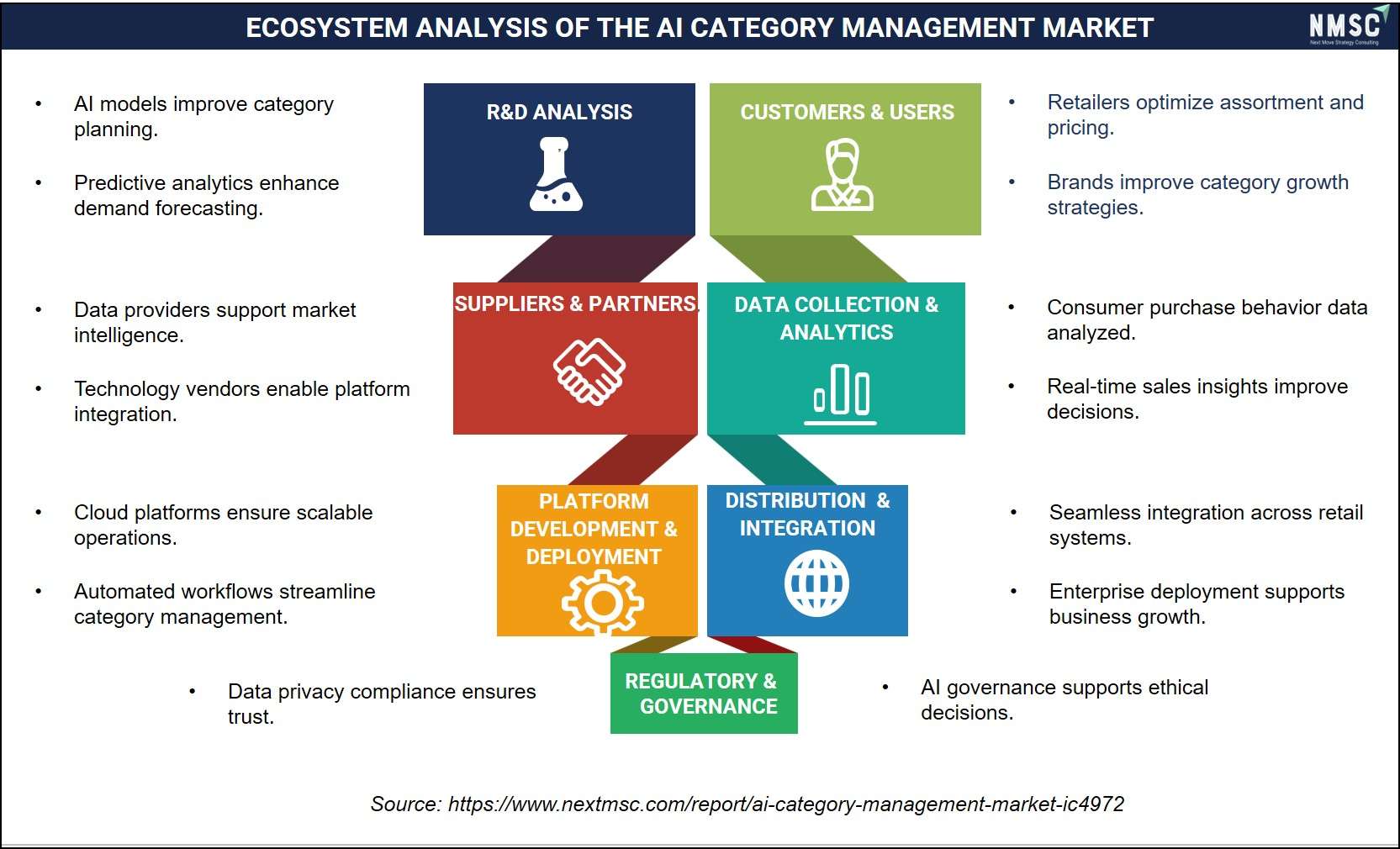
The above framework presents an ecosystem analysis of the AI Category Management Market across R&D, platform development, data analytics, distribution and integration, regulatory governance, and end-user segments. We observed that retailers optimize assortment and pricing while brands improve category growth strategies, shaping customer and user dynamics. Suppliers and partners support platform development and deployment, with data collection and analytics enabling real-time insights and decision-making. Distribution and integration facilitate seamless adoption across retail systems, while regulatory governance enforces data privacy, pricing compliance, and ethical AI standards, collectively driving innovation and operational efficiency in this evolving market.
Key Emerging Trends in the AI Category Management Market
How Is Agentic AI Redefining Autonomous Sourcing in the AI Category Management Market?
Our analysis shows that agentic AI, autonomous systems capable of executing multi-step procurement workflows without human approval at each stage, represents the defining trend in the AI Category Management Market as of 2025. Platforms such as GEP SMART and Keelvar's autonomous sourcing agents have demonstrated the capacity to generate RFPs, evaluate bids, simulate award scenarios, and finalize sourcing decisions within minutes. For example, Keelvar's optimization engine processed over one million sourcing events in 2024, illustrating the scale at which agentic systems are now deployed. This trend is transforming procurement from a reactive function into a predictive, continuously optimizing intelligence layer across enterprise category portfolios.
How Are Large Language Models Reshaping Spend Intelligence within the AI Category Management Market?
Through our market assessment, we observed that large language model integration into spend intelligence platforms is dramatically improving classification accuracy and contextual category analysis. Traditional spend classification systems relied on keyword matching and static taxonomies; NLP-based spend intelligence models can now interpret vendor invoice data, contracts, and purchase order narratives to dynamically assign categories with greater than 95% reported accuracy by leading vendors. Coupa Software's AI-powered spend visibility tools, for example, leverage proprietary NLP models trained on billions of procurement transactions, enabling procurement leaders to identify hidden savings opportunities that conventional analytics tools systematically miss.
How Is ESG Intelligence Becoming a Core Component of AI Category Management?
Based on our market evaluation, we noticed that ESG compliance intelligence has shifted from an optional procurement overlay to a foundational component of AI category management strategy. Enterprises operating under the EU Corporate Sustainability Reporting Directive and SEC climate disclosure rules are now embedding ESG scoring directly into supplier discovery and performance monitoring workflows. Platforms including Ivalua and JAGGAER have integrated financial stability scoring, geopolitical exposure analytics, and carbon footprint benchmarking into their supplier intelligence modules. NMSC's analysis indicates that ESG-embedded category management platforms are commanding a 20–25% revenue premium relative to conventional procurement analytics tools.
How Is Real-Time Market Price Intelligence Transforming Category Strategy in the AI Category Management Market?
Our findings suggest that real-time market price intelligence, continuous AI-driven monitoring of commodity prices, logistics costs, and supplier market dynamics, is becoming a decisive competitive differentiator within the AI Category Management Market. Systems such as Beroe Inc.'s market intelligence platform and o9 Solutions' integrated demand-supply planning engine are enabling procurement leaders to time sourcing events, renegotiate contracts, and adjust category strategies based on live market signals rather than quarterly reviews. This shift toward real-time intelligence is compressing the strategic sourcing cycle and generating measurable cost savings across manufacturing and retail category portfolios globally.
What Are the Key Market Drivers, Breakthroughs, and Investment Opportunities That Will Shape the AI Category Management Industry in the Next Decade?
|
Drivers / Trends / Restraints |
(+/-) % Impact on CAGR Forecast |
Geographic Relevance |
Impact Timeline |
|
Rising enterprise demand for AI-powered spend transparency |
+3.2% |
North America, Europe, Asia-Pacific |
2025–2028 (Immediate) |
|
Adoption of agentic AI in autonomous sourcing workflows |
+2.8% |
Global — led by North America |
2026–2030 (Medium-term) |
|
ESG and regulatory compliance driving procurement technology investment |
+2.1% |
Europe, North America, Asia-Pacific |
2025–2032 (Sustained) |
|
Real-time market price intelligence integration |
+1.8% |
Manufacturing and Retail sectors globally |
2026–2030 (Medium-term) |
|
Data privacy and AI governance concerns limiting deployment |
-1.5% |
Europe (GDPR), North America |
2025–2028 (Near-term) |
|
High implementation complexity in legacy ERP environments |
-1.2% |
Mid-market and SME segments globally |
2025–2027 (Near-term) |
|
Expansion of AI category management into SME and mid-market segments |
+2.5% |
Asia-Pacific, Latin America, MEA |
2027–2035 (Long-term) |
|
Cloud-native platform adoption accelerating global accessibility |
+1.9% |
Global - strongest in APAC and LATAM |
2026–2032 (Sustained) |
What Are the Growth Drivers of the AI Category Management Market?
How Is Rising Procurement Spend Complexity Fueling Demand for AI Category Management Platforms?
Our assessment indicates that enterprises managing increasingly fragmented global supply chains are generating procurement spending data at volumes that exceed human analytical capacity. According to the Organisation for Economic Co-operation and Development (OECD), government procurement alone accounts for approximately 12% to 13% of GDP in member economies, representing trillions of dollars in annual spending that requires structured category intelligence. Private-sector procurement spend at large multinationals regularly exceeds USD 10 billion annually. The sheer volume and complexity of this expenditure data are compelling organizations across manufacturing, retail, and financial services sectors to deploy AI-powered spend intelligence systems that can classify, analyze, and generate actionable category insights at scale without proportional headcount increases.
How Is Regulatory Transparency Driving AI Category Management Market Growth?
Based on NMSC's research, regulatory requirements mandating procurement transparency and supply chain due diligence are generating a structural demand tailwind for the AI Category Management Market. The European Union's Corporate Sustainability Reporting Directive (CSRD), which entered into force in 2024 and applies to approximately 50,000 companies across the EU, requires detailed disclosures on supply chain sustainability performance, creating a direct requirement for AI-enabled ESG compliance intelligence systems. The U.S. Securities and Exchange Commission's supply chain disclosure rules similarly require public companies to disclose material supplier-related risks. These regulatory frameworks are effectively mandating AI category management infrastructure across regulated industries.
How Is the Rise of Generative AI Enabling New Capabilities Within the AI Category Management Market?
Through NMSC's assessment, we found that the integration of generative AI into procurement workflows represents a breakthrough capability that is materially expanding the AI Category Management Market's addressable opportunity. Generative AI models are enabling automated RFP generation that previously required specialist input, synthesizing complex contract terms into actionable category strategy recommendations, and generating supplier negotiation briefs from historical transaction data. According to the World Intellectual Property Organization, AI-related patent filings in business process automation, a category encompassing procurement AI, grew at an annual rate exceeding 20% between 2020 and 2023, reflecting the intensity of innovation investment underpinning this market's sustained growth trajectory.
What Are the Growth Inhibitors of the AI Category Management Market?
How Do Data Privacy Regulations Constrain AI Category Management Deployment?
Our analysis shows that data privacy frameworks present a meaningful near-term restraint to AI Category Management Market expansion, particularly in Europe and regulated North American sectors. The EU's General Data Protection Regulation imposes strict limitations on automated decision-making affecting contractual relationships, which encompasses AI-driven supplier selection and contract award processes. Article 22 of GDPR specifically restricts solely automated decisions that produce significant legal effects, requiring human review protocols that increase operational overhead for autonomous category management agents. Healthcare procurement and financial services organizations face additional sector-specific data handling requirements that increase compliance costs for AI platform deployment.
How Does Implementation Complexity in Legacy ERP Environments Limit the AI Category Management Market?
Based on our research, integration complexity within legacy enterprise resource planning environments represents the most significant operational barrier to AI category management adoption among mid-market and SME organizations. Many organizations operate procurement processes on SAP ERP or Oracle E-Business Suite versions with limited native AI connectivity, requiring custom middleware development or complete platform migrations to leverage modern AI category management capabilities. According to Workday's 2024 global CFO survey report available on its investor relations portal, a majority of finance and procurement leaders cited integration complexity as the leading barrier to advanced procurement technology adoption, validating this structural constraint on AI Category Management Market growth velocity.
What Are the Growth Opportunities in the AI Category Management Market?
How Is the Mid-Market Enterprise Segment Creating Expansion Opportunities in the AI Category Management Market?
In our observation, the mid-market enterprise segment, organizations with annual revenues between USD 100 million and USD 1 billion, represents the most significant near-term growth opportunity within the AI Category Management Market. These organizations possess sufficient procurement complexity to benefit materially from AI-driven category intelligence yet have historically lacked access to enterprise-grade platforms designed for large corporation budgets. The emergence of modular, subscription-based AI category management solutions from vendors including Fairmarkit, Zip, and Simfoni is directly addressing this gap, offering pre-configured spend intelligence and supplier discovery capabilities that deploy in weeks rather than months. NMSC's analysis indicates mid-market adoption is set to expand significantly through 2035.
How Are Emerging Market Digital Procurement Mandates Opening New Opportunities in the AI Category Management Market?
Our findings suggest that government-led digital procurement initiatives across Asia-Pacific, Latin America, and MEA are creating substantial demand opportunities for AI category management platform providers. India's Government e-Marketplace (GeM) portal, launched by the Ministry of Commerce and Industry and disclosed on its official portal gem.gov.in, processed procurement transactions exceeding INR 4 lakh crore in fiscal year 2024, signaling large-scale public procurement digitization that requires AI-powered category intelligence infrastructure. Brazil's national digital government strategy and Saudi Arabia's Vision 2030 procurement modernization program similarly represent addressable demand pools for AI category management platform vendors seeking international expansion opportunities.
How Does the Integration of AI Category Management with Financial Planning Systems Create Value Opportunities?
Through our analysis, we found that convergence between AI category management platforms and enterprise financial planning and analysis systems represents an emerging integration opportunity with significant value creation potential. Organizations that connect procurement category intelligence with treasury management, accounts payable automation, and financial forecasting systems can generate working capital optimization insights that extend AI's value beyond strategic sourcing. Workday's Procurement and Financial Management integration and SAP's Business AI embedded in S/4HANA illustrate this convergence. According to SAP's 2024 Annual Report, customers deploying integrated AI procurement and financial management capabilities reported measurable improvements in cash flow forecasting accuracy, validating the commercial opportunity for vendors offering unified intelligence platforms.
How Is the AI Category Management Market Segmented in This Report, and What Are the Key Insights from the Segmentation Analysis?
Which Sub-Segments Are Driving the Category Intelligence Platforms Segment of the AI Category Management Market?
|
Category Intelligence Platforms Segment |
2025 (USD Bn) |
2035 (USD Bn) |
CAGR (%) |
|
Category Intelligence Platforms |
1.46 |
15.69 |
26.8% |
|
Spend Intelligence Systems |
0.58 |
6.28 |
26.9% |
|
Category Insight Engines |
0.44 |
4.70 |
26.6% |
|
Decision Intelligence Systems |
0.44 |
4.71 |
27.1% |
Category Intelligence Platforms constituted the largest primary segment of the AI Category Management Market, generating USD 1.46 billion in 2025, with projections to reach USD 15.69 billion by 2035. Spend Intelligence Systems dominate within this segment, driven by high enterprise demand for spend data classification engines and spend pattern detection models that enable granular cost structure analysis across thousands of supplier categories. Category Insight Engines are growing steadily as procurement leaders leverage market price intelligence systems to benchmark external pricing against internal contracts. Decision Intelligence Systems represent the fastest-growing sub-segment at a CAGR of 27.1%, as prescriptive optimization models and scenario simulation systems enable procurement teams to evaluate sourcing strategies before committing capital.
How Are Supplier Discovery and Risk Intelligence Sub-Segments Performing in the AI Category Management Market?
|
Supplier Intelligence Platforms Segment |
2025 (USD Bn) |
2035 (USD Bn) |
CAGR (%) |
|
Supplier Intelligence Platforms |
1.17 |
12.55 |
26.7% |
|
Supplier Discovery Systems |
0.41 |
4.40 |
26.8% |
|
Supplier Risk Intelligence Systems |
0.44 |
4.70 |
26.6% |
|
Supplier Performance Intelligence |
0.32 |
3.45 |
26.7% |
Supplier Intelligence Platforms generated USD 1.17 billion in 2025 and are expected to reach USD 12.55 billion by 2035, reflecting sustained enterprise investment in AI-powered supplier management infrastructure. Supplier Risk Intelligence Systems represent the dominant sub-segment, as ESG compliance intelligence, financial stability scoring models, and geopolitical exposure analytics have become non-negotiable for multinational procurement organizations navigating complex, multi-tier supplier relationships. Supplier Discovery Systems are gaining adoption driven by global supplier mapping AI and capability matching engines that accelerate qualified vendor identification. Supplier Performance Intelligence is emerging rapidly as delivery performance analytics and quality tracking models provide continuous, data-driven vendor scorecards that replace periodic manual reviews.
What Role Do RFx Intelligence and Negotiation AI Play in the Sourcing Optimization Segment of the AI Category Management Market?
|
Sourcing Optimization Platforms Segment |
2025 (USD Bn) |
2035 (USD Bn) |
CAGR (%) |
|
Sourcing Optimization Platforms |
1.05 |
11.30 |
26.8% |
|
RFx Intelligence Systems |
0.35 |
3.77 |
26.8% |
|
Negotiation Intelligence Systems |
0.44 |
4.71 |
26.7% |
|
Award Optimization Engines |
0.26 |
2.82 |
26.8% |
Sourcing Optimization Platforms accounted for USD 1.05 billion in 2025 and are projected to reach USD 11.30 billion by 2035. Negotiation Intelligence Systems dominate this segment, driven by the commercial impact of price optimization algorithms and autonomous negotiation agents that continuously refine bidding strategies against live market benchmarks. RFx Intelligence Systems are experiencing strong adoption as automated RFP generation engines dramatically reduce the time and specialist input required to structure competitive sourcing events. Award Optimization Engines, featuring multi-supplier allocation models and scenario-based award simulations, are emerging as procurement teams seek to balance cost, risk, and supplier diversity objectives simultaneously across complex category awards.
How Are Workflow Intelligence and Policy Compliance Systems Shaping Procurement Orchestration in the AI Category Management Market?
|
Procurement Orchestration Platforms Segment |
2025 (USD Bn) |
2035 (USD Bn) |
CAGR (%) |
|
Procurement Orchestration Platforms |
0.88 |
9.42 |
26.7% |
|
Workflow Intelligence Systems |
0.32 |
3.45 |
26.7% |
|
Policy Compliance Systems |
0.30 |
3.14 |
26.4% |
|
Execution Automation Systems |
0.26 |
2.83 |
26.9% |
Procurement Orchestration Platforms generated USD 0.88 billion in 2025 and are forecast to reach USD 9.42 billion by 2035. Workflow Intelligence Systems represent the leading sub-segment, as procurement workflow automation AI and approval routing optimization engines reduce process cycle times and enable straight-through processing for high-volume, low-complexity purchasing events. Policy Compliance Systems are a critical growth enabler, with contract policy enforcement AI and procurement governance monitoring systems ensuring regulatory and internal control adherence without manual audit overhead. Execution Automation Systems, including purchase request automation and task orchestration engines, are the fastest-growing sub-segment, reflecting enterprise demand for end-to-end touchless procurement execution capabilities.
How Are Procurement Data Structuring and Taxonomy Systems Supporting AI Category Management Market Growth?
|
Data and Knowledge Foundation Layer Segment |
2025 (USD Bn) |
2035 (USD Bn) |
CAGR (%) |
|
Data and Knowledge Foundation Layer |
0.58 |
6.28 |
26.9% |
|
Procurement Data Structuring Systems |
0.23 |
2.51 |
26.9% |
|
Category Taxonomy Engines |
0.18 |
1.88 |
26.4% |
|
External Data Fusion Systems |
0.17 |
1.89 |
27.2% |
The Data and Knowledge Foundation Layer generated USD 0.58 billion in 2025 and is projected to expand to USD 6.28 billion by 2035. This segment provides the essential data infrastructure upon which all AI category management intelligence is built. Procurement Data Structuring Systems, including transaction normalization engines and master data enrichment AI, dominate adoption, as organizations must first resolve data quality and classification inconsistencies before deploying advanced analytics. Category Taxonomy Engines, featuring automated category mapping models and product and service classification systems, are gaining traction as enterprises standardize on UNSPSC and custom taxonomy frameworks. External Data Fusion Systems, which integrate supplier data aggregation APIs and market intelligence data feeds, represent the fastest-growing sub-segment at a CAGR of 27.2%.
How Is Agentic Procurement Transforming the Embedded AI Segment of the AI Category Management Market?
|
Embedded AI and Agentic Layer Segment |
2025 (USD Bn) |
2035 (USD Bn) |
CAGR (%) |
|
Embedded AI and Agentic Layer |
0.44 |
5.02 |
27.2% |
|
Procurement AI Models |
0.20 |
2.51 |
28.8% |
|
Agentic Procurement Systems |
0.15 |
1.88 |
28.8% |
|
API and Embedded Toolkits |
0.09 |
0.63 |
21.5% |
The Embedded AI and Agentic Layer is the fastest-growing primary segment in the AI Category Management Market, valued at USD 0.44 billion in 2025 and forecast to reach USD 5.02 billion by 2035, at a CAGR of 27.2%. Procurement AI Models, incorporating NLP-based spend intelligence and predictive procurement algorithms, and Agentic Procurement Systems, encompassing autonomous category management agents and multi-agent sourcing optimization systems, are co-leading growth at a CAGR of 28.8%, reflecting the transformative commercial impact of AI systems capable of executing complete sourcing cycles autonomously. API and Embedded Toolkits, including ERP-integrated AI modules and procurement AI SDKs, enable broader platform reach but grow more modestly at 21.5% CAGR as this market matures.
What Role Do Category Strategy Advisory and Managed Intelligence Services Play in the AI Category Management Market?
|
Managed Services and Advisory Segment |
2025 (USD Bn) |
2035 (USD Bn) |
CAGR (%) |
|
Managed Services and Advisory |
0.17 |
1.88 |
27.2% |
|
Category Strategy Advisory |
0.07 |
0.76 |
26.8% |
|
Implementation and Change Management |
0.06 |
0.63 |
26.4% |
|
Managed Intelligence Services |
0.04 |
0.49 |
28.7% |
Managed Services and Advisory generated USD 0.17 billion in 2025 and are expected to grow to USD 1.88 billion by 2035. Category Strategy Advisory dominates this segment, reflecting strong demand for expert-led support in designing AI-enabled category strategies and translating platform data into procurement value realization. Implementation and Change Management services are critical for enabling organizational adoption of AI systems in procurement teams with limited digital transformation experience. Managed Intelligence Services, where vendors operate AI category management platforms on behalf of clients, are the fastest-growing sub-segment at 28.7% CAGR, as procurement outsourcing models incorporate AI-powered intelligence delivery as a core service component.
How Do Other Category Management Applications Contribute to the Broader AI Category Management Market?
|
Other Category Management Applications Segment |
2025 (USD Bn) |
2035 (USD Bn) |
CAGR (%) |
|
Other Category Management Applications |
0.09 |
0.61 |
21.0% |
Other Category Management Applications encompass niche AI tools and specialized modules that address procurement sub-functions not fully captured within the primary platform categories. These include industry-specific category management tools for regulated sectors such as pharmaceuticals and defense, proprietary in-house AI solutions built on open-source foundations, and emerging conversational procurement assistants deployed at the department level. Though smaller in absolute value at USD 0.09 billion in 2025 and projected at USD 0.61 billion in 2035, this segment grows at a CAGR of 21.0%, reflecting steady but more moderate adoption of specialized applications outside mainstream enterprise platform ecosystems.
How Does Deployment Mode Influence Enterprise Adoption Within the AI Category Management Market?
|
Deployment Mode Segment |
2025 (USD Bn) |
2035 (USD Bn) |
CAGR (%) |
|
Cloud |
3.80 |
43.40 |
27.6% |
|
On-Premises |
1.17 |
9.07 |
22.7% |
|
Hybrid |
0.87 |
10.28 |
27.9% |
Cloud deployment dominated the AI Category Management Market in 2025, generating USD 3.80 billion, reflecting procurement technology buyers' strong preference for scalable, continuously updated SaaS platforms that eliminate on-premises infrastructure management costs. Cloud-native vendors including Coupa Software, Ivalua, and Zip benefit from this preference, delivering AI model updates without disruption. On-premises deployment generated USD 1.17 billion in 2025, supported by regulated industries with strict data residency requirements. Hybrid deployment, growing at the fastest CAGR of 27.9%, represents the emerging preferred architecture for large enterprises seeking to combine cloud AI intelligence with on-premises data governance controls for sensitive category and supplier data.
Which Enterprise Size Segment Is Growing Fastest in the AI Category Management Market?
|
Enterprise Size Segment |
2025 (USD Bn) |
2035 (USD Bn) |
CAGR (%) |
|
Large Enterprises |
3.21 |
31.38 |
25.6% |
|
Mid-Market |
1.87 |
22.57 |
28.4% |
|
Small and Medium Enterprises |
0.76 |
8.80 |
27.9% |
Large Enterprises accounted for the largest share of the AI Category Management Market in 2025 at USD 3.21 billion, driven by complex multi-tier supply chains, substantial annual procurement budgets, and the organizational capacity to absorb enterprise AI platform implementation costs. However, Mid-Market enterprises are projected to grow at the fastest CAGR of 28.4%, from USD 1.87 billion in 2025 to USD 22.57 billion in 2035, as vendors including Fairmarkit, Simfoni, and TealBook offer modular, right-sized AI category management capabilities at price points accessible to organizations without large IT departments. Small and Medium Enterprises are also growing rapidly at 27.9% CAGR, driven by embedded AI modules within accounting and ERP platforms these organizations already use.
Which End-Use Industries Are Leading AI Category Management Market Adoption Globally?
|
End-Use Industry Segment |
2025 (USD Bn) |
2035 (USD Bn) |
CAGR (%) |
|
Manufacturing |
1.11 |
12.55 |
27.5% |
|
Retail and Consumer Goods |
0.88 |
9.41 |
26.8% |
|
Healthcare and Pharmaceuticals |
0.76 |
7.85 |
26.3% |
|
Energy and Utilities |
0.64 |
7.22 |
27.3% |
|
IT and Telecommunications |
1.11 |
12.55 |
27.5% |
|
Banking, Financial Services, and Insurance |
0.88 |
10.03 |
27.5% |
|
Other Industries |
0.46 |
3.14 |
21.1% |
Manufacturing and IT and Telecommunications jointly led AI Category Management Market adoption in 2025, each generating USD 1.11 billion, reflecting these sectors' high procurement spend complexity and large supplier bases. Manufacturing organizations deploy AI category management primarily for direct materials sourcing, supplier risk management, and production-aligned procurement orchestration. IT and Telecommunications enterprises leverage AI category management for managing technology vendor portfolios and software licensing categories at scale. Banking, Financial Services, and Insurance is the fastest-growing industry vertical at CAGR of 27.5%, driven by compliance-mandated procurement transparency. Healthcare and Pharmaceuticals generated USD 0.76 billion in 2025, with growth driven by clinical supply chain risk intelligence and regulatory compliance procurement requirements.
Porter's Five Forces Analysis of the AI Category Management Market
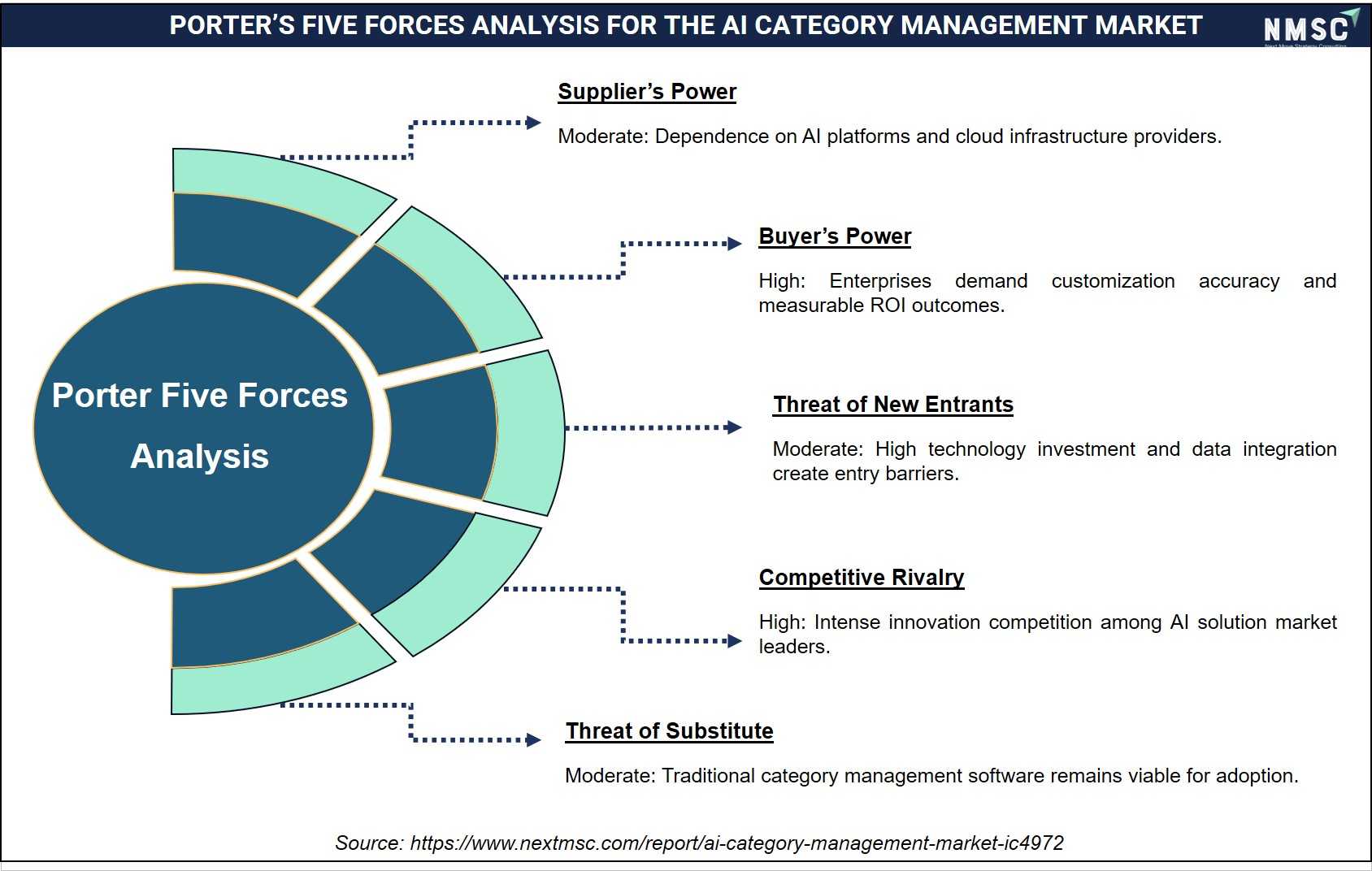
The above infographic presents a Porter's Five Forces analysis of the AI Category Management Market, providing insight into the competitive structure and profitability drivers shaping the industry. It evaluates competitive rivalry, bargaining power of buyers and suppliers, threat of substitutes, and barriers to entry. The framework highlights increasing competition among AI solution providers, growing enterprise adoption, and the importance of data capabilities and ecosystem partnerships in sustaining long-term market differentiation.
Regional Outlook
Geographic Performance Snapshot
|
Regional Segment |
2025 (USD Bn) |
2035 (USD Bn) |
CAGR (%) |
Primary Drivers |
|
North America |
2.04 |
19.00 |
25.1% |
Rapid adoption of AI-driven procurement analytics and enterprise spend optimization platforms |
|
Europe |
1.28 |
12.00 |
25.3% |
Growing focus on supplier risk management, procurement compliance, and digital sourcing transformation |
|
Asia-Pacific |
1.87 |
25.25 |
29.9% |
Expanding enterprise digitization initiatives and increasing deployment of AI-powered procurement solutions |
|
Middle East & Africa |
0.35 |
3.50 |
25.8% |
Government-led digital transformation programs and modernization of procurement operations |
|
Latin America |
0.30 |
3.00 |
25.9% |
Rising investment in procurement automation and cost-efficiency enhancement across enterprises |
North America AI Category Management Market
North America dominated the AI Category Management Market in 2025, generating USD 2.04 billion, and is projected to reach USD 19.00 billion by 2035 at a CAGR of 25.1%. The region benefits from the highest global concentration of AI procurement software vendors, a mature enterprise SaaS adoption culture, deep venture capital investment in procurement technology startups, and a robust regulatory environment that incentivizes spend transparency. NMSC's analysis indicates that Fortune 500 procurement organizations across North America are deploying multi-module AI category management platforms at scale, driving sustained revenue growth throughout the forecast period.
United States AI Category Management Market
Based on our engagements, the United States represents the single largest national market within the global AI Category Management Market, contributing the substantial majority of North America's USD 2.04 billion in 2025. Demand is driven by large enterprise procurement transformation programs, strong adoption of cloud-based sourcing intelligence platforms, and a dense ecosystem of specialist AI procurement vendors headquartered domestically. Government procurement agencies are also increasingly piloting AI category management tools, supported by the U.S. General Services Administration's digital procurement modernization initiatives. The competitive intensity among vendors is the highest globally, with frequent platform feature launches and M&A activity shaping the market landscape.
Canada AI Category Management Market
Through our analysis, Canada's AI Category Management Market is experiencing steady growth driven by public-sector digital procurement reform and private-sector supply chain resilience investments following COVID-19-related disruption. The Canadian government's Directive on the Management of Procurement encourages digital platform adoption across federal departments, creating a replicable public-sector demand model. Financial services and manufacturing organizations in Ontario and British Columbia are primary private-sector adopters, deploying spend intelligence and supplier risk intelligence systems to manage complex North American and international supply chains. Canada benefits from proximity to leading U.S.-based AI procurement vendors and a strong bilingual talent pool supporting platform implementation.
Mexico AI Category Management Market
From our assessment, Mexico's AI Category Management Market is at an early but accelerating stage of adoption, supported by manufacturing sector growth linked to nearshoring trends as multinational corporations relocate supply chains from Asia to North America. Mexico's position as a major automotive and electronics manufacturing hub is creating demand for AI-powered direct materials category management and supplier performance intelligence systems. Government procurement modernization under Mexico's CompraNet digital platform is establishing foundational digital infrastructure. Mid-market manufacturing enterprises represent the primary near-term opportunity, though adoption is currently constrained by limited local implementation partner capacity and ERP modernization backlogs.
Europe AI Category Management Market
Europe generated USD 1.28 billion in 2025 and is projected to reach USD 12.00 billion by 2035 at a CAGR of 25.3% in the AI Category Management Market. Europe's growth is anchored by the regulatory imperative created by the Corporate Sustainability Reporting Directive, which is compelling thousands of large and listed mid-market enterprises to invest in AI-powered ESG compliance intelligence and supply chain transparency platforms. Germany, the UK, and France lead regional adoption, while Nordic markets demonstrate early-mover advantage in AI procurement technology. The European AI Act, which creates requirements for high-risk AI system transparency, is influencing platform architecture decisions among procurement technology vendors operating in the region.
United Kingdom AI Category Management Market
Based on our engagements, the United Kingdom represents Europe's leading AI Category Management Market, benefiting from a deep enterprise software adoption culture, a concentration of global financial services and retail procurement organizations, and a progressive regulatory environment that supports AI innovation within governance boundaries. The UK government's Procurement Act 2023, which establishes new transparency and commercial standards for public procurement, is directly incentivizing AI category management adoption across public-sector contracting authorities. Professional services and retail sectors are primary demand drivers, with London-headquartered multinationals deploying AI sourcing platforms across global category portfolios managed from UK procurement centers of excellence.
Germany AI Category Management Market
Through our analysis, Germany is the second-largest European market for AI category management, driven by the country's dominant manufacturing and automotive sectors that manage extraordinarily complex multi-tier supplier networks. German enterprises including automotive OEMs and tier-one industrial manufacturers are deploying AI-powered supplier risk intelligence systems to manage geopolitical exposure in global supply chains following supply disruptions experienced in 2021–2023. The German government's digitalization strategy, Digitalstrategie Deutschland, supports enterprise digital transformation investment. SAP SE's headquarters in Walldorf positions Germany as a natural hub for AI procurement platform innovation, with domestic enterprise customers benefiting from early access to SAP Business AI embedded in S/4HANA.
France AI Category Management Market
From our assessment, France's AI Category Management Market is growing steadily, supported by the country's large consumer goods, aerospace, and luxury retail sectors that require sophisticated AI-powered indirect and direct category management capabilities. The French government's procurement reform under its Programme Action Publique reinforces digital platform adoption in public-sector spending. French enterprises are notable early adopters of ESG-embedded category management tools, aligning with national sustainability commitments under the Loi PACTE framework. Ivalua, a French-headquartered AI procurement platform vendor, has a strong domestic client base, and its continued product development in AI-native category intelligence is contributing to market maturation in France.
Italy AI Category Management Market
According to evaluation, Italy's AI Category Management Market is at a developing stage, with primary adoption concentrated in manufacturing, fashion, and food and beverage sectors. Italian enterprises managing complex international sourcing portfolios are beginning to deploy AI spend intelligence and supplier discovery systems, supported by EU digital transformation funding under the PNRR (Piano Nazionale di Ripresa e Resilienza). Public procurement digitization is advancing through the ANAC (National Anti-Corruption Authority) digital platform, establishing data infrastructure that supports AI analytics deployment. Adoption growth is expected to accelerate as implementation partner capacity increases and platform providers localize offerings for Italian market requirements.
Spain AI Category Management Market
Based on our engagements, Spain's AI Category Management Market is growing as retail, telecommunications, and energy sector enterprises invest in AI-powered procurement optimization. Spain's procurement digitization has received impetus from EU NextGenerationEU funding allocated to digital transformation projects. The Spanish Ministry of Finance's PLACE (Public Procurement Law) framework supports transparency requirements that incentivize AI platform adoption in public contracting. Major Spanish multinationals in energy and telecommunications are deploying spend intelligence platforms to manage complex global supplier portfolios. Growth is expected to accelerate through 2028 as cloud-first mid-market procurement platforms become available in Spanish-language configurations from leading vendors.
Sweden AI Category Management Market
Through our analysis, Sweden demonstrates above-average AI Category Management Market maturity relative to its population size, driven by a technology-forward enterprise culture, strong sustainability procurement mandates, and a high concentration of globally competitive manufacturing and retail organizations. Swedish public procurement guidelines strongly encourage supplier sustainability assessment, creating natural demand for ESG-embedded category intelligence systems. Companies including IKEA and Volvo are recognized globally for supply chain transparency practices that require sophisticated AI category management infrastructure. Roslyn Data Technologies and several Nordic procurement analytics startups serve the regional market alongside global platform vendors.
Denmark AI Category Management Market
From our assessment, Denmark's AI Category Management Market benefits from the country's high digital readiness and strong public procurement governance framework administered through the State and University Service Denmark (Statens og Kommunernes Indkøbsservice - SKI). Danish enterprises in pharmaceuticals, shipping, and renewable energy are deploying AI-powered category management tools to manage global sourcing complexity. Denmark's commitment to circular economy procurement principles is accelerating adoption of sustainability intelligence modules within category management platforms. The relatively small domestic market size is offset by Danish multinationals managing international procurement portfolios that require global AI category intelligence capabilities.
Finland AI Category Management Market
According to evaluation, Finland's AI Category Management Market is characterized by strong technology adoption in public-sector procurement, supported by Hansel Ltd, the central procurement unit of the Finnish government that has pursued digital procurement platform modernization. Private-sector adoption is driven by technology, forest industry, and healthcare sectors. Finland's advanced digital infrastructure and high enterprise software literacy rates support rapid AI procurement platform deployment timelines relative to European peers. The country's commitment to EU sustainability reporting requirements creates growing demand for ESG compliance intelligence modules embedded within AI category management platforms serving Finnish exporters.
Netherlands AI Category Management Market
Based on our engagements, the Netherlands is an important European hub for AI Category Management Market activity, driven by the country's position as a major European logistics, chemicals, and financial services center. Dutch multinational corporations managing global supply chains are significant adopters of AI supplier discovery and risk intelligence platforms. The Netherlands' PIANOo (Dutch Public Procurement Expertise Centre) framework promotes innovative and sustainable procurement practices in government, generating public-sector demand for AI category intelligence tools. Amsterdam's role as a European technology hub supports access to AI procurement implementation expertise, reducing deployment barriers for mid-market adopters.
Rest of Europe AI Category Management Market
Through our analysis, the Rest of Europe, encompassing Poland, Belgium, Austria, Switzerland, Portugal, and other markets, collectively represents a meaningful and growing portion of the European AI Category Management Market. Poland's manufacturing sector growth and EU structural fund investments in digital transformation are driving procurement technology adoption. Switzerland's concentration of global pharmaceutical and financial services headquarters creates high-value demand for enterprise AI category management platforms. Eastern European markets are at earlier adoption stages but are accelerating as multinational corporations standardize AI procurement platforms across regional operations, creating implementation demand that regional system integrators are increasingly equipped to fulfill.
Asia-Pacific AI Category Management Market
Asia-Pacific is the fastest-growing regional market in the AI Category Management Market, valued at USD 1.87 billion in 2025 and projected to reach USD 25.25 billion by 2035 at a CAGR of 29.9%. The region's growth is powered by large-scale manufacturing sector expansion, government digital procurement mandates in India, South Korea, and Australia, rapid adoption of cloud-based enterprise software among mid-market organizations, and a growing base of AI procurement technology startups emerging from China, India, and Singapore. NMSC's analysis indicates Asia-Pacific will overtake North America as the largest regional market by the early 2030s.
China AI Category Management Market
From our assessment, China represents the largest Asia-Pacific market for AI category management, driven by its position as the world's largest manufacturing economy with extraordinarily complex domestic and international supplier networks. Chinese enterprises in electronics, automotive, and consumer goods sectors are deploying AI-powered category intelligence and supplier discovery systems at scale, supported by domestic AI champions and international platform vendors operating through local partnerships. China's government procurement digitization initiatives, administered through the Ministry of Finance's centralized platform, are establishing foundational data infrastructure. Domestic AI procurement vendors are growing rapidly, creating a competitive dynamic between local and global platform providers.
India AI Category Management Market
Based on our engagements, India is the fastest-growing individual country market in the AI Category Management Market, driven by the government's digital procurement platform (GeM), expanding manufacturing and IT services sectors, and a growing base of procurement technology talent. The GeM portal's transaction volumes exceeding INR 4 lakh crore in FY2024, as disclosed on gem.gov.in, demonstrate India's large-scale public procurement digitization. Private sector adoption is accelerating as large conglomerates including Tata, Mahindra, and Reliance deploy AI category management platforms across their diversified procurement portfolios. India's competitive technology talent cost advantage is also attracting global vendors to establish development and analytics centers locally.
Japan AI Category Management Market
Through our analysis, Japan's AI Category Management Market is evolving as the country's large manufacturing conglomerates modernize procurement infrastructure in response to supply chain resilience imperatives exposed during the COVID-19 pandemic and subsequent semiconductor shortages. Japanese enterprises have historically favored proprietary procurement systems, but adoption of international AI category management platforms is accelerating as vendors localize offerings with Japanese-language interfaces and domestic ERP integration capabilities. The Japanese government's digital transformation strategy, managed through the Digital Agency established in 2021, is driving public procurement platform modernization that creates demand for AI category intelligence infrastructure.
South Korea AI Category Management Market
According to evaluation, South Korea's AI Category Management Market benefits from the country's technology-forward enterprise culture, high digital infrastructure quality, and large electronics, semiconductor, and shipbuilding sectors that require sophisticated global supply chain intelligence. South Korea's Public Procurement Service (PPS), operating the KONEPS (Korea Online E-Procurement System) platform, has been a global benchmark for digital procurement transparency, creating public-sector demand for AI intelligence layers. Large conglomerates including Samsung, LG, and Hyundai are deploying AI-powered supplier risk intelligence and sourcing optimization platforms to manage their extensive global supplier networks.
Taiwan AI Category Management Market
From our assessment, Taiwan's AI Category Management Market is growing driven by the country's critical role in global semiconductor and electronics supply chains, creating acute demand for AI-powered supplier intelligence and risk monitoring systems. Taiwanese semiconductor foundries and electronics manufacturers require real-time visibility into supplier financial stability, geopolitical exposure, and delivery performance metrics. Government Procurement Agency (GPA) digital initiatives are supporting public-sector adoption of procurement intelligence tools. Taiwan's geographic position creates significant supply chain concentration risk awareness among enterprise procurement teams, directly incentivizing investment in AI-powered supplier risk intelligence platforms.
Indonesia AI Category Management Market
Based on our engagements, Indonesia's AI Category Management Market is at an early development stage but is accelerating, driven by the country's large and growing manufacturing sector, significant public procurement volumes managed through the LKPP (National Public Procurement Agency), and increasing international investor interest in Indonesian supply chains. Mid-market manufacturing and retail enterprises in Sumatra and Java are beginning to deploy cloud-based spend intelligence and category insight tools. The Indonesian government's e-purchasing and e-tendering platforms, disclosed on LKPP's official site (lkpp.go.id), provide foundational digital infrastructure upon which AI category intelligence capabilities are being built.
Vietnam AI Category Management Market
Through our analysis, Vietnam's AI Category Management Market is emerging as a growth opportunity, driven by the country's rapid manufacturing sector expansion and its increasing importance as a global electronics and textile production hub. Foreign direct investment inflows from multinational manufacturers are creating demand for standardized, AI-enabled supplier management and category intelligence platforms that align with global parent company procurement standards. Vietnam's Ministry of Planning and Investment's digital transformation roadmap supports enterprise digital adoption. AI category management adoption currently remains concentrated among subsidiaries of multinational corporations rather than domestic enterprises.
Australia AI Category Management Market
According to evaluation, Australia's AI Category Management Market demonstrates solid maturity driven by the country's large mining, financial services, and retail sectors with complex procurement portfolios. The Australian government's Procurement Connected Policy and the Digital Transformation Agency's digital procurement modernization agenda are supporting public-sector AI adoption. Australian enterprises are notable early adopters of cloud-based procurement intelligence platforms, with strong market presence from vendors including Coupa Software and SAP Ariba. The country's proximity and trade linkages to Asia-Pacific supply chains are driving investment in AI-powered supplier risk and geopolitical exposure analytics.
Philippines AI Category Management Market
From our assessment, the Philippines' AI Category Management Market is in early development, with adoption primarily concentrated in business process outsourcing, retail, and government sectors. The Philippine Government Electronic Procurement System (PhilGEPS), operated by the Government Procurement Policy Board, provides digital procurement infrastructure. As the Philippines develops its manufacturing and export sectors, demand for AI-powered category intelligence and sourcing optimization is expected to grow. Current adoption is largely driven by multinational corporation subsidiaries standardizing on global procurement platforms and Philippine conglomerates beginning to invest in digital supply chain transparency capabilities.
Malaysia AI Category Management Market
Based on our engagements, Malaysia's AI Category Management Market benefits from the country's strategic position as a manufacturing, technology, and palm oil sector hub in Southeast Asia. Malaysia's MyProcurement digital platform, managed by the Ministry of Finance, is advancing public procurement digitization. Private-sector adoption is driven by electronics manufacturing, petrochemicals, and palm oil supply chain organizations deploying AI supplier intelligence and spend analytics tools. Malaysia's government-linked corporations are significant early adopters of enterprise procurement platforms, supported by digital transformation investment under the Malaysia Digital Economy Blueprint (MyDigital) strategy disclosed on Malaysia.gov.my.
Rest of Asia-Pacific AI Category Management Market
Through our analysis, the Rest of Asia-Pacific, comprising Singapore, Thailand, New Zealand, Bangladesh, and other markets, represents a collectively meaningful market opportunity. Singapore serves as a regional headquarters hub for multinational AI procurement platform vendors, supporting sales and implementation for Southeast Asian markets. Thailand's automotive and electronics manufacturing sectors are driving mid-market procurement technology adoption. New Zealand's public procurement framework, managed through the New Zealand Government Procurement and Property division, supports digital platform modernization. These markets collectively offer long-term expansion opportunities as cloud infrastructure investment and digital enterprise adoption reach critical mass.
Middle East and Africa AI Category Management Market
The Middle East and Africa AI Category Management Market generated USD 0.35 billion in 2025 and is projected to reach USD 3.50 billion by 2035 at a CAGR of 25.8%. The region's growth is anchored by large-scale government procurement modernization programs linked to economic diversification strategies in the Gulf Cooperation Council states, particularly Saudi Arabia's Vision 2030 and UAE's We the UAE 2031 initiative. Africa's expanding manufacturing and retail sectors provide long-term demand potential. Regulatory developments around procurement transparency and anti-corruption frameworks in several African nations are creating early demand for AI-powered procurement governance tools.
Saudi Arabia AI Category Management Market
From our assessment, Saudi Arabia is the largest AI Category Management Market in the Middle East, driven by the Kingdom's multi-trillion-dollar Vision 2030 economic transformation program, which is generating extraordinary public and private procurement activity across infrastructure, energy, and hospitality sectors. The National Transformation Program includes public procurement digitization as a core objective, managed through the Etimad government procurement platform. Saudi Aramco, SABIC, and major Vision 2030 project delivery entities represent high-value private-sector clients for AI category management platforms. NMSC's analysis indicates Saudi Arabia's procurement technology market will grow disproportionately relative to regional peers through 2030.
UAE AI Category Management Market
Based on our engagements, the UAE is the second-largest MEA market for AI category management, reflecting Dubai and Abu Dhabi's position as regional hubs for multinational procurement and supply chain management. The UAE government's AI strategy, anchored by the UAE Artificial Intelligence Strategy 2031, establishes AI adoption as a national priority across government services including procurement. Dubai's World Expo legacy infrastructure and Abu Dhabi's industrial investment programs generate substantial procurement activity requiring AI-powered category intelligence. Free zone entities managing large import and re-export supply chains are deploying spend analytics and supplier intelligence platforms to optimize their complex international procurement portfolios.
Egypt AI Category Management Market
Through our analysis, Egypt's AI Category Management Market is at a nascent stage, with early adoption in manufacturing, pharmaceuticals, and government-linked enterprises. Egypt's public procurement framework, managed through the Central Agency for Organization and Administration (CAOA), is undergoing digitization reforms that will create foundational infrastructure for AI intelligence deployment. Egypt's growing manufacturing sector, expanding under the government's industrial development strategy, is attracting multinational investors who bring global procurement platform standards. Adoption is expected to accelerate in the second half of the forecast period as digital enterprise infrastructure matures and international vendor presence in Egypt expands.
Israel AI Category Management Market
According to evaluation, Israel's AI Category Management Market is technologically advanced relative to its size, benefiting from the country's deep AI research ecosystem, strong technology sector, and a culture of early enterprise technology adoption. Israeli technology companies and defense contractors are significant users of AI-powered spend intelligence and supplier management systems. Israel's public procurement portal operates under the State Comptroller's procurement transparency framework. The local AI technology ecosystem, which includes numerous procurement AI startups, contributes both to domestic market innovation and to global vendor pipelines that enhance the competitive landscape within the broader AI category management industry.
Turkey AI Category Management Market
From our assessment, Turkey's AI Category Management Market is growing, driven by the country's large manufacturing base, particularly in automotive, textiles, and consumer goods, that manages complex international supply chain relationships. Turkey's Public Procurement Authority (Kamu Ýhale Kurumu - KIK) manages significant public procurement volumes digitally, and the government's digital transformation strategy supports broader adoption of AI procurement tools. Turkish enterprises exporting to European markets face growing ESG supplier disclosure requirements from European buyers, creating pull-through demand for AI-powered sustainability intelligence embedded within category management platforms. Mid-market manufacturing exporters represent the primary opportunity segment.
Nigeria AI Category Management Market
Based on our engagements, Nigeria's AI Category Management Market is in early development, with current adoption driven primarily by multinational oil and gas companies and telecommunications operators managing large supplier networks in complex operating environments. The Bureau of Public Procurement (BPP) manages federal procurement governance and is advancing e-procurement infrastructure. Nigeria's growing fintech and consumer goods sectors are beginning to evaluate cloud-based spend intelligence tools. Long-term demand potential is significant given Nigeria's position as Africa's largest economy, though near-term adoption is constrained by digital infrastructure gaps and limited availability of local implementation partners for enterprise-grade AI procurement platforms.
South Africa AI Category Management Market
Through our analysis, South Africa represents the most mature AI Category Management Market in sub-Saharan Africa, driven by the country's mining, financial services, retail, and manufacturing sectors. The National Treasury's central supplier database and e-procurement framework provide foundational digital procurement infrastructure. South African enterprises are the most active AI procurement platform adopters in Africa, with several multinational corporations managing continental procurement from South African centers of excellence. B-BBEE compliance requirements, which mandate supplier diversity reporting and tracking, create natural demand for AI-powered supplier intelligence and classification systems that automate empowerment scorecard procurement analytics.
Rest of Middle East and Africa AI Category Management Market
According to evaluation, the Rest of MEA encompasses Qatar, Kuwait, Bahrain, Oman, Jordan, Kenya, Ethiopia, and other markets that collectively represent an emerging growth pool within the AI Category Management Market. GCC markets beyond Saudi Arabia and UAE are advancing procurement digitization as part of national development plans. Kenya's technology ecosystem, centered in Nairobi, is beginning to produce procurement technology solutions for African markets. Qatar's large infrastructure development programs linked to post-FIFA World Cup legacy investments require AI-powered category intelligence for managing extensive construction and services supply chains. These markets collectively represent long-term opportunity as digital procurement infrastructure matures.
Latin America AI Category Management Market
Latin America generated USD 0.30 billion in 2025 and is projected to reach USD 3.00 billion by 2035 at a CAGR of 25.9% in the AI Category Management Market. The region's growth is primarily driven by Brazil's large industrial base, Argentina's technology sector, and increasing adoption of cloud-based enterprise software across regional multinationals. Government procurement digitization programs across several Latin American nations are creating institutional demand for AI-powered category intelligence. However, macroeconomic volatility, currency risk, and variable digital infrastructure quality across markets create growth uncertainties that vendors must navigate in regional market expansion strategies.
Brazil AI Category Management Market
From our assessment, Brazil is the largest Latin American AI Category Management Market, driven by the country's diversified economy encompassing manufacturing, agriculture, energy, and financial services sectors with complex domestic and international procurement portfolios. Brazil's ComprasNet federal procurement platform and the broader government's digital public services transformation agenda support institutional AI adoption. Large Brazilian conglomerates including Petrobras, Vale, and Embraer manage global supplier networks requiring AI-powered risk intelligence and category optimization. International AI category management vendors including SAP SE, Oracle, and Coupa Software maintain active Brazilian operations, supporting enterprise adoption among large domestic and multinational clients.
Argentina AI Category Management Market
Based on our engagements, Argentina's AI Category Management Market faces macroeconomic headwinds but demonstrates resilience in technology sector adoption and among export-oriented agricultural and manufacturing enterprises. Argentine technology companies, many operating internationally to mitigate domestic currency risk, are significant users of cloud-based AI category management tools. The government's Contrat.ar digital procurement platform represents public-sector digitization progress. Argentina's software development talent pool, which is internationally competitive, supports local AI procurement platform customization and implementation capabilities that attract regional vendor investment despite the challenging macroeconomic environment.
Chile AI Category Management Market
Through our analysis, Chile's AI Category Management Market benefits from the country's relatively stable macroeconomic environment, strong mining sector, and mature public procurement infrastructure through the ChileCompra platform, one of Latin America's most advanced government procurement digitization initiatives, as documented on chilecompra.cl. Mining enterprises managing complex equipment, materials, and services supply chains are primary private-sector adopters of AI category management intelligence. Chile's business-friendly regulatory environment and trade agreements with major global economies support adoption of international AI procurement platform standards among Chilean multinationals.
Colombia AI Category Management Market
According to our evaluation, Colombia's AI Category Management Market is growing, driven by the country's manufacturing, energy, and financial services sectors. Colombia Compra Eficiente, the national public procurement agency, has developed the SECOP II digital procurement platform that establishes institutional demand for AI analytics overlays. Colombian oil and gas sector enterprises are significant users of supplier risk intelligence and category spend optimization tools. The growing presence of international technology companies establishing Latin American operations in Bogotá is creating enterprise software adoption momentum that benefits AI category management platform vendors targeting Colombian and broader Andean market opportunities.
Rest of Latin America AI Category Management Market
From our assessment, the Rest of Latin America represents an emerging opportunity in the AI Category Management Market. Peru's mining sector and growing manufacturing base create demand for AI-powered sourcing optimization tools. Uruguay's digital government agenda, including advanced public procurement digitization, serves as a regional model. Central American free trade zone manufacturing operations managed by multinational corporations represent near-term adoption opportunities for embedded AI category intelligence modules within global procurement platforms that standardize across regional operations.
Competitive Landscape
Competitive Dynamics and M&A Landscape
|
Key Takeaways |
Details |
|
Market Structure |
The AI Category Management Market remains moderately fragmented, with leading players including SAP SE, Oracle Corporation, Coupa Software, and GEP commanding significant share while a growing cohort of AI-native challengers including Zip, Fairmarkit, Arkestro, and TealBOOK compete on innovation speed and specialized capability. |
|
Innovation Focus |
Innovation is concentrated in agentic AI sourcing, NLP-based spend intelligence, autonomous negotiation engines, and ESG compliance intelligence, with vendors investing heavily in large language model integration, multi-agent orchestration, and predictive category analytics as primary differentiation vectors. |
|
M&A Activity |
The AI Category Management Market has seen sustained M&A activity as large ERP vendors acquire specialist AI procurement startups to accelerate intelligence capability integration; strategic acquisitions in 2023–2025 have focused on spend analytics, supplier risk platforms, and autonomous sourcing agents. |
How Do Companies Compete in the AI Category Management Market?
The AI Category Management Market is characterized by multi-dimensional competition across platform breadth, AI model sophistication, integration depth, and geographic reach. Large ERP-integrated vendors including SAP SE and Oracle Corporation compete primarily on ecosystem integration advantage, offering AI category management as a component of broader enterprise suite deployments. Mid-tier procurement specialists including Coupa Software, Ivalua, JAGGAER, and GEP differentiate on procurement-specific AI depth, pre-built category taxonomies, and established implementation partner networks. AI-native challengers including Arkestro, Fairmarkit, and Keelvar compete on algorithmic innovation, speed of deployment, and specific use-case performance.
Pricing strategies vary significantly across the market: large suite vendors bundle AI category management within enterprise license agreements, while specialized vendors offer modular, consumption-based pricing that lowers adoption barriers for mid-market organizations. Geographic expansion strategies reflect market maturity differences — North American and European vendors are prioritizing Asia-Pacific market localization, while emerging regional players in India and Singapore are building global go-to-market capabilities. NMSC's analysis indicates that vendors with demonstrated ROI evidence, measurable savings outcomes, and transparent AI model explainability are gaining competitive advantage in procurement technology evaluation processes.
Which Kind of Companies Dominate the AI Category Management Market?
The AI Category Management Market is currently dominated by three archetypes of enterprise technology companies. First, global ERP giants, led by SAP SE and Oracle Corporation, leverage deep customer relationships, extensive implementation partner networks, and bundled commercial arrangements to maintain broad market presence across enterprise segments. Second, procurement-specialist platform vendors including Coupa Software, Ivalua, JAGGAER, and GEP offer purpose-built AI category management suites that deliver higher functional depth in sourcing intelligence and supplier management relative to ERP modules, attracting enterprises with complex procurement requirements.
Third, AI-native procurement innovators, including Arkestro, Keelvar, Fairmarkit, and TealBOOK, are reshaping competitive dynamics by deploying machine learning models specifically trained on procurement data, enabling capabilities such as autonomous negotiation, predictive award optimization, and continuous supplier intelligence that incumbent platforms are working to replicate. This third category is gaining enterprise customer traction and attracting significant venture capital funding. Through NMSC's assessment, we found that AI-native vendors are disproportionately winning competitive evaluations in advanced sourcing optimization and spend intelligence use cases among technology-forward enterprises.
AI-Native Differentiation and Open Standards Drive Market Success in the AI Category Management Market
Our analysis shows that vendors demonstrating measurable AI-native differentiation, characterised by proprietary training datasets, domain-specific model architectures, and continuously learning procurement intelligence systems, are achieving superior market positioning and customer retention within the AI Category Management Market. Open standards adoption, including PEPPOL e-invoicing compatibility, UNSPSC taxonomy support, and API-first architectures, is becoming a market entry requirement as enterprises demand interoperability across their broader procurement and financial technology stacks. Vendors that combine AI performance with open integration architectures are establishing durable competitive positions that are difficult for single-capability challengers to displace.
Market Players to opt for Merger and Acquisition Strategies to Expand Their Presence in the AI Category Management Market
M&A activity within the AI Category Management Market is accelerating as established vendors seek to close capability gaps in AI intelligence and agentic automation through strategic acquisitions rather than organic development. Coupa Software's acquisition history demonstrates a pattern of expanding category intelligence through targeted procurement analytics acquisitions. JAGGAER's inorganic growth strategy has incorporated specialist supplier management and contract intelligence platforms. Workday's investment in procurement AI capabilities through its platform strategy reflects the broader trend of financial management suite vendors acquiring procurement intelligence assets. Based on NMSC's research, M&A activity is expected to intensify between 2026 and 2030 as AI model differentiation becomes the primary competitive battleground and vendors with superior training data assets attract premium acquisition valuations.
Who Are the Key Market Players in the AI Category Management Market?
-
SAP SE
-
Oracle Corporation
-
Coupa Software, Inc.
-
Ivalua
-
JAGGAER
-
GEP
-
Zycus Infotech Private Limited
-
Basware
-
Sievo
-
Corcentric, LLC
-
Zip
-
Workday, Inc.
-
o9 Solutions, Inc.
-
Beroe Inc.
-
Keelvar Systems Ltd.
-
TealBOOK
-
Simfoni
-
Rosslyn Data Technologies plc
-
Fairmarkit, Inc.
-
Arkestro
What Are the Latest Developments in the AI Category Management Market?
The AI Category Management Market is experiencing steady advancement as enterprises increasingly adopt AI-enabled procurement and spend management platforms to enhance sourcing efficiency and supplier intelligence. Companies such as SAP, Oracle, Coupa, Ivalua, JAGGAER, and o9 Solutions are focusing on predictive analytics, generative AI capabilities, autonomous sourcing, and data-driven decision support, reflecting the growing emphasis on cost optimization, supply chain resilience, and strategic procurement transformation across industries.
What Are the Investment Opportunities in the AI Category Management Market?
Capital Inflows Shaping Investment Dynamics in the AI Category Management Market
Our findings suggest that venture capital and private equity investment in the AI Category Management Market has accelerated significantly since 2023, with AI-native procurement startups attracting multi-hundred-million-dollar funding rounds. Keelvar, Fairmarkit, Zip, and Arkestro have collectively raised substantial capital from leading technology-focused funds, reflecting investor confidence in the market's long-term growth trajectory. The investment thesis centers on the large and growing total addressable market for AI procurement intelligence, high enterprise switching costs once platforms are embedded in ERP and financial systems, and the compounding value of proprietary procurement training data. NMSC's analysis indicates that AI category management remains among the most actively funded enterprise software categories globally.
Digital Infrastructure Investment Creating AI Category Management Market Opportunities
Through our market assessment, we observed that enterprise digital infrastructure investment, including ERP modernisation, cloud migration, and procurement data platform buildouts, is creating enabling conditions for AI category management platform adoption at scale. According to the World Bank's digital development data, global cloud computing investment is growing at double-digit rates annually across developed and emerging markets, directly expanding the infrastructure base upon which cloud-native AI category management tools are deployed. This infrastructure tailwind is particularly significant in Asia-Pacific and Latin America, where cloud adoption curves are steepest, and AI procurement platform deployment is expected to accelerate materially between 2027 and 2032.
ESG Considerations Creating Targeted Investment Opportunities in the AI Category Management Market
NMSC's analysis indicates that ESG-aligned procurement investment represents one of the highest-growth investment themes within the broader AI Category Management Market. Institutional investors operating under sustainability mandates are actively seeking enterprise technology companies that enable supply chain ESG compliance and reporting, directly benefiting AI category management vendors with strong ESG intelligence capabilities. The EU Corporate Sustainability Reporting Directive's phased implementation, requiring approximately 50,000 companies to provide detailed sustainability supply chain disclosures as specified in the directive's official text available on eur-lex.europa.eu, is creating a multi-year investment demand cycle for ESG-embedded AI category management solutions, generating durable return opportunities for investors in this space.
Digital Transformation Across Emerging Markets Creating Investment Opportunities in the AI Category Management Market
Based on our market evaluation, emerging market digital transformation programs represent a significant and underappreciated investment opportunity within the AI Category Management Market. Government-led digitization initiatives in India, Saudi Arabia, Brazil, and across Southeast Asia are creating institutional procurement infrastructure that directly enables AI platform adoption by both public and private sector organizations. Investors targeting high-growth AI procurement technology exposure are increasingly evaluating regional market entry strategies, local partnership structures, and emerging market-specific pricing models as pathways to capture this growth opportunity. Companies with demonstrated emerging market implementation capabilities and localized AI model training are attracting premium investment interest.
PE and VC Activity Influencing the Competitive Structure of the AI Category Management Market
Our assessment indicates that private equity and venture capital activity is reshaping the competitive structure of the AI Category Management Market through consolidation, capability enhancement, and market expansion investments. PE-backed platforms including Corcentric and JAGGAER have used acquisition capital to build comprehensive AI category management capability stacks spanning spend intelligence, sourcing optimization, and supplier intelligence within unified platform architectures. VC investment in AI-native startups is simultaneously creating competitive pressure on incumbents, accelerating the pace of innovation across autonomous sourcing, predictive analytics, and embedded AI capabilities. This dual dynamic of consolidation and disruption is expected to sustain elevated investment activity throughout the forecast period.
Key Benefits for Stakeholders
Enterprise Value Creation Through AI Category Management Platforms
Enterprises deploying AI category management platforms achieve measurable procurement value across multiple dimensions simultaneously. Spend intelligence systems enable organizations to identify category consolidation opportunities, eliminate maverick spending, and benchmark supplier pricing against real-time market data, generating direct cost savings that typically represent a multiple of platform investment costs. Supplier intelligence platforms reduce supplier risk exposure by providing early warning indicators of financial instability, ESG non-compliance, and geopolitical disruption. Procurement orchestration platforms compress sourcing cycle times, enabling procurement teams to reallocate effort from transactional processing to strategic category development activities.
Strategic Insights for Investors and Financial Analysts
Investors and financial analysts gain a structured, data-driven framework for evaluating the AI Category Management Market's growth trajectory, competitive dynamics, and segment-level opportunity sizing. The report provides verified market size estimates from 2025 through 2035, segment-level CAGR projections, regional demand assessments, and competitive landscape analysis that support investment thesis development, portfolio company benchmarking, and sector allocation decision-making. Strategic investors evaluating M&A opportunities within the procurement technology sector will find the competitive landscape analysis, M&A trend narrative, and key player profiles particularly actionable for target identification and valuation context.
Growth and Positioning Advantages for Technology Vendors
Technology vendors operating in or targeting the AI Category Management Market benefit from a comprehensive segmentation analysis that identifies the specific platform categories, enterprise size segments, industry verticals, and geographies generating the highest growth rates. The report's competitive landscape assessment provides vendor positioning context, innovation focus benchmarking, and M&A activity mapping that supports product roadmap prioritization, go-to-market strategy development, and partnership evaluation. Vendors can use regional outlook insights to prioritize geographic expansion investments, while industry vertical analysis guides sector-specific AI model development and use-case communication strategies.
Policy and Regulatory Insights for Governments and Regulators
Policymakers and regulators benefit from the AI Category Management Market report's analysis of regulatory influence on procurement technology adoption, ESG intelligence requirements driven by disclosure mandates, and the relationship between digital procurement infrastructure investment and market growth. Governments seeking to improve public procurement efficiency will find the analysis of digital procurement mandate outcomes, including the demonstrated impact of India's GeM, South Korea's KONEPS, and Chile's ChileCompra, directly relevant to policy design. The report also provides context on AI governance implications for autonomous procurement agents, supporting informed regulatory framework development for AI deployment in public and private procurement environments.
Key Market Segments
By Category Intelligence Platforms
-
Spend Intelligence Systems
-
Spend Data Classification Engines
-
Spend Pattern Detection Models
-
Cost Structure Decomposition AI
-
Category Insight Engines
-
Category Opportunity Identification Models
-
Market Price Intelligence Systems
-
Savings Potential Estimation AI
-
Decision Intelligence Systems
-
Recommendation Engines for Category Strategy
-
Prescriptive Optimization Models
-
Scenario Simulation Systems
By Supplier Intelligence Platforms
-
Supplier Discovery Systems
-
Global Supplier Mapping AI
-
Capability Matching Engines
-
Supplier Risk Intelligence Systems
-
Financial Stability Scoring Models
-
ESG Compliance Intelligence Systems
-
Geopolitical Exposure Analytics
-
Supplier Performance Intelligence
-
Delivery Performance Analytics
-
Quality and Compliance Tracking Models
By Sourcing Optimization Platforms
-
RFx Intelligence Systems
-
Automated RFP Generation Engines
-
Bid Analysis AI Models
-
Negotiation Intelligence Systems
-
Price Optimization Algorithms
-
Autonomous Negotiation Agents
-
Award Optimization Engines
-
Multi-Supplier Allocation Models
-
Scenario-Based Award Simulation
By Deployment Mode
-
Cloud
-
On-Premises
-
Hybrid
By Enterprise Size
-
Large Enterprises
-
Mid-Market
-
Small and Medium Enterprises
By End-Use Industry
-
Manufacturing
-
Retail and Consumer Goods
-
Healthcare and Pharmaceuticals
-
Energy and Utilities
-
IT and Telecommunications
-
Banking, Financial Services, and Insurance
-
Other Industries
Conclusion and Recommendations
Long-Term Outlook for the AI Category Management Market
The AI Category Management Market presents one of the most compelling long-term growth narratives in the enterprise software landscape, with a projected expansion from USD 5.84 billion in 2025 to USD 62.75 billion by 2035 at a CAGR of 26.8%. This growth trajectory reflects the convergence of structural demand drivers, including global supply chain complexity, regulatory transparency mandates, and generative AI capability maturation, that are collectively transforming procurement from a cost center into a strategic intelligence function. NMSC's analysis indicates that the AI category management revenue forecast is supported by multiple independent demand vectors that reinforce rather than substitute for each other, creating a robust and durable growth foundation.
Strategic Positioning Priorities for Stakeholders
Our assessment indicates that strategic positioning within the AI Category Management Market requires a differentiated approach across stakeholder types. Enterprise procurement leaders should prioritize platform investments that combine foundational spend data structuring with advanced agentic AI capabilities, sequencing deployment to build proprietary training data assets before attempting autonomous sourcing at scale. Technology vendors should focus differentiation investment on explainable AI architectures, procurement-specific model training, and deep ERP integration that reduces deployment friction. Investors should prioritize exposure to AI-native vendors with demonstrated ROI metrics, sticky enterprise customer bases, and geographic expansion strategies targeting high-growth emerging markets.
Key Risks Affecting AI Category Management Market Growth
The primary risks to AI Category Management Market growth include regulatory backlash against automated procurement decision-making under the EU AI Act's high-risk system classification framework, data privacy constraints that limit cross-border AI training data flows under GDPR and similar frameworks, and implementation complexity that extends platform deployment timelines in mid-market and SME segments. Macroeconomic downturns could compress enterprise technology budgets, slowing platform adoption cycles. AI model reliability concerns, including hallucination risks in generative AI applications and bias in supplier scoring models, represent reputational risks that could slow autonomous agent deployment if high-profile failures occur. Competitive commoditization of basic spend analytics capabilities could compress vendor margins.
Growth Pathways Shaping the AI Category Management Market
Through NMSC's assessment, we found that three primary growth pathways will define the AI Category Management Market through 2035. First, the deepening of agentic AI capabilities, from assisted decision support toward fully autonomous category management execution, will unlock new enterprise value propositions and expand the market's addressable opportunity into operational procurement functions previously considered unsuitable for AI automation. Second, geographic expansion into high-growth emerging markets, particularly India, Southeast Asia, and the GCC, will generate incremental demand that extends the market's growth runway beyond the saturation point of mature North American and European enterprise segments. Third, vertical AI specialization, where procurement intelligence models are trained on industry-specific data sets for healthcare, financial services, and manufacturing categories, will create premium market segments with higher willingness to pay, supporting sustained revenue growth and margin expansion for differentiated vendors through the forecast horizon.
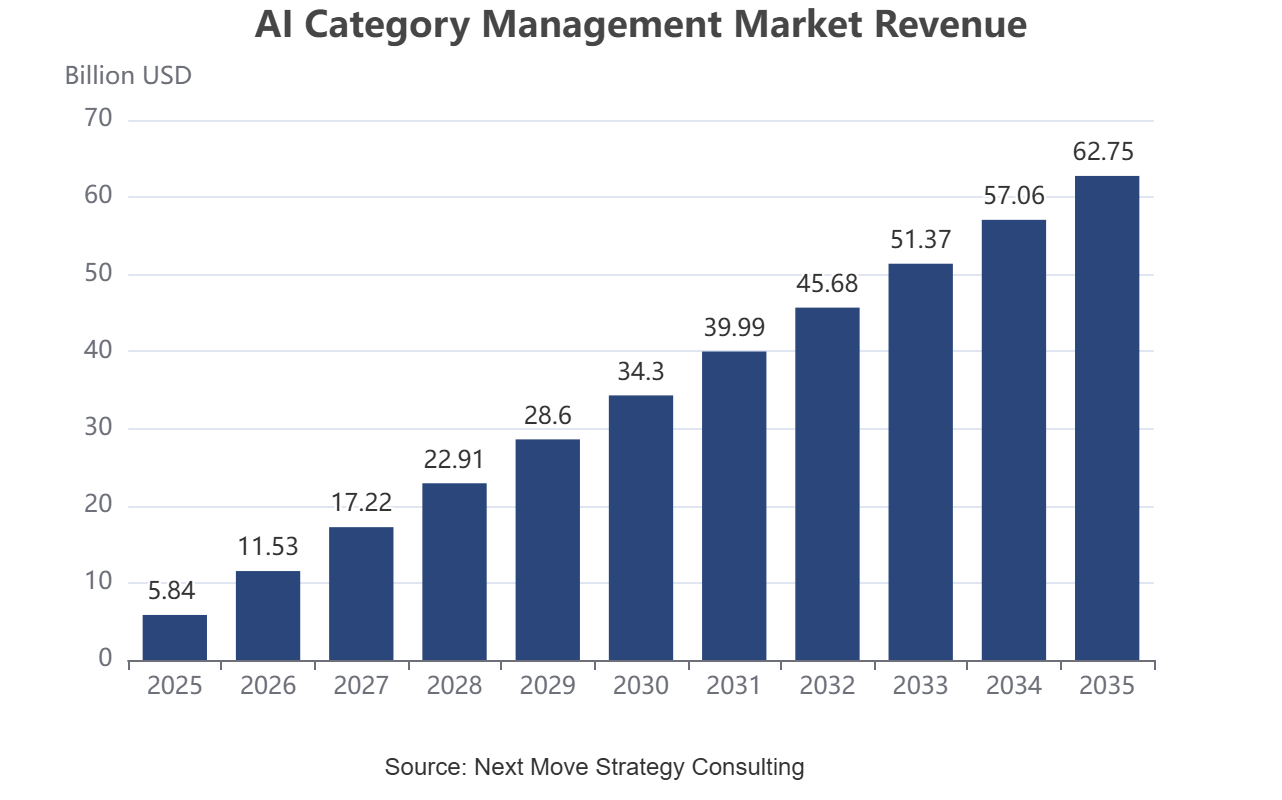
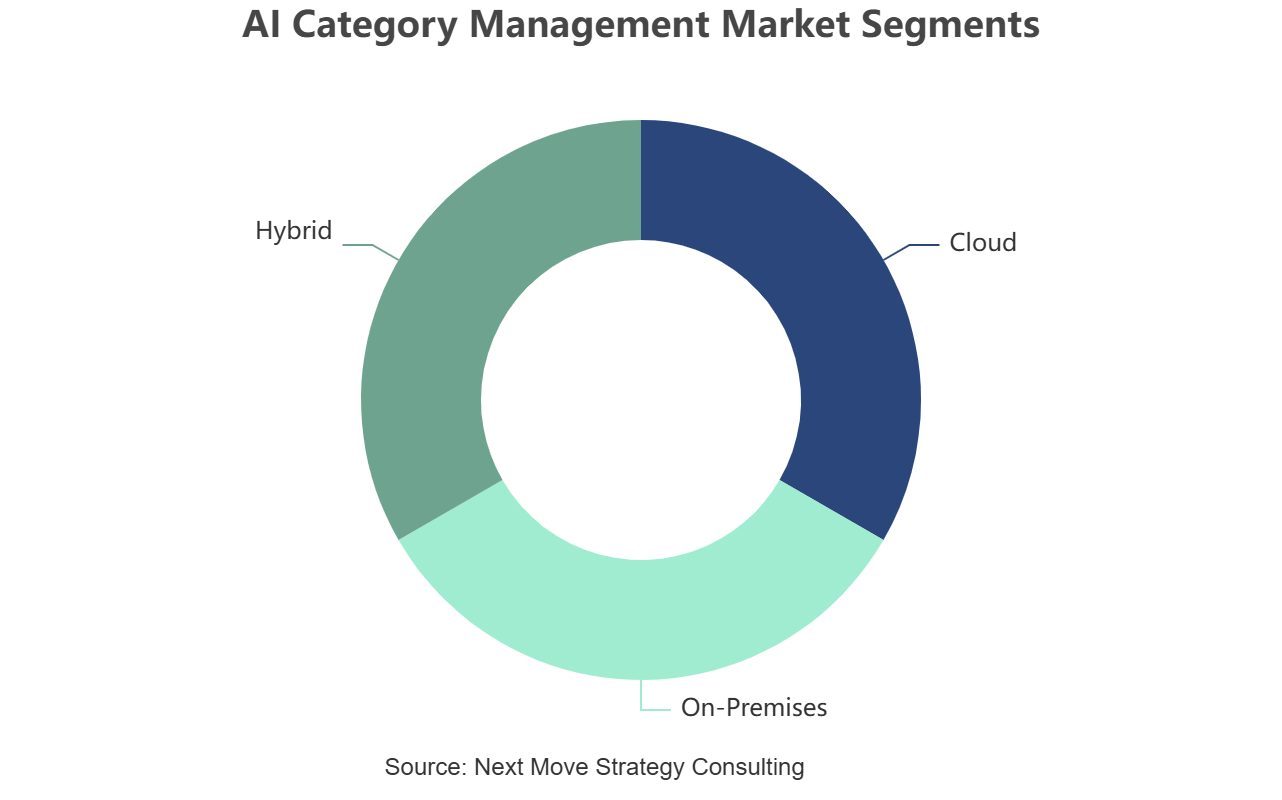
About the Author
 Mayurima Roy
— Mayurima Roy is Research Analyst at Next Move Strategy Consulting, where she has spent 4 years working across the firm's full industry coverage rather than a single fixed vertical. Her work centers on structured research, ongoing trend tracking, competitive assessment, and insight-led content development, translating complex market data into clear, decision-ready narratives that support informed client decision-making across diverse global industries, market sectors, and world regions every day.
Mayurima Roy
— Mayurima Roy is Research Analyst at Next Move Strategy Consulting, where she has spent 4 years working across the firm's full industry coverage rather than a single fixed vertical. Her work centers on structured research, ongoing trend tracking, competitive assessment, and insight-led content development, translating complex market data into clear, decision-ready narratives that support informed client decision-making across diverse global industries, market sectors, and world regions every day.
About the Reviewer
 Supradip Baul
— Supradip Baul is an accomplished business consultant and strategist with over a decade of rich experience in market intelligence, strategy, technology, and business transformation. His work has included rigorous qualitative and quantitative analysis across multiple industries, helping clients shape investment decisions and long-term roadmaps. Earlier in his career, he was associated with Gartner, where he contributed to industry-leading reports and market share analyses. He has worked with leading global companies and holds an MBA with a dual specialization in Marketing and Finance.
Supradip Baul
— Supradip Baul is an accomplished business consultant and strategist with over a decade of rich experience in market intelligence, strategy, technology, and business transformation. His work has included rigorous qualitative and quantitative analysis across multiple industries, helping clients shape investment decisions and long-term roadmaps. Earlier in his career, he was associated with Gartner, where he contributed to industry-leading reports and market share analyses. He has worked with leading global companies and holds an MBA with a dual specialization in Marketing and Finance.
At Next Move Strategy Consulting, we understand that insightful market research is the cornerstone of successful business decisions. That's why we employ a robust and multifaceted approach, combining various methodologies to deliver the most accurate and actionable data for our clients.

Research Landscape
We navigate the world of research with two primary approaches:
Qualitative Approach
Our qualitative research methodologies involve immersive techniques such as in-depth interviews, focus groups, and observational studies. By engaging directly with individuals and stakeholders, we uncover valuable insights that quantitative data alone may overlook.

Quantitative Research
In tandem with qualitative methodologies, NMSC leverages the power of Quantitative Research to provide a robust foundation of numerical insights. Through systematic data collection and analysis, we quantify patterns, preferences, and market trends, offering a comprehensive view of the business landscape.
Our quantitative research approach employs diverse tools, including surveys, experiments, and statistical modelling. These methodologies enable us to gather data from a large and representative sample, ensuring the statistical significance of our findings. By employing structured questionnaires and standardized data collection methods, we guarantee the reliability and validity of the information we present to our clients.
Quantitative research is particularly effective in measuring the prevalence of trends, assessing market size, and gauging the impact of various factors on consumer behavior. The numerical precision attained through this approach equips our clients with actionable insights, facilitating data-driven decision-making and strategy formulation.


Our Specialized Toolbox for Industry-Specific Market Research
We deploy a specialized arsenal of techniques tailored to meet your unique requirements. Here's a glimpse into our comprehensive toolbox:

Information Procurement
The stage entails acquiring market data or relevant information through various sources and methodologies.


Market Research Approach
We utilize both top-down and bottom-up approaches in market research analysis to achieve a comprehensive understanding of the market dynamics, leveraging the broad perspective of industry trends and macroeconomic factors alongside detailed insights from specific segments and individual companies.

Porters Five Forces Analysis
We conduct Porter's Five Forces analysis to evaluate the competitive landscape of an industry, providing us with insights into factors that affect profitability and strategic positioning.

SWOT Analysis

Forecasting
We utilize a forecasting model to predict future consumption by considering parameters like population, economics, regulations, market competition, drivers, constraints, technology, and pricing. We also employ statistical techniques such as multilinear regression, exponential smoothing, moving average, ARIMA, and Monte Carlo simulations for accurate predictions. In econometric forecasting, we analyzed short-term and long-term event impacts, attributing values based on regulatory frameworks, economic factors, and market events.





 Speak to Our Analyst