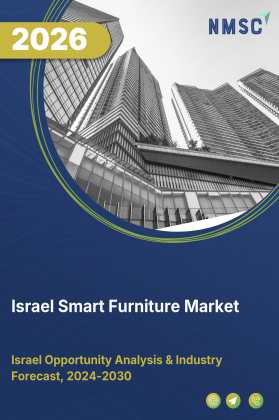
Israel Smart Furniture Market By Product Type (Smart Tables & Desks, Smart Stools & Benches, Smart Chairs and Smart Bed), By Distribution Channel [B2C/Retail (Big‑box/Home Centres, Specialty Furniture Stores and E‑commerce), and Contract (B2B Projects & Fit‑Outs)], and By End-User (Residential, and Commercial) – Opportunity Analysis & Forecast, 2025–2030
Industry: ICT & Media | Latest Edition: June 1, 2026 | No of Pages: 101 | No. of Tables: 71 | No. of Figures: 36 | Format: PDF | Report Code: IC1159
Industry Outlook
The Israel Smart Furniture Market size was valued at USD 8.58 million in 2024 and is expected to reach USD 10.3 million by 2025. Furthermore, the market is projected to reach USD 21.38 million by 2030, growing at a CAGR of 15.73% from 2025 to 2030.
Israel’s smart furniture market is gaining momentum due to rising smart-home adoption, strong broadband and 5G coverage, and growing demand for ergonomic, multifunctional furniture suited to compact urban homes and hybrid work setups. Consumers seek furniture that works with local smart ecosystems, offers health and productivity benefits, and saves space without sacrificing design. High manufacturing costs, concerns about long-term software support, and data privacy are key restraints, but collaborations between furniture makers and electronics/platform providers create room for differentiated, service-driven offerings. These dynamics position Israel to expand its smart furniture footprint regionally as manufacturers introduce affordable, design-forward, connected products.
High Technology Adoption Drives the Israel Smart Furniture Market Growth
Israel’s strong culture of adopting advanced technologies is a key driver for the growth of the smart furniture market. The country has one of the highest household penetration rates of smart home devices, including smart speakers, IoT sensors, energy-efficient appliances, and connected home security systems. This digital integration creates favourable conditions for consumers to adopt smart furniture that enhances convenience, comfort, and space optimization. Tech-savvy consumers, especially in urban regions such as Tel Aviv and Haifa, are increasingly looking for furniture that incorporates wireless charging, automated adjustments, voice-control compatibility, health monitoring sensors, and smart lighting integration. In addition, the government’s support for digital transformation and the growing presence of smart homes in newly constructed residential projects further fuel market expansion. As consumers continue to prioritize efficiency, aesthetics, and connected living, the demand for smart furniture is expected to rise steadily, making technological readiness a major driving force for market growth.
Innovation-Friendly Market in Egypt Boosts the Israel Smart Furniture Market Demand
Israel’s ecosystem is globally recognized for its strong emphasis on innovation, driven by a well-established network of research institutions, startups, and tech incubators. This environment supports continuous experimentation and product development, including the integration of IoT, sensors, robotics, and AI into everyday furniture. Many startups collaborate with global furniture manufacturers, enabling the development of ergonomic smart desks, automated seating, and smart sleep systems that adapt to user behavior and health needs. The availability of venture capital funding further encourages local firms to innovate and launch new designs aimed at workplace wellness, elderly care, and compact urban living. Additionally, Israel’s rising trend of hybrid work and remote work encourages demand for smart office furniture that enhances productivity and posture management. The country’s innovation-driven culture therefore accelerates market growth, encourages technology integration into lifestyle products, and promotes continuous advancement in the smart furniture sector.
Limited Domestic Production Restraints the Market Growth
Despite strong technological capabilities, limited domestic furniture manufacturing capacity acts as a restraint for the smart furniture market in Israel. Most high-quality furniture and electronic components used in smart furniture solutions are imported from Europe, the United States, and Asian countries such as China and South Korea. This reliance on imports increases production costs, extends supply lead times, and makes final product pricing higher than conventional furniture alternatives. As a result, smart furniture often remains less accessible to price-sensitive consumers. Additionally, smaller local manufacturers may lack the expertise or capital required to integrate advanced IoT systems, automation, and embedded electronics into furniture designs. This leads to fewer domestic suppliers and limited product variety in the local market. Fluctuations in global logistics and currency exchange rates also create uncertainty in supply continuity. These challenges collectively constrain market scalability, consumer adoption, and the development of a fully self-sustaining local smart furniture manufacturing ecosystem.
Integration of AI and IoT Unlocks the New Opportunities for the Market Growth
The integration of Artificial Intelligence and IoT technologies is creating promising opportunities for the Israel smart furniture market. Smart furniture equipped with AI interpret user behaviors, comfort needs, and biometric indicators to deliver personalized ergonomic adjustments and improved energy efficiency. For example, height-adjustable smart desks automatically adapt to posture changes throughout the day, while intelligent beds track sleep patterns and adjust support or temperature for better rest. Israel’s advanced IoT infrastructure and widespread adoption of smart home systems support seamless connectivity between furniture and other household devices, enabling cohesive and automated home environments. This innovation aligns well with the country’s tech-driven lifestyle and preference for modern, compact, and efficient living solutions. As demand grows for convenience, personalization, and sustainability in home and office setups, companies that effectively combine AI and IoT into functional and aesthetically appealing furniture stand to benefit from increased market traction and competitive advantage.
Competitive Landscape
The Israel smart furniture industry comprises various market players, such as Steelcase, MillerKnoll, Haworth, Humanscale, Teknion, TEMPUR, HON (brand of HNI Corporation), La-Z-Boy, IKEA, and Kettal.
Israel Smart Furniture Market Key Segments
By Product Type
-
Smart Tables & Desks
-
Smart Stools & Benches
-
Smart Chairs
-
Smart Bed
By Distribution Channel
-
B2C/Retail
-
Big‑box/Home Centres
-
Specialty Furniture Stores
-
E‑commerce
-
-
Contract (B2B Projects & Fit‑Outs)
By End-User
-
Residential
-
Commercial
Key Players
-
MillerKnoll
-
Humanscale
-
Teknion
-
TEMPUR
-
HON (Brand of HNI Corporation)
-
La-Z-Boy
-
IKEA
-
Kettal
Report Scope and Segmentation
|
Parameters |
Details |
|
Market Size in 2025 |
USD 10.3 Million |
|
Revenue Forecast in 2030 |
USD 21.38 Million |
|
Growth Rate |
CAGR of 15.73% from 2025 to 2030 |
|
Analysis Period |
2024–2030 |
|
Base Year Considered |
2024 |
|
Forecast Period |
2025–2030 |
|
Market Size Estimation |
Million (USD) |
|
Growth Factors |
|
|
Companies Profiled |
10 |
|
Market Share |
Available for 10 companies |
|
Customization Scope |
Free customization (equivalent to up to 80 working hours of analysts) after purchase. Addition or alteration to country, regional, and segment scope. |
|
Pricing and Purchase Options |
Avail customized purchase options to meet your exact research needs. |


About the Author
 Mayurima Roy
— Mayurima Roy is Research Analyst at Next Move Strategy Consulting, where she has spent 4 years working across the firm's full industry coverage rather than a single fixed vertical. Her work centers on structured research, ongoing trend tracking, competitive assessment, and insight-led content development, translating complex market data into clear, decision-ready narratives that support informed client decision-making across diverse global industries, market sectors, and world regions every day.
Mayurima Roy
— Mayurima Roy is Research Analyst at Next Move Strategy Consulting, where she has spent 4 years working across the firm's full industry coverage rather than a single fixed vertical. Her work centers on structured research, ongoing trend tracking, competitive assessment, and insight-led content development, translating complex market data into clear, decision-ready narratives that support informed client decision-making across diverse global industries, market sectors, and world regions every day.
About the Reviewer
 Supradip Baul
— Supradip Baul is an accomplished business consultant and strategist with over a decade of rich experience in market intelligence, strategy, technology, and business transformation. His work has included rigorous qualitative and quantitative analysis across multiple industries, helping clients shape investment decisions and long-term roadmaps. Earlier in his career, he was associated with Gartner, where he contributed to industry-leading reports and market share analyses. He has worked with leading global companies and holds an MBA with a dual specialization in Marketing and Finance.
Supradip Baul
— Supradip Baul is an accomplished business consultant and strategist with over a decade of rich experience in market intelligence, strategy, technology, and business transformation. His work has included rigorous qualitative and quantitative analysis across multiple industries, helping clients shape investment decisions and long-term roadmaps. Earlier in his career, he was associated with Gartner, where he contributed to industry-leading reports and market share analyses. He has worked with leading global companies and holds an MBA with a dual specialization in Marketing and Finance.
At Next Move Strategy Consulting, we understand that insightful market research is the cornerstone of successful business decisions. That's why we employ a robust and multifaceted approach, combining various methodologies to deliver the most accurate and actionable data for our clients.

Research Landscape
We navigate the world of research with two primary approaches:
Qualitative Approach
Our qualitative research methodologies involve immersive techniques such as in-depth interviews, focus groups, and observational studies. By engaging directly with individuals and stakeholders, we uncover valuable insights that quantitative data alone may overlook.

Quantitative Research
In tandem with qualitative methodologies, NMSC leverages the power of Quantitative Research to provide a robust foundation of numerical insights. Through systematic data collection and analysis, we quantify patterns, preferences, and market trends, offering a comprehensive view of the business landscape.
Our quantitative research approach employs diverse tools, including surveys, experiments, and statistical modelling. These methodologies enable us to gather data from a large and representative sample, ensuring the statistical significance of our findings. By employing structured questionnaires and standardized data collection methods, we guarantee the reliability and validity of the information we present to our clients.
Quantitative research is particularly effective in measuring the prevalence of trends, assessing market size, and gauging the impact of various factors on consumer behavior. The numerical precision attained through this approach equips our clients with actionable insights, facilitating data-driven decision-making and strategy formulation.


Our Specialized Toolbox for Industry-Specific Market Research
We deploy a specialized arsenal of techniques tailored to meet your unique requirements. Here's a glimpse into our comprehensive toolbox:

Information Procurement
The stage entails acquiring market data or relevant information through various sources and methodologies.


Market Research Approach
We utilize both top-down and bottom-up approaches in market research analysis to achieve a comprehensive understanding of the market dynamics, leveraging the broad perspective of industry trends and macroeconomic factors alongside detailed insights from specific segments and individual companies.

Porters Five Forces Analysis
We conduct Porter's Five Forces analysis to evaluate the competitive landscape of an industry, providing us with insights into factors that affect profitability and strategic positioning.

SWOT Analysis

Forecasting
We utilize a forecasting model to predict future consumption by considering parameters like population, economics, regulations, market competition, drivers, constraints, technology, and pricing. We also employ statistical techniques such as multilinear regression, exponential smoothing, moving average, ARIMA, and Monte Carlo simulations for accurate predictions. In econometric forecasting, we analyzed short-term and long-term event impacts, attributing values based on regulatory frameworks, economic factors, and market events.





 Speak to Our Analyst