Smart Furniture Market Size, Growth & Forecast by Product Type (Seating, Desks and Tables, Sleep Furniture, Storage and Casegoods, Modular and Architectural Systems), Technology (Motorized Adjustment, Connectivity and App Control, Health and Environmental Sensors, Integrated Power and Charging, Climate Control and Wellness), End User (Residential, Commercial Office, Education, Hospitality, Healthcare, Retail and Public Spaces), Distribution Channel, and Revenue Stream — Global Analysis 2025–2035
Industry: Retail and Consumer | Latest Edition: October 16, 2026 | No of Pages: 459 | No. of Tables: 486 | No. of Figures: 480 | Format: PDF | Report Code: RC478
What Is the Smart Furniture Market Size?
The global Smart Furniture Market was valued at USD 4.2 billion in 2025 and is expected to reach USD 4.6 billion in 2026. Rising adoption of IoT-enabled workspace solutions, growing consumer demand for health-optimized sleep products, and accelerating digitization of commercial interiors are projected to propel the market to USD 10.8 billion by 2035, advancing at a CAGR of 9.9% from 2026 to 2035. Key growth catalysts include the proliferation of hybrid work environments requiring motorized height-adjustable desks, expanding smart home ecosystems integrating connected sleep furniture, growing healthcare sector procurement of sensor-equipped beds and seating, and enterprise investment in occupancy-aware workspace management systems.
|
Parameters |
Details |
|
Market Size in 2025 |
USD 4.2 Billion |
|
Market Size in 2026 |
USD 4.6 Billion |
|
Revenue Forecast in 2035 |
USD 10.8 Billion |
|
Growth Rate |
CAGR of 9.9% from 2026 to 2035 |
|
Analysis Period |
2025–2035 |
|
Base Year Considered |
2025 |
|
Forecast Period |
2026–2035 |
|
Market Size Estimation |
USD Billion |
|
Companies Profiled |
20 |
|
Countries Covered |
33 |
|
Market Share |
Top 10 |
Smart Furniture Market Overview
What Is the Smart Furniture Market?
The Smart Furniture Market encompasses furniture products embedded with sensors, actuators, wireless connectivity, and software platforms that enable remote monitoring, automated adjustment, environmental sensing, and usage analytics. Spanning residential, commercial office, healthcare, hospitality, and education end markets, the market integrates motorized actuation, IoT data collection, app-based control, and health-monitoring capabilities into conventional furniture form factors including desks, chairs, beds, storage units, and modular architectural systems.
How Has the Smart Furniture Market Evolved?
The Smart Furniture Market has evolved through three distinct development phases. The first phase featured electronically adjustable components, primarily powered sit-stand desks and hospital beds with manual remote controls. The second phase introduced Bluetooth and Wi-Fi connectivity enabling app-based control and basic usage analytics. NMSC's analysis indicates that the current phase centers on AI-integrated furniture ecosystems, combining biometric sensors, machine learning-based posture coaching, predictive maintenance, and seamless integration with smart building management systems and workplace experience platforms across commercial environments.
How Do Regulations Influence the Smart Furniture Market?
Regulatory developments are reshaping the Smart Furniture Market across multiple dimensions. Ergonomics directives such as the EU's Workplace Directive 90/270/EEC mandate employer investment in adjustable workstation equipment, directly stimulating height-adjustable desk procurement. Medical device regulations including the FDA's 21 CFR Part 880 classification of electronically adjustable hospital beds require manufacturer compliance with safety and interoperability standards. Energy efficiency standards, including the EU Ecodesign Regulation for electronically controlled products, are compelling smart furniture manufacturers to optimize power consumption and lifecycle performance across all connected product categories.
How Is Technology Adoption Expanding Across the Smart Furniture Market?
Technology adoption across the Smart Furniture Market is accelerating as enterprise workplace designers, residential developers, and healthcare facility managers integrate connectivity as a standard specification requirement. Our findings suggest that the convergence of IoT platforms, edge computing, and cloud-based analytics is lowering the deployment cost of sensor-rich furniture solutions. Subscription-based software services for workplace utilization analytics, sleep health monitoring, and predictive maintenance are extending the revenue lifecycle of smart furniture deployments beyond initial hardware sales, supporting recurring revenue models across both commercial and residential segments.
|
Key Takeaways |
|
By product type, Desks and Tables held the largest share of the Smart Furniture Market at USD 1.5 billion in 2025, led by height-adjustable desk adoption across commercial offices globally. The Sleep Furniture segment is the fastest-growing product category, projected to expand from USD 0.7 billion in 2025 to USD 2.1 billion by 2035 at a CAGR of 11.6%, fueled by consumer and healthcare demand for smart beds with biometric monitoring and automated adjustment capabilities. |
|
By technology, Motorized Adjustment commanded the largest share at USD 1.8 billion in 2025, representing approximately 43% of total smart furniture market revenue. Connectivity and App Control is the fastest-growing technology sub-segment at a CAGR of 12.4% from 2026 to 2035, driven by integration with smart building platforms, workplace experience applications, and consumer wellness ecosystems. |
|
By end user, the Commercial Office segment accounted for USD 1.6 billion in 2025, the largest revenue share of the Smart Furniture Market. The Healthcare segment is the fastest-growing end user at a CAGR of 11.1% from 2026 to 2035, as hospital networks modernize patient care environments with sensor-equipped smart beds and pressure-monitoring healthcare seating. |
|
By distribution channel, Dealer and Contract Sales held the largest revenue share at USD 1.4 billion in 2025, reflecting enterprise and institutional procurement patterns. Direct to Consumer Online is the fastest-growing distribution channel in the Smart Furniture Market at a CAGR of 13.0% from 2026 to 2035, driven by consumer e-commerce adoption of smart sleep and home office furniture. |
|
By revenue stream, Product Sales led at USD 3.3 billion in 2025. Subscription and Software Services is the fastest-growing revenue stream in the Smart Furniture Market at a CAGR of 18.4% from 2026 to 2035, as manufacturers monetize workplace analytics dashboards, sleep coaching applications, and remote maintenance platforms beyond the initial hardware transaction. |
|
North America held the largest regional share at USD 1.7 billion in 2025, projected to reach USD 4.1 billion by 2035 at a CAGR of 9.2%, anchored by enterprise ergonomics investment, the largest installed base of height-adjustable desks, and advanced smart home consumer adoption across the U.S. market. |
|
Asia-Pacific is the fastest-growing major region in the Smart Furniture Market at a CAGR of 12.8%, advancing from USD 0.8 billion in 2025 to an estimated USD 2.7 billion by 2035, driven by rapid commercial real estate modernization in China, India's growing premium furniture market, and Japan's advanced healthcare furniture adoption. |
|
The United States is the single largest country market in the Smart Furniture Market share, representing over 75% of North American revenue in 2025, underpinned by the world's highest concentration of smart furniture platform vendors, the most mature ergonomics investment culture among enterprise employers, and deep consumer penetration of smart home ecosystems. |
|
China is the fastest-growing national market in Asia-Pacific within the Smart Furniture Market at a CAGR of 14.2%, propelled by government smart city initiatives, rapid commercial office space expansion in tier-1 cities, and a rapidly growing domestic manufacturing base for connected furniture components. |
Key Emerging Trends in the Smart Furniture Market
How Is the Integration of AI-Powered Posture and Wellness Coaching Transforming the Smart Furniture Market?
AI-powered wellness integration is fundamentally repositioning the Smart Furniture Market from hardware sales to health management platforms. Our analysis shows that companies such as Humanscale and Herman Miller are embedding biometric sensing into task chairs and desks to provide real-time posture feedback, movement reminders, and ergonomic score tracking through companion mobile applications. This transformation is shifting buyer conversations from unit pricing toward total cost of employee wellness, expanding adoption among large enterprise employers and healthcare institutions that quantify musculoskeletal injury reduction as a measurable return on investment for smart furniture procurement programs.
How Is the Rise of Hybrid Work Environments Reshaping Demand Patterns in the Smart Furniture Market?
The structural transition to hybrid work models has become one of the most consequential demand drivers reshaping the Smart Furniture Market. From our research, we found that enterprise real estate teams are redesigning commercial office floors around activity-based working principles that require furniture with embedded occupancy sensors and flexible motorized reconfiguration. Height-adjustable desks with desk booking integration, acoustic office pods, and sensor-enabled collaboration seating allow facilities managers to optimize space utilization data in real time. Steelcase and MillerKnoll have both launched workspace management software platforms that derive analytics from connected furniture deployments across corporate campuses.
What Role Is Smart Sleep Technology Playing in the Evolution of the Smart Furniture Market?
Smart sleep furniture represents one of the fastest-growing and most commercially differentiated segments within the Smart Furniture Market. Our assessment indicates that Sleep Number Corporation's Sleep IQ platform and Eight Sleep's Pod smart mattress have demonstrated the commercial viability of subscription-based sleep health monitoring that integrates biometric data collection, automated temperature regulation, and personalized sleep coaching algorithms. The convergence of cardiovascular health monitoring, sleep apnea screening indicators, and smart home ecosystem compatibility is expanding smart sleep furniture from premium consumer gadgetry to a recognized component of preventive healthcare infrastructure across residential and hospitality markets.
How Is Modular and Space-Transforming Architecture Emerging as a Growth Frontier in the Smart Furniture Market?
Transformable and modular architectural furniture systems are emerging as a structurally distinct and high-growth segment within the Smart Furniture Market. Through NMSC's assessment, we found that real estate pressures in high-density urban environments across Asia-Pacific and Europe are driving demand for motorized wall units, fold-down beds, convertible workspace modules, and sensor-integrated acoustic pods that maximize per-square-meter utility in micro-apartments, co-working spaces, and hospitality environments. Companies such as Hi-Interiors and Ori Living are pioneering robotic furniture systems controlled via smartphone applications and voice assistants that can transform a single room into multiple functional configurations within seconds.
What Are the Key Market Drivers, Breakthroughs, and Investment Opportunities that Will Shape the Smart Furniture Market Industry in the Next Decade?
|
Drivers / Trends / Restraints |
(+/-) % Impact on CAGR Forecast |
Geographic Relevance |
Impact Timeline |
|
Hybrid Work and Ergonomics Investment |
+1.8% |
Global (led by North America, Europe) |
2025–2030 |
|
Smart Sleep Ecosystem Adoption |
+1.4% |
North America, Europe, APAC |
2025–2035 |
|
Healthcare Modernization and Smart Beds |
+1.2% |
North America, Europe, APAC |
2025–2032 |
|
IoT and Smart Building Integration |
+1.0% |
Global |
2026–2035 |
|
Subscription Software Revenue Expansion |
+0.9% |
North America, Europe |
2026–2035 |
|
Robotic and Modular Furniture Adoption |
+0.8% |
APAC, Europe, Middle East |
2027–2035 |
|
High Unit Price and Affordability Barrier |
-1.1% |
APAC, LATAM, MEA |
Ongoing |
|
Complex IoT Integration and Interoperability |
-0.7% |
All regions |
Ongoing |
|
Data Privacy Concerns in Biometric Furniture |
-0.5% |
Europe, North America |
2025–2030 |
|
AI-Native Workspace Experience Platforms |
+1.3% |
Global |
2026–2035 |
What Are the Growth Drivers of the Smart Furniture Market Trends?
How Is the Global Expansion of Hybrid and Remote Work Models Driving the Smart Furniture Market Growth?
The structural shift toward hybrid work models across enterprise organizations is the most direct demand driver for the Smart Furniture Market, particularly for height-adjustable desks, connected task chairs, and occupancy-sensing workspace systems. Based on our engagements with enterprise workplace strategy professionals, we observed that organizations are reconfiguring commercial office environments to support activity-based working, requiring motorized and sensor-embedded furniture that tracks utilization patterns. The U.S. Bureau of Labor Statistics reports that telework-capable roles now represent a substantial share of the professional workforce, creating simultaneous demand for home office smart furniture investment by individuals and employers through equipment stipend programs.
How Is the Growth of Healthcare Infrastructure Fueling the Smart Furniture Market Demand?
Global healthcare infrastructure expansion is generating sustained institutional demand for sensor-equipped smart beds, pressure-monitoring healthcare seating, and electronically adjustable clinical furniture in hospital wards, rehabilitation centers, and long-term care facilities. Our findings suggest that the World Health Organization's Universal Health Coverage initiative and national healthcare infrastructure investment programs across North America, Europe, and Asia-Pacific are directing capital toward patient care environment modernization. Stryker Corporation, LINET Group, and Arjo AB report growing revenue from IoT-enabled hospital bed systems that monitor patient vital signs, automate repositioning alerts, and integrate with electronic health record platforms to improve care delivery outcomes.
How Is the Proliferation of Smart Home and IoT Ecosystems Expanding the Smart Furniture Market?
The widespread adoption of smart home platforms including Amazon Alexa, Google Home, and Apple HomeKit is creating an enabling ecosystem that significantly lowers the integration barrier for connected smart furniture products in residential environments. Through our market assessment, we observed that sleep furniture brands including Eight Sleep and Sleep Number have reported growing platform integrations with wearable health devices, smart thermostats, and circadian lighting systems that create holistic health management environments. The Consumer Technology Association's IoT standards initiatives are promoting interoperability frameworks that facilitate faster consumer adoption of connected furniture as part of broader smart home ecosystems.
What Are the Growth Inhibitors of the Smart Furniture Market?
How Does the High Unit Cost of Smart Furniture Constrain Broader Market Adoption?
Premium pricing remains the most significant adoption barrier limiting the Smart Furniture Market's penetration across small-to-medium enterprises, individual consumers, and price-sensitive emerging market buyers. Based on our analysis, entry-level smart height-adjustable desks from branded vendors are priced at two to three times the cost of equivalent conventional desks, while smart bed systems with biometric monitoring capabilities command substantial price premiums over standard mattress and bed frame combinations. The U.S. Bureau of Economic Analysis purchasing power data indicates that durable goods price sensitivity is heightened during economic uncertainty, constraining demand cycles for premium furniture categories with long replacement intervals across key consumer segments.
How Do IoT Integration Complexity and Interoperability Challenges Restrain the Smart Furniture Market?
The absence of universal IoT interoperability standards across smart furniture platforms creates friction in enterprise procurement and deployment, representing a structural growth constraint for the Smart Furniture Market. Our assessment indicates that facility managers report significant operational challenges when integrating furniture from multiple vendors into unified building management systems, as proprietary APIs, inconsistent data formats, and competing wireless protocols create compatibility barriers. The National Institute of Standards and Technology's IoT cybersecurity framework highlights that IoT device heterogeneity substantially increases security management complexity, discouraging large-scale enterprise deployment of multi-vendor smart furniture ecosystems without substantial IT integration investment.
What Are the Growth Opportunities in the Smart Furniture Market?
How Does the Expansion of Subscription-Based Software Services Create a Multi-Billion Dollar Revenue Opportunity in the Smart Furniture Market?
Subscription software services represent the highest-margin and fastest-growing revenue opportunity within the Smart Furniture Market, transforming one-time hardware transactions into recurring revenue relationships. Based on NMSC's research, we found that manufacturers including Sleep Number, Eight Sleep, and Steelcase are deploying SaaS analytics platforms that provide ongoing value through sleep health coaching, workspace utilization dashboards, and predictive maintenance alerts. The U.S. Small Business Administration's digital transformation guidelines highlight subscription technology investment as a priority for productivity improvement, reinforcing enterprise willingness to commit to ongoing software service fees alongside initial smart furniture hardware procurement decisions.
How Does Emerging Market Urbanization and Premium Real Estate Development Present a Strategic Opportunity for the Smart Furniture Market?
Rapid urban development and premium real estate construction across Asia-Pacific, the Middle East, and Latin America are generating structural opportunities for smart furniture adoption in newly built commercial towers, luxury residential developments, and premium hospitality properties. Through our market evaluation, we noticed that government-led smart city programs including Saudi Arabia's NEOM project, India's Smart Cities Mission, and Singapore's Smart Nation initiative are specifying connected infrastructure across new urban developments that includes IoT-capable furniture in public and institutional buildings. These developments represent high-volume, specification-driven procurement channels for smart furniture vendors with the scale and certification credentials to serve institutional construction programs.
How Is the Healthcare and Wellness Industry's Digital Transformation Creating Structural Demand Across the Smart Furniture Market?
The digital transformation of healthcare delivery systems and the broader preventive wellness industry is creating durable institutional demand for sensor-rich smart furniture that monitors patient biometrics, prevents pressure injuries, and automates repositioning protocols in clinical environments. Our analysis shows that the Centers for Medicare and Medicaid Services (CMS) value-based care reimbursement model in the United States financially incentivizes hospitals to reduce hospital-acquired conditions including pressure ulcers, creating measurable ROI for investments in smart pressure-monitoring mattresses and electronically adjustable clinical beds from vendors such as Stryker, LINET, and Paramount Bed Holdings.
How Is the Smart Furniture Market Segmented in This Report, and What Are the Key Insights from the Segmentation Analysis?
Which Product Type Segments Are Driving the Highest Revenue in the Smart Furniture Market?
|
Product Type Segment |
2025 (USD Bn) |
2035 (USD Bn) |
CAGR (%) |
|
Seating |
0.82 |
1.94 |
9.0% |
|
Desks and Tables |
1.50 |
3.62 |
9.2% |
|
Sleep Furniture |
0.70 |
2.10 |
11.6% |
|
Storage and Casegoods |
0.38 |
0.82 |
8.0% |
|
Modular and Architectural Systems |
0.52 |
1.62 |
12.0% |
|
Other Smart Furniture |
0.28 |
0.70 |
9.6% |
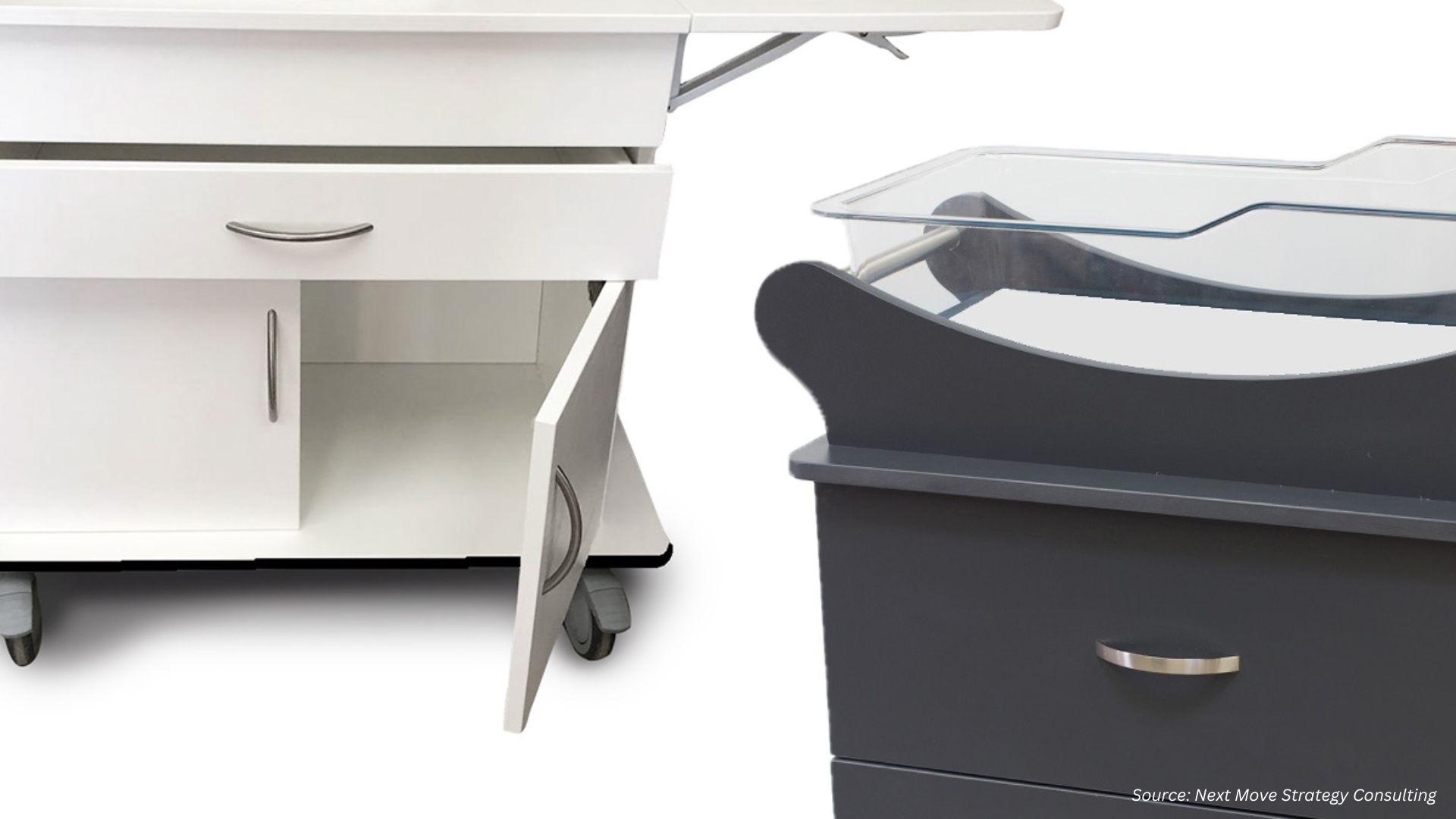
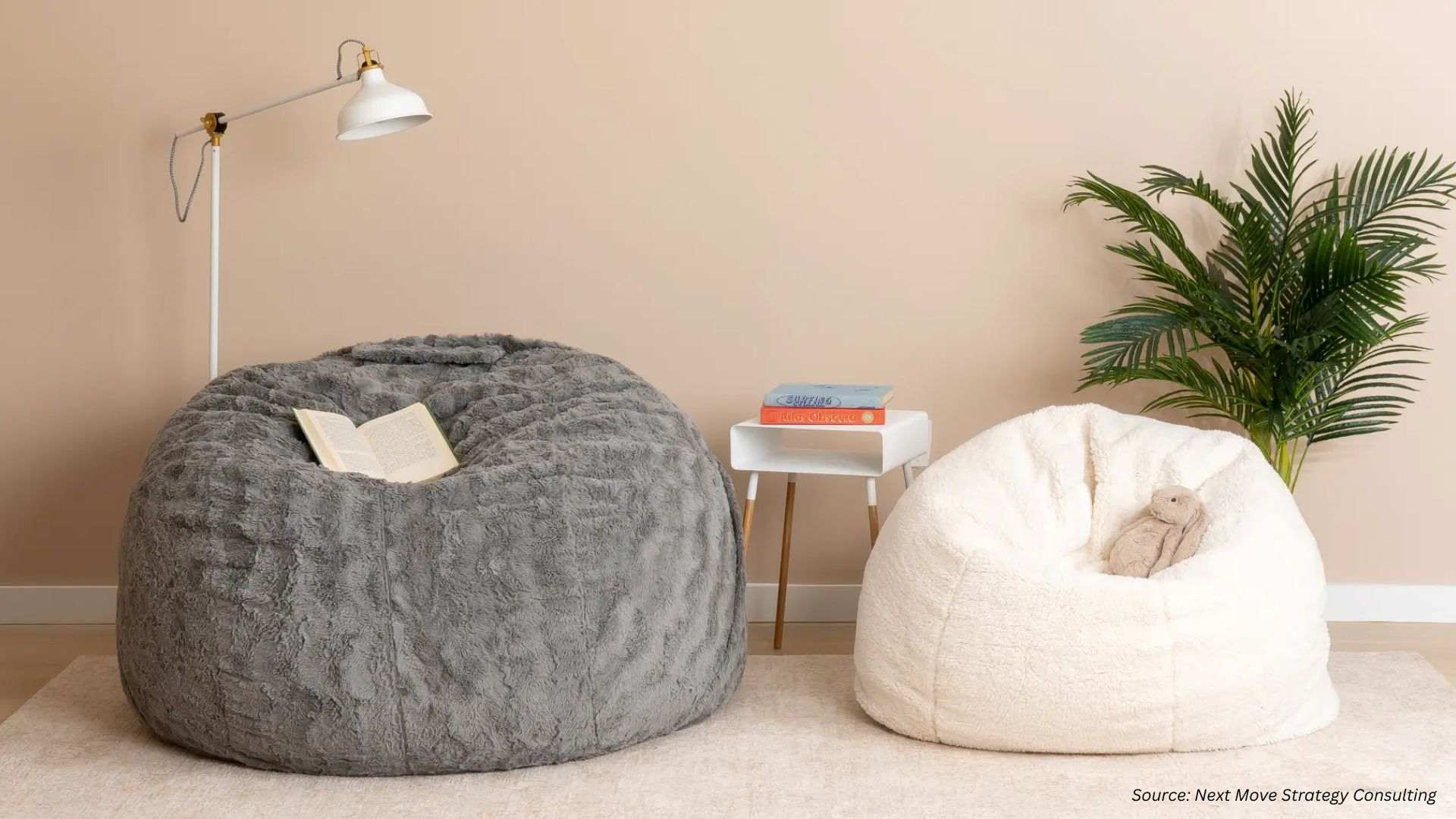
From our research, we found that the Smart Furniture Market by product type spans Seating, Desks and Tables, Sleep Furniture, Storage and Casegoods, Modular and Architectural Systems, and Other Smart Furniture. The Desks and Tables segment dominates with USD 1.50 billion in 2025, driven by enterprise-scale procurement of height-adjustable sit-stand desks with embedded activity trackers, conference tables with integrated power management, and smart work surfaces compatible with digital workplace platforms. Within this segment, Height Adjustable Desks represent the highest-revenue sub-category, supported by ergonomics mandates in North America and Europe. Seating follows with strong adoption of connected task chairs, healthcare seating, and smart lounge solutions. The Sleep Furniture segment is the fastest-growing product category, particularly driven by smart beds, adjustable bases, and biometric-monitoring mattresses from brands including Sleep Number and Eight Sleep. Modular and Architectural Systems such as office pods, room dividers, and transformable wall units are gaining momentum across co-working spaces and high-density urban residential developments.
How Does Technology Segmentation Reveal the Structural Composition of the Smart Furniture Market?
|
Technology Segment |
2025 (USD Bn) |
2035 (USD Bn) |
CAGR (%) |
|
Motorized Adjustment |
1.80 |
4.10 |
8.6% |
|
Connectivity and App Control |
0.72 |
2.48 |
13.2% |
|
Health and Environmental Sensors |
0.58 |
1.80 |
12.0% |
|
Integrated Power and Charging |
0.54 |
1.30 |
9.2% |
|
Climate Control and Wellness |
0.28 |
0.72 |
9.9% |
|
Other Technology |
0.28 |
0.40 |
3.6% |
Based on our market evaluation, we noticed that the Smart Furniture Market by technology encompasses Motorized Adjustment, Connectivity and App Control, Health and Environmental Sensors, Integrated Power and Charging, Climate Control and Wellness, and Other Technology. Motorized Adjustment remains the largest technology segment, generating USD 1.80 billion in 2025, as electronically controlled sit-stand mechanisms represent the most widely deployed smart furniture technology across commercial office and healthcare environments. Connectivity and App Control is the fastest-growing technology sub-segment, reflecting the strategic priority vendors are placing on software-enabled experiences, over-the-air updates, and integration with enterprise workplace management platforms. Health and Environmental Sensors are gaining substantial traction, particularly in smart beds monitoring heart rate, respiratory patterns, and sleep stages, as well as in clinical seating monitoring posture and pressure distribution.
Which End User Segments Are Generating the Most Value in the Smart Furniture Market?
|
End User Segment |
2025 (USD Bn) |
2035 (USD Bn) |
CAGR (%) |
|
Residential |
0.98 |
2.48 |
9.7% |
|
Commercial Office |
1.60 |
3.62 |
8.5% |
|
Education |
0.26 |
0.62 |
9.1% |
|
Hospitality |
0.38 |
0.98 |
9.9% |
|
Healthcare |
0.56 |
1.60 |
11.1% |
|
Retail and Public Spaces |
0.24 |
0.58 |
9.2% |
|
Other |
0.18 |
0.40 |
8.3% |
Through our analysis, we assessed that the Smart Furniture Market by end user spans Residential, Commercial Office, Education, Hospitality, Healthcare, Retail and Public Spaces, and Other verticals. The Commercial Office segment commands the largest revenue share at USD 1.60 billion in 2025, reflecting sustained enterprise investment in ergonomic and productivity-enhancing smart furniture systems. Occupancy-sensing desks and chairs with usage analytics integration are now standard specifications in corporate headquarters and campus developments across North America, Northern Europe, and APAC. The Healthcare segment is the fastest-growing end user at a CAGR of 11.1%, driven by global hospital modernization programs procuring electronically adjustable beds, smart mattresses, and pressure-monitoring systems. Residential adoption is accelerating meaningfully, led by smart home office investment and premium sleep furniture adoption.
How Are Distribution Channels Reshaping Go-to-Market Strategies in the Smart Furniture Market?
|
Distribution Channel |
2025 (USD Bn) |
2035 (USD Bn) |
CAGR (%) |
|
Direct to Consumer Online |
0.52 |
1.78 |
13.0% |
|
Brand Retail Stores |
0.62 |
1.42 |
8.6% |
|
Dealer and Contract Sales |
1.40 |
3.02 |
8.0% |
|
Third Party Retail |
0.68 |
1.48 |
8.1% |
|
Online Marketplaces |
0.56 |
1.74 |
12.0% |
|
OEM and Private Label |
0.42 |
1.36 |
12.5% |
Based on NMSC's research, we found that the Smart Furniture Market by distribution channel includes Direct to Consumer Online, Brand Retail Stores, Dealer and Contract Sales, Third Party Retail, Online Marketplaces, and OEM and Private Label channels. Dealer and Contract Sales dominates at USD 1.40 billion in 2025, reflecting the institutional nature of commercial office, healthcare, and education procurement where relationship-based selling and project specification support remain essential. Direct to Consumer Online is the fastest-growing channel at a CAGR of 13.0%, driven by consumer smart bed and home office furniture purchases facilitated by brands' direct e-commerce platforms with rich configurator and app demonstration capabilities. Online Marketplaces and OEM channels are also experiencing above-average growth as private label smart furniture components achieve distribution through major retail aggregators.
How Do Revenue Stream Segments Reflect the Commercial Evolution of the Smart Furniture Market?
|
Revenue Stream |
2025 (USD Bn) |
2035 (USD Bn) |
CAGR (%) |
|
Product Sales |
3.30 |
7.22 |
8.1% |
|
Subscription and Software Services |
0.28 |
1.58 |
18.8% |
|
Installation and Maintenance |
0.36 |
1.02 |
11.0% |
|
Spare Parts and Accessories |
0.22 |
0.68 |
12.0% |
|
Other Revenue |
0.04 |
0.30 |
22.4% |
Our analysis shows that the Smart Furniture Market by revenue stream encompasses Product Sales, Subscription and Software Services, Installation and Maintenance, Spare Parts and Accessories, and Other Revenue. Product Sales dominates at USD 3.30 billion in 2025, constituting approximately 79% of market revenue and reflecting the hardware-centric nature of the current smart furniture business model. However, Subscription and Software Services is the fastest-growing revenue stream at a CAGR of 18.8%, as manufacturers deploy recurring revenue platforms including sleep health subscriptions, workplace utilization analytics dashboards, remote diagnostic services, and predictive maintenance alert systems that extend the commercial relationship with enterprise and consumer buyers well beyond the initial product purchase.
Regional Outlook
Geographic Performance Snapshot
|
Region |
2025 (USD Bn) |
2035 (USD Bn) |
CAGR (%) |
Key Driver |
|
North America |
1.70 |
4.10 |
9.2% |
Enterprise ergonomics, smart home adoption |
|
Europe |
1.10 |
2.72 |
9.5% |
Workplace ergonomics mandates, healthcare modernization |
|
Asia-Pacific |
0.80 |
2.70 |
12.8% |
Commercial real estate growth, healthcare infrastructure |
|
Middle East & Africa |
0.32 |
0.76 |
9.1% |
Smart city projects, hospitality modernization |
|
Latin America |
0.28 |
0.52 |
6.4% |
Premium real estate, healthcare expansion |
North America Smart Furniture Market
North America is the largest region in the Smart Furniture Market, accounting for USD 1.70 billion in 2025 and forecast to reach USD 4.10 billion by 2035 at a CAGR of 9.2%. The region benefits from the highest enterprise ergonomics investment culture globally, with large technology and financial services employers specifying smart height-adjustable desks and connected seating as standard workplace equipment. Advanced smart home consumer adoption in the U.S. and Canada supports residential sleep furniture and connected home office furniture growth. OSHA ergonomics guidelines and state-level ergonomics programs continue to influence commercial furniture procurement across key enterprise segments.
U.S. Smart Furniture Market
Based on our engagements with North American enterprise real estate professionals, we found that the United States represents over 75% of the North American Smart Furniture Market and is the single largest national market globally, valued at approximately USD 1.28 billion in 2025. The U.S. hosts the headquarters of leading smart furniture manufacturers including Sleep Number, Eight Sleep, MillerKnoll, Steelcase, Humanscale, Ergotron, and ReST Performance. Federal ergonomics investment programs and employer wellness initiatives drive commercial adoption. The OSHA General Duty Clause has historically prompted large employers to invest in adjustable and sensor-enabled workstations to minimize workplace musculoskeletal disorder claims across office environments.
Canada Smart Furniture Market
Through our analysis, we assessed that Canada represents approximately 14% of North American Smart Furniture Market revenue in 2025. Canadian enterprises, particularly in financial services and technology, are active smart desk and connected seating buyers aligned with provincial occupational health and safety regulations mandating employer ergonomics investment. The federal government's Accessible Canada Act and workplace accessibility standards are also driving procurement of electronically adjustable furniture in public sector offices. Canada's advanced smart home adoption supports residential sleep furniture growth, particularly in major urban markets including Toronto, Vancouver, and Montreal across the consumer premium segment.
Mexico Smart Furniture Market
Based on our market evaluation, we noticed that Mexico is an emerging smart furniture market, representing approximately 10% of North American revenue in 2025. Growth is driven by the expansion of multinational corporate offices in Mexico City, Monterrey, and Guadalajara, which adopt global workspace standards including height-adjustable desks and connected meeting room furniture. Mexico's NOM-036 ergonomics standard provides regulatory context for ergonomic workstation investment. The growing hospitality and tourism sector, supported by major hotel brands expanding smart room installations, represents an additional demand driver for smart furniture in the Mexican market.
Europe Smart Furniture Market
Europe is the second-largest region in the Smart Furniture Market, contributing USD 1.10 billion in 2025 and forecast to reach USD 2.72 billion by 2035 at a CAGR of 9.5%. Europe's regulatory environment, including the EU Workplace Directive mandating ergonomic workstation adjustability for display screen equipment users, is one of the most consequential demand drivers for height-adjustable smart furniture. Advanced healthcare systems across Northern and Western Europe drive institutional procurement of smart hospital beds and clinical seating. Northern European countries demonstrate the highest per-capita penetration of smart furniture, supported by progressive ergonomics cultures and well-funded public healthcare infrastructure.
UK Smart Furniture Market
Based on our engagements, we found that the United Kingdom is Western Europe's largest individual Smart Furniture Market, representing approximately 20% of European revenue in 2025. Post-Brexit UK maintains Health and Safety Executive ergonomics regulations aligned with EU standards, supporting height-adjustable desk procurement in financial services, technology, and creative industry offices. London's position as a global financial hub drives premium office furniture investment. The National Health Service's ongoing hospital modernization programs are significant institutional buyers of smart clinical beds and patient handling systems from vendors including Arjo and LINET, supporting healthcare segment growth.
Germany Smart Furniture Market
According to our evaluation, Germany is the second-largest European market in the Smart Furniture Market landscape. Germany's world-class manufacturing sector and strong engineering heritage have made it both a leading consumer and producer of smart furniture components. BGHM ergonomics guidelines and DIN standards for adjustable office furniture are among Europe's most prescriptive, driving high adoption of motorized sit-stand desks in commercial environments. German healthcare infrastructure investment supports strong procurement of smart hospital beds. Companies including Bosch Smart Home have integration partnerships with furniture manufacturers creating connected home office ecosystem opportunities across the German residential market.
France Smart Furniture Market
Through our analysis, we noticed that France is the third-largest European Smart Furniture Market, distinguished by a strong public sector modernization agenda and growing premium residential smart furniture adoption. France's ANACT workplace well-being programs and employer obligations under the Code du Travail support ergonomics furniture investment in corporate settings. The French government's healthcare modernization investment plan is supporting procurement of smart clinical beds across public hospital networks. French luxury real estate developments increasingly specify connected furniture as premium lifestyle amenities, supporting residential smart sleep and home office furniture adoption in high-value property developments.
Italy Smart Furniture Market
Based on our assessment, Italy is a mid-tier Smart Furniture Market with growing adoption in commercial office, healthcare, and premium residential segments. Italy's leading furniture manufacturing industry, centered in the Brianza district, provides a strong industrial base for producing smart furniture components. The Italian National Recovery Plan directs investment toward healthcare digitalization that includes smart clinical equipment procurement. Workplace Legislative Decree 81/2008 mandates ergonomic workstation compliance that supports height-adjustable desk adoption in Italian commercial offices, particularly among multinational corporations and technology companies headquartered in Milan.
Spain Smart Furniture Market
Based on our evaluation, Spain demonstrates growing momentum in the Smart Furniture Market, driven by commercial real estate expansion in Madrid and Barcelona and growing enterprise awareness of workplace ergonomics compliance. Spain's Instituto Nacional de Seguridad y Salud en el Trabajo (INSST) provides ergonomics guidelines supporting smart workstation procurement. Spanish healthcare system investments, particularly under the Sistema Nacional de Salud modernization programs, represent institutional demand for smart clinical furniture. Spain's growing co-working and flexible office market is a notable driver for occupancy-sensing furniture and space management systems across commercial property operators.
Sweden Smart Furniture Market
Sweden is among the most advanced Smart Furniture Markets in Europe on a per-capita basis, supported by a highly ergonomics-conscious corporate culture, progressive public sector workplace standards, and significant healthcare furniture demand. Swedish furniture brand Kinnarps and global brands operate in a market where sit-stand desk adoption is among the highest globally. The Swedish Work Environment Authority mandates ergonomically adjustable workstations, creating institutional demand. Sweden's advanced healthcare system drives substantial smart bed procurement. Swedish smart home adoption supports residential connected sleep furniture growth, particularly in premium urban housing in Stockholm and Gothenburg.
Denmark Smart Furniture Market
Through our analysis, we evaluated that Denmark is among Europe's most mature Smart Furniture Markets, with one of the world's highest penetrations of height-adjustable desks in commercial offices. Danish workplace culture and the Danish Working Environment Authority's ergonomics mandates have established sit-stand desk usage as standard office practice. Denmark-based manufacturers including Linak, a global leader in electric linear actuator systems used in smart furniture, are strategically positioned within the European supply chain. Denmark's advanced healthcare system supports steady smart clinical furniture procurement, and the Danish smart home market supports residential connected sleep and home office furniture adoption.
Finland Smart Furniture Market
Finland's Smart Furniture Market is characterized by high ergonomics awareness, strong occupational health regulations under the Occupational Safety and Health Act, and advanced technology adoption across enterprise and healthcare segments. Finland's mature smart home ecosystem, led by Nokia's heritage and strong consumer technology adoption, supports integration of smart furniture within connected home environments. Finnish healthcare infrastructure investment supports smart hospital bed procurement from European vendors. The Finnish government's public sector digitalization programs include workplace modernization elements that drive smart workstation adoption in government offices and educational institutions.
Netherlands Smart Furniture Market
From our assessment, the Netherlands is a commercially significant Smart Furniture Market driven by its position as a European corporate hub, high ergonomics investment culture, and advanced healthcare system. Dutch Working Conditions Act (Arbowet) compliance requirements mandate ergonomic workstation provisions that stimulate smart desk procurement among Dutch employers. The Netherlands hosts European headquarters of major technology companies whose workplace design standards influence regional furniture specifications. Dutch healthcare system investments, including ongoing hospital modernization programs, support smart clinical furniture procurement. Amsterdam and Rotterdam are key commercial markets for premium smart workspace installations.
Rest of Europe Smart Furniture Market
The Rest of Europe, comprising Poland, Belgium, Switzerland, Austria, Portugal, Czech Republic, Sweden, and other nations beyond those covered individually, collectively represents a growing and commercially relevant portion of the European Smart Furniture Market. Poland and Czech Republic are emerging as smart furniture adoption leaders in Central and Eastern Europe, driven by expanding multinational corporate office development and growing ergonomics awareness. Switzerland's high-income consumer base and premium real estate market support luxury smart sleep furniture adoption. Belgian pharmaceutical and financial sector offices are active smart workstation buyers. Austria's healthcare system supports smart clinical furniture demand.
Asia-Pacific Smart Furniture Market
Asia-Pacific is the fastest-growing major region in the Smart Furniture Market, advancing from USD 0.80 billion in 2025 to an estimated USD 2.70 billion by 2035 at a CAGR of 12.8%. The region's growth is propelled by rapid commercial real estate development in China and India, Japan's advanced healthcare furniture market, South Korea's high-technology consumer electronics integration, and the expanding premium hospitality sector across Southeast Asia. Regulatory frameworks including Japan's Industrial Safety and Health Act and South Korea's Occupational Safety and Health Act are shaping enterprise smart furniture investment across the region.
China Smart Furniture Market
Based on our engagements, we found that China is the largest Smart Furniture Market in Asia-Pacific, valued at approximately USD 0.28 billion in 2025 and growing at a CAGR of 14.2%. China's massive commercial real estate development, smart city programs, and a rapidly expanding middle class with premium home furnishing aspirations are primary growth drivers. China's national standards for workplace ergonomics and ongoing healthcare infrastructure investment support institutional smart furniture procurement. Zhejiang Loctek Technology, headquartered in China, is a globally significant manufacturer of electric linear actuator desk systems, supplying smart desk components to international brands and domestic commercial markets.
India Smart Furniture Market
Through our analysis, we assessed that India is the fastest-growing emerging market for smart furniture in Asia-Pacific, driven by the rapid expansion of premium commercial office developments in Mumbai, Bengaluru, and Delhi NCR, where multinational technology companies specify global-standard ergonomic furniture. India's Smart Cities Mission, overseen by the Ministry of Housing and Urban Affairs, includes smart workspace specifications in newly developed urban infrastructure. The Indian government's healthcare expansion under Ayushman Bharat is directing hospital modernization investment that includes smart clinical bed procurement from domestic and international vendors serving Indian healthcare institutions.
Japan Smart Furniture Market
In our evaluation, Japan is the second-largest Asia-Pacific market for Smart Furniture, supported by a mature and high-specification commercial furniture sector, advanced healthcare infrastructure, and strong consumer technology adoption. Okamura Corporation and Kokuyo are prominent Japanese smart furniture manufacturers with significant domestic market share. Japan's Ministry of Health, Labour and Welfare ergonomics guidelines, and the nation's aging population driving healthcare-grade smart furniture adoption, represent key structural demand factors. Japanese smart home technology, led by Panasonic and Sharp, is facilitating connected residential furniture integration, particularly in the growing smart sleep and home wellness furniture segment.
South Korea Smart Furniture Market
From our assessment, South Korea demonstrates high smart furniture potential, supported by one of the world's highest broadband penetration rates, strong consumer electronics affinity, and a proactive smart manufacturing environment. South Korea's Industrial Safety and Health Act ergonomics provisions support commercial smart desk adoption. Samsung and LG's smart home platform ecosystems create integration opportunities for connected residential furniture. South Korean healthcare institutions, driven by Ministry of Health and Welfare modernization investments, are adopters of smart clinical beds and patient monitoring furniture systems from domestic and international vendors operating in the Korean market.
Taiwan Smart Furniture Market
Taiwan's Smart Furniture Market is concentrated in commercial office applications and a rapidly growing residential premium segment, supported by the island's high-technology manufacturing ecosystem and sophisticated consumer electronics adoption. Taiwan's Occupational Safety and Health Act provides regulatory context for ergonomic workstation procurement across commercial enterprises. The government's Asia Silicon Valley Development Agency initiative and smart city programs in Taipei and Taichung are driving adoption of connected workspace furniture in public and commercial buildings. Taiwan's semiconductor and electronics manufacturing clusters represent enterprise buyers of smart industrial workstation furniture with ergonomic monitoring capabilities.
Indonesia Smart Furniture Market
Indonesia is among the most rapidly growing smart furniture markets in Southeast Asia, driven by a large and young urban population, accelerating commercial real estate development in Jakarta and Surabaya, and a fast-growing hospitality sector. Government initiatives under Indonesia's National Long-Term Development Plan 2025–2045 include smart city and healthcare modernization investment. Indonesian healthcare expansion is generating institutional demand for smart clinical beds from international vendors. The growing co-working and flexible office sector in Jakarta is adopting occupancy-sensing furniture and smart workspace management systems aligned with regional office market modernization trends.
Vietnam Smart Furniture Market
Vietnam is an emerging smart furniture market in Southeast Asia, supported by accelerating digital economy development, expanding premium commercial real estate in Ho Chi Minh City and Hanoi, and government ambitions under the National Digital Transformation Program. Multinational companies expanding manufacturing and services operations in Vietnam are adopting global ergonomics standards that include smart workstation specifications. Vietnam's rapidly expanding healthcare infrastructure, supported by Ministry of Health modernization investments, represents early-stage institutional demand for smart clinical furniture. The growing hospitality and tourism sector is also contributing to smart room furniture specification in premium hotel developments.
Australia Smart Furniture Market
Based on our engagements, we found that Australia is the most mature smart furniture market in Asia-Pacific outside Northeast Asia, with strong adoption across commercial office, healthcare, and premium residential segments. Australia's Safe Work Act and model Work Health and Safety regulations include ergonomics provisions supporting smart workstation adoption among Australian employers. The Australian Government's My Health Record and digital health initiatives are driving healthcare facility modernization that includes smart clinical furniture procurement. Australia's advanced smart home adoption supports residential smart sleep furniture growth, particularly in premium property developments across Sydney, Melbourne, and Brisbane.
Philippines Smart Furniture Market
Based on our assessment, the Philippines is a developing but rapidly growing smart furniture market in Southeast Asia, supported by a large and expanding business process outsourcing industry that requires high-specification commercial furniture, growing digital banking sector investment, and government ICT modernization programs. Philippine Occupational Safety and Health Standards include ergonomics requirements that support adjustable workstation procurement in BPO and corporate office environments. Government programs including Ambisyon Natin 2040 digital economy investments are supporting healthcare infrastructure modernization that creates institutional demand for smart clinical furniture solutions.
Malaysia Smart Furniture Market
Malaysia is a mid-tier and growing smart furniture market in Southeast Asia, characterized by strong government-led digital transformation under the MyDigital strategy, a rapidly maturing commercial office sector in Kuala Lumpur, and growing smart hospitality investment. Malaysia's Occupational Safety and Health Act provisions support ergonomic workstation procurement in commercial enterprises. Major Malaysian banking institutions and technology companies are adopters of smart workspace furniture with usage analytics integration. Malaysia's medical tourism and healthcare expansion programs are generating demand for smart clinical beds and patient care furniture across new and modernized hospital facilities.
Rest of Asia-Pacific Smart Furniture Market
The Rest of Asia-Pacific, comprising Thailand, Singapore, Bangladesh, New Zealand, and other markets, collectively represents a growing share of the regional Smart Furniture Market. Singapore is a commercially disproportionate smart furniture hub, hosting regional headquarters of major furniture vendors and benefiting from Workplace Safety and Health Act ergonomics provisions and a premium office and hospitality market. Thailand's National Digital Economy and Society Plan is supporting smart office adoption. New Zealand's commercial furniture market aligns closely with Australian standards, supporting smart workspace adoption across Auckland and Wellington corporate environments.
Middle East and Africa Smart Furniture Market
The Middle East and Africa is a growing and strategically important region in the Smart Furniture Market, advancing from USD 0.32 billion in 2025 to USD 0.76 billion by 2035 at a CAGR of 9.1%. Vision-driven national transformation programs in Saudi Arabia and the UAE are the primary growth engines, supported by Israel's advanced technology sector, South Africa's financial services hub, and Nigeria's growing commercial real estate sector. Premium hospitality development and smart city infrastructure investment across the Gulf Cooperation Council are creating institutional demand for connected furniture in luxury hotels, smart offices, and healthcare facilities.
Saudi Arabia Smart Furniture Market
Based on our engagements, we found that Saudi Arabia is the largest smart furniture market in the Middle East and Africa, driven by Vision 2030's ambitious commercial real estate, smart city, and healthcare modernization programs. NEOM, the line city development, specifies connected infrastructure throughout, creating unprecedented demand for smart architectural furniture systems. Saudi healthcare expansion under the Vision 2030 health pillar is generating institutional procurement of smart clinical beds from international vendors establishing regional distribution presence. The Saudi Authority for Data and Artificial Intelligence (SDAIA) smart infrastructure programs are creating specification opportunities for IoT-enabled furniture in new government facilities and commercial developments.
UAE Smart Furniture Market
The UAE is the second-largest smart furniture market in MEA, powered by Dubai and Abu Dhabi's ambitions as global smart city and luxury hospitality hubs. The UAE National AI Strategy 2031 includes smart infrastructure specifications that encompass connected furniture in public and commercial buildings. Dubai's EXPO legacy developments and ongoing premium hospitality construction maintain strong demand for smart room furniture solutions. The Dubai Health Authority and Abu Dhabi Department of Health's healthcare modernization investments drive smart clinical furniture procurement. The UAE's concentration of luxury hotels from global brands creates a premium market for smart hospitality furniture with in-room connectivity and comfort automation capabilities.
Egypt Smart Furniture Market
Based on our assessment, Egypt is an emerging smart furniture market driven by a large population of over 100 million, a rapidly growing commercial real estate sector in Cairo and New Administrative Capital, and government Egypt Vision 2030 digital transformation investments. The development of Egypt's New Administrative Capital includes modern commercial office towers and healthcare facilities that specify contemporary ergonomic furniture. Egyptian public healthcare expansion through Ministry of Health investment programs is generating early-stage demand for smart clinical beds and patient care furniture. Premium hospitality development along the Red Sea coast represents an additional demand channel for smart room furniture.
Israel Smart Furniture Market
Through our analysis, we observed that Israel occupies a commercially significant position in the Smart Furniture Market, combining advanced enterprise technology adoption with a strong startup ecosystem that generates IoT-enabled furniture innovation. Israeli technology companies and a high density of R&D centers demand premium smart workspace furniture. Israel's Protection of Privacy Law and healthcare digitalization programs support smart clinical furniture procurement. Israeli startup activity in IoT sensors, AI health monitoring, and smart building technologies creates a technologically sophisticated buyer and innovation environment that contributes to above-average smart furniture adoption intensity relative to market size.
Turkey Smart Furniture Market
Through our evaluation, we assessed that Turkey is a mid-sized and growing smart furniture market within the MEA region, characterized by a dynamic commercial real estate sector, a large and expanding manufacturing industry, and government investments under the National Artificial Intelligence Strategy 2021–2025. Istanbul's rapidly expanding corporate office and premium residential real estate markets are key demand drivers for smart workspace and sleep furniture. Turkey's growing healthcare modernization program and the Ministry of Health's hospital investment plan are generating institutional demand for smart clinical furniture from international vendors with regional distribution capabilities in Turkish healthcare markets.
Nigeria Smart Furniture Market
Based on our assessment, Nigeria is Sub-Saharan Africa's most significant emerging smart furniture market, powered by Lagos's rapid commercial real estate expansion, a growing premium corporate office sector, and a fast-developing fintech and financial services industry. Nigerian banks, telecoms including MTN Nigeria and Airtel Africa, and technology companies in the Yaba technology district represent the primary enterprise buyers of smart commercial office furniture. The Nigeria Data Protection Act 2023 and growing corporate governance standards among Nigerian enterprises are elevating workplace environment investment, including ergonomic and connected furniture procurement in commercial office developments.
South Africa Smart Furniture Market
Based on our analysis, South Africa is the most mature and developed smart furniture market in Sub-Saharan Africa, driven by Johannesburg's status as the continent's financial capital, an established commercial real estate sector, and a well-developed banking and financial services industry. South African financial institutions including Standard Bank, FirstRand, and Nedbank are adopters of premium smart office furniture in their corporate headquarters. South Africa's National Health Insurance (NHI) implementation and public hospital modernization investments represent growing institutional demand for smart clinical furniture. The Occupational Health and Safety Act provides regulatory context for ergonomic workstation investment in South African commercial environments.
Rest of MEA Smart Furniture Market
The Rest of MEA, comprising Kuwait, Qatar, Bahrain, Oman, Jordan, Morocco, Kenya, and other markets, collectively represents a growing share of the regional Smart Furniture Market. GCC nations including Qatar and Kuwait are benefiting from national vision programs that specify smart infrastructure in commercial, healthcare, and hospitality developments. Morocco's growing commercial real estate sector and expanding technology park developments in Casablanca are early-stage smart office furniture markets. Kenya's growing fintech sector and Nairobi's expanding corporate office market represent East Africa's most commercially relevant smart furniture demand center.
Latin America Smart Furniture Market
Latin America is a developing but commercially relevant region in the Smart Furniture Market, contributing USD 0.28 billion in 2025 and forecast to reach USD 0.52 billion by 2035 at a CAGR of 6.4%. Brazil and Mexico represent the largest markets within the region, supported by growing premium commercial real estate, expanding multinational corporate office presence, and early-stage healthcare modernization investment. Latin America's smart furniture market is shaped by a dual-speed adoption dynamic where premium urban commercial and hospitality segments adopt smart furniture while price sensitivity limits broader mass-market consumer penetration.
Brazil Smart Furniture Market
Based on our market evaluation, we noticed that Brazil is the largest Smart Furniture Market in Latin America, driven by São Paulo's position as South America's leading financial and corporate hub, a large healthcare system undergoing modernization investment, and a growing premium residential real estate sector. Brazilian Regulatory Standard NR-17 on ergonomics mandates employer investment in adjustable workstations for occupational health compliance. São Paulo's expanding co-working and flexible office sector is a demand driver for occupancy-sensing furniture and smart workspace management systems. Brazilian healthcare procurement through Sistema Único de Saúde modernization is generating early institutional demand for smart clinical beds.
Argentina Smart Furniture Market
Through our analysis, we assessed that Argentina is a mid-tier smart furniture market within Latin America, characterized by a significant professional services sector in Buenos Aires and a growing technology startup ecosystem. Argentine occupational health regulations include ergonomics provisions that support smart workstation procurement in formal sector employers. Economic volatility historically constrains large-scale premium furniture investment cycles, but growing multinational corporate office investment and expanding hospitality sector modernization in Buenos Aires represent more stable demand segments. Argentina's National Artificial Intelligence Plan includes digital workplace modernization elements relevant to connected office furniture adoption.
Chile Smart Furniture Market
Based on our assessment, Chile is the most economically stable smart furniture market in South America, supported by Santiago's mature financial services sector, growing technology investment, and a healthcare system with consistent modernization funding. Chilean Occupational Safety Institute guidelines include ergonomics provisions supporting adjustable workstation investment. Santiago's premium commercial office and residential real estate market is an active buyer of smart workspace and home office furniture from international brands with Chilean distribution presence. Chile's private healthcare system includes well-funded hospital groups that are early adopters of smart clinical furniture from leading international vendors.
Colombia Smart Furniture Market
Based on our research, Colombia is an emerging smart furniture market driven by Bogotá's expanding corporate office sector, growing technology industry, and healthcare system modernization under the government's Pacto por Colombia investment programs. Colombian Ministerio del Trabajo occupational health guidelines support ergonomic workstation investment among formal sector employers. Bogotá's rapidly expanding co-working and technology park developments are early adopters of smart workspace furniture and occupancy analytics systems. The Colombian healthcare sector's ongoing hospital infrastructure investment is generating early-stage institutional demand for smart clinical beds from international vendors establishing Andean regional distribution.
Rest of Latin America Smart Furniture Market
The Rest of Latin America, comprising Peru, Ecuador, Uruguay, Venezuela, Central American nations, and Caribbean markets, collectively represents a nascent but growing portion of the Latin American Smart Furniture Market. Peru's growing Lima corporate office market and healthcare modernization programs represent early smart furniture demand. Uruguay's advanced digital economy and stable institutional environment support smart workplace furniture adoption among professional services firms. Central American markets, particularly Costa Rica's medical device and technology sector hub, are emerging demand points for smart clinical and workspace furniture in the broader Latin American smart furniture regional context.
Supply Chain Structure of the Smart Furniture Market
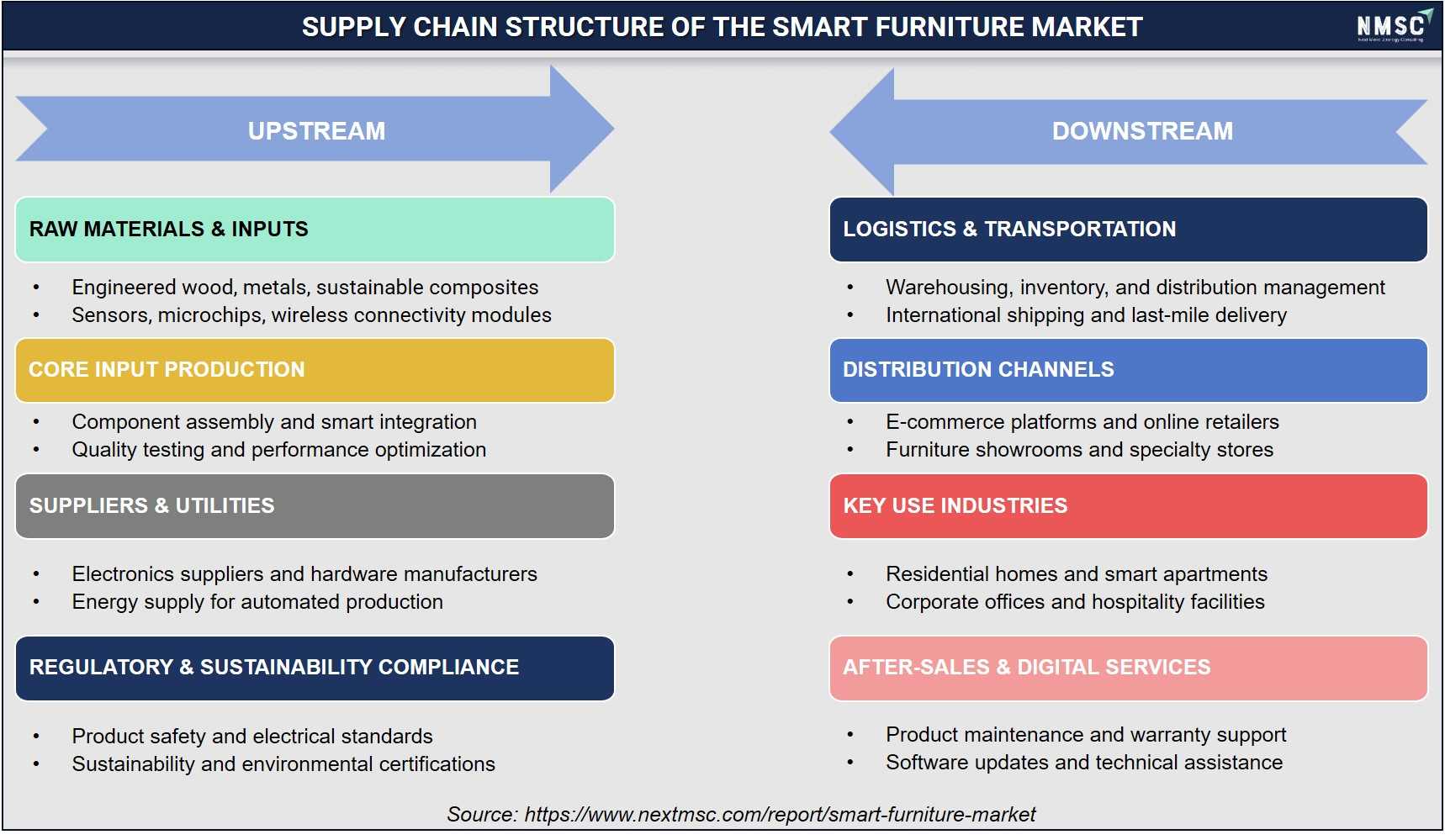
The Smart Furniture Market supply chain begins with raw material suppliers providing engineered wood, metals, sustainable composites, sensors, microchips, and connectivity modules. Manufacturers integrate these components through assembly, testing, and performance optimization processes. Electronics suppliers, hardware vendors, and utility providers support production activities. Downstream, logistics providers manage warehousing, transportation, and last-mile delivery, while e-commerce platforms, retailers, and specialty furniture stores facilitate market access. Key end users include residential households, smart apartments, corporate offices, and hospitality facilities. After-sales services such as maintenance, warranty support, software updates, and technical assistance enhance customer satisfaction and ensure long-term product performance, reliability, and customer retention.
Competitive Landscape
Competitive Dynamics and M&A Landscape
|
Key Takeaways |
Details |
|
Market Structure |
The Smart Furniture Market is moderately fragmented, with leading players including Sleep Number, MillerKnoll, Steelcase, Eight Sleep, and Stryker holding significant but not dominant market share. The market features distinct competitive clusters across sleep furniture, commercial office furniture, healthcare furniture, and modular architectural systems segments. |
|
Innovation Focus |
R&D investment is concentrated in biometric sensor integration, AI-powered wellness algorithms, IoT connectivity platform development, and materials innovation for sustainable smart furniture. Eight Sleep's thermal regulation technology and Sleep Number's Sleep IQ platform represent leading subscription software innovation examples. |
|
M&A Activity |
The Smart Furniture Market has seen targeted acquisition activity focused on sensor technology, software platform capabilities, and geographic expansion. MillerKnoll's 2021 merger combined Herman Miller and Knoll into a leading global commercial furniture platform, accelerating smart workspace product development and geographic market coverage. |
How Do Companies Compete in the Smart Furniture Market?
The Smart Furniture Market features a multi-dimensional competitive landscape where hardware performance, software platform sophistication, and channel relationships collectively determine competitive positioning. From our research, we found that market structure is characterized by distinct competitive clusters: established office furniture manufacturers such as Steelcase, MillerKnoll, and Haworth compete on integrated workspace management platform capabilities; sleep furniture specialists including Sleep Number and Eight Sleep compete on AI-powered sleep health subscription services and biometric monitoring precision; healthcare furniture specialists including Stryker, LINET, and Arjo compete on clinical safety certifications, hospital procurement relationships, and IoT integration with EHR platforms.
Which Kind of Companies Dominate the Smart Furniture Market?
The Smart Furniture Market is dominated by two primary categories of market participants. First, established global commercial furniture manufacturers including MillerKnoll, Steelcase, Haworth, Okamura, and Kokuyo leverage their scale, distribution networks, contract procurement relationships, and brand equity to extend existing product lines with smart technology integration. Second, technology-first smart furniture specialists including Sleep Number, Eight Sleep, Autonomous, Hi-Interiors, and ReST Performance are building vertically integrated hardware-software platforms that compete on sensor precision, AI algorithm sophistication, and subscription service value. Our assessment indicates that convergence between these two categories is accelerating as traditional furniture manufacturers acquire technology capabilities.
AI-Native Differentiation and Open Standards Drive Market Success in the Smart Furniture Market
NMSC's analysis indicates that companies achieving sustained competitive advantage in the Smart Furniture Market are those successfully combining AI-native product differentiation with open integration standards that facilitate adoption within enterprise smart building ecosystems. Vendors that embed proprietary AI wellness algorithms within furniture products while maintaining open API compatibility with major workplace experience platforms, including Microsoft Viva, Salesforce Workplace, and leading building management systems, are capturing premium enterprise contracts. The growing importance of sustainability certifications such as GREENGUARD and BIFMA level is also reshaping competitive differentiation, particularly among enterprise buyers with ESG procurement mandates.
Market Players to Opt for Merger and Acquisition Strategies to Expand Their Presence in the Smart Furniture Market
Our findings suggest that M&A activity within the Smart Furniture Market will intensify over the 2026 to 2035 forecast period as established furniture manufacturers seek to accelerate sensor technology acquisition, software platform capability expansion, and geographic market access. Traditional commercial furniture incumbents are likely targets for partnerships or acquisitions with workplace technology firms providing occupancy sensing, environmental monitoring, and AI coaching platforms. Healthcare furniture specialists are acquiring medical IoT and patient monitoring software companies to strengthen clinical integration value propositions. Strategic acquirers from the smart home and building automation sector may enter the furniture market through acquisitions of technology-first furniture platform companies.
Who Are the Key Market Players in the Smart Furniture Market?
-
Sleep Number Corporation
-
Eight Sleep, Inc.
-
MillerKnoll, Inc.
-
Haworth, Inc.
-
Okamura Corporation
-
Autonomous, Inc.
-
Zhejiang Loctek Technology Co., Ltd.
-
Stryker Corporation
-
Arjo AB
-
LINET Group SE
-
Paramount Bed Holdings Co., Ltd.
-
Steelcase Inc.
-
Humanscale Corporation
-
Ergotron, Inc.
-
Herman Miller
-
Actiu Berbegal y Formas S.A.
-
Kokuyo Co., Ltd.
-
Acerpure Inc.
-
Hi-Interiors Srl
-
ReST Performance LLC
What Are the Latest Developments in the Smart Furniture Market Industry?
|
Date |
Event |
|
March 2026 |
Eight Sleep secured USD 50 million in strategic funding at a USD 1.5 billion valuation to accelerate AI-driven sleep optimization, health monitoring capabilities, and international expansion. |
|
August 2025 |
Eight Sleep raised USD 100 million to expand AI-powered sleep technology, medical sleep applications, and global market penetration. |
What Are the Investment Opportunities in the Smart Furniture Market?
Capital Inflows and Strategic Investment Themes
The Smart Furniture Market is attracting capital across multiple investment horizons, from early-stage IoT sensor startups to growth equity investment in established smart sleep and commercial workspace furniture platforms. Our assessment indicates that the highest-conviction capital deployment themes include AI-powered sleep health platforms with subscription recurring revenue, commercial workspace analytics software companies that derive data from connected furniture deployments, and smart modular furniture system developers addressing the high-density urban residential market. The Subscription and Software Services revenue stream, forecast to grow at a CAGR of 18.8%, represents the most attractive capital return profile within the smart furniture ecosystem for technology-oriented investors.
Infrastructure and Manufacturing Investment
Manufacturing infrastructure investment opportunities in the Smart Furniture Market are concentrated in smart actuator system production capacity expansion, wireless sensing module integration facilities, and sustainable materials processing for IoT-compatible furniture components. Zhejiang Loctek Technology's ongoing production capacity expansion for electric linear actuators represents a category example of manufacturing infrastructure investment driven by global demand growth. Investors with exposure to industrial automation, semiconductor supply chains, and advanced materials are increasingly identifying smart furniture component manufacturing as a complementary investment theme within the broader IoT hardware manufacturing ecosystem across Asia-Pacific.
ESG Considerations and Sustainable Investment
ESG considerations are reshaping investment frameworks for the Smart Furniture Market as institutional investors and enterprise procurement teams apply sustainability screening to furniture supply chains and product lifecycle assessments. Smart furniture manufacturers with demonstrated circular economy programs, including take-back and refurbishment schemes for electronically adjustable components, are achieving preferential access to ESG-mandated procurement budgets. The EU's Ecodesign for Sustainable Products Regulation, which encompasses electronically controlled furniture products, is compelling manufacturers to provide lifecycle environmental impact data that directly influences investment and procurement decisions across European institutional buyer networks.
Digital Transformation Investment Themes
Digital transformation investment in the Smart Furniture Market centers on software platform development, AI algorithm enhancement, and data architecture for biometric health data governance. Companies building workplace experience platform integrations, sleep health data APIs, and predictive maintenance software layers on top of smart furniture hardware are attracting software-multiple valuations that significantly exceed traditional furniture hardware manufacturer multiples. Our findings suggest that investors evaluating digital transformation opportunities within the smart furniture space should prioritize companies with demonstrated subscription revenue traction, proprietary biometric data assets, and defensible AI model differentiation that cannot be easily replicated through component-level smart furniture hardware alone.
Private Equity and Venture Capital Activity
Private equity and venture capital activity in the Smart Furniture Market reflects investor conviction in the long-term secular growth thesis of connected human environments. Eight Sleep has raised over USD 150 million in venture funding from leading technology investors, demonstrating VC sector confidence in the premium sleep technology subscription model. Commercial workspace analytics companies integrated with smart furniture deployments are attracting growth equity investment from enterprise technology-focused funds. The National Venture Capital Association reports sustained interest in health technology hardware-software platforms, within which smart sleep and wellness furniture companies are positioned as a commercially adjacent investment opportunity driven by quantifiable consumer health impact outcomes.
Consumer Behavior Analysis of the Smart Furniture Market
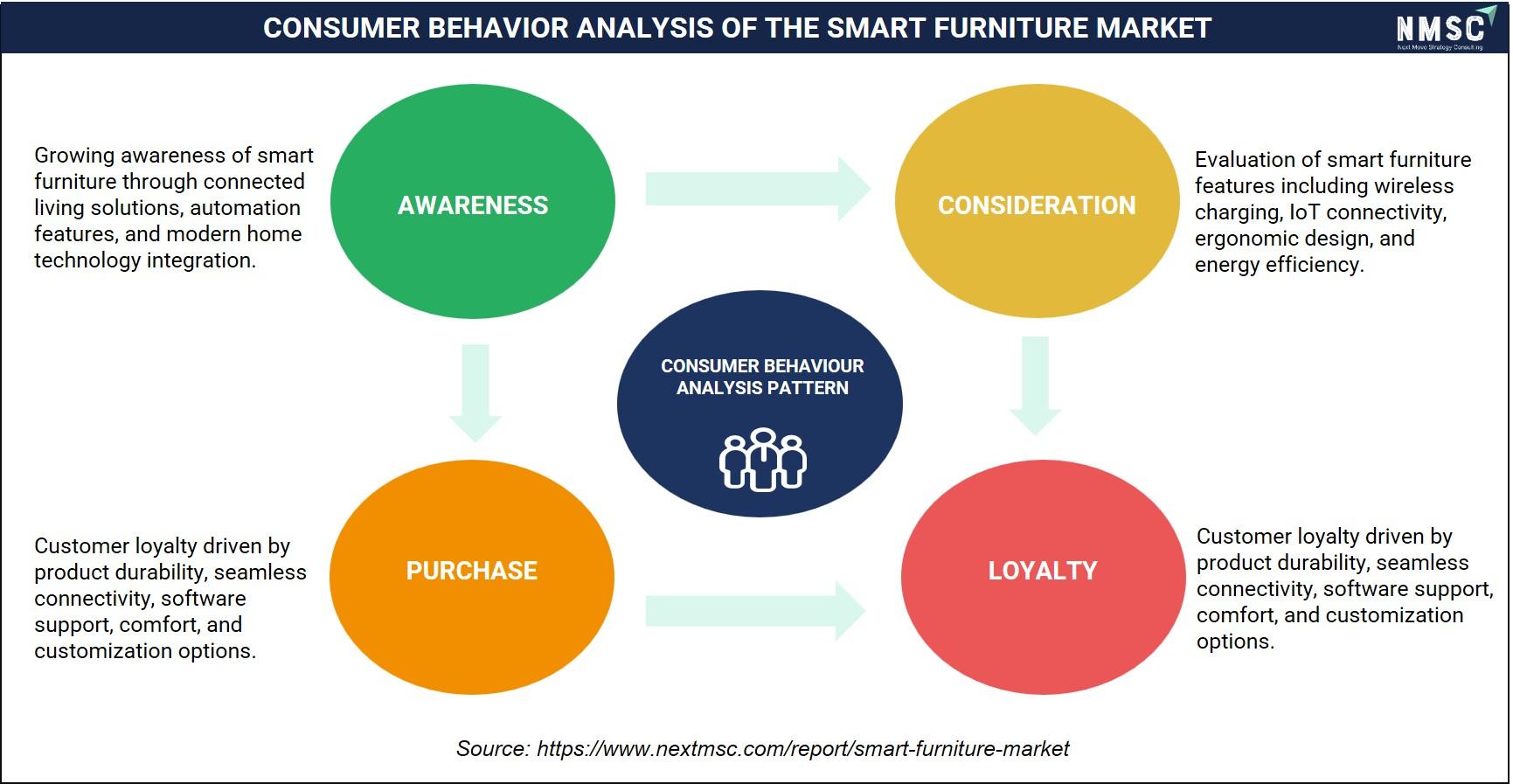
Consumer behavior in the Smart Furniture Market follows a progression from awareness to loyalty. Awareness is driven by increasing interest in connected living, home automation, and smart home ecosystems. During the consideration stage, buyers evaluate features such as IoT connectivity, wireless charging, ergonomic design, energy efficiency, and compatibility with existing devices. Purchase decisions are influenced by convenience, functionality, aesthetics, and value for money. Long-term loyalty depends on product durability, seamless connectivity, software support, comfort, customization options, and positive user experiences, encouraging repeat purchases and brand advocacy in both residential and commercial settings.
Key Benefits for Stakeholders
For Enterprise Buyers
Enterprise buyers gain comprehensive, vendor-neutral insights into the Smart Furniture Market, including quantitative sizing across product categories, connectivity technologies, applications, end-user segments, and distribution channels. This intelligence supports workplace modernization initiatives, smart building strategies, and long-term procurement planning. Our competitive landscape analysis enables purchasing teams to benchmark product capabilities, evaluate supplier ecosystems, and make informed decisions regarding connected furniture investments for residential, commercial, healthcare, hospitality, and educational environments.
For Investors and Financial Analysts
Investors and financial analysts gain access to a structured, data-driven assessment of the Smart Furniture Market’s growth trajectory, competitive landscape, innovation pipeline, and segment-level revenue forecasts through 2035. CAGR analysis by product type, application, region, and customer segment supports portfolio allocation and valuation modeling. Detailed profiles of leading manufacturers, technology providers, and emerging innovators, combined with tracking of strategic partnerships, acquisitions, and product launches, provide valuable insights for identifying high-growth opportunities and assessing competitive risks across the global smart furniture ecosystem.
For Smart Furniture Manufacturers and Technology Providers
Smart furniture manufacturers, IoT solution providers, and connected-home technology companies gain actionable intelligence on emerging consumer preferences, product innovation opportunities, and high-growth market segments. Product category analysis highlights opportunities in connected seating, height-adjustable desks, smart beds, integrated charging furniture, and AI-enabled home furnishings. Regional market assessments identify geographic expansion priorities while accounting for digital infrastructure maturity, smart home adoption rates, and consumer spending patterns. Insights into customer purchasing behavior and channel dynamics enable vendors to optimize product development, pricing strategies, distribution partnerships, and go-to-market execution.
For Government Bodies, Urban Planners, and Smart Infrastructure Authorities
Government agencies, urban planners, and smart infrastructure authorities gain a structured understanding of how digital transformation, energy efficiency initiatives, smart city development programs, and workplace modernization policies are influencing the Smart Furniture Market. Country-level insights provide evidence-based perspectives on the adoption of connected living and working environments, helping policymakers evaluate opportunities related to smart buildings, sustainable infrastructure, public-sector workplace upgrades, and digital innovation. Analysis of smart home and IoT integration trends supports the development of policies that encourage technology-enabled, energy-efficient, and user-centric built environments.
Key Market Segments
By Product Type
-
Seating
-
Task Chairs
-
Lounge Chairs
-
Sofas and Benches
-
Specialty Seating
-
Healthcare Seating
-
Other Seating
-
-
Desks and Tables
-
Height Adjustable Desks
-
Fixed Desks
-
Conference Tables
-
Occasional Tables
-
Other Work Surfaces
-
-
Sleep Furniture
-
Smart Beds
-
Adjustable Bases
-
Smart Mattresses and Toppers
-
Other Sleep Systems
-
-
Storage and Casegoods
-
Cabinets and Wardrobes
-
Shelving and Credenzas
-
Drawer Units
-
Other Storage
-
-
Modular and Architectural Systems
-
Office Pods and Booths
-
Room Dividers and Partitions
-
Transformable Wall Units
-
Other Connected Modules
-
-
Other Smart Furniture
By Technology
-
Motorized Adjustment
-
Connectivity and App Control
-
Health and Environmental Sensors
-
Integrated Power and Charging
-
Climate Control and Wellness
-
Other Technology
By End User
-
Residential
-
Commercial Office
-
Education
-
Hospitality
-
Healthcare
-
Retail and Public Spaces
-
Other
By Distribution Channel
-
Direct to Consumer Online
-
Brand Retail Stores
-
Dealer and Contract Sales
-
Third Party Retail
-
Online Marketplaces
-
OEM and Private Label
By Revenue Stream
-
Product Sales
-
Subscription and Software Services
-
Installation and Maintenance
-
Spare Parts and Accessories
-
Other Revenue
By Region
-
North America: U.S., Canada, and Mexico.
-
Europe: UK, Germany, France, Italy, Spain, Sweden, Denmark, Finland, the Netherlands, and the rest of Europe.
-
Asia Pacific: China, India, Japan, South Korea, Taiwan, Indonesia, Vietnam, Australia, Philippines, Malaysia and the rest of APAC.
-
Middle East & Africa (MEA): Saudi Arabia, UAE, Egypt, Israel, Turkey, Nigeria, South Africa, and the rest of MEA.
-
Latin America: Brazil, Argentina, Chile, Colombia, and the rest of LATAM.
Conclusion and Recommendations
Long-Term Outlook
The Smart Furniture Market is entering a structurally important growth decade driven by the convergence of hybrid work normalization, health monitoring technology democratization, healthcare infrastructure modernization, and smart city development investment. The market is forecast to grow from USD 4.6 billion in 2026 to USD 10.8 billion by 2035, at a CAGR of 9.9%. Our analysis shows that this growth reflects both expanding commercial and institutional demand for functionally intelligent furniture and the increasing consumer recognition that furniture represents a health management asset rather than a passive household expenditure across key demographic and geographic segments.
Strategic Positioning Recommendations
Smart furniture manufacturers should prioritize software platform development to capture subscription revenue streams that significantly exceed hardware product margins over the customer lifetime. Companies that embed proprietary AI wellness algorithms within furniture hardware while maintaining open API compatibility with major workplace experience and smart building platforms will capture premium enterprise contract pricing and superior land-and-expand economics. Healthcare segment investment is non-negotiable for vendors targeting sustained institutional demand, requiring clinical safety certifications, EHR platform integration, and hospital procurement relationship development across target healthcare markets in North America, Europe, and Asia-Pacific.
Investment Attractiveness
The Smart Furniture Market represents a commercially attractive investment environment with durable secular growth drivers, expanding recurring revenue opportunities, and a structural transition from single-transaction hardware purchasing toward platform subscription relationships. Our assessment identifies the highest-conviction investment themes as Sleep Furniture at a CAGR of 11.6%, Subscription and Software Services at a CAGR of 18.8%, Modular and Architectural Systems at a CAGR of 12.0%, and Asia-Pacific regional expansion at a CAGR of 12.8%. Investors should monitor subscription revenue traction, AI algorithm differentiation, and smart building platform integration depth as primary valuation drivers across both public and private smart furniture company investment candidates.
Market Shifts and Key Risks
The most significant market shift underway is the transition from hardware-centric commercial furniture procurement toward outcome-based smart furniture platform purchasing, where buyers evaluate total workplace wellness ROI, sleep health improvement metrics, and space utilization optimization value rather than unit price comparisons. This shift benefits software-platform-integrated furniture brands at the expense of commodity hardware manufacturers. Key risks include data privacy regulatory escalation constraining biometric data collection in smart furniture products, macroeconomic pressures slowing enterprise commercial office investment, technology commoditization reducing hardware margins for established brands, and open-source IoT platform development reducing software differentiation barriers.
Growth Pathways
Organizations seeking to maximize value from the Smart Furniture Market should pursue a three-horizon strategy. In the near term from 2025 to 2027, prioritize commercial office segment penetration through height-adjustable desk and connected seating programs integrated with enterprise workplace analytics platforms. In the mid-term from 2027 to 2031, invest in healthcare segment expansion through clinical certification, EHR integration, and hospital contract procurement capability development. In the long term from 2031 to 2035, position for smart modular architectural furniture adoption in high-density urban residential and hospitality development programs across Asia-Pacific, the Middle East, and European premium real estate markets as IoT infrastructure costs continue to decline.
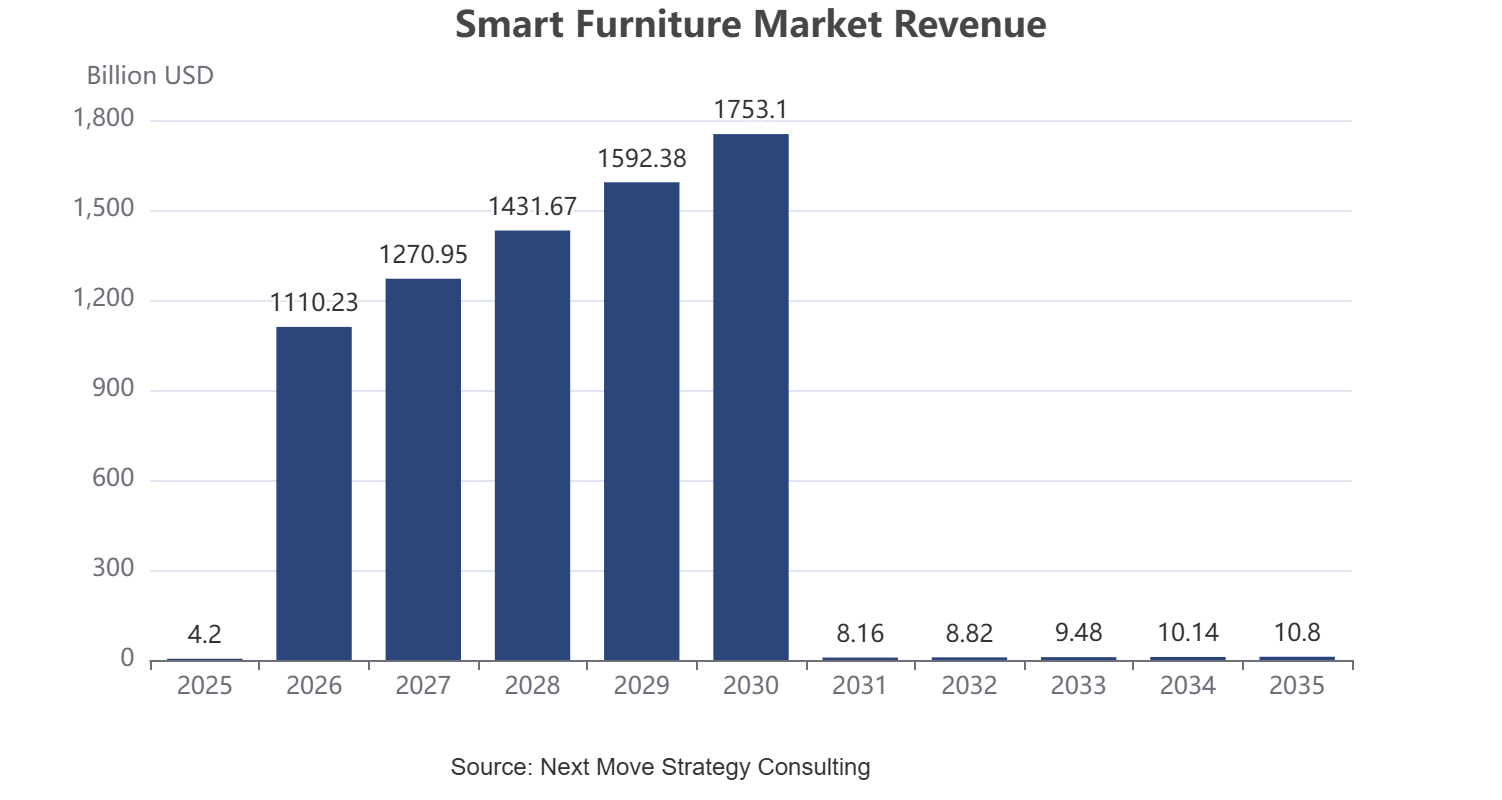
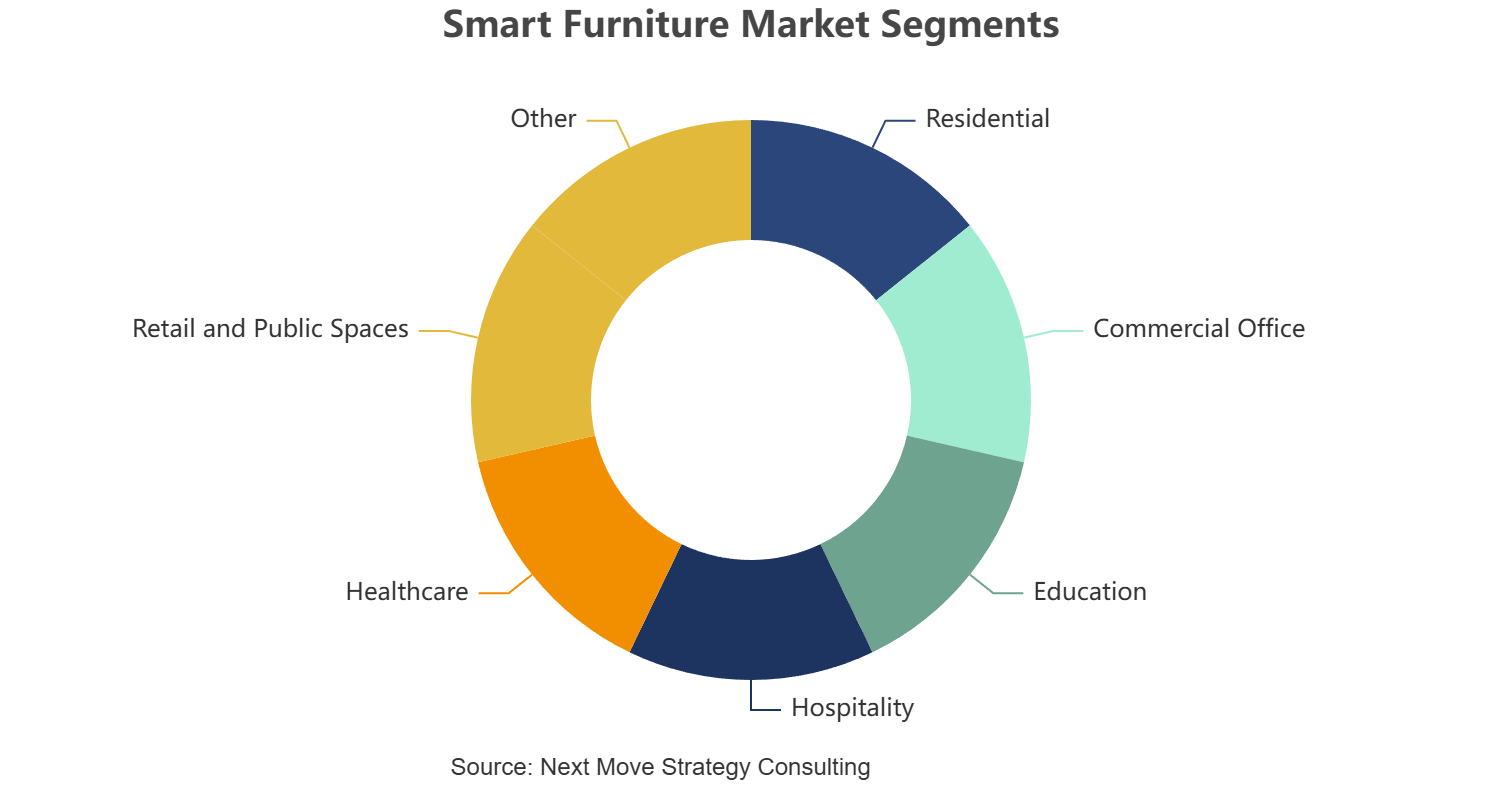
About the Author
 Mihul Sharma
— Mihul Sharma is Research Associate at Next Move Strategy Consulting, where he has covered technology, industrial, and healthcare markets for 3 years. His work applies structured business research, market analysis, and secondary-source review to assess market trends, competitive developments, and growth opportunities. He supports report development by fully synthesizing industry data, company information, and market signals into concise findings for strategy and investment-focused research teams.
Mihul Sharma
— Mihul Sharma is Research Associate at Next Move Strategy Consulting, where he has covered technology, industrial, and healthcare markets for 3 years. His work applies structured business research, market analysis, and secondary-source review to assess market trends, competitive developments, and growth opportunities. He supports report development by fully synthesizing industry data, company information, and market signals into concise findings for strategy and investment-focused research teams.
About the Reviewer
 Supradip Baul
— Supradip Baul is an accomplished business consultant and strategist with over a decade of rich experience in market intelligence, strategy, technology, and business transformation. His work has included rigorous qualitative and quantitative analysis across multiple industries, helping clients shape investment decisions and long-term roadmaps. Earlier in his career, he was associated with Gartner, where he contributed to industry-leading reports and market share analyses. He has worked with leading global companies and holds an MBA with a dual specialization in Marketing and Finance.
Supradip Baul
— Supradip Baul is an accomplished business consultant and strategist with over a decade of rich experience in market intelligence, strategy, technology, and business transformation. His work has included rigorous qualitative and quantitative analysis across multiple industries, helping clients shape investment decisions and long-term roadmaps. Earlier in his career, he was associated with Gartner, where he contributed to industry-leading reports and market share analyses. He has worked with leading global companies and holds an MBA with a dual specialization in Marketing and Finance.
At Next Move Strategy Consulting, we understand that insightful market research is the cornerstone of successful business decisions. That's why we employ a robust and multifaceted approach, combining various methodologies to deliver the most accurate and actionable data for our clients.

Research Landscape
We navigate the world of research with two primary approaches:
Qualitative Approach
Our qualitative research methodologies involve immersive techniques such as in-depth interviews, focus groups, and observational studies. By engaging directly with individuals and stakeholders, we uncover valuable insights that quantitative data alone may overlook.

Quantitative Research
In tandem with qualitative methodologies, NMSC leverages the power of Quantitative Research to provide a robust foundation of numerical insights. Through systematic data collection and analysis, we quantify patterns, preferences, and market trends, offering a comprehensive view of the business landscape.
Our quantitative research approach employs diverse tools, including surveys, experiments, and statistical modelling. These methodologies enable us to gather data from a large and representative sample, ensuring the statistical significance of our findings. By employing structured questionnaires and standardized data collection methods, we guarantee the reliability and validity of the information we present to our clients.
Quantitative research is particularly effective in measuring the prevalence of trends, assessing market size, and gauging the impact of various factors on consumer behavior. The numerical precision attained through this approach equips our clients with actionable insights, facilitating data-driven decision-making and strategy formulation.


Our Specialized Toolbox for Industry-Specific Market Research
We deploy a specialized arsenal of techniques tailored to meet your unique requirements. Here's a glimpse into our comprehensive toolbox:

Information Procurement
The stage entails acquiring market data or relevant information through various sources and methodologies.


Market Research Approach
We utilize both top-down and bottom-up approaches in market research analysis to achieve a comprehensive understanding of the market dynamics, leveraging the broad perspective of industry trends and macroeconomic factors alongside detailed insights from specific segments and individual companies.

Porters Five Forces Analysis
We conduct Porter's Five Forces analysis to evaluate the competitive landscape of an industry, providing us with insights into factors that affect profitability and strategic positioning.

SWOT Analysis

Forecasting
We utilize a forecasting model to predict future consumption by considering parameters like population, economics, regulations, market competition, drivers, constraints, technology, and pricing. We also employ statistical techniques such as multilinear regression, exponential smoothing, moving average, ARIMA, and Monte Carlo simulations for accurate predictions. In econometric forecasting, we analyzed short-term and long-term event impacts, attributing values based on regulatory frameworks, economic factors, and market events.





 Speak to Our Analyst