Italy Construction Market By Project Type (New Construction, Renovation & Retrofit, and Maintenance & Repair), By Sector (Buildings, Industrial & Process, and Civil & Infrastructure Construction), By Construction Method (On-site, Off-site Prefabricated, Hybrid, and 3D Construction), By Contractor Role (General, EPC, Specialty Trade Contractors, & Others), By Customer Type (Government & Public Authorities, Private Real Estate Developers, & Others) – Opportunity Analysis & Forecast, 2025-2035
Industry: Construction & Manufacturing | Lastest Edition: June 22, 2026 | No of Pages: 181 | No. of Tables: 67 | No. of Figures: 62 | Format: PDF | Report Code : CM2200
Italy Construction Market Size & Forecast
|
Parameters |
Details |
|
Market Size in 2026 |
USD 265.31 Billion |
|
Revenue Forecast in 2035 |
USD 335.88 billion |
|
Growth Rate |
CAGR of 2.66% from 2026 to 2035 |
|
Analysis Period |
2025–2035 |
|
Base Year Considered |
2025 |
|
Forecast Period |
2026–2035 |
|
Market Size Estimation |
Billion (USD) |
|
Companies Profiled |
15 |
|
Market Share |
Available for 10 companies |
Industry Outlook
The Italy Construction Market size was valued at USD 256.60 billion in 2025 and is expected to reach USD 265.31 billion by 2026. Looking ahead, the industry is projected to expand significantly, reaching USD 335.88 billion by 2035, registering a CAGR of 2.66% from 2026 to 2035.
What are the Key Market Drivers, Breakthroughs, and Investment Opportunities that will Shape the Italy Construction Market in the Next Decade?
Growth Catalyst & Risk Assessment Matrix
|
DRIVERS / TRENDS / RESTRAINTS |
(+/-) % IMPACT ON CAGR FORECAST |
GEOGRAPHIC RELEVANCE |
IMPACT TIMELINE |
|
Tourism infrastructure development accelerating investments in hospitality, transportation, and urban redevelopment projects |
+3.58% |
Rome, Milan, Venice, Florence, Naples |
Medium to Long term (3–6 years) |
|
Renovation of ageing infrastructure increasing modernization and refurbishment activity across residential and public assets |
+3.11% |
Northern Italy, Rome, Milan, Turin |
Medium to Long term (3–6 years) |
|
Urban mobility infrastructure expansion strengthening investments in public transportation and smart mobility networks |
+2.66% |
Rome, Milan, Naples, Bologna |
Medium term (2–5 years) |
|
Administrative delays extending approval timelines and reducing project execution efficiency |
-3.42% |
Italy |
Short to Medium term (1–4 years) |
|
Energy-efficient building renovation accelerating sustainable retrofit and modernization projects |
+2.84% |
Milan, Rome, Turin, Florence |
Medium to Long term (3–6 years) |
From our assessment, we found that the Italy construction market is being shaped by rising tourism infrastructure development, accelerating renovation of ageing infrastructure, and expanding urban mobility infrastructure investments across major cities and tourist destinations. NMSC analysis indicates that increasing investments in hospitality facilities, transportation modernization, metro systems, railway connectivity, smart mobility networks, and refurbishment of historical and public infrastructure are significantly strengthening long-term construction activity across the country. Moreover, growing emphasis on sustainable urban connectivity, cultural destination upgrades, and modernization of ageing residential and commercial assets continues reinforcing construction demand across multiple project segments. However, based on our evaluation, we found that administrative delays remain a significant inhibitor, as lengthy permitting procedures, regulatory complexities, and bureaucratic approval processes continue delaying project execution and reducing operational efficiency. At the same time, energy-efficient building renovation is creating substantial growth opportunities by accelerating investments in sustainable refurbishment, green construction technologies, insulation systems, and smart energy-efficient infrastructure upgrades across Italy.
Growth Drivers:
How is Tourism Infrastructure Development Expanding the Italy Construction Market?
NMSC analysis confirms that tourism infrastructure development is driving market growth by accelerating investments in hospitality facilities, transportation infrastructure, and urban redevelopment projects. Italy’s strong tourism sector continues increasing demand for hotels, resorts, mixed-use commercial spaces, and supporting public infrastructure across major tourist destinations. Through our engagement with developers and infrastructure agencies, we identified that modernization of airports, railway connectivity, and tourism-focused urban infrastructure is significantly strengthening construction pipelines across key regions. Moreover, rising investments in luxury hospitality developments and cultural destination upgrades continue reinforcing construction activity. At the same time, regional tourism expansion initiatives are increasing redevelopment projects surrounding heritage and coastal areas. Consequently, tourism infrastructure development remains a major contributor supporting sustained construction market growth across Italy.
How is Renovation of Ageing Infrastructure Driving the Italy Construction Market Growth?
Renovation of ageing infrastructure is driving market growth by accelerating modernization activity across residential, commercial, and public infrastructure segments. A significant share of Italy’s building stock and civic infrastructure requires structural upgrades, energy-efficiency improvements, and modernization to meet evolving safety and sustainability standards. Based on our interactions with developers and engineering consultants, we observed that refurbishment projects are increasingly prioritized across mature urban regions where land availability remains limited. Furthermore, restoration and preservation requirements associated with historical infrastructure are strengthening long-term renovation-related construction activity. In addition, modernization of transportation systems, utilities, and public buildings continues expanding project pipelines across the country. As renovation activity accelerates across ageing infrastructure assets, refurbishment-driven development remains a significant contributor supporting overall market growth.
How is Urban Mobility Infrastructure Expansion Fueling the Italy Construction Market Expansion?
Our assessment highlights that urban mobility infrastructure expansion is fueling the market expansion by increasing investments in public transportation systems, smart mobility networks, and integrated urban infrastructure projects. Rising focus on sustainable transportation and urban connectivity continues accelerating construction activity involving metro systems, railway modernization, pedestrian infrastructure, and electric mobility networks across major Italian cities. From our analysis of ongoing urban development initiatives, we found that modernization of public mobility infrastructure is significantly strengthening demand for civil engineering and technologically advanced construction capabilities. Moreover, regional investments aimed at reducing congestion and improving urban accessibility continue reinforcing long-term infrastructure development. At the same time, smart city integration initiatives are supporting modernization of transportation-linked urban infrastructure. Consequently, urban mobility infrastructure development remains a strong contributor supporting sustained construction market growth.
Growth Inhibitor:
How are Administrative Delays Restraining the Italy Construction Market Expansion?
Administrative delays are restraining the market expansion by extending project approval timelines and reducing operational efficiency across residential, commercial, and infrastructure developments. Lengthy permitting procedures, regulatory approvals, and bureaucratic documentation requirements continue creating execution challenges for developers and contractors across multiple project categories. Through our engagement with developers and regulatory consultants, we identified that prolonged administrative processes are delaying project initiation and weakening construction scheduling efficiency across large-scale developments. Furthermore, coordination complexities among regional and local authorities continue increasing procedural uncertainty and compliance-related burdens. In addition, delays associated with approvals and inspections are affecting investment continuity across infrastructure modernization projects. As administrative inefficiencies persist, procedural bottlenecks continue acting as a significant constraint limiting overall market expansion.
Growth Opportunity:
How is Energy-Efficient Building Renovation Creating New Opportunities for Market Expansion Across Italy?
Energy-efficient building renovation is creating new opportunities for market expansion by accelerating investments in sustainable refurbishment and modernization projects. Increasing emphasis on reducing building emissions and improving energy performance continues strengthening demand for insulation systems, energy-efficient materials, and environmentally sustainable renovation practices across residential and commercial sectors. Based on our interactions with contractors and engineering consultants, we observed that government-backed incentive programs and sustainability-focused regulations are significantly expanding retrofit-related construction activity. Moreover, modernization of ageing building stock is reinforcing long-term demand for smart energy systems and green construction technologies. At the same time, property owners are increasingly prioritizing operational efficiency and long-term cost optimization through sustainable renovation initiatives. Consequently, energy-efficient refurbishment continues unlocking substantial growth opportunities across the Italy construction market.
Porter’s Five Forces Analysis of the Italy Construction Industry
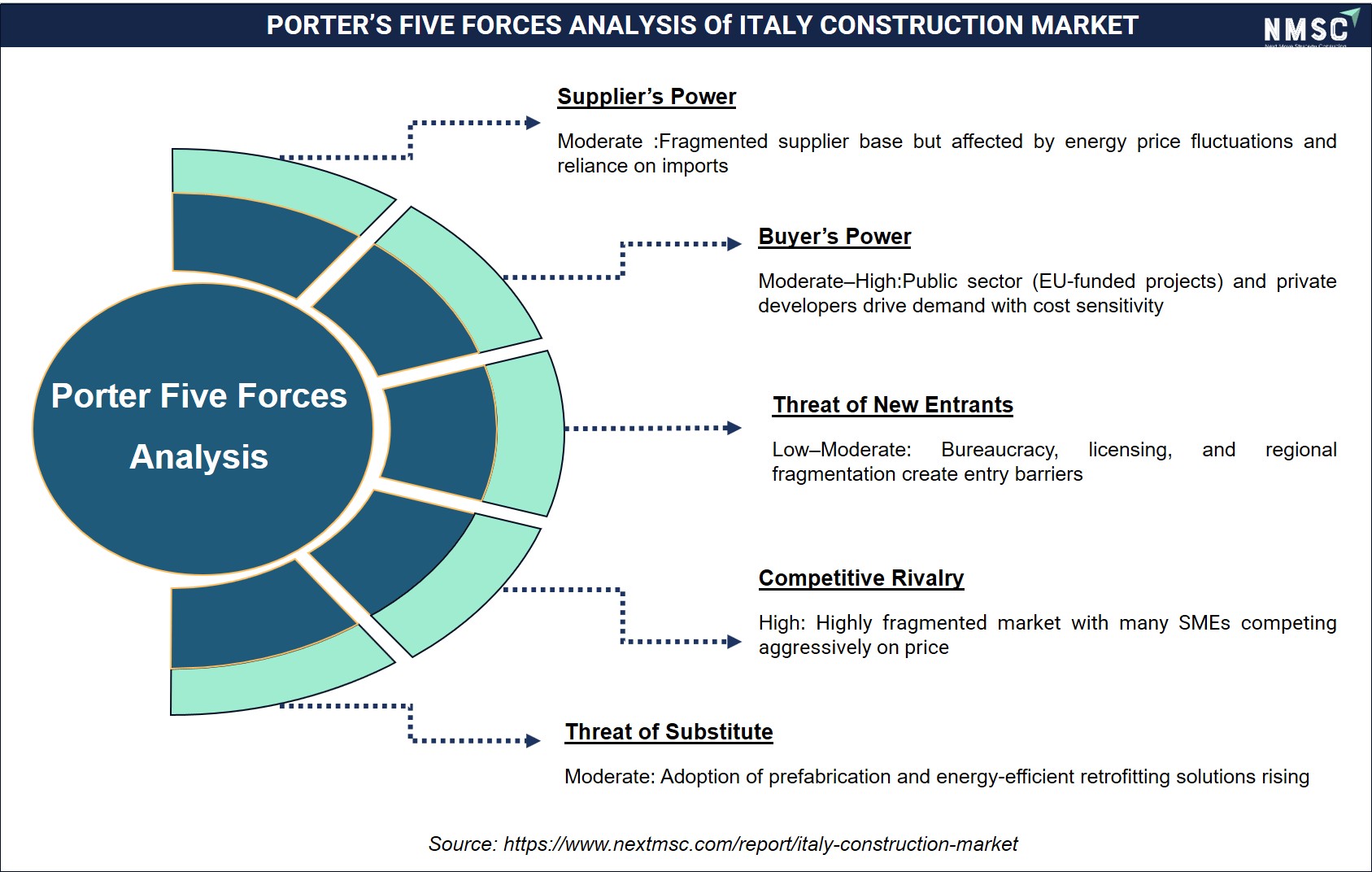
Our analysis indicates that supplier power remains moderate due to fragmented supplier networks and dependence on imported construction inputs affected by energy price fluctuations. Buyer power ranges from moderate to high as EU-funded infrastructure projects and private developers emphasize cost-efficient project execution. Additionally, the threat of new entrants remains low to moderate because of licensing complexity, regional fragmentation, and bureaucratic barriers. Competitive rivalry remains intense, driven by strong competition among SMEs and regional contractors. Furthermore, prefabrication and energy-efficient retrofitting solutions continue reshaping traditional construction methodologies across Italy.
How is the Italy Construction Market segmented in this report, and what are the key insights from the segmentation analysis?
By Construction Method Insights
Is Construction Method Segmentation Influencing Construction Activities in the Italy Construction Market?
Based on construction method, the market is segmented into on-site construction, off-site prefabricated, hybrid construction, and 3D construction.
Based on our assessment, we observed that on-site construction continues supporting residential, commercial, infrastructure, and restoration projects across Italy due to project customisation requirements and varied architectural structures. Off-site prefabricated and hybrid construction methods are also gaining traction due to construction efficiency, reduced material usage, and streamlined project execution. The increasing adoption of modular systems, digital planning technologies, and automated construction processes is further supporting operational efficiency across multiple project categories. Furthermore, 3D construction technologies are receiving growing attention in pilot projects focused on sustainable building practices and innovative construction solutions.
By Sector Insights
Is Sector Segmentation Supporting Construction Development in the Italy Construction Market?
Based on sector, the market is segmented into building construction, industrial & process construction, civil & infrastructure construction, and telecommunication.
Construction activities across Italy involve residential, commercial, industrial, infrastructure, and telecommunication development projects across urban and regional markets. Based on our analysis, we observed that building construction continues progressing due to residential renovation projects, hospitality developments, and commercial property investments. Industrial & process construction is also expanding through manufacturing upgrades, logistics infrastructure development, and energy-related projects. Civil & infrastructure construction supports railway modernisation, road upgrades, water management systems, and public utility developments. In addition, telecommunication infrastructure projects are increasing due to broadband expansion and digital network modernisation initiatives across the country.
Competitive Landscape
The Italy construction industry is characterised by a competitive and moderately fragmented structure, supported by the presence of infrastructure developers, engineering firms, and specialised construction contractors. The market growth is being driven by rising investments in transportation infrastructure, energy projects, urban redevelopment initiatives, and residential and commercial construction activities across major regions. In addition, the increasing adoption of sustainable construction practices, digital engineering technologies, and advanced project management systems is strengthening operational efficiency and supporting broader market expansion.
Strategic Developments:
-
January 2026 – Impresa Pizzarotti & C. successfully completed the Cortina Sliding Centre in just 13 months for the Milan Cortina 2026 Winter Olympic Games. The 1,749-meter track is the world’s first glycol-cooled track, representing a 96% reduction in ammonia use compared to traditional designs.
-
December 2025 – Saipem secured a new offshore contract valued at approximately USD 425 million for the Sakarya gas field development project in Türkiye, strengthening the company’s Italy-based EPC, offshore engineering, and energy infrastructure construction capabilities in international markets.
Key Players of the Italy Construction Market
-
Pizzarotti & C.
-
Keller Group plc
-
Léon Grosse
-
Eiffage
-
ACCIOna
-
Bonatti Società per Azioni
-
Saipem
-
Webuild S.p.A.
-
Rizzani de Eccher S.p.A.
-
Mundys S.p.A.
-
SICIM S.p.A
-
Ghella S.p.A.
-
Salcef Group
Our assessment indicates that the competitive dynamics are increasingly shaped by engineering expertise, project execution efficiency, technological integration, and the ability to manage complex infrastructure and industrial developments. Key players such as Pizzarotti & C., Vinci, Bonatti Società per Azioni, Saipem, Webuild S.p.A., Rizzani de Eccher S.p.A., Mundys S.p.A., SICIM S.p.A., Ghella S.p.A., and Salcef Group are strengthening their presence through strategic infrastructure contracts, expansion of sustainable construction capabilities, advanced project management integration, and diversified project portfolios. In addition, companies with strong regional execution networks, integrated engineering capabilities, and diversified infrastructure exposure are better positioned to address evolving construction requirements across transportation, energy, industrial, residential, and commercial sectors. Consequently, the competitive landscape is advancing toward a more technology-driven, sustainability-focused, and integrated structure in the Italy construction market.
SWOT Analysis of the Italy Construction Industry
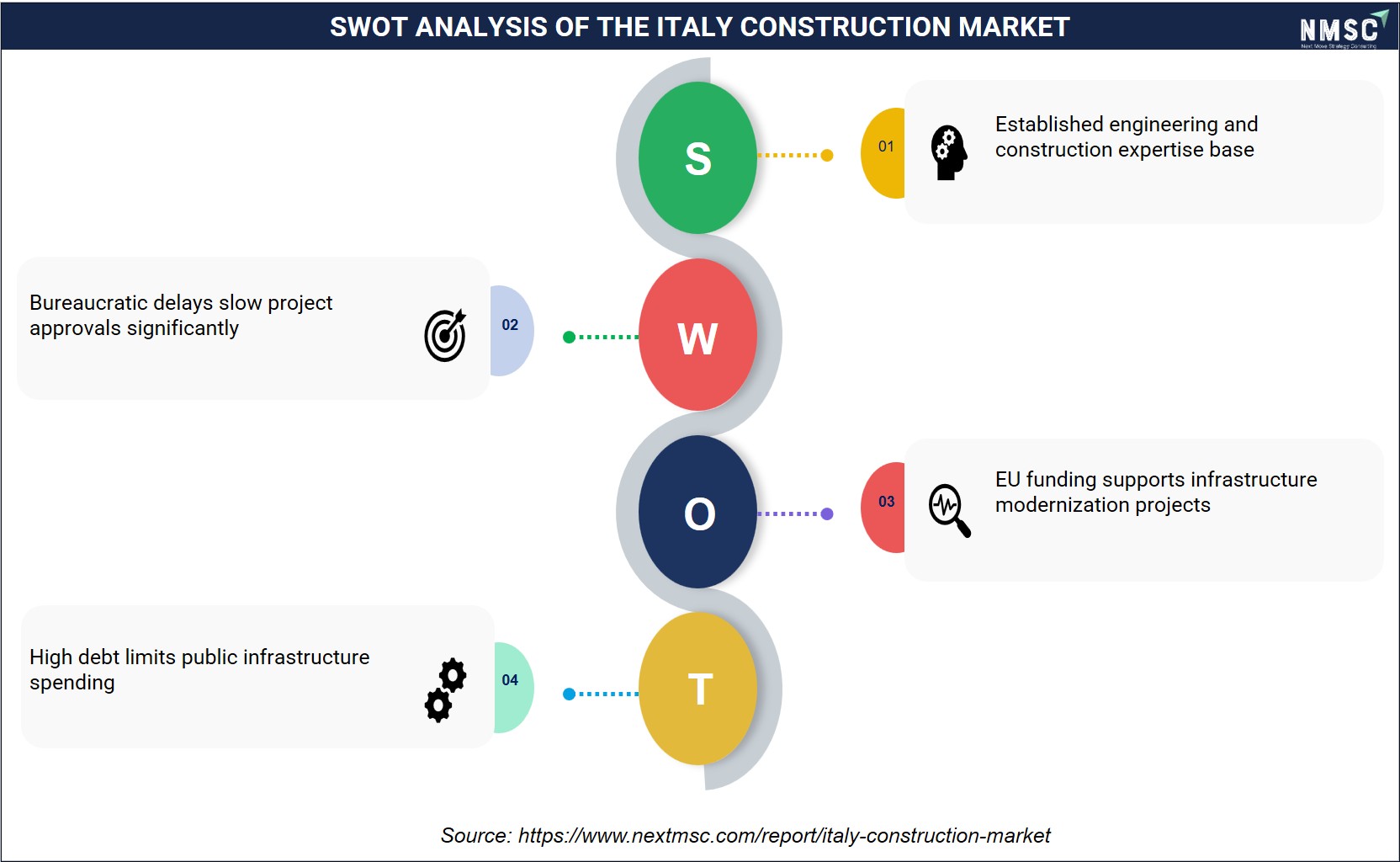
Our assessment indicates that Italy’s construction sector benefits from a strong engineering heritage and established construction expertise supporting infrastructure and urban development activities. However, lengthy bureaucratic approval procedures continue delaying project execution timelines across multiple regions. At the same time, EU-backed funding programs are strengthening opportunities for infrastructure modernization and sustainable construction investments. Nevertheless, elevated public debt levels continue restricting large-scale public infrastructure spending and long-term capital allocation priorities within the market.
Italy Construction Market Key Segments
By Project Type
-
New Construction
-
Renovation & Retrofit
-
Maintenance & Repair
By Sector
-
Buildings Construction
-
Residential Buildings
-
Affordable Housing
-
Luxury Housing
-
-
Commercial Buildings
-
Office Buildings
-
Retail Buildings
-
Hospitality
-
Educational Buildings
-
Healthcare Buildings
-
Government & Public Buildings
-
Entertainment & Sports Venues
-
-
Industrial & Warehouse Buildings
-
Manufacturing Buildings
-
Warehouses & Logistics Centers
-
-
-
Industrial & Process Construction
-
Power Generation Facilities
-
Oil & Gas Facilities
-
Chemical & Petrochemical Plants
-
Other Process & Heavy Manufacturing Plants
-
-
Civil & Infrastructure Construction
-
Transportation Infrastructure
-
Roads & Highways
-
Bridges
-
Tunnels
-
Railways & Metros
-
Airports
-
Ports & Terminals
-
-
Environmental & Utility Infrastructure
-
Water Supply & Treatment Systems
-
Wastewater & Sewerage Systems
-
Solid Waste Management Systems
-
Dams, Levees & Flood Control
-
-
Telecommunication
-
By Construction Method
-
On-site Construction
-
Off-site Prefabricated
-
Hybrid Construction
-
3D Construction
By Contractor Role
-
General Contractors
-
EPC
-
Specialty Trade Contractors
-
Construction Management
By Customer Type
-
Government & Public Authorities
-
Private Real Estate Developers
-
Industrial & Energy Corporations
-
Healthcare Institutions
-
Educational Institutions
-
Individual Households
Key Benefits for Stakeholders:
Next Move Strategy Consulting (NMSC) presents a comprehensive analysis of the Italy construction market trends, covering historical developments from 2020 to 2025 and providing forward-looking forecasts through 2035. Our study evaluates the market at national and regional levels, delivering quantitative outlooks alongside qualitative insights into key growth drivers, infrastructure rehabilitation, sustainability initiatives, urban redevelopment trends, and technology adoption across major construction segments.
The Italy construction market delivers measurable value to a diverse stakeholder ecosystem. Investors benefit from public infrastructure restoration programs, transport modernization projects, and increasing investments in energy-efficient building upgrades. Contractors and developers benefit from sustained demand across residential renovation, heritage building restoration, commercial redevelopment, and transportation infrastructure supported by urban renewal initiatives and tourism-related development activity. Material suppliers and equipment providers benefit from rising demand for sustainable construction materials, seismic-resilient building solutions, and prefabricated construction technologies. By aligning infrastructure rehabilitation with sustainability objectives and modernization strategies, the market supports long-term operational efficiency, resilient urban development, and economic revitalization across the country.
|
Parameters |
Details |
|
Customization Scope |
Free customization (equivalent to up to 80 analyst-working hours) after purchase. |
|
Pricing and Purchase Options |
Avail customized purchase options to meet your exact research needs. |
|
Approach |
In-depth primary and secondary research; proprietary databases; rigorous quality control and validation measures. |
|
Analytical Tools |
Porter's Five Forces, SWOT, value chain, and Harvey ball analysis to assess competitive intensity, stakeholder roles, and relative impact of key factors. |


About the Author
 Saista Faiyaz is a Research Associate specializing in analytical research, structured data review, and knowledge-driven insight development. She supports projects through methodical evaluation, cross-disciplinary understanding, and clear documentation that aid informed outcomes. With experience bridging research and technical domains, she contributes to organized learning processes, critical analysis, and collaborative problem solving. Her approach emphasizes accuracy, adaptability, and clarity, enabling consistent research support and meaningful contributions across diverse projects effectively.
About the Reviewer
 Supradip Baul is an accomplished business consultant and strategist with over a decade of rich experience in market intelligence, strategy, technology, and business transformation. His work has included rigorous qualitative and quantitative analysis across multiple industries, helping clients shape investment decisions and long-term roadmaps. Earlier in his career, he was associated with Gartner, where he contributed to industry-leading reports and market share analyses. He has worked with leading global companies and holds an MBA with a dual specialization in Marketing and Finance.
At Next Move Strategy Consulting, we understand that insightful market research is the cornerstone of successful business decisions. That's why we employ a robust and multifaceted approach, combining various methodologies to deliver the most accurate and actionable data for our clients.

Research Landscape
We navigate the world of research with two primary approaches:
Qualitative Approach
Our qualitative research methodologies involve immersive techniques such as in-depth interviews, focus groups, and observational studies. By engaging directly with individuals and stakeholders, we uncover valuable insights that quantitative data alone may overlook.

Quantitative Research
In tandem with qualitative methodologies, NMSC leverages the power of Quantitative Research to provide a robust foundation of numerical insights. Through systematic data collection and analysis, we quantify patterns, preferences, and market trends, offering a comprehensive view of the business landscape.
Our quantitative research approach employs diverse tools, including surveys, experiments, and statistical modelling. These methodologies enable us to gather data from a large and representative sample, ensuring the statistical significance of our findings. By employing structured questionnaires and standardized data collection methods, we guarantee the reliability and validity of the information we present to our clients.
Quantitative research is particularly effective in measuring the prevalence of trends, assessing market size, and gauging the impact of various factors on consumer behavior. The numerical precision attained through this approach equips our clients with actionable insights, facilitating data-driven decision-making and strategy formulation.


Our Specialized Toolbox for Industry-Specific Market Research
We deploy a specialized arsenal of techniques tailored to meet your unique requirements. Here's a glimpse into our comprehensive toolbox:

Information Procurement
The stage entails acquiring market data or relevant information through various sources and methodologies.


Market Research Approach
We utilize both top-down and bottom-up approaches in market research analysis to achieve a comprehensive understanding of the market dynamics, leveraging the broad perspective of industry trends and macroeconomic factors alongside detailed insights from specific segments and individual companies.

Porters Five Forces Analysis
We conduct Porter's Five Forces analysis to evaluate the competitive landscape of an industry, providing us with insights into factors that affect profitability and strategic positioning.

SWOT Analysis

Forecasting
We utilize a forecasting model to predict future consumption by considering parameters like population, economics, regulations, market competition, drivers, constraints, technology, and pricing. We also employ statistical techniques such as multilinear regression, exponential smoothing, moving average, ARIMA, and Monte Carlo simulations for accurate predictions. In econometric forecasting, we analyzed short-term and long-term event impacts, attributing values based on regulatory frameworks, economic factors, and market events.





 Speak to Our Analyst