Liquid Feeds Market Global Industry Analysis and Forecast (2026-2035)

Liquid Feeds Market size is estimated at USD 109.36 billion in 2026, projected to reach USD 204.17 billion by 2035, growing at a CAGR of 7.18% from 2026 to 2035. Key drivers include rising livestock productivity targets, and growing dairy production, with North America leading the market and Asia-Pacific registering the fastest growth.

Download Free Sample PDF
Base Year (2025)
$98.83 Billion
Forecast (2035)
$204.17 Billion
CAGR (2026-2035)
7.2%
Top Region
North America

What Does the Liquid Feeds Market Encompass?

The liquid feeds market encompasses molasses-based and co-product-based liquid supplements formulated to deliver protein, energy, vitamins, minerals, and functional additives to dairy cattle, beef cattle, swine, poultry, and aquaculture species. Our assessment indicates that the scope spans macronutrient supplements, micronutrient premix blends, functional additives, and combination formulations delivered through free-choice lick tanks, top-dress application, and total mixed ration blending across commercial feedlots, dairies, and independent farms worldwide. The category has evolved from a simple palatability enhancer into a precision nutrient-delivery format, driven by rising forage costs, herd productivity targets, and functional additive innovation.
Regulatory frameworks such as national feed mill licensing requirements and animal feed labeling standards shape product formulation and quality control, while trade associations increasingly reference liquid feed adoption in livestock productivity guidance. We observed that technology adoption is shifting toward functional additive blends incorporating organic acids, yeasts, and enzymes that improve digestion beyond basic energy and protein delivery. NMSC's analysis indicates that this structural shift, combined with growing vitamin and trace mineral premix integration, is redefining sourcing criteria across the liquid feeds market.

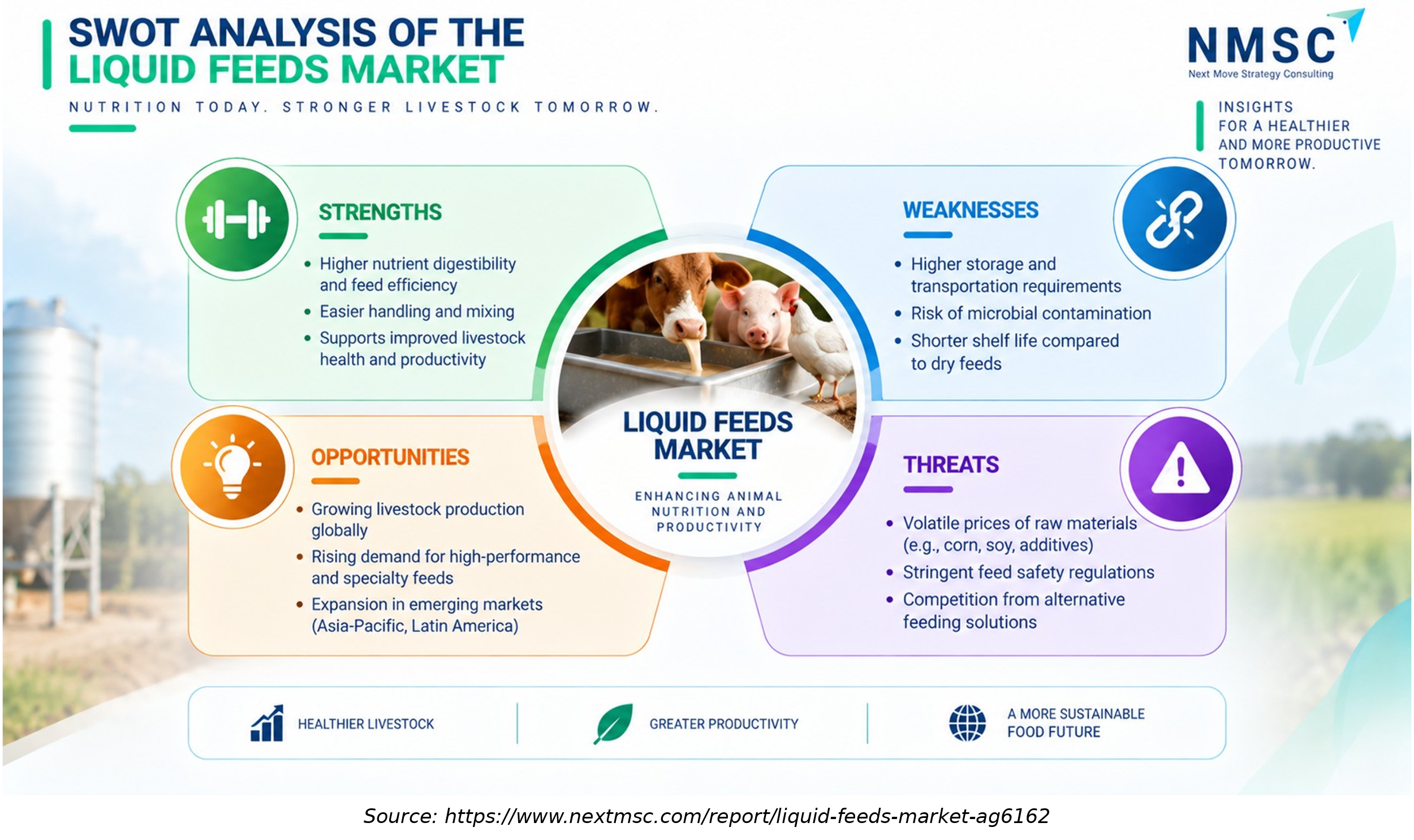
SWOT Analysis

This SWOT view highlights structural strengths, strategic gaps, expansion headroom, and external risks shaping outcomes in the Liquid Feeds Market Global Industry Analysis and Forecast (2026-2035).

Strengths

improved nutrient digestibility, feed efficiency, easier handling, and enhanced livestock productivity

Weaknesses

storage requirements, microbial contamination risks, and shorter shelf life

Opportunities

growing livestock production, demand for specialty feeds, and emerging-market expansion

Threats

raw-material price volatility, stringent feed-safety regulations, and competition from alternative feeding

Market Drivers & Dynamics

Interactive Dataset
Rising global dairy and beef cattle herd productivity targets driver +1.9% Global 2026–2035
Expanding functional additive adoption in commercial feedlots driver +1.6% North America, Europe 2026–2035
Growing dairy and livestock production in Asia-Pacific driver +1.7% Asia-Pacific 2026–2035
Feed business consolidation improving distribution reach driver +1.1% North America 2026–2032
Rising forage costs favoring nutrient-dense liquid supplementation driver +1.0% Global 2026–2032
Brazilian and Latin American cattle herd expansion driver +0.9% Latin America 2026–2035
Molasses price volatility tied to sugar cane harvests restraint −1.1% Global 2026–2032
Competition from dry and pelleted feed supplement formats restraint −0.7% Global 2026–2035
Storage and handling infrastructure costs for bulk liquids restraint −0.5% Global 2026–2032
Source: Next Move Strategy Consulting

Growth Drivers

What Is the Primary Growth Driver of the Liquid Feeds Market?

Rising global dairy and beef cattle herd productivity targets are the primary driver of the market. The United States Department of Agriculture's National Agricultural Statistics Service continues to track herd productivity and milk yield data that informs feed formulation investment decisions across commercial dairy operations. We observed that this productivity focus, reinforced by expanding cattle herds in Asia-Pacific and Latin America, continues to anchor baseline demand for liquid feed supplements across developed and emerging livestock markets alike.

How Is Feed Business Consolidation Driving Liquid Feeds Market Growth?

Feed business consolidation is accelerating market growth by expanding distribution reach and product breadth available to commercial producers. Akralos Animal Nutrition's launch in February 2026, combining more than 40 feed mills and 1,400 employees across North America, illustrates how integrated feed and nutrition platforms are scaling to serve dairy and beef producers with broader liquid and dry supplement portfolios. Our assessment indicates that this consolidation trend is compressing sourcing complexity for large-herd operators seeking single-supplier relationships.

Growth Inhibitors

What Is Restraining Liquid Feeds Market Expansion?

Molasses price volatility restrains market expansion, particularly for manufacturers without diversified carrier ingredient sourcing. Pricing for the primary carrier ingredient fluctuates with sugar cane harvest yields and competing ethanol and biofuel demand, creating margin pressure for blenders reliant on a single feedstock. We found that manufacturers lacking co-product diversification face particular exposure, as carrier cost swings compress margins compared with suppliers blending whey, glycerin, and corn steep alongside molasses.

What Are the Growth Opportunities?

How Can Functional Additive Blends Unlock Value for Commercial Dairies?

Functional additive blends combining organic acids, yeasts, and postbiotics present a whitespace opportunity for suppliers serving large commercial dairies. Manufacturers that commercialize microbiome-focused liquid formulations stand to capture recurring supply contracts as dairy cooperatives seek measurable milk yield and herd health gains beyond basic molasses-based energy supplementation.

Where Does Aquaculture Liquid Nutrition Create New Demand?

Liquid nutrient delivery formats represent an underpenetrated opportunity for suppliers serving expanding aquafeed production. Providers that adapt molasses and co-product-based liquid carriers for fish and shrimp farming can secure long-term contracts with aquaculture operators, benefiting from recurring demand tied to the sector's fastest-growing livestock application status.

How Can Co-Product Diversification Benefit Feed Manufacturers?

Diversified carrier sourcing beyond molasses creates an opportunity for feed manufacturers seeking to manage input cost volatility. Early movers that secure reliable whey, glycerin, and corn steep supply agreements can differentiate on price stability with commercial feedlots and dairies pursuing predictable, multi-year liquid feed procurement contracts through 2035.

Segmentation Analysis

2025 (USD Billion)
2035 (USD Billion)
Macronutrient Supplements 2025: $56.33 Billion | 2035: $102.08 Billion
Macronutrien
Micronutrient Premixes 2025: $16.80 Billion | 2035: $32.67 Billion
Micronutrien
Functional Additives 2025: $16.80 Billion | 2035: $44.92 Billion
Functional A
Combination and Multi-Ingredient Blends 2025: $8.89 Billion | 2035: $24.50 Billion
Combination
Macronutrient Supplements $56.33 Billion $102.08 Billion 5.6%
Micronutrient Premixes $16.80 Billion $32.67 Billion 6.5%
Functional Additives $16.80 Billion $44.92 Billion 10.3%
Combination and Multi-Ingredient Blends $8.89 Billion $24.50 Billion 10.7%

Which Product Type Dominates the Liquid Feeds Market?

Macronutrient Supplements, encompassing molasses-based protein blends and liquid energy and fat supplements, led the market with USD 56.33 billion in 2025, supported by their role as the primary vehicle for forage utilization and dry matter intake. We observed that Functional Additives are the fastest-growing product type alongside Combination Blends, expanding at a 10.3% CAGR from 2026 to 2035, as organic acids, yeasts, and enzymes increasingly determine which suppliers win large commercial feedlot and dairy contracts.

2025 (USD Billion)
2035 (USD Billion)
Molasses-Bas
Whey and Dai
Glycerin-Bas
Corn and Soy
Other Liquid
Segment Item 2025 (USD Billion) 2035 (USD Billion) CAGR
Molasses-Based $10.0 USD Billion $40.0 USD Billion 14.0%
Whey and Dairy Co-Product-Based $17.1 USD Billion $51.1 USD Billion 24.0%
Glycerin-Based $24.2 USD Billion $62.2 USD Billion 10.0%
Corn and Soy Co-Product-Based $31.3 USD Billion $73.3 USD Billion 24.0%
Other Liquid Co-Product-Based $38.4 USD Billion $84.4 USD Billion 27.0%

Segment-wise data is locked

Unlock complete segment-wise numbers for By Carrier Base.

Unlock Full Data

Which Carrier Base Drives the Liquid Feeds Market?

Molasses-Based carriers remained the leading base within the market, valued at USD 63.25 billion in 2025 on sustained sugar cane and sugar beet co-product availability and established blending infrastructure. Based on research conducted by NMSC, we found that Other Liquid Co-Product-Based carriers are the fastest-growing base, registering an 11.3% CAGR from 2026 to 2035, as manufacturers diversify sourcing toward citrus, distillery, and biofuel co-products to manage molasses price volatility.

2025 (USD Billion)
2035 (USD Billion)
Dairy Cattle
Beef Cattle
Swine
Poultry
Aquaculture
Segment Item 2025 (USD Billion) 2035 (USD Billion) CAGR
Dairy Cattle $10.0 USD Billion $40.0 USD Billion 8.0%
Beef Cattle $17.1 USD Billion $51.1 USD Billion 18.0%
Swine $24.2 USD Billion $62.2 USD Billion 20.0%
Poultry $31.3 USD Billion $73.3 USD Billion 26.0%
Aquaculture $38.4 USD Billion $84.4 USD Billion 13.0%

Segment-wise data is locked

Unlock complete segment-wise numbers for By Livestock Application.

Unlock Full Data

Which Livestock Application Leads Liquid Feeds Market Demand?

Dairy Cattle remained the dominant livestock application across the market, reaching USD 46.45 billion in 2025 due to the central role of liquid supplementation in supporting milk yield and reproductive performance. Our findings suggest that Aquaculture is the fastest-growing livestock application, registering a 13.4% CAGR from 2026 to 2035, as expanding fish and shrimp farming operations adopt liquid nutrient delivery formats previously concentrated in ruminant feeding programs.

2025 (USD Billion)
2035 (USD Billion)
Free-Choice
Top-Dress Ap
Total Mixed
Automated Di
Segment Item 2025 (USD Billion) 2035 (USD Billion) CAGR
Free-Choice Lick Tank $10.0 USD Billion $40.0 USD Billion 24.0%
Top-Dress Application $17.1 USD Billion $51.1 USD Billion 14.0%
Total Mixed Ration Blending $24.2 USD Billion $62.2 USD Billion 12.0%
Automated Dispensing Systems $31.3 USD Billion $73.3 USD Billion 10.0%

Segment-wise data is locked

Unlock complete segment-wise numbers for By Feeding Method.

Unlock Full Data
2025 (USD Billion)
2035 (USD Billion)
Direct Farm
Feed Mill an
Agricultural
Online and D
Segment Item 2025 (USD Billion) 2035 (USD Billion) CAGR
Direct Farm Delivery $10.0 USD Billion $40.0 USD Billion 25.0%
Feed Mill and Cooperative Distribution $17.1 USD Billion $51.1 USD Billion 19.0%
Agricultural Retail and Dealer Networks $24.2 USD Billion $62.2 USD Billion 25.0%
Online and Direct-to-Farm Ordering $31.3 USD Billion $73.3 USD Billion 19.0%

Segment-wise data is locked

Unlock complete segment-wise numbers for By Distribution Channel.

Unlock Full Data
2025 (USD Billion)
2035 (USD Billion)
Large Commer
Mid-Size Com
Small and In
Segment Item 2025 (USD Billion) 2035 (USD Billion) CAGR
Large Commercial Feedlots and Dairies $10.0 USD Billion $40.0 USD Billion 22.0%
Mid-Size Commercial Operations $17.1 USD Billion $51.1 USD Billion 16.0%
Small and Independent Farms $24.2 USD Billion $62.2 USD Billion 26.0%

Segment-wise data is locked

Unlock complete segment-wise numbers for By Operation Scale.

Unlock Full Data

Growth Opportunities

Three forward-looking whitespace opportunities stand out for suppliers positioning ahead of 2035 demand across the liquid feeds market.

How Can Functional Additive Blends Unlock Value for Commercial Dairies?

Functional additive blends combining organic acids, yeasts, and postbiotics present a whitespace opportunity for suppliers serving large commercial dairies. Manufacturers that commercialize microbiome-focused liquid formulations stand to capture recurring supply contracts as dairy cooperatives seek measurable milk yield and herd health gains beyond basic molasses-based energy supplementation.

Where Does Aquaculture Liquid Nutrition Create New Demand?

Liquid nutrient delivery formats represent an underpenetrated opportunity for suppliers serving expanding aquafeed production. Providers that adapt molasses and co-product-based liquid carriers for fish and shrimp farming can secure long-term contracts with aquaculture operators, benefiting from recurring demand tied to the sector's fastest-growing livestock application status.

How Can Co-Product Diversification Benefit Feed Manufacturers?

Diversified carrier sourcing beyond molasses creates an opportunity for feed manufacturers seeking to manage input cost volatility. Early movers that secure reliable whey, glycerin, and corn steep supply agreements can differentiate on price stability with commercial feedlots and dairies pursuing predictable, multi-year liquid feed procurement contracts through 2035.

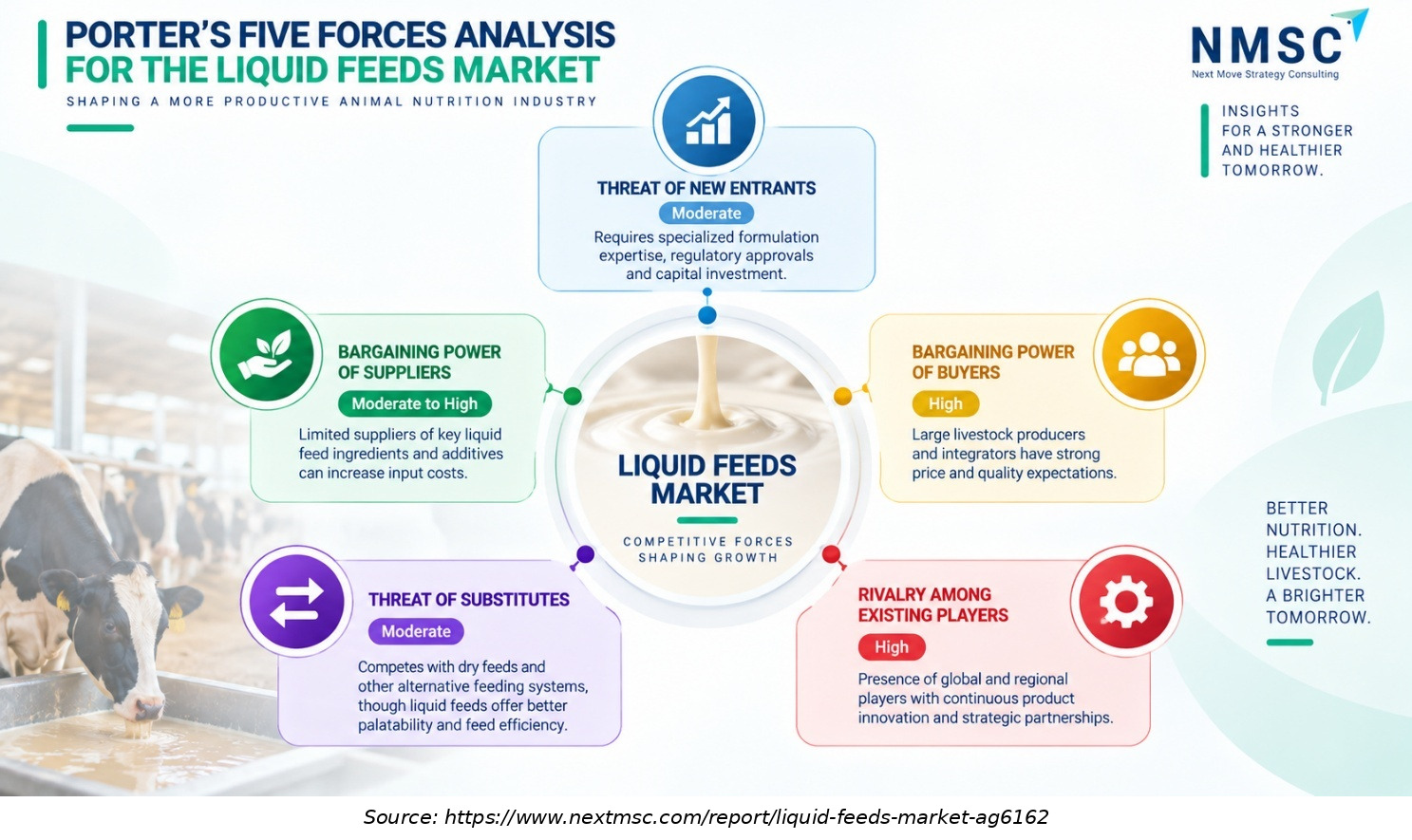
Porter’s Five Forces Analysis for the Liquid Feeds Market
This Porter’s Five Forces analysis highlights the competitive dynamics shaping the Liquid Feeds Market. Supplier bargaining power is moderate to high due to limited key ingredients and additives, while buyer power is high among large livestock producers. The threat of new entrants and substitutes is moderate, influenced by formulation expertise, regulatory requirements, and alternative feeding systems. Competitive rivalry remains high, driven by global and regional players, product innovation, and strategic partnerships.

Regional Outlook

2025 (USD Billion)
2035 (USD Billion)
North Americ
Europe
Asia-Pacific
Middle East
Latin Americ
Region 2025 (USD Billion) 2035 (USD Billion) CAGR (%)
North America $10.0 USD Billion $40.0 USD Billion 9.0%
Europe $17.1 USD Billion $51.1 USD Billion 27.0%
Asia-Pacific $24.2 USD Billion $62.2 USD Billion 25.0%
Middle East & Africa $31.3 USD Billion $73.3 USD Billion 23.0%
Latin America $38.4 USD Billion $84.4 USD Billion 12.0%

Regional data is locked

Unlock complete regional numbers for this market.

Unlock Full Data

Competitive Landscape

We observed that the liquid feeds market features a moderately consolidated competitive landscape, with diversified agricultural commodity traders competing alongside specialized liquid feed manufacturers on molasses sourcing scale, functional additive innovation, and distribution reach.

Dimension Description
Dimension Assessment
Market Structure Moderately consolidated; leading companies profiled in this report account for a substantial share of Industry revenue, while numerous regional blenders and cooperatives serve cost-sensitive local dairy and feedlot demand.
Innovation Focus Functional additive integration, postbiotic and microbiome research, and co-product carrier diversification dominate current innovation pipelines across leading suppliers.
M&A Activity Active consolidation through joint ventures and capacity expansion, exemplified by the Akralos Animal Nutrition joint venture between ADM and Alltech, launched in February 2026 to combine North American feed mill networks.

How Do Companies Compete in the Liquid Feeds Market?

Companies compete primarily on molasses sourcing scale, functional additive innovation, and distribution network reach across the Industry. Global commodity traders such as Archer Daniels Midland Company and Cargill, Incorporated leverage integrated sourcing, blending, and logistics capabilities to serve multinational dairy and feedlot customers, while specialized regional manufacturers compete on customer service depth and formulation customization for independent farm operations.

Which Competitive Archetypes Dominate the Liquid Feeds Market?

Two archetypes dominate the market: diversified agricultural commodity traders offering integrated molasses sourcing, blending, and global distribution, and specialized liquid feed manufacturers focused on formulation expertise and regional customer relationships. Archer Daniels Midland Company and ED&F Man Holdings Limited exemplify the diversified commodity trader archetype, while Quality Liquid Feeds, Inc. exemplifies the specialized manufacturer archetype serving dairy and beef cattle producers directly.

How Are Companies Differentiating Through Innovation in Liquid Feeds?

Innovation and differentiation strategy increasingly center on functional additive integration and microbiome-focused research. Cargill's postbiotic fermentation capacity expansion at its Cedar Rapids facility and its Engerwitzdorf, Austria micronutrition capacity increase both demonstrate how commodity traders differentiate through science-based additive innovation rather than commodity molasses supply alone. Our analysis shows that suppliers unable to demonstrate credible functional additive pathways risk exclusion from large commercial dairy and feedlot procurement shortlists.

What M&A and Expansion Activity Is Shaping the Liquid Feeds Market?

Strategic joint ventures, capacity expansion, and geographic diversification continue to consolidate capabilities within the Industry. The Akralos Animal Nutrition joint venture between ADM and Alltech, effective February 2026, combines more than 40 feed mills and 1,400 employees to strengthen North American distribution, while Cargill's facility expansions in Austria and Iowa illustrate how commodity traders pursue functional additive capacity scaling across multiple continents.

Key Market Players

Our assessment indicates that the following 20 companies are actively shaping product innovation, molasses sourcing scale, and distribution expansion within the global liquid feeds market.

Archer Daniels Midland Company Cargill, Incorporated ED&F Man Holdings Limited Land O'Lakes, Inc. Alltech, Inc. Louis Dreyfus Company B.V. Cosan S.A. Südzucker AG Associated British Foods plc Tereos SCA Sucres et Denrées SA Nutreco N.V. Ridley Corporation Limited Phibro Animal Health Corporation BASF SE Quality Liquid Feeds, Inc. Kent Corporation CHS Inc. Indiana Sugars, Inc. Animix LLC

Latest Developments

We observed that recent company activity centers on capacity expansion, joint ventures, and functional additive innovation across the liquid feeds market.

Date Event
May, 2026 Phibro launched its Sustainable Solutions Platform and introduced Verratain™ Spirulina and Verratain™ Omega Oil through a strategic partnership with VAXA Technologies. The low-carbon microalgae feed ingredients are designed for integration into existing feeding systems, adding new functional ingredient options for animal nutrition formulations.
October, 2025 Nutreco highlighted its Revalet range for treating high-moisture food-industry byproducts so they remain safe, nutritious and usable as animal feed. The company also cited collaboration with Wageningen University & Research examining liquid feeds based on food-industry byproducts in swine production.

Expert Insights

Dr. Kelley Neuhold

Beef Technical Support Manager | Westway Feed Products

"Liquid feeds aren’t meant to replace a lot of ingredients in a diet. They replace a few things, but they are primarily meant to add to the diet and make other ingredients more digestible."

Analyst Interpretation

The insight underscores the role of liquid feeds as targeted nutritional supplements that complement conventional rations and can improve nutrient digestibility. This supports market demand for formulated liquid-feed products designed to enhance feed efficiency, nutrient utilization, and livestock performance.

Investment Opportunities

What Capital Inflows Are Targeting the Liquid Feeds Market?

Capital inflows into the liquid feeds market are increasingly directed toward functional additive capacity and consolidated distribution platforms. Strategic investment continues to fund platform expansion, as seen in Cargill's Engerwitzdorf and Cedar Rapids facility upgrades and the Akralos Animal Nutrition joint venture, both advanced in 2025 and 2026. We observed that investors favor manufacturers demonstrating validated functional additive credentials, viewing microbiome-focused innovation as a proxy for long-term margin retention amid molasses price volatility.

How Is Infrastructure Investment Supporting Liquid Feeds Manufacturing?

Infrastructure investment is expanding blending and fermentation capacity across North America, Europe, and Asia-Pacific to serve rising dairy and livestock demand. Our findings suggest that manufacturers are investing in postbiotic fermentation facilities and regional Animal Nutrition & Health manufacturing presence in India to improve responsiveness for fast-growing dairy cooperative and commercial feedlot customers across emerging markets.

What ESG Considerations Are Shaping Liquid Feeds Investment Decisions?

Environmental, social, and governance considerations are central to investment decisions across the Industry, with reduced feed waste and improved herd health as key criteria. Cargill's own facility investments emphasize 100% renewable energy use and enhanced worker safety alongside production capacity gains. We found that investors increasingly favor manufacturers demonstrating measurable sustainability outcomes in molasses sourcing and co-product upcycling, treating it as a governance indicator alongside labor and safety compliance.

Key Benefits for Stakeholders

How Does This Report Benefit Enterprise and Industry Leaders?

Enterprise and industry leaders gain access to validated segmentation, competitive benchmarking, and regional demand forecasts that support sourcing and vendor-selection decisions across the liquid feeds Industry. Our analysis shows that detailed product type, carrier base, and livestock application breakdowns help procurement teams align specifications with herd productivity and cost management goals while identifying underserved feeding method and distribution channel segments for portfolio expansion.

How Does This Report Benefit Investors and Financial Analysts?

Investors and financial analysts benefit from consistent, single-point market size and CAGR estimates that support valuation and capital-allocation decisions across the liquid feeds supply chain. We observed that the report's regional and segment-level growth differentials help identify which manufacturers are best positioned to capture above-market growth in functional additive and Asia-Pacific categories through 2035.

How Does This Report Benefit Technology Vendors and Product Teams?

Technology vendors and product teams gain insight into emerging formulation requirements, including postbiotic integration and specialty chemical-grade functional additives, that are reshaping the Industry. Our findings suggest that this analysis helps R&D teams prioritize development roadmaps around microbiome science and co-product carrier diversification increasingly required by large commercial dairy procurement processes.

Key Market Segments Evaluated

By Product Type

  • Macronutrient Supplements 
    • Molasses-Based Protein Blends
    • Liquid Fat Supplements
    • Liquid Energy Supplements
  • Micronutrient Premixes 
    • Vitamin Premixes
    • Mineral and Trace Element Premixes
  • Functional Additives 
    • Organic Acid Blends
    • Yeast and Probiotic Liquids
    • Enzyme Liquids
  • Combination and Multi-Ingredient Blends

By Carrier Base

  • Molasses-Based
  • Whey and Dairy Co-Product-Based
  • Glycerin-Based
  • Corn and Soy Co-Product-Based
  • Other Liquid Co-Product-Based

By Livestock Application

  • Dairy Cattle
  • Beef Cattle
  • Swine
  • Poultry
  • Aquaculture
  • Sheep and Goats
  • Other Livestock

By Feeding Method

  • Free-Choice Lick Tank
  • Top-Dress Application
  • Total Mixed Ration Blending
  • Automated Dispensing Systems

By Distribution Channel

  • Direct Farm Delivery
  • Feed Mill and Cooperative Distribution
  • Agricultural Retail and Dealer Networks
  • Online and Direct-to-Farm Ordering

By Operation Scale

  • Large Commercial Feedlots and Dairies
  • Mid-Size Commercial Operations
  • Small and Independent Farms

By Region

  • North America 
    • U.S.
    • Canada
    • Mexico.
  • Europe 
    • UK
    • Germany
    • France
    • Italy
    • Spain
    • Sweden
    • Denmark
    • Finland
    • Netherlands
    • Rest of Europe.
  • Asia-Pacific 
    • China
    • India
    • Japan
    • South Korea
    • Taiwan
    • Indonesia
    • Vietnam
    • Australia
    • Philippines
    • Malaysia
    • Rest of APAC.
  • Middle East & Africa 
    • Saudi Arabia
    • UAE
    • Egypt
    • Israel
    • Turkey
    • Nigeria
    • South Africa
    • Rest of MEA.
  • Latin America 
    • Brazil
    • Argentina
    • Chile
    • Colombia
    • Rest of LATAM.

Conclusion & Recommendations

The long-term outlook for the liquid feeds market remains strongly positive, supported by a USD 94.81 billion absolute dollar opportunity between 2026 and 2035 and sustained Asia-Pacific dairy expansion. NMSC's analysis indicates that manufacturers combining functional additive innovation with consolidated distribution platforms will be best positioned to capture the market's projected growth from USD 109.36 billion in 2026 to USD 204.17 billion by 2035.

What Strategic Positioning Should Suppliers Pursue in the Liquid Feeds Market?

Suppliers should prioritize functional additive integration to secure long-term commercial dairy and feedlot contracts. Our assessment indicates that manufacturers investing early in postbiotic research and co-product carrier diversification, alongside expanded distribution networks, will be best positioned to capture premium pricing within the liquid feeds market as herd productivity targets rise.

How Attractive Is the Liquid Feeds Market for New Investment?

The liquid feeds Industry presents an attractive investment case, supported by a USD 94.81 billion absolute dollar opportunity between 2026 and 2035 and above-average growth in Asia-Pacific and functional additive categories. We found that investment attractiveness is highest for manufacturers combining validated additive innovation with scaled distribution capacity, positioning them to serve both mature North American and emerging Asia-Pacific dairy segments simultaneously.

What Market Shifts and Key Risks Should Stakeholders Monitor?

Stakeholders should monitor molasses price volatility, competition from dry feed formats, and integration risk from ongoing industry consolidation as key risks to the liquid feeds market. Our analysis shows that manufacturers unable to diversify carrier ingredient sourcing risk margin compression relative to competitors with established co-product supply chains, particularly amid fluctuating sugar cane harvest cycles.

What Are the Key Growth Pathways for the Liquid Feeds Market?

Key growth pathways include expanding functional additive and combination blend portfolios, scaling postbiotic and microbiome research capacity, and deepening penetration into Asia-Pacific and Latin American dairy channels. NMSC's analysis indicates that manufacturers pursuing these pathways while maintaining cost competitiveness in standard macronutrient supplements will be best positioned to capture the liquid feeds market's projected growth through 2035.

FAQs

Market Size & Forecast

Liquid Feeds Market Global Industry Analysis and Forecast (2026-2035) Revenue Forecast

Values in USD Billion

2025 $98.83 Billion
2025
2026 $105.93 Billion
2026
2027 $113.53 Billion
2027
2028 $121.68 Billion
2028
2029 $130.42 Billion
2029
2030 $139.78 Billion
2030
2031 $149.82 Billion
2031
2032 $160.58 Billion
2032
2033 $172.11 Billion
2033
2034 $184.46 Billion
2034
2035 $204.17 Billion
2035

Key Takeaways

By Product Type: Macronutrient Supplements held the largest share of approximately 57% (USD 56.33 billion) in 2025; Combination and Multi-Ingredient Blends is the fastest-growing sub-segment at 10.7% CAGR from 2026–2035.

By Carrier Base: Molasses-Based held the largest share of approximately 64% (USD 63.25 billion) in 2025; Other Liquid Co-Product-Based is the fastest-growing sub-segment at approximately 11.3% CAGR from 2026–2035.

By Livestock Application: Dairy Cattle held the largest share of approximately 47% (USD 46.45 billion) in 2025; Aquaculture is the fastest-growing sub-segment at 13.4% CAGR from 2026–2035.

By Feeding Method: Free-Choice Lick Tank held the largest share of approximately 41% (USD 40.52 billion) in 2025; Automated Dispensing Systems is the fastest-growing sub-segment at approximately 11.8% CAGR from 2026–2035.

By Distribution Channel: Feed Mill and Cooperative Distribution held the largest share of approximately 38% (USD 37.56 billion) in 2025; Online and Direct-to-Farm Ordering is the fastest-growing sub-segment at approximately 12.5% CAGR from 2026–2035.

By Operation Scale: Large Commercial Feedlots and Dairies held the largest share of approximately 49% (USD 48.43 billion) in 2025; Mid-Size Commercial Operations is the fastest-growing sub-segment at approximately 9.0% CAGR from 2026–2035.

Dominant Region: North America dominated with approximately 32% revenue share (USD 31.63 billion) in 2025.

Fastest-Growing Region: Asia-Pacific is expected to register the highest CAGR of 9.2% during 2026–2035.

Dominant Country: U.S. led with approximately USD 24.04 billion in 2025.

Fastest-Growing Country: India is the fastest-growing country at approximately 11.0% CAGR from 2026–2035.

Market Opportunity: The liquid feeds market is expected to create an absolute dollar opportunity of USD 94.81 billion between 2026 and 2035, presenting significant investment potential across functional additive blends and Asia-Pacific dairy and beef supply chains.

According to NMSC analysis, feed manufacturers are increasingly consolidating molasses sourcing and blending capacity around integrated agricultural commodity traders, a shift that favors full-supply-chain providers over regional blenders as functional additive adoption accelerates through 2035.

Sources & References

1.

Archer Daniels Midland Company

adm.com
2.

Cargill, Incorporated

cargill.com
3.

Alltech, Inc.

alltech.com
4.

Akralos Animal Nutrition

akralos.com
5.

ED&F Man Holdings Limited

edfmanmolasses.com
6.

Südzucker AG

suedzuckergroup.com
7.

U.S. Department of Agriculture (USDA)

usda.gov
8.

USDA National Agricultural Statistics Service

nass.usda.gov
9.

U.S. Geological Survey (USGS)

usgs.gov
10.

European Commission

commission.europa.eu

About the Author

Liza Phukan

Liza Phukan

Liza Phukan is Research Associate at Next Move Strategy Consulting, where she has covered emerging industries and market research across sectors for 3.5 years. Her work includes analyzing industry developments, validating market data, and developing structured business content from research findings. She uses secondary research and data-validation practices to turn complex market information into clear decision-useful market analysis for business audiences and support report development and B2B.

About the Reviewer

Supradip Baul

Supradip Baul

Supradip Baul is an accomplished business consultant and strategist with over a decade of rich experience in market intelligence, strategy, technology, and business transformation. His work has included rigorous qualitative and quantitative analysis across multiple industries, helping clients shape investment decisions and long-term roadmaps. Earlier in his career, he was associated with Gartner, where he contributed to industry-leading reports and market share analyses. He has worked with leading global companies and holds an MBA with a dual specialization in Marketing and Finance.

Download Free Sample

Henri Knyphausen

HENRI KNYPHAUSEN

Partner at Singulier [Ex-BCG]

Singulier

I recently engaged NEXTMSC.com for a commercial due diligence project within the intralogistics sector, and I am pleased to provide a reference based on my experience. In utilizing NEXTMSC.com's services, I found their report to offer valuable insights into market dynamics and key industry players. The initial report provided a solid foundation for our analysis. However, as we were investigating a smaller target in the market, and I had specific customization requests requiring additional research. These requests included detailed information on product portfolios of various players and sub-market sizes, both inclusive and exclusive of certain product categories. NEXTMSC.com demonstrated commendable responsiveness and agility in accommodating these customization requests. Within a timeframe of 1-2 weeks, they delivered a revised report that met our specific needs. Furthermore, they were receptive to my follow-up inquiries, ensuring clarity and understanding of the data provided. The final deliverable significantly contributed to our due diligence efforts. One of NEXTMSC.com's notable strengths lies in their qualitative research capabilities. However, for future engagements, I would recommend the inclusion of a quantified market model in Excel format. Such a model would offer the ability to conduct in-depth analyses and explore various market segments, including country-specific data and subcomponent breakdowns. Based on my positive experience, I would not hesitate to work with NEXTMSC.com again. Their responsiveness, willingness to accommodate customization requests, and commitment to delivering actionable insights make them a reliable partner for commercial research projects.

Amos Chang

AMOS CHANG

Strategy Consultant

Kardex Group

I have bought the intralogistics market reports from NMSC two times so far. Joseph and his team are always very helpful and flexible in responding to any customization requirements on the report. Their expertise in market reports really helps us steer the day-to-day business. I will definitely recommend and come back myself whenever there is a need.

Melanie Samko

MELANIE SAMKO

Director of Marketing

TOSOH BIOSCIENCE, INC.

The information provided by NMSC is incredibly valuable, thank you so much for such a excellent work. I really appreciate it. I will make sure to reference all of it, in my summary document.

Nishant Awate

NISHANT AWATE

Business Development Global Sales

Zehnder Group Deutschland GmbH

Our experience working with Next Move Strategy Consulting was positive. The team was responsive, professional, and open to incorporating our specific requirements throughout the project. The India AHU market study was comprehensive and well structured, covering market value and volume forecasts, product and application segments, and key industry trends. The inclusion of both AHU and residential MVHR market insights made the study particularly relevant for our strategic market assessment. Overall, the report provides a solid foundation for evaluating market potential, identifying priority segments, and supporting business-development decisions in India.

Rishabh Jogani

RISHABH JOGANI

Strategy Analyst

Accenture Japan

We are incredibly impressed with the market report on the real estate market in India provided by Next Move Strategy Consulting. The report was thorough, insightful, and well-structured, offering deep analysis and actionable recommendations. It not only captured the current trends and dynamics but also provided a forward-looking perspective that has been invaluable for our strategic planning. Their team demonstrated exceptional professionalism, attention to detail, and a profound understanding of the industry. The data-driven insights and clarity of presentation exceeded our expectations, making complex market trends easy to understand. We highly recommend Next Move Strategy Consulting to anyone looking for reliable and comprehensive market research services. Their expertise has given us the confidence to navigate the complexities of the Indian real estate market with clarity and foresight.

Custom Market Research Services

We will customize the research for you if the listed report does not fully match your requirements.

Get 30% Free Customization

Select License

This website uses cookies to ensure you get the best experience on our website. Learn more

✖