Liquid Laundry Detergent Market Global Industry Analysis and Forecast (2026-2035)

Liquid laundry detergent market size is estimated at USD 52.64 billion in 2026, projected to reach USD 80.57 billion by 2035, growing at a CAGR of 4.84% from 2026 to 2035. Key drivers include rising washing machine penetration, premiumization toward concentrated and pod formulations, and expanding e-commerce channels, with Asia-Pacific leading the market and Middle East & Africa registering the fastest growth.

Download Free Sample PDF
Base Year (2025)
$49.54 Billion
Forecast (2035)
$80.57 Billion
CAGR (2026-2035)
4.8%
Top Region
Asia-Pacific

What Is the Liquid Laundry Detergent Market Size?

The global liquid laundry detergent market size was valued at USD 49.54 Billion in 2025 and is estimated to grow from USD 52.64 Billion in 2026 to USD 80.57 Billion by 2035, expanding at a CAGR of 4.84% between 2026 and 2035. Asia-Pacific led the liquid laundry detergent market with an approximate 36% revenue share in 2025, while Conventional Liquid Detergent remained the dominant formulation segment within the broader fabric care category, holding an approximate 52% share of global revenue.

We observed that the liquid laundry detergent market's momentum is best captured through a concise set of indicators before deeper analysis follows.

Liquid Laundry Detergent Market Global Industry Analysis and Forecast (2026-2035) Revenue Forecast

Values in USD Billion

2025 $49.54 Billion
2025
2026 $51.94 Billion
2026
2027 $54.45 Billion
2027
2028 $57.09 Billion
2028
2029 $59.85 Billion
2029
2030 $62.75 Billion
2030
2031 $65.78 Billion
2031
2032 $68.97 Billion
2032
2033 $72.31 Billion
2033
2034 $75.81 Billion
2034
2035 $80.57 Billion
2035

Key Takeaways

By Formulation: Conventional Liquid Detergent held the largest share of approximately 50% (USD 25.76 billion) in 2025; Liquid Detergent Pods is the fastest-growing sub-segment at 9.87% CAGR from 2026–2035.

By Distribution Channel: Supermarkets and Hypermarkets held the largest share of approximately 46% (USD 23.78 billion) in 2025; Online Retail is the fastest-growing sub-segment at 9.99% CAGR from 2026–2035.

By End Use: Household and Residential held the largest share of approximately 79% (USD 40.62 billion) in 2025; Commercial and Institutional is the fastest-growing sub-segment at 8.05% CAGR from 2026–2035.

Dominant Region: Asia-Pacific dominated with approximately 35% revenue share (USD 17.84 billion) in 2025.

Fastest-Growing Region: Middle East & Africa is expected to register the highest CAGR of 10.50% during 2026–2035.

Dominant Country: China led with the largest single national contribution within Asia-Pacific in 2025.

Fastest-Growing Country: Saudi Arabia is the fastest-growing country, with a CAGR exceeding the regional Middle East & Africa average.

Market Opportunity: The liquid laundry detergent market is projected to generate an incremental revenue opportunity of approximately USD 27.93 Billion between 2026 and 2035, reflecting the absolute dollar gap between the 2035 forecast and the 2026 base value a signal of sustained premiumization toward concentrated and unit-dose formulations.

According to NMSC analysis, unit-dose pod formats are gaining share fastest among urban households in markets with compact living spaces, a dynamic tied to storage convenience that is not fully captured in aggregate formulation revenue figures.

What does the Liquid Laundry Detergent Market Encompass?

The liquid laundry detergent market encompasses liquid-form fabric cleaning products, including conventional, concentrated, and unit-dose pod formulations, sold to household and commercial and institutional end users. Our assessment indicates that the market's scope spans supermarket, convenience store, online, and other retail distribution channels, distinct from powder detergent and standalone dishwashing detergent categories that serve different cleaning applications and purchase occasions.

Structurally, the market has evolved from conventional dilute liquid formulas toward concentrated and ultra-concentrated products requiring smaller dose volumes per wash load. We found that regulatory environments administered by consumer product safety and environmental authorities continue to tighten packaging and ingredient disclosure requirements, while technology adoption trends in enzyme-based and cold-water-effective formulations are reshaping how manufacturers balance cleaning performance against reduced energy and water consumption.

Consumer Behavior in the Liquid Laundry Detergent Market
Consumer Behavior in the Liquid Laundry Detergent Market

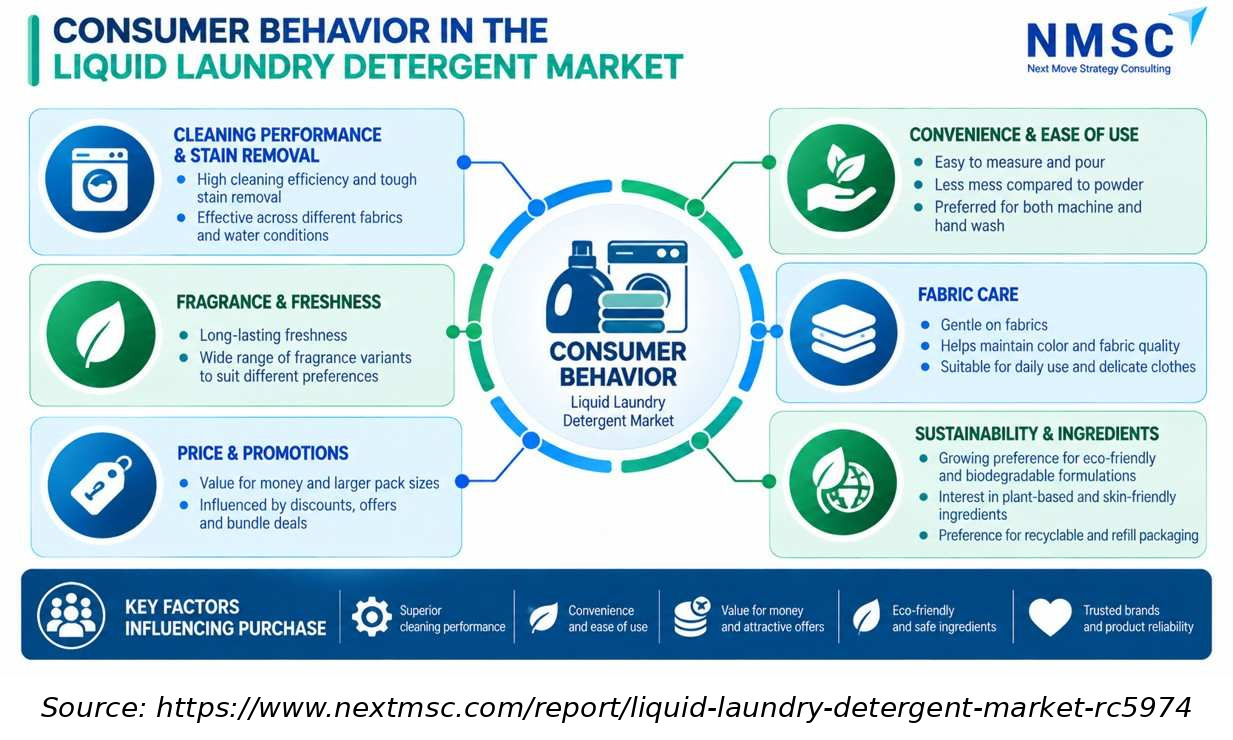
This infographic presents the Consumer Behavior in the Liquid Laundry Detergent Market, highlighting cleaning performance, stain removal, fragrance, convenience, fabric care, price and promotions, and sustainability preferences. It shows how consumers evaluate product effectiveness, ease of use, freshness, fabric protection, value for money, eco-friendly formulations, and packaging when selecting liquid laundry detergents for household and commercial laundry needs.

Market Drivers & Dynamics

Interactive Dataset
Rising household formation and washing machine penetration in emerging markets driver +1.4% Asia-Pacific, Latin America, MEA 2026–2035
Growing premiumization toward concentrated and pod formulations driver +1.1% North America, Europe 2026–2033
Expanding e-commerce and subscription replenishment channels driver +0.8% Global 2027–2035
Rising commercial and institutional laundry service demand driver +0.6% North America, Europe, Asia-Pacific 2026–2032
Volatile surfactant and petrochemical raw material pricing restraint −0.6% Global 2026–2030
Tightening ingredient disclosure and environmental packaging regulation restraint −0.4% North America, Europe 2026–2032
Private label price competition compressing branded product margins restraint −0.3% North America, Europe 2026–2035
Source: Next Move Strategy Consulting

Growth Drivers

What Is the Primary Growth Driver for the Liquid Laundry Detergent Market?

Rising household formation and washing machine penetration in emerging markets is the primary growth driver, as expanding middle-class populations gain access to home laundry appliances for the first time. The United Nations Department of Economic and Social Affairs projects continued urban household formation growth across Asia-Pacific and Latin America through the coming decade, underscoring the expanding addressable household base for liquid detergent demand.

How Is Premiumization Driving the Market Growth?

Premiumization toward concentrated and pod formulations is driving growth by increasing average revenue per wash load relative to conventional dilute liquid products. Company analysis indicates that manufacturers with established pod and concentrate manufacturing capability are capturing incremental margin from convenience-seeking households. Based on research conducted by NMSC, we found that this shift is most pronounced across North American and European urban markets.

Growth Inhibitors

What Is Restraining the Liquid Laundry Detergent Market?

Volatile surfactant and petrochemical raw material pricing is restraining margin stability, as liquid detergent production costs are directly tied to petroleum-derived surfactant inputs. We observed that this restraint is most pronounced for manufacturers lacking long-term feedstock supply agreements, exposing production costs to periodic energy and petrochemical market volatility that compresses margins even as consumer demand remains stable.

Segmentation Analysis

2025 (USD Billion)
2035 (USD Billion)
Conventional Liquid Detergent 2025: $25.76 Billion | 2035: $32.23 Billion
Conventional
Concentrated Liquid Detergent 2025: $16.84 Billion | 2035: $30.61 Billion
Concentrated
Liquid Detergent Pods 2025: $6.94 Billion | 2035: $17.73 Billion
Liquid Deter
Conventional Liquid Detergent $25.76 Billion $32.23 Billion 2.26%
Concentrated Liquid Detergent $16.84 Billion $30.61 Billion 6.16%
Liquid Detergent Pods $6.94 Billion $17.73 Billion 9.87%

Which Formulation Dominates the Liquid Laundry Detergent Market?

Conventional Liquid Detergent dominates formulation segmentation with an estimated USD 25.76 Billion in 2025, rising to USD 32.23 Billion by 2035, reflecting its continued price-accessible positioning across value-conscious and emerging-market households. Liquid Detergent Pods are the fastest-growing formulation at a 9.87% CAGR, reflecting rising adoption among convenience-seeking urban households in compact living spaces.

2025 (USD Billion)
2035 (USD Billion)
Supermarkets
Convenience
Online retai
Other retail
Segment Item 2025 (USD Billion) 2035 (USD Billion) CAGR
Supermarkets and hypermarkets $10.0 USD Billion $40.0 USD Billion 25.0%
Convenience stores $17.1 USD Billion $51.1 USD Billion 19.0%
Online retail $24.2 USD Billion $62.2 USD Billion 25.0%
Other retail channels $31.3 USD Billion $73.3 USD Billion 19.0%

Segment-wise data is locked

Unlock complete segment-wise numbers for By Distribution Channel.

Unlock Full Data

Which Distribution Channel Is Gaining the Most Ground?

Supermarkets and Hypermarkets lead distribution-channel segmentation with USD 23.78 Billion in 2025 revenue, reflecting their continued role as the primary bulk-purchase venue for laundry care products. Online Retail is the fastest-growing channel at a 9.99% CAGR, driven by rising subscription replenishment adoption and growing consumer comfort purchasing bulky household staples through digital channels.

2025 (USD Billion)
2035 (USD Billion)
Household an
Commercial a
Segment Item 2025 (USD Billion) 2035 (USD Billion) CAGR
Household and residential $10.0 USD Billion $40.0 USD Billion 15.0%
Commercial and institutional $17.1 USD Billion $51.1 USD Billion 13.0%

Segment-wise data is locked

Unlock complete segment-wise numbers for By End Use.

Unlock Full Data

Which End Use Segment Is Growing Fastest?

Household and Residential leads end-use segmentation with USD 40.62 Billion in 2025 revenue, reflecting the scale of global home laundry demand relative to commercial applications. Commercial and Institutional is the fastest-growing end use at a 8.05% CAGR, driven by expanding commercial laundry service demand across hospitality, healthcare, and industrial uniform service sectors.

Growth Opportunities

Beyond current demand drivers, three whitespace opportunities stand out as forward-looking mechanisms for revenue expansion through 2035.

Can Affordable Concentrated Formats Unlock Emerging-Market Premiumization?

Lower-cost concentrated liquid formats tailored to price-sensitive emerging-market households can unlock premiumization currently concentrated among North American and European consumers. This mechanism primarily benefits manufacturers with scaled concentrate production capable of reaching cost parity with conventional liquid products in value-focused markets.

Will Refill Pouch Formats Expand Sustainability-Linked Purchasing?

Lightweight refill pouch formats reducing plastic bottle consumption offer a mechanism to capture sustainability-conscious consumer spending while lowering packaging costs. Manufacturers with established refill infrastructure and surfactant sourcing efficiency are best positioned to capture this expanding environmentally motivated purchase segment.

Can Direct-to-Consumer Subscription Models Expand Brand Loyalty Margins?

Direct-to-consumer subscription replenishment models offer brands a mechanism to capture higher per-unit margins while reducing retailer distribution costs and improving customer retention data visibility. Manufacturers with established digital commerce infrastructure are best positioned to capture this direct-channel opportunity as e-commerce penetration continues expanding.

Ecosystem Analysis

Regional Outlook

2025 (USD Billion)
2035 (USD Billion)
North Americ
Europe
Asia-Pacific
Middle East
Latin Americ
Region 2025 (USD Billion) 2035 (USD Billion) CAGR (%)
North America $10.0 USD Billion $40.0 USD Billion 9.0%
Europe $17.1 USD Billion $51.1 USD Billion 27.0%
Asia-Pacific $24.2 USD Billion $62.2 USD Billion 25.0%
Middle East & Africa $31.3 USD Billion $73.3 USD Billion 23.0%
Latin America $38.4 USD Billion $84.4 USD Billion 12.0%

Regional data is locked

Unlock complete regional numbers for this market.

Unlock Full Data

Competitive Landscape

Our findings suggest that the competitive landscape spans diversified global consumer goods conglomerates and regional fast-moving consumer goods manufacturers, each pursuing distinct differentiation strategies.

Dimension Description
Dimension Assessment
Market Structure Moderately consolidated; diversified global conglomerates hold significant branded premium share while regional manufacturers compete on price-accessible value positioning
Innovation Focus Concentrated and pod formulation technology, cold-water enzyme performance, refill and sustainable packaging design
M&A Activity Selective; diversified conglomerates pursue targeted regional brand acquisitions to expand emerging-market distribution reach

How Do Companies Compete in the Liquid Laundry Detergent Market?

Companies compete primarily on brand equity, formulation performance credibility, and breadth of retail distribution relationships across supermarket, convenience, and online channels. Our analysis shows that manufacturers combining strong brand recognition with concentrated and pod formulation capability sustain larger market share than regional competitors reliant on conventional liquid products alone.

Which Competitive Archetypes Dominate the Liquid Laundry Detergent Market?

Two archetypes dominate: diversified global consumer goods conglomerates with multi-category brand portfolios and extensive retail distribution reach, and regional fast-moving consumer goods manufacturers competing on price-accessible positioning within specific national markets. We observed that the differentiation between these archetypes is narrowing as regional manufacturers expand premium concentrated product lines.

What Innovation and Differentiation Strategies Are Companies Pursuing?

Company analysis indicates that leading firms are differentiating through proprietary enzyme technology for cold-water performance, expanded pod and concentrate manufacturing capability, and refill and sustainable packaging formats. Investment in direct-to-consumer digital commerce infrastructure continues, alongside expanded regional manufacturing capacity to serve growing emerging-market household demand.

How Active Is M&A in the Liquid Laundry Detergent Industry?

M&A activity remains selective as diversified conglomerates pursue targeted regional brand acquisitions to expand emerging-market distribution reach rather than broad portfolio consolidation. Based on research conducted by NMSC, we found that acquisition interest is concentrated on regional manufacturers with established local distribution networks, reflecting strategic pivots toward the fastest-growing Middle East & Africa and Latin America regional categories.

Key Market Players

Our assessment indicates that the following companies represent the validated set of key players shaping competitive dynamics across conventional, concentrated, and pod liquid detergent categories within the liquid laundry detergent market.

Procter & Gamble Co. Unilever PLC Henkel AG & Co. KGaA Church & Dwight Co., Inc. Reckitt Benckiser Group plc Kao Corporation Lion Corporation LG Household & Health Care Ltd. Godrej Consumer Products Limited RSPL Group Jyothy Labs Limited Nirma Limited Blue Moon Group Holdings Limited Guangzhou Liby Enterprise Group Co., Ltd. Werner & Mertz GmbH McBride plc PZ Cussons plc

Latest Developments

We observed that recent developments across the industry reflect continued investment in concentrated formulation technology and sustainable packaging formats.

Date Event
September, 2026 Unilever reported that Wonder Wash, its latest-generation liquid laundry detergent, is being rolled out beyond Europe into India and Brazil after strong adoption in the UK, France and Türkiye. In 2026, Wonder Wash Max was introduced in France and the UK with enhanced short-cycle stain and malodour performance.
September, 2026 P&G launched Tide Fresh & Gentle with Coastal Oasis Scent, expanding the Free & Gentle liquid detergent line for the first time in more than 30 years. The dermatologist-tested formulation combines a light fragrance with gentle cleaning, targeting consumers seeking fragrance without giving up sensitive-skin positioning

Expert Insights

Srinandan Sundaram

Srinandan Sundaram

Executive Director, Home Care | Hindustan Unilever

"Liquids are the fastest growing segment in this market, where the liquids growth is upwards of four times than the rest of the category."

Analyst Interpretation

The statement provides direct evidence of liquids outperforming the broader laundry category in growth, supporting the view that liquid detergent is one of the key format transitions reshaping laundry care. HUL's strategy of extending liquid products toward more accessible price points also indicates that category expansion is increasingly moving beyond premium urban consumers.

Investment Opportunities

Where Is Capital Flowing Within the Liquid Laundry Detergent Market?

Capital inflows are concentrated in pod and concentrate manufacturing capacity expansion by diversified global conglomerates, alongside targeted regional brand acquisitions in emerging markets. We found that strategic capital is also flowing into sustainable packaging and refill infrastructure development, signaling growing institutional interest in environmentally differentiated product formats.

How Significant Is Infrastructure Investment in This Market?

Infrastructure investment is substantial, with manufacturers expanding concentrate and pod production facilities to meet rising premiumization demand across North America, Europe, and Asia-Pacific. Our assessment indicates that continued investment in regional manufacturing capacity is becoming a prerequisite for competing in fast-growing Middle East & Africa and Latin America markets.

What ESG Considerations Are Relevant to This Market?

ESG considerations center on biodegradable surfactant formulation, reduced plastic packaging through refill and concentrate formats, and responsible water-use messaging embedded in product marketing. We observed that manufacturers increasingly disclose packaging reduction and biodegradability commitments in annual sustainability reporting relevant to environmentally conscious consumer segments.

Key Benefits for Stakeholders

How Does This Report Benefit Industry Leaders?

Industry and enterprise leaders gain a structured view of formulation, channel, and regional revenue distribution, supporting prioritization decisions across product development and distribution strategy. Our analysis shows that this structured segmentation clarifies where competitive intensity is rising fastest ahead of resource-allocation decisions.

How Does This Report Benefit Investors and Financial Analysts?

Investors and financial analysts gain reconciled market-size, CAGR, and regional-growth data supporting valuation and portfolio-allocation decisions. Company analysis indicates that segment-level growth differentials, particularly around pod formulation and online retail categories, are material inputs for evaluating manufacturer growth durability.

How Does This Report Benefit Technology Vendors and Product Teams?

Technology vendors and product teams gain visibility into formulation and channel trends shaping enzyme technology and digital commerce infrastructure demand. We found that this analysis supports prioritization of R&D investment toward the fastest-growing formulation categories identified across the forecast period.

Key Market Segments Evaluated

By Formulation

  • Conventional Liquid Detergent
  • Concentrated Liquid Detergent
  • Liquid Detergent Pods

By Distribution Channel

  • Supermarkets and Hypermarkets
  • Convenience Stores
  • Online Retail
  • Other Retail Channels

By End Use

  • Household and Residential
  • Commercial and Institutional

Conclusion & Recommendations

The long-term outlook remains steadily expansionary, with revenue projected to grow from USD 52.64 Billion in 2026 to USD 80.57 Billion by 2035 at a 4.84% CAGR. Our analysis shows that this trajectory is underpinned by structural household formation growth and rising premiumization rather than cyclical promotional cycles alone.

What Strategic Positioning Should Companies Pursue?

Companies should prioritize concentrated and pod formulation capability alongside sustainable packaging investment over conventional liquid products alone. We found that manufacturers combining formulation premiumization with distribution breadth across modern and online retail channels sustain more resilient revenue than competitors reliant on a single channel or format.

How Attractive Is the Market for Investment?

Investment attractiveness is moderate to high given double-digit growth in pod formulations and online retail channels alongside a large, stable base of conventional liquid demand in mature and emerging markets. Our assessment indicates that capital allocators should weight exposure toward manufacturers with proven premiumization and digital commerce capability over conventional-only regional competitors.

What Market Shifts and Key Risks Should Stakeholders Monitor?

Key risks include volatile surfactant and petrochemical raw material pricing, tightening ingredient disclosure regulation, and private label price competition compressing branded margins. We observed that raw material price volatility poses the most immediate risk to manufacturer margins given the direct link between surfactant costs and petrochemical market conditions.

What Are the Primary Growth Pathways Through 2035?

Primary growth pathways include affordable concentrated formats for emerging-market premiumization, refill pouch formats for sustainability-linked purchasing, and direct-to-consumer subscription models expanding brand loyalty margins. Our findings suggest that companies combining all three pathways will outpace single-lever competitors through the forecast period.

FAQs

About the Author

Liza Phukan

Liza Phukan

Liza Phukan is Research Associate at Next Move Strategy Consulting, where she has covered emerging industries and market research across sectors for 3.5 years. Her work includes analyzing industry developments, validating market data, and developing structured business content from research findings. She uses secondary research and data-validation practices to turn complex market information into clear decision-useful market analysis for business audiences and support report development and B2B.

About the Reviewer

Supradip Baul

Supradip Baul

Supradip Baul is an accomplished business consultant and strategist with over a decade of rich experience in market intelligence, strategy, technology, and business transformation. His work has included rigorous qualitative and quantitative analysis across multiple industries, helping clients shape investment decisions and long-term roadmaps. Earlier in his career, he was associated with Gartner, where he contributed to industry-leading reports and market share analyses. He has worked with leading global companies and holds an MBA with a dual specialization in Marketing and Finance.

Download Free Sample

Mohit Agarwal

MOHIT AGARWAL

Chief Manager

DryChem India Pvt. Ltd.

Next Move Strategy Consulting is an amazing team of consultants. We required a market study report for our investors on top priority and the team went above and beyond our expectations to deliver the same with ample supporting data within a short time span enabling us to secure the investments and keep our project timeline maintained. Their professionalism, attention to detail, and timely delivery of actionable recommendations have left a lasting impression on our organization.

Melanie Samko

MELANIE SAMKO

Director of Marketing

TOSOH BIOSCIENCE, INC.

The information provided by NMSC is incredibly valuable, thank you so much for such a excellent work. I really appreciate it. I will make sure to reference all of it, in my summary document.

Gaurav Jaiswal

GAURAV JAISWAL

Founder & CEO

Yano Charge Private Limited

The EV Charging market research report provided by the NextMSC was exceptionally detailed and insightful. It offered a comprehensive analysis that proved to be a game-changer for our strategic planning. Truly a testament to the NextMSC’s expertise and thoroughness in EV market landscape & analysis.

Diana Trejo

DIANA TREJO

Assistant Manager

Sumitomo Corporation de Mexico, S.A. de C.V.

Recently, we purchased a report on the Mexico Data Center Market from Next Move Strategy Consulting. The service has been excellent, with support that is always timely and thoroughly professional. The information provided is interesting, highly useful, and delivered with clarity. I would highly recommend NextMSC for anyone seeking insightful and dependable analysis.

Semih Kavaklioglu

SEMIH KAVAKLIOGLU

Co-Founder & Sales Manager

Decortie

I work a lot in the marketing industry and I know that research is an essential part of any campaign. I have used Market research reports for my own products and I found them to be very informative and well-researched. The team here produces insightful reports for a good price

Custom Market Research Services

We will customize the research for you if the listed report does not fully match your requirements.

Get 30% Free Customization

Select License

This website uses cookies to ensure you get the best experience on our website. Learn more

✖