Liquid-Cooled EV Charging Cable Market By Product Type (Integrated Cable Assemblies, Detachable Cable Assemblies), By Compatibility (Open Standard, OEM-Proprietary Locked), By Power Rating (400–599 A, 600–799 A, ≥800 A), By Voltage Class (400V Systems, 800V Systems & Others), By Connector Standard (CCS1, CCS2 & Others), By End Use (Public Charging, Commercial Fleet Charging & Others) and By Buyer Type – Global Analysis & Forecast, 2025-2035
Industry: Automotive & Transportation | Latest Edition: September 10, 2026 | No of Pages: 312 | No. of Tables: 1142 | No. of Figures: 1127 | Format: PDF | Report Code: AT4669
Industry Outlook
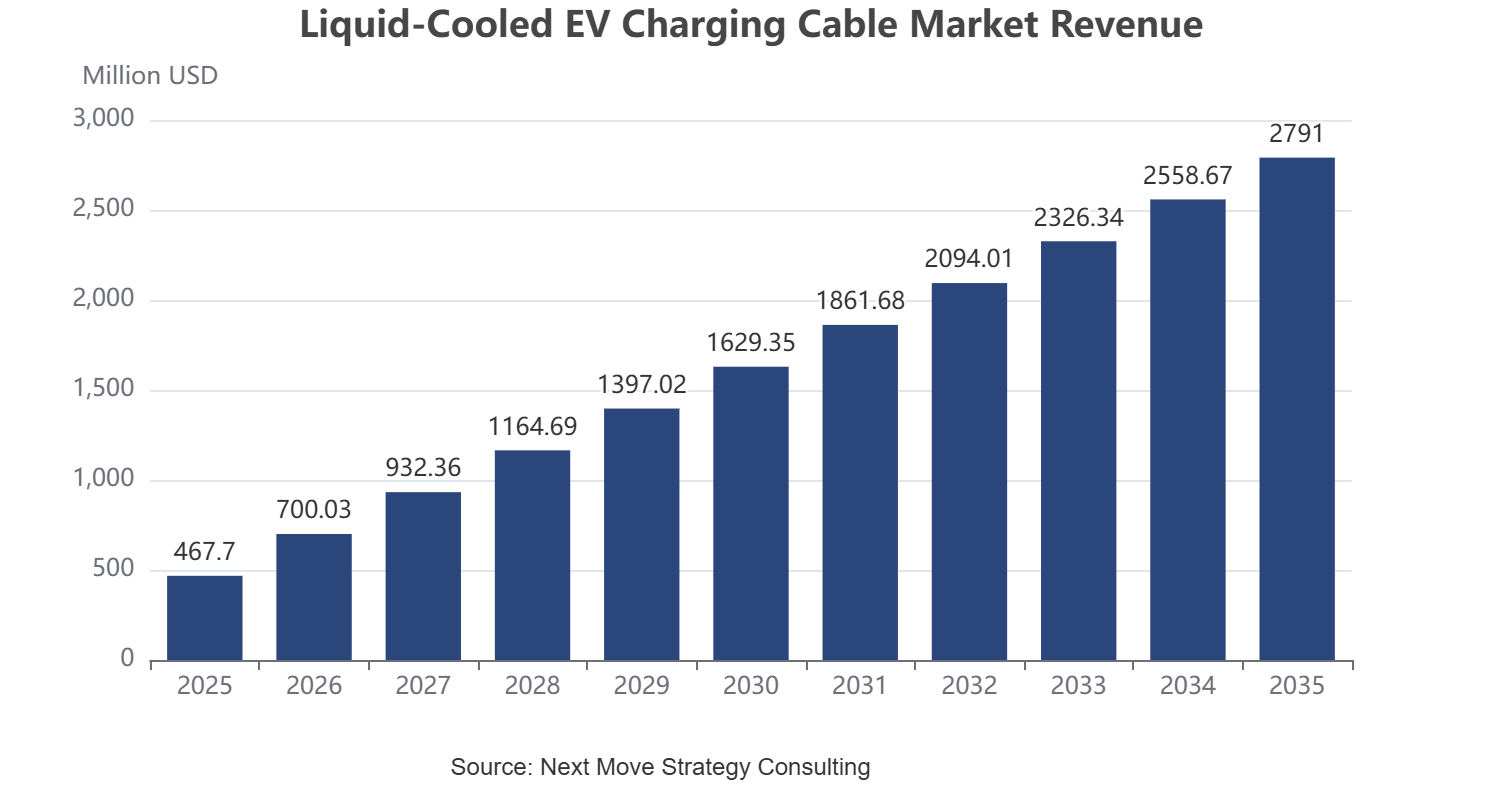
The global Liquid-Cooled EV Charging Cable Market size was valued at USD 467.7 million in 2025 and is expected to reach USD 655.4 million by 2026. Looking ahead, the industry is projected to expand significantly, reaching USD 2791 million by 2035, registering a CAGR of 17.47% from 2026 to 2035. In terms of volume, the market recorded 269 thousand Units in 2025, with forecasts indicating growth to 391 thousand Units by 2026 and further to 2165 thousand Units by 2035, reflecting a CAGR of 20.93% over the same period.
Liquid-Cooled EV Charging Cable Industry Size & Forecast
|
Parameters |
Details |
|
Market Size in 2026 |
USD 655.4 million |
|
Revenue Forecast in 2035 |
USD 2791.0 million |
|
Growth Rate |
CAGR of 17.47% from 2026 to 2035 |
|
Market Volume in 2026 |
391 thousand units |
|
Volume Forecast in 2035 |
2165 thousand units |
|
Growth Rate |
CAGR of 20.93% from 2026 to 2035 |
|
Analysis Period |
2025–2035 |
|
Base Year Considered |
2025 |
|
Forecast Period |
2026–2035 |
|
Market Size Estimation |
Million (USD) |
|
Companies Profiled |
20 |
|
Countries Covered |
33 |
|
Market Share |
Available for 10 companies |
The Liquid-Cooled EV Charging Cable market is witnessing strong growth due to the rapid expansion of ultra-fast EV charging infrastructure and increasing deployment of high-current charging systems globally. Our market analysis shows that automotive manufacturers are increasingly introducing advanced EV platforms that support faster charging speeds, accelerating demand for liquid-cooled EV charging connectors and ultra-fast charging cable solutions. In addition, the growing adoption of megawatt charging systems across electric trucks, buses, and logistics fleets is increasing the need for thermally managed EV cable technologies capable of maintaining stable charging performance under continuous high-load operations. Commercial fleet operators are also investing in high-power charging depots to reduce vehicle downtime and improve operational efficiency. Consequently, charging infrastructure providers are increasingly deploying advanced cooling-enabled charging systems across highway corridors, public charging hubs, and commercial fleet networks.
We further observed that the manufacturers are also focusing on lightweight and compact high-power EV charging cable designs to improve charging flexibility, user handling, and installation efficiency across modern charging environments. Liquid-cooling technology enables efficient heat dissipation while supporting reduced cable diameter without compromising charging performance. Thinner and more flexible DC fast charging cable solutions help reduce connector stress and improve operational convenience across urban charging stations and fleet facilities. In parallel, increasing smart charging integration, renewable energy adoption, and commercial fleet electrification are further strengthening market expansion globally. Growing investments across Asia-Pacific, Europe, and North America are accelerating deployment of next-generation charging infrastructure compatible with 800V and megawatt charging systems. As a result, liquid-cooled charging technologies are becoming increasingly important for supporting efficient, reliable, and scalable EV charging ecosystems worldwide.
What Are the Key Trends in the Liquid-Cooled EV Charging Cable Industry?
How Are Ultra-High Current Charging Systems Accelerating the Liquid-Cooled EV Charging Cable Market Demand?
Our analysis indicates that the expansion of ultra-high current EV charging infrastructure is significantly increasing technology adoption across the Liquid-Cooled EV Charging Cable market. High-current DC charging systems generate substantial heat during energy transfer, necessitating advanced thermal management solutions to maintain charging reliability and operational efficiency. Moreover, automotive manufacturers are introducing advanced EV platforms that support faster charging speeds. This is increasing the demand for liquid-cooled cable assemblies. These charging cables enable continuous high-current transmission while minimizing overheating risks during prolonged charging operations. Consequently, charging network operators are increasingly adopting liquid-cooled charging technologies across highway fast-charging corridors and urban charging hubs. These systems help improve charging consistency and operational efficiency in ultra-fast EV charging environments.
Why Are Megawatt Charging Systems Emerging as a Major Trend in the Liquid-Cooled EV Charging Cable Market?
The growing deployment of megawatt charging systems for heavy-duty electric vehicles is becoming a prominent trend within the Liquid-Cooled EV Charging Cable market. Electric trucks, buses, and logistics fleets require high-capacity charging infrastructure for rapid energy replenishment. These systems also help maintain operational efficiency across demanding transportation networks. Furthermore, our evaluation shows that liquid-cooled charging cables are gaining traction because they effectively manage the excessive heat generated during megawatt-level charging operations. Commercial fleet operators are also investing in high-power charging depots to minimize vehicle downtime and improve route productivity. Therefore, the rising electrification of commercial mobility is encouraging manufacturers to develop durable and thermally optimized charging cable solutions. These systems support continuous high-current transmission across intensive heavy-duty EV fast-charging networks.
How Is Cable Miniaturization Influencing Product Development in the Liquid-Cooled EV Charging Cable Market?
Our market research suggests that manufacturers are increasingly focusing on compact and lightweight cable designs to improve charging convenience and operational flexibility within the Liquid-Cooled EV Charging Cable market. High-current charging applications require thermally optimized cable architectures capable of maintaining charging efficiency under elevated electrical loads. Alongside this, liquid-cooling technology enables efficient heat dissipation, allowing manufacturers to reduce cable diameter without compromising charging performance. Thinner and lighter charging cables also improve user handling, reduce mechanical stress on charging connectors, and support easier installation across public charging infrastructure. As a result, charging equipment providers are prioritizing ergonomic and flexible cable architectures across urban charging stations, fleet facilities, and highway fast-charging corridors. Growing EV infrastructure deployment is further accelerating demand for lightweight EV charging cables.
Supply Chain Structure of the Liquid-Cooled EV Charging Cable Industry
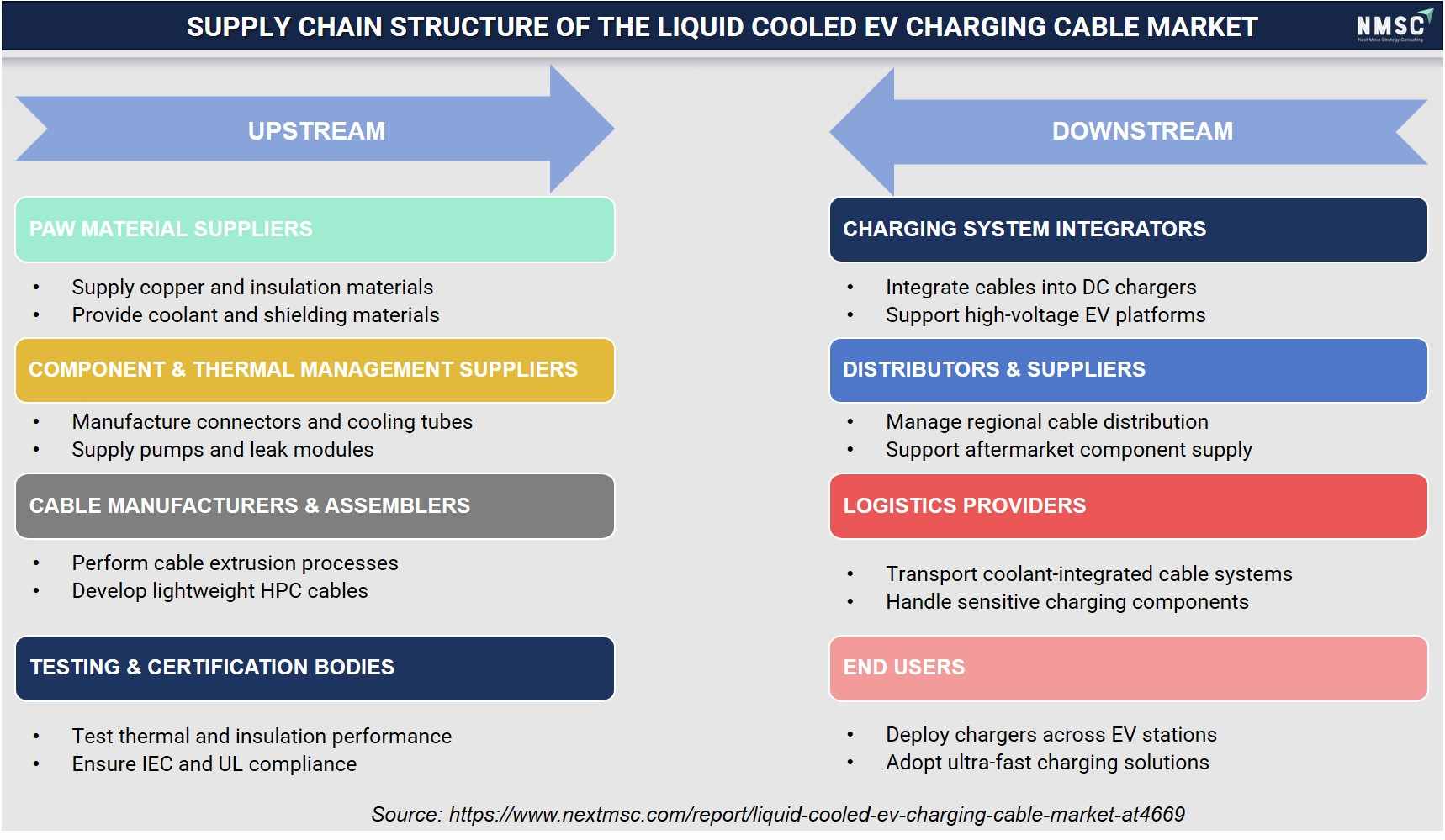
Our assessment indicates that the Liquid-Cooled EV Charging Cable market supply chain is structured across upstream and downstream operations to support ultra-fast EV charging infrastructure. Upstream activities include raw material sourcing, thermal management component manufacturing, cable assembly, and certification processes focused on high-current performance and thermal efficiency. Meanwhile, downstream operations involve charging system integration, regional distribution, logistics handling, and deployment across public and commercial EV charging stations. Furthermore, increasing adoption of high-voltage EV platforms and megawatt charging systems is driving demand for advanced liquid-cooled charging cable networks globally.
What Are the Key Market Drivers, Breakthroughs, and Investment Opportunities that will Shape the Liquid-Cooled EV Charging Cable Industry in the Next Decade?
Growth Catalyst & Risk Assessment Matrix
|
DRIVERS / TRENDS / RESTRAINTS |
(+/-) % IMPACT ON CAGR FORECAST |
GEOGRAPHIC RELEVANCE |
IMPACT TIMELINE |
|
Expansion of national EV infrastructure programs, including charging corridors and public-private partnerships |
+5.10% |
Asia-Pacific (India, China), Europe, North America |
Short to Medium term (1–4 years) |
|
Accelerating commercial fleet electrification across logistics, transit, and freight sectors |
+4.60% |
Asia-Pacific, Europe, Latin America |
Medium term (3–6 years) |
|
High infrastructure, installation, and maintenance costs limiting large-scale deployment |
-3.80% |
Asia-Pacific (emerging economies), Africa, Latin America |
Short to Medium term (1–4 years) |
|
Integration of smart energy ecosystems including renewable energy, smart grids, and V2G technologies |
+3.20% |
North America, Western Europe, East Asia |
Medium to Long term (3–7 years) |
Our market assessment indicates that the rapid expansion of EV charging infrastructure, accelerating commercial fleet electrification, and the evolution of smart energy ecosystems are collectively driving growth across the global Liquid-Cooled EV Charging Cable market. Governments and infrastructure developers are increasingly investing in ultra-fast charging corridors and urban electrification programs. These investments support rising EV adoption and transportation decarbonization goals. Simultaneously, the growing deployment of electric buses, freight vehicles, and delivery fleets is increasing demand for advanced charging systems. These systems help reduce downtime and support continuous vehicle operations. Simultaneously, integration of renewable energy systems, smart grids, and digitally connected charging infrastructure is strengthening demand for intelligent power management and thermally efficient charging technologies. However, high installation costs, complex system integration, and elevated maintenance requirements continue to restrain wider adoption in cost-sensitive markets. Despite these challenges, ongoing technological advancements and long-term clean mobility investments are expected to support sustained market expansion globally.
Growth Drivers:
How Are Global EV Infrastructure Expansion Initiatives Supporting in the Liquid-Cooled EV Charging Cable Market Growth?
The rapid expansion of EV infrastructure programs across developed and emerging economies is creating substantial growth opportunities for the global Liquid-Cooled EV Charging Cable market. Governments and infrastructure authorities are increasingly investing in cross-border charging corridors and urban fast-charging networks. They are also supporting large-scale public-private electrification initiatives to accelerate EV adoption. In addition, the integration of renewable energy systems and smart grids is increasing demand for intelligent power management solutions. Our assessment shows that this is also supporting the adoption of thermally efficient charging technologies. The increasing focus on reducing charging time and improving charging efficiency is accelerating demand for advanced liquid-cooled EV charging connectors. These systems offer enhanced thermal management capabilities. Moreover, supportive regulatory frameworks and infrastructure modernization programs are accelerating market expansion opportunities for liquid-cooled charging cable manufacturers. Long-term clean mobility investments are further strengthening growth across global EV charging ecosystems.
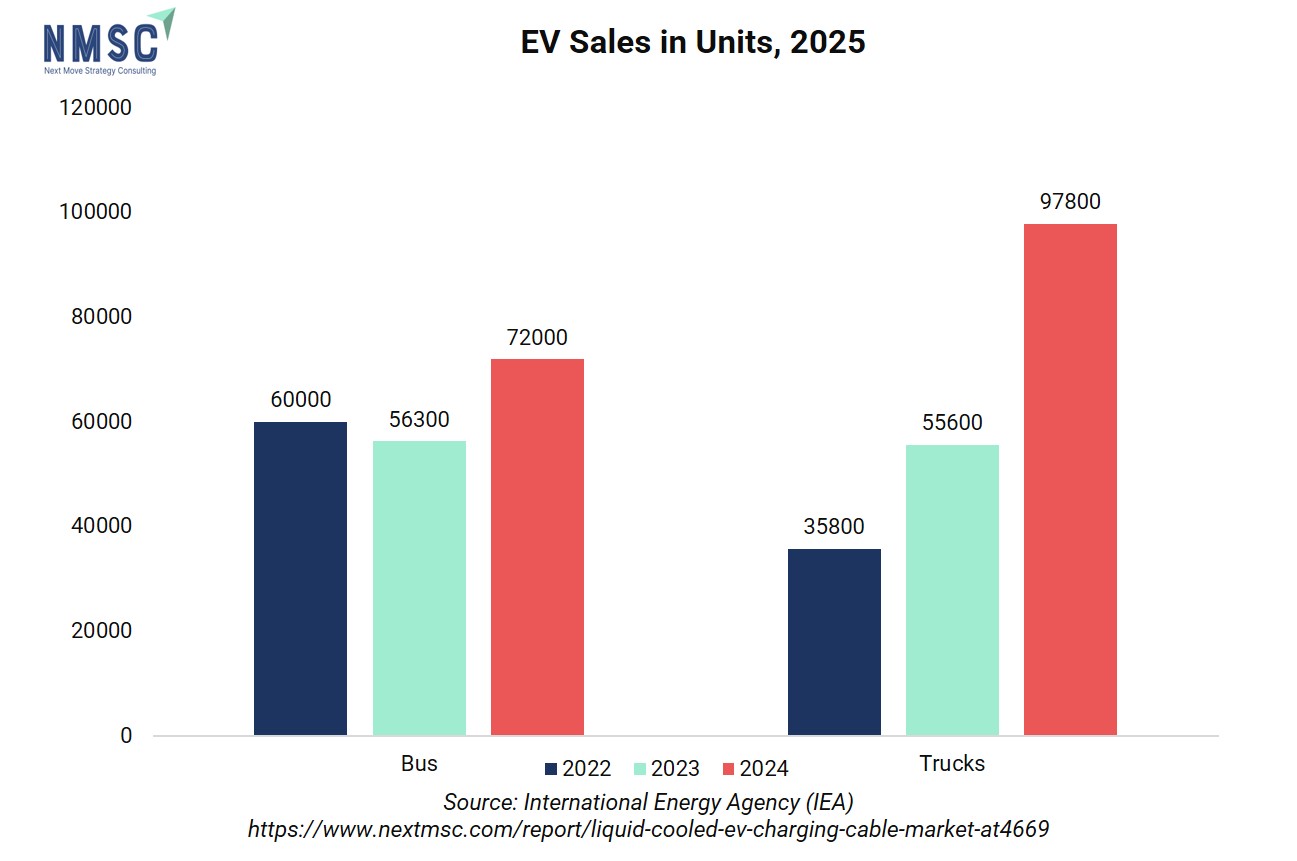
The chart highlights the strong growth momentum in global commercial EV adoption, particularly in the truck segment. Electric bus sales increased from 60,000 units in 2022 to 72,000 units in 2024, while electric truck sales recorded a sharper rise from 35,800 units to 97,800 units during the same period. Our market analysis indicates that the rapid expansion of electric commercial fleets is accelerating demand for high-power charging infrastructure, thereby supporting increased deployment of Liquid-Cooled EV Charging Cables for efficient thermal management and fast-charging operations.
Why Is Commercial Fleet Electrification Emerging as a Major Driver for the Liquid-Cooled EV Charging Cable Market Expansion?
Our findings reveal that the accelerating electrification of commercial transportation fleets is becoming a significant growth driver for the Liquid-Cooled EV Charging Cable market. Logistics companies, public transit operators, mining organizations, and last-mile delivery providers are increasingly adopting electric mobility solutions. This transition helps reduce fuel dependency and supports sustainability objectives. Furthermore, fleet operators require charging infrastructure capable of supporting continuous vehicle utilization while minimizing operational downtime. This is increasing demand for advanced charging technologies with enhanced thermal management capabilities and DC fast charging cable solutions. The expansion of electric bus deployment programs and heavy-duty freight electrification projects is also encouraging infrastructure developers to establish high-capacity charging networks across industrial transportation corridors. Additionally, rising corporate sustainability commitments and emission reduction targets are supporting long-term investments in commercial EV ecosystems. Therefore, the increasing adoption of fleet electrification strategies across logistics and industrial sectors is generating substantial growth potential for liquid-cooled charging cable manufacturers globally.
Growth Inhibitor:
How Are High Infrastructure and Installation Costs Restricting Adoption Across the Industry?
High infrastructure and installation costs continue to remain a major challenge affecting expansion across the Liquid-Cooled EV Charging Cable market. Liquid-cooled charging systems require advanced thermal management components, specialized coolant circulation technologies, and liquid-cooled EV charging connector systems. As a result, deployment expenses are significantly higher compared to standard charging infrastructure solutions. Charging station operators often encounter additional costs related to system integration, maintenance requirements, and infrastructure retrofitting for high-capacity charging environments. The need for technically skilled installation and maintenance personnel further increases operational expenditure across large-scale charging projects. In developing economies, uneven infrastructure investment and limited financial assistance also create barriers to the rapid deployment of advanced charging technologies. From our research, it is evident that these cost-related constraints are slowing adoption among smaller charging operators and infrastructure developers with limited access to long-term investment resources.
Growth Opportunity:
How Is the Evolution of Smart Energy Ecosystems Creating Opportunities in the Liquid-Cooled EV Charging Cable Market?
Our assessment of the market shows that the rapid evolution of smart energy ecosystems is creating significant long-term Liquid-Cooled EV Charging Cable market opportunities. Governments, utilities, and infrastructure developers are increasingly investing in intelligent EV charging networks. These systems are being integrated with renewable energy, smart grids, and energy storage technologies to improve energy efficiency and grid stability. Additionally, the growing deployment of digitally connected charging infrastructure is encouraging the adoption of advanced charging solutions for real-time energy optimization and dynamic power distribution. Moreover, thermally managed EV cable technologies are supporting efficient and stable charging network operations. The integration of renewable energy sources within EV charging stations is also gaining momentum as countries strengthen decarbonization targets and sustainable transportation initiatives. Vehicle-to-grid communication technologies are opening new possibilities for bidirectional energy management and load balancing across charging networks. Ultimately, the convergence of smart energy infrastructure and advanced EV charging technologies is expected to create strong innovation and expansion opportunities for liquid-cooled charging cable manufacturers globally.
Number of EV Charging Points Installed Per Year:
|
Years |
EV Charging Points (Units) |
|
2022 |
2710000 Units |
|
2023 |
4000000 Units |
|
2024 |
5400000 Units |
The table highlights the rapid expansion of global EV charging infrastructure between 2022 and 2024. EV charging points increased from 2.71 million units in 2022 to 5.4 million units in 2024, reflecting strong investment in public charging networks worldwide. Moreover, our observations indicate that the rising installation of EV charging stations is supporting growth across the Liquid-Cooled EV Charging Cable market. High-power and ultra-fast charging cable are increasingly requiring advanced thermal management solutions for efficient and reliable charging operations.
How is the Liquid-Cooled EV Charging Cable Industry Segmented in This Report, And What Are the Key Insights from the Segmentation Analysis?
Market Highlights & Strategic Insights - Liquid-Cooled EV Charging Cable Market:
|
Segments |
Key Takeaways |
|
Product Type |
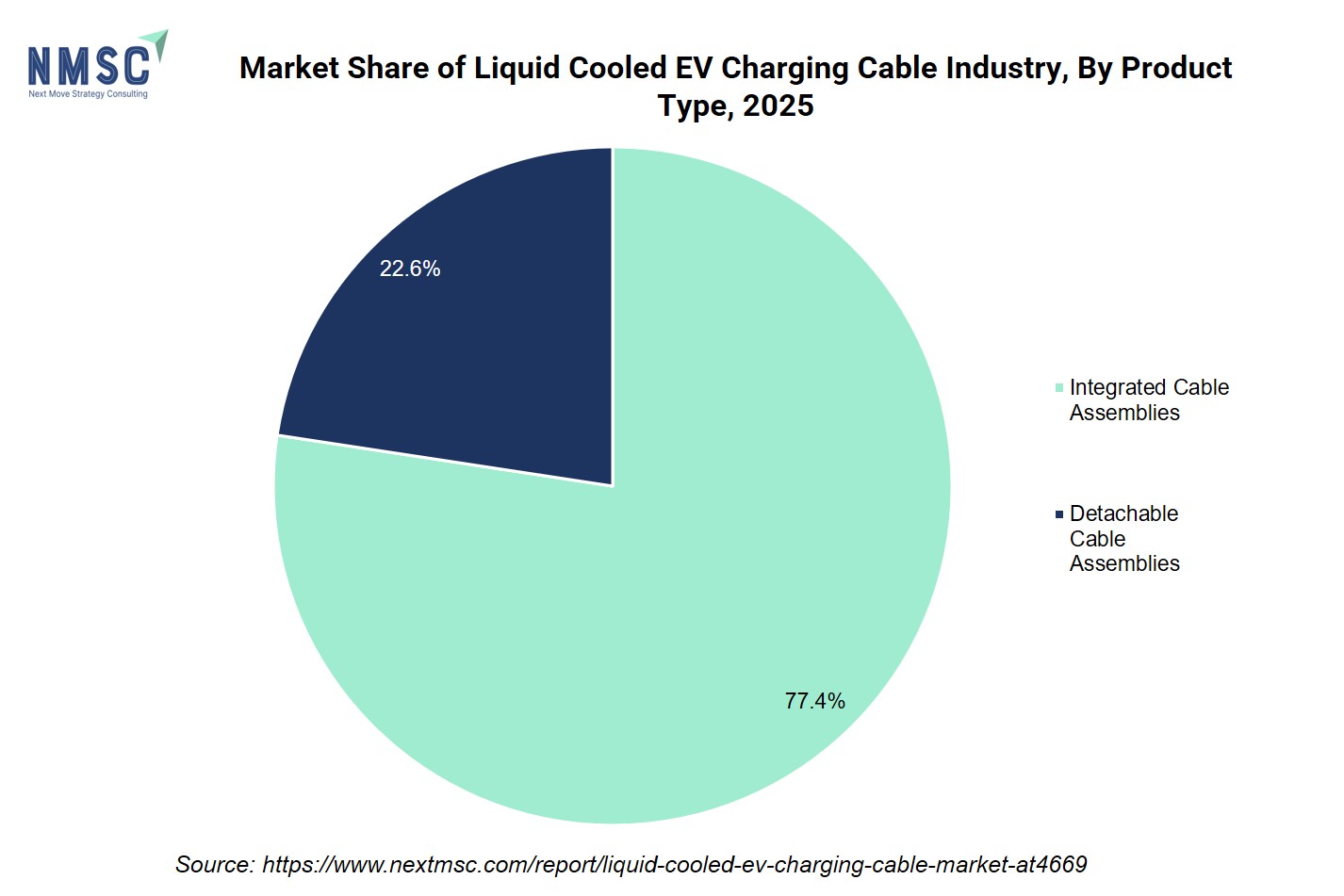
NMSC’s assessment indicates integrated cable assemblies dominate the Liquid-Cooled EV Charging Cable market with a 77.4% market share in 2025. Their widespread deployment across public fast-charging infrastructure and commercial fleet charging networks continues to support segment growth. These systems offer enhanced thermal management, operational reliability, and simplified installation. In addition, the expansion of fixed high-power charging infrastructure continues to support segment growth globally. |
|
Compatibility |
Our segmental research indicates that open standard systems dominate the Liquid-Cooled EV Charging Cable market with a 63.2% share in 2025 due to their broader interoperability across EV charging networks and vehicle platforms. The growing adoption of standardized charging technologies and the expansion of public charging infrastructure continue to support segment growth globally. |
|
Power Rating |
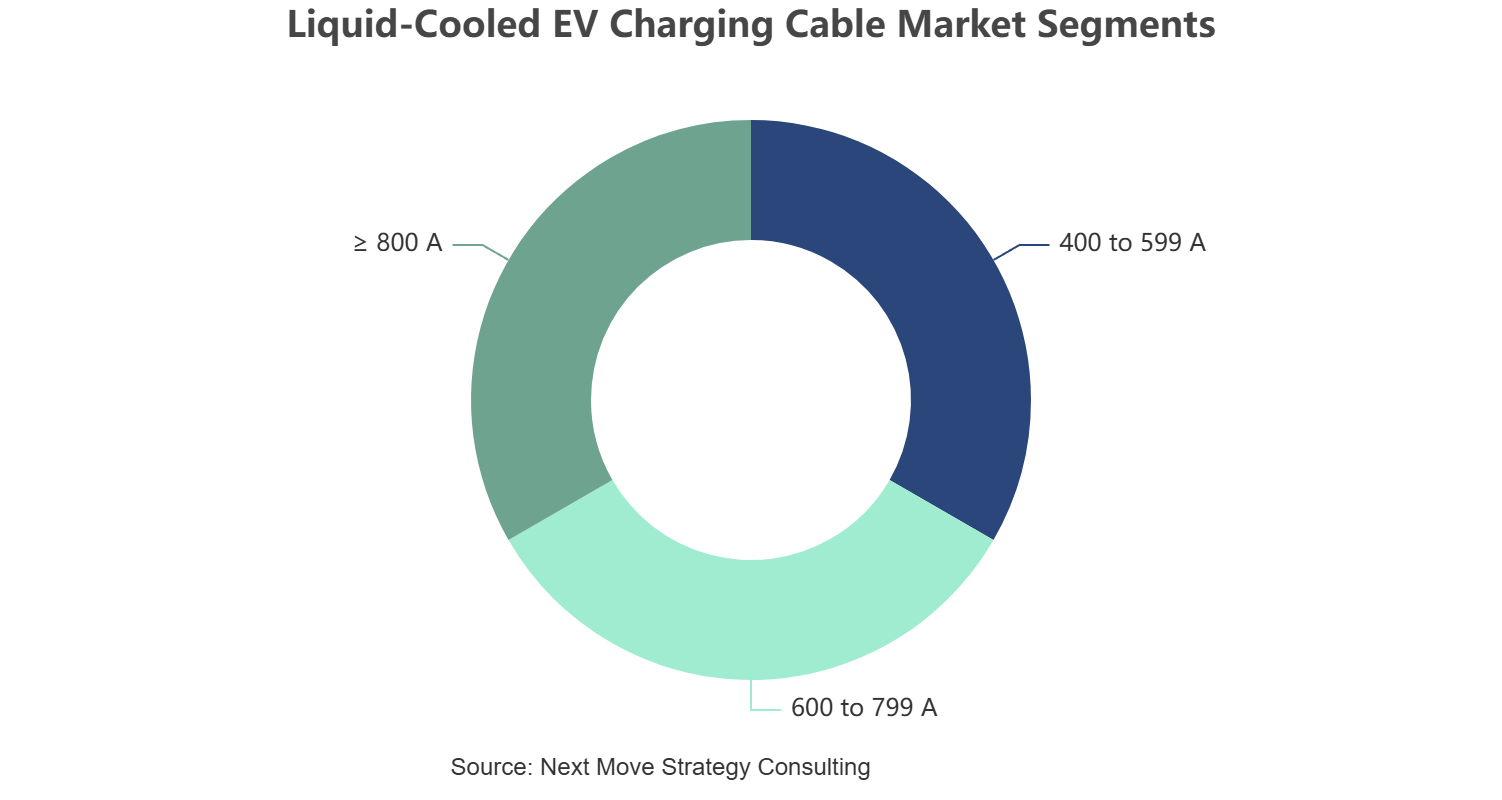
400 to 599 A segment dominates the Liquid-Cooled EV Charging Cable market with a 38.7% share in 2025 due to its balanced charging efficiency, thermal performance, and infrastructure compatibility. We found that the growing deployment of public fast-charging networks and commercial EV charging stations continues to support segment expansion globally. |
|
Voltage Class |
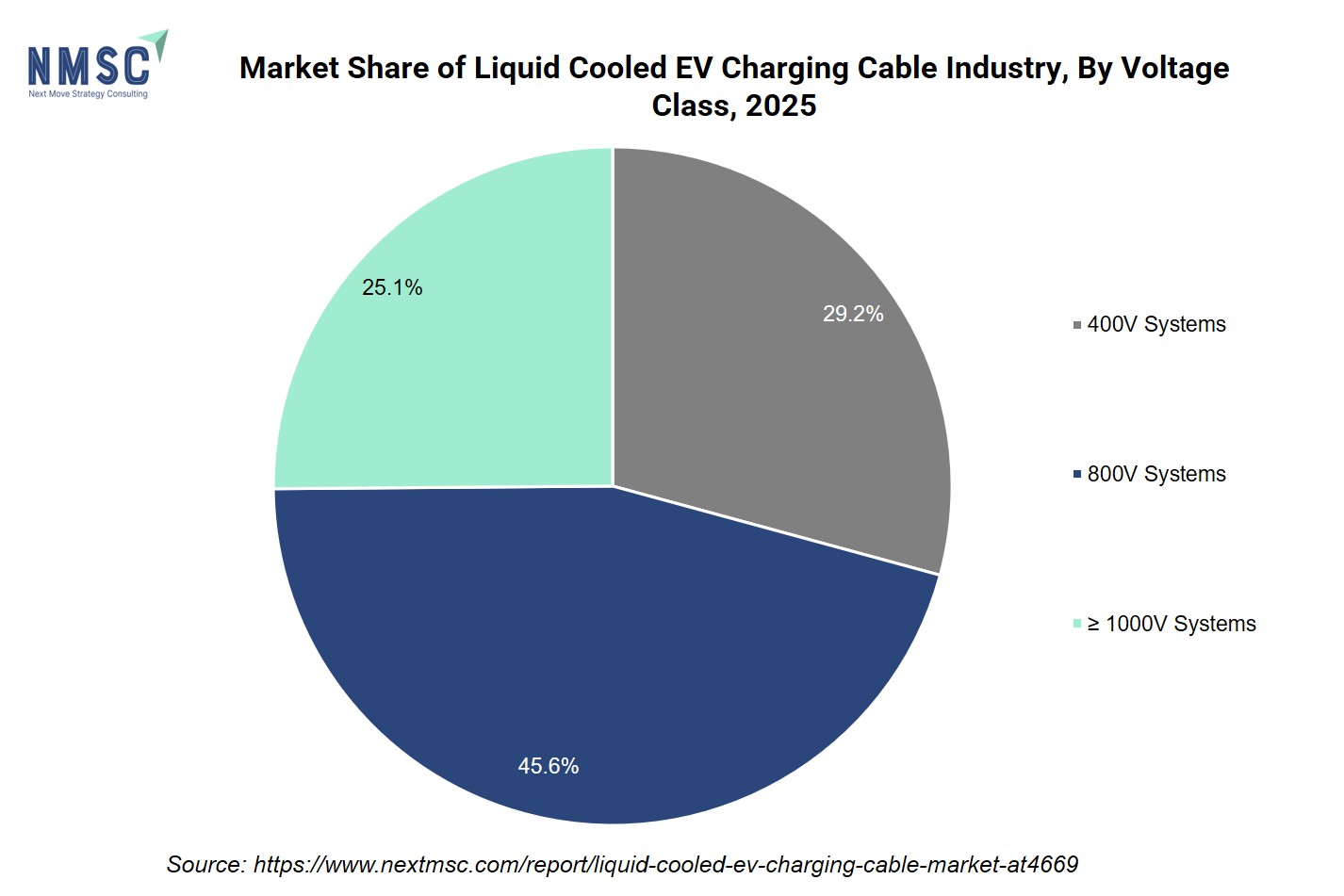
800V systems dominate the Liquid-Cooled EV Charging Cable market with a 45.6% share in 2025 due to their faster charging capabilities, improved energy efficiency, and strong compatibility with next-generation EV platforms. We observed that increasing deployment of ultra-fast charging infrastructure and rising automotive industry adoption continue to support segment growth globally. |
|
Connector Standard |
GB/T DC dominates the Liquid-Cooled EV Charging Cable market with a 31.4% share in 2025 due to its extensive deployment across China’s expanding EV charging infrastructure. Our market research shows that rising adoption of high-power DC fast-charging cable and strong domestic EV production continue supporting widespread utilization of GB/T DC connector standards globally. |
|
End Use |
We analysed that public charging dominates the Liquid-Cooled EV Charging Cable market with a 60.2% share in 2025 due to the rapid expansion of public fast-charging hubs and destination charging infrastructure. Increasing EV adoption, government-supported charging corridor development, and rising demand for accessible ultra-fast charging continue to support segment growth globally. |
|
Buyer Type |
Charging Network Operators dominate the Liquid-Cooled EV Charging Cable market with a 20.6% share in 2025 due to increasing investments in public fast-charging infrastructure and ultra-fast charging networks. We found that growing EV adoption, expansion of charging corridors, and rising deployment of high-power charging stations continue supporting segment growth globally. |
By Product Type
How Is Product Type Segmentation Shaping the Liquid-Cooled EV Charging Cable Industry in 2025?
On the basis of product type, the market is segmented into integrated cable assemblies and detachable cable assemblies.
Based on our assessment, we found that integrated cable assemblies dominate the Liquid-Cooled EV Charging Cable market in 2025 due to their widespread deployment across public fast-charging infrastructure and commercial fleet charging environments. These systems offer improved operational reliability, simplified installation architecture, and enhanced thermal management integration for high-current charging applications. Moreover, charging network operators increasingly prefer integrated systems because they support continuous charging operations with lower connector handling complexity. Detachable cable assemblies continue gaining traction in flexible charging environments and specialized applications. However, the rapid expansion of fixed high-power charging infrastructure continues to position integrated cable assemblies as the dominant product type driving global market growth.
By Compatibility
How Is Compatibility Segmentation Shaping the Liquid-Cooled EV Charging Cable Industry in 2025?
Based on compatibility, the market is segmented into open standard and OEM-proprietary locked systems.
Open standard systems dominate the Liquid-Cooled EV Charging Cable industry in 2025 due to their broader interoperability across diverse EV charging networks and vehicle platforms. Charging infrastructure providers increasingly prefer open compatibility solutions due to their broader connector integration capabilities. These systems also simplify infrastructure deployment and improve charging accessibility for end users. Beyond this, NMSC’s research indicates that the growing expansion of public charging ecosystems is encouraging the adoption of standardized charging technologies that enable seamless connectivity across multiple vehicle brands and charging environments. OEM-proprietary locked systems continue to maintain relevance within brand-specific charging ecosystems and controlled infrastructure environments; however, the increasing emphasis on interoperability and scalable charging infrastructure positions open standard systems as the leading compatibility type shaping long-term market adoption globally.
By Power Rating
How Is Power Rating Segmentation Shaping the Liquid-Cooled EV Charging Cable Industry in 2025?
Based on power rating, the market is segmented into 400 to 599 A, 600 to 799 A, and ≥800 A.
Our market analysis suggests that the 400 to 599 A segment dominates the Liquid-Cooled EV Charging Cable market in 2025 due to its optimal balance between charging efficiency, thermal management performance, and infrastructure affordability. These charging systems are increasingly deployed across public fast-charging stations and commercial EV charging environments where operators require reliable high-current charging with lower installation complexity and broader infrastructure compatibility. Additionally, the rising expansion of urban fast-charging networks and growing adoption of mid-to-high power EV platforms are accelerating demand for efficient charging solutions capable of supporting faster charging durations and stable operational performance. The 600 to 799 A and ≥800 A segments continue gaining traction in ultra-fast and heavy-duty charging applications. However, the widespread deployment and operational flexibility of 400 to 599 A systems continue to position this segment as the leading power rating category globally.
By Voltage Class
How Is Voltage Class Segmentation Shaping the Liquid-Cooled EV Charging Cable Industry in 2025?
On the basis of voltage class, the market is segmented into 400V systems, 800V systems, and ≥1,000V systems.
Our findings reveal that 800V systems dominate the Liquid-Cooled EV Charging Cable Industry in 2025 due to their ability to support faster charging performance, improved energy efficiency, and reduced charging duration across next-generation electric vehicle platforms. Automotive manufacturers and charging infrastructure developers are increasingly adopting 800V architectures. These systems enable high-power charging while improving overall efficiency and thermal management performance. Additionally, the growing expansion of ultra-fast charging networks is encouraging wider deployment of charging infrastructure compatible with advanced voltage platforms. Although ≥1,000V systems are gaining attention within heavy-duty transportation and megawatt charging applications, the broader commercial deployment and strong automotive industry adoption of 800V systems position this segment as the primary voltage class influencing market expansion globally.
Regional Outlook:
Geographic Performance Snapshot:
|
Countries |
Key Takeaways |
|
North America |
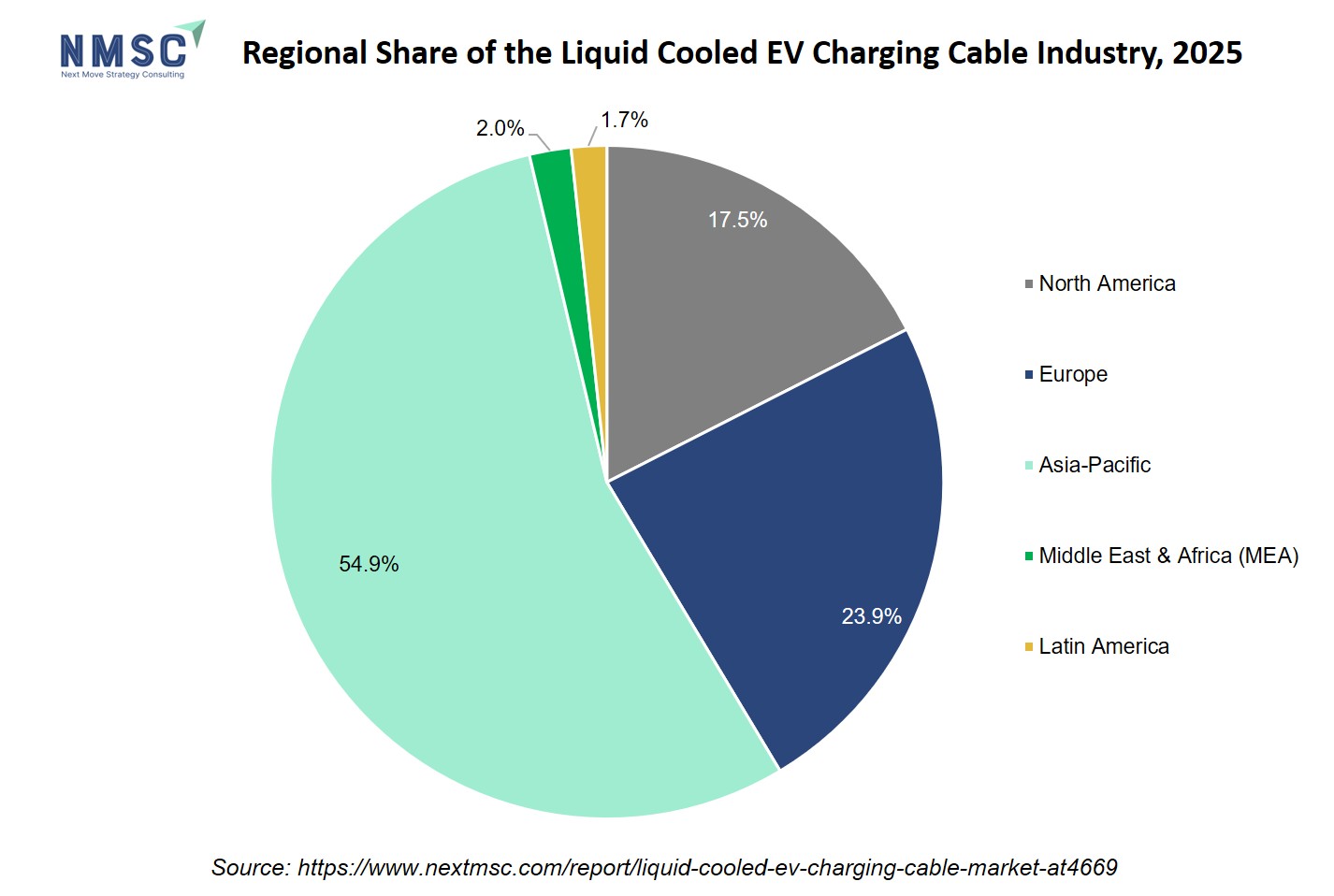
NMSC’s evaluation indicates that North America accounts for 17.5% of the global Liquid-Cooled EV Charging Cable market in 2025, supported by expanding ultra-fast charging corridors and commercial fleet charging infrastructure. Moreover, increasing deployment of megawatt charging systems and high-current charging technologies is strengthening demand for advanced liquid-cooled cable solutions across transportation and logistics networks. |
|
Europe |
Europe holds a 23.9% share of the global Liquid-Cooled EV Charging Cable market in 2025 due to expanding interoperable charging infrastructure and strong regional electrification initiatives. Furthermore, increasing investments in smart charging integration, cross-border charging compatibility, and sustainable mobility infrastructure are accelerating the adoption of advanced liquid-cooled charging cable technologies across the region. |
|
Asia-Pacific |
Asia-Pacific dominates the global Liquid-Cooled EV Charging Cable market with a 54.9% share in 2025, driven by large-scale EV infrastructure expansion and growing high-power charging deployment across China, South Korea, and India. Additionally, increasing integration of smart charging systems and rising commercial electrification initiatives continue supporting demand for advanced liquid-cooled charging technologies throughout the region. |
|
Middle East and Africa |
The Middle East & Africa region holds a 2.0% share of the global Liquid-Cooled EV Charging Cable market in 2025, supported by smart city projects and expanding premium EV charging ecosystems. Consequently, increasing focus on thermal management performance and sustainable mobility infrastructure is accelerating adoption of liquid-cooled charging cable technologies across high-temperature operating environments. |
|
Latin America |
Latin America accounts for 1.7% of the global Liquid-Cooled EV Charging Cable market in 2025 as EV charging infrastructure development gradually expands across major urban centers. Meanwhile, growing government electrification initiatives and rising investments in commercial fleet charging networks are supporting long-term demand for liquid-cooled charging cable systems across emerging regional EV ecosystems. |
The Liquid-Cooled EV Charging Cable industry is geographically studied across North America, Europe, Asia Pacific, the Middle East & Africa, and Latin America, and each region is further studied across countries.
Liquid-Cooled EV Charging Cable Market in North America
Our assessment of industry movements shows that North America is witnessing significant expansion across the market due to the rapid deployment of ultra-fast charging corridors and high-current charging infrastructure. The region is increasingly investing in commercial fleet charging networks to support continuous high-power charging operations. These deployments are expanding across logistics, public transportation, and heavy-duty mobility applications. Moreover, megawatt charging deployment is gaining momentum as infrastructure developers focus on enabling faster charging capabilities for next-generation electric commercial vehicles. Private charging network operators are increasing investments in advanced charging ecosystems. These efforts aim to improve charging accessibility and reduce downtime across major transportation routes. Beyond this, the growing adoption of high-current charging technologies is encouraging the integration of advanced thermal management systems within charging cable assemblies. Consequently, the combined expansion of commercial charging infrastructure and high-capacity charging technologies is strengthening long-term growth opportunities across the North American Liquid-Cooled EV Charging Cable market.
Liquid-Cooled EV Charging Cable Market in the United States
The United States is emerging as a major contributor to the Liquid-Cooled EV Charging Cable market due to the continuous expansion of highway fast-charging networks and large-scale commercial EV charging infrastructure. Charging network providers are increasingly deploying high-power charging systems across interstate transportation corridors. These investments support rising long-distance EV adoption and commercial mobility requirements. Besides this, our industry research reveals that megawatt charging systems are gaining strong traction across heavy-duty transportation applications, including logistics fleets, freight transportation, and transit operations. Private sector investment in EV charging infrastructure is also accelerating as technology companies, charging operators, and automotive manufacturers expand nationwide charging ecosystems. The growing focus on expanding high-current charging infrastructure is encouraging the adoption of advanced EV charging cable solutions. These technologies help maintain charging efficiency during prolonged charging operations. Therefore, rising infrastructure modernization initiatives and expanding commercial charging deployments are positioning the United States as a key growth market for liquid-cooled charging technologies.
Liquid-Cooled EV Charging Cable Market in Canada
Canada’s Liquid-Cooled EV Charging Cable market is witnessing steady growth as the country expands long-distance charging infrastructure and nationwide charging accessibility. Our findings reveal that the increasing development of cross-country EV charging corridors is encouraging infrastructure providers to deploy reliable fast-charging systems capable of supporting uninterrupted travel across extensive transportation networks. Furthermore, Canada accounts for 17.1% of the North American market, supported by rising public charging investments and expanding EV infrastructure deployment. Harsh winter operating conditions are driving demand for charging cable technologies with strong thermal stability and dependable charging performance under cold-climate environments. Government-backed EV infrastructure initiatives are also contributing to wider public charging deployment across urban regions, remote areas, and intercity transportation routes. At the same time, charging operators are increasingly focusing on improving charging consistency and infrastructure reliability for high-current charging applications. Ultimately, the combination of climate-specific charging requirements, infrastructure expansion programs, and public charging investments is supporting long-term growth across the industry.
Liquid-Cooled EV Charging Cable Market in Europe
The Liquid-Cooled EV Charging Cable market is gaining traction across Europe as charging interoperability frameworks mature under coordinated regional policy direction. Our industry assessment indicates that high-density urban clusters are driving demand for ultra-fast charging infrastructure, while sustainable mobility systems are being embedded into long-term transport planning. Rather than a single-direction expansion, multiple layers of infrastructure development are occurring simultaneously, particularly across smart charging integration and automotive electrification initiatives. In cities with heavy EV penetration, charging networks are increasingly optimized for shared access and cross-border compatibility. This is further reinforced by infrastructure standardization across EU member states, thereby enabling seamless operational alignment. The market is transitioning toward highly connected charging ecosystems where efficiency and scalability increasingly shape infrastructure development strategies. Consequently, adoption momentum continues to strengthen across stakeholder groups, reinforcing Europe’s broader shift toward integrated electric mobility systems.
Liquid-Cooled EV Charging Cable Market in the United Kingdom
Urban infrastructure pressure in major cities is reshaping charging network development in the United Kingdom. In dense metropolitan areas such as London, the focus is shifting toward high-capacity fast-charging deployment, where limited space requires compact systems with strong thermal efficiency. According to our analysis, we found that smart charging solutions are increasingly being integrated into existing grid systems to manage load fluctuations, particularly as electrified fleets expand across logistics and ride-hailing sectors. At the same time, public charging interoperability is improving, enabling seamless access across multiple charging networks. Demand growth is being supported by both infrastructure expansion and rising commercial fleet electrification, which is increasing charging utilization rates. This growing pressure is reinforcing the need for high-power charging infrastructure across urban clusters. Consequently, liquid-cooled EV charging market are emerging as a key solution for maintaining reliable performance during sustained high-load charging operations.
Liquid-Cooled EV Charging Cable Market in Germany
NMSC’s research indicates that Germany accounts for 18.9% of the European Liquid-Cooled EV Charging Cable market, supported by strong OEM-driven technological advancement and industrial-scale electrification requirements. The rapid rollout of 800V charging platforms is reshaping infrastructure expectations, particularly across premium and high-performance EV segments. Germany is witnessing segmented infrastructure expansion across industrial charging hubs, automotive production zones, and public fast-charging corridors. Automotive manufacturers continue to play a central role in defining charging standards and aligning vehicle architecture with infrastructure capabilities. Meanwhile, industrial charging demand is increasing across logistics-intensive regions where continuous high-load operation is required. This is accelerating demand for advanced thermal management solutions and liquid-cooled charging systems. As these structural developments continue, Germany is strengthening its position as an engineering-led market where charging innovation remains closely aligned with automotive technology advancement.
Liquid-Cooled EV Charging Cable Market in France
Government-backed mobility transformation is playing a major role in shaping the Liquid-Cooled EV Charging Cable market in France, particularly through large-scale public transport electrification programs. Our findings reveal that electric bus networks and municipal fleet conversions are driving demand for high-capacity charging infrastructure across urban centers. France is also developing integrated mobility corridors where charging systems are incorporated into broader sustainability and transportation planning initiatives. Urban charging modernization is progressing through upgrades to legacy infrastructure, especially in high-density cities where energy efficiency is becoming a major priority. Besides this, public investment mechanisms are accelerating deployment timelines and supporting consistent infrastructure expansion across regions. This policy-driven environment is reinforcing the transition toward low-emission transportation ecosystems. Consequently, advanced charging technologies, including liquid-cooled systems, are becoming increasingly aligned with national efficiency goals and long-term EV infrastructure modernization strategies.
Liquid-Cooled EV Charging Cable Market in Italy
From our market analysis, we found that tourism-driven transportation patterns and intercity mobility requirements are significantly influencing the Liquid-Cooled EV Charging Cable market in Italy. Highway corridor electrification is becoming a key infrastructure priority, particularly along routes connecting major cultural and coastal destinations. Italy demonstrates a dual demand structure driven by seasonal tourism activity and steady commercial charging expansion in cities such as Milan and Rome. In addition, medium-capacity fast charging is emerging as a transitional solution that supports both urban mobility and long-distance travel requirements. Public–private investment models are gaining traction and enabling phased infrastructure expansion without placing excessive pressure on public funding systems. As mobility demand becomes increasingly variable, infrastructure flexibility is also becoming a critical requirement. Consequently, liquid-cooled charging systems are being integrated to maintain operational stability during peak charging periods and support Italy’s transition toward a more resilient EV charging ecosystem.
Liquid-Cooled EV Charging Cable Market in Spain
Renewable energy integration is significantly influencing the Liquid-Cooled EV Charging Cable market in Spain, which accounts for 6.3% of the European market. Moreover, solar-integrated charging infrastructure is expanding rapidly across the country. Alongside this, our market analysis suggests that charging stations are increasingly being co-located with renewable energy assets to improve energy optimization and charging efficiency. Spain is also developing interconnected energy and mobility systems where smart charging projects help balance grid demand dynamically. In addition, logistics corridor electrification is gaining importance, particularly for freight transportation between industrial zones and ports. Public-private investment structures are accelerating charging infrastructure deployment across both urban and highway networks, supporting broader geographic coverage. This renewable-driven ecosystem is strengthening the integration between energy generation and EV infrastructure development. Consequently, thermally managed EV cable systems are becoming increasingly important for maintaining stable high-power charging performance under variable energy conditions. This trend is reinforcing Spain’s transition toward a more integrated and sustainable mobility framework.
Liquid-Cooled EV Charging Cable Market in the Nordics
High EV penetration across Nordic countries is creating one of the most advanced charging ecosystems globally, supported by strong renewable energy integration. Smart charging optimization is being widely implemented to improve grid stability and energy efficiency across distributed charging networks. Extreme climate conditions are also influencing infrastructure design, increasing demand for durable and thermally efficient charging components. Advanced grid-connected charging systems are further improving operational flexibility and enabling real-time load management. Additionally, renewable-powered charging networks based on hydropower and wind energy continue to support regional EV infrastructure expansion. As a result, the Nordics remain a leading market for sustainable mobility adoption and charging technology advancement. Our evaluation reveals that deployment of Liquid-Cooled EV Charging Cables is increasing due to their ability to maintain reliable performance under both high-load and low-temperature conditions. Consequently, the Nordics represent a highly optimized and sustainability-focused charging market with strong long-term growth potential.
Liquid-Cooled EV Charging Cable Market in the Asia-Pacific
Across the Asia Pacific, large-scale electrification is driving rapid expansion of high-capacity charging infrastructure as governments and private operators continue expanding both public and commercial charging networks. Within this environment, the Liquid-Cooled EV Charging Cable market is gaining traction due to rising demand for high-current transmission and efficient thermal management in dense deployment environments. Manufacturing ecosystems in China, South Korea, and India are strengthening production capabilities and supporting faster rollout of advanced charging components. In parallel, our assessment shows that smart charging systems are also being increasingly integrated into grid frameworks to manage fluctuating electricity demand across rapidly growing urban clusters. Infrastructure deployment is extending beyond cities into intercity and industrial corridors, reflecting broader regional expansion strategies. Collectively, these developments are reshaping infrastructure planning across the region and accelerating the transition toward high-power EV charging systems where liquid-cooled technologies support stable long-duration charging performance.
Liquid-Cooled EV Charging Cable Market in China
Our research demonstrates that the Liquid-Cooled EV Charging Cable market in China is being driven by the rapid deployment of ultra-fast and megawatt charging infrastructure across urban and highway corridors. Domestic charging equipment manufacturing is strengthening supply chain capabilities and supporting large-scale infrastructure rollout. Public charging networks continue expanding aggressively, supported by strong policy frameworks and coordinated industrial investment. Integrated EV ecosystem development is also improving coordination between automotive OEMs, infrastructure operators, and energy providers. Demand for high-power charging is increasing significantly, particularly across commercial and long-distance transportation applications. In parallel, technological standardization is improving deployment efficiency for high-capacity charging systems across regions. Consequently, liquid-cooled charging cable solutions are becoming increasingly important for maintaining reliable performance in ultra-fast charging environments and supporting China’s leadership in high-power EV infrastructure development.
Liquid-Cooled EV Charging Cable Market in Japan
Our analysis indicates that Japan accounts for 7.6% of the Asia-Pacific Liquid-Cooled EV Charging Cable market, driven by precision engineering requirements and compact infrastructure deployment strategies. Advanced thermal management systems are increasingly being integrated to maintain reliable performance in space-constrained urban environments. Automotive technology integration remains a major growth driver, supporting efficient energy transfer across connected mobility systems. High-efficiency charging solutions are also being prioritized to improve energy optimization and operational reliability. Rather than focusing on large-scale infrastructure expansion, Japan continues emphasizing refinement and technological optimization of charging systems. Compact and high-performance charging solutions are increasingly being deployed across residential and commercial zones. Consequently, liquid-cooled charging cable technologies are gaining importance due to their ability to support stable heat management in dense charging installations.
Liquid-Cooled EV Charging Cable Market in India
India’s EV charging landscape is undergoing rapid transformation driven by electrification across mobility and logistics sectors, with infrastructure expansion extending beyond major metropolitan areas. Our industry evaluation reveals that government-led initiatives are accelerating deployment of fast-charging stations along highways and urban corridors to improve charging accessibility. Within this evolving environment, the Liquid-Cooled EV Charging Cable market is gradually gaining importance as demand for higher-capacity charging infrastructure increases across fleet and public transportation applications. Commercial fleet electrification, particularly in logistics and last-mile delivery operations, is further increasing charging infrastructure utilization. Cost efficiency remains a key factor influencing deployment strategies and technology adoption across the country. Infrastructure development is progressing in phases, with urban centers leading initial adoption followed by gradual intercity expansion. This staged development approach is supporting scalable infrastructure growth and strengthening long-term readiness for high-power charging integration.
Liquid-Cooled EV Charging Cable Market in South Korea
South Korea’s EV charging ecosystem is evolving through a digitally integrated mobility framework where smart charging systems and rapid infrastructure deployment are advancing simultaneously. Charging infrastructure modernization is closely aligned with the country’s strong battery manufacturing industry, enabling deeper integration between energy storage and charging technologies. Within this environment, the Liquid-Cooled EV Charging Cable market is gaining importance as high-speed charging stations require advanced thermal management for sustained energy transfer. Digital platforms are also being widely deployed to support real-time monitoring and efficient load distribution across charging networks. At the same time, our findings reveal that high-performance battery systems are increasing demand for rapid and stable charging cycles. South Korea’s EV infrastructure model reflects strong integration across digital technologies, automotive engineering, and energy systems. Consequently, this convergence is accelerating the transition toward intelligent EV charging ecosystems where operational efficiency and responsiveness are becoming key infrastructure priorities.
Liquid-Cooled EV Charging Cable Market in Taiwan
Our research demonstrates that the Liquid-Cooled EV Charging Cable market in Taiwan is being driven by strong precision manufacturing capabilities and advanced component engineering expertise. Connector and cable assembly production continue to play a major role in global EV supply chains. Semiconductor-integrated charging technologies are also improving system intelligence and operational efficiency across charging networks. In addition, export-oriented infrastructure development is strengthening Taiwan’s position as a key supplier of EV charging components globally. Advanced cable engineering capabilities are supporting development of high-performance and thermally efficient charging solutions for high-power EV applications. Integration between electronics and mobility technologies is further accelerating innovation in charging system design. Consequently, liquid-cooled charging cable solutions are becoming increasingly important for supporting high-performance EV charging infrastructure and reinforcing Taiwan’s role in advanced EV hardware manufacturing.
Liquid-Cooled EV Charging Cable Market in Indonesia
Indonesia’s EV charging infrastructure remains in the early stages of development, supported by expanding urban mobility and growing two-wheeler electrification trends. Charging accessibility is gradually improving across major cities as government initiatives continue supporting domestic EV adoption and charging infrastructure deployment. Within this environment, the Liquid-Cooled EV Charging Cable market remains at a nascent stage but is expected to gain importance as fast-charging demand increases across urban and intercity transportation routes. Initial deployment of fast-charging systems is emerging in selected high-traffic areas through DC fast charging cable deployment, large-scale infrastructure rollout remains limited. Infrastructure development continues to focus on scalable and cost-efficient solutions compatible with diverse vehicle categories. Expansion is progressing gradually rather than through rapid large-scale deployment. This phased development approach is establishing a foundational charging ecosystem capable of supporting future high-capacity charging technologies.
Liquid-Cooled EV Charging Cable Market in Australia
The Liquid-Cooled EV Charging Cable market in Australia accounts for 4.2% of the Asia-Pacific market, supported by increasing long-distance highway charging requirements and expanding heavy-duty industrial charging applications. Demand for durable and high-capacity charging systems is rising across the mining and freight sectors, where continuous charging operation is essential. Due to the country’s large geographical area, development of remote charging infrastructure is becoming increasingly important for ensuring charging accessibility across dispersed regions. Renewable-powered charging stations are also being deployed to align infrastructure growth with sustainability objectives and emissions reduction targets. In parallel, we observed that commercial transport electrification is gradually expanding across major logistics corridors, strengthening demand for high-performance charging networks. Infrastructure development is therefore prioritizing resilience and operational efficiency under demanding environmental conditions. Consequently, thermally managed EV cable systems are becoming critical for maintaining charging stability and performance reliability across high-load and remote charging environments.
Liquid-Cooled EV Charging Cable Market in Latin America
Our market analysis indicates that the Liquid-Cooled EV Charging Cable market in Latin America is developing gradually as public charging infrastructure continues expanding across major urban centers. Government-led EV adoption initiatives are supporting early-stage charging infrastructure development throughout the region. Commercial transportation electrification is also increasing, particularly across logistics and fleet-based operations. Charging accessibility remains a major focus area influencing infrastructure planning and deployment strategies. Market expansion is occurring in phases and remains concentrated within selected urban markets. Alongside this, cost efficiency and scalability considerations continue shaping infrastructure investment decisions. Consequently, liquid-cooled charging cable systems are expected to support future high-power charging requirements as the regional EV ecosystem continues to mature.
Liquid-Cooled EV Charging Cable Market in the Middle East & Africa
The Liquid-Cooled EV Charging Cable market in the Middle East & Africa is evolving through smart city initiatives and expanding premium EV charging ecosystems. At the same time, our findings reveal that high-temperature environmental conditions are significantly influencing infrastructure design and thermal management requirements across the region. Energy diversification programs are also supporting long-term mobility transformation strategies in key regional markets. Charging infrastructure expansion is currently concentrated in urban centers and high-income developments. The regional charging ecosystem remains in the early-to-mid stages of development, supported by increasing investment activity and government sustainability initiatives. These initiatives are encouraging broader EV adoption and infrastructure modernization across the region. Consequently, liquid-cooled charging cable systems are becoming increasingly important for maintaining thermal stability and operational reliability under extreme climate conditions in the Middle East & Africa.
SWOT Analysis of the Liquid-Cooled EV Charging Cable Industry
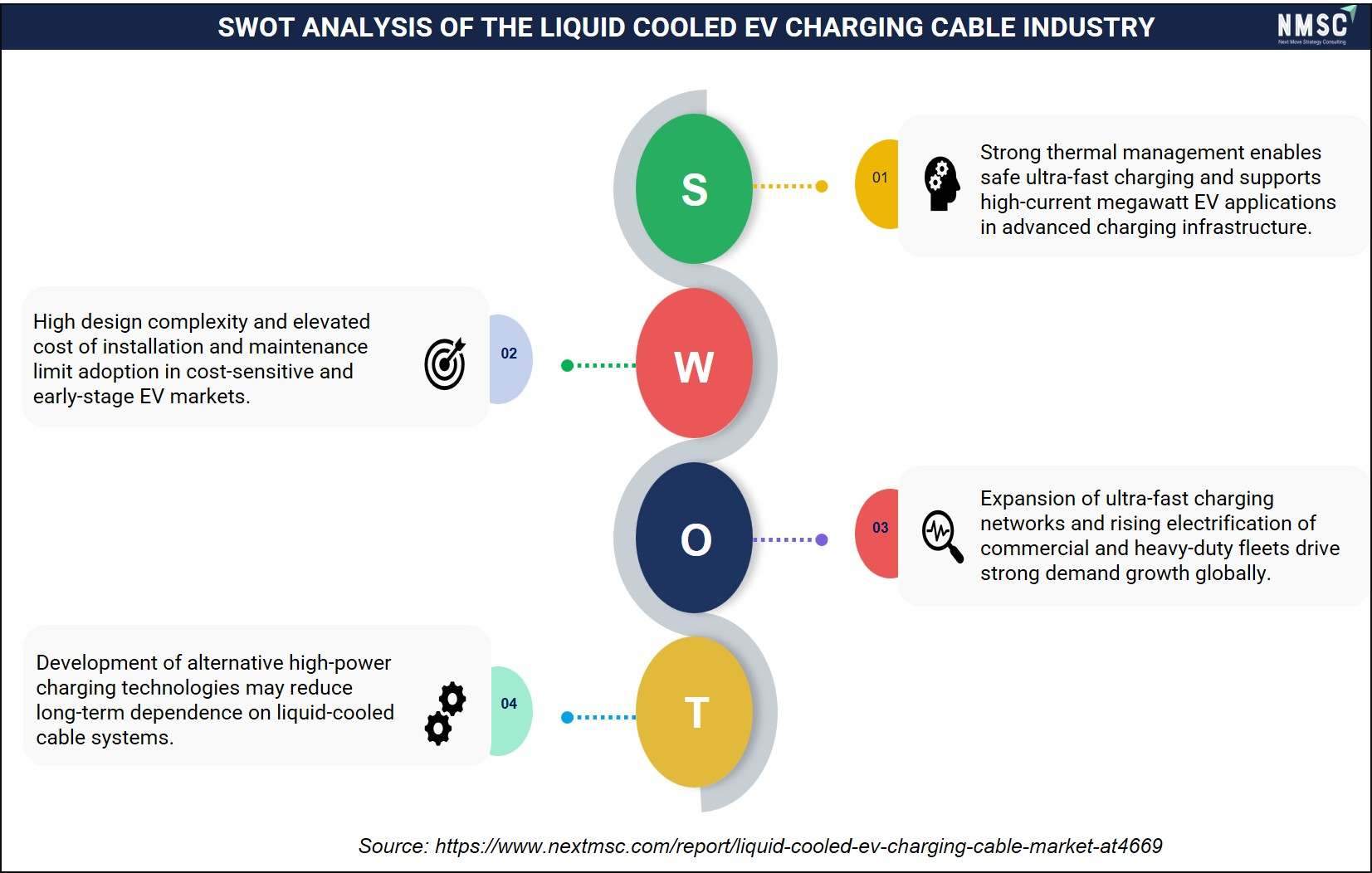
Our sector analysis shows that the Liquid-Cooled EV Charging Cable Industry demonstrates strong thermal management capabilities that support safe ultra-fast charging and megawatt-level EV applications. However, high design complexity and elevated installation and maintenance costs continue to restrict wider adoption, particularly in cost-sensitive and early-stage markets. Expanding ultra-fast charging infrastructure and growing electrification of commercial and heavy-duty fleets are creating strong growth opportunities globally. At the same time, advancements in alternative high-power charging technologies may increase competitive pressure on liquid-cooled cable systems over the long term.
Competitive Landscape
Competitive Dynamics & M&A Landscape:
|
Key Takeaways |
|
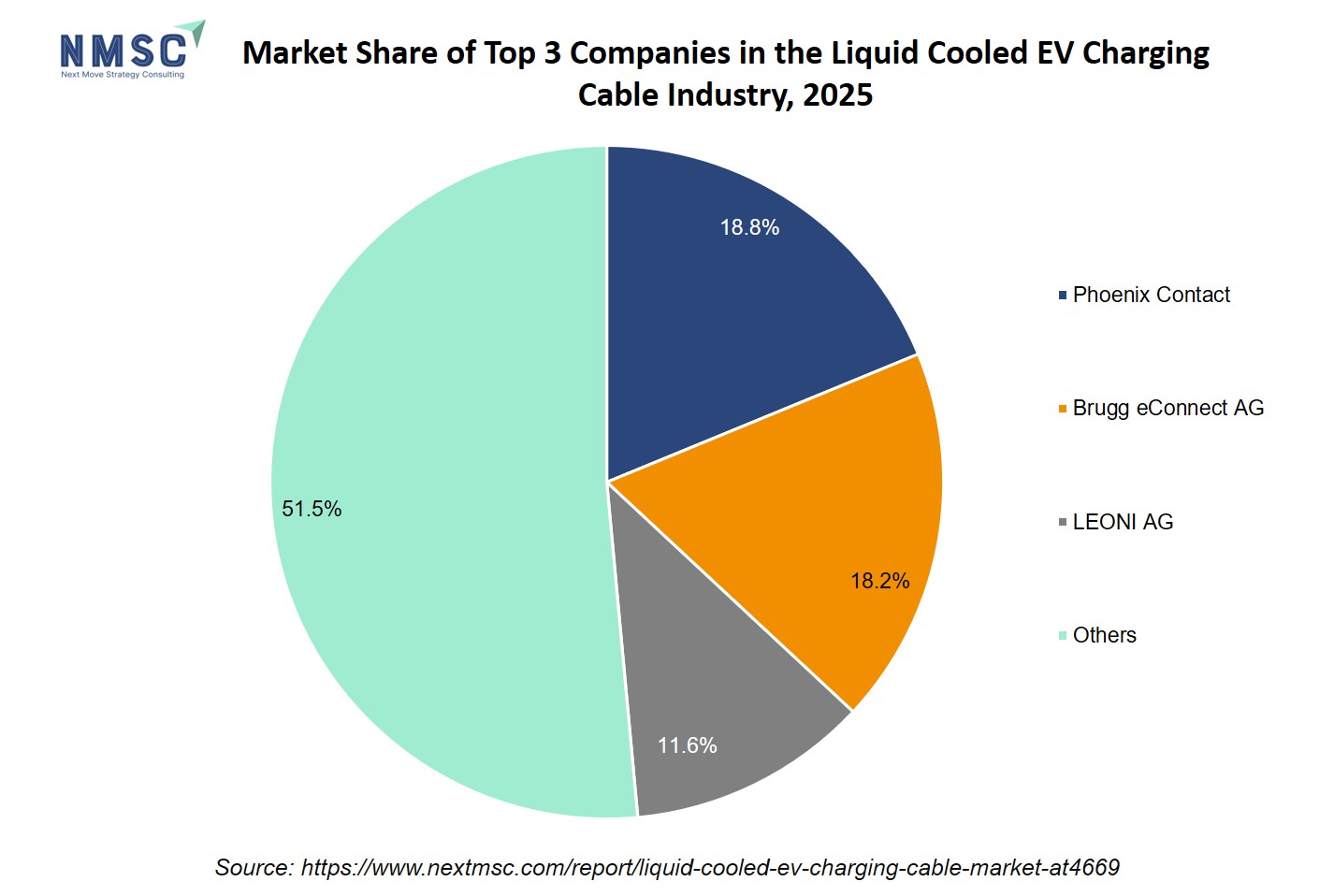
Our evaluation indicates that market leadership remains concentrated among Phoenix Contact GmBH & Co.KG, Brugg eConnect AG, and LEONI AG due to their strong capabilities in high-current liquid-cooled charging systems for megawatt charging applications. Their competitive advantage is supported by early alignment with evolving ultra-fast charging standards. Amphenol Corporation and HUBER+SUHNER AG also strengthen competition through advanced connector engineering and precision cable technologies. |
|
Our market analysis highlights that innovation across the market is increasingly focused on thermal efficiency, voltage resilience, and compatibility with 800V and above charging architectures. Companies are also prioritizing modular system designs to simplify deployment across dense charging networks. Interoperability across OEM platforms is becoming an important benchmark influencing product development strategies. |
|
Strategic acquisitions and partnerships are being used selectively to strengthen capabilities in materials, connectors, and regional distribution networks. Companies are increasingly targeting niche manufacturers with cost-efficient production models and localized expertise. Consequently, the market is gradually shifting toward scale-driven competition where integrated supply chains and technology ownership support long-term positioning. |
For the latest market share analysis and in-depth report on Liquid-Cooled EV Charging Cable Industry insights, you can buy our latest report: Access the Full Report
Which Companies Dominate the Liquid-Cooled EV Charging Cable Market and How Do They Compete?
Our evaluation shows that the Liquid-Cooled EV Charging Cable market is led by companies such as Phoenix Contact GmBH & Co.KG, Brugg eConnect AG, and LEONI AG due to their strong expertise in advanced thermal management systems and high-current charging technologies for ultra-fast EV charging infrastructure. These companies compete by focusing on charging reliability, efficient heat dissipation, and compatibility with evolving EV charging standards and high-voltage vehicle platforms. In addition, Amphenol Corporation and HUBER+SUHNER AG strengthen the competitive landscape through connector innovation, precision engineering, and durable high-performance cable solutions. Regional manufacturers also contribute through scalable production capabilities and cost-efficient deployment strategies. Consequently, competition across the market is increasingly shaped by innovation, interoperability, durability, manufacturing efficiency, and alignment with expanding megawatt and ultra-fast charging ecosystems globally.
Market Dominated by Liquid-Cooled EV Charging Cable Industry Giants and Specialists
In our assessment, we observed that the Liquid-Cooled EV Charging Cable market is characterized by competition between established global companies and specialized technology providers. Major players such as Phoenix Contact GmBH & Co.KG, Brugg eConnect AG, and LEONI AG maintain strong positions through advanced thermal management systems, high-current charging capabilities, and integration with ultra-fast EV charging infrastructure. These companies emphasize reliability, safety certification, and compliance with evolving charging standards. At the same time, specialized firms such as Amphenol Corporation and HUBER+SUHNER AG contribute through connector innovation and precision-engineered cable solutions. Regional manufacturers further increase competition by offering scalable and cost-efficient products tailored to local market requirements. Consequently, the market continues to evolve through innovation in charging efficiency, interoperability, and high-power performance.
Innovation and Adaptability Drive the Market Success
Our current market analysis highlights that innovation and adaptability remain key success factors in the Liquid-Cooled EV Charging Cable market. Leading companies such as Phoenix Contact GmBH & Co.KG, Brugg eConnect AG, and LEONI AG continue enhancing high-current charging systems with improved thermal management and compatibility with next-generation charging standards. These developments support safer and more efficient megawatt-level charging applications across public and commercial infrastructure. Companies including Amphenol Corporation and HUBER+SUHNER AG are also focusing on connector innovation and advanced material engineering to improve durability under high-voltage conditions. Additionally, regional manufacturers are strengthening market responsiveness through cost-effective designs suited to diverse deployment environments. As EV charging infrastructure evolves, companies are increasingly prioritizing modularity, scalability, and interoperability to address changing market requirements. Strategic collaborations with OEMs and charging network operators are also supporting faster technology adoption and infrastructure expansion.
Market Players to Opt for Merger & Acquisition Strategies to Expand Their Presence
Our market evaluation shows that merger and acquisition strategies are becoming increasingly important across the Liquid-Cooled EV Charging Cable market. Leading companies such as Phoenix Contact GmBH & Co.KG, Brugg eConnect AG, and LEONI AG are strengthening technological capabilities and expanding geographic reach through strategic collaborations and selective acquisitions. These strategies support portfolio expansion in high-current and liquid-cooled charging systems used for ultra-fast EV infrastructure. Companies, including Amphenol Corporation and HUBER+SUHNER AG are also leveraging partnerships to strengthen connector technologies and broaden application capabilities. In addition, regional manufacturers are emerging as acquisition targets due to their cost-efficient production models and local market access. Consequently, the market is gradually consolidating as companies seek improved scalability, faster innovation, and stronger competitive positioning.
List of Key Liquid-Cooled EV Charging Cable Companies
-
HUBER+SUHNER AG AG
-
LEONI AG
-
SINBON Electronics Co., Ltd.
-
OMG Cable Manufacturing CO., Ltd.
-
Brugg eConnect AG
-
China EV Supply Equipment Co., Ltd.
-
Shanghai Mida EV Power Co., Ltd.
-
Caledonian Cables Limited Limited
-
Nexway Co., Ltd. Co., Ltd.
-
Teison Energy Technology Co., Ltd.
-
Fujikura Ltd. Ltd.
-
Shenzhen Woer Heat-Shrinkable Material Co., Ltd.
-
Dongguan FaFa-e New Energy Technology Co., Ltd.
-
Fiverevse Technology Co., Ltd. Technology Co., Ltd.
-
TITION Electric Wire Co., Ltd. Co., Ltd.
-
Bessun New Energy Technology Co., Ltd.
-
Amphenol Corporation
-
ITT Cannon GmbH
What Are the Latest Key Industry Developments?
-
September 2025 – Autel Energy integrated Phoenix Contact’s liquid-cooled cable and connector technology into its new 1,000 A EV charging system designed for megawatt-level fast charging applications. The system supports ultra-fast charging for commercial and heavy-duty electric vehicles while improving thermal efficiency and charging performance. This development strengthens the expansion of high-power liquid-cooled EV charging infrastructure.
-
June 2025- VOSS, Amphenol, and GG Group unveiled a 1 MW liquid-cooled EV charging harness designed with reduced cable size and advanced thermal management capabilities. The development supports high-power ultra-fast charging applications for next-generation electric vehicles and commercial fleets. This strategic collaboration strengthens innovation in the Liquid-Cooled EV Charging Cable market.
-
May 2025- Phoenix Contact launched its CHARX connect professional liquid-cooled CCS charging connector for megawatt-level EV charging at The smarter E Europe 2025. The company stated that the new connector is 20% lighter than conventional cooled CCS charging connectors and is designed for high-power commercial and future electric mobility applications.
Expert Insights
 “Government of India is committed to creating a modern and reliable EV charging ecosystem to support the country’s clean mobility transition.”
-Shri H.D. Kumaraswamy, Union Minister for Heavy Industries and Steel
Statement made during the Government of India’s official Press Information Bureau (PIB) briefing on the expansion of the national EV charging ecosystem under the clean mobility transition agenda.
Market Interpretation
The Government of India’s commitment to developing a modern and reliable EV charging ecosystem signals a structured push toward large-scale electric mobility adoption supported by policy and infrastructure investment. This approach is strengthening foundational charging availability across urban and highway networks, which directly influences the scalability of high-power charging systems. In the context of the Liquid-Cooled EV Charging Cable market, this policy direction accelerates demand for advanced thermal management solutions capable of supporting higher current levels, improved uptime, and safe continuous operation, enabling ultra-fast charging deployment across India’s expanding EV infrastructure landscape.
Price Point Analysis of the Liquid-Cooled EV Charging Cable Industry
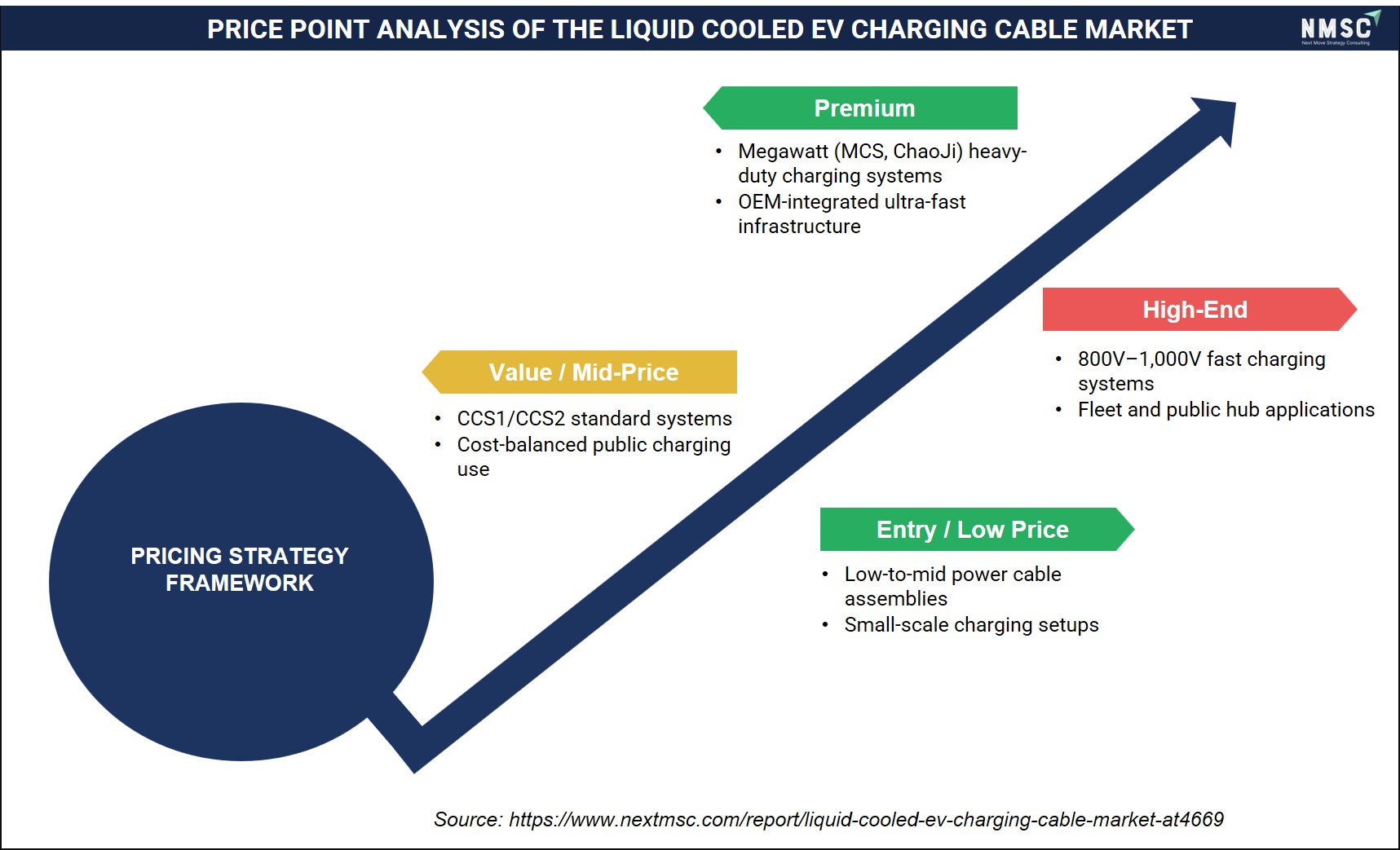
The Liquid-Cooled EV Charging Cable industry is segmented into Premium, High-End, Value/Mid-Price, and Entry/Low-Price categories based on performance and application scope. Furthermore, our analysis shows that premium solutions primarily support megawatt charging systems, including MCS and ChaoJi applications used in heavy-duty and OEM-integrated ultra-fast charging infrastructure. High-End systems are widely used across 800V–1,000V charging applications for fleet and public charging hubs. Value/Mid-Price solutions mainly utilize CCS1 and CCS2 standards for cost-balanced public charging infrastructure. Entry/Low-Price products focus on low-to-mid-power charging assemblies designed for small-scale deployments, thereby reflecting a structured market aligned with varying charging demand and infrastructure maturity across regions.
What Are the Key Factors Influencing Investment Analysis & Opportunities in the Liquid-Cooled EV Charging Cable Industry?
Our market assessment shows that investment opportunities in the Liquid-Cooled EV Charging Cable industry are primarily driven by the rapid expansion of ultra-fast EV charging infrastructure and the increasing demand for high-power charging systems. Moreover, the rising adoption of 800V and above EV architectures is accelerating the need for advanced liquid-cooled cable technologies capable of managing higher thermal loads efficiently. In addition, supportive government policies for EV deployment and charging infrastructure development are attracting sustained capital inflows into charging networks and equipment manufacturing. Collaborations between automotive OEMs and charging providers are further enhancing long-term investment stability. Investors are increasingly prioritizing scalable technologies aligned with global EV growth trajectories. Consequently, the industry demonstrates strong growth potential across both developed and emerging markets.
Furthermore, our evaluation shows that additional investment opportunities are shaped by continuous technological innovation, improved cost efficiency, and the expanding role of commercial EV applications. Furthermore, advancements in thermal management systems and high-current transmission capabilities are significantly improving product reliability and performance consistency. The electrification of commercial fleets and heavy-duty transport is generating new and sustained demand for advanced charging infrastructure. Besides this, strategic partnerships and integrated supply chain development are accelerating commercialization and market penetration. Our research demonstrates that companies with strong R&D capabilities and global operational scalability are gaining higher investor preference. As a result, increasing standardization of charging protocols is reinforcing long-term market stability. Therefore, the sector continues to present a favorable outlook for sustained investment expansion.
Key Benefits for Stakeholders:
Next Move Strategy Consulting (NMSC) provides a comprehensive and evidence-based analysis of the Liquid-Cooled EV Charging Cable market, covering historical developments from 2020 to 2025 and offering forward-looking forecasts through 2035. Our study evaluates the market at global, regional, and country levels, combining quantitative projections with qualitative insights into ultra-fast charging infrastructure expansion, high-voltage EV adoption trends, thermal management innovations, regulatory developments, and investment opportunities across major Liquid-Cooled EV Charging Cable segments. The research further examines evolving charging standards, OEM integration, and technology advancements shaping next-generation EV charging ecosystems.
The Liquid-Cooled EV Charging Cable market creates differentiated value across automotive OEMs, charging infrastructure providers, component manufacturers, and investors through the rapid transition toward high-power and megawatt charging systems. Our assessment confirms that investors benefit from strong demand growth driven by EV electrification, expansion of public and commercial fast-charging networks, and increasing adoption of 800V+ architectures requiring advanced cooling solutions. Additionally, companies with strong engineering capabilities, connector innovation, and scalable manufacturing infrastructure are strengthening their competitive positioning, enabling improved charging efficiency, safety performance, and long-term market expansion across global EV infrastructure ecosystems.
|
Parameters |
Details |
|
Customization Scope |
Free customisation (equivalent to up to 80 analyst-working hours) after purchase. Addition or alteration to country, regional & segment scope. |
|
Pricing and Purchase Options |
Avail customised purchase options to meet your exact research needs. |
|
Approach |
In-depth primary and secondary research; proprietary databases; rigorous quality control and validation measures. |
|
Analytical Tools |
Porter's Five Forces, SWOT, value chain, and Harvey ball analysis to assess competitive intensity, stakeholder roles, and relative impact of key factors. |
Key Market Segments
By Product Type
-
Integrated Cable Assemblies
-
Fixed Length
-
Retractable
-
-
Detachable Cable Assemblies
By Compatibility
-
Open Standard
-
OEM-Proprietary Locked
By Power Rating
-
400 to 599 A
-
600 to 799 A
-
≥ 800 A
By Voltage Class
-
400V Systems
-
800V Systems
-
≥ 1,000V Systems
By Connector Standard
-
CCS1
-
CCS2
-
GB/T DC
-
CHAdeMO
-
NACS
-
MCS
-
ChaoJi
By End Use
-
Public Charging
-
Public Fast Charging Hubs
-
Retail and Destination Charging
-
Workplace Charging
-
High-Performance Residential Charging
-
-
Commercial Fleet Charging
-
Fleet Depots
-
Logistics and Last Mile Depots
-
Transit and Bus Depots
-
Ride Hailing and Taxi Depots
-
-
Heavy Duty Charging
-
Truck Corridor Charging
-
Mining and Off Highway Charging
-
Marine and Port Charging
-
Aviation and Ground Support Charging
-
-
Mobile Charging
-
Mobile Charging Units
-
Temporary Charging Sites
-
Emergency Backup Charging
-
By Buyer Type
-
Charging Network Operators
-
Charging Equipment OEMs
-
Automotive OEMs
-
Fleet Operators
-
Infrastructure Developers
-
EPC Companies
Conclusion & Recommendations
NMSC’s assessment indicates that the Liquid-Cooled EV Charging Cable market is expected to witness sustained growth, driven by the rapid expansion of ultra-fast EV charging infrastructure and increasing adoption of high-voltage EV architectures. Moreover, rising demand for efficient thermal management solutions is supporting the transition toward liquid-cooled cable systems in megawatt charging applications. Growing investments from automotive OEMs and charging network operators are strengthening market development across both developed and emerging regions. Furthermore, supportive regulatory frameworks and infrastructure development initiatives are accelerating deployment. Our evaluation indicates that companies focusing on innovation, scalability, and interoperability are better positioned to capture long-term opportunities. Consequently, continuous technological advancement and ecosystem integration remain critical for maintaining competitiveness and driving future market expansion across the global EV charging landscape.
Additionally, our research demonstrates that strategic recommendations for stakeholders include prioritizing investment in advanced liquid cooling technologies and strengthening partnerships across the EV charging value chain. In addition, companies should focus on enhancing product efficiency, durability, and compatibility with evolving charging standards to maintain market relevance. Expanding manufacturing capabilities and optimizing supply chain integration can improve cost competitiveness and scalability. Alongside this, collaboration with OEMs and infrastructure developers is essential to accelerate the adoption of high-power charging solutions. Our analysis shows that firms with strong R&D capabilities and global expansion strategies are likely to achieve sustainable growth. Therefore, a coordinated focus on innovation, standardization, and strategic alliances will be key to long-term success in the evolving market landscape.
About the Author
 Tushmi Dutta
— Tushmi Dutta is a focused researcher specializing in detailed analysis and insight-driven research across diverse business landscapes. She supports strategic initiatives through structured data interpretation, thorough validation, and clear communication of findings that aid informed decision-making. With a strong interest in writing, she enjoys presenting research insights in an engaging and accessible manner. Beyond work, she enjoys traveling, reading, painting, and continuously learning new skills that contribute to her creative and professional growth.
Tushmi Dutta
— Tushmi Dutta is a focused researcher specializing in detailed analysis and insight-driven research across diverse business landscapes. She supports strategic initiatives through structured data interpretation, thorough validation, and clear communication of findings that aid informed decision-making. With a strong interest in writing, she enjoys presenting research insights in an engaging and accessible manner. Beyond work, she enjoys traveling, reading, painting, and continuously learning new skills that contribute to her creative and professional growth.
About the Reviewer
 Supradip Baul
— Supradip Baul is an accomplished business consultant and strategist with over a decade of rich experience in market intelligence, strategy, technology, and business transformation. His work has included rigorous qualitative and quantitative analysis across multiple industries, helping clients shape investment decisions and long-term roadmaps. Earlier in his career, he was associated with Gartner, where he contributed to industry-leading reports and market share analyses. He has worked with leading global companies and holds an MBA with a dual specialization in Marketing and Finance.
Supradip Baul
— Supradip Baul is an accomplished business consultant and strategist with over a decade of rich experience in market intelligence, strategy, technology, and business transformation. His work has included rigorous qualitative and quantitative analysis across multiple industries, helping clients shape investment decisions and long-term roadmaps. Earlier in his career, he was associated with Gartner, where he contributed to industry-leading reports and market share analyses. He has worked with leading global companies and holds an MBA with a dual specialization in Marketing and Finance.
At Next Move Strategy Consulting, we understand that insightful market research is the cornerstone of successful business decisions. That's why we employ a robust and multifaceted approach, combining various methodologies to deliver the most accurate and actionable data for our clients.

Research Landscape
We navigate the world of research with two primary approaches:
Qualitative Approach
Our qualitative research methodologies involve immersive techniques such as in-depth interviews, focus groups, and observational studies. By engaging directly with individuals and stakeholders, we uncover valuable insights that quantitative data alone may overlook.

Quantitative Research
In tandem with qualitative methodologies, NMSC leverages the power of Quantitative Research to provide a robust foundation of numerical insights. Through systematic data collection and analysis, we quantify patterns, preferences, and market trends, offering a comprehensive view of the business landscape.
Our quantitative research approach employs diverse tools, including surveys, experiments, and statistical modelling. These methodologies enable us to gather data from a large and representative sample, ensuring the statistical significance of our findings. By employing structured questionnaires and standardized data collection methods, we guarantee the reliability and validity of the information we present to our clients.
Quantitative research is particularly effective in measuring the prevalence of trends, assessing market size, and gauging the impact of various factors on consumer behavior. The numerical precision attained through this approach equips our clients with actionable insights, facilitating data-driven decision-making and strategy formulation.


Our Specialized Toolbox for Industry-Specific Market Research
We deploy a specialized arsenal of techniques tailored to meet your unique requirements. Here's a glimpse into our comprehensive toolbox:

Information Procurement
The stage entails acquiring market data or relevant information through various sources and methodologies.


Market Research Approach
We utilize both top-down and bottom-up approaches in market research analysis to achieve a comprehensive understanding of the market dynamics, leveraging the broad perspective of industry trends and macroeconomic factors alongside detailed insights from specific segments and individual companies.

Porters Five Forces Analysis
We conduct Porter's Five Forces analysis to evaluate the competitive landscape of an industry, providing us with insights into factors that affect profitability and strategic positioning.

SWOT Analysis

Forecasting
We utilize a forecasting model to predict future consumption by considering parameters like population, economics, regulations, market competition, drivers, constraints, technology, and pricing. We also employ statistical techniques such as multilinear regression, exponential smoothing, moving average, ARIMA, and Monte Carlo simulations for accurate predictions. In econometric forecasting, we analyzed short-term and long-term event impacts, attributing values based on regulatory frameworks, economic factors, and market events.





 Speak to Our Analyst