Long Duration Energy Storage Market Global Industry Analysis and Forecast (2026-2035)

Long Duration Energy Storage Market size is estimated at USD 10.02 billion in 2026, projected to reach USD 26.00 billion by 2035, growing at a CAGR of 11.18% from 2026 to 2035. Key growth factors include rising renewable energy integration, grid firming demand, and increasing adoption of non-lithium storage technologies.
Download Free Sample PDF
Base Year (2025)
$8.24 Billion
Forecast (2035)
$26.00 Billion
CAGR (2026-2035)
11.2%
Top Region
North America

What Is the Long Duration Energy Storage Market Size?

The global long duration energy storage market size was valued at USD 8.24 Billion in 2025 and is estimated to grow from USD 10.02 Billion in 2026 to USD 26.00 Billion by 2035, expanding at a CAGR of 11.18% between 2026 and 2035. North America led the long duration energy storage market with an approximate 38% revenue share in 2025, while Pumped Hydro Storage remained the dominant technology segment with an approximate 32% share of global revenue.

We observed that the long duration energy storage market's momentum is best captured through a concise set of indicators before deeper analysis follows.

Long Duration Energy Storage Market Global Industry Analysis and Forecast (2026-2035) Revenue Forecast

Values in USD Billion

2025 $8.24 Billion
2025
2026 $9.16 Billion
2026
2027 $10.19 Billion
2027
2028 $11.32 Billion
2028
2029 $12.59 Billion
2029
2030 $14.00 Billion
2030
2031 $15.56 Billion
2031
2032 $17.30 Billion
2032
2033 $19.24 Billion
2033
2034 $21.39 Billion
2034
2035 $26.00 Billion
2035

Key Takeaways

Dominant Technology: Pumped Hydro Storage held the largest share with USD 2.64 Billion in 2025 and is projected to reach USD 5.20 Billion by 2035.

Fastest-Growing Technology: Liquid Air Energy Storage is the fastest-growing technology at 16.14% CAGR from 2026–2035.

Dominant Duration: 8–24 Hours held the largest share with USD 4.53 Billion in 2025 and is projected to reach USD 11.70 Billion by 2035.

Fastest-Growing Duration: More Than 100 Hours is the fastest-growing duration segment at 16.02% CAGR from 2026–2035.

Dominant Application: Grid Firming held the largest share with USD 2.47 Billion in 2025 and is projected to reach USD 6.76 Billion by 2035.

Fastest-Growing Application: Industrial Decarbonization is the fastest-growing application at 17.13% CAGR from 2026–2035.

Dominant Region: North America dominated with USD 3.14 Billion in 2025 and is projected to reach USD 8.84 Billion by 2035.

Fastest-Growing Region: Middle East & Africa is expected to register the highest CAGR of 14.61% during 2026–2035.

Dominant Country: U.S. was the largest single national contributor within North America.

Fastest-Growing Country: Saudi Arabia is the fastest-growing country, with CAGR outpacing the regional Middle East & Africa average.

Market Opportunity: The long duration energy storage market is projected to generate an incremental revenue opportunity of approximately USD 15.98 Billion between 2026 and 2035, reflecting the absolute dollar gap between the 2035 forecast and the 2026 base value a signal of accelerating capital deployment into non-lithium storage technologies capable of multi-day discharge.

According to NMSC analysis, thermal and gravity-based storage technologies are attracting capital at a faster relative pace than their current revenue base would suggest, a dynamic tied to their lower material-cost profile that is not fully captured in near-term revenue figures.

What does the Long Duration Energy Storage Market Encompass?

The long duration energy storage market encompasses technologies capable of storing and discharging electricity over durations of eight hours or longer, spanning pumped hydro, compressed air, flow battery, thermal, gravity-based, and liquid air storage systems. Our assessment indicates that the market's scope covers grid-connected and behind-the-meter installations distinct from short-duration grid-scale battery storage systems using conventional lithium-ion chemistries optimized for sub-four-hour discharge cycles.
Structurally, the market has evolved from pumped hydro as the sole commercially mature technology toward a diversified mix of flow battery, thermal, and mechanical storage systems reaching commercial deployment scale. We found that regulatory environments administered by national energy regulators continue to define market mechanisms and capacity remuneration structures shaping project economics, while technology adoption trends in multi-day discharge systems are reshaping how utilities plan renewable integration and grid firming capacity.

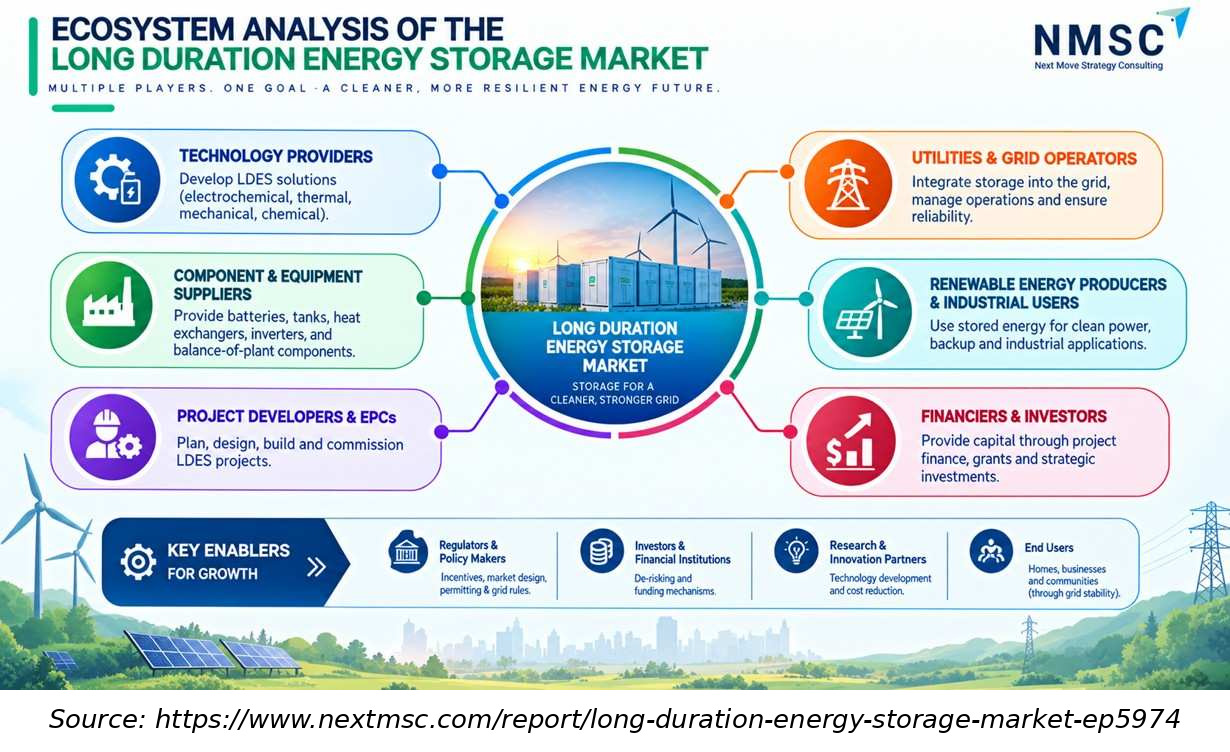
Ecosystem Analysis

Market Drivers & Dynamics

Interactive Dataset
Rising renewable energy capacity requiring multi-hour grid firming driver +3.2% North America, Europe, Asia-Pacific 2026–2035
Expanding government funding and capacity remuneration mechanisms driver +2.1% North America, Europe 2026–2032
Declining levelized cost of non-lithium long duration technologies driver +1.6% Global 2027–2035
Growing industrial decarbonization demand for thermal storage driver +1.1% North America, Europe, Asia-Pacific 2026–2033
Lack of standardized technology performance benchmarks restraint −1.2% Global 2026–2030
High upfront capital cost relative to short-duration battery alternatives restraint −0.9% Asia-Pacific, Latin America, MEA 2026–2032
Site-specific geographic constraints for pumped hydro and CAES restraint −0.6% Global 2026–2035
Source: Next Move Strategy Consulting

Growth Drivers

What Is the Primary Growth Driver for the Long Duration Energy Storage Market?

Rising renewable energy capacity requiring multi-hour grid firming is the primary growth driver, as intermittent solar and wind generation increasingly requires storage capable of bridging multi-day generation gaps. The U.S. Department of Energy continues to fund long duration storage demonstration projects through its Office of Electricity, underscoring institutional recognition of the grid-firming capacity gap that long duration technologies are positioned to fill as renewable penetration rises.

How Is Declining Technology Cost Driving the Market Growth?

Declining levelized cost of non-lithium long duration technologies is driving growth by improving project economics relative to extending short-duration battery systems to multi-day applications. Company analysis indicates that developers with commercially proven iron-air, thermal, or gravity-based platforms are securing utility offtake agreements at increasingly competitive pricing. Based on research conducted by NMSC, we found that this cost decline is most pronounced across technologies benefiting from abundant, low-cost raw materials.

Growth Inhibitors

What Is Restraining the Long Duration Energy Storage Market?

Lack of standardized technology performance benchmarks is restraining procurement confidence, as utilities evaluating competing long duration technologies face inconsistent performance and degradation data across vendors. We observed that this restraint is most pronounced for utility procurement teams comparing unproven technologies against pumped hydro's decades-long operating track record, slowing procurement decisions even where cost economics favor newer technologies.

Segmentation Analysis

2025 (USD Billion)
2035 (USD Billion)
Pumped Hydro Storage 2025: $2.64 Billion | 2035: $5.20 Billion
Pumped Hydro
Compressed Air Energy Storage 2025: $1.32 Billion | 2035: $4.16 Billion
Compressed A
Flow Batteries 2025: $1.98 Billion | 2035: $7.28 Billion
Flow Batteri
Thermal Energy Storage 2025: $1.15 Billion | 2035: $4.68 Billion
Thermal Ener
Gravity-Based Storage 2025: $0.49 Billion | 2035: $2.08 Billion
Gravity-Base
Liquid Air Energy Storage 2025: $0.41 Billion | 2035: $1.82 Billion
Liquid Air E
Other Emerging LDES Technologies 2025: $0.25 Billion | 2035: $0.78 Billion
Other Emergi
Pumped Hydro Storage $2.64 Billion $5.20 Billion 7.02%
Compressed Air Energy Storage $1.32 Billion $4.16 Billion 12.15%
Flow Batteries $1.98 Billion $7.28 Billion 14.00%
Thermal Energy Storage $1.15 Billion $4.68 Billion 15.15%
Gravity-Based Storage $0.49 Billion $2.08 Billion 15.62%
Liquid Air Energy Storage $0.41 Billion $1.82 Billion 16.14%
Other Emerging LDES Technologies $0.25 Billion $0.78 Billion 12.05%

Which Technology Dominates the Long Duration Energy Storage Market?

Pumped Hydro Storage dominates technology segmentation with an estimated USD 2.64 Billion in 2025, rising to USD 5.20 Billion by 2035, reflecting its decades-long installed base as the only long duration technology proven at multi-gigawatt scale. Liquid Air Energy Storage is the fastest-growing technology at a 16.14% CAGR, reflecting its site-flexibility advantage over pumped hydro combined with improving round-trip efficiency.

2025 (USD Billion)
2035 (USD Billion)
8–24 hours
24–100 hours
More than 10
Segment Item 2025 (USD Billion) 2035 (USD Billion) CAGR
8–24 hours $10.0 USD Billion $40.0 USD Billion 25.0%
24–100 hours $17.1 USD Billion $51.1 USD Billion 11.0%
More than 100 hours $24.2 USD Billion $62.2 USD Billion 25.0%

Segment-wise data is locked

Unlock complete segment-wise numbers for By Duration.

Unlock Full Data

Which Duration Category Is Gaining the Most Ground?

The 8–24 Hours duration category leads with USD 4.53 Billion in 2025 revenue, reflecting the current sweet spot for daily renewable generation and demand mismatch bridging. More Than 100 Hours is the fastest-growing duration category at a 16.02% CAGR, driven by early commercial deployment of multi-week and seasonal-scale storage systems targeting extended renewable generation gaps.

2025 (USD Billion)
2035 (USD Billion)
Grid firming
Renewable in
Peak shaving
Backup and r
Industrial d
Segment Item 2025 (USD Billion) 2035 (USD Billion) CAGR
Grid firming $10.0 USD Billion $40.0 USD Billion 27.0%
Renewable integration $17.1 USD Billion $51.1 USD Billion 9.0%
Peak shaving $24.2 USD Billion $62.2 USD Billion 19.0%
Backup and resilience $31.3 USD Billion $73.3 USD Billion 17.0%
Industrial decarbonization $38.4 USD Billion $84.4 USD Billion 18.0%

Segment-wise data is locked

Unlock complete segment-wise numbers for By Application.

Unlock Full Data

Which Application Segment Is Growing Fastest?

Grid Firming leads application segmentation with USD 2.47 Billion in 2025 revenue, reflecting utility priority on maintaining reliable capacity as renewable penetration rises. Industrial Decarbonization is the fastest-growing application at a 17.13% CAGR, driven by rising thermal storage adoption among heavy industrial customers seeking to replace fossil-fuel process heat.

2025 (USD Billion)
2035 (USD Billion)
Utility-owne
Independent
Behind-the-m
Segment Item 2025 (USD Billion) 2035 (USD Billion) CAGR
Utility-owned $10.0 USD Billion $40.0 USD Billion 14.0%
Independent power producer $17.1 USD Billion $51.1 USD Billion 24.0%
Behind-the-meter commercial and industrial $24.2 USD Billion $62.2 USD Billion 22.0%

Segment-wise data is locked

Unlock complete segment-wise numbers for By Ownership Model.

Unlock Full Data

Growth Opportunities

Beyond current demand drivers, three whitespace opportunities stand out as forward-looking mechanisms for revenue expansion through 2035.

Can Iron-Air Battery Scale-Up Unlock Non-Topographic Grid Firming Demand?

Iron-air and other low-cost electrochemical technologies free from pumped hydro's site-specific topographic requirements can unlock grid firming demand in regions lacking suitable terrain. This mechanism primarily benefits developers with proven commercial-scale iron-air platforms capable of siting near existing grid interconnection points.

Will Industrial Thermal Storage Retrofits Expand Decarbonization Financing Demand?

Thermal storage systems retrofitted into existing industrial process heat infrastructure can expand decarbonization financing demand among heavy industry customers facing carbon compliance pressure. Providers with proven renewable energy integration and industrial retrofit engineering capability are best positioned to capture this expanding decarbonization-linked opportunity.

Can Seasonal-Scale Storage Financing Models Expand Utility Adoption?

Innovative financing models spreading seasonal-scale storage capital costs across multi-decade contracted revenue streams can expand utility adoption of More Than 100 Hours duration systems currently limited by high upfront capital requirements. Developers with established long-term power purchase agreement structuring capability are best positioned to capture this financing-driven opportunity.

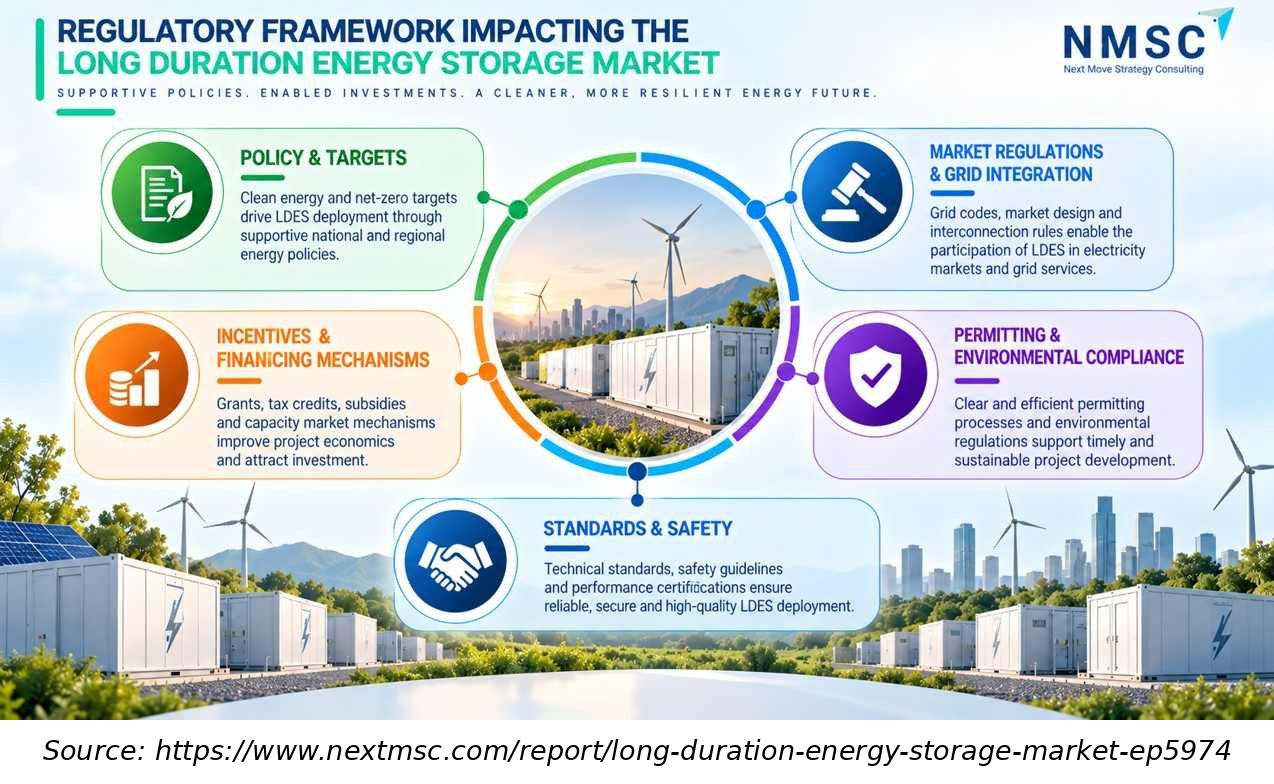
Regulatory Framework Impacting the Long Duration Energy Storage Market

This infographic presents the Regulatory Framework impacting the Long Duration Energy Storage Market, highlighting policy and clean-energy targets, market regulations and grid integration, incentives and financing mechanisms, permitting and environmental compliance, and standards and safety. It shows how these regulatory pillars influence LDES deployment, grid participation, project economics, investment, environmental performance, operational reliability, and the development of secure, high-quality energy storage infrastructure.

Regional Outlook

2025 (USD Billion)
2035 (USD Billion)
North Americ
Europe
Asia-Pacific
Middle East
Latin Americ
Region 2025 (USD Billion) 2035 (USD Billion) CAGR (%)
North America $10.0 USD Billion $40.0 USD Billion 9.0%
Europe $17.1 USD Billion $51.1 USD Billion 27.0%
Asia-Pacific $24.2 USD Billion $62.2 USD Billion 25.0%
Middle East & Africa $31.3 USD Billion $73.3 USD Billion 23.0%
Latin America $38.4 USD Billion $84.4 USD Billion 12.0%

Regional data is locked

Unlock complete regional numbers for this market.

Unlock Full Data

Competitive Landscape

Our findings suggest that the competitive landscape spans venture-backed technology-specific developers and diversified industrial conglomerates with long duration storage divisions, each pursuing distinct differentiation strategies.

Dimension Description
Dimension Assessment
Market Structure Fragmented and emerging; technology-specific developers compete for early commercial deployments while diversified conglomerates leverage existing industrial manufacturing and project-finance capability
Innovation Focus Iron-air and flow battery chemistry, thermal storage material science, gravity-based mechanical engineering
M&A Activity Selective; diversified conglomerates pursue strategic investments and partnerships with technology-specific developers rather than outright acquisitions

How Do Companies Compete in the Long Duration Energy Storage Market?

Companies compete primarily on demonstrated commercial-scale deployment track record, levelized cost of storage, and depth of utility offtake agreement relationships. Our analysis shows that developers with proven multi-megawatt commercial installations sustain stronger procurement credibility than competitors with only pilot-scale demonstration projects, particularly given utility risk aversion toward unproven long duration technologies.

Which Competitive Archetypes Dominate the Long Duration Energy Storage Market?

Two archetypes dominate: venture-backed technology-specific developers focused exclusively on a single storage chemistry or mechanical approach, and diversified industrial conglomerates leveraging existing engineering and project-finance capability to enter long duration storage. We observed that the differentiation between these archetypes is narrowing as technology-specific developers secure strategic partnerships with larger industrial players.

What Innovation and Differentiation Strategies Are Companies Pursuing?

Company analysis indicates that leading firms are differentiating through proprietary electrochemistry, thermal material science, and mechanical engineering approaches optimized for specific duration and application niches. Investment in manufacturing scale-up continues, alongside expanded project development capability targeting utility-scale grid firming and industrial decarbonization customer segments.

How Active Is M&A in the Long Duration Energy Storage Industry?

M&A activity remains selective as diversified conglomerates pursue strategic investments and technology partnerships with venture-backed developers rather than outright acquisitions of early-stage companies. Based on research conducted by NMSC, we found that partnership activity is concentrated on iron-air and thermal storage developers, reflecting strategic interest in the fastest-growing technology and application categories.

Key Market Players

Our assessment indicates that the following companies represent the validated set of key players shaping competitive dynamics across pumped hydro, flow battery, thermal, and mechanical storage technologies within the long duration energy storage market.

Form Energy, Inc. ESS Tech, Inc. Energy Vault Holdings, Inc. Highview Power Storage Ltd. Hydrostor Inc. Energy Dome S.p.A. Invinity Energy Systems plc Eos Energy Enterprises, Inc. Redflow Limited CellCube Energy Storage Systems Inc. Ambri Inc. Malta Inc. Rondo Energy, Inc. Antora Energy, Inc. Siemens Energy AG Sumitomo Electric Industries, Ltd. Fluence Energy, Inc. Wärtsilä Corporation Stryten Energy LLC VRB Energy Inc.

Latest Developments

We observed that recent developments across the industry reflect continued commercial-scale deployment and manufacturing capacity expansion.

Date Event
September, 2026 Malta and Kobe Steel formed a capital and business alliance, with Kobe Steel making a strategic investment in Malta. The companies will combine Malta’s thermodynamic technology and Kobe Steel’s compression expertise to accelerate commercialization, including grid-scale energy storage. The collaboration expands industrial-scale thermal storage technology and strategic manufacturing partnerships
September, 2026 Antora and GrafTech announced a strategic collaboration to develop and supply carbon-based materials for Antora thermal batteries at GrafTech’s Pennsylvania facility. The materials will support battery modules that store electricity as heat and deliver heat or electricity around the clock, strengthening domestic supply-chain capacity for thermal long-duration storage.
September, 2026 Hydrostor received grid connection approval from AEMO and Transgrid for its 200 MW/1,600 MWh Silver City Energy Storage Centre in Broken Hill, Australia. The approval confirms the project meets Generator Performance Standards and advances the eight-hour A-CAES project toward connection to the NSW transmission network. The project includes 50 MW/250 MWh of capacity reserved for backup power during planned or unplanned network outages.

Investment Opportunities

Where Is Capital Flowing Within the Long Duration Energy Storage Market?

Capital inflows are concentrated in commercial-scale manufacturing capacity expansion for iron-air and flow battery developers, alongside project-level financing for utility-scale deployments. We found that government funding programs are also flowing into thermal and gravity-based demonstration projects, signaling continued institutional support for technology diversification beyond pumped hydro.

How Significant Is Infrastructure Investment in This Market?

Infrastructure investment is substantial, with developers expanding manufacturing facilities and project development pipelines to meet rising utility procurement demand. Our assessment indicates that continued investment in stationary energy storage manufacturing infrastructure is becoming a prerequisite for competing at the utility-scale deployment volumes required by grid firming contracts.

What ESG Considerations Are Relevant to This Market?

ESG considerations center on responsible sourcing of vanadium and other flow battery materials, land and water use impact of pumped hydro and compressed air projects, and the broader decarbonization value proposition long duration storage enables for grid operators. We observed that developers increasingly disclose material sourcing and environmental impact commitments in project-level sustainability disclosures.

Key Benefits for Stakeholders

How Does This Report Benefit Industry Leaders?

Industry and enterprise leaders gain a structured view of technology, duration, and regional revenue distribution, supporting prioritization decisions across R&D investment and manufacturing capacity planning. Our analysis shows that this structured segmentation clarifies where competitive intensity is rising fastest ahead of resource-allocation decisions.

How Does This Report Benefit Investors and Financial Analysts?

Investors and financial analysts gain reconciled market-size, CAGR, and regional-growth data supporting valuation and portfolio-allocation decisions. Company analysis indicates that segment-level growth differentials, particularly around liquid air and industrial decarbonization categories, are material inputs for evaluating developer growth durability.

How Does This Report Benefit Technology Vendors and Product Teams?

Technology vendors and product teams gain visibility into technology and duration trends shaping manufacturing and project development infrastructure demand. We found that this analysis supports prioritization of engineering investment toward the fastest-growing technology categories identified across the forecast period.

Key Market Segments Evaluated

By Technology

  • Pumped Hydro Storage
  • Compressed Air Energy Storage
  • Flow Batteries
  • Thermal Energy Storage
  • Gravity-Based Storage
  • Liquid Air Energy Storage
  • Other Emerging LDES Technologies

By Duration

  • 8–24 Hours
  • 24–100 Hours
  • More Than 100 Hours

By Application

  • Grid Firming
  • Renewable Integration
  • Peak Shaving
  • Backup and Resilience
  • Industrial Decarbonization

By Ownership Model

  • Utility-owned
  • Independent power producer
  • Behind-the-meter commercial and industrial

Conclusion & Recommendations

The long-term outlook remains firmly expansionary, with revenue projected to more than double from USD 10.02 Billion in 2026 to USD 26.00 Billion by 2035 at a 11.18% CAGR. Our analysis shows that this trajectory is underpinned by structural renewable integration demand rather than one-time demonstration project funding alone.

What Strategic Positioning Should Companies Pursue?

Companies should prioritize commercial-scale deployment track record and manufacturing cost reduction over continued pilot-scale demonstration alone. We found that developers transitioning fastest from demonstration to commercial-scale deployment are securing the largest utility offtake agreements ahead of less-proven competitors.

How Attractive Is the Market for Investment?

Investment attractiveness is high given double-digit growth across nearly every technology and application category alongside continued government funding support for technology diversification. Our assessment indicates that capital allocators should weight exposure toward developers with proven commercial-scale deployment over pilot-stage competitors still awaiting first commercial installations.

What Market Shifts and Key Risks Should Stakeholders Monitor?

Key risks include lack of standardized technology performance benchmarks, high upfront capital costs relative to short-duration alternatives, and site-specific geographic constraints for pumped hydro and compressed air technologies. We observed that performance benchmark uncertainty poses the most immediate risk to procurement decision timelines across utility customers evaluating multiple competing technologies.

What Are the Primary Growth Pathways Through 2035?

Primary growth pathways include iron-air battery scale-up for non-topographic grid firming, industrial thermal storage retrofits for decarbonization financing, and seasonal-scale storage financing models expanding utility adoption. Our findings suggest that companies combining all three pathways will outpace single-lever competitors through the forecast period.

FAQs

About the Author

Liza Phukan

Liza Phukan

Liza Phukan is Research Associate at Next Move Strategy Consulting, where she has covered emerging industries and market research across sectors for 3.5 years. Her work includes analyzing industry developments, validating market data, and developing structured business content from research findings. She uses secondary research and data-validation practices to turn complex market information into clear decision-useful market analysis for business audiences and support report development and B2B.

About the Reviewer

Supradip Baul

Supradip Baul

Supradip Baul is an accomplished business consultant and strategist with over a decade of rich experience in market intelligence, strategy, technology, and business transformation. His work has included rigorous qualitative and quantitative analysis across multiple industries, helping clients shape investment decisions and long-term roadmaps. Earlier in his career, he was associated with Gartner, where he contributed to industry-leading reports and market share analyses. He has worked with leading global companies and holds an MBA with a dual specialization in Marketing and Finance.

Download Free Sample

Amos Chang

AMOS CHANG

Strategy Consultant

Kardex Group

I have bought the intralogistics market reports from NMSC two times so far. Joseph and his team are always very helpful and flexible in responding to any customization requirements on the report. Their expertise in market reports really helps us steer the day-to-day business. I will definitely recommend and come back myself whenever there is a need.

Kevin Coker

KEVIN COKER

Founder, CEO and Board Diector

Proxima Clinical Research

I have been using Next MSC reports for product positioning in a new geography for a long time. They have by far the best reports I have found and the price is reasonable too!

Robert Sean Trevino

ROBERT SEAN TREVINO

Sr. Director, Head of Strategic Insights & Analytics

Foundation Medicine

I realized that it was a reliable source of information. These days, there are many people who are looking for authentic data, and this is one of the only sources that can offer them with what they need;

Kishu Kanda

KISHU KANDA

Strategy Analyst

Accenture

We purchased the AI Consumer Market Report from this company. Not only did they customize the report to meet our specific requirements, but they also showed great flexibility in accommodating our budget. The report we received fully met our expectations. Additionally, they provided prompt and thorough responses to both our pre-purchase and follow-up questions. We look forward to working with this company again in the future.

Ross J Mckenzie

ROSS J MCKENZIE

Business Insight Manager

Staysure Group

“Next MSC have been incredibly helpful in providing detailed & robust information on our market, alongside quantifying growth by different segments. The process to procure was simple and easy, with sample reports and regular contact to ensure we had what we needed. Succinct detail on their sources & methodologies is also greatly received, allowing transparency in this respect helps build trust in the detail you pay for. Joseph in particular was fantastic, and helped ensure efficient provision of the insight pack – thank you NMSC!”.

Custom Market Research Services

We will customize the research for you if the listed report does not fully match your requirements.

Get 30% Free Customization

Select License

This website uses cookies to ensure you get the best experience on our website. Learn more

✖