Magnesia Chrome Brick Market Global Industry Analysis and Forecast (2026-2035)

Magnesia Chrome Brick Market size was USD 3.18 Billion in 2025, projected to reach USD 7.43 Billion by 2035, growing at a CAGR of 8.36% from 2026 to 2035. Key drivers include robust steel and non-ferrous metallurgy demand, expansion of copper smelting capacity for the energy transition, and growing specialty glass manufacturing applications, with Asia-Pacific leading the market.
Download Free Sample PDF
Base Year (2025)
$3.18 Billion
Forecast (2035)
$7.43 Billion
CAGR (2026-2035)
8.4%
Top Region
Asia-Pacific

What Is the Magnesia Chrome Brick Market Size?

The global Magnesia Chrome Brick Market reached USD 3.18 Billion in 2025 and is estimated at USD 3.61 Billion in 2026, forecast to reach USD 7.43 Billion by 2035 at a CAGR of 8.36% between 2026 and 2035. Asia-Pacific leads with an approximate 51% share, while the Steel Industry application segment dominates at approximately 52% share in 2025.
Our assessment indicates that the Magnesia Chrome Brick Market is experiencing sustained demand momentum across all primary application sectors, with non-ferrous metallurgy and specialty glass manufacturing emerging as the fastest-growing end-use categories alongside the historically dominant steel furnace lining segment.
Magnesia Chrome Brick Market Global Industry Analysis and Forecast (2026-2035) Revenue Forecast
Values in USD Billion

2025 $3.18 Billion
2025
2026 $3.45 Billion
2026
2027 $3.73 Billion
2027
2028 $4.05 Billion
2028
2029 $4.38 Billion
2029
2030 $4.75 Billion
2030
2031 $5.15 Billion
2031
2032 $5.58 Billion
2032
2033 $6.04 Billion
2033
2034 $6.55 Billion
2034
2035 $7.43 Billion
2035

Key Takeaways

By Product Type: Sintered Grain Magnesia Chrome Bricks held the largest share, expanding from USD 1.24 billion in 2025 to USD 2.70 billion by 2035; Direct Bonded Magnesia Chrome Bricks is the fastest-growing sub-segment at 10.1% CAGR from 2026–2035.

By Application: Steel Industry held the largest share, expanding from USD 1.65 billion in 2025 to USD 3.71 billion by 2035; Glass Industry is the fastest-growing application at 13.35% CAGR from 2026–2035.

By MgO Content: Standard Grade (50–75% MgO) held the largest share, expanding from USD 1.44 billion in 2025 to USD 2.97 billion by 2035; Chrome-Rich Grade (<50% MgO) is the fastest-growing grade at 11.24% CAGR from 2026–2035.

By Sales Channel: Direct Sales held the largest share, expanding from USD 1.97 billion in 2025 to USD 4.72 billion by 2035; Direct Sales is growing at a 9.14% CAGR from 2026–2035.

Dominant Region: Asia-Pacific dominated with approximately 51% revenue share in 2025.

Fastest-Growing Region: Middle East & Africa is expected to register the highest CAGR of 10.88% during 2026–2035.

Dominant Country: China led the market, anchored by the world's largest steel production base and extensive non-ferrous smelting capacity.

Fastest-Growing Country: India is the fastest-growing country, driven by rapid steel capacity expansion, growing cement industry investment, and increasing copper refining operations.

The market presents an absolute investment opportunity of approximately USD 3.82 Billion between 2026 and 2035, calculated as the difference between the 2035 forecast of USD 7.43 Billion and the 2026 base of USD 3.61 Billion, positioning non-ferrous metallurgy lining solutions and advanced fused grain products as high-priority development categories for refractory manufacturers and specialty materials investors.

According to NMSC analysis, the Magnesia Chrome Brick Market is increasingly bifurcated between established steel furnace lining applications and a rapidly growing non-ferrous and specialty segment, where higher-chromia formulations and fused grain products command premium pricing that disproportionately expands revenue relative to volume growth.
Ecosystem Analysis of the Magnesia Chrome Brick Industry

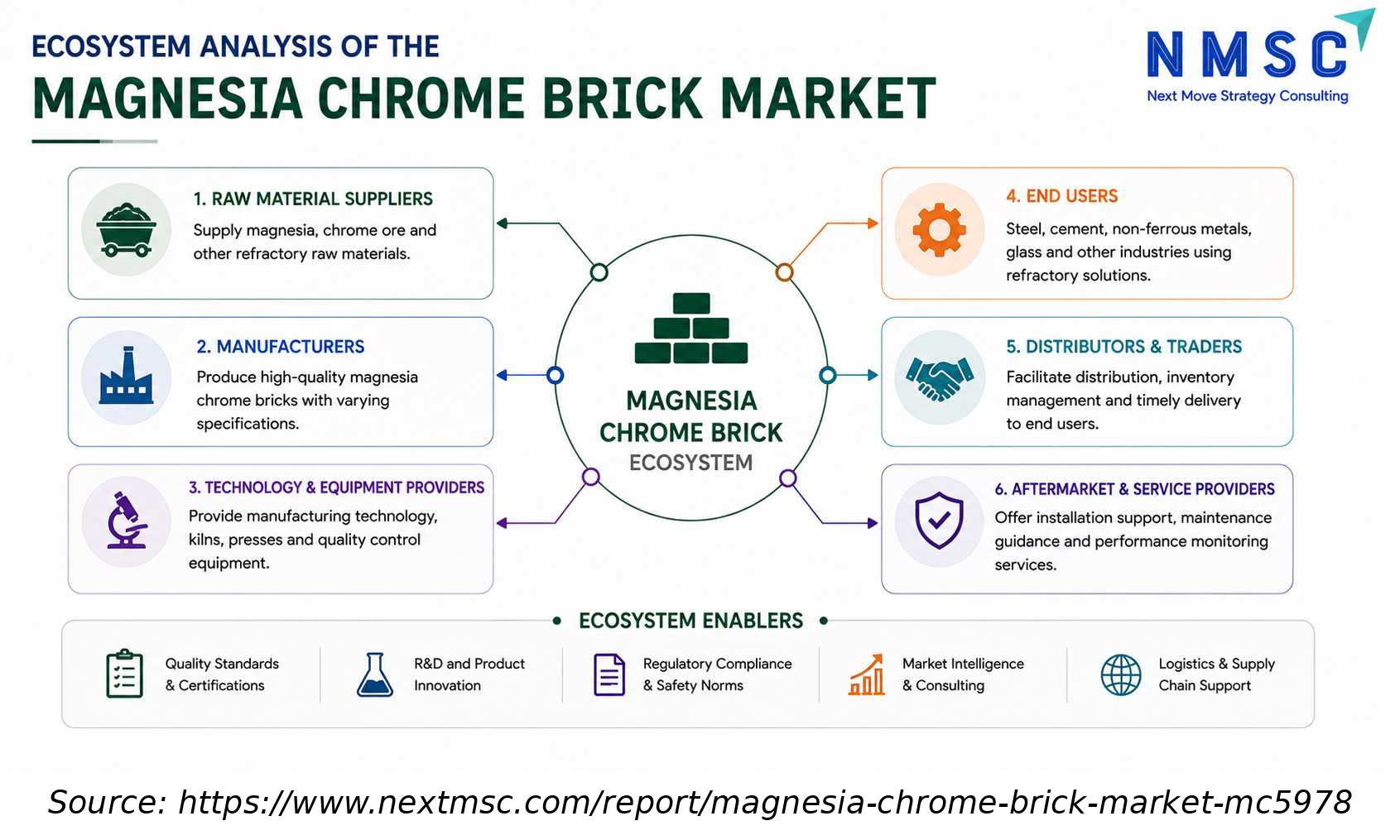
The above infographic provides a detailed ecosystem analysis of the magnesia chrome brick market, mapping out six key segments from raw material suppliers to aftermarket service providers. It illustrates how manufacturers, technology providers, and distributors interact within a connected network to deliver high-quality refractory solutions to industries like steel and cement. The analysis further highlights crucial ecosystem enablers, such as quality standards, R&D innovation, and regulatory compliance, that support the industry. Ultimately, it demonstrates how this interconnected chain ensures reliable distribution and long-term performance monitoring for end users.

What Does the Magnesia Chrome Brick Market Encompass?
The Magnesia Chrome Brick Market encompasses the production, sale, and application of refractory bricks manufactured from magnesia (MgO) and chromite (FeO·Cr2O3) as principal raw materials, used to line the high-temperature working zones of steel furnaces, non-ferrous metal smelters, cement rotary kilns, and glass melting tanks. The market covers product types differentiated by manufacturing method and Cr2O3 content level, including fused grain, sintered grain, rebonded fused grain, and direct bonded grades, as well as services related to furnace lining design, installation, and maintenance.
We observed that the market has evolved from a commodity supply business serving captive steel plant requirements into a technically differentiated specialty segment, with refractory producers competing on refractory wear resistance, thermal shock stability, and slag corrosion performance metrics specific to each application. Environmental regulations in Europe and North America restricting hexavalent chromium (Cr6+) emissions from spent chrome-bearing refractories are reshaping product formulation priorities and end-of-life management practices globally. In parallel, adoption of advanced manufacturing processes including electrofusion and isostatic pressing is improving product performance consistency and supporting premium pricing across the market.

Market Drivers & Dynamics

Interactive Dataset
Expanding global crude steel and EAF production capacity driver +2.4% Asia-Pacific, MEA, Latin America 2026–2035
Growing copper smelting investment for EV and energy transition supply chains driver +1.8% Global 2026–2032
Government infrastructure programs driving cement industry capacity addition driver +1.4% Asia-Pacific, MEA, Latin America 2026–2033
Specialty and solar glass manufacturing capacity expansion driver +0.9% Asia-Pacific, Europe, North America 2026–2035
EAF steelmaking transition increasing demand for thermal shock-resistant grades driver +0.7% Europe, North America, India 2026–2035
Environmental regulations restricting Cr6+ emissions limiting chrome refractory use restraint −1.2% Europe, North America 2026–2033
Substitution of chrome-free refractory alternatives in regulated applications restraint −0.9% Europe 2026–2035
Volatile magnesia and chromite raw material price cycles restraint −0.5% Global 2026–2030
Decarbonization pressures reducing conventional BF-BOF steelmaking capacity restraint −0.4% Europe, North America 2026–2035
Source: Next Move Strategy Consulting

Growth Drivers

What Is the Primary Growth Driver in the Magnesia Chrome Brick Market?

The primary growth driver is the structural expansion of global steel production capacity, particularly electric arc furnace-based steelmaking across Asia-Pacific, the Middle East, and Latin America. The World Steel Association reports that global crude steel output exceeded 1.8 billion metric tons in 2024, with emerging market capacity additions continuing to create sustained demand for furnace lining refractories, including magnesia chrome bricks. Magnesia chrome grades remain the preferred lining material for BOF vessels, EAF sidewalls, and ladle working linings in steelmaking operations where basic slag resistance and thermal stability are required.

How Is Copper Smelting Capacity Expansion Driving Magnesia Chrome Brick Market Growth?
Copper smelting capacity investment, driven by the rapid growth of lithium-ion battery supply chains and EV charging infrastructure requiring large volumes of copper, is creating a structurally new demand stream for magnesia chrome bricks in converter and anode furnace linings. Market analysis indicates that new copper smelter projects announced through 2028 in Chile, Peru, the Democratic Republic of Congo, and Indonesia will require thousands of metric tons of magnesia chrome refractories for initial lining and subsequent relining campaigns, collectively representing a meaningful volume addition to the non-ferrous metallurgy segment of the Magnesia Chrome Brick Market.

Growth Inhibitors

What Is Restraining the Magnesia Chrome Brick Market?

Environmental regulations restricting hexavalent chromium from spent refractory waste are the primary structural restraint, as European Union directives and U.S. EPA chromium waste guidelines impose significant compliance costs on steelmakers and non-ferrous smelters that use and dispose of chrome-bearing refractories. The European Chemicals Agency's restrictions under the REACH regulation specifically address chromium trioxide and certain Cr6+ compounds, compelling European steel producers to evaluate chrome-free or reduced-chrome magnesia refractory alternatives. Our findings suggest that this substitution pressure is most acute in the European Union, where environmental compliance risk is materially influencing refractory procurement decisions.

What Are the Growth Opportunities?

Can Non-Ferrous Smelting Expansion Unlock a Durable New Premium Revenue Segment?

Non-ferrous metallurgy applications, particularly copper, nickel, and lead-zinc smelting, are growing faster than the overall Magnesia Chrome Brick Market at 8.73% CAGR and command premium product pricing due to the more aggressive chemical attack conditions of non-ferrous slags versus steel slag. Refractory manufacturers that develop copper-specific magnesia chrome formulations with certified performance data from operating smelters can secure preferred supplier status in greenfield smelter tenders, where lining specifications are fixed in the project engineering phase. Aluminumsmelter input materials procurement parallels this pattern of long-term technical supply relationships in non-ferrous metallurgy operations.

Does Specialty Glass Furnace Lining Represent a High-Margin Diversification Opportunity?

Glass Industry magnesia chrome brick demand is growing at 13.35% CAGR from 2026 to 2035, the fastest of all application sub-segments, and specialty glass applications consistently require premium quality, closely toleranced bricks with certified chemical purity that generic steel-grade products cannot supply. Manufacturers that invest in dedicated glass-grade product development, including low-iron contamination formulations and precise dimensional control, can establish technical differentiation barriers and secure sole-source or approved-supplier positions with specialty glass producers, where refractory performance directly impacts melt quality and regulatory compliance in pharmaceutical and food-grade glass applications.

Can Advanced Recycling and Circular Economy Programs for Spent Magnesia Chrome Bricks Create a New Business Model?

The growing regulatory burden of spent magnesia chrome brick disposal, particularly in Europe and North America, is creating a market opportunity for refractory producers and specialized industrial waste management firms that can offer closed-loop collection, Cr6+ stabilization, and recycled magnesia-chrome raw material recovery services to steel and non-ferrous metal producers. Offering brick-to-brick recycling programs that reduce customers' environmental compliance costs while supplying recycled raw materials back into production can create differentiated value propositions that improve customer retention and open new regulatory compliance services revenue streams beyond traditional product supply relationships.

Segmentation Analysis

2025 (USD Billion)
2035 (USD Billion)
Fused Grain Magnesia Chrome Bricks 2025: $0.82 Billion | 2035: $1.92 Billion
Fused Grain
Sintered Grain Magnesia Chrome Bricks 2025: $1.24 Billion | 2035: $2.70 Billion
Sintered Gra
Rebonded Fused Grain Magnesia Chrome Bricks 2025: $0.67 Billion | 2035: $1.63 Billion
Rebonded Fus
Direct Bonded Magnesia Chrome Bricks 2025: $0.45 Billion | 2035: $1.18 Billion
Direct Bonde
Fused Grain Magnesia Chrome Bricks $0.82 Billion $1.92 Billion 9.0%
Sintered Grain Magnesia Chrome Bricks $1.24 Billion $2.70 Billion 8.1%
Rebonded Fused Grain Magnesia Chrome Bricks $0.67 Billion $1.63 Billion 9.3%
Direct Bonded Magnesia Chrome Bricks $0.45 Billion $1.18 Billion 10.1%

Which Product Type Dominates and Which Is Fastest-Growing?

Sintered Grain Magnesia Chrome Bricks dominate at USD 1.24 Billion in 2025, growing to USD 2.70 Billion by 2035, reflecting their widespread use across steel furnaces, cement kilns, and copper smelting applications where their balance of performance and cost-effectiveness makes them the standard industrial specification. Direct Bonded Magnesia Chrome Bricks are the fastest-growing product type at 10.1% CAGR from 2026 to 2035, driven by their superior performance in high-temperature oxidizing atmospheres, making them the preferred choice for the increasingly demanding operating conditions in stainless steel AOD converter lining and advanced copper smelting applications.

2025 (USD Billion)
2035 (USD Billion)
Steel Indust
Electric Arc
Basic Oxygen
Ladle and Se
Non-Ferrous
Segment Item 2025 (USD Billion) 2035 (USD Billion) CAGR
Steel Industry $10.0 USD Billion $40.0 USD Billion 25.0%
Electric Arc Furnace Lining $17.1 USD Billion $51.1 USD Billion 11.0%
Basic Oxygen Furnace Lining $24.2 USD Billion $62.2 USD Billion 25.0%
Ladle and Secondary Metallurgy $31.3 USD Billion $73.3 USD Billion 11.0%
Non-Ferrous Metallurgy $38.4 USD Billion $84.4 USD Billion 16.0%

Segment-wise data is locked

Unlock complete segment-wise numbers for By Application.

Unlock Full Data

Which Application Segment Dominates and Which Is Fastest-Growing?

Steel Industry holds the dominant Application position at USD 1.65 Billion in 2025, expanding to USD 3.71 Billion by 2035, reflecting the central role of magnesia chrome bricks in electric arc furnace sidewalls, basic oxygen furnace vessels, and ladle permanent linings across the global steel industry. Glass Industry is the fastest-growing Application sub-segment at 13.35% CAGR from 2026 to 2035, driven by expanding specialty glass capacity for solar photovoltaic panels, pharmaceutical glass, and automotive safety glass manufacturing in China, Germany, and the U.S., where magnesia chrome bricks provide the thermal stability and chemical inertness required for extended campaign life in glass tank furnace crowns and superstructure linings.

2025 (USD Billion)
2035 (USD Billion)
High Magnesi
Standard Gra
Chrome-Rich
Segment Item 2025 (USD Billion) 2035 (USD Billion) CAGR
High Magnesia Grade (MgO >75%) $10.0 USD Billion $40.0 USD Billion 27.0%
Standard Grade (MgO 50–75%) $17.1 USD Billion $51.1 USD Billion 9.0%
Chrome-Rich Grade (MgO <50%) $24.2 USD Billion $62.2 USD Billion 19.0%

Segment-wise data is locked

Unlock complete segment-wise numbers for By MgO Content.

Unlock Full Data

Which MgO Content Grade Dominates and Which Is Growing Fastest?

Standard Grade (50–75% MgO) dominates MgO Content at USD 1.44 Billion in 2025, reflecting its broad suitability for steel BOF lining, cement kiln burning zone, and standard non-ferrous converter applications where the balance of periclase and chrome spinel phases delivers reliable chemical and thermal performance at cost-competitive pricing. Chrome-Rich Grade (MgO <50%) is the fastest-growing grade at 11.24% CAGR from 2026 to 2035, driven by its superior performance in aggressive copper smelting slags and specialty glass tank environments where high chromia content provides enhanced resistance to extreme corrosion and wear that cannot be achieved with standard or high-magnesia compositions.

2025 (USD Billion)
2035 (USD Billion)
Direct Sales
Indirect Sal
Distributors
Trading Comp
Segment Item 2025 (USD Billion) 2035 (USD Billion) CAGR
Direct Sales $10.0 USD Billion $40.0 USD Billion 14.0%
Indirect Sales $17.1 USD Billion $51.1 USD Billion 24.0%
Distributors $24.2 USD Billion $62.2 USD Billion 22.0%
Trading Companies $31.3 USD Billion $73.3 USD Billion 12.0%

Segment-wise data is locked

Unlock complete segment-wise numbers for By Sales Channel.

Unlock Full Data
2025 (USD Billion)
2035 (USD Billion)
North Americ
Canada
Mexico
Europe: UK
Germany
Segment Item 2025 (USD Billion) 2035 (USD Billion) CAGR
North America: U.S. $10.0 USD Billion $40.0 USD Billion 24.0%
Canada $17.1 USD Billion $51.1 USD Billion 22.0%
Mexico $24.2 USD Billion $62.2 USD Billion 20.0%
Europe: UK $31.3 USD Billion $73.3 USD Billion 22.0%
Germany $38.4 USD Billion $84.4 USD Billion 13.0%

Segment-wise data is locked

Unlock complete segment-wise numbers for By Region.

Unlock Full Data

Growth Opportunities

Our analysis shows that three whitespace opportunities stand out for magnesia chrome brick manufacturers and investors seeking disproportionate market share through 2035.

Can Non-Ferrous Smelting Expansion Unlock a Durable New Premium Revenue Segment?

Non-ferrous metallurgy applications, particularly copper, nickel, and lead-zinc smelting, are growing faster than the overall Magnesia Chrome Brick Market at 8.73% CAGR and command premium product pricing due to the more aggressive chemical attack conditions of non-ferrous slags versus steel slag. Refractory manufacturers that develop copper-specific magnesia chrome formulations with certified performance data from operating smelters can secure preferred supplier status in greenfield smelter tenders, where lining specifications are fixed in the project engineering phase. Aluminumsmelter input materials procurement parallels this pattern of long-term technical supply relationships in non-ferrous metallurgy operations.

Does Specialty Glass Furnace Lining Represent a High-Margin Diversification Opportunity?

Glass Industry magnesia chrome brick demand is growing at 13.35% CAGR from 2026 to 2035, the fastest of all application sub-segments, and specialty glass applications consistently require premium quality, closely toleranced bricks with certified chemical purity that generic steel-grade products cannot supply. Manufacturers that invest in dedicated glass-grade product development, including low-iron contamination formulations and precise dimensional control, can establish technical differentiation barriers and secure sole-source or approved-supplier positions with specialty glass producers, where refractory performance directly impacts melt quality and regulatory compliance in pharmaceutical and food-grade glass applications.

Can Advanced Recycling and Circular Economy Programs for Spent Magnesia Chrome Bricks Create a New Business Model?

The growing regulatory burden of spent magnesia chrome brick disposal, particularly in Europe and North America, is creating a market opportunity for refractory producers and specialized industrial waste management firms that can offer closed-loop collection, Cr6+ stabilization, and recycled magnesia-chrome raw material recovery services to steel and non-ferrous metal producers. Offering brick-to-brick recycling programs that reduce customers' environmental compliance costs while supplying recycled raw materials back into production can create differentiated value propositions that improve customer retention and open new regulatory compliance services revenue streams beyond traditional product supply relationships.

Regional Outlook

2025 (USD Billion)
2035 (USD Billion)
Asia-Pacific
Europe
North Americ
Middle East
Latin Americ
Region 2025 (USD Billion) 2035 (USD Billion) CAGR (%)
Asia-Pacific $10.0 USD Billion $40.0 USD Billion 9.0%
Europe $17.1 USD Billion $51.1 USD Billion 27.0%
North America $24.2 USD Billion $62.2 USD Billion 25.0%
Middle East & Africa $31.3 USD Billion $73.3 USD Billion 23.0%
Latin America $38.4 USD Billion $84.4 USD Billion 12.0%

Regional data is locked

Unlock complete regional numbers for this market.

Unlock Full Data

Supply Chain Analysis of the Magnesia Chrome Brick Industry

Supply Chain Analysis of the Magnesia Chrome Brick Industry
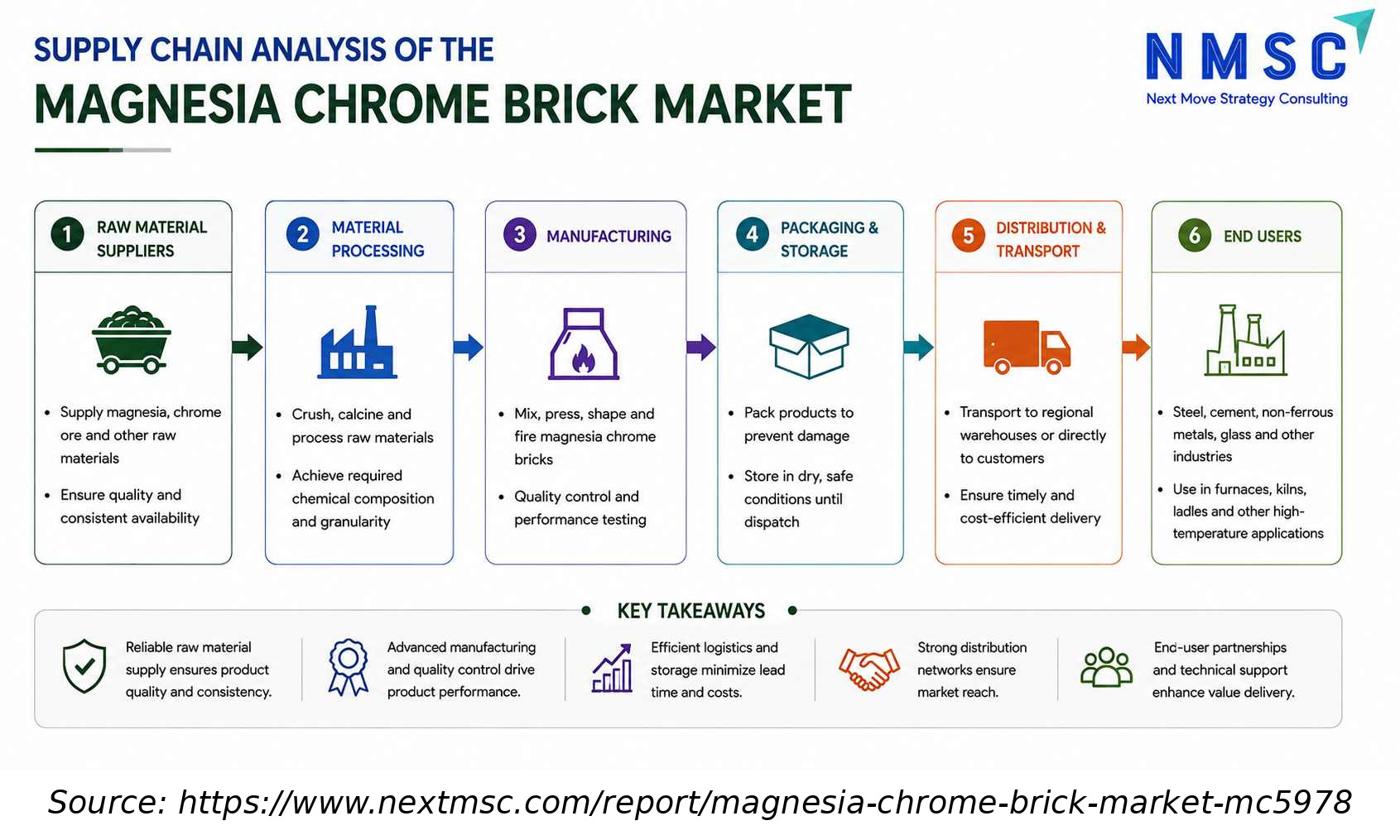
The above infographic provides a detailed supply chain analysis of the magnesia chrome brick market, outlining a six-step flow from raw material suppliers to end users. It traces the process from sourcing magnesia and chrome ore through processing, manufacturing, and packaging to final distribution for high-temperature industrial applications like steel and cement. The analysis highlights that advanced manufacturing and quality control are critical for product performance. Ultimately, it concludes that reliable raw materials, efficient logistics, and strong end-user partnerships are essential for enhancing overall value delivery.

Competitive Landscape

Our assessment indicates that the Magnesia Chrome Brick Market Industry competitive landscape spans global integrated refractory conglomerates, regional specialist manufacturers, and emerging market domestic producers, each competing on product performance specifications, application engineering support, and geographic proximity to major industrial customers.

Dimension Description
Dimension Assessment
Market Structure Moderately concentrated; the top five global refractory groups hold the majority of premium segment market share in the Magnesia Chrome Brick Market Industry, while domestic Chinese producers dominate the volume-driven standard-grade segment by output

Innovation Focus Advanced fused grain microstructure development, chrome-reduced and chrome-free alternative formulations for regulated markets, electrofusion manufacturing process investment, and digital lining monitoring systems for steelmakers and copper smelters
M&A Activity Bolt-on acquisitions of regional refractory specialists and raw material suppliers by global leaders seeking to expand geographic coverage and secure magnesia and chromite raw material supply chain security

How Do Companies Compete in the Magnesia Chrome Brick Market?

Companies compete primarily on refractory performance per lining campaign, measured by brick wear rate, campaign life, and total cost of ownership for the customer's furnace operation, rather than on unit price alone. We observed that leading global producers invest significantly in application engineering teams that co-develop lining designs with steel, copper, and cement plant engineering departments, creating technical relationships that are difficult for lower-cost competitors to displace through price competition alone. Geographic service responsiveness, including proximity of manufacturing facilities to key industrial clusters, is a secondary competitive dimension.

Which Competitive Archetypes Dominate the Market Industry?

Three competitive archetypes define the Magnesia Chrome Brick Market Industry: global integrated refractory groups with captive raw material sourcing and multi-country manufacturing networks, such as RHI Magnesita; regional specialists with deep application expertise in specific industries, such as Krosaki Harima in Japanese steel and Chosun Refractories in Korean steel; and domestic volume producers serving national markets at competitive price points, such as Chinese manufacturers including Liaoning Jinding Magnesite Group. NMSC's analysis indicates that the premium and specialty product tier is dominated by global and regional specialists, while domestic volume producers compete primarily in the standard-grade segment.

What Innovation and Differentiation Strategies Are Companies Pursuing?

Leading firms are differentiating through advanced electrofusion manufacturing that produces more homogeneous microstructures with superior thermal shock resistance, alongside digital lining management systems that monitor brick wear rates in real-time using embedded sensors or laser scanning, enabling customers to optimize campaign life and reduce unplanned downtime costs. Investment in chrome-reduced magnesia-based formulations is accelerating among European producers responding to regulatory pressure, while Asian producers are investing in ultra-high-purity graphite-free fused grain bricks for specialty glass applications that require stringent contamination specifications.

What M&A and Geographic Expansion Activity Is Shaping the Magnesia Chrome Brick Industry?

During our market evaluation, we noticed that M&A activity in the Magnesia Chrome Brick Market Industry is focused on raw material security, particularly magnesia and chromite ore supply, and on geographic expansion into high-growth emerging markets through acquisition of regional refractory specialists. RHI Magnesita's consolidation strategy exemplifies the global leader pattern of acquiring national market specialists to deepen local manufacturing and service capabilities. Partnership arrangements between global producers and local distributors are the preferred entry model in markets like India, Southeast Asia, and the Middle East, where local relationships and logistical proximity are critical to winning supply contracts from regional industrial buyers.

Key Market Players

Based on research conducted by NMSC, the following companies represent the validated set of leading magnesia chrome brick producers and refractory system providers, ranked by estimated market-specific revenue, production capacity, and geographic scale of operations.

RHI Magnesita N.V. Shinagawa Refractories Co., Ltd. Krosaki Harima Corporation Refratechnik Holding GmbH Chosun Refractories Co., Ltd. Vesuvius plc Calderys Kümaş Manyezit Sanayi A.Ş. Resco Products, Inc. Orient Refractories Limited Dalmia Bharat Refractories Ltd. IFGL Refractories Ltd. Liaoning Jinding Magnesite Group Co., Ltd. Haicheng Houying Group Co., Ltd. Magnezit Group LLC Rath Group Intocast AG Nutec Group Yingkou Sanqiang Refractory Materials Co., Ltd. Liaoning Fucheng Magnesia Chemical Group Co., Ltd.

Latest Developments

We found that recent corporate activity in the Magnesia Chrome Brick Market reflects continued product innovation, capacity investment, and strategic supply chain development across leading refractory producers.

Date Event
September 2026 SHINAGAWA REFRA completed a new continuous-casting refractory plant in Anshan, China. The facility expands Shinagawa Anshan’s manufacturing capabilities from mold flux into continuous-casting refractories.
August 2026 RHI Magnesita and Khemka Refractories officially launched MINPRO, following completion of their joint venture. MINPRO is a dedicated refractory-recycling business in India focused on recovering, processing, and reusing refractory materials and developing circular mineral solutions.

Investment Opportunities

Where Are Capital Inflows Concentrating in the Magnesia Chrome Brick Market?

Capital is concentrating in magnesia chrome brick manufacturing capacity expansion in Asia-Pacific, particularly India and Southeast Asia, where steel, cement, and non-ferrous capacity additions are creating demand growth that outpaces available regional supply from existing manufacturers. Investment in advanced electrofusion manufacturing equipment for premium fused grain and direct bonded product grades is a second priority focus, as premium product margins justify the capital intensity of electrofusion versus conventional sintering manufacturing. We found that the USD 3.82 Billion absolute opportunity between 2026 and 2035 is most accessible to producers with both manufacturing scale and application engineering capability in the non-ferrous metallurgy and specialty glass niches.

How Is Infrastructure and Industrial Capacity Investment Shaping Long-Term Magnesia Chrome Brick Demand?

Government infrastructure investment programs across Asia-Pacific, the Middle East, and Africa are the primary multi-decade demand multiplier for cement and steel industries, which together account for approximately 67% of magnesia chrome brick consumption by revenue in 2025. Greenfield steel mills and cement plant projects in Saudi Arabia, India, Vietnam, and Nigeria that are currently in planning or construction phases will generate initial lining demand followed by sustained relining procurement for operational lifetimes of 20–30 years. The growing demand for gold and PGM refining capacity in South Africa and West Africa represents an additional long-duration infrastructure investment stream with magnesia chrome refractory requirements.

What ESG Considerations Are Influencing Investment in the Market?

Environmental, Social, and Governance considerations are reshaping both product development investment and supply chain decisions in the Magnesia Chrome Brick Market. The imperative to develop chrome-reduced and eventually chrome-free refractory alternatives for regulated EU and North American markets is driving R&D capital allocation toward magnesia-spinel and magnesia-forsterite alternatives, while simultaneously maintaining investment in standard magnesia chrome grades for unregulated markets where no viable substitute has been qualified. Investors evaluating the refractory sector are increasingly assessing producers' ability to manage spent refractory waste responsibly, with Cr6+ stabilization and recycling programs emerging as ESG performance metrics in European and North American capital markets.

Key Benefits for Stakeholders

How Does This Report Benefit Steel, Non-Ferrous, and Industrial Furnace Operators?

Industrial operators gain application-segment revenue forecasts and CAGR benchmarks that support refractory procurement strategy planning and budget forecasting across their furnace lining cycles. Our analysis of the shift from standard sintered grain to premium fused grain and direct bonded product types, and our identification of Glass Industry and Non-Ferrous Metallurgy as the fastest-growing Application sub-segments, enables industrial buyers to anticipate supply availability, competitive pricing dynamics, and product innovation trajectories as they plan long-term furnace lining programs and negotiate supply agreements with preferred refractory vendors.

How Does This Report Benefit Investors and Financial Analysts?

Investors and financial analysts gain a reconciled market-sizing framework, competitive landscape assessment, and company-level development tracking that supports valuation and capital-allocation decisions across the specialty refractory sector. The Growth Catalyst and Risk Assessment Matrix quantifies driver and restraint impact on the 8.36% CAGR, enabling scenario analysis for investment thesis stress-testing under different environmental, regulatory, and steel market cycle assumptions. The absolute USD 3.82 Billion opportunity between 2026 and 2035 is decomposed by Application, Product Type, MgO Content, and region to support targeted investment prioritization within the refractory materials sector.

How Does This Report Benefit Refractory Manufacturers and Raw Material Suppliers?

Refractory manufacturers and magnesia and chromite ore suppliers gain segment-level demand projections, competitive positioning intelligence, and geographic growth opportunity assessments that inform production capacity investment decisions, product portfolio development priorities, and raw material procurement strategies. Our findings on Direct Bonded and Fused Grain product type growth, combined with the Glass Industry and Non-Ferrous Metallurgy application segment opportunity analysis, directly guide R&D investment allocation and commercial pipeline prioritization for producers seeking to maximize revenue growth in the highest-value product and application categories within the Magnesia Chrome Brick Market through 2035.
Key Market Segments Evaluated

By Product Type

  • Fused Grain Magnesia Chrome Bricks
  • Sintered Grain Magnesia Chrome Bricks
  • Rebonded Fused Grain Magnesia Chrome Bricks
  • Direct Bonded Magnesia Chrome Bricks

By Application

  • Steel Industry 
    • Electric Arc Furnace Lining
    • Basic Oxygen Furnace Lining
    • Ladle and Secondary Metallurgy
  • Non-Ferrous Metallurgy 
    • Copper Smelting
    • Lead and Zinc Smelting
    • Other Non-Ferrous Smelting
  • Cement Industry
  • Glass Industry
  • Other Applications

By MgO Content

  • High Magnesia Grade (MgO >75%)
  • Standard Grade (MgO 50–75%)
  • Chrome-Rich Grade (MgO <50%)

By Sales Channel

  • Direct Sales
  • Indirect Sales 
    • Distributors
    • Trading Companies

By Region

  • North America 
    • U.S.
    • Canada
    • Mexico
  • Europe 
    • UK
    • Germany
    • France
    • Italy
    • Spain
    • Sweden
    • Denmark
    • Finland
    • Netherlands
    • Rest of Europe
  • Asia-Pacific 
    • China
    • India
    • Japan
    • South Korea
    • Taiwan
    • Indonesia
    • Vietnam
    • Australia
    • Philippines
    • Malaysia
    • Rest of APAC
  • Middle East & Africa 
    • Saudi Arabia
    • UAE
    • Egypt
    • Israel
    • Turkey
    • Nigeria
    • South Africa
    • Rest of MEA
  • Latin America 
    • Brazil
    • Argentina
    • Chile
    • Colombia
    • Rest of LATAM

Conclusion & Recommendations

The long-term outlook for the Magnesia Chrome Brick Market is constructive, with the market expanding from USD 3.61 Billion in 2026 to USD 7.43 Billion by 2035 at an 8.36% CAGR, supported by the structural growth of steel, copper smelting, cement, and specialty glass industries in emerging markets. Our assessment indicates that this growth trajectory is underpinned by multi-decade industrial capacity expansion cycles in Asia-Pacific, the Middle East, Africa, and Latin America, where infrastructure and industrial investment programs extend demand visibility well beyond the 2035 forecast horizon for refractory producers serving these growing industrial bases.

What Strategic Positioning Do We Recommend?

Our assessment indicates that magnesia chrome brick producers should prioritize premium product development, particularly direct bonded and fused grain grades for EAF, copper smelting, and specialty glass applications, over volume-oriented standard grade capacity expansion, given the superior CAGR and margin profile of premium segments. Geographic expansion into India, Southeast Asia, and the Middle East through local manufacturing investment or joint venture partnerships is the highest-priority market entry strategy, given the 10–12% CAGR projected for these markets through 2035 and the competitive advantage that local production and technical service presence provides over purely export-based supply strategies.

How Attractive Is the Magnesia Chrome Brick Market for Investment?

Investment attractiveness is highest in Asia-Pacific and MEA given superior CAGR profiles of 9.77% and 10.88%, respectively, while specialty application niches, Glass Industry at 13.35% CAGR and Chrome-Rich Grade at 11.24% CAGR, offer the most compelling margin expansion opportunity within the overall market. We found that direct bonded and fused grain product types offer structurally superior revenue per metric ton and more defensible competitive positioning than sintered standard-grade bricks, making them the preferred product investment theme for producers seeking to outpace the overall market growth rate through technology differentiation. The USD 3.82 Billion absolute revenue expansion between 2026 and 2035 supports a strong investment thesis.

What Are the Key Market Shifts and Risks?

Key market shifts include the progressive EAF steelmaking transition accelerating demand for thermal shock-resistant direct bonded grades while reducing BOF lining demand, the copper smelting investment wave creating a structurally new non-ferrous premium demand segment, and expanding environmental regulations in Europe and North America that will progressively restrict standard chrome refractory use over the forecast period. Key risks include commodity price volatility impacting steel and non-ferrous metal production volumes, raw material supply disruptions for magnesia and chromite ore, and the risk that chrome-free alternative refractories achieve technical performance parity faster than expected in regulated markets, accelerating substitution beyond current assumptions.

What Are the Primary Growth Pathways Through 2035?

Primary growth pathways include non-ferrous metallurgy lining system specialization for the copper and PGM smelting investment cycle, specialty glass furnace chrome-rich grade development for the solar and pharmaceutical glass expansion, and managed lining service models that convert brick supply relationships into long-term performance management contracts. Our analysis shows that companies combining advanced product technology, regional manufacturing and service proximity, and digital campaign monitoring capabilities are best positioned to capture a disproportionate share of the USD 3.82 Billion absolute opportunity created between 2026 and 2035 in the Magnesia Chrome Brick Market.

FAQs

About the Author

Mayurima Roy

Mayurima Roy

Mayurima Roy is Research Analyst at Next Move Strategy Consulting, where she has spent 4 years working across the firm's full industry coverage rather than a single fixed vertical. Her work centers on structured research, ongoing trend tracking, competitive assessment, and insight-led content development, translating complex market data into clear, decision-ready narratives that support informed client decision-making across diverse global industries, market sectors, and world regions every day.

About the Reviewer

Supradip Baul

Supradip Baul

Supradip Baul is an accomplished business consultant and strategist with over a decade of rich experience in market intelligence, strategy, technology, and business transformation. His work has included rigorous qualitative and quantitative analysis across multiple industries, helping clients shape investment decisions and long-term roadmaps. Earlier in his career, he was associated with Gartner, where he contributed to industry-leading reports and market share analyses. He has worked with leading global companies and holds an MBA with a dual specialization in Marketing and Finance.

Download Free Sample

Semih Kavaklioglu

SEMIH KAVAKLIOGLU

Co-Founder &amp; Sales Manager

Decortie

I work a lot in the marketing industry and I know that research is an essential part of any campaign. I have used Market research reports for my own products and I found them to be very informative and well-researched. The team here produces insightful reports for a good price

Amos Chang

AMOS CHANG

Strategy Consultant

Kardex Group

I have bought the intralogistics market reports from NMSC two times so far. Joseph and his team are always very helpful and flexible in responding to any customization requirements on the report. Their expertise in market reports really helps us steer the day-to-day business. I will definitely recommend and come back myself whenever there is a need.

Kevin Coker

KEVIN COKER

Founder, CEO and Board Diector

Proxima Clinical Research

I have been using Next MSC reports for product positioning in a new geography for a long time. They have by far the best reports I have found and the price is reasonable too!

Kishu Kanda

KISHU KANDA

Strategy Analyst

Accenture

We purchased the AI Consumer Market Report from this company. Not only did they customize the report to meet our specific requirements, but they also showed great flexibility in accommodating our budget. The report we received fully met our expectations. Additionally, they provided prompt and thorough responses to both our pre-purchase and follow-up questions. We look forward to working with this company again in the future.

Henri Knyphausen

HENRI KNYPHAUSEN

Partner at Singulier [Ex-BCG]

Singulier

I recently engaged NEXTMSC.com for a commercial due diligence project within the intralogistics sector, and I am pleased to provide a reference based on my experience. In utilizing NEXTMSC.com's services, I found their report to offer valuable insights into market dynamics and key industry players. The initial report provided a solid foundation for our analysis. However, as we were investigating a smaller target in the market, and I had specific customization requests requiring additional research. These requests included detailed information on product portfolios of various players and sub-market sizes, both inclusive and exclusive of certain product categories. NEXTMSC.com demonstrated commendable responsiveness and agility in accommodating these customization requests. Within a timeframe of 1-2 weeks, they delivered a revised report that met our specific needs. Furthermore, they were receptive to my follow-up inquiries, ensuring clarity and understanding of the data provided. The final deliverable significantly contributed to our due diligence efforts. One of NEXTMSC.com's notable strengths lies in their qualitative research capabilities. However, for future engagements, I would recommend the inclusion of a quantified market model in Excel format. Such a model would offer the ability to conduct in-depth analyses and explore various market segments, including country-specific data and subcomponent breakdowns. Based on my positive experience, I would not hesitate to work with NEXTMSC.com again. Their responsiveness, willingness to accommodate customization requests, and commitment to delivering actionable insights make them a reliable partner for commercial research projects.

Custom Market Research Services

We will customize the research for you if the listed report does not fully match your requirements.

Get 30% Free Customization

Select License

This website uses cookies to ensure you get the best experience on our website. Learn more

✖