Aluminum Smelter Input Materials Market By Material Type {Primary Inputs (Bauxite, Alumina), Carbon Materials (CPC, CTP, & Others), Fluoride Bath Chemicals (Aluminum Fluoride, & Others), Potline and Cathode Materials (Cathode Blocks, Ramming and Sealing Paste, & Others), Refractories (Shaped Refractories, Monolithics and Castables, & Others), Structural and Steel Inputs (Plates, Sections and Coils, & Others)} – Global Analysis & Forecast, 2026–2035
Industry: Materials and Chemical | Latest Edition: September 21, 2026 | No of Pages: 330 | No. of Tables: 378 | No. of Figures: 365 | Format: PDF | Report Code: MC3858
Industry Outlook
The global Aluminum Smelter Input Materials Market size is valued at USD 66.80 billion in 2025 and is expected to reach USD 69.79 billion by 2026. Looking ahead, the industry is projected to expand significantly, reaching USD 103.44 billion by 2035, registering a CAGR of 4.47% from 2026 to 2035.
The industry is advancing steadily, driven by rising global demand for aluminum in transportation, construction, packaging, consumer goods, and electrical applications. Smelters rely on a core set of essential inputs, primarily alumina, calcined petroleum coke, coal tar pitch, prebaked anodes, cryolite, aluminum fluoride, and other fluoride bath chemicals, to ensure efficient electrolysis, energy optimisation, and high-quality metal output.
Growing emphasis on operational efficiency, decarbonization, and cost reduction is pushing producers toward higher-purity feedstocks, improved carbon anode technology, and additives that enhance cell performance and reduce energy consumption. At the same time, stricter environmental regulations are accelerating the adoption of low-emission materials, sustainable sourcing practices, and recycling of smelter by-products. By combining process innovation, material quality, and sustainability, the aluminum smelter input materials market is supporting the evolution of modern aluminum production and meeting global demand for lightweight, recyclable metals.
What Are the Key Trends in the Aluminum Smelter Input Materials Market?
How is Input-Price and Supply Volatility Shifting Smelter Procurement Toward Integrated and Long-Term Contracting?
Global smelters face more volatile input costs, alumina price swings, CPC availability and carbon anode premiums, prompting a shift from spot buying to integrated and multi-year contracts. USGS and IAI reporting show primary production and recycled shares moving in parallel with shifts in raw-material sourcing strategies.
Major producers like Alcoa, Rio Tinto, and EGA disclosed that they are securing alumina through long-dated arrangements and seeking vertical integration where feasible. This reduces short-term margin volatility but requires capital and supply-chain coordination, such as logistics, port capacity, and FX exposure.
Trading desks and procurement are building blended sourcing ladders, layer collar/forward economics for alumina and CPC, and incorporate indexed pricing tied to transparent benchmarks to balance cost certainty with access to cheaper spot windows.
What Decarbonisation Priorities Are Influencing Input Decisions in Aluminum Smelting?
Decarbonisation priorities like power mix and anode-related CO2 now shape input decisions. IAI and industry filings indicate growing buyer preference for low-carbon alumina and lower-emissions carbon anodes, including inert anodes pilots, because anode carbon and electricity dominate smelting emissions.
Producers are, thus, willing to pay premiums for verified low-carbon alumina and for carbon inputs compatible with new anode technologies. This creates both procurement and R&D linkages across the value chain. Smelters and input suppliers are piloting low-carbon alumina sourcing, co-funding R&D for advanced anodes, and implementing supplier scorecards that include embedded carbon metrics to prepare for premium product markets and potential regulatory requirements.
How are Carbon Input Markets Evolving Amid Feedstock Quality and Regulatory Pressure?
Carbon inputs such as calcined petroleum coke and coal tar pitch remain essential for anode manufacture. Market notices elevated interest in low-sulfur, low-ash CPC grades and engineered low-PAH pitches to meet environmental and performance requirements. Supply concentration in specific geographies, such as China and selected calciners, raises allocation risk for global smelters.
Environmental regulation and buyer sustainability targets also push for cleaner feedstock specifications. Smelters are mapping alternative suppliers, qualifying multiple CPC/CTP sources, and investing in anode-quality testing at port to reduce quality-related disruptions, where feasible, long-term strategic alliances with calciners secure priority allocation.
What Are the Key Market Drivers, Breakthroughs, and Investment Opportunities That Will Shape the Aluminum Smelter Input Materials Market in the Next Decade?
The aluminum smelter input materials market trends is being reshaped by three forces such as, demand recovery and structural growth in primary aluminum and recycling, decarbonisation mandates that change input preferences and economics, and the concentration of speciality suppliers for carbon and fluoride chemicals that creates allocation risk.
Breakthroughs include advanced anode pilots and hydrometallurgical refinement improvements for lower-impurity alumina. Challenges include port/logistics constraints and certification for low-carbon inputs. Opportunities exist in upstream integration, low-carbon input production, and modular pretreatment to upgrade lower-grade feed.
Growth Drivers:
How are Technological Advances in Anode and Electrolyte Materials Improving Smelter Performance and Driving Demand for Speciality Inputs?
Advances in anode life, current efficiency and bath chemistry are increasing demand for speciality carbon products and high-performance fluoride additives, supporting lower energy use and more stable potline operation. Recent pilots and commercial deployments of improved anode formulations and optimised electrolyte chemistries have produced measurable gains in anode longevity and cell current efficiency, reducing specific energy consumption and unplanned downtime.
Refiners and smelters report that these gains raise willingness to pay for higher-spec CPC, engineered pitches and premium aluminum fluoride grades because quality and compatibility materially affect achieved efficiency. As bath chemistry becomes more tightly engineered, suppliers of speciality carbon and fluoride additives capture a larger share of value through performance-linked contracts.

The chart displays the Technology Readiness Index by country for 2024. High technology readiness allows these countries to modernise and automate their manufacturing sectors, including aluminum smelting, by rapidly adopting advanced digitalisation, process controls, and Industry 4.0 practices.
As a result, aluminum smelters in high-readiness markets see increased efficiency, data-driven optimisation, and advanced material sourcing requirements. This accelerates demand for specialised input materials such as high-purity alumina, calcined petroleum coke, speciality carbon anodes, and digital process additives, shaping a more dynamic and sophisticated aluminum smelter input materials market across leading economies.
How is Structural Growth in Primary Aluminum and Recycling Increasing Long-Term Demand for Smelter Input Materials?
Structural expansion in both primary aluminum production and secondary recycling is steadily amplifying consumption of smelter input materials, particularly alumina, CPC, CTP, aluminum fluoride, and refractories. Global aluminum demand is projected to keep rising through 2030, driven by transportation light-weighting, solar build-out, packaging shifts, and EV platform expansion.
At the same time, major producers and governments are scaling recycling capacity to meet sustainability and emissions targets, which increases the need for high-purity scrap-compatible additives and upgraded anode and lining materials that support energy-efficient operations.
As more jurisdictions encourage low-carbon aluminum certifications, smelters invest in better potline stability and cleaner input chemistries to reduce energy intensity across both primary and recycled routes. Suppliers are expanding dual-path portfolios for primary smelters and recycling operators, emphasising low-impurity carbon products, energy-efficient fluoride formulations, and longer-life refractories aligned with low-carbon aluminum standards.
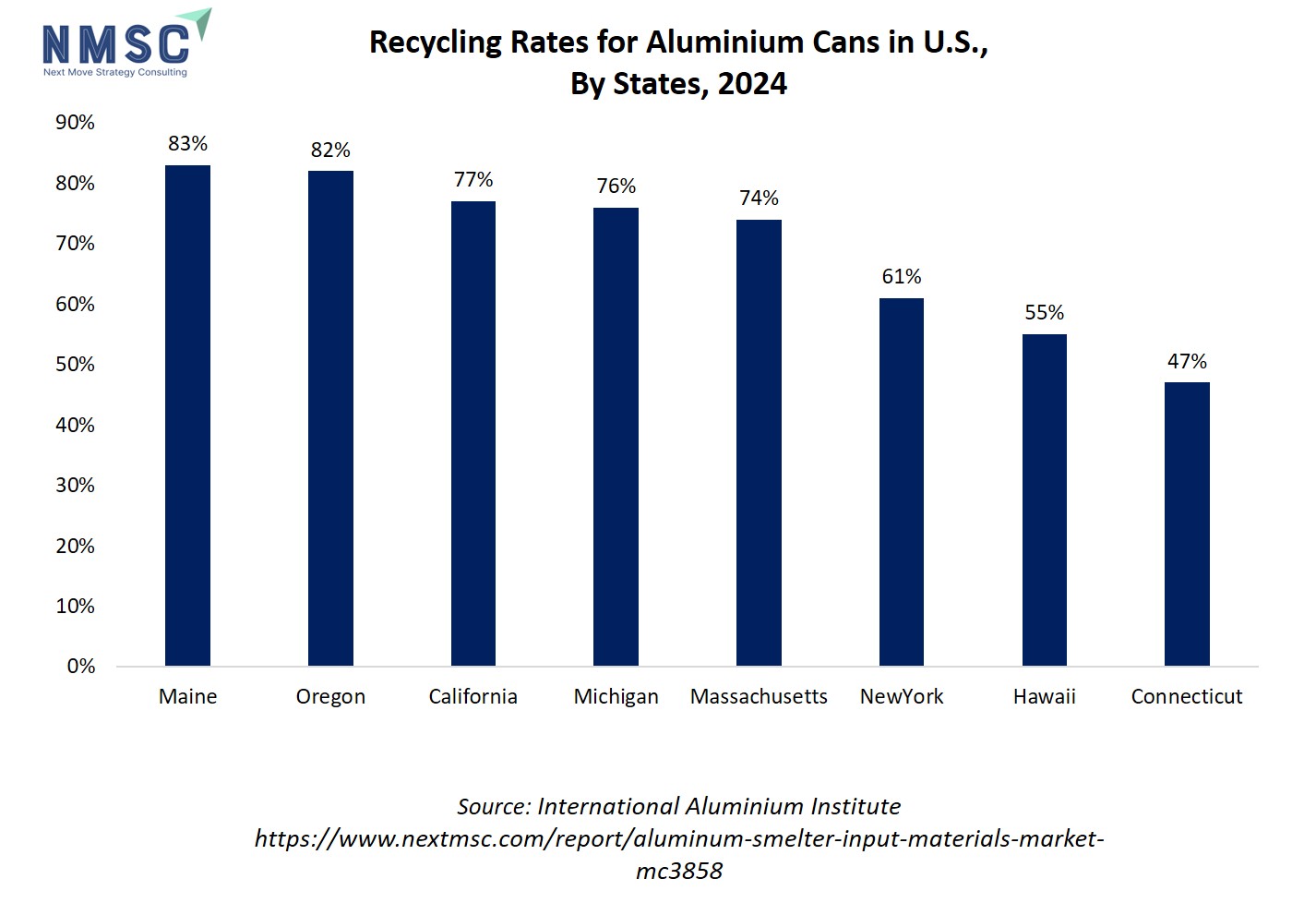
The chart highlights recycling rates for aluminum cans in U.S. states in 2024. High recycling rates in top states ensure a steady supply of recycled aluminum, which is a key input material for smelters aiming to reduce costs and environmental impact compared to relying solely on primary aluminum from bauxite.
Because recycled aluminum requires significantly less energy for smelting, regions with strong recycling programs support more sustainable and flexible smelter operations. Thus, efficient aluminum recycling feeds directly into the aluminum smelter input materials industry, lowering raw material costs, shrinking carbon footprints, and underpinning the circular economy by converting post-consumer scrap back into new aluminum products.
Growth Inhibitors:
How do Supplier Concentration and Logistics Present a Key Inhibitor?
Supplier concentration in pre-baked anodes, high-spec CPC grades and key fluoride chemicals creates structural vulnerability, as only a limited number of global producers meet smelter qualification standards. This exposes operators to allocation risk, variable quality and price swings, particularly when China’s dual role as major supplier and large consumer drives abrupt export policy or demand shifts.
Logistics constraints, congested ports, inland transport bottlenecks, long lead times and FX-linked freight costs further amplify operational risk. Mitigation requires multi-supplier qualification, strategic inventories for critical inputs, and regional diversification of CPC, anode and fluoride procurement to reduce dependence on any single geography.
Where is the Highest-Value Investment Opportunity in the Input Value Chain?
The most attractive investment opportunities lie in low-carbon alumina and next-generation carbon materials, particularly upgraded CPC and CTP capable of meeting low-impurity, low-emission anode requirements. Decarbonised calcination technologies and advanced carbon plants positioned outside supplier-concentrated regions offer pricing power as smelters pursue Scope 1–3 reductions.
Additional value lies in expanding fluoride chemical capacity in diversified geographies to relieve concentration risk. Investors target assets with potential long-term offtake from integrated aluminum producers, supported by shared logistics or pretreatment infrastructure that shortens lead times and creates durable competitive barriers.
How Is the Aluminum Smelter Input Materials Market Report Segmented, and What Are the Key Insights from the Segmentation Analysis?
By Material Type Insights
Are Primary Inputs Still the Dominant Cost Driver for Smelters?
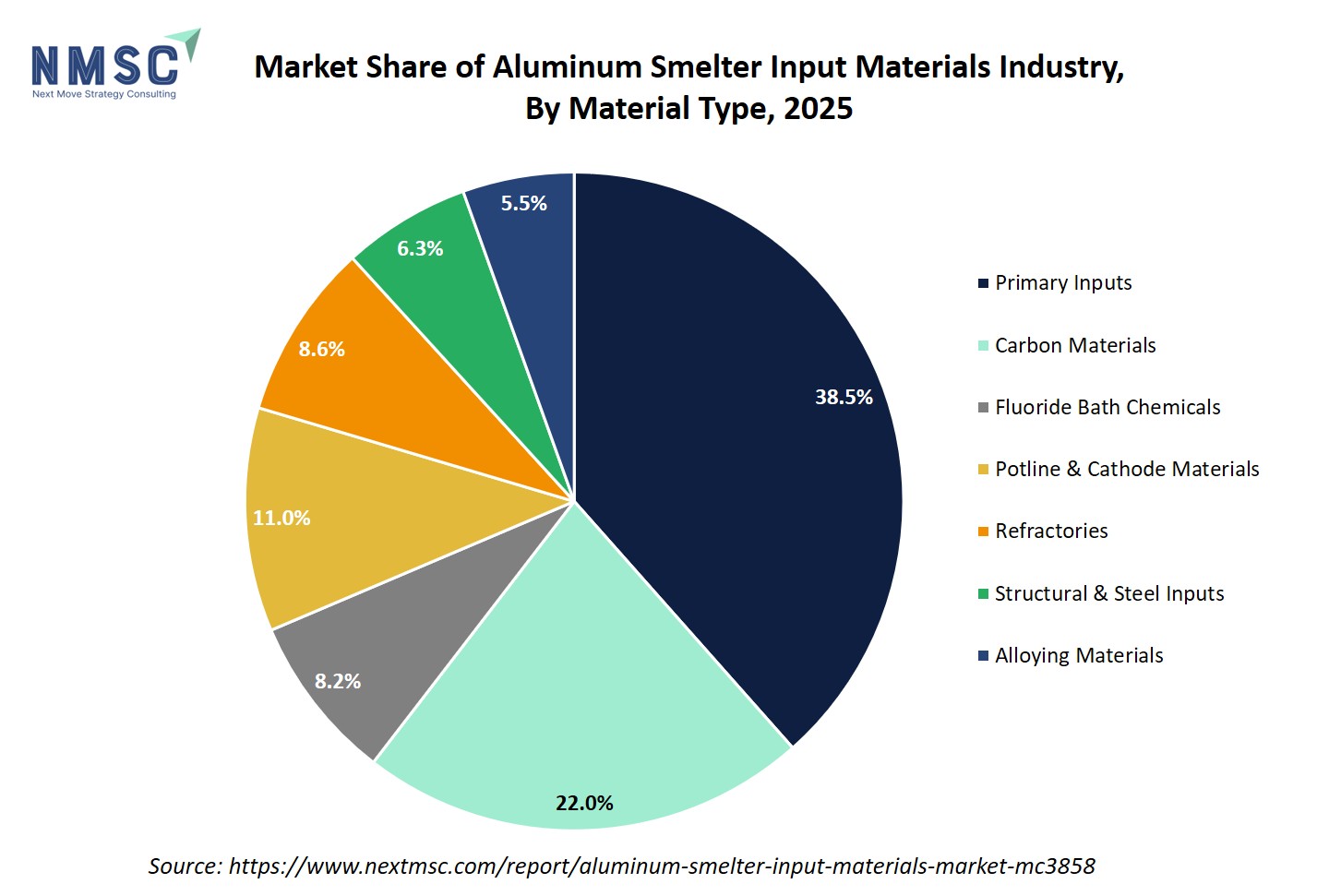
Based on material type, the market is segmented into primary inputs, carbon materials, fluoride bath chemicals, potline and cathode materials, refractories, structural and steel inputs, and alloying materials.
Primary inputs remain a dominant cost and supply risk for smelters, alumina feed quality, impurity profile, and freight materially affect electrolysis performance and anode life. USGS bauxite and alumina data show alumina flows and regional refined capacity shifts, while Rio Tinto and Alcoa 2024 filings emphasise securing reliable alumina access. Alumina cost pass-throughs and port logistics are thus pivotal for smelter margins, where alumina supply tightness exists, smelters need to pay geographic premiums or invest in refinery stakes. Smelters are securing multi-year alumina contracts indexed to transparent benchmarks and exploring near-site refining or strategic equity positions in refineries to stabilise supply and quality.
Regional Outlook
The aluminum smelter input materials market share is geographically studied across North America, Europe, Asia Pacific, the Middle East & Africa, and Latin America, and each region is further studied across countries.
Aluminum Smelter Input Materials Market in North America
North America’s market is shaped by stable alumina imports into Canada, rising recycled-aluminum availability, and ongoing constraints in CPC and prebaked-anode sourcing. Consolidation among refiners and calciners is increasing as suppliers seek scale, quality consistency and long-term contracts with smelters.
U.S. and Canadian facilities remain sensitive to logistics performance and feedstock pricing, especially given reliance on imported carbon materials from Asia. Regulatory incentives for low-carbon production are accelerating interest in decarbonised alumina and upgraded CPC grades. The region’s downstream demand in automotive and packaging further pressures smelters to secure dependable input supply with tighter impurity and sustainability specifications.
Aluminum Smelter Input Materials Market in the United States
The U.S. market emphasises feedstock security, low-carbon inputs and onshoring of critical smelter materials. Smelters increasingly prioritise long-term alumina contracts and diversify CPC and anode supply to mitigate geopolitical and freight risks. Federal incentives supporting domestic manufacturing and grid-renewable sourcing are prompting investment in advanced calcination, anode plants and local refractory production.
Port-capacity modernisation and inland logistics improvements remain central to reducing lead-time volatility, while downstream automotive and aerospace sectors push for cleaner, certified materials. As a result, U.S. smelters strategically balance imported high-spec inputs with efforts to develop resilient, domestic low-carbon alternatives.
Aluminum Smelter Input Materials Market in Canada
Canada plays a dual role as a stable alumina importer and a significant producer of recycled aluminum. Smelters benefit from hydro-powered operations, but competitiveness still hinges on efficient procurement of CPC, anodes and fluoride chemicals, much of which is imported. Proximity to U.S. smelters strengthens cross-border supply networks, yet both markets face similar exposure to global carbon-input concentration.
Canadian producers increasingly evaluate long-term contracts with international calciners and pursue logistics optimisation to manage freight-sensitive input costs. The broader shift toward low-carbon manufacturing reinforces demand for certified and traceable input materials aligned with North American decarbonisation goals.
Aluminum Smelter Input Materials Market in Europe
Europe’s smelter-input landscape is defined by its emphasis on low-carbon alumina, advanced anode formulations and strict environmental compliance. Given limited domestic carbon-input manufacturing, smelters rely heavily on imports of CPC, CTP and prebaked anodes, increasing exposure to global allocation shifts. Energy-transition policies accelerate the adoption of low-emission materials and drive investment in next-generation anode technologies and refractory upgrades.
Strategic inventory planning and multi-sourcing become essential as European producers manage volatility in feedstock logistics. Growing demand from automotive, aerospace and packaging industries reinforces the need for certified low-carbon inputs and robust supply-chain resilience across the continent.
Aluminum Smelter Input Materials Market in the United Kingdom
The UK remains import-reliant for alumina, CPC, anodes and fluoride chemicals, making supply stability and freight economics central considerations. The national decarbonisation agenda pushes smelters and downstream users toward certified low-carbon materials and recycled-aluminum feed.
With limited domestic primary capacity, the market depends on diversified sourcing from Europe, the Middle East and Asia, supported by warehousing and port-based logistics. Downstream manufacturing sectors, automotive components, aerospace and packaging, demand tighter quality and sustainability specifications, prompting stronger scrutiny of input provenance. Investment interest is rising in recycling infrastructure and low-carbon input certification aligned with industrial-transition priorities.
Aluminum Smelter Input Materials Market in Germany
Germany’s input in the market is driven by its advanced manufacturing ecosystem, requiring high-quality refractories, alloy additives and reliable alumina supply. Automotive and engineered-components segments push smelters to secure low-carbon aluminum, which increases demand for upgraded anodes and cleaner CPC grades.
Although Germany relies on imported carbon materials, the country is expanding R&D and partnerships focused on anode innovation, low-emission calcination and improved impurity control. Logistics integration within the EU helps manage feedstock flow, but energy costs and decarbonisation requirements elevate the need for long-term supply planning. High-specification input procurement remains critical to maintaining competitiveness in premium aluminum applications.
Aluminum Smelter Input Materials Market in France
France integrates renewable power and industrial-decarbonisation policies into its aluminum input strategy, driving higher demand for certified low-carbon alumina and upgraded carbon materials. Smelters focus heavily on optimising prebaked-anode performance and securing diversified CPC supply to support energy-efficient operations.
Import reliance remains significant for carbon inputs, prompting long-term procurement agreements and regional inventory hubs. The country’s automotive and aerospace sectors reinforce the need for consistent, high-purity raw materials. France’s commitment to reducing industrial emissions shapes investment in advanced calcination technology, improved refractories and recycling capacity to lower lifecycle impacts across the aluminum value chain.
Aluminum Smelter Input Materials Market in Italy
Italy relies on regional and imported supplies of alumina, refractories and alloying inputs, with strong demand from its downstream engineering and industrial-manufacturing sectors. Local smelters prioritise feedstock quality and finishing capability, especially for high-value aluminum used in machinery, automotive and consumer applications.
CPC and prebaked-anode sourcing vary across suppliers in the Middle East and APAC, making logistics planning critical to maintaining cost competitiveness. Italy’s decarbonisation initiatives push producers toward lower-emission inputs and wider use of recycled aluminum. Smelters increasingly seek stable, impurity-controlled inputs supported by diversified supply networks and more efficient port-centric logistics.
Aluminum Smelter Input Materials Market in Spain
Spain’s smelter-input market emphasizes regional integration, cost management and compliance with EU environmental standards. Domestic smelters rely on imported CPC, prebaked anodes and alumina, making port efficiency and freight reliability essential determinants of competitiveness. Environmental requirements drive interest in low-carbon inputs and upgraded refractory materials.
Spain’s downstream manufacturing base in automotive, packaging and industrial components reinforces the need for consistent quality and predictable input delivery schedules. As global CPC and anode markets tighten, Spanish producers increasingly adopt strategic inventory buffers and multi-region sourcing to maintain resilience while aligning with EU decarbonisation pathways.
Aluminum Smelter Input Materials Market in the Nordics
Nordic producers leverage hydro-powered smelting and strong sustainability frameworks, resulting in high demand for certified low-carbon alumina and advanced carbon inputs. Smelters in Norway and Iceland rely on imported CPC and prebaked anodes, making supply diversification and logistics optimisation essential.
The region’s emphasis on low-emission industrial production drives adoption of upgraded anode technologies and cleaner-feedstock carbon materials. Strong integration with European markets ensures consistent offtake for automotive, construction and packaging uses. Nordic producers increasingly pursue long-term agreements with suppliers offering traceable, low-impurity input materials to maintain their competitive advantage in premium low-carbon aluminum.
Aluminum Smelter Input Materials Market in the Asia-Pacific
Asia-Pacific dominates the global aluminum production and is the core manufacturing base for CPC, prebaked anodes and other critical carbon inputs. China’s influence over global allocation, pricing and export decisions significantly affects smelters worldwide. APAC smelters benefit from proximity to large alumina refineries, but face regional variation in carbon-input quality and environmental compliance.
Growing investment in low-carbon alumina, advanced anodes and upgraded CPC grades reflects downstream pressures from automotive, electronics and packaging sectors. With rising intra-Asian demand, smelters increasingly form long-term contracts with calciners and anode producers to secure stable feed and reduce exposure to volatile export flows.
Aluminum Smelter Input Materials Market in China
China is the world’s largest supplier of CPC, CTP, prebaked anodes and other smelter-critical carbon inputs, shaping global pricing and trade flows. Domestic investment in calcination, anode plants and low-impurity carbon grades provides China with significant leverage over global feedstock allocation.
Smelters worldwide track Chinese export policies, local demand surges and environmental regulations, all of which influence availability and pricing. China’s alumina refining scale further strengthens its dominance. As carbon-input standards tighten, China is upgrading production toward cleaner, higher-spec materials, reinforcing its pivotal role in the aluminum smelter input ecosystem.
Aluminum Smelter Input Materials Market in Japan
Japan focuses on high-quality refractories, speciality alloys and advanced carbon products, supporting both domestic and regional smelters. Although Japan does not host large primary smelting capacity, its precision-manufacturing sectors require dependable, high-purity aluminum inputs.
Domestic suppliers excel in engineered refractories and premium anode materials designed for efficiency and low impurity performance. Imports of CPC and alumina supplement domestic production, supported by highly efficient port logistics. Japan’s emphasis on low-carbon manufacturing increases demand for certified, traceable inputs and advanced anode technology aligned with stringent industrial standards.
Aluminum Smelter Input Materials Market in India
India is expanding alumina refining and increasing its role in global supply, but smelters still face variability in bauxite quality and alumina consistency. Domestic CPC production is rising, yet certain high-grade and low-sulphur variants must be imported, exposing producers to international market fluctuations.
Smelter expansions and downstream demand in construction, power and transport sectors amplify the need for predictable, high-spec inputs. India invests in improved calcination technology, anode plants and quality-control systems to reduce reliance on imported carbon inputs. Logistics infrastructure improvements remain essential for supply-chain reliability and cost competitiveness.
Aluminum Smelter Input Materials Market in South Korea
South Korea prioritises high-spec carbon materials, engineered refractories and precision alloying inputs to support its downstream aluminum industries, including electronics, automotive and packaging. Smelters and rolling mills rely on both regional and imported CPC, anodes and fluoro-chemicals, making logistics and supplier diversification essential.
Korea emphasises low-impurity, high-consistency inputs that meet its exacting industrial-quality standards. With a strong interest in low-carbon production, the market evaluates upgraded carbon-input technologies and secure alumina contracts. Efficient port and container logistics provide competitiveness, but exposure to global carbon-input concentration remains a key operational risk.
Aluminum Smelter Input Materials Market in Taiwan
Taiwan’s aluminum sector focuses on high-quality alloying elements, refined refractories and consistent alumina inputs, supporting advanced manufacturing sectors such as electronics, precision components and packaging. Smelters and downstream processors rely heavily on efficient, predictable logistics, given the island’s import dependence for CPC, anodes and fluoride chemicals.
High-finish aluminum applications require stringent impurity control, prompting long-term procurement relationships with overseas suppliers. As environmental expectations rise, Taiwanese firms increasingly evaluate low-carbon and traceable raw-material options to maintain competitiveness in export-driven markets.
Aluminum Smelter Input Materials Market in Indonesia
Indonesia’s expanding metals ecosystem is increasing demand for CPC, pre-baked anodes, alumina and refractories. Although rich in bauxite, the country’s refining and carbon-input infrastructure is still developing, creating reliance on imports for high-spec CPC and anodes. Smelter development plans in industrial parks raise input logistics requirements, yet port capacity and inland transport constraints remain challenges.
Government industrialisation policies aim to build alumina refineries and carbon plants domestically, but project timing and consistency remain variable. Demand growth is strong, but input reliability and logistics performance determine competitiveness as Indonesia scales downstream aluminum production.
Aluminum Smelter Input Materials Market in Australia
Australia is a major supplier of bauxite and alumina, serving both domestic and regional smelters across the Asia-Pacific. The country is positioning itself as a secure upstream provider as concerns about concentration risk increase globally. Investments in refining capacity, low-carbon alumina projects, and improved port infrastructure strengthen Australia’s role.
While CPC and anode materials are largely imported, stable mining operations and strong regulatory frameworks enhance reliability. Downstream demand in Asia reinforces Australia’s importance in maintaining supply continuity for smelters requiring consistent-quality alumina with traceable sourcing and low-carbon credentials.
Aluminum Smelter Input Materials Market in Latin America
Latin America contributes significantly to global bauxite and alumina supply, with Brazil and Jamaica as key producers. Smelters in the region rely on regional logistics routes but face cost variability linked to port performance and inland transportation. Carbon-input sourcing depends heavily on imports, exposing producers to global CPC and anode market dynamics.
Decarbonisation initiatives are prompting evaluation of cleaner alumina and recycled-aluminum integration. Competitive positioning hinges on improving refining capacity, supply-chain efficiency and alignment with global sustainability standards. Growing downstream industries in packaging, transport, and construction reinforce the need for consistent, high-spec smelter inputs.
Aluminum Smelter Input Materials Market in the Middle East & Africa
The Middle East hosts world-class smelters supported by major port hubs and established CPC and anode import channels. Investments in logistics and storage infrastructure help stabilise feedstock availability. Regional producers increasingly pursue low-carbon inputs to align with global automotive and aerospace customers.
In Africa, abundant bauxite resources position countries such as Guinea for upstream advantage, though limited refining and calcination capacity restricts value capture. Long-term opportunities exist in expanding alumina refining and developing regional carbon-input facilities to support growing smelting clusters.
Competitive Landscape
Which Companies Dominate the Aluminum Smelter Input Materials Market and How do they Compete?
The market is populated by diversified miners and refiners like Rio Tinto, Alcoa, specialist carbon and anode manufacturers such as global calciners and pre-baked anode makers, chemical suppliers for fluoride baths and refractory producers. Competition is transactional but increasingly strategic. Large smelters seek integrated supply, joint investments, or equity stakes in refineries and calciners to secure supply and lower life-cycle emissions.
Suppliers that demonstrate reliable quality, low impurities and credible decarbonisation roadmaps command premium positioning. Strategic capability now includes assay/QA services, port-proximate pretreatment, and validated low-carbon certifications.
Market Dominated by Aluminum Smelter Input Materials Giants and Specialists
Giants like Rio Tinto & Alcoa control large upstream alumina and bauxite flows and influence alumina pricing. Specialists produce CPC, coal tar pitch and prebaked anodes, regionally concentrated, giving them leverage in allocation periods. Refractory and alloy suppliers include specialised metallurgical firms with long delivery lead times.
This dual structure, large upstream integration and specialised midstream suppliers, means smelters manage relationships across both types to secure both volume and quality. Blend integrated contracts with strategic spot allocations and co-fund supplier capacity upgrades for mutually beneficial outcomes.
Innovation and Adaptability Drive Market Success
Leading suppliers invest in lower-emissions calcination, improved anode formulations and advanced refractories to shorten maintenance cycles. Pilots for inert anodes and electric calcination show promise in reducing both operating cost volatility and carbon intensity.
Suppliers that embed digital quality tracking, port-side assay labs and modular pre-treatment shorten lead times and capture premium contracts. Input suppliers are deploying pilot low-carbon production lines and offering bundled service contracts to lock in long-term customer relationships.
Market Players to Opt for Merger & Acquisition Strategies to Expand their Presence
M&A efforts are centred on strengthening access to upstream alumina, increasing calciner capacity, and acquiring pretreatment-focused firms. Companies target strategic deals that offer smelters greater vertical integration or provide suppliers with more secure offtake arrangements.
Recent corporate disclosures highlight plans for capacity additions and targeted investments in refining and carbon-related assets. Firms also pursue bolt-on acquisitions in logistics and pretreatment to shorten delivery timelines, while partnering with customers to share risks and returns on new capacity expansions.
Key Players
-
Rio Tinto
-
South 32
-
Hindalco
-
Rusal
-
Hydro
-
Maaden
-
Emirates Global Aluminum
-
Glencore
-
Nalco
-
Companhia Brasileira de Alumínio
-
Toyo Tanso Co., Ltd.
-
SGL Carbon
-
Epsilon Carbon
-
RHI Magnesita India Ltd
What Are the Latest Key Industry Developments?
-
April 2025 - Rio Tinto is preparing to re-enter the Indian market with a green aluminum project in partnership with AM Green, aiming at a 1 million tonne per annum smelter powered entirely by renewable energy.
-
February 2025 - Hindalco committed USD 1.8 billion investment to expand aluminum smelting.
-
January 2024 - Alcoa completed acquisition of Alumina Limited 2024, fully owning the Alcoa World Alumina and Chemicals (AWAC) joint venture, consolidating its position as a leading global supplier of bauxite and alumina.
What Are the Key Factors Influencing Investment Analysis & Opportunities in the Aluminum Smelter Input Materials Market?
Investment decisions hinge on feedstock security, like alumina and high-spec carbon, decarbonisation alignment, such as the ability to supply low-carbon alumina/CPC, and logistics/port capacity. Funding is attracted to assets that reduce smelter exposure, regional calcination capacity, low-carbon alumina plants, and prebaked anode facilities with quality control.
Valuation premiums are likely for assets with long-term offtake or strategic partnerships with large smelters. Hotspots include APAC calciners, near-smelter pretreatment hubs, and decarbonised alumina projects in mining jurisdictions with renewable power. Investors stress-test models for alumina price shocks and logistics disruptions and prefer projects with contracted offtake or co-investment from smelters.
Key Benefits for Stakeholders:
Next Move Strategy Consulting (NMSC) presents a comprehensive analysis of the Aluminum Smelter Input Materials Market, covering historical trends from 2020 through 2024 and offering detailed forecasts through 2035. Our study examines the market at regional and country levels, providing quantitative projections and insights into key growth drivers, challenges, and investment opportunities across all major market segments.
Smelters benefit from secured multi-year input contracts and quality-assured materials that reduce potline instability and downtime, suppliers gain revenue visibility from term contracts and capture premiums for low-carbon or high-quality feed. Investors obtain exposure to critical industrial inputs with defensive demand driven by lightweighting trends and circularity.
Report Scope
|
Parameters |
Details |
|
Market Size in 2026 |
USD 69.79 Billion |
|
Revenue Forecast in 2035 |
USD 103.44 Billion |
|
Growth Rate |
CAGR of 4.47% from 2025 to 2035 |
|
Analysis Period |
2025–2035 |
|
Base Year Considered |
2025 |
|
Forecast Period |
2026–2035 |
|
Market Size Estimation |
Billion (USD) |
|
Growth Factors |
|
|
Companies Profiled |
15 |
|
Countries Covered |
33 |
|
Market Share |
Available for 10 companies |
|
Customization Scope |
Free customization (equivalent to up to 80 analyst-working hours) after purchase. Addition or alteration to country, regional & segment scope. |
|
Pricing and Purchase Options |
Avail customized purchase options to meet your exact research needs. |
|
Approach |
In-depth primary and secondary research; proprietary databases; rigorous quality control and validation measures. |
|
Analytical Tools |
Porter's Five Forces, SWOT, value chain, and Harvey ball analysis to assess competitive intensity, stakeholder roles, and relative impact of key factors. |
Aluminum Smelter Input Materials Market Key Segments
By Material Type
-
Primary Inputs
-
Bauxite
-
Alumina
-
-
Carbon Materials
-
Calcined Petroleum Coke (CPC)
-
Coal Tar Pitch (CTP)
-
Prebaked Anodes
-
Anode and Tamping Paste
-
-
Fluoride Bath Chemicals
-
Aluminum Fluoride (AlF3)
-
Cryolite
-
Other Fluorides
-
-
Potline and Cathode Materials
-
Cathode Blocks
-
Ramming and Sealing Paste
-
Collector Bars and Potlining Steels
-
Cathode and Lining Coatings and Binders
-
- Refractories
-
Shaped Refractories
-
Monolithics and Castables
-
Insulation Refractories
-
-
Structural and Steel Inputs
-
Plates, Sections, and Coils
-
Pipes, Tubes, and Structural Hollow Sections
-
-
Alloying Materials
-
Alloying Elements
-
Master Alloys
-
Geographical Breakdown
-
North America: U.S., Canada, and Mexico.
-
Europe: UK, Germany, France, Italy, Spain, Sweden, Denmark, Finland, Netherlands, and rest of Europe.
-
Asia Pacific: China, India, Japan, South Korea, Taiwan, Indonesia, Vietnam, Australia, Philippines, Malaysia and rest of APAC.
-
Middle East & Africa (MEA): Saudi Arabia, UAE, Egypt, Israel, Turkey, Nigeria, South Africa, and rest of MEA.
-
Latin America: Brazil, Argentina, Chile, Colombia, and rest of LATAM.
Conclusion & Recommendations
Our report equips stakeholders, industry participants, investors, and consultants with actionable intelligence to capitalise on the transformative aluminum smelter input materials market potential. By combining robust data-driven analysis with strategic frameworks, NMSC’s Market Report serves as an indispensable resource for navigating the evolving landscape.
The market is simultaneously a cost centre and a strategic lever for smelter competitiveness and decarbonisation. Securing high-quality alumina, reliable low-impurity carbon inputs, and certified low-carbon materials will define winners. Smelters blend long-term contracted supply with selective spot exposure, co-invest in upstream refining and calcination where feasible, and develop supplier scorecards that include carbon and quality metrics. Suppliers prioritise low-carbon product lines, port-proximate pretreatment hubs and assay/QA services. Investors target low-carbon alumina projects, advanced calcination and prebaked-anode capacity with offtake commitments.
For executives and investors, the key to capitalising on these trends lies in identifying high-potential segments, investing in R&D for innovative cryolite solutions, and fostering strategic partnerships to expand the aluminum smelter input materials market reach. Securing multi-year alumina and carbon contracts with indexed pricing. Building port-side QA and inventory buffers for critical anode and fluoride supplies.


About the Author
 Ridip Gogoi
— Ridip Gogoi is a Research Associate at Next Move Strategy Consulting, where he supports cross-vertical market research and analysis across multiple industry sectors, with four years of experience. His work includes market analysis, data validation, secondary research, and insight development, helping structure evidence into clear findings for business and strategy decisions. He contributes to research quality checks and reporting, with a focus on consistency, source review, and clarity accuracy.
Ridip Gogoi
— Ridip Gogoi is a Research Associate at Next Move Strategy Consulting, where he supports cross-vertical market research and analysis across multiple industry sectors, with four years of experience. His work includes market analysis, data validation, secondary research, and insight development, helping structure evidence into clear findings for business and strategy decisions. He contributes to research quality checks and reporting, with a focus on consistency, source review, and clarity accuracy.
About the Reviewer
 Supradip Baul
— Supradip Baul is an accomplished business consultant and strategist with over a decade of rich experience in market intelligence, strategy, technology, and business transformation. His work has included rigorous qualitative and quantitative analysis across multiple industries, helping clients shape investment decisions and long-term roadmaps. Earlier in his career, he was associated with Gartner, where he contributed to industry-leading reports and market share analyses. He has worked with leading global companies and holds an MBA with a dual specialization in Marketing and Finance.
Supradip Baul
— Supradip Baul is an accomplished business consultant and strategist with over a decade of rich experience in market intelligence, strategy, technology, and business transformation. His work has included rigorous qualitative and quantitative analysis across multiple industries, helping clients shape investment decisions and long-term roadmaps. Earlier in his career, he was associated with Gartner, where he contributed to industry-leading reports and market share analyses. He has worked with leading global companies and holds an MBA with a dual specialization in Marketing and Finance.
At Next Move Strategy Consulting, we understand that insightful market research is the cornerstone of successful business decisions. That's why we employ a robust and multifaceted approach, combining various methodologies to deliver the most accurate and actionable data for our clients.

Research Landscape
We navigate the world of research with two primary approaches:
Qualitative Approach
Our qualitative research methodologies involve immersive techniques such as in-depth interviews, focus groups, and observational studies. By engaging directly with individuals and stakeholders, we uncover valuable insights that quantitative data alone may overlook.

Quantitative Research
In tandem with qualitative methodologies, NMSC leverages the power of Quantitative Research to provide a robust foundation of numerical insights. Through systematic data collection and analysis, we quantify patterns, preferences, and market trends, offering a comprehensive view of the business landscape.
Our quantitative research approach employs diverse tools, including surveys, experiments, and statistical modelling. These methodologies enable us to gather data from a large and representative sample, ensuring the statistical significance of our findings. By employing structured questionnaires and standardized data collection methods, we guarantee the reliability and validity of the information we present to our clients.
Quantitative research is particularly effective in measuring the prevalence of trends, assessing market size, and gauging the impact of various factors on consumer behavior. The numerical precision attained through this approach equips our clients with actionable insights, facilitating data-driven decision-making and strategy formulation.


Our Specialized Toolbox for Industry-Specific Market Research
We deploy a specialized arsenal of techniques tailored to meet your unique requirements. Here's a glimpse into our comprehensive toolbox:

Information Procurement
The stage entails acquiring market data or relevant information through various sources and methodologies.


Market Research Approach
We utilize both top-down and bottom-up approaches in market research analysis to achieve a comprehensive understanding of the market dynamics, leveraging the broad perspective of industry trends and macroeconomic factors alongside detailed insights from specific segments and individual companies.

Porters Five Forces Analysis
We conduct Porter's Five Forces analysis to evaluate the competitive landscape of an industry, providing us with insights into factors that affect profitability and strategic positioning.

SWOT Analysis

Forecasting
We utilize a forecasting model to predict future consumption by considering parameters like population, economics, regulations, market competition, drivers, constraints, technology, and pricing. We also employ statistical techniques such as multilinear regression, exponential smoothing, moving average, ARIMA, and Monte Carlo simulations for accurate predictions. In econometric forecasting, we analyzed short-term and long-term event impacts, attributing values based on regulatory frameworks, economic factors, and market events.





 Speak to Our Analyst