Methanol Ships Market Size, Share, Growth & Forecast By Fuel Type (Residual Fuel Oil, Distillate Marine Fuel, and Others), By Bunkering Method (Ship-To-Ship Bunkering, Truck-To-Ship Bunkering, and Others), By Procurement Type (Spot Purchase and Term Contract), By Supplier Type (Physical Supplier and Trader and Marketer), and By Port Type (Major Hub Port, Regional Port, and Offshore Anchorage) – Global Opportunity Analysis and Industry Forecast, 2026–2035
Industry: Automotive & Transportation | Publishing Date: July 3, 2026 | Last Updated: July 3, 2026 | No of Pages: N/A | No. of Tables: N/A | No. of Figures: N/A | Format: PDF | Report Code: AT4737
What Is the Methanol Ships Market Size?
The global Methanol Ships Market was valued at USD 12.84 billion in 2025 and is expected to reach USD 14.17 billion in 2026. Accelerating decarbonization mandates from the International Maritime Organization (IMO), fleet renewal cycles driving adoption of dual-fuel methanol and LNG vessels, and expanding seaborne trade volumes are projected to propel the market to USD 38.49 billion by 2035, advancing at a CAGR of 11.74% from 2026 to 2035. Key growth drivers include the IMO 2030 and 2050 Greenhouse Gas (GHG) Strategy targets, the EU Emissions Trading System extension to maritime shipping, rising newbuild orders for methanol-capable vessels from global container shipping majors, and expanding green methanol supply chains underpinned by renewable energy investments across Europe and Asia.
|
Parameters |
Details |
|
Market Size in 2025 |
USD 12.84 Billion |
|
Market Size in 2026 |
USD 14.17 Billion |
|
Revenue Forecast in 2035 |
USD 38.49 Billion |
|
Growth Rate |
CAGR of 11.74% from 2026 to 2035 |
|
Analysis Period |
2025–2035 |
|
Base Year Considered |
2025 |
|
Forecast Period |
2026–2035 |
|
Market Size Estimation |
Billion USD |
|
Companies Profiled |
17 |
|
Countries Covered |
34 |
|
Market Share |
Top 10 |
Methanol Ships Market Overview
What Is the Methanol Ships Market?
The Methanol ships market encompasses the global commercial supply, procurement, and distribution of marine fuels across all vessel types, encompassing conventional fossil fuels such as residual fuel oil and distillate marine fuels alongside an expanding portfolio of alternative fuels including methanol, LNG, biofuels, ammonia, and hydrogen. The market is assessed at the point of bunkering, covering fuel delivery via ship-to-ship, truck-to-ship, pipeline, and portable tank methods across major hub ports, regional ports, and offshore anchorages. NMSC's analysis indicates that the market is undergoing a structural transformation driven by international regulatory decarbonization frameworks and evolving shipowner fuel procurement strategies.
How Has the Methanol Ships Market Evolved?
The Methanol ships market has evolved through three distinct phases. The first phase, spanning through the early 2010s, was dominated by high-sulfur fuel oil (HSFO) as the near-universal bunker choice. The second phase, catalyzed by IMO's 2020 global sulfur cap, prompted mass transition to very low sulfur fuel oil (VLSFO) and accelerated LNG bunkering infrastructure investment. Our findings suggest that the current third phase centers on the commercialization of methanol, biofuel blends, and renewable ammonia as IMO's 2030 and 2050 GHG intensity targets create genuine commercial urgency for shipowners, fuel suppliers, and port operators to scale alternative fuel ecosystems globally.
How Do Regulations Influence the Methanol Ships Market?
Regulatory developments are the single most consequential structural driver in the Methanol ships market. The IMO's 2023 Revised GHG Strategy mandates at least a 20% reduction in GHG emissions from international shipping by 2030 and net-zero by 2050, directly influencing vessel ordering and fuel procurement decisions across the global fleet. The EU's FuelEU Maritime Regulation, effective from 2025, and the EU Emissions Trading System (ETS) extension to maritime shipping are compelling European-connected vessel operators to adopt greener fuels. Based on NMSC's research, we found that CII rating requirements further incentivize fleet operators to accelerate fuel-switching away from residual fuel oil.
How Is Technology Adoption Expanding Across the Methanol Ships Market?
Technology adoption in the Methanol ships market is advancing rapidly across vessel design, bunkering infrastructure, and digital operations. Dual-fuel methanol engines developed by MAN Energy Solutions and WinGD are now commercially available and have been adopted by leading container shipping operators. LNG-fuelled vessel fleets continue to expand across bulk carriers, tankers, and cruise ships. Through NMSC's assessment, we found that digital bunkering platforms enabling real-time quantity measurement, quality verification, and emissions calculation are being deployed at major hub ports, reducing bunkering disputes and supporting shipowner CII compliance documentation requirements worldwide.
Porter's Five Forces Analysis of the Methanol Ships Market
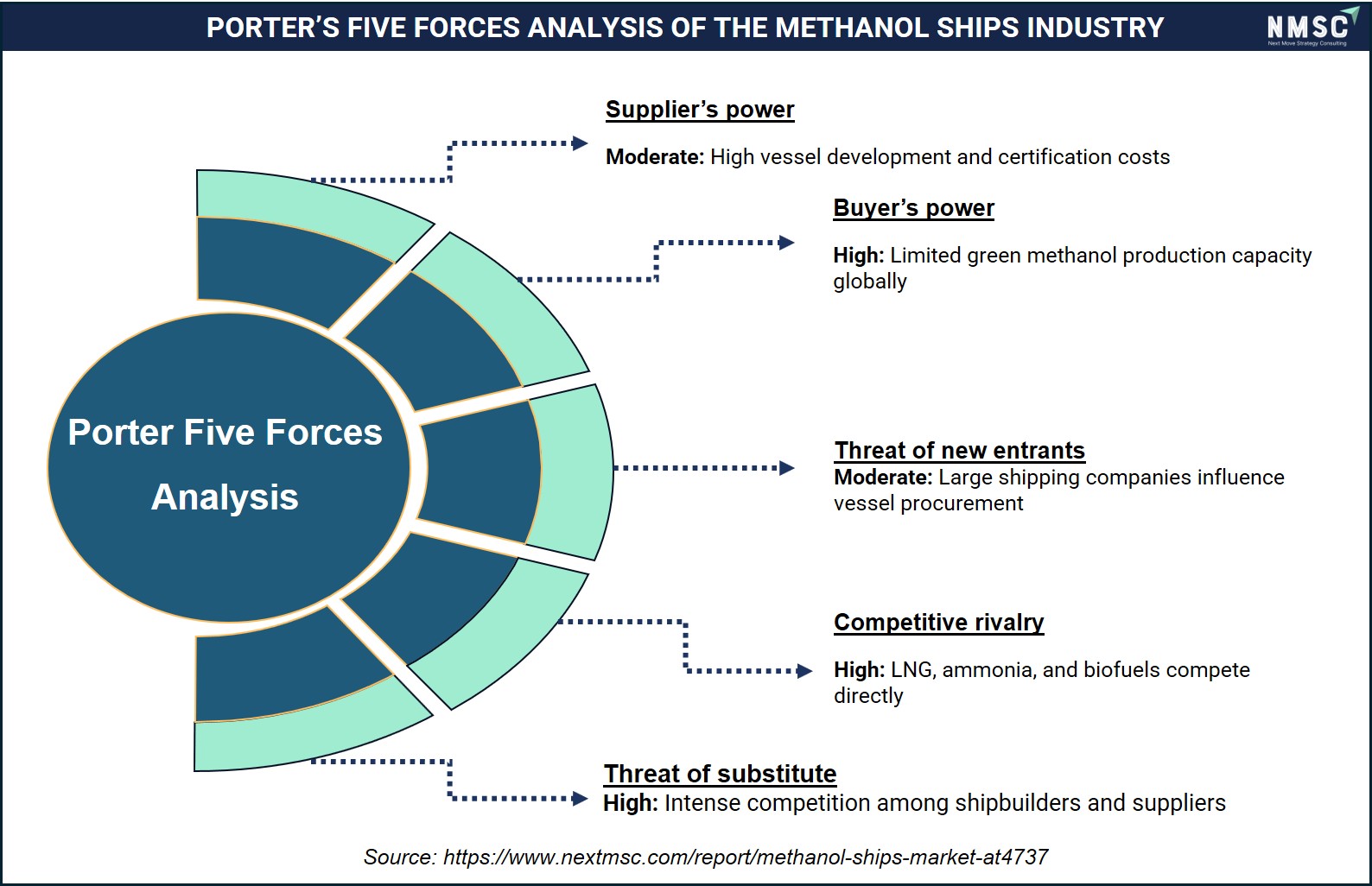
The Methanol ships market is characterized by strong competitive rivalry, evolving alternative-fuel competition, and significant supplier influence due to limited green methanol production and specialized propulsion technologies. Industry participants are investing heavily in vessel innovation and fuel infrastructure to meet decarbonization targets. Regulatory support and growing shipowner interest continue to strengthen market attractiveness despite adoption and fuel availability challenges.
|
Key Takeaways |
|
By fuel type, Residual Fuel Oil holds the largest share of the Methanol ships market at USD 6.86 billion in 2025. Methanol is the fastest-growing fuel sub-segment, projected to expand from USD 0.58 billion in 2025 to USD 4.43 billion by 2035 at a CAGR of 22.5%, driven by newbuild orders from Maersk, CMA CGM, Evergreen, and MSC for dual-fuel methanol container vessels. |
|
By commercial vessel type, Container Vessels account for the largest share at USD 2.57 billion in 2025, reflecting high fuel consumption intensities on transoceanic liner routes. The 'Other Commercial Vessel' segment, capturing emerging vessel categories including autonomous surface vessels and hybrid-electric ferries, records the fastest growth at a CAGR of 25.9%. |
|
By bunkering method, Truck-to-Ship bunkering leads the Methanol ships market at USD 4.62 billion in 2025, owing to its operational flexibility across diverse port types. Portable Tank Bunkering is the fastest-growing method at a CAGR of 14.6%, driven by adoption at smaller ports and for alternative fuel pilots where fixed infrastructure is not yet available. |
|
By procurement type, Spot Purchase dominates at USD 7.71 billion in 2025 as volatile fuel prices incentivize shorter-term procurement commitments. Term Contracts are the faster-growing procurement mode at a CAGR of 12.7%, reflecting shipowner preference for price stability and supply security as fuel portfolios expand to include multiple alternative fuel types. |
|
By supplier type, Physical Suppliers lead the Methanol ships market at USD 8.68 billion in 2025, owing to direct infrastructure ownership and bunkering license control. Traders and Marketers are growing faster at a CAGR of 12.9%, as commodity trading houses expand marine fuel desks to capitalize on fuel portfolio diversification and price arbitrage opportunities. |
|
By port type, Major Hub Ports account for the largest share at USD 7.42 billion in 2025, anchored by Singapore, Rotterdam, Fujairah, and Houston. Offshore Anchorage bunkering is the fastest-growing port type segment at a CAGR of 12.3%, driven by the logistical convenience of ship-to-ship methanol and LNG bunkering for vessels on major trade lanes. |
|
Asia Pacific held the largest regional share in the Methanol ships market, supported by the presence of major bunkering hubs, extensive shipbuilding activity, and high maritime trade volumes across the region. |
|
Europe is the fastest-growing region in the Methanol ships market share, driven by stringent maritime decarbonization regulations, expanding green shipping corridor initiatives, and growing investments in alternative fuel bunkering infrastructure. |
|
China is the dominant country market in the Methanol ships market, underpinned by its large bunkering volumes, extensive domestic methanol production capacity, strong maritime trade activity, and government-led decarbonization initiatives. |
|
Denmark is the fastest-growing country market within Europe in the Methanol ships market, propelled by A.P. Moller-Maersk's leadership in methanol-fuelled vessel deployment, expanding green methanol sourcing agreements, supportive maritime policies, and ongoing investments in methanol bunkering infrastructure. |
Key Emerging Trends in the Methanol Ships Market
How Is the Commercial Scale-Up of Dual-Fuel Methanol Vessels Transforming the Methanol Ships Market?
The accelerating adoption of dual-fuel methanol vessels is fundamentally reshaping the Methanol ships market demand. A.P. Moller-Maersk has emerged as the global anchor customer, operating a growing fleet of methanol-capable container vessels powered by MAN Energy Solutions dual-fuel engines. CMA CGM and Evergreen have placed comparable newbuild orders. From our research, we found that over 120 methanol-fuelled vessels were on order or under construction globally as of mid-2024, representing a structural shift in fuel demand that is compelling bunkering operators across Asia, Europe, and North America to invest in methanol storage and delivery infrastructure at their respective port facilities.
What Role Is Green Corridor Development Playing in Accelerating the Methanol Ships Market?
Green shipping corridors, defined as specific trade routes where zero or near-zero emission shipping is commercially demonstrated at scale, are becoming a critical market structure innovation in the Methanol ships market. The Asia-Europe container corridor, spearheaded by shipping alliances and supported by the Clydebank Declaration signatories, is establishing framework conditions for standardized green methanol bunkering infrastructure. Our assessment indicates that green corridors are creating concentrated infrastructure investment demand at anchor ports such as Singapore, Rotterdam, Shanghai, and Busan, which in turn incentivizes fuel suppliers to establish methanol bunkering capabilities at these strategically important locations ahead of commercial volume materialization.
How Is the IMO Net-Zero Framework Reshaping Procurement Strategies in the Methanol Ships Market?
The IMO Net-Zero Framework adopted at MEPC 82 in July 2024 establishes binding lifecycle greenhouse gas intensity targets for marine fuels, creating mandatory demand for zero and near-zero emission fuel options in the Methanol ships market. NMSC's analysis indicates that shipowners are increasingly integrating lifecycle carbon intensity as a fuel procurement criterion alongside traditional parameters of cost, availability, and quality. This regulatory shift is accelerating demand for renewable methanol, bio-LNG, hydrotreated vegetable oil (HVO), and eventually green ammonia, while simultaneously increasing the commercial viability of long-term supply agreements between fuel producers and shipping companies seeking compliance certainty through 2035.
How Are Digital Bunkering Platforms Redefining Operational Efficiency in the Methanol Ships Market?
Digital transformation is emerging as a differentiation vector across the Methanol ships market as bunkering operators invest in mass flow metering, real-time quantity and quality reporting, and integrated emissions accounting platforms. Based on our market evaluation, we noticed that major traders such as World Fuel Services and Bunker Holding have deployed proprietary digital platforms that provide shipowners with instantaneous fuel consumption data, carbon intensity tracking, and CII compliance projections. Port authorities in Singapore and Rotterdam have mandated electronic bunker delivery notes (e-BDNs), reducing measurement disputes and enhancing supply chain traceability, creating a competitive requirement for all market participants to adopt compatible digital infrastructure.
What Are the Key Market Drivers, Breakthroughs, and Investment Opportunities That Will Shape the Methanol Ships Market in the Next Decade?
|
Drivers / Trends / Restraints |
(+/-) % Impact on CAGR Forecast |
Geographic Relevance |
Impact Timeline |
|
IMO 2030 and 2050 GHG Strategy Mandates |
+0.8% |
Global (all regions) |
2025–2035 |
|
Rising Methanol Newbuild Orders from Major Carriers |
+0.6% |
Asia Pacific, Europe, North America |
2025–2030 |
|
LNG Bunkering Infrastructure Expansion |
+0.5% |
Asia Pacific, Europe |
2025–2030 |
|
Global Seaborne Trade Volume Growth |
+0.4% |
Global |
Ongoing |
|
IMO Carbon Intensity Indicator (CII) Compliance |
+0.4% |
Global |
2025–2035 |
|
Fleet Renewal and Dual-Fuel Vessel Adoption |
+0.5% |
Global (led by Europe, APAC) |
2025–2032 |
|
Green Methanol Supply Scale-Up |
+0.3% |
Europe, North America, APAC |
2027–2035 |
|
EU Emissions Trading System (ETS) Extension to Shipping |
+0.4% |
Europe, MEA |
2025–2035 |
|
High Capital Cost of Dual-Fuel Methanol Vessels |
-0.6% |
SME shipping companies globally |
2025–2030 |
|
Fossil Fuel Price Volatility |
-0.4% |
Global |
Ongoing |
|
Limited Methanol Bunkering Port Coverage |
-0.5% |
MEA, Latin America, smaller APAC ports |
2025–2028 |
|
Regulatory Uncertainty in Ammonia/Hydrogen Safety Codes |
-0.3% |
Global |
2025–2030 |
|
Biofuel Feedstock Supply Constraints |
-0.3% |
Europe, APAC |
2026–2032 |
|
Digitalization of Bunkering Operations |
+0.2% |
Global |
2025–2035 |
|
Expanding OSV and Ferry Electrification |
+0.2% |
Europe, North America |
2025–2032 |
What Are the Growth Drivers of the Methanol Ships Market?
How Are IMO Decarbonization Mandates Driving Structural Transformation in the Methanol Ships Market?
The IMO's binding GHG reduction framework is the primary structural demand driver in the Methanol ships market. The 2023 Revised GHG Strategy mandates a minimum 20% reduction in total GHG emissions from international shipping by 2030 compared to 2008 levels, rising to at least 70% by 2040 and net-zero by 2050. Based on our analysis, we found that the Carbon Intensity Indicator (CII) rating system, now mandatory for ships above 5,000 GT, is directly incentivizing fuel switching as vessels rated D or E face operational restrictions. The IMO's adopted 2024 Net-Zero Framework further codifies lifecycle GHG intensity standards for fuels, creating unambiguous commercial demand for green methanol and other alternative marine fuels across the global fleet through 2035.
How Is Fleet Renewal and the Rise of Dual-Fuel Newbuilds Fueling Methanol Ships Market Growth?
Global fleet renewal is generating durable investment demand in the Methanol ships market as aging vessels are replaced with dual-fuel or alternative-fuel capable newbuilds. Through our market assessment, we observed that South Korean shipyards Samsung Heavy Industries, Hyundai Heavy Industries, and Daewoo Shipbuilding and Chinese counterparts are receiving record methanol and LNG dual-fuel vessel orders from leading container, tanker, and bulk carrier operators. South Korea's Ministry of Oceans and Fisheries data confirms that methanol-capable vessel orders represent a growing proportion of total newbuild contracts at Korean yards. Each new dual-fuel vessel commissioned creates structural long-term demand for methanol bunkering infrastructure at the ports these vessels are designed to service.
How Is the Expansion of Global Seaborne Trade Sustaining Baseline Demand in the Methanol Ships Market?
Global seaborne trade volumes, the primary determinant of aggregate fuel consumption in the Methanol ships market, continue to expand in line with long-term GDP growth and industrial activity. UNCTAD's Review of Maritime Transport 2024 documented that global seaborne trade volumes exceeded 12 billion tonnes in 2023, with container, dry bulk, and tanker segments contributing the largest fuel consumption profiles. Our analysis shows that China's Belt and Road Initiative maritime components, Southeast Asian industrial expansion, and post-pandemic supply chain restructuring are creating new trade routes that expand bunkering demand at Asian hub ports. Even modest volume growth at prevailing fuel consumption rates sustains meaningful market revenue growth through the forecast period.
What Are the Growth Inhibitors of the Methanol Ships Market?
How Does the High Capital Cost of Dual-Fuel Methanol Vessel Conversions Constrain Market Expansion?
The capital premium associated with dual-fuel methanol vessel construction remains a meaningful constraint on the pace of fuel transition in the Methanol ships market. Methanol-capable dual-fuel engines, high-pressure fuel storage systems, and safety containment upgrades add approximately 10–15% to newbuild vessel costs compared to conventional fuel oil specifications, according to shipbuilding industry disclosures. Smaller and mid-sized shipping operators, lacking the balance sheet strength of Maersk or CMA CGM, face material access-to-capital barriers for fleet transition investments. NMSC's analysis indicates that the Green Shipping Guarantee program under Norway's Enova and EU-backed ship finance programs under the European Investment Bank are partially addressing this constraint, but coverage remains insufficient for the broader global fleet.
How Does Uneven Methanol Bunkering Infrastructure Limit the Methanol Ships Market Growth?
The geographic concentration of methanol bunkering infrastructure at a limited number of major hub ports represents a structural constraint on the Methanol ships market's growth trajectory. As of 2024, commercial-scale methanol bunkering was available at fewer than 15 ports globally, concentrated in Rotterdam, Singapore, Shanghai, and the Chinese coastal region. This infrastructure gap creates operational range anxiety for shipowners deploying dual-fuel methanol vessels on routes transiting ports in Latin America, the Middle East, West Africa, and secondary Asian port calls. Based on NMSC's research, we found that the IMO Alternative Fuel Infrastructure Guidelines and port master plan updates in Singapore and Fujairah explicitly address this constraint, but full global coverage remains a medium-term horizon challenge rather than a near-term market reality.
What Are the Growth Opportunities in the Methanol Ships Market?
How Does the Green Methanol Supply Scale-Up Create a Multi-Billion Dollar Opportunity in the Methanol Ships Market?
The commercial scale-up of renewable and green methanol production represents the most transformative growth opportunity in the Methanol ships market. Green methanol, produced from renewable hydrogen and captured carbon dioxide, carries near-zero lifecycle GHG intensity and fully qualifies as a compliance fuel under the IMO Net-Zero Framework. IRENA's Renewable Methanol for Transport report identified over 80 green methanol projects globally in various stages of development, targeting combined production capacity sufficient to supply a significant share of marine fuel methanol demand by 2030. Our analysis shows that successful green methanol scale-up would allow shipowners to achieve both CII compliance and FuelEU Maritime Regulation requirements simultaneously, creating structured long-term supply agreement opportunities worth billions of dollars across the forecast period.
How Does the EU ETS Extension to Maritime Shipping Generate Commercial Opportunity in the Methanol Ships Market?
The inclusion of maritime shipping in the EU Emissions Trading System (ETS) from 2024, covering 40% of emissions in the first year rising to 100% by 2026, is creating tangible financial incentives for alternative fuel adoption that benefit the Methanol ships market. Shipowners operating EU-connected voyages must surrender ETS allowances for vessel CO2 emissions, making lower-carbon fuels commercially attractive beyond pure regulatory compliance. Through NMSC's assessment, we found that EU ETS carbon prices, which have traded between EUR 50 and EUR 100 per tonne of CO2, generate a meaningful per-voyage cost differential that favors methanol, biofuel blends, and LNG over high-sulfur residual fuel oil, accelerating procurement diversification and infrastructure investment in European bunkering hubs.
How Does the Digitalization of the Bunkering Supply Chain Create Structural Opportunity in the Methanol Ships Market?
The digitalization of bunkering operations across the Methanol ships market presents a substantial commercial opportunity for technology-enabled suppliers and port operators. Electronic mass flow metering mandated at the Port of Singapore since 2017, now being adopted across Rotterdam, Fujairah, and major Chinese ports, reduces measurement disputes and strengthens supply chain trust for alternative fuel transactions involving methanol and LNG fuels where quantity accuracy is commercially critical. Based on our market evaluation, we noticed that digital bunkering platforms integrating fuel quantity data, emissions certificates, and CII compliance analytics are creating sticky value-added services that reduce customer churn and support premium pricing for suppliers capable of delivering end-to-end digital documentation alongside physical fuel delivery.
Price Point Analysis of the Methanol Ships Market
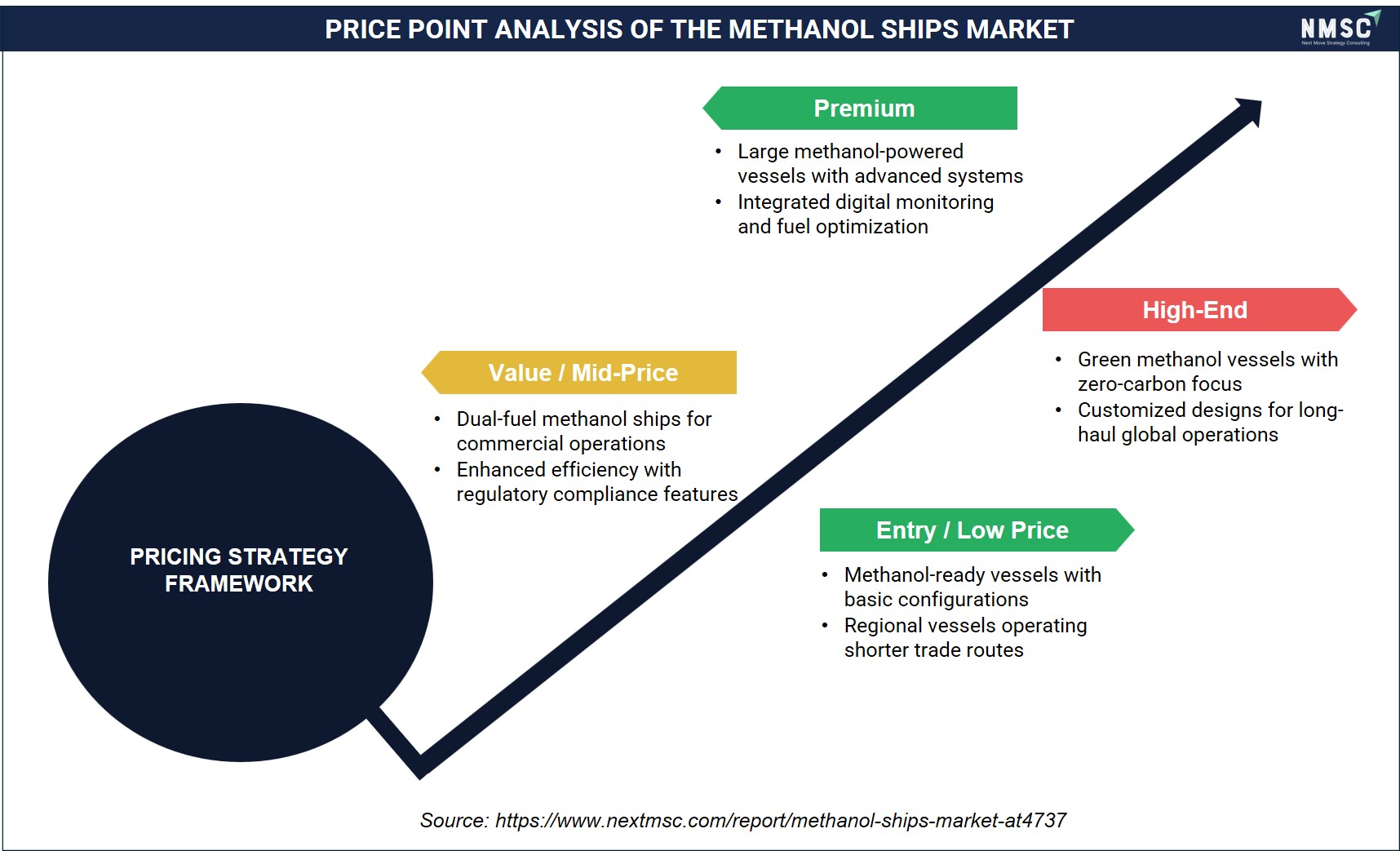
The Methanol Ships Market exhibits a tiered pricing structure driven by vessel size, propulsion systems, fuel flexibility, and emissions performance. Premium and high-end segments benefit from advanced dual-fuel technologies, digital optimization capabilities, and green methanol compatibility. As fuel infrastructure expands and production scales increase, wider commercialization is expected to improve affordability and accelerate adoption across global shipping fleets.
How Is the Methanol Ships Market Segmented in This Report, and What Are the Key Insights from the Segmentation Analysis?
How Does Fuel Type Segmentation Reveal the Structural Composition of the Methanol Ships Market?
|
Fuel Type Segment |
2025 (USD Bn) |
2035 (USD Bn) |
CAGR (%) |
|
Residual Fuel Oil |
6.86 |
15.80 |
8.7% |
|
Distillate Marine Fuel |
2.76 |
5.64 |
7.4% |
|
LNG |
1.33 |
6.15 |
16.5% |
|
Methanol |
0.58 |
4.43 |
22.5% |
|
Biofuel |
0.74 |
4.08 |
18.6% |
|
Ammonia |
0.32 |
1.45 |
16.3% |
|
Hydrogen |
0.25 |
0.94 |
14.2% |
Based on NMSC's analysis of global bunkering volumes and alternative fuel adoption trajectories, the Methanol Ships Market is segmented into Residual Fuel Oil (HSFO and VLSFO grades), Distillate Marine Fuel (MGO and MDO), LNG (fossil, bio, and synthetic), Methanol (conventional and renewable), Biofuel (FAME, HVO, and blends), Ammonia (conventional and renewable), and Hydrogen (compressed and liquid). Residual Fuel Oil continues to dominate at USD 6.86 billion in 2025 given the large installed base of conventional-fuel vessels still in active service globally. Methanol is the fastest-growing sub-segment at a CAGR of 22.5%, driven by newbuild commitments from Maersk, CMA CGM, Evergreen, and MSC, while LNG and biofuels represent intermediate growth pathways gaining significant adoption across diverse vessel types.
How Does Commercial Vessel Type Analysis Define Demand Patterns Across the Methanol Ships Market?
|
Vessel Type Segment |
2025 (USD Bn) |
2035 (USD Bn) |
CAGR (%) |
|
Container Vessel |
2.57 |
7.56 |
11.4% |
|
Bulk Carrier |
2.05 |
5.84 |
11.0% |
|
Oil Tanker |
1.93 |
5.33 |
10.7% |
|
Chemical Tanker |
1.15 |
3.29 |
11.1% |
|
LNG Carrier |
0.96 |
3.41 |
13.5% |
|
LPG Carrier |
0.64 |
1.80 |
10.9% |
|
General Cargo Vessel |
0.77 |
2.04 |
10.2% |
|
Ro-Ro Vessel |
0.51 |
1.41 |
10.7% |
|
Cruise Ship |
0.39 |
1.14 |
11.3% |
|
Ferry |
0.51 |
1.53 |
11.6% |
|
Offshore Support Vessel |
0.39 |
1.14 |
11.3% |
|
Fishing Vessel |
0.39 |
1.02 |
10.1% |
|
Dredger |
0.25 |
0.67 |
10.4% |
|
Naval and Government Vessel |
0.13 |
0.31 |
9.1% |
|
Other Commercial Vessel |
0.20 |
2.00 |
25.9% |
Through NMSC's assessment, we found that the Methanol Ships Market is segmented across 15 commercial vessel categories, each with distinct fuel consumption profiles, regulatory exposure, and alternative fuel adoption timelines. Container Vessels dominate at USD 2.57 billion in 2025 given their high fuel intensity on major transoceanic routes and the concentrated ownership base of major liner operators driving methanol and LNG adoption. LNG Carriers record the strongest growth among established vessel types at a CAGR of 13.5%, benefiting from both LNG as cargo and as fuel on new dual-fuel LNG carrier designs. The Other Commercial Vessel segment grows at a remarkable 25.9% CAGR, capturing emerging electrification and hydrogen pilots in autonomous vessels and specialty craft.
How Do Bunkering Methods Influence Supply Chain Architecture in the Methanol Ships Market?
|
Bunkering Method |
2025 (USD Bn) |
2035 (USD Bn) |
CAGR (%) |
|
Truck-to-Ship Bunkering |
4.62 |
13.40 |
11.2% |
|
Ship-to-Ship Bunkering |
3.85 |
11.60 |
11.7% |
|
Pipeline-to-Ship Bunkering |
3.35 |
9.52 |
11.0% |
|
Portable Tank Bunkering |
1.02 |
3.97 |
14.6% |
Our findings suggest that the Methanol Ships Market bunkering method segmentation reflects the diverse port infrastructure realities across global bunkering locations. Truck-to-Ship bunkering leads at USD 4.62 billion in 2025 due to its operational flexibility at regional ports and during port calls where fixed infrastructure is absent. Ship-to-Ship bunkering is growing at a strong CAGR of 11.7% as bunker barges equipped for methanol and LNG delivery expand their operational capabilities at hub ports in Asia and Europe. Portable Tank Bunkering is the fastest-growing method at 14.6% CAGR, reflecting its practical utility for delivering methanol and alternative fuels at smaller ports where large-scale infrastructure investments are not yet commercially justified.
How Does Procurement Type Shape Commercial Relationships in the Methanol Ships Market?
|
Procurement Type |
2025 (USD Bn) |
2035 (USD Bn) |
CAGR (%) |
|
Spot Purchase |
7.71 |
21.60 |
10.9% |
|
Term Contract |
5.13 |
16.89 |
12.7% |
Based on our engagements with maritime procurement teams and analysis of commercial bunkering patterns, we observed that Spot Purchase dominates the Methanol Ships Market at USD 7.71 billion in 2025, reflecting shipowners' preference for procurement flexibility in volatile commodity markets. However, Term Contract procurement is growing significantly faster at a CAGR of 12.7%, driven by the fuel supply security requirements of operators deploying capital-intensive dual-fuel methanol vessels that require reliable multi-year methanol availability at specific hub ports. Our analysis shows that long-term supply agreements are becoming structurally important for green methanol, where production volumes require demand visibility to justify renewable energy and carbon capture investments by fuel producers.
How Do Supplier Types Define Competitive Positioning in the Methanol Ships Market?
|
Supplier Type |
2025 (USD Bn) |
2035 (USD Bn) |
CAGR (%) |
|
Physical Supplier |
8.68 |
24.46 |
10.9% |
|
Trader and Marketer |
4.16 |
14.03 |
12.9% |
NMSC's analysis indicates that Physical Suppliers command the largest revenue share in the Methanol Ships Market at USD 8.68 billion in 2025, given their direct control of bunkering infrastructure, storage facilities, and licensed delivery vessels. Integrated oil majors including Shell, BP, TotalEnergies, and Sinopec represent the dominant physical supplier category, benefiting from refining-to-vessel supply chain integration. Traders and Marketers are growing faster at a CAGR of 12.9%, as commodity trading houses such as Vitol, TFG Marine, and Monjasa capitalize on fuel portfolio complexity arising from the parallel management of conventional and alternative marine fuels, leveraging price arbitrage, credit facilitation, and logistics optimization capabilities.
How Does Port Type Influence Market Concentration in the Methanol Ships Market?
|
Port Type |
2025 (USD Bn) |
2035 (USD Bn) |
CAGR (%) |
|
Major Hub Port |
7.42 |
22.50 |
11.7% |
|
Regional Port |
4.29 |
12.39 |
11.2% |
|
Offshore Anchorage |
1.13 |
3.61 |
12.3% |
Through our analysis, we found that Major Hub Ports account for USD 7.42 billion of the Methanol Ships Market in 2025, concentrated at Singapore, Rotterdam, Fujairah, the Port of Houston, and China's major coastal bunkering centers. These ports benefit from economies of scale, multi-fuel availability, competitive pricing, and established credit infrastructure for large-volume transactions. Offshore Anchorage bunkering is the fastest-growing port type segment at a CAGR of 12.3%, driven by expansion of ship-to-ship methanol and LNG bunkering at sea, reducing port waiting times for major liner vessels. Regional Ports are growing at 11.2% CAGR as secondary bunkering locations invest in alternative fuel capabilities to serve the diversifying fuel needs of vessels operating regional trade routes.
Regional Outlook
Geographic Performance Snapshot
|
Region |
2025 (USD Bn) |
2035 (USD Bn) |
CAGR (%) |
Key Driver |
|
North America |
1.28 |
3.88 |
11.7% |
Gulf Coast bunkering hubs, USCG regulatory push |
|
Europe |
2.95 |
8.74 |
11.5% |
EU ETS shipping extension, green corridor mandates |
|
Asia Pacific |
6.16 |
18.74 |
11.8% |
Port of Singapore, China fleet renewal, South Korea shipbuilding |
|
Middle East & Africa |
1.67 |
4.86 |
11.3% |
Fujairah hub growth, Saudi Vision 2030 |
|
Latin America |
0.78 |
2.27 |
11.3% |
Port of Santos expansion, Brazil biofuel mandates |
North America Methanol Ships Market
North America is a significant region in the Methanol Ships Market, contributing USD 1.28 billion in 2025 and forecast to reach USD 3.88 billion by 2035 at a CAGR of 11.7%. The region is anchored by major bunkering hubs at the Port of Houston, the Port of New York and New Jersey, and key Gulf of Mexico and Pacific Coast locations. USCG regulatory initiatives on vessel emissions and the U.S. Environmental Protection Agency's National Emission Standards for Hazardous Air Pollutants are pushing North American fleet operators toward lower-emission fuels. Based on our engagements with North American maritime stakeholders, we found that U.S. flag carriers and major international operators calling at U.S. East and Gulf Coast ports are at early stages of methanol and LNG fuel adoption, with accelerating term contracts for biofuel blends.
U.S. Methanol Ships Market
Based on our engagements with the U.S. maritime sector, we found that the United States represents approximately 68% of North American Methanol Ships Market revenue, driven by the Gulf Coast's status as a global energy hub, substantial domestic methanol production capacity, and the concentration of international shipping traffic at Houston, Los Angeles, and New York ports. The U.S. Department of Energy's Alternative Fuels Data Center has documented growing investment in methanol and LNG marine fuel infrastructure. USCG's Port Access Route Studies and National Maritime Strategy align with IMO decarbonization objectives, creating a regulatory pathway for accelerated alternative fuel adoption. U.S.-flagged Jones Act vessels operating coastal routes are early adopters of biofuel blends and LNG as transition fuels.
Canada Methanol Ships Market
Through our analysis, Canada represents approximately 18% of the North America Methanol Ships Market, with key bunkering activity at the Port of Vancouver and the Port of Montreal. Transport Canada's Clean Transportation Strategy aligns with IMO GHG reduction targets and promotes LNG and methanol as maritime fuel alternatives. Canada's significant natural gas reserves support a competitive domestic LNG supply chain for marine applications. The Great Lakes-St. Lawrence Seaway shipping corridor is a high-potential zone for biofuel blends and shore power adoption. Canadian shipowners are beginning to explore methanol dual-fuel retrofits for vessels on North American coastal and transoceanic routes connecting to European green corridor partners.
Mexico Methanol Ships Market
From our assessment, Mexico is a growing participant in the Methanol Ships Market, driven by the strategic importance of PEMEX-operated bunkering terminals at Veracruz, Manzanillo, and Lazaro Cardenas. Mexico's maritime fuel sector remains predominantly conventional, with HSFO and VLSFO dominating vessel fueling requirements. However, SEMARNAT and Secretaria de Marina regulations aligned with MARPOL Annex VI are compelling operators at major Mexican ports to transition toward sulfur-compliant fuels. Increasing container shipping traffic on Mexico's Pacific and Gulf coasts, driven by nearshoring-related manufacturing expansion, is gradually expanding total bunkering volumes at Mexican ports, with biofuel blends emerging as the near-term alternative fuel of choice.
Europe Methanol Ships Market
Europe is the second-largest and fastest-growing major region in the Methanol Ships Market, contributing USD 2.95 billion in 2025 and forecast to reach USD 8.74 billion by 2035 at a CAGR of 11.5%. The region is the global epicenter of maritime decarbonization policy, with the EU FuelEU Maritime Regulation, EU ETS shipping inclusion, and the Green Shipping Corridor initiative creating the world's most demanding alternative fuel regulatory environment. NMSC's analysis indicates that Rotterdam, Antwerp, Hamburg, and Gibraltar are investing substantially in methanol, LNG, and biofuel bunkering infrastructure to retain hub port competitiveness as EU decarbonization requirements escalate.
UK Methanol Ships Market
Based on our engagements with UK maritime stakeholders, we found that the United Kingdom remains a significant Methanol Ships Market participant despite Brexit, with the Port of Southampton, London Gateway, and Scottish offshore supply base ports serving as active bunkering locations. The UK Maritime 2050 strategy and Clean Maritime Plan establish domestic decarbonization pathways aligned with IMO 2050 targets. UK port operators are investing in shore power, biofuel blending facilities, and exploratory LNG bunkering infrastructure. The UK's largest bunkering volumes serve offshore oil and gas support vessels in the North Sea, creating early-mover demand for low-emission marine fuels supporting operators' own scope 3 emission reduction commitments.
Germany Methanol Ships Market
Through our analysis, Germany is a major European participant in the Methanol Ships Market, with the Port of Hamburg serving as one of Europe's most important container vessel bunkering locations. The German Federal Ministry for Digital and Transport's maritime decarbonization roadmap supports investment in LNG, methanol, and green ammonia bunkering infrastructure. German shipping companies including Hapag-Lloyd are global leaders in methanol vessel adoption, with a significant dual-fuel methanol fleet on order at South Korean and domestic shipyards. Our assessment indicates that Hamburg's proximity to industrial methanol production facilities in the Rhine-Ruhr region provides a competitive cost advantage for conventional methanol supply as green methanol capacity scales.
France Methanol Ships Market
From our assessment, France occupies a mid-sized position in the European Methanol Ships Market, with bunkering activity concentrated at the Port of Marseille-Fos, Le Havre, and Dunkirk. CMA CGM, headquartered in Marseille, is a global leader in methanol and LNG dual-fuel vessel ordering, driving significant alternative fuel procurement demand at French and international ports. The French Ministry of Ecological Transition's green shipping plan and France 2030 program support investment in green hydrogen and methanol production that can serve marine fuel applications. France's Mediterranean coastal position makes Marseille-Fos a strategically important alternative fuel bunkering hub for vessels on South Europe and Middle East trade routes.
Italy Methanol Ships Market
According to our evaluation, Italy is a growing Methanol Ships Market participant, with the Port of Genoa, Trieste, and Augusta among the primary bunkering locations serving Mediterranean shipping traffic. Italy's Assoporti federation has been active in developing sustainable bunkering roadmaps aligned with EU regulatory requirements. Italian maritime regulations enforce strict compliance with MARPOL Annex VI sulfur limits, supporting continued transition from HSFO to VLSFO and biofuel blends. Costa Cruises, headquartered in Genoa, has been an early adopter of LNG in the cruise segment, creating demand for LNG bunkering at Italian ports. Methanol adoption among Italian fleet operators remains at an early stage but is expected to accelerate post-2027 as FuelEU Maritime requirements intensify.
Spain Methanol Ships Market
Based on our market evaluation, we noticed that Spain plays a strategically important role in the Methanol Ships Market as both a transit bunkering hub and a growing adopter of alternative marine fuels. The Port of Algeciras, one of Europe's largest container transshipment hubs and a critical bunkering center, handles significant volumes of marine fuel for vessels on the Asia-Europe trade lane. Puertos del Estado (the Spanish State Port Authority) has published a sustainability roadmap calling for expanded LNG and biofuel bunkering services at major Spanish ports. The Canary Islands' port network serves as a critical Atlantic bunkering waypoint, presenting strategic opportunities for methanol and LNG bunkering as alternative fuel-capable vessels scale on Atlantic routes.
Sweden Methanol Ships Market
Through our analysis, Sweden is a regional leader in alternative fuel adoption within the Methanol Ships Market, driven by strong domestic environmental policy and the Stena Line ferry group's early commitment to methanol-fuelled vessels. The Port of Gothenburg, Sweden's largest port, operates one of Europe's first commercial methanol bunkering facilities, established to serve Stena Line's Stena Germanica and subsequent methanol-fuelled vessels on Baltic Sea routes. The Swedish Transport Agency enforces stringent emissions standards for vessels operating in Swedish waters, compelling Baltic ferry and cargo operators to transition toward methanol, LNG, or biofuel alternatives. Sweden's leadership in green methanol production research through institutions such as RISE and Vattenfall further strengthens the country's strategic position.
Denmark Methanol Ships Market
From our assessment, Denmark holds a uniquely important position in the global Methanol Ships Market given A.P. Moller-Maersk's Copenhagen headquarters and its role as the world's leading operator of methanol-fuelled container vessels. Maersk's green methanol sourcing strategy and multi-year supply agreements with European Energy and REintegrate directly anchor Denmark's role as a global methanol shipping hub. Copenhagen Malmö Port has invested in methanol bunkering infrastructure to support Maersk's domestic operations. The Danish Maritime Authority's Shipping 2030 strategy explicitly supports methanol and ammonia as key future marine fuels. NMSC's analysis indicates that Denmark will remain a global reference market for methanol shipping policy and commercial innovation through the forecast period.
Finland Methanol Ships Market
Based on our engagements, Finland is a specialized contributor to the Methanol Ships Market, particularly in the LNG and methanol bunkering segment serving Baltic Sea ferry and icebreaker vessel operations. Finnish shipbuilder Meyer Turku and Wärtsilä are global technology leaders in LNG and methanol dual-fuel marine engine design, with their technology deployed in vessels operating worldwide. The Port of Helsinki has established LNG bunkering services for ferry operations, with methanol bunkering investments under consideration. Finland's Gasum operates the Baltic Sea's most developed LNG bunkering network, extending its portfolio toward bio-LNG and green methanol as Finnish environmental standards and EU FuelEU Maritime requirements drive alternative fuel adoption among Baltic shipping operators.
Netherlands Methanol Ships Market
Through our analysis, the Netherlands is Europe's most strategically important country market in the market, anchored by the Port of Rotterdam the world's largest bunkering port by volume outside Asia. Rotterdam bunkered over 10 million tonnes of marine fuel annually in recent years and has committed to becoming a major hub for all alternative marine fuels by 2030, with active LNG, biofuel blend, and methanol bunkering infrastructure now operational. The Port of Rotterdam Authority's Energy Transition Program directly funds methanol storage terminal expansion. Shell's Rotterdam refinery and marine fuels division is a major physical methanol supplier. Our assessment indicates that Rotterdam's infrastructure leadership will sustain the Netherlands' position as Europe's dominant Methanol Ships Market revenue contributor through 2035.
Asia Pacific Methanol Ships Market
Asia Pacific dominates the Methanol Ships Market at USD 6.16 billion in 2025, representing 48% of global market revenue, and is forecast to reach USD 18.74 billion by 2035 at a CAGR of 11.8%. The region hosts the world's largest and busiest bunkering hubs, including Singapore, Shanghai, Busan, and Chinese coastal ports collectively. Asia Pacific is simultaneously the global center of shipbuilding, ship management, and seaborne trade volume, creating compound demand for all fuel types. NMSC's analysis indicates that IMO-aligned national decarbonization policies in China, Japan, South Korea, and Singapore are driving accelerated investments in LNG, methanol, and biofuel bunkering infrastructure across the region's dominant port ecosystem.
China Methanol Ships Market
Based on our engagements with Chinese maritime industry stakeholders, we found that China is the largest national market by bunkering volume in Asia Pacific within the Methanol Ships Market, supported by state-owned enterprises including COSCO Shipping, CNOOC, and Sinopec Fuel Oil Sales. The China Maritime Decarbonization Action Plan mandates progressive GHG intensity reductions for domestically registered vessels, creating structured domestic demand for alternative fuels. China's Ministry of Transport has accelerated LNG bunkering infrastructure investment along the Yangtze River corridor. Methanol bunkering is expanding at major Chinese coastal ports, supported by China's large domestic methanol production base. Sinopec and PetroChina are investing in green methanol production from coal gasification with carbon capture to serve marine fuel requirements.
India Methanol Ships Market
Through our analysis, India is a fast-growing emerging market in the Methanol Ships Market, driven by the expansion of the Jawaharlal Nehru Port (JNPT), Mundra, and Kandla as high-volume bunkering centers serving international container and tanker traffic. India's Maritime India Vision 2030, overseen by the Ministry of Ports, Shipping and Waterways, explicitly includes green fuel transition as a strategic priority. NMSC's analysis indicates that India's large domestic methanol production capacity, primarily from natural gas, provides a cost-competitive supply foundation for marine methanol use. The Sagarmala programme is funding port modernization investments that include alternative fuel bunkering infrastructure. International shipping lines calling at Indian ports are beginning to request biofuel blend options aligned with their global decarbonization strategies.
Japan Methanol Ships Market
From our assessment, Japan is a strategically important and technically sophisticated Methanol Ships Market participant, driven by Japan's Ministry of Land, Infrastructure, Transport and Tourism's Green Shipping Corridor program and Nippon Yusen Kaisha (NYK Line) and Mitsui O.S.K. Lines' (MOL) leadership in alternative fuel vessel development. Japan's domestic coastal shipping fleet is exploring methanol and hydrogen fuel cells as alternatives to conventional heavy oil. The Port of Yokohama and Port of Kobe have developed LNG bunkering facilities, with methanol bunkering capabilities under assessment. Japan's Green Innovation Fund, managed by NEDO, is funding shipborne hydrogen and ammonia fuel system research with potential long-term implications for marine fuel demand structure.
South Korea Methanol Ships Market
Based on our market evaluation, South Korea occupies a uniquely strategic position in the Methanol Ships Market as the world's second-largest shipbuilding nation, with Samsung Heavy Industries, Hyundai Heavy Industries, and Korea Shipbuilding and Offshore Engineering collectively holding substantial order books for dual-fuel methanol, LNG, and ammonia-ready vessels. South Korea's Ministry of Oceans and Fisheries' K-Shipping Carbon Neutral Strategy provides government-backed incentives for fleet decarbonization. The port of Busan, South Korea's primary international bunkering hub, is expanding LNG bunkering infrastructure with methanol capabilities planned. NMSC's analysis indicates that South Korea's shipbuilding dominance makes it a critical technology enabler and infrastructure investment node in the global Methanol Ships Market.
Taiwan Methanol Ships Market
According to our evaluation, Taiwan is a significant participant in the Methanol Ships Market, driven by Evergreen Marine Corporation and Yang Ming Marine Transport's growing methanol-capable vessel fleets and the Port of Kaohsiung's status as a major Asia Pacific container transshipment and bunkering hub. Evergreen has placed substantial orders for methanol dual-fuel container vessels, creating tangible demand for commercial methanol bunkering at Taiwanese and international ports. Taiwan's Central Maritime Safety Administration is aligning domestic regulations with IMO CII and FuelEU Maritime requirements. Taiwan's semiconductor and electronics export industries drive high-frequency container ship calling patterns that sustain robust bunkering volumes at Kaohsiung and Taichung ports.
Indonesia Methanol Ships Market
Based on our engagements with Southeast Asian maritime industry, we found that Indonesia represents a significant and growing Methanol Ships Market participant given its archipelagic geography requiring extensive inter-island shipping and its role as a major coal, palm oil, and LNG exporter generating high tanker and bulk carrier bunkering volumes. Indonesia's Ministry of Transportation is implementing MARPOL Annex VI compliance measures at major ports including Tanjung Priok, Balikpapan, and Batam. Indonesian state energy company Pertamina operates the country's primary marine fuel bunkering network. Biofuel blends utilizing Indonesia's extensive palm oil surplus are gaining traction as a practical near-term alternative fuel option for domestic flag vessels operating inter-island routes.
Vietnam Methanol Ships Market
Through our analysis, Vietnam is an emerging participant in the Methanol Ships Market, driven by rapidly expanding seaborne trade volumes generated by Vietnam's manufacturing export growth and the port development programs at Hai Phong, Da Nang, and the Cai Mep International Terminal complex in Ba Ria-Vung Tau Province. Vietnam's Ministry of Transport is progressively implementing MARPOL compliance requirements, driving demand for VLSFO and marine gas oil at major Vietnamese ports. International container lines calling at Vietnamese ports are requesting biofuel blend bunkering options. Long-term methanol bunkering infrastructure investment will require further port masterplan development and regulatory frameworks for alternative fuel handling at Vietnamese facilities.
Australia Methanol Ships Market
From our assessment, Australia is a strategically important Methanol Ships Market participant given its role as a major LNG exporter and its substantial domestic bunkering requirements for coastal shipping, offshore support vessels, and international vessels calling at Port of Melbourne, Port Botany, and the Pilbara iron ore export ports. The Australian Department of Infrastructure's shipping emissions regulations align with IMO frameworks. Australia's position as a major LNG producer creates a natural domestic LNG bunker supply advantage. The Australian Government's hydrogen strategy and significant offshore wind development pipeline create long-term potential for green methanol and green ammonia production serving both domestic and international marine fuel markets from Australian port infrastructure.
Philippines Methanol Ships Market
Based on our market evaluation, the Philippines is a growing Methanol Ships Market participant anchored by the Manila International Container Terminal and the Port of Cebu, which serve high-frequency inter-island domestic shipping and international container calls. The Philippine Ports Authority's port development plans include environmental compliance upgrades aligned with MARPOL Annex VI. Philippine domestic shipping, which is among the world's most extensive given the country's 7,000-island geography, relies heavily on conventional fuels but is beginning to explore LNG and biofuel options for major ferry and ro-ro operators. The Philippines' significant bunker trade volumes servicing vessels on Asia-Pacific trade routes represent growing alternative fuel transition demand.
Malaysia Methanol Ships Market
Through our analysis, Malaysia is a significant Methanol Ships Market contributor, with the Port of Tanjung Pelepas (PTP) serving as a major Asia Pacific container transshipment and bunkering competitor to Singapore, and Labuan as an offshore financial and bunkering center serving deepwater exploration vessels. PETRONAS Trading Corporation operates a major marine fuels business serving international vessels through Singapore and Malaysian port networks. Malaysia's Ministry of Transport maritime policy aligns with IMO decarbonization commitments. The proximity of PTP to Singapore creates competitive dynamics in hub port bunkering, incentivizing Malaysian port operators to invest in alternative fuel capabilities to attract environmentally committed shipping lines.
Middle East & Africa Methanol Ships Market
The Middle East and Africa (MEA) region holds a significant position in the Methanol Ships Market at USD 1.67 billion in 2025, forecast to reach USD 4.86 billion by 2035 at a CAGR of 11.3%. The region is anchored by the Port of Fujairah, which has established itself as the world's second-largest bunkering hub by volume, and the port complexes of Ras Al Khaimah, Jebel Ali, and Saudi Aramco's marine fuel operations at Ras Tanura. MEA's strategic position at the crossroads of Europe-Asia and Europe-Africa shipping routes creates structural bunkering demand. NMSC's analysis indicates that Gulf state diversification strategies and African port development programs are creating new investment momentum in alternative fuel bunkering infrastructure across the region.
Saudi Arabia Methanol Ships Market
Based on our engagements, Saudi Arabia is a major Methanol Ships Market participant driven by the Port of Jeddah Islamic Port, the Jubail Industrial City marine terminal, and Ras Tanura's massive petroleum export and bunkering complex. Saudi Aramco's marine fuels division manages substantial bunkering volumes for tanker fleets serving crude oil export routes. Saudi Vision 2030's maritime logistics strategy targets development of King Salman International Complex for Maritime Industries and Services (Iktva program) as a regional marine hub. NMSC's analysis indicates that Saudi Arabia's significant methanol production capacity from natural gas positions the Kingdom as a potential methanol bunkering hub alongside its traditional fuel oil operations, subject to regulatory and infrastructure investment decisions.
UAE Methanol Ships Market
Through our analysis, the UAE is the most strategically critical Methanol Ships Market participant in the Middle East, anchored by the Port of Fujairah which regularly ranks as the world's second-largest bunkering port by volume, surpassing Rotterdam. Fujairah's geographic position between the Arabian Sea and the Persian Gulf makes it the default refueling stop for vessels on Asia-Europe, Asia-Africa, and Middle East trade routes. The Fujairah Oil Industry Zone (FOIZ) houses the world's largest concentration of oil storage tanks outside the United States. The UAE Federal Transport Authority is engaging with IMO frameworks on alternative fuel bunkering regulations. NMSC's analysis indicates that Fujairah's future as a major methanol and LNG bunkering hub will depend on infrastructure investment decisions by FOIZ operators and UAE government policy signals in the 2025-2027 period.
Egypt Methanol Ships Market
From our assessment, Egypt holds a strategic position in the Methanol Ships Market due to the Suez Canal's role as the world's most critical maritime chokepoint, through which an estimated 12–15% of global seaborne trade transits annually. Port Said at the northern entrance and Port Suez at the southern end are major bunkering hubs for Suez Canal transit traffic. The Suez Canal Authority has expressed interest in developing green fuel bunkering services to attract environmentally compliant vessels offering traffic priority incentives. Egypt's gas reserves and renewable energy potential create a long-term green methanol production opportunity that could directly serve Suez Canal bunkering demand, positioning Egypt as a future hub for alternative marine fuel supply in the Eastern Mediterranean.
Israel Methanol Ships Market
Based on our market evaluation, Israel's Methanol Ships Market is modest in scale but strategically positioned, with the Port of Haifa and Port of Ashdod serving as primary bunkering centers for Mediterranean shipping traffic. Israel's offshore natural gas discoveries, particularly the Leviathan and Tamar fields, create a domestic gas supply foundation that could support LNG bunkering expansion. Israeli maritime regulations enforce MARPOL Annex VI compliance, driving vessel operators to transition toward VLSFO and lower-emission fuels at Israeli ports. The Israeli Shipping and Ports Authority is engaging with Mediterranean green shipping corridor initiatives, which could catalyze alternative fuel bunkering investment at Israeli port facilities in the medium term.
Turkey Methanol Ships Market
Through our analysis, Turkey is an important Methanol Ships Market participant given its strategic position controlling the Bosphorus and Dardanelles straits, through which Black Sea trade passes, and Istanbul's and Iskenderun's roles as significant Mediterranean bunkering locations. Turkey's booming shipbuilding sector, centered in Tuzla and Antalya, produces vessels for domestic and international customers, creating near-term demand for compliance-grade marine fuels. The Turkish Chamber of Shipping is engaging with IMO CII compliance frameworks. Turkey's growing LNG import infrastructure and renewable energy expansion present opportunities for domestic LNG and eventually green methanol production supporting marine fuel requirements at Turkish bunkering terminals.
Nigeria Methanol Ships Market
Based on our engagements, Nigeria is the largest Methanol Ships Market participant in Sub-Saharan Africa, driven by extensive crude oil export tanker bunkering operations at the Bonny and Escravos terminals and the Port of Lagos (Apapa). Nigeria's dominant role in West Africa's maritime trade creates substantial conventional fuel bunkering volumes. NIMASA (Nigerian Maritime Administration and Safety Agency) is progressively implementing MARPOL Annex VI sulfur compliance requirements. Nigeria's Petroleum Industry Act includes provisions for domestic gas supply infrastructure development that could support future LNG bunkering capabilities. Alternative fuel adoption at Nigerian ports remains at an early stage, with the primary near-term focus on VLSFO compliance and biofuel blend piloting.
South Africa Methanol Ships Market
Through our analysis, South Africa plays an important Methanol Ships Market role as a refueling hub on the Cape of Good Hope maritime route, which serves as the primary alternative to the Suez Canal for Very Large Crude Carriers (VLCCs) and vessels too large for canal transit. The Port of Durban and Richards Bay coal export terminal are major bunkering centers. South Africa's South African Maritime Safety Authority (SAMSA) enforces MARPOL standards. Transnet National Ports Authority is developing a maritime sustainability strategy. NMSC's analysis indicates that South Africa's renewable energy potential, including significant offshore wind resources, creates a long-term opportunity for green methanol and green ammonia production serving Cape Route bunkering demand.
Latin America Methanol Ships Market
Latin America contributes USD 0.78 billion to the Methanol Ships Market in 2025, forecast to reach USD 2.27 billion by 2035 at a CAGR of 11.3%. The region is anchored by the Port of Santos in Brazil, the Caribbean Petroleum Corporation bunkering operations in Puerto Rico, and Colombia's Pacific and Atlantic coast port complexes. Latin America's role as a major agricultural commodity exporter generates consistent bulk carrier and general cargo vessel bunkering demand. NMSC's analysis indicates that Brazil's mandated biofuel blending requirements and Chile's green methanol export ambitions create distinctive alternative fuel market development pathways within the regional landscape through the forecast period.
Brazil Methanol Ships Market
Based on our engagements, Brazil is the dominant Methanol Ships Market participant in Latin America, driven by the Port of Santos Latin America's busiest port and major iron ore export terminals at Tubarao and Ponta da Madeira. Petrobras operates extensive marine fuel supply infrastructure supporting Brazilian offshore oil and gas exploration vessel fleets. Brazil's RenovaBio mandate for decarbonization of the transportation sector, overseen by ANEEL and ANP, includes provisions extending toward maritime applications, driving domestic demand for biofuel-blended marine fuels. Brazil's massive sugarcane ethanol and biomass production base positions the country as a potential regional leader in sustainable biofuel-based marine fuel supply, particularly for vessels on South Atlantic trade routes.
Argentina Methanol Ships Market
Through our analysis, Argentina is a significant Methanol Ships Market participant, driven by grain and soybean export volumes generating regular bulk carrier bunkering demand at the Port of Rosario, Puerto General San Martin, and Buenos Aires. Argentina's Vaca Muerta shale formation represents a major natural gas reserve that could support domestic LNG production for marine fuel applications. The Argentine Secretariat of Transport enforces MARPOL Annex VI compliance standards at Argentine ports. Increasing Liquefied Natural Gas export terminal development in Bahia Blanca creates potential for port-level LNG bunkering capabilities for vessels calling at Argentine export facilities on South American Atlantic routes.
Chile Methanol Ships Market
From our assessment, Chile is an emerging strategic player in the Methanol Ships Market with significant long-term potential as a green methanol producer for marine fuel applications. Chile's extraordinary solar and wind energy resources in the Atacama Desert and Patagonia make it one of the world's lowest-cost green hydrogen production locations, enabling economically competitive green methanol synthesis. Chile's National Green Hydrogen Strategy, developed by the Ministry of Energy, targets 25 GW of electrolysis capacity by 2030, with marine fuel among identified export markets. Chile's Port of Valparaiso and Puerto Angamos serve vessels on the South Pacific trade route. NMSC's analysis indicates that Chile's green methanol production ambitions could transform the country into a regional alternative marine fuel supplier by 2032.
Colombia Methanol Ships Market
Based on our market evaluation, Colombia occupies a growing position in the Methanol Ships Market as a dual-coast nation with significant port operations at the Port of Barranquilla, Cartagena, and Buenaventura on the Pacific coast. Colombia's coal and oil export volumes generate consistent tanker and bulk carrier bunkering demand. DIMAR (Colombian Maritime Authority) enforces MARPOL compliance at Colombian ports. Colombia's emerging offshore wind energy projects in the Caribbean coast region, as well as its natural gas reserves, create a medium-term potential for LNG or green methanol production supporting regional marine fuel requirements. Biofuel blends based on Colombian palm oil production are gaining consideration as near-term sustainable marine fuel options for regional shipping operators.
Competitive Landscape
Competitive Dynamics & M&A Landscape
|
Key Takeaways |
Details |
|
Market Structure |
The Methanol Ships Market features competition among large global shipbuilding groups, including HD Hyundai, Hanwha Ocean, Samsung Heavy Industries, CSSC, and major Japanese and European shipbuilders. Competition is driven by shipbuilding capacity, alternative-fuel vessel expertise, order backlog strength, and engineering capabilities. |
|
Innovation Focus |
Innovation focuses on methanol dual-fuel propulsion integration, methanol-ready vessel designs, advanced fuel storage systems, emissions reduction technologies, and compliance with evolving IMO decarbonization requirements. |
|
M&A Activity |
Strategic partnerships, technology collaborations, and capacity expansion initiatives are accelerating across leading shipyards as manufacturers invest in alternative-fuel vessel construction and next-generation green shipping solutions. |
How Do Companies Compete in the Methanol Ships Market?
The Methanol Ships Market is characterized by intense competition among global shipbuilders competing on alternative-fuel vessel expertise, engineering capabilities, construction capacity, order backlogs, and delivery performance. Korean shipbuilders including HD Hyundai, Hanwha Ocean, and Samsung Heavy Industries compete through large-scale production capabilities and advanced dual-fuel vessel technologies. Chinese shipbuilders such as CSSC, COSCO Shipping Heavy Industry, Yangzijiang Shipbuilding, and New Times Shipbuilding leverage scale, cost competitiveness, and expanding alternative-fuel portfolios, while Japanese and European manufacturers focus on specialized vessel designs, quality, and long-term customer relationships.
Which Kind of Companies Dominate the Methanol Ships Market?
Three competitive tiers dominate the Methanol Ships Market. First, large global shipbuilding groups including HD Hyundai, Hanwha Ocean, Samsung Heavy Industries, and CSSC lead through scale, technological capabilities, and extensive order books. Second, established Japanese shipbuilders such as Imabari Shipbuilding, Tsuneishi Shipbuilding, Japan Marine United, Mitsubishi Heavy Industries, Oshima Shipbuilding, and Namura Shipbuilding compete through high-quality commercial vessel construction and alternative-fuel vessel expertise. Third, European manufacturers including Fincantieri, Meyer Werft, and Damen Shipyards focus on specialized vessel segments and advanced engineering solutions.
How Are Innovation and Sustainability Reshaping Competitive Strategy in the Methanol Ships Market?
Innovation in the Methanol Ships Market is increasingly centered on methanol dual-fuel propulsion systems, fuel storage optimization, energy-efficiency technologies, and vessel designs aligned with maritime decarbonization targets. Leading shipbuilders are investing in alternative-fuel vessel platforms capable of supporting lower-emission operations while meeting future regulatory requirements. Competitive differentiation is increasingly determined by the ability to deliver technologically advanced, fuel-flexible vessels that support shipowner sustainability objectives.
How Are M&A and Partnership Activities Reshaping the Methanol Ships Market?
Strategic partnerships, technology collaborations, and production capacity investments are reshaping the competitive landscape of the Methanol Ships Market. Shipbuilders are working closely with engine manufacturers, technology providers, and shipowners to accelerate deployment of methanol-capable vessels. Industry participants are expanding alternative-fuel shipbuilding capabilities and strengthening engineering expertise to capture growing demand for low-emission vessels, supporting long-term market growth and maritime decarbonization objectives.
Key Market Players in the Methanol Ships Market
-
HD Hyundai Co., Ltd.
-
Hanwha Ocean Co., Ltd.
-
Samsung Heavy Industries Co., Ltd.
-
China State Shipbuilding Corporation Limited
-
Imabari Shipbuilding Co., Ltd.
-
Tsuneishi Shipbuilding Co., Ltd.
-
Mitsubishi Heavy Industries, Ltd.
-
Japan Marine United Corporation
-
Yangzijiang Shipbuilding (Holdings) Ltd.
-
New Times Shipbuilding Co., Ltd.
-
COSCO Shipping Heavy Industry Co., Ltd.
-
Taizhou Sanfu Ship Engineering Co., Ltd.
-
Fincantieri S.p.A.
-
Meyer Werft GmbH & Co. KG
-
Damen Shipyards Group N.V.
-
Oshima Shipbuilding Co., Ltd.
-
Namura Shipbuilding Co., Ltd.
What Are the Latest Developments in the Methanol Ships Market?
|
Date |
Event |
|
June 2026 |
Yangzijiang Shipbuilding announced the successful delivery of the Tema Mærsk, a large methanol-enabled container ship. The delivery confirms the yard’s integration of dual-fuel engine technology into its high-capacity series, supporting the broader decarbonization goals of its partners. |
|
September 2025 |
Global methanol leader Methanex launched commercial methanol bunkering operations simultaneously in two premier international logistics hubs, the ARA (Amsterdam-Rotterdam-Antwerp) region partnering with Tank Match, and South Korea partnering with Alpha Maritime |
|
April 2025 |
Green fuel venture C2X (backed by A.P. Moller Holding) secured a USD 100 million strategic equity injection to expedite the global buildout, scalability, and engineering of commercial-grade green methanol production facilities to meet upcoming maritime regulatory mandates |
Expert Insights
 “Over the next five to 10 years, shipping companies will focus first on reducing emissions through proven products like LNG and methanol.”
- Takeshi Hashimoto, CEO, Mitsui O.S.K. Lines (MOL)
Statement made during the APPEC Conference in Singapore while discussing the shipping industry's fuel transition strategy and the role of commercially available low-carbon marine fuels in achieving decarbonization objectives.
Market Interpretation
NMSC analysis indicates that methanol is emerging as one of the most commercially viable alternative marine fuels during the current phase of maritime decarbonization. The statement highlights that shipping companies are prioritizing proven fuel pathways that can be deployed at scale within existing regulatory timelines, positioning methanol among the leading near-term solutions for emissions reduction. Growing investments in methanol-fueled vessels, expanding bunkering infrastructure, and increasing commitments to green methanol production are strengthening the fuel's role across container shipping, tanker operations, and other commercial vessel segments. As regulatory frameworks such as FuelEU Maritime and IMO decarbonization measures continue to tighten, methanol-powered ships are expected to gain further traction due to their operational flexibility, established technology readiness, and compatibility with long-term carbon reduction strategies.
What Are the Investment Opportunities in the Methanol Ships Market?
Capital Inflows and Venture Activity
The Methanol Ships Market is attracting growing volumes of institutional and private capital as energy transition imperatives translate into commercially viable investment cases. Green methanol production ventures backed by renewable energy developers including European Energy and Reintegrate have secured substantial project financing commitments. European Investment Bank (EIB) and European Bank for Reconstruction and Development (EBRD) programs offer concessional financing for green shipping infrastructure, including methanol and LNG bunkering terminal development. NMSC's analysis indicates that port authorities in Singapore, Rotterdam, and Hamburg are partnering with private capital providers to co-fund alternative fuel bunkering infrastructure, recognizing that hub port leadership in green marine fuel availability is a long-term competitive advantage.
Infrastructure Investment
Bunkering infrastructure investment is a defining capital deployment theme within the Methanol Ships Market. Major port authorities including the Maritime and Port Authority of Singapore (MPA) have committed to developing methanol and ammonia bunkering frameworks, with methanol bunkering licensing established in late 2024. The Port of Rotterdam Authority's EUR 1 billion Energy Transition Fund is co-investing in alternative fuel storage and delivery infrastructure. South Korea's Korea Development Bank is financing LNG and methanol bunker barge construction for Busan-based suppliers. Based on our analysis, we found that infrastructure investment at hub ports generates a compounding market benefit, as vessel operators route traffic toward ports where multi-fuel optionality minimizes fuel supply risk and enables compliance across multiple regulatory frameworks simultaneously.
ESG and Sustainable Marine Fuel Investment
Environmental, Social, and Governance (ESG) considerations are increasingly driving investment decisions in the Methanol Ships Market as shipping companies and fuel suppliers face sustainability reporting obligations and investor scrutiny of Scope 1 and Scope 3 emissions. The Poseidon Principles framework, adopted by leading ship finance banks, ties loan terms to vessel GHG performance, incentivizing fleet decarbonization investments that drive alternative fuel demand. NMSC's analysis indicates that green methanol and biofuel blends certified under ISCC or RSB sustainability standards command premium pricing in ESG-aligned procurement programs. Institutional investors are increasingly screening marine fuel supplier portfolios for renewable fuel transition credibility, creating capital market incentives for physical suppliers to invest ahead of customer demand.
Digital Transformation and Bunkering Technology
Digital transformation across bunkering operations is emerging as a durable investment theme within the Methanol Ships Market. Mass flow metering standardization, electronic bunker delivery note (e-BDN) mandates, and emissions calculation platform integration are creating demand for technology-enabled bunkering services that go beyond physical fuel delivery. Our findings suggest that companies investing in integrated digital bunkering platforms that provide shipowners with real-time CII compliance analytics, carbon credit verification, and multi-fuel procurement optimization will capture premium margins and stronger customer retention than pure commodity suppliers. Regulatory-driven data transparency requirements from IMO Data Collection System (DCS) and EU MRV (Monitoring, Reporting, and Verification) further cement the commercial value of digital bunkering infrastructure investments.
Private Equity and Strategic M&A Activity
Private equity is playing a growing role in reshaping the competitive structure of the Methanol Ships Market, targeting mid-tier bunker traders, alternative fuel logistics companies, and green methanol production ventures. Strategic M&A activity is driven by the need for scale in alternative fuel supply chain development, with established trading houses acquiring green fuel specialists and port logistics operators acquiring bunkering businesses to establish integrated marine energy service offerings. NMSC's assessment indicates that investors should monitor consolidation activity in green methanol production, biofuel marine certification, and digital bunkering platform segments as structurally attractive M&A themes over the 2025-2030 period. The long-term revenue visibility provided by IMO's binding GHG targets creates a more predictable investment horizon for alternative fuel infrastructure than has historically characterized commodity marine fuel businesses.
Key Benefits for Stakeholders
For Shipping Companies and Fleet Operators
Shipping companies and fleet operators gain comprehensive, vendor-neutral intelligence on the Methanol Ships Market, including quantitative market sizing across all fuel types, vessel categories, and bunkering methods through 2035. This intelligence supports fuel procurement strategy development, newbuild specification decisions, and multi-year decarbonization roadmap planning. Our competitive landscape analysis enables procurement teams to evaluate supplier capabilities across physical fuel supply, digital services, and alternative fuel availability at specific port locations relevant to their trade routes and fleet deployment patterns.
For Fuel Suppliers and Bunker Traders
Fuel suppliers and bunker traders access a structured, data-rich assessment of the Methanol Ships Market's growth trajectory, competitive dynamics, and segment-level revenue forecasts through 2035. The segmentation analysis by fuel type, vessel type, bunkering method, and port type enables suppliers to identify white-space opportunities in alternative fuel service development and optimize geographic investment prioritization. Our regional outlook analysis identifies ports and corridors where alternative fuel demand is materializing fastest, enabling suppliers to sequence infrastructure investments for maximum first-mover commercial advantage in the evolving green marine fuel marketplace.
For Port Authorities and Infrastructure Investors
Port authorities and infrastructure investors gain strategic intelligence on which fuel types, bunkering methods, and vessel categories are driving market growth across each region, enabling evidence-based investment decisions in bunkering terminal development and storage facility upgrades. Our analysis of competitive hub port dynamics across Singapore, Rotterdam, Fujairah, and emerging Asian and European green corridor ports provides a comparative investment framework. Country-level assessments include regulatory context and market maturity indicators that support long-term capital allocation decisions for bunkering infrastructure development in both established and emerging maritime hubs.
For Investors and Financial Analysts
Investors and financial analysts access a structured assessment of the Methanol Ships Market's investment landscape, including segment-level CAGRs, regional growth rates, M&A activity, and latest commercial developments. The alternative fuel segment growth analysis highlights the specific subsegments green methanol, bio-LNG, and HVO biofuels generating premium returns above overall market CAGR. Detailed coverage of 17 key market participants, combined with latest development tracking of supply agreements, newbuild orders, and infrastructure investments, provides a systematic framework for identifying growth leaders and at-risk incumbent positions within the global marine fuel supply ecosystem.
For Government and Regulatory Bodies
Government agencies and regulatory bodies gain a structured analysis of how IMO GHG Strategy mandates, EU FuelEU Maritime Regulation, EU ETS shipping inclusion, and national maritime decarbonization policies are influencing the Methanol Ships Market's structure and competitive dynamics. Country-level insights provide policymakers with evidence-based perspectives on how regulatory design choices affect hub port competitiveness, alternative fuel infrastructure investment attraction, and seaborne trade facilitation. The regional outlook analysis offers direct relevance to national maritime cluster strategy development, port master planning, and alternative fuel incentive program design.
Key Market Segments
By Fuel Type
-
Residual Fuel Oil
-
High Sulfur Fuel Oil
-
HSFO 180
-
HSFO 380
-
Other HSFO Grades
-
-
Very Low Sulfur Fuel Oil
-
VLSFO 0.50 Percent Sulfur
-
Other VLSFO Grades
-
-
Ultra Low Sulfur Fuel Oil
-
ULSFO 0.10 Percent Sulfur
-
-
-
Distillate Marine Fuel
-
Marine Gas Oil
-
DMA Grade
-
DMZ Grade
-
Other MGO Grades
-
-
Marine Diesel Oil
-
DMB Grade
-
Other MDO Grades
-
-
-
Liquefied Natural Gas
-
Fossil LNG
-
Bio LNG
-
Synthetic LNG
-
-
Methanol
-
Conventional Methanol
-
Renewable Methanol
-
-
Biofuel
-
FAME
-
Hydrotreated Vegetable Oil
-
Biofuel Blends
-
B20 And Below
-
B21 To B50
-
Above B50
-
-
-
Ammonia
-
Conventional Ammonia
-
Renewable Ammonia
-
-
Hydrogen
-
Compressed Hydrogen
-
Liquid Hydrogen
-
By Commercial Vessel Type
-
Container Vessel
-
Bulk Carrier
-
Oil Tanker
-
Chemical Tanker
-
LNG Carrier
-
LPG Carrier
-
General Cargo Vessel
-
Ro-Ro Vessel
-
Cruise Ship
-
Ferry
-
Offshore Support Vessel
-
Fishing Vessel
-
Dredger
-
Naval And Government Vessel
-
Other Commercial Vessel
By Bunkering Method
-
Ship-To-Ship Bunkering
-
Truck-To-Ship Bunkering
-
Pipeline-To-Ship Bunkering
-
Portable Tank Bunkering
By Procurement Type
-
Spot Purchase
-
Term Contract
By Supplier Type
-
Physical Supplier
-
Trader And Marketer
By Port Type
-
Major Hub Port
-
Regional Port
-
Offshore Anchorage
By Region
-
North America: U.S., Canada, and Mexico.
-
Europe: UK, Germany, France, Italy, Spain, Sweden, Denmark, Finland, the Netherlands, and the rest of Europe.
-
Asia Pacific: China, India, Japan, South Korea, Taiwan, Indonesia, Vietnam, Australia, Philippines, Malaysia and the rest of APAC.
-
Middle East & Africa (MEA): Saudi Arabia, UAE, Egypt, Israel, Turkey, Nigeria, South Africa, and the rest of MEA.
-
Latin America: Brazil, Argentina, Chile, Colombia, and the rest of LATAM.
Conclusion and Recommendations
Long-Term Outlook
The Methanol Ships Market is entering a decade of accelerating structural transformation, driven by the simultaneous convergence of mandatory IMO decarbonization targets, EU regulatory escalation, commercial-scale dual-fuel vessel deployment, and green methanol supply chain maturation. The market is forecast to grow from USD 14.17 billion in 2026 to USD 38.49 billion by 2035 at a CAGR of 11.74%. NMSC's analysis indicates that this growth trajectory reflects both baseline seaborne trade volume expansion and the incremental value uplift generated by alternative fuel premium pricing, infrastructure investment monetization, and digital bunkering service differentiation as the industry transitions from commodity fuel supply toward multi-fuel energy management services.
Strategic Positioning Recommendations
Physical fuel suppliers should prioritize alternative fuel portfolio development, particularly commercial-scale methanol and biofuel bunkering capabilities at the world's 20 largest hub ports, as container shipping majors accelerate dual-fuel fleet deployment through 2030. Bunker traders and marketers should invest in digital bunkering platforms that integrate quantity measurement, emissions accounting, and CII compliance analytics to transform commodity transactions into value-added service relationships. Port authorities should establish methanol and LNG bunkering licensing frameworks and co-invest in storage infrastructure to prevent hub port market share loss to better-prepared competitor ports on key trade corridors. NMSC's analysis indicates that the Methanol Ships Market's future competitive leaders will be defined by their ability to serve as comprehensive marine energy management partners rather than single-fuel commodity suppliers.
Investment Attractiveness
The Methanol Ships Market represents an attractive long-term investment environment within the global energy transition landscape, combining stable baseline cash flows from conventional marine fuel operations with asymmetric growth optionality in alternative fuel infrastructure and green methanol supply chains. Our assessment indicates that the highest-conviction investment themes include green methanol production and supply infrastructure (22.5% CAGR for methanol fuel type), LNG carrier bunkering expansion (16.5% CAGR), portable tank bunkering for alternative fuel deployment (14.6% CAGR), and Asia Pacific hub port infrastructure serving the world's largest bunkering market. Private equity investors should focus on green methanol logistics companies, digital bunkering platform providers, and port-integrated alternative fuel storage operators as structurally attractive targets through the 2025-2030 investment window.
Market Shifts and Key Risks
The most significant market shift underway in the Methanol Ships Market is the bifurcation of the fleet into conventional fuel-dependent aging vessels and alternative fuel-capable newbuilds, creating divergent demand trajectories for different fuel types simultaneously. These structural split benefits suppliers capable of serving both fleet segments while investing ahead for the alternative fuel future. Key risks include fossil methanol feedstock price volatility impacting the economics of conventional methanol bunkering, green methanol production cost curves failing to achieve anticipated reductions, geopolitical disruptions to major shipping trade routes reducing bunkering demand, and competing fuel pathways including green ammonia or hydrogen fuel cells capturing more newbuild market share than current projections suggest.
Growth Pathways
Organizations seeking to maximize value from the Methanol Ships Market should pursue a three-horizon decarbonization enablement strategy. In the near term (2025–2027), prioritize VLSFO and biofuel blend supply optimization alongside conventional fuels, securing CII-compliant fuel supply agreements with the fastest-transitioning container and tanker fleet operators. In the mid-term (2027–2031), invest in methanol and bio-LNG bunkering infrastructure at the 20 most strategically important global hub ports to capture first-mover commercial advantages as dual-fuel fleet deployment accelerates. In the long term (2031–2035), position for green methanol, green ammonia, and hydrogen bunkering as the mature alternative fuel ecosystem delivers cost-competitive zero-emission fuels at commercial scale across the global port network.
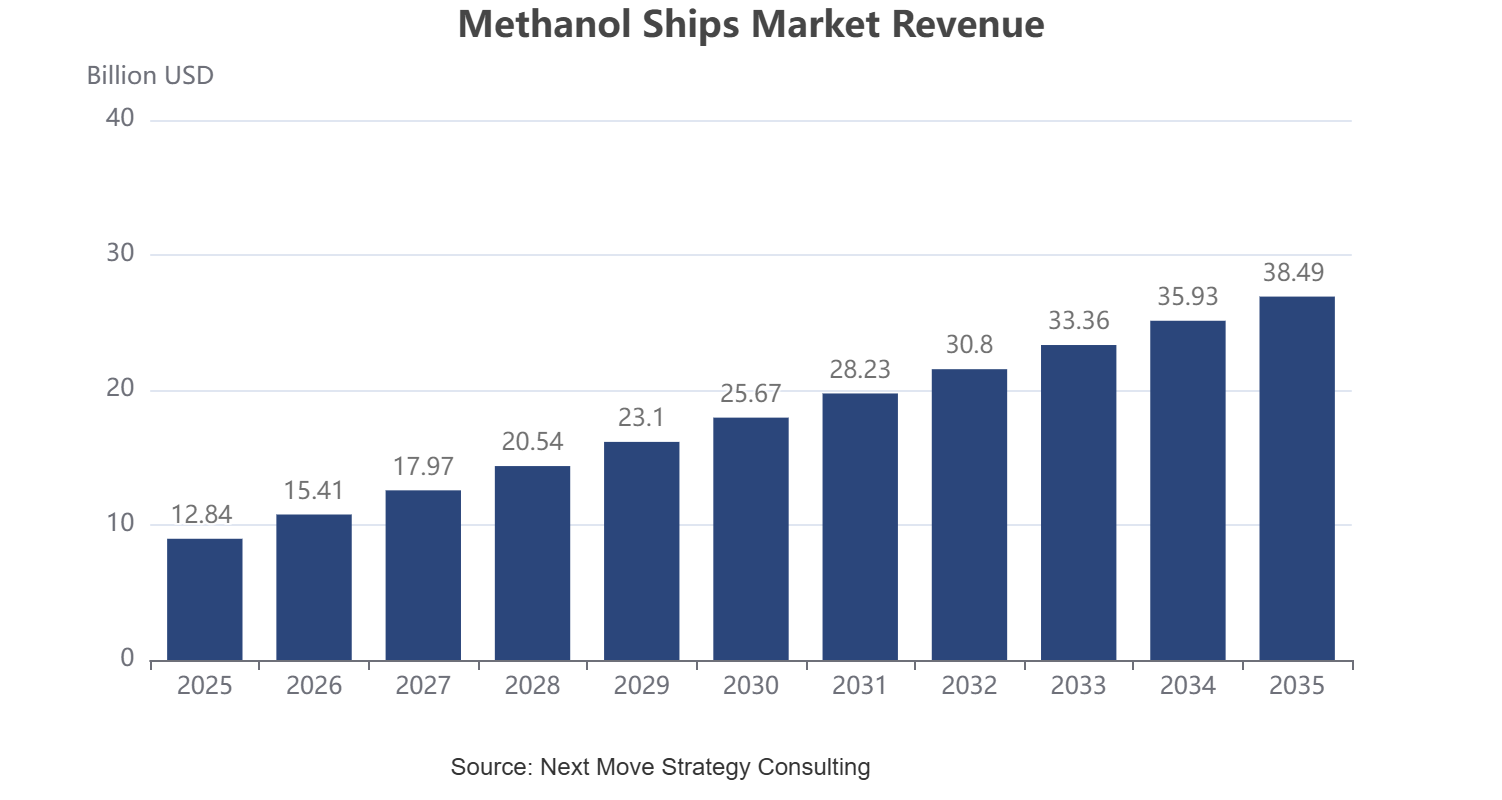
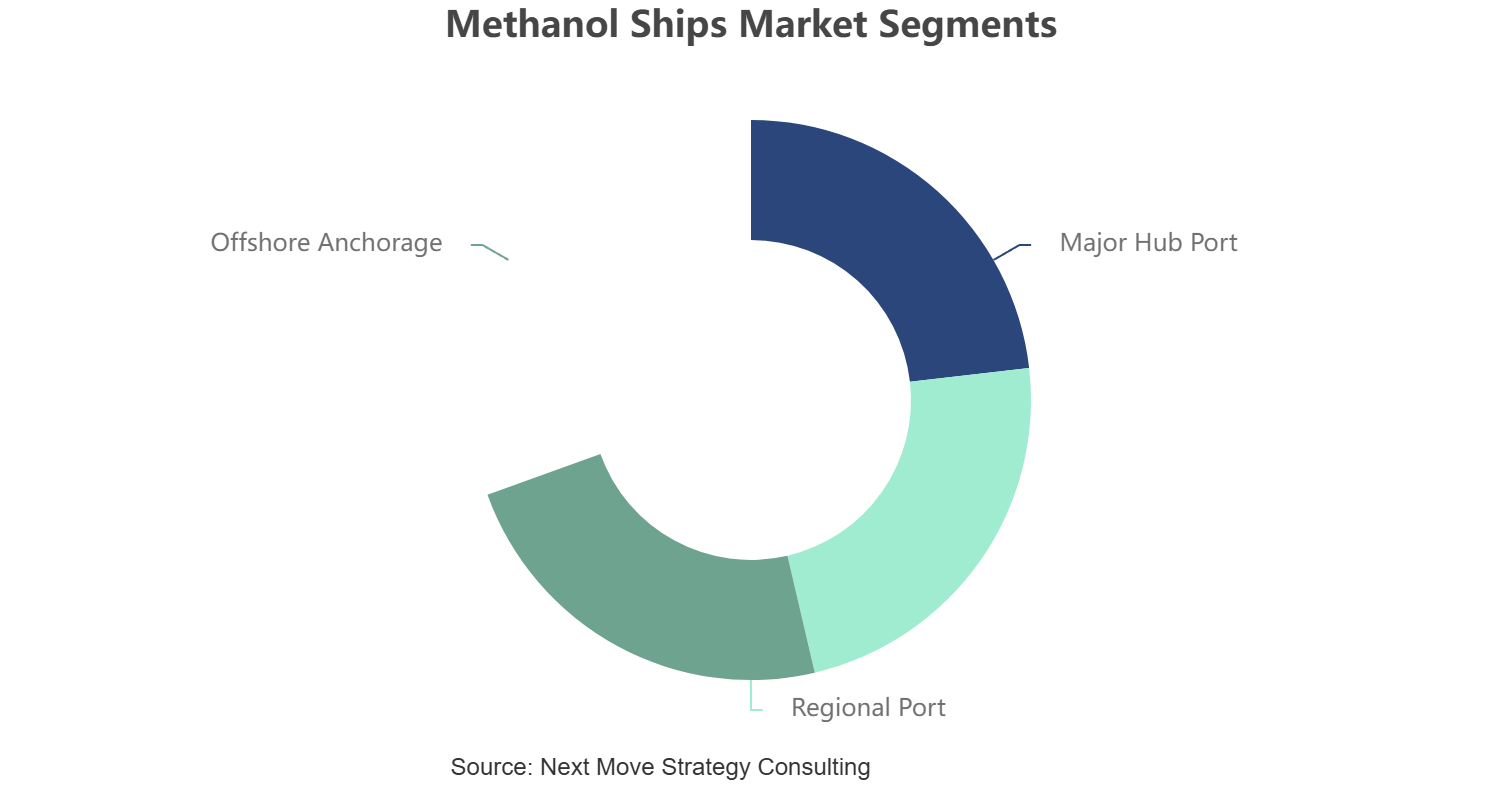
About the Author
 Saista Faiyaz
— Saista Faiyaz is Research Associate at Next Move Strategy Consulting, where she has covered consumer markets and healthcare technologies for 3 years. Her work includes primary interview review, secondary-source validation, market sizing, and structured analysis of company and industry data. She supports research by comparing evidence across sources, organizing findings into market narratives, and documenting assumptions used in analysis. Her scope includes cross-market benchmarking, and reports.
Saista Faiyaz
— Saista Faiyaz is Research Associate at Next Move Strategy Consulting, where she has covered consumer markets and healthcare technologies for 3 years. Her work includes primary interview review, secondary-source validation, market sizing, and structured analysis of company and industry data. She supports research by comparing evidence across sources, organizing findings into market narratives, and documenting assumptions used in analysis. Her scope includes cross-market benchmarking, and reports.
About the Reviewer
 Supradip Baul
— Supradip Baul is an accomplished business consultant and strategist with over a decade of rich experience in market intelligence, strategy, technology, and business transformation. His work has included rigorous qualitative and quantitative analysis across multiple industries, helping clients shape investment decisions and long-term roadmaps. Earlier in his career, he was associated with Gartner, where he contributed to industry-leading reports and market share analyses. He has worked with leading global companies and holds an MBA with a dual specialization in Marketing and Finance.
Supradip Baul
— Supradip Baul is an accomplished business consultant and strategist with over a decade of rich experience in market intelligence, strategy, technology, and business transformation. His work has included rigorous qualitative and quantitative analysis across multiple industries, helping clients shape investment decisions and long-term roadmaps. Earlier in his career, he was associated with Gartner, where he contributed to industry-leading reports and market share analyses. He has worked with leading global companies and holds an MBA with a dual specialization in Marketing and Finance.
At Next Move Strategy Consulting, we understand that insightful market research is the cornerstone of successful business decisions. That's why we employ a robust and multifaceted approach, combining various methodologies to deliver the most accurate and actionable data for our clients.

Research Landscape
We navigate the world of research with two primary approaches:
Qualitative Approach
Our qualitative research methodologies involve immersive techniques such as in-depth interviews, focus groups, and observational studies. By engaging directly with individuals and stakeholders, we uncover valuable insights that quantitative data alone may overlook.

Quantitative Research
In tandem with qualitative methodologies, NMSC leverages the power of Quantitative Research to provide a robust foundation of numerical insights. Through systematic data collection and analysis, we quantify patterns, preferences, and market trends, offering a comprehensive view of the business landscape.
Our quantitative research approach employs diverse tools, including surveys, experiments, and statistical modelling. These methodologies enable us to gather data from a large and representative sample, ensuring the statistical significance of our findings. By employing structured questionnaires and standardized data collection methods, we guarantee the reliability and validity of the information we present to our clients.
Quantitative research is particularly effective in measuring the prevalence of trends, assessing market size, and gauging the impact of various factors on consumer behavior. The numerical precision attained through this approach equips our clients with actionable insights, facilitating data-driven decision-making and strategy formulation.


Our Specialized Toolbox for Industry-Specific Market Research
We deploy a specialized arsenal of techniques tailored to meet your unique requirements. Here's a glimpse into our comprehensive toolbox:

Information Procurement
The stage entails acquiring market data or relevant information through various sources and methodologies.


Market Research Approach
We utilize both top-down and bottom-up approaches in market research analysis to achieve a comprehensive understanding of the market dynamics, leveraging the broad perspective of industry trends and macroeconomic factors alongside detailed insights from specific segments and individual companies.

Porters Five Forces Analysis
We conduct Porter's Five Forces analysis to evaluate the competitive landscape of an industry, providing us with insights into factors that affect profitability and strategic positioning.

SWOT Analysis

Forecasting
We utilize a forecasting model to predict future consumption by considering parameters like population, economics, regulations, market competition, drivers, constraints, technology, and pricing. We also employ statistical techniques such as multilinear regression, exponential smoothing, moving average, ARIMA, and Monte Carlo simulations for accurate predictions. In econometric forecasting, we analyzed short-term and long-term event impacts, attributing values based on regulatory frameworks, economic factors, and market events.





 Speak to Our Analyst