Multimodal Transport Market Size, Share, Growth Trends and Segmentation Analysis, By Service Type (Freight Forwarding, Intermodal Transport, and Others), By Lead Transport Mode (Ocean, Air, Road, and Others), By Shipment Complexity (Standard Cargo, Temperature-Controlled Cargo, and Others), By Commercial Model, By Customer Industry (Manufacturing, Automotive, Retail and Consumer Goods, and Others), and By Region - Forecast to 2035, Growing at a 7.2% CAGR
Industry: Automotive & Transportation | Publishing Date: July 31, 2026 | Last Updated: July 31, 2026 | No of Pages: N/A | No. of Tables: N/A | No. of Figures: N/A | Format: PDF | Report Code: AT5500
What Is the Multimodal Transport Market Size?
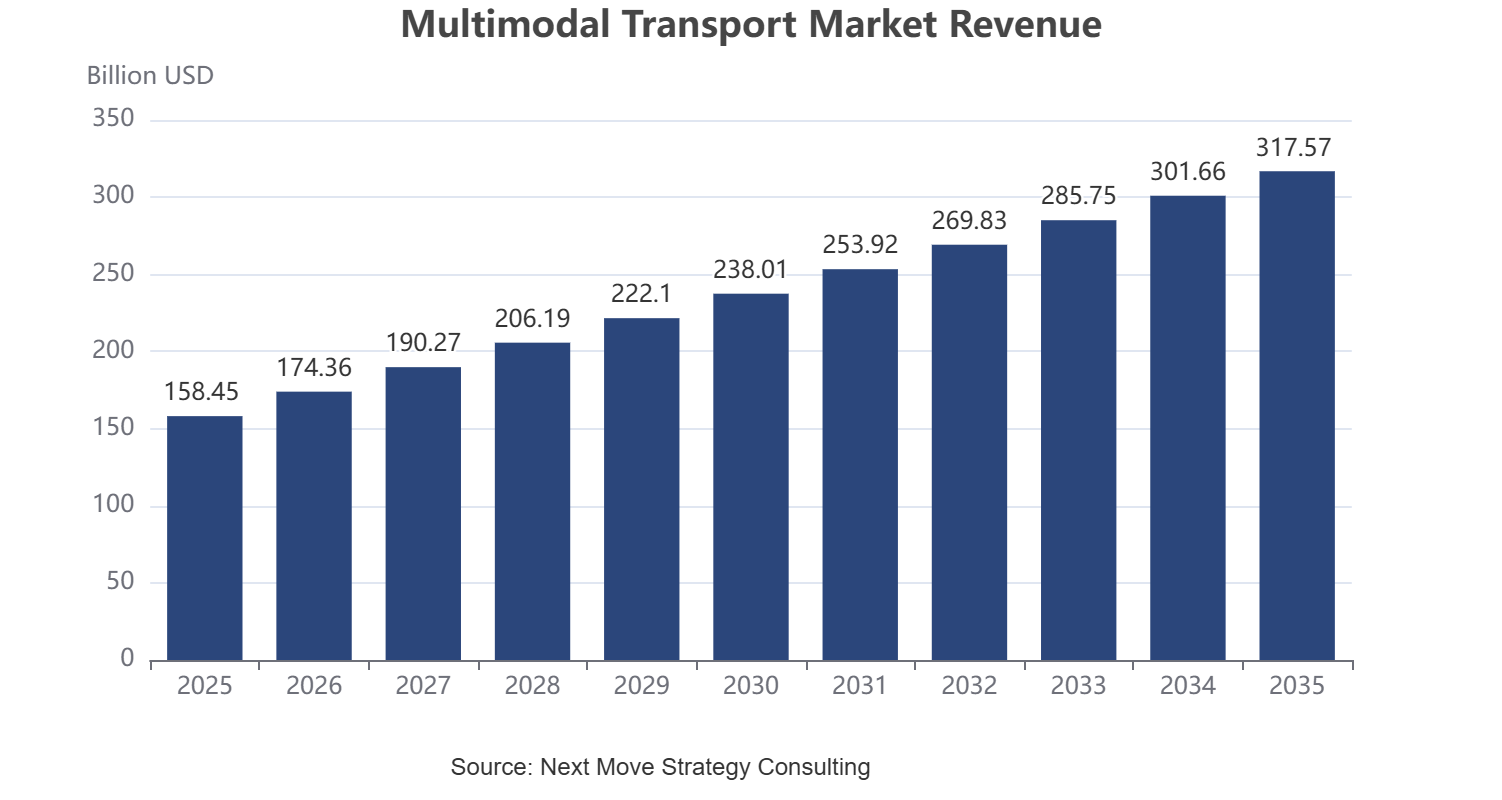
The global Multimodal Transport Market size was valued at USD 158.45 billion in 2025 and is estimated at USD 169.86 billion in 2026, forecast to reach USD 317.57 billion by 2035, expanding at a 7.2% CAGR between 2026 and 2035. Asia-Pacific leads with approximately a 33% share, while Freight Forwarding dominates all other service types with approximately a 46% share.
We observed that growth is broad-based across every segmentation axis, with intermodal integration and managed transport adoption driving the dominant structural shifts through 2035.
|
Key Takeaways |
|
By Service Type: Freight Forwarding held the largest share of approximately 46% (USD 72.89 Billion) in 2025; Managed Transport is the fastest-growing sub-segment at 8.8% CAGR from 2026-2035. |
|
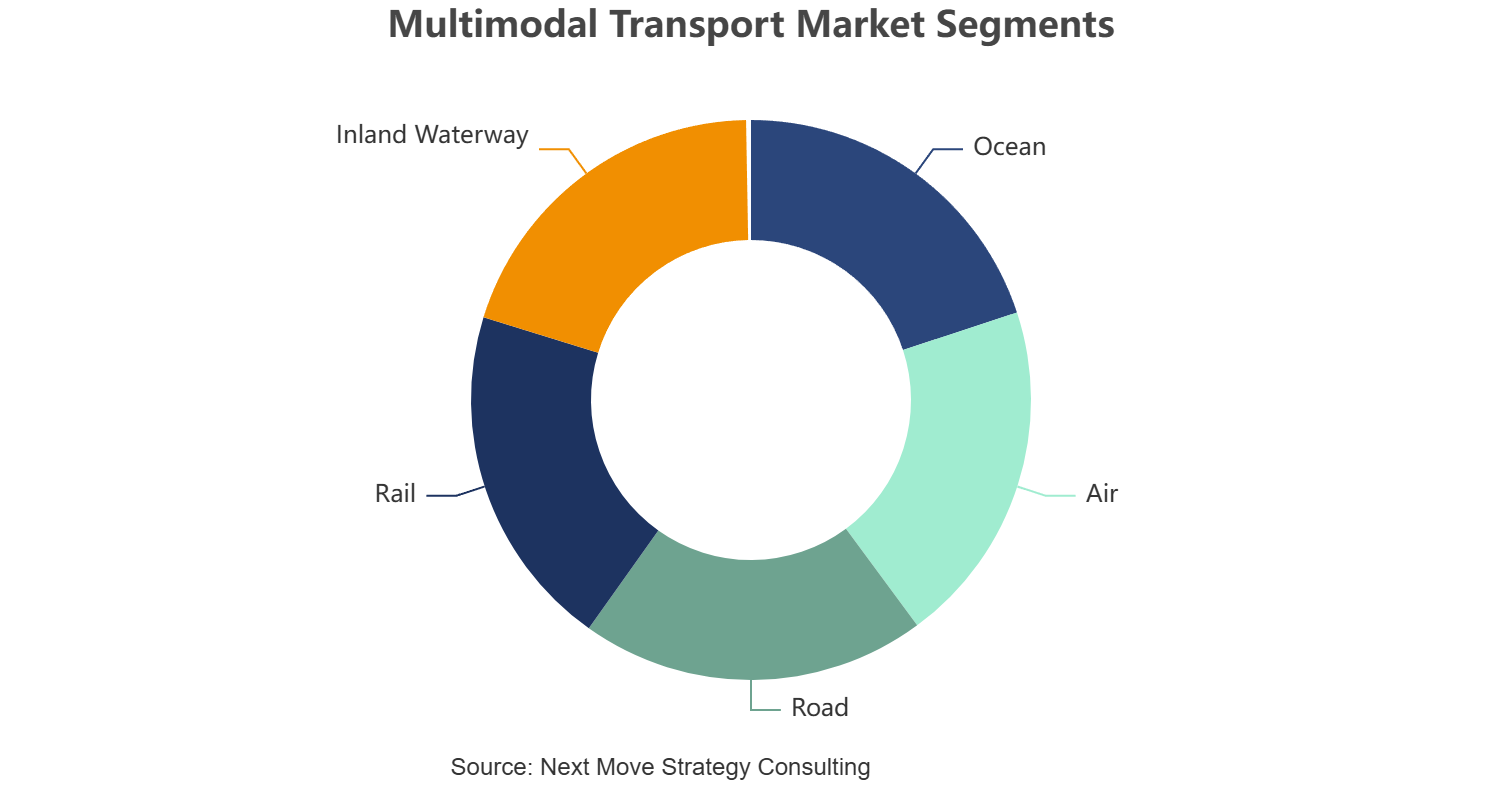
By Lead Transport Mode: Ocean held the largest share of approximately 38% (USD 60.21 Billion) in 2025; Rail is the fastest-growing sub-segment at 10.7% CAGR from 2026-2035. |
|
By Shipment Complexity: Standard Cargo held the largest share of approximately 52% (USD 82.39 Billion) in 2025; Time-Critical Cargo is the fastest-growing sub-segment at 9.7% CAGR from 2026-2035. |
|
By Commercial Model: Long-Term Contract held the largest share of approximately 44% (USD 69.72 Billion) in 2025; Project-Based Contract is the fastest-growing sub-segment at 10.4% CAGR from 2026-2035. |
|
By Customer Industry: Manufacturing held the largest share of approximately 24% (USD 38.03 Billion) in 2025; E-commerce is the fastest-growing sub-segment at 12.6% CAGR from 2026-2035. |
|
Dominant Region: Asia-Pacific dominated with approximately 33% revenue share (USD 52.29 Billion) in 2025. |
|
Fastest-Growing Region: Asia-Pacific is expected to register the highest CAGR of 8.9% during 2026-2035. |
|
Dominant Country: China led with approximately USD 17.26 Billion in 2025. |
|
Fastest-Growing Country: India is the fastest-growing country at approximately 12.2% CAGR from 2026-2035. |
Market Opportunity: The Multimodal Transport Market is expected to create an absolute dollar opportunity of USD 147.71 billion between 2026 and 2035, presenting significant investment potential across integrated freight forwarding, intermodal, and managed transport service networks.
According to Next Move Strategy Consulting analysis, shippers are increasingly consolidating freight spend with fewer, control tower-enabled providers to simplify multi-modal visibility, a shift that favors diversified global forwarders over single-mode specialists as supply chain resilience requirements intensify through 2035.
What does the Multimodal Transport Market Encompass?
The Multimodal Transport Market encompasses freight forwarding, intermodal transport, project logistics, managed transport, and bundled transport services that move cargo across ocean, air, road, rail, and inland waterway legs under a single carriage arrangement. We observed that the scope spans standard, temperature-controlled, hazardous, time-critical, and oversized cargo handled for manufacturing, automotive, retail, healthcare, and e-commerce shippers, evolving from single-mode brokerage into digitally orchestrated, control tower-managed transport networks.
Regulatory frameworks such as the International Maritime Organization's carbon intensity rules and the U.S. Federal Maritime Commission's Shipping Act oversight shape carrier accountability and documentation requirements, while customs digitization initiatives across the European Union and Asia-Pacific streamline cross-border clearance. Our assessment indicates that technology adoption is shifting toward real-time shipment visibility platforms and API-integrated booking systems, with forwarders increasingly bundling customs brokerage and cargo insurance into core service offerings to differentiate against commoditized single-mode carriers.
|
Parameters |
Details |
|
Market Size in 2025 |
USD 158.45 Billion |
|
Market Size in 2026 |
USD 169.86 Billion |
|
Revenue Forecast in 2035 |
USD 317.57 Billion |
|
Growth Rate |
CAGR of 7.20% from 2026 to 2035 |
|
Analysis Period |
2025–2035 |
|
Base Year Considered |
2025 |
|
Forecast Period |
2026–2035 |
|
Market Size Estimation |
USD Billion |
|
Companies Profiled |
20 |
|
Countries Covered |
38 |
|
Market Share |
Available for Top 10 Companies |
Key Emerging Trends
Based on research conducted by Next Move Strategy Consulting, we found that four structural trends are reshaping service design, technology adoption, and stakeholder engagement across the industry.
How Is Control Tower Technology Transforming Shipment Visibility?
Control tower platforms are consolidating multi-carrier, multi-mode shipment data into unified dashboards that give shippers real-time exception management across ocean, air, road, and rail legs. We observed that DHL Group's control tower services integrate supply chain management data feeds directly into client ERP systems, reducing manual track-and-trace effort for large manufacturing and automotive shippers managing complex, multi-leg cargo movements.
Why Is Intermodal Rail-Road Integration Gaining Momentum in the Multimodal Transport Market?
Intermodal rail-road integration is gaining momentum as shippers seek to reduce carbon intensity and road congestion exposure on long-haul corridors. We found that Kuehne+Nagel International AG has expanded rail-road combined offerings across European corridors, positioning intermodal transport as a structural alternative to pure road freight for manufacturing and chemicals shippers prioritizing schedule reliability alongside emissions reduction.
How Are Digital Booking Platforms Reshaping Freight Forwarding?
Digital booking platforms are compressing quote-to-book cycles for standard cargo shipments, letting shippers compare ocean-led and air-led options instantly. During our market evaluation, we noticed that container management integration with digital freight platforms is improving container utilization visibility, with DSV A/S expanding self-service booking capability for less-than-container-load and full-container-load shipments across its global network.
What Role Is Project Logistics Playing in Energy Transition Cargo in the Multimodal Transport Market?
Project logistics capabilities are becoming critical as renewable energy infrastructure build-out drives demand for heavy lift and out-of-gauge cargo movement. Our findings suggest that GEODIS and Rhenus Group have expanded project charter and industrial plant relocation services to support wind turbine and battery manufacturing equipment shipments, positioning project logistics as a premium, higher-margin category within the broader Multimodal Transport Market structure.
Growth Drivers and Restraints
Growth Catalyst and Risk Assessment Matrix
|
Factors |
Type |
(+/-) % Impact on CAGR |
Geographic Relevance |
Impact Timeline |
|
Expansion of global e-commerce cross-border trade |
Driver |
+2.4% |
Global |
2026–2035 |
|
Growing shipper demand for integrated multimodal visibility |
Driver |
+2.0% |
North America, Europe, Asia-Pacific |
2026–2035 |
|
Rising intermodal rail-road adoption for decarbonization |
Driver |
+1.6% |
Europe, Asia-Pacific |
2026–2033 |
|
Expansion of manufacturing capacity in Asia-Pacific |
Driver |
+1.9% |
Asia-Pacific |
2026–2035 |
|
Growth of project logistics tied to energy transition infrastructure |
Driver |
+1.3% |
Global |
2026–2032 |
|
Port congestion and infrastructure capacity constraints |
Restraint |
-1.1% |
Asia-Pacific, North America |
2026–2030 |
|
Volatility in ocean and air freight rates |
Restraint |
-1.4% |
Global |
2026–2035 |
|
Fragmented customs and cross-border regulatory compliance |
Restraint |
-0.9% |
Middle East & Africa, Latin America |
2026–2031 |
|
Driver and capacity shortages in road freight |
Restraint |
-0.8% |
North America, Europe |
2026–2029 |
What Is the Primary Growth Driver for the Multimodal Transport Market?
The primary growth driver is expanding global e-commerce cross-border trade, which requires integrated, multi-leg transport solutions rather than single-mode carriage. We observed that the U.S. Census Bureau reports sustained growth in cross-border e-commerce parcel volumes since 2024, reinforcing demand for forwarders capable of combining air-led express with last-leg road delivery across time-critical cargo shipments.
How Is Supply Chain Resilience Demand Driving Market Growth?
Supply chain resilience demand is driving market growth as shippers diversify routing across ocean, air, and rail to reduce single-mode dependency risk. Based on research conducted by NMSC, we found that manufacturers increasingly specify multimodal contingency routing supported by fleet management visibility tools, a shift expanding the addressable market for managed transport and control tower services beyond traditional freight forwarding.
What Is Restraining the Multimodal Transport Market?
Volatility in ocean and air freight rates, driven by capacity swings and geopolitical disruption, restrains margin predictability across the industry. The U.S. Federal Maritime Commission has documented recurring container freight rate volatility tied to vessel capacity management, complicating long-term contract pricing. Our analysis shows that smaller regional forwarders face particular exposure, as limited scale reduces their ability to hedge capacity commitments compared with globally diversified providers.
Segmentation Analysis
Segment Sizing: By Service Type
|
Segment |
2025 (USD) |
2035 (USD) |
CAGR% (2026-2035) |
|
Freight Forwarding |
USD 72.89 Billion |
USD 133.38 Billion |
6.1% |
|
Intermodal Transport |
USD 34.86 Billion |
USD 79.39 Billion |
8.7% |
|
Project Logistics |
USD 15.85 Billion |
USD 28.58 Billion |
5.9% |
|
Managed Transport |
USD 22.18 Billion |
USD 50.81 Billion |
8.8% |
|
Bundled Transport Services |
USD 12.67 Billion |
USD 25.41 Billion |
7.2% |
|
Total |
USD 158.45 Billion |
USD 317.57 Billion |
7.2% |
Which Service Type Dominates the Multimodal Transport Market?
Freight Forwarding dominates the service type axis, contributing USD 72.89 billion in 2025 and projected to reach USD 133.38 billion by 2035. We found that ocean-led and air-led forwarding remain the largest revenue contributors as global warehouse management systems integrate directly with forwarder booking platforms, while Managed Transport grows fastest as shippers outsource end-to-end network orchestration to control tower providers.
Segment Sizing: By Lead Transport Mode
|
Segment |
2025 (USD) |
2035 (USD) |
CAGR% (2026-2035) |
|
Ocean |
USD 60.21 Billion |
USD 107.97 Billion |
5.9% |
|
Air |
USD 26.94 Billion |
USD 60.34 Billion |
8.5% |
|
Road |
USD 50.70 Billion |
USD 98.45 Billion |
6.8% |
|
Rail |
USD 14.26 Billion |
USD 38.11 Billion |
10.7% |
|
Inland Waterway |
USD 6.34 Billion |
USD 12.70 Billion |
7.2% |
|
Total |
USD 158.45 Billion |
USD 317.57 Billion |
7.2% |
Which Lead Transport Mode Is Growing Fastest in the Multimodal Transport Market?
Ocean remains the largest lead transport mode at USD 60.21 billion in 2025, while Rail is the fastest-growing at a 10.7% CAGR through 2035. Our findings suggest that expanding railway management system infrastructure across Europe and China is enabling shippers to shift long-haul cargo from road to rail-road combined services, supporting decarbonization commitments alongside cost predictability.
Segment Sizing: By Shipment Complexity
|
Segment |
2025 (USD) |
2035 (USD) |
CAGR% (2026-2035) |
|
Standard Cargo |
USD 82.39 Billion |
USD 146.08 Billion |
5.7% |
|
Temperature-Controlled Cargo |
USD 25.35 Billion |
USD 60.34 Billion |
9.3% |
|
Hazardous Cargo |
USD 19.01 Billion |
USD 34.93 Billion |
6.2% |
|
Time-Critical Cargo |
USD 20.60 Billion |
USD 50.81 Billion |
9.7% |
|
Oversized Cargo |
USD 11.10 Billion |
USD 25.41 Billion |
8.8% |
|
Total |
USD 158.45 Billion |
USD 317.57 Billion |
7.2% |
Why Does Standard Cargo Lead the Multimodal Transport Market?
Standard Cargo leads with USD 82.39 billion in 2025, reflecting the broad base of general merchandise and manufacturing inputs moved across established trade lanes. We observed that Time-Critical Cargo is the fastest-growing complexity category at a 9.7% CAGR through 2035, as e-commerce and electronics shippers increasingly specify guaranteed transit windows requiring air-led and express service tiers.
Supply Chain Analysis of the Multimodal Transport Industry
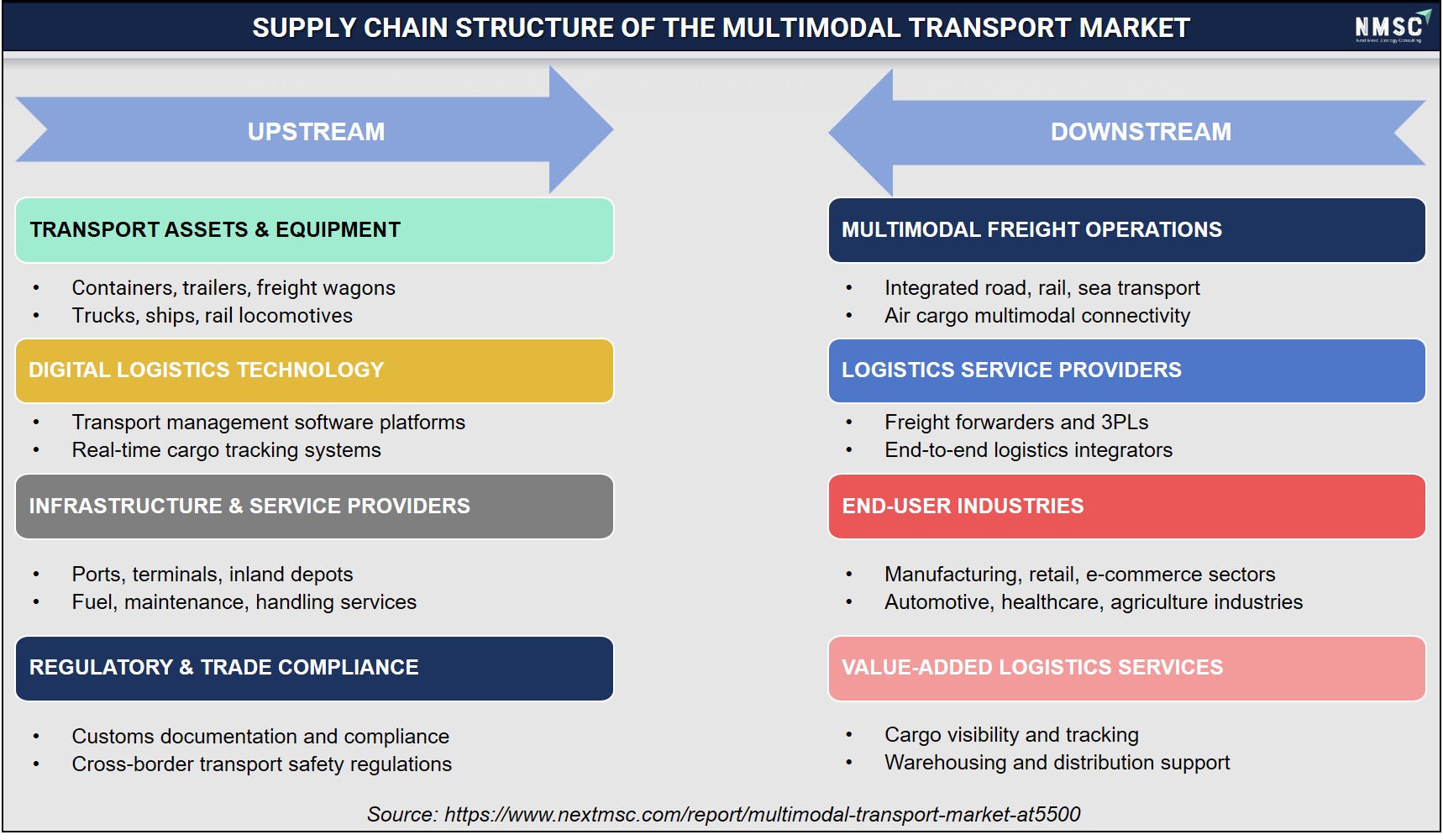
The above infographic presents the supply chain structure of the Multimodal Transport Market, segmented into upstream and downstream activities. Upstream includes transport assets such as containers, trailers, and locomotives, along with digital logistics platforms and real-time tracking systems. Ports, terminals, and service providers support operations, while customs documentation and cross-border safety regulations ensure compliance. Moving downstream, integrated road, rail, sea, and air freight operations are managed by freight forwarders and 3PLs, serving end-user industries such as manufacturing, retail, e-commerce, automotive, and healthcare. Looking ahead, we observed that cargo visibility, warehousing, and distribution support enhance operational efficiency and customer satisfaction across the market.
Growth Opportunities
Beyond the core drivers outlined above, three forward-looking whitespace opportunities stand out for stakeholders positioning within the Multimodal Transport Market over the 2026-2035 forecast period.
Can Rail-Barge Corridors Unlock Value for Chemicals Shippers?
Rail-barge intermodal corridors present a whitespace opportunity for chemicals and energy shippers seeking lower-emission, high-volume inland transport alternatives to road freight. Providers that expand inland waterway and rail-barge combined offerings stand to capture recurring contract volume as chemicals manufacturers shift bulk cargo away from congested road corridors toward scheduled intermodal services.
Where Do Cold Chain-Capable Intermodal Networks Create New Demand?
Temperature-controlled intermodal networks represent an underpenetrated opportunity for healthcare, pharmaceuticals, and food and beverage shippers requiring unbroken cold chain integrity across mode transfers. Providers such as Kintetsu World Express, Inc. and Yusen Logistics Co., Ltd. that validate reefer capability across ocean, air, and road legs can secure long-term contracts with pharmaceutical shippers prioritizing compliance-grade temperature control.
How Can Digital Freight Marketplaces Benefit Spot Contract Shippers?
Digital freight marketplaces create a mechanism to serve spot contract shippers who lack dedicated logistics procurement teams, reducing quote turnaround from days to minutes. This channel benefits mid-market manufacturing and retail shippers by lowering procurement friction, directly supporting the 10.4% CAGR projected for the commercial vehicle telematics-enabled Project-Based Contract category through 2035.
Regional Outlook
|
Region |
2025 (USD) |
2035 (USD) |
CAGR% (2026-2035) |
Key Driver |
|
North America |
USD 42.78 Billion |
USD 76.22 Billion |
5.8% |
Nearshoring-driven manufacturing supply chain realignment |
|
Europe |
USD 41.20 Billion |
USD 73.04 Billion |
5.8% |
EU decarbonization mandates favoring intermodal rail |
|
Asia-Pacific |
USD 52.29 Billion |
USD 120.68 Billion |
8.9% |
Manufacturing export growth and port capacity expansion |
|
Middle East & Africa |
USD 12.68 Billion |
USD 28.58 Billion |
8.6% |
Logistics hub investment under national diversification |
|
Latin America |
USD 9.49 Billion |
USD 19.05 Billion |
7.2% |
Expanding cross-border trade infrastructure |
|
Total |
USD 158.45 Billion |
USD 317.57 Billion |
7.2% |
— |
North America
North America remains a mature Multimodal Transport Market, anchored by dense freight forwarding networks and nearshoring-driven manufacturing supply chain realignment. We observed that U.S. Federal Maritime Commission oversight of ocean carrier practices sustains demand for compliant, diversified forwarding partners, while brand owners increasingly specify multimodal contingency routing. Technology adoption remains advanced, with control tower visibility platforms widely deployed across large manufacturing and automotive shippers.
Europe
Europe's market reflects a mature, regulation-intensive landscape shaped by European Union decarbonization mandates favoring intermodal rail-road transport over pure road freight. Our findings suggest that shippers across Germany, France, and the UK are accelerating adoption of rail-road combined services to meet emissions reduction commitments. Technology adoption favors digital booking platforms, supported by regional forwarders investing in customs digitization infrastructure.
Asia-Pacific
Asia-Pacific is the fastest-growing Multimodal Transport Market region, propelled by manufacturing export growth in China and India and expanding port capacity investment. We found that regulatory frameworks remain less harmonized than in Europe, giving forwarders flexibility to scale ocean-led and rail-led services rapidly. Technology adoption is accelerating as regional providers, including several China-based forwarders, expand digital booking capacity to serve global manufacturing and electronics shippers.
Middle East & Africa
Middle East & Africa is expanding as Gulf Cooperation Council economies invest in logistics hub infrastructure tied to national economic diversification programs. Our analysis shows that Saudi Arabia and the UAE are attracting freight forwarding investment linked to regional re-export trade. Regulatory influence remains moderate, while technology adoption is gradually shifting toward digital customs clearance as regional hubs align with global trade facilitation standards.
Latin America
Latin America's market is supported by expanding cross-border trade infrastructure in Brazil and Argentina and growing manufacturing export activity. We observed that regulatory frameworks are less stringent than in North America or Europe, though multinational forwarders operating locally are introducing multimodal routing options. Technology adoption remains centered on road-led and ocean-led services, with competitive intensity increasing as regional distributors partner with global forwarding networks.
U.S.
Based on our estimates, the U.S. Multimodal Transport Market was valued at approximately USD 26.52 billion in 2025 and is projected to reach USD 44.21 billion by 2035, growing at a 5.0% CAGR. Demand is anchored by mature manufacturing and retail shipper bases, with high control tower adoption and strong competitive intensity among domestic and global forwarders. Technology penetration favors digital booking platforms, and strategic outlook favors continued nearshoring-driven route diversification.
Canada
The market in Canada reached roughly USD 10.70 billion in 2025 and is forecast to hit USD 21.34 billion by 2035 at a 7.2% CAGR. Demand structure mirrors U.S. manufacturing and cross-border trade patterns, while Transport Canada regulatory guidance shapes customs and safety compliance. Technology penetration is rising as shippers request integrated rail-road visibility, with competitive intensity moderate given reliance on cross-border capacity from U.S.-based forwarders.
UK
The market in the UK market stood at about USD 11.12 billion in 2025, advancing toward USD 18.99 billion by 2035 at a 5.3% CAGR. Demand is driven by established retail and manufacturing shippers navigating post-Brexit customs documentation requirements. Regulatory influence is significant, technology penetration favors digital customs clearance, and competitive intensity remains steady among domestic and European forwarders serving UK trade lanes.
Germany
Germany's Multimodal Transport Market was valued at near USD 10.30 billion in 2025 and is set to reach USD 18.26 billion by 2035, expanding at a 5.8% CAGR. Demand structure benefits from a strong domestic automotive and industrial manufacturing base. Germany's alignment with EU decarbonization mandates drives regulatory influence, while technology penetration favors rail-road combined services among leading forwarders headquartered domestically.
France
As per our estimate, France's market reached approximately USD 7.00 billion in 2025, projected to climb to USD 12.42 billion by 2035 at a 5.7% CAGR. Demand is supported by France's prominent aerospace and chemicals manufacturing base, which shapes project logistics and hazardous cargo adoption. Regulatory influence from French customs modernization is notable, and competitive intensity remains high given the concentration of forwarders headquartered domestically.
China
The market in China stood at roughly USD 17.26 billion in 2025 and is forecast to reach USD 36.20 billion by 2035, registering a 7.7% CAGR. Demand is fueled by expanding domestic manufacturing exports and a dense base of regional forwarding providers. Regulatory influence is increasing gradually, technology penetration is accelerating through digital booking upgrades, and competitive intensity remains elevated among numerous China-based forwarders such as Sinotrans Limited and COSCO SHIPPING Logistics Co., Ltd.
India
According to our analysis, India's Multimodal Transport Market was valued at about USD 8.37 billion in 2025, projected to reach USD 25.34 billion by 2035 at a 12.2% CAGR, the fastest among covered countries. Demand structure reflects rising manufacturing exports and expanding organized retail cross-border trade. Regulatory influence remains developing, while technology penetration is rising quickly as multinational forwarders localize multimodal routing to serve India's growing export base.
Japan
Japan's market reached close to USD 8.89 billion in 2025 and is expected to hit USD 16.90 billion by 2035, growing at a 6.6% CAGR. Demand is supported by Japan's precision-engineered electronics and automotive export base, led by domestic providers such as Nippon Express Holdings, Inc. Regulatory influence is well established, technology penetration is advanced, and competitive intensity remains high among long-standing domestic forwarders.
South Korea
Based on our estimates, South Korea's market stood at approximately USD 5.75 billion in 2025, forecast to reach USD 14.48 billion by 2035 at a 9.9% CAGR. Demand structure benefits from the country's globally influential electronics and shipbuilding export base. Technology penetration is high, with domestic providers such as LX Pantos Co., Ltd. supplying integrated multimodal services, and competitive intensity remains pronounced amid rapid trade lane expansion.
Australia
The Multimodal Transport Market in Australia reached about USD 4.18 billion in 2025 and is projected to reach USD 8.45 billion by 2035, expanding at a 7.3% CAGR. Demand is supported by a well-established mining and agricultural export sector and growing preference for integrated intermodal routing. Regulatory influence stems from Australia's biosecurity and customs frameworks, while technology penetration favors digital booking platforms amid moderate competitive intensity.
UAE
The market in the UAE market was valued at near USD 3.80 billion in 2025, projected to reach USD 8.29 billion by 2035 at an 8.2% CAGR. Demand structure is shaped by the UAE's role as a regional freight forwarding and re-export hub. Regulatory influence remains moderate, technology penetration is improving through digital customs clearance, and competitive intensity is rising as forwarders expand Gulf market coverage.
Saudi Arabia
Saudi Arabia's market reached roughly USD 3.42 billion in 2025 and is expected to hit USD 8.00 billion by 2035, growing at a 9.0% CAGR. Demand is driven by Vision 2030-linked logistics infrastructure investment and rising industrial export activity. Regulatory influence is developing under Saudi customs modernization guidelines, and technology penetration is advancing as domestic forwarders scale multimodal capacity.
South Africa
As per our estimate, South Africa's Multimodal Transport Market stood at about USD 2.16 billion in 2025, forecast to reach USD 4.57 billion by 2035 at a 7.9% CAGR. Demand structure reflects a developing manufacturing and mining export base serving regional Southern African trade routes. Regulatory influence remains moderate, technology penetration is gradually improving, and competitive intensity is limited given reliance on established international forwarding networks.
Brazil
The market in Brazil reached approximately USD 4.27 billion in 2025 and is projected to reach USD 8.19 billion by 2035, registering a 6.6% CAGR. Demand is underpinned by Brazil's large domestic manufacturing and agricultural export industry and expanding cross-border infrastructure. Regulatory influence stems from Brazilian customs modernization initiatives, technology penetration favors road-led and ocean-led services, and competitive intensity remains moderate among regional forwarders.
Argentina
According to our analysis, Argentina's market was valued at USD 2.09 billion in 2025, projected to reach USD 4.38 billion by 2035 at a 7.7% CAGR. Demand structure is supported by steady agribusiness and manufacturing export consumption despite macroeconomic volatility. Regulatory influence remains limited, technology penetration is modest, and competitive intensity is centered on a small number of regional distributors serving domestic exporters.
Strategic Analysis of the Multimodal Transport Industry
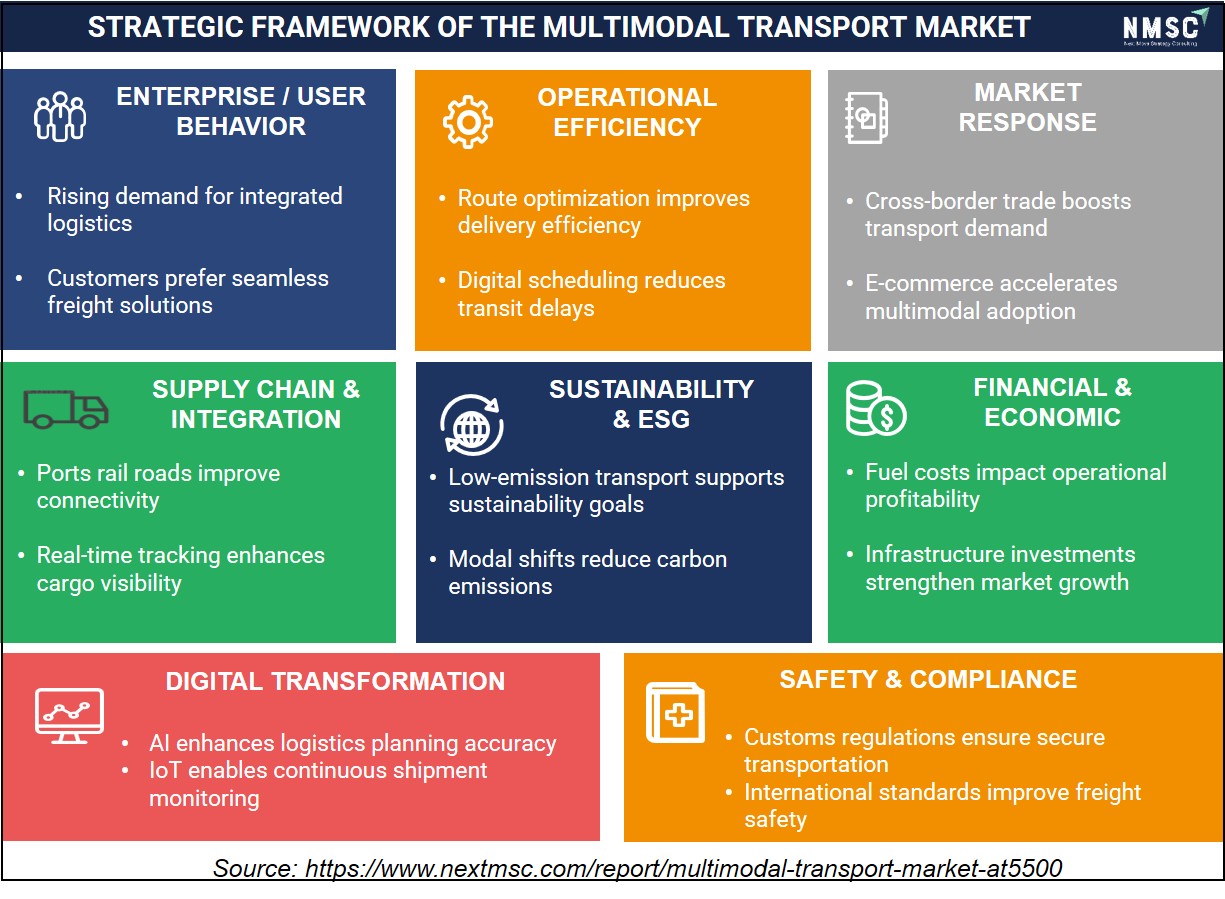
The above infographic presents a strategic framework of the Multimodal Transport Market, where rising demand for integrated logistics and seamless freight solutions is driving market expansion. Ports, rail, and road networks are improving connectivity, while real-time tracking and route optimization are enhancing cargo visibility and delivery efficiency. At the same time, low-emission transport and modal shifts are supporting sustainability goals, while cross-border trade and e-commerce are accelerating adoption. Fuel costs and infrastructure investments are influencing profitability and growth, just as AI and IoT are improving planning accuracy and shipment monitoring. Looking ahead, we observed that customs regulations and international standards ensure secure and safe freight operations across the market.
Competitive Landscape
We observed that the Multimodal Transport Market features a moderately consolidated competitive landscape, with global integrated forwarders competing alongside regional Asian providers on network breadth, digital capability, and pricing flexibility.
|
Dimension |
Description |
|
Market Structure |
Moderately consolidated; the top companies profiled in this report collectively account for a significant share of global multimodal transport revenue, while numerous regional Asia-Pacific providers serve cost-sensitive ocean-led demand |
|
Innovation Focus |
Control tower visibility platforms, digital booking integration, and intermodal rail-road network expansion dominate current innovation pipelines across leading providers |
|
M&A Activity |
Selective consolidation through network acquisitions, exemplified by DSV A/S's continued integration of acquired freight forwarding platforms to broaden global route coverage |
How Do Companies Compete in the Multimodal Transport Market?
Companies compete primarily on network breadth, digital visibility capability, and pricing flexibility across contract types. We observed that global players such as DHL Group and Kuehne+Nagel International AG leverage broad multimodal route portfolios to serve multinational manufacturing shippers, while regional Asian providers compete on cost efficiency and rapid capacity turnaround for standard cargo shipments supplied to smaller exporters.
Which Competitive Archetypes Dominate the Multimodal Transport Market?
Two archetypes dominate the market: diversified global forwarders offering integrated control tower and managed transport services, and specialized regional providers focused on high-volume, cost-competitive ocean and road freight. A.P. Moller - Maersk A/S exemplifies the diversified archetype through integrated ocean-to-inland network ownership, while Sinotrans Limited exemplifies the regional cost-leadership archetype serving Asia-Pacific export demand.
How Are Companies Differentiating Through Innovation?
Innovation and differentiation strategy increasingly center on digital visibility integration and autonomous truck pilot programs for road-led legs. CEVA Logistics and GEODIS have both expanded API-integrated booking capability to secure enterprise contracts, while providers unable to demonstrate real-time visibility risk exclusion from request-for-proposal shortlists among large manufacturing and retail shippers.
What M&A and Expansion Activity Is Shaping the Market?
Mergers, acquisitions, and geographic expansion continue to consolidate multimodal capabilities within the industry. DSV A/S's ongoing integration of acquired forwarding networks broadened its global route coverage, while Kuehne+Nagel International AG's continued investment in intermodal rail infrastructure illustrates how diversified groups pursue geographic expansion and pricing leverage across manufacturing, automotive, and retail end markets.
Key Market Players
We observed that the following twenty companies represent the core competitive set shaping network expansion, digital innovation, and pricing strategy across the Multimodal Transport Market.
-
DHL Group
-
DSV A/S
-
A.P. Moller - Maersk A/S
-
Kuehne+Nagel International AG
-
CEVA Logistics
-
Nippon Express Holdings, Inc.
-
Sinotrans Limited
-
C.H. Robinson Worldwide, Inc.
-
Expeditors International of Washington, Inc.
-
KLN Logistics Group Limited
-
Dachser SE
-
Rhenus Group
-
Hellmann Worldwide Logistics SE & Co. KG
-
JAS Worldwide
-
Kintetsu World Express, Inc.
-
Yusen Logistics Co., Ltd.
-
LX Pantos Co., Ltd.
-
COSCO SHIPPING Logistics Co., Ltd.
-
CTS International Logistics Corporation Limited
Latest Developments
We found that recent network and technology announcements underscore accelerating vendor investment in digital visibility and intermodal capacity expansion.
|
Date |
Event |
|
June 2026 |
DHL Group successfully completed its first Türkiye-to-China import rail block train through the Trans-Caspian International Transport Route, moving Electrolux's AEG-branded refrigerators from Izmir to Chengdu in 30 days, compared with typical eastbound transit times of 40–50 days. |
|
March 2026 |
A.P. Moller - Maersk announced the continued expansion of its multimodal transport solutions across Saudi Arabia, Kuwait, Bahrain, the UAE, Qatar, Iraq, and surrounding markets. |
|
January 2026 |
DHL Group launched TRUCKAIR, a multimodal service combining road and air freight for large-volume and bulky shipments moving between China and Europe. |
Expert Insights
 “The strategic design of the TRUCKAIR route reflects China’s pivotal role as a global trade hub. With its vast network, well-developed logistics infrastructure and rapid adoption of smart technologies and automation, the country is uniquely positioned to maintain strong connectivity with international markets.”
— Aditi Rasquinha, CEO of DHL Global Forwarding Greater China
Statement made in DHL's announcement of its TRUCKAIR multimodal service connecting China and Europe.
Market Interpretation
The insight highlights the increasing strategic importance of multimodal transport networks in strengthening global trade connectivity and addressing supply-chain complexity. NMSC's analysis indicates that the integration of multiple transportation modes with advanced logistics infrastructure and smart technologies is enabling businesses to improve flexibility and connectivity across international trade corridors. The development of multimodal routes linking major Asian trade hubs with European markets is expected to support more resilient and efficient cross-border freight movement.
Investment Opportunities
Where Are Capital Inflows Concentrated in the Multimodal Transport Market?
Capital inflows are concentrated in digital freight platform providers and intermodal infrastructure operators, with strategic acquirers targeting firms offering proprietary visibility technology. Our analysis shows that established forwarders are increasingly funding internal digital platform development, reflecting confidence in the segment's 7.2% CAGR through 2035 as a durable, fundamentals-supported growth trajectory rather than a short-term cyclical uptick.
How Significant Is Infrastructure Investment Supporting Market Growth?
Infrastructure investment supporting port capacity and railway equipment expansion underpins the market's Rail and Asia-Pacific growth, projected at a 10.7% and 8.9% CAGR respectively through 2035. We observed that intermodal terminal expansion across Asia-Pacific and Europe is directly enabling faster regional adoption of rail-road combined services among manufacturing and chemicals shippers.
What ESG Considerations Are Shaping Investment Decisions in the Multimodal Transport Market?
Environmental, Social, and Governance considerations increasingly factor into shipper and provider decisions, as intermodal routing directly reduces carbon intensity compared with pure road freight. Our assessment indicates that investors favor providers demonstrating measurable emissions reduction from expanded rail and inland waterway utilization, aligning multimodal transport adoption with broader corporate sustainability reporting requirements across large enterprise shippers.
Key Benefits for Stakeholders
How Does This Report Benefit Enterprise and Industry Leaders?
Enterprise and industry leaders gain access to segment-level revenue forecasts across service type, transport mode, and shipment complexity axes, enabling informed prioritization of freight procurement and network design decisions. Our analysis shows that benchmarking against the 7.2% market CAGR through 2035 helps logistics leaders justify budget allocation relative to peers, while regional data supports carrier and route selection decisions.
How Does This Report Benefit Investors and Financial Analysts?
Investors and financial analysts benefit from reconciled market sizing across twenty companies and thirty-eight countries, supporting due diligence on competitive positioning and growth trajectory. NMSC's analysis indicates that the report's segment-level CAGR data, including the 10.7% growth rate for Rail adoption, helps identify underappreciated growth pockets ahead of broader market recognition.
How Does This Report Benefit Technology Vendors and Product Teams?
Technology vendors and product teams gain visibility into which service types and transport modes are growing fastest, directly informing product roadmap and go-to-market prioritization. Our findings suggest that the report's competitive landscape and latest developments sections help product teams benchmark feature investment against direct competitors, reducing the risk of misallocating development spend toward slower-growing segments.
Key Market Segments
By Service Type
Freight Forwarding
-
Ocean-Led
-
Full Container Load
-
Less than Container Load
-
Reefer
-
Breakbulk
-
-
Air-Led
-
General Cargo
-
Express and Time-Critical
-
Charter
-
Onboard Courier
-
-
Road-Led
-
Full Truckload
-
Less than Truckload
-
Groupage
-
Cross-Border
-
-
Rail-Led
-
Block Train
-
Intra-Regional Rail
-
Rail-Road Combined
-
-
Intermodal Transport
-
Port Hinterland Transport
-
Rail-Road Transport
-
Rail-Barge Transport
-
Inland Waterway Transport
-
-
Project Logistics
-
Heavy Lift
-
Out-of-Gauge Cargo
-
Industrial Plant Relocation
-
Project Charter
-
-
Managed Transport
-
Control Tower Services
-
Lead Logistics Provider
-
Vendor Managed Transport
-
Dedicated Transport Network
-
-
Bundled Transport Services
-
Customs Brokerage
-
Cargo Insurance
-
Transport Documentation
-
Shipment Visibility Services
-
By Lead Transport Mode
-
Ocean
-
Air
-
Road
-
Rail
-
Inland Waterway
By Shipment Complexity
-
Standard Cargo
-
Temperature-Controlled Cargo
-
Hazardous Cargo
-
Time-Critical Cargo
-
Oversized Cargo
By Commercial Model
-
Spot Contract
-
Long-Term Contract
-
Framework Agreement
-
Project-Based Contract
By Customer Industry
-
Manufacturing
-
Automotive
-
Retail and Consumer Goods
-
Healthcare and Pharmaceuticals
-
Chemicals
-
Energy and Mining
-
Aerospace and Defense
-
Technology and Electronics
-
Food and Beverage
-
E-commerce
-
Government and Public Sector
-
Other Industries
By Region
-
North America: U.S., Canada, Mexico
-
Europe: UK, Germany, France, Italy, Spain, Sweden, Denmark, Finland, Netherlands, Rest of Europe
-
Asia-Pacific: China, India, Japan, South Korea, Taiwan, Indonesia, Vietnam, Australia, Philippines, Malaysia, Rest of APAC
-
Middle East & Africa: Saudi Arabia, UAE, Egypt, Israel, Turkey, Nigeria, South Africa, Rest of MEA
-
Latin America: Brazil, Argentina, Chile, Colombia, Rest of LATAM
Conclusion and Recommendations
What Is the Long-Term Outlook for the Multimodal Transport Market?
The long-term outlook for the market remains positive, with global revenue projected to expand from USD 169.86 billion in 2026 to USD 317.57 billion by 2035 at a 7.2% CAGR. We observed that sustained e-commerce growth, supply chain resilience demand, and intermodal decarbonization adoption will continue underpinning demand across manufacturing, retail, and healthcare shipper segments through the forecast period.
What Strategic Positioning Should Providers Pursue in the Multimodal Transport Market?
Providers should prioritize digital visibility integration and intermodal network breadth while pursuing control tower service expansion to secure long-term enterprise contracts. Our assessment indicates that mid-sized forwarders without proprietary visibility platforms face a competitive disadvantage, making strategic alliances with digital freight technology providers an increasingly important positioning lever heading into the later years of the forecast period.
How Attractive Is the Multimodal Transport Market for New Investment?
The multimodal transport industry presents an attractive investment case, supported by a USD 147.71 billion absolute dollar opportunity between 2026 and 2035 and above-average growth in Asia-Pacific and Rail categories. We found that investment attractiveness is highest for providers combining digital visibility credentials with scaled network capacity, positioning them to serve both cost-sensitive and premium shipper segments simultaneously.
What Market Shifts and Key Risks Should Stakeholders Monitor?
Stakeholders should monitor ocean and air freight rate volatility, tightening decarbonization regulation, and port congestion risk as key factors shaping the Multimodal Transport Market. Our analysis shows that providers unable to adapt to intermodal rail-road specifications risk losing contract share to competitors with certified low-emission network capabilities, particularly within Europe's increasingly regulated transport environment.
What Are the Key Growth Pathways for the Multimodal Transport Market?
Key growth pathways include expanding Managed Transport and control tower service portfolios, scaling intermodal rail capacity, and deepening penetration into e-commerce and time-critical cargo channels. Next Move Strategy Consulting's analysis indicates that providers pursuing these pathways while maintaining cost competitiveness in standard freight forwarding categories will be best positioned to capture the market's projected growth through 2035.
About the Author
 Mayurima Roy
— Mayurima Roy is Research Analyst at Next Move Strategy Consulting, where she has spent 4 years working across the firm's full industry coverage rather than a single fixed vertical. Her work centers on structured research, ongoing trend tracking, competitive assessment, and insight-led content development, translating complex market data into clear, decision-ready narratives that support informed client decision-making across diverse global industries, market sectors, and world regions every day.
Mayurima Roy
— Mayurima Roy is Research Analyst at Next Move Strategy Consulting, where she has spent 4 years working across the firm's full industry coverage rather than a single fixed vertical. Her work centers on structured research, ongoing trend tracking, competitive assessment, and insight-led content development, translating complex market data into clear, decision-ready narratives that support informed client decision-making across diverse global industries, market sectors, and world regions every day.
About the Reviewer
 Supradip Baul
— Supradip Baul is an accomplished business consultant and strategist with over a decade of rich experience in market intelligence, strategy, technology, and business transformation. His work has included rigorous qualitative and quantitative analysis across multiple industries, helping clients shape investment decisions and long-term roadmaps. Earlier in his career, he was associated with Gartner, where he contributed to industry-leading reports and market share analyses. He has worked with leading global companies and holds an MBA with a dual specialization in Marketing and Finance.
Supradip Baul
— Supradip Baul is an accomplished business consultant and strategist with over a decade of rich experience in market intelligence, strategy, technology, and business transformation. His work has included rigorous qualitative and quantitative analysis across multiple industries, helping clients shape investment decisions and long-term roadmaps. Earlier in his career, he was associated with Gartner, where he contributed to industry-leading reports and market share analyses. He has worked with leading global companies and holds an MBA with a dual specialization in Marketing and Finance.
At Next Move Strategy Consulting, we understand that insightful market research is the cornerstone of successful business decisions. That's why we employ a robust and multifaceted approach, combining various methodologies to deliver the most accurate and actionable data for our clients.

Research Landscape
We navigate the world of research with two primary approaches:
Qualitative Approach
Our qualitative research methodologies involve immersive techniques such as in-depth interviews, focus groups, and observational studies. By engaging directly with individuals and stakeholders, we uncover valuable insights that quantitative data alone may overlook.

Quantitative Research
In tandem with qualitative methodologies, NMSC leverages the power of Quantitative Research to provide a robust foundation of numerical insights. Through systematic data collection and analysis, we quantify patterns, preferences, and market trends, offering a comprehensive view of the business landscape.
Our quantitative research approach employs diverse tools, including surveys, experiments, and statistical modelling. These methodologies enable us to gather data from a large and representative sample, ensuring the statistical significance of our findings. By employing structured questionnaires and standardized data collection methods, we guarantee the reliability and validity of the information we present to our clients.
Quantitative research is particularly effective in measuring the prevalence of trends, assessing market size, and gauging the impact of various factors on consumer behavior. The numerical precision attained through this approach equips our clients with actionable insights, facilitating data-driven decision-making and strategy formulation.


Our Specialized Toolbox for Industry-Specific Market Research
We deploy a specialized arsenal of techniques tailored to meet your unique requirements. Here's a glimpse into our comprehensive toolbox:

Information Procurement
The stage entails acquiring market data or relevant information through various sources and methodologies.


Market Research Approach
We utilize both top-down and bottom-up approaches in market research analysis to achieve a comprehensive understanding of the market dynamics, leveraging the broad perspective of industry trends and macroeconomic factors alongside detailed insights from specific segments and individual companies.

Porters Five Forces Analysis
We conduct Porter's Five Forces analysis to evaluate the competitive landscape of an industry, providing us with insights into factors that affect profitability and strategic positioning.

SWOT Analysis

Forecasting
We utilize a forecasting model to predict future consumption by considering parameters like population, economics, regulations, market competition, drivers, constraints, technology, and pricing. We also employ statistical techniques such as multilinear regression, exponential smoothing, moving average, ARIMA, and Monte Carlo simulations for accurate predictions. In econometric forecasting, we analyzed short-term and long-term event impacts, attributing values based on regulatory frameworks, economic factors, and market events.





 Speak to Our Analyst