Mexico Automotive Urea Market Global Industry Analysis and Forecast (2026-2035)

Mexico automotive urea market size was USD 176.0 million in 2025, projected to reach USD 382.0 million by 2035 at an 8.1% CAGR, per this market report.

Download Free Sample PDF
Base Year (2025)
$176.00 Billion
Forecast (2035)
$382.00 Billion
CAGR (2026-2035)
8.1%
Top Region
North America

What Is the Mexico Automotive Urea Market Size?

The Mexico automotive urea market size was valued at USD 176.0 million in 2025 and is estimated at USD 190.0 million in 2026, forecast to reach USD 382.0 million by 2035, expanding at an 8.1% CAGR between 2026 and 2035. North America represents the key regional market context, with Mexico benefiting from its established automotive manufacturing base and increasing adoption of SCR-equipped diesel vehicles. On-road vehicles account for the dominant share of automotive urea demand.

We observed that the growth is broad-based across every segmentation axis, with NOM-044 emission standard enforcement and heavy-duty fleet replacement driving the dominant structural shifts through 2035.

Mexico Automotive Urea Market Global Industry Analysis and Forecast (2026-2035) Revenue Forecast

Values in USD Billion

2025 $0.18 Billion
2025
2026 $0.19 Billion
2026
2027 $0.21 Billion
2027
2028 $0.22 Billion
2028
2029 $0.24 Billion
2029
2030 $0.26 Billion
2030
2031 $0.28 Billion
2031
2032 $0.30 Billion
2032
2033 $0.33 Billion
2033
2034 $0.35 Billion
2034
2035 $0.38 Billion
2035

Key Takeaways

By Vehicle Application: On-Road Vehicles held the largest share of approximately 84% (USD 148.0 million) in 2025; Off-Highway Equipment is the fastest-growing sub-segment at 10.6% CAGR from 2026–2035.

By Packaging Format: Bulk held the largest share of approximately 50% (USD 88.0 million) in 2025; IBC Tote is the fastest-growing sub-segment at 10.3% CAGR from 2026–2035.

By Sales Channel: Direct Fleet Supply held the largest share of approximately 40% (USD 70.0 million) in 2025; OEM First Fill is the fastest-growing sub-segment at 11.8% CAGR from 2026–2035.

Market Opportunity: The Mexico automotive urea market is expected to create an absolute dollar opportunity of USD 192.0 million between 2026 and 2035, presenting significant investment potential across bulk distribution, fleet supply, and export-linked packaging channels.

According to Next Move Strategy Consulting analysis, Mexican urea producers and distributors are increasingly pairing bulk domestic fleet supply contracts with export-oriented IBC tote and drum packaging to serve nearby Latin American markets, a shift that favors vertically integrated distributors over single-format suppliers as NOM-044 enforcement anchors domestic demand through 2035.

What Does the Mexico Automotive Urea Market Encompass?

The market encompasses the production, distribution, and sale of high-purity urea solution used in selective catalytic reduction systems to reduce nitrogen oxide emissions from diesel engines. Our assessment indicates that the scope spans on-road vehicles, including heavy duty trucks, buses and coaches, light commercial vehicles, and passenger diesel cars, alongside off-highway equipment such as agricultural, construction, and mining machinery, distributed through bulk, IBC tote, drum, jerrycan, and bottle packaging formats. The category has evolved from a niche fleet consumable into a structurally mandated commercial vehicle component, driven by Mexico's alignment of heavy-duty emission standards with US EPA 2010 and Euro VI requirements.
Mexico's NOM-044-SEMARNAT-2017 standard, published in the Diario Oficial de la Federacion and enforced by SEMARNAT, requires selective catalytic reduction aftertreatment for new heavy-duty diesel trucks and buses above 3,857 kilograms gross vehicle weight sold in Mexico from 2025 onward. We observed that technology adoption is shifting toward ISO 22241-certified urea solution distributed through expanding retail and wholesale networks. Next Move Strategy Consulting's analysis indicates that this regulatory milestone, combined with growing first-fill programs from vehicle manufacturers, is redefining sourcing criteria across the Mexico automotive urea market.

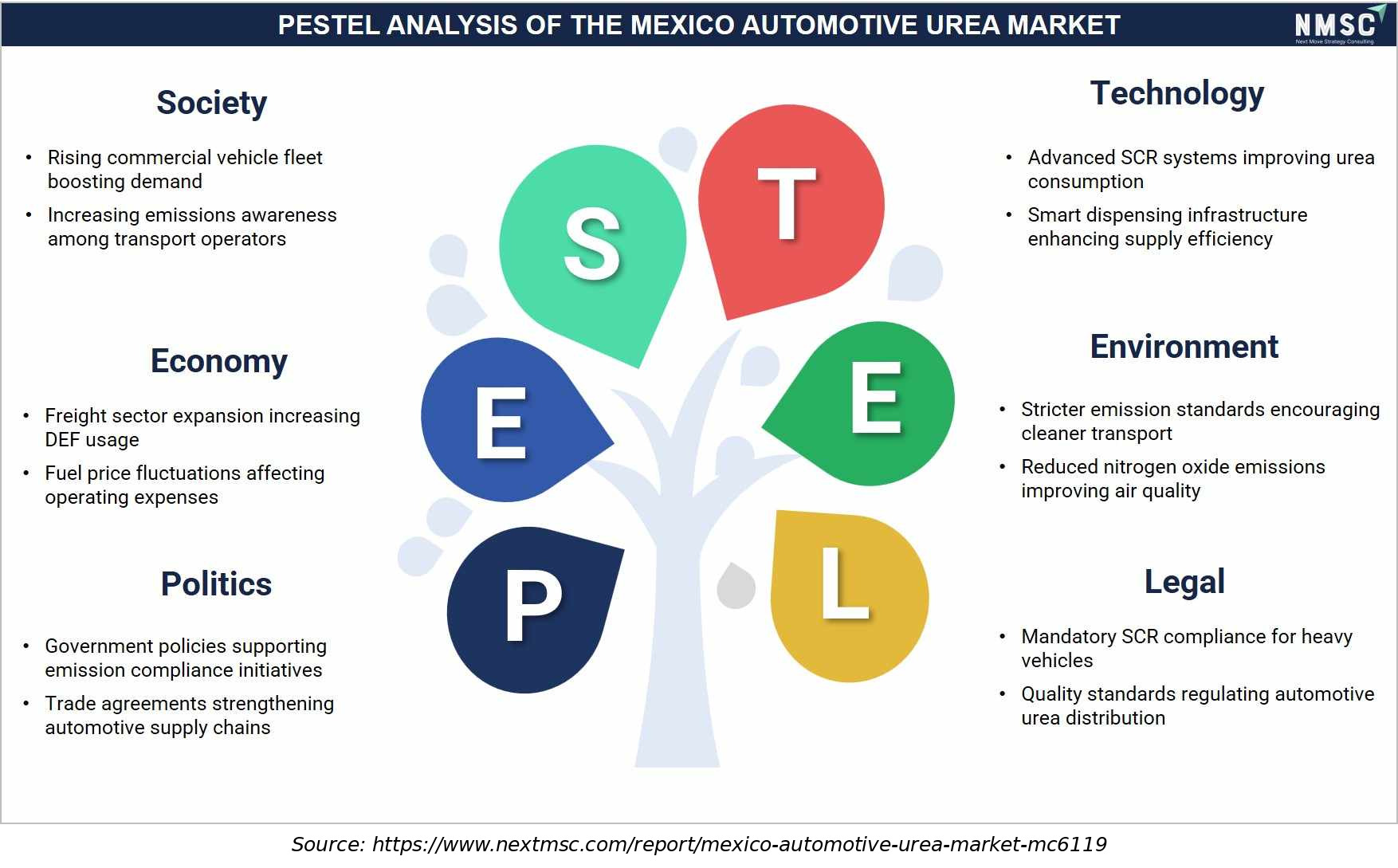
PESTEL ANALYSIS OF THE MEXICO AUTOMOTIVE UREA MARKET

PESTEL ANALYSIS OF THE MEXICO AUTOMOTIVE UREA MARKET
The PESTEL analysis highlights the major external factors shaping Mexico's automotive urea market. Political policies and emission regulations encourage SCR adoption, while economic growth in commercial vehicle production supports demand. Social awareness of cleaner transportation, technological advancements in diesel after-treatment systems, environmental goals to reduce NOx emissions, and evolving legal compliance requirements collectively influence market growth, investment decisions, and long-term industry development.

Market Drivers & Dynamics

Interactive Dataset
Rising NOM-044 emission standard enforcement for heavy trucks driver +1.2% Mexico 2026-2035
Growing heavy-duty truck and bus fleet replacement cycle driver +1.0% Mexico 2026-2035
Expansion of OEM first-fill SCR-equipped vehicle sales driver +0.8% Mexico 2026-2032
Rising construction and mining equipment SCR adoption driver +0.6% Mexico 2026-2035
Growth of cross-border USMCA freight trucking demand driver +0.5% North America 2026-2035
Expanding retail and wholesale distribution network density driver +0.4% Mexico 2026-2032
Price volatility of urea feedstock and natural gas restraint −0.7% Mexico 2026-2035
Counterfeit and substandard urea solution quality concerns restraint −0.5% Mexico 2026-2032
Limited SCR retrofit penetration in older vehicle fleet restraint −0.4% Mexico 2026-2030
Source: Next Move Strategy Consulting

Growth Drivers

What Is the Primary Growth Driver of the Mexico Automotive Urea Market?

Rising enforcement of the NOM-044-SEMARNAT-2017 emission standard for new heavy-duty diesel vehicles is the primary driver of the market. SEMARNAT's alignment of Mexico's heavy-duty limits with US EPA 2010 and Euro VI standards, published in the Diario Oficial de la Federacion, requires selective catalytic reduction aftertreatment for new heavy-duty trucks and buses above 3,857 kilograms gross vehicle weight sold from 2025 onward. We observed that this regulatory milestone continues to anchor baseline urea consumption across Mexico's growing compliant vehicle population.

How Is Fleet Replacement Driving Mexico Automotive Urea Market Growth?

Growing heavy-duty truck and bus fleet replacement cycles are accelerating market growth toward a larger base of SCR-equipped vehicles. Our assessment indicates that as older, pre-NOM-044 vehicles are retired and replaced with compliant models, the installed base of urea-consuming vehicles expands steadily each year. This pathway, combined with rising OEM first-fill program participation, is compressing adoption timelines for consistent urea consumption growth across Mexico's commercial trucking sector.

Growth Inhibitors

What Is Restraining Mexico Automotive Urea Market Expansion?

Price volatility of urea feedstock and natural gas restrains margin stability across the Mexico automotive urea supply chain. We found that smaller distributors face particular exposure, as limited purchasing scale reduces their ability to hedge feedstock costs compared with larger, vertically integrated suppliers such as Yara Mexico and TotalEnergies Mexico, delaying pricing stability for fleet operators reliant on predictable per-liter costs.

Price volatility of urea feedstock and natural gas restrains margin stability across the Mexico automotive urea supply chain. We found that smaller distributors face particular exposure, as limited purchasing scale reduces their ability to hedge feedstock costs compared with larger, vertically integrated suppliers such as Yara Mexico and TotalEnergies Mexico, delaying pricing stability for fleet operators reliant on predictable per-liter costs.

Segmentation Analysis

2025 (USD Billion)
2035 (USD Billion)
On-Road Vehicles 2025: $148.00 Billion | 2035: $305.00 Billion
On-Road Vehi
Off-Highway Equipment 2025: $28.00 Billion | 2035: $77.00 Billion
Off-Highway
On-Road Vehicles $148.00 Billion $305.00 Billion 7.5%
Off-Highway Equipment $28.00 Billion $77.00 Billion 10.6%

Which Vehicle Application Segment Dominates the Mexico Automotive Urea Market?

On-Road Vehicles, encompassing heavy duty trucks, buses and coaches, light commercial vehicles, and passenger diesel cars, led the market with USD 148.0 million in 2025, supported by NOM-044 compliance requirements for the majority of Mexico's commercial trucking fleet. We observed that Off-Highway Equipment is the fastest-growing vehicle application, expanding at a 10.6% CAGR from 2026 to 2035, as agricultural, construction, and mining machinery increasingly adopt selective catalytic reduction systems.

2025 (USD Billion)
2035 (USD Billion)
Bulk
IBC tote
Drum
Jerrycan
Bottle
Segment Item 2025 (USD Billion) 2035 (USD Billion) CAGR
Bulk $10.0 USD Billion $40.0 USD Billion 25.0%
IBC tote $17.1 USD Billion $51.1 USD Billion 11.0%
Drum $24.2 USD Billion $62.2 USD Billion 25.0%
Jerrycan $31.3 USD Billion $73.3 USD Billion 11.0%
Bottle $38.4 USD Billion $84.4 USD Billion 16.0%

Segment-wise data is locked

Unlock complete segment-wise numbers for By Packaging Format.

Unlock Full Data

Which Packaging Format Leads Mexico Automotive Urea Market Demand?

Bulk remained the leading packaging format within the market, valued at USD 88.0 million in 2025, driven by sustained demand from large trucking and bus fleets operating depot-based refueling infrastructure. Our findings suggest that IBC Tote is the fastest-growing packaging format, registering a 10.3% CAGR from 2026 to 2035, as mid-size fleets and distributors favor its balance of volume efficiency and handling flexibility over bulk tank installation.

2025 (USD Billion)
2035 (USD Billion)
OEM first fi
Direct fleet
Wholesale su
Retail suppl
Institutiona
Segment Item 2025 (USD Billion) 2035 (USD Billion) CAGR
OEM first fill $10.0 USD Billion $40.0 USD Billion 27.0%
Direct fleet supply $17.1 USD Billion $51.1 USD Billion 9.0%
Wholesale supply $24.2 USD Billion $62.2 USD Billion 19.0%
Retail supply $31.3 USD Billion $73.3 USD Billion 17.0%
Institutional supply $38.4 USD Billion $84.4 USD Billion 18.0%

Segment-wise data is locked

Unlock complete segment-wise numbers for By Sales Channel.

Unlock Full Data

Which Sales Channel Is Most Widely Used in the Mexico Automotive Urea Market?

Direct Fleet Supply remained the dominant sales channel, reaching USD 70.0 million in 2025 due to established supply contracts between distributors and large fleet management operators running heavy-duty trucking fleets. Based on research conducted by Next Move Strategy Consulting, we found that OEM First Fill is the fastest-growing sales channel at an 11.8% CAGR from 2026 to 2035, reflecting rising integration of pre-filled urea tanks into new SCR-equipped vehicle sales.

Growth Opportunities

Our analysis shows that three forward-looking opportunities stand out for stakeholders positioning within the market over the 2026-2035 forecast period.

How Can Bulk Distribution Infrastructure Unlock Value for Large Fleets?

Expanded bulk distribution infrastructure presents a whitespace opportunity for suppliers seeking to serve large trucking and bus fleets seeking lower per-liter costs. Suppliers that commercialize depot-based bulk tank installation services stand to capture recurring supply contracts as heavy-duty fleet operators shift away from drum and jerrycan formats toward bulk-based procurement.

Where Do Export-Oriented Packaging Formats Create New Demand?

Mexican urea producers seeking to serve nearby Latin American markets create an opportunity for suppliers offering export-ready IBC tote and drum packaging formats. Early movers that secure reliable cross-border logistics can differentiate with distributors in Brazil, Argentina, and other Latin American markets pursuing dependable, ISO 22241-certified urea supply.

How Can OEM First-Fill Partnerships Expand Access for New Vehicle Buyers?

OEM first-fill partnerships represent an underpenetrated opportunity for suppliers seeking to embed their urea brand into new commercial vehicle telematics-equipped vehicle sales. Suppliers that develop validated first-fill supply agreements with truck and bus manufacturers can secure long-term brand exposure to new vehicle buyers, benefiting from recurring aftermarket refill revenue tied to expanding SCR-equipped fleet penetration.

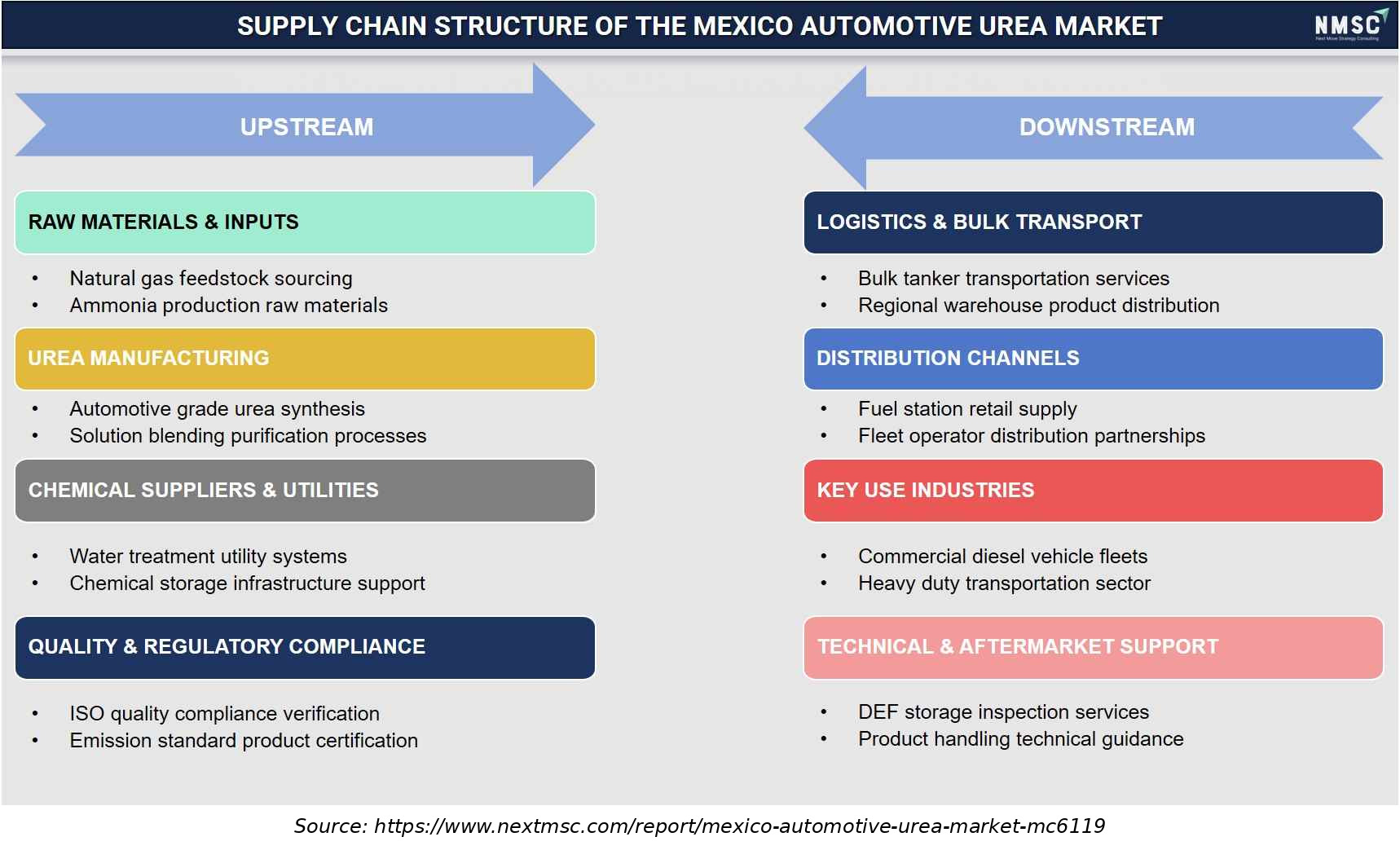
SUPPLY CHAIN STRUCTURE OF THE MEXICO AUTOMOTIVE UREA MARKET

SUPPLY CHAIN STRUCTURE OF THE MEXICO AUTOMOTIVE UREA MARKET
The infographic illustrates the upstream-to-downstream supply chain of the Mexico Automotive Urea Market. The upstream stage covers raw material sourcing, urea manufacturing, chemical suppliers, utilities, and quality compliance. Downstream activities include logistics and bulk transportation, distribution channels, key commercial vehicle and heavy-duty applications, and technical and aftermarket support. Together, these stages show how automotive-grade urea moves from production inputs through distribution to end-use vehicle applications in Mexico.

Competitive Landscape

We observed that the Mexico automotive urea market features a fragmented competitive landscape, with multinational chemical and energy groups competing alongside numerous Mexican distributors on bulk supply capability, certification credentials, and distribution network reach.

Dimension Description
Market Structure Fragmented; multinational suppliers such as Yara Mexico and TotalEnergies Mexico compete alongside a large base of Mexican lubricant and chemical distributors serving retail and wholesale channels across the country.
Innovation Focus ISO 22241 certification, bulk distribution infrastructure expansion, and OEM first-fill partnership development dominate current innovation pipelines across leading suppliers.
M&A Activity Distribution partnership expansion and certified brand licensing rather than large-scale mergers, exemplified by Yara Mexico's Air1-branded distributor network spanning multiple Mexican states.

How Do Companies Compete in the Mexico Automotive Urea Market?

Companies compete primarily on bulk supply capability, certification credentials, and distribution network reach across the industry. Multinational suppliers such as Yara Mexico and TotalEnergies Mexico leverage ISO 22241-certified product lines and established distributor relationships to serve national fleet operators, while lubricant distributors compete on local market knowledge and retail-channel presence for smaller fleet and passenger vehicle customers.

Which Competitive Archetypes Dominate the Mexico Automotive Urea Market?

Two archetypes dominate the market: multinational chemical and energy groups offering globally certified, brand-recognized urea solutions, and Mexican lubricant and chemical distributors serving localized retail and wholesale demand. Yara Mexico, S. de R.L. de C.V. and TotalEnergies Mexico, S.A. de C.V. exemplify the multinational archetype through globally certified Air1 and TotalEnergies-branded product lines, while smaller distributors exemplify the localized archetype serving retail and institutional supply channels.

How Are Companies Differentiating Through Innovation in Automotive Urea Supply?

Innovation and differentiation strategy increasingly center on certification credentials and bulk distribution infrastructure. Yara Mexico's ISO 22241-certified Air1 brand, distributed through a national network spanning multiple Mexican states, exemplifies this direction toward certified, traceable supply chains. Our analysis shows that distributors unable to demonstrate credible certification and consistent bulk supply capability risk exclusion from large fleet procurement shortlists as NOM-044 compliance scrutiny increases.

What M&A and Expansion Activity Is Shaping the Mexico Automotive Urea Market?

Distributor network expansion and certified brand licensing continue to shape the competitive landscape within the industry. Yara Mexico's expansion of its Air1-branded distributor network across multiple Mexican states illustrates how multinational suppliers pursue geographic expansion and distribution-channel breadth to serve growing fleet demand across retail, wholesale, and institutional supply channels nationwide.

Key Market Players

Our assessment indicates that the following 20 companies are actively shaping supply, distribution, and certification strategy within the Mexico automotive urea market.

Yara Mexico, S. de R.L. de C.V. ZAR KRUSE, S.A. de C.V. Noxguard Mexico, S.A. de C.V. Comercial Importadora, S. de R.L. de C.V. Mexicana de Lubricantes, S.A. de C.V. Comercial Roshfrans, S.A. de C.V. Alveg Distribución Química, S.A. de C.V. ISQUISA, S.A. de C.V. Lubricantes de América, S.A. de C.V. Bardahl de México, S. de R.L. de C.V. TotalEnergies México, S.A. de C.V. LLMX Solutions, S. de R.L. de C.V. Asesoría Profesional y Proyectos Integrales, S.A. de C.V. Koons Empresarial, S.A. de C.V. Raloy Lubricantes, S.A. de C.V. Autokimia, S.A. de C.V. ECOPOLAR DEL NORTE, S.A. de C.V. Compañía Industrial Hanka, S.A. de C.V. Refacciones Aguilar, S.A. de C.V. Tecno Urea, S.A. de C.V.

Latest Developments

We found that recent developments within the Mexico automotive urea market are concentrated on regulatory enforcement and certified product distribution, reflecting the industry's compliance-driven growth trajectory.

Date Event
January 2026 Yara announced enhancements to its global Air1® AdBlue (Diesel Exhaust Fluid) supply network, highlighting expanded capability to serve growing demand in emerging markets, including Mexico. The company emphasized its network of five production plants, 50 terminals, telemetry-monitored bulk tanks, and partnerships with distributors to ensure uninterrupted supply of ISO 22241-compliant DEF for SCR-equipped diesel vehicles. The update also introduced lower-carbon AdBlue solutions and new packaging innovations to support cleaner transportation

Investment Opportunities

What Capital Inflows Are Targeting the Mexico Automotive Urea Market?

Capital inflows into the Mexico automotive urea market are increasingly directed toward bulk distribution infrastructure and certified production capacity. Multinational suppliers continue to fund distributor network expansion, as seen in Yara Mexico's Air1-branded distribution footprint spanning multiple Mexican states. We observed that investors favor distributors demonstrating validated ISO 22241 certification, viewing quality assurance as a proxy for long-term fleet operator contract retention.

How Is Infrastructure Investment Supporting Mexico Automotive Urea Distribution?

Infrastructure investment is expanding bulk storage and depot-based distribution capacity across Mexico's major industrial and logistics corridors to serve rising fleet demand. Suppliers are scaling IBC tote and drum packaging lines to support both domestic bulk fleet supply and export-oriented shipments to nearby Latin American markets. Our findings suggest that distributors are investing in bulk tank installation services to improve consistency for large trucking fleet customers.

What ESG Considerations Are Shaping Mexico Automotive Urea Investment Decisions?

nvironmental, social, and governance (ESG) considerations are increasingly influencing investment decisions across the Mexico automotive urea market, particularly as stricter emission regulations drive demand for certified diesel exhaust fluid (DEF) products. Compliance with NOM-044 supports Mexico's air quality and NOx reduction objectives under SEMARNAT oversight. In addition, ISO 22241 certification enhances product quality assurance and supply chain reliability, making certified suppliers more attractive to fleet operators, OEMs, and commercial customers.

Key Benefits for Stakeholders

How Does This Report Benefit Enterprise and Industry Leaders?

Enterprise and industry leaders gain access to validated segmentation, competitive benchmarking, and country-level demand forecasts that support distribution-portfolio decisions across the Mexico automotive urea industry. Our analysis shows that detailed vehicle application, packaging format, and sales channel breakdowns help procurement teams align specifications with NOM-044 compliance requirements while identifying underserved segments for portfolio expansion.

How Does This Report Benefit Investors and Financial Analysts?

Investors and financial analysts benefit from consistent, single-point market size and CAGR estimates that support valuation and capital-allocation decisions across the Mexico automotive urea supply chain. We observed that the report's segment-level growth differentials help identify which distributors and packaging suppliers are best positioned to capture above-market growth in off-highway equipment and OEM first-fill categories through 2035.

How Does This Report Benefit Technology Vendors and Product Teams?

Technology vendors and product teams gain insight into emerging design requirements, including bulk distribution infrastructure, ISO 22241 certification, and export-ready packaging formats, that are reshaping the industry. Our findings suggest that this analysis helps distribution teams prioritize investment roadmaps around certification credentials and supply reliability increasingly required by fleet operator and OEM procurement processes.

Key Market Segments Evaluated

By Vehicle Application

  • On-Road Vehicles
  • Off-Highway Equipment

By Packaging Format

  • Bulk
  • IBC Tote
  • Drum
  • Jerrycan
  • Bottle
  • Other Pack

By Sales Channel

  • Direct Fleet Supply
  • Wholesale Supply
  • Retail Supply
  • OEM First Fill
  • Institutional Supply

Conclusion & Recommendations

The long-term outlook for the market remains positive, with revenue projected to expand from USD 176.0 million in 2025 to USD 382.0 million by 2035 at an 8.1% CAGR. We observed that sustained NOM-044 enforcement, heavy-duty fleet replacement, and growing off-highway equipment adoption will continue underpinning demand across on-road and off-highway applications through the forecast period.

What Strategic Positioning Should Mexico Automotive Urea Suppliers Pursue?

Suppliers should prioritize bulk distribution infrastructure while pursuing ISO 22241 certification to secure long-term fleet operator contracts. Our assessment indicates that distributors investing early in OEM first-fill partnerships and export-ready packaging formats will be best positioned to capture premium pricing within the Mexico automotive urea market.

How Attractive Is the Mexico Automotive Urea Market for New Investment?

The Mexico automotive urea industry presents an attractive investment case, supported by a USD 192.0 million absolute dollar opportunity between 2026 and 2035 and above-average growth in Off-Highway Equipment and OEM First Fill categories. We found that investment attractiveness is highest for distributors combining certification credentials with scaled bulk distribution, positioning them to serve both domestic fleet and export-linked buyer segments simultaneously.

What Market Shifts and Key Risks Should Stakeholders Monitor?

Stakeholders should monitor urea feedstock and natural gas price volatility, counterfeit and substandard product quality concerns, and limited SCR retrofit penetration in older vehicles as key risks to the Mexico automotive urea market. Our analysis shows that suppliers unable to demonstrate consistent certification risk losing distribution shelf space to competitors with validated ISO 22241 credentials, particularly as fleet operators tighten quality-assurance requirements.

What Are the Key Growth Pathways for the Mexico Automotive Urea Market?

Key growth pathways include expanding bulk distribution infrastructure, scaling ISO 22241-certified production, and deepening penetration into off-highway equipment and export-linked packaging channels. Next Move Strategy Consulting's analysis indicates that suppliers pursuing these pathways while maintaining cost competitiveness in retail packaging formats will be best positioned to capture the Mexico automotive urea market's projected growth through 2035.

FAQs

About the Author

Liza Phukan

Liza Phukan

Liza Phukan is Research Associate at Next Move Strategy Consulting, where she has covered emerging industries and market research across sectors for 3.5 years. Her work includes analyzing industry developments, validating market data, and developing structured business content from research findings. She uses secondary research and data-validation practices to turn complex market information into clear decision-useful market analysis for business audiences and support report development and B2B.

About the Reviewer

Supradip Baul

Supradip Baul

Supradip Baul is an accomplished business consultant and strategist with over a decade of rich experience in market intelligence, strategy, technology, and business transformation. His work has included rigorous qualitative and quantitative analysis across multiple industries, helping clients shape investment decisions and long-term roadmaps. Earlier in his career, he was associated with Gartner, where he contributed to industry-leading reports and market share analyses. He has worked with leading global companies and holds an MBA with a dual specialization in Marketing and Finance.

Download Free Sample

Ross J Mckenzie

ROSS J MCKENZIE

Business Insight Manager

Staysure Group

“Next MSC have been incredibly helpful in providing detailed & robust information on our market, alongside quantifying growth by different segments. The process to procure was simple and easy, with sample reports and regular contact to ensure we had what we needed. Succinct detail on their sources & methodologies is also greatly received, allowing transparency in this respect helps build trust in the detail you pay for. Joseph in particular was fantastic, and helped ensure efficient provision of the insight pack – thank you NMSC!”.

Mohit Agarwal

MOHIT AGARWAL

Chief Manager

DryChem India Pvt. Ltd.

Next Move Strategy Consulting is an amazing team of consultants. We required a market study report for our investors on top priority and the team went above and beyond our expectations to deliver the same with ample supporting data within a short time span enabling us to secure the investments and keep our project timeline maintained. Their professionalism, attention to detail, and timely delivery of actionable recommendations have left a lasting impression on our organization.

Melanie Samko

MELANIE SAMKO

Director of Marketing

TOSOH BIOSCIENCE, INC.

The information provided by NMSC is incredibly valuable, thank you so much for such a excellent work. I really appreciate it. I will make sure to reference all of it, in my summary document.

Nishant Awate

NISHANT AWATE

Business Development Global Sales

Zehnder Group Deutschland GmbH

Our experience working with Next Move Strategy Consulting was positive. The team was responsive, professional, and open to incorporating our specific requirements throughout the project. The India AHU market study was comprehensive and well structured, covering market value and volume forecasts, product and application segments, and key industry trends. The inclusion of both AHU and residential MVHR market insights made the study particularly relevant for our strategic market assessment. Overall, the report provides a solid foundation for evaluating market potential, identifying priority segments, and supporting business-development decisions in India.

Semih Kavaklioglu

SEMIH KAVAKLIOGLU

Co-Founder & Sales Manager

Decortie

I work a lot in the marketing industry and I know that research is an essential part of any campaign. I have used Market research reports for my own products and I found them to be very informative and well-researched. The team here produces insightful reports for a good price

Custom Market Research Services

We will customize the research for you if the listed report does not fully match your requirements.

Get 30% Free Customization

Select License

This website uses cookies to ensure you get the best experience on our website. Learn more

✖