Commercial Vehicle Market by Vehicle Type (Light Commercial Vehicle, Medium-Duty Truck, Heavy-Duty Truck, and Bus & Coach), by Propulsion Type (Diesel, Petrol (Gasoline), Natural Gas (CNG & LNG), Hybrid Electric (HEV & PHEV), Battery Electric Vehicle (BEV), Fuel Cell Electric Vehicle (FCEV), and Other Propulsion), by Sales Channel (Direct Sale, Dealer & Distributor, Public Tender, and Other Channels), and Others – Global Opportunity Analysis and Industry Forecast, 2025–2030
Industry: Automotive & Transportation | Publishing Date: September 5, 2025 | Last Updated: September 30, 2026 | No of Pages: N/A | No. of Tables: N/A | No. of Figures: N/A | Format: PDF | Report Code: AT3052
Commercial Vehicle Market Overview
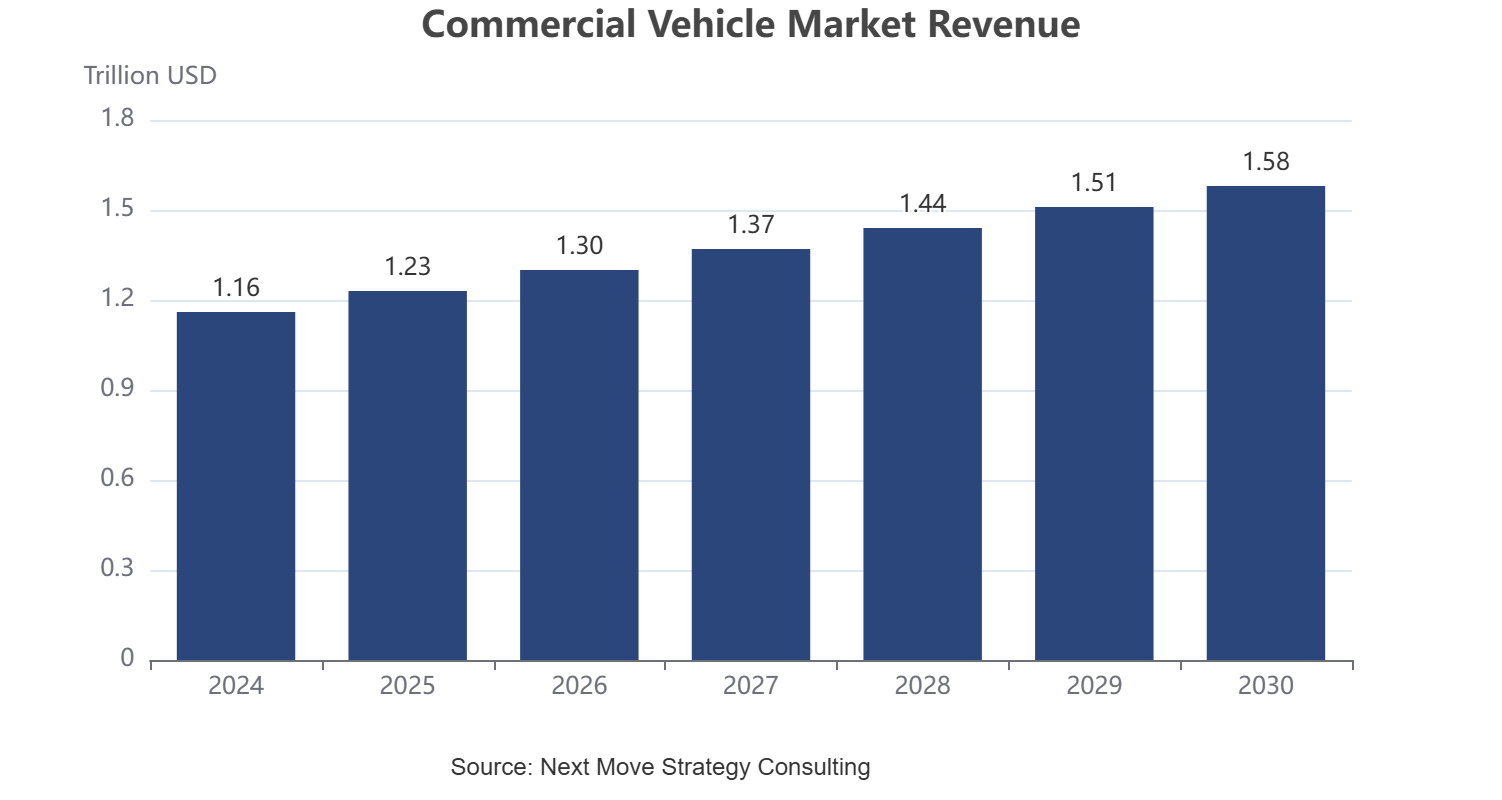
The global Commercial Vehicle Market size was valued at USD 1.16 trillion in 2024 and is predicted to reach USD 1.58 trillion by 2030 with a CAGR of 6.3% from 2025-2030.
Growing uptake of electric vehicles along with urbanization and advances in autonomous car technology are driving growth in the market. However high initial costs pose a significant challenge that limiting market expansion and accessibility for a broader consumer base. On the other hand, the expansion of electric and autonomous vehicles in commercial transport presents promising growth opportunities by enabling cost efficient and technologically advanced mobility solutions. Major players including BYD Auto and Tata Motors are in the midst of actively undertaking strategic moves including product development and partnerships to further consolidate their market leadership and improve their product.
Expanding Electric Vehicle Sector Drives the Market Growth
The high rate of electric vehicles adoption propels commercial vehicle market growth owing to rising demand for environmentally friendly transportation solution, government incentives, and technology breakthroughs in batteries. As logistics companies and businesses shift to electric fleets to lower emissions and operating expenditure, manufacturers are increasing their commercial vehicle offerings that are electric. The most recent report released by the International Energy Agency reported that, approximately 14 million new electric vehicles were sold in 2023 representing a 35% increase from the year before. This increase in EV adoption is fueling investments in charging infrastructure, energy storage technologies and future battery technologies further propelling market growth.
Growing Urbanization Further Boosts the Market
The growing urbanization further boosts the commercial vehicle market trends as increasing population density and expanding city infrastructure drive the demand for efficient transportation and logistics solutions. Rising eCommerce activities, urban freight movement and last mile delivery services require a robust fleet of commercial vehicles to meet the growing consumer demand.
As per the latest report published by the United Nations Population Fund Global urban population is projected to reach around 5 billion by 2030. This increasing urbanization is motivating governments and companies to invest in technologically superior and environmentally friendly commercial vehicles to maintain the traffic system and enhance operational performance.
Advancements in Autonomous and Connected Vehicle Technologies Drives Market Growth
Technological improvements in autonomous and connected vehicle technologies continue to fuel the commercial vehicle market demand as companies incorporate artificial intelligence-based systems, IoT connectivity and smart driver assistance functions to improve safety and fleet management.
For instance, in February 2025, CEA Leti initiated research and development program to enhance autonomous vehicles Via V2X communication. Moreover, in September 2024, Nissan announced to introduce autonomous drive mobility services by 2027 in several cities that supports the industry's focus on smart transportation solutions.
High Initial Costs Limiting Market Expansion and Accessibility
High upfront and operational costs restrict market growth since the high investment needed for research, development and deployment of advanced technologies is a financial burden to companies.
The Implementation of Fleet Management Solutions and Vehicle as a Service Provides Future Market Growth
The implementation of fleet management solutions and vehicle as a service provides future market growth opportunities as companies look to maximize fleet efficiency, minimize operating expenses and enhance sustainability. Through the use of advanced data analytics and real time tracking fleet management solutions allow organizations to optimize vehicle operations and reduce fuel usage.
Market Segmentation and Scope of The Study
The commercial vehicle market report is segmented on the basis of vehicle type, propulsion type, sales channel, end-use industry, buyer type, and region. Based on vehicle type, the market is divided into light commercial vehicles, medium-duty trucks, heavy-duty trucks, and buses & coaches. Light commercial vehicles are further segmented into vans, pickups, and cab chassis vehicles. Medium-duty and heavy-duty trucks are categorized into rigid and tractor trucks. Buses & coaches are further segmented into city buses (transit), coaches (intercity), minibuses, and bus chassis.
Based on propulsion type, the market is segmented into diesel, petrol (gasoline), natural gas (CNG & LNG), hybrid electric (HEV & PHEV), battery electric vehicles (BEV), fuel cell electric vehicles (FCEV), and other propulsion systems. Based on sales channel, the market is divided into direct sales, dealer & distributor, public tender, and other channels.
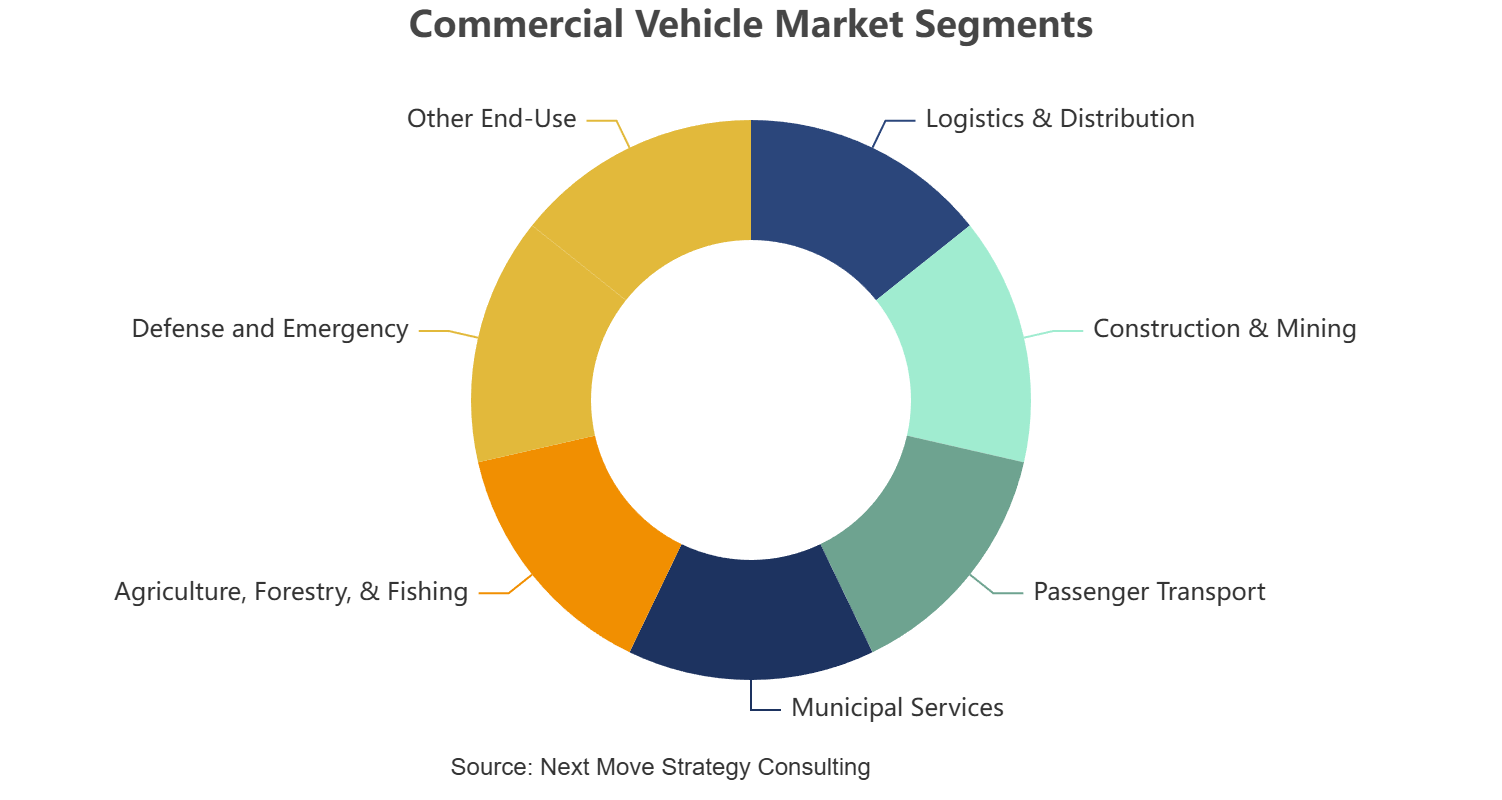
Based on end-use industry, the market includes logistics & distribution, construction & mining, passenger transport, municipal services, agriculture, forestry & fishing, defense and emergency services, and other end-use industries. Based on buyer type, the market is segmented into fleet operators, owner operators & SMEs, government & municipal entities, and leasing & rental companies.
Regional breakdown and analysis of each of the aforesaid segments includes North America, Europe, Asia-Pacific,RoW.
Geographical Analysis
Asia-Pacific dominates the commercial vehicle market share due to the growing electric vehicle sector in the region driven by increasing environmental concerns and the rising demand for sustainable transportation solutions.
Countries including China along with Japan and India are heavily investing in electric vehicle infrastructure advancing electric vehicle adoption for both personal and commercial use. The IEA latest report stated that China’s sold around 8 million new EVs in 2023 marking a growth of 30% from the previous year.
Furthermore, efforts initiated by major players in the region continuously contribute to the growth of the market as companies invest in autonomous drive technologies and fleet management solutions to increase efficiency and sustainability.
Key manufacturers are introducing new products and building strategic alliances in order to match the increasing demand for commercial vehicles. For instance, in November 2024 Tata motors introduced automated manual transmission truck in order to enhance productivity and efficiency in fuel usage for customers through a robust drivetrain.
On the other hand, North America is the fastest growing region in commercial vehicles with the increasing logistics industry as expanding freight transport and need for effective supply chain management boost demand for these vehicles.
The latest report published by International Trade Administration mentioned that U.S business logistics costs reached USD 2.3 trillion that representing 8.7% of GDP in 2023. This highlights the significant role of the logistics sector in the economy presenting opportunities for growth and increased investment in sustainable and efficient transportation solutions.
Additionally, increasing urbanization enhances the market in the region as a result of growing demand for effective transport and growing commercial activities. The World Bank recent report stated that urban population of Mexico reached 105 million in 2023 up from 97 million in 2017. This increased urbanization is driving investment in smart city programs and better transit systems that is boosting market growth.
Competitive Landscape
Various players in the commercial vehicle industry includes Ford Motor Company, Daimler Truck Holding AG, Stellantis N.V., AB Volvo, TRATON SE, PACCAR Inc, Isuzu Motors Limited, Sinotruk (Hong Kong) Limited, ARCHION Corporation, Iveco Group N.V., Tata Motors Limited, FAW Jiefang Group Co., Ltd., Beiqi Foton Motor Co., Ltd., Dongfeng Motor Group Company Limited, Zhengzhou Yutong Bus Co., Ltd., Ashok Leyland Limited, NFI Group Inc., Hyundai Motor Company, Anhui Jianghuai Automobile Group Corp., Ltd., and BYD Company Limited. These market players are opting strategies including product launches to maintain their dominance in the market.
Additionally, in April 2026, BYD Company Limited expanded its commercial electric vehicle portfolio with new battery-electric buses and medium-duty trucks designed for urban logistics and municipal transportation applications. The company emphasized enhanced battery efficiency, longer driving range, and lower operational costs for fleet operators transitioning toward zero-emission transportation.
In February 2026, Daimler Truck Holding AG announced the expansion of its hydrogen-powered and battery-electric truck programs across Europe and North America. The initiative included investments in charging and hydrogen refueling ecosystems, advanced fleet telematics, and long-haul sustainable freight transportation solutions to support commercial fleet decarbonization strategies.
Key Benefits
-
The report provides quantitative analysis and estimations of the commercial vehicle market from 2025 to 2030, which assists in identifying the prevailing market opportunities.
-
The study comprises a deep-dive analysis of market including the current and future trends to depict prevalent investment pockets in the market.
-
Information related to key drivers, restraints, and opportunities and their impact on the market is provided in the report.
-
Competitive analysis of the players, along with their market share is provided in the report.
-
SWOT analysis and Porters Five Forces model is elaborated in the study.
-
Value chain analysis in the market study provides a clear picture of roles of stakeholders.
Commercial Vehicle Market Key Segments
By Vehicle Type
-
Light Commercial Vehicle
-
Van
-
Pickup
-
Cab Chassis
-
-
Medium-Duty Truck
-
Rigid
-
Tractor
-
-
Heavy-Duty Truck
-
Rigid
-
Tractor
-
-
Bus & Coach
-
City Bus (Transit)
-
Coach (Intercity)
-
Minibus
-
Bus Chassis
-
By Propulsion Type
-
Diesel
-
Petrol (Gasoline)
-
Natural Gas (CNG & LNG)
-
Hybrid Electric (HEV & PHEV)
-
Battery Electric Vehicle (BEV)
-
Fuel Cell Electric Vehicle (FCEV)
-
Other Propulsion
By Sales Channel
-
Direct Sale
-
Dealer & Distributor
-
Public Tender
-
Other Channel
By End-Use Industry
-
Logistics & Distribution
-
Construction & Mining
-
Passenger Transport
-
Municipal Services
-
Agriculture, Forestry, & Fishing
-
Defense and Emergency
-
Other End-Use
By Buyer Type
-
Fleet Operator
-
Owner Operator & SME
-
Government & Municipal Entity
-
Leasing & Rental Company
By Region
-
North America
-
The U.S.
-
Canada
-
Mexico
-
-
Europe
-
The UK
-
Germany
-
France
-
Italy
-
Spain
-
Denmark
-
Netherlands
-
Finland
-
Sweden
-
Norway
-
Russia
-
Rest of Europe
-
-
Asia-Pacific
-
China
-
Japan
-
India
-
South Korea
-
Australia
-
Indonesia
-
Singapore
-
Taiwan
-
Thailand
-
Rest of Asia-Pacific
-
-
RoW
-
Latin America
-
Middle East
-
Africa
-
Key Players
-
Ford Motor Company
-
Daimler Truck Holding AG
-
Stellantis N.V.
-
AB Volvo
-
TRATON SE
-
PACCAR Inc
-
Isuzu Motors Limited
-
Sinotruk (Hong Kong) Limited
-
ARCHION Corporation
-
Iveco Group N.V.
-
Tata Motors Limited
-
FAW Jiefang Group Co., Ltd.
-
Beiqi Foton Motor Co., Ltd.
-
Dongfeng Motor Group Company Limited
-
Zhengzhou Yutong Bus Co., Ltd.
-
Ashok Leyland Limited
-
NFI Group Inc.
-
Hyundai Motor Company
-
Anhui Jianghuai Automobile Group Corp., Ltd.
-
BYD Company Limited
Report Scope and Segmentation:
|
Parameters |
Details |
|
Market Size in 2024 |
USD 1.16 Trillion |
|
Revenue Forecast in 2030 |
USD 1.58 Trillion |
|
Growth Rate |
CAGR of 6.3% from 2025 to 2030 |
|
Analysis Period |
2024–2030 |
|
Base Year Considered |
2024 |
|
Forecast Period |
2025–2030 |
|
Market Size Estimation |
Trillion (USD) |
|
Growth Factors |
|
|
Countries Covered |
28 |
|
Companies Profiled |
15 |
|
Market Share |
Available for 10 companies |
|
Customization Scope |
Free customization (equivalent to up to 80 working hours of analysts) after purchase. Addition or alteration to country, regional, and segment scope. |
|
Pricing and Purchase Options |
Avail customized purchase options to meet your exact research needs. |
About the Author
 Jayanta Das
— Jayanta Das is Senior Analyst at Next Move Strategy Consulting, where he has spent 4.5 years covering the firm's full industry taxonomy — spanning aerospace and defense, healthcare, BFSI, energy and power, semiconductors, and beyond — rather than one specialization. His work follows NextMSC's research model, combining data mining, analytics, and secondary research to build market sizing and forecasts behind NextMSC's 2,000-plus research reports, trusted by more than 3,000 organizations globally.
Jayanta Das
— Jayanta Das is Senior Analyst at Next Move Strategy Consulting, where he has spent 4.5 years covering the firm's full industry taxonomy — spanning aerospace and defense, healthcare, BFSI, energy and power, semiconductors, and beyond — rather than one specialization. His work follows NextMSC's research model, combining data mining, analytics, and secondary research to build market sizing and forecasts behind NextMSC's 2,000-plus research reports, trusted by more than 3,000 organizations globally.
About the Reviewer
 Supradip Baul
— Supradip Baul is an accomplished business consultant and strategist with over a decade of rich experience in market intelligence, strategy, technology, and business transformation. His work has included rigorous qualitative and quantitative analysis across multiple industries, helping clients shape investment decisions and long-term roadmaps. Earlier in his career, he was associated with Gartner, where he contributed to industry-leading reports and market share analyses. He has worked with leading global companies and holds an MBA with a dual specialization in Marketing and Finance.
Supradip Baul
— Supradip Baul is an accomplished business consultant and strategist with over a decade of rich experience in market intelligence, strategy, technology, and business transformation. His work has included rigorous qualitative and quantitative analysis across multiple industries, helping clients shape investment decisions and long-term roadmaps. Earlier in his career, he was associated with Gartner, where he contributed to industry-leading reports and market share analyses. He has worked with leading global companies and holds an MBA with a dual specialization in Marketing and Finance.
At Next Move Strategy Consulting, we understand that insightful market research is the cornerstone of successful business decisions. That's why we employ a robust and multifaceted approach, combining various methodologies to deliver the most accurate and actionable data for our clients.

Research Landscape
We navigate the world of research with two primary approaches:
Qualitative Approach
Our qualitative research methodologies involve immersive techniques such as in-depth interviews, focus groups, and observational studies. By engaging directly with individuals and stakeholders, we uncover valuable insights that quantitative data alone may overlook.

Quantitative Research
In tandem with qualitative methodologies, NMSC leverages the power of Quantitative Research to provide a robust foundation of numerical insights. Through systematic data collection and analysis, we quantify patterns, preferences, and market trends, offering a comprehensive view of the business landscape.
Our quantitative research approach employs diverse tools, including surveys, experiments, and statistical modelling. These methodologies enable us to gather data from a large and representative sample, ensuring the statistical significance of our findings. By employing structured questionnaires and standardized data collection methods, we guarantee the reliability and validity of the information we present to our clients.
Quantitative research is particularly effective in measuring the prevalence of trends, assessing market size, and gauging the impact of various factors on consumer behavior. The numerical precision attained through this approach equips our clients with actionable insights, facilitating data-driven decision-making and strategy formulation.


Our Specialized Toolbox for Industry-Specific Market Research
We deploy a specialized arsenal of techniques tailored to meet your unique requirements. Here's a glimpse into our comprehensive toolbox:

Information Procurement
The stage entails acquiring market data or relevant information through various sources and methodologies.


Market Research Approach
We utilize both top-down and bottom-up approaches in market research analysis to achieve a comprehensive understanding of the market dynamics, leveraging the broad perspective of industry trends and macroeconomic factors alongside detailed insights from specific segments and individual companies.

Porters Five Forces Analysis
We conduct Porter's Five Forces analysis to evaluate the competitive landscape of an industry, providing us with insights into factors that affect profitability and strategic positioning.

SWOT Analysis

Forecasting
We utilize a forecasting model to predict future consumption by considering parameters like population, economics, regulations, market competition, drivers, constraints, technology, and pricing. We also employ statistical techniques such as multilinear regression, exponential smoothing, moving average, ARIMA, and Monte Carlo simulations for accurate predictions. In econometric forecasting, we analyzed short-term and long-term event impacts, attributing values based on regulatory frameworks, economic factors, and market events.





 Speak to Our Analyst