Milking Robot Market Size, Share, Growth & Forecast 2025–2035, By System Type (Single-Stall Unit, Multi-Stall Unit, Rotary System), Offering (Hardware: Robotic Arms, Control Systems; Software and Data Analytics: Herd Management, Milking Control; Services: Installation, Maintenance), Herd Size (Below 100, 100 to 1,000, Above 1,000), Animal Type (Dairy Cattle, Other Species), Deployment (New Installation, Retrofit and Upgrade, Rental and Lease), and Region — Global Analysis 2025–2035
Industry: Agriculture | Publishing Date: July 8, 2026 | Last Updated: July 8, 2026 | No of Pages: N/A | No. of Tables: N/A | No. of Figures: N/A | Format: PDF | Report Code: AG2609
What Is the Milking Robot Market Size?
The global Milking Robot Market was valued at USD 3.82 billion in 2025 and is projected to reach USD 4.30 billion in 2026, expanding further to USD 12.51 billion by 2035, at a CAGR of 12.6% from 2026 to 2035. This robust growth trajectory is driven by escalating labour shortages in dairy farm operations across North America and Europe, increasing awareness of the productivity, animal welfare, and data intelligence benefits of automatic milking systems, accelerating government-backed precision agriculture programs, and the growing adoption of robotic milking solutions among mid-to-large dairy herds transitioning from conventional parlour systems to continuous voluntary milking operations.
|
Parameters |
Details |
|
Market Size in 2025 |
USD 3.82 Billion |
|
Market Size in 2026 |
USD 4.30 Billion |
|
Revenue Forecast in 2035 |
USD 12.51 Billion |
|
Growth Rate |
CAGR of 12.6% from 2026 to 2035 |
|
Analysis Period |
2025–2035 |
|
Base Year Considered |
2025 |
|
Forecast Period |
2026–2035 |
|
Market Size Estimation |
USD Billion |
|
Companies Profiled |
20 |
|
Countries Covered |
33 |
|
Market Share |
Top 10 |
Milking Robot Market Overview
What Is the Milking Robot Market and How Has It Evolved Structurally?
The Milking Robot Market encompasses the commercial ecosystem of automatic milking systems (AMS), associated herd management software, data analytics platforms, and professional services that enable dairy farmers to automate the milking process through robotic technology. The market spans single-stall, multi-stall, and rotary robotic milking configurations designed for dairy cattle, goats, sheep, and other dairy species. Structurally, the market has evolved from single-stall robotic milking units introduced commercially in the early 1990s by Lely International in the Netherlands to sophisticated multi-robot installations with integrated herd health monitoring, activity tracking, milk quality analysis, and AI-powered decision support systems.
How Is the Regulatory Environment Shaping the Milking Robot Market?
The Milking Robot Market operates within a regulatory environment defined by animal welfare legislation, food safety standards, and agricultural investment support programs. The European Union's Farm to Fork Strategy and its animal welfare framework impose milk quality and hygiene standards that robotic milking systems are well positioned to meet through automated inline milk analysis, cell count monitoring, and conductivity measurement. The U.S. Department of Agriculture's precision agriculture research programs and the USDA National Institute of Food and Agriculture's funding for agricultural automation directly support technology adoption within the American dairy sector.
How Is Technology Adoption Accelerating Within the Milking Robot Market?
NMSC's analysis indicates that technology adoption within the Milking Robot Market is advancing well beyond basic automated milking toward fully integrated precision livestock farming ecosystems. Through our market assessment, we observed that leading vendors including Lely and DeLaval are now embedding real-time cow health monitoring, rumination tracking, reproductive cycle detection, and nutritional management within their robotic milking platforms. The integration of cloud-based herd management software, IoT sensor networks, and machine learning algorithms is enabling dairy farmers to achieve measurable improvements in milk yield per cow, somatic cell count reduction, and early disease detection, strengthening the return-on-investment case for milking robot adoption globally.
|
Key Takeaways |
|
By System Type, Single-Stall Unit held the largest share of the Automated Milking Systems Market at USD 2.02 billion in 2025, accounting for 52.9% of total revenue. Rotary Systems are the fastest-growing segment, projected to expand at a CAGR of 14.6% from 2026 to 2035, supported by rising adoption among large-scale dairy farms. |
|
By Hardware Offering, Robotic Arms and Milking Units accounted for the largest revenue share in 2025, supported by widespread deployment of leading robotic milking platforms. Sensors and Vision Systems are projected to be the fastest-growing hardware category, advancing at an estimated CAGR of 15.8% from 2026 to 2035, driven by investments in precision livestock farming. |
|
By Software Offering, Herd Management Software dominated revenue generation in 2025, reflecting its central role in dairy operations. Analytics and Reporting Software is expected to be the fastest-growing segment at an estimated CAGR of 16.2% from 2026 to 2035, supported by growing use of AI and cloud-based analytics tools. |
|
By Service Offering, Installation and Commissioning Services held the largest market share in 2025 due to continued new system deployments. Managed Services are forecast to be the fastest-growing segment, registering an estimated CAGR of 15.4% from 2026 to 2035, as more farms outsource system management. |
|
By Herd Size, farms with 100 to 1,000 cows generated the highest revenue at USD 2.14 billion in 2025, representing 56.0% of the market. Farms with more than 1,000 cows are the fastest-growing segment, projected to expand at an estimated CAGR of 14.6% from 2026 to 2035. |
|
By Animal Type, Dairy Cattle dominated the Automated Milking Systems Market with USD 3.42 billion in 2025, accounting for 89.5% of total revenue. Goats are expected to be the fastest-growing segment, advancing at an estimated CAGR of 14.1% from 2026 to 2035, supported by rising demand for premium dairy products. |
|
By Deployment, New Installations held the largest share at USD 2.42 billion in 2025, representing 63.4% of total revenue. Retrofit and Upgrade Deployments are forecast to be the fastest-growing category, expanding at an estimated CAGR of 13.8% from 2026 to 2035 as farms modernize existing facilities. |
|
By Sales Channel, OEM Direct Sales generated the highest revenue at USD 1.86 billion in 2025, accounting for 48.7% of the market. System Integrators are the fastest-growing channel, projected to register an estimated CAGR of 14.8% from 2026 to 2035, reflecting demand for turnkey automation projects. |
|
Europe held the largest regional share of the Automated Milking Systems Market at USD 1.72 billion in 2025, accounting for 45.0% of global revenue, supported by strong adoption across major dairy-producing countries. |
|
Asia Pacific is the fastest-growing region in the Automated Milking Systems Market, expected to expand at a CAGR of 15.4% from 2026 to 2035, driven by dairy sector modernization in China and India. |
|
The Netherlands represented the largest country market in 2025, generating USD 0.20 billion, supported by high per-farm adoption rates and a strong dairy ecosystem. |
|
China is projected to be the fastest-growing country market, advancing at an estimated CAGR of 16.8% from 2026 to 2035, supported by government-backed dairy modernization programs and expansion of commercial dairy farms. |
Ecosystem Analysis of the Milking Robot Market
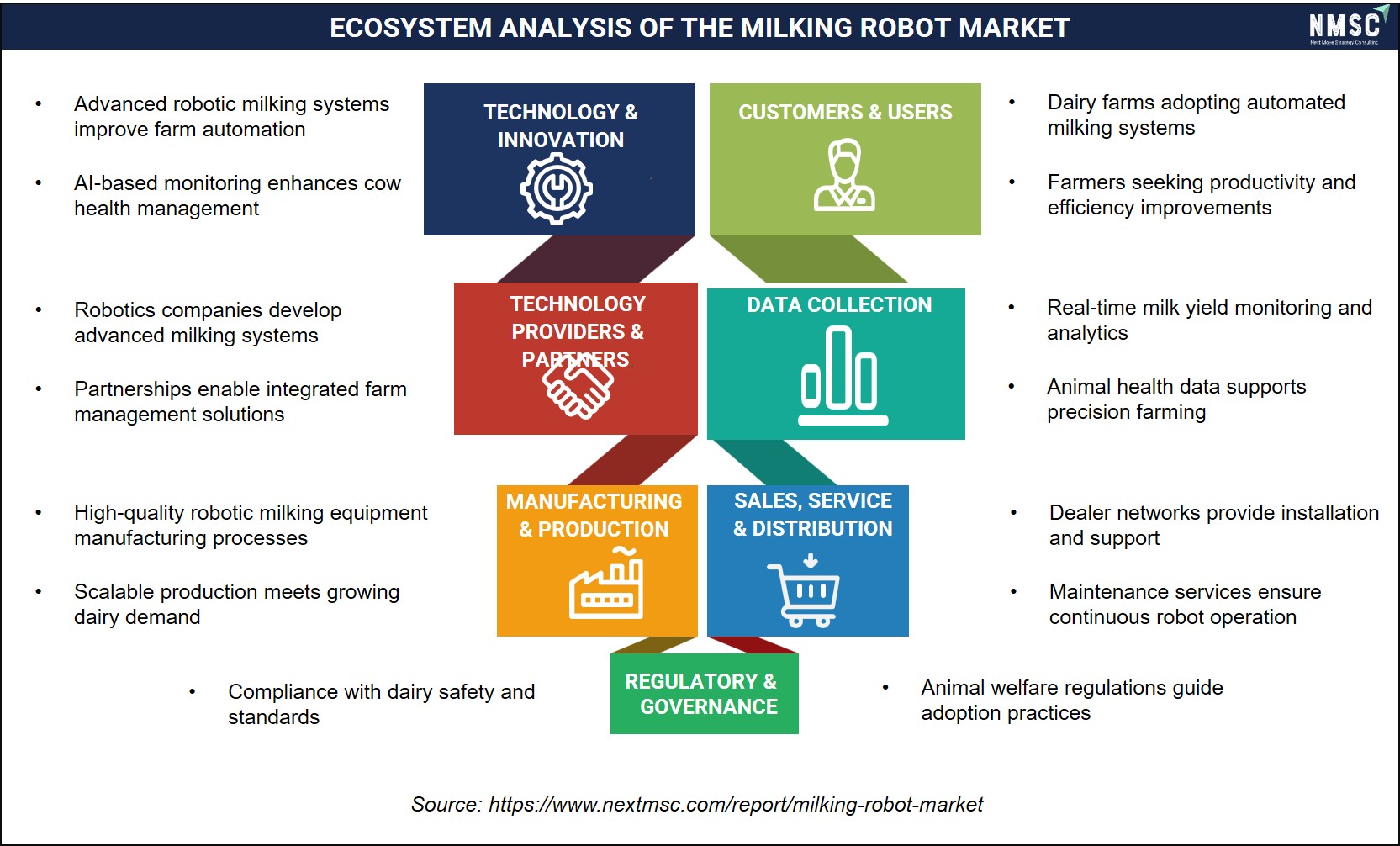
The above framework presents an ecosystem analysis of the Milking Robot Market across technology innovation, manufacturing, sales and service, data collection, regulatory governance, and end-user segments. We observed that dairy farms are adopting automated milking systems while farmers seek productivity and efficiency improvements, shaping customer and user dynamics. Technology providers and partners support manufacturing and production, with sales, service, and distribution enabling global market reach. Data collection facilitates herd monitoring and operational analytics, while regulatory governance enforces animal welfare standards and food safety compliance, collectively driving innovation and operational efficiency in this evolving agricultural technology landscape.
Key Emerging Trends in the Milking Robot Market
How Is AI and Machine Learning Integration Reshaping the Milking Robot Market?
From our research, we found that AI and machine learning integration is transforming robotic milking from a purely mechanical process into a data-driven precision farming discipline. Leading milking robot vendors are embedding AI algorithms that analyze teat positioning data, milk flow curves, and somatic cell count patterns to optimize individual cow milking protocols in real time. Lely's Astronaut A5 and DeLaval's VMS V300 are representative examples of AI-enhanced milking robot platforms that enable early mastitis detection through conductivity and temperature sensor fusion, reducing veterinary intervention costs and improving herd health outcomes for dairy operators.
How Is Cloud-Based Herd Management Software Extending the Value Proposition of the Milking Robot Market?
Through our market assessment, we observed that cloud-based herd management software is becoming the primary differentiator between milking robot vendors, as hardware performance across leading systems has largely converged. Platforms including Lely T4C InHerd, DeLaval DelPro, and Afimilk AfiFarm deliver integrated herd reproductive cycle management, milk production benchmarking, and nutritional feeding optimization that enable farm managers to make data-driven decisions beyond the milking operation itself. Our assessment indicates that software and data analytics recurring revenue is the fastest-growing segment within the Milking Robot Market's offering dimension, reflecting increasing willingness among dairy farmers to pay annual subscription fees for actionable intelligence.
How Is the Labour Shortage Crisis in Dairy Farming Accelerating Milking Robot Market?
Based on NMSC's research, we found that the structural labor shortage in dairy farming across North America, Northern Europe, and Australia is the single most powerful demand driver for milking robot adoption among conventional parlor operators. The U.S. Department of Agriculture has documented persistent challenges in recruiting and retaining skilled milking labor, particularly for twice- and thrice-daily milking schedules. Robotic milking systems that operate continuously without fixed milking times allow cows to self-present for milking on a voluntary basis, reducing the farm's dependence on shift-based milking labor and enabling 24-hour milk collection without proportional labor cost increases.
How Is Precision Livestock Farming Expanding the Milking Robot Market Beyond Cattle?
Our findings suggest that the precision livestock farming movement is expanding the Milking Robot Market's addressable base beyond traditional dairy cattle operations to include goat, sheep, and other dairy species producers. Specialist milking robot configurations for caprine dairy operations are gaining commercial traction in Southern Europe, the Middle East, and specialty U.S. dairy markets where premium artisan cheese production is supporting investment in automated milking technology. Vendors including Fullwood Packo, Milkline, and specialist European suppliers are developing species-specific robotic milking adaptations that address the anatomical differences in teat placement, flow rates, and milking frequency requirements between cattle, goat, and ovine dairy production.
What Are the Key Market Drivers, Breakthroughs, and Investment Opportunities That Will Shape the Milking Robot Market in the Next Decade?
|
Drivers / Trends / Restraints |
(+/−) % Impact on CAGR |
Geographic Relevance |
Impact Timeline |
|
Dairy Farm Labor Shortage |
+3.2% |
North America, Europe, Australia |
2025–2035 |
|
Precision Livestock Farming Investment |
+2.1% |
Europe, North America, APAC |
2025–2032 |
|
AI and IoT Integration in Milking Systems |
+1.8% |
Global |
2026–2035 |
|
Government Agricultural Modernization Programs |
+1.4% |
Europe, APAC, MEA |
2025–2030 |
|
Milk Quality and Food Safety Standards |
+1.0% |
Global |
2025–2035 |
|
Animal Welfare Legislation |
+0.8% |
Europe, Australia |
2025–2035 |
|
Large-Scale Commercial Dairy Farm Development |
+1.2% |
China, India, MEA |
2026–2035 |
|
High Capital Expenditure Requirements |
−2.4% |
SMB Farmers, Emerging Markets |
2025–2030 |
|
Skilled Technician Shortage for Robot Maintenance |
−0.9% |
LATAM, MEA, Southeast Asia |
2025–2032 |
|
Resistance to Technology Change in Traditional Farming |
−0.6% |
MEA, Southeast Asia |
2025–2030 |
|
Rental and Lease Model Expansion |
+0.9% |
Europe, North America |
2026–2035 |
|
Goat and Sheep Dairy Automation Growth |
+0.7% |
Europe, MEA, North America |
2026–2035 |
What Are the Growth Drivers of the Milking Robot Market?
How Is the Dairy Farming Labor Shortage Driving Milking Robot Market Demand?
The persistent structural labor shortage in dairy farming is the most consequential demand driver in the Milking Robot Market across North America, Europe, and Australia. The U.S. Department of Agriculture's Economic Research Service has documented the increasing reliance of U.S. dairy farms on migrant labor and the challenges associated with labor availability for round-the-clock milking operations. Milking robots that enable continuous voluntary milking without fixed shift requirements directly address this structural vulnerability by reducing farm dependence on human milking operators while simultaneously improving milk collection frequency and per-cow yield.
How Are Government Agricultural Modernization Programs Accelerating the Milking Robot Market?
Government-backed agricultural modernization and precision farming investment programs are creating institutional funding pathways that reduce the effective capital expenditure barrier for dairy farmers considering milking robot adoption. The European Union's Common Agricultural Policy provides direct support for precision farming technology investment. The U.S. Department of Agriculture's National Institute of Food and Agriculture funds precision livestock farming research programs that demonstrate robotic milking efficacy. In Asia Pacific, China's Ministry of Agriculture and Rural Affairs has implemented dairy industry modernization initiatives that explicitly support large-scale dairy farm automation, creating a policy-backed demand foundation for milking robot vendors.
How Are Milk Quality and Animal Welfare Standards Sustaining Milking Robot Market Investment?
Evolving milk quality standards and animal welfare legislation across the EU and key export markets are creating compliance-driven investment in milking robot systems that provide automated inline milk quality testing, somatic cell count monitoring, and precise individual cow health tracking. The EU Animal Welfare Strategy for 2023 to 2027 emphasizes continuous monitoring of dairy herd health metrics that robotic milking platforms are architecturally designed to provide. Through NMSC's assessment, we found that dairy processors and retail buyers are increasingly requiring supplier farms to demonstrate milk quality consistency metrics that voluntary robotic milking systems with integrated inline analyzers are better positioned to sustain than conventional twice-daily parlor operations.
What Are the Growth Inhibitors of the Milking Robot Market?
How Does the High Capital Expenditure Requirement Constrain Milking Robot Market Adoption?
The high upfront capital expenditure required to purchase and install a milking robot system, typically ranging from USD 150,000 to over USD 250,000 per single-stall unit including barn modification costs, represents the most significant barrier to milking robot adoption among small and mid-scale dairy farmers globally. Farmers operating herds of fewer than 50 cows frequently cannot achieve the return-on-investment threshold that justifies robotic milking investment based on labor cost savings alone. This capital intensity barrier is most pronounced in emerging markets in LATAM, MEA, and Southeast Asia where dairy farm financing options are limited and conventional milking labor remains relatively affordable compared to North American and Northern European markets.
How Does the Skilled Technician Shortage Create Operational Risk in the Milking Robot Market?
The specialized technical expertise required to maintain, calibrate, and troubleshoot milking robot systems is in short supply in many markets where milking robot adoption is expanding, creating operational risk and elevated downtime potential for farmers adopting robotics in regions with thin service networks. According to the U.S. Bureau of Labor Statistics, agricultural equipment mechanic and technician occupations face supply constraints that are intensifying as the precision agriculture equipment installed base expands. Vendors operating in markets with thin service technician networks must invest in remote diagnostics, predictive maintenance AI, and rapid service dispatch capabilities to maintain uptime guarantees that underpin the business case for robotic milking investment.
What Are the Growth Opportunities in the Milking Robot Market?
How Is the Rental and Lease Business Model Creating New Milking Robot Market Access Opportunities?
The emergence of rental and lease financing models for milking robot systems is progressively dismantling the capital expenditure barrier that previously constrained adoption among small and mid-scale dairy farmers. Vendors including Lely and DeLaval are expanding their financial services partnerships to offer operating lease structures that convert the milking robot purchase from a capital expense to an operational cost, aligning vendor revenue timing with farmer cash flow cycles tied to milk production. Our findings suggest that rental and lease deployment is the fastest-growing deployment model in the Milking Robot Market, creating new addressable market segments among farmers who would not qualify for large-scale capital financing under traditional purchase models.
How Is the Large-Scale Commercial Dairy Farm Development in Asia and MEA Creating High-Growth Milking Robot Market Opportunities?
The rapid development of large-scale commercial dairy farms in China, India, Saudi Arabia, UAE, and other emerging markets is creating greenfield milking robot installation opportunities of significant scale. China's Ministry of Agriculture and Rural Affairs has set targets for large-scale dairy farm modernization that prioritize automated milking technology adoption. Saudi Arabia's Vision 2030 agricultural self-sufficiency goals include dairy production expansion at large commercial facilities that are being designed with robotic milking infrastructure from inception. Our analysis shows that these greenfield large-scale farm projects represent premium milking robot sales opportunities, often involving multi-robot installations with integrated barn management and feeding automation systems.
How Is the Retrofit and Upgrade Market Expanding the Milking Robot Market's Revenue Base?
As the earliest generation of milking robots installed in the mid-2000s and early 2010s reaches end-of-life replacement cycles, the retrofit and upgrade market is creating a structurally expanding revenue stream for milking robot vendors. Dairy farmers who completed their initial return-on-investment from first-generation robotic milking systems are a highly qualified buyer segment for technology upgrades that deliver improved teat mapping precision, enhanced milk quality analytics, and integrated AI health monitoring. NMSC's analysis indicates that the retrofit and upgrade deployment category is growing at an estimated CAGR of 13.8%, reflecting the maturing installed base of milking robots in the Netherlands, Germany, Sweden, Denmark, and Canada.
How Is the Milking Robot Market Segmented in This Report, and What Are the Key Insights from the Segmentation Analysis?
How Do Single-Stall, Multi-Stall, and Rotary System Configurations Compare in the Milking Robot Market?
|
Segment |
2025 (USD Bn) |
2035 (USD Bn) |
CAGR (%) |
|
Single-Stall Unit |
2.02 |
5.88 |
11.3% |
|
Multi-Stall Unit |
1.22 |
4.38 |
13.7% |
|
Rotary System |
0.58 |
2.25 |
14.6% |
Single-Stall Units dominate the Milking Robot Market's system type dimension, representing approximately USD 2.02 billion in 2025, reflecting their suitability for herds of 50 to 200 cows and their established commercial adoption across the Netherlands, Germany, Canada, and the United States. The Lely Astronaut series and DeLaval VMS platform are the most widely deployed single-stall milking robot products globally. Multi-Stall Units are gaining traction among larger dairy operations seeking higher throughput without the barn infrastructure requirements of a rotary system. Rotary Systems are the fastest-growing configuration, driven by large-scale commercial dairy farms in Australia, New Zealand, and China adopting high-capacity rotary robotic milking platforms such as the GEA DairyRoter for herds exceeding 500 cows.
How Do Hardware, Software, and Services Sub-Segments Define the Milking Robot Market's Revenue Structure?
|
Segment |
2025 (USD Bn) |
2035 (USD Bn) |
CAGR (%) |
|
Hardware |
2.48 |
7.82 |
12.2% |
|
Software and Data Analytics |
0.72 |
2.94 |
15.1% |
|
Services |
0.62 |
1.75 |
11.0% |
Hardware dominates the Milking Robot Market's offering dimension at USD 2.48 billion in 2025, with Robotic Arms and Milking Units representing the single largest hardware sub-category, encompassing teat detection systems, pulsation units, and milking cluster components from Lely, DeLaval, GEA, and BouMatic. Control Systems and PLCs, and Sensors and Vision Systems are rapidly growing hardware sub-categories as AI-powered teat mapping and predictive maintenance sensor networks become standard in next-generation milking robot platforms. Software and Data Analytics is the fastest-growing offering segment, reflecting the increasing value placed on Herd Management Software, Milking Control Software, and Analytics and Reporting platforms that convert raw sensor data into actionable farm management intelligence.
Which Herd Size Segments Are Driving the Most Milking Robot Market Revenue?
|
Segment |
2025 (USD Bn) |
2035 (USD Bn) |
CAGR (%) |
|
Below 100 Cows |
0.88 |
2.38 |
10.5% |
|
100 to 1,000 Cows |
2.14 |
7.02 |
12.6% |
|
Above 1,000 Cows |
0.80 |
3.11 |
14.6% |
Herds of 100 to 1,000 cows dominate the Milking Robot Market at USD 2.14 billion in 2025, representing the optimal adoption segment where the robot-to-cow ratio economics are most favourable, and capital expenditure is manageable within dairy farm investment cycles in the Netherlands, Germany, Canada, and the United States. Herds below 100 cows face relatively higher per-cow robot utilization costs but are increasingly being served by entry-level single-stall systems and rental models. Herds above 1,000 cows are the fastest-growing herd size segment, driven by large-scale commercial dairy farm development in China, Saudi Arabia, and Australia that requires multi-robot and rotary system configurations.
How Do Dairy Cattle, Goat, Sheep, and Other Species Segments Differ in the Milking Robot Market?
|
Segment |
2025 (USD Bn) |
2035 (USD Bn) |
CAGR (%) |
|
Dairy Cattle |
3.42 |
10.98 |
12.4% |
|
Goats |
0.22 |
0.82 |
14.1% |
|
Sheep |
0.12 |
0.48 |
14.9% |
|
Other Species |
0.06 |
0.23 |
14.3% |
Dairy Cattle overwhelmingly dominates the Milking Robot Market's animal type dimension at USD 3.42 billion in 2025, reflecting the fact that virtually all commercially deployed milking robots were originally engineered for bovine dairy operations. Holstein, Friesian, and Jersey breeds represent the primary cattle populations served by Lely, DeLaval, and GEA milking robot platforms. Goats represent the fastest-growing major species segment as premium artisan goat cheese and caprine milk demand drives investment in specialized automated milking systems for caprine dairy herds in Southern Europe, the Middle East, and specialty North American producers. Sheep dairy automation is an emerging niche, primarily in Southern European and Australian markets producing specialty ovine milk products.
How Do New Installation, Retrofit and Upgrade, and Rental and Lease Deployments Compare?
|
Segment |
2025 (USD Bn) |
2035 (USD Bn) |
CAGR (%) |
|
New Installation |
2.42 |
7.58 |
12.1% |
|
Retrofit and Upgrade |
1.08 |
3.94 |
13.8% |
|
Rental and Lease |
0.32 |
0.99 |
12.0% |
New Installation dominates the Milking Robot Market deployment dimension at USD 2.42 billion in 2025, reflecting the ongoing conversion of conventional twice-daily milking parlors to robotic systems among dairy farmers in established markets and the development of purpose-built robotic dairy farm infrastructure in emerging markets. Retrofit and Upgrade is the fastest-growing deployment mode, driven by the maturing installed base of first- and second-generation milking robots in the Netherlands, Denmark, Sweden, Germany, and Canada that are entering technology refresh cycles. Rental and Lease is growing steadily, enabling smaller dairy farmers and those in cash-constrained geographies to access milking robot technology without large upfront capital commitments.
How Do OEM Direct, Dealer or Distributor, and System Integrator Channels Compete in the Milking Robot Market?
|
Segment |
2025 (USD Bn) |
2035 (USD Bn) |
CAGR (%) |
|
OEM Direct |
1.86 |
5.92 |
12.3% |
|
Dealers or Distributors |
1.62 |
5.24 |
12.4% |
|
System Integrator |
0.34 |
1.35 |
14.8% |
OEM Direct sales lead the Milking Robot Market at USD 1.86 billion in 2025, reflecting Lely and DeLaval's preference for direct customer engagement in large-farm and dairy cooperative accounts requiring custom barn layout design, system integration with feeding automation, and long-term maintenance contracts. Dealer and Distributor channels represent the primary route for mid-scale farm sales across Europe, North America, and emerging markets where vendors rely on regional agricultural equipment dealers with established farmer relationships. System Integrators represent the fastest-growing channel, driven by turnkey dairy automation projects that integrate milking robots, automated feeding systems, manure management, and barn environmental control within a single project delivery.
Strategic Framework of the Milking Robot Market
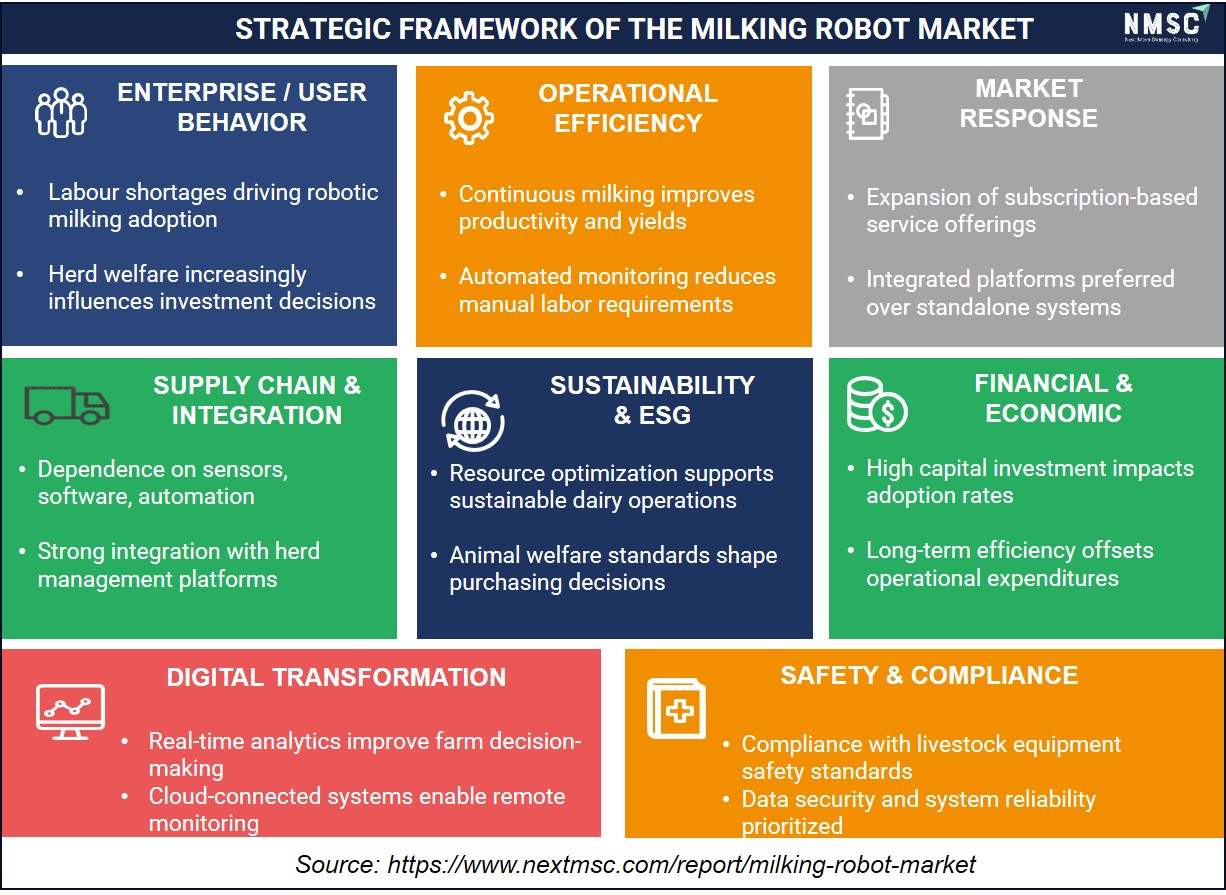
The above framework outlines key forces shaping the Milking Robot Market across user behaviour, operations, supply chain, sustainability, compliance, and financial outcomes. We observed that labor shortages and herd welfare concerns are driving adoption, while automated monitoring and continuous milking improve productivity and reduce manual work. Integration with herd management platforms and sensor-based systems define supply chain dynamics, with subscription models gaining traction. Resource optimization supports sustainable operations, and real-time analytics enable remote monitoring. Although high capital investment impacts adoption, long-term efficiency gains and compliance with safety standards reinforce market growth.
Regional Outlook
|
Region |
2025 (USD Bn) |
2035 (USD Bn) |
CAGR 2026–2035 (%) |
Key Driver |
|
North America |
1.08 |
3.24 |
11.6% |
Labor shortage, USDA precision ag programs, large herd automation |
|
Europe |
1.72 |
5.06 |
11.4% |
Largest installed base, Netherlands and Germany market maturity, EU CAP |
|
Asia Pacific |
0.68 |
2.86 |
15.4% |
China dairy modernization, India AMS adoption, Australia rotary systems |
|
Middle East & Africa |
0.18 |
0.72 |
14.9% |
Saudi/UAE commercial dairy farms, Vision 2030 food security programs |
|
Latin America |
0.16 |
0.63 |
14.7% |
Brazil dairy expansion, Argentina precision farming, Colombia modernization |
North America Milking Robot Market
North America accounts for USD 1.08 billion of the global Milking Robot Market in 2025, driven primarily by acute dairy farm labor shortages across the United States and Canada that are making continuous robotic milking financially compelling for medium and large-scale dairy operators. Based on our engagements with North American dairy equipment dealers, the return-on-investment calculation for milking robot adoption has strengthened considerably as labor costs for milking operations continue to rise. The USDA National Institute of Food and Agriculture's precision livestock farming research programs are validating robotic milking productivity and animal welfare outcomes, accelerating institutional endorsement of the technology.
United States Milking Robot Market
Through our analysis, the United States Milking Robot Market is estimated at approximately USD 0.88 billion in 2025. The U.S. dairy sector faces persistent labor recruitment challenges documented by the USDA Economic Research Service, making milking robots increasingly compelling for farms transitioning away from dependence on shift-based milking labor. States with the largest dairy farm concentrations, including Wisconsin, California, Idaho, New York, and Pennsylvania, represent the highest-density milking robot adoption markets. Lely and DeLaval are the dominant vendors, competing through dealer networks and direct accounts with large cooperative dairy operations.
Canada Milking Robot Market
From our assessment, Canada's Milking Robot Market is valued at approximately USD 0.14 billion in 2025. Canadian dairy farmers, operating within the Supply Management system that guarantees stable milk prices, have one of the highest milking robot adoption rates per farm globally, particularly in Ontario, Quebec, and British Columbia. The stable regulated pricing environment reduces return-on-investment risk for capital-intensive milking robot investments. Canadian dairy associations actively promote precision dairy technology adoption, and the federal government's Growing Forward agricultural support program has included provisions for precision farming technology investment.
Mexico Milking Robot Market
According to our evaluation, Mexico's Milking Robot Market is estimated at approximately USD 0.06 billion in 2025. Mexico's commercial dairy sector is concentrated in Jalisco, Durango, and Chihuahua states, where larger-scale operations are beginning to evaluate robotic milking adoption. Dairy labor availability has historically constrained automation investment, but rising farm labor costs and growing awareness of productivity benefits are creating incremental demand. Distribution through agricultural equipment dealers with access to imported Lely and DeLaval equipment represents the primary sales channel in the Mexican market.
Europe Milking Robot Market
Europe leads the global Milking Robot Market with an estimated USD 1.72 billion in 2025, representing 45.0% of the global market revenue. This dominance reflects Europe's position as the birthplace of commercial milking robotics, the highest installed base concentration globally, and a dairy farming culture that has embraced precision livestock farming technology across Netherlands, Germany, Sweden, Denmark, and the United Kingdom. Based on NMSC's research, we found that European dairy farmers collectively operate the largest regional fleet of milking robots, and the region's strong dairy cooperative infrastructure has facilitated collective adoption decisions that accelerate penetration rates beyond those achievable through individual farm sales alone.
United Kingdom Milking Robot Market
Through our analysis, the United Kingdom Milking Robot Market is estimated at approximately USD 0.18 billion in 2025. The UK dairy sector faces significant milking labor challenges following post-Brexit changes to agricultural labor availability, making robotic milking adoption a strategic necessity for many British dairy farmers. The Agriculture Act 2020's Sustainable Farming Incentive scheme includes provisions for productivity-enhancing technology investment. Fullwood Packo, a UK-based milking robot manufacturer, provides domestic supply chain advantages alongside competition from Lely and DeLaval in the British market.
Germany Milking Robot Market
From our assessment, Germany's Milking Robot Market is valued at approximately USD 0.28 billion in 2025. Germany's dairy sector is concentrated in Bavaria, Lower Saxony, and Schleswig-Holstein, with a mix of family-operated and cooperative-scale dairy farms that represent the core milking robot buyer segment. The German Agricultural Society (DLG) actively evaluates and endorses milking robot performance standards, providing credibility signals that support farmer adoption decisions. GEA Group, headquartered in Germany, benefits from home market brand trust advantages in competition with Dutch and Swedish vendors.
France Milking Robot Market
Based on our engagements, France's Milking Robot Market is estimated at approximately USD 0.22 billion in 2025. France's dairy sector, concentrated in Normandy, Brittany, and the Pays de la Loire, is experiencing accelerating milking robot adoption as generational farm succession challenges and rural labor scarcity converge to make automation economically compelling. The French government's Plan France 2030 includes specific agricultural technology modernization funding. Lely and DeLaval compete for market leadership through their French dealer and agricultural cooperative networks.
Italy Milking Robot Market
Through NMSC's assessment, Italy's Milking Robot Market reached approximately USD 0.10 billion in 2025. Northern Italian dairy regions in Lombardy, Veneto, and Emilia-Romagna, home to the Parmigiano-Reggiano, Grana Padano, and Gorgonzola PDO cheese industries, represent the primary milking robot adoption markets. Italian dairy farmers are increasingly investing in milking robots to address declining rural labor supply and to meet milk quality consistency standards required by PDO cheese cooperatives. Milkrite InterPuls and Milkline, Italy-based milking technology companies, serve the local market alongside global vendors.
Spain Milking Robot Market
Our analysis shows that Spain's Milking Robot Market is estimated at approximately USD 0.08 billion in 2025. Spain's dairy sector is concentrated in Galicia and the Cantabrian coast, with a structural shift from small family farms toward larger consolidated operations driving milking robot adoption. The Spanish Ministry of Agriculture's precision farming investment support program and EU CAP funding accessible through Spanish agricultural authorities are creating financial pathways for dairy farm technology modernization. Adoption remains below the Northwestern European norm but is accelerating.
Sweden Milking Robot Market
According to our evaluation, Sweden's Milking Robot Market reached approximately USD 0.12 billion in 2025. Sweden is one of the earliest markets for commercial milking robotics, with Lely and DeLaval both maintaining strong presence in the home market of Swedish dairy automation. Swedish dairy farmers are among the most technology-advanced globally, with high milking robot penetration rates relative to herd count. The Swedish Board of Agriculture's precision farming investment programs and Sweden's strong dairy cooperative structure have historically accelerated technology adoption cycles.
Denmark Milking Robot Market
From our assessment, Denmark's Milking Robot Market is valued at approximately USD 0.14 billion in 2025. Denmark's dairy sector, dominated by Arla Foods cooperative members, has one of the highest milking robot adoption rates per dairy farm globally. The Danish Veterinary and Food Administration's milk quality standards are consistently met by robotic milking systems with integrated inline milk analyzers. Denmark's advanced precision agriculture ecosystem and strong agricultural advisory services infrastructure support accelerating milking robot installation rates among remaining conventional parlor operators.
Finland Milking Robot Market
Based on our market evaluation, Finland's Milking Robot Market reached approximately USD 0.08 billion in 2025. Finland's dairy sector, organized around the Valio cooperative, has a high milking robot penetration rate driven by long winter seasons that make conventional milking labor particularly challenging. The Finnish Ministry of Agriculture and Forestry's investment support programs have historically included precision livestock farming technology. The remote geography of many Finnish dairy farms makes autonomous continuous milking particularly operationally valuable relative to labour-dependent parlour systems.
Netherlands Milking Robot Market
Through our analysis, the Netherlands Milking Robot Market is estimated at approximately USD 0.20 billion in 2025. The Netherlands is the global epicenter of milking robot development and adoption, home to Lely International, the company that commercialized the world's first milking robot in 1992. Dutch dairy farmers operate one of the highest per-farm milking robot penetration rates globally, and the Netherlands serves as the primary reference market for milking robot vendors seeking to demonstrate technology maturity and return-on-investment to international buyers. Upgrading from first- and second-generation to current-generation milking robots represents a significant recurring market opportunity.
Rest of Europe Milking Robot Market
According to our evaluation, the Rest of Europe segment, encompassing Poland, Belgium, Ireland, Austria, Switzerland, and other European markets, collectively represents approximately USD 0.32 billion in 2025. Ireland's large dairy sector, expanded following EU milk quota abolition, is a growing milking robot adoption market as Irish dairy farmers scale herd sizes and face labor availability constraints. Polish dairy farms are consolidating and modernizing, creating incremental milking robot demand. Belgian and Austrian dairy operations have well-established precision livestock farming cultures that support continued adoption.
Asia Pacific Milking Robot Market
Asia Pacific is the fastest-growing regional market in the Milking Robot Market, projected to expand from USD 0.68 billion in 2025 to USD 2.86 billion by 2035 at a CAGR of 15.4%. NMSC's analysis indicates that the region's growth is driven by China's large-scale dairy farm modernization programs, India's expanding organized dairy sector beginning its automation transition, and Australia's established rotary milking robot market adopting next-generation systems. Government-backed agricultural investment programs in China and India represent the most significant institutional demand catalysts for milking robot adoption across the Asia Pacific region.
China Milking Robot Market
Through our analysis, China's Milking Robot Market is estimated at approximately USD 0.14 billion in 2025 and is the fastest-growing national market in the region. China's Ministry of Agriculture and Rural Affairs has set policy targets for large-scale dairy farm development, with farms exceeding 1,000 cows representing the primary milking robot adoption segment. Companies including Vansun Technologies are developing domestically manufactured robotic milking solutions for the Chinese market alongside international vendors. Rising domestic milk demand and food safety requirements following historical quality concerns are reinforcing investment in controlled, automated milk production infrastructure.
India Milking Robot Market
From our assessment, India's Milking Robot Market reached approximately USD 0.08 billion in 2025. India's dairy sector is the world's largest by milk production volume, but the sector is dominated by smallholder farmers for whom individual milking robot adoption is economically infeasible. Adoption is concentrated in large organized dairy farms, corporate dairy operations, and government model farms in states including Gujarat, Maharashtra, and Punjab. The National Dairy Development Board's programs for large-scale dairy farm development are creating institutional demand pathways for milking robot vendors seeking to establish Indian market presence.
Japan Milking Robot Market
According to our evaluation, Japan's Milking Robot Market is valued at approximately USD 0.10 billion in 2025. Japan's dairy sector faces severe agricultural labor shortages that make milking robots operationally compelling for the country's 13,000-plus dairy farms, primarily concentrated in Hokkaido. The Ministry of Agriculture, Forestry and Fisheries has recognized agricultural robotics as a strategic investment priority within its Smart Agriculture policy framework. DeLaval and Lely have established Japanese dealer networks, and domestic agricultural equipment companies are evaluating milking robot product development partnerships.
South Korea Distributed Database Market
Based on our engagements, South Korea's Milking Robot Market is estimated at approximately USD 0.06 billion in 2025. South Korea's dairy sector faces structural aging and labor shortage challenges similar to Japan. The Rural Development Administration's Smart Farm programs include livestock automation as a priority investment category. The government's agricultural consolidation policies are creating larger dairy farm operations that reach the herd size threshold where milking robot adoption economics become favorable. International vendors are entering the Korean market through agricultural equipment importers.
Taiwan Milking Robot Market
Through NMSC's assessment, Taiwan's Milking Robot Market reached approximately USD 0.03 billion in 2025. Taiwan's relatively small domestic dairy sector is concentrated in the western plains regions, with dairy farming facing competition for land from urban development. Government programs supporting domestic dairy production are creating a modest but growing addressable market for milking robot technology among Taiwan's larger organized dairy farms.
Indonesia Milking Robot Market
Our analysis shows that Indonesia's Milking Robot Market is valued at approximately USD 0.04 billion in 2025. Indonesia's dairy sector is underdeveloped relative to domestic milk demand, with the government implementing programs to expand domestic dairy production through large-scale farm development. The Indonesian Ministry of Agriculture's dairy development programs include technology modernization components that create early-stage milking robot adoption opportunities among model farms and commercially organized dairy operations.
Vietnam Milking Robot Market
From our assessment, Vietnam's Milking Robot Market is estimated at approximately USD 0.03 billion in 2025. Vietnam's dairy sector is growing rapidly, anchored by TH True Milk and Vinamilk's large-scale commercial dairy farm operations that represent the primary milking robot adoption segment. The Vietnamese Ministry of Agriculture and Rural Development's agricultural modernization programs are supporting dairy technology investment. Import-dependent on European and Asian milking robot suppliers, Vietnam represents a nascent but growing market opportunity.
Australia Milking Robot Market
According to our evaluation, Australia's Milking Robot Market reached approximately USD 0.12 billion in 2025. Australia is one of the world's most established milking robot markets, with a particular concentration of rotary robotic milking system installations driven by the large herd sizes typical of Australian dairy operations, particularly in Victoria and South Australia. Waikato Milking Systems and international vendors including DeLaval and Lely compete for the Australian market. Australia's Dairy Australia's industry extension programs support precision dairy farming technology adoption across the sector.
Philippines Milking Robot Market
Based on our engagements, the Philippines Milking Robot Market is valued at approximately USD 0.02 billion in 2025. The Philippines' dairy sector is limited in scale, with the country relying predominantly on imported milk products. Government programs supporting domestic dairy development through the Philippine Carabao Center and Department of Agriculture are creating early-stage demand for dairy technology modernization, though milking robot adoption remains nascent and primarily limited to demonstration and model farm contexts.
Malaysia Milking Robot Market
Through our analysis, Malaysia's Milking Robot Market is estimated at approximately USD 0.03 billion in 2025. Malaysia's domestic dairy sector is small relative to population size, with the government actively promoting domestic dairy development through FAMA (Federal Agricultural Marketing Authority) programs. Large-scale integrated dairy farms supported under Malaysia's National Agrofood Policy are the primary milking robot addressable segment. Adoption remains early-stage with import-dependent supply chains through agricultural equipment distributors.
Rest of APAC Milking Robot Market
Our findings suggest that the Rest of APAC segment, including Thailand, New Zealand, Bangladesh, and other markets, collectively represents approximately USD 0.03 billion in 2025. New Zealand's large commercial dairy farms are potential milking robot adopters, though the pasture-based grazing system dominant in New Zealand creates unique system design requirements compared to housing-based European dairy operations. Thailand's growing organized dairy sector represents an emerging adoption market.
Middle East & Africa (MEA) Milking Robot Market
The MEA Milking Robot Market is projected at USD 0.18 billion in 2025 and is one of the fastest-growing regional markets at a CAGR of 14.9%, driven by Saudi Arabia Vision 2030 food security objectives, UAE agricultural diversification programs, and the development of large-scale commercial dairy farms across the GCC region. Based on NMSC's research, we found that MEA milking robot demand is uniquely concentrated in large commercial farm contexts, as the region lacks the family dairy farming tradition of Europe and North America that drives adoption at smaller herd sizes. Turnkey robotic dairy farm projects represent the primary procurement model for MEA milking robot installations.
Saudi Arabia Milking Robot Market
Through our analysis, Saudi Arabia's Milking Robot Market is valued at approximately USD 0.04 billion in 2025. Large commercial dairy farms including Almarai, the Middle East's largest integrated dairy company, represent the primary milking robot adoption segment. Saudi Arabia's Vision 2030 food security programs and the Ministry of Environment, Water and Agriculture's dairy development initiatives are driving investment in automated milking technology for large-scale facilities. The extreme climate requires specialized barn temperature management systems to be integrated with milking robot installations.
UAE Milking Robot Market
From our assessment, the UAE Milking Robot Market reached approximately USD 0.03 billion in 2025. The UAE's dairy sector, anchored by Emirates Industry for Camel Milk and Treatment (EICMT) and conventional bovine dairy operations, is investing in automation as part of broader food security diversification programs. The Dubai government's food security initiative and Abu Dhabi's agricultural development programs are creating institutional support for technology adoption in agricultural enterprises.
Egypt Milking Robot Market
Based on our market evaluation, Egypt's Milking Robot Market is estimated at approximately USD 0.02 billion in 2025. Egypt's large domestic dairy sector is predominantly smallholder-based, but organized commercial dairy operations are expanding and representing an addressable milking robot market. The Egyptian government's modern agriculture investment programs are supporting commercial dairy development. Labor cost escalation in commercial dairy operations is creating economic justification for automation investment among Egypt's larger dairy producers.
Israel Milking Robot Market
According to our evaluation, Israel's Milking Robot Market is valued at approximately USD 0.02 billion in 2025. Israel has a sophisticated dairy technology ecosystem, with Afimilk Ltd., an Israeli company, being a globally recognized supplier of herd management software and milking systems. Israeli kibbutz-based dairy cooperatives and commercial dairy farms have a well-established precision livestock farming culture. Israel's agricultural technology innovation sector contributes to domestic demand for advanced milking automation and precision dairy monitoring solutions.
Turkey Milking Robot Market
Through NMSC's assessment, Turkey's Milking Robot Market reached approximately USD 0.03 billion in 2025. Turkey's dairy sector is the largest in the region by production volume, with a mix of smallholder and organized commercial farming. The Turkish Ministry of Agriculture and Forestry's agricultural modernization programs are supporting larger commercial dairy operations in transitioning toward automated milking. Rising rural labor costs and growing organized dairy sector consolidation are creating incremental milking robot demand among Turkey's larger dairy farmers.
Nigeria Milking Robot Market
Based on our engagements, Nigeria's Milking Robot Market is estimated at approximately USD 0.01 billion in 2025. Nigeria's dairy sector is predominantly subsistence-scale, with milking robot adoption extremely nascent and limited to model farms and development program contexts. Government agricultural development programs and donor-funded agricultural modernization initiatives represent the primary institutional channels through which milking robot awareness and adoption could expand in Nigeria over the forecast period.
South Africa Milking Robot Market
Our analysis shows that South Africa's Milking Robot Market is valued at approximately USD 0.02 billion in 2025. South Africa has a more developed commercial dairy sector relative to sub-Saharan African peers, with organized dairy farms in the Western Cape, KwaZulu-Natal, and Eastern Cape representing the primary addressable market for milking robot technology. The South African Department of Agriculture, Land Reform and Rural Development's precision farming support programs create a modest institutional foundation for technology adoption among the country's larger commercial dairy operators.
Rest of MEA Milking Robot Market
From our assessment, the Rest of MEA segment, including Kenya, Morocco, Jordan, Kuwait, Bahrain, Oman, and other markets, collectively represents approximately USD 0.01 billion in 2025. Market development across these territories is at a very early stage, with milking robot adoption primarily limited to demonstration farms, government-backed agricultural modernization projects, and a small number of commercially oriented dairy operations. Government food security programs and donor-funded agricultural development initiatives represent the primary institutional pathways for future milking robot market expansion in these markets over the forecast period.
Latin America Milking Robot Market
Latin America's Milking Robot Market is estimated at USD 0.16 billion in 2025, driven by Brazil's large and growing commercial dairy sector, Argentina's established precision farming culture, and improving access to agricultural technology financing across the region. Through our market assessment, we observed that Brazil's dairy sector, among the world's largest by production volume, is undergoing structural consolidation toward larger commercial operations that reach the herd size threshold for milking robot adoption economics. Government agricultural investment support programs in Brazil and Argentina are creating partial capital expenditure subsidy mechanisms that improve the investment case.
Brazil Milking Robot Market
Based on our engagements, Brazil's Milking Robot Market is the largest in Latin America at approximately USD 0.07 billion in 2025. Brazil's dairy sector is concentrated in Minas Gerais, Goias, and Rio Grande do Sul states, with ongoing farm consolidation creating a growing segment of herds exceeding 200 cows that can justify milking robot investment. EMBRAPA, Brazil's agricultural research corporation, has been evaluating precision dairy farming technology adoption pathways. Rising agricultural labor costs and increasing dairy quality standards from major processors are reinforcing the automation investment case.
Argentina Milking Robot Market
Through our analysis, Argentina's Milking Robot Market reached approximately USD 0.04 billion in 2025. Argentina's dairy sector has a well-established precision farming culture, with the Pampas region supporting commercial dairy operations of sufficient scale for milking robot adoption. The Argentine government's agricultural investment programs and access to international agricultural financing from institutions including the Inter-American Development Bank create financing pathways for technology adoption. Economic volatility has historically constrained capital-intensive agricultural investment in Argentina.
Chile Milking Robot Market
From our assessment, Chile's Milking Robot Market is valued at approximately USD 0.02 billion in 2025. Chile's dairy sector is concentrated in the Los Lagos and Los Rios regions in southern Chile, with commercial dairy operations facing labor availability constraints that make robotic milking operationally attractive. INDAP, Chile's agricultural development institute, provides investment support for commercial farming technology adoption. The Asociacion de Productores de Leche is an active industry body promoting precision dairy technology among Chilean producers.
Colombia Milking Robot Market
According to our evaluation, Colombia's Milking Robot Market reached approximately USD 0.02 billion in 2025. Colombia's dairy sector is concentrated in the Bogota savanna and Antioquia and Nariño departments. The ICA (Colombian Agricultural Institute) and FEDEGAN (Colombian Cattle Ranchers Federation) are promoting dairy modernization programs. Larger commercial dairy farms and Fedecoleche-affiliated cooperative members represent the primary addressable milking robot market in Colombia's evolving dairy landscape.
Rest of LATAM Milking Robot Market
Based on our market evaluation, the Rest of LATAM segment, including Uruguay, Paraguay, Ecuador, and Central American markets, collectively represents approximately USD 0.01 billion in 2025. Uruguay's commercial dairy sector, organized around Conaprole cooperative operations, represents a modest but growing potential milking robot market. Improving access to international agricultural equipment financing across the region is gradually expanding the addressable market for milking robot technology.
Competitive Landscape
|
Competitive Dynamics & M&A Landscape |
|
Market Structure Moderately concentrated with two dominant global leaders (Lely and DeLaval) accounting for an estimated combined 55–60% of installed base globally, supplemented by GEA Group in the large-farm and rotary segment and a long tail of regional and specialist vendors. |
|
Innovation Focus AI-powered teat detection, real-time milk quality analysis via inline sensors, cloud-based herd health monitoring, machine learning-driven reproductive cycle prediction, and integration of robotic feeding automation with milking systems are the primary innovation battlegrounds. |
|
M&A Activity The Milking Robot Market has seen limited major M&A in the 2023–2025 period, with competition focused on organic R&D investment. GEA Group has pursued strategic partnerships with barn automation integrators. Lely and DeLaval continue to invest in software platform acquisitions and partnerships to enhance herd management analytics capabilities. |
How Do Companies Compete in the Milking Robot Market?
The Milking Robot Market's competitive structure is defined by technology differentiation in robotic milking unit performance, software ecosystem depth, dealer and service network coverage, and total cost of ownership. Lely and DeLaval compete primarily on their established global dealer networks, brand trust built over three decades of commercial milking robot operation, and the breadth of their integrated herd management software platforms. GEA Group differentiates on rotary system capability for large-herd operations. Emerging vendors from China (Vansun) and domestic North American manufacturers (BouMatic, AMS Galaxy) compete on regional market responsiveness and pricing. Service network quality, technician availability, and uptime guarantees are critical competitive dimensions given the operational criticality of continuous robotic milking for dairy farm cash flow.
Which Kind of Companies Dominate the Milking Robot Market?
The Milking Robot Market is dominated by established precision livestock farming technology companies with deep agricultural engineering heritage and multi-decade commercial milking robot operating experience. European companies, led by Dutch and Swedish manufacturers, account for the majority of the global installed base. These incumbents combine hardware manufacturing expertise with proprietary herd management software ecosystems that create high switching costs once farmers adopt a specific platform. Specialist component suppliers (Milkrite InterPuls, Hokofarm), regional market specialists (Waikato Milking Systems, Milkomax), and turnkey barn automation integrators serve as important supporting ecosystem participants.
AI-Native Differentiation and Open Standards Drive Market Success in the Milking Robot Market
NMSC's analysis indicates that AI-native differentiation is progressively separating the Milking Robot Market's leading vendors from the field. Vendors embedding machine learning algorithms for individual cow behaviour profiling, anomaly detection, and predictive health monitoring are achieving measurably higher farmer satisfaction scores, stronger renewal and upgrade rates, and expanded software subscription revenue per installed unit. From our research, we found that dairy farmers who leverage AI-powered analytics from their milking robot platforms consistently report superior herd performance metrics, creating a data-validated narrative that strengthens vendor positioning in competitive farm visits and dealer demonstration events.
Market Players to opt for Merger and Acquisition Strategies to Expand Their Presence in the Milking Robot Market
Our assessment indicates that the Milking Robot Market is entering a phase where strategic M&A will increasingly be used to acquire software capabilities, geographic distribution networks, and specialist technology for non-bovine dairy automation. Vendors with strong hardware manufacturing bases but limited software analytics depth are likely to pursue acquisitions of herd management software companies and AI livestock monitoring platform developers. Additionally, global vendors without established Asia Pacific distribution networks may target acquisitions of regional agricultural equipment companies in China, India, and Southeast Asia to accelerate market entry into the fastest-growing regional markets.
Who Are the Key Market Players in the Milking Robot Market?
-
Lely International N.V.
-
DeLaval Holding AB
-
GEA Group Aktiengesellschaft
-
BouMatic LLC
-
Fullwood Packo Ltd.
-
Hokofarm Group B.V.
-
S.A. Christensen & Co.
-
Afimilk Ltd.
-
Waikato Milking Systems LP
-
Milkline S.r.l.
-
Vansun Technologies Co., Ltd.
-
Milkomax Solutions Inc.
-
AMS Galaxy USA, Inc.
-
Rovibec Agrisolutions Inc.
-
System Happel GmbH
-
RDS Future B.V.
-
Insentec B.V.
-
Easy Dairy Ltd.
-
Milkrite InterPuls S.p.A.
-
miRobot Ltd.
What Are the Latest Developments in the Milking Robot Market?
|
Date |
Event |
|
June 2025 |
Lely launched Astronaut Max, a centralized automatic milking concept capable of connecting up to 18 robots and serving farms with 500–1,100 cows. The development expands robotic milking adoption into large-scale dairy operations and establishes a new benchmark for high-capacity automated milking systems. |
|
April 2025 |
DeLaval unveiled the VMS V300 2025 robotic milking system with Flow-Responsive Milking technology and upgraded automation features. The system provides faster and gentler milking while improving productivity and cow health, reinforcing demand for next-generation robotic milking solutions. |
Expert Insights
 “Business continuity is crucial for our farmers. Both in terms of the reliability of the milking processes and digital resilience. Astronaut Max and Astronaut A5 Next are designed to provide farmers with stability in their dairy operations and offer future-proof automatic milking solutions. Furthermore, with the increase in digital services on the farm, data security is essential. Lely Hub supports our farmers by improving digital safety between Lely solutions and the internet.”
— André van Troost, CEO of Lely
Statement made during the launch of Lely's Astronaut Max, Astronaut A5 Next, and Lely Hub solutions.
Market Interpretation
The statement highlights the evolving priorities within the Milking Robot market, where operational reliability and digital connectivity are becoming as important as automation itself. As dairy farms increasingly adopt software-driven and connected milking systems, demand is shifting toward solutions that provide continuous operation, remote support, cybersecurity, and seamless data integration. This trend is expected to accelerate investments in intelligent robotic milking platforms and strengthen the role of digital infrastructure in modern dairy farming.
What Are the Investment Opportunities in the Milking Robot Market?
PE and VC Investment Shaping the Milking Robot Market
The Milking Robot Market has attracted PE investment primarily through platform consolidations within the broader agricultural technology and precision livestock farming sectors. Lely International is owned by the van der Lely family and operates as a private company, while DeLaval is part of Tetra Laval Group's private ownership structure. AgTech and precision livestock farming venture capital activity has increased investment in AI-powered herd health monitoring and data analytics platforms that complement and integrate with milking robot hardware, creating a surrounding software investment ecosystem. Israel's Afimilk and other precision dairy software companies have attracted growth capital for global expansion of their cloud-based herd management platforms.
Commercial Dairy Farm Infrastructure Investment
Large-scale commercial dairy farm infrastructure investment programs in China, Saudi Arabia, UAE, India, and Brazil are creating significant milking robot procurement opportunities as part of greenfield dairy farm capital expenditure. Saudi Arabia's Almarai company, a major regional dairy operator, has historically invested in state-of-the-art automated milking infrastructure. China's government-backed large dairy farm development program involves direct capital allocation to modern dairy farm equipment including robotic milking systems. These institutional infrastructure investments represent high-value milking robot procurement events that are disproportionate in size relative to typical single-farm sales in established European and North American markets.
ESG and Sustainability Considerations
Environmental, social, and governance considerations are creating premium demand within the Milking Robot Market among dairy processors, retailers, and export-focused dairy operations that must demonstrate animal welfare, milk quality, and operational sustainability credentials to their supply chain partners and end consumers. The EU Farm to Fork Strategy's animal welfare and environmental sustainability requirements are driving compliance investment in precision dairy monitoring and automated milking technology that generates the data audit trails required for sustainability certification and reporting. Dairy farms operating under Environmental Farm Plans in Canada and Sustainable Agriculture certification programs in the United States are using milking robot data outputs as evidence of welfare-compliant and resource-efficient dairy production.
Digital Transformation
The broader digital transformation of dairy farming is creating investment opportunities in the software, connectivity, and data intelligence layer of the Milking Robot Market that extend well beyond hardware procurement. Cloud-based herd management platforms, AI-powered health monitoring applications, and predictive analytics tools that convert milking robot sensor data into actionable management insights represent high-margin, recurring revenue software investment opportunities. Our findings suggest that PE and growth equity investors targeting precision livestock farming software companies, IoT sensor technology developers for dairy applications, and cloud-based agricultural data platform companies are accessing the Milking Robot Market's highest-margin and fastest-growing revenue layers through software-first investment strategies.
Key Benefits for Stakeholders
For Milking Robot Manufacturers and Vendors
Milking robot manufacturers and vendors gain access to a comprehensive and vendor-neutral assessment of the Milking Robot Market, including detailed segmentation by system type, herd size, animal type, and deployment model. Regional outlook and country-level demand analysis across 33 countries provide valuable guidance for geographic expansion and product portfolio optimization. Competitive landscape mapping further enables vendors to identify white-space opportunities, strengthen market positioning, and evaluate potential acquisition targets within the precision livestock farming ecosystem.
For Dairy Farmers and Agricultural Cooperatives
Dairy farmers and agricultural cooperatives obtain actionable intelligence on system configurations, herd size requirements, and deployment models, enabling informed technology selection decisions aligned with operational objectives and farm scale. Comparative analysis of new installations, retrofits, and rental or leasing options supports capital planning and investment evaluation. In addition, country-specific regulatory frameworks and subsidy programs provide insight into available financial support mechanisms that can accelerate automation adoption.
For Agricultural Equipment Dealers and Distributors
Agricultural equipment dealers and distributors gain visibility into sales channel dynamics and regional market potential, allowing them to quantify addressable opportunities and prioritize expansion strategies. Competitive assessments highlight vendor partnership opportunities that complement existing product offerings, while country-level market maturity analysis provides a foundation for evaluating the commercial viability of entering new territories and expanding service networks.
For Investors and Financial Analysts
Investors and financial analysts access a structured and data-rich evaluation of the Milking Robot Market's growth trajectory, competitive dynamics, and segment-level opportunities through 2035. Market sizing, CAGR forecasts, and assessments of the fastest-growing sub-segments provide a robust framework for investment thesis development. Competitive benchmarking across leading companies and analysis of merger and acquisition activity also offer valuable insights into consolidation trends and long-term opportunities within the precision livestock farming sector.
For Government Agencies and Agricultural Policy Bodies
Government agencies and agricultural policy bodies gain a comprehensive understanding of country-level market maturity, technology adoption drivers, and penetration trends across the Milking Robot Market. Regional regulatory analysis and benchmarking of automation adoption support the development of evidence-based agricultural modernization policies and precision farming initiatives. The study also provides insights into subsidy structures and farm investment support mechanisms, enabling policymakers to design targeted programs that encourage the adoption of automated milking technologies and improve productivity across the dairy sector.
Key Market Segments
By System Type
-
Single-Stall Unit
-
Multi-Stall Unit
-
Rotary System
By Offering
-
Hardware
-
Robotic Arms and Milking Units
-
Control Systems and PLCs
-
Sensors and Vision Systems
-
Auxiliary Equipment
-
-
Software and Data Analytics
-
Herd Management Software
-
Milking Control Software
-
Analytics and Reporting
-
-
Services
-
Installation and Commissioning
-
Maintenance and Support
-
Managed Services
-
By Herd Size
-
Below 100 Cows
-
100 to 1,000 Cows
-
Above 1,000 Cows
By Animal Type
-
Dairy Cattle
-
Goats
-
Sheep
-
Other Species
By Deployment
-
New Installation
-
Retrofit and Upgrade
-
Rental and Lease
By Sales Channel
-
OEM Direct
-
Dealers or Distributors
-
System Integrator
By Region
-
North America: U.S., Canada, Mexico
-
Europe: UK, Germany, France, Italy, Spain, Sweden, Denmark, Finland, Netherlands, Rest of Europe
-
Asia Pacific: China, India, Japan, South Korea, Taiwan, Indonesia, Vietnam, Australia
-
Middle East & Africa: Saudi Arabia, UAE, Egypt, Israel, Turkey, Nigeria, South Africa, Rest of MEA
-
Latin America: Brazil, Argentina, Chile, Colombia, Rest of LATAM
Conclusion & Recommendations
Long-Term Market Outlook
The Milking Robot Market is positioned for sustained compound growth through 2035, supported by irreversible structural labor shortages in dairy farming across North America, Europe, and Australia, expanding commercial dairy farm development in Asia Pacific and MEA, and the progressive maturation of AI-powered precision livestock farming technology that is widening the performance gap between robotic and conventional milking operations. NMSC's assessment indicates that the market will expand from USD 3.82 billion in 2025 to USD 12.51 billion by 2035, driven by technology upgrade cycles in mature markets and greenfield adoption in high-growth emerging markets.
Strategic Positioning Recommendations
Milking robot vendors should prioritize software platform depth and AI analytics capability investment to differentiate in mature markets where hardware performance has converged. Geographic expansion into Asia Pacific and MEA large commercial farm segments requires localized service network development, barn design expertise relevant to regional housing systems, and local regulatory certification. Dealers and distributors should develop specialist precision dairy advisory capabilities alongside equipment sales to strengthen farmer relationships and capture recurring software subscription and managed service revenue streams within existing customer accounts.
Investment Attractiveness Assessment
The Milking Robot Market presents high investment attractiveness across hardware manufacturing, software and data analytics, and managed services dimensions. Software and data analytics is the highest-margin and fastest-growing layer, offering PE and growth equity investors exposure to recurring subscription revenue with strong retention characteristics. Large-scale commercial dairy farm development in China, Saudi Arabia, and Brazil represents high-value greenfield capital equipment procurement opportunities. Rental and lease financing model expansion is creating new addressable market segments that were previously inaccessible due to capital expenditure constraints.
Key Market Shifts to Monitor
The most consequential market shifts to monitor in the Milking Robot Market include the pace of rental and lease model adoption among smaller dairy farmers, the rate of large-scale commercial farm development programs in China and India that will drive multi-robot installation orders, the emergence of domestically manufactured milking robot competitors from Chinese manufacturers such as Vansun Technologies, and the expanding application of milking robot technology to non-bovine species (goats, sheep) that could open material new addressable market segments for specialist vendors.
Key Risks to the Milking Robot Market Outlook
Primary risks to the Milking Robot Market growth outlook include sustained commodity milk price depression that reduces dairy farmer investment capacity, macroeconomic conditions that tighten agricultural credit availability and reduce capital expenditure appetite, faster-than-anticipated development of cost-effective automated milking retrofits that compress the market for full-system replacement, and the potential for new entrants from the broader agricultural robotics sector to introduce competitive pricing pressure that erodes margins for incumbent vendors.
Growth Pathways for Market Participants
The primary growth pathways in the Milking Robot Market include software subscription revenue expansion through enhanced AI analytics and remote monitoring service offerings, geographic market entry into China, India, and GCC commercial dairy farm segments through local partnership or acquisition, development of goat and sheep dairy-specific milking robot products addressing underserved species segments, expansion of rental and lease deployment models that broaden the addressable farmer base beyond current capital expenditure capacity constraints, and development of integrated dairy farm automation packages that bundle milking robots with automated feeding, manure management, and barn environment control systems into turnkey farm modernization solutions.


About the Author
 Mayurima Roy
— Mayurima Roy is Research Analyst at Next Move Strategy Consulting, where she has spent 4 years working across the firm's full industry coverage rather than a single fixed vertical. Her work centers on structured research, ongoing trend tracking, competitive assessment, and insight-led content development, translating complex market data into clear, decision-ready narratives that support informed client decision-making across diverse global industries, market sectors, and world regions every day.
Mayurima Roy
— Mayurima Roy is Research Analyst at Next Move Strategy Consulting, where she has spent 4 years working across the firm's full industry coverage rather than a single fixed vertical. Her work centers on structured research, ongoing trend tracking, competitive assessment, and insight-led content development, translating complex market data into clear, decision-ready narratives that support informed client decision-making across diverse global industries, market sectors, and world regions every day.
About the Reviewer
 Supradip Baul
— Supradip Baul is an accomplished business consultant and strategist with over a decade of rich experience in market intelligence, strategy, technology, and business transformation. His work has included rigorous qualitative and quantitative analysis across multiple industries, helping clients shape investment decisions and long-term roadmaps. Earlier in his career, he was associated with Gartner, where he contributed to industry-leading reports and market share analyses. He has worked with leading global companies and holds an MBA with a dual specialization in Marketing and Finance.
Supradip Baul
— Supradip Baul is an accomplished business consultant and strategist with over a decade of rich experience in market intelligence, strategy, technology, and business transformation. His work has included rigorous qualitative and quantitative analysis across multiple industries, helping clients shape investment decisions and long-term roadmaps. Earlier in his career, he was associated with Gartner, where he contributed to industry-leading reports and market share analyses. He has worked with leading global companies and holds an MBA with a dual specialization in Marketing and Finance.
At Next Move Strategy Consulting, we understand that insightful market research is the cornerstone of successful business decisions. That's why we employ a robust and multifaceted approach, combining various methodologies to deliver the most accurate and actionable data for our clients.

Research Landscape
We navigate the world of research with two primary approaches:
Qualitative Approach
Our qualitative research methodologies involve immersive techniques such as in-depth interviews, focus groups, and observational studies. By engaging directly with individuals and stakeholders, we uncover valuable insights that quantitative data alone may overlook.

Quantitative Research
In tandem with qualitative methodologies, NMSC leverages the power of Quantitative Research to provide a robust foundation of numerical insights. Through systematic data collection and analysis, we quantify patterns, preferences, and market trends, offering a comprehensive view of the business landscape.
Our quantitative research approach employs diverse tools, including surveys, experiments, and statistical modelling. These methodologies enable us to gather data from a large and representative sample, ensuring the statistical significance of our findings. By employing structured questionnaires and standardized data collection methods, we guarantee the reliability and validity of the information we present to our clients.
Quantitative research is particularly effective in measuring the prevalence of trends, assessing market size, and gauging the impact of various factors on consumer behavior. The numerical precision attained through this approach equips our clients with actionable insights, facilitating data-driven decision-making and strategy formulation.


Our Specialized Toolbox for Industry-Specific Market Research
We deploy a specialized arsenal of techniques tailored to meet your unique requirements. Here's a glimpse into our comprehensive toolbox:

Information Procurement
The stage entails acquiring market data or relevant information through various sources and methodologies.


Market Research Approach
We utilize both top-down and bottom-up approaches in market research analysis to achieve a comprehensive understanding of the market dynamics, leveraging the broad perspective of industry trends and macroeconomic factors alongside detailed insights from specific segments and individual companies.

Porters Five Forces Analysis
We conduct Porter's Five Forces analysis to evaluate the competitive landscape of an industry, providing us with insights into factors that affect profitability and strategic positioning.

SWOT Analysis

Forecasting
We utilize a forecasting model to predict future consumption by considering parameters like population, economics, regulations, market competition, drivers, constraints, technology, and pricing. We also employ statistical techniques such as multilinear regression, exponential smoothing, moving average, ARIMA, and Monte Carlo simulations for accurate predictions. In econometric forecasting, we analyzed short-term and long-term event impacts, attributing values based on regulatory frameworks, economic factors, and market events.





 Speak to Our Analyst