Mining Engineering Services Market Global Industry Analysis and Forecast (2026-2035)

Mining Engineering Services Market size was USD 28.97 Billion in 2025, projected to reach USD 51.92 Billion by 2035, growing at a CAGR of 5.80% from 2026 to 2035. Key drivers include energy transition-driven critical mineral development, expanding digital engineering adoption, and growing mine closure regulatory mandates, with North America leading the market.

Download Free Sample PDF
Base Year (2025)
$28.97 Billion
Forecast (2035)
$51.92 Billion
CAGR (2026-2035)
5.8%
Top Region
North America

What Is the Mining Engineering Services Market Size?

The global Mining Engineering Services Market reached USD 28.97 Billion in 2025 and is estimated at USD 31.26 Billion in 2026, forecast to reach USD 51.92 Billion by 2035 at a CAGR of 5.80% between 2026 and 2035. North America leads with an approximate 28% share, while Engineering and Design dominates the service offering segment at approximately 35% share in 2025.

We observed that the Mining Engineering Services Market is drawing sustained demand across all service offering and lifecycle categories, with energy transition minerals driving the fastest absolute revenue expansion in operations optimization and digital engineering sub-segments.

Mining Engineering Services Market Global Industry Analysis and Forecast (2026-2035) Revenue Forecast

Values in USD Billion

2025 $28.97 Billion
2025
2026 $30.65 Billion
2026
2027 $32.43 Billion
2027
2028 $34.31 Billion
2028
2029 $36.30 Billion
2029
2030 $38.40 Billion
2030
2031 $40.63 Billion
2031
2032 $42.99 Billion
2032
2033 $45.48 Billion
2033
2034 $48.12 Billion
2034
2035 $51.92 Billion
2035

Key Takeaways

By Service Offering: Engineering and Design held the largest share, expanding from USD 10.15 billion in 2025 to USD 18.44 billion by 2035; Operations and Optimization is the fastest-growing sub-segment at 7.08% CAGR from 2026–2035.

By Mine Lifecycle: Production and Expansion held the largest share, expanding from USD 12.08 billion in 2025 to USD 21.78 billion by 2035; Closure and Post-Closure is the fastest-growing sub-segment at 6.73% CAGR from 2026–2035.

By Mining Method: Surface Mining held the largest share, expanding from USD 16.94 billion in 2025 to USD 29.56 billion by 2035; In-Situ and Solution Mining is the fastest-growing sub-segment at 6.65% CAGR from 2026–2035.

By Commodity Family: Base Metals held the largest share, expanding from USD 8.12 billion in 2025 to USD 14.97 billion by 2035; Battery and Technology Minerals is the fastest-growing sub-segment at 8.32% CAGR from 2026–2035.

By Buyer Type: Mining Companies held the largest share, expanding from USD 17.09 billion in 2025 to USD 30.14 billion by 2035; Processing and Industrial Companies are the fastest-growing sub-segment at 6.82% CAGR from 2026–2035.

Dominant Region: North America dominated with approximately 28% revenue share in 2025.

Fastest-Growing Region: Asia-Pacific is expected to register the highest CAGR of 6.43% during 2026–2035.

Dominant Country: The U.S. led the market, anchored by large-scale copper and gold mine development and high engineering firm density.

Fastest-Growing Country: India is the fastest-growing country, supported by rising mineral extraction investment and expanding domestic mining capacity.

The market presents an absolute investment opportunity of approximately USD 20.66 Billion between 2026 and 2035, calculated as the difference between the 2035 forecast of USD 51.92 Billion and the 2026 base of USD 31.26 Billion, positioning battery mineral project engineering and digital automation design as high-conviction service categories for mine engineering providers and specialized infrastructure investors.

According to NMSC analysis, the segment's momentum stems from the structural convergence of energy transition-driven mineral demand with increasing technical complexity at depth and in remote geographies, expanding total addressable engineering spend per mine project well beyond conventional feasibility study and civil design mandates.

Ecosystem Analysis of the Mining Engineering Services Industry

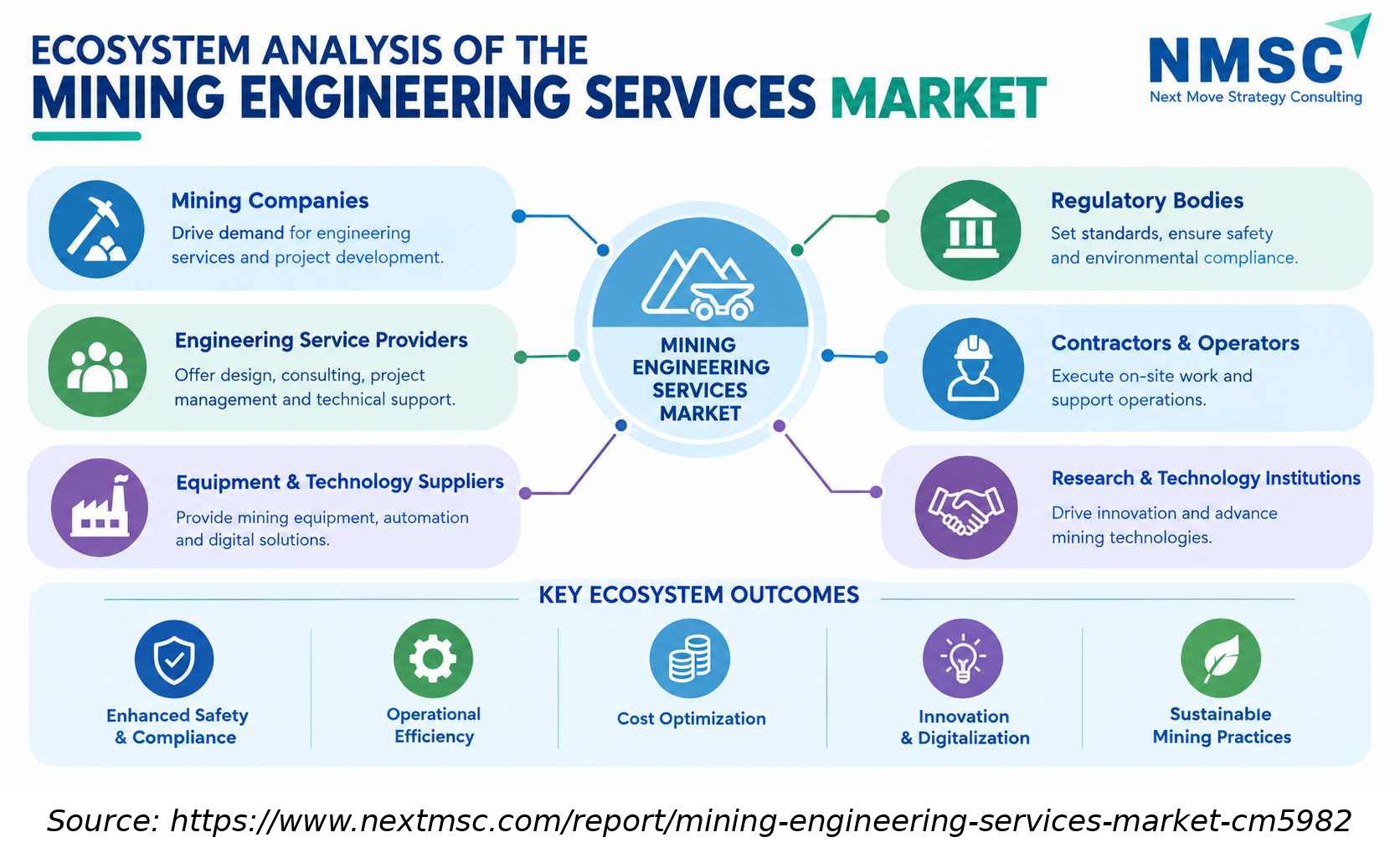
The above infographic presents the mining engineering services market ecosystem by connecting mining companies, engineering service providers, equipment and technology suppliers, contractors, regulatory bodies, and research institutions. It shows how these stakeholders interact to support mine development and operations while contributing to enhanced safety and compliance, operational efficiency, cost optimization, innovation, digitalization, and sustainable mining practices.

What Does the Mining Engineering Services Market Encompass?

The Mining Engineering Services Market encompasses advisory and studies, engineering and design, project delivery, operations and optimization, and closure and remediation services delivered to mining companies, exploration and development entities, processing firms, and public institutions across the full mine lifecycle from initial resource evaluation through post-closure care. The market spans surface, underground, in-situ, dredge, and specialist mining methods and covers commodity families ranging from base and precious metals to battery minerals, fertilizers, energy minerals, and industrial commodities.
Our findings suggest that the market has evolved from discrete project-centric engagements toward integrated lifecycle advisory relationships, as major mining companies increasingly outsource technical functions beyond their core operational competency. Environmental impact assessment requirements in North America and Europe, closure bond mandates in Australia, and tailings management standards under the Global Industry Standard on Tailings Management are structurally expanding the scope and duration of engineering service contracts. Technology adoption in digital mine planning, geospatial analytics, and autonomous equipment specification is deepening value per engagement for specialist service providers.

Competitive Landscape

Our assessment indicates that the Mining Engineering Services Market competitive landscape spans diversified multi-sector engineering groups with dedicated mining divisions, specialist mining advisory and design firms, and environmental and technical advisory specialists, each competing on multi-commodity breadth, geographic reach, and digital workflow integration capability.

Dimension Description
Dimension Assessment
Market Structure Moderately consolidated; top 10 companies hold the majority of market share in the Mining Engineering Services Market Industry, led by diversified multi-sector engineering groups alongside established specialist mining firms

Innovation Focus Expanded battery mineral project advisory, integrated digital mine planning and SCADA-linked performance engineering, AI-assisted process design, and mine closure credentialing
M&A Activity Bolt-on acquisition of specialist technical advisory, environmental services, and digital engineering firms by larger multi-sector groups seeking commodity depth and geographic reach

How Do Companies Compete in the Mining Engineering Services Market Industry?
Companies compete primarily on multi-disciplinary service breadth, geographic coverage across key mining jurisdictions, and depth of technical specialization in priority commodity families. We observed that firms with integrated capabilities spanning advisory and studies, engineering design, and project delivery maintain stronger client retention than single-discipline providers, as mine developers increasingly prefer consolidated engineering partnerships over fragmented specialist engagements. Pricing strategies range from lump-sum feasibility contracts to time-and-materials retainers and performance-linked delivery arrangements that align engineering firm incentives with project capital cost and schedule outcomes.

Which Competitive Archetypes Dominate the Mining Engineering Services Market Industry?
Three competitive archetypes define the Mining Engineering Services Market Industry: diversified multi-sector engineering groups with dedicated mining divisions, such as WSP Global, Worley, and Fluor Corporation; specialist mining engineering firms with deep commodity-specific or regional expertise, such as Hatch, DRA Global, and Lycopodium; and environmental and technical advisory specialists with significant mine closure and permitting practices, such as SLR Consulting and SRK Consulting. Diversified groups hold a structural advantage in large integrated project delivery mandates, while specialists win on technical credibility and commodity depth for complex greenfield feasibility studies.

What Innovation and Differentiation Strategies Are Companies Pursuing?

NMSC's analysis indicates that leading firms are differentiating through SCADA-integrated mine automation engineering, AI-assisted ore body modeling, and sustainability reporting frameworks that connect engineering design decisions to ESG performance disclosure. Firms that have developed proprietary geological simulation algorithms or integrated mine planning platforms are creating technical moats that competitors without equivalent R&D investment cannot readily replicate. Closure and tailings engineering credentials are emerging as a second competitive axis as regulatory scrutiny of mine waste management intensifies globally and financial assurance obligations expand the lifecycle scope of engineering mandates.

What M&A and Partnership Activity Is Shaping the Mining Engineering Services Market?

During our market evaluation, we noticed that M&A activity in the Mining Engineering Services Market is concentrated in bolt-on acquisitions of specialist firms by larger multi-sector engineering groups seeking to deepen commodity-specific technical bench strength or expand geographically into high-growth mining regions. The acquisition of environmental advisory and geotechnical specialists by diversified engineering groups reflects the growing importance of closure, tailings, and water engineering as competitive differentiators. Partnership arrangements between global engineering groups and regional technical firms are emerging across West Africa, Southeast Asia, and the Andean region to capture project mandates where local content requirements or language expertise influence procurement outcomes.
Key Market Players

Based on research conducted by NMSC, the following companies represent the validated set of leading participants across mining engineering advisory, design, project delivery, and technical services.

WSP Global Inc. Worley Limited Fluor Corporation Hatch Ltd. Bechtel Corporation Tetra Tech, Inc. Stantec Inc. AFRY AB AtkinsRéalis Group Inc. Ausenco Pty Ltd John Wood Group PLC DRA Global Limited SLR Consulting AECOM Lycopodium Limited Sedgman Pty Limited GHD Pty Ltd SRK Consulting (Global) Limited Knight Piésold DMT GmbH & Co. KG

Market Drivers & Dynamics

Interactive Dataset
Energy transition critical mineral project pipeline expansion driver +1.8% Global 2026–2035
Increasing technical complexity of greenfield mine projects driver +1.4% Global 2026–2032
Digital and automation engineering adoption in mine operations driver +0.9% Australia, North America, Asia-Pacific 2026–2035
Mine closure and remediation regulatory mandate expansion driver +0.6% Europe, North America, Australia 2026–2035
Latin America and Africa greenfield project capital deployment driver +0.5% Latin America, Middle East & Africa 2026–2033
Commodity price volatility suppressing capex commitments restraint −1.2% Global 2026–2035
Skilled workforce shortage in geotechnical and metallurgical disciplines restraint −0.8% Global 2026–2031
Permitting and social license delays in key mining jurisdictions restraint −0.5% North America, Europe 2026–2033
Competition from in-house engineering functions at major miners restraint −0.3% Global 2026–2030
Source: Next Move Strategy Consulting

Growth Drivers

What Is the Primary Growth Driver in the Mining Engineering Services Market?

The primary growth driver is the structural expansion of battery and technology mineral project development, as clean energy transition commitments require a dramatic scaling of copper, lithium, nickel, and cobalt production capacity. The International Energy Agency's Critical Minerals Market Review indicates that mineral demand for clean energy technologies is on course to more than double by 2030 under current policy trajectories, creating an extended forward pipeline of greenfield and brownfield engineering mandates that directly expands addressable market volume for mining engineering service providers.

How Is Digital Platform Adoption Driving Mining Engineering Services Market Growth?
Our analysis shows that digital platform adoption is directly driving per-project engineering revenue higher, as mine developers procure integrated simulation, scanning, and remote monitoring capabilities alongside traditional civil and process engineering scope. Digital scope is becoming a material component of study and design engineering fees on major greenfield copper and battery mineral projects initiated since 2022. This blended revenue model expands the addressable fee market per engagement and supports recurring software subscription and monitoring retainer components.

Growth Inhibitors

What Is Restraining the Mining Engineering Services Market?

Our findings suggest that commodity price volatility is the primary structural restraint, as capital expenditure decisions across the mining industry are sensitive to spot and forward prices for iron ore, copper, gold, and thermal coal. The World Bank's Commodity Markets Outlook has documented historically elevated price volatility in metals markets since 2020, and mine developers routinely defer or scale down feasibility study mandates when price signals deteriorate below project hurdle rates. This cyclical demand suppression is most acute for exploration-stage advisory and pre-feasibility study services that precede capital commitment decisions.

What Are the Growth Opportunities?

Can Battery Mineral Project Advisory Capture Disproportionate Fee Growth Through 2035?

Engineering service providers with established lithium, copper, and nickel project advisory practices are positioned to capture disproportionate revenue from the multi-decade battery mineral investment cycle. Junior and mid-tier battery mineral developers lack the internal technical depth to manage simultaneous geotechnical, metallurgical, and environmental engineering workstreams, enabling specialist advisory firms to secure multi-phase, lifecycle-spanning mandates. The Battery and Technology Minerals sub-segment within the Commodity Family axis is forecast to grow at 8.32% CAGR from 2026 to 2035, making it the primary whitespace for advisory fee expansion among firms with established critical mineral project credentials.

Does Integrated Digital Engineering Bundling Create Defensible Long-Term Revenue Streams?

Firms that bundle digital twin mine modeling, three-dimensional geological simulation, and performance optimization analytics into unified engineering service contracts can capture recurring digital retainer revenues alongside project-based fees. This integrated model benefits the Operations and Optimization service offering segment and creates structural switching costs for mine operators who embed vendor-specific digital workflows into daily production management. The fastest-growing service offering sub-segment, Operations and Optimization, is expanding at 7.08% CAGR from 2026 to 2035 precisely because operators are retaining engineering firms on long-term digital performance contracts.

Can Closure and Remediation Service Expansion Address the Market's Emerging Regulatory Liability?

Engineering firms investing in dedicated closure planning, decommissioning engineering, and post-closure monitoring capabilities are uniquely positioned to serve the growing volume of mines approaching end-of-life across established mining jurisdictions in North America, Australia, and Europe. Regulatory tightening on mine financial assurance obligations is converting single-engagement closure studies into multi-decade monitoring and site rehabilitation contracts. Closure and Post-Closure, the fastest-growing mine lifecycle sub-segment at 6.73% CAGR from 2026 to 2035, represents an underserved addressable opportunity relative to current engineering workforce capacity committed to this lifecycle phase.

Segmentation Analysis

2025 (USD Billion)
2035 (USD Billion)
Advisory and Studies 2025: $5.21 Billion | 2035: $8.64 Billion
Advisory and
Engineering and Design 2025: $10.15 Billion | 2035: $18.44 Billion
Engineering
Project Delivery Services 2025: $7.24 Billion | 2035: $12.96 Billion
Project Deli
Operations and Optimization 2025: $4.33 Billion | 2035: $8.58 Billion
Operations a
Closure and Remediation 2025: $2.04 Billion | 2035: $3.30 Billion
Closure and
Advisory and Studies $5.21 Billion $8.64 Billion 5.20%
Engineering and Design $10.15 Billion $18.44 Billion 6.17%
Project Delivery Services $7.24 Billion $12.96 Billion 5.99%
Operations and Optimization $4.33 Billion $8.58 Billion 7.08%
Closure and Remediation $2.04 Billion $3.30 Billion 4.93%

Which Service Offering Segment Leads and Which Is Fastest-Growing?

Engineering and Design leads with USD 10.15 Billion in 2025, expanding to USD 18.44 Billion by 2035, reflecting the central role of mine engineering design, process and metallurgical engineering, and geotechnical systems in every project lifecycle phase. Operations and Optimization is the fastest-growing service offering at a 7.08% CAGR, as mine operators increasingly retain engineering firms under long-term performance and digital monitoring contracts beyond the project delivery phase, generating recurring revenue streams for firms that embed digital systems into daily production management workflows.

2025 (USD Billion)
2035 (USD Billion)
Exploration
Development
Production a
Closure and
Segment Item 2025 (USD Billion) 2035 (USD Billion) CAGR
Exploration and Evaluation $10.0 USD Billion $40.0 USD Billion 20.0%
Development and Construction $17.1 USD Billion $51.1 USD Billion 18.0%
Production and Expansion $24.2 USD Billion $62.2 USD Billion 12.0%
Closure and Post-Closure $31.3 USD Billion $73.3 USD Billion 26.0%

Segment-wise data is locked

Unlock complete segment-wise numbers for By Mine Lifecycle.

Unlock Full Data

Which Mine Lifecycle Stage Dominates and Which Is Growing Fastest?

Production and Expansion leads the Mining Engineering Services Market at USD 12.08 Billion in 2025, growing to USD 21.78 Billion by 2035, reflecting the volume of operating mine optimization, expansion scoping, and sustaining capital projects that require ongoing technical operations support and performance engineering services. Closure and Post-Closure is the fastest-growing lifecycle sub-segment at 6.73% CAGR, driven by tightening regulatory requirements for concurrent closure planning and expanding financial assurance obligations across Australia, Canada, and the European Union. Effective smart water management engineering for post-closure containment is a growing component of the closure lifecycle mandate.
2025 (USD Billion)
2035 (USD Billion)
Surface Mini
Open Pit Min
Open Cast an
Quarry Minin
Non-Dredge P
Segment Item 2025 (USD Billion) 2035 (USD Billion) CAGR
Surface Mining $10.0 USD Billion $40.0 USD Billion 11.0%
Open Pit Mining $17.1 USD Billion $51.1 USD Billion 9.0%
Open Cast and Strip Mining $24.2 USD Billion $62.2 USD Billion 15.0%
Quarry Mining $31.3 USD Billion $73.3 USD Billion 9.0%
Non-Dredge Placer Mining $38.4 USD Billion $84.4 USD Billion 22.0%

Segment-wise data is locked

Unlock complete segment-wise numbers for By Mining Method.

Unlock Full Data
2025 (USD Billion)
2035 (USD Billion)
Base Metals
Copper
Nickel
Zinc and Lea
Tin
Segment Item 2025 (USD Billion) 2035 (USD Billion) CAGR
Base Metals $10.0 USD Billion $40.0 USD Billion 22.0%
Copper $17.1 USD Billion $51.1 USD Billion 16.0%
Nickel $24.2 USD Billion $62.2 USD Billion 22.0%
Zinc and Lead $31.3 USD Billion $73.3 USD Billion 16.0%
Tin $38.4 USD Billion $84.4 USD Billion 15.0%

Segment-wise data is locked

Unlock complete segment-wise numbers for By Commodity Family.

Unlock Full Data
2025 (USD Billion)
2035 (USD Billion)
Mining Compa
Exploration
Processing a
Public and F
Segment Item 2025 (USD Billion) 2035 (USD Billion) CAGR
Mining Companies $10.0 USD Billion $40.0 USD Billion 22.0%
Exploration and Development Companies $17.1 USD Billion $51.1 USD Billion 12.0%
Processing and Industrial Companies $24.2 USD Billion $62.2 USD Billion 14.0%
Public and Financial Institutions $31.3 USD Billion $73.3 USD Billion 12.0%

Segment-wise data is locked

Unlock complete segment-wise numbers for By Buyer Type.

Unlock Full Data

Which Buyer Type Leads and Which Is Growing Fastest?

Mining Companies dominate at USD 17.09 Billion in 2025, reflecting their role as the primary procurers of integrated engineering services across all project lifecycle phases from feasibility through closure. Processing and Industrial Companies represent the fastest-growing buyer type at 6.82% CAGR, as companies commissioning mineral processing plants for battery materials and specialty chemicals increasingly require metallurgical engineering, environmental permitting, and infrastructure design services that previously fell outside traditional mine engineering mandates. Public and Financial Institutions are the second-fastest-growing buyer type as development finance institutions fund mine infrastructure in emerging markets.

Growth Opportunities

Our analysis shows that three whitespace opportunities stand out for engineering service providers positioning ahead of 2035 demand in the Mining Engineering Services Market.

Can Battery Mineral Project Advisory Capture Disproportionate Fee Growth Through 2035?

Engineering service providers with established lithium, copper, and nickel project advisory practices are positioned to capture disproportionate revenue from the multi-decade battery mineral investment cycle. Junior and mid-tier battery mineral developers lack the internal technical depth to manage simultaneous geotechnical, metallurgical, and environmental engineering workstreams, enabling specialist advisory firms to secure multi-phase, lifecycle-spanning mandates. The Battery and Technology Minerals sub-segment within the Commodity Family axis is forecast to grow at 8.32% CAGR from 2026 to 2035, making it the primary whitespace for advisory fee expansion among firms with established critical mineral project credentials.

Does Integrated Digital Engineering Bundling Create Defensible Long-Term Revenue Streams?

Firms that bundle digital twin mine modeling, three-dimensional geological simulation, and performance optimization analytics into unified engineering service contracts can capture recurring digital retainer revenues alongside project-based fees. This integrated model benefits the Operations and Optimization service offering segment and creates structural switching costs for mine operators who embed vendor-specific digital workflows into daily production management. The fastest-growing service offering sub-segment, Operations and Optimization, is expanding at 7.08% CAGR from 2026 to 2035 precisely because operators are retaining engineering firms on long-term digital performance contracts.

Can Closure and Remediation Service Expansion Address the Market's Emerging Regulatory Liability?

Engineering firms investing in dedicated closure planning, decommissioning engineering, and post-closure monitoring capabilities are uniquely positioned to serve the growing volume of mines approaching end-of-life across established mining jurisdictions in North America, Australia, and Europe. Regulatory tightening on mine financial assurance obligations is converting single-engagement closure studies into multi-decade monitoring and site rehabilitation contracts. Closure and Post-Closure, the fastest-growing mine lifecycle sub-segment at 6.73% CAGR from 2026 to 2035, represents an underserved addressable opportunity relative to current engineering workforce capacity committed to this lifecycle phase.

Regional Outlook

2025 (USD Billion)
2035 (USD Billion)
North Americ
Asia-Pacific
Europe
Middle East
Latin Americ
Region 2025 (USD Billion) 2035 (USD Billion) CAGR (%)
North America $10.0 USD Billion $40.0 USD Billion 9.0%
Asia-Pacific $17.1 USD Billion $51.1 USD Billion 27.0%
Europe $24.2 USD Billion $62.2 USD Billion 25.0%
Middle East & Africa $31.3 USD Billion $73.3 USD Billion 23.0%
Latin America $38.4 USD Billion $84.4 USD Billion 12.0%

Regional data is locked

Unlock complete regional numbers for this market.

Unlock Full Data

Regulatory Framework Impacting the Mining Engineering Services Industry

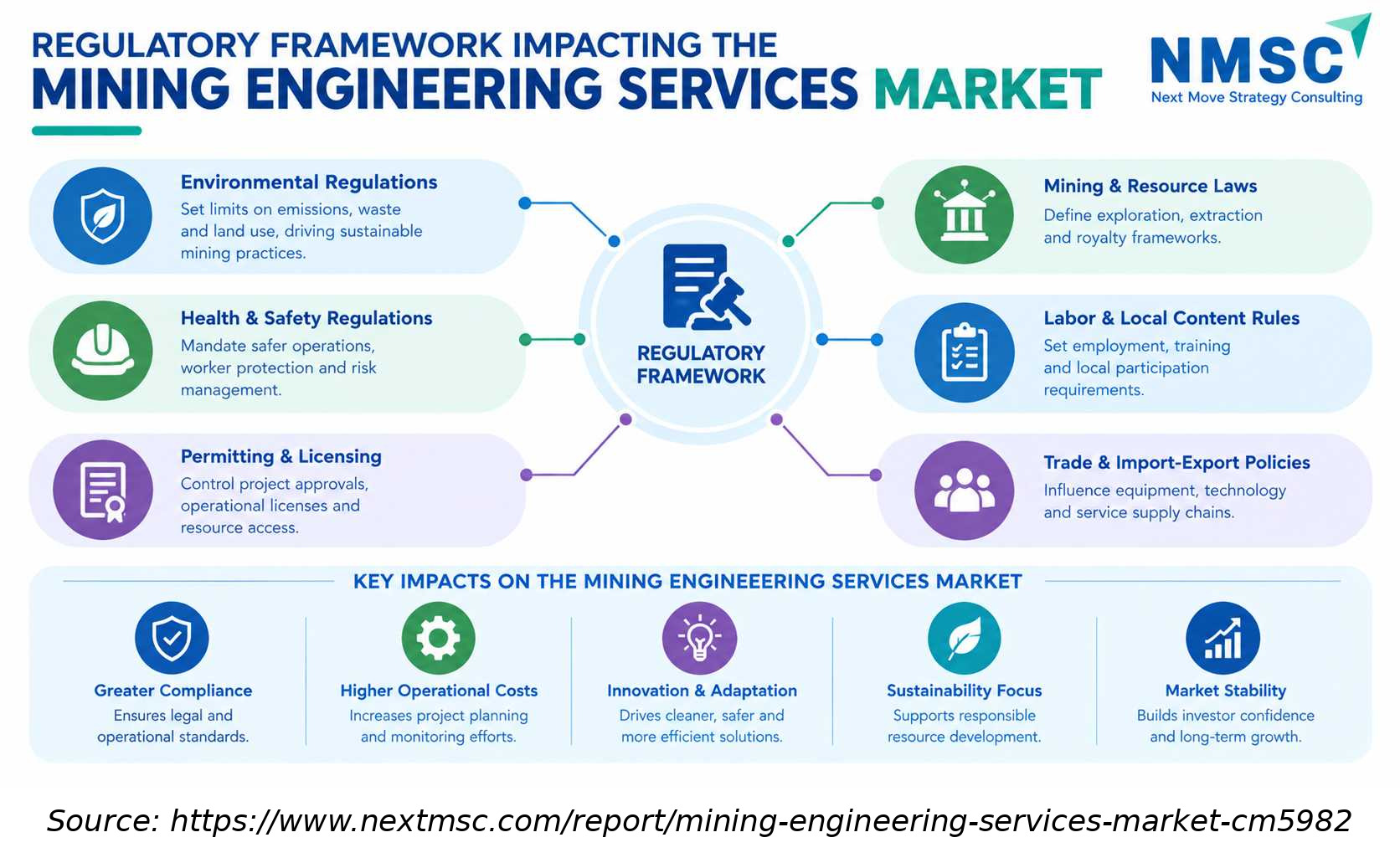
The above infographic illustrates the regulatory framework impacting the mining engineering services market through environmental regulations, health and safety rules, permitting and licensing, mining laws, labor requirements, and trade policies. It shows how these regulatory areas influence compliance, operating costs, technological adaptation, sustainability practices, and overall market stability across mining engineering projects

Latest Developments

We found that recent corporate activity in the Mining Engineering Services Market reflects continued geographic and capability expansion, digital engineering investment, and growing commitment to battery mineral project advisory across leading engineering service providers.

Date Event
May 2026 Fluor was selected to perform feasibility study services for Anglo American’s Woodsmith underground polyhalite mine. The project involves deep shafts and a 37-km underground conveyor system, creating substantial demand for engineering, mine infrastructure and project-planning services.
March 2026 Saturn Metals selected Ausenco to deliver the DFS for the Apollo Hill Gold Project in Western Australia. The assignment covers technical and economic definition of a planned 10 Mtpa operation and directly reflects demand for mining engineering, processing and feasibility services.

Investment Opportunities

Where Are Capital Inflows Concentrating in the Mining Engineering Services Market?

Capital is concentrating in battery mineral project advisory capacity and digital mine engineering platform development, as the energy transition mineral pipeline creates sustained forward demand for specialist feasibility, process, and geotechnical engineering services. The USD 20.66 Billion absolute revenue opportunity between 2026 and 2035 is most accessible to firms that have established technical credibility in lithium, copper, and nickel project development prior to the study pipeline peak. Firms without battery mineral track records are investing in targeted M&A and talent acquisition to establish the credentials required to compete for the highest-value mandates in this segment.

How Is Infrastructure Investment Shaping Long-Term Engineering Service Capacity?

Infrastructure investment by mining engineering firms is shifting toward digital mine planning software development, geospatial and remote sensing capability, and physical presence expansion in high-growth markets including Chile, Peru, Australia, Indonesia, and Saudi Arabia. These investments reflect the structural reality that proximity to resource projects, deep commodity expertise, and integrated digital delivery capability together determine which firms secure long-duration project mandates. Our findings suggest that firms investing proactively in these capabilities ahead of the peak battery mineral feasibility cycle will secure first-mover advantages in terms of client relationships and technical credentialing that are difficult for late entrants to replicate.

What ESG Considerations Are Influencing Investment Decisions in the Mining Engineering Services Market?

Environmental, Social, and Governance considerations are directly expanding the scope and value of engineering mandates in the Mining Engineering Services Market, as mining companies face growing expectations from investors, lenders, and regulators to demonstrate responsible project design and progressive closure planning from the earliest project phases. Demand for phosphate and fertilizer mineral project studies with embedded environmental impact engineering reflects the sector-wide shift toward ESG-integrated technical delivery. Investors in engineering service firms are increasingly evaluating portfolio exposure to mine closure liability management, tailings safety engineering, and biodiversity impact assessment capabilities as indicators of long-term revenue sustainability.

Key Benefits for Stakeholders

How Does This Report Benefit Industry Leaders?

Industry leaders gain segment-level revenue forecasts and CAGR benchmarks across service offering, mine lifecycle, mining method, commodity family, and buyer type axes, enabling product roadmap and service portfolio decisions grounded in the same 2025–2035 figures used consistently throughout this analysis. Our findings on regional growth differentials and commodity-specific engineering demand further support market-entry strategy, geographic footprint planning, and buyer segment prioritization decisions. The competitive landscape assessment provides a structured framework for benchmarking service breadth, digital capability, and commodity expertise against the 20 profiled firms.

How Does This Report Benefit Investors and Financial Analysts?

Investors and financial analysts gain a reconciled market-sizing model, competitive-landscape assessment, and named-company development tracking that supports valuation and capital-allocation decisions across the mining engineering services sector. The Growth Catalyst and Risk Assessment Matrix quantify driver and restraint impact on the 5.80% CAGR, aiding scenario analysis for portfolio positioning and sector exposure calibration. The absolute investment opportunity of USD 20.66 Billion between 2026 and 2035 is decomposed across segment and regional axes to support geographic and service-type investment prioritization within the engineering services peer group.

How Does This Report Benefit Technology Vendors and Product Teams?

Technology vendors and product teams gain visibility into which service offering and buyer type segments, particularly operations and optimization and processing and industrial companies, are growing fastest relative to the market average, informing where to prioritize engineering platform development and go-to-market resource allocation through 2035. Our assessment of the digital engineering adoption trend within the Key Emerging Trends section identifies the specific workflow areas - geological modeling, mine simulation, and performance monitoring - where software and digital tool demand is expanding within client engineering mandates.

Key Market Segments Evaluated

By Service Offering

  • Advisory and Studies 
    • Exploration and Resource Services
    • Economic and Feasibility Studies
    • Independent Technical Advisory
    • Audit and Assurance
  • Engineering and Design 
    • Mine Engineering
    • Geotechnical and Mine Systems
    • Process and Metallurgical Engineering
    • Mine Infrastructure Engineering
    • Water and Mine Waste Engineering
    • Environmental and Permitting Engineering
  • Project Delivery Services 
    • Project Management and Controls
    • Procurement Management
    • Construction Management
    • Commissioning and Start-Up
    • Integrated Project Delivery
  • Operations and Optimization 
    • Technical Operations Support
    • Maintenance and Asset Integrity
    • Performance Optimization
    • Digital and Automation Engineering
  • Closure and Remediation 
    • Closure Planning
    • Decommissioning Engineering
    • Reclamation and Rehabilitation
    • Post-Closure Engineering

By Mine Lifecycle

  • Exploration and Evaluation
  • Development and Construction
  • Production and Expansion
  • Closure and Post-Closure

By Mining Method

  • Surface Mining 
    • Open Pit Mining
    • Open Cast and Strip Mining
    • Quarry Mining
    • Non-Dredge Placer Mining
  • Underground Mining 
    • Supported Underground Mining
    • Caving and Bulk Underground Mining
    • Other Underground Mining
  • In-Situ and Solution Mining
  • Dredge and Marine Mining
  • Other Specialist Mining

By Commodity Family

  • Base Metals 
    • Copper
    • Nickel
    • Zinc and Lead
    • Tin
  • Precious Metals 
    • Gold
    • Silver
    • Platinum Group Metals
  • Ferrous and Alloy Minerals 
    • Iron Ore
    • Manganese
    • Chromium
    • Molybdenum and Vanadium
  • Battery and Technology Minerals 
    • Lithium
    • Graphite
    • Rare Earth Elements
    • Other Battery Minerals
  • Energy Minerals 
    • Thermal Coal
    • Metallurgical Coal
    • Uranium
    • Other Energy Minerals
  • Industrial Minerals 
    • Bauxite
    • Silica
    • Limestone and Aggregates
    • Salt and Clays
  • Fertilizer Minerals 
    • Potash
    • Phosphate
  • Diamonds and Gemstones
  • Other Minerals

By Buyer Type

  • Mining Companies
  • Exploration and Development Companies
  • Processing and Industrial Companies
  • Public and Financial Institutions

By Region

  • North America 
    • U.S.
    • Canada
    • Mexico
  • Europe 
    • UK
    • Germany
    • France
    • Italy
    • Spain
    • Sweden
    • Denmark
    • Finland
    • Netherlands
    • Rest of Europe
  • Asia-Pacific 
    • China
    • India
    • Japan
    • South Korea
    • Taiwan
    • Indonesia
    • Vietnam
    • Australia
    • Philippines
    • Malaysia
    • Rest of APAC
  • Middle East & Africa 
    • Saudi Arabia
    • UAE
    • Egypt
    • Israel
    • Turkey
    • Nigeria
    • South Africa
    • Rest of MEA
  • Latin America 
    • Brazil
    • Argentina
    • Chile
    • Colombia
    • Rest of LATAM

Conclusion & Recommendations

The long-term outlook remains structurally positive, with the Mining Engineering Services Market expanding from USD 31.26 Billion in 2026 to USD 51.92 Billion by 2035 at a 5.80% CAGR, driven by energy transition mineral demand, increasing project technical complexity, and growing mine closure regulatory obligations. Our assessment indicates that this growth trajectory is underpinned by durable structural and demographic tailwinds rather than speculative commodity demand cycles, supporting sustained engineering firm investment in service capability expansion, digital platform development, and geographic footprint broadening.

What Strategic Positioning Do We Recommend?

Our assessment indicates that engineering service providers should prioritize battery mineral project advisory capability and DSO-style integrated contract delivery to capture the fastest-growing service offering and buyer type segments. Firms without established digital mine planning and performance optimization capabilities should pursue targeted partnerships or acquisitions rather than attempting to build these functions organically, given the lead time required to credential a new digital platform within a major mine operator's engineering ecosystem. Market entry into Asia-Pacific and Latin America, the two fastest-growing regions, should be structured around joint ventures or local content-compliant delivery models to navigate regulatory and social license complexity.

How Attractive Is the Mining Engineering Services Market for Investment?

Investment attractiveness is high in Asia-Pacific and Latin America given superior CAGR profiles of 6.43% and 5.89%, respectively, while North America offers the largest absolute revenue base with strong digital engineering and closure planning-driven recurring demand. We found that Operations and Optimization and Closure and Remediation service offering streams offer more durable margin and growth profiles than commoditized feasibility study services, making them preferred investment targets within the engineering services value chain. Battery and Technology Minerals and Base Metals are the most attractive commodity family investment themes through 2035.

What Are the Key Market Shifts and Risks in the Mining Engineering Services Market?

Key risks include commodity price volatility constraining capex and study mandate volume, the skilled workforce shortage in geotechnical and metallurgical disciplines limiting delivery capacity, and permitting and social license delays extending the timeline between study award and project sanction. Our analysis shows that engineering firms unable to demonstrate deep battery mineral technical credentials risk being excluded from the fastest-growing segment of the advisory and feasibility pipeline through 2035. Additionally, firms competing primarily on price in feasibility and design mandates without differentiated digital or specialist capability face long-term margin pressure as clients consolidate toward integrated delivery partners.

What Are the Primary Growth Pathways Through 2035?

Primary growth pathways include battery mineral project advisory capacity expansion, integrated digital engineering bundling for long-term operations and optimization retainers, and targeted mine closure and remediation service development. Our analysis shows that companies combining battery mineral advisory credentials, digital mine planning platforms, and closure engineering expertise are best positioned to capture a disproportionate share of the USD 20.66 Billion absolute opportunity created between 2026 and 2035. Geographic expansion into Asia-Pacific, Latin America, and sub-Saharan Africa, combined with local content delivery capability, will be a key differentiator for firms competing for the highest-value greenfield project mandates in the next investment cycle.

FAQs

About the Author

Mayurima Roy

Mayurima Roy

Mayurima Roy is Research Analyst at Next Move Strategy Consulting, where she has spent 4 years working across the firm's full industry coverage rather than a single fixed vertical. Her work centers on structured research, ongoing trend tracking, competitive assessment, and insight-led content development, translating complex market data into clear, decision-ready narratives that support informed client decision-making across diverse global industries, market sectors, and world regions every day.

About the Reviewer

Supradip Baul

Supradip Baul

Supradip Baul is an accomplished business consultant and strategist with over a decade of rich experience in market intelligence, strategy, technology, and business transformation. His work has included rigorous qualitative and quantitative analysis across multiple industries, helping clients shape investment decisions and long-term roadmaps. Earlier in his career, he was associated with Gartner, where he contributed to industry-leading reports and market share analyses. He has worked with leading global companies and holds an MBA with a dual specialization in Marketing and Finance.

Download Free Sample

Melanie Samko

MELANIE SAMKO

Director of Marketing

TOSOH BIOSCIENCE, INC.

The information provided by NMSC is incredibly valuable, thank you so much for such a excellent work. I really appreciate it. I will make sure to reference all of it, in my summary document.

Gustaf Hummel Burstrom

GUSTAF HUMMEL BURSTROM

Founder

Revline Tools AB

Joseph and the team at Next Move Strategy Consulting have been excellent to work with, in supplying us with relevant market data and forecasts for our specific category. We had some special requirements and they were able to do a custom package to suit our needs. We would definitely recommend them to any other company needing market data and forecasts

Rishabh Jogani

RISHABH JOGANI

Strategy Analyst

Accenture Japan

We are incredibly impressed with the market report on the real estate market in India provided by Next Move Strategy Consulting. The report was thorough, insightful, and well-structured, offering deep analysis and actionable recommendations. It not only captured the current trends and dynamics but also provided a forward-looking perspective that has been invaluable for our strategic planning. Their team demonstrated exceptional professionalism, attention to detail, and a profound understanding of the industry. The data-driven insights and clarity of presentation exceeded our expectations, making complex market trends easy to understand. We highly recommend Next Move Strategy Consulting to anyone looking for reliable and comprehensive market research services. Their expertise has given us the confidence to navigate the complexities of the Indian real estate market with clarity and foresight.

Nishant Awate

NISHANT AWATE

Business Development Global Sales

Zehnder Group Deutschland GmbH

Our experience working with Next Move Strategy Consulting was positive. The team was responsive, professional, and open to incorporating our specific requirements throughout the project. The India AHU market study was comprehensive and well structured, covering market value and volume forecasts, product and application segments, and key industry trends. The inclusion of both AHU and residential MVHR market insights made the study particularly relevant for our strategic market assessment. Overall, the report provides a solid foundation for evaluating market potential, identifying priority segments, and supporting business-development decisions in India.

Ross J Mckenzie

ROSS J MCKENZIE

Business Insight Manager

Staysure Group

“Next MSC have been incredibly helpful in providing detailed & robust information on our market, alongside quantifying growth by different segments. The process to procure was simple and easy, with sample reports and regular contact to ensure we had what we needed. Succinct detail on their sources & methodologies is also greatly received, allowing transparency in this respect helps build trust in the detail you pay for. Joseph in particular was fantastic, and helped ensure efficient provision of the insight pack – thank you NMSC!”.

Custom Market Research Services

We will customize the research for you if the listed report does not fully match your requirements.

Get 30% Free Customization

Select License

This website uses cookies to ensure you get the best experience on our website. Learn more

✖