AI-Based Energy Forecasting Services Market Size, Share, Trends and Growth Analysis, By Revenue Stream (SaaS Subscription, Managed Forecasting Services, Professional Services, AI-Enhanced Data Services, and Support and Training), By Forecast Type (Load Forecasting, Renewable Generation Forecasting, Power Price Forecasting, and Others), By Forecast Horizon, By Deployment Mode, By Sales Channel, By Buyer Industry — Global Industry Report and Forecast, 2026–2035
Industry: Energy & Power | Publishing Date: July 14, 2026 | Last Updated: September 30, 2026 | No of Pages: N/A | No. of Tables: N/A | No. of Figures: N/A | Format: PDF | Report Code: EP5142
What Is the AI-Based Energy Forecasting Services Market Size?
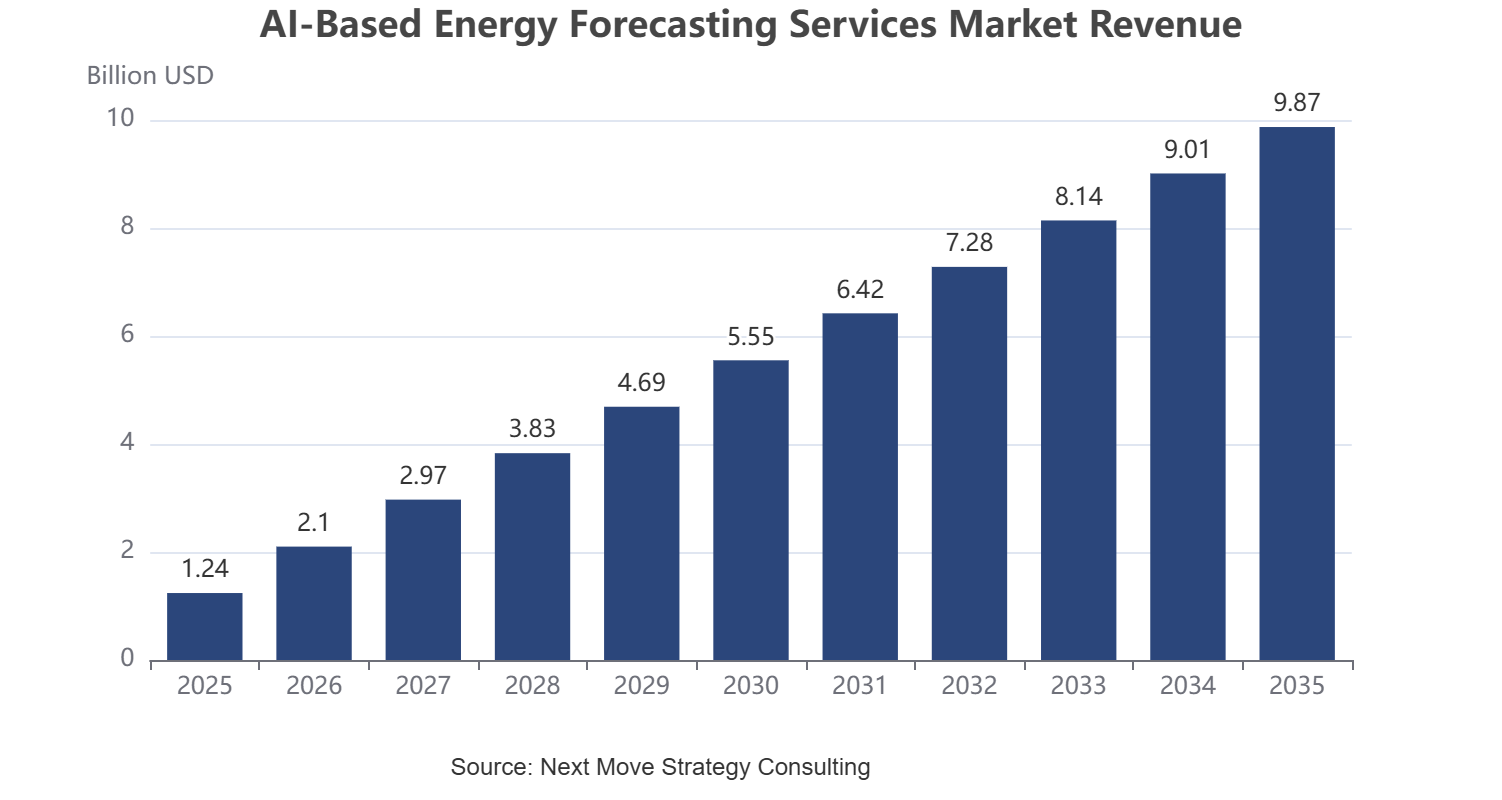
The global AI-Based Energy Forecasting Services Market size was valued at USD 1.24 Billion in 2025 and is estimated at USD 1.52 Billion in 2026, forecast to reach USD 9.87 Billion by 2035, expanding at a 23.1% CAGR between 2026 and 2035. North America leads with approximately 36% share, while under revenue stream, SaaS Subscription dominates with approximately 40% share.
We observed that growth is broad-based across every segmentation axis, with real-time renewable generation forecasting and distributed energy resource analytics driving the dominant structural shifts through 2035.
|
Key Takeaways |
|
By Revenue Stream: SaaS Subscription held the largest share of approximately 40% (USD 496 Million) in 2025; AI-Enhanced Data Services is the fastest-growing sub-segment at 31.1% CAGR from 2026–2035. |
|
By Forecast Type: Load Forecasting held the largest share of approximately 32% (USD 397 Million) in 2025; Flexibility and DER Forecasting is the fastest-growing sub-segment at 29.8% CAGR from 2026–2035. |
|
By Forecast Horizon: Intraday and Day-Ahead held the largest share of approximately 34% (USD 422 Million) in 2025; Real-Time is the fastest-growing sub-segment at 28.4% CAGR from 2026–2035. |
|
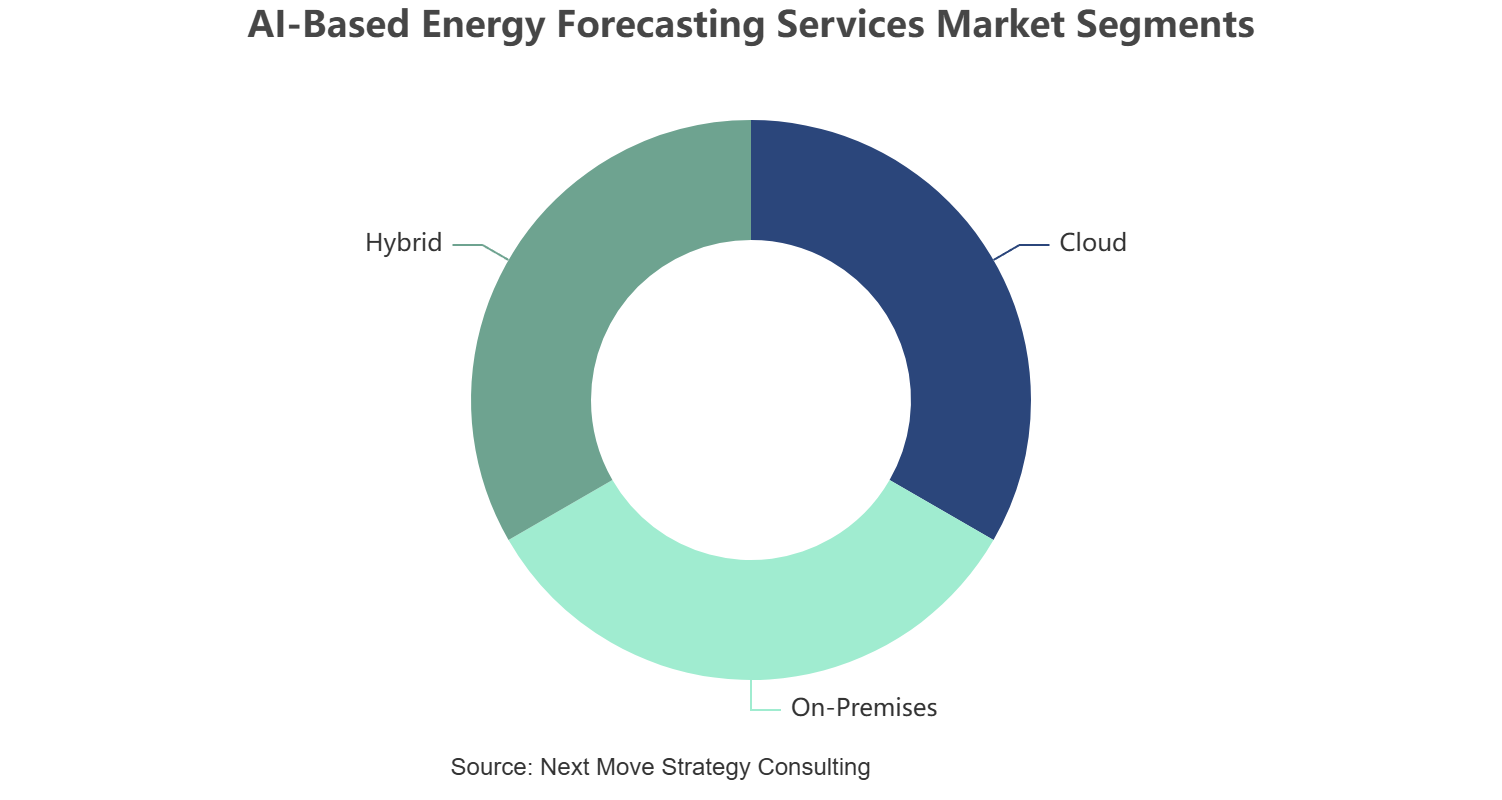
By Deployment Mode: Cloud held the largest share of approximately 54% (USD 670 Million) in 2025; Hybrid is the fastest-growing sub-segment at 26.2% CAGR from 2026–2035. |
|
By Sales Channel: Direct Sales held the largest share of approximately 61% (USD 756 Million) in 2025; Marketplace Sales is the fastest-growing sub-segment at 30.4% CAGR from 2026–2035. |
|
By Buyer Industry: Electric Utilities held the largest share of approximately 38% (USD 471 Million) in 2025; Commercial and Industrial Enterprises is the fastest-growing sub-segment at 27.9% CAGR from 2026–2035. |
|
Dominant Region: North America dominated with approximately 36% revenue share (USD 446 Million) in 2025. |
|
Fastest-Growing Region: Asia-Pacific is expected to register the highest CAGR of 29.7% during 2026–2035. |
|
Dominant Country: U.S. led with approximately USD 348 Million in 2025. |
|
Fastest-Growing Country: India is the fastest-growing country at approximately 32.0% CAGR from 2026–2035. |
Between 2026 and 2035, the AI-Based Energy Forecasting Services Market is set to generate an absolute dollar opportunity of USD 8.35 Billion, positioning renewable generation forecasting and distributed energy resource analytics as a compelling area for capital allocation.
According to Next Move Strategy Consulting analysis, sustained investment in agentic and probabilistic forecasting models is reshaping procurement criteria for grid operators, as forecast-error-linked service level agreements increasingly determine vendor shortlisting across utility and independent power producer segments.
What does the AI-Based Energy Forecasting Services Market Encompass?
The AI-Based Energy Forecasting Services Market encompasses software platforms, managed services, and professional services that apply machine learning and statistical modeling to predict electricity load, renewable generation output, wholesale power prices, and distributed energy resource behavior. Our assessment indicates that the scope spans standalone forecasting platforms, embedded forecasting modules, operational forecast delivery, model operations and tuning, implementation and advisory services, and AI-generated weather and market data supplied to utilities, grid operators, independent power producers, energy traders, and commercial and industrial enterprises worldwide.
Regulatory frameworks such as the U.S. Federal Energy Regulatory Commission's Order 2222 on distributed energy resource market participation and the European Network of Transmission System Operators for Electricity's balancing guidelines shape forecast accuracy and reporting requirements, while national grid codes increasingly mandate probabilistic forecasting for renewable-heavy grids. We observed that technology adoption is shifting toward foundation-model-based and agentic forecasting architectures that continuously retrain on real-time telemetry. Next Move Strategy Consulting's analysis indicates that this structural shift, combined with rising renewable penetration, is redefining sourcing criteria across the AI-Based Energy Forecasting Services Market.
|
Parameter |
Details |
|
Market Size in 2025 |
USD 1.24 Billion |
|
Market Size in 2026 |
USD 1.52 Billion |
|
Revenue Forecast in 2035 |
USD 9.87 Billion |
|
Growth Rate |
CAGR of 23.1% from 2026 to 2035 |
|
Analysis Period |
2025–2035 |
|
Base Year Considered |
2025 |
|
Forecast Period |
2026–2035 |
|
Market Size Estimation |
Revenue (USD Billion) |
|
Companies Profiled |
20 |
|
Countries Covered |
33 |
|
Market Share |
Available for Top 10 Companies |
Key Emerging Trends
Based on research conducted by Next Move Strategy Consulting, we found that four structural trends are reshaping product development, sourcing, and stakeholder engagement across the AI-Based Energy Forecasting Services Market.
How Are Foundation Models Transforming Load and Renewable Forecasting Accuracy?
Foundation-model-based forecasting architectures trained on large-scale weather, telemetry, and historical load datasets are replacing narrow, single-purpose statistical models. We observed that IBM Corporation's watsonx platform has expanded time-series foundation-model capabilities applicable to load and renewable generation forecasting, enabling utilities to fine-tune a shared base model across multiple feeders and substations. Grid operators are adopting these architectures to shorten model deployment cycles, while forecasting vendors are retooling platforms to accommodate transfer learning across geographically diverse asset portfolios.
Why Is Probabilistic and Uncertainty-Aware Forecasting Gaining Adoption?
Probabilistic forecasting outputs, which quantify confidence intervals rather than single point estimates, are gaining share as grid operators respond to rising renewable variability. Our findings suggest that day-ahead and intraday market participants increasingly specify quantile-based forecast delivery to improve reserve procurement decisions. Vendors such as Oracle Corporation and Hitachi Energy Ltd. are expanding probabilistic modeling portfolios, positioning uncertainty-aware forecasting as a premium, higher-margin category within the broader market segmentation structure.
How Is Real-Time Telemetry Integration Reshaping Forecasting Infrastructure Requirements?
Rising deployment of smart meters, phasor measurement units, and distributed sensor networks is pushing forecasting vendors toward streaming, low-latency data pipelines capable of ingesting continuous telemetry. We observed that forecasting platforms increasingly integrate with utility advanced metering infrastructure to support sub-hourly model retraining. This trend is elevating demand for cloud-native and hybrid deployment architectures among grid operators and independent system operators, while software vendors redesign pipelines to minimize latency between telemetry ingestion and forecast publication.
What Role Does Agentic AI Play in Forecasting Model Operations?
Agentic AI systems capable of autonomously monitoring forecast drift, triggering retraining, and flagging anomalous grid conditions are emerging as a response to model-operations scrutiny. Our analysis shows that managed forecasting service providers in energy trading and utility operations are piloting agent-based monitoring layers paired with human-in-the-loop validation to reduce forecast error escalations. Microsoft Corporation's Azure AI agent framework, extended into energy analytics partnerships during 2025, exemplifies this direction with continuous model operations tooling engineered for grid-scale forecasting workloads.
Strategic Framework of the AI-Based Energy Forecasting Services Market
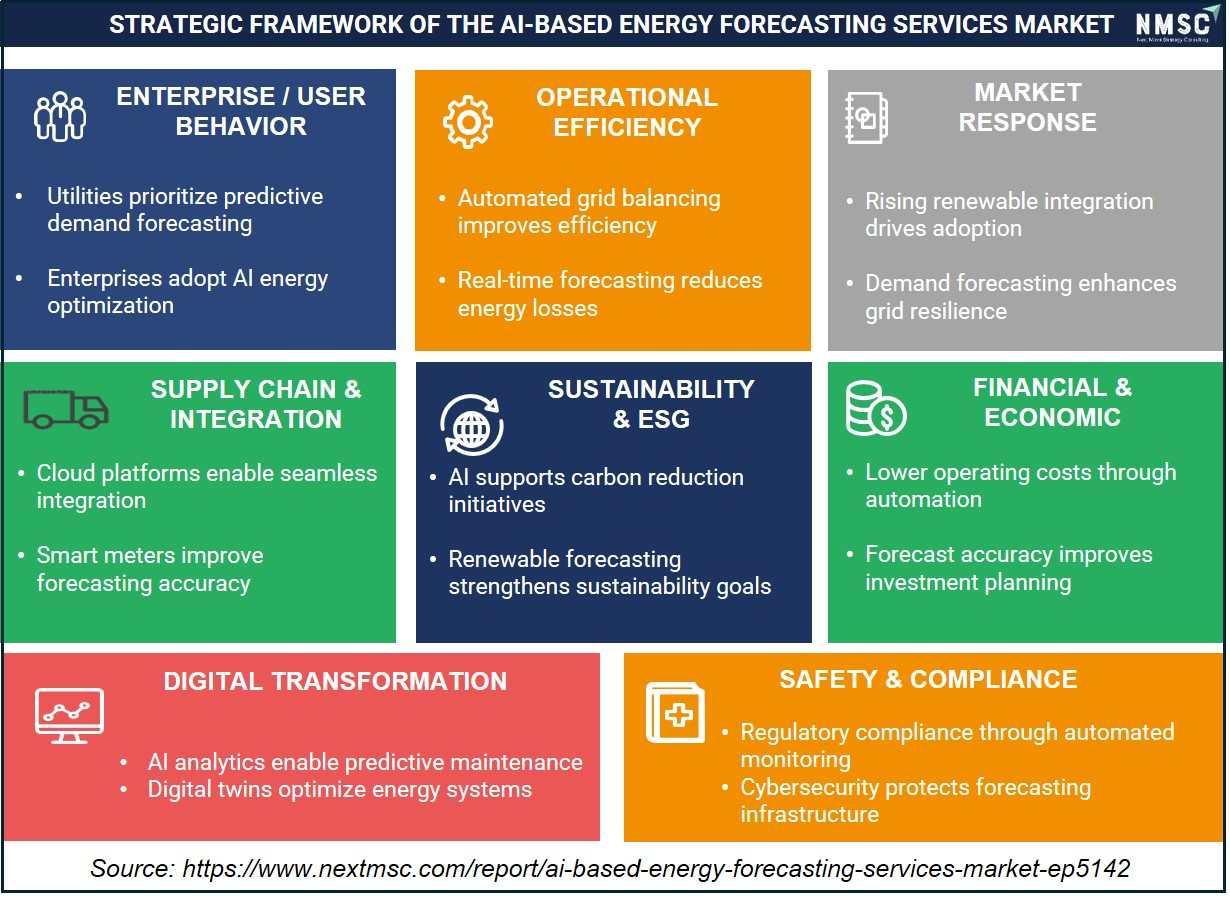
Based on our strategic assessment, we observed that utilities prioritize predictive forecasting, operational efficiency, renewable integration, and digital transformation to optimize electricity management. Moreover, AI-powered forecasting platforms improve decision-making, strengthen sustainability initiatives, enhance regulatory compliance, and reduce operational costs, thereby supporting continuous market expansion across energy ecosystems
Growth Drivers and Restraints
Growth Catalyst and Risk Assessment Matrix
|
Factors |
Type |
(+/−) % Impact on CAGR |
Geographic Relevance |
Impact Timeline |
|
Rising renewable energy penetration and grid variability |
Driver |
+3.2% |
Global |
2026-2035 |
|
Grid modernization and smart meter rollout mandates |
Driver |
+2.4% |
North America, Europe |
2026-2035 |
|
Expansion of distributed energy resources and demand response programs |
Driver |
+2.1% |
North America, Asia-Pacific |
2026-2035 |
|
Electricity market deregulation and real-time price signaling |
Driver |
+1.7% |
Europe, Asia-Pacific |
2026-2035 |
|
Rising adoption of cloud-native AI infrastructure by utilities |
Driver |
+1.5% |
Global |
2026-2032 |
|
Government clean-energy and grid-resilience funding programs |
Driver |
+1.2% |
North America, Asia-Pacific |
2026-2035 |
|
Data quality and interoperability gaps across legacy grid systems |
Restraint |
-1.4% |
Global |
2026-2035 |
|
Shortage of skilled AI and grid-analytics talent |
Restraint |
-1.0% |
North America, Europe |
2026-2032 |
|
Cybersecurity and data-sovereignty concerns in cloud deployment |
Restraint |
-0.7% |
Europe, Middle East & Africa |
2028-2035 |
What Is the Primary Growth Driver of the AI-Based Energy Forecasting Services Market?
Rising renewable energy penetration and the resulting grid variability are the primary driver of the AI-Based Energy Forecasting Services Market. The U.S. Energy Information Administration reports that renewable sources continue to account for a growing share of new U.S. generating capacity additions, sustaining utility and grid operator demand for accurate wind and solar output forecasts. We observed that this structural shift, reinforced by rising battery storage dispatch complexity, continues to anchor baseline consumption of load and renewable generation forecasting services across developed and emerging power markets alike.
How Is Grid Modernization Driving AI-Based Energy Forecasting Services Market Growth?
Smart meter rollouts and grid modernization investment are accelerating AI-Based Energy Forecasting Services Market growth toward real-time, telemetry-driven models. The U.S. Department of Energy's grid modernization initiatives and the European Network of Transmission System Operators for Electricity's balancing platform investments are pushing utilities to specify AI-enabled forecasting as a core operational capability. Our assessment indicates that this infrastructure investment, combined with rising distributed energy resource penetration, is compressing adoption timelines for cloud-native forecasting platforms across North America and Europe.
What Is Restraining AI-Based Energy Forecasting Services Market Expansion?
Data quality and interoperability gaps across legacy grid metering and SCADA systems restrain the pace of AI model deployment across the market. The U.S. Department of Energy has noted persistent interoperability challenges among legacy utility data systems that complicate real-time analytics integration. We found that smaller regional utilities face particular exposure, as limited data infrastructure budgets reduce their ability to adopt advanced forecasting platforms compared with larger, digitally mature transmission system operators.
Segmentation Analysis
Segment Sizing: By Revenue Stream
|
Segment |
2025 (USD) |
2035 (USD) |
CAGR% (2026–2035) |
|
SaaS Subscription |
USD 496 Million |
USD 3.69 Billion |
22.2% |
|
Managed Forecasting Services |
USD 310 Million |
USD 2.12 Billion |
21.0% |
|
Professional Services |
USD 186 Million |
USD 1.37 Billion |
22.0% |
|
AI-Enhanced Data Services |
USD 149 Million |
USD 2.09 Billion |
31.1% |
|
Support and Training |
USD 99 Million |
USD 604 Million |
19.5% |
|
Total |
USD 1.24 Billion |
USD 9.87 Billion |
23.1% |
Which Revenue Stream Dominates the AI-Based Energy Forecasting Services Market?
SaaS Subscription remained the dominant revenue stream across the AI-Based Energy Forecasting Services Market, valued at USD 496 Million in 2025 on sustained demand for standalone forecasting platforms and embedded forecasting modules among utilities and grid operators. Our findings suggest that AI-Enhanced Data Services is the fastest-growing revenue stream, registering a 31.1% CAGR from 2026 to 2035, as AI-generated weather and market price datasets increasingly supplement in-house forecasting pipelines across energy trading and independent power producer segments.
Segment Sizing: By Forecast Type
|
Segment |
2025 (USD) |
2035 (USD) |
CAGR% (2026–2035) |
|
Load Forecasting |
USD 397 Million |
USD 2.36 Billion |
19.1% |
|
Renewable Generation Forecasting |
USD 347 Million |
USD 3.10 Billion |
24.7% |
|
Power Price Forecasting |
USD 248 Million |
USD 1.78 Billion |
21.7% |
|
Flexibility and DER Forecasting |
USD 149 Million |
USD 1.92 Billion |
29.8% |
|
Site Energy Use Forecasting |
USD 99 Million |
USD 716 Million |
21.9% |
|
Total |
USD 1.24 Billion |
USD 9.87 Billion |
23.1% |
Which Forecast Type Leads the AI-Based Energy Forecasting Services Market?
Load Forecasting remained the leading forecast type across the AI-Based Energy Forecasting Services Market, reaching USD 397 Million in 2025 due to its foundational role in utility resource planning and grid balancing operations. Based on research conducted by Next Move Strategy Consulting, we found that Flexibility and DER Forecasting represents the fastest-growing category at a 29.8% CAGR from 2026 to 2035, reflecting rising battery dispatch complexity and demand response program expansion across North America and Asia-Pacific.
Segment Sizing: By Buyer Industry
|
Segment |
2025 (USD) |
2035 (USD) |
CAGR% (2026–2035) |
|
Electric Utilities |
USD 471 Million |
USD 3.36 Billion |
21.6% |
|
Grid Operators and ISOs |
USD 248 Million |
USD 1.92 Billion |
22.7% |
|
Independent Power Producers |
USD 174 Million |
USD 1.33 Billion |
22.6% |
|
Energy Traders and Retailers |
USD 149 Million |
USD 1.34 Billion |
24.8% |
|
Commercial and Industrial Enterprises |
USD 136 Million |
USD 1.53 Billion |
27.9% |
|
Government and Regulators |
USD 394 Million |
20.1% |
|
|
Total |
USD 1.24 Billion |
USD 9.87 Billion |
23.1% |
Which Buyer Industry Accounts for the Largest AI-Based Energy Forecasting Services Market Share?
Electric Utilities accounted for the largest buyer industry share of the AI-Based Energy Forecasting Services Market, valued at USD 471 Million in 2025 on sustained load and renewable forecasting procurement for grid operations. Our analysis shows that Commercial and Industrial Enterprises is the fastest-growing buyer segment, expanding at a 27.9% CAGR from 2026 to 2035, as on-site generation, battery storage, and demand-response participation increasingly require site-level energy use forecasting capability.
Growth Opportunities
Our analysis shows that three forward-looking opportunities stand out for stakeholders positioning within the AI-Based Energy Forecasting Services Market over the 2026-2035 forecast period.
How Are Battery Dispatch Forecasting Platforms Creating Opportunities for Independent Power Producers?
Battery dispatch forecasting presents a whitespace opportunity for independent power producers and energy storage operators seeking to optimize state-of-charge scheduling against volatile intraday prices. Suppliers that commercialize dispatch-optimized forecasting modules stand to capture recurring subscription revenue as storage operators shift toward AI-assisted arbitrage strategies, particularly across deregulated markets in North America and Europe seeking differentiated, revenue-maximizing dispatch platforms.
Why Are Embedded Forecasting Modules Emerging as a Growth Opportunity for Energy Software Vendors?
Energy management and distributed energy resource management software vendors represent an underpenetrated opportunity for embedded forecasting modules that plug directly into existing operational technology stacks. Vendors that develop lightweight, API-first forecasting engines for commercial and industrial enterprises can secure long-term platform-embedded revenue streams, benefiting from recurring licensing tied to broader energy management software adoption cycles.
How Is AI-Generated Weather Data Unlocking Opportunities for Renewable Asset Operators?
Renewable asset operators seeking higher-resolution weather inputs create an opportunity for AI-enhanced data service providers offering hyperlocal, machine-learning-refined weather forecasts. Early movers that validate forecast accuracy improvements against national meteorological benchmarks can differentiate with wind and solar generation forecasting customers pursuing tighter forecast-error-linked service contracts across their renewable asset portfolios.
Regional Outlook
Geographic Performance Snapshot
|
Region |
2025 (USD) |
2035 (USD) |
CAGR% (2026–2035) |
Key Driver |
|
North America |
USD 446 Million |
USD 2.63 Billion |
19.1% |
Mature grid modernization programs and FERC Order 2222 DER market rules |
|
Europe |
USD 298 Million |
USD 1.70 Billion |
18.7% |
ENTSO-E balancing platform investment and renewable integration mandates |
|
Asia-Pacific |
USD 322 Million |
USD 4.11 Billion |
29.7% |
Rapid renewable capacity additions and grid digitalization investment |
|
Middle East & Africa |
USD 99 Million |
USD 881 Million |
24.7% |
Vision-linked renewable diversification and grid resilience programs |
|
Latin America |
USD 75 Million |
USD 545 Million |
21.9% |
Expanding renewable auctions and modernizing transmission infrastructure |
|
Total |
USD 1.24 Billion |
USD 9.87 Billion |
23.1% |
– |
North America AI-Based Energy Forecasting Services Market Outlook
North America leads the AI-Based Energy Forecasting Services Market with an established grid modernization program base and mature independent system operator infrastructure. We observed that Federal Energy Regulatory Commission Order 2222 continues to expand distributed energy resource market participation, sustaining demand for flexibility and DER forecasting platforms, while utilities increasingly specify cloud-native forecasting to meet real-time balancing requirements. Technology adoption remains advanced, with independent system operators such as PJM Interconnection and CAISO driving demand for probabilistic, low-latency forecasting across the region's deregulated wholesale markets.
Europe AI-Based Energy Forecasting Services Market Outlook
Europe's AI-Based Energy Forecasting Services Market benefits from an integrated transmission system operator network and aggressive renewable integration targets. We observed that the European Network of Transmission System Operators for Electricity's balancing guidelines sustain demand for cross-border renewable generation forecasting, while European Commission clean-energy policy continues to expand grid investment. Technology adoption is advancing steadily, with regulatory influence remaining high across Germany, France, and the UK's liberalized power markets.
Asia-Pacific AI-Based Energy Forecasting Services Market Outlook
Asia-Pacific is the fastest-growing region in the AI-Based Energy Forecasting Services Market, underpinned by rapid renewable capacity additions and large-scale grid digitalization programs across China, India, and Australia. We observed that national grid operators are scaling AI-enabled load and renewable forecasting to manage rising variable generation shares. Regulatory influence is developing steadily, technology penetration is accelerating through cloud-based platform adoption, and competitive intensity is rising as both global vendors and domestic technology providers expand regional forecasting portfolios.
Middle East & Africa AI-Based Energy Forecasting Services Market Outlook
The Middle East & Africa AI-Based Energy Forecasting Services Market is expanding as national diversification programs drive utility-scale renewable investment. We observed that grid operators across the Gulf Cooperation Council are piloting AI-based forecasting to manage rising solar generation shares. Regulatory influence remains developing, technology penetration is advancing through partnerships with global platform vendors, and strategic outlook favors utilities pursuing renewable-heavy generation mixes under national energy diversification agendas.
Latin America AI-Based Energy Forecasting Services Market Outlook
Latin America's AI-Based Energy Forecasting Services Market is supported by expanding renewable energy auctions and modernizing transmission infrastructure across Brazil and Argentina. We observed that grid operators are gradually adopting AI-enabled forecasting to manage rising wind and solar penetration from competitive renewable auction programs. Regulatory influence remains moderate, technology adoption favors cloud-delivered platforms given limited on-premises infrastructure budgets, and competitive intensity is centered on a small number of regional and global vendors serving utility-scale renewable operators.
U.S. AI-Based Energy Forecasting Services Market
Based on our engagements, U.S.'s AI-Based Energy Forecasting Services Market was valued at approximately USD 348 Million in 2025, projected to reach USD 1.82 Billion by 2035 at a 18.0% CAGR. Demand structure reflects a mature, deregulated wholesale power market with extensive independent system operator infrastructure. Regulatory influence is high under FERC Order 2222, technology penetration is advanced through cloud-native forecasting adoption, and competitive intensity remains strong among global software vendors and specialized forecasting providers serving utilities and grid operators nationwide.
Canada AI-Based Energy Forecasting Services Market
Through our analysis, Canada's AI-Based Energy Forecasting Services Market was valued at approximately USD 62 Million in 2025, projected to reach USD 298 Million by 2035 at a 17.0% CAGR. Demand structure is shaped by provincially regulated utilities investing in grid modernization and renewable integration. Regulatory influence remains moderate, technology penetration is advancing through partnerships with global cloud vendors, and competitive intensity is centered on a limited set of forecasting providers serving hydro-heavy and wind-integrated provincial grids.
UK AI-Based Energy Forecasting Services Market
From our assessment, UK's AI-Based Energy Forecasting Services industry was valued at approximately USD 66 Million in 2025, projected to reach USD 317 Million by 2035 at a 17.0% CAGR. Demand structure is driven by the National Energy System Operator's balancing requirements and expanding offshore wind capacity. Regulatory influence is significant under Ofgem's market frameworks, technology penetration is advanced, and competitive intensity is rising as forecasting vendors compete for national balancing and ancillary service contracts.
Germany AI-Based Energy Forecasting Services Market
According to evaluation, Germany's AI-Based Energy Forecasting Services industry was valued at approximately USD 80 Million in 2025, projected to reach USD 456 Million by 2035 at a 19.0% CAGR. Demand structure reflects Germany's leading renewable generation share and Energiewende-driven grid investment. Regulatory influence is high under Bundesnetzagentur oversight, technology penetration is advanced through transmission system operator adoption, and competitive intensity remains strong among established European and global forecasting vendors.
France AI-Based Energy Forecasting Services Market
Based on our engagements, France's AI-Based Energy Forecasting Services industry was valued at approximately USD 54 Million in 2025, projected to reach USD 283 Million by 2035 at a 18.0% CAGR. Demand structure is shaped by a nuclear-renewable hybrid generation mix requiring precise load and price forecasting. Regulatory influence is moderate to high under RTE's balancing framework, technology penetration is advancing steadily, and competitive intensity is centered on established European vendors serving the state-influenced power sector.
China AI-Based Energy Forecasting Services Market
Through our analysis, China's AI-Based Energy Forecasting Services industry was valued at approximately USD 129 Million in 2025, projected to reach USD 1.78 Billion by 2035 at a 30.0% CAGR. Demand structure is driven by the world's largest renewable capacity build-out and aggressive grid digitalization investment. Regulatory influence is substantial under National Energy Administration planning, technology penetration is accelerating rapidly through domestic and global platform adoption, and competitive intensity is intensifying as domestic technology providers scale forecasting capabilities.
India AI-Based Energy Forecasting Services Market
From our assessment, India's AI-Based Energy Forecasting Services industry was valued at approximately USD 51 Million in 2025, projected to reach USD 819 Million by 2035 at a 32.0% CAGR. Demand structure is shaped by rapid renewable capacity additions under national solar and wind targets. Regulatory influence is developing under Central Electricity Regulatory Commission frameworks, technology penetration is expanding through cloud-based platform adoption, and competitive intensity is rising as global vendors partner with domestic system integrators.
Japan AI-Based Energy Forecasting Services Market
According to evaluation, Japan's AI-Based Energy Forecasting Services industry was valued at approximately USD 45 Million in 2025, projected to reach USD 279 Million by 2035 at a 20.0% CAGR. Demand structure reflects post-liberalization grid restructuring and rising renewable integration requirements. Regulatory influence is moderate under the Organization for Cross-regional Coordination of Transmission Operators, technology penetration is advancing steadily, and competitive intensity remains moderate among established regional and global vendors.
South Korea AI-Based Energy Forecasting Services Market
Based on our engagements, South Korea's AI-Based Energy Forecasting Services industry was valued at approximately USD 32 Million in 2025, projected to reach USD 275 Million by 2035 at a 24.0% CAGR. Demand structure is driven by national renewable energy expansion targets and grid digitalization investment led by Korea Electric Power Corporation. Regulatory influence is developing, technology penetration is advancing through utility-led pilot programs, and competitive intensity remains moderate given a concentrated utility buyer base.
Australia AI-Based Energy Forecasting Services Market
Through our analysis, Australia's AI-Based Energy Forecasting Services industry was valued at approximately USD 26 Million in 2025, projected to reach USD 190 Million by 2035 at a 22.0% CAGR. Demand structure is shaped by high rooftop solar penetration and the Australian Energy Market Operator's forecasting requirements for renewable-heavy grids. Regulatory influence is significant under AEMO's market rules, technology penetration is advanced, and competitive intensity is rising among vendors serving the National Electricity Market.
UAE AI-Based Energy Forecasting Services Market
From our assessment, UAE's AI-Based Energy Forecasting Services industry was valued at approximately USD 25 Million in 2025, projected to reach USD 252 Million by 2035 at a 26.0% CAGR. Demand structure is shaped by the UAE's role as a regional clean-energy investment hub and utility-scale solar expansion. Regulatory influence remains moderate, technology penetration is improving through partnerships with global platform vendors, and competitive intensity is rising as vendors expand forecasting portfolios to serve Gulf utilities.
Saudi Arabia AI-Based Energy Forecasting Services Market
According to evaluation, Saudi Arabia's AI-Based Energy Forecasting Services industry was valued at approximately USD 30 Million in 2025, projected to reach USD 328 Million by 2035 at a 27.0% CAGR. Demand is driven by Vision 2030-linked renewable diversification and utility-scale solar and wind project pipelines. Regulatory influence is developing under national energy sector guidelines, and technology penetration is advancing as domestic utilities scale digital grid capabilities.
South Africa AI-Based Energy Forecasting Services Market
Based on our engagements, South Africa's AI-Based Energy Forecasting Services industry was valued at approximately USD 15 Million in 2025, projected to reach USD 93 Million by 2035 at a 20.0% CAGR. Demand structure reflects a developing grid modernization program addressing chronic supply constraints through renewable integration. Regulatory influence remains moderate, technology penetration is gradually improving, and competitive intensity is limited given reliance on international forecasting vendors and development-finance-backed renewable projects.
Brazil AI-Based Energy Forecasting Services Market
Through our analysis, Brazil's AI-Based Energy Forecasting Services industry was valued at approximately USD 41 Million in 2025, projected to reach USD 300 Million by 2035 at a 22.0% CAGR. Demand is underpinned by Brazil's large renewable auction program and expanding wind and solar capacity. Regulatory influence stems from ANEEL's regulatory framework, technology penetration favors cloud-delivered platforms, and competitive intensity remains moderate among regional and global vendors serving the National Interconnected System.
Argentina AI-Based Energy Forecasting Services Market
From our assessment, Argentina's AI-Based Energy Forecasting Services industry was valued at approximately USD 14 Million in 2025, projected to reach USD 87 Million by 2035 at a 20.0% CAGR. Demand structure is supported by steady renewable auction activity despite macroeconomic volatility. Regulatory influence remains limited, technology penetration is modest, and competitive intensity is centered on a small number of regional distributors serving domestic utility and renewable operator segments.
PESTEL Analysis of the AI-Based Energy Forecasting Services Market
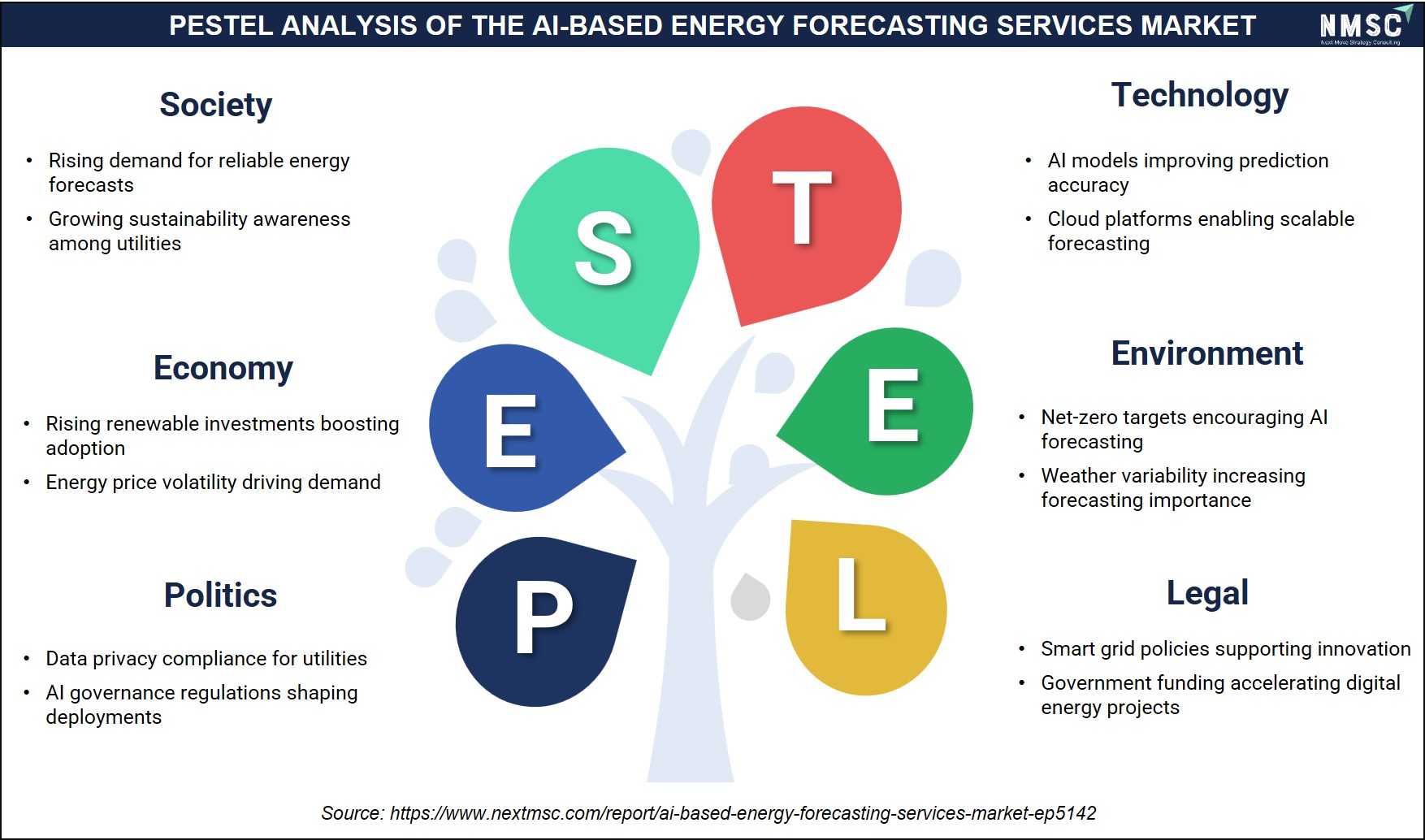
Based on our PESTEL assessment, we identified that political support for energy digitalization, economic investments in grid modernization, social demand for reliable electricity forecasting, technological advances in AI analytics, environmental sustainability goals, and evolving regulatory frameworks collectively shape the AI-based energy forecasting service market. Furthermore, these macroeconomic and regulatory factors accelerate solution adoption while strengthening long-term market competitiveness and operational resilience.
Competitive Landscape
We observed that the AI-Based Energy Forecasting Services Market features a moderately consolidated competitive landscape, with diversified industrial technology conglomerates competing alongside specialized energy-analytics software vendors on forecast accuracy, model architecture, and grid-scale deployment experience.
|
Dimension |
Description |
|
Market Structure |
Moderately consolidated; the top companies profiled in this report collectively account for a majority of global AI-Based Energy Forecasting Services Market revenue, while numerous specialized regional analytics vendors serve niche utility and industrial forecasting demand. |
|
Innovation Focus |
Foundation-model-based forecasting, probabilistic and uncertainty-aware modeling, and agentic model-operations tooling dominate current innovation pipelines across leading suppliers. |
|
M&A Activity |
Selective consolidation through platform acquisitions, exemplified by large industrial technology vendors acquiring specialized energy-analytics startups to broaden AI-based forecasting and grid-analytics portfolios. |
How Do Companies Compete in the AI-Based Energy Forecasting Services Market?
Companies compete primarily on forecast accuracy, model transparency, and grid-scale deployment experience across the AI-Based Energy Forecasting Services Market. Global technology players such as IBM Corporation and Microsoft Corporation leverage broad cloud and AI infrastructure to serve multinational utility customers, while specialized vendors such as Amperon Holdings, Inc. and Innowatts, Inc. compete on forecast-error performance and rapid implementation for regional utility and commercial and industrial customers.
Which Competitive Archetypes Dominate the AI-Based Energy Forecasting Services Market?
Two archetypes dominate the AI-Based Energy Forecasting Services Market: diversified industrial technology conglomerates offering integrated grid-analytics and automation portfolios, and specialized forecasting-native software vendors focused on high-accuracy, purpose-built prediction models. Siemens AG and Schneider Electric SE exemplify the diversified archetype through integrated grid-automation and forecasting offerings, while C3.ai, Inc. and Bidgely, Inc. exemplify the specialized archetype serving utility and commercial energy analytics demand.
How Are Companies Differentiating Through Innovation in AI-Based Energy Forecasting Services?
Innovation and differentiation strategy increasingly center on foundation-model adaptation and probabilistic forecast delivery. GE Vernova Inc. and Hitachi Energy Ltd. continue to expand grid-analytics platforms that combine forecasting with broader grid-automation capabilities. Our analysis shows that vendors unable to demonstrate credible forecast-accuracy benchmarks risk exclusion from utility request-for-proposal shortlists across North America and Europe's increasingly performance-based procurement frameworks.
What M&A and Expansion Activity Is Shaping the AI-Based Energy Forecasting Services Market?
Mergers, acquisitions, and geographic expansion continue to consolidate forecasting capabilities within the AI-Based Energy Forecasting Services Market. Large cloud and industrial technology vendors have pursued targeted acquisitions of specialized energy-analytics startups to broaden AI-based forecasting portfolios, while forecasting-native vendors such as Uplight, Inc. and GridBeyond Limited expand geographic footprints into Asia-Pacific and Middle Eastern utility markets, illustrating how both archetypes pursue expansion and pricing leverage across utility, grid operator, and commercial end markets.
Key Market Players
Our assessment indicates that the following 20 companies represent the validated competitive set actively shaping product innovation, model architecture, and geographic expansion strategy within the global AI-Based Energy Forecasting Services Market.
-
GE Vernova Inc.
-
Hitachi Energy Ltd.
-
IBM Corporation
-
Oracle Corporation
-
ABB Ltd.
-
Microsoft Corporation
-
Amazon Web Services, Inc.
-
C3.ai, Inc.
-
Uplight, Inc.
-
Enverus, Inc.
-
Bidgely, Inc.
-
Amperon Holdings, Inc.
-
Innowatts, Inc.
-
GridBeyond Limited
-
Utopus Insights, Inc.
-
Vaisala Oyj
-
UL Solutions Inc.
Latest Developments
We found that recent product launches and partnerships within the AI-Based Energy Forecasting Services Market are concentrated on foundation-model-based and probabilistic forecasting capabilities, reflecting the industry's broader shift toward higher-accuracy, real-time prediction.
|
Date |
Event |
|
April 2026 |
Amperon launched new Probabilistic Asset Solar and Wind Short-Term Forecasts. This allows energy companies to move beyond single-point predictions and instead quantify the uncertainty of renewable generation. This capability is critical in 2026 as grid operators struggle with the extreme volatility of a renewable-heavy energy mix. |
|
January 2026 |
At CES 2026, Siemens launched the Digital Twin Composer, an AI-native tool designed to simulate entire industrial environments. For energy utilities, this allows for high-fidelity simulations that integrate weather patterns and grid load forecasting in a 3D virtual environment. This "Industrial Metaverse" approach helps operators identify up to 90% of potential grid stability issues before they occur. |
|
January 2026 |
Amperon, a leader in AI-driven grid demand forecasting, announced a significant investment from Samsung Ventures. The partnership is designed to scale Amperon's hyper-granular load forecasting technology, which is currently being used to help power traders and utilities manage the extreme demand volatility caused by the rapid expansion of AI-driven data centers. |
Expert Insights
 “The future of digital intelligence is quite bright, and so the future of the energy sector is bright, too. The greatest impact and return is in applying AI in the delivery of energy over the grid.”
— Jensen Huang, CEO, NVIDIA
Statement made during a discussion at the Edison Electric Institute (EEI), emphasizing the transformative role of AI in energy systems and grid operations.
Market Interpretation
The statement highlights the increasing integration of artificial intelligence in energy grid operations, which serves as a critical foundation for AI-based energy forecasting services. By enabling real-time data processing and intelligent energy distribution, AI enhances the ability of utilities to anticipate demand fluctuations and optimize supply. As energy systems become more complex with the growing penetration of renewable sources, AI-driven forecasting and grid intelligence solutions are gaining traction to improve operational efficiency, ensure grid stability, and support data-driven decision-making across the energy sector.
Investment Opportunities
How Are Capital Inflows Shaping the AI-Based Energy Forecasting Services Market?
Capital inflows into the AI-Based Energy Forecasting Services Market are concentrated among venture-backed forecasting-native software vendors and strategic corporate investment from diversified industrial technology conglomerates. We observed that investors continue to favor vendors demonstrating measurable forecast-accuracy improvements over generic AI infrastructure providers, reflecting a maturing investment thesis centered on domain-specific model performance rather than broad platform breadth alone.
How Is Infrastructure Investment Supporting Market Expansion?
Grid modernization and cloud infrastructure investment are directly supporting AI-Based Energy Forecasting Services Market expansion. The U.S. Department of Energy's continued grid infrastructure funding programs and comparable European Union clean-energy investment initiatives are expanding the telemetry and connectivity foundation required for real-time AI forecasting deployment, creating durable demand tailwinds for cloud-native forecasting platform vendors across developed power markets.
What ESG Considerations Influence Investment in AI-Based Energy Forecasting Services?
Environmental, Social, and Governance considerations increasingly influence investment decisions within the AI-Based Energy Forecasting Services Market, as accurate renewable generation forecasting directly supports grid decarbonization goals by reducing curtailment and fossil-fuel balancing reserve requirements. Our findings suggest that investors increasingly evaluate forecasting vendors on their contribution to renewable integration outcomes, alongside traditional financial performance metrics, when assessing long-term portfolio positioning.
Key Benefits for Stakeholders
How Does This Report Benefit Utility and Grid Operator Leaders?
Utility and grid operator leaders benefit from this report's granular segmentation analysis and country-level forecasts, which support vendor evaluation and technology roadmap planning. Our assessment indicates that the report's Growth Catalyst and Risk Assessment Matrix and Competitive Landscape analysis provide actionable benchmarks for prioritizing forecasting investments across load, renewable generation, and flexibility forecasting use cases.
How Does This Report Benefit Investors and Financial Analysts?
Investors and financial analysts benefit from the report's consolidated market sizing, segmentation, and regional forecasts, which support due diligence on forecasting-native software vendors and diversified technology conglomerates alike. We found that the Investment Opportunities and Key Market Players sections offer a structured basis for evaluating competitive positioning and capital allocation priorities within the AI-Based Energy Forecasting Services Market.
How Does This Report Benefit Technology Vendors and Product Teams?
Technology vendors and product teams benefit from the report's Key Emerging Trends and Growth Opportunities sections, which identify specific product-development priorities including foundation-model adaptation, probabilistic forecasting, and embedded forecasting modules. Our analysis shows that this strategic insight supports roadmap prioritization for vendors seeking to align product development with validated market demand signals across the forecast period.
Key Market Segments
By Revenue Stream
-
SaaS Subscription
-
Standalone Forecasting Platform
-
Embedded Forecasting Module
-
-
Managed Forecasting Services
-
Operational Forecast Delivery
-
Model Operations and Tuning
-
-
Professional Services
-
Implementation and Integration
-
Custom Model Development and Advisory
-
-
AI-Enhanced Data Services
-
AI-Generated Weather Forecasts
-
AI-Generated Market and Price Data
-
-
Support and Training
-
Technical Support and SLAs
-
User Enablement
-
By Forecast Type
-
Load Forecasting
-
System-Wide Load
-
Feeder and Substation Load
-
-
Renewable Generation Forecasting
-
Wind
-
Solar
-
Hybrid Renewables
-
-
Power Price Forecasting
-
Day-Ahead
-
Intraday
-
Long-Term Price
-
-
Flexibility and DER Forecasting
-
DER Adoption
-
Demand Response
-
Battery Dispatch
-
-
Site Energy Use Forecasting
-
Commercial Buildings
-
Industrial Plants
-
Campuses and Microgrids
-
By Forecast Horizon
-
Real-Time
-
Intraday and Day-Ahead
-
Short-Term
-
Mid-Term
-
Long-Term
By Deployment Mode
-
Cloud
-
On-Premises
-
Hybrid
By Sales Channel
-
Direct Sales
-
Channel Partner Sales
-
Marketplace Sales
By Buyer Industry
-
Electric Utilities
-
Grid Operators and ISOs
-
Independent Power Producers
-
Energy Traders and Retailers
-
Commercial and Industrial Enterprises
-
Government and Regulators
By Region
-
North America: U.S., Canada, Mexico.
-
Europe: UK, Germany, France, Italy, Spain, Sweden, Denmark, Finland, Netherlands, Rest of Europe.
-
Asia-Pacific: China, India, Japan, South Korea, Taiwan, Indonesia, Vietnam, Australia, Philippines, Malaysia, Rest of APAC.
-
Middle East & Africa: Saudi Arabia, UAE, Egypt, Israel, Turkey, Nigeria, South Africa, Rest of MEA.
-
Latin America: Brazil, Argentina, Chile, Colombia, Rest of LATAM.
Conclusion and Recommendations
What Is the Long-Term Outlook for the AI-Based Energy Forecasting Services Market?
The long-term outlook for the AI-Based Energy Forecasting Services Market remains highly positive, with global revenue projected to expand nearly eightfold from USD 1.24 billion in 2025 to USD 9.87 billion by 2035 at a 23.1% CAGR. We observed that sustained renewable capacity growth, grid modernization investment, and distributed energy resource expansion will continue underpinning demand across utility, grid operator, and commercial and industrial applications through the forecast period.
What Strategic Positioning Should AI-Based Energy Forecasting Services Suppliers Pursue?
Suppliers should prioritize probabilistic, foundation-model-based forecasting platforms while pursuing forecast-error-linked service level agreements to secure long-term utility and grid operator contracts. Our assessment indicates that vendors investing early in real-time telemetry integration and agentic model-operations capability will be best positioned to capture premium pricing within the AI-Based Energy Forecasting Services Market.
How Attractive Is the AI-Based Energy Forecasting Services Market for New Investment?
The AI-Based Energy Forecasting Services Market presents a highly attractive investment case, supported by a USD 8.35 billion absolute dollar opportunity between 2026 and 2035 and above-average growth in Asia-Pacific and AI-Enhanced Data Services categories. We found that investment attractiveness is highest for vendors combining forecast-accuracy credentials with scaled cloud infrastructure, positioning them to serve both cost-sensitive and premium utility segments simultaneously.
What Market Shifts and Key Risks Should Stakeholders Monitor?
Stakeholders should monitor data interoperability constraints, AI talent shortages, and cybersecurity concerns in cloud deployment as key risks to the AI-Based Energy Forecasting Services Market. Our analysis shows that vendors unable to adapt to evolving grid data standards risk losing utility contracts to competitors with certified interoperability and cybersecurity credentials, particularly within Europe's increasingly regulated data-sovereignty environment.
What Are the Key Growth Pathways for the AI-Based Energy Forecasting Services Market?
Key growth pathways include expanding probabilistic and agentic forecasting portfolios, scaling cloud-native deployment capacity, and deepening penetration into commercial and industrial site energy use forecasting. Next Move Strategy Consulting's analysis indicates that suppliers pursuing these pathways while maintaining cost competitiveness in standard load forecasting categories will be best positioned to capture the AI-Based Energy Forecasting Services Market's projected growth through 2035.
About the Author
 Saista Faiyaz
— Saista Faiyaz is Research Associate at Next Move Strategy Consulting, where she has covered consumer markets and healthcare technologies for 3 years. Her work includes primary interview review, secondary-source validation, market sizing, and structured analysis of company and industry data. She supports research by comparing evidence across sources, organizing findings into market narratives, and documenting assumptions used in analysis. Her scope includes cross-market benchmarking, and reports.
Saista Faiyaz
— Saista Faiyaz is Research Associate at Next Move Strategy Consulting, where she has covered consumer markets and healthcare technologies for 3 years. Her work includes primary interview review, secondary-source validation, market sizing, and structured analysis of company and industry data. She supports research by comparing evidence across sources, organizing findings into market narratives, and documenting assumptions used in analysis. Her scope includes cross-market benchmarking, and reports.
About the Reviewer
 Supradip Baul
— Supradip Baul is an accomplished business consultant and strategist with over a decade of rich experience in market intelligence, strategy, technology, and business transformation. His work has included rigorous qualitative and quantitative analysis across multiple industries, helping clients shape investment decisions and long-term roadmaps. Earlier in his career, he was associated with Gartner, where he contributed to industry-leading reports and market share analyses. He has worked with leading global companies and holds an MBA with a dual specialization in Marketing and Finance.
Supradip Baul
— Supradip Baul is an accomplished business consultant and strategist with over a decade of rich experience in market intelligence, strategy, technology, and business transformation. His work has included rigorous qualitative and quantitative analysis across multiple industries, helping clients shape investment decisions and long-term roadmaps. Earlier in his career, he was associated with Gartner, where he contributed to industry-leading reports and market share analyses. He has worked with leading global companies and holds an MBA with a dual specialization in Marketing and Finance.
At Next Move Strategy Consulting, we understand that insightful market research is the cornerstone of successful business decisions. That's why we employ a robust and multifaceted approach, combining various methodologies to deliver the most accurate and actionable data for our clients.

Research Landscape
We navigate the world of research with two primary approaches:
Qualitative Approach
Our qualitative research methodologies involve immersive techniques such as in-depth interviews, focus groups, and observational studies. By engaging directly with individuals and stakeholders, we uncover valuable insights that quantitative data alone may overlook.

Quantitative Research
In tandem with qualitative methodologies, NMSC leverages the power of Quantitative Research to provide a robust foundation of numerical insights. Through systematic data collection and analysis, we quantify patterns, preferences, and market trends, offering a comprehensive view of the business landscape.
Our quantitative research approach employs diverse tools, including surveys, experiments, and statistical modelling. These methodologies enable us to gather data from a large and representative sample, ensuring the statistical significance of our findings. By employing structured questionnaires and standardized data collection methods, we guarantee the reliability and validity of the information we present to our clients.
Quantitative research is particularly effective in measuring the prevalence of trends, assessing market size, and gauging the impact of various factors on consumer behavior. The numerical precision attained through this approach equips our clients with actionable insights, facilitating data-driven decision-making and strategy formulation.


Our Specialized Toolbox for Industry-Specific Market Research
We deploy a specialized arsenal of techniques tailored to meet your unique requirements. Here's a glimpse into our comprehensive toolbox:

Information Procurement
The stage entails acquiring market data or relevant information through various sources and methodologies.


Market Research Approach
We utilize both top-down and bottom-up approaches in market research analysis to achieve a comprehensive understanding of the market dynamics, leveraging the broad perspective of industry trends and macroeconomic factors alongside detailed insights from specific segments and individual companies.

Porters Five Forces Analysis
We conduct Porter's Five Forces analysis to evaluate the competitive landscape of an industry, providing us with insights into factors that affect profitability and strategic positioning.

SWOT Analysis

Forecasting
We utilize a forecasting model to predict future consumption by considering parameters like population, economics, regulations, market competition, drivers, constraints, technology, and pricing. We also employ statistical techniques such as multilinear regression, exponential smoothing, moving average, ARIMA, and Monte Carlo simulations for accurate predictions. In econometric forecasting, we analyzed short-term and long-term event impacts, attributing values based on regulatory frameworks, economic factors, and market events.





 Speak to Our Analyst