Site Reliability Engineering-as-a-Service Market Size, Share, and Trends Analysis by Service Type (Managed SRE Services, Incident Management and Response, Observability and Monitoring, SRE Consulting and Advisory, SRE Staffing and Training), Organization Size (Large Enterprises, Small and Medium Enterprises), End-Use Industry (BFSI, IT and Telecom, Retail and E-commerce, Healthcare, Media and Entertainment, Others), and Region — Global Industry Report and Forecast, 2026–2035
Industry: ICT & Media | Publishing Date: August 11, 2026 | Last Updated: August 11, 2026 | No of Pages: N/A | No. of Tables: N/A | No. of Figures: N/A | Format: PDF | Report Code: IC5659
What Is the Site Reliability Engineering-as-a-Service Market Size?
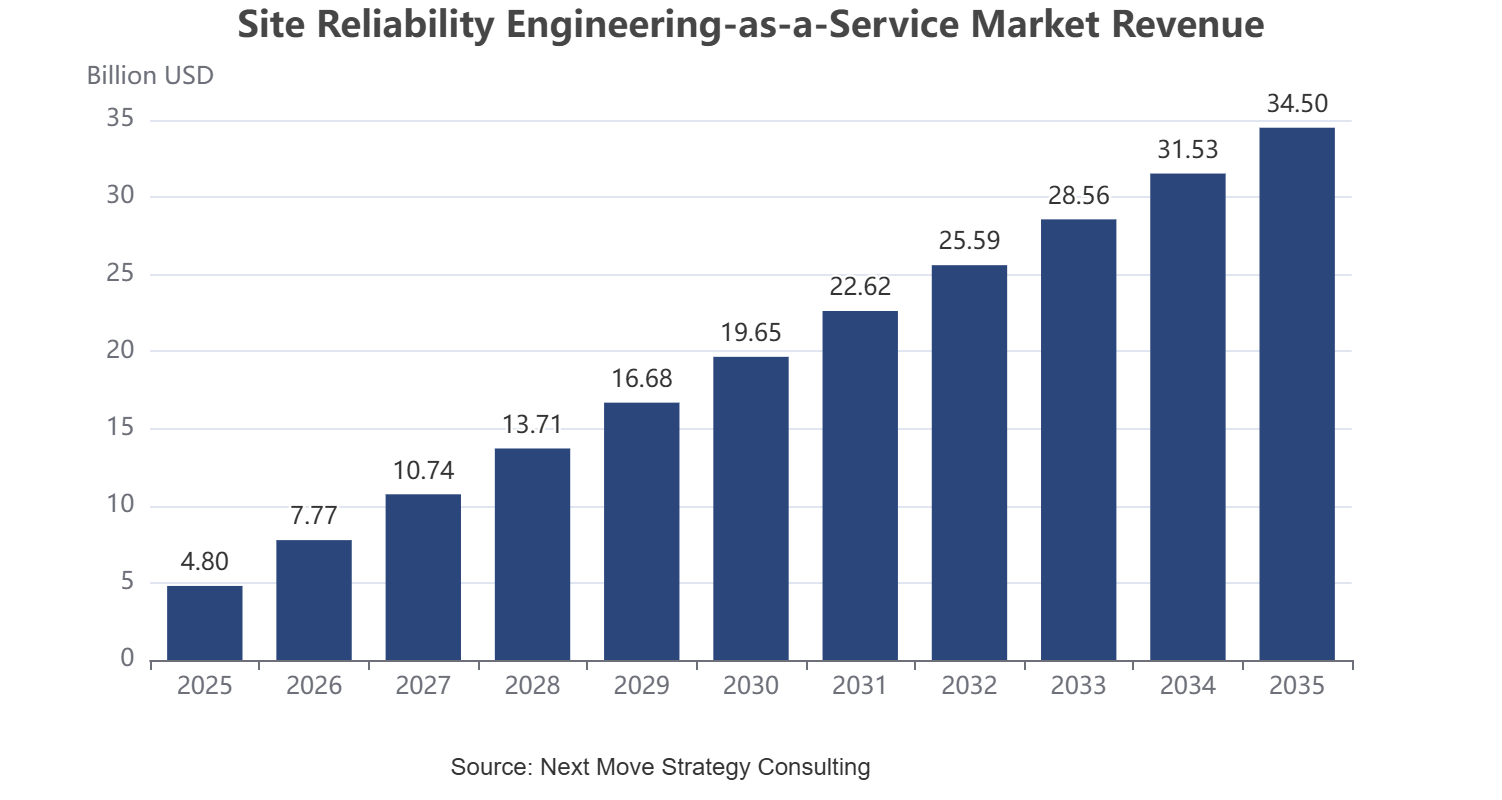
The global Site Reliability Engineering-as-a-Service Market size reached USD 4.80 Billion in 2025 and is estimated at USD 5.85 Billion in 2026, forecast to reach USD 34.50 Billion by 2035 at a CAGR of 21.79% between 2026 and 2035. North America leads with an approximate 46% share, while Managed SRE Services dominates the service-type segment at approximately 34% share in 2025.
We observed that enterprises are increasingly outsourcing full-stack reliability operations rather than building in-house SRE teams, a shift reinforced by the introduction of generative AI-based incident response capabilities that are compressing detection-to-resolution timelines across managed service engagements.
|
Key Takeaways |
|
By Service Type: Managed SRE Services held the largest share, expanding from USD 1.63 billion in 2025 to USD 13.11 billion by 2035; Managed SRE Services is also the fastest-growing sub-segment at 23.30% CAGR from 2026–2035. |
|
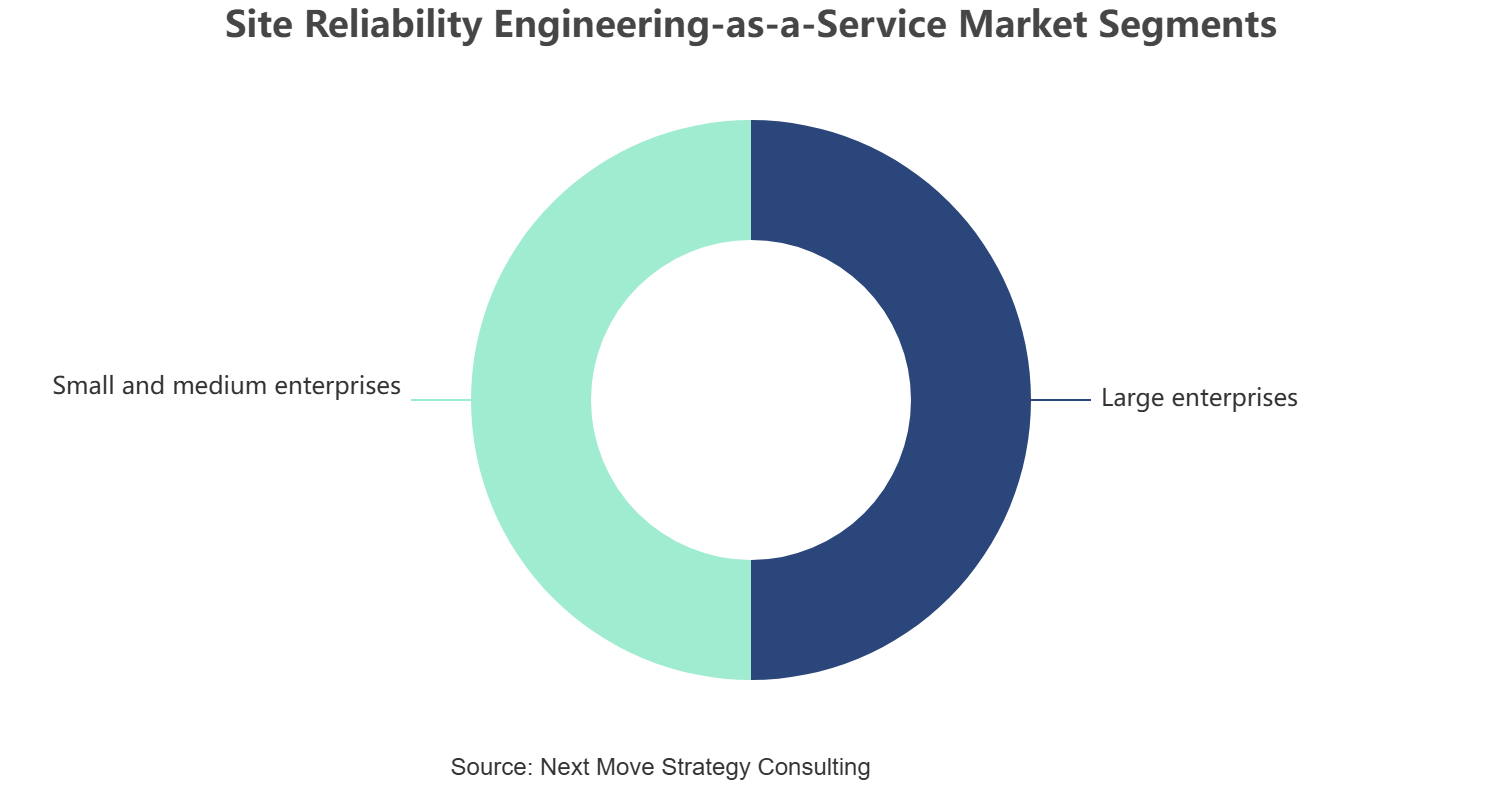
By Organization Size: Large Enterprises held the largest share, expanding from USD 3.26 billion in 2025 to USD 20.70 billion by 2035; Small and Medium Enterprises is the fastest-growing sub-segment at 24.87% CAGR from 2026–2035. |
|
By End-Use Industry: IT and Telecom held the largest share, expanding from USD 1.26 billion in 2025 to USD 8.30 billion by 2035; Others is the fastest-growing sub-segment at 23.32% CAGR from 2026–2035. |
|
Dominant Region: North America dominated with approximately 46% revenue share in 2025. |
|
Fastest-Growing Region: Middle East & Africa is expected to register the highest CAGR of 25.40% during 2026–2035. |
|
Dominant Country: The U.S. led the market, anchored by concentrated enterprise cloud adoption and managed reliability spend. |
|
Fastest-Growing Country: India is the fastest-growing country, supported by expanding IT services delivery capacity for global SRE engagements. |
The Site Reliability Engineering-as-a-Service Market presents an absolute investment opportunity of approximately USD 28.65 Billion between 2026 and 2035, calculated as the difference between the 2035 forecast of USD 34.50 Billion and the 2026 base of USD 5.85 Billion, positioning managed reliability platforms and AI-assisted incident response as a high-conviction category for enterprise software and IT services investors.
According to NMSC analysis, the segment's momentum stems from a persistent shortage of experienced site reliability engineers, which is pushing enterprises of all sizes toward outsourced delivery models that combine platform tooling with staffed operational expertise rather than building internal capability from scratch.
Ecosystem Analysis of the Site Reliability Engineering-as-a-Service Industry
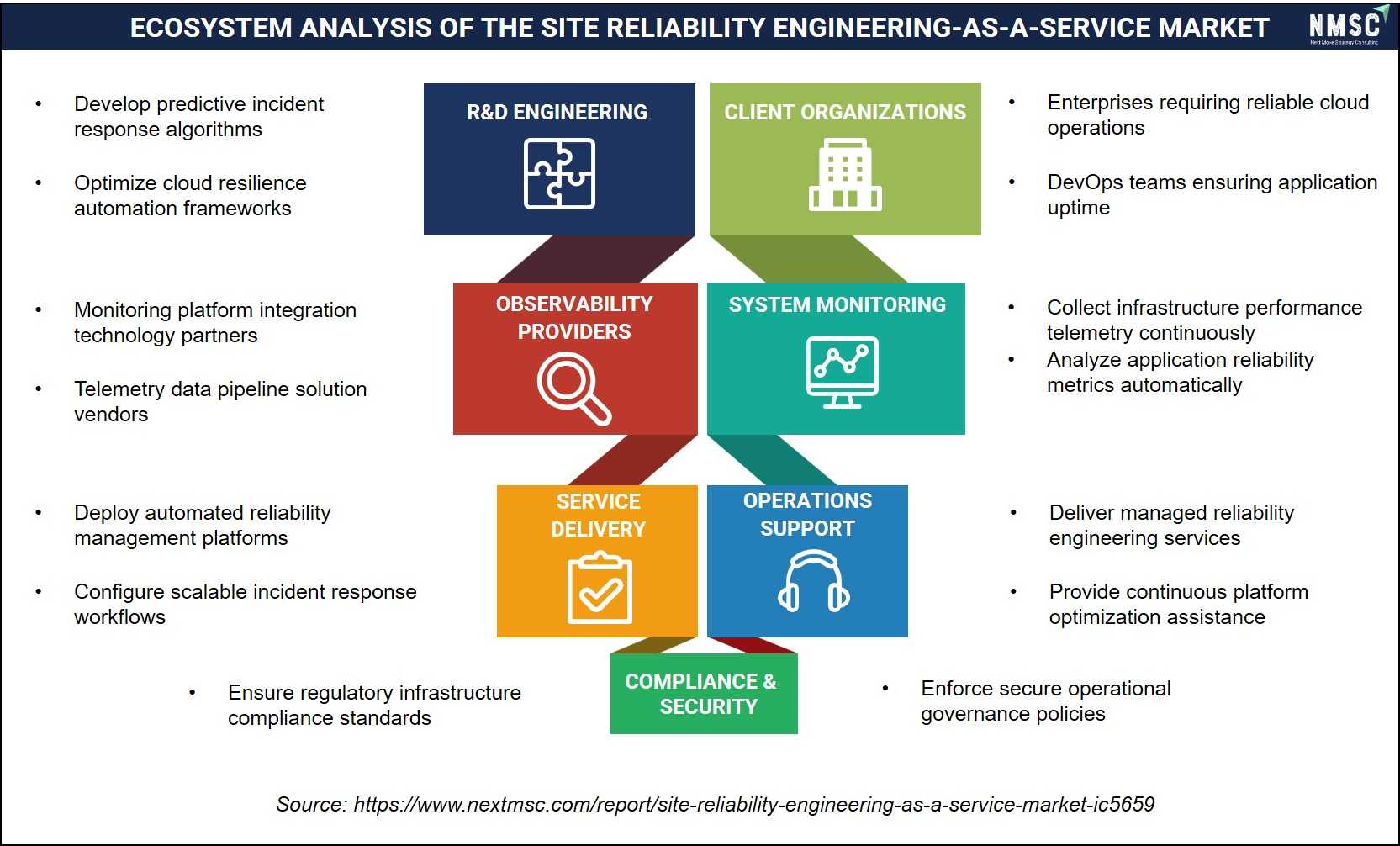
The above infographic presents an ecosystem analysis of the site reliability engineering-as-a-service market, where predictive incident response and cloud resilience frameworks are being developed with support from monitoring platforms and telemetry pipelines. Automated reliability management and scalable incident workflows further enhance service delivery, while continuous performance analysis optimizes operations. Compliance and security governance ensure regulatory adherence. Looking ahead, we observed that ongoing platform optimization and secure governance will remain critical for sustaining reliability and trust across digital ecosystems.
What does the Site Reliability Engineering-as-a-Service Market Encompass?
The Site Reliability Engineering-as-a-Service Market covers managed SRE services, incident management and response platforms, observability and monitoring tools, and SRE consulting, staffing, and training delivered on a subscription or outsourced basis rather than built and operated entirely in-house. We observed that the market has evolved from point incident-alerting tools into comprehensive digital operations platforms that integrate directly with IT service management workflows across development, infrastructure, and customer-facing operations teams.
Our findings suggest that the absence of a dedicated regulatory framework specific to SRE-as-a-Service is allowing rapid commercial innovation, with vendors instead operating under broader data protection and cloud service compliance obligations relevant to each customer industry. Technology adoption trends toward generative AI-based incident triage and automated root-cause analysis are further compressing the time between anomaly detection and resolution across managed service engagements.
|
Parameters |
Details |
|
Market Size in 2025 |
USD 4.80 Billion |
|
Market Size in 2026 |
USD 5.85 Billion |
|
Revenue Forecast in 2035 |
USD 34.50 Billion |
|
Growth Rate |
CAGR of 21.79% from 2026 to 2035 |
|
Analysis Period |
2025–2035 |
|
Base Year Considered |
2025 |
|
Forecast Period |
2026–2035 |
|
Market Size Estimation |
USD Billion |
|
Companies Profiled |
20 |
|
Countries Covered |
38 |
|
Market Share |
Available for Top 10 Companies |
Key Emerging Trends
Based on research conducted by NMSC, we found that four structural trends are redefining how site reliability engineering as a service providers compete, price, and expand their addressable customer base through 2035.
How Is Generative AI Incident Response Transforming Managed SRE Delivery?
We found that generative AI-based incident response is transforming managed SRE delivery by automating initial triage and suggesting remediation steps before human engineers engage. PagerDuty's introduction of Agentic Artificial Intelligence capabilities within its platform in 2025 exemplifies this transformation, embedding autonomous incident-handling agents directly into digital operations workflows serving its more than 34,000 paid and free customers.
What Role Does Pricing Model Transition Play in Enterprise Adoption?
Our assessment indicates that vendors are transitioning from per-seat pricing toward usage- and outcome-based pricing models that better align cost with the scale of monitored infrastructure. PagerDuty's ongoing pricing and go-to-market transition, referenced in its fiscal 2026 fourth-quarter results, illustrates how providers are restructuring commercial models to support durable growth as customer infrastructure footprints scale independently of headcount.
How Are Stakeholders Responding to SRE Talent Shortages?
We observed that enterprise technology leaders are responding to persistent site reliability engineering talent shortages by shifting from in-house team-building toward outsourced managed service and staffing arrangements. This stakeholder response reflects the specialized, cross-disciplinary skill set required for effective SRE practice, which remains difficult for individual enterprises to recruit and retain at scale.
Why Is Full-Stack Observability Integration Gaining Traction?
During our market evaluation, we noticed that customers increasingly demand full-stack observability integrated directly with incident response rather than separately procured monitoring and alerting tools. This traction reflects growing recognition that fragmented tooling across observability and incident management functions slows resolution time, pushing vendors to consolidate previously separate product lines into unified reliability platforms.
Growth Drivers & Restraints
Growth Catalyst & Risk Assessment Matrix
|
Factors |
Type |
(+/-) % Impact on CAGR |
Geographic Relevance |
Impact Timeline |
|
Persistent site reliability engineering talent shortages |
Driver |
+4.6% |
North America, Europe |
2026–2035 |
|
Rising enterprise cloud infrastructure complexity |
Driver |
+3.8% |
Global |
2026–2035 |
|
Generative AI-based incident response automation |
Driver |
+3.1% |
North America, Europe, Asia-Pacific |
2026–2032 |
|
Growing SME adoption of outsourced reliability services |
Driver |
+2.4% |
Asia-Pacific, Latin America |
2026–2033 |
|
Expanding full-stack observability platform consolidation |
Driver |
+1.7% |
Global |
2026–2031 |
|
Data residency and sovereignty compliance complexity |
Restraint |
−1.6% |
Europe, Asia-Pacific |
2026–2032 |
|
Enterprise reluctance to outsource mission-critical operations |
Restraint |
−1.3% |
North America, Europe |
2026–2030 |
|
Vendor lock-in concerns around proprietary platform tooling |
Restraint |
−0.9% |
Global |
2026–2033 |
|
Budget scrutiny on recurring subscription-based IT spend |
Restraint |
−0.6% |
Global |
2026–2029 |
What is the Primary Growth Driver of the Site Reliability Engineering-as-a-Service Market?
The primary growth driver is persistent site reliability engineering talent shortages combined with rising enterprise cloud infrastructure complexity that outpaces internal hiring capacity. PagerDuty reported full fiscal year 2026 revenue of USD 492.5 million, an increase of 5.4% year-over-year, alongside its first full year of GAAP profitability, directly evidencing sustained enterprise demand for managed digital operations capability rather than in-house team expansion alone.
How is Generative AI Automation Driving the Site Reliability Engineering-as-a-Service Market Growth?
Our analysis shows that generative AI-based incident automation is directly driving market growth, with PagerDuty CEO Jennifer Tejada stating the company delivered a second consecutive quarter of GAAP profitability in its fiscal 2026 third quarter while serving more than 34,000 paid and free customers who rely on the platform as enterprises scale AI-driven operations. This sustained customer base growth evidences durable demand for AI-assisted reliability tooling embedded within managed service delivery.
What is Restraining the Site Reliability Engineering-as-a-Service Market?
We found that the primary restraint is enterprise reluctance to outsource mission-critical operational functions to third-party providers, particularly among regulated industries with strict internal control requirements. Industry-derived estimates suggest that data residency and sovereignty compliance complexity is also slowing adoption among multinational enterprises seeking to maintain jurisdiction-specific operational control over incident data.
Segmentation Analysis
Segment Sizing: By Service Type
|
Segment |
2025 (USD Bn) |
2035 (USD Bn) |
CAGR% (2026–2035) |
|
Managed SRE Services |
1.63 |
13.11 |
23.30% |
|
Incident Management and Response |
1.34 |
8.28 |
19.71% |
|
Observability and Monitoring |
1.06 |
7.59 |
21.76% |
|
SRE Consulting and Advisory |
0.48 |
3.45 |
21.91% |
|
SRE Staffing and Training |
0.29 |
2.07 |
21.83% |
|
Total |
4.80 |
34.50 |
21.79% |
Which Service Type Segment Dominates the Site Reliability Engineering-as-a-Service Market?
Managed SRE Services leads with USD 1.63 Billion in 2025, expanding to USD 13.11 Billion by 2035, reflecting enterprise preference for fully outsourced operational ownership over piecemeal tool procurement. Managed SRE Services is also the fastest-growing service type at a 23.30% CAGR, as enterprises increasingly favor comprehensive outsourced delivery over standalone incident management or observability tools purchased separately.
Segment Sizing: By Organization Size
|
Segment |
2025 (USD Bn) |
2035 (USD Bn) |
CAGR% (2026–2035) |
|
Large Enterprises |
3.26 |
20.70 |
20.11% |
|
Small and Medium Enterprises |
1.54 |
13.80 |
24.87% |
|
Total |
4.80 |
34.50 |
21.79% |
Which Organization Size Dominates and Which is Fastest-Growing?
Large Enterprises dominate at USD 3.26 Billion in 2025, growing to USD 20.70 Billion by 2035, reflecting their larger infrastructure footprints and greater existing budget allocation for digital operations tooling. Small and Medium Enterprises are the fastest-growing organization size at a 24.87% CAGR, as outsourced SRE-as-a-Service models lower the capability barrier for smaller technology teams that cannot justify building dedicated in-house reliability functions.
Segment Sizing: By End-Use Industry
|
Segment |
2025 (USD Bn) |
2035 (USD Bn) |
CAGR% (2026–2035) |
|
BFSI |
1.15 |
7.59 |
20.66% |
|
IT and Telecom |
1.26 |
8.30 |
20.67% |
|
Retail and E-Commerce |
0.86 |
6.55 |
22.56% |
|
Healthcare |
0.67 |
5.17 |
22.70% |
|
Media and Entertainment |
0.48 |
3.79 |
23.19% |
|
Others |
0.38 |
3.10 |
23.32% |
|
Total |
4.80 |
34.50 |
21.79% |
Which End-Use Industry Dominates and Which is Fastest-Growing?
IT and Telecom leads end-use demand at USD 1.26 Billion in 2025, reflecting the sector's foundational role operating the digital infrastructure that other industries depend on. The Others category, spanning education, logistics, and public sector adopters, is the fastest-growing end-use industry at a 23.32% CAGR, as outsourced reliability engineering extends beyond its traditional technology-sector base into a broader set of digitally dependent organizations.
Porter’s Five Forces Analysis of the Site Reliability Engineering-as-a-Service Industry
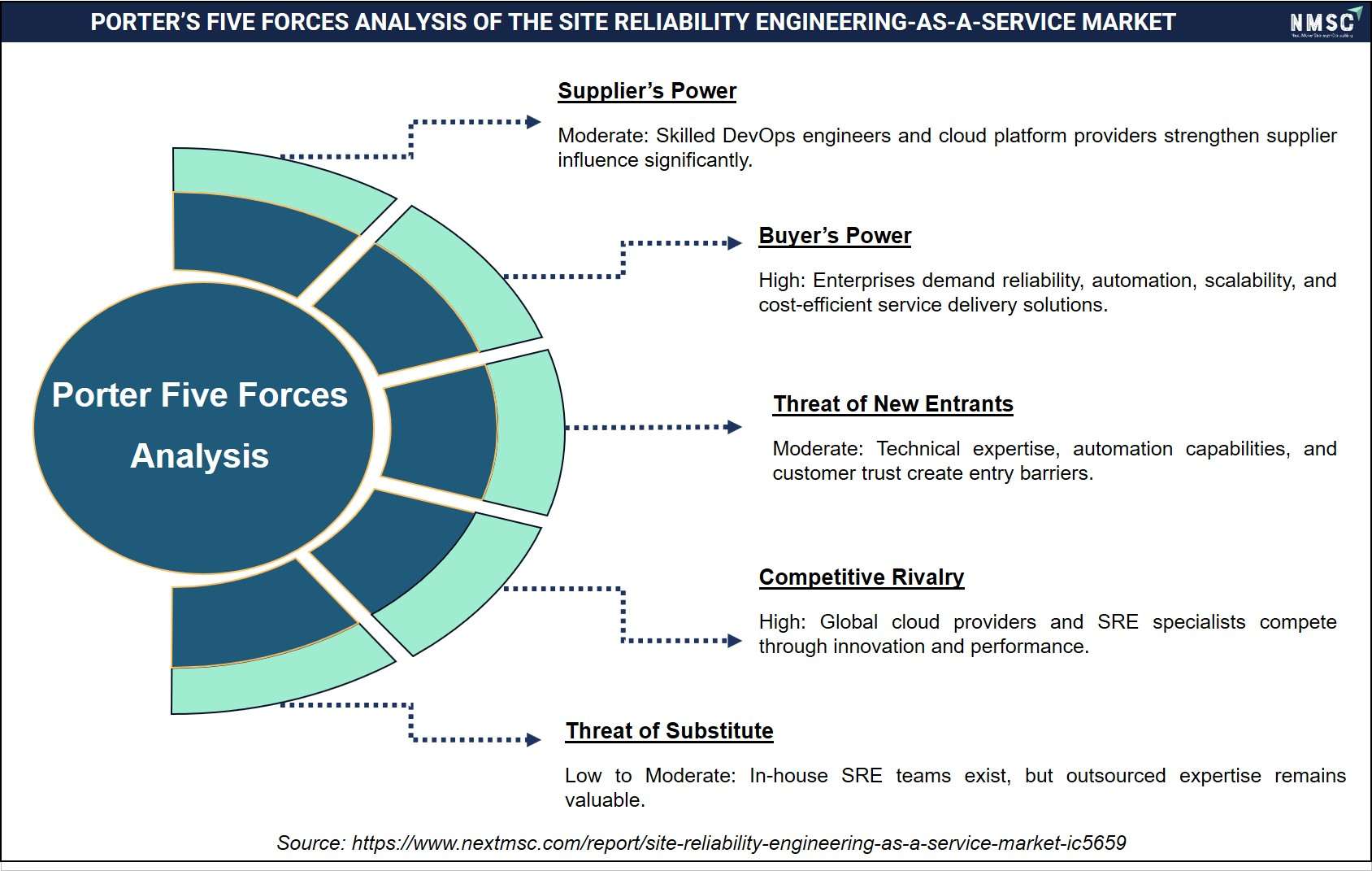
The above infographic presents a Porter's Five Forces analysis of the site reliability engineering-as-a-service market, where supplier power is moderate due to reliance on skilled engineers and cloud platforms. Buyer power is high as enterprises demand performance and cost efficiency. The threat of new entrants is moderate, constrained by expertise and trust requirements. Competitive rivalry is intense among global providers. Looking ahead, we observed that the threat of substitutes remains low to moderate, as outsourced expertise continues to offer valuable scalability advantages.
Growth Opportunities
Our analysis shows that three whitespace opportunities stand out for providers positioning ahead of 2035 demand.
Can Agentic AI Incident Resolution Unlock Premium Managed Service Tiers?
Providers that expand autonomous, agentic AI incident resolution capability beyond triage into automated remediation can capture premium-priced managed service tiers, benefiting the Managed SRE Services segment as enterprises pay for measurably faster resolution outcomes rather than tooling access alone.
Does SME-Focused Packaging Create Value for Underserved Technology Teams?
Providers offering simplified, lower-cost SRE-as-a-Service packages designed specifically for small and medium enterprise technology teams can capture a fast-growing, currently underserved customer segment, benefiting the Small and Medium Enterprises organization-size segment as outsourced reliability becomes accessible beyond large enterprise budgets.
Can Vertical-Specific Compliance Packaging Expand Healthcare and BFSI Adoption?
Providers that build regulatory-compliance-specific SRE service packages for healthcare and financial services customers can capture rising demand from regulated industries currently hesitant to outsource mission-critical operations, benefiting the BFSI and Healthcare end-use segments as compliance-ready managed offerings reduce adoption barriers.
Regional Outlook
|
Region |
2025 (USD Bn) |
2035 (USD Bn) |
CAGR% (2026–2035) |
Key Driver |
|
North America |
2.21 |
13.80 |
19.92% |
Concentrated enterprise cloud adoption and managed reliability spend |
|
Europe |
1.15 |
7.59 |
20.66% |
Data residency-compliant managed service adoption |
|
Asia-Pacific |
1.06 |
9.66 |
25.07% |
Expanding IT services delivery capacity for global SRE engagements |
|
Latin America |
0.24 |
2.07 |
24.41% |
Growing outsourced technology services investment |
|
Middle East & Africa |
0.14 |
1.38 |
25.40% |
Emerging digital transformation and cloud adoption programs |
|
Total |
4.80 |
34.50 |
21.79% |
|
North America Site Reliability Engineering-as-a-Service Market
North America holds the largest regional share, supported by concentrated enterprise cloud adoption and the presence of leading platform vendors including PagerDuty, Datadog, and Dynatrace. We observed that generative AI-based incident automation is most advanced in this region, positioning North America as both the largest revenue base and the primary launch market for new managed reliability capability.
Europe Site Reliability Engineering-as-a-Service Market
Europe's market is shaped by data residency and sovereignty compliance requirements that favor providers offering regionally hosted managed service delivery. Our findings suggest that regional enterprises are increasingly comfortable outsourcing reliability operations once providers demonstrate compliant data handling practices, supporting steady adoption growth despite more cautious initial procurement cycles than North America.
Asia-Pacific Site Reliability Engineering-as-a-Service Market
Asia-Pacific is the fastest-growing major region, driven by expanding IT services delivery capacity across India that supports both domestic adoption and global outsourced SRE engagements. We found that regional IT services firms are scaling managed reliability offerings fastest in this region, reflecting the sector's existing strength in global technology services delivery.
Middle East & Africa Site Reliability Engineering-as-a-Service Market
The Middle East & Africa region is the fastest-growing overall at a 25.40% CAGR, with the UAE and Saudi Arabia leading emerging digital transformation and cloud adoption programs tied to broader economic diversification strategies. Industry-derived estimates suggest regional growth will track broader cloud infrastructure investment rather than reliability-specific regulatory mandates, given the comparatively nascent managed service market in the region.
Latin America Site Reliability Engineering-as-a-Service Market
Latin America is expanding at a 24.41% CAGR, led by Brazil's growing outsourced technology services investment and expanding enterprise cloud migration. We observed that Argentina's technology sector offers latent demand for managed reliability services as regional enterprises increasingly favor outsourced digital operations over building scarce in-house SRE talent.
U.S. Site Reliability Engineering-as-a-Service Market
Based on our estimates, the U.S. market was valued at approximately USD 1.92 Billion in 2025 and is projected to reach USD 11.87 Billion by 2035 at a CAGR near 19.9%. Demand structure is anchored by concentrated enterprise cloud adoption and high technology penetration among AI-assisted incident response platforms, with strong competitive intensity between PagerDuty, Datadog, and Cisco Systems.
Canada Site Reliability Engineering-as-a-Service Market
The market in Canada was estimated at around USD 0.29 Billion in 2025, forecast to reach USD 1.94 Billion by 2035 at roughly 20.9% CAGR. Canada's demand structure closely mirrors U.S. adoption patterns, with growing enterprise interest in managed reliability services supporting steady technology penetration and moderate competitive intensity.
UK Site Reliability Engineering-as-a-Service Market
As per our estimate, the UK market stood near USD 0.34 Billion in 2025 and is expected to reach USD 2.35 Billion by 2035 at approximately 21.4% CAGR. Strong enterprise cloud adoption and growing comfort with outsourced digital operations support demand, with regulatory influence centered on data protection compliance rather than binding SRE-specific mandates.
Germany Site Reliability Engineering-as-a-Service Market
According to our analysis, Germany's market was valued at about USD 0.28 Billion in 2025, projected to reach USD 1.90 Billion by 2035 at a CAGR near 21.3%. Germany's demand structure benefits from a large domestic enterprise base and cautious but steadily increasing adoption of outsourced reliability services among regulated industries.
France Site Reliability Engineering-as-a-Service Market
Based on our estimates, France's market reached approximately USD 0.19 Billion in 2025 and is forecast to grow to USD 1.28 Billion by 2035 at around 21.3% CAGR. Demand is supported by growing enterprise digital transformation investment, with moderate competitive intensity among regional and global managed service providers.
China Site Reliability Engineering-as-a-Service Market
The market in China was valued at nearly USD 0.24 Billion in 2025 and is projected to reach USD 2.42 Billion by 2035 at approximately 25.9% CAGR. China's growth reflects its large domestic technology sector and rapidly expanding cloud infrastructure investment, with domestic IT services providers competing intensely alongside global vendors for enterprise contracts.
India Site Reliability Engineering-as-a-Service Market
As per our estimate, India's market was close to USD 0.20 Billion in 2025, expected to reach USD 2.35 Billion by 2035 at roughly 27.9% CAGR, the fastest among covered countries. India's established IT services delivery capacity, anchored by Tata Consultancy Services, Infosys, and Wipro, is driving both domestic adoption and global outsourced SRE engagement growth.
Japan Site Reliability Engineering-as-a-Service Market
According to our analysis, Japan's market stood at about USD 0.19 Billion in 2025 and is forecast to reach USD 1.56 Billion by 2035 at approximately 23.4% CAGR. Japan's demand structure benefits from a mature enterprise technology base gradually shifting toward outsourced reliability models as domestic SRE talent availability remains constrained.
South Korea Site Reliability Engineering-as-a-Service Market
Based on our estimates, South Korea's market was valued at around USD 0.14 Billion in 2025, projected to reach USD 1.28 Billion by 2035 at around 25.0% CAGR. Growing enterprise cloud adoption and rising digital operations complexity support increasing technology adoption within a competitively intense domestic technology sector.
Australia Site Reliability Engineering-as-a-Service Market
As per our estimate, Australia's market reached approximately USD 0.10 Billion in 2025 and is expected to grow to USD 0.76 Billion by 2035 at roughly 22.9% CAGR. Australia's demand structure benefits from strong enterprise cloud maturity, positioning the country as a steady adopter of managed reliability engineering services.
UAE Site Reliability Engineering-as-a-Service Market
Based on our estimates, the UAE market was valued at about USD 0.05 Billion in 2025 and is forecast to reach USD 0.47 Billion by 2035 at approximately 25.3% CAGR. Growing government-backed digital transformation programs and expanding cloud adoption support the UAE's emerging role as a regional managed services hub.
Saudi Arabia Site Reliability Engineering-as-a-Service Market
According to our analysis, Saudi Arabia's market stood at around USD 0.06 Billion in 2025, projected to reach USD 0.52 Billion by 2035 at around 25.3% CAGR. Vision 2030-linked digital economy initiatives are supporting early-stage investment in cloud infrastructure and outsourced reliability engineering capability.
South Africa Site Reliability Engineering-as-a-Service Market
As per our estimate, South Africa's market was close to USD 0.02 Billion in 2025 and is expected to reach USD 0.16 Billion by 2035 at roughly 24.4% CAGR. A growing technology sector gives South Africa the strongest technology penetration in the MEA region, supporting a strategic outlook centered on outsourced digital operations adoption.
Brazil Site Reliability Engineering-as-a-Service Market
Based on our estimates, Brazil's market reached approximately USD 0.14 Billion in 2025 and is projected to reach USD 1.24 Billion by 2035 at around 25.6% CAGR. Growing outsourced technology services investment and expanding enterprise cloud migration are driving demand structure, with strategic investment appeal strengthening as regional adoption matures.
Argentina Site Reliability Engineering-as-a-Service Market
According to our analysis, Argentina's market was valued at about USD 0.04 Billion in 2025, forecast to reach USD 0.35 Billion by 2035 at approximately 24.6% CAGR. A growing technology sector offers rising demand for managed reliability services, though competitive intensity remains moderate given the still-developing formal outsourcing infrastructure relative to Brazil.
Competitive Landscape
Our assessment indicates that the competitive landscape spans dedicated digital operations platform vendors, diversified cloud and technology conglomerates, and global IT services firms, each competing on platform capability, delivery scale, and vertical-specific compliance readiness.
|
Key Takeaways |
Details |
|
Market Structure |
Fragmented; top 10 companies hold a meaningful but not dominant share of Market Share, reflecting a mix of platform vendors, cloud hyperscalers, and global IT services firms |
|
Innovation Focus |
Agentic AI incident automation, unified observability and incident response platforms, and outcome-based pricing model transitions |
|
M&A Activity |
Selective platform capability acquisitions and pricing model restructuring rather than large-scale industry-wide consolidation |
How Do Companies Compete in the Site Reliability Engineering-as-a-Service Market?
Companies compete primarily on platform automation capability, breadth of managed service delivery beyond software tooling alone, and depth of vertical-specific compliance readiness for regulated industries. Our findings suggest that vendors combining platform technology with staffed delivery capability hold a structural advantage over pure-software competitors, since enterprise customers increasingly favor comprehensive outsourced ownership over standalone tool procurement.
Which Competitive Archetypes Dominate the Site Reliability Engineering-as-a-Service Market?
Dedicated digital operations platform vendors such as PagerDuty and Datadog dominate through purpose-built incident management and observability capability, while diversified cloud conglomerates including Amazon.com and Microsoft compete through native integration with their broader infrastructure platforms. Global IT services firms such as Accenture, Tata Consultancy Services, and Infosys differentiate through staffed managed service delivery underserved by pure-software vendors.
What Innovation and Differentiation Strategies Are Companies Pursuing?
We observed that leading vendors are investing in agentic AI incident automation and unified platform consolidation that combines previously separate observability and incident response tooling. Differentiation increasingly rests on demonstrated resolution-time improvement, since enterprise customers increasingly evaluate providers on measurable operational outcomes rather than feature breadth alone.
What M&A and Partnership Activity Is Shaping the Site Reliability Engineering-as-a-Service Market?
Recent activity favors internal platform development and pricing model restructuring over large-scale acquisitions, exemplified by PagerDuty's continued investment in Agentic Artificial Intelligence capability and its ongoing transition toward outcome-aligned pricing referenced in its fiscal 2026 results. Our analysis shows that established vendors are prioritizing organic platform capability expansion over M&A, reflecting the technical integration complexity of combining separately built observability and incident management systems.
Key Market Players
Based on research conducted by NMSC, the following companies represent the validated set of leading participants across managed SRE services, incident management platforms, observability tooling, and SRE consulting and staffing delivery.
-
PagerDuty, Inc.
-
Datadog, Inc.
-
Cisco Systems, Inc.
-
Dynatrace, Inc.
-
New Relic, Inc.
-
Atlassian Corporation
-
Alphabet Inc.
-
Amazon.com, Inc.
-
Accenture plc
-
Wipro Limited
-
Infosys Limited
-
Tata Consultancy Services Limited
-
Capgemini SE
-
Rackspace Technology, Inc.
-
incident.io Inc.
-
FireHydrant, Inc.
-
Squadcast Inc.
-
Everbridge, Inc.
Latest Developments
We found that recent corporate activity reflects continued platform investment in AI-based automation and improving financial performance among leading digital operations vendors.
|
Date |
Event |
|
October 2025 |
PagerDuty announced an end-to-end AI Agent Suite designed to slash incident response times and help teams innovate faster. |
|
August 2025 |
Dynatrace introduced AI-powered remediation intelligence, focused on reducing mean time to resolution and improving incident response in complex environments. |
Expert Insights

“This is a turning point for digital operations. PagerDuty’s AI agents are not just automating tasks—they’re transforming how organizations innovate and compete in a world where every second counts.”
— Jeffrey Hausman, Chief Product Development Officer, PagerDuty, Inc.
Statement made during the launch of PagerDuty's Industry's First End-to-End AI Agent Suite.
Market Interpretation
The statement reflects the industry's shift from reactive incident management toward AI-driven autonomous reliability operations. NMSC's analysis indicates that organizations are increasingly embedding AI into Site Reliability Engineering (SRE) workflows to automate incident detection, root cause analysis, remediation, and operational decision-making. As digital infrastructures become more distributed and complex, demand for AI-enabled SRE platforms that improve operational resilience, reduce mean time to resolution (MTTR), and minimize manual intervention is expected to accelerate, reinforcing the long-term growth of the Site Reliability Engineering-as-a-Service Market.
Investment Opportunities
Where Are Capital Inflows Concentrating in the Site Reliability Engineering-as-a-Service Market?
Capital is concentrating in agentic AI incident automation and unified observability platform development, reflected in PagerDuty's continued Agentic Artificial Intelligence investment alongside its first full year of GAAP profitability in fiscal 2026. This profitability milestone signals sustained capital efficiency improvement across established platform vendors even as they continue investing in next-generation automation capability.
How Is Infrastructure Investment Shaping Long-Term Capacity?
Our findings suggest that infrastructure investment is shifting toward integrated platforms that combine observability, incident management, and managed service delivery within a single vendor relationship rather than multiple point solutions. This shift favors providers with existing platform breadth that can be extended into comprehensive managed offerings without requiring customers to integrate multiple separate vendor tools.
What ESG Considerations Are Influencing Investment Decisions in the Site Reliability Engineering-as-a-Service Market?
Environmental, Social, and Governance considerations in this market center on operational resilience as a business continuity and customer trust issue, given the direct link between service reliability and end-user impact during outages. We found that investors increasingly favor providers demonstrating transparent incident disclosure practices and measurable customer uptime outcomes as a proxy for durable, trust-aligned growth.
Key Benefits for Stakeholders
How Does This Report Benefit Industry Leaders?
Industry leaders gain segment-level revenue forecasts and CAGR benchmarks across service type, organization size, and end-use industry axes, enabling product-roadmap decisions grounded in the same 2025–2035 figures used consistently throughout this analysis. Our findings on regional growth differentials further support market-entry and delivery-capacity investment decisions.
How Does This Report Benefit Investors and Financial Analysts?
Investors and financial analysts gain a reconciled market-sizing model, competitive-landscape assessment, and named-company development tracking that supports valuation and capital-allocation decisions. The report's Growth Catalyst & Risk Assessment Matrix quantifies driver and restraint impact on CAGR, aiding scenario analysis for portfolio positioning.
How Does This Report Benefit Technology Vendors and Product Teams?
Technology vendors and product teams gain visibility into which service-type and organization-size segments, such as Managed SRE Services and Small and Medium Enterprises, are growing fastest, informing where to prioritize engineering investment and go-to-market focus through 2035.
Key Market Segments
By Service Type
-
Managed SRE services
-
Incident management and response
-
Observability and monitoring
-
SRE consulting and advisory
-
SRE staffing and training
By Organization Size
-
Large enterprises
-
Small and medium enterprises
By End-Use Industry
-
BFSI
-
IT and telecom
-
Retail and e-commerce
-
Healthcare
-
Media and entertainment
-
Others
By Region
-
North America: U.S., Canada, Mexico
-
Europe: UK, Germany, France, Italy, Spain, Sweden, Denmark, Finland, Netherlands, Rest of Europe
-
Asia-Pacific: China, India, Japan, South Korea, Taiwan, Indonesia, Vietnam, Australia,Philippines, Malaysia and the rest of APAC.
-
Middle East & Africa: Saudi Arabia, UAE, Egypt, Israel, Turkey, Nigeria, South Africa, and the rest of MEA.
-
Latin America: Brazil, Argentina, Chile, Colombia, and the rest of LATAM.
Conclusion & Recommendations
What Is the Long-Term Outlook for the Site Reliability Engineering-as-a-Service Market?
The long-term outlook remains strongly positive, with the market expanding from USD 5.85 Billion in 2026 to USD 34.50 Billion by 2035 at a 21.79% CAGR, driven by persistent SRE talent shortages and rising cloud infrastructure complexity. We observed that this growth trajectory is underpinned by structural enterprise capability gaps rather than speculative demand, supporting sustained platform and services investment.
What Strategic Positioning Do We Recommend?
Our assessment indicates that providers should prioritize agentic AI incident automation and SME-focused service packaging to capture the fastest-growing Managed SRE Services and Small and Medium Enterprises segments. Companies without established compliance-ready offerings for regulated industries should pursue vertical-specific packaging rather than generic platform positioning given persistent enterprise caution around outsourcing mission-critical operations.
How Attractive Is the Site Reliability Engineering-as-a-Service Market for Investment?
Investment attractiveness is high in the Middle East & Africa and Asia-Pacific given superior CAGR profiles of 25.40% and 25.07%, respectively, while North America offers the largest absolute revenue base with durable enterprise-driven demand. We found that managed service and SME-focused revenue streams offer stronger growth profiles than the more mature large-enterprise incident management segment alone.
What Are the Key Market Shifts and Risks?
Key risks include data residency and sovereignty compliance complexity that slows adoption among multinational enterprises, alongside persistent reluctance to outsource mission-critical operations in certain regulated industries. Our analysis shows that providers unable to demonstrate compliant, trustworthy data handling practices risk ceding share of the fastest-growing regulated-industry segments to competitors with stronger compliance credentials.
What Are the Primary Growth Pathways Through 2035?
Primary growth pathways include agentic AI incident automation expansion, deeper SME-focused service packaging, and vertical-specific compliance offerings for regulated industries such as BFSI and healthcare. We observed that providers combining all three pathways are best positioned to capture a disproportionate share of the USD 28.65 Billion absolute opportunity created between 2026 and 2035.
About the Author
 Mayurima Roy
— Mayurima Roy is Research Analyst at Next Move Strategy Consulting, where she has spent 4 years working across the firm's full industry coverage rather than a single fixed vertical. Her work centers on structured research, ongoing trend tracking, competitive assessment, and insight-led content development, translating complex market data into clear, decision-ready narratives that support informed client decision-making across diverse global industries, market sectors, and world regions every day.
Mayurima Roy
— Mayurima Roy is Research Analyst at Next Move Strategy Consulting, where she has spent 4 years working across the firm's full industry coverage rather than a single fixed vertical. Her work centers on structured research, ongoing trend tracking, competitive assessment, and insight-led content development, translating complex market data into clear, decision-ready narratives that support informed client decision-making across diverse global industries, market sectors, and world regions every day.
About the Reviewer
 Supradip Baul
— Supradip Baul is an accomplished business consultant and strategist with over a decade of rich experience in market intelligence, strategy, technology, and business transformation. His work has included rigorous qualitative and quantitative analysis across multiple industries, helping clients shape investment decisions and long-term roadmaps. Earlier in his career, he was associated with Gartner, where he contributed to industry-leading reports and market share analyses. He has worked with leading global companies and holds an MBA with a dual specialization in Marketing and Finance.
Supradip Baul
— Supradip Baul is an accomplished business consultant and strategist with over a decade of rich experience in market intelligence, strategy, technology, and business transformation. His work has included rigorous qualitative and quantitative analysis across multiple industries, helping clients shape investment decisions and long-term roadmaps. Earlier in his career, he was associated with Gartner, where he contributed to industry-leading reports and market share analyses. He has worked with leading global companies and holds an MBA with a dual specialization in Marketing and Finance.
At Next Move Strategy Consulting, we understand that insightful market research is the cornerstone of successful business decisions. That's why we employ a robust and multifaceted approach, combining various methodologies to deliver the most accurate and actionable data for our clients.

Research Landscape
We navigate the world of research with two primary approaches:
Qualitative Approach
Our qualitative research methodologies involve immersive techniques such as in-depth interviews, focus groups, and observational studies. By engaging directly with individuals and stakeholders, we uncover valuable insights that quantitative data alone may overlook.

Quantitative Research
In tandem with qualitative methodologies, NMSC leverages the power of Quantitative Research to provide a robust foundation of numerical insights. Through systematic data collection and analysis, we quantify patterns, preferences, and market trends, offering a comprehensive view of the business landscape.
Our quantitative research approach employs diverse tools, including surveys, experiments, and statistical modelling. These methodologies enable us to gather data from a large and representative sample, ensuring the statistical significance of our findings. By employing structured questionnaires and standardized data collection methods, we guarantee the reliability and validity of the information we present to our clients.
Quantitative research is particularly effective in measuring the prevalence of trends, assessing market size, and gauging the impact of various factors on consumer behavior. The numerical precision attained through this approach equips our clients with actionable insights, facilitating data-driven decision-making and strategy formulation.


Our Specialized Toolbox for Industry-Specific Market Research
We deploy a specialized arsenal of techniques tailored to meet your unique requirements. Here's a glimpse into our comprehensive toolbox:

Information Procurement
The stage entails acquiring market data or relevant information through various sources and methodologies.


Market Research Approach
We utilize both top-down and bottom-up approaches in market research analysis to achieve a comprehensive understanding of the market dynamics, leveraging the broad perspective of industry trends and macroeconomic factors alongside detailed insights from specific segments and individual companies.

Porters Five Forces Analysis
We conduct Porter's Five Forces analysis to evaluate the competitive landscape of an industry, providing us with insights into factors that affect profitability and strategic positioning.

SWOT Analysis

Forecasting
We utilize a forecasting model to predict future consumption by considering parameters like population, economics, regulations, market competition, drivers, constraints, technology, and pricing. We also employ statistical techniques such as multilinear regression, exponential smoothing, moving average, ARIMA, and Monte Carlo simulations for accurate predictions. In econometric forecasting, we analyzed short-term and long-term event impacts, attributing values based on regulatory frameworks, economic factors, and market events.





 Speak to Our Analyst