Mutual Induction Transducers Market

Mutual induction transducers market size was USD 2.95 billion in 2025, set to reach USD 6.57 billion by 2035 at an 8.4% CAGR from 2026 to 2035, per this report.

Download Free Sample PDF
Base Year (2025)
$2.95 Billion
Forecast (2035)
$6.57 Billion
CAGR (2026-2035)
8.4%
Top Region
North America

What Is the Mutual Induction Transducers Market Size?

The global mutual induction transducers market size was valued at USD 2.95 billion in 2025 and is estimated at USD 3.18 billion in 2026, forecast to reach USD 6.57 billion by 2035, expanding at an 8.4% CAGR between 2026 and 2035. North America leads with approximately 36% share, while Linear Variable Differential Transformer dominates all other product types with approximately 52% share.

We observed that growth is broad-based across every segmentation axis, with mutual inductive current transformers and digital output configurations driving the dominant structural shifts through 2035.

Mutual Induction Transducers Market Revenue Forecast

Values in USD Billion

2025 $2.95 Billion
2025
2026 $3.18 Billion
2026
2027 $3.45 Billion
2027
2028 $3.74 Billion
2028
2029 $4.05 Billion
2029
2030 $4.39 Billion
2030
2031 $4.76 Billion
2031
2032 $5.16 Billion
2032
2033 $5.59 Billion
2033
2034 $6.06 Billion
2034
2035 $6.57 Billion
2035

Key Takeaways

By Product Type: Linear Variable Differential Transformer (LVDT) held the largest share of approximately 52% (USD 1.53 billion) in 2025; Mutual Inductive Current Transformer is the fastest-growing sub-segment at 16.9% CAGR from 2026–2035.

By Output Type: Analog Output held the largest share of approximately 64% (USD 1.89 billion) in 2025; Digital Output is the fastest-growing sub-segment at 13.5% CAGR from 2026–2035.

By Sensing Mechanism: Non Contact Type held the largest share of approximately 58% (USD 1.71 billion) in 2025; Non Contact Type is also the fastest-growing sub-segment at 9.6% CAGR from 2026–2035.

By Measurement Type: Linear Displacement Measurement held the largest share of approximately 54% (USD 1.59 billion) in 2025; Current Measurement is the fastest-growing sub-segment at 15.8% CAGR from 2026–2035.

By Product Configuration: Standalone Transducer held the largest share of approximately 62% (USD 1.83 billion) in 2025; Integrated Sensor Assembly is the fastest-growing sub-segment at 12.4% CAGR from 2026–2035.

By Application: Industrial Automation held the largest share of approximately 34% (USD 1.00 billion) in 2025; Automotive is the fastest-growing sub-segment at 11.4% CAGR from 2026–2035.

By End User: Original Equipment Manufacturers held the largest share of approximately 46% (USD 1.36 billion) in 2025; Research Institutions is the fastest-growing sub-segment at 12.2% CAGR from 2026–2035.

Dominant Region: North America dominated with approximately 36% revenue share (USD 1.06 billion) in 2025.

Fastest-Growing Region: Asia-Pacific is expected to register the highest CAGR of 12.0% during 2026–2035.

Dominant Country: U.S. led with approximately USD 0.83 billion in 2025.

Fastest-Growing Country: UAE is the fastest-growing country at approximately 14.3% CAGR from 2026–2035.

Market Opportunity: The mutual induction transducers industry is expected to create an absolute dollar opportunity of USD 3.39 billion between 2026 and 2035, presenting significant investment potential across mutual inductive current transformer production and digital signal conditioning infrastructure.

According to NMSC analysis, aerospace and defense sensor manufacturers are increasingly expanding product portfolios through acquisitions of specialized temperature and position sensor businesses to internalize precision electromagnetic sensing capability, a shift that favors diversified suppliers with broad flight-critical sensor portfolios over single-product manufacturers as next-generation aircraft platforms demand integrated sensing solutions through 2035.

What Does the Mutual Induction Transducers industry Encompass?

The mutual induction transducers industry encompasses electromechanical sensors that convert linear or rotary displacement, position, or current into a proportional electrical signal using mutual inductance between primary and secondary coil windings. Our assessment indicates that the scope spans linear and rotary variable differential transformers, mutual inductive position and proximity sensors, and mutual inductive current transformers deployed across industrial automation, aerospace defense, automotive, and energy power applications. The category has evolved from analog, contact-based measurement instruments into digitally interfaced, non-contact sensing devices, driven by Industry 4.0 adoption, aerospace electrification, and rising demand for infinite-resolution feedback in closed-loop control systems.
Regulatory and qualification frameworks, including aerospace environmental qualification standards governing flight-critical sensor reliability, shape product certification and design validation. We observed that technology adoption is shifting from purely analog AC-excited transducers toward DC-operated units with integrated digital signal conditioning that interface directly with programmable logic controllers and data acquisition systems. NMSC's analysis indicates that this structural shift, combined with rising electric vehicle testing demand, is redefining product development priorities across the mutual induction transducers market.

Market Drivers & Dynamics

Interactive Dataset
Rising Industry 4.0 adoption in industrial automation driver +2.2% Asia-Pacific, Global 2026–2035
Expanding aerospace and defense flight control sensor demand driver +1.9% North America, Europe 2026–2035
Growing electric vehicle testing and validation requirements driver +1.7% Asia-Pacific, Europe 2026–2032
Rising demand for non-contact, long-life sensing technology driver +1.5% Global 2026–2035
Expanding renewable energy infrastructure and turbine control systems driver +1.3% Europe, Asia-Pacific 2026–2035
Increasing integration of digital signal conditioning electronics driver +1.1% Global 2026–2032
High unit cost relative to alternative sensing technologies restraint −1.0% Latin America, MEA 2026–2032
Competition from magnetostrictive and optical position sensors restraint −0.8% Global 2026–2035
Long qualification cycles delaying aerospace product adoption restraint −0.6% North America, Europe 2026–2030
Source: Next Move Strategy Consulting

Growth Drivers

What Is the Primary Growth Driver of the Mutual Induction Transducers Market?

Rising Industry 4.0 adoption in industrial automation is the primary driver of the market. The International Federation of Robotics continues to report global industrial robot installations exceeding 600,000 units annually, sustaining demand for high-precision displacement feedback devices used in closed-loop motion control systems. We observed that this behavioral shift, reinforced by expanding robotics motion control deployment, continues to anchor baseline consumption of mutual induction transducers across developed and emerging manufacturing markets alike.

How Is Aerospace Sensor Demand Driving Market Growth?

Expanding aerospace and defense flight control system demand is accelerating market growth toward flight-critical actuation and engine control applications. Curtiss-Wright Corporation reported full-year 2025 sales of USD 3.5 billion, up 12% year over year, with new orders of USD 4.1 billion reflecting solid demand across its Aerospace & Defense segment. Our assessment indicates that this expansion, combined with next-generation aircraft platform development, is compressing adoption timelines for advanced position sensors across North America and Europe.

Growth Inhibitors

What Is Restraining Mutual Induction Transducers Market Expansion?

High unit cost relative to alternative sensing technologies restrains broader adoption of mutual induction transducers in cost-sensitive applications. The U.S. Bureau of Labor Statistics continues to document elevated precision manufacturing labor costs that contribute to transducer production expenses relative to lower-cost potentiometric alternatives. We found that smaller regional manufacturers face particular exposure, as limited production scale constrains their ability to compete on price against diversified global suppliers with established manufacturing infrastructure.

What Are the Growth Opportunities?

How Can Digital-Native Transducers Unlock Smart Factory Revenue?

Digitally interfaced mutual induction transducers present a whitespace opportunity for manufacturers seeking to serve Industry 4.0-enabled smart factory deployments. Vendors that commercialize transducers with embedded digital signal conditioning and industrial communication protocols stand to capture recurring contracts as manufacturers upgrade legacy analog feedback systems, particularly among robotics motion control and process automation end users.

Where Does Electric Vehicle Testing Create Sensor Whitespace?

Electric vehicle testing infrastructure represents an underpenetrated opportunity for transducer manufacturers offering ruggedized, non-contact position sensors validated for automotive testing environments. Vendors that develop transducers specifically calibrated for battery and powertrain durability testing can secure long-term contracts, benefiting from expanding vehicle testing system investment among global automotive OEMs and testing laboratories.

How Can Renewable Energy Partnerships Unlock Turbine Control Contracts?

Wind and solar power operators seeking reliable blade pitch and equipment monitoring solutions create an opportunity for manufacturers offering environmentally hardened rotary transducers for renewable energy applications. Early movers that secure turbine control system partnerships can differentiate with power equipment monitoring customers pursuing long-term, low-maintenance sensing contracts.

Segmentation Analysis

2025 (USD Billion)
2035 (USD Billion)
Linear Variable Differential Transformer (LVDT) 2025: $1.53 Billion | 2035: $2.76 Billion
Linear Varia
Rotary Variable Differential Transformer (RVDT) 2025: $0.53 Billion | 2035: $0.99 Billion
Rotary Varia
Mutual Inductive Position Sensor 2025: $0.41 Billion | 2035: $1.25 Billion
Mutual Induc
Mutual Inductive Proximity Sensor 2025: $0.32 Billion | 2035: $0.92 Billion
Mutual Induc
Mutual Inductive Current Transformer 2025: $0.16 Billion | 2035: $0.65 Billion
Mutual Induc
Linear Variable Differential Transformer (LVDT) $1.53 Billion $2.76 Billion 5.9%
Rotary Variable Differential Transformer (RVDT) $0.53 Billion $0.99 Billion 6.3%
Mutual Inductive Position Sensor $0.41 Billion $1.25 Billion 12.0%
Mutual Inductive Proximity Sensor $0.32 Billion $0.92 Billion 11.3%
Mutual Inductive Current Transformer $0.16 Billion $0.65 Billion 16.9%

Which Product Type Segment Dominates the Mutual Induction Transducers Market?

Linear Variable Differential Transformer led the market with USD 1.53 billion in 2025, supported by its established role in aerospace flight control actuation and industrial hydraulic position feedback applications requiring infinite resolution. We observed that Mutual Inductive Current Transformer is the fastest-growing product type, expanding at a 16.9% CAGR from 2026 to 2035, as power equipment monitoring and renewable energy applications scale demand for non-contact current sensing.

2025 (USD Billion)
2035 (USD Billion)
Analog Outpu
Digital Outp
Segment Item 2025 (USD Billion) 2035 (USD Billion) CAGR
Analog Output $10.0 USD Billion $40.0 USD Billion 22.0%
Digital Output $17.1 USD Billion $51.1 USD Billion 20.0%

Segment-wise data is locked

Unlock complete segment-wise numbers for By Output Type.

Unlock Full Data
2025 (USD Billion)
2035 (USD Billion)
Contact Type
Non Contact
Segment Item 2025 (USD Billion) 2035 (USD Billion) CAGR
Contact Type $10.0 USD Billion $40.0 USD Billion 13.0%
Non Contact Type $17.1 USD Billion $51.1 USD Billion 27.0%

Segment-wise data is locked

Unlock complete segment-wise numbers for By Sensing Mechanism.

Unlock Full Data
2025 (USD Billion)
2035 (USD Billion)
Linear Displ
Angular Disp
Current Meas
Segment Item 2025 (USD Billion) 2035 (USD Billion) CAGR
Linear Displacement Measurement $10.0 USD Billion $40.0 USD Billion 20.0%
Angular Displacement Measurement $17.1 USD Billion $51.1 USD Billion 10.0%
Current Measurement $24.2 USD Billion $62.2 USD Billion 8.0%

Segment-wise data is locked

Unlock complete segment-wise numbers for By Measurement Type.

Unlock Full Data
2025 (USD Billion)
2035 (USD Billion)
Standalone T
Integrated S
Segment Item 2025 (USD Billion) 2035 (USD Billion) CAGR
Standalone Transducer $10.0 USD Billion $40.0 USD Billion 23.0%
Integrated Sensor Assembly $17.1 USD Billion $51.1 USD Billion 25.0%

Segment-wise data is locked

Unlock complete segment-wise numbers for By Product Configuration.

Unlock Full Data
2025 (USD Billion)
2035 (USD Billion)
Industrial A
Machine Tool
Robotics Mot
Process Auto
Aerospace De
Segment Item 2025 (USD Billion) 2035 (USD Billion) CAGR
Industrial Automation $10.0 USD Billion $40.0 USD Billion 15.0%
Machine Tools $17.1 USD Billion $51.1 USD Billion 21.0%
Robotics Motion Control $24.2 USD Billion $62.2 USD Billion 11.0%
Process Automation $31.3 USD Billion $73.3 USD Billion 21.0%
Aerospace Defense $38.4 USD Billion $84.4 USD Billion 14.0%

Segment-wise data is locked

Unlock complete segment-wise numbers for By Application.

Unlock Full Data

Which Application Leads Mutual Induction Transducers Market Demand?

Industrial Automation remained the leading application, valued at USD 1.00 billion in 2025, on the strength of sustained machine tool and industrial automation deployment requiring precise position feedback. Based on research conducted by NMSC, we found that Automotive is the fastest-growing application at an 11.4% CAGR from 2026 to 2035, reflecting expanding electric vehicle powertrain and battery system testing requirements among global automotive manufacturers.

2025 (USD Billion)
2035 (USD Billion)
Original Equ
System Integ
Research Ins
Industrial U
Segment Item 2025 (USD Billion) 2035 (USD Billion) CAGR
Original Equipment Manufacturers $10.0 USD Billion $40.0 USD Billion 25.0%
System Integrators $17.1 USD Billion $51.1 USD Billion 23.0%
Research Institutions $24.2 USD Billion $62.2 USD Billion 9.0%
Industrial Users $31.3 USD Billion $73.3 USD Billion 23.0%

Segment-wise data is locked

Unlock complete segment-wise numbers for By End User.

Unlock Full Data

Which End User Leads Mutual Induction Transducers Market Demand?

Original Equipment Manufacturers remained the leading end user, valued at USD 1.36 billion in 2025, on the strength of direct integration relationships with aerospace, automotive, and industrial machinery producers. Our findings suggest that Research Institutions is the fastest-growing end user, registering a 12.2% CAGR from 2026 to 2035, as laboratory measurement systems and calibration equipment demand expands alongside growing materials science research investment.

Growth Opportunities

Our analysis shows that three forward-looking opportunities stand out for stakeholders positioning within the mutual induction transducers market over the 2026–2035 forecast period.

How Can Digital-Native Transducers Unlock Smart Factory Revenue?

Digitally interfaced mutual induction transducers present a whitespace opportunity for manufacturers seeking to serve Industry 4.0-enabled smart factory deployments. Vendors that commercialize transducers with embedded digital signal conditioning and industrial communication protocols stand to capture recurring contracts as manufacturers upgrade legacy analog feedback systems, particularly among robotics motion control and process automation end users.

Where Does Electric Vehicle Testing Create Sensor Whitespace?

Electric vehicle testing infrastructure represents an underpenetrated opportunity for transducer manufacturers offering ruggedized, non-contact position sensors validated for automotive testing environments. Vendors that develop transducers specifically calibrated for battery and powertrain durability testing can secure long-term contracts, benefiting from expanding vehicle testing system investment among global automotive OEMs and testing laboratories.

How Can Renewable Energy Partnerships Unlock Turbine Control Contracts?

Wind and solar power operators seeking reliable blade pitch and equipment monitoring solutions create an opportunity for manufacturers offering environmentally hardened rotary transducers for renewable energy applications. Early movers that secure turbine control system partnerships can differentiate with power equipment monitoring customers pursuing long-term, low-maintenance sensing contracts.

Ecosystem Analysis of the Mutual Induction Transducers Market

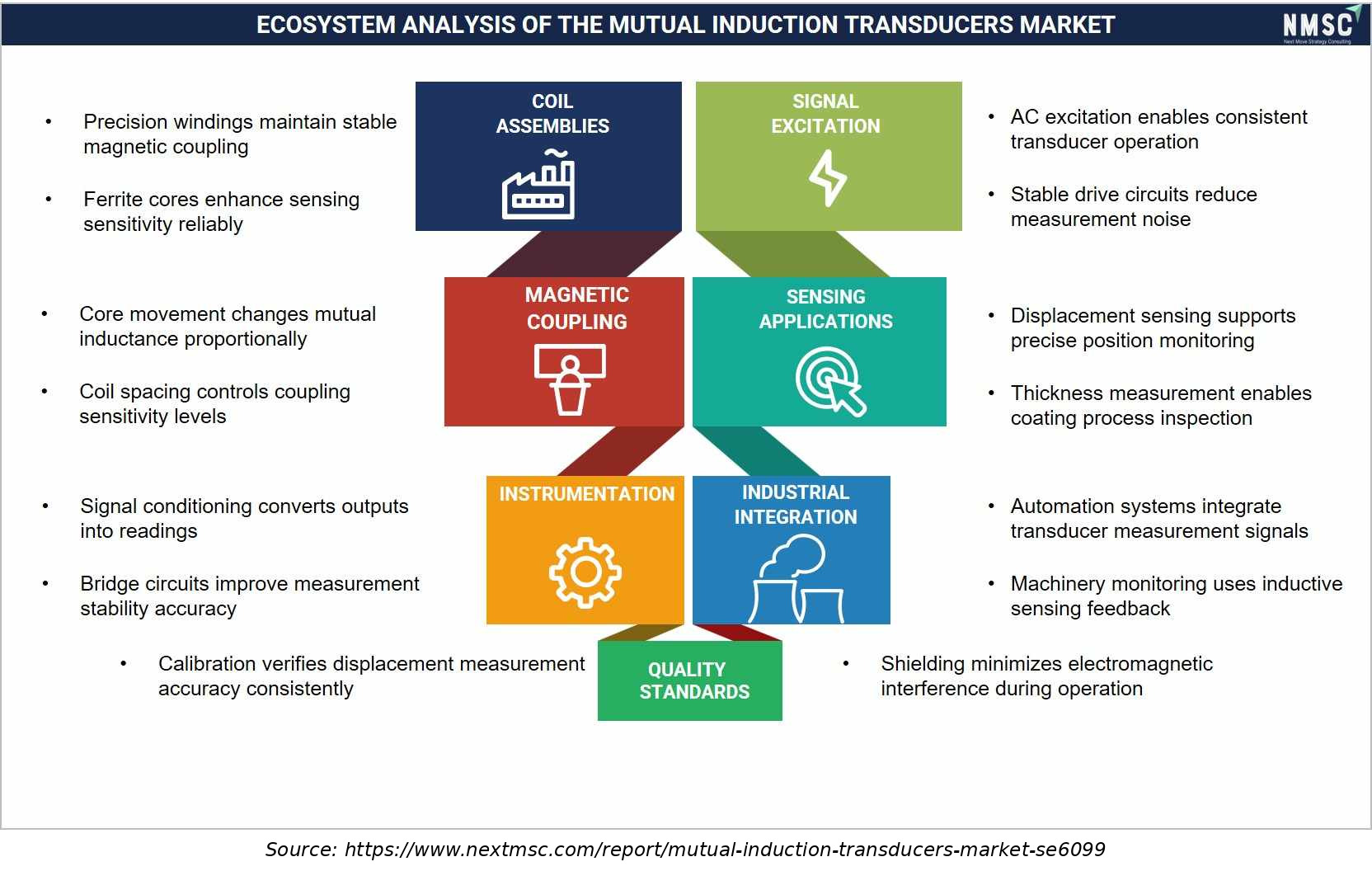
The ecosystem analysis illustrates the interconnected components supporting the mutual induction transducers market, including coil assemblies, signal excitation, magnetic coupling, sensing applications, instrumentation, industrial integration, and quality standards. These elements collectively support accurate electrical measurement and sensing, while integration with industrial systems and adherence to quality standards influence product performance, reliability, and application suitability.

Regional Outlook

2025 (USD Billion)
2035 (USD Billion)
North Americ
Europe
Asia-Pacific
Middle East
Latin Americ
Region 2025 (USD Billion) 2035 (USD Billion) CAGR (%)
North America $10.0 USD Billion $40.0 USD Billion 9.0%
Europe $17.1 USD Billion $51.1 USD Billion 27.0%
Asia-Pacific $24.2 USD Billion $62.2 USD Billion 25.0%
Middle East & Africa $31.3 USD Billion $73.3 USD Billion 23.0%
Latin America $38.4 USD Billion $84.4 USD Billion 12.0%

Regional data is locked

Unlock complete regional numbers for this market.

Unlock Full Data

Competitive Landscape

We observed that the mutual induction transducers market features a moderately consolidated competitive landscape, with diversified industrial technology conglomerates competing alongside specialized sensor manufacturers on precision, reliability, and application-specific engineering.

Dimension Description
Market Structure Moderately consolidated; the top companies profiled in this report collectively account for a majority of global mutual induction transducers revenue, while specialized regional manufacturers serve niche application segments.
Innovation Focus Digital signal conditioning integration, miniaturization, and multi-parameter sensor portfolio expansion dominate current innovation pipelines across leading manufacturers.
M&A Activity Selective aerospace sensor portfolio consolidation, exemplified by Curtiss-Wright Corporation's 2025 acquisition of Ultra Energy, including Weed Instrument Co., Inc.'s temperature sensor business.

How Do Companies Compete in the Mutual Induction Transducers Market?

Companies compete primarily on measurement precision, environmental ruggedness, and application-specific engineering support across the industry. Diversified conglomerates such as TE Connectivity Ltd. and Honeywell International Inc. leverage broad sensor portfolios to serve aerospace and industrial customers, while specialized manufacturers such as Micro-Epsilon Messtechnik GmbH & Co. KG and Hoffmann + Krippner GmbH compete on niche application expertise and custom engineering capability.

Which Competitive Archetypes Dominate the Mutual Induction Transducers Market?

Two archetypes dominate the market: diversified industrial technology conglomerates offering transducers within broader sensor and connectivity portfolios, and specialized manufacturers focused exclusively on precision inductive sensing. AMETEK Inc. and Curtiss-Wright Corporation exemplify the diversified archetype through multi-segment aerospace and industrial platforms, while G.W. Lisk Company Inc. and Kistler Holding AG exemplify the specialized archetype serving application-specific precision measurement demand.

How Are Companies Differentiating Through Innovation in Mutual Induction Transducers?

Innovation and differentiation strategy increasingly center on digital signal conditioning integration and miniaturized packaging. Curtiss-Wright Corporation's expanded aerospace sensor portfolio and TE Connectivity Ltd.'s broad LVDT and RVDT product range both extend precision sensing into new application-specific configurations. Our analysis shows that manufacturers unable to demonstrate credible digital interface compatibility risk exclusion from modern Industry 4.0 procurement specifications.

What M&A and Expansion Activity Is Shaping the Mutual Induction Transducers Market?

Portfolio consolidation and product line expansion continue to reshape capability within the industry. Curtiss-Wright Corporation's acquisition of Ultra Energy broadened its aerospace sensor offering beyond position sensing into temperature measurement, while AMETEK, Inc. reported record second-quarter 2026 sales of USD 2.04 billion, reflecting sustained acquisition-driven growth across its precision instrumentation businesses.

Key Market Players

Our assessment indicates that the following 17 companies are actively shaping product innovation, portfolio expansion, and application engineering strategy within the global mutual induction transducers market.

Honeywell International Inc. Sensata Technologies Holding plc Curtiss-Wright Corporation AMETEK Inc. Micro-Epsilon Messtechnik GmbH & Co. KG Parker Hannifin Corporation Meggitt PLC G.W. Lisk Company Inc. Hoffmann + Krippner GmbH OMEGA Engineering Inc. Balluff GmbH Pepperl+Fuchs SE IFM Electronic GmbH Omron Corporation Vishay Intertechnology Inc. Kistler Holding AG

Latest Developments

We found that recent developments within the mutual induction transducers market are concentrated on aerospace sensor portfolio expansion and sustained financial investment, reflecting the industry's continued precision instrumentation growth.

Date Event
March 2026 Micro-Epsilon introduced the eddyNCDT 3005, a compact inductive eddy-current displacement sensor system for fast, precise measurement on metal targets. The sensor head, cable and controller are sealed for harsh environments, while active temperature compensation improves accuracy under changing thermal conditions.
March 2026 Pepperl+Fuchs released an updated inductive sensor, NCN3-F31-B3B-V1-K, with AS-Interface connectivity and a 2026 release date. The product provides contactless metal detection for automation applications, adding industrial networking capability to the company’s inductive sensing portfolio.

Expert Insights

Christian Schrick

Christian Schrick

CEO | eddylab GmbH

"The requirements for our sensor solutions are continuously increasing—especially in safety-critical and extreme environments. This is exactly where reliable sensor technology proves its value: precision, robustness, and reliability under conditions that allow no compromise—from demanding industrial applications to safety-critical use cases in nuclear power plants."

Analyst Interpretation

The statement indicates a shift in the Mutual Induction Transducers Market toward higher-performance, application-specific sensing solutions. Demand is increasingly being driven by safety-critical industrial environments where conventional sensing technologies may not provide the required combination of precision, robustness, environmental resistance, and long operating life. This supports opportunities for advanced LVDTs and associated signal-conditioning technologies in power generation, aerospace, heavy industrial equipment, and process-control applications.

Supply Chain Structure of the Mutual Induction Transducers Market

Supply Chain Structure of the Mutual Induction Transducers Market

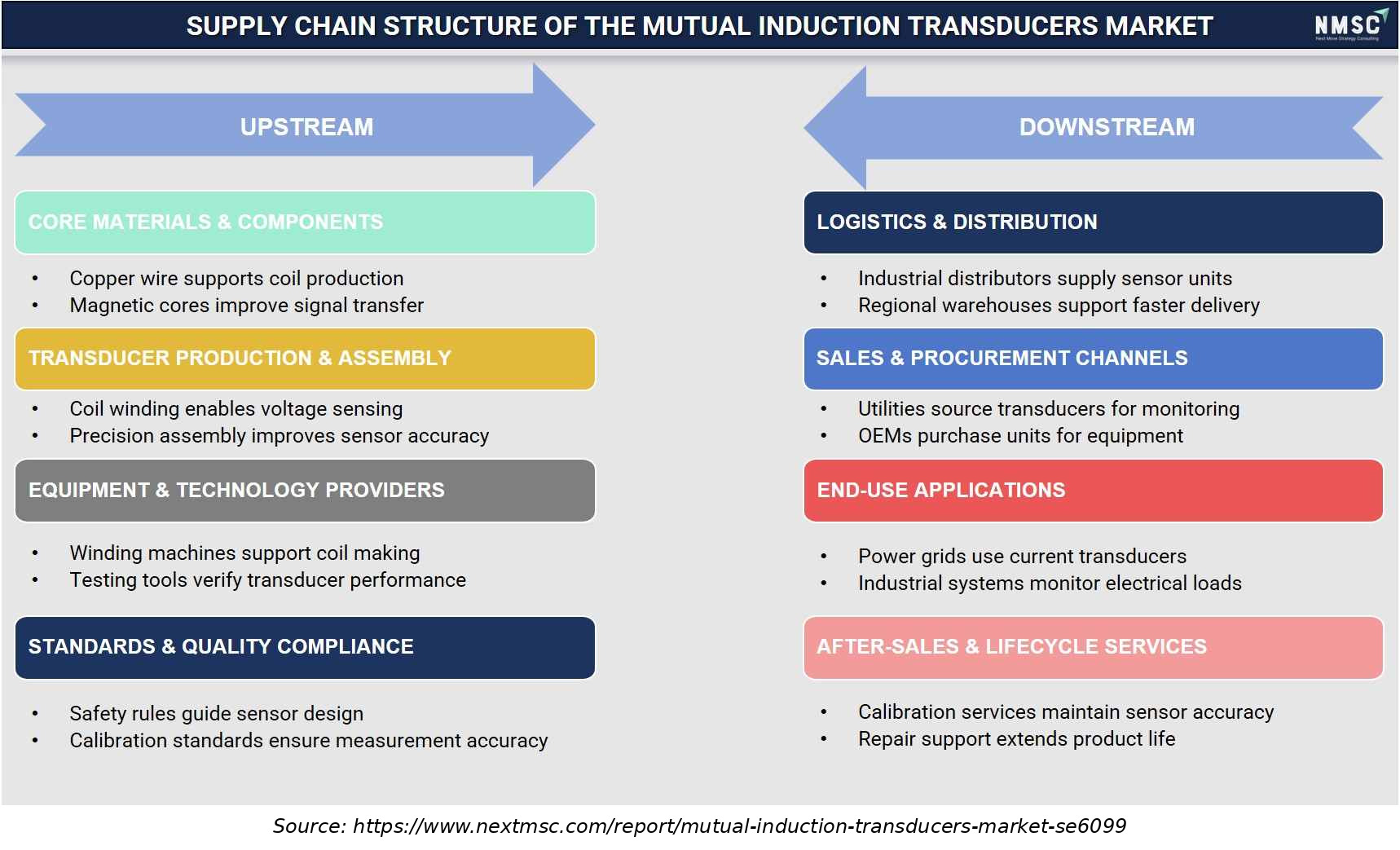
The supply chain structure maps the mutual induction transducers market from core materials and components through transducer production, assembly, equipment providers, and standards compliance. Downstream activities encompass logistics, distribution, procurement, end-use applications, and after-sales services. The value chain highlights the importance of precision manufacturing, calibration, industrial distribution, and technical support in maintaining sensor accuracy and reliability.

Investment Opportunities

What Capital Inflows Are Targeting the Mutual Induction Transducers Market?

Capital inflows into the mutual induction transducers market are increasingly directed toward aerospace sensor portfolio expansion and precision manufacturing capacity. AMETEK, Inc. reported record second-quarter 2026 sales of USD 2.04 billion, a 15% increase over the prior year, reflecting sustained acquisition-driven investment across its precision instrumentation businesses supporting aircraft engine control applications. We observed that investors favor manufacturers demonstrating credible aerospace qualification credentials and diversified application coverage.

How Is Infrastructure Investment Supporting Mutual Induction Transducers Delivery?

Infrastructure investment is expanding precision manufacturing capacity and digital signal conditioning integration to support transducer delivery at scale. Our findings suggest that Curtiss-Wright Corporation's raised full-year 2026 outlook reflects continued capital deployment toward operating margin expansion and manufacturing capability across its Sensors & Actuation Division. Manufacturers are prioritizing automated coil winding and calibration infrastructure as the binding constraint on production scale.

What ESG Considerations Are Shaping Mutual Induction Transducers Investment Decisions?

Environmental, social, and governance considerations are central to investment decisions across the industry, with product longevity and energy-efficient manufacturing as key environmental criteria. TE Connectivity Ltd. and AMETEK Inc. continue to publish sustainability disclosures covering manufacturing energy efficiency and materials sourcing. We found that investors increasingly scrutinize manufacturers' product reliability testing and aerospace qualification transparency as governance indicators alongside manufacturing efficiency.

Key Benefits for Stakeholders

How Does This Report Benefit Enterprise and Industry Leaders?

Enterprise and industry leaders gain access to validated segmentation, competitive benchmarking, and regional demand forecasts that support product design and sourcing decisions across the mutual induction transducers industry. Our analysis shows that detailed product type, application, and end user breakdowns help procurement teams align specifications with reliability and qualification requirements while identifying underserved categories for portfolio expansion.

How Does This Report Benefit Investors and Financial Analysts?

Investors and financial analysts benefit from consistent, single-point market size and CAGR estimates that support valuation and capital-allocation decisions across the mutual induction transducers market supply chain. We observed that the report's regional and segment-level growth differentials help identify which manufacturers are best positioned to capture above-market growth in current transformer and digital output categories through 2035.

How Does This Report Benefit Technology Vendors and Product Teams?

Technology vendors and product teams gain insight into emerging design requirements, including digital signal conditioning integration, miniaturization, and multi-parameter sensor assemblies, that are reshaping the industry. Our findings suggest that this analysis helps research and development teams prioritize roadmaps around digital interface compatibility and aerospace qualification increasingly required by OEM and system integrator procurement processes.

Key Market Segments Evaluated

By Product Type

  • Linear Variable Differential Transformer (LVDT) 
    • AC LVDT
    • DC LVDT
  • Rotary Variable Differential Transformer (RVDT)
  • Mutual Inductive Position Sensor
  • Mutual Inductive Proximity Sensor
  • Mutual Inductive Current Transformer

By Output Type

  • Analog Output
  • Digital Output

By Sensing Mechanism

  • Contact Type
  • Non Contact Type

By Measurement Type

  • Linear Displacement Measurement
  • Angular Displacement Measurement
  • Current Measurement

By Product Configuration

  • Standalone Transducer
  • Integrated Sensor Assembly

By Application

  • Industrial Automation 
    • Machine Tools
    • Robotics Motion Control
    • Process Automation
  • Aerospace Defense 
    • Flight Control Systems
    • Engine Control Systems
    • Actuation Systems
  • Automotive 
    • Powertrain Systems
    • Electric Vehicle Systems
    • Vehicle Testing Systems
  • Energy Power 
    • Turbine Control Systems
    • Power Equipment Monitoring
    • Renewable Energy Systems
  • Research Testing 
    • Material Testing
    • Laboratory Measurement Systems
    • Calibration Equipment
  • Others

By End User

  • Original Equipment Manufacturers
  • System Integrators
  • Research Institutions
  • Industrial Users

By Region

  • North America 
    • U.S.
    • Canada
    • Mexico.
  • Europe 
    • UK
    • Germany
    • France
    • Italy
    • Spain
    • Sweden
    • Denmark
    • Finland
    • Netherlands
    • Rest of Europe.
  • Asia-Pacific 
    • China
    • India
    • Japan
    • South Korea
    • Taiwan
    • Indonesia
    • Vietnam
    • Australia
    • Philippines
    • Malaysia
    • Rest of APAC.
  • Middle East & Africa 
    • Saudi Arabia
    • UAE
    • Egypt
    • Israel
    • Turkey
    • Nigeria
    • South Africa
    • Rest of MEA.
  • Latin America 
    • Brazil
    • Argentina
    • Chile
    • Colombia
    • Rest of LATAM.

Conclusion & Recommendations

The long-term outlook for the mutual induction transducers market remains constructive, supported by sustained industrial automation investment, aerospace flight-critical sensing demand, and expanding electric vehicle testing requirements. NMSC's analysis indicates that the market's expansion from USD 2.95 billion in 2025 to USD 6.57 billion by 2035 reflects structural, durable demand rather than short-term cyclical growth, positioning the industry for sustained expansion through the forecast period.

What Strategic Positioning Should Manufacturers Pursue?

Manufacturers should prioritize digital signal conditioning integration and aerospace qualification breadth to differentiate from single-application competitors. Our assessment indicates that suppliers combining broad product portfolios with application-specific engineering support will be best positioned to capture premium aerospace and industrial automation contracts within the mutual induction transducers market's regulated segments.

How Attractive Is the Mutual Induction Transducers Market for New Investment?

The mutual induction transducers industry presents an attractive investment case, supported by a USD 3.39 billion absolute dollar opportunity between 2026 and 2035 and above-average growth in Asia-Pacific and current transformer categories. We found that investment attractiveness is highest for manufacturers combining aerospace qualification credentials with scaled precision manufacturing infrastructure, positioning them to serve both premium and cost-sensitive industrial segments simultaneously.

What Market Shifts and Key Risks Should Stakeholders Monitor?

Stakeholders should monitor high unit costs relative to alternative sensing technologies, competition from magnetostrictive and optical position sensors, and long aerospace qualification cycles as key risks to the mutual induction transducers market. Our analysis shows that manufacturers unable to demonstrate digital interface compatibility risk losing Industry 4.0-oriented contracts to competitors with modernized product portfolios, particularly as automation upgrades accelerate.

What Are the Key Growth Pathways for the Mutual Induction Transducers Market?

Key growth pathways include expanding digitally interfaced product portfolios, scaling electric vehicle testing sensor supply, and deepening penetration into renewable energy turbine control applications. NMSC's analysis indicates that manufacturers pursuing these pathways while maintaining cost discipline in standard industrial categories will be best positioned to capture the mutual induction transducers market's projected growth through 2035.

FAQs

About the Author

Mihul Sharma

Mihul Sharma

Mihul Sharma is Research Associate at Next Move Strategy Consulting, where he has covered technology, industrial, and healthcare markets for 3 years. His work applies structured business research, market analysis, and secondary-source review to assess market trends, competitive developments, and growth opportunities. He supports report development by fully synthesizing industry data, company information, and market signals into concise findings for strategy and investment-focused research teams.

About the Reviewer

Supradip Baul

Supradip Baul

Supradip Baul is an accomplished business consultant and strategist with over a decade of rich experience in market intelligence, strategy, technology, and business transformation. His work has included rigorous qualitative and quantitative analysis across multiple industries, helping clients shape investment decisions and long-term roadmaps. Earlier in his career, he was associated with Gartner, where he contributed to industry-leading reports and market share analyses. He has worked with leading global companies and holds an MBA with a dual specialization in Marketing and Finance.

Download Free Sample

Gustaf Hummel Burstrom

GUSTAF HUMMEL BURSTROM

Founder

Revline Tools AB

Joseph and the team at Next Move Strategy Consulting have been excellent to work with, in supplying us with relevant market data and forecasts for our specific category. We had some special requirements and they were able to do a custom package to suit our needs. We would definitely recommend them to any other company needing market data and forecasts

Mohit Agarwal

MOHIT AGARWAL

Chief Manager

DryChem India Pvt. Ltd.

Next Move Strategy Consulting is an amazing team of consultants. We required a market study report for our investors on top priority and the team went above and beyond our expectations to deliver the same with ample supporting data within a short time span enabling us to secure the investments and keep our project timeline maintained. Their professionalism, attention to detail, and timely delivery of actionable recommendations have left a lasting impression on our organization.

Ross J Mckenzie

ROSS J MCKENZIE

Business Insight Manager

Staysure Group

“Next MSC have been incredibly helpful in providing detailed & robust information on our market, alongside quantifying growth by different segments. The process to procure was simple and easy, with sample reports and regular contact to ensure we had what we needed. Succinct detail on their sources & methodologies is also greatly received, allowing transparency in this respect helps build trust in the detail you pay for. Joseph in particular was fantastic, and helped ensure efficient provision of the insight pack – thank you NMSC!”.

Gaurav Jaiswal

GAURAV JAISWAL

Founder & CEO

Yano Charge Private Limited

The EV Charging market research report provided by the NextMSC was exceptionally detailed and insightful. It offered a comprehensive analysis that proved to be a game-changer for our strategic planning. Truly a testament to the NextMSC’s expertise and thoroughness in EV market landscape & analysis.

Melanie Samko

MELANIE SAMKO

Director of Marketing

TOSOH BIOSCIENCE, INC.

The information provided by NMSC is incredibly valuable, thank you so much for such a excellent work. I really appreciate it. I will make sure to reference all of it, in my summary document.

Custom Market Research Services

We will customize the research for you if the listed report does not fully match your requirements.

Get 30% Free Customization

Select License

This website uses cookies to ensure you get the best experience on our website. Learn more

✖