Mutual Inductive Transducer Market Size, Share, Growth Trends and Segmentation Analysis, By Product Type (LVDT, RVDT, Rotary Variable Inductance Transducer, Half Bridge Transducer), By Output Type (AC Output & DC Output), By Application (Position Sensing, Displacement Measurement, & Others), By End User Industry (Aerospace and Defense, Oil and Gas, Industrial Automation, & Others), and By Region — Global Industry Report and Forecast, 2026–2035
Industry: Semiconductor & Electronics | Publishing Date: August 3, 2026 | Last Updated: August 3, 2026 | No of Pages: N/A | No. of Tables: N/A | No. of Figures: N/A | Format: PDF | Report Code: SE5527
What Is the Mutual Inductive Transducer Market Size?
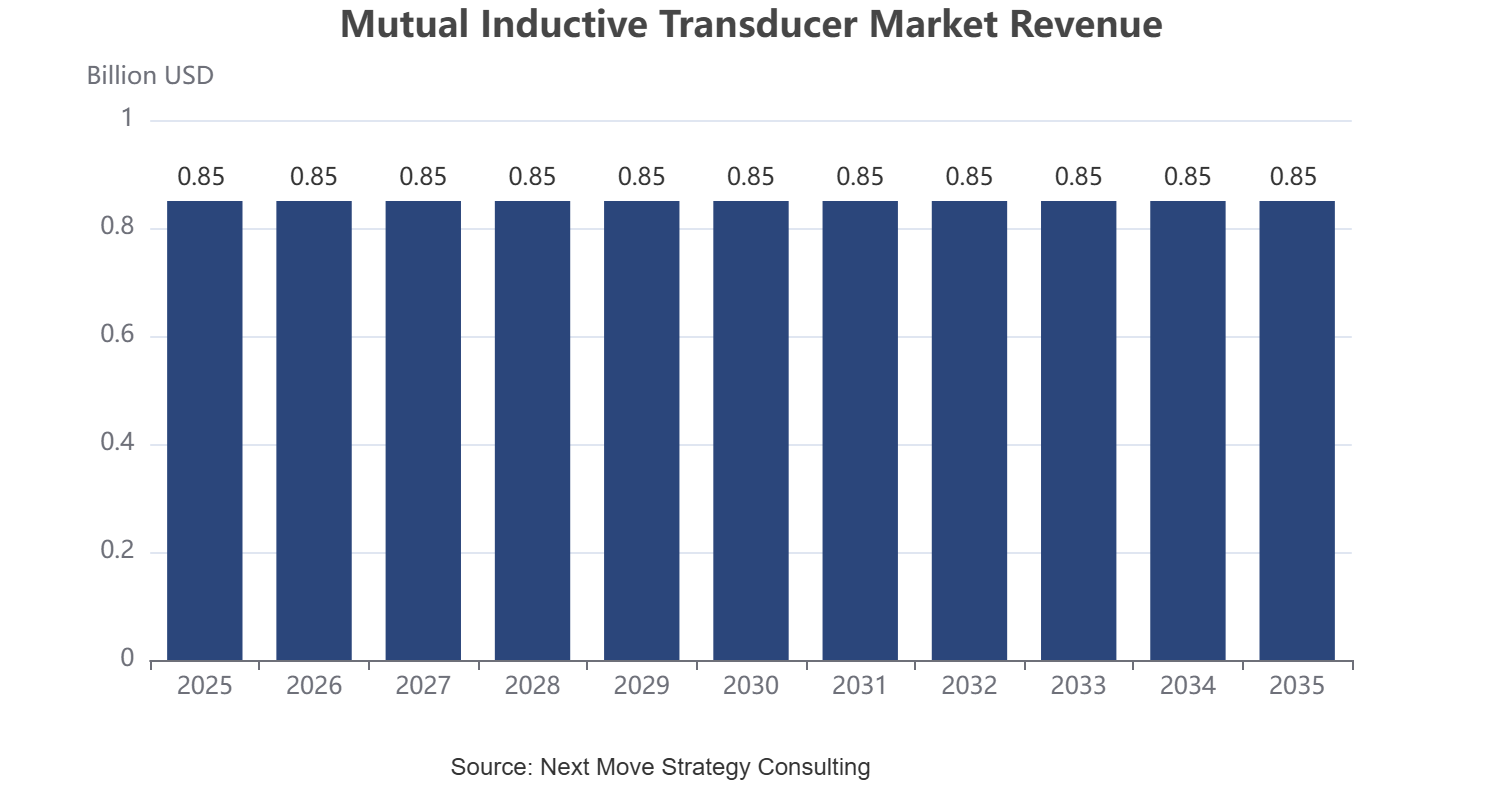
The global Mutual Inductive Transducer Market size was valued at USD 0.85 billion in 2025 and is estimated at USD 0.90 billion in 2026, forecast to reach USD 1.62 billion by 2035, expanding at a 6.75% CAGR between 2026 and 2035. North America leads with approximately a 36% share, while LVDT dominates all other product types with approximately a 52% share.
We observed that growth is broad-based across every segmentation axis, with DC output adoption and industrial automation integration driving the dominant structural shifts through 2035.
|
Key Takeaways |
|
By Product Type: LVDT held the largest share of approximately 52% (USD 0.44 Billion) in 2025; Rotary Variable Inductance Transducer is the fastest-growing sub-segment at 8.3% CAGR from 2026–2035. |
|
By Output Type: AC Output held the largest share of approximately 57% (USD 0.48 Billion) in 2025; DC Output is the fastest-growing sub-segment at 8.8% CAGR from 2026–2035. |
|
By Application: Position Sensing held the largest share of approximately 34% (USD 0.29 Billion) in 2025; Pressure Measurement is the fastest-growing sub-segment at 8.5% CAGR from 2026–2035. |
|
By End User Industry: Aerospace and Defense held the largest share of approximately 27% (USD 0.23 Billion) in 2025; Automotive is the fastest-growing sub-segment at 8.9% CAGR from 2026–2035. |
|
Dominant Region: North America dominated with approximately 36% revenue share (USD 0.31 Billion) in 2025. |
|
Fastest-Growing Region: Asia-Pacific is expected to register the highest CAGR of 9.7% during 2026–2035. |
|
Dominant Country: The U.S. led with approximately USD 0.19 Billion in 2025. |
|
Fastest-Growing Country: India is the fastest-growing country at approximately 15.2% CAGR from 2026–2035. |
Market Opportunity: The Mutual Inductive Transducer Market is expected to create an absolute dollar opportunity of USD 720 million between 2026 and 2035, presenting significant investment potential across DC output conversion and industrial automation-integrated sensing platforms.
According to NMSC analysis, aerospace and industrial automation buyers are increasingly specifying digitally compensated DC output transducers with integrated signal conditioning over legacy AC output units, a shift that favors manufacturers with in-house electronics integration capability over mechanically focused component producers as precision measurement requirements tighten across regulated end markets through 2035.
Ecosystem Analysis of the Mutual Inductive Transducer Industry
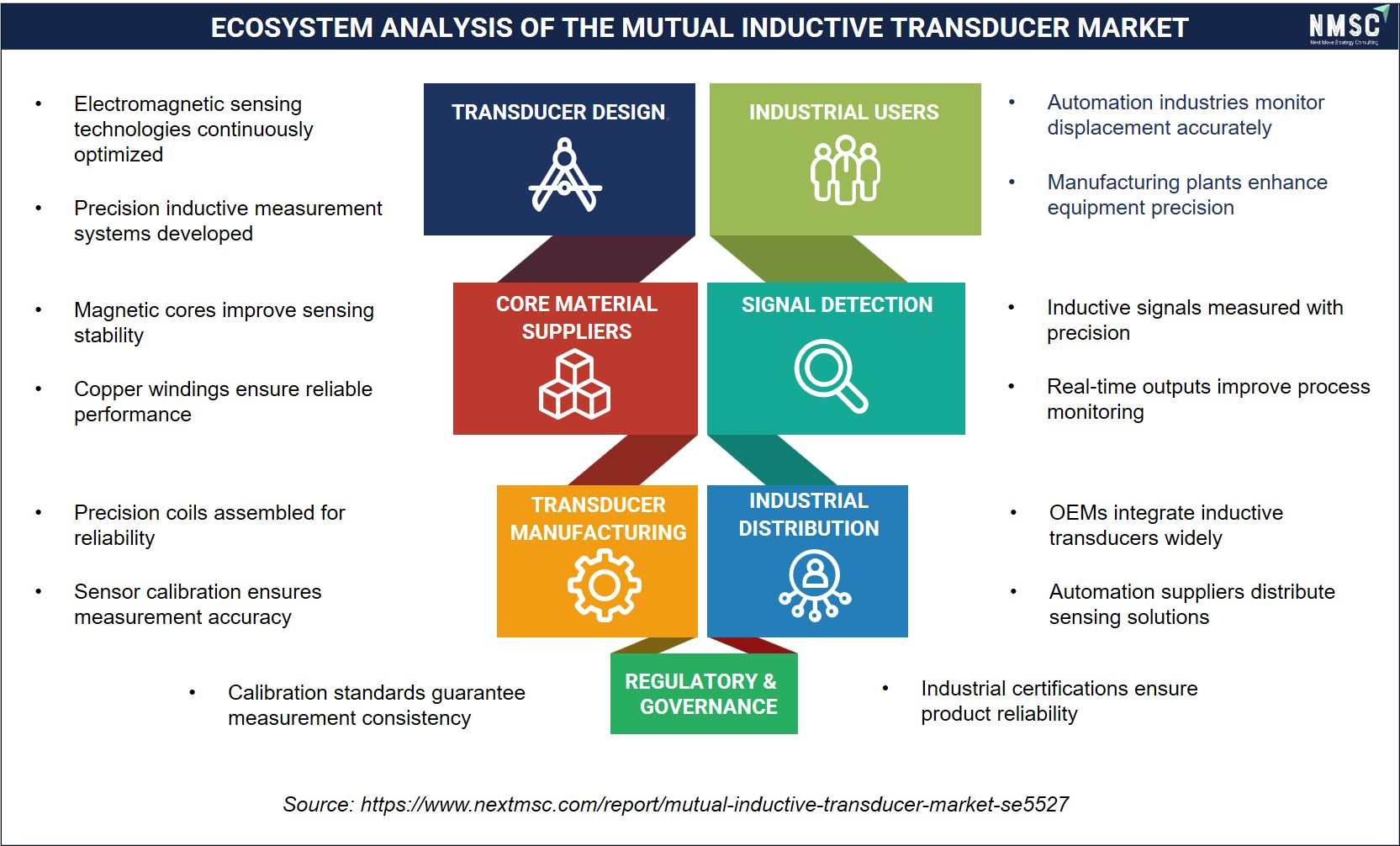
The above infographic maps the interdependent mutual inductive transducer ecosystem, where advanced electromagnetic design and core material suppliers establish foundational sensing accuracy. Signal detection and precision manufacturing ensure reliable real-time outputs and measurement consistency for industrial users. Market viability hinges on seamless OEM integration through industrial distribution channels. Ultimately, regulatory and governance bodies serve as critical gatekeepers, enforcing calibration standards and industrial certifications that guarantee product reliability and measurement integrity across all deployments.
What does the Mutual Inductive Transducer Market Encompass?
The Mutual Inductive Transducer Market encompasses linear variable differential transformers, rotary variable differential transformers, rotary variable inductance transducers, and half-bridge transducers used for position sensing, displacement measurement, and force and load measurement across aerospace, oil and gas, and industrial automation applications. We observed that the scope spans AC and DC output configurations supplied to original equipment manufacturers and end users requiring contactless, high-reliability position feedback in harsh operating environments.
Regulatory frameworks such as the U.S. Federal Aviation Administration's airworthiness certification requirements and the International Electrotechnical Commission's industrial sensor standards shape qualification timelines for aerospace and process control applications. Our assessment indicates that technology adoption is shifting toward digitally integrated DC output transducers with embedded signal conditioning, with manufacturers increasingly bundling calibration and diagnostic capability into core product lines to support predictive maintenance programs across industrial and aerospace end markets.
|
Parameters |
Details |
|
Market Size in 2025 |
USD 850 Million |
|
Market Size in 2026 |
USD 900 Million |
|
Revenue Forecast in 2035 |
USD 1,620 Million |
|
Growth Rate |
CAGR of 6.75% from 2026 to 2035 |
|
Analysis Period |
2025–2035 |
|
Base Year Considered |
2025 |
|
Forecast Period |
2026–2035 |
|
Market Size Estimation |
USD Million |
|
Companies Profiled |
18 |
|
Countries Covered |
38 |
|
Market Share |
Available for Top 10 Companies |
Key Emerging Trends
Based on research conducted by NMSC, we found that four structural trends are reshaping product design, adoption, and stakeholder engagement across the industry.
How Is Digital Signal Conditioning Transforming Transducer Output?
Digitally integrated signal conditioning electronics are replacing standalone external amplifier modules for DC output transducers. We observed that TE Connectivity Ltd. has expanded embedded electronics capability across its position sensor portfolio, letting integrators reduce external wiring complexity while improving smart sensors compatibility for industrial automation and aerospace test equipment applications.
Why Is Miniaturization Gaining Momentum in Aerospace Applications?
Miniaturized transducer designs are gaining momentum as aerospace actuator systems demand reduced weight and footprint without sacrificing measurement accuracy. We found that Curtiss-Wright Corporation has expanded compact rotary variable differential transformer product lines for flight control applications, positioning miniaturized designs as a structural requirement for next-generation aircraft actuation systems.
How Are Predictive Maintenance Programs Reshaping Transducer Specification?
Predictive maintenance programs are compressing the gap between routine calibration cycles and real-time condition monitoring for critical rotating and reciprocating machinery. During our market evaluation, we noticed that vibration monitoring integration with displacement transducers is improving early fault detection, with Micro-Epsilon Messtechnik GmbH & Co. KG expanding diagnostic-capable transducer lines for industrial process monitoring.
What Role Is Harsh Environment Qualification Playing in Oil and Gas Adoption?
Harsh environment qualification is becoming a differentiating requirement as oil and gas operators demand transducers rated for high-pressure, high-temperature downhole and subsea conditions. Our findings suggest that Honeywell International Inc. has expanded ruggedized transducer product lines certified for extended temperature and pressure ranges, positioning environmental qualification as a key purchasing criterion for upstream and midstream applications.
Growth Drivers and Restraints
Growth Catalyst and Risk Assessment Matrix
|
Factors |
Type |
(+/-) % Impact on CAGR |
Geographic Relevance |
Impact Timeline |
|
Rising aerospace production rates and flight control system demand |
Driver |
+1.8% |
North America, Europe |
2026–2035 |
|
Growing industrial automation and predictive maintenance adoption |
Driver |
+1.6% |
Global |
2026–2035 |
|
Expansion of oil and gas exploration in harsh environments |
Driver |
+1.2% |
Middle East & Africa, North America |
2026–2033 |
|
Rising manufacturing investment in Asia-Pacific |
Driver |
+1.4% |
Asia-Pacific |
2026–2035 |
|
Growth of digitally integrated DC output transducer adoption |
Driver |
+0.9% |
Global |
2026–2032 |
|
Competition from optical and capacitive displacement sensing technologies |
Restraint |
-1.1% |
North America, Europe |
2026–2031 |
|
High qualification costs for aerospace-grade transducers |
Restraint |
-0.8% |
Global |
2026–2030 |
|
Price sensitivity in cost-driven industrial automation segments |
Restraint |
-0.7% |
Asia-Pacific, Latin America |
2026–2029 |
|
Long product replacement cycles limiting unit volume growth |
Restraint |
-0.6% |
Global |
2026–2030 |
What Is the Primary Growth Driver for the Mutual Inductive Transducer Market?
The primary growth driver is rising aerospace production rates and flight control system demand, as commercial and defense aircraft programs require high-reliability position feedback for actuation systems. We observed that the U.S. Federal Aviation Administration has maintained stringent airworthiness certification requirements for flight control sensing components since 2024, reinforcing demand for qualified mutual inductive transducers across new aircraft production programs.
How Is Industrial Automation Investment Driving Market Growth?
Industrial automation investment is driving market growth as manufacturers integrate position and displacement feedback directly into closed-loop control systems. Based on research conducted by NMSC, we found that expanding industrial sensors deployment across process manufacturing is increasing demand for contactless, high-reliability transducers capable of operating in harsh factory floor conditions without frequent recalibration.
What Is Restraining the Mutual Inductive Transducer Market?
Competition from optical and capacitive displacement sensing technologies restrains growth in applications where non-contact optical measurement offers comparable accuracy at lower unit cost. Industry filings indicate that alternative sensing technology adoption has grown steadily in general industrial applications since 2024, though mutual inductive transducers retain preference in high-vibration and electromagnetically noisy environments. Our analysis shows that manufacturers with diversified sensing technology portfolios face less competitive exposure than pure mutual inductive specialists.
Segmentation Analysis
Segment Sizing: By Product Type
|
Segment |
2025 (USD) |
2035 (USD) |
CAGR% (2026–2035) |
|
LVDT |
USD 442 Million |
USD 778 Million |
5.8% |
|
RVDT |
USD 221 Million |
USD 437 Million |
7.2% |
|
Rotary Variable Inductance Transducer |
USD 119 Million |
USD 259 Million |
8.3% |
|
Half Bridge Transducer |
USD 68 Million |
USD 146 Million |
8.2% |
|
Total |
USD 850 Million |
USD 1,620 Million |
6.75% |
Which Product Type Dominates the Mutual Inductive Transducer Market?
LVDT dominates the product type axis, contributing USD 0.442 billion in 2025 and projected to reach USD 0.778 billion by 2035. We found that linear variable differential transformers remain the largest revenue contributor given their established role in aerospace actuator feedback and industrial linear position sensing, while Rotary Variable Inductance Transducer products grow fastest as rotary motion feedback demand expands across automation applications.
Segment Sizing: By Application
|
Segment |
2025 (USD) |
2035 (USD) |
CAGR% (2026–2035) |
|
Position Sensing |
USD 289 Million |
USD 502 Million |
5.7% |
|
Displacement Measurement |
USD 238 Million |
USD 437 Million |
6.3% |
|
Force and Load Measurement |
USD 144 Million |
USD 292 Million |
7.4% |
|
Pressure Measurement |
USD 110 Million |
USD 243 Million |
8.5% |
|
Vibration Monitoring |
USD 68 Million |
USD 146 Million |
8.2% |
|
Total |
USD 850 Million |
USD 1,620 Million |
6.75% |
Which Application Is Growing Fastest?
Position Sensing remains the largest application at USD 0.289 billion in 2025, while Pressure Measurement is the fastest-growing at an 8.5% CAGR through 2035. Our findings suggest that expanding industrial automation deployment in process manufacturing is driving demand for transducer-based pressure feedback in closed-loop control systems requiring high electromagnetic immunity.
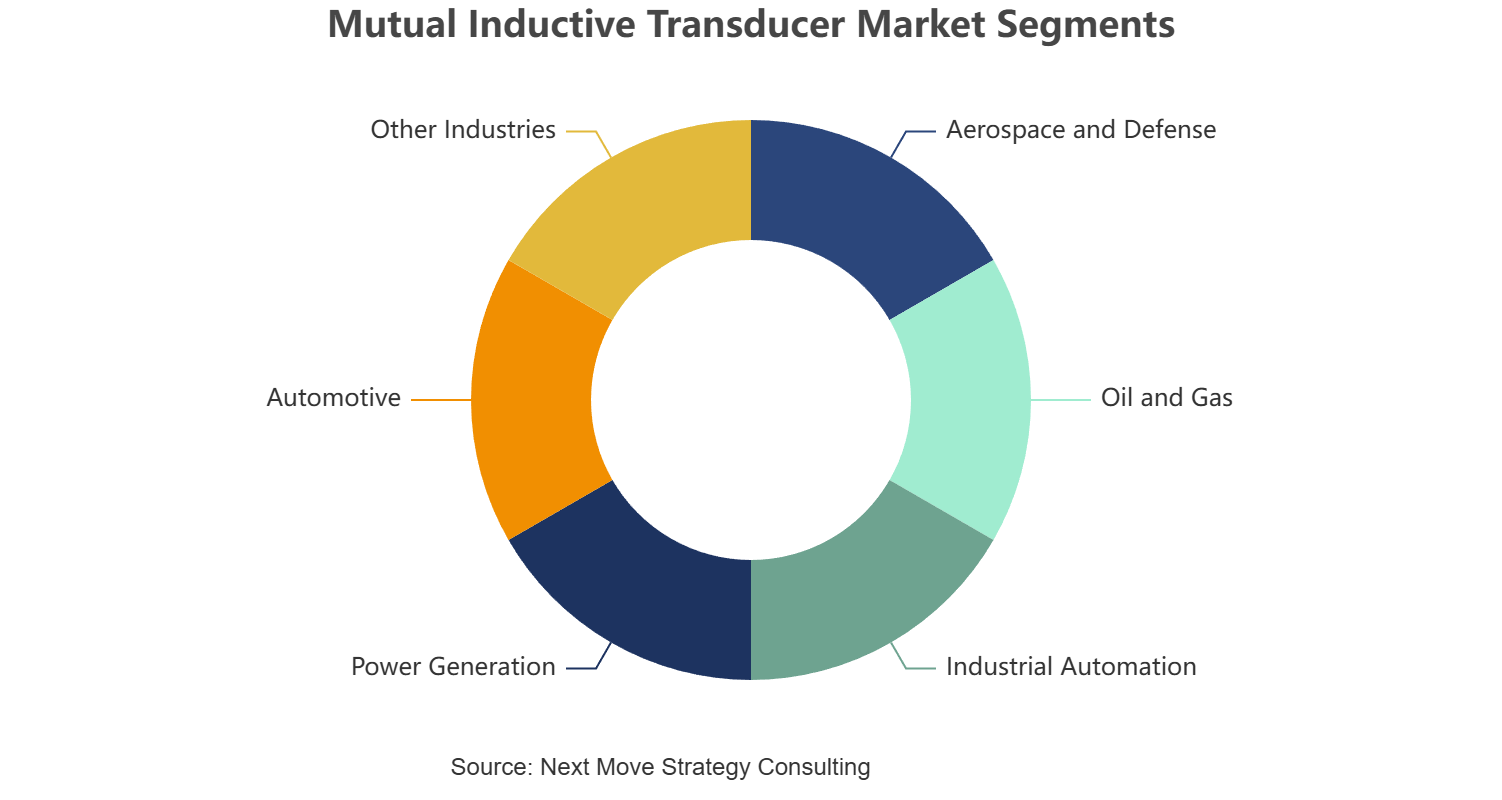
Segment Sizing: By End User Industry
|
Segment |
2025 (USD) |
2035 (USD) |
CAGR% (2026–2035) |
|
Aerospace and Defense |
USD 229 Million |
USD 421 Million |
6.3% |
|
Oil and Gas |
USD 170 Million |
USD 275 Million |
4.8% |
|
Industrial Automation |
USD 204 Million |
USD 437 Million |
8.1% |
|
Power Generation |
USD 119 Million |
USD 211 Million |
5.9% |
|
Automotive |
USD 85 Million |
USD 194 Million |
8.9% |
|
Other Industries |
USD 43 Million |
USD 81 Million |
6.7% |
|
Total |
USD 850 Million |
USD 1,620 Million |
6.75% |
Why Does Automotive Grow Fastest Among End User Industries?
Aerospace and Defense leads with USD 0.229 billion in 2025, reflecting stringent qualification requirements and long program lifecycles that sustain steady transducer demand. We observed that Automotive forms the fastest-growing end user category at an 8.9% CAGR through 2035, as electrified powertrain testing and advanced driver assistance system validation increasingly require high-precision position feedback during vehicle development programs.
Porter's Five Forces Analysis of the Mutual Inductive Transducer Industry
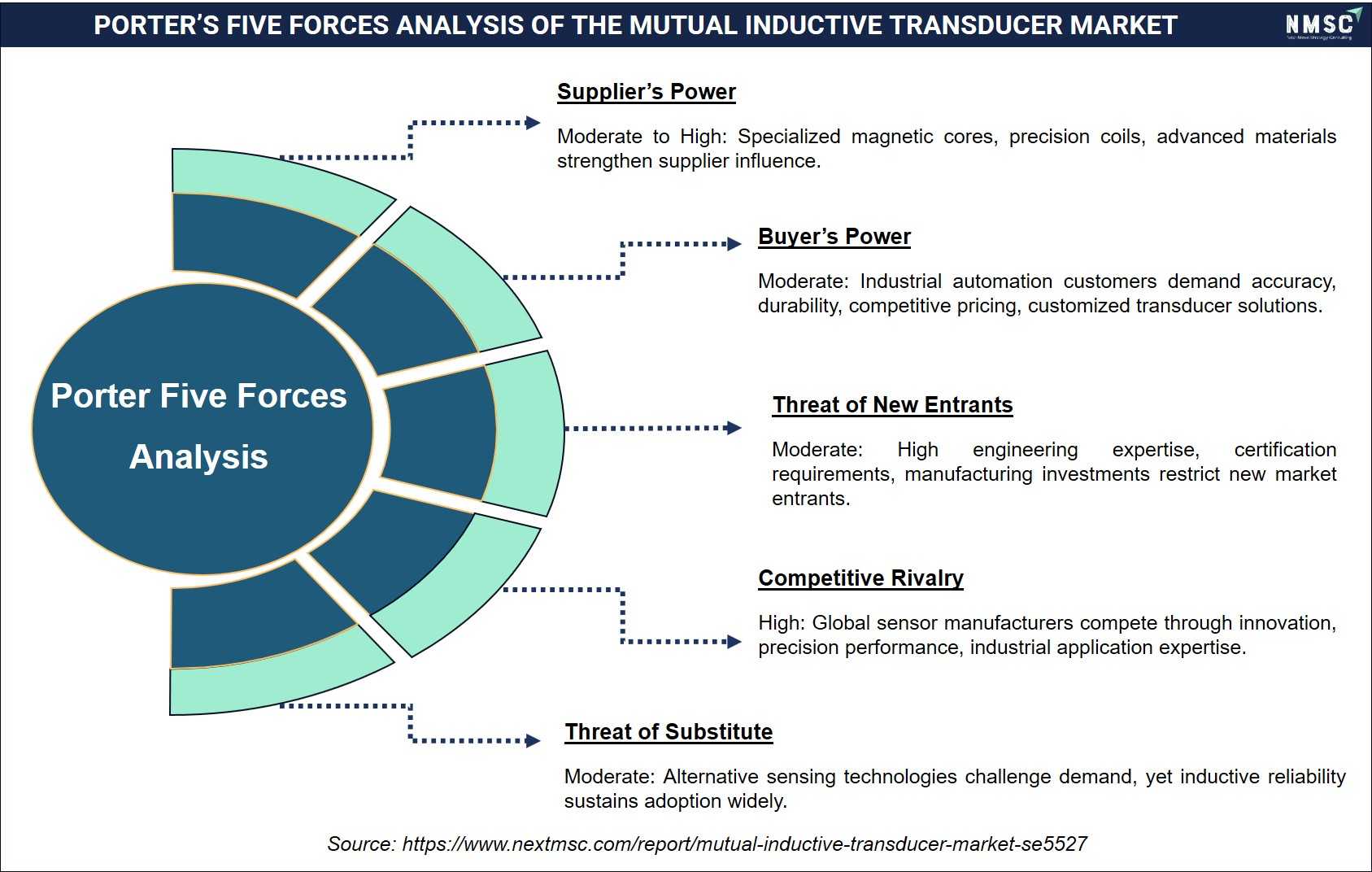
The above infographic presents a Porter's Five Forces analysis of the mutual inductive transducer market, where supplier power remains moderate to high due to reliance on specialized magnetic cores and precision coils. Buyer power is moderate as industrial users demand customized, durable solutions. The threat of new entrants is moderate, constrained by high engineering expertise and manufacturing investments, though competitive rivalry is intense among global sensor manufacturers. The threat of substitutes remains moderate, as alternative technologies exist, but inductive reliability sustains widespread industrial adoption.
Growth Opportunities
Beyond the core drivers outlined above, three forward-looking whitespace opportunities stand out for stakeholders positioning within the mutual inductive transducer market over the 2026–2035 forecast period.
Can Embedded Diagnostics Unlock Value for Predictive Maintenance Programs?
Embedded diagnostic capability integrated directly into transducer housings presents a whitespace opportunity for industrial customers building predictive maintenance programs. Manufacturers that expand self-monitoring transducer lines stand to capture recurring replacement and service contract revenue as process manufacturers prioritize early fault detection over reactive maintenance scheduling.
Where Does Electrified Powertrain Testing Create New Demand?
Electrified powertrain testing represents an underpenetrated opportunity as automotive manufacturers validate electric motor and battery system components requiring precise position and displacement feedback. Manufacturers such as Novotechnik U.S., Inc. and Trans-Tek, Inc. that expand automotive-qualified transducer lines can capture recurring demand from vehicle testing and validation programs.
How Can Compact Aerospace Designs Benefit Next-Generation Aircraft Programs?
Compact, lightweight transducer designs create a mechanism to serve next-generation aircraft programs prioritizing weight reduction across flight control systems. This category benefits manufacturers integrating transducers with smart sensor capability, directly supporting continued RVDT demand growth within aerospace and defense actuation applications through 2035.
Regional Outlook
|
Region |
2025 (USD) |
2035 (USD) |
CAGR% (2026–2035) |
Key Driver |
|
North America |
USD 306 Million |
USD 535 Million |
5.7% |
Aerospace production rates and defense procurement |
|
Europe |
USD 255 Million |
USD 421 Million |
5.1% |
Industrial automation modernization and aerospace manufacturing |
|
Asia-Pacific |
USD 212 Million |
USD 518 Million |
9.7% |
Manufacturing capacity expansion and automotive testing demand |
|
Middle East & Africa |
USD 51 Million |
USD 97 Million |
6.7% |
Oil and gas exploration infrastructure investment |
|
Latin America |
USD 25 Million |
USD 49 Million |
6.8% |
Expanding industrial manufacturing base |
|
Total |
USD 850 Million |
USD 1,620 Million |
6.75% |
— |
North America Mutual Inductive Transducer Market
North America remains the most mature mutual inductive transducer market, anchored by dense aerospace production capacity and established defense procurement programs. We observed that U.S. Federal Aviation Administration certification requirements sustain demand for qualified, high-reliability transducers across commercial and military aircraft programs. Technology adoption remains advanced, with digitally integrated DC output transducers widely specified across new aerospace and industrial automation programs.
Europe Mutual Inductive Transducer Market
Europe's market reflects a mature, regulation-intensive landscape shaped by International Electrotechnical Commission industrial sensor standards governing qualification and interoperability. Our findings suggest that manufacturers across Germany, France, and the UK increasingly prioritize digitally compensated transducers for industrial automation modernization programs. Technology adoption favors embedded signal conditioning, supported by manufacturers investing in precision calibration infrastructure.
Asia-Pacific Mutual Inductive Transducer Market
Asia-Pacific is the fastest-growing mutual inductive transducer market region, propelled by manufacturing capacity expansion in China and India and rising automotive testing demand. We found that regulatory frameworks remain less harmonized than in Europe, giving manufacturers flexibility to scale industrial automation-focused product lines rapidly. Technology adoption is accelerating as regional manufacturers expand domestic production capacity to serve growing automation demand.
Middle East & Africa Mutual Inductive Transducer Market
Middle East & Africa is expanding as regional oil and gas operators invest in exploration infrastructure requiring harsh environment-qualified transducers. Our analysis shows that Saudi Arabia and the UAE are attracting transducer investment linked to upstream and midstream project expansion. Regulatory influence remains moderate, while technology adoption is gradually shifting toward ruggedized product lines as regional operators align with international qualification standards.
Latin America Mutual Inductive Transducer Market
Latin America's market is supported by expanding industrial manufacturing activity in Brazil and Argentina and growing demand for automation-compatible position feedback. We observed that regulatory frameworks are less stringent than in North America or Europe, though multinational manufacturers operating locally are introducing digitally integrated product options. Technology adoption remains centered on conventional AC output transducers, with competitive intensity increasing as regional distributors partner with global manufacturers.
U.S. Mutual Inductive Transducer Market
Based on our estimates, the U.S. Mutual Inductive Transducer Market was valued at approximately USD 0.19 billion in 2025 and is projected to reach USD 0.31 billion by 2035, growing at a 4.9% CAGR. Demand is anchored by a mature aerospace and defense manufacturing base, with high digitally integrated transducer adoption and strong competitive intensity among domestic manufacturers. Technology penetration favors embedded diagnostics, and strategic outlook favors continued flight control system qualification programs.
Canada Mutual Inductive Transducer Market
The market in Canada reached roughly USD 0.073 billion in 2025 and is forecast to hit USD 0.144 billion by 2035 at a 7.0% CAGR. Demand structure mirrors U.S. aerospace and industrial automation patterns, while Transport Canada regulatory guidance shapes aviation component certification. Technology penetration is rising as manufacturers request integrated diagnostic capability, with competitive intensity moderate given reliance on cross-border capacity from U.S.-based suppliers.
UK Mutual Inductive Transducer Market
The market in the UK market stood at about USD 0.066 billion in 2025, advancing toward USD 0.105 billion by 2035 at a 4.6% CAGR. Demand is driven by established aerospace manufacturing and defense procurement programs navigating post-Brexit certification requirements. Regulatory influence is significant, technology penetration favors digitally compensated transducers, and competitive intensity remains steady among domestic and European manufacturers serving UK aerospace programs.
Germany Mutual Inductive Transducer Market
Germany's market was valued at USD 0.071 billion in 2025 and is set to reach USD 0.114 billion by 2035, expanding at a 4.6% CAGR. Demand structure benefits from a strong domestic industrial automation and precision manufacturing base. Germany's alignment with IEC industrial sensor standards drives regulatory influence, while technology penetration favors embedded signal conditioning among leading manufacturers headquartered domestically.
France Mutual Inductive Transducer Market
As per our estimate, France's market reached approximately USD 0.041 billion in 2025, projected to climb to USD 0.072 billion by 2035 at a 5.9% CAGR. Demand is supported by France's prominent aerospace manufacturing base, which shapes flight control transducer adoption. Regulatory influence from French aviation certification modernization is notable, and competitive intensity remains high given the concentration of manufacturers serving domestic aerospace programs.
China Mutual Inductive Transducer Market
The market in China stood at roughly USD 0.064 billion in 2025 and is forecast to reach USD 0.135 billion by 2035, registering a 7.9% CAGR. Demand is fueled by expanding domestic manufacturing capacity and a growing industrial automation base. Regulatory influence is increasing gradually, technology penetration is accelerating through digitally integrated transducer upgrades, and competitive intensity remains elevated among manufacturers expanding local production capacity.
India Mutual Inductive Transducer Market
According to our analysis, India's market was valued at about USD 0.028 billion in 2025, projected to reach USD 0.104 billion by 2035 at a 15.2% CAGR, the fastest among covered countries. Demand structure reflects rapidly expanding industrial automation adoption and growing automotive testing infrastructure. Regulatory influence remains developing, while technology penetration is rising quickly as manufacturers localize production to serve India's growing manufacturing base.
Japan Mutual Inductive Transducer Market
Japan's market reached close to USD 0.045 billion in 2025 and is expected to hit USD 0.088 billion by 2035, growing at a 7.2% CAGR. Demand is supported by Japan's advanced automotive and precision manufacturing base, led by domestic manufacturers coordinating closely with global aerospace partners. Regulatory influence is well established, technology penetration is advancing, and competitive intensity remains moderate among long-standing domestic and multinational manufacturers.
South Korea Mutual Inductive Transducer Market
Based on our estimates, South Korea's market stood at approximately USD 0.028 billion in 2025, forecast to reach USD 0.073 billion by 2035 at a 10.8% CAGR. Demand structure benefits from the country's advanced automotive and electronics manufacturing base. Technology penetration is high, with domestic manufacturers supplying integrated transducer solutions, and competitive intensity remains pronounced amid rapid industrial automation expansion.
Australia Mutual Inductive Transducer Market
The mutual inductive transducer market in Australia reached about USD 0.017 billion in 2025 and is projected to reach USD 0.036 billion by 2035, expanding at an 8.0% CAGR. Demand is supported by a growing mining and industrial automation sector and rising preference for ruggedized position feedback. Regulatory influence stems from Australia's industrial safety standards, while technology penetration favors digitally integrated transducers amid moderate competitive intensity.
UAE Mutual Inductive Transducer Market
The market in the UAE market was valued at near USD 0.016 billion in 2025, projected to reach USD 0.029 billion by 2035 at a 6.1% CAGR. Demand structure is shaped by the UAE's expanding oil and gas infrastructure and regional industrial diversification programs. Regulatory influence remains moderate, technology penetration is improving through harsh environment qualification adoption, and competitive intensity is rising as manufacturers expand Gulf market coverage.
Saudi Arabia Mutual Inductive Transducer Market
Saudi Arabia's market reached roughly USD 0.015 billion in 2025 and is expected to hit USD 0.028 billion by 2035, growing at a 6.4% CAGR. Demand is driven by Vision 2030-linked industrial infrastructure investment and rising upstream oil and gas exploration activity. Regulatory influence is developing under Saudi industrial standards modernization guidelines, and technology penetration is advancing as domestic distributors scale ruggedized transducer availability.
South Africa Mutual Inductive Transducer Market
As per our estimate, South Africa's market stood at about USD 0.008 billion in 2025, forecast to reach USD 0.016 billion by 2035 at a 6.6% CAGR. Demand structure reflects a developing industrial and mining base serving regional Southern African markets. Regulatory influence remains moderate, technology penetration is gradually improving, and competitive intensity is limited given reliance on established international manufacturers.
Brazil Mutual Inductive Transducer Market
The market in Brazil reached approximately USD 0.011 billion in 2025 and is projected to reach USD 0.021 billion by 2035, registering a 6.4% CAGR. Demand is underpinned by Brazil's expanding industrial manufacturing base and growing automotive testing activity. Regulatory influence stems from Brazilian industrial modernization initiatives, technology penetration favors conventional AC output transducers, and competitive intensity remains moderate among regional distributors.
Argentina Mutual Inductive Transducer Market
According to our analysis, Argentina's market was valued at near USD 0.006 billion in 2025, projected to reach USD 0.012 billion by 2035 at an 8.0% CAGR. Demand structure is supported by steady industrial manufacturing activity despite macroeconomic volatility. Regulatory influence remains limited, technology penetration is modest, and competitive intensity is centered on a small number of regional distributors serving domestic manufacturers.
Competitive Landscape
We observed that the mutual inductive transducer market features a moderately consolidated competitive landscape, with diversified industrial conglomerates competing alongside specialized precision sensor manufacturers on qualification breadth, signal conditioning capability, and pricing flexibility.
|
Dimension |
Description |
|
Market Structure |
Moderately consolidated; the top companies profiled in this report collectively account for a significant share of global mutual inductive transducer revenue, while numerous specialized manufacturers serve niche aerospace and industrial qualification demand |
|
Innovation Focus |
Digitally integrated signal conditioning, miniaturized aerospace designs, and embedded diagnostic capability dominate current innovation pipelines across leading manufacturers |
|
M&A Activity |
Selective consolidation through precision sensor acquisitions, exemplified by AMETEK, Inc.'s continued integration of acquired metrology and sensing technology platforms |
How Do Companies Compete in the Mutual Inductive Transducer Market?
Companies compete primarily on qualification breadth, signal conditioning capability, and pricing flexibility across end-user industry tiers. We observed that diversified players such as TE Connectivity Ltd. and Honeywell International Inc. leverage broad sensing technology portfolios to serve multinational aerospace and industrial customers, while specialized manufacturers such as RDP Electrosense Ltd. compete on application-specific engineering depth for niche measurement requirements.
Which Competitive Archetypes Dominate the Mutual Inductive Transducer Market?
Two archetypes dominate the market: diversified industrial conglomerates offering integrated sensing and electronics capability across multiple technologies, and specialized precision transducer manufacturers focused on application-specific engineering. Curtiss-Wright Corporation exemplifies the diversified aerospace-focused archetype through integrated actuation and sensing capability, while Macro Sensors, Inc. exemplifies the specialized archetype serving niche industrial and OEM demand.
How Are Companies Differentiating Through Innovation?
Innovation and differentiation strategy increasingly center on embedded electronics and smart sensors integration for diagnostic-capable transducer lines. Micro-Epsilon Messtechnik GmbH & Co. KG and Parker Hannifin Corporation have both expanded digitally integrated product capability to secure industrial automation contracts, while manufacturers unable to demonstrate embedded diagnostics risk losing specification share to more digitally advanced competitors.
What M&A and Expansion Activity Is Shaping the Market?
Mergers, acquisitions, and geographic expansion continue to consolidate mutual inductive transducer capabilities within the industry. AMETEK, Inc.'s ongoing integration of acquired metrology platforms broadened its precision sensing product coverage, while Parker Hannifin Corporation's continued investment following its acquisition of Meggitt PLC's sensing capabilities illustrates how diversified industrial groups pursue geographic expansion and technology breadth across aerospace and industrial segments.
Key Market Players
We observed that the following eighteen companies represent the verified competitive set shaping product innovation, geographic expansion, and pricing strategy across the Mutual Inductive Transducer Market.
-
TE Connectivity Ltd.
-
Honeywell International Inc.
-
Curtiss-Wright Corporation
-
AMETEK, Inc.
-
Parker Hannifin Corporation
-
Micro-Epsilon Messtechnik GmbH & Co. KG
-
RDP Electrosense Ltd.
-
Macro Sensors, Inc.
-
Alliance Sensors Group
-
Spectris plc
-
Trans-Tek, Inc.
-
Positek Ltd.
-
Novotechnik U.S., Inc.
-
Magnetic Sensor Systems, Inc.
-
WIKA Alexander Wiegand SE & Co. KG
-
Baumer Group
-
Sensata Technologies Holding plc
-
Kaman Aerospace Corporation
Latest Developments
The Mutual Inductive Transducer Market continues to benefit from increasing demand for high-precision position and displacement measurement across industrial automation, aerospace, defense, energy, and process industries. Manufacturers are focusing on enhancing sensor accuracy, durability, electromagnetic interference resistance, and digital integration capabilities to support Industry 4.0 applications. Growing investments in predictive maintenance, factory automation, and mission-critical monitoring systems are expected to further strengthen the adoption of mutual inductive transducer technologies across precision measurement applications.
Investment Opportunities
Where Are Capital Inflows Concentrated in the Market?
Capital inflows are concentrated in digitally integrated sensing technology developers and aerospace-qualified precision manufacturers, with strategic acquirers targeting firms offering proprietary signal conditioning and diagnostic capability. Our analysis shows that established manufacturers are increasingly funding internal embedded electronics development, reflecting confidence in the segment's 6.75% CAGR through 2035 as a durable, fundamentals-supported growth trajectory.
How Significant Is Infrastructure Investment Supporting Market Growth?
Infrastructure investment supporting precision manufacturing and industrial automation capacity underpins the market's Industrial Automation and Asia-Pacific growth, projected at an 8.1% and 9.7% CAGR, respectively, through 2035. We observed that manufacturing capacity expansion across Asia-Pacific is directly enabling faster regional adoption of digitally integrated position and displacement transducers.
What ESG Considerations Are Shaping Investment Decisions?
Environmental, Social, and Governance considerations increasingly factor into manufacturer and investor decisions, as extended transducer lifespan and predictive maintenance capability directly reduce equipment replacement waste. Our assessment indicates that investors favor manufacturers demonstrating measurable durability and diagnostic-driven maintenance efficiency gains, aligning mutual inductive transducer adoption with broader corporate sustainability reporting requirements across aerospace and industrial customers.
Key Benefits for Stakeholders
How Does This Report Benefit Enterprise and Industry Leaders?
Enterprise and industry leaders gain access to segment-level revenue forecasts across product type, application, and end user industry axes, enabling informed prioritization of product development and supplier selection decisions. Our analysis shows that benchmarking against the 6.75% market CAGR through 2035 helps industrial leaders justify budget allocation relative to peers, while regional data supports manufacturing footprint and sourcing decisions.
How Does This Report Benefit Investors and Financial Analysts?
Investors and financial analysts benefit from reconciled market sizing across eighteen companies and thirty-eight countries, supporting due diligence on competitive positioning and growth trajectory. NMSC's analysis indicates that the report's segment-level CAGR data, including the 8.9% growth rate for Automotive end user demand, helps identify underappreciated growth pockets ahead of broader market recognition.
How Does This Report Benefit Technology Vendors and Product Teams?
Technology vendors and product teams gain visibility into which product types and applications are growing fastest, directly informing product roadmap and go-to-market prioritization. Our findings suggest that the report's competitive landscape and latest developments sections help product teams benchmark feature investment against direct competitors, reducing the risk of misallocating development spend toward slower-growing segments.
Key Market Segments
By Product Type
-
LVDT
-
RVDT
-
Rotary Variable Inductance Transducer
-
Half Bridge Transducer
By Output Type
-
AC Output
-
DC Output
By Application
-
Position Sensing
-
Displacement Measurement
-
Force and Load Measurement
-
Pressure Measurement
-
Vibration Monitoring
By End User Industry
-
Aerospace and Defense
-
Oil and Gas
-
Industrial Automation
-
Power Generation
-
Automotive
-
Other Industries
By Region
-
North America: U.S., Canada, Mexico
-
Europe: UK, Germany, France, Italy, Spain, Sweden, Denmark, Finland, Netherlands, Rest of Europe
-
Asia-Pacific: China, India, Japan, South Korea, Taiwan, Indonesia, Vietnam, Australia, Philippines, Malaysia, Rest of APAC
-
Middle East & Africa: Saudi Arabia, UAE, Egypt, Israel, Turkey, Nigeria, South Africa, Rest of MEA
-
Latin America: Brazil, Argentina, Chile, Colombia, Rest of LATAM
Conclusion and Recommendations
What Is the Long-Term Outlook for the Mutual Inductive Transducer Market?
The long-term outlook for the market remains steady, with global revenue projected to expand from USD 0.90 billion in 2026 to USD 1.62 billion by 2035 at a 6.75% CAGR. We observed that sustained aerospace production, industrial automation investment, and digitally integrated transducer adoption will continue underpinning growth across end-user industries through the forecast period.
What Strategic Positioning Should Manufacturers Pursue?
Manufacturers should prioritize embedded signal conditioning and diagnostic capability while pursuing aerospace qualification breadth to secure long-term OEM contracts. Our assessment indicates that smaller manufacturers without digital electronics integration capability face a competitive disadvantage, making strategic alliances with electronics and diagnostics technology providers an increasingly important positioning lever heading into the later years of the forecast period.
How Attractive Is the Mutual Inductive Transducer Market for New Investment?
The mutual inductive transducer industry presents a moderately attractive investment case, supported by a USD 0.72 billion absolute dollar opportunity between 2026 and 2035 and above-average growth in Asia-Pacific and Industrial Automation categories. We found that investment attractiveness is highest for manufacturers combining aerospace qualification credentials with scaled industrial automation product lines.
What Market Shifts and Key Risks Should Stakeholders Monitor?
Stakeholders should monitor competition from optical and capacitive sensing alternatives, high aerospace qualification costs, and long product replacement cycles as key factors shaping the mutual inductive transducer market. Our analysis shows that manufacturers unable to diversify into digitally integrated product lines risk losing specification share to competitors offering broader sensing technology portfolios.
What Are the Key Growth Pathways for the Mutual Inductive Transducer Market?
Key growth pathways include expanding DC Output and Industrial Automation-focused product portfolios, scaling embedded diagnostic capability, and deepening penetration into automotive electrified powertrain testing channels. NMSC's analysis indicates that manufacturers pursuing these pathways while maintaining qualification depth in standard aerospace categories will be best positioned to capture the market's projected growth through 2035.
About the Author
 Mayurima Roy
— Mayurima Roy is Research Analyst at Next Move Strategy Consulting, where she has spent 4 years working across the firm's full industry coverage rather than a single fixed vertical. Her work centers on structured research, ongoing trend tracking, competitive assessment, and insight-led content development, translating complex market data into clear, decision-ready narratives that support informed client decision-making across diverse global industries, market sectors, and world regions every day.
Mayurima Roy
— Mayurima Roy is Research Analyst at Next Move Strategy Consulting, where she has spent 4 years working across the firm's full industry coverage rather than a single fixed vertical. Her work centers on structured research, ongoing trend tracking, competitive assessment, and insight-led content development, translating complex market data into clear, decision-ready narratives that support informed client decision-making across diverse global industries, market sectors, and world regions every day.
About the Reviewer
 Supradip Baul
— Supradip Baul is an accomplished business consultant and strategist with over a decade of rich experience in market intelligence, strategy, technology, and business transformation. His work has included rigorous qualitative and quantitative analysis across multiple industries, helping clients shape investment decisions and long-term roadmaps. Earlier in his career, he was associated with Gartner, where he contributed to industry-leading reports and market share analyses. He has worked with leading global companies and holds an MBA with a dual specialization in Marketing and Finance.
Supradip Baul
— Supradip Baul is an accomplished business consultant and strategist with over a decade of rich experience in market intelligence, strategy, technology, and business transformation. His work has included rigorous qualitative and quantitative analysis across multiple industries, helping clients shape investment decisions and long-term roadmaps. Earlier in his career, he was associated with Gartner, where he contributed to industry-leading reports and market share analyses. He has worked with leading global companies and holds an MBA with a dual specialization in Marketing and Finance.
At Next Move Strategy Consulting, we understand that insightful market research is the cornerstone of successful business decisions. That's why we employ a robust and multifaceted approach, combining various methodologies to deliver the most accurate and actionable data for our clients.

Research Landscape
We navigate the world of research with two primary approaches:
Qualitative Approach
Our qualitative research methodologies involve immersive techniques such as in-depth interviews, focus groups, and observational studies. By engaging directly with individuals and stakeholders, we uncover valuable insights that quantitative data alone may overlook.

Quantitative Research
In tandem with qualitative methodologies, NMSC leverages the power of Quantitative Research to provide a robust foundation of numerical insights. Through systematic data collection and analysis, we quantify patterns, preferences, and market trends, offering a comprehensive view of the business landscape.
Our quantitative research approach employs diverse tools, including surveys, experiments, and statistical modelling. These methodologies enable us to gather data from a large and representative sample, ensuring the statistical significance of our findings. By employing structured questionnaires and standardized data collection methods, we guarantee the reliability and validity of the information we present to our clients.
Quantitative research is particularly effective in measuring the prevalence of trends, assessing market size, and gauging the impact of various factors on consumer behavior. The numerical precision attained through this approach equips our clients with actionable insights, facilitating data-driven decision-making and strategy formulation.


Our Specialized Toolbox for Industry-Specific Market Research
We deploy a specialized arsenal of techniques tailored to meet your unique requirements. Here's a glimpse into our comprehensive toolbox:

Information Procurement
The stage entails acquiring market data or relevant information through various sources and methodologies.


Market Research Approach
We utilize both top-down and bottom-up approaches in market research analysis to achieve a comprehensive understanding of the market dynamics, leveraging the broad perspective of industry trends and macroeconomic factors alongside detailed insights from specific segments and individual companies.

Porters Five Forces Analysis
We conduct Porter's Five Forces analysis to evaluate the competitive landscape of an industry, providing us with insights into factors that affect profitability and strategic positioning.

SWOT Analysis

Forecasting
We utilize a forecasting model to predict future consumption by considering parameters like population, economics, regulations, market competition, drivers, constraints, technology, and pricing. We also employ statistical techniques such as multilinear regression, exponential smoothing, moving average, ARIMA, and Monte Carlo simulations for accurate predictions. In econometric forecasting, we analyzed short-term and long-term event impacts, attributing values based on regulatory frameworks, economic factors, and market events.





 Speak to Our Analyst