Technical Textiles Market Size, Share, Trends and Growth Analysis, By Product Type (Nonwoven, Woven, and Knitted and Braided), By Application (Automotive and Transportation, Construction and Geotextiles, Medical and Hygiene, Protective and Safety, and Industrial and Packaging), By Raw Material (Synthetic Fibers, Natural Fibers, and Specialty and High-Performance Fibers), and Region —Global Industry Report and Forecast, 2026-2035
Industry: Materials and Chemical | Publishing Date: August 11, 2026 | Last Updated: August 11, 2026 | No of Pages: N/A | No. of Tables: N/A | No. of Figures: N/A | Format: PDF | Report Code: MC5658
What Is the Technical Textiles Market Size?
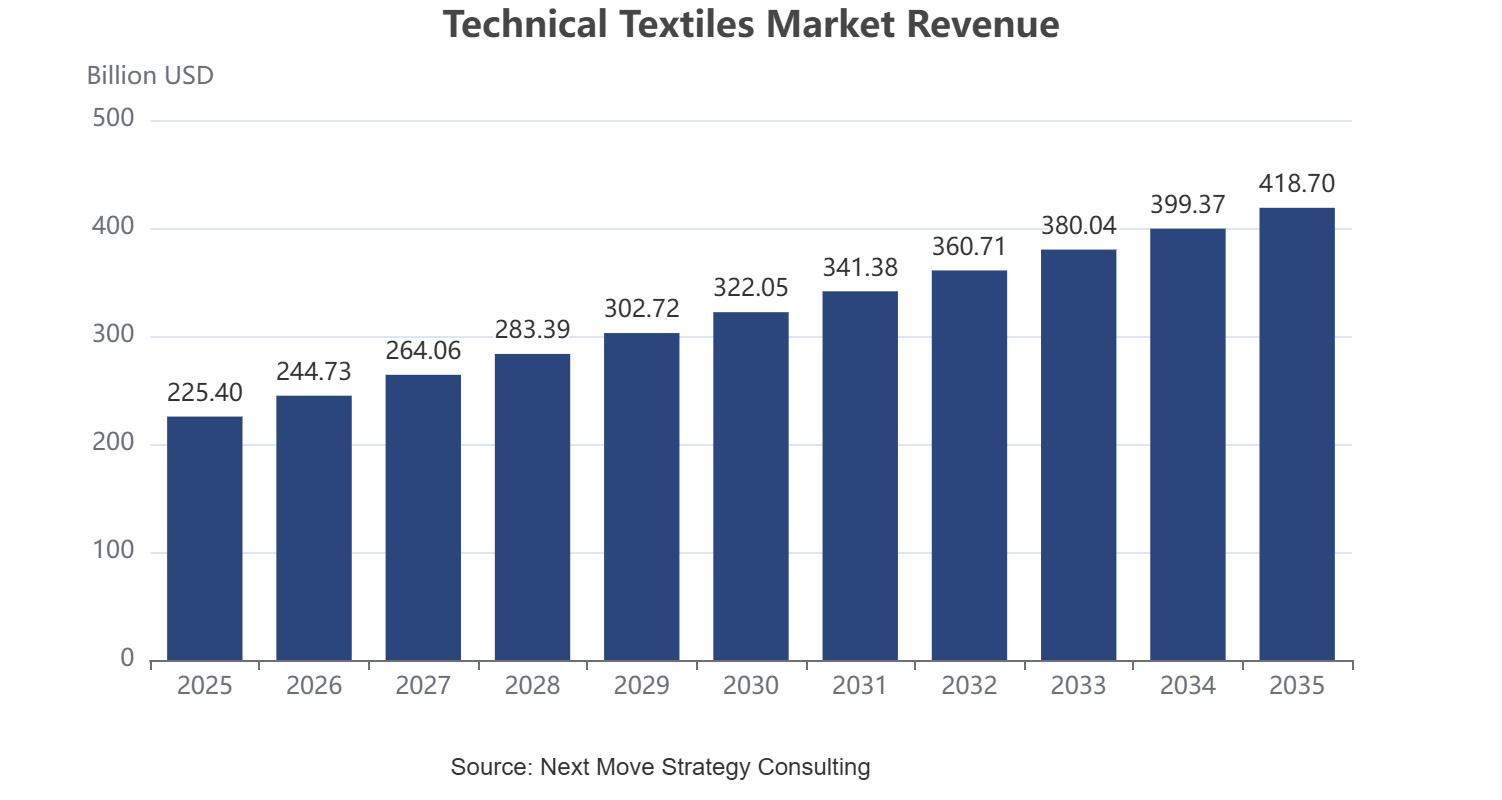
The Technical Textiles Market size was valued at USD 225.40 Billion in 2025, reaching USD 239.30 Billion in 2026, and is forecast to hit USD 418.70 Billion by 2035, growing at a 6.40% CAGR from 2026 to 2035, led by Asia-Pacific at approximately 42% share and Nonwoven at approximately 44% share.
|
Key Takeaways |
|
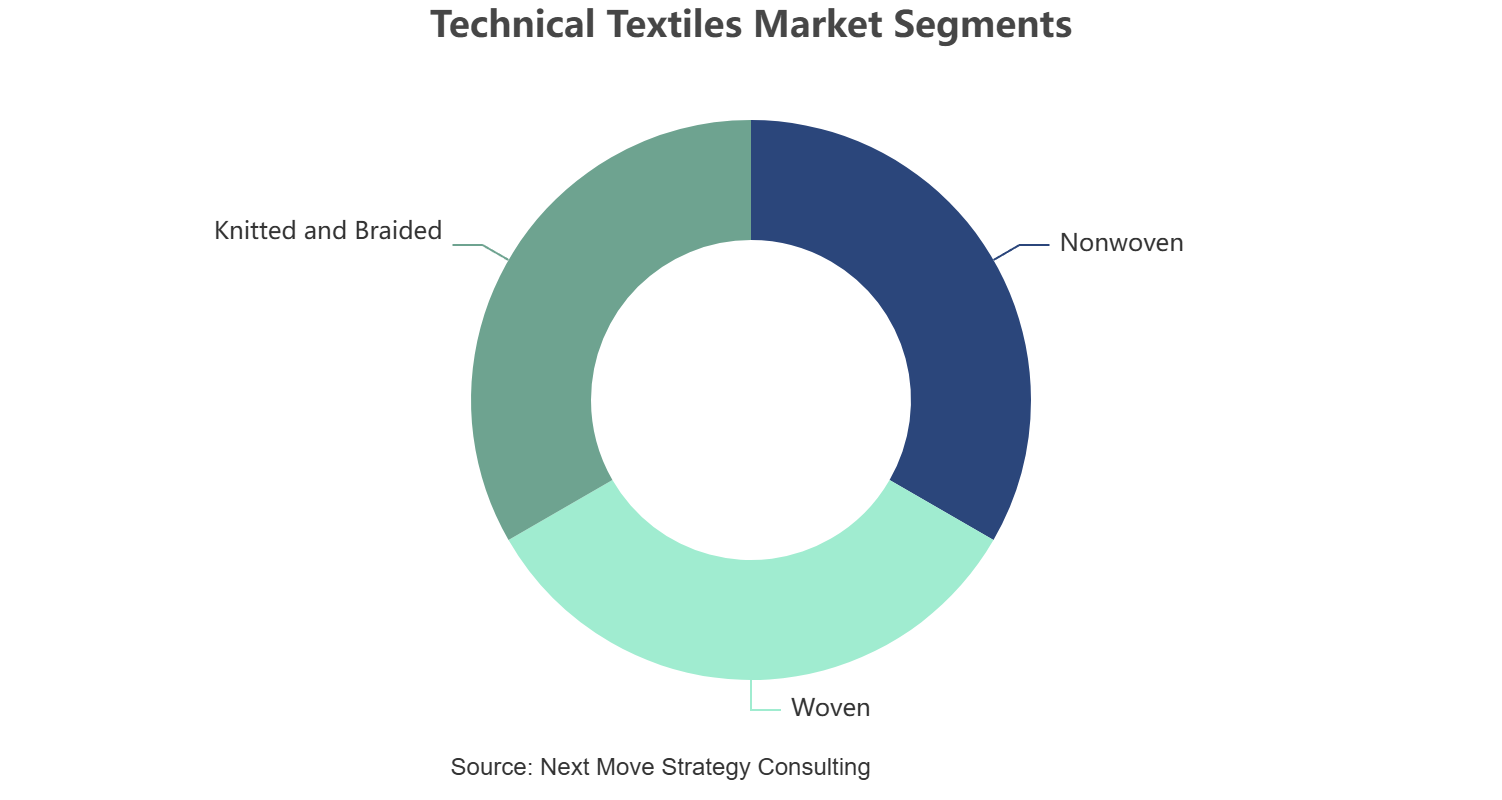
By Product Type: Nonwoven held the largest share of approximately 44% (USD 99.18 Billion) in 2025; Nonwoven is the fastest-growing sub-segment at 7.45% CAGR from 2026-2035. |
|
By Application: Automotive and Transportation held the largest share of approximately 24% (USD 54.10 Billion) in 2025; Medical and Hygiene is the fastest-growing sub-segment at 7.60% CAGR from 2026-2035. |
|
By Raw Material: Synthetic Fibers held the largest share of approximately 61% (USD 137.49 Billion) in 2025; Specialty and High-Performance Fibers is the fastest-growing sub-segment at 10.30% CAGR from 2026-2035. |
|
Dominant Region (aggregate): Asia-Pacific dominated with approximately 42% revenue share (USD 94.67 Billion) in 2025, as the combined total of its constituent countries, including China, India, Japan, South Korea, and Australia. |
|
Fastest-Growing Region: Middle East & Africa is expected to register the highest CAGR of 8.60% during 2026-2035. |
|
Dominant Country (single largest): U.S. led with approximately USD 38.41 Billion in 2025, the largest of any single country, exceeding China (USD 35.98 Billion), the largest individual country within the Asia-Pacific region. |
|
Fastest-Growing Country: Nigeria is the fastest-growing country at approximately 10.03% CAGR from 2026-2035. |
Market Opportunity: The Technical Textiles Market is expected to create an absolute dollar opportunity of USD 179.40 billion between 2026 and 2035, presenting significant investment potential across nonwoven capacity expansion, specialty fiber development, and protective textile manufacturing.
According to NMSC analysis, specialty and high-performance fiber demand is compounding faster than the broader technical textiles market is growing, a structural shift not fully captured by 2025 baseline figures alone.
What Does the Technical Textiles Market Encompass?
The technical textiles market report encompasses fibers, fabrics, and finished textile products engineered for functional performance rather than aesthetic appeal, spanning automotive, construction, medical, protective, and industrial applications. During our market evaluation, we noticed that the market has evolved from commodity-grade industrial fabrics toward specialty, high-performance fiber systems, with automotive lightweighting and medical hygiene demand driving sustained revenue, market size growth across covered geographies through 2035.
Regulatory oversight is shaped by product-specific safety and performance standards, including automotive flammability regulations and medical-grade material certification requirements administered by national industry ministries. We found that digital manufacturing technologies, including automated nonwoven line monitoring and fiber-property simulation software, are becoming standard across large producers, a technology adoption pattern improving production consistency and reducing material waste across the industry through the forecast period.
|
Parameters |
Details |
|
Market Size in 2025 |
USD 225.40 Billion |
|
Market Size in 2026 |
USD 239.30 Billion |
|
Revenue Forecast in 2035 |
USD 418.70 Billion |
|
Growth Rate |
CAGR of 6.40% from 2026 to 2035 |
|
Analysis Period |
2025-2035 |
|
Base Year Considered |
2025 |
|
Forecast Period |
2026-2035 |
|
Market Size Estimation |
Revenue (USD Billion) |
|
Companies Profiled |
20 |
|
Countries Covered |
38 |
|
Market Share |
Available for Top 10 Companies |
Key Emerging Trends
Our analysis shows that four structural trends are reshaping how manufacturers, brand owners, and end users engage with the technical textiles market through 2035, spanning automotive design, medical applications, workplace safety, and material sourcing.
How Is Lightweighting Reshaping Automotive Technical Textiles?
Based on research conducted by NMSC, we found that automakers are specifying lighter-weight automotive coated fabrics and technical nonwoven components to offset the added weight of electric vehicle battery packs, replacing traditional metal and foam interior components. Toray and Teijin have both expanded automotive-grade technical fiber lines, a transformation that is shortening vehicle development cycles while helping automakers meet fuel-efficiency and emissions targets across covered regions.
How Are Medical Textile Applications Expanding Beyond Traditional Hygiene Products?
NMSC's analysis indicates that medical textile applications are expanding into wound-care substrates, surgical drapes, and implantable fiber structures, moving beyond traditional hygiene and hospital-linen products. Freudenberg Performance Materials has expanded medical-grade nonwoven capacity, a stakeholder shift that benefits healthcare providers seeking domestically sourced, certified medical fabric supply chains.
How Is Protective Textile Demand Responding to Workplace Safety Regulation?
Our findings suggest that protective textile demand is rising as workplace safety regulation tightens across construction, industrial, and utility sectors, requiring certified flame-resistant and cut-resistant fabric specifications. DuPont's Nomex and Kevlar fiber lines are named examples of this transformation, with adoption accelerating fastest among industrial employers facing stricter occupational safety enforcement.
How Is Circularity Influencing Technical Textile Material Selection?
Our assessment indicates that producers are increasingly incorporating recycled and bio-based fiber content into technical textile products without compromising performance specifications, a transformation driven by corporate sustainability commitments and tightening European textile circularity regulation. This adoption pattern is most advanced among European nonwoven producers serving automotive and construction end markets.
Ecosystem Analysis of the Technical Textiles Market
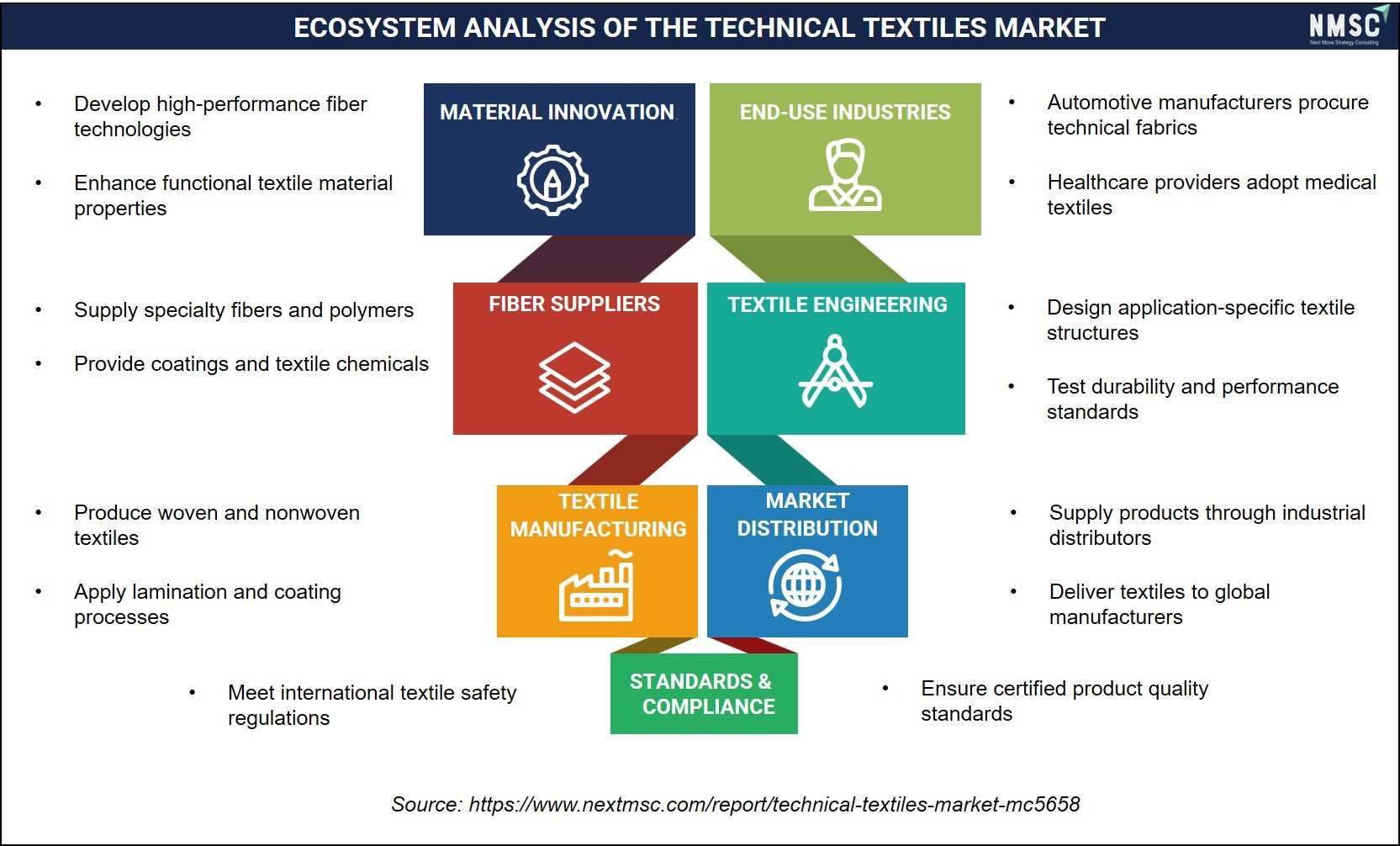
NMSC's analysis indicates that the Technical Textiles Market operates through an ecosystem driven by material innovation, specialty fiber suppliers, and advanced engineering testing. Woven, nonwoven, laminated, and coated textiles are distributed globally through industrial networks. Consequently, these high-performance materials serve end-use industries like automotive manufacturing and healthcare, while certified product quality and international safety regulations guarantee strict industry compliance.
Growth Drivers & Restraints
Growth Catalyst & Risk Assessment Matrix
|
Factors |
Type |
(+/-) % Impact on CAGR |
Geographic Relevance |
Impact Timeline |
|
Rising automotive lightweighting and EV production |
Driver |
+1.6% |
Asia-Pacific, Europe |
2026-2030 |
|
Expanding medical and hygiene textile demand |
Driver |
+1.3% |
North America, Europe |
2026-2029 |
|
Tightening workplace safety and protective-textile regulation |
Driver |
+1.1% |
North America, Middle East & Africa |
2026-2031 |
|
Infrastructure investment driving geotextile adoption |
Driver |
+0.9% |
Asia-Pacific, Latin America |
2026-2032 |
|
Growth in specialty and high-performance fiber demand |
Driver |
+0.8% |
Global |
2028-2035 |
|
Circular and bio-based fiber sourcing initiatives |
Driver |
+0.5% |
Europe |
2028-2035 |
|
Volatile raw material and petrochemical feedstock pricing |
Restraint |
-0.9% |
Global |
2026-2028 |
|
High capital intensity of nonwoven production capacity |
Restraint |
-0.6% |
Asia-Pacific, Latin America |
2026-2029 |
|
Fragmented regional certification and testing standards |
Restraint |
-0.4% |
Middle East & Africa, Asia-Pacific |
2026-2030 |
What Is the Primary Growth Driver for the Technical Textiles Market?
We observed that rising automotive lightweighting and electric vehicle production remains the primary growth driver, with automakers specifying technical nonwoven and coated fabric components to offset battery pack weight. According to the U.S. Department of Commerce, domestic advanced manufacturing investment has expanded across textile-adjacent industrial categories, reinforcing sustained demand, growth, and trends across automotive-grade technical textile supply chains.
How Is Medical Textile Demand Driving Market Growth?
During our market evaluation, we noticed that expanding medical and hygiene textile demand is driving market growth as healthcare systems specify certified nonwoven substrates for wound care, surgical drapes, and hospital-grade hygiene products. This pattern is most visible in North American and European healthcare procurement, where hospital systems report increasing preference for domestically certified medical fabric suppliers.
What Is Restraining the Technical Textiles Market?
We found that volatile raw material and petrochemical feedstock pricing remains the primary restraint, as synthetic fiber producers face fluctuating input costs tied to global oil and gas markets. This restraint disproportionately affects smaller regional producers without long-term feedstock supply contracts or vertically integrated polymer production capacity.
Segmentation Analysis
Segment Sizing: By Product Type
|
Segment |
2025 (USD) |
2035 (USD) |
CAGR% (2026-2035) |
|
Nonwoven |
USD 99.18 Billion |
USD 200.98 Billion |
7.45% |
|
Woven |
USD 72.13 Billion |
USD 121.42 Billion |
5.25% |
|
Knitted and Braided |
USD 54.09 Billion |
USD 96.30 Billion |
5.91% |
|
Total |
USD 225.40 Billion |
USD 418.70 Billion |
6.40% |
How Is the Market Segmented by Product Type?
NMSC's analysis indicates that product type segmentation separates nonwoven, woven, and knitted and braided technical textiles. Nonwoven held the largest 2025 share on cost-efficient, high-volume production suited to medical, hygiene, and filtration applications, while it also remains the fastest-growing category as automotive and construction end markets increasingly specify engineered nonwoven components over traditional woven alternatives.
Segment Sizing: By Application
|
Segment |
2025 (USD) |
2035 (USD) |
CAGR% (2026-2035) |
|
Automotive and Transportation |
USD 54.10 Billion |
USD 92.11 Billion |
5.39% |
|
Construction and Geotextiles |
USD 45.08 Billion |
USD 87.93 Billion |
6.99% |
|
Medical and Hygiene |
USD 42.83 Billion |
USD 87.93 Billion |
7.60% |
|
Protective and Safety |
USD 40.57 Billion |
USD 75.37 Billion |
6.41% |
|
Industrial and Packaging |
USD 42.82 Billion |
USD 75.36 Billion |
5.77% |
|
Total |
USD 225.40 Billion |
USD 418.70 Billion |
6.40% |
How Is the Market Segmented by Application?
Our findings suggest that application segmentation covers automotive and transportation, construction and geotextiles, medical and hygiene, protective and safety, and industrial and packaging uses. Automotive and Transportation retained the largest 2025 share on sustained vehicle production volume, while Medical and Hygiene is the fastest-growing application as healthcare systems expand certified nonwoven substrate procurement.
Segment Sizing: By Raw Material
|
Segment |
2025 (USD) |
2035 (USD) |
CAGR% (2026-2035) |
|
Synthetic Fibers |
USD 137.49 Billion |
USD 230.29 Billion |
5.20% |
|
Natural Fibers |
USD 40.57 Billion |
USD 66.99 Billion |
5.03% |
|
Specialty and High-Performance Fibers |
USD 47.34 Billion |
USD 121.42 Billion |
10.30% |
|
Total |
USD 225.40 Billion |
USD 418.70 Billion |
6.40% |
How Is the Market Segmented by Raw Material?
Our assessment indicates that raw material segmentation distinguishes synthetic fibers, natural fibers, and specialty and high-performance fibers. Synthetic Fibers dominate 2025 revenue on established polyester and polypropylene production infrastructure, while Specialty and High-Performance Fibers is the fastest-growing category as aramid, carbon, and glass fiber demand expands across protective and industrial applications.
Growth Opportunities
Our analysis shows that three forward-looking whitespace opportunities stand out for manufacturers and brand owners positioning ahead of 2035 demand.
What Opportunity Exists in Electric Vehicle Interior Textile Components?
Producers developing lightweight, technical nonwoven and coated fabric components for electric vehicle interiors and battery enclosures can capture premium automotive-grade pricing, a mechanism already benefiting Toray's automotive fiber division. This opportunity favors producers with dedicated automotive-grade certification and testing capability.
What Opportunity Exists in Certified Medical-Grade Nonwoven Capacity?
Producers expanding certified medical-grade nonwoven capacity can capture recurring healthcare procurement contracts, a mechanism already benefiting Freudenberg Performance Materials' hospital-supply partnerships. This opportunity favors producers with regulatory certification infrastructure over general-purpose nonwoven manufacturers.
What Opportunity Exists in Infrastructure-Linked Geotextile Contracts?
Producers securing multi-year geotextile supply contracts tied to national infrastructure programs gain recurring, volume-backed revenue less exposed to consumer demand cycles, a mechanism benefiting large-scale woven and nonwoven exporters serving Asia-Pacific and Latin American construction programs.
Regional Outlook
Geographic Performance Snapshot
|
Region |
2025 (USD) |
2035 (USD) |
CAGR% (2026-2035) |
Key Driver |
|
Asia-Pacific |
USD 94.67 Billion |
USD 188.41 Billion |
7.23% |
Large-scale textile manufacturing base and expanding automotive and construction demand |
|
North America |
USD 54.10 Billion |
USD 92.11 Billion |
5.39% |
Advanced protective and medical textile innovation and defense procurement |
|
Europe |
USD 51.84 Billion |
USD 83.74 Billion |
4.77% |
Stringent automotive and construction performance standards and geotextile adoption |
|
Latin America |
USD 13.52 Billion |
USD 29.31 Billion |
8.25% |
Expanding agricultural and construction geotextile applications |
|
Middle East & Africa |
USD 11.27 Billion |
USD 25.13 Billion |
8.60% |
Infrastructure development and growing protective textile demand |
|
Total |
USD 225.40 Billion |
USD 418.70 Billion |
6.40% |
- |
Asia-Pacific Technical Textiles Market Outlook
Based on research conducted by NMSC, we found that Asia-Pacific's technical textiles market reflects mature, high-volume production capacity anchored by China's large-scale manufacturing base, alongside expanding automotive and construction demand in India and Southeast Asia. Regulatory influence remains moderate, technology adoption of automated nonwoven production runs ahead of other regions, and strategic outlook favors producers with vertically integrated fiber-to-fabric capacity.
North America Technical Textiles Market Outlook
We observed that North America's market reflects advanced protective and medical textile innovation supported by defense and healthcare procurement across the U.S. and Canada. Regulatory influence is significant, given stringent flammability and medical-material certification requirements, and strategic outlook favors producers with established government and healthcare-system supply relationships.
Europe Technical Textiles Market Outlook
During our market evaluation, we noticed that Europe's market reflects mature demand shaped by stringent automotive and construction performance standards, alongside expanding geotextile adoption in infrastructure projects. Regulatory influence is considerable, given EU textile circularity and REACH chemical-safety requirements, and strategic outlook favors producers investing in recycled and bio-based fiber capacity.
Latin America Technical Textiles Market Outlook
We found that Latin America's market is driven primarily by expanding agricultural and construction geotextile applications in Brazil and Argentina. Regulatory influence remains moderate, technology adoption of automated production is rising among larger regional manufacturers, and strategic outlook favors producers integrating forward into infrastructure-linked supply contracts.
Middle East & Africa Technical Textiles Market Outlook
NMSC's analysis indicates that Middle East & Africa demand structure is shaped by large-scale infrastructure development and growing protective textile demand tied to industrial safety regulation across Saudi Arabia and the UAE. Regulatory influence is increasing as national certification requirements tighten, and strategic outlook favors exporters with dedicated regional compliance capability.
China Technical Textiles Market
Based on our estimates, the China technical textiles market was valued at approximately USD 35.98 Billion in 2025 and is projected to reach USD 65.94 Billion by 2035, expanding at a 6.26% CAGR from 2026 to 2035. Locally, demand structure remains concentrated among automotive and industrial buyers, adoption of certified technical fabrics is high, regulatory influence is moderate through safety and performance standards, technology penetration continues to widen through automated production, competitive intensity is increasing among mid-sized producers, and the strategic outlook favors capacity expansion.
India Technical Textiles Market
The market in India technical textiles market was valued at approximately USD 14.20 Billion in 2025 and is projected to reach USD 33.91 Billion by 2035, expanding at a 9.43% CAGR from 2026 to 2035. Locally, demand structure is increasingly healthcare and protective-textile driven, adoption of certified nonwoven substrates is accelerating, regulatory influence remains centered on material safety certification, technology penetration is above the regional average, competitive intensity is moderate, and the strategic outlook favors continued specialty-fiber investment.
Japan Technical Textiles Market
As per our estimate, the Japan technical textiles market was valued at approximately USD 12.31 Billion in 2025 and is projected to reach USD 20.73 Billion by 2035, expanding at a 5.26% CAGR from 2026 to 2035. Locally, demand structure combines construction and geotextile buyers with industrial packaging demand, adoption of engineered fabrics remains steady, regulatory influence is expanding through infrastructure procurement standards, technology penetration is rising quickly through automated manufacturing, competitive intensity is high among local and international entrants, and the strategic outlook favors localized production partnerships.
South Korea Technical Textiles Market
According to our analysis, the South Korea technical textiles market was valued at approximately USD 8.52 Billion in 2025 and is projected to reach USD 16.96 Billion by 2035, expanding at a 7.23% CAGR from 2026 to 2035. Locally, demand structure is led by export-oriented industrial manufacturers, adoption of vertically integrated fiber-to-fabric production is common, regulatory influence is developing, technology penetration is accelerating with manufacturing automation investment, competitive intensity remains moderate relative to mature markets, and the strategic outlook favors first-mover capacity investment.
Australia Technical Textiles Market
Based on our estimates, the Australia technical textiles market was valued at approximately USD 3.79 Billion in 2025 and is projected to reach USD 7.54 Billion by 2035, expanding at a 7.23% CAGR from 2026 to 2035. Locally, demand structure remains concentrated among automotive and industrial buyers, adoption of certified technical fabrics is high, regulatory influence is moderate through safety and performance standards, technology penetration continues to widen through automated production, competitive intensity is increasing among mid-sized producers, and the strategic outlook favors capacity expansion.
U.S. Technical Textiles Market
The market in U.S. technical textiles market was valued at approximately USD 38.41 Billion in 2025 and is projected to reach USD 62.63 Billion by 2035, expanding at a 4.89% CAGR from 2026 to 2035. Locally, demand structure is increasingly healthcare and protective-textile driven, adoption of certified nonwoven substrates is accelerating, regulatory influence remains centered on material safety certification, technology penetration is above the regional average, competitive intensity is moderate, and the strategic outlook favors continued specialty-fiber investment.
Canada Technical Textiles Market
As per our estimate, the Canada technical textiles market was valued at approximately USD 9.20 Billion in 2025 and is projected to reach USD 16.58 Billion by 2035, expanding at a 6.06% CAGR from 2026 to 2035. Locally, demand structure combines construction and geotextile buyers with industrial packaging demand, adoption of engineered fabrics remains steady, regulatory influence is expanding through infrastructure procurement standards, technology penetration is rising quickly through automated manufacturing, competitive intensity is high among local and international entrants, and the strategic outlook favors localized production partnerships.
UK Technical Textiles Market
According to our analysis, the UK technical textiles market was valued at approximately USD 5.70 Billion in 2025 and is projected to reach USD 9.21 Billion by 2035, expanding at a 4.77% CAGR from 2026 to 2035. Locally, demand structure is led by export-oriented industrial manufacturers, adoption of vertically integrated fiber-to-fabric production is common, regulatory influence is developing, technology penetration is accelerating with manufacturing automation investment, competitive intensity remains moderate relative to mature markets, and the strategic outlook favors first-mover capacity investment.
Germany Technical Textiles Market
Based on our estimates, the Germany technical textiles market was valued at approximately USD 11.40 Billion in 2025 and is projected to reach USD 17.59 Billion by 2035, expanding at a 4.23% CAGR from 2026 to 2035. Locally, demand structure remains concentrated among automotive and industrial buyers, adoption of certified technical fabrics is high, regulatory influence is moderate through safety and performance standards, technology penetration continues to widen through automated production, competitive intensity is increasing among mid-sized producers, and the strategic outlook favors capacity expansion.
France Technical Textiles Market
The market in France technical textiles market was valued at approximately USD 6.74 Billion in 2025 and is projected to reach USD 10.89 Billion by 2035, expanding at a 4.77% CAGR from 2026 to 2035. Locally, demand structure is increasingly healthcare and protective-textile driven, adoption of certified nonwoven substrates is accelerating, regulatory influence remains centered on material safety certification, technology penetration is above the regional average, competitive intensity is moderate, and the strategic outlook favors continued specialty-fiber investment.
Brazil Technical Textiles Market
As per our estimate, the Brazil technical textiles market was valued at approximately USD 5.95 Billion in 2025 and is projected to reach USD 12.31 Billion by 2035, expanding at a 7.69% CAGR from 2026 to 2035. Locally, demand structure combines construction and geotextile buyers with industrial packaging demand, adoption of engineered fabrics remains steady, regulatory influence is expanding through infrastructure procurement standards, technology penetration is rising quickly through automated manufacturing, competitive intensity is high among local and international entrants, and the strategic outlook favors localized production partnerships.
Argentina Technical Textiles Market
According to our analysis, the Argentina technical textiles market was valued at approximately USD 2.43 Billion in 2025 and is projected to reach USD 5.28 Billion by 2035, expanding at a 8.25% CAGR from 2026 to 2035. Locally, demand structure is led by export-oriented industrial manufacturers, adoption of vertically integrated fiber-to-fabric production is common, regulatory influence is developing, technology penetration is accelerating with manufacturing automation investment, competitive intensity remains moderate relative to mature markets, and the strategic outlook favors first-mover capacity investment.
Saudi Arabia Technical Textiles Market
Based on our estimates, the Saudi Arabia technical textiles market was valued at approximately USD 2.37 Billion in 2025 and is projected to reach USD 5.28 Billion by 2035, expanding at a 8.60% CAGR from 2026 to 2035. Locally, demand structure remains concentrated among automotive and industrial buyers, adoption of certified technical fabrics is high, regulatory influence is moderate through safety and performance standards, technology penetration continues to widen through automated production, competitive intensity is increasing among mid-sized producers, and the strategic outlook favors capacity expansion.
UAE Technical Textiles Market
The market in UAE technical textiles market was valued at approximately USD 2.14 Billion in 2025 and is projected to reach USD 4.52 Billion by 2035, expanding at a 7.95% CAGR from 2026 to 2035. Locally, demand structure is increasingly healthcare and protective-textile driven, adoption of certified nonwoven substrates is accelerating, regulatory influence remains centered on material safety certification, technology penetration is above the regional average, competitive intensity is moderate, and the strategic outlook favors continued specialty-fiber investment.
South Africa Technical Textiles Market
As per our estimate, the South Africa technical textiles market was valued at approximately USD 1.01 Billion in 2025 and is projected to reach USD 2.01 Billion by 2035, expanding at a 7.19% CAGR from 2026 to 2035. Locally, demand structure combines construction and geotextile buyers with industrial packaging demand, adoption of engineered fabrics remains steady, regulatory influence is expanding through infrastructure procurement standards, technology penetration is rising quickly through automated manufacturing, competitive intensity is high among local and international entrants, and the strategic outlook favors localized production partnerships.
Supply Chain Structure of the Technical Textiles Market
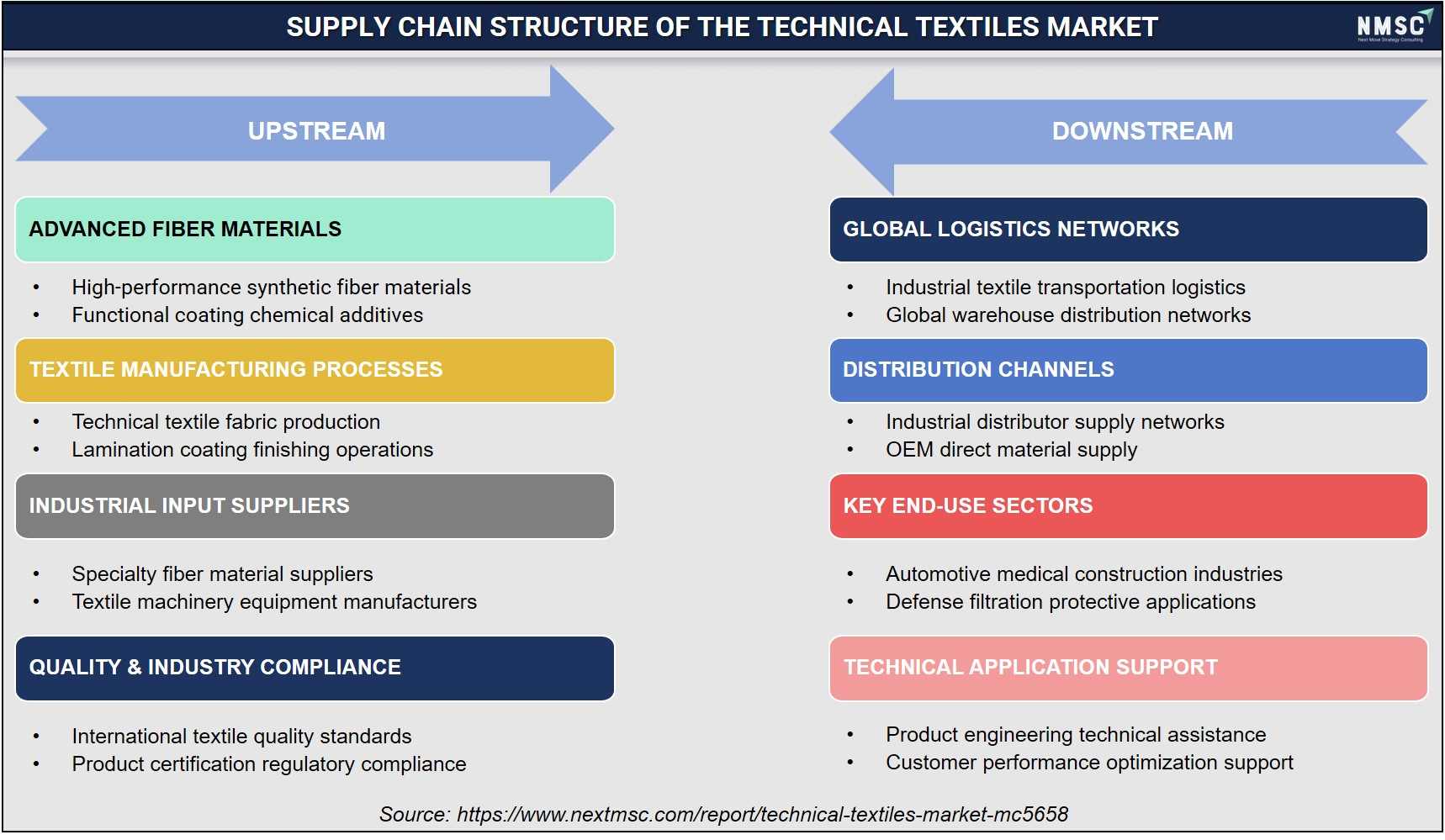
Based on research conducted by NMSC, we found that the supply chain structure of the Technical Textiles Market integrates synthetic fiber materials, specialty suppliers, and lamination processes with global logistics networks. Industrial distributors and direct OEM channels supply textiles to key sectors including automotive, medical, defense, and filtration. Furthermore, ongoing engineering technical assistance and performance optimization support ensure high quality and regulatory compliance.
Competitive Landscape
We observed that the technical textiles industry reflects a moderately fragmented but consolidating competitive structure heading into 2035.
|
Aspect |
Assessment |
|
Market Structure |
Moderately fragmented, with the top ten producers holding a combined mid-range share; consolidation is accelerating following Magnera's 2024 formation as the world's largest nonwovens producer. |
|
Innovation Focus |
Specialty and high-performance fiber development, automotive lightweighting components, and certified medical-grade nonwoven substrates. |
|
M&A Activity |
Active, concentrated among diversified chemical and materials groups consolidating nonwoven and specialty fiber capacity. |
How Do Companies Compete Within the Technical Textiles Market?
Our findings suggest that producers compete primarily on certified performance specifications, production scale, and vertically integrated fiber-to-fabric capacity rather than price alone. Established relationships with automotive OEMs, healthcare systems, and industrial safety-equipment brands function as durable competitive moats, while producers lacking certification infrastructure face increasing difficulty differentiating within a crowded, industry-wide supplier landscape.
Which Competitive Archetypes Dominate the Market?
Our assessment indicates that three archetypes dominate the industry: diversified nonwovens leaders formed through large-scale consolidation, such as Magnera following its 2024 merger; specialty high-performance fiber producers, such as DuPont and Toray; and vertically integrated chemical groups extending into technical fabrics, such as Freudenberg and Mitsubishi Chemical Group.
What Innovation and Differentiation Strategies Are Producers Pursuing?
Our analysis shows that leading producers are differentiating through specialty and high-performance fiber development, targeting automotive lightweighting and protective-textile applications that command premium pricing over commodity synthetic fabrics. Producers with certified medical-grade production lines are also capturing recurring healthcare-contract revenue less exposed to cyclical industrial demand.
What M&A and Geographic Expansion Activity Characterizes the Landscape?
Based on research conducted by NMSC, we found that M&A activity remains concentrated among large materials groups consolidating nonwoven and specialty fiber capacity, exemplified by the 2024 merger that formed Magnera as the world's largest nonwovens company from Berry Global's former Health, Hygiene and Specialties business and Glatfelter. Geographic expansion is increasingly directed toward Asia-Pacific markets with growing automotive and construction demand.
Key Market Players
During our market evaluation, we noticed that the following validated set of producers represents the largest identifiable participants in the technical textiles market as of 2026.
-
DuPont de Nemours, Inc.
-
Toray Industries, Inc.
-
Freudenberg & Co. KG
-
Magnera Corporation
-
Ahlstrom Oyj
-
Teijin Limited
-
Kolon Industries, Inc.
-
Hyosung Corporation
-
Milliken & Company
-
W. L. Gore & Associates, Inc.
-
Asahi Kasei Corporation
-
Mitsubishi Chemical Group Corporation
-
Solvay SA
-
Huntsman Corporation
-
Trelleborg AB
-
Lenzing AG
-
Habasit AG
-
Autoneum Holding AG
-
SRF Limited
-
Indorama Ventures Public Company Limited
Latest Developments
We found that recent developments in the technical textiles market reflect significant consolidation among the largest nonwoven producers through 2025.
|
Date |
Event |
|
April 2026 |
Freudenberg Performance Materials launched Tacnera®, a proprietary technology for silicone-based polyurethane foam dressings in advanced wound care. The system integrates polyurethane foam with a proprietary coating and silicone gel to prevent skin trauma during dressing changes while ensuring reliable adhesion for medical applications. |
|
April 2026 |
Teijin Frontier Co., Ltd., a subsidiary of Teijin Limited, developed a new stretch polyester yarn engineered with proprietary polymer design and spinning technology. Built for sports and outdoor wear, the yarn offers high elasticity and seamless compatibility with high-performance polyester materials, with sales launching in 2027. |
|
March 2026 |
Lenzing AG expanded production of its VEOCEL™ nonwoven-grade lyocell fibers to its manufacturing facility in Prachinburi, Thailand. This marks the company's first production of nonwoven lyocell fibers in Asia, utilizing a 100,000-ton capacity site to supply eco-friendly fibers for local personal care and hygiene markets. |
|
December 2025 |
Magnera Corporation launched its next-generation liquid barrier solution for nonwoven textiles. Designed for healthcare and protective apparel, this nonwoven innovation delivers superior fluid repellency and breathability without using intentionally added per- and polyfluoroalkyl substances, directly addressing evolving global environmental restrictions and industry demand. |
Expert Insights
 “The textile industry, through both leading trade fairs, becomes the driving force and enabler for cross-industry transformations and a globally future-proof economy.”
— Detlef Braun, Member of the Executive Board, Messe Frankfurt GmbH
Statement made during the official Techtextil & Texprocess 2024 post-event announcement discussing the growing role of textile innovation in enabling industrial transformation across multiple sectors.
Market Interpretation
The comment highlights the evolving role of the technical textiles industry as a strategic enabler of innovation across diverse sectors, including automotive, healthcare, construction, aerospace, and industrial manufacturing. As demand grows for high-performance, functional, and sustainable textile solutions, technical textiles are increasingly supporting cross-industry advancements through material innovation, smart manufacturing, and circular economy initiatives. This reflects the market's transition from traditional textile applications toward high-value engineered materials, creating significant growth opportunities driven by technological innovation and expanding industrial adoption.
Investment Opportunities
Where Is Capital Investment Concentrated Within the Market?
Our findings suggest that capital investment is concentrated among diversified materials groups expanding specialty and high-performance fiber capacity, alongside recently consolidated nonwoven producers integrating combined manufacturing footprints. Investors favor producers with certified automotive and medical-grade production lines over undifferentiated commodity fabric manufacturers.
What Infrastructure Investment Is Required to Scale Production?
Our assessment indicates that scaling production requires sustained investment in automated nonwoven manufacturing lines and certified testing infrastructure that meets automotive, medical, and geosynthetics performance standards. Producers underinvesting in this infrastructure risk losing certified-supply contracts to competitors offering integrated, testing-validated production capacity.
How Do ESG Considerations Factor Into Investment Decisions?
Our analysis shows that ESG-oriented investors increasingly favor producers demonstrating reduced water and energy use in fiber production, alongside expanding recycled and bio-based content, consistent with tightening European textile circularity regulation. Social-impact metrics tied to workplace safety in protective-textile manufacturing are also becoming a standard due-diligence component for institutional investors evaluating the sector.
Key Benefits for Stakeholders
What Benefits Does This Report Offer Industry Leaders and Manufacturers?
Based on research conducted by NMSC, we found that industry leaders and manufacturers gain segment-level sizing across product type and raw material, detailed in Section 6, to benchmark capacity investment against market-wide demand shifts toward specialty and high-performance fibers.
What Benefits Does This Report Offer Investors and Financial Analysts?
We observed that investors and financial analysts gain a validated competitive-landscape assessment, detailed in Section 9, alongside regional and country-level sizing in Section 8 to evaluate producer positioning and consolidation opportunity ahead of capital-allocation decisions.
What Benefits Does This Report Offer Technology and Material Suppliers?
During our market evaluation, we noticed that technology and material suppliers gain visibility into segmentation shifts toward automotive lightweighting and medical-grade applications, detailed in Section 7's growth-opportunity analysis, informing product-roadmap prioritization for fiber and fabric development.
Key Market Segments
By Product Type
-
Nonwoven
-
Woven
-
Knitted and Braided
By Application
-
Automotive and Transportation
-
Construction and Geotextiles
-
Medical and Hygiene
-
Protective and Safety
-
Industrial and Packaging
By Raw Material
-
Synthetic Fibers
-
Natural Fibers
-
Specialty and High-Performance Fibers
By Region
-
North America: U.S., Canada, Mexico, Rest of North America
-
Europe: UK, Germany, France, Italy, Spain, Sweden, Denmark, Finland, Netherlands, Rest of Europe
-
Asia-Pacific: China, India, Japan, South Korea, Taiwan, Indonesia, Vietnam, Australia, Philippines,Malaysia, Rest of APAC
-
Middle East & Africa: Saudi Arabia, UAE, Egypt, Israel, Turkey, Nigeria, South Africa, Rest of MEA
-
Latin America: Brazil, Argentina, Chile, Colombia, Rest of LATAM
Conclusion & Recommendations
What Is the Long-Term Outlook for the Technical Textiles Market?
The technical textiles market is positioned for sustained expansion through 2035, growing from USD 225.40 Billion in 2025 to USD 418.70 Billion at a 6.40% CAGR from 2026 to 2035. Growth is underpinned by durable automotive lightweighting demand and expanding medical textile specification that are unlikely to reverse within the forecast window, positioning the sector for steady, application-diversified growth relative to broader industrial materials spending.
What Strategic Positioning Should Technical Textile Producers Pursue?
Producers should prioritize specialty and high-performance fiber capacity investment, pursue certified automotive and medical-grade production capability ahead of competitors, and evaluate consolidation opportunities as the market continues integrating following recent large-scale mergers. Producers without differentiated certification infrastructure face increasing difficulty competing against scaled, diversified materials groups through the forecast period.
How Attractive Is the Technical Textiles Market for New Investment?
The sector offers steady investment attractiveness relative to broader industrial materials, driven by recurring automotive and healthcare contract revenue and expanding infrastructure-linked geotextile demand. Investment attractiveness is highest among producers combining certified performance credentials with vertically integrated fiber production, and comparatively lower among undifferentiated commodity fabric manufacturers facing consolidation pressure.
What Market Shifts and Key Risks Should Stakeholders Monitor?
Key risks include volatile petrochemical feedstock pricing, high capital intensity of nonwoven production capacity, and fragmented regional certification standards that could slow cross-border supply qualification. Producers must monitor these shifts closely, as they represent the primary downside scenarios to the CAGR forecast presented throughout this report.
What Are the Key Growth Pathways for the Technical Textiles Market?
The clearest growth pathways run through electric vehicle interior textile components, certified medical-grade nonwoven capacity, and infrastructure-linked geotextile contracts. Producers that combine these three pathways with continued industry consolidation are best positioned to capture disproportionate share of the USD 418.70 Billion addressable market forecast for 2035.
About the Author
 Saista Faiyaz
— Saista Faiyaz is Research Associate at Next Move Strategy Consulting, where she has covered consumer markets and healthcare technologies for 3 years. Her work includes primary interview review, secondary-source validation, market sizing, and structured analysis of company and industry data. She supports research by comparing evidence across sources, organizing findings into market narratives, and documenting assumptions used in analysis. Her scope includes cross-market benchmarking, and reports.
Saista Faiyaz
— Saista Faiyaz is Research Associate at Next Move Strategy Consulting, where she has covered consumer markets and healthcare technologies for 3 years. Her work includes primary interview review, secondary-source validation, market sizing, and structured analysis of company and industry data. She supports research by comparing evidence across sources, organizing findings into market narratives, and documenting assumptions used in analysis. Her scope includes cross-market benchmarking, and reports.
About the Reviewer
 Supradip Baul
— Supradip Baul is an accomplished business consultant and strategist with over a decade of rich experience in market intelligence, strategy, technology, and business transformation. His work has included rigorous qualitative and quantitative analysis across multiple industries, helping clients shape investment decisions and long-term roadmaps. Earlier in his career, he was associated with Gartner, where he contributed to industry-leading reports and market share analyses. He has worked with leading global companies and holds an MBA with a dual specialization in Marketing and Finance.
Supradip Baul
— Supradip Baul is an accomplished business consultant and strategist with over a decade of rich experience in market intelligence, strategy, technology, and business transformation. His work has included rigorous qualitative and quantitative analysis across multiple industries, helping clients shape investment decisions and long-term roadmaps. Earlier in his career, he was associated with Gartner, where he contributed to industry-leading reports and market share analyses. He has worked with leading global companies and holds an MBA with a dual specialization in Marketing and Finance.
At Next Move Strategy Consulting, we understand that insightful market research is the cornerstone of successful business decisions. That's why we employ a robust and multifaceted approach, combining various methodologies to deliver the most accurate and actionable data for our clients.

Research Landscape
We navigate the world of research with two primary approaches:
Qualitative Approach
Our qualitative research methodologies involve immersive techniques such as in-depth interviews, focus groups, and observational studies. By engaging directly with individuals and stakeholders, we uncover valuable insights that quantitative data alone may overlook.

Quantitative Research
In tandem with qualitative methodologies, NMSC leverages the power of Quantitative Research to provide a robust foundation of numerical insights. Through systematic data collection and analysis, we quantify patterns, preferences, and market trends, offering a comprehensive view of the business landscape.
Our quantitative research approach employs diverse tools, including surveys, experiments, and statistical modelling. These methodologies enable us to gather data from a large and representative sample, ensuring the statistical significance of our findings. By employing structured questionnaires and standardized data collection methods, we guarantee the reliability and validity of the information we present to our clients.
Quantitative research is particularly effective in measuring the prevalence of trends, assessing market size, and gauging the impact of various factors on consumer behavior. The numerical precision attained through this approach equips our clients with actionable insights, facilitating data-driven decision-making and strategy formulation.


Our Specialized Toolbox for Industry-Specific Market Research
We deploy a specialized arsenal of techniques tailored to meet your unique requirements. Here's a glimpse into our comprehensive toolbox:

Information Procurement
The stage entails acquiring market data or relevant information through various sources and methodologies.


Market Research Approach
We utilize both top-down and bottom-up approaches in market research analysis to achieve a comprehensive understanding of the market dynamics, leveraging the broad perspective of industry trends and macroeconomic factors alongside detailed insights from specific segments and individual companies.

Porters Five Forces Analysis
We conduct Porter's Five Forces analysis to evaluate the competitive landscape of an industry, providing us with insights into factors that affect profitability and strategic positioning.

SWOT Analysis

Forecasting
We utilize a forecasting model to predict future consumption by considering parameters like population, economics, regulations, market competition, drivers, constraints, technology, and pricing. We also employ statistical techniques such as multilinear regression, exponential smoothing, moving average, ARIMA, and Monte Carlo simulations for accurate predictions. In econometric forecasting, we analyzed short-term and long-term event impacts, attributing values based on regulatory frameworks, economic factors, and market events.





 Speak to Our Analyst