Nutraceutical Market Global Industry Analysis and Forecast (2026-2035)

Nutraceutical market size is estimated at USD 668.21 billion in 2026, projected to reach USD 1336.12 billion by 2035, growing at a CAGR of 8.00% from 2026 to 2035. Key drivers include rising preventive wellness adoption, growing immune and gut health demand, with North America leading the market and Asia-Pacific registering the fastest growth.

Download Free Sample PDF
Base Year (2025)
$594.00 Billion
Forecast (2035)
$1,336.12 Billion
CAGR (2026-2035)
8.0%
Top Region
North America

What Is the Nutraceutical Market Size?

The global nutraceutical market size was valued at USD 594.00 billion in 2025 and is estimated at USD 668.21 billion in 2026, forecast to reach USD 1336.12 billion by 2035, expanding at an 8.00% CAGR between 2026 and 2035. North America leads with approximately 33% share, while Dietary Supplements dominate all other product types with approximately 57% share.

We observed that the growth is broad-based across every segmentation axis, with preventive wellness adoption and immune health demand driving the dominant structural shifts through 2035.

Nutraceutical Market Global Industry Analysis and Forecast (2026-2035) Revenue Forecast

Values in USD Billion

2025 $594.00 Billion
2025
2026 $668.21 Billion
2026
2027 $721.67 Billion
2027
2028 $779.40 Billion
2028
2029 $841.75 Billion
2029
2030 $909.09 Billion
2030
2031 $981.82 Billion
2031
2032 $1,060.37 Billion
2032
2033 $1,145.19 Billion
2033
2034 $1,236.81 Billion
2034
2035 $1,336.12 Billion
2035

Key Takeaways

By Product Type: Dietary Supplements held the largest share of approximately 57% (USD 338.00 billion) in 2025; Functional Beverages is the fastest-growing sub-segment at 11.8% CAGR from 2026–2035.

By End-User Application: General Wellness held the largest share of approximately 19% (USD 115.00 billion) in 2025; Cognitive and Mental Health is the fastest-growing sub-segment at 10.5% CAGR from 2026–2035.

By Distribution Channel: Direct Sales held the largest share of approximately 35% (USD 210.00 billion) in 2025; E-Commerce is the fastest-growing sub-segment at 10.8% CAGR from 2026–2035.

Dominant Region: North America dominated with approximately 33% revenue share (USD 195.00 billion) in 2025.

Fastest-Growing Region: Asia-Pacific is expected to register the highest CAGR of 10.3% during 2026–2035.

Dominant Country: U.S. led with approximately USD 158.00 billion in 2025.

Fastest-Growing Country: India is the fastest-growing country at approximately 12.5% CAGR from 2026–2035.

Market Opportunity: The nutraceutical market is expected to create an absolute dollar opportunity of USD 667.91 billion between 2026 and 2035, presenting significant investment potential across immune health, personalized nutrition, and e-commerce distribution channels.

According to NMSC analysis, brand owners are increasingly pairing clinically substantiated ingredient formulations with direct-to-consumer subscription models to deepen consumer loyalty, a shift that favors science-backed, digitally native brands over traditional mass-market suppliers as personalized nutrition adoption accelerates through 2035.

What Does the Nutraceutical Market Encompass?

The nutraceutical market encompasses dietary supplements, functional foods, and functional beverages formulated to deliver targeted health benefits beyond basic nutrition. Our assessment indicates that the scope spans vitamins and minerals, botanicals and herbal supplements, probiotics and prebiotics, sports and performance supplements, weight management supplements, and specialty supplements, alongside fortified foods and functional beverages distributed through direct sales, e-commerce, healthcare, and foodservice channels. The category has evolved from a niche health-store offering into a mainstream preventive wellness category, exemplified by mainstream retail and e-commerce expansion of clinically substantiated supplement brands.

Regulatory frameworks such as the U.S. Dietary Supplement Health and Education Act and the European Union's regulations governing novel foods and nutrition and health claims shape which ingredients and claims manufacturers can market across covered jurisdictions. We observed that technology adoption is shifting toward personalized nutrition platforms that use consumer health data to recommend individualized supplement regimens. NMSC's analysis indicates that this structural shift, combined with rising immune health and gut microbiome awareness, is redefining product development priorities across the nutraceutical market.

Ecosystem Analysis of the Nutraceutical Market

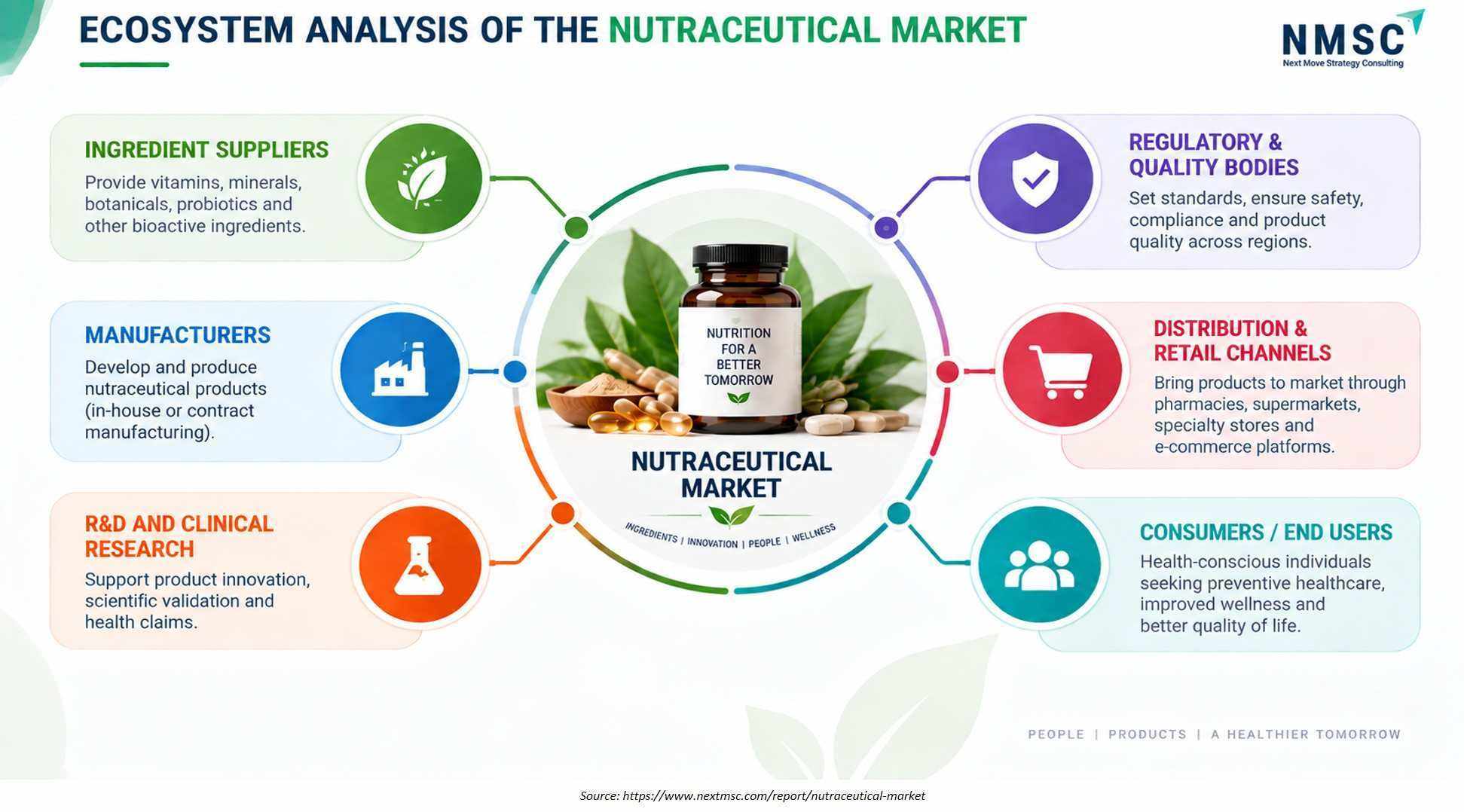
The infographic presents the Nutraceutical Market ecosystem, illustrating the key stakeholders involved from ingredient sourcing to end-user consumption. It highlights ingredient suppliers, manufacturers, R&D and clinical research organizations, regulatory and quality bodies, distribution and retail channels, and consumers. The interconnected structure demonstrates how these participants support product development, quality, regulatory compliance, market access, innovation, and consumer wellness across the nutraceutical industry.

Market Drivers & Dynamics

Interactive Dataset
Rising consumer preference for preventive health and wellness products driver +2.0% Global 2026-2035
Growing demand for immune health and gut microbiome supplements driver +1.6% Global 2026-2032
Expanding personalized nutrition and biomarker-based supplementation driver +1.2% North America, Europe 2026-2032
Rising e-commerce and direct-to-consumer supplement distribution driver +1.0% Global 2026-2035
Growing sports nutrition demand among mainstream consumers driver +0.8% North America, Asia-Pacific 2026-2035
Expanding functional beverage innovation and clean-label formulations driver +0.6% Global 2026-2032
Regulatory scrutiny over supplement label claims and safety restraint −0.9% North America, Europe 2026-2035
Raw material price volatility for botanicals and specialty ingredients restraint −0.6% Global 2026-2032
Counterfeit and substandard product concerns undermining consumer trust restraint −0.4% Global 2026-2030
Source: Next Move Strategy Consulting

Growth Drivers

What Is the Primary Growth Driver of the Nutraceutical Market?

Rising consumer preference for preventive health and wellness products is the primary driver of the market. The U.S. National Institutes of Health's Office of Dietary Supplements continues to report sustained growth in dietary supplement usage among American adults, reflecting a broader consumer shift toward preventive self-care. We observed that this behavioral shift, reinforced by rising chronic disease prevention awareness, continues to anchor baseline consumption of vitamins, minerals, and specialty supplements across developed and emerging economies alike.

How Is Immune Health Demand Driving Nutraceutical Market Growth?

Growing demand for immune health and gut microbiome supplements is accelerating market growth toward science-backed probiotic, prebiotic, and vitamin formulations. Our assessment indicates that consumer awareness of the gut-immune connection, reinforced by expanding clinical research into microbiome health, is compressing adoption timelines for synbiotic and postbiotic product categories. This pathway, combined with rising direct-to-consumer distribution, is expanding demand across North America and Europe.

Growth Inhibitors

What Is Restraining Nutraceutical Market Expansion?

Regulatory scrutiny over supplement label claims and safety restrains marketing flexibility across the nutraceutical supply chain. We found that smaller regional manufacturers face particular exposure, as limited regulatory affairs resources reduce their ability to navigate evolving label-claim substantiation requirements compared with larger, vertically integrated companies such as Nestlé and Bayer, delaying new product launches pending compliance review.

Segmentation Analysis

2025 (USD Billion)
2035 (USD Billion)
Dietary Supplements 2025: $338.00 Billion | 2035: $700.00 Billion
Dietary Supp
Functional Foods 2025: $158.00 Billion | 2035: $336.00 Billion
Functional F
Functional Beverages 2025: $98.00 Billion | 2035: $300.12 Billion
Functional B
Dietary Supplements $338.00 Billion $700.00 Billion 7.6%
Functional Foods $158.00 Billion $336.00 Billion 7.8%
Functional Beverages $98.00 Billion $300.12 Billion 11.8%

Which Product Type Segment Dominates the Nutraceutical Market?

Dietary Supplements led the market with USD 338.00 billion in 2025, supported by sustained consumer purchases of vitamins, minerals, botanicals, and specialty supplement formats. We observed that Functional Beverages is the fastest-growing product type, expanding at an 11.8% CAGR from 2026 to 2035, as sports hydration, protein, and probiotic beverage innovation captures growing share of everyday consumer spending.

2025 (USD Billion)
2035 (USD Billion)
General Well
Immune Healt
Digestive He
Cardiovascul
Metabolic He
Segment Item 2025 (USD Billion) 2035 (USD Billion) CAGR
General Wellness $10.0 USD Billion $40.0 USD Billion 11.0%
Immune Health $17.1 USD Billion $51.1 USD Billion 9.0%
Digestive Health $24.2 USD Billion $62.2 USD Billion 23.0%
Cardiovascular Health $31.3 USD Billion $73.3 USD Billion 13.0%
Metabolic Health $38.4 USD Billion $84.4 USD Billion 10.0%

Segment-wise data is locked

Unlock complete segment-wise numbers for By End-User Application.

Unlock Full Data

Which End-User Application Leads Nutraceutical Market Demand?

General Wellness remained the leading end-user application, valued at USD 115.00 billion in 2025 on sustained baseline demand for multivitamins and everyday health maintenance products. Our findings suggest that Cognitive and Mental Health is the fastest-growing end-user application, registering a 10.5% CAGR from 2026 to 2035, as brain health supplement awareness and nootropic ingredient innovation gain mainstream consumer traction.

2025 (USD Billion)
2035 (USD Billion)
Direct Sales
E-Commerce
Healthcare a
Foodservice
Segment Item 2025 (USD Billion) 2035 (USD Billion) CAGR
Direct Sales $10.0 USD Billion $40.0 USD Billion 25.0%
E-Commerce $17.1 USD Billion $51.1 USD Billion 19.0%
Healthcare and Institutional $24.2 USD Billion $62.2 USD Billion 25.0%
Foodservice and Other Out-of-Home $31.3 USD Billion $73.3 USD Billion 19.0%

Segment-wise data is locked

Unlock complete segment-wise numbers for By Distribution Channel.

Unlock Full Data

Which Distribution Channel Is Most Widely Used in the Nutraceutical Market?

Direct Sales remained the dominant distribution channel, reaching USD 210.00 billion in 2025 due to established multi-level marketing networks operated by companies such as Amway, Herbalife, and USANA Health Sciences. Based on research conducted by NMSC, we found that E-Commerce is the fastest-growing distribution channel at a 10.8% CAGR from 2026 to 2035, reflecting rising consumer preference for online supplement subscription and direct-to-consumer purchasing models.

2025 (USD Billion)
2035 (USD Billion)
North Americ
Canada
Mexico
Europe: UK
Germany
Segment Item 2025 (USD Billion) 2035 (USD Billion) CAGR
North America: U.S. $10.0 USD Billion $40.0 USD Billion 10.0%
Canada $17.1 USD Billion $51.1 USD Billion 8.0%
Mexico $24.2 USD Billion $62.2 USD Billion 18.0%
Europe: UK $31.3 USD Billion $73.3 USD Billion 8.0%
Germany $38.4 USD Billion $84.4 USD Billion 15.0%

Segment-wise data is locked

Unlock complete segment-wise numbers for By Region.

Unlock Full Data

Growth Opportunities

Our analysis shows that three forward-looking opportunities stand out for stakeholders positioning within the nutraceutical market over the 2026-2035 forecast period.

How Can Personalized Nutrition Platforms Unlock Value for Brand Owners?

Personalized nutrition platforms present a whitespace opportunity for brand owners seeking to differentiate beyond commoditized multivitamin formats. Suppliers that commercialize biomarker-based supplement recommendation tools stand to capture recurring subscription revenue as consumers shift toward individualized wellness regimens over generic, one-size-fits-all products.

Where Does Clinically Substantiated Botanical Formulation Create New Demand?

Consumers seeking scientifically validated efficacy create an opportunity for manufacturers offering clinically substantiated botanical and herbal extract formulations. Early movers that secure published clinical research backing can differentiate with health-conscious consumers pursuing evidence-based alternatives to unsubstantiated traditional herbal claims.

How Can Functional Beverage Innovation Expand Access for Mainstream Consumers?

Clean-label, functional beverage innovation represents an underpenetrated opportunity for manufacturers seeking to reach mainstream consumers beyond dedicated supplement users. Suppliers that develop great-tasting, science-backed functional waters and probiotic beverages can secure long-term retail shelf placement, benefiting from recurring purchase revenue tied to expanding everyday functional beverage consumption.

Regulatory Framework Impacting the Nutraceutical Market

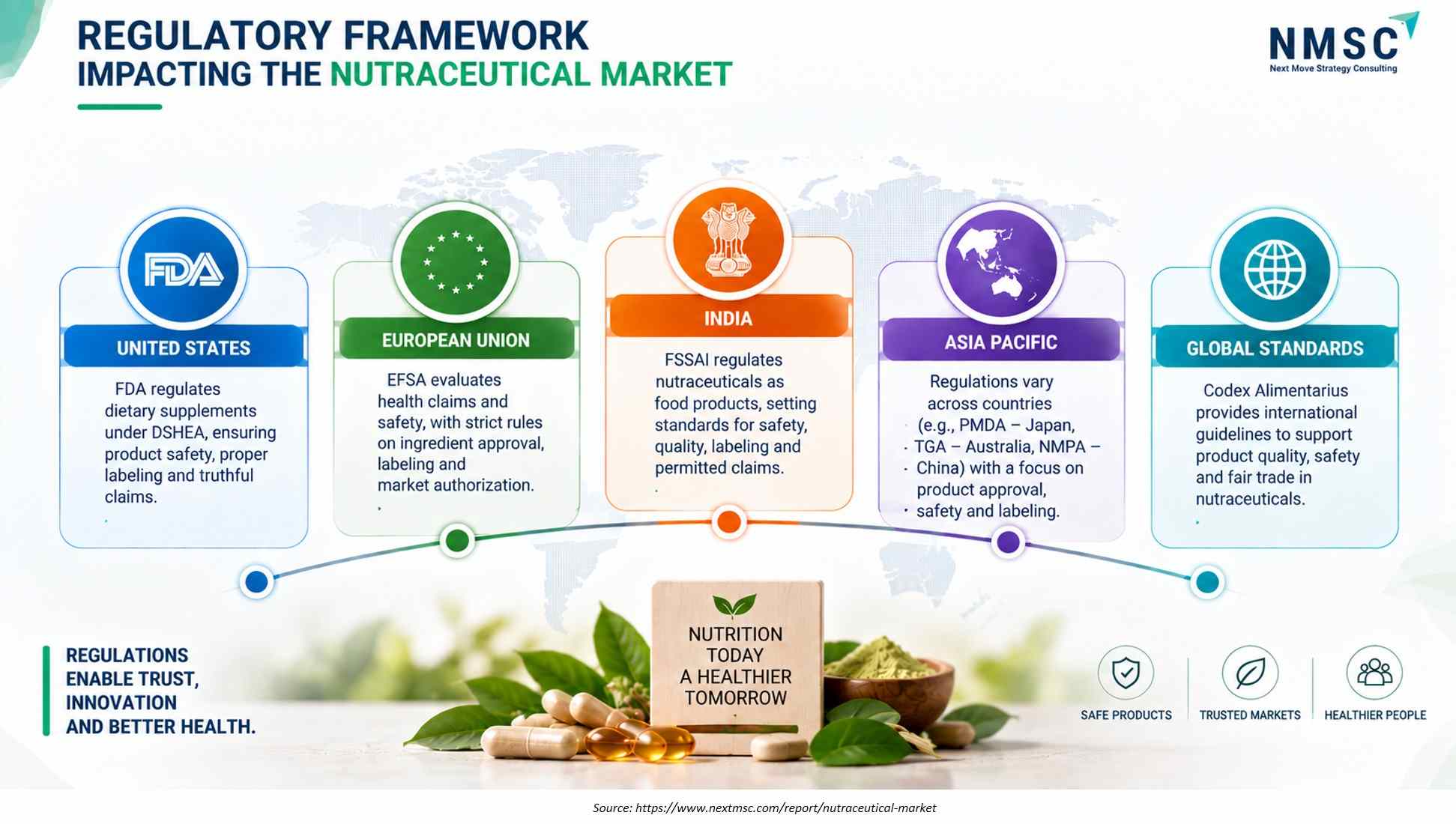
The infographic presents the Regulatory Framework Impacting the Nutraceutical Market, highlighting key regulatory considerations across major markets. It covers the United States, European Union, India, Asia Pacific, and global standards, focusing on product safety, quality, labeling, ingredient approval, health claims, and compliance. The framework illustrates how regulatory requirements influence market access, product development, consumer trust, and the growth of the global nutraceutical industry.

Regional Outlook

2025 (USD Billion)
2035 (USD Billion)
North Americ
Europe
Asia-Pacific
Middle East
Latin Americ
Region 2025 (USD Billion) 2035 (USD Billion) CAGR (%)
North America $10.0 USD Billion $40.0 USD Billion 9.0%
Europe $17.1 USD Billion $51.1 USD Billion 27.0%
Asia-Pacific $24.2 USD Billion $62.2 USD Billion 25.0%
Middle East & Africa $31.3 USD Billion $73.3 USD Billion 23.0%
Latin America $38.4 USD Billion $84.4 USD Billion 12.0%

Regional data is locked

Unlock complete regional numbers for this market.

Unlock Full Data

Competitive Landscape

We observed that the nutraceutical market features a moderately fragmented competitive landscape, with diversified consumer goods and pharmaceutical groups competing alongside specialized direct-selling and functional beverage companies on formulation science, distribution reach, and brand trust.

Dimension Description
Market Structure Moderately fragmented; diversified groups such as Nestlé and Unilever compete alongside direct-selling specialists such as Amway and Herbalife, and regional manufacturers such as BY-HEALTH serving domestic consumer bases.
Innovation Focus Personalized nutrition platforms, clinically substantiated botanical formulations, and functional beverage innovation dominate current innovation pipelines across leading suppliers.
M&A Activity Selective portfolio expansion through acquisitions and brand partnerships, exemplified by Haleon's continued consumer health brand portfolio management following its 2022 spin-off from GSK.

How Do Companies Compete in the Nutraceutical Market?

Companies compete primarily on formulation science, distribution reach, and brand trust across the industry. Diversified groups such as Nestlé and Unilever leverage broad consumer goods distribution and research capabilities to serve mainstream retail channels, while direct-selling specialists such as Amway and Herbalife compete on distributor network depth and personalized consumer relationships across their respective markets.

Which Competitive Archetypes Dominate the Nutraceutical Market?

Two archetypes dominate the market: diversified consumer goods and pharmaceutical groups offering broad product portfolios across multiple retail channels, and specialized direct-selling or regional manufacturers focused on distributor-led or domestic market distribution. Nestlé and Bayer exemplify the diversified archetype through integrated research and multi-channel distribution, while Amway and USANA Health Sciences exemplify the direct-selling archetype serving distributor-based consumer relationships.

How Are Companies Differentiating Through Innovation in Nutraceuticals?

Innovation and differentiation strategy increasingly center on clinical substantiation and personalized formulation. USANA Health Sciences' personalized wellness assessment tools and Yakult Honsha's proprietary probiotic strain research both extend science-backed credibility into consumer-facing product positioning. Our analysis shows that suppliers unable to demonstrate credible clinical backing risk exclusion from health-conscious consumer consideration sets as label-claim scrutiny intensifies across North America and Europe.

What M&A and Expansion Activity Is Shaping the Nutraceutical Market?

Portfolio management and brand expansion continue to shape the competitive landscape within the industry. Haleon's ongoing consumer health brand portfolio strategy, following its 2022 separation from GlaxoSmithKline, alongside continued regional expansion by BY-HEALTH and Otsuka Holdings, illustrates how diversified and regional groups pursue geographic expansion and category breadth across dietary supplement, functional food, and functional beverage end markets.

Key Market Players

Our assessment indicates that the following 20 companies are actively shaping product innovation, distribution strategy, and brand positioning within the global nutraceutical market.

Amway Corporation Herbalife Ltd. Otsuka Holdings Co., Ltd. Nestlé S.A. Glanbia plc BellRing Brands, Inc. Haleon plc Health and Happiness (H&H) International Holdings Limited Unilever PLC The Simply Good Foods Company BY-HEALTH Co., Ltd. Bayer AG Yakult Honsha Co., Ltd. Kirin Holdings Company, Limited USANA Health Sciences, Inc. Jamieson Wellness Inc. Meiji Holdings Co., Ltd. Nu Skin Enterprises, Inc. Nature's Sunshine Products, Inc. Suntory Holdings Limited

Latest Developments

We found that recent developments within the market are concentrated on functional beverage innovation and direct-selling channel modernization, reflecting the industry's broader wellness-focused product transition.

Date Event
Aug 2026 BellRing’s Premier Protein introduced a new clear, carbonated protein beverage containing 15g of whey protein isolate per can. Available nationally from August 2026 in four flavors, the launch broadens protein delivery beyond traditional shakes and extends convenient nutrition into the ready-to-drink functional beverage segment.

Investment Opportunities

What Capital Inflows Are Targeting the Nutraceutical Market?

Capital inflows into the market are increasingly directed toward clinically substantiated formulation research and direct-to-consumer brand development. Companies continue to fund research and development investment in proprietary ingredient strains and delivery formats, as seen in Yakult Honsha's sustained probiotic strain research programs. We observed that investors favor brands demonstrating validated clinical substantiation, viewing published research backing as a proxy for long-term consumer trust and retention.

How Is Infrastructure Investment Supporting Nutraceutical Manufacturing?

Infrastructure investment is expanding manufacturing and quality-control capacity across North America and Asia-Pacific to serve rising dietary supplement and functional food demand. Manufacturers are scaling production capacity to support both mass-market and specialty formulation categories. Our findings suggest that regional manufacturers are investing in automated quality-testing infrastructure to improve consistency for products ranging from standard multivitamins to specialty botanical extracts.

What ESG Considerations Are Shaping Nutraceutical Investment Decisions?

Environmental, social, and governance considerations are increasingly central to investment decisions across the industry, with sustainable sourcing of botanical ingredients and transparent supply chain disclosure as leading criteria. Regulatory bodies continue to shape ingredient sourcing and safety expectations that inform manufacturer governance practices. We found that investors increasingly favor manufacturers with transparent sourcing and quality-testing disclosures, treating it as a governance indicator alongside product safety compliance.

Key Benefits for Stakeholders

How Does This Report Benefit Enterprise and Industry Leaders?

Enterprise and industry leaders gain access to validated segmentation, competitive benchmarking, and regional demand forecasts that support product-portfolio decisions across the nutraceutical industry. Our analysis shows that detailed product-type, end-user, and distribution-channel breakdowns help procurement and product teams align specifications with consumer demand and regulatory requirements while identifying underserved segments for portfolio expansion.

How Does This Report Benefit Investors and Financial Analysts?

Investors and financial analysts benefit from consistent, single-point market size and CAGR estimates that support valuation and capital-allocation decisions across the nutraceutical supply chain. We observed that the report's regional and segment-level growth differentials help identify which manufacturers and distribution channels are best positioned to capture above-market growth in functional beverage and e-commerce categories through 2035.

How Does This Report Benefit Technology Vendors and Product Teams?

Technology vendors and product teams gain insight into emerging design requirements, including personalized nutrition platforms, clinically substantiated formulation, and direct-to-consumer subscription models, that are reshaping the industry. Our findings suggest that this analysis helps R&D teams prioritize development roadmaps around scientific substantiation and digital consumer engagement increasingly required by retail and direct-selling procurement processes.

Key Market Segments Evaluated

By Product Type

  • Dietary Supplements 
    • Vitamins and Minerals
      • Single-Nutrient Supplements
      • Multivitamins and Multiminerals
      • Mineral Combinations
    • Botanicals and Herbal Supplements
      • Single Botanicals
      • Botanical Blends
      • Herbal Extract Formulas
    • Probiotics and Prebiotics
      • Probiotics
      • Prebiotics
      • Synbiotics and Postbiotics
    • Sports and Performance Supplements
      • Protein Supplements
      • Amino Acid Supplements
      • Creatine Supplements
      • Electrolyte Supplements
    • Weight Management Supplements
      • Meal-Replacement Supplements
      • Satiety Supplements
      • Metabolism Supplements
    • Specialty Supplements
      • Omega-3 and Essential Fatty Acid Supplements
      • Collagen Supplements
      • Enzyme Supplements
      • Coenzyme Q10 Supplements
      • Glucosamine and Chondroitin Supplements
      • Other Specialty Supplements
  • Functional Foods 
    • Nutrition Bars and Snacks
    • Fortified Dairy and Dairy Alternatives
    • Fortified Bakery and Cereals
    • Functional Meat and Seafood
    • Functional Oils and Spreads
    • Functional Confectionery
    • Other Functional Foods
  • Functional Beverages 
    • Sports and Hydration Beverages
    • Energy Beverages
    • Protein and Meal-Replacement Beverages
    • Probiotic and Fermented Beverages
    • Functional Water
    • Other Functional Beverages

By End-User Application

  • General Wellness
  • Immune Health
  • Digestive Health
  • Cardiovascular Health
  • Metabolic Health
  • Weight Management
  • Bone and Joint Health
  • Cognitive and Mental Health
  • Sports Performance and Recovery
  • Energy and Vitality
  • Women's Health
  • Men's Health
  • Beauty and Skin Health
  • Healthy Aging
  • Other Health Benefits

By Distribution Channel

  • Direct Sales
  • E-Commerce
  • Healthcare and Institutional
  • Foodservice and Other Out-of-Home

By Region

  • North America 
    • U.S.
    • Canada
    • Mexico
  • Europe 
    • UK
    • Germany
    • France
    • Italy
    • Spain
    • Sweden
    • Denmark
    • Finland
    • Netherlands
    • Rest of Europe
  • Asia-Pacific 
    • China
    • India
    • Japan
    • South Korea
    • Taiwan
    • Indonesia
    • Vietnam
    • Australia
    • Philippines
    • Malaysia
    • Rest of APAC
  • Middle East & Africa 
    • Saudi Arabia
    • UAE
    • Egypt
    • Israel
    • Turkey
    • Nigeria
    • South Africa
    • Rest of MEA
  • Latin America 
    • Brazil
    • Argentina
    • Chile
    • Colombia
    • Rest of LATAM

Conclusion & Recommendations

The long-term outlook for the market remains positive, with global revenue projected to increase from USD 594.00 billion in 2025 to USD 1,336.12 billion by 2035. Based on the 2026 market estimate, the market is projected to grow at an 8.00% CAGR from 2026 to 2035. We observed that preventive wellness adoption, immune health demand, and personalized nutrition growth will continue to underpin demand across dietary supplement, functional food, and functional beverage applications through the forecast period.

What Strategic Positioning Should Nutraceutical Suppliers Pursue?

Suppliers should prioritize clinically substantiated formulation while pursuing personalized nutrition capability to secure long-term consumer loyalty. Our assessment indicates that companies investing early in direct-to-consumer subscription models and scientific research backing will be best positioned to capture premium pricing within the nutraceutical market.

How Attractive Is the Nutraceutical Market for New Investment?

The nutraceutical industry presents an attractive investment case, supported by a USD 667.91 billion absolute dollar opportunity between 2026 and 2035 and above-average growth in Asia-Pacific and Functional Beverage categories. We found that investment attractiveness is highest for companies combining scientific substantiation with scaled distribution networks, positioning them to serve both mass-market and premium wellness consumer segments simultaneously.

What Market Shifts and Key Risks Should Stakeholders Monitor?

Stakeholders should monitor regulatory scrutiny over label claims, raw material price volatility for botanicals, and counterfeit product concerns as key risks to the nutraceutical market. Our analysis shows that suppliers unable to substantiate health claims risk losing distribution shelf space to competitors with validated clinical research backing, particularly as regulators in North America and Europe tighten label-claim enforcement.

What Are the Key Growth Pathways for the Nutraceutical Market?

Key growth pathways include expanding personalized nutrition platforms, scaling clinically substantiated specialty supplement capacity, and deepening penetration into e-commerce and functional beverage channels. NMSC's analysis indicates that suppliers pursuing these pathways while maintaining cost competitiveness in mass-market vitamin categories will be best positioned to capture the nutraceutical market's projected growth through 2035.

Delivered Customizations

We have successfully delivered the following deep-dive customizations:

Client Request Customization Delivered Value Adds
Historical Market & Sales Analysis
  • Historical sales and revenue analysis of nutraceuticals by product type (dietary supplements, functional foods, functional beverages) and region.
  • Identifies high-growth product categories and regions to prioritize for portfolio and investment decisions.
Company-Level Product Share Analysis
  • Company-level revenue share benchmarking across nutraceutical product categories using annual reports and investor filings.
  • Highlights competitor strengths by product category and reveals white-space and share-gain opportunities.
Country-Level Trade Assessment
  • Country-wise import and export analysis of key nutraceutical products and ingredients such as vitamins, probiotics, and botanical extracts.
  • Supports sourcing, manufacturing location, and export market entry decisions.
Ingredient Demand Mapping by End-User Application
  • Mapping of key nutraceutical ingredient classes (probiotics, omega-3, vitamins, botanicals, proteins) to end-user applications such as immunity, gut health, sports nutrition, and healthy ageing.
  • Guides ingredient portfolio focus and product development toward the highest-demand health applications.
Distribution Channel Performance Assessment
  • Comparison of nutraceutical sales across pharmacies, supermarkets, specialty stores, and e-commerce or direct-to-consumer channels by region and product type.
  • Shows which channels to prioritize for go-to-market strategy and retail partnerships.
Regulatory and Health Claim Landscape Assessment
  • Regional comparison of nutraceutical regulations, permitted health claims, and product registration requirements across major countries from regulatory agency sources.
  • Reduces market entry risk and speeds up compliant product launches and localization.

FAQs

About the Author

Liza Phukan

Liza Phukan

Liza Phukan is Research Associate at Next Move Strategy Consulting, where she has covered emerging industries and market research across sectors for 3.5 years. Her work includes analyzing industry developments, validating market data, and developing structured business content from research findings. She uses secondary research and data-validation practices to turn complex market information into clear decision-useful market analysis for business audiences and support report development and B2B.

About the Reviewer

Supradip Baul

Supradip Baul

Supradip Baul is an accomplished business consultant and strategist with over a decade of rich experience in market intelligence, strategy, technology, and business transformation. His work has included rigorous qualitative and quantitative analysis across multiple industries, helping clients shape investment decisions and long-term roadmaps. Earlier in his career, he was associated with Gartner, where he contributed to industry-leading reports and market share analyses. He has worked with leading global companies and holds an MBA with a dual specialization in Marketing and Finance.

Download Free Sample

Ross J Mckenzie

ROSS J MCKENZIE

Business Insight Manager

Staysure Group

“Next MSC have been incredibly helpful in providing detailed & robust information on our market, alongside quantifying growth by different segments. The process to procure was simple and easy, with sample reports and regular contact to ensure we had what we needed. Succinct detail on their sources & methodologies is also greatly received, allowing transparency in this respect helps build trust in the detail you pay for. Joseph in particular was fantastic, and helped ensure efficient provision of the insight pack – thank you NMSC!”.

Kevin Coker

KEVIN COKER

Founder, CEO and Board Diector

Proxima Clinical Research

I have been using Next MSC reports for product positioning in a new geography for a long time. They have by far the best reports I have found and the price is reasonable too!

Gaurav Jaiswal

GAURAV JAISWAL

Founder & CEO

Yano Charge Private Limited

The EV Charging market research report provided by the NextMSC was exceptionally detailed and insightful. It offered a comprehensive analysis that proved to be a game-changer for our strategic planning. Truly a testament to the NextMSC’s expertise and thoroughness in EV market landscape & analysis.

Mohit Agarwal

MOHIT AGARWAL

Chief Manager

DryChem India Pvt. Ltd.

Next Move Strategy Consulting is an amazing team of consultants. We required a market study report for our investors on top priority and the team went above and beyond our expectations to deliver the same with ample supporting data within a short time span enabling us to secure the investments and keep our project timeline maintained. Their professionalism, attention to detail, and timely delivery of actionable recommendations have left a lasting impression on our organization.

Pratyush Kumar Das

PRATYUSH KUMAR DAS

Assistant Manager

Polycab India Limited

We would like to express our appreciation for the data and insights provided by nextmsc. We are very pleased with the quality and depth of the information, which has proven to be highly valuable and beneficial for our business decision-making.

Custom Market Research Services

We will customize the research for you if the listed report does not fully match your requirements.

Get 30% Free Customization

Select License

This website uses cookies to ensure you get the best experience on our website. Learn more

✖