Ophthalmology EMR Software Market

Ophthalmology EMR software market size was USD 452.7 million in 2025, projected to reach USD 1217.6 million by 2035 at a 10.4% CAGR from 2026 to 2035 worldwide.

Download Free Sample PDF
Base Year (2025)
$452.7 Million
Forecast (2035)
$1,217.6 Million
CAGR (2026-2035)
10.4%
Top Region
North America

What Is the Ophthalmology EMR Software Market Size?

The global ophthalmology EMR software market size was valued at USD 452.7 million in 2025 and is estimated at USD 499.8 million in 2026, forecast to reach USD 1217.6 million by 2035, expanding at a 10.4% CAGR between 2026 and 2035. North America leads with approximately 46% share, while Clinical EMR dominates all other offering categories with approximately 28% share.

We observed that growth is broad-based across every segmentation axis, with AI scribe add-ons and cloud deployment driving the dominant structural shifts through 2035.

Ophthalmology EMR Software Market Revenue Forecast

Values in USD Million

2025 $452.7 Million
2025
2026 $499.8 Million
2026
2027 $551.8 Million
2027
2028 $609.1 Million
2028
2029 $672.5 Million
2029
2030 $742.4 Million
2030
2031 $819.6 Million
2031
2032 $904.9 Million
2032
2033 $999.0 Million
2033
2034 $1,102.9 Million
2034
2035 $1,217.6 Million
2035

Key Takeaways

By Offering: Clinical EMR held the largest share of approximately 28% (USD 126.8 million) in 2025; Add-Ons is the fastest-growing sub-segment at 17.2% CAGR from 2026–2035.

By Specialty: Ophthalmology only held the largest share of approximately 46% (USD 208.2 million) in 2025; Multi-Specialty Eye Care is the fastest-growing sub-segment at 12.9% CAGR from 2026–2035.

By Deployment: Cloud held the largest share of approximately 58% (USD 262.6 million) in 2025; Cloud is also the fastest-growing sub-segment at 13.1% CAGR from 2026–2035.

By Revenue Model: Subscription held the largest share of approximately 54% (USD 244.5 million) in 2025; Subscription is also the fastest-growing sub-segment at 12.9% CAGR from 2026–2035.

By Sales Channel: Direct held the largest share of approximately 62% (USD 280.7 million) in 2025; Marketplace is the fastest-growing sub-segment at 17.5% CAGR from 2026–2035.

By Buyer Type: Small Group Practice held the largest share of approximately 24% (USD 108.6 million) in 2025; Ambulatory Surgery Centre is the fastest-growing sub-segment at 13.1% CAGR from 2026–2035.

Dominant Region: North America dominated with approximately 46% revenue share (USD 208.2 million) in 2025.

Fastest-Growing Region: Asia-Pacific is expected to register the highest CAGR of 13.7% during 2026–2035.

Dominant Country: The U.S. led with approximately USD 177.0 million in 2025.

Fastest-Growing Country: India is the fastest-growing country at approximately 16.7% CAGR from 2026–2035.

Market Opportunity: The ophthalmology EMR software market is expected to create an absolute dollar opportunity of USD 717.8 million between 2026 and 2035, presenting significant investment potential across AI scribe technology, surgical workflow integration, and cloud-native platform migration.

According to NMSC analysis, vendors are increasingly embedding specialty-trained AI scribe capability directly into core EMR charting workflows rather than offering it as a bolt-on add-on, a shift that favors platform-native providers over third-party point solutions as ophthalmology practices prioritize documentation efficiency amid persistent technician staffing shortages through 2035.

Ecosystem Analysis of the Ophthalmology EMR Software Industry

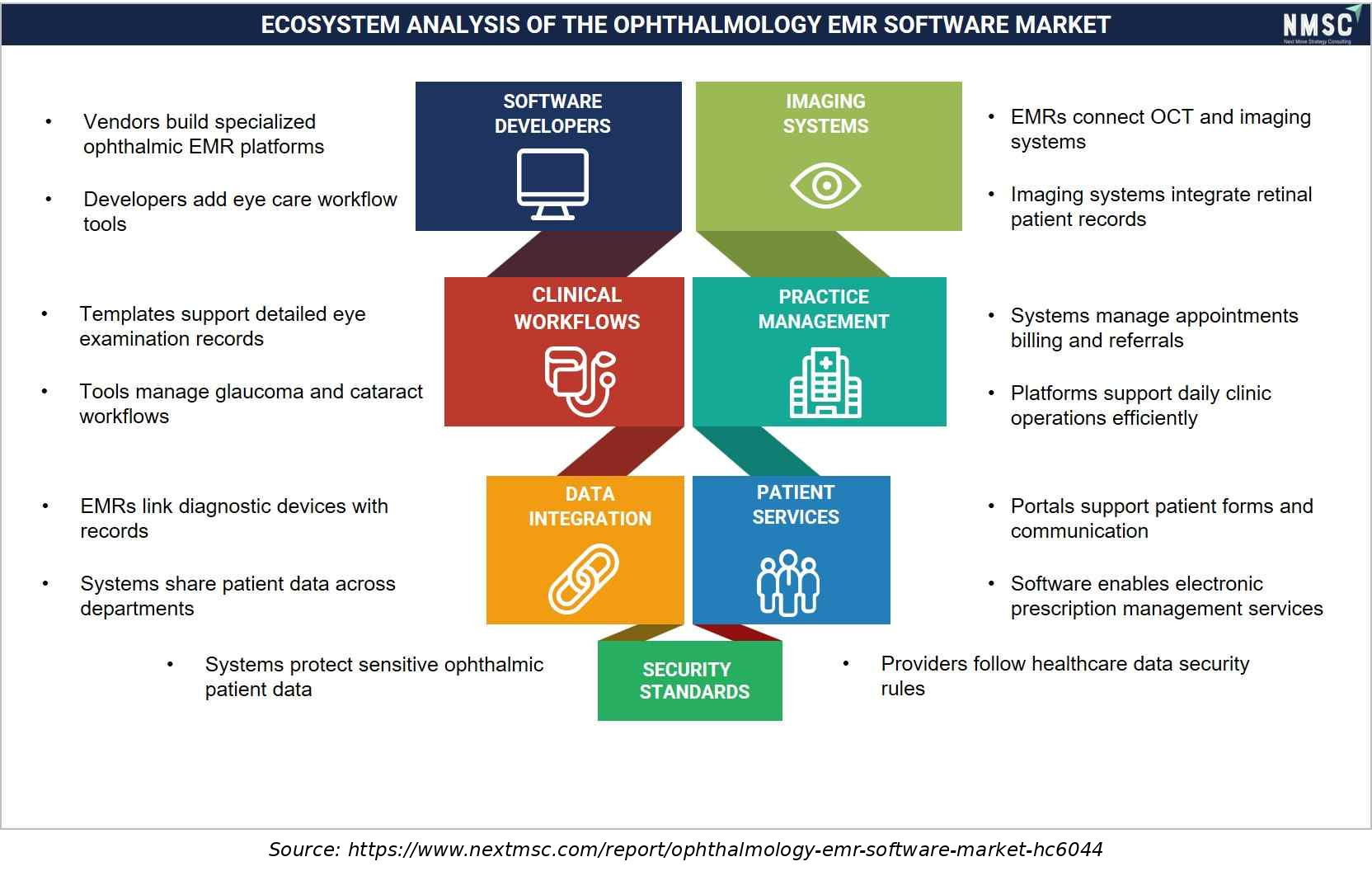
The above infographic presents an ecosystem analysis of the ophthalmology EMR software market, covering software developers, imaging systems, clinical workflows, practice management, data integration, patient services, and security standards. Developers build specialized platforms that connect OCT and imaging devices, with templates supporting detailed eye examination records and glaucoma or cataract management workflows. Further, data integration links diagnostic devices across departments, and security protocols ensure compliance with healthcare privacy regulations. Looking ahead, we observed that seamless interoperability and robust data protection will remain central to enhancing clinical efficiency and patient care across the ophthalmology sector.

What Does the Ophthalmology EMR Software Market Encompass?

The ophthalmology EMR software market encompasses the clinical charting, practice management, surgical workflow, patient engagement, and data integration software platforms purpose-built for eye care practices, ambulatory surgery centers, and hospital ophthalmology departments. Our assessment indicates that the scope spans specialty-focused software vendors serving solo practitioners through large multi-specialty eye care groups within the broader healthcare IT ecosystem worldwide.
Regulatory frameworks including the U.S. Office of the National Coordinator for Health Information Technology's interoperability requirements and the 21st Century Cures Act information-blocking provisions directly shape platform data-sharing obligations. We observed that technology adoption is shifting decisively toward embedded, specialty-trained AI scribe tools that reduce documentation burden within highly parameterized ophthalmic exam workflows. NMSC's analysis indicates that this structural shift, combined with accelerating cloud migration among mid-sized and large practice groups, is redefining vendor selection criteria across the market.

Market Drivers & Dynamics

Interactive Dataset
Rising adoption of specialty-trained AI scribe technology driver +2.4% North America, Europe 2026-2035
Growing cloud migration among mid-sized and large practice groups driver +1.9% Global 2026-2033
Expanding ambulatory surgery center ophthalmology procedure volume driver +1.6% North America, Asia-Pacific 2026-2035
Aging population driving rising cataract and retina procedure demand driver +1.3% Global 2026-2035
Interoperability mandates favoring integrated, connected platforms driver +0.9% North America 2026-2032
High switching cost and workflow disruption during EMR migration restraint -1.1% Global 2026-2033
Persistent technician and staffing shortages limiting technology adoption restraint -0.8% North America, Europe 2026-2032
Data privacy and AI documentation compliance concerns restraint -0.6% Global 2026-2030
Price sensitivity among solo and small group practices restraint -0.5% Global 2026-2035
Source: Next Move Strategy Consulting

Growth Drivers

What Is the Primary Growth Driver of the Ophthalmology EMR Software Market?

Rising adoption of specialty-trained AI scribe technology is the primary driver of the market. Nextech reported that its Cora Scribe platform, launched in January 2026, was developed specifically for ophthalmology workflows after being trained on thousands of ophthalmic patient charts to address the specialty's unusually parameterized documentation requirements. We observed that this specialty-specific approach, validated through a physician pilot program at Chicago Cornea Consultants, continues to anchor vendor differentiation strategy as practices prioritize documentation tools built for eye care rather than adapted from general medicine platforms.

How Is Ambulatory Surgery Center Growth Driving the Market Growth?

Ambulatory surgery center procedure volume growth is accelerating market growth by expanding demand for dedicated surgical workflow and ASC coordination software modules. The U.S. Centers for Medicare and Medicaid Services has continued expanding the list of procedures approved for ambulatory surgical center settings, supporting the shift of cataract and other ophthalmic procedures away from hospital outpatient departments. NMSC's analysis indicates that this site-of-care shift is directly increasing demand for integrated pre-operative, intra-operative, and post-operative software coordination between ophthalmology practices and affiliated surgery centers.

Growth Inhibitors

What Is Restraining Ophthalmology EMR Software Market Expansion?

High switching cost and workflow disruption during EMR migration restrain platform replacement decisions across the market. Practices transitioning between EMR systems face extended implementation timelines, staff retraining requirements, and temporary productivity loss during data migration. We found that established practices with deeply customized templates and integrated device connections face particular exposure, as the operational disruption of switching vendors often outweighs the incremental benefit of newer platform features absent a compelling efficiency case.

What Are the Growth Opportunities?

How Can Embedded AI Scribe Licensing Unlock Value for Platform Vendors?

Embedded, specialty-trained AI scribe technology presents a whitespace opportunity for vendors seeking to differentiate on documentation efficiency. Companies that deliver validated, ophthalmology-specific ambient documentation stand to capture premium subscription revenue as practices increasingly evaluate vendor selection based on measurable technician time savings rather than baseline charting functionality alone.

Where Does Ambulatory Surgery Center Coordination Create New Demand for Vendors?

Ambulatory surgery centers requiring seamless coordination with affiliated ophthalmology practices represent an underpenetrated opportunity for vendors offering integrated pre-operative, intra-operative, and post-operative workflow modules. Vendors that deliver validated ASC coordination capability can secure long-term contracts with expanding surgical practice groups, differentiating from competitors offering clinical charting alone.

How Can Multi-Specialty Eye Care Platforms Benefit from Marketplace Distribution?

Multi-specialty eye care groups seeking integrated third-party applications create an opportunity for vendors expanding marketplace-based distribution and partner ecosystems. Early movers that build robust developer and integration marketplaces can capture recurring transaction and partnership revenue, differentiating from vendors reliant solely on direct sales relationships.

Segmentation Analysis

2025 (USD Million)
2035 (USD Million)
Clinical EMR 2025: $126.8 Million | 2035: $292.2 Million
Clinical EMR
Practice Management 2025: $108.6 Million | 2035: $243.5 Million
Practice Man
Surgical Workflow 2025: $72.4 Million | 2035: $207.0 Million
Surgical Wor
Patient Engagement 2025: $58.9 Million | 2035: $170.5 Million
Patient Enga
Data and Integration 2025: $54.3 Million | 2035: $158.3 Million
Data and Int
Add-Ons 2025: $31.7 Million | 2035: $146.1 Million
Add-Ons
Clinical EMR $126.8 Million $292.2 Million 8.5%
Practice Management $108.6 Million $243.5 Million 8.2%
Surgical Workflow $72.4 Million $207.0 Million 11.2%
Patient Engagement $58.9 Million $170.5 Million 11.3%
Data and Integration $54.3 Million $158.3 Million 11.4%
Add-Ons $31.7 Million $146.1 Million 17.2%

Which Offering Dominates the Ophthalmology EMR Software Market?

Clinical EMR, encompassing encounter charting, templates and forms, and orders and e-prescribing, led the market with USD 126.8 million in 2025, reflecting its position as the foundational software layer every ophthalmology practice requires. Our findings suggest that Add-Ons is the fastest-growing offering, registering a 17.2% CAGR from 2026 to 2035, as AI scribe adoption accelerates following Nextech's Cora Scribe launch and competitors race to embed comparable specialty-trained documentation capability.

2025 (USD Million)
2035 (USD Million)
Cloud
Hosted
On-Premise
Hybrid
Segment Item 2025 (USD Million) 2035 (USD Million) CAGR
Cloud $10.0 USD Million $40.0 USD Million 10.0%
Hosted $17.1 USD Million $51.1 USD Million 24.0%
On-Premise $24.2 USD Million $62.2 USD Million 26.0%
Hybrid $31.3 USD Million $73.3 USD Million 20.0%

Segment-wise data is locked

Unlock complete segment-wise numbers for By Deployment.

Unlock Full Data

Which Deployment Model Leads Ophthalmology EMR Software Adoption?

Cloud deployment remained the leading model within the market, reaching USD 262.6 million in 2025 as practices increasingly favor subscription-based access over capital-intensive on-premises infrastructure, aligning with broader healthcare IT modernization trends. Based on research conducted by NMSC, we found that Cloud is also the fastest-growing deployment model at a 13.1% CAGR from 2026 to 2035, as vendors prioritize cloud-native architecture to support rapid AI feature deployment and multi-location practice scalability.

2025 (USD Million)
2035 (USD Million)
Subscription
Perpetual Li
Transaction-
Managed Serv
Professional
Segment Item 2025 (USD Million) 2035 (USD Million) CAGR
Subscription $10.0 USD Million $40.0 USD Million 23.0%
Perpetual License $17.1 USD Million $51.1 USD Million 13.0%
Transaction-Based $24.2 USD Million $62.2 USD Million 23.0%
Managed Services $31.3 USD Million $73.3 USD Million 9.0%
Professional Services $38.4 USD Million $84.4 USD Million 26.0%

Segment-wise data is locked

Unlock complete segment-wise numbers for By Revenue Model.

Unlock Full Data
2025 (USD Million)
2035 (USD Million)
Direct
Partner
Marketplace
Segment Item 2025 (USD Million) 2035 (USD Million) CAGR
Direct $10.0 USD Million $40.0 USD Million 24.0%
Partner $17.1 USD Million $51.1 USD Million 10.0%
Marketplace $24.2 USD Million $62.2 USD Million 8.0%

Segment-wise data is locked

Unlock complete segment-wise numbers for By Sales Channel.

Unlock Full Data
2025 (USD Million)
2035 (USD Million)
Solo Practic
Small Group
Mid-Market G
Large Group
Hospital Dep
Segment Item 2025 (USD Million) 2035 (USD Million) CAGR
Solo Practice $10.0 USD Million $40.0 USD Million 22.0%
Small Group Practice $17.1 USD Million $51.1 USD Million 12.0%
Mid-Market Group $24.2 USD Million $62.2 USD Million 14.0%
Large Group $31.3 USD Million $73.3 USD Million 12.0%
Hospital Department $38.4 USD Million $84.4 USD Million 15.0%

Segment-wise data is locked

Unlock complete segment-wise numbers for By Buyer Type.

Unlock Full Data

Which Buyer Type Leads Ophthalmology EMR Software Market Demand?

Small Group Practice remained the leading buyer type within the market, valued at USD 108.6 million in 2025, reflecting the concentration of eye care delivery among independent practices with two to ten physicians. Our findings suggest that Ambulatory Surgery Centre is the fastest-growing buyer type, registering a 13.1% CAGR from 2026 to 2035, as the continued shift of cataract and refractive procedures toward ASC settings drives dedicated demand for surgical workflow and ASC coordination software.

2025 (USD Million)
2035 (USD Million)
Ophthalmolog
Ophthalmolog
Multi-Specia
Segment Item 2025 (USD Million) 2035 (USD Million) CAGR
Ophthalmology Only $10.0 USD Million $40.0 USD Million 25.0%
Ophthalmology and Optometry $17.1 USD Million $51.1 USD Million 11.0%
Multi-Specialty Eye Care $24.2 USD Million $62.2 USD Million 13.0%

Segment-wise data is locked

Unlock complete segment-wise numbers for By Speciality.

Unlock Full Data

Growth Opportunities

Our analysis shows that three forward-looking opportunities stand out for stakeholders positioning within the ophthalmology EMR software market over the 2026-2035 forecast period.

How Can Embedded AI Scribe Licensing Unlock Value for Platform Vendors?

Embedded, specialty-trained AI scribe technology presents a whitespace opportunity for vendors seeking to differentiate on documentation efficiency. Companies that deliver validated, ophthalmology-specific ambient documentation stand to capture premium subscription revenue as practices increasingly evaluate vendor selection based on measurable technician time savings rather than baseline charting functionality alone.

Where Does Ambulatory Surgery Center Coordination Create New Demand for Vendors?

Ambulatory surgery centers requiring seamless coordination with affiliated ophthalmology practices represent an underpenetrated opportunity for vendors offering integrated pre-operative, intra-operative, and post-operative workflow modules. Vendors that deliver validated ASC coordination capability can secure long-term contracts with expanding surgical practice groups, differentiating from competitors offering clinical charting alone.

How Can Multi-Specialty Eye Care Platforms Benefit from Marketplace Distribution?

Multi-specialty eye care groups seeking integrated third-party applications create an opportunity for vendors expanding marketplace-based distribution and partner ecosystems. Early movers that build robust developer and integration marketplaces can capture recurring transaction and partnership revenue, differentiating from vendors reliant solely on direct sales relationships.

Regional Outlook

2025 (USD Million)
2035 (USD Million)
North Americ
Europe
Asia-Pacific
Middle East
Latin Americ
Region 2025 (USD Million) 2035 (USD Million) CAGR (%)
North America $10.0 USD Million $40.0 USD Million 9.0%
Europe $17.1 USD Million $51.1 USD Million 27.0%
Asia-Pacific $24.2 USD Million $62.2 USD Million 25.0%
Middle East & Africa $31.3 USD Million $73.3 USD Million 23.0%
Latin America $38.4 USD Million $84.4 USD Million 12.0%

Regional data is locked

Unlock complete regional numbers for this market.

Unlock Full Data

Regulatory Framework Impacting the Ophthalmology EMR Software Industry

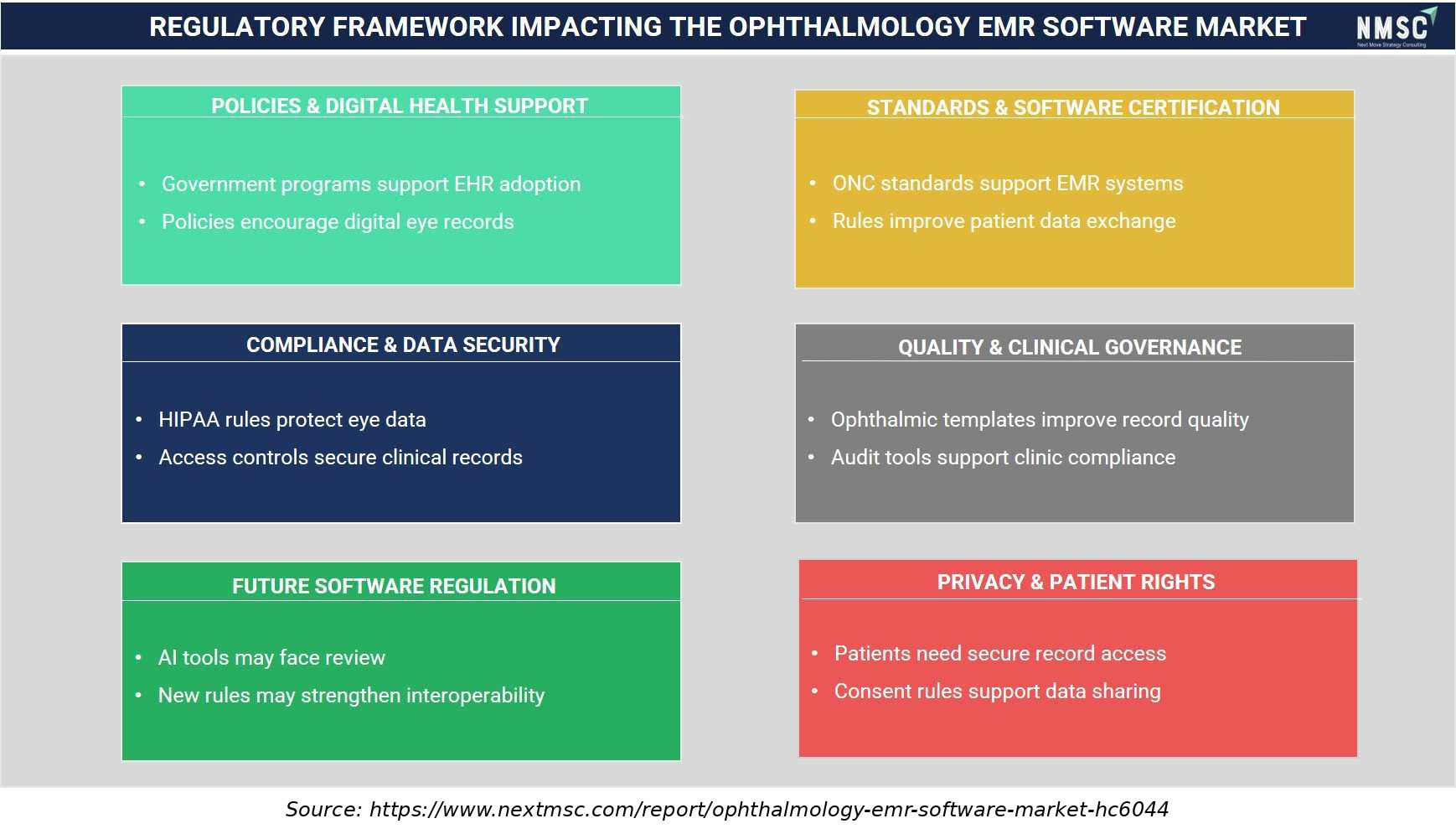
The above infographic presents a regulatory framework impacting the ophthalmology EMR software market, wherein government programs and digital health policies are encouraging EHR adoption and standardized record-keeping. HIPAA compliance and access controls ensure data security, while ONC certification supports interoperability and patient data exchange. Ophthalmic templates and audit tools enhance clinical documentation quality and governance, with patient consent and secure access protecting privacy rights. Looking ahead, we observed that future regulations may introduce AI tool reviews and strengthen interoperability standards, shaping the evolution of digital eye care platforms across the healthcare sector.

Competitive Landscape

We observed that the ophthalmology EMR software market features a moderately fragmented competitive landscape, with specialty-focused platform leaders competing alongside broader ambulatory EHR vendors and smaller niche developers on AI documentation capability, surgical workflow depth, and device interoperability across the industry.

Dimension Description
Market Structure Moderately fragmented; Modernizing Medicine and Nextech Systems lead the specialty-dedicated segment, while broader ambulatory EHR vendors including eClinicalWorks, NextGen Healthcare, and athenahealth compete for multi-specialty practices that include ophthalmology.
Innovation Focus Specialty-trained AI scribe technology, integrated optical point-of-sale software, and surgical workflow interoperability with diagnostic imaging devices dominate current innovation pipelines.
M&A Activity Selective platform partnerships and feature expansion, exemplified by Nextech's collaboration with Ocuco to integrate optical retail software into its core ophthalmology EMR platform.

How Do Companies Compete in the Ophthalmology EMR Software Market?

Companies compete primarily on specialty-specific workflow depth, AI documentation capability, and diagnostic device interoperability across the industry. Specialty-dedicated leaders such as Nextech Systems and Modernizing Medicine leverage purpose-built ophthalmic templates and embedded AI scribe technology to serve eye care practices, while broader ambulatory EHR vendors such as eClinicalWorks and athenahealth compete through multi-specialty platform breadth serving mixed practice groups that include ophthalmology alongside other specialties.

Which Competitive Archetypes Dominate the Ophthalmology EMR Software Market?

Two archetypes dominate the market: specialty-dedicated ophthalmology platform vendors offering deep clinical and surgical workflow customization, and broader ambulatory EHR providers offering multi-specialty flexibility at lower switching costs for mixed practices. Nextech Systems and Modernizing Medicine exemplify the specialty-dedicated archetype, while eClinicalWorks and NextGen Healthcare exemplify the multi-specialty archetype serving practices seeking a single platform across several clinical disciplines.

How Are Companies Differentiating Through Innovation in Ophthalmology EMR Software?

Innovation and differentiation strategy increasingly center on specialty-trained AI documentation and integrated retail functionality. Nextech's Cora Scribe launch and its optical software partnership with Ocuco both illustrate how specialty-dedicated vendors extend platform value beyond core charting into documentation automation and dispensary operations. Our analysis shows that vendors unable to demonstrate credible AI scribe accuracy or device interoperability risk losing competitive positioning as practices increasingly weight these capabilities in purchase decisions.

What M&A and Expansion Activity Is Shaping the Ophthalmology EMR Software Market?

Strategic partnerships and feature-level expansion continue to shape competitive positioning within the industry rather than large-scale acquisitions. Nextech's 2025 integration partnership with Ocuco to embed optical point-of-sale and inventory functionality illustrates how specialty vendors expand platform scope through partnership rather than costly in-house development, while continued AI feature rollout across multiple vendors signals an industry-wide race to match Nextech's Cora Scribe capability.

Key Market Players

Our assessment indicates that the following 20 companies are actively shaping platform development, AI documentation strategy, and practice group distribution within the global ophthalmology EMR software market.

Modernizing Medicine, Inc. Nextech Systems, LLC eClinicalWorks, LLC NextGen Healthcare, Inc. athenahealth, Inc. AdvancedMD, Inc. Compulink Healthcare Solutions, Inc. EyeMD EMR Healthcare Systems, Inc. Meditab Software, Inc. CureMD.com, Inc. WRS Health, Inc. Mednetworx, Inc. Sightview First Insight Corporation EHNOTE, Inc. Doctorsoft, Inc. RioMed Limited Barti Software, Inc. Moyae, Inc. PracticeSuite, Inc.

Latest Developments

We found that recent milestones within the ophthalmology EMR software market are concentrated on AI scribe launches and platform integration partnerships, reflecting the industry's rapid push toward documentation automation.

Date Event
May 2026 Moyae launched two AI capabilities for its ophthalmology EHR: one-click care-team letters and billing-code suggestions. The system generates letters from patient encounters and recommends up to nine ICD-10 codes, E&M levels, and charge-list updates using an ophthalmology-optimized large language model.
April 2026 Sightview announced early access to its new flagship EHR platform at ASCRS 2026. The enhanced system introduces a modern interface and redesigned workflows while retaining ophthalmology-specific functionality
March 2026 Moyae released a digital retina-drawing component that allows retina specialists to create, save, and reference retinal diagrams directly within patient encounters. Annotations are mapped automatically to ICD-10 billing codes, eliminating paper-based diagrams and manual transcription within retina documentation workflows.
January 2026 Nextech launched Cora Scribe, an AI clinical documentation solution embedded directly within its EHR. The tool listens to patient conversations, understands ophthalmology-specific context, and generates structured clinical findings in near real time

Expert Insights

Rusty Frantz

Rusty Frantz

CEO of Nextech | Nextech, LLC

"“Cora is designed specifically for ophthalmology, drawing on decades of real-world experience from one of healthcare's most complex specialties,” said Rusty Frantz, CEO of Nextech. “It marks a move away from generic AI scribing toward specialty-specific clinical assistants, starting with ophthalmology and extending to other specialties over time. Being truly helpful in the exam room demands more than simple note-taking — it requires alignment with clinical workflows, and that’s what sets Cora apart.”"

Analyst Interpretation

The statement highlights the increasing shift in the Ophthalmology EMR Software Market toward specialty-specific AI-enabled clinical workflows. NMSC's analysis indicates that ophthalmology practices are increasingly moving beyond conventional electronic documentation toward EHR platforms that integrate AI directly into clinical workflows. The integration of specialty terminology, structured examination data, automated documentation, and workflow-specific AI is expected to improve documentation efficiency while allowing ophthalmologists and care teams to devote greater attention to patient care.

Investment Opportunities

What Capital Inflows Are Targeting the Ophthalmology EMR Software Market?

Capital inflows into the ophthalmology EMR software market are increasingly directed toward AI scribe development and platform integration partnerships. Nextech's Cora Scribe launch and its Ocuco optical software partnership illustrate continued strategic investment toward both documentation automation and platform scope expansion. We observed that investors favor vendors demonstrating validated AI documentation performance, viewing measurable time-savings data as a proxy for sustained subscription revenue retention.

How Significant Is Infrastructure Investment in the Ophthalmology EMR Software Market?

Infrastructure investment tied to cloud-native platform architecture and diagnostic device interoperability is a critical enabler of ophthalmology EMR software market scalability. Vendors must invest in robust imaging device connectivity given the specialty's heavy reliance on optical coherence tomography and fundus imaging equipment. Our assessment indicates that practices increasingly condition vendor selection on demonstrated cloud infrastructure reliability and device integration breadth alongside core charting functionality.

What ESG Considerations Are Shaping Ophthalmology EMR Software Investment?

Environmental, social, and governance considerations shape ophthalmology EMR software investment primarily through data privacy governance and healthcare access priorities. Cloud-based platforms that reduce on-premises server infrastructure support lower practice-level energy consumption relative to legacy on-premises systems. NMSC's analysis indicates that AI documentation tools reducing technician workload are increasingly framed as a response to healthcare staffing sustainability challenges, supporting broader access to eye care in technician-constrained markets.

Key Benefits for Stakeholders

How Does This Report Benefit Healthcare IT Industry Leaders?

Healthcare IT industry leaders gain access to validated segmentation, offering benchmarking, and regional regulatory analysis that supports ophthalmology EMR software strategy decisions. The report's offering and deployment breakdowns help executives evaluate clinical EMR, surgical workflow, and AI scribe investment priorities against evolving practice group technology requirements, supporting more informed portfolio decisions across cloud and hybrid deployment models.

How Does This Report Benefit Investors and Financial Analysts?

Investors and financial analysts benefit from consolidated market sizing, regional growth forecasts, and competitive positioning data that inform capital allocation across the ophthalmology EMR software value chain. The report's country-level revenue estimates and growth catalyst matrix support due diligence on specialty-dedicated vendors and broader ambulatory EHR providers positioned to capture forecast demand growth through 2035.

How Does This Report Benefit Technology Vendors and Product Teams?

Technology vendors and product teams gain competitive intelligence on AI scribe adoption trends, deployment model shifts, and recent developments among the 20 companies profiled. This supports product roadmap decisions around specialty-trained documentation automation, ASC coordination software, and marketplace distribution strategy aligned with the fastest-growing offering and regional segments identified in this report.

Key Market Segments Evaluated

By Offering

  • Clinical EMR 
    • Encounter Charting
    • Templates and Forms
    • Orders and E-Prescribing
  • Practice Management 
    • Scheduling and Registration
    • Billing and Claims
    • Collections and Denials
    • Inventory and Optical POS
  • Surgical Workflow 
    • Pre Op
    • Intra Op
    • Post Op
    • ASC Coordination
  • Patient Engagement 
    • Portal
    • Messaging
    • Reminders
    • Intake
    • Telehealth
  • Data and Integration 
    • Imaging and Device Links
    • Reporting and Analytics
    • Quality and Registry
    • Interoperability
  • Add-Ons 
    • AI Scribe
    • Custom Modules
    • Other Add-Ons

By Speciality

  • Ophthalmology Only
  • Ophthalmology and Optometry
  • Multi-Specialty Eye Care

By Deployment

  • Cloud
  • Hosted
  • On-Premise
  • Hybrid

By Revenue Model

  • Subscription
  • Perpetual License
  • Transaction-Based
  • Managed Services
  • Professional Services

By Sales Channel

  • Direct
  • Partner
  • Marketplace

By Buyer Type

  • Solo Practice
  • Small Group Practice
  • Mid-Market Group
  • Large Group
  • Hospital Department
  • Ambulatory Surgery Centre

By Region

  • North America 
    • U.S.
    • Canada
    • Mexico.
  • Europe 
    • UK
    • Germany
    • France
    • Italy
    • Spain
    • Sweden
    • Denmark
    • Finland
    • Netherlands
    • Rest of Europe.
  • Asia-Pacific 
    • China
    • India
    • Japan
    • South Korea
    • Taiwan
    • Indonesia
    • Vietnam
    • Australia
    • Philippines
    • Malaysia
    • Rest of APAC.
  • Middle East & Africa 
    • Saudi Arabia
    • UAE
    • Egypt
    • Israel
    • Turkey
    • Nigeria
    • South Africa
    • Rest of MEA.
  • Latin America 
    • Brazil
    • Argentina
    • Chile
    • Colombia
    • Rest of LATAM.

Conclusion & Recommendations

The long-term outlook for the ophthalmology EMR software market remains structurally positive, supported by a USD 717.8 million absolute dollar opportunity between 2026 and 2035 and accelerating AI scribe adoption reshaping documentation workflows. We found that Clinical EMR will continue commanding the largest revenue share while Add-Ons gain disproportionate share as specialty-trained AI documentation becomes a standard practice expectation through the forecast period.

What Strategic Positioning Should Stakeholders Pursue?

Stakeholders should pursue strategic positioning that combines specialty-trained AI documentation with broad diagnostic device interoperability to serve practices across the full buyer spectrum from solo practitioners to hospital departments. NMSC's analysis indicates that vendors bundling embedded AI scribe capability with integrated optical retail and ASC coordination modules are best positioned to capture recurring, multi-year subscription revenue across the ophthalmology EMR software market.

How Attractive Is the Ophthalmology EMR Software Market for New Investment?

The ophthalmology EMR software industry presents an attractive investment case, supported by a USD 717.8 million absolute dollar opportunity between 2026 and 2035 and above-average growth in Asia-Pacific and AI-driven Add-Ons categories. We found that investment attractiveness is highest for vendors combining validated AI documentation performance with cloud-native architecture, positioning them to capture share across both established North American and rapidly digitizing Asia-Pacific practice networks.

What Market Shifts and Key Risks Should Stakeholders Monitor?

Stakeholders should monitor high switching costs constraining platform replacement, persistent technician staffing shortages, and data privacy compliance requirements around AI documentation as key risks to the ophthalmology EMR software market. Our analysis shows that vendors unable to demonstrate credible AI scribe accuracy and compliant data handling risk losing competitive positioning as practices increasingly scrutinize both efficiency claims and regulatory compliance during vendor evaluation.

What Are the Key Growth Pathways for the Ophthalmology EMR Software Market?

Key growth pathways include scaling specialty-trained AI scribe capability, expanding ASC coordination and surgical workflow modules, and deepening marketplace-based distribution for multi-specialty eye care groups. NMSC's analysis indicates that vendors pursuing these pathways while maintaining diagnostic device interoperability will be best positioned to capture the ophthalmology EMR software market's projected growth through 2035.

FAQs

About the Author

Mayurima Roy

Mayurima Roy

Mayurima Roy is Research Analyst at Next Move Strategy Consulting, where she has spent 4 years working across the firm's full industry coverage rather than a single fixed vertical. Her work centers on structured research, ongoing trend tracking, competitive assessment, and insight-led content development, translating complex market data into clear, decision-ready narratives that support informed client decision-making across diverse global industries, market sectors, and world regions every day.

About the Reviewer

Supradip Baul

Supradip Baul

Supradip Baul is an accomplished business consultant and strategist with over a decade of rich experience in market intelligence, strategy, technology, and business transformation. His work has included rigorous qualitative and quantitative analysis across multiple industries, helping clients shape investment decisions and long-term roadmaps. Earlier in his career, he was associated with Gartner, where he contributed to industry-leading reports and market share analyses. He has worked with leading global companies and holds an MBA with a dual specialization in Marketing and Finance.

Download Free Sample

Kevin Coker

KEVIN COKER

Founder, CEO and Board Diector

Proxima Clinical Research

I have been using Next MSC reports for product positioning in a new geography for a long time. They have by far the best reports I have found and the price is reasonable too!

Diana Trejo

DIANA TREJO

Assistant Manager

Sumitomo Corporation de Mexico, S.A. de C.V.

Recently, we purchased a report on the Mexico Data Center Market from Next Move Strategy Consulting. The service has been excellent, with support that is always timely and thoroughly professional. The information provided is interesting, highly useful, and delivered with clarity. I would highly recommend NextMSC for anyone seeking insightful and dependable analysis.

Pratyush Kumar Das

PRATYUSH KUMAR DAS

Assistant Manager

Polycab India Limited

We would like to express our appreciation for the data and insights provided by nextmsc. We are very pleased with the quality and depth of the information, which has proven to be highly valuable and beneficial for our business decision-making.

Gaurav Jaiswal

GAURAV JAISWAL

Founder & CEO

Yano Charge Private Limited

The EV Charging market research report provided by the NextMSC was exceptionally detailed and insightful. It offered a comprehensive analysis that proved to be a game-changer for our strategic planning. Truly a testament to the NextMSC’s expertise and thoroughness in EV market landscape & analysis.

Henri Knyphausen

HENRI KNYPHAUSEN

Partner at Singulier [Ex-BCG]

Singulier

I recently engaged NEXTMSC.com for a commercial due diligence project within the intralogistics sector, and I am pleased to provide a reference based on my experience. In utilizing NEXTMSC.com's services, I found their report to offer valuable insights into market dynamics and key industry players. The initial report provided a solid foundation for our analysis. However, as we were investigating a smaller target in the market, and I had specific customization requests requiring additional research. These requests included detailed information on product portfolios of various players and sub-market sizes, both inclusive and exclusive of certain product categories. NEXTMSC.com demonstrated commendable responsiveness and agility in accommodating these customization requests. Within a timeframe of 1-2 weeks, they delivered a revised report that met our specific needs. Furthermore, they were receptive to my follow-up inquiries, ensuring clarity and understanding of the data provided. The final deliverable significantly contributed to our due diligence efforts. One of NEXTMSC.com's notable strengths lies in their qualitative research capabilities. However, for future engagements, I would recommend the inclusion of a quantified market model in Excel format. Such a model would offer the ability to conduct in-depth analyses and explore various market segments, including country-specific data and subcomponent breakdowns. Based on my positive experience, I would not hesitate to work with NEXTMSC.com again. Their responsiveness, willingness to accommodate customization requests, and commitment to delivering actionable insights make them a reliable partner for commercial research projects.

Custom Market Research Services

We will customize the research for you if the listed report does not fully match your requirements.

Get 30% Free Customization

Select License

This website uses cookies to ensure you get the best experience on our website. Learn more

✖