Organic Plant Ground Covers Market Size, Share, Trends and Growth Analysis, By Type (Perennial Ground Covers, Ornamental Grasses & Sedges, and Flowering Ground Covers), By Application (Residential, Commercial & Institutional, Erosion Control, and Public Parks & Municipal), By Distribution Channel (Nurseries and Garden Centers, Landscaping Contractors, Online Retail, and Wholesale Growers), and Region — Global Industry Report and Forecast, 2026–2035
Industry: Agriculture | Publishing Date: August 13, 2026 | Last Updated: September 21, 2026 | No of Pages: N/A | No. of Tables: N/A | No. of Figures: N/A | Format: PDF | Report Code: AG5692
What Is the Organic Plant Ground Covers Market Size?
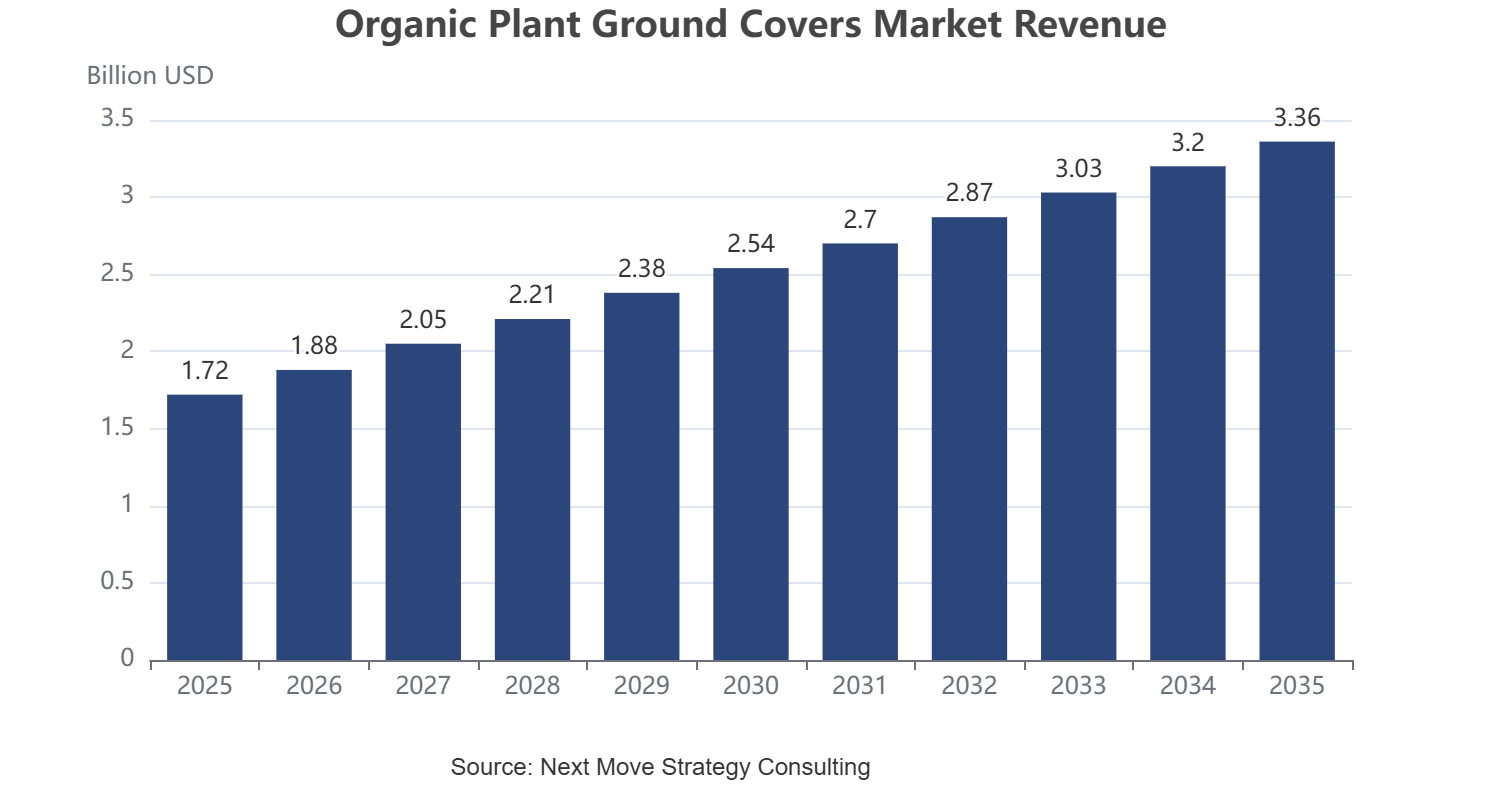
The global organic plant ground covers market was valued at USD 1.72 billion in 2025 and is estimated at USD 1.84 billion in 2026, forecast to reach USD 3.36 billion by 2035 at a 6.92% CAGR from 2026 to 2035. North America led with approximately 36% revenue share, while Perennial Ground Covers dominated the primary segmentation axis at approximately 54% share in 2025.
We observed that momentum is broad-based across every segmentation axis of the organic plant ground covers market, with residential landscaping and perennial ground cover varieties driving the dominant structural shifts through 2035.
|
Key Takeaways |
|
By Type: Perennial Ground Covers held the largest share of approximately 54% (USD 0.93 Billion) in 2025; Ornamental Grasses & Sedges is the fastest-growing sub-segment at 7.7% CAGR from 2026–2035. |
|
By Application: Residential Landscaping held the largest share of approximately 42% (USD 0.73 Billion) in 2025; Erosion Control & Slope Stabilization is the fastest-growing sub-segment at 8.1% CAGR from 2026–2035. |
|
By Distribution Channel: Nurseries & Garden Centers held the largest share of approximately 46% (USD 0.79 Billion) in 2025; Online Retail is the fastest-growing sub-segment at 8.9% CAGR from 2026–2035. |
|
Dominant Region: North America dominated with approximately 36% revenue share (USD 0.62 Billion) in 2025. |
|
Fastest-Growing Region: Asia Pacific is expected to register the highest CAGR of 8.8% during 2026–2035. |
|
Dominant Country: U.S. led with approximately USD 429.9 million in 2025. |
|
Fastest-Growing Country: India is the fastest-growing country at approximately 11.3% CAGR from 2026–2035. |
Market Opportunity: The organic plant ground covers market is expected to create an absolute dollar opportunity of USD 1.52 billion between 2026 and 2035, presenting significant investment potential across the residential, commercial landscaping, and erosion control value chain.
According to NMSC analysis, landscape architects are increasingly specifying organic perennial ground covers as low-maintenance alternatives to mulch and turf, a shift that is accelerating demand for drought-tolerant varieties across water-restricted residential and commercial landscaping markets.
What Does the Organic Plant Ground Covers Market Encompass?
The organic plant ground covers market encompasses the breeding, propagation, and commercial sale of low-growing perennial, ornamental grass, and flowering plant varieties used as sustainable alternatives to mulch, bare soil, or turf in residential, commercial, and municipal landscaping. Our assessment indicates that scope spans nursery propagation, wholesale grower distribution, and retail sale across North America, Europe, Asia Pacific, Middle East & Africa, and Latin America, with demand shaped by climate zone, water-use regulation, and landscaping trends favoring reduced-maintenance plantings.
We found that the market has evolved from a niche horticultural category toward a mainstream landscaping alternative, driven by growing consumer and municipal preference for organic, pesticide-free plantings over synthetic mulch and chemically maintained turf. Technology adoption is progressing through improved propagation techniques and drought-tolerant breeding, while regulatory environments governing water restrictions and pesticide use continue to shape which ground cover varieties gain market share across regions.
|
Parameter |
Details |
|
Market Size in 2025 |
USD 1.72 Billion |
|
Market Size in 2026 |
USD 1.84 Billion |
|
Revenue Forecast in 2035 |
USD 3.36 Billion |
|
Growth Rate |
CAGR of 6.92% from 2026 to 2035 |
|
Analysis Period |
2025–2035 |
|
Base Year Considered |
2025 |
|
Forecast Period |
2026–2035 |
|
Market Size Estimation |
Revenue (USD Billion) |
|
Companies Profiled |
12 |
|
Countries Covered |
33 |
|
Market Share |
Available for Top 10 Companies |
Key Emerging Trends
We found that four structural trends are reshaping how growers develop and market organic ground cover varieties across the industry.
How Is Drought-Tolerant Breeding Changing Product Development?
Breeders are prioritizing drought-tolerant perennial ground cover varieties that require minimal irrigation once established, responding directly to municipal water restrictions across the western United States and southern Europe. Proven Winners' ongoing introductions of low-water perennial groundcover cultivars illustrate how established horticultural brands are redirecting breeding investment toward water-efficient genetics rather than purely ornamental traits, a shift closely tied to the broader lawn & garden consumables category as homeowners seek lower-maintenance landscaping alternatives.
How Are Native Species Gaining Ground in Landscape Design?
Landscape architects and municipal specifiers are increasingly favoring native perennial and ornamental grass ground covers over non-native ornamentals, aligning with pollinator-friendly and biodiversity-focused landscaping mandates. North Creek Nurseries' expanding native plant liner program exemplifies how wholesale growers are scaling native ground cover production to meet rising specification demand from commercial and municipal landscaping projects.
How Is Erosion Control Demand Elevating Ground Cover Specification?
Municipal and infrastructure projects are increasingly specifying organic ground covers for slope stabilization and erosion control in place of synthetic geotextiles, reflecting growing preference for living, self-sustaining erosion solutions. This elevates demand for fast-establishing, deep-rooted ground cover varieties, a trend we found is accelerating cultivar innovation particularly among growers supplying public infrastructure and reclamation contracts.
How Are Organic Certification Standards Shaping Grower Practices?
Retail consumers and commercial landscapers are increasingly requesting organically grown, pesticide-free ground cover plants, pushing wholesale growers to adopt certified organic propagation practices and reduce reliance on crop protection chemical inputs during production. We observed that this shift is most pronounced in residential and public parks applications, where consumer and municipal preference for organic-labeled plantings outweighs marginally higher production costs.
PESTEL Analysis of the Organic Plant Ground Covers Market
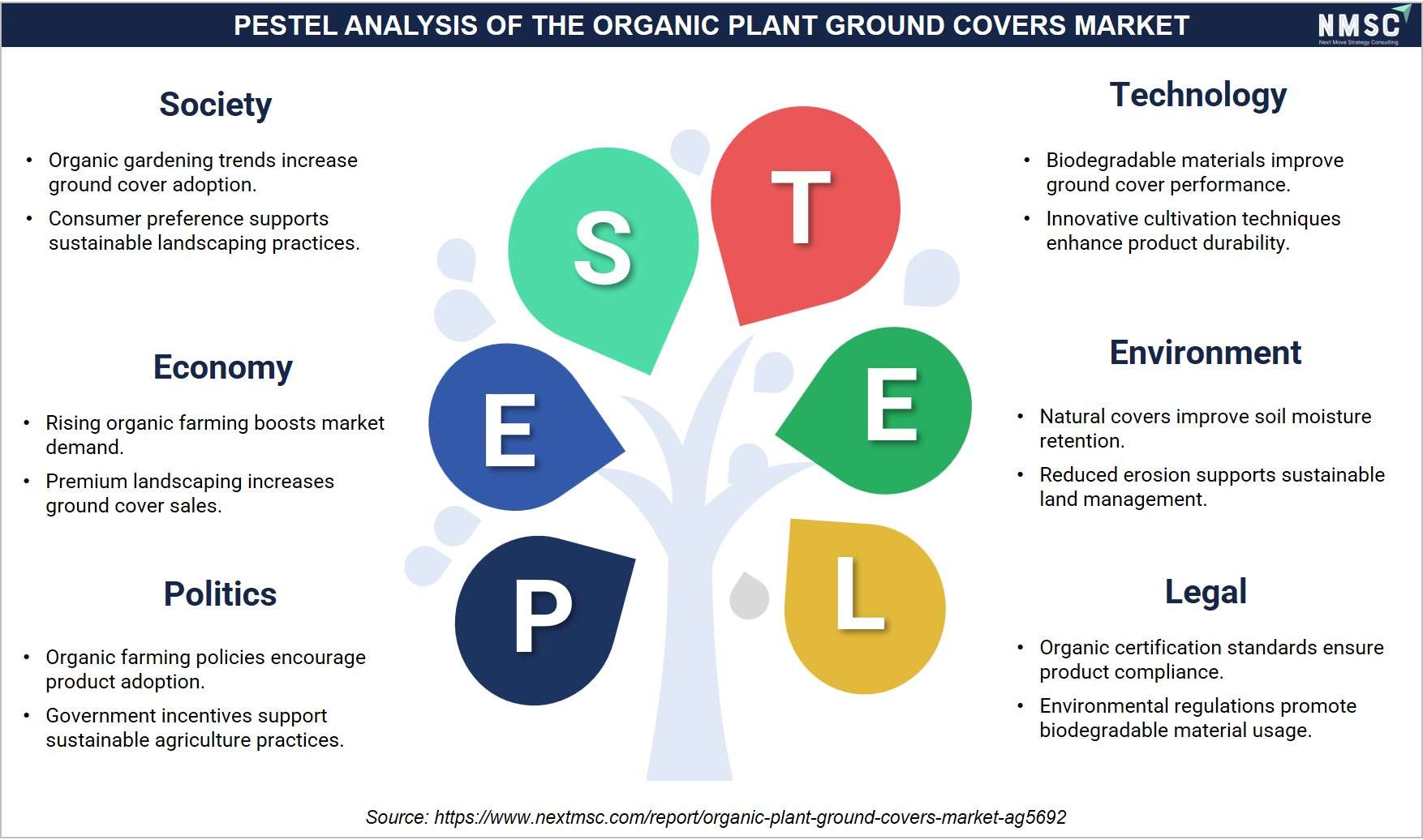
NMSC's analysis indicates that rising consumer preference for organic gardening, premium landscaping, and government farming incentives are accelerating growth in the Organic Plant Ground Covers Market. Furthermore, innovative cultivation techniques and biodegradable materials improve durability and field performance. Concurrently, natural covers enhance soil moisture retention and reduce erosion, while strict organic certification standards and environmental regulations ensure sustainable land management compliance across regions.
Growth Drivers & Restraints
|
Factors |
Type |
(+/-) % Impact on CAGR |
Geographic Relevance |
Impact Timeline |
|
Rising demand for low-maintenance landscaping |
Driver |
+1.6% |
North America, Europe |
2026–2031 |
|
Municipal preference for organic, pesticide-free plantings |
Driver |
+1.3% |
Global |
2026–2033 |
|
Growth in erosion control and slope stabilization projects |
Driver |
+1.1% |
Asia Pacific, MEA |
2026–2035 |
|
Water-use restrictions favoring drought-tolerant ground covers |
Driver |
+1.0% |
North America, MEA |
2026–2032 |
|
Expansion of commercial and institutional landscaping budgets |
Driver |
+0.8% |
Global |
2026–2030 |
|
Rising native and pollinator-friendly landscaping mandates |
Driver |
+0.7% |
North America, Europe |
2028–2035 |
|
Slower establishment times versus synthetic mulch alternatives |
Restraint |
−0.9% |
Global |
2026–2029 |
|
Weather variability affecting nursery production yields |
Restraint |
−0.6% |
Europe, North America |
2026–2030 |
|
Higher upfront cost versus conventional turf installation |
Restraint |
−0.5% |
Asia Pacific, LATAM |
2026–2035 |
What Is the Primary Growth Driver for the Organic Plant Ground Covers Market?
Rising demand for low-maintenance landscaping remains the largest single driver of organic ground cover demand across mature residential and commercial markets. The U.S. Environmental Protection Agency's guidance on reduced-input landscaping underscores growing regulatory support for water-efficient plantings, a dynamic our analysis shows sustains steady replacement and new-installation demand across drought-affected regions.
How Is Municipal Demand for Organic Plantings Driving Market Growth?
Municipalities are increasingly specifying organic, pesticide-free ground covers for public parks and green spaces to align with sustainability mandates and reduce chemical maintenance costs over the plant lifecycle. This extends demand beyond residential and commercial channels into public procurement budgets, widening the addressable market considerably as cities expand green infrastructure investment.
What Is Restraining the Organic Plant Ground Covers Market?
Slower establishment times relative to synthetic mulch and instant turf alternatives remain the primary restraint on new-installation demand, particularly among commercial buyers prioritizing rapid project completion. This dynamic is documented in landscaping industry guidance on installation timelines, and our assessment indicates it remains the most significant barrier slowing broader adoption despite strong underlying preference for organic plantings.
Segmentation Analysis
Segment Sizing: By Type
|
Segment |
2025 (USD) |
2035 (USD) |
CAGR% (2026–2035) |
|
Perennial Ground Covers |
USD 0.93 Billion |
USD 1.74 Billion |
6.47% |
|
Ornamental Grasses & Sedges |
USD 0.45 Billion |
USD 0.93 Billion |
7.72% |
|
Flowering Ground Covers |
USD 0.34 Billion |
USD 0.69 Billion |
7.27% |
|
Total |
USD 1.72 Billion |
USD 3.36 Billion |
6.92% |
Which Type Leads the Organic Plant Ground Covers Market?
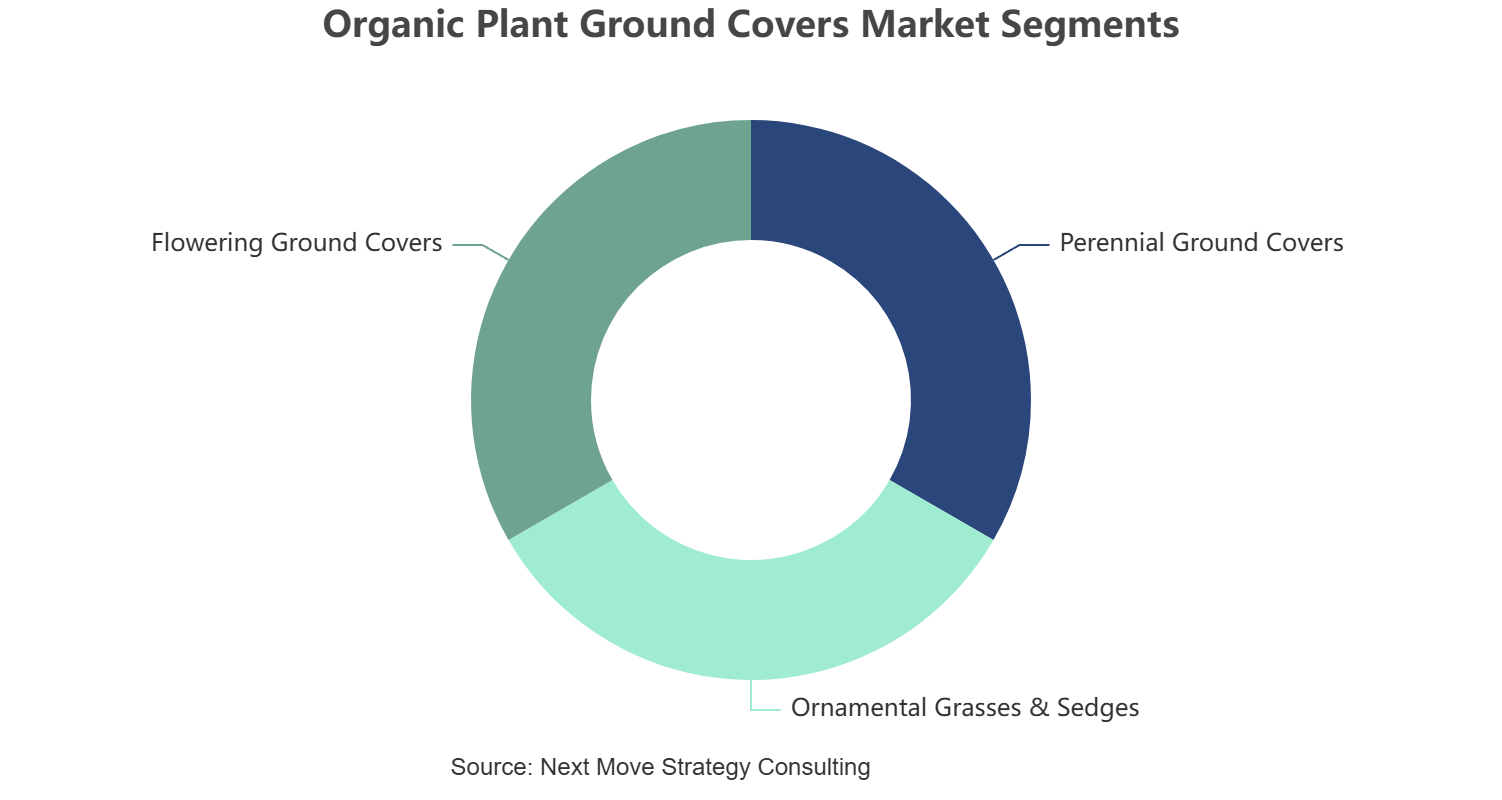
Type segmentation splits the market across perennial, ornamental grass, and flowering ground cover varieties. Our analysis shows that Perennial Ground Covers held the dominant share in 2025 at USD 0.93 billion, reflecting broad landscaper and homeowner preference for durable, low-maintenance perennial plantings. Ornamental Grasses & Sedges is projected as the fastest-growing type through 2035 at a 7.72% CAGR, as erosion control and naturalized landscaping demand expands.
Segment Sizing: By Application
|
Segment |
2025 (USD) |
2035 (USD) |
CAGR% (2026–2035) |
|
Residential Landscaping |
USD 0.73 Billion |
USD 1.32 Billion |
6.17% |
|
Commercial & Institutional Landscaping |
USD 0.41 Billion |
USD 0.84 Billion |
7.47% |
|
Erosion Control & Slope Stabilization |
USD 0.34 Billion |
USD 0.74 Billion |
8.10% |
|
Public Parks & Municipal Green Spaces |
USD 0.24 Billion |
USD 0.46 Billion |
6.75% |
|
Total |
USD 1.72 Billion |
USD 3.36 Billion |
6.92% |
Which Application Dominates Ground Cover Demand?
Application segmentation captures how organic ground covers are ultimately used across residential, commercial, and public land management. We found that Residential Landscaping dominated in 2025 at USD 0.73 billion, driven by ongoing homeowner adoption of low-maintenance landscaping. Erosion Control & Slope Stabilization is the fastest-growing application at a 8.10% CAGR from 2026 to 2035, supported by expanding infrastructure and reclamation project specification.
Segment Sizing: By Distribution Channel
|
Segment |
2025 (USD) |
2035 (USD) |
CAGR% (2026–2035) |
|
Nurseries & Garden Centers |
USD 0.79 Billion |
USD 1.43 Billion |
6.09% |
|
Landscaping Contractors |
USD 0.48 Billion |
USD 0.98 Billion |
7.40% |
|
Online Retail |
USD 0.24 Billion |
USD 0.56 Billion |
8.93% |
|
Wholesale Growers |
USD 0.21 Billion |
USD 0.39 Billion |
6.50% |
|
Total |
USD 1.72 Billion |
USD 3.36 Billion |
6.92% |
Which Distribution Channel Generates the Most Revenue?
Distribution channel segmentation distinguishes how buyers ultimately source ground cover plants. Our assessment indicates Nurseries & Garden Centers generated the largest revenue share in 2025 at USD 0.79 billion, reflecting the continued dominance of physical retail for plant purchasing decisions. Online Retail is the fastest-growing distribution channel at a 8.93% CAGR from 2026 to 2035, as e-commerce plant delivery logistics improve.
Growth Opportunities
Beyond the core growth drivers, three whitespace opportunities stand out for organic ground cover producers positioning ahead of 2035.
How Can Drought-Tolerant Cultivar Licensing Create Value?
Growers that patent and license drought-tolerant, low-input perennial cultivars can capture premium pricing from commercial and municipal landscaping specifiers facing tightening water regulations, creating a durable royalty revenue stream distinct from commodity plant sales.
How Can Direct-to-Consumer E-Commerce Expand Reach?
Growers that invest in direct-to-consumer online plant delivery can capture retail margin currently held by intermediary garden centers, particularly for specialty and native ground cover varieties underrepresented in mainstream nursery inventory, opening a higher-margin sales channel within the residential segment.
How Can Erosion Control Partnerships Expand Market Reach?
Growers that establish supply partnerships with infrastructure and reclamation contractors gain reference credibility that accelerates adoption among municipal and commercial erosion control specifiers, benefiting producers positioned in the erosion control and slope stabilization application segment.
Regional Outlook
|
Region |
2025 (USD) |
2035 (USD) |
CAGR% (2026–2035) |
Key Driver |
|
North America |
USD 0.62 Billion |
USD 1.13 Billion |
5.98% |
Large residential landscaping renovation base |
|
Europe |
USD 0.50 Billion |
USD 0.91 Billion |
6.12% |
Municipal green space and biodiversity mandates |
|
Asia Pacific |
USD 0.33 Billion |
USD 0.75 Billion |
8.82% |
Urban landscaping and infrastructure expansion |
|
Middle East & Africa |
USD 0.10 Billion |
USD 0.22 Billion |
7.92% |
Water-efficient landscaping programs |
|
Latin America |
USD 0.17 Billion |
USD 0.35 Billion |
7.47% |
Commercial landscaping sector growth |
|
Total |
USD 1.72 Billion |
USD 3.36 Billion |
6.92% |
— |
North America Organic Plant Ground Covers Market Outlook
North America leads the organic plant ground covers market on the strength of a large residential landscaping renovation base and strong retail nursery distribution infrastructure. Water-use regulation in drought-prone states shapes cultivar selection toward lower-input perennial varieties. Our analysis indicates the region will retain its lead through 2035, supported by steady residential and commercial landscaping demand.
Europe Organic Plant Ground Covers Market Outlook
Europe's market is shaped by strong municipal biodiversity and pollinator-friendly landscaping mandates that favor native ground cover species over conventional turf. Regulatory influence from national and EU-level pesticide reduction policies supports organic cultivation practices. Our assessment indicates that public green space investment continues to sustain steady regional demand alongside residential adoption.
Asia Pacific Organic Plant Ground Covers Market Outlook
Asia Pacific is the fastest-growing region, propelled by rapid urban park development and rising disposable income supporting residential and commercial landscaping in emerging economies. We observed that government-backed urban greening initiatives across the region's major cities are extending organic ground cover demand well beyond traditional gardening applications into large-scale municipal infrastructure.
Middle East & Africa Organic Plant Ground Covers Market Outlook
The Middle East & Africa region is expanding on the back of large-scale water-efficient landscaping programs in Gulf state urban developments addressing water scarcity concerns. Regulatory influence from national water conservation policies shapes strong preference for drought-tolerant ground cover varieties. We found that Gulf state infrastructure investment is the primary catalyst driving regional adoption.
Latin America Organic Plant Ground Covers Market Outlook
Latin America's growth is concentrated in expanding commercial landscaping activity tied to urban development across Brazil and Argentina. Residential adoption remains a smaller but growing contributor as awareness of organic landscaping alternatives increases. Our findings suggest the region will continue posting steady growth as commercial and residential construction activity sustains underlying demand.
U.S. Organic Plant Ground Covers Market
Based on our estimates, the U.S. organic plant ground covers market was valued at approximately USD 429.9 million in 2025 and is projected to reach approximately USD 748.9 million by 2035, growing at a 5.68% CAGR from 2026 to 2035. Demand structure is dominated by residential landscaping renovation and commercial development, with strong adoption levels supported by an extensive retail nursery network; competitive intensity remains high among national horticultural brands, and strategic outlook favors continued premiumization through drought-tolerant cultivar breeding.
Canada Organic Plant Ground Covers Market
The market in Canada was valued at approximately USD 126.4 million in 2025 and is projected to reach approximately USD 230.2 million by 2035, growing at a 6.20% CAGR from 2026 to 2035. Cooler climate zones favor hardy perennial ground cover varieties, reflecting steady adoption levels supported by a well-established garden center retail sector; regulatory environment includes provincial water-use guidance in drier regions, and strategic outlook centers on continued residential landscaping demand.
UK Organic Plant Ground Covers Market
As per our estimate, the UK organic plant ground covers market was valued at approximately USD 99.9 million in 2025 and is projected to reach approximately USD 170.1 million by 2035, growing at a 5.39% CAGR from 2026 to 2035. Demand structure centers on residential gardens and municipal parks, with regulatory influence from national biodiversity and pollinator-friendly planting policies shaping species selection; strategic outlook favors continued investment in native ground cover breeding.
Germany Organic Plant Ground Covers Market
According to our analysis, the Germany organic plant ground covers market was valued at approximately USD 84.9 million in 2025 and is projected to reach approximately USD 151.1 million by 2035, growing at a 5.91% CAGR from 2026 to 2035. Municipal green infrastructure and residential gardens both contribute meaningfully to demand structure, supported by strong nursery cooperative distribution networks; adoption levels are steady, and strategic outlook favors continued breeding investment in native and pollinator-friendly varieties.
France Organic Plant Ground Covers Market
Based on our estimates, the France organic plant ground covers market was valued at approximately USD 64.9 million in 2025 and is projected to reach approximately USD 112.5 million by 2035, growing at a 5.60% CAGR from 2026 to 2035. Residential and commercial landscaping both drive demand structure, supported by a strong domestic horticultural breeding sector; strategic outlook favors continued leadership in European ornamental ground cover genetics.
China Organic Plant Ground Covers Market
The market in China was valued at approximately USD 68.0 million in 2025 and is projected to reach approximately USD 150.8 million by 2035, growing at a 8.23% CAGR from 2026 to 2035. Rapid urban park and commercial landscaping construction drives demand structure, with technology penetration accelerating through government-backed urban greening programs; strategic outlook favors continued public and private sector-led landscaping infrastructure investment.
India Organic Plant Ground Covers Market
As per our estimate, the India organic plant ground covers market was valued at approximately USD 61.9 million in 2025 and is projected to reach approximately USD 176.4 million by 2035, growing at a 11.30% CAGR from 2026 to 2035. Demand structure is shaped by expanding commercial real estate development and rising residential landscaping in urban centers, with adoption levels rising from a small base; strategic outlook favors distribution partnerships that extend reach into emerging urban markets.
Japan Organic Plant Ground Covers Market
According to our analysis, the Japan organic plant ground covers market was valued at approximately USD 40.2 million in 2025 and is projected to reach approximately USD 78.4 million by 2035, growing at a 6.69% CAGR from 2026 to 2035. Established municipal park maintenance and residential garden culture drive steady demand structure, with regulatory influence shaped by strict horticultural quality standards; strategic outlook favors incremental adoption of premium native cultivars.
South Korea Organic Plant Ground Covers Market
Based on our estimates, the South Korea organic plant ground covers market was valued at approximately USD 30.9 million in 2025 and is projected to reach approximately USD 68.6 million by 2035, growing at a 8.23% CAGR from 2026 to 2035. Urban park development and residential landscaping support relatively strong adoption levels for premium ground cover varieties; strategic outlook favors continued partnerships between domestic distributors and international breeders.
Australia Organic Plant Ground Covers Market
The market in Australia was valued at approximately USD 24.7 million in 2025 and is projected to reach approximately USD 50.3 million by 2035, growing at a 7.20% CAGR from 2026 to 2035. Drought-tolerant native ground cover varieties dominate demand structure given the climate, supported by strong residential and commercial landscaping culture; strategic outlook favors continued breeding investment in low-water native cultivars.
UAE Organic Plant Ground Covers Market
As per our estimate, the UAE organic plant ground covers market was valued at approximately USD 22.4 million in 2025 and is projected to reach approximately USD 52.1 million by 2035, growing at a 8.90% CAGR from 2026 to 2035. Large-scale urban landscaping and water-efficient greening programs drive demand structure, with technology penetration high among premium residential and commercial developments; strategic outlook favors continued adoption of drought-tolerant, low-water cultivars.
Saudi Arabia Organic Plant Ground Covers Market
According to our analysis, the Saudi Arabia organic plant ground covers market was valued at approximately USD 22.4 million in 2025 and is projected to reach approximately USD 51.2 million by 2035, growing at a 8.69% CAGR from 2026 to 2035. National urban greening and water conservation programs under broader development initiatives drive strong demand structure; strategic outlook favors continued large-scale landscaping project procurement.
South Africa Organic Plant Ground Covers Market
Based on our estimates, the South Africa organic plant ground covers market was valued at approximately USD 7.1 million in 2025 and is projected to reach approximately USD 13.7 million by 2035, growing at a 6.65% CAGR from 2026 to 2035. Commercial landscaping and water-efficient residential gardening support steady demand structure amid ongoing water scarcity concerns; strategic outlook favors partnerships with international breeders offering drought-tolerant genetics.
Brazil Organic Plant Ground Covers Market
The market in Brazil was valued at approximately USD 70.3 million in 2025 and is projected to reach approximately USD 148.9 million by 2035, growing at a 7.82% CAGR from 2026 to 2035. Expanding commercial and residential construction drives the majority of regional demand structure, with adoption levels well ahead of most Latin American peers; strategic outlook favors continued landscaping sector growth tied to urban development.
Argentina Organic Plant Ground Covers Market
As per our estimate, the Argentina organic plant ground covers market was valued at approximately USD 30.1 million in 2025 and is projected to reach approximately USD 61.1 million by 2035, growing at a 7.30% CAGR from 2026 to 2035. Residential and commercial landscaping demand leads regional growth, supported by the country's expanding urban development sector; strategic outlook favors continued partnerships with established international ground cover breeders.
Consumer Behavior Analysis of the Organic Plant Ground Covers Market
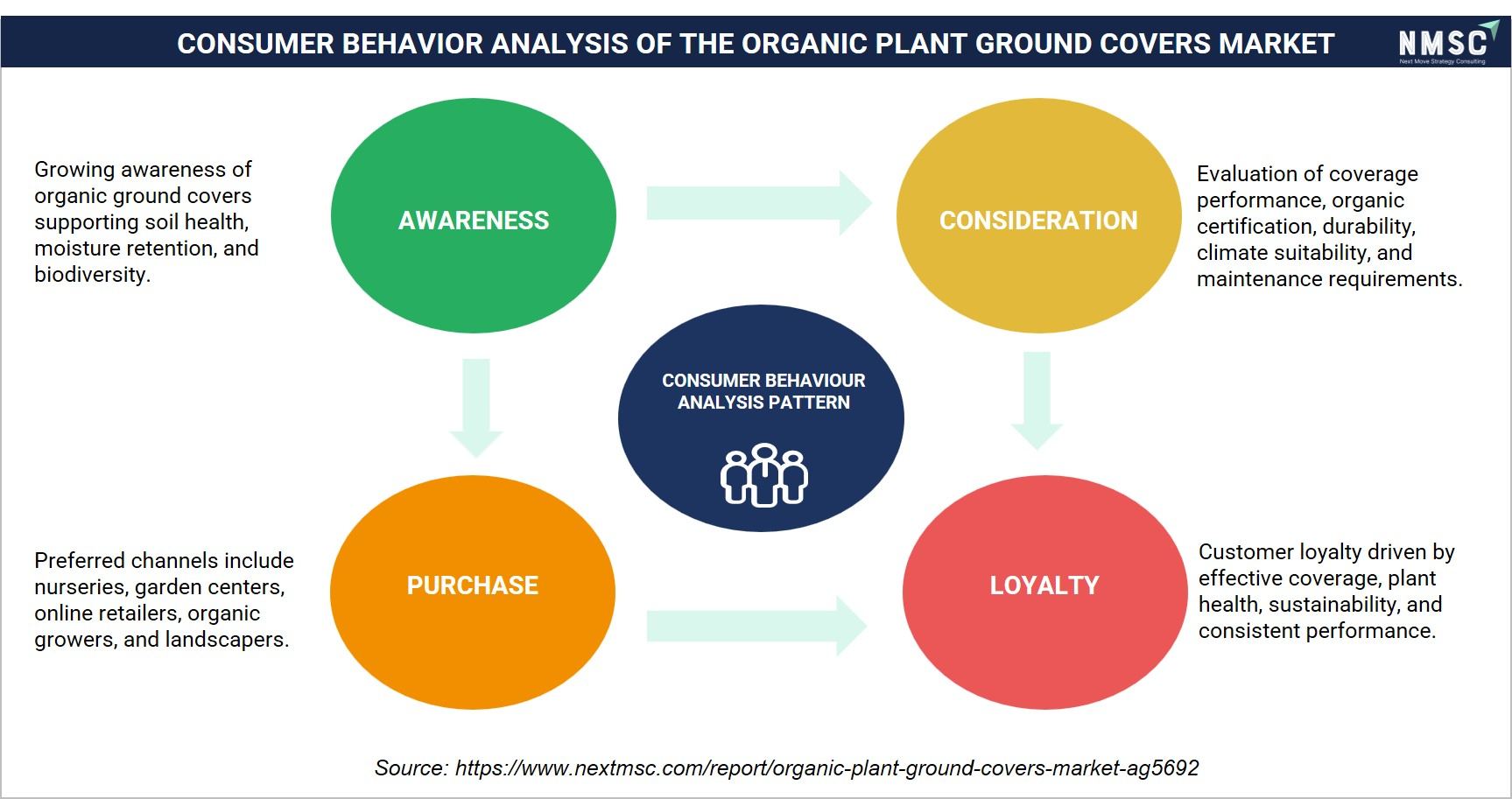
Based on research conducted by NMSC, we found that consumer journey in the Organic Plant Ground Covers Market begins with awareness of soil health, moisture retention, and biodiversity benefits. Consequently, during consideration, buyers evaluate coverage performance, organic certification, durability, and climate suitability. Purchases are made via nurseries, garden centers, online retailers, and landscapers, while long-term brand loyalty depends on effective coverage, healthy plant growth, and consistent performance.
Competitive Landscape
We found that competitive dynamics in the organic plant ground covers market center on breeding differentiation and nursery distribution reach rather than price alone.
|
Category |
Details |
|
Market Structure |
Moderately fragmented, led by a group of established wholesale nurseries and horticultural breeding companies alongside specialized regional growers. |
|
Innovation Focus |
Drought-tolerant and native cultivar breeding, organic propagation practices, and improved establishment-rate genetics. |
|
M&A Activity |
Consolidation of specialized regional growers by larger horticultural breeding and distribution companies expanding portfolio breadth. |
How Do Companies Compete in the Organic Plant Ground Covers Market?
Competition centers on proprietary cultivar performance and nursery distribution reach, since landscapers and retail buyers favor varieties with proven establishment rates, disease resistance, and climate suitability over generic unbranded plants. Our analysis shows that vendors differentiate through breeding investment, garden center shelf presence, and landscaping contractor relationships rather than through price competition alone.
Which Competitive Archetypes Dominate the Market?
Three archetypes define the landscape: large wholesale nurseries with vertically integrated propagation such as Bailey Nurseries and Monrovia, global horticultural breeding companies such as Ball Horticultural and Dümmen Orange, and specialized regional growers focused on native or specialty ground cover varieties. We found that large wholesale nurseries hold the strongest position in mainstream residential and commercial garden center distribution.
What Innovation and Differentiation Strategies Are Companies Pursuing?
Vendors are investing in breeding programs targeting drought tolerance and disease resistance, and in improved propagation techniques that raise establishment success rates for retail and commercial buyers. We observed that companies with strong native plant breeding credentials use that positioning to capture growing demand from municipal and pollinator-friendly landscaping specifiers.
How Active Is M&A in the Competitive Landscape?
Consolidation has been most visible where larger horticultural companies acquire specialized regional growers to expand germplasm access and geographic distribution reach without duplicating breeding program investment. Our assessment indicates this pattern is likely to continue as companies seek broader native and specialty cultivar portfolios to meet diversifying landscaping specification requirements.
Key Market Players
The following companies represent the verified set of active organic plant ground covers market participants profiled in this report, ranked by scale of operations and documented market activity.
-
Bailey Nurseries, Inc.
-
Monrovia Nursery Company
-
Ball Horticultural Company
-
Proven Winners, LLC
-
Walters Gardens, Inc.
-
Skagit Gardens, Inc.
-
North Creek Nurseries, Inc.
-
Emerald Coast Growers, Inc.
-
Dümmen Orange
-
Sakata Seed Corporation
-
Danziger "Dan" Flower Farm
-
Syngenta Group
Latest Developments
We found that leading growers are expanding breeding programs and product lines, with the following developments reflecting the most recent verifiable activity in the market.
|
Date |
Event |
|
May 2026 |
Dümmen Orange and Syngenta Flowers signed an agreement to establish a strategic joint venture combining their global ornamental breeding and propagation businesses. The new entity will integrate complementary portfolios, advanced breeding capabilities, production operations, and worldwide commercial networks to better serve ornamental plant growers and strengthen innovation. |
|
March 2026 |
Ball Horticultural Company published its 2025 sustainability report, “Sowing Sustainability,” outlining companywide sustainability goals and progress across its global operations. The report focuses on products, people and planet and highlights initiatives across Ball’s global facilities and supply chain, including a target to reduce its corporate carbon footprint by 50% by 2030. |
|
December 2025 |
Walters Gardens unveiled the new Proven Winners® Perennials for 2025–2026, featuring varieties including COLOR CODED® 'Knock 'em Red' Echinacea and DOLCE® 'Glazed and Infused' Heuchera. The new perennial selections were made available to the wholesale trade beginning July 1, 2025, with retail availability planned for 2026, following evaluation for landscape, production and container performance. |
|
July 2025 |
Danziger launched its 2026 new varieties assortment and digital grower support platform, introducing breeding innovations such as CAPELLA™ Hello Sunshine petunia and VANESSA™ Compact Bicolor Marshmallow verbena, designed for enhanced environmental adaptability and ground cover performance. |
Investment Opportunities
Where Are Capital Inflows Concentrated?
Capital inflows favor growers with proprietary, patent-protected cultivar portfolios over commodity plant producers, since patented genetics support licensing royalty revenue with stronger margins than undifferentiated nursery stock. Our assessment indicates that investors increasingly value breeding program depth and native germplasm libraries as durable competitive advantages.
What Infrastructure Investment Trends Are Emerging?
Nursery operators are investing in expanded propagation and liner production infrastructure to support premium product lines that command higher retail margins than undifferentiated ground cover stock. This infrastructure investment lowers per-unit production cost at scale, making expanded capacity increasingly attractive for growers serving both retail and commercial landscaping channels.
How Do ESG Considerations Factor Into Investment Decisions?
Organic ground cover propagation for reduced water and pesticide input aligns directly with environmental, social, and governance priorities around water conservation and biodiversity support. We observed that institutional investors increasingly favor growers with documented organic and native cultivar pipelines as sustainability-linked landscaping regulation expands across drought-prone and biodiversity-focused markets.
Key Benefits for Stakeholders
How Does This Report Benefit Industry Leaders?
Industry leaders overseeing breeding and product portfolio decisions gain a segmentation view across type, application, and distribution channel that clarifies where demand growth is concentrated. The regional outlook helps leaders benchmark market maturity against peer regions before committing to new breeding program investment.
How Does This Report Benefit Investors and Financial Analysts?
Investors evaluating exposure to horticultural and landscaping markets gain a validated market-size trajectory from 2025 through 2035, alongside a competitive landscape identifying which company archetypes are consolidating share through breeding investment and distribution partnerships. The Investment Opportunities section further clarifies where capital inflows are concentrated.
How Does This Report Benefit Growers and Distributors?
Growers and distributors gain segmentation data identifying which applications and distribution channels are growing fastest, informing product portfolio prioritization. The Key Emerging Trends and Growth Drivers sections identify the specific regulatory and climate pressures currently shaping purchasing decisions across target customer segments.
Key Market Segments
By Type
-
Perennial Ground Covers
-
Ornamental Grasses & Sedges
-
Flowering Ground Covers
By Application
-
Residential Landscaping
-
Commercial & Institutional Landscaping
-
Erosion Control & Slope Stabilization
-
Public Parks & Municipal Green Spaces
By Distribution Channel
-
Nurseries & Garden Centers
-
Landscaping Contractors
-
Online Retail
-
Wholesale Growers
By Region
-
North America: U.S., Canada, Mexico
-
Europe: UK, Germany, France, Italy, Spain, Sweden, Denmark, Finland, Netherlands, Rest of Europe
-
Asia-Pacific: China, India, Japan, South Korea, Taiwan, Indonesia, Vietnam, Australia, Philippines, Malaysia, Rest of APAC
-
Middle East & Africa: Saudi Arabia, UAE, Egypt, Israel, Turkey, Nigeria, South Africa, Rest of MEA
-
Latin America: Brazil, Argentina, Chile, Colombia, Rest of LATAM
Conclusion & Recommendations
What Is the Long-Term Outlook for the Organic Plant Ground Covers Market?
The organic plant ground covers market is set to expand from USD 1.84 billion in 2026 to USD 3.36 billion by 2035, registering a 6.92% CAGR as demand shifts from conventional turf and mulch toward organic, low-maintenance perennial plantings. Long-term growth rests on continued residential landscaping renovation demand, expanding municipal green infrastructure investment, and rising preference for water-efficient, pesticide-free landscaping alternatives.
What Strategic Positioning Should Organic Plant Ground Covers Producers Pursue?
Producers should prioritize breeding investment in drought-tolerant and native cultivars over commodity plant expansion, since patent-protected genetics support stronger margins and licensing revenue. Positioning around water-efficient, organic-certified varieties is particularly critical for producers targeting drought-affected North American and Middle Eastern markets.
How Attractive Is the Organic Plant Ground Covers Market for New Investment?
Investment attractiveness is highest among growers with proprietary, patent-protected cultivar portfolios and diversified distribution across retail nurseries, landscaping contractors, and online channels, since these characteristics correlate with durable margin protection. Producers with strong native and pollinator-friendly plant credentials represent a particularly attractive segment for premium positioning investment.
What Market Shifts and Key Risks Should Stakeholders Monitor?
The most significant structural shift is the move from conventional turf and synthetic mulch toward organic, trait-differentiated ground cover plantings commanding higher per-unit pricing. Key risks include slower establishment times relative to synthetic alternatives, weather variability affecting nursery production yields, and higher upfront installation costs relative to conventional turf.
What Are the Key Growth Pathways for the Organic Plant Ground Covers Market?
The clearest growth pathway runs through drought-tolerant cultivar licensing, where patented low-input genetics extend producer revenue beyond commodity plant sales. Secondary growth pathways include expanding municipal green infrastructure investment across Asia Pacific and the Middle East, and continued direct-to-consumer e-commerce expansion improving access to specialty native varieties.
About the Author
 Saista Faiyaz
— Saista Faiyaz is Research Associate at Next Move Strategy Consulting, where she has covered consumer markets and healthcare technologies for 3 years. Her work includes primary interview review, secondary-source validation, market sizing, and structured analysis of company and industry data. She supports research by comparing evidence across sources, organizing findings into market narratives, and documenting assumptions used in analysis. Her scope includes cross-market benchmarking, and reports.
Saista Faiyaz
— Saista Faiyaz is Research Associate at Next Move Strategy Consulting, where she has covered consumer markets and healthcare technologies for 3 years. Her work includes primary interview review, secondary-source validation, market sizing, and structured analysis of company and industry data. She supports research by comparing evidence across sources, organizing findings into market narratives, and documenting assumptions used in analysis. Her scope includes cross-market benchmarking, and reports.
About the Reviewer
 Supradip Baul
— Supradip Baul is an accomplished business consultant and strategist with over a decade of rich experience in market intelligence, strategy, technology, and business transformation. His work has included rigorous qualitative and quantitative analysis across multiple industries, helping clients shape investment decisions and long-term roadmaps. Earlier in his career, he was associated with Gartner, where he contributed to industry-leading reports and market share analyses. He has worked with leading global companies and holds an MBA with a dual specialization in Marketing and Finance.
Supradip Baul
— Supradip Baul is an accomplished business consultant and strategist with over a decade of rich experience in market intelligence, strategy, technology, and business transformation. His work has included rigorous qualitative and quantitative analysis across multiple industries, helping clients shape investment decisions and long-term roadmaps. Earlier in his career, he was associated with Gartner, where he contributed to industry-leading reports and market share analyses. He has worked with leading global companies and holds an MBA with a dual specialization in Marketing and Finance.
At Next Move Strategy Consulting, we understand that insightful market research is the cornerstone of successful business decisions. That's why we employ a robust and multifaceted approach, combining various methodologies to deliver the most accurate and actionable data for our clients.

Research Landscape
We navigate the world of research with two primary approaches:
Qualitative Approach
Our qualitative research methodologies involve immersive techniques such as in-depth interviews, focus groups, and observational studies. By engaging directly with individuals and stakeholders, we uncover valuable insights that quantitative data alone may overlook.

Quantitative Research
In tandem with qualitative methodologies, NMSC leverages the power of Quantitative Research to provide a robust foundation of numerical insights. Through systematic data collection and analysis, we quantify patterns, preferences, and market trends, offering a comprehensive view of the business landscape.
Our quantitative research approach employs diverse tools, including surveys, experiments, and statistical modelling. These methodologies enable us to gather data from a large and representative sample, ensuring the statistical significance of our findings. By employing structured questionnaires and standardized data collection methods, we guarantee the reliability and validity of the information we present to our clients.
Quantitative research is particularly effective in measuring the prevalence of trends, assessing market size, and gauging the impact of various factors on consumer behavior. The numerical precision attained through this approach equips our clients with actionable insights, facilitating data-driven decision-making and strategy formulation.


Our Specialized Toolbox for Industry-Specific Market Research
We deploy a specialized arsenal of techniques tailored to meet your unique requirements. Here's a glimpse into our comprehensive toolbox:

Information Procurement
The stage entails acquiring market data or relevant information through various sources and methodologies.


Market Research Approach
We utilize both top-down and bottom-up approaches in market research analysis to achieve a comprehensive understanding of the market dynamics, leveraging the broad perspective of industry trends and macroeconomic factors alongside detailed insights from specific segments and individual companies.

Porters Five Forces Analysis
We conduct Porter's Five Forces analysis to evaluate the competitive landscape of an industry, providing us with insights into factors that affect profitability and strategic positioning.

SWOT Analysis

Forecasting
We utilize a forecasting model to predict future consumption by considering parameters like population, economics, regulations, market competition, drivers, constraints, technology, and pricing. We also employ statistical techniques such as multilinear regression, exponential smoothing, moving average, ARIMA, and Monte Carlo simulations for accurate predictions. In econometric forecasting, we analyzed short-term and long-term event impacts, attributing values based on regulatory frameworks, economic factors, and market events.





 Speak to Our Analyst