Growing Media Market Size, Share, Trends and Growth Analysis, By Product Type (Peat based Growing Media, Coco Coir and Coir based Growing Media, Bark and Wood Fiber based Growing Media, and Others), By Application (Commercial Horticulture and Greenhouse Cultivation, Nursery and Propagation, Landscaping and Turf, and Home and Garden), By Distribution Channel (Direct B2B Sales, Retail and Garden Centers, and Others), and Region — Global Industry Report and Forecast, 2026–2035
Industry: Agriculture | Publishing Date: August 12, 2026 | Last Updated: August 11, 2026 | No of Pages: N/A | No. of Tables: N/A | No. of Figures: N/A | Format: PDF | Report Code: AG5670
What Is the Growing Media Market Size?
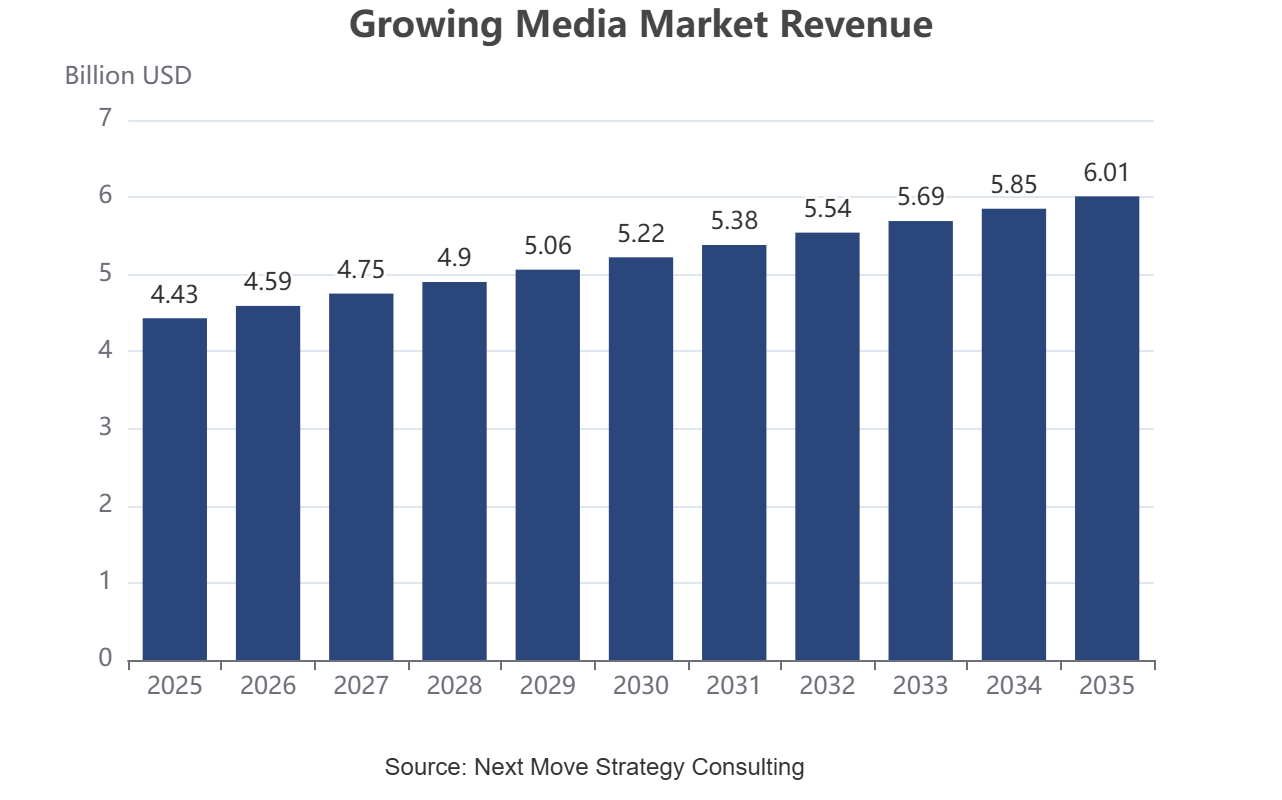
The global Growing Media Market size was valued at USD 4.43 billion in 2025 and is estimated at USD 4.56 billion in 2026, forecast to reach USD 6.01 billion by 2035, expanding at a 3.10% CAGR between 2026 and 2035. Europe leads with approximately 35% share, while peat based growing media dominates all product types with approximately 40% share.
We observed that growth remains steady but regulation-sensitive across every segmentation axis, with coco coir adoption and peat extraction restrictions driving the dominant structural shifts in the growing media market through 2035.
|
Key Takeaways |
|
By Product Type: Peat based Growing Media held the largest share of approximately 40% (USD 1.77 Billion) in 2025; Coco Coir and Coir based Growing Media is the fastest-growing sub-segment at 5.55% CAGR from 2026–2035. |
|
By Application: Commercial Horticulture and Greenhouse Cultivation held the largest share of approximately 46% (USD 2.04 Billion) in 2025; Home and Garden is the fastest-growing sub-segment at 6.66% CAGR from 2026–2035. |
|
By Distribution Channel: Direct B2B Sales held the largest share of approximately 44% (USD 1.95 Billion) in 2025; Online and E-commerce is the fastest-growing sub-segment at 6.55% CAGR from 2026–2035. |
|
Dominant Region: Europe dominated with approximately 35% revenue share (USD 1.55 Billion) in 2025. |
|
Fastest-Growing Region: Asia-Pacific is expected to register the highest CAGR of 5.34% during 2026–2035. |
|
Dominant Country: U.S. led with approximately USD 0.92 billion in 2025. |
|
Fastest-Growing Country: India is the fastest-growing country at approximately 7.4% CAGR from 2026–2035. |
Market Opportunity: The growing media market is expected to create an absolute dollar opportunity of USD 1.45 billion between 2026 and 2035, presenting steady investment potential across the peat-alternative and soilless substrate value chain.
According to NMSC analysis, growing media producers are increasingly restructuring extraction and sourcing footprints toward coir and wood fiber inputs to reduce peatland dependency, a shift that favors diversified multinational substrate suppliers over single-source peat bog operators as environmental scrutiny intensifies through 2035.
Growing Media Market Overview
The growing media market encompasses peat, coco coir, bark, perlite, vermiculite, and compost based substrates supplied to commercial greenhouse operators, nurseries, landscaping contractors, and retail consumers for soilless and soil-amended plant cultivation. Our assessment indicates that the category has evolved from bulk peat extraction toward blended, sustainability-certified substrate formulations that balance water retention, aeration, and renewable sourcing as environmental regulation reshapes raw material availability across major peat-producing regions.
Regulatory frameworks such as European Union peatland restoration directives and national wetland protection statutes shape extraction permitting, while Responsibly Produced Peat certification increasingly influences procurement standards among commercial growers. We found that technology adoption is shifting toward precision-blended substrates calibrated for hydroponic and controlled-environment agriculture. NMSC's analysis indicates that this structural shift, combined with rising greenhouse cultivation investment, is redefining sourcing criteria across the growing media market.
|
Parameter |
Details |
|
Market Size in 2025 |
USD 4.43 Billion |
|
Market Size in 2026 |
USD 4.56 Billion |
|
Revenue Forecast in 2035 |
USD 6.01 Billion |
|
Growth Rate |
CAGR of 3.10% from 2026 to 2035 |
|
Analysis Period |
2025–2035 |
|
Base Year Considered |
2025 |
|
Forecast Period |
2026–2035 |
|
Market Size Estimation |
Revenue (USD Billion) |
|
Companies Profiled |
20 |
|
Countries Covered |
33 |
|
Market Share |
Available for Top 10 Companies |
Key Emerging Trends
We found that four structural trends are reshaping product development and sourcing strategy across the growing media market heading into 2035.
How Is Peatland Restoration Regulation Reshaping Substrate Sourcing?
Government peatland restoration mandates across the European Union are constraining new peat extraction permits, pushing producers toward blended and peat-reduced formulations. Our analysis shows that this shift is accelerating wood fiber and coir input adoption among commercial substrate manufacturers. Klasmann-Deilmann has publicly disclosed rewetting and Responsibly Produced Peat certification programs across its extraction sites, illustrating how established producers are integrating environmental compliance into core operations.
How Is Coco Coir Adoption Transforming the Industry?
Coco coir is gaining share as a renewable, peat-free substrate alternative valued for its water retention and neutral pH properties in hydroponic and greenhouse applications. We observed that Pelemix has expanded coir processing capacity to serve global hydroponic and nursery demand. This convergence of sustainability preference and functional performance is becoming a key differentiator among top-tier substrate developers competing on renewable sourcing credentials.
How Is Controlled-Environment Agriculture Reshaping Substrate Formulation?
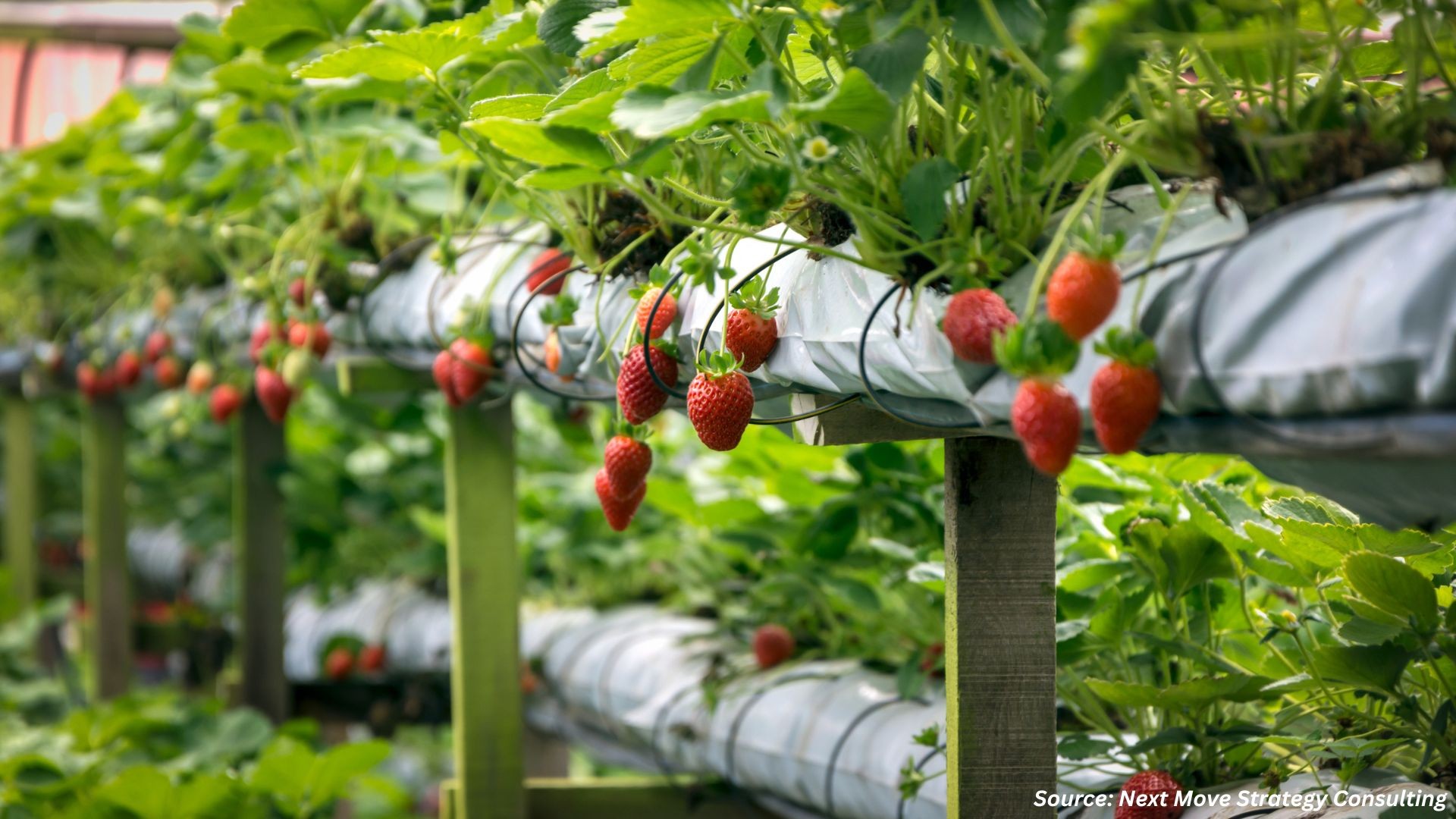
Greenhouse and vertical farming operators are prioritizing precision-blended substrates calibrated for consistent moisture and nutrient delivery under controlled-environment conditions. Based on research conducted by NMSC, we found that formulation portfolios are being restructured around fertigation compatibility rather than raw material cost alone. Premier Tech has disclosed continued investment in its PRO-MIX ready-to-use substrate lines, reflecting accelerated product renewal for controlled-environment growers.
How Is Biological Input Integration Influencing Product Design?
Substrate producers are increasingly incorporating mycorrhizae and beneficial microbial inputs directly into growing media to improve root establishment without added synthetic fertilizer. Our findings suggest that Premier Tech's industrial-scale mycorrhizae production, integrated into its horticultural substrate lines, exemplifies how biological integration is becoming a standard commercial offering rather than an aftermarket add-on across major substrate brands.
PESTEL Analysis of the Growing Media Market
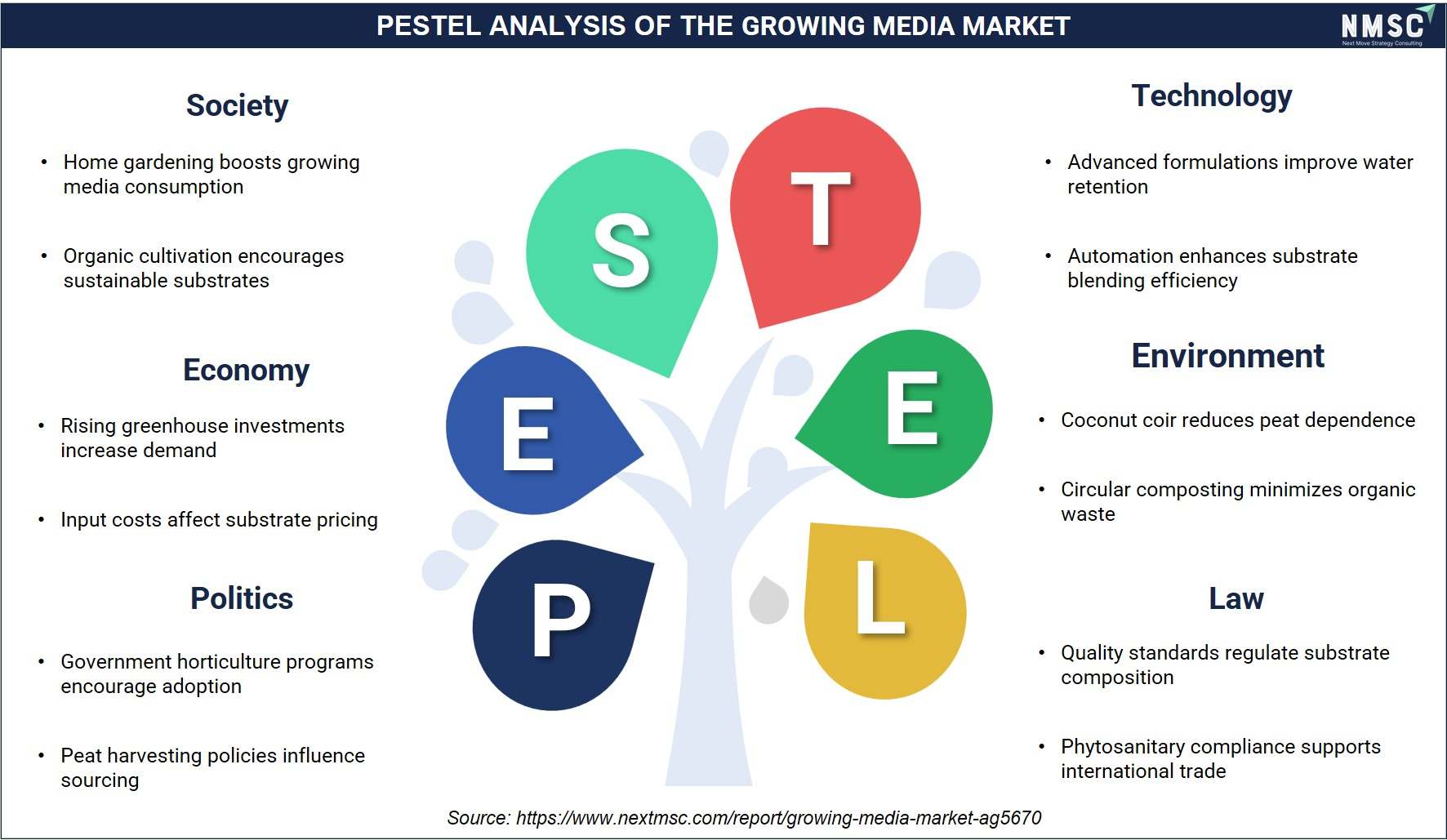
NMSC's analysis indicates that consumer interest in home gardening and organic cultivation drives adoption in the Growing Media Market. Furthermore, rising greenhouse investments, government horticulture programs, and automated substrate blending boost industry expansion. Concurrently, environmental trends favor coconut coir and circular composting to minimize peat reliance, while strict substrate quality standards and phytosanitary regulations ensure seamless international trade compliance.
Growth Drivers and Restraints
|
Factors |
Type |
(+/-) % Impact on CAGR |
Geographic Relevance |
Impact Timeline |
|
Rising greenhouse and controlled-environment agriculture investment |
Driver |
+0.9% |
Global |
2026–2035 |
|
Growing adoption of coco coir as a renewable peat alternative |
Driver |
+0.7% |
Asia-Pacific, Europe |
2026–2035 |
|
Expansion of commercial nursery and ornamental horticulture |
Driver |
+0.5% |
North America, Europe |
2026–2032 |
|
Government support for sustainable substrate certification |
Driver |
+0.4% |
Europe |
2027–2035 |
|
Rising urban and home gardening participation |
Driver |
+0.3% |
North America, Asia-Pacific |
2026–2035 |
|
Peatland extraction restrictions and rewetting mandates |
Restraint |
-0.6% |
Europe |
2026–2035 |
|
High transportation costs for coir imports from source regions |
Restraint |
-0.4% |
North America, Europe |
2026–2032 |
|
Price volatility in raw peat and perlite input costs |
Restraint |
-0.3% |
Global |
2026–2030 |
|
Limited farmer awareness of soilless substrate benefits |
Restraint |
-0.2% |
Asia-Pacific, Latin America |
2026–2031 |
What Is the Primary Growth Driver?
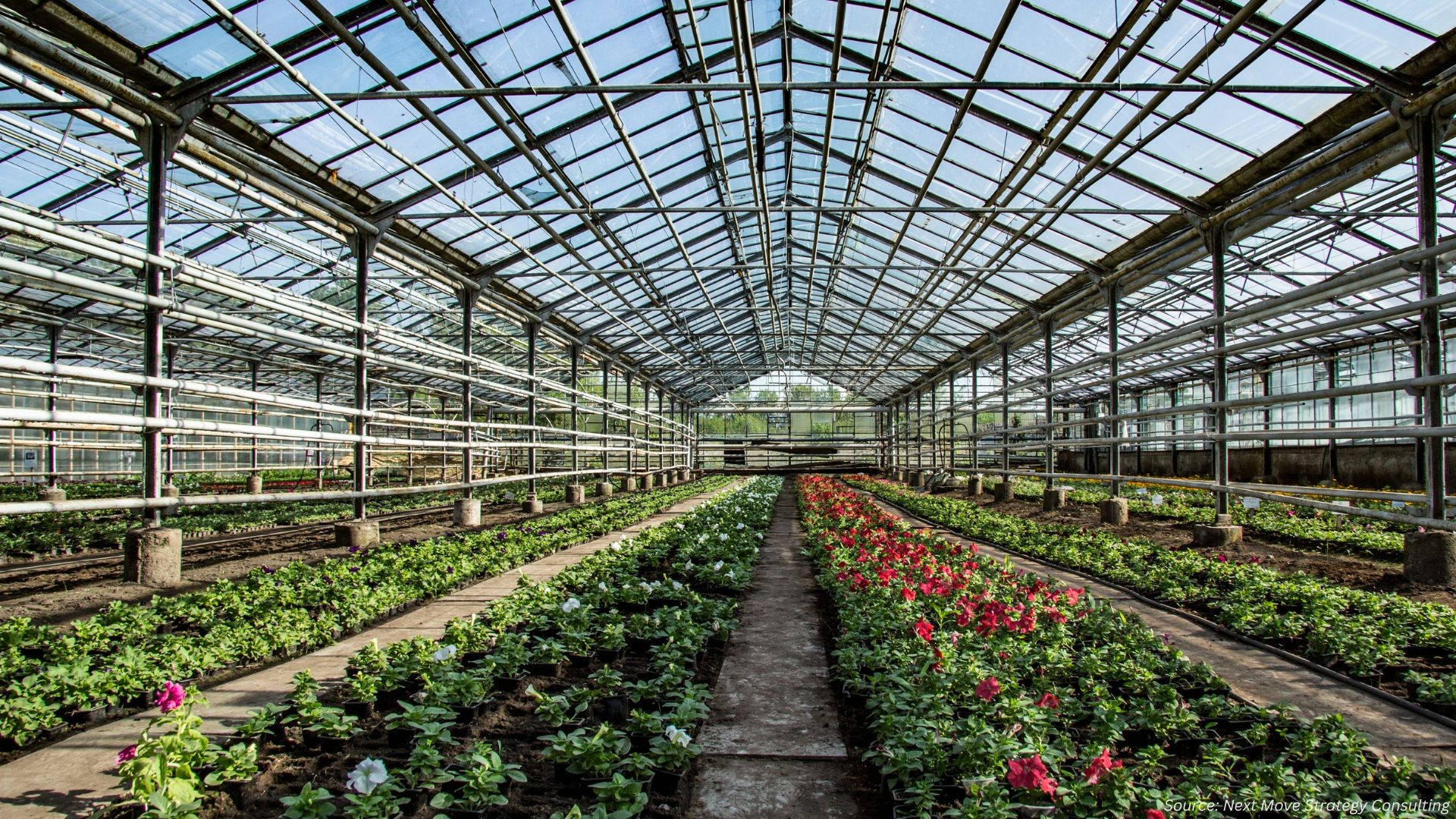
Rising greenhouse and controlled-environment agriculture investment is the primary growth driver, with the United States Department of Agriculture reporting continued expansion in protected cultivation acreage across major producing states. We observed that this expansion, combined with rising demand for consistent year-round crop quality, is pushing commercial growers toward precision-blended growing media over field soil, directly supporting the 3.10% CAGR projected for 2026–2035.
How Is Coco Coir Substitution Driving Market Growth?
Coco coir substitution is expanding as growers seek renewable alternatives to peat amid tightening European extraction permitting. Regulatory guidance from the European Commission on peatland conservation is accelerating this shift across commercial greenhouse operations. Our assessment indicates that this substitution trend is replicating across North American and Asia-Pacific markets as coir processing capacity scales, reinforcing coco coir as the fastest-growing product type segment through 2035.
What Is Restraining Growing Media Market Growth?
Peatland extraction restrictions and statutory rewetting mandates across the European Union remain the primary restraint, limiting new bog development and constraining raw peat supply for established producers. We found that high transportation costs for coir imports from source regions in South and Southeast Asia further limit cost competitiveness in distant markets, an industry-derived estimate given the absence of a single publicly verifiable global freight-cost dataset for this category.
Segmentation Analysis
Segment Sizing: By Product Type
|
Segment |
2025 (USD Billion) |
2035 (USD Billion) |
CAGR% (2026–2035) |
|
Peat based Growing Media |
1.77 |
2.16 |
2.15% |
|
Coco Coir and Coir based Growing Media |
1.07 |
1.74 |
5.55% |
|
Bark and Wood Fiber based Growing Media |
0.75 |
1.02 |
3.44% |
|
Perlite and Vermiculite based Growing Media |
0.53 |
0.68 |
2.77% |
|
Compost and Organic Growing Media |
0.31 |
0.41 |
3.16% |
|
Total |
4.43 |
6.01 |
3.10% |
Which Product Type Segment Dominates the Growing Media Market?
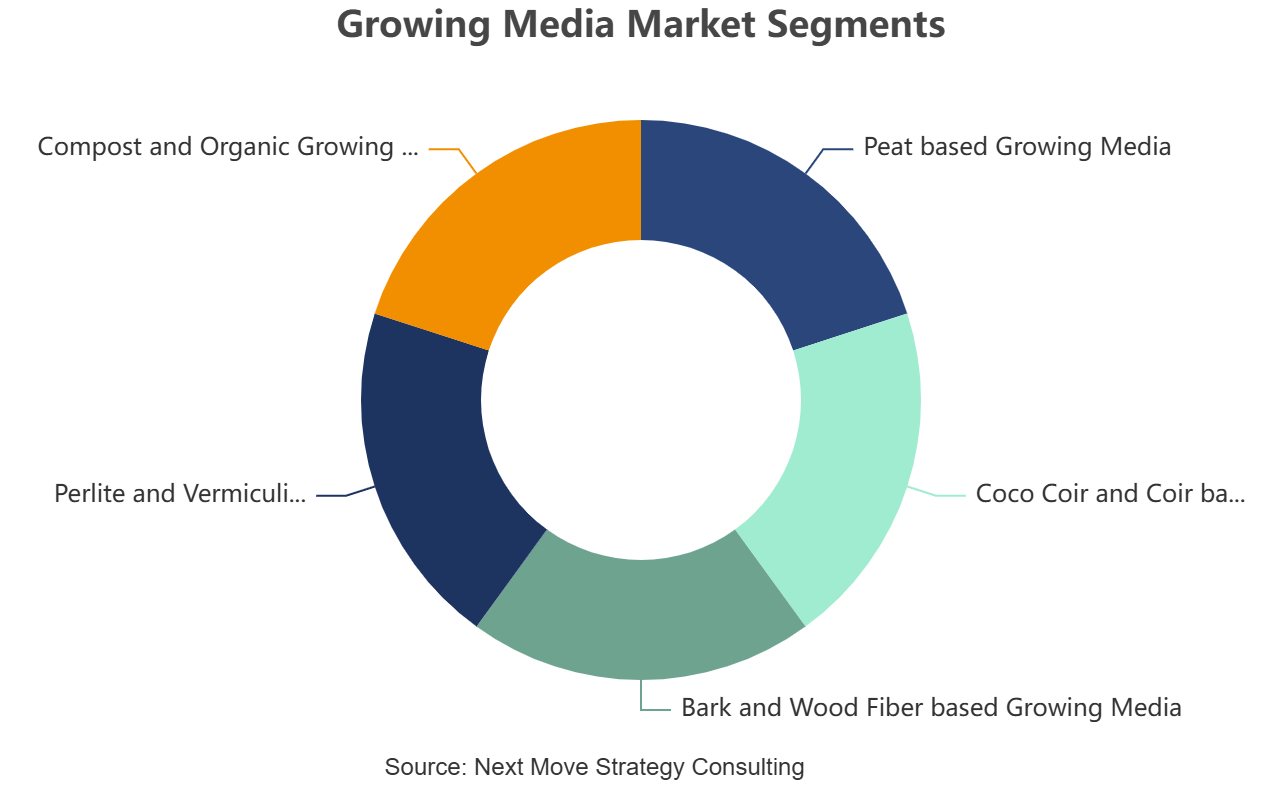
Peat based growing media defines the product type axis, valued for its water retention and consistent structure across commercial greenhouse and nursery applications. We found that this segment held approximately 40% share in 2025 given decades of established peat bog extraction infrastructure across Northern Europe and Canada. Coco coir and coir based growing media is the fastest-growing sub-segment at 5.55% CAGR, driven by renewable sourcing preference and expanding hydroponic cultivation demand across Asia-Pacific and Europe.
Segment Sizing: By Application
|
Segment |
2025 (USD Billion) |
2035 (USD Billion) |
CAGR% (2026–2035) |
|
Commercial Horticulture and Greenhouse Cultivation |
2.04 |
2.62 |
2.83% |
|
Nursery and Propagation |
1.06 |
1.42 |
3.28% |
|
Landscaping and Turf |
0.80 |
1.02 |
2.77% |
|
Home and Garden |
0.53 |
0.95 |
6.66% |
|
Total |
4.43 |
6.01 |
3.10% |
Which Application Segment Leads Growing Media Market Demand?
Commercial horticulture and greenhouse cultivation dominates the application axis with approximately 46% share in 2025, reflecting sustained investment in protected cultivation infrastructure among large-scale commercial growers. Our analysis shows that home and garden is the fastest-growing sub-segment at 6.66% CAGR as urban and consumer gardening participation expands across North America and Asia-Pacific, narrowing the gap with traditional commercial-scale application segments.
Segment Sizing: By Distribution Channel
|
Segment |
2025 (USD Billion) |
2035 (USD Billion) |
CAGR% (2026–2035) |
|
Direct B2B Sales to Commercial Growers |
1.95 |
2.55 |
3.02% |
|
Retail and Garden Centers |
1.33 |
1.68 |
2.64% |
|
Online and E-commerce |
0.62 |
1.10 |
6.55% |
|
Landscaping Contractors and Institutional Buyers |
0.53 |
0.68 |
2.77% |
|
Total |
4.43 |
6.01 |
3.10% |
Which Distribution Channel Is Fastest-Growing in the Growing Media Market?
Direct B2B sales to commercial growers remain the dominant distribution channel at approximately 44% share in 2025, reflecting entrenched supply agreements between substrate producers and large-scale greenhouse operators. We observed that online and e-commerce channels are the fastest-growing sub-segment at 6.55% CAGR as direct-to-consumer ordering platforms expand home and garden segment reach across North America and Europe.
Growth Opportunities
We identified three forward-looking whitespace opportunities within the growing media market that are distinct from the primary investment thesis outlined above.
Expansion of Peat-Free Certified Substrate Licensing
Licensing peat-free formulation technology to regional substrate producers across Asia-Pacific and Latin America opens a mechanism for European innovators to monetize proprietary blending expertise without direct extraction investment, benefiting commercial horticulture and nursery segments.
Growth of Direct-to-Consumer Substrate Subscription Models
Bundling recurring substrate delivery with home gardening advisory content creates a subscription-style revenue mechanism, benefiting online and e-commerce channels as urban consumers seek convenient, renewable growing media options.
Scaling of Biological Input Bundling in Commercial Substrates
Integrating mycorrhizae and biostimulant inputs directly into bulk commercial substrate formulations creates an incremental revenue mechanism per unit sold, benefiting nursery and propagation segments where early root establishment commands premium pricing.
Regional Outlook
|
Region |
2025 (USD Billion) |
2035 (USD Billion) |
CAGR% (2026–2035) |
Key Driver |
|
Europe |
1.55 |
1.85 |
1.98% |
Established peat extraction infrastructure and certification standards |
|
North America |
1.24 |
1.62 |
3.00% |
Expanding controlled-environment agriculture investment |
|
Asia-Pacific |
0.98 |
1.55 |
5.34% |
Rising greenhouse cultivation and coir processing capacity |
|
Latin America |
0.40 |
0.60 |
4.62% |
Growing coir export processing and nursery demand |
|
Middle East and Africa |
0.26 |
0.39 |
4.36% |
Government-backed protected cultivation programs |
|
Total |
4.43 |
6.01 |
3.10% |
|
Europe Growing Media Market Outlook
Europe dominates the growing media market with approximately 35% share in 2025, supported by long-established peat extraction infrastructure across Germany, Ireland, and the Baltic states. We observed that peatland restoration regulation is tempering growth relative to other regions, while regulatory harmonization around Responsibly Produced Peat certification is easing cross-border trade standards. Our assessment indicates that continued substrate blending innovation will sustain the region's leadership through 2035.
North America Growing Media Market Outlook
North America remains a mature, technology-intensive market anchored by large-scale commercial greenhouse and nursery operations. We found that peat and bark based substrate adoption is well established, with USDA-supported protected cultivation programs providing a predictable demand base. Strategic outlook favors continued growth in precision-blended substrates and direct-to-consumer retail expansion among leading producers.
Asia-Pacific Growing Media Market Outlook
Asia-Pacific is the fastest-growing region at 5.34% CAGR, driven by expanding greenhouse cultivation and coir processing capacity across China, India, and Southeast Asia. Our analysis shows that rising government support for protected agriculture is accelerating substrate adoption, while technology penetration in fertigation-compatible blends continues to rise. Strategic outlook favors continued double-digit growth in coir export processing capacity.
Latin America Growing Media Market Outlook
Latin America is emerging as a growing coir export processing hub, supported by expanding nursery and ornamental horticulture demand across Brazil and Argentina. We observed that regulatory support for agricultural exports has accelerated coir processing investment, while technology penetration in blended substrate formulation continues to expand. Strategic outlook favors continued growth in export-oriented coir production.
Middle East and Africa Growing Media Market Outlook
Middle East and Africa growth is supported by government-backed protected cultivation programs addressing water-scarce agricultural conditions across the Gulf states. Our findings suggest that regulatory environments are gradually expanding import approval pathways for renewable substrate inputs, though limited domestic processing capacity continues to moderate regional self-sufficiency. Strategic outlook favors continued public-private greenhouse investment partnerships.
U.S. Growing Media Market
Based on our engagements, U.S. growing media demand stood at approximately USD 0.92 billion in 2025, projected to approach USD 1.22 billion by 2035 at a 2.9% CAGR. Demand is anchored in large-scale commercial greenhouse and nursery operations with high peat and bark substrate adoption. Regulatory oversight through state agricultural extension programs supports predictable demand. Technology penetration in precision-blended substrates is advanced, and competitive intensity among top-tier suppliers is high.
Canada Growing Media Market
Through our analysis, Canada growing media demand stood at approximately USD 0.32 billion in 2025, projected to reach USD 0.40 billion by 2035 at a 2.5% CAGR. Demand is shaped by commercial nursery and ornamental horticulture production, with steady peat based substrate adoption supported by domestic bog resources. Regulatory influence from provincial environmental agencies shapes extraction permitting. Technology penetration in blended formulations is rising, and strategic outlook favors continued export-oriented production.
UK Growing Media Market
From our assessment, UK growing media demand stood at approximately USD 0.28 billion in 2025, projected to reach USD 0.34 billion by 2035 at a 2.2% CAGR. Demand centers on retail garden center and consumer gardening substrate sales under an increasingly peat-conscious regulatory environment. Regulatory influence from national peatland policy shapes sourcing decisions. Technology penetration favors peat-free blends, and strategic outlook favors continued growth in renewable substrate retail formats.
Germany Growing Media Market
According to evaluation, Germany growing media demand stood at approximately USD 0.42 billion in 2025, projected to reach USD 0.48 billion by 2035 at a 1.5% CAGR. Demand is driven by commercial horticulture and export-oriented ornamental plant production supported by domestic peat extraction capacity. Regulatory oversight aligns with European Union peatland restoration frameworks. Technology adoption in certified substrate blending is advanced, and competitive intensity among domestic producers remains high.
France Growing Media Market
Based on our engagements, France growing media demand stood at approximately USD 0.24 billion in 2025, projected to reach USD 0.29 billion by 2035 at a 2.1% CAGR. Demand reflects strong nursery and landscaping substrate consumption supported by cooperative agricultural distribution structures. Regulatory influence follows European Union environmental frameworks. Technology penetration in blended substrate formulation is expanding, and strategic outlook favors continued cooperative-model distribution.
China Growing Media Market
Through our analysis, China growing media demand stood at approximately USD 0.42 billion in 2025, projected to reach USD 0.72 billion by 2035 at a 6.2% CAGR. Demand is driven by expanding greenhouse cultivation and government-backed protected agriculture programs supporting productivity gains. Regulatory influence from state agricultural ministries shapes import approval, while technology penetration in coir processing is rising. Competitive intensity is high among domestic and multinational suppliers.
India Growing Media Market
From our assessment, India growing media demand stood at approximately USD 0.19 billion in 2025, projected to reach USD 0.36 billion by 2035 at a 7.4% CAGR. Demand reflects rapidly expanding greenhouse and polyhouse cultivation supported by domestic coir processing capacity. Regulatory influence from national horticulture boards shapes export standards, while technology penetration in substrate blending continues to accelerate. Strategic outlook favors continued high-growth coir export processing.
Japan Growing Media Market
According to evaluation, Japan growing media demand stood at approximately USD 0.13 billion in 2025, projected to reach USD 0.16 billion by 2035 at a 2.3% CAGR. Demand centers on high-value nursery and ornamental substrate consumption supported by advanced greenhouse infrastructure. Regulatory oversight through the Ministry of Agriculture ensures strict import quality standards. Technology penetration in precision blending is mature, and competitive intensity favors domestic specialty producers.
South Korea Growing Media Market
Based on our engagements, South Korea growing media demand stood at approximately USD 0.08 billion in 2025, projected to reach USD 0.10 billion by 2035 at a 2.5% CAGR. Demand is supported by nursery and greenhouse substrate consumption with government-backed horticulture research programs. Regulatory influence from the Rural Development Administration shapes import standards. Technology penetration in substrate blending is rising, and strategic outlook favors continued public research investment.
Australia Growing Media Market
Through our analysis, Australia growing media demand stood at approximately USD 0.09 billion in 2025, projected to reach USD 0.12 billion by 2035 at a 3.2% CAGR. Demand reflects nursery, turf, and landscaping substrate consumption across broadacre and urban horticulture operations. Regulatory oversight through national biosecurity frameworks shapes substrate import approval. Technology penetration in precision blending is advanced, and competitive intensity remains moderate among established suppliers.
UAE Growing Media Market
From our assessment, UAE growing media demand stood at approximately USD 0.04 billion in 2025, projected to reach USD 0.06 billion by 2035 at a 4.6% CAGR. Demand is emerging around government-backed protected cultivation programs addressing water-scarce agricultural conditions. Regulatory influence from national agricultural authorities is expanding substrate import approval pathways. Technology penetration remains early-stage, and strategic outlook favors continued public-private greenhouse investment.
Saudi Arabia Growing Media Market
According to evaluation, Saudi Arabia growing media demand stood at approximately USD 0.05 billion in 2025, projected to reach USD 0.075 billion by 2035 at a 4.6% CAGR. Demand is driven by government agricultural diversification programs supporting protected cultivation and nursery production. Regulatory influence from the Ministry of Environment, Water and Agriculture shapes substrate import standards. Technology penetration in irrigation-linked substrate use is rising, and competitive intensity is moderate.
South Africa Growing Media Market
Based on our engagements, South Africa growing media demand stood at approximately USD 0.045 billion in 2025, projected to reach USD 0.065 billion by 2035 at a 4.2% CAGR. Demand reflects commercial nursery and landscaping substrate consumption supported by domestic distribution networks. Regulatory influence from national agricultural authorities shapes import registration. Technology penetration in blended substrate adoption is expanding, and strategic outlook favors continued commercial nursery growth.
Brazil Growing Media Market
Through our analysis, Brazil growing media demand stood at approximately USD 0.26 billion in 2025, projected to reach USD 0.40 billion by 2035 at a 4.9% CAGR. Demand is anchored in large-scale coir export processing and ornamental horticulture production. Regulatory influence from national agricultural export authorities has supported processing capacity expansion. Technology penetration in mechanized coir processing is advanced, and competitive intensity among multinational suppliers is high.
Argentina Growing Media Market
From our assessment, Argentina growing media demand stood at approximately USD 0.07 billion in 2025, projected to reach USD 0.10 billion by 2035 at a 4.0% CAGR. Demand reflects expanding nursery and landscaping substrate consumption supported by favorable agricultural export policy. Regulatory influence from national agricultural authorities shapes substrate distribution standards. Technology penetration is rising, and strategic outlook favors continued coir and compost substrate expansion.
Supply Chain Structure of the Growing Media Market
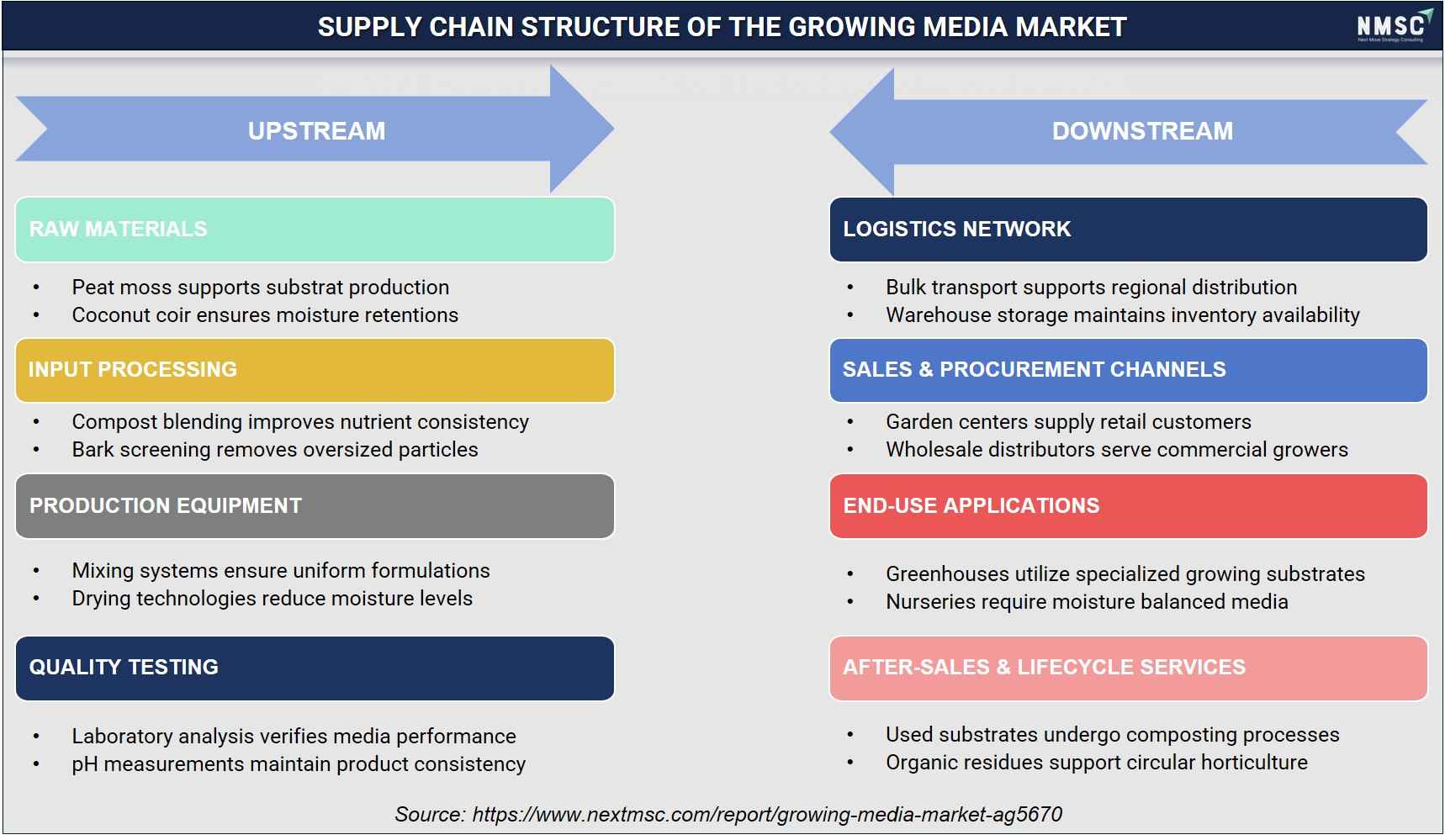
Based on research conducted by NMSC, we found that the supply chain structure of the Growing Media Market seamlessly connects raw materials like peat moss and coconut coir through precision compost blending and laboratory quality testing. Subsequently, bulk logistics, garden centers, and wholesale distributors deliver specialized substrates to commercial greenhouses and nurseries, supported by post-use composting practices that advance sustainable circular horticulture.
Competitive Landscape
We found that the growing media industry is moderately fragmented, with a group of specialized peat, coir, and blended-substrate producers competing across geographically concentrated raw material bases.
|
Dimension |
Details |
|
Market Structure |
Moderately fragmented with specialized regional peat and coir producers alongside diversified blenders |
|
Innovation Focus |
Peat-free formulation, coir processing efficiency, and biological input integration |
|
M and A Activity |
Selective bolt-on acquisitions in coir processing capacity and regional distribution networks |
How Do Companies Compete in the Growing Media Market?
Leading companies compete on raw material access, extraction and processing infrastructure, and blended-formulation expertise tailored to greenhouse and nursery customer needs. Our analysis shows that pricing strategies vary by substrate type, with certified peat-free blends commanding premium pricing over conventional peat based products. Geographic expansion is pursued through processing joint ventures in coir-source regions across South and Southeast Asia.
Which Competitive Archetypes Dominate the Growing Media Industry?
Vertically integrated peat producers such as Premier Tech and Klasmann-Deilmann compete on extraction scale and certification credentials, while coir-focused processors such as Pelemix compete on renewable sourcing differentiation. Retail-facing brands such as Scotts Miracle-Gro differentiate through consumer distribution reach. This archetype segmentation explains sustained producer diversity alongside resilient specialty processors.
What Is the Innovation and Differentiation Strategy Across the Industry?
Industry leaders differentiate through peat-free formulation research, coir processing efficiency improvements, and biological input integration that connects substrate performance to grower productivity outcomes. We observed that mycorrhizae and biostimulant bundling is becoming a standard differentiator, allowing producers to capture incremental revenue per unit sold beyond base substrate pricing.
How Active Is M&A in the Growing Media Industry?
M&A activity remains selective, concentrated in coir processing capacity and regional distribution network acquisitions rather than large-scale consolidation. Recent bolt-on transactions in peat-free substrate technology illustrate how established producers are reinforcing existing portfolio strengths rather than expanding core geographic footprint.
Key Market Players
-
Premier Tech Ltd.
-
Klasmann-Deilmann GmbH
-
Sun Gro Horticulture Inc.
-
Kekkilä-BVB
-
Bord na Móna PLC
-
Berger Group
-
Lambert Peat Moss Inc.
-
Jiffy Products International B.V.
-
Pindstrup Mosebrug A/S
-
Florentaise Group
-
Grodan B.V.
-
Profile Products LLC
-
Turveruukki Oy
-
Neova Group
-
Mikskaar AS
-
Annapolis Valley Peat Moss Co. Ltd.
-
Westland Horticulture Ltd.
-
FoxFarm Soil and Fertilizer Company
-
Dutch Plantin B.V.
Latest Developments
We found that recent corporate activity reflects continued sustainability-driven product development among leading growing media producers heading into 2026.
|
Date |
Event |
|
May 2026 |
Grodan entered a strategic partnership with Priva to integrate real-time root zone data from Grodan's GroSens sensors directly into the Priva One greenhouse platform. The commercial digital integration enables high-tech growers to access precise sensor-level substrate metrics to execute faster, data-driven irrigation decisions. |
|
February 2026 |
Klasmann-Deilmann acquired US-based gel plug producer VelociGro from investment firm Ospraie. The acquisition secures patented compostable gel plug technology for plant propagation, strengthening Klasmann-Deilmann's innovative capacity and expanding its portfolio of sustainable young-plant cultivation solutions for commercial horticulture. |
Investment Opportunities
What Capital Inflows Are Shaping the Growing Media Market?
Capital inflows are concentrated in coir processing capacity expansion and peat-free formulation research, with leading producers reinvesting in certification infrastructure to meet tightening European sourcing standards. We observed that Klasmann-Deilmann has disclosed continued investment in rewetting and sustainability reporting infrastructure, an industry-derived benchmark for capital intensity across top-tier producers.
How Is Infrastructure Investment Evolving Across the Industry?
Infrastructure investment is expanding in South and Southeast Asian coir processing facilities designed to serve growing global hydroponic and nursery demand. Our analysis shows that similar capacity investments are likely across other coir-source regions through 2035 as multinational substrate producers diversify raw material bases.
What ESG Considerations Are Relevant to Growing Media Market Investment?
Environmental, social, and governance considerations increasingly center on peatland conservation, renewable substrate sourcing, and reduced synthetic input dependency through biological amendments. We found that these considerations are becoming embedded in institutional investment screening criteria applied to agricultural input and substrate producers.
Key Benefits for Stakeholders
How Does This Report Benefit Horticulture Industry Leaders?
Industry leaders gain a validated view of segment-level growth rates, competitive archetypes, and regional sourcing dynamics that inform substrate portfolio prioritization and go-to-market sequencing across product categories through 2035.
How Does This Report Benefit Investors and Financial Analysts?
Investors and financial analysts gain access to consistent market sizing, CAGR benchmarks, and competitive landscape analysis that support capital allocation decisions across peat, coir, and blended substrate producers.
How Does This Report Benefit Technology Vendors and Product Teams?
Technology vendors and product teams gain visibility into peat-free formulation, coir processing, and biological input adoption trends that inform partnership and product development strategies aligned with leading substrate producers' innovation roadmaps.
Key Market Segments
By Product Type
-
Peat based Growing Media
-
Coco Coir and Coir based Growing Media
-
Bark and Wood Fiber based Growing Media
-
Perlite and Vermiculite based Growing Media
-
Compost and Organic Growing Media
By Application
-
Commercial Horticulture and Greenhouse Cultivation
-
Nursery and Propagation
-
Landscaping and Turf
-
Home and Garden
By Distribution Channel
-
Direct B2B Sales to Commercial Growers
-
Retail and Garden Centers
-
Online and E-commerce
-
Landscaping Contractors and Institutional Buyers
By Region
-
North America: U.S., Canada, Mexico
-
Europe: UK, Germany, France, Italy, Spain, Sweden, Denmark, Finland, Netherlands, Rest of Europe
-
Asia-Pacific: China, India, Japan, South Korea, Taiwan, Indonesia, Vietnam, Australia,Philippines, Malaysia, Rest of APAC
-
Middle East and Africa: Saudi Arabia, UAE, Egypt, Israel, Turkey, Nigeria, South Africa, Rest of MEA
-
Latin America: Brazil, Argentina, Chile, Colombia, Rest of LATAM
Conclusion and Recommendations
What Is the Long-Term Outlook for the Growing Media Market?
The growing media market is projected to expand from USD 4.56 billion in 2026 to USD 6.01 billion by 2035 at a 3.10% CAGR, supported by sustained controlled-environment agriculture investment and renewable substrate adoption. We found that this trajectory reflects durable, regulation-shaped structural demand rather than a cyclical upswing, positioning the industry for continued steady expansion.
What Are the Strategic Positioning Recommendations?
Producers should prioritize coir and wood fiber portfolio expansion in Asia-Pacific and Latin America while defending certified peat-based supply relationships in mature European markets. Our assessment indicates that companies balancing both strategies will capture the broadest share of the projected USD 1.45 billion incremental opportunity through 2035.
How Attractive Is the Growing Media Market for Investment?
The market's 3.10% CAGR, combined with a moderately fragmented competitive structure among twenty validated global producers, signals a stable investment profile for capital targeting durable agricultural input demand rather than high-volatility discretionary categories.
What Market Shifts and Key Risks Should Stakeholders Monitor?
Stakeholders should monitor peatland extraction policy shifts, coir freight cost volatility, and raw material price fluctuations that could moderate margin stability across substrate producers through the forecast period.
What Are the Primary Growth Pathways Through 2035?
Primary growth pathways include expanding peat-free certified substrate adoption, scaling coir processing capacity in source regions, and bundling biological inputs at the point of sale, each reinforcing the growing media market's projected expansion to USD 6.01 billion by 2035.
About the Author
 Saista Faiyaz
— Saista Faiyaz is Research Associate at Next Move Strategy Consulting, where she has covered consumer markets and healthcare technologies for 3 years. Her work includes primary interview review, secondary-source validation, market sizing, and structured analysis of company and industry data. She supports research by comparing evidence across sources, organizing findings into market narratives, and documenting assumptions used in analysis. Her scope includes cross-market benchmarking, and reports.
Saista Faiyaz
— Saista Faiyaz is Research Associate at Next Move Strategy Consulting, where she has covered consumer markets and healthcare technologies for 3 years. Her work includes primary interview review, secondary-source validation, market sizing, and structured analysis of company and industry data. She supports research by comparing evidence across sources, organizing findings into market narratives, and documenting assumptions used in analysis. Her scope includes cross-market benchmarking, and reports.
About the Reviewer
 Supradip Baul
— Supradip Baul is an accomplished business consultant and strategist with over a decade of rich experience in market intelligence, strategy, technology, and business transformation. His work has included rigorous qualitative and quantitative analysis across multiple industries, helping clients shape investment decisions and long-term roadmaps. Earlier in his career, he was associated with Gartner, where he contributed to industry-leading reports and market share analyses. He has worked with leading global companies and holds an MBA with a dual specialization in Marketing and Finance.
Supradip Baul
— Supradip Baul is an accomplished business consultant and strategist with over a decade of rich experience in market intelligence, strategy, technology, and business transformation. His work has included rigorous qualitative and quantitative analysis across multiple industries, helping clients shape investment decisions and long-term roadmaps. Earlier in his career, he was associated with Gartner, where he contributed to industry-leading reports and market share analyses. He has worked with leading global companies and holds an MBA with a dual specialization in Marketing and Finance.
At Next Move Strategy Consulting, we understand that insightful market research is the cornerstone of successful business decisions. That's why we employ a robust and multifaceted approach, combining various methodologies to deliver the most accurate and actionable data for our clients.

Research Landscape
We navigate the world of research with two primary approaches:
Qualitative Approach
Our qualitative research methodologies involve immersive techniques such as in-depth interviews, focus groups, and observational studies. By engaging directly with individuals and stakeholders, we uncover valuable insights that quantitative data alone may overlook.

Quantitative Research
In tandem with qualitative methodologies, NMSC leverages the power of Quantitative Research to provide a robust foundation of numerical insights. Through systematic data collection and analysis, we quantify patterns, preferences, and market trends, offering a comprehensive view of the business landscape.
Our quantitative research approach employs diverse tools, including surveys, experiments, and statistical modelling. These methodologies enable us to gather data from a large and representative sample, ensuring the statistical significance of our findings. By employing structured questionnaires and standardized data collection methods, we guarantee the reliability and validity of the information we present to our clients.
Quantitative research is particularly effective in measuring the prevalence of trends, assessing market size, and gauging the impact of various factors on consumer behavior. The numerical precision attained through this approach equips our clients with actionable insights, facilitating data-driven decision-making and strategy formulation.


Our Specialized Toolbox for Industry-Specific Market Research
We deploy a specialized arsenal of techniques tailored to meet your unique requirements. Here's a glimpse into our comprehensive toolbox:

Information Procurement
The stage entails acquiring market data or relevant information through various sources and methodologies.


Market Research Approach
We utilize both top-down and bottom-up approaches in market research analysis to achieve a comprehensive understanding of the market dynamics, leveraging the broad perspective of industry trends and macroeconomic factors alongside detailed insights from specific segments and individual companies.

Porters Five Forces Analysis
We conduct Porter's Five Forces analysis to evaluate the competitive landscape of an industry, providing us with insights into factors that affect profitability and strategic positioning.

SWOT Analysis

Forecasting
We utilize a forecasting model to predict future consumption by considering parameters like population, economics, regulations, market competition, drivers, constraints, technology, and pricing. We also employ statistical techniques such as multilinear regression, exponential smoothing, moving average, ARIMA, and Monte Carlo simulations for accurate predictions. In econometric forecasting, we analyzed short-term and long-term event impacts, attributing values based on regulatory frameworks, economic factors, and market events.





 Speak to Our Analyst