Polyolefin Plastomers Market Global Industry Analysis and Forecast (2026–2035)

The global Polyolefin Plastomers Market size was valued at USD 2.15 billion in 2025 and is estimated at USD 2.28 billion in 2026, forecast to reach USD 4.12 billion by 2035, expanding at a 6.8% CAGR between 2026 and 2035. Asia-Pacific leads with approximately a 33% share, while Metallocene-Based Plastomers dominate all other plastomer types with approximately a 66% share.

Download Free Sample PDF
Base Year (2025)
$2.15 Billion
Forecast (2035)
$4.12 Billion
CAGR (2026-2035)
6.8%
Top Region
Asia-Pacific

What Is the Polyolefin Plastomers Market Size?

The global polyolefin plastomers market size was valued at USD 2.15 billion in 2025 and is estimated at USD 2.28 billion in 2026, forecast to reach USD 4.12 billion by 2035, expanding at a 6.8% CAGR between 2026 and 2035. Asia-Pacific leads with approximately a 33% share, while Metallocene-Based Plastomers dominate the Ziegler-Natta-Based Plastomers type with approximately a 66% share.

We observed that growth is broad-based across every segmentation axis, with metallocene catalyst technology and automotive lightweighting applications driving the dominant structural shifts through 2035.

Polyolefin Plastomers Market Global Industry Analysis and Forecast (2026–2035) Revenue Forecast

Values in USD Billion

2025 $2.15 Billion
2025
2026 $2.30 Billion
2026
2027 $2.45 Billion
2027
2028 $2.62 Billion
2028
2029 $2.80 Billion
2029
2030 $2.99 Billion
2030
2031 $3.19 Billion
2031
2032 $3.41 Billion
2032
2033 $3.64 Billion
2033
2034 $3.89 Billion
2034
2035 $4.12 Billion
2035

Key Takeaways

By Type: Metallocene-Based Plastomers held the largest share of approximately 66% (USD 1.42 billion) in 2025; Metallocene-Based Plastomers is also the fastest-growing sub-segment at 8.0% CAGR from 2026–2035.

By Base Resin: Ethylene-Based Plastomers held the largest share of approximately 78% (USD 1.68 billion) in 2025; Propylene-Based Plastomers is the fastest-growing sub-segment at 8.8% CAGR from 2026–2035.

By Form: Pellets held the largest share of approximately 87% (USD 1.87 billion) in 2025; Powder is the fastest-growing sub-segment at 9.3% CAGR from 2026–2035.

By Application: Flexible Packaging held the largest share of approximately 32% (USD 0.69 billion) in 2025; Medical and Healthcare Products is the fastest-growing sub-segment at 9.8% CAGR from 2026–2035.

By End Use Industry: Packaging held the largest share of approximately 37% (USD 0.80 billion) in 2025; Healthcare is the fastest-growing sub-segment at 9.5% CAGR from 2026–2035.

Dominant Region: Asia-Pacific dominated with approximately 33% revenue share (USD 0.71 billion) in 2025.

Fastest-Growing Region: Asia-Pacific is also expected to register the highest CAGR of 8.8% during 2026–2035.

Dominant Country: The U.S. led with approximately USD 532.8 million in 2025.

Fastest-Growing Country: India is the fastest-growing country at approximately 11.8% CAGR from 2026–2035.

What Does the Polyolefin Plastomers Market Encompass?

The polyolefin plastomers market encompasses ethylene and propylene-based copolymer resins engineered for flexibility, impact resistance, and processability across flexible packaging, adhesive, automotive, and wire and cable applications. Our assessment indicates that the scope spans metallocene and Ziegler-Natta catalyzed grades supplied in pellet and powder form to converters, compounders, and original equipment manufacturers producing films, hot melt adhesives, automotive components, and medical products.
Regulatory frameworks such as the U.S. Food and Drug Administration's food contact material approvals shape formulation requirements for packaging-grade plastomers, while extended producer responsibility regulations in the European Union increasingly influence recyclable mono-material film design. We observed that technology adoption is shifting toward advanced metallocene catalyst systems that enable precise comonomer distribution, a structural change that NMSC's analysis indicates is redefining product development priorities across the flexible packaging value chain.

Market Drivers & Dynamics

Interactive Dataset
Rising flexible packaging demand across food and beverage sectors driver +1.9% Global 2026–2035
Expanding metallocene catalyst-based production capacity driver +1.5% North America, Asia-Pacific 2026–2033
Growing automotive lightweighting and NVH damping applications driver +1.3% North America, Europe, Asia-Pacific 2026–2035
Rising hygiene product and hot melt adhesive specialty grade demand driver +1.1% Global 2026–2034
Expanding manufacturing capacity across Asia-Pacific economies driver +0.9% Asia-Pacific 2026–2035
Growing recyclable mono-material packaging development driver +0.7% Europe, North America 2026–2032
Volatile crude oil and ethylene feedstock pricing restraint −1.1% Global 2026–2035
Competition from alternative flexible packaging materials restraint −0.8% Global 2026–2032
Extended producer responsibility and plastic packaging regulation restraint −0.6% Europe 2026–2033
High capital costs for new metallocene production facilities restraint −0.4% Global 2028–2035
Source: Next Move Strategy Consulting

Growth Drivers

What Is the Primary Growth Driver of the Polyolefin Plastomers Market?

Rising flexible packaging demand across food and beverage sectors is the primary driver of the market. The U.S. Environmental Protection Agency's data on plastic packaging generation continues to reflect sustained flexible film consumption growth across food contact applications, supporting baseline demand for sealant-layer plastomer resins. We observed that this packaging demand, reinforced by growing preference for lightweight, resealable film formats, continues to anchor consistent procurement of ethylene-based plastomer grades across converters globally.

How Is Metallocene Catalyst Technology Driving Market Growth?

Expanding metallocene catalyst-based production capacity is accelerating adoption of high-performance plastomer grades across packaging, hygiene, and automotive applications. ExxonMobil's continued expansion of its Texas facility output to meet growing electric vehicle and cable market demand reflects the pace at which producers are scaling specialty polyethylenefuranoate-adjacent and metallocene polyolefin capacity. Our assessment indicates that this capacity investment is compressing supply constraints for premium plastomer grades across global converter programs.

Growth Inhibitors

What Is Restraining Polyolefin Plastomers Market Expansion?

Volatile crude oil and ethylene feedstock pricing restrains predictable margin planning for plastomer producers, particularly given the tight linkage between naphtha cracking economics and resin production costs. Extended producer responsibility regulations across the European Union increasingly require packaging redesign toward mono-material recyclable formats, creating near-term reformulation costs for converters. We found that competition from alternative flexible packaging materials further pressures pricing in cost-sensitive application segments.
What Are the Growth Opportunities?

How Can Producers Capture Recyclable Mono-Material Packaging Demand?

Recyclable mono-material packaging represents a whitespace opportunity for producers developing plastomer grades compatible with polyethylene-only film structures replacing multi-material laminates. Producers that commercialize sealant-layer plastomers optimized for mono-material recyclability stand to capture recurring specification wins as converters redesign packaging to meet European Union extended producer responsibility requirements through 2035.

Where Does Electric Vehicle Cable Compounding Create New Plastomer Demand?

Electric vehicle cable and wire compounding represents an underpenetrated opportunity for plastomer producers developing flexible, heat-resistant insulation formulations suited to high-voltage battery and charging infrastructure applications. Companies that qualify plastomer-based compounds for automotive wire and cable specifications can secure long-term supply agreements with cable manufacturers scaling production alongside expanding electric vehicle adoption.

How Can Medical-Grade Plastomer Formulations Expand Healthcare Revenue?

Medical-grade plastomer formulations create a sustained opportunity for producers seeking premium pricing in biocompatible, sterilization-resistant applications. Early movers that develop pharmacopeia-compliant plastomer grades for flexible tubing and pharmaceutical packaging can differentiate with medical device manufacturers pursuing reliable, consistent-performance polymer sourcing for regulated healthcare applications.

Segmentation Analysis

2025 (USD Billion)
2035 (USD Billion)
Metallocene-Based Plastomers 2025: $1.42 Billion | 2035: $3.01 Billion
Metallocene-
Ziegler-Natta-Based Plastomers 2025: $0.73 Billion | 2035: $1.11 Billion
Ziegler-Natt
Metallocene-Based Plastomers $1.42 Billion $3.01 Billion 8.0%
Ziegler-Natta-Based Plastomers $0.73 Billion $1.11 Billion 4.1%

Which Type Segment Dominates the Polyolefin Plastomers Market?

Metallocene-Based Plastomers led the market with USD 1.42 billion in 2025, supported by their superior molecular weight distribution control and enhanced sealing performance compared with conventional catalyst systems. Our findings suggest that Metallocene-Based Plastomers also remain the fastest-growing segment, registering an 8.0% CAGR from 2026 to 2035, as producers continue expanding dedicated metallocene production capacity to meet growing specialty packaging and automotive component demand.

2025 (USD Billion)
2035 (USD Billion)
Ethylene-bas
Propylene-ba
Segment Item 2025 (USD Billion) 2035 (USD Billion) CAGR
Ethylene-based plastomers $10.0 USD Billion $40.0 USD Billion 11.0%
Propylene-based plastomers $17.1 USD Billion $51.1 USD Billion 21.0%

Segment-wise data is locked

Unlock complete segment-wise numbers for By Base Resin.

Unlock Full Data
2025 (USD Billion)
2035 (USD Billion)
Pellets
Powder
Segment Item 2025 (USD Billion) 2035 (USD Billion) CAGR
Pellets $10.0 USD Billion $40.0 USD Billion 8.0%
Powder $17.1 USD Billion $51.1 USD Billion 10.0%

Segment-wise data is locked

Unlock complete segment-wise numbers for By Form.

Unlock Full Data
2025 (USD Billion)
2035 (USD Billion)
Flexible pac
Hot melt adh
Wire and cab
Automotive c
Footwear
Segment Item 2025 (USD Billion) 2035 (USD Billion) CAGR
Flexible packaging $10.0 USD Billion $40.0 USD Billion 15.0%
Hot melt adhesives $17.1 USD Billion $51.1 USD Billion 21.0%
Wire and cable compounds $24.2 USD Billion $62.2 USD Billion 11.0%
Automotive components $31.3 USD Billion $73.3 USD Billion 21.0%
Footwear $38.4 USD Billion $84.4 USD Billion 14.0%

Segment-wise data is locked

Unlock complete segment-wise numbers for By Application.

Unlock Full Data

Which Application Segment Leads Polyolefin Plastomers Market Demand?

Flexible Packaging remained the leading application within the market, valued at USD 0.69 billion in 2025 on sustained demand for sealant layers and barrier films across food and beverage packaging. Based on research conducted by NMSC, we found that Medical and Healthcare Products is the fastest-growing application, registering a 9.8% CAGR from 2026 to 2035, as biocompatible plastomer grades gain adoption in flexible medical tubing and pharmaceutical packaging applications requiring precise sealing performance.

2025 (USD Billion)
2035 (USD Billion)
Packaging
Automotive
Building and
Consumer goo
Healthcare
Segment Item 2025 (USD Billion) 2035 (USD Billion) CAGR
Packaging $10.0 USD Billion $40.0 USD Billion 9.0%
Automotive $17.1 USD Billion $51.1 USD Billion 11.0%
Building and construction $24.2 USD Billion $62.2 USD Billion 25.0%
Consumer goods $31.3 USD Billion $73.3 USD Billion 15.0%
Healthcare $38.4 USD Billion $84.4 USD Billion 16.0%

Segment-wise data is locked

Unlock complete segment-wise numbers for By End Use Industry.

Unlock Full Data

Which End Use Industry Segment Is Most Significant in the Market?

Packaging remained the dominant end use industry across the market, reaching USD 0.80 billion in 2025 as food and beverage converters represent the largest concentration of plastomer resin consumption globally. Our analysis shows that Healthcare is the fastest-growing end use industry at a 9.5% CAGR from 2026 to 2035, reflecting expanding adoption of biocompatible plastomer formulations in medical device and pharmaceutical packaging applications.

Supply Chain Analysis of the Polyolefin Plastomers Industry

Supply Chain Analysis of the Polyolefin Plastomers Industry
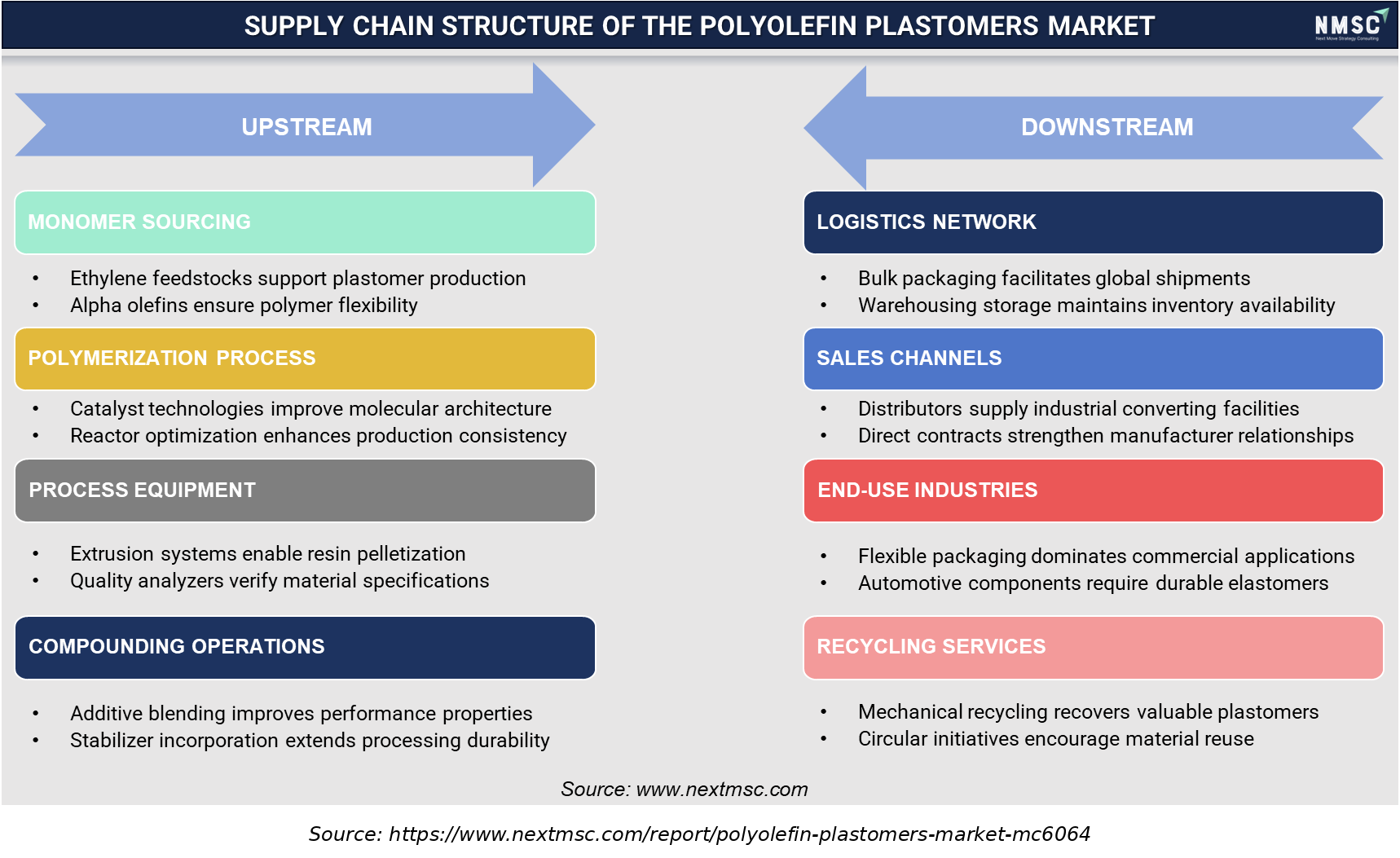
The above infographic presents the supply chain structure of the polyolefin plastomers market, segmented into upstream and downstream activities. Ethylene and alpha olefins serve as key feedstocks, which are processed through catalyst-driven polymerization and reactor optimization to ensure consistent molecular performance. Extrusion, compounding, and quality analysis further refine material properties and verify compliance. Downstream, bulk logistics and warehousing enable global distribution, serving major end-use sectors such as flexible packaging and automotive components. Looking ahead, we observed that mechanical recycling and circular initiatives are gaining momentum, supporting long-term material sustainability and regulatory alignment.
Growth Opportunities

Our analysis shows that three forward-looking opportunities stand out for stakeholders positioning within the polyolefin plastomers market over the 2026–2035 forecast period.

How Can Producers Capture Recyclable Mono-Material Packaging Demand?

Recyclable mono-material packaging represents a whitespace opportunity for producers developing plastomer grades compatible with polyethylene-only film structures replacing multi-material laminates. Producers that commercialize sealant-layer plastomers optimized for mono-material recyclability stand to capture recurring specification wins as converters redesign packaging to meet European Union extended producer responsibility requirements through 2035.

Where Does Electric Vehicle Cable Compounding Create New Plastomer Demand?

Electric vehicle cable and wire compounding represents an underpenetrated opportunity for plastomer producers developing flexible, heat-resistant insulation formulations suited to high-voltage battery and charging infrastructure applications. Companies that qualify plastomer-based compounds for automotive wire and cable specifications can secure long-term supply agreements with cable manufacturers scaling production alongside expanding electric vehicle adoption.

How Can Medical-Grade Plastomer Formulations Expand Healthcare Revenue?

Medical-grade plastomer formulations create a sustained opportunity for producers seeking premium pricing in biocompatible, sterilization-resistant applications. Early movers that develop pharmacopeia-compliant plastomer grades for flexible tubing and pharmaceutical packaging can differentiate with medical device manufacturers pursuing reliable, consistent-performance polymer sourcing for regulated healthcare applications.

Regional Outlook

2025 (USD Billion)
2035 (USD Billion)
North Americ
Europe
Asia-Pacific
Middle East
Latin Americ
Region 2025 (USD Billion) 2035 (USD Billion) CAGR (%)
North America $10.0 USD Billion $40.0 USD Billion 9.0%
Europe $17.1 USD Billion $51.1 USD Billion 27.0%
Asia-Pacific $24.2 USD Billion $62.2 USD Billion 25.0%
Middle East & Africa $31.3 USD Billion $73.3 USD Billion 23.0%
Latin America $38.4 USD Billion $84.4 USD Billion 12.0%

Regional data is locked

Unlock complete regional numbers for this market.

Unlock Full Data

PESTEL Analysis of the Polyolefin Plastomers Industry

PESTEL Analysis of the Polyolefin Plastomers Industry
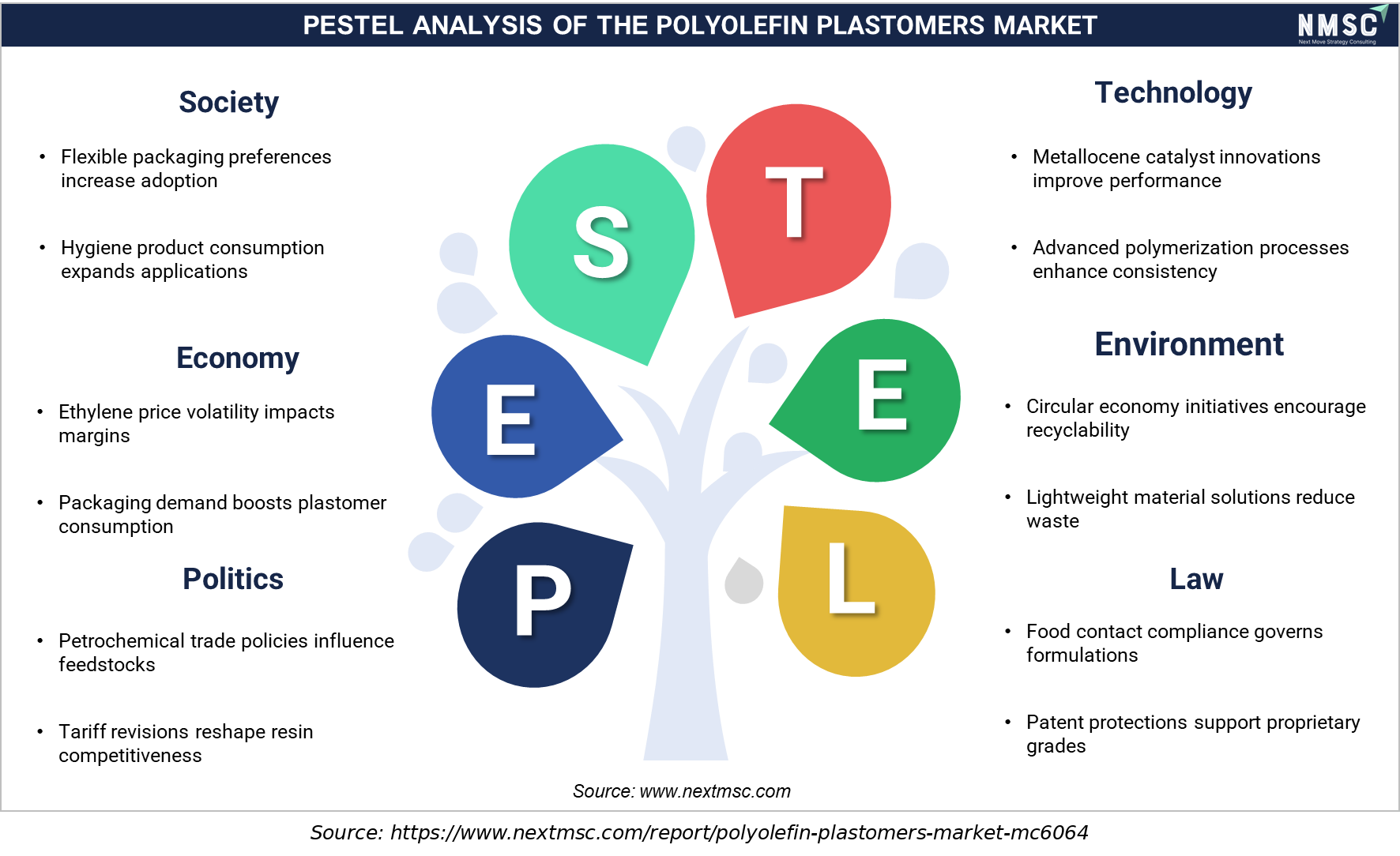
The above infographic presents a PESTEL analysis of the polyolefin plastomers market, wherein trade policies and tariff fluctuations are shaping feedstock availability and competitive dynamics. Packaging demand is driving consumption, while consumer preference for flexible and lightweight solutions is supporting adoption. Metallocene catalyst innovations and advanced polymerization processes are enhancing material performance and production consistency. Circular economy initiatives and lightweight material applications are contributing to waste reduction and recyclability. These developments are underpinned by food contact compliance standards and patent protections that safeguard proprietary formulations. Looking ahead, we observed that sustainability goals and regulatory developments will continue to influence market growth and material innovation across the value chain.

Competitive Landscape

We observed that the polyolefin plastomers market features a moderately consolidated competitive landscape, with integrated global petrochemical majors competing alongside regional producers on catalyst technology, feedstock integration, and application development support.

Dimension Description
Market Structure Moderately consolidated; the top companies profiled in this report collectively account for a majority of global market revenue, given the capital-intensive nature of integrated petrochemical production.
Innovation Focus Metallocene catalyst advancement, recyclable mono-material packaging formulations, and circular feedstock development dominate current innovation pipelines across leading producers.
M&A Activity Selective capability partnerships, exemplified by the Clariant and Borealis collaboration piloting plastic waste conversion into cracker-grade feedstock supporting circular plastomer and elastomer production.

How Do Companies Compete in the Polyolefin Plastomers Market?

Companies compete primarily on catalyst technology, feedstock integration, and application development support across the industry. Integrated majors such as Dow Inc. and ExxonMobil Corporation leverage proprietary metallocene catalyst platforms and backward-integrated ethylene production to serve global converter customers, while regional producers such as Reliance Industries Limited and China Petroleum & Chemical Corporation compete through cost-competitive production scale and proximity to fast-growing domestic packaging markets.

Which Competitive Archetypes Dominate the Market?

Two archetypes dominate the market: integrated global petrochemical majors offering proprietary catalyst technology and application development support, and regional producers competing on production scale and feedstock cost advantages. Dow Inc. and ExxonMobil Corporation exemplify the technology-integrated archetype through branded metallocene plastomer product lines, while China Petroleum & Chemical Corporation and Reliance Industries Limited exemplify the scale-integrated archetype through large domestic production capacity serving regional demand.


How Are Companies Differentiating Through Innovation in Polyolefin Plastomers?

Innovation and differentiation strategy increasingly center on circular feedstock development and application-specific grade engineering. The Clariant and Borealis chemical recycling pilot and ExxonMobil's continued Vistamaxx and Exact Plastomers portfolio expansion both illustrate how producers extend platform relevance through sustainability credentials and application-specific performance. Our analysis shows that producers unable to demonstrate credible recyclability and catalyst technology risk losing specification wins with major packaging and automotive customers.

What M&A and Expansion Activity Is Shaping the Market?

Capacity expansion and technology partnership activity continue to reshape competitive positioning within the industry. ExxonMobil's expansion of its Texas facility output to meet growing electric vehicle and cable market demand strengthens its metallocene production position, while the Clariant-Borealis chemical recycling collaboration illustrates how producers pursue circular feedstock partnerships to support future virgin polyolefin and plastomer production without traditional acquisition-driven consolidation.

Key Market Players

Our assessment indicates that the following 20 companies are actively shaping catalyst innovation, production capacity expansion, and application development strategy within the global polyolefin plastomers market.

Dow Inc. ExxonMobil Corporation LyondellBasell Industries N.V. SABIC Borealis AG Mitsui Chemicals, Inc. LG Chem Ltd. Sumitomo Chemical Co., Ltd. Mitsubishi Chemical Group Corporation Braskem S.A. China Petroleum & Chemical Corporation Reliance Industries Limited Formosa Plastics Corporation Wanhua Chemical Group Co., Ltd. Chevron Phillips Chemical Company LLC TotalEnergies SE INEOS Group Holdings S.A. Westlake Chemical Corporation Repsol S.A. Sasol Limited

Latest Developments

We found that recent activity within the polyolefin plastomers market is concentrated on circular feedstock development, metallocene capacity expansion, and application-specific portfolio growth, reflecting the industry's response to accelerating sustainability and lightweighting demand.

Date Event
March 2026 Clariant, Borealis and SINTEF successfully completed a pilot-scale project demonstrating the conversion of plastic-waste-derived pyrolysis oil into cracker-grade feedstock suitable for virgin polyolefin production, supporting a circular pathway for plastics recycling.
September 2025 Dow introduced DOWSIL 5-1050 Polymer Processing Aid, a new solution for blown and stretch polyethylene film applications. The product is designed to replace fluoropolymer-based processing aids while improving film processing efficiency, melt fracture mitigation, and film quality.

Investment Opportunities

What Capital Inflows Are Fueling Polyolefin Plastomers Market Development?

Capital investment is flowing into metallocene catalyst capacity expansion and circular feedstock infrastructure, exemplified by ExxonMobil's approximately 25% capacity expansion at its Texas performance polymer facility. Our findings suggest that this capital inflow is validating specialty plastomer production as a durable, margin-accretive petrochemical segment rather than a commodity extension, attracting continued producer investment in application-specific grade development.

How Is Infrastructure Investment Shaping Market Expansion?

Chemical recycling and circular feedstock infrastructure investment, including the Clariant-Borealis cracker-grade feedstock pilot, is shaping how producers scale sustainable plastomer production without relying solely on virgin fossil feedstock. We observed that this infrastructure investment reflects sustained commitment to reducing feedstock carbon intensity while maintaining the performance characteristics required for premium packaging and automotive applications.

What ESG Considerations Influence Polyolefin Plastomers Market Investment?

Environmental, social, and governance considerations increasingly influence plastomer investment as producers and converters prioritize recyclable, mono-material packaging formulations over multi-material laminate structures. Our analysis shows that circular feedstock partnerships and recyclable film-compatible plastomer grades align with European Union extended producer responsibility goals, strengthening the investment case for producers with demonstrated sustainability development track records.

Key Benefits for Stakeholders

How Does This Report Benefit Industry Leaders?

This report equips chemicals and materials industry leaders with segmented revenue forecasts, application adoption trends, and competitive benchmarking needed to prioritize plastomer sourcing and product development across converter and OEM segments. Our findings suggest that leaders can use the segmentation analysis and regional outlook to align procurement and product roadmaps with the fastest-growing type, application, and end-use segments identified in this report.

How Does This Report Benefit Investors and Financial Analysts?

Investors and financial analysts gain a data-driven view of market sizing, CAGR trajectories, and company-level competitive positioning to evaluate capital allocation across the polyolefin plastomers value chain. We found that the investment opportunities and competitive landscape sections provide the forecast granularity needed to assess producer capacity expansion and circular feedstock partnership opportunities.

How Does This Report Benefit Technology Vendors and Product Teams?

Technology vendors and product teams benefit from detailed segmentation across type, base resin, and application axes that clarify where catalyst and formulation development investment will generate the strongest returns. Our assessment indicates that the growth opportunities and emerging trends sections help product teams prioritize recyclable packaging and medical-grade formulation roadmaps ahead of competitors.

Key Market Segments Evaluated

By Type

  • Metallocene-Based Plastomers
  • Ziegler-Natta-Based Plastomers

By Base Resin

  • Ethylene-based plastomers
  • Propylene-based plastomers

By Form

  • Pellets
  • Powder

By Application

  • Flexible Packaging
  • Hot Melt Adhesives
  • Wire and Cable Compounds
  • Automotive Components
  • Footwear
  • Medical and Healthcare Products
  • Other Applications

By End Use Industry

  • Packaging
  • Automotive
  • Building and Construction
  • Consumer Goods
  • Healthcare
  • Electrical and Electronics
  • Other Industries

Conclusion & Recommendations

The long-term outlook remains positive, with the market projected to expand from USD 2.28 billion in 2026 to USD 4.12 billion by 2035 at a 6.8% CAGR. We observed that sustained flexible packaging demand and expanding automotive lightweighting applications provide durable, structural tailwinds that extend well beyond the current forecast window, supporting continued producer investment across metallocene and specialty grade development.

What Strategic Positioning Should Suppliers Pursue?

Suppliers should prioritize integrated metallocene catalyst platforms combined with circular feedstock capability that reduce converter and OEM sustainability compliance complexity. Our assessment indicates that producers combining proven catalyst technology with credible recycling partnerships will be best positioned to win recurring specification contracts, particularly as converters consolidate resin sourcing to simplify long-term sustainability reporting.

How Attractive Is the Polyolefin Plastomers Market for New Investment?

The polyolefin plastomers industry presents an attractive investment case, supported by a USD 1.84 billion absolute dollar opportunity between 2026 and 2035 and above-average growth in Asia-Pacific and medical and healthcare application categories. We found that investment attractiveness is highest for producers combining metallocene technology depth with circular feedstock partnerships, positioning them to serve both established packaging customers and emerging medical and automotive programs simultaneously.

What Market Shifts and Key Risks Should Stakeholders Monitor?

Stakeholders should monitor feedstock price volatility, extended producer responsibility compliance timelines, and competition from alternative packaging materials as key risks to the polyolefin plastomers market. Our analysis shows that producers unable to demonstrate credible recyclability and consistent feedstock cost management risk losing specification wins, particularly as European Union packaging waste regulation deadlines take effect through the late 2020s.

What Are the Key Growth Pathways for the Polyolefin Plastomers Market?

Key growth pathways include expanding metallocene production capacity, scaling circular feedstock partnerships, and deepening penetration into medical and electric vehicle cable compounding applications. NMSC's analysis indicates that producers pursuing these pathways while maintaining cost competitiveness in core flexible packaging categories will be best positioned to capture the polyolefin plastomers market's projected growth through 2035.

FAQs

About the Author

Mayurima Roy

Mayurima Roy

Mayurima Roy is Research Analyst at Next Move Strategy Consulting, where she has spent 4 years working across the firm's full industry coverage rather than a single fixed vertical. Her work centers on structured research, ongoing trend tracking, competitive assessment, and insight-led content development, translating complex market data into clear, decision-ready narratives that support informed client decision-making across diverse global industries, market sectors, and world regions every day.

About the Reviewer

Supradip Baul

Supradip Baul

Supradip Baul is an accomplished business consultant and strategist with over a decade of rich experience in market intelligence, strategy, technology, and business transformation. His work has included rigorous qualitative and quantitative analysis across multiple industries, helping clients shape investment decisions and long-term roadmaps. Earlier in his career, he was associated with Gartner, where he contributed to industry-leading reports and market share analyses. He has worked with leading global companies and holds an MBA with a dual specialization in Marketing and Finance.

Download Free Sample

Rishabh Jogani

RISHABH JOGANI

Strategy Analyst

Accenture Japan

We are incredibly impressed with the market report on the real estate market in India provided by Next Move Strategy Consulting. The report was thorough, insightful, and well-structured, offering deep analysis and actionable recommendations. It not only captured the current trends and dynamics but also provided a forward-looking perspective that has been invaluable for our strategic planning. Their team demonstrated exceptional professionalism, attention to detail, and a profound understanding of the industry. The data-driven insights and clarity of presentation exceeded our expectations, making complex market trends easy to understand. We highly recommend Next Move Strategy Consulting to anyone looking for reliable and comprehensive market research services. Their expertise has given us the confidence to navigate the complexities of the Indian real estate market with clarity and foresight.

Semih Kavaklioglu

SEMIH KAVAKLIOGLU

Co-Founder & Sales Manager

Decortie

I work a lot in the marketing industry and I know that research is an essential part of any campaign. I have used Market research reports for my own products and I found them to be very informative and well-researched. The team here produces insightful reports for a good price

Kevin Coker

KEVIN COKER

Founder, CEO and Board Diector

Proxima Clinical Research

I have been using Next MSC reports for product positioning in a new geography for a long time. They have by far the best reports I have found and the price is reasonable too!

Mohit Agarwal

MOHIT AGARWAL

Chief Manager

DryChem India Pvt. Ltd.

Next Move Strategy Consulting is an amazing team of consultants. We required a market study report for our investors on top priority and the team went above and beyond our expectations to deliver the same with ample supporting data within a short time span enabling us to secure the investments and keep our project timeline maintained. Their professionalism, attention to detail, and timely delivery of actionable recommendations have left a lasting impression on our organization.

Gustaf Hummel Burstrom

GUSTAF HUMMEL BURSTROM

Founder

Revline Tools AB

Joseph and the team at Next Move Strategy Consulting have been excellent to work with, in supplying us with relevant market data and forecasts for our specific category. We had some special requirements and they were able to do a custom package to suit our needs. We would definitely recommend them to any other company needing market data and forecasts

Custom Market Research Services

We will customize the research for you if the listed report does not fully match your requirements.

Get 30% Free Customization

Select License

This website uses cookies to ensure you get the best experience on our website. Learn more

✖