Quantum as a Service (QaaS) Market Global Industry Analysis and Forecast (2026–2035)

The global Quantum as a Service (QaaS) Market size was valued at USD 4.48 billion in 2025 and is estimated at USD 6.68 billion in 2026, forecast to reach USD 150.82 billion by 2035, expanding at a 42.1% CAGR between 2025 and 2035. North America leads with approximately 38% share, while Consulting and Integration Services dominate all other components with approximately 38% share.

Download Free Sample PDF
Base Year (2025)
$4.48 Billion
Forecast (2035)
$150.82 Billion
CAGR (2026-2035)
42.1%
Top Region
North America

What Is the Quantum as a Service (QaaS) Market Size?

The global Quantum as a Service (QaaS) market size was valued at USD 4.48 billion in 2025 and is estimated at USD 6.68 billion in 2026, forecast to reach USD 150.82 billion by 2035, expanding at a 42.1% CAGR between 2025 and 2035. North America leads with approximately 38% share, while consulting and integration services dominate all other components with approximately 38% share.

We observed that growth is broad-based across every segmentation axis, with hybrid cloud delivery and AI-linked optimization workloads driving the dominant structural shifts through 2035.

Quantum as a Service (QaaS) Market Global Industry Analysis and Forecast (2026–2035) Revenue Forecast

Values in USD Billion

2025 $4.48 Billion
2025
2026 $6.37 Billion
2026
2027 $9.05 Billion
2027
2028 $12.85 Billion
2028
2029 $18.27 Billion
2029
2030 $25.96 Billion
2030
2031 $36.88 Billion
2031
2032 $52.41 Billion
2032
2033 $74.48 Billion
2033
2034 $105.83 Billion
2034
2035 $150.82 Billion
2035

Key Takeaways

By Component: Consulting & Integration Services held the largest share of approximately 38% (USD 1.70 Billion) in 2025; Software & Development Platforms is the fastest-growing sub-segment at 45.0% CAGR from 2025–2035.

By Deployment Mode: Public Cloud held the largest share of approximately 55% (USD 2.46 Billion) in 2025; Hybrid Cloud is the fastest-growing sub-segment at 48.0% CAGR from 2025–2035.

By Application: Optimization Problems held the largest share of approximately 24% (USD 1.08 Billion) in 2025; AI & Machine Learning is the fastest-growing sub-segment at 45.8% CAGR from 2025–2035.

By End User: BFSI held the largest share of approximately 22% (USD 0.99 Billion) in 2025; Healthcare & Pharmaceuticals is identified as the fastest-growing sub-segment.

Dominant Region: North America dominated with approximately 38% revenue share (USD 1.70 Billion) in 2025.

Fastest-Growing Region: Asia-Pacific is expected to register the highest CAGR of 46.7% during 2025–2035.

Dominant Country: U.S. led with approximately USD 1.11 billion in 2025.

Fastest-Growing Country: India is the fastest-growing country at approximately 50.6% CAGR from 2025–2035.

What Does the Quantum as a Service (QaaS) Market Encompass?

The Quantum as a Service (QaaS) Market encompasses cloud-delivered access to quantum processing units, quantum simulators, and quantum software development environments, enabling enterprises and researchers to run quantum and hybrid quantum-classical workloads without owning physical quantum hardware. Our assessment indicates that the scope spans hardware access, software platforms, and consulting or integration services supplied to hyperscale cloud providers, independent quantum vendors, and system integrators serving BFSI, healthcare, government, automotive, and energy end markets. The category has evolved from experimental research access into a commercial subscription model, driven by rising enterprise interest in optimization, cryptography, and AI-linked simulation workloads worldwide.
Regulatory frameworks such as the U.S. National Quantum Initiative Act and the European Union’s Quantum Flagship program shape national funding priorities and export-control considerations for quantum hardware access, while post-quantum cryptography guidance from the National Institute of Standards and Technology increasingly influences enterprise security roadmaps. We observed that technology adoption is shifting toward hybrid cloud architectures that pair classical high-performance computing with quantum processing units to shorten workload turnaround. Next Move Strategy Consulting’s analysis indicates that this structural shift, combined with growing enterprise AI budgets, is redefining sourcing criteria across the Quantum as a Service (QaaS) Market.

Ecosystem Analysis of the Quantum as a Service (QaaS) Industry

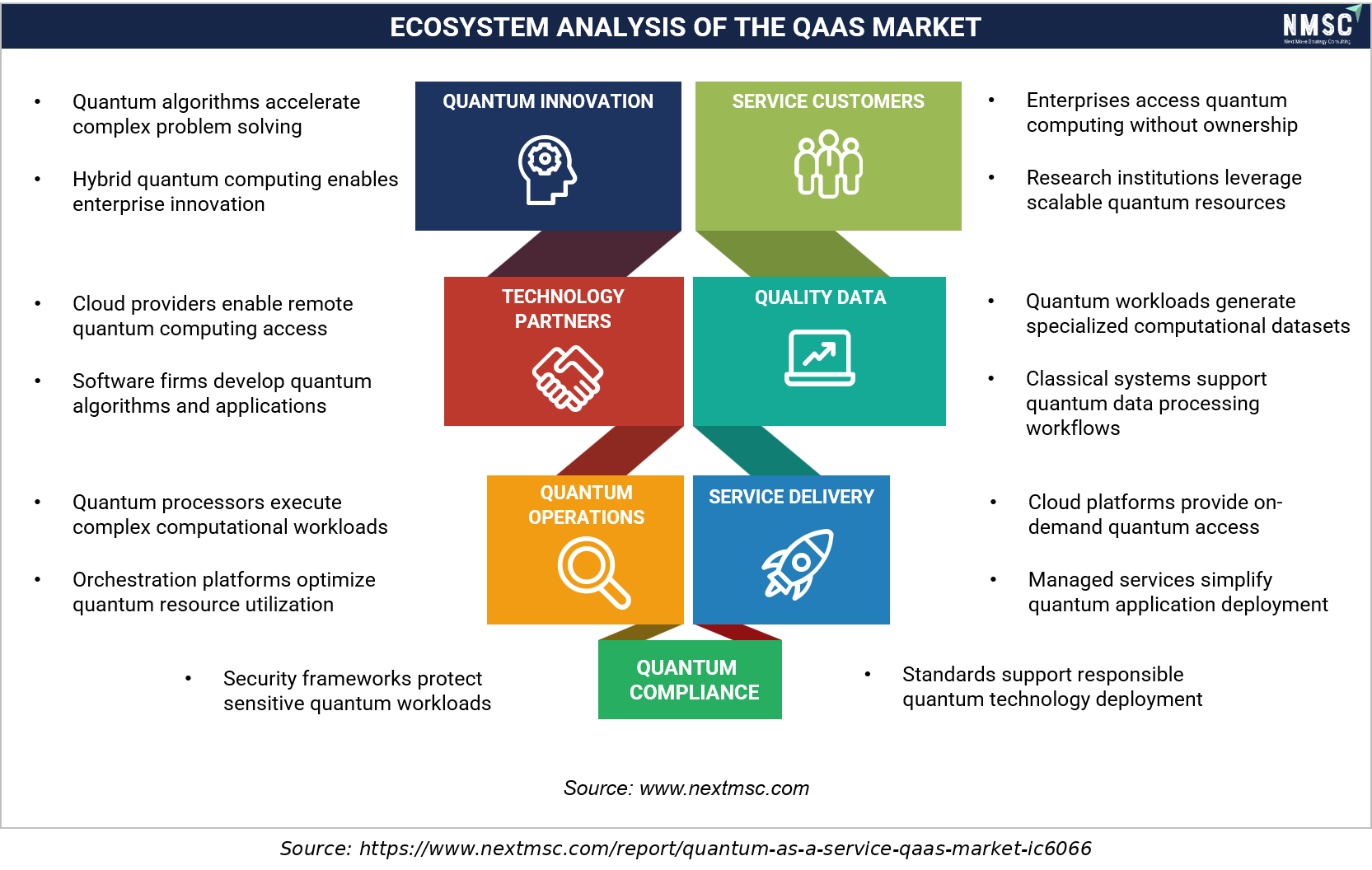
The above ecosystem analysis maps the key operational components, such as platform innovation, technology partners, testing operations, workload data, service delivery, security and compliance, and service customers, shaping the Quantum as a Service (QaaS) Market. From our analysis, we observed that platform innovation and technology partners drive service advancements, while testing operations and workload data ensure robust service assurance. Service delivery and security and compliance maintain operational standards, whereas service customers represent key end-users across the market ecosystem.

Market Drivers & Dynamics

Interactive Dataset
Rising enterprise adoption of quantum-linked optimization workloads driver +9.2% Global 2026–2035
Hyperscale cloud provider investment in quantum access infrastructure driver +8.4% North America, Asia-Pacific 2026–2035
Government-backed national quantum computing missions driver +6.1% Global 2026–2032
Growing demand for post-quantum cryptography validation tools driver +5.3% North America, Europe 2027–2035
Expansion of quantum machine learning pilot programs driver +4.7% Global 2026–2033
High cost of error-corrected quantum hardware access restraint −4.8% Global 2026–2030
Shortage of quantum-skilled software engineering talent restraint −3.6% Global 2026–2031
Fragmented hardware standards across qubit modalities restraint −2.9% Global 2026–2032
Data sovereignty restrictions on cross-border quantum cloud access restraint −2.1% Middle East & Africa, Asia-Pacific 2027–2035
Source: Next Move Strategy Consulting

Growth Drivers

What Is the Primary Growth Driver for the Quantum as a Service (QaaS) Market?

Rising enterprise adoption of quantum-linked optimization workloads is the primary growth driver, as firms pursue potential efficiency gains on selected complex problems. According to the U.S. National Science Foundation, federal quantum information science research funding continued expanding through 2025, supporting applied optimization research that feeds directly into commercial QaaS pilots. This funding-to-commercialization pipeline is shortening the path from academic demonstration to enterprise-ready service offerings.

How Is Hyperscale Cloud Investment Driving Market Growth?

Hyperscale cloud providers are driving market growth by embedding quantum access directly within existing enterprise cloud subscriptions, lowering adoption friction. We found that expanding data center capacity dedicated to quantum orchestration infrastructure is enabling faster provisioning of hybrid quantum-classical jobs, a structural advantage for vendors with existing enterprise cloud relationships over standalone quantum specialists.

Growth Inhibitors

What Is Restraining Quantum as a Service (QaaS) Market Growth?

The high cost of accessing error-corrected quantum hardware restrains broader market penetration, particularly among mid-sized enterprises with limited experimental budgets. Our assessment indicates that qubit-hour pricing on leading cloud platforms remains substantially higher than equivalent classical high-performance computing access, and the National Institute of Standards and Technology has noted that error-correction overhead continues to constrain practical qubit counts, limiting near-term commercial workload complexity.

What Are the Growth Opportunities?

How Can Quantum-as-a-Service Bundling With AI Platforms Unlock New Revenue?

Bundling quantum access with existing enterprise AI platform subscriptions creates a low-friction upsell mechanism for hyperscale cloud vendors, benefiting software and platform providers most directly. This mechanism lets vendors monetize quantum capability through existing enterprise billing relationships rather than requiring standalone procurement cycles, shortening sales timelines and lowering the internal approval burden that typically slows first-time enterprise quantum adoption decisions.

What Opportunity Exists in Sovereign Quantum Cloud Infrastructure?

Government-backed sovereign quantum cloud buildouts create a direct opportunity for regional integrators and consulting firms to capture public-sector contracts. Middle Eastern and Asia-Pacific government technology agencies stand to benefit as domestic quantum access reduces dependence on foreign cloud jurisdictions for sensitive workloads, while local integrators gain a durable, multi-year revenue channel tied to national digital sovereignty and data-residency priorities.

How Does Post-Quantum Migration Create Recurring Service Revenue?

Post-quantum cryptography migration aligned with regulatory and organizational transition timelines creates recurring, multi-year service engagements for consulting and integration providers. Enterprise security teams are the primary beneficiary segment, gaining structured migration roadmaps that reduce the risk of last-minute compliance gaps, while providers benefit from predictable, subscription-like revenue as migration work extends well beyond a single implementation cycle.

Segmentation Analysis

2025 (USD Billion)
2035 (USD Billion)
Quantum Hardware Access (QPU-as-a-Service) 2025: $1.52 Billion | 2035: $39.21 Billion
Quantum Hard
Software & Development Platforms 2025: $1.25 Billion | 2035: $51.28 Billion
Software & D
Consulting & Integration Services 2025: $1.70 Billion | 2035: $60.33 Billion
Consulting &
Quantum Hardware Access (QPU-as-a-Service) $1.52 Billion $39.21 Billion 38.4%
Software & Development Platforms $1.25 Billion $51.28 Billion 45.0%
Consulting & Integration Services $1.70 Billion $60.33 Billion 42.9%

Which Component Leads the Quantum as a Service (QaaS) Market?

The component axis defines how enterprises procure quantum capability, spanning hardware access, software platforms, and consulting or integration services. We observed that consulting and integration services lead in 2025 as enterprises rely on external expertise to translate business problems into quantum-executable workloads. Software and development platforms are the fastest-growing sub-segment at a 45.0% CAGR, driven by rising demand for no-code and low-code quantum programming environments that reduce reliance on specialized quantum physicists.

2025 (USD Billion)
2035 (USD Billion)
Public Cloud
Private Clou
Hybrid Cloud
Segment Item 2025 (USD Billion) 2035 (USD Billion) CAGR
Public Cloud $10.0 USD Billion $40.0 USD Billion 24.0%
Private Cloud $17.1 USD Billion $51.1 USD Billion 26.0%
Hybrid Cloud $24.2 USD Billion $62.2 USD Billion 12.0%

Segment-wise data is locked

Unlock complete segment-wise numbers for By Deployment Mode.

Unlock Full Data

Which Deployment Mode Dominates the Quantum as a Service (QaaS) Market?

The deployment mode axis captures how enterprises access quantum resources across public, private, and hybrid cloud environments. Public cloud dominates in 2025 as hyperscale providers offer the lowest barrier to entry for enterprise pilots. Our findings suggest that hybrid cloud is the fastest-growing sub-segment at a 48.0% CAGR, as regulated industries increasingly require quantum workloads to run alongside on-premises classical infrastructure to satisfy data residency and latency requirements.

2025 (USD Billion)
2035 (USD Billion)
Optimization
AI & Machine
Cryptography
Drug Discove
Financial Mo
Segment Item 2025 (USD Billion) 2035 (USD Billion) CAGR
Optimization Problems $10.0 USD Billion $40.0 USD Billion 15.0%
AI & Machine Learning $17.1 USD Billion $51.1 USD Billion 21.0%
Cryptography & Security $24.2 USD Billion $62.2 USD Billion 11.0%
Drug Discovery & Materials Simulation $31.3 USD Billion $73.3 USD Billion 21.0%
Financial Modeling & Risk Analysis $38.4 USD Billion $84.4 USD Billion 14.0%

Segment-wise data is locked

Unlock complete segment-wise numbers for By Application.

Unlock Full Data

Which Application Segment Leads the Quantum as a Service (QaaS) Market?

The application axis reflects the specific enterprise problems that quantum-linked workloads address, from optimization to cryptography. Optimization problems lead in 2025 given established use cases in logistics, scheduling, and portfolio construction. We found that AI and machine learning applications are the fastest-growing segment at a 45.8% CAGR, as enterprises increasingly pair quantum sampling techniques with classical AI training pipelines to accelerate model convergence on complex datasets.

2025 (USD Billion)
2035 (USD Billion)
BFSI
Government &
Healthcare &
IT & Telecom
Automotive &
Segment Item 2025 (USD Billion) 2035 (USD Billion) CAGR
BFSI $10.0 USD Billion $40.0 USD Billion 25.0%
Government & Defense $17.1 USD Billion $51.1 USD Billion 23.0%
Healthcare & Pharmaceuticals $24.2 USD Billion $62.2 USD Billion 9.0%
IT & Telecommunications $31.3 USD Billion $73.3 USD Billion 23.0%
Automotive & Manufacturing $38.4 USD Billion $84.4 USD Billion 24.0%

Segment-wise data is locked

Unlock complete segment-wise numbers for By End User.

Unlock Full Data

Growth Opportunities

Beyond current demand drivers, three forward-looking whitespace opportunities stand out for stakeholders positioning ahead of 2035.

How Can Quantum-as-a-Service Bundling With AI Platforms Unlock New Revenue?

Bundling quantum access with existing enterprise AI platform subscriptions creates a low-friction upsell mechanism for hyperscale cloud vendors, benefiting software and platform providers most directly. This mechanism lets vendors monetize quantum capability through existing enterprise billing relationships rather than requiring standalone procurement cycles, shortening sales timelines and lowering the internal approval burden that typically slows first-time enterprise quantum adoption decisions.

What Opportunity Exists in Sovereign Quantum Cloud Infrastructure?

Government-backed sovereign quantum cloud buildouts create a direct opportunity for regional integrators and consulting firms to capture public-sector contracts. Middle Eastern and Asia-Pacific government technology agencies stand to benefit as domestic quantum access reduces dependence on foreign cloud jurisdictions for sensitive workloads, while local integrators gain a durable, multi-year revenue channel tied to national digital sovereignty and data-residency priorities.

How Does Post-Quantum Migration Create Recurring Service Revenue?

Post-quantum cryptography migration aligned with regulatory and organizational transition timelines creates recurring, multi-year service engagements for consulting and integration providers. Enterprise security teams are the primary beneficiary segment, gaining structured migration roadmaps that reduce the risk of last-minute compliance gaps, while providers benefit from predictable, subscription-like revenue as migration work extends well beyond a single implementation cycle.

Regional Outlook

2025 (USD Billion)
2035 (USD Billion)
North Americ
Europe
Asia-Pacific
Middle East
Latin Americ
Region 2025 (USD Billion) 2035 (USD Billion) CAGR (%)
North America $10.0 USD Billion $40.0 USD Billion 9.0%
Europe $17.1 USD Billion $51.1 USD Billion 27.0%
Asia-Pacific $24.2 USD Billion $62.2 USD Billion 25.0%
Middle East & Africa $31.3 USD Billion $73.3 USD Billion 23.0%
Latin America $38.4 USD Billion $84.4 USD Billion 12.0%

Regional data is locked

Unlock complete regional numbers for this market.

Unlock Full Data

Porter's Five Forces Analysis of the Quantum as a Service (QaaS) Market

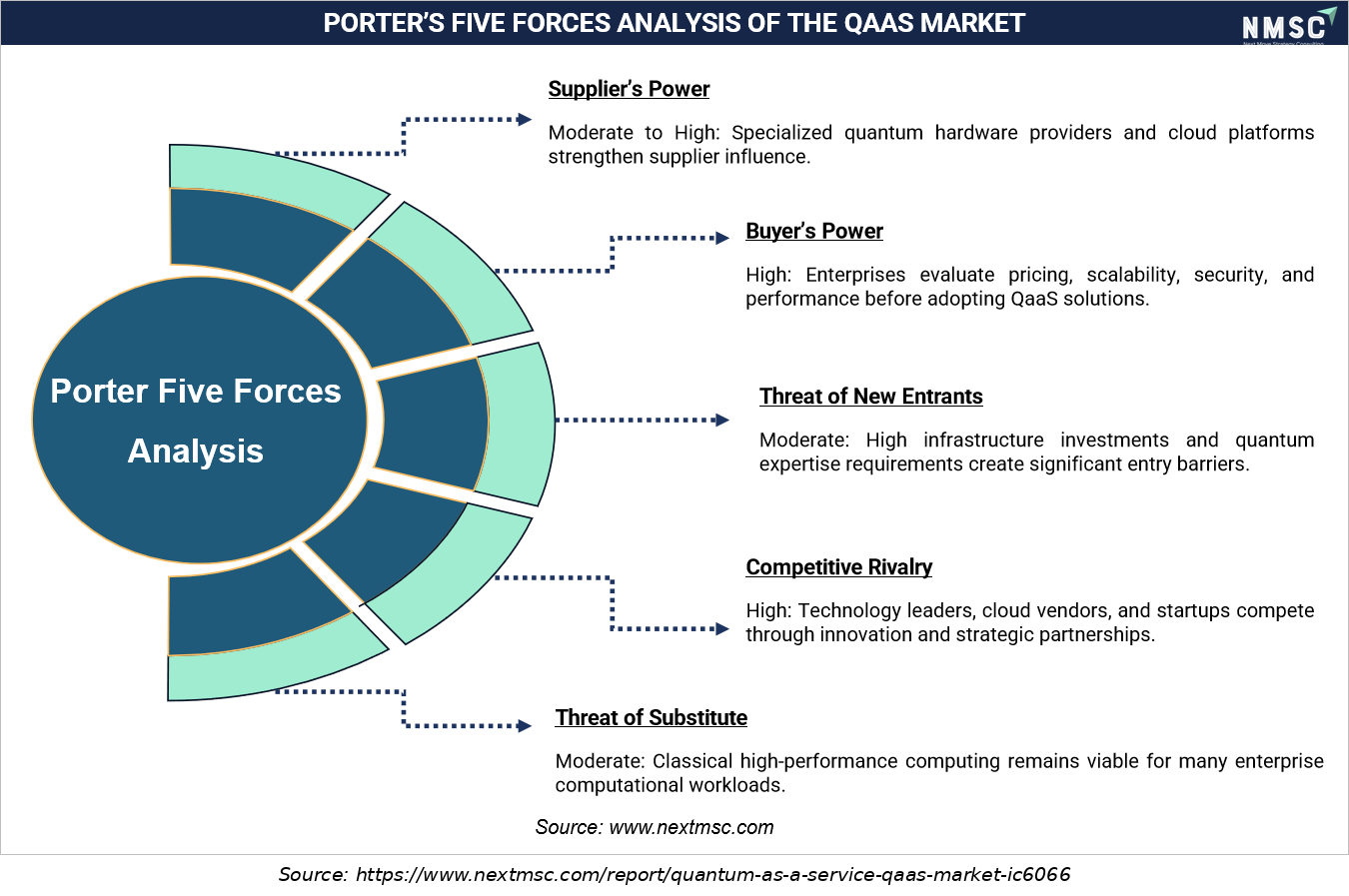
The above Porter's Five Forces analysis maps the key competitive forces, such as threat of new entrants, bargaining power of suppliers, bargaining power of buyers, threat of substitutes, and industry rivalry, shaping the Quantum as a Service (QaaS) Market. From our analysis, we observed that industry rivalry remains moderate with specialized quantum service providers competing, while the bargaining power of suppliers is influenced by technology platform dependencies. The threat of new entrants is limited by expertise and certification requirements, whereas the bargaining power of buyers is growing with enterprises demanding flexible quantum solutions, and the threat of substitutes remains moderate with in-house quantum teams as an alternative.

Competitive Landscape

Our findings suggest that the competitive landscape is moderately consolidated around a small group of hyperscale cloud providers, with a broader base of specialized hardware and software vendors competing on differentiated qubit modalities and developer tooling.

Dimension Description
Market Structure Moderately consolidated, with a small group of hyperscale cloud providers holding a significant share of platform-access revenue, while specialized quantum technology providers and emerging software companies compete across application and infrastructure layers.
Innovation Focus Concentrated on quantum error-correction advances, hybrid quantum-classical orchestration software, and developer-friendly quantum programming frameworks that simplify application development, improve system reliability, and expand accessibility for enterprise users.
M&A Activity Rising as cloud platform vendors and technology companies acquire specialized quantum software, algorithm, and infrastructure startups to accelerate application-layer capabilities, strengthen intellectual property portfolios, and expand their quantum computing ecosystems.

How Do Companies Compete in the Quantum as a Service (QaaS) Market?

Companies compete primarily on qubit access breadth, developer tooling maturity, and integration depth with existing enterprise cloud accounts. Our analysis shows that hyperscale cloud providers leverage existing enterprise billing relationships to reduce procurement friction, while specialized hardware vendors compete on qubit fidelity and modality-specific performance claims for targeted use cases such as optimization or chemistry simulation.

Which Competitive Archetypes Dominate the Quantum as a Service (QaaS) Market?

Two archetypes dominate: diversified hyperscale cloud platforms offering multi-vendor hardware marketplaces, and specialized quantum hardware developers offering direct proprietary access. We found that the marketplace archetype currently commands broader enterprise reach due to existing cloud relationships, while proprietary hardware developers differentiate through claimed qubit performance advantages in narrow, high-value application niches.

What Innovation and Differentiation Strategies Define Market Leadership?

Leading vendors are investing in error-mitigation software, no-code quantum development environments, and industry-specific application templates to lower enterprise adoption barriers. Next Move Strategy Consulting’s analysis indicates that vendors pairing hardware roadmap transparency with accessible software tooling are best positioned to convert research pilots into recurring commercial contracts.

How Active Is M&A in the Quantum as a Service (QaaS) Market?

Selected M&A activity is emerging as technology companies acquire specialized quantum hardware and software capabilities to strengthen their application-layer offerings. Further consolidation is possible as enterprises increasingly prefer single-vendor accountability over managing multiple specialized quantum suppliers directly.

Key Market Players

We observed that the following companies represent a set of leading Quantum as a Service providers active as of 2026.

International Business Machines Corporation Amazon.com, Inc. Microsoft Corporation Alphabet Inc. D-Wave Quantum Inc. IonQ, Inc. Rigetti Computing, Inc. Quantinuum LLC Xanadu Quantum Technologies Inc. PASQAL SAS QuEra Computing Inc. Baidu, Inc. Origin Quantum Computing Technology Co., Ltd. Fujitsu Limited Atos SE (Eviden) Oxford Quantum Circuits Ltd. Terra Quantum AG Infleqtion, Inc. QC Ware Corp. Alpine Quantum Technologies GmbH

Latest Developments

Our assessment indicates that recent developments reflect accelerating platform investment and expanding enterprise partnership activity across leading providers.

Date Event
March 2026 Rigetti plans to invest up to USD 100 million in the UK to deploy a 1,000+ qubit quantum computer, expanding its local quantum computing infrastructure and QCS capabilities.
June 2025 IonQ announced a definitive agreement to acquire UK-based Oxford Ionics for USD 1.075 billion, comprising approximately USD 1.065 billion in IonQ shares and USD 10 million in cash. The transaction is intended to strengthen quantum computing R&D in the UK, with IonQ planning to expand its Oxford workforce and continue collaboration with UK quantum institutions and government programs.

Investment Opportunities

How Are Capital Inflows Shaping the Quantum as a Service (QaaS) Market?

Capital inflows into quantum computing companies have accelerated, with the U.S. National Science Foundation continuing to expand quantum information science research grants through 2025. Our findings suggest that private capital is increasingly directed toward software and application-layer startups rather than hardware alone, reflecting investor recognition that near-term commercial revenue is concentrated in the services and software layers of the value chain.

What Infrastructure Investment Trends Are Emerging in the Quantum as a Service (QaaS) Market?

Infrastructure investment is concentrated in expanding hyperscale data center capacity dedicated to quantum orchestration and hybrid classical-quantum job scheduling. This buildout mirrors capacity expansion trends observed in the broader cloud networking software domain, where orchestration layer investment is similarly outpacing raw compute capacity additions as vendors prioritize workload efficiency.

What ESG Considerations Apply to Quantum as a Service Investment?

Environmental, social, and governance considerations are emerging around the substantial cooling and cryogenic energy requirements of superconducting quantum hardware. We found that leading providers are beginning to disclose data center energy sourcing commitments, and investors are increasingly weighing energy efficiency per qubit-hour alongside raw performance metrics when evaluating hardware vendor sustainability.

Key Benefits for Stakeholders

How Does This Report Benefit Enterprise Technology Leaders?

Enterprise technology leaders gain a structured view of segment-level growth rates and deployment mode adoption patterns, supporting informed build-versus-buy decisions for quantum pilot programs. The report’s regional and application-level forecasts help technology leaders prioritize investment toward the highest-return use cases within their industry vertical, while competitive landscape analysis clarifies which vendor archetypes are best suited to specific enterprise integration requirements.

How Does This Report Benefit Investors and Financial Analysts?

Investors and financial analysts gain access to validated market sizing, competitive positioning, and company-level rankings that support due diligence on both public and private quantum technology investments. The report’s growth driver and restraint analysis clarifies which structural factors are most likely to influence near-term commercial revenue trajectories, helping analysts distinguish sustainable growth segments from those more exposed to hardware-cost or talent-supply constraints.

How Does This Report Benefit Technology Vendors and Product Teams?

Technology vendors and product teams gain segment-level sizing that supports roadmap prioritization across hardware, software, and services offerings. The report’s regional outlook helps product teams sequence market-entry decisions based on regulatory maturity and competitive intensity across covered geographies, while the competitive landscape section benchmarks differentiation strategies that leading vendors are using to convert enterprise pilots into recurring commercial contracts.

Key Market Segments Evaluated

By Component

  • Quantum Hardware Access (QPU-as-a-Service)
  • Software & Development Platforms
  • Consulting & Integration Services

By Deployment Mode

  • Public Cloud
  • Private Cloud
  • Hybrid Cloud

By Application

  • Optimization Problems
  • AI & Machine Learning
  • Cryptography & Security
  • Drug Discovery & Materials Simulation
  • Financial Modeling & Risk Analysis
  • Others (Logistics, Weather Modeling)

By End User

  • BFSI
  • Government & Defense
  • Healthcare & Pharmaceuticals
  • IT & Telecommunications
  • Automotive & Manufacturing
  • Energy & Utilities
  • Others

Conclusion & Recommendations

The long-term outlook remains strongly positive, with the market projected to expand from USD 6.68 billion in 2026 to USD 150.82 billion by 2035 at a 42.1% CAGR. Our analysis shows that continued hardware maturation and expanding enterprise use cases will sustain elevated growth through the forecast period, even as the rate of expansion moderates gradually as the market scales.

What Strategic Positioning Should Vendors Pursue?

Vendors should prioritize hybrid cloud delivery and developer-accessible software tooling while pursuing partnerships with post-quantum cryptography specialists to secure long-term enterprise contracts. Our assessment indicates that providers combining hardware transparency with accessible application-layer tooling will be best positioned to capture premium enterprise engagements within the Quantum as a Service (QaaS) Market.

How Attractive Is the Quantum as a Service (QaaS) Market for New Investment?

The Quantum as a Service industry presents an attractive investment case, supported by a USD 144.14 billion absolute dollar opportunity between 2025 and 2035 and above-average growth in Asia-Pacific and hybrid cloud deployment categories. We found that investment attractiveness is highest for platform vendors combining broad enterprise cloud reach with scaled quantum hardware partnerships, positioning them to serve both experimental and production-grade enterprise segments simultaneously.

What Market Shifts and Key Risks Should Stakeholders Monitor?

Stakeholders should monitor talent shortages, fragmented hardware standards, and data sovereignty restrictions as key risks to the Quantum as a Service (QaaS) Market. Our analysis shows that vendors unable to adapt to regional data residency requirements risk losing enterprise contracts to competitors with established local cloud infrastructure, particularly within Asia-Pacific’s increasingly regulated digital economy environment.

What Are the Key Growth Pathways for the Quantum as a Service (QaaS) Market?

Key growth pathways include expanding hybrid cloud service portfolios, scaling post-quantum cryptography migration services, and deepening penetration into healthcare and financial services optimization use cases. Next Move Strategy Consulting’s analysis indicates that vendors pursuing these pathways while maintaining accessible pricing for mid-sized enterprises will be best positioned to capture the Quantum as a Service (QaaS) Market’s projected growth through 2035.

FAQs

About the Author

Saista Faiyaz

Saista Faiyaz

Saista Faiyaz is Research Associate at Next Move Strategy Consulting, where she has covered consumer markets and healthcare technologies for 3 years. Her work includes primary interview review, secondary-source validation, market sizing, and structured analysis of company and industry data. She supports research by comparing evidence across sources, organizing findings into market narratives, and documenting assumptions used in analysis. Her scope includes cross-market benchmarking, and reports.

About the Reviewer

Supradip Baul

Supradip Baul

Supradip Baul is an accomplished business consultant and strategist with over a decade of rich experience in market intelligence, strategy, technology, and business transformation. His work has included rigorous qualitative and quantitative analysis across multiple industries, helping clients shape investment decisions and long-term roadmaps. Earlier in his career, he was associated with Gartner, where he contributed to industry-leading reports and market share analyses. He has worked with leading global companies and holds an MBA with a dual specialization in Marketing and Finance.

Download Free Sample

Mohit Agarwal

MOHIT AGARWAL

Chief Manager

DryChem India Pvt. Ltd.

Next Move Strategy Consulting is an amazing team of consultants. We required a market study report for our investors on top priority and the team went above and beyond our expectations to deliver the same with ample supporting data within a short time span enabling us to secure the investments and keep our project timeline maintained. Their professionalism, attention to detail, and timely delivery of actionable recommendations have left a lasting impression on our organization.

Ross J Mckenzie

ROSS J MCKENZIE

Business Insight Manager

Staysure Group

“Next MSC have been incredibly helpful in providing detailed & robust information on our market, alongside quantifying growth by different segments. The process to procure was simple and easy, with sample reports and regular contact to ensure we had what we needed. Succinct detail on their sources & methodologies is also greatly received, allowing transparency in this respect helps build trust in the detail you pay for. Joseph in particular was fantastic, and helped ensure efficient provision of the insight pack – thank you NMSC!”.

Kevin Coker

KEVIN COKER

Founder, CEO and Board Diector

Proxima Clinical Research

I have been using Next MSC reports for product positioning in a new geography for a long time. They have by far the best reports I have found and the price is reasonable too!

Melanie Samko

MELANIE SAMKO

Director of Marketing

TOSOH BIOSCIENCE, INC.

The information provided by NMSC is incredibly valuable, thank you so much for such a excellent work. I really appreciate it. I will make sure to reference all of it, in my summary document.

Nishant Awate

NISHANT AWATE

Business Development Global Sales

Zehnder Group Deutschland GmbH

Our experience working with Next Move Strategy Consulting was positive. The team was responsive, professional, and open to incorporating our specific requirements throughout the project. The India AHU market study was comprehensive and well structured, covering market value and volume forecasts, product and application segments, and key industry trends. The inclusion of both AHU and residential MVHR market insights made the study particularly relevant for our strategic market assessment. Overall, the report provides a solid foundation for evaluating market potential, identifying priority segments, and supporting business-development decisions in India.

Custom Market Research Services

We will customize the research for you if the listed report does not fully match your requirements.

Get 30% Free Customization

Select License

This website uses cookies to ensure you get the best experience on our website. Learn more

✖