Security as a Service Market Size, Share, Growth & Forecast By Security Function (Identity Security, Endpoint Security, Network Security, Cloud Security), By Revenue Stream (Subscription, Managed Service), By Deployment Model (Public Cloud), By Buyer Size and Type (Small Business, Mid Market, Enterprise), By Sales Channel (Direct, Partner Led, Self Serve and Marketplace), and By End User Industry (Financial Services, Healthcare, Government and Defense) — Global Analysis 2025–2035
Industry: ICT & Media | Publishing Date: July 7, 2026 | Last Updated: September 30, 2026 | No of Pages: N/A | No. of Tables: N/A | No. of Figures: N/A | Format: PDF | Report Code: IC5011
What Is the Security as a Service Market Size?
The global Security as a Service Market was valued at USD 21.6 billion in 2025 and is expected to reach USD 25.1 billion in 2026. Accelerating cloud adoption, a surge in sophisticated cyber threats, and the transition from on-premises security appliances to cloud-delivered managed security models are projected to propel the market to USD 98.4 billion by 2035, advancing at a CAGR of 16.4% from 2026 to 2035. Key growth drivers include enterprise-wide zero trust architecture deployments, expanding attack surfaces driven by hybrid work and IoT proliferation, stringent data privacy regulations mandating continuous compliance monitoring, and rising demand for Security Operations Center capabilities delivered as fully managed cloud services.
|
Parameters |
Details |
|
Market Size in 2025 |
USD 21.6 Billion |
|
Market Size in 2026 |
USD 25.1 Billion |
|
Revenue Forecast in 2035 |
USD 98.4 Billion |
|
Growth Rate |
CAGR of 16.4% from 2026 to 2035 |
|
Analysis Period |
2025–2035 |
|
Base Year Considered |
2025 |
|
Forecast Period |
2026–2035 |
|
Market Size Estimation |
Billion USD |
|
Companies Profiled |
20 |
|
Countries Covered |
33 |
|
Market Share |
Top 10 |
Security as a Service Market Overview
What Is the Security as a Service Market?
Security as a Service (SECaaS) is a cloud-based delivery model through which organizations subscribe to cybersecurity capabilities, tools, and managed services rather than acquiring and operating security infrastructure on-premises. The Security as a Service Market encompasses a broad spectrum of functions including identity and access management, endpoint detection and response, network security, cloud security posture management, email protection, data loss prevention, security operations, vulnerability management, and governance, risk, and compliance. NMSC's analysis indicates that this model enables enterprises to achieve continuous security coverage, scalable threat detection, and managed compliance without the capital expenditure and talent overhead traditionally required for in-house security operations.
How Has the Security as a Service Market Evolved?
The Security as a Service Market has evolved through three distinct structural phases. The first phase, spanning approximately 2010 to 2016, focused on basic cloud-delivered endpoint protection and managed firewall services targeting small and mid-market organizations. The second phase, from 2016 to 2022, was characterized by the emergence of cloud-access security brokers, software-defined wide area network integration, and the first generation of cloud-native SIEM platforms. Through our market assessment, we observed that the current third phase, beginning around 2023, is defined by AI-native security platforms, zero trust network access architectures, unified security data platforms, and the convergence of detection, response, and exposure management into integrated SECaaS suites delivered by a narrowing set of dominant platform vendors.
How Do Regulations Influence the Security as a Service Market?
Regulatory compliance requirements represent one of the most powerful structural demand drivers across the Security as a Service Market. The European Union's General Data Protection Regulation, the U.S. Health Insurance Portability and Accountability Act, the Payment Card Industry Data Security Standard, the Cybersecurity Maturity Model Certification program, and the U.S. Securities and Exchange Commission's cyber incident disclosure rules collectively compel enterprises to maintain verifiable, continuous security controls. From our research, we found that the EU NIS2 Directive, effective October 2024, has substantially expanded the universe of regulated entities across Europe that are now obligated to implement minimum-security baselines, accelerating demand for managed detection, incident response, and vulnerability management services delivered as cloud subscriptions.
How Is Technology Adoption Expanding Across the Security as a Service Market?
Technology adoption across the Security as a Service Market is accelerating as enterprises retire legacy hardware-based security stacks and migrate to cloud-native security architectures. Based on NMSC's research, we found that the consolidation of security capabilities onto unified platforms combining endpoint, identity, network, and cloud security into single vendor panes is reducing tool sprawl and lowering total cost of ownership. Extended Detection and Response (XDR) platforms, Security Service Edge architectures, and AI-powered threat intelligence are among the most rapidly adopted technology categories. Mid-market and SMB segments are particularly benefiting from the self-service and marketplace delivery models that eliminate procurement complexity and reduce time-to-protection significantly.
|
Key Takeaways |
|
By Security Function, Network Security held the largest share of the Security as a Service (SECaaS) Market, generating USD 5.4 billion in 2025. Cloud Security emerged as the fastest-growing primary security function, projected to increase from USD 3.8 billion in 2025 to USD 20.6 billion by 2035, registering a CAGR of 20.7% during the forecast period. |
|
By Security Function, Governance, Risk and Compliance (GRC) and Other Security (OT/IoT Security and Deception Technology) are the fastest-growing security function categories, each expected to grow at a CAGR of 21.3% from 2026 to 2035, driven by increasing regulatory compliance requirements and the growing need to secure connected operational technology environments. |
|
By Revenue Stream, Subscription-based offerings dominated the market with USD 11.8 billion in revenue in 2025, reflecting strong enterprise preference for predictable recurring security expenditures. Managed Services represent the fastest-growing revenue stream and are forecast to expand at a CAGR of 21.1% through 2035, supported by growing demand for outsourced security operations and managed detection and response services. |
|
By Deployment Model, Public Cloud led the market with USD 14.2 billion in 2025. Hybrid Cloud is anticipated to be the fastest-growing deployment model, advancing at a CAGR of 22.0% from 2026 to 2035, as enterprises balance cloud scalability with regulatory and data residency requirements. |
|
By Buyer Size and Type, Enterprise organizations accounted for the largest share with USD 9.8 billion in 2025. The Mid-Market segment is expected to register the highest growth rate at a CAGR of 20.7%, driven by increasing adoption of managed security services and cloud-based security platforms. |
|
By Sales Channel, Partner-Led distribution remained the dominant channel, generating USD 10.4 billion in 2025, supported by the strong role of managed security service providers, value-added resellers, and system integrators. Self-Serve and Marketplace channels are projected to be the fastest-growing, with a CAGR of 20.2%, as cloud marketplaces streamline procurement and deployment. |
|
By End User Industry, Financial Services represented the largest vertical, contributing USD 4.8 billion in 2025. Healthcare is expected to be the fastest-growing industry segment, expanding at a CAGR of 23.6%, driven by rising ransomware attacks, increasing healthcare digitization, and stringent data protection requirements. |
|
North America held the largest regional share of the Security as a Service Market at USD 9.8 billion in 2025 and is projected to reach USD 43.2 billion by 2035, growing at a CAGR of 17.9%, supported by high cybersecurity spending, mature MSSP ecosystems, and strong regulatory frameworks. |
|
Asia-Pacific is the fastest-growing major region in the Security as a Service Market, projected to expand from USD 4.2 billion in 2025 to USD 22.8 billion by 2035 at a CAGR of 20.7%, driven by rapid digital transformation, cloud adoption, and expanding cybersecurity regulations across key economies. |
|
The United States is the largest national market within the Security as a Service Market, accounting for more than 75% of North American revenue in 2025, supported by the world's highest enterprise cybersecurity spending levels and the presence of leading SECaaS vendors. |
|
India is the fastest-growing country market in Asia-Pacific, projected to grow at a CAGR of 24.6% through 2035, driven by CERT-In cybersecurity directives, increasing cloud adoption, digital banking expansion, and rising enterprise demand for managed security operations. |
Key Emerging Trends in the Security as a Service Market
How Is AI-Powered Threat Detection Transforming the Security as a Service Market?
Artificial intelligence is fundamentally reshaping threat detection and response capabilities within the Security as a Service Market. NMSC's analysis indicates that vendors such as CrowdStrike, Microsoft, and Palo Alto Networks have embedded machine learning models directly into endpoint, identity, and network security telemetry pipelines, enabling sub-second threat correlation that was previously impossible with human-operated SIEM platforms. CrowdStrike's Charlotte AI co-pilot demonstrates the practical deployment of generative AI within security operations workflows, accelerating analyst triage and investigation tasks. This transformation is driving consolidation toward AI-native SECaaS platforms and compelling legacy managed security providers to accelerate platform modernization to remain competitive.
How Is Zero Trust Architecture Adoption Reshaping the Security as a Service Market Ecosystem?
Zero trust architecture, underpinned by the principle that no user, device, or network segment is inherently trusted, has emerged as the foundational design philosophy driving Security as a Service Market evolution. From our assessment, the U.S. federal government's Zero Trust Strategy, published by the Office of Management and Budget, has institutionalized zero trust requirements across all federal agencies, creating a direct procurement mandate for SECaaS capabilities including Zero Trust Network Access, Identity Governance, and Privileged Access Management. Enterprise buyers are increasingly consolidating identity and network security onto integrated zero trust platforms, compressing the total number of security vendors and accelerating average contract values within the market.
What Role Is Security Service Edge Playing in the Evolution of the Security as a Service Market?
Security Service Edge, which converges Secure Web Gateway, Cloud Access Security Broker, and Zero Trust Network Access into a unified cloud-delivered architecture, is one of the defining platform categories reshaping the Security as a Service Market. Based on our market evaluation, vendors including Zscaler, Netskope, and Palo Alto Networks' Prisma Access have captured significant enterprise adoption by replacing legacy hardware-based web and network security stacks with cloud-native service edge architectures. Enterprises distributed across multiple sites, hybrid work environments, and multi-cloud deployments benefit from SSE by replacing appliance refresh cycles with subscription-based security policies applied uniformly at the cloud edge, regardless of user location.
How Is Autonomous Security Operations Center Development Influencing the Security as a Service Market?
The emergence of autonomous and AI-augmented Security Operations Centers represents a major structural trend across the Security as a Service Market. Our findings suggest that the chronic global shortage of qualified cybersecurity analysts, estimated by the International Information System Security Certification Consortium (ISC2) at over 4 million unfilled positions globally, is compelling enterprises to accelerate adoption of AI-driven SOAR, SIEM, and MDR platforms that automate tier-1 and tier-2 analyst tasks. Vendors delivering SOC as a Service and Managed Detection and Response capabilities are experiencing the strongest demand growth within the Security Operations segment, as organizations recognize that building and staffing internal 24x7 security operations is neither cost-effective nor achievable given talent market constraints.
Regulatory Framework Impacting the Security as a Service Market
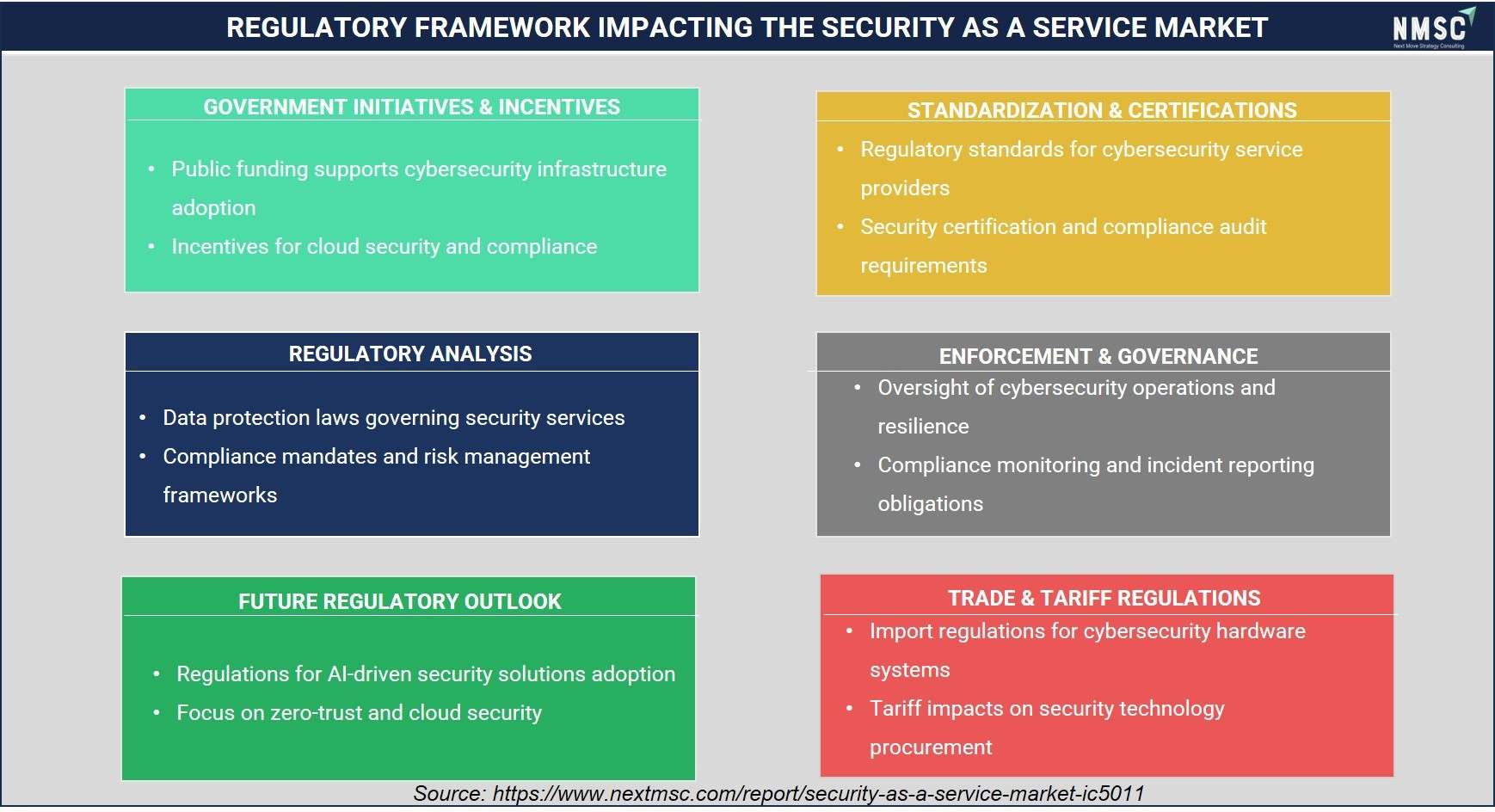
The regulatory framework impacting the Security as a Service (SECaaS) Market is shaped by cybersecurity laws, compliance mandates, and industry standards that ensure secure service delivery and data protection. Governments support adoption through funding programs and cloud security incentives, while certification requirements strengthen trust and accountability. Regulatory authorities oversee compliance monitoring, incident reporting, and operational resilience. Future regulations are expected to focus on AI-driven security solutions, zero-trust architectures, and cloud security governance, while trade policies and tariffs continue to influence cybersecurity technology procurement and deployment.
What Are the Key Market Drivers, Breakthroughs, and Investment Opportunities that Will Shape the Security as a Service Market in the Next Decade?
|
Drivers / Trends / Restraints |
(+/-) % Impact on CAGR Forecast |
Geographic Relevance |
Impact Timeline |
|
Escalating Ransomware and Advanced Persistent Threats |
+2.4% |
Global (led by North America, Europe) |
2025–2035 |
|
Enterprise Zero Trust Architecture Mandates |
+2.0% |
North America, Europe, APAC |
2025–2032 |
|
Cloud and SaaS Expansion Driving Attack Surface Growth |
+1.8% |
Global (all regions) |
2025–2035 |
|
AI-Native Security Platform Consolidation |
+1.6% |
North America, Europe, APAC |
2025–2030 |
|
Regulatory Compliance Mandates (NIS2, CMMC, SEC) |
+1.4% |
North America, Europe |
2025–2030 |
|
Cybersecurity Talent Shortage Driving MSS Demand |
+1.2% |
Global |
Ongoing |
|
High Implementation Complexity for Legacy Enterprises |
-1.0% |
Europe, APAC Mid-market |
2025–2028 |
|
Data Sovereignty and Cross-Border Compliance Friction |
-0.8% |
Europe, MEA, APAC |
Ongoing |
|
Vendor Lock-in Concerns Slowing Platform Consolidation |
-0.6% |
All regions |
2025–2028 |
|
MSSP Channel Expansion and Marketplace Distribution |
+1.3% |
Global |
2025–2035 |
|
Healthcare and Critical Infrastructure Security Investment |
+1.0% |
North America, Europe, APAC |
2026–2035 |
What Are the Growth Drivers of the Security as a Service Market?
How Is the Global Escalation of Ransomware and Cyberattacks Driving Security as a Service Market Growth?
Ransomware and advanced persistent threat campaigns represent the most immediate and quantifiable demand driver for Security as a Service Market expansion. The Federal Bureau of Investigation's Internet Crime Complaint Center (IC3) reported losses exceeding USD 16 billion from cybercrime in 2023 in the United States alone, with ransomware incidents targeting critical infrastructure, healthcare, and financial services at record frequency. Our analysis shows that the cost and operational disruption associated with these attacks is compelling boards of directors and executive leadership teams to authorize elevated security spending, with cloud-delivered detection, response, and backup services emerging as the primary beneficiaries of this investment acceleration throughout the forecast period.
How Are Government Mandates and Regulatory Compliance Requirements Fueling Demand for Security as a Service?
Government-driven regulatory frameworks are structurally expanding the addressable market for Security as a Service solutions. The U.S. Cybersecurity and Infrastructure Security Agency's Binding Operational Directive 22-01 mandates timely remediation of known exploited vulnerabilities across all federal civilian agencies, creating direct procurement demand for vulnerability management and patch management services delivered as managed subscriptions. Similarly, the EU's NIS2 Directive, which entered into force in October 2024, has expanded mandatory cybersecurity requirements to over 160,000 additional entities across Europe, substantially broadening the regulatory compliance demand base for managed security services across the Security as a Service Market.
How Is the Proliferation of Cloud Services and Remote Work Expanding the Security as a Service Market?
The sustained enterprise migration to SaaS applications, infrastructure-as-a-service platforms, and hybrid work environments is geometrically expanding the attack surface that organizations must defend, creating structural and durable demand for Security as a Service capabilities. Based on NMSC's research, we found that as applications move from the corporate data center to cloud environments, traditional perimeter-based security architectures lose effectiveness, compelling enterprises to adopt cloud-delivered security controls that apply consistent policy enforcement irrespective of where users, devices, and applications reside. This secular shift from hardware-based to cloud-delivered security is the single most important structural driver of long-term Security as a Service Market revenue growth through 2035.
What Are the Growth Inhibitors of the Security as a Service Market?
How Does Integration Complexity with Legacy Security Infrastructure Constrain Security as a Service Market Adoption?
Despite the operational benefits of Security as a Service delivery, organizations with extensive legacy on-premises security investments face significant integration complexity when migrating to cloud-delivered security architectures. The U.S. Government Accountability Office has documented comparable integration challenges in federal agency cloud security migrations, noting that data pipeline complexity, identity federation, and log format normalization requirements extend migration timelines and increase total transition costs. Our assessment indicates that mid-market enterprises in particular face this constraint, as their existing security tooling investments are partially depreciated and the business case for full platform migration requires longer payback periods than smaller or fully cloud-native organizations encounter.
How Do Data Sovereignty and Residency Requirements Limit Security as a Service Market Expansion in Certain Regions?
Data sovereignty regulations in the European Union, the Gulf Cooperation Council, India, and Southeast Asia impose strict requirements on where security telemetry, log data, and threat intelligence may be processed and stored, creating operational and commercial friction for global SECaaS platform providers. The European Data Act and GDPR restrict certain cross-border transfers of personal and operational data, including security event logs that may contain personal information. Through our analysis, we observed that vendors without locally deployed security data processing infrastructure in these regulated markets face competitive disadvantage in enterprise procurement processes, increasing the capital requirements for global platform buildout and compressing achievable addressable market share in high-growth regulated regions.
SWOT Analysis of the Security as a Service Market
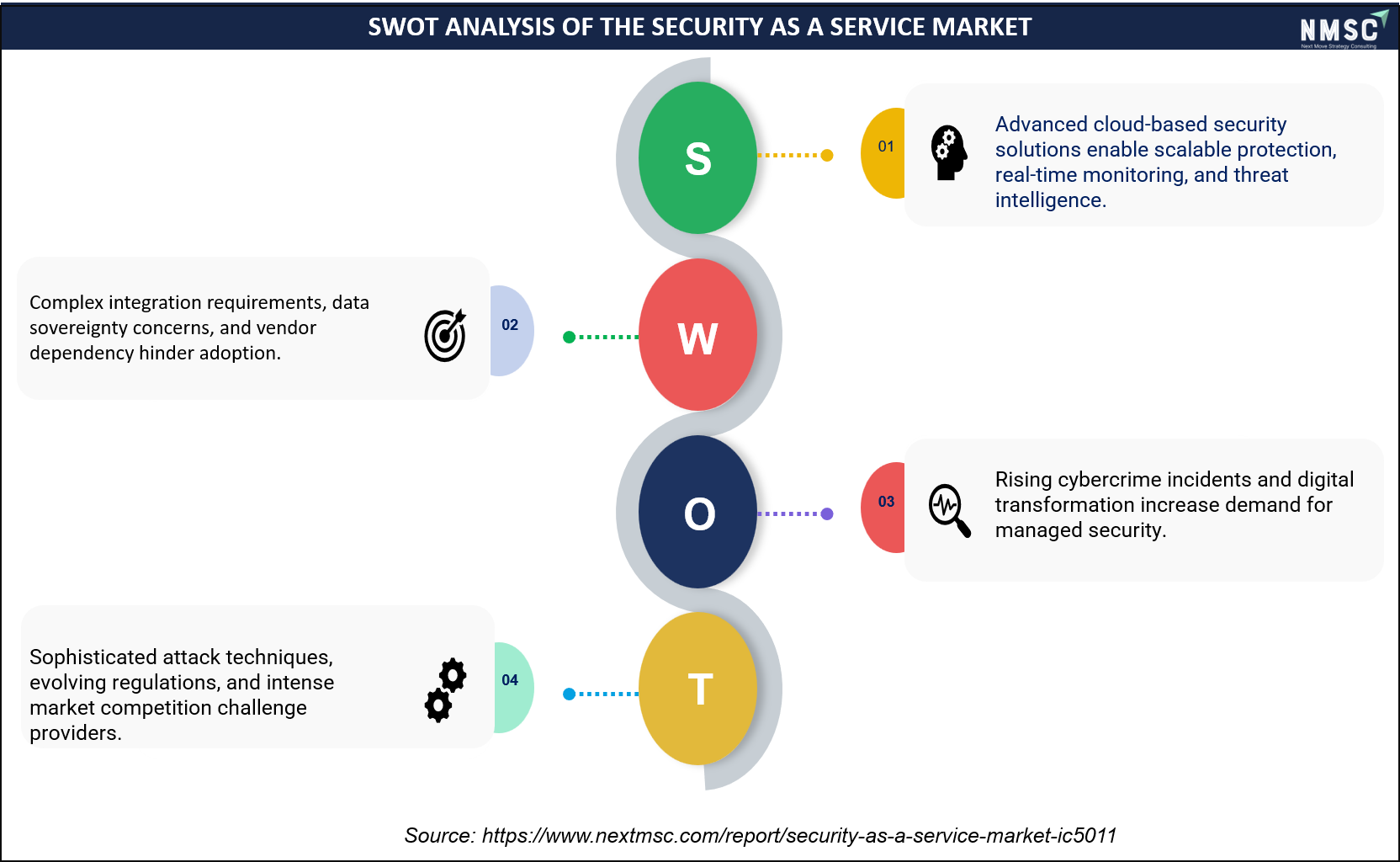
The SWOT analysis highlights the key factors influencing the growth and competitiveness of the Security as a Service (SECaaS) Market. The market's primary strength lies in its scalable cloud-based security capabilities, offering real-time threat monitoring and advanced protection. However, challenges such as integration complexity, data sovereignty concerns, and vendor dependency may hinder adoption. Growing cybercrime threats and accelerating digital transformation create significant opportunities for market expansion, while evolving attack techniques, stringent regulatory requirements, and intense competition among providers present ongoing threats. Overall, the market remains well-positioned for growth as organizations increasingly prioritize cybersecurity resilience and managed security services
What Are the Growth Opportunities in the Security as a Service Market?
How Does the Global Cybersecurity Talent Shortage Create a Multi-Billion Dollar Opportunity in the Security as a Service Market?
The structural deficit in qualified cybersecurity professionals globally is perhaps the most durable and commercially significant demand catalyst for managed and cloud-delivered security services. The International Information System Security Certification Consortium (ISC2) estimated in its 2023 Cybersecurity Workforce Study that the global cybersecurity talent gap stood at approximately 4 million unfilled positions, with demand consistently outpacing the supply of trained professionals. Our findings suggest that this talent constraint is compelling organizations of all sizes to substitute internal security operations capacity with managed detection and response, SOC as a Service, and security awareness training delivered through the Security as a Service Market, creating a structural and expanding revenue opportunity that is expected to persist through the entire 2025 to 2035 forecast period.
How Does the Healthcare and Critical Infrastructure Security Investment Wave Create Opportunity in the Security as a Service Market?
Healthcare and critical infrastructure sectors represent the highest-growth vertical opportunity within the Security as a Service Market, driven by a convergence of escalating threat activity, regulatory pressure, and operational technology security requirements. The U.S. Department of Health and Human Services Office for Civil Rights has recorded a continuous increase in healthcare data breach disclosures under HIPAA, with ransomware accounting for the majority of major incidents targeting hospitals and health systems. Our analysis shows that healthcare organizations, which historically under-invested in cybersecurity relative to their threat exposure, are now accelerating procurement of managed endpoint protection, email security, and identity management services delivered through the Security as a Service model to address compliance obligations and operational resilience requirements.
How Are MSSP Ecosystems and Cloud Marketplace Channels Creating New Distribution Opportunities in the Security as a Service Market?
Managed Security Service Provider ecosystems and cloud hyperscaler marketplace channels are emerging as high-velocity distribution accelerators for Security as a Service vendors. The U.S. General Services Administration's FedRAMP program has established a structured marketplace pathway enabling SECaaS vendors with federal authorization to access the multi-billion dollar U.S. federal security spending budget through streamlined procurement processes. Based on our market evaluation, we noticed that AWS Security Hub, Microsoft Sentinel, and Google Chronicle have created integrated marketplace environments where enterprises can consume and operationalize third-party security services within existing cloud spend commitments, substantially reducing procurement friction and accelerating land-and-expand motions for SECaaS platform vendors targeting mid-market and enterprise buyer segments.
How Is the Security as a Service Market Segmented in This Report, and What Are the Key Insights from the Segmentation Analysis?
Which Security Functions Are Generating the Most Revenue in the Security as a Service Market?
|
Security Function Segment |
2025 (USD Bn) |
2035 (USD Bn) |
CAGR (%) |
|
Identity Security |
3.2 |
15.8 |
19.4% |
|
Endpoint Security |
3.8 |
17.6 |
18.6% |
|
Network Security |
5.4 |
22.4 |
17.1% |
|
Cloud Security |
3.8 |
20.6 |
20.7% |
|
Application Security |
1.0 |
3.8 |
16.0% |
|
Email Security |
1.2 |
3.6 |
13.0% |
|
Data Security |
0.9 |
3.4 |
15.9% |
|
Security Operations |
1.0 |
4.1 |
17.0% |
|
Exposure Management |
0.4 |
2.0 |
19.6% |
|
Governance, Risk and Compliance |
0.3 |
1.7 |
21.3% |
|
Other Security (OT/IoT, Deception) |
0.6 |
3.4 |
21.3% |
How Do Revenue Stream Models Reflect the Commercial Structure of the Security as a Service Market?
|
Revenue Stream Segment |
2025 (USD Bn) |
2035 (USD Bn) |
CAGR (%) |
|
Subscription |
11.8 |
52.4 |
18.0% |
|
Managed Service |
6.4 |
35.8 |
21.1% |
|
Support and Maintenance |
2.2 |
7.2 |
14.1% |
|
Other Recurring Revenue |
1.2 |
3.0 |
10.7% |
Through our market assessment, we observed that the Security as a Service Market is structured across four primary revenue stream categories. The Subscription segment dominates, driven by enterprises' preference for predictable annual or multi-year security service commitments that align with corporate budgeting cycles and provide continuous coverage without renewal gaps. Managed Service revenue is the fastest-growing stream, reflecting enterprises' accelerating transition to fully outsourced security operations where the vendor provides staffed 24x7 monitoring, detection, and response capabilities alongside the underlying security technology. Support and Maintenance revenue, while growing more slowly, remains commercially significant as a recurring revenue layer for legacy security product vendors transitioning their installed base to cloud-delivered architectures.
How Does Deployment Model Selection Reflect Enterprise Security Architecture Priorities?
|
Deployment Model Segment |
2025 (USD Bn) |
2035 (USD Bn) |
CAGR (%) |
|
Public Cloud |
14.2 |
61.4 |
17.7% |
|
Private Cloud |
4.6 |
20.2 |
17.9% |
|
Hybrid Cloud |
2.8 |
16.8 |
22.0% |
From our assessment of enterprise security architecture modernization trends, we observed that the Security as a Service Market is structured across three primary deployment model categories. Public Cloud deployment dominates, driven by the scalability, global distribution, and native integration with hyperscaler security ecosystems that public cloud platforms provide. Hybrid Cloud deployment is the fastest-growing model, reflecting the operational reality that regulated enterprises in financial services, healthcare, and government must maintain on-premises security controls for specific sensitive workloads while simultaneously consuming cloud-delivered SECaaS capabilities for the majority of their security operations. Private Cloud deployment remains commercially relevant among high-security enterprises, particularly in defense, intelligence, and sovereign financial sectors that require dedicated security telemetry processing environments without shared infrastructure exposure.
How Does Buyer Size Influence Security as a Service Market Adoption Patterns?
|
Buyer Size and Type Segment |
2025 (USD Bn) |
2035 (USD Bn) |
CAGR (%) |
|
Small Business |
2.2 |
11.8 |
20.5% |
|
Mid Market |
5.4 |
29.4 |
20.7% |
|
Enterprise |
9.8 |
42.6 |
17.7% |
|
Public Sector |
2.8 |
10.2 |
15.4% |
|
Service Provider |
1.4 |
4.4 |
13.6% |
In our analysis of enterprise technology procurement patterns and cybersecurity investment trends, we observed that the Security as a Service Market is segmented into Small Business, Mid Market, Enterprise, Public Sector, and Service Provider buyer categories. The Enterprise segment holds the largest revenue share, reflecting large organizations' multi-million dollar annual security budgets and complex, multi-function security requirements. The Mid Market segment is the fastest-growing buyer category, driven by MSSP-packaged SECaaS offerings that deliver enterprise-grade security capabilities at subscription price points accessible to organizations with limited internal security teams. Small Business adoption is also expanding rapidly as self-serve and marketplace channels eliminate minimum commitment barriers and provide pre-configured security bundles that require minimal technical implementation expertise for the Security as a Service Market.
How Are Sales Channels Shaping Go-to-Market Strategies in the Security as a Service Market?
|
Sales Channel Segment |
2025 (USD Bn) |
2035 (USD Bn) |
CAGR (%) |
|
Direct |
7.2 |
28.8 |
16.7% |
|
Partner Led |
10.4 |
48.6 |
18.7% |
|
Self Serve and Marketplace |
4.0 |
21.0 |
20.2% |
Our findings suggest that the Security as a Service Market operates across three primary sales channel structures. The Partner Led channel holds the largest revenue share, driven by the critical role of MSSPs, value-added resellers, and system integrators in packaging, delivering, and managing security services for enterprise and mid-market clients who prefer outsourced accountability for security operations. Direct sales channel volume reflects enterprise buyers' preference for vendor-managed relationships on complex, multi-function platform deployments requiring deep technical and commercial engagement. The Self Serve and Marketplace channel is the fastest-growing distribution approach within the Security as a Service Market, as cloud hyperscaler security marketplaces enable organizations to discover, evaluate, and activate SECaaS services within their existing cloud consumption commitments, significantly reducing procurement friction.
Which End User Industries Are Driving the Most Security as a Service Market Revenue?
|
End User Industry Segment |
2025 (USD Bn) |
2035 (USD Bn) |
CAGR (%) |
|
Financial Services |
4.8 |
21.4 |
18.1% |
|
Healthcare |
2.4 |
16.2 |
23.6% |
|
Government and Defense |
2.8 |
11.4 |
16.9% |
|
IT and Telecom |
3.6 |
16.8 |
18.7% |
|
Retail |
1.8 |
8.6 |
19.0% |
|
Manufacturing |
2.2 |
9.8 |
18.1% |
|
Energy and Utilities |
1.8 |
7.2 |
16.7% |
|
Education |
1.0 |
4.4 |
17.9% |
|
Other Industries |
1.2 |
2.6 |
9.0% |
Based on our analysis of vertical-specific cybersecurity investment trends and threat intelligence, we observed that the Security as a Service Market is segmented across nine end user industry categories. The Financial Services vertical dominates, driven by stringent regulatory requirements under PCI-DSS, Basel III operational risk frameworks, and national financial supervisory authorities' cybersecurity expectations that compel banks, insurance firms, and payment processors to maintain continuous, auditable security controls. Healthcare is the fastest-growing vertical within the Security as a Service Market, reflecting the escalating frequency of ransomware attacks on hospital systems, the expansion of connected medical device attack surfaces, and the high penalties for HIPAA data breach incidents. Government and Defense remains a structurally important segment, with the U.S. Cybersecurity and Infrastructure Security Agency's continuous diagnostic and mitigation programs driving adoption of cloud-delivered security operations and identity management capabilities across federal and state government agencies.
Regional Outlook
Geographic Performance Snapshot
|
Region |
2025 (USD Bn) |
2035 (USD Bn) |
CAGR (%) |
Key Driver |
|
North America |
9.8 |
43.2 |
17.9% |
Enterprise security budgets, regulatory mandates, vendor HQ concentration |
|
Europe |
5.4 |
24.8 |
18.5% |
NIS2 Directive, GDPR compliance, critical infrastructure security |
|
Asia-Pacific |
4.2 |
22.8 |
20.7% |
Digital transformation, cloud adoption, regulatory frameworks |
|
Middle East & Africa |
1.2 |
5.2 |
17.7% |
Vision 2030 programs, critical infrastructure digitization |
|
Latin America |
1.0 |
2.4 |
10.2% |
Financial sector digitization, cloud adoption, regulatory maturity |
North America Security as a Service Market
North America is the global epicenter of the Security as a Service Market, accounting for USD 9.8 billion in 2025 and forecast to reach USD 43.2 billion by 2035 at a CAGR of 17.9%. The region benefits from the headquarters concentration of every major SECaaS platform vendor, the world's highest enterprise cybersecurity spending per organization, and the most mature MSSP ecosystem globally. Regulatory drivers including the SEC's cyber incident disclosure rules, CISA's Binding Operational Directives, and CMMC requirements for defense contractors are compelling continuous procurement of managed security services across enterprise and public sector buyer segments throughout the forecast period.
U.S. Security as a Service Market
Based on our analysis, we found that the United States represents over 75% of the North American Security as a Service Market and is the world's single largest national market. The U.S. benefits from the highest concentration of Fortune 500 enterprise SECaaS buyers, the headquarters of CrowdStrike, Palo Alto Networks, Microsoft, Zscaler, Okta, and Cloudflare, and a deep venture capital ecosystem that continuously funds security innovation. The U.S. Federal Zero Trust Strategy and CISA's cybersecurity directives institutionalize demand for managed identity, network, and endpoint security services across government agencies. The U.S. federal security budget represents tens of billions of dollars annually, creating a structurally significant public sector demand floor for the Security as a Service Market.
Canada Security as a Service Market
Through our analysis, we observed that Canada represents approximately 15% of North American Security as a Service Market revenue. Canadian financial institutions are among the world's most sophisticated SECaaS buyers, driven by OSFI's B-10 guideline on technology and cyber risk management for federally regulated financial institutions. The Canadian Centre for Cyber Security (CCCS) provides national threat intelligence that shapes enterprise security procurement across public and private sector buyers. Canada's proximity to U.S. SECaaS vendors facilitates rapid technology adoption. Data residency concerns under the Personal Information Protection and Electronic Documents Act (PIPEDA) and provincial privacy laws are driving demand for Canadian-resident cloud security deployments.
Mexico Security as a Service Market
According to our evaluation, Mexico is a growing Security as a Service Market within North America, advancing as financial sector digitization, manufacturing industry connectivity, and government digital transformation accelerate enterprise exposure and security investment. Mexico's financial regulators, including the Comision Nacional Bancaria y de Valores (CNBV), have issued cybersecurity guidelines for regulated financial entities that drive managed security service procurement. The nearshoring wave attracting manufacturing investment is expanding the connectivity footprint and attack surface of industrial enterprises, creating demand for operational technology security and endpoint protection services within the Security as a Service Market.
Europe Security as a Service Market
Europe is the second-largest region in the Security as a Service Market, contributing USD 5.4 billion in 2025 and forecast to reach USD 24.8 billion by 2035 at a CAGR of 16.4%. Europe's regulatory environment, including the NIS2 Directive, GDPR, the EU Cybersecurity Act, and the Digital Operational Resilience Act (DORA) for financial services, creates a structurally mandated demand foundation for Security as a Service capabilities across critical infrastructure, financial services, and public sector organizations. Sovereign security considerations are also compelling European enterprises to evaluate locally deployed or EU-jurisdiction-controlled SECaaS offerings.
UK Security as a Service Market
Based on our research, we found that the United Kingdom is Europe's largest individual country market for Security as a Service, representing approximately 22% of European revenue in 2025. The UK National Cyber Security Centre (NCSC), under GCHQ, provides guidance, active threat intelligence, and certification frameworks including Cyber Essentials that shape enterprise security procurement. The Financial Conduct Authority and Bank of England's CBEST and STAR-FS frameworks mandate rigorous threat-led penetration testing and continuous security monitoring across regulated financial services firms. London's concentration of global financial institutions, professional services firms, and critical national infrastructure organizations creates multi-vertical SECaaS demand in this market.
Germany Security as a Service Market
Our market assessment indicates that Germany is the second-largest European market in the Security as a Service landscape, driven by its world-leading manufacturing and industrial sector's rapid operational technology security requirements and a stringent data protection environment. The Federal Office for Information Security (BSI) publishes the IT-Grundschutz framework and issues the BSI-C5 cloud security catalog, which shapes enterprise procurement criteria for cloud-delivered security services. German enterprises operating in critical infrastructure sectors subject to the IT Security Act 2.0 (IT-SiG 2.0) are required to implement state-of-the-art security measures, creating direct demand for managed detection, incident response, and vulnerability management within the Security as a Service Market.
France Security as a Service Market
Through our analysis, we noticed that France represents the third-largest European Security as a Service market, distinguished by strong government investment in national cybersecurity capabilities and critical infrastructure protection. The Agence Nationale de la Securite des Systemes d'Information (ANSSI) certifies and recommends security products and services used by French government and critical infrastructure entities, creating a structured qualification framework that shapes enterprise procurement. France 2030 investments in digital sovereignty and the ANSSI SecNumCloud qualification for cloud providers are compelling SECaaS vendors to invest in ANSSI-certified French cloud infrastructure to access government and regulated enterprise procurement opportunities.
Italy Security as a Service Market
From our assessment, Italy is a growing mid-tier European market for Security as a Service, with accelerating adoption in financial services, manufacturing, and public administration. Italy's National Cybersecurity Agency (Agenzia per la Cybersicurezza Nazionale, ACN), established in 2021, provides the national regulatory and guidance framework for cybersecurity across critical infrastructure and public sector organizations. The Piano Nazionale di Ripresa e Resilienza has allocated significant investment to cybersecurity modernization for Italian government entities. Italian enterprises operating in critical infrastructure sectors subject to NIS2 transposition are creating expanding demand for managed security operations and compliance management services throughout the Security as a Service Market.
Spain Security as a Service Market
Based on our evaluation, Spain demonstrates growing momentum in the Security as a Service Market, driven by a dynamic financial sector, expanding digital economy, and regulatory pressures under the Spanish transposition of the NIS2 Directive. The Centro Criptologico Nacional (CCN) provides the national cybersecurity framework for public sector and critical infrastructure organizations, while the INCIBE oversees cybersecurity for private enterprises. Spanish banks including Santander, BBVA, and CaixaBank are significant buyers of managed security and identity services. The Digital Spain 2026 agenda is accelerating public sector cloud adoption and cybersecurity investment across national and regional government entities.
Sweden Security as a Service Market
Sweden operates as a high-maturity Security as a Service Market within Europe, supported by advanced digital infrastructure, a highly connected enterprise base, and a proactive national cybersecurity posture. The Swedish Civil Contingencies Agency (MSB) coordinates national cybersecurity policy and issues security guidelines that influence enterprise procurement criteria. Swedish enterprises in financial services, telecommunications, and critical infrastructure are sophisticated SECaaS buyers. Sweden's position as a major Nordic data center hub creates natural demand for cloud-delivered security services that protect concentrated data infrastructure assets from escalating cyber threats targeting high-value data center environments.
Denmark Security as a Service Market
Through our analysis, we evaluated that Denmark is among the most advanced digital economies in Europe within the Security as a Service landscape. The Danish Centre for Cyber Security (CFCS), under the Danish Defence Intelligence Service, provides national cybersecurity threat assessments that directly influence enterprise security investment decisions. Denmark's consistent top rankings in the EU Digital Economy and Society Index reflect deep digital literacy and high cloud adoption rates that create strong underlying demand for cloud-delivered security services. Danish financial institutions, pharmaceutical companies, and public sector organizations are significant SECaaS buyers within this market.
Finland Security as a Service Market
Finland's Security as a Service Market is characterized by high cloud adoption, a strong national cybersecurity culture, and an advanced technology sector anchored by Nokia's global telecommunications security requirements. The National Cyber Security Centre Finland (NCSC-FI), under the Finnish Transport and Communications Agency (Traficom), provides national guidance on cybersecurity requirements. Finnish enterprises in telecommunications, financial services, and public administration are significant managed security service buyers. Finland's position as a major Nordic data center hub and its growing role in Baltic region digital infrastructure security create durable demand for Security as a Service capabilities.
Netherlands Security as a Service Market
From our assessment, the Netherlands is a strategically important hub for the European Security as a Service Market, hosting significant cloud and internet infrastructure that requires advanced security coverage. The National Cyber Security Centre (NCSC-NL), under the Ministry of Justice and Security, provides threat intelligence and incident response guidance to Dutch enterprises and critical infrastructure operators. The Dutch Data Protection Authority has issued significant GDPR enforcement decisions that shape enterprise data protection and security investment priorities. Dutch enterprises in financial services, logistics, and technology sectors represent sophisticated multi-function SECaaS buyers with above-average per-organization security spending.
Rest of Europe Security as a Service Market
The Rest of Europe, comprising Poland, Belgium, Switzerland, Austria, Portugal, Czech Republic, and other European nations, collectively represents a growing and commercially significant portion of the European Security as a Service Market. Poland is emerging as a major SECaaS adoption leader in Central and Eastern Europe, driven by rapidly expanding financial services and business process outsourcing sectors. Switzerland hosts major financial institutions and pharmaceutical companies that are significant managed security service buyers. Belgium, home to EU institutions and NATO headquarters, represents a uniquely high-density demand center for government-grade security operations and intelligence services within the Security as a Service Market.
Asia-Pacific Security as a Service Market
Asia-Pacific is the fastest-growing major region in the Security as a Service Market, advancing from USD 4.2 billion in 2025 to an estimated USD 22.8 billion by 2035 at a CAGR of 18.4%. The region's growth is propelled by rapid digital transformation in India and Southeast Asia, China's national cybersecurity regulatory framework expansion, and the advanced security maturity of Japan, South Korea, Taiwan, and Australia. Regulatory frameworks including Japan's revised cybersecurity guidelines, South Korea's ISMS-P certification requirements, India's CERT-In directives, and Australia's Security of Critical Infrastructure Act are collectively driving expanded enterprise investment in managed security services throughout the Asia-Pacific region.
China Security as a Service Market
China is the largest single market in Asia-Pacific for Security as a Service, driven by its massive digital economy, extensive enterprise cloud adoption, and a comprehensive national cybersecurity regulatory framework. China's Cybersecurity Law, Data Security Law, and Personal Information Protection Law create mandatory security control requirements that drive investment in managed security services. The Multi-Level Protection Scheme (MLPS 2.0), administered by the Ministry of Public Security, requires organizations to implement classified security controls and undergo regular assessments, creating direct demand for compliance management and security operations services. Domestic SECaaS providers including Alibaba Cloud Security, Tencent Security, and Qi-ANXIN operate within China's distinct domestic cybersecurity ecosystem.
India Security as a Service Market
India is the fastest-growing national market within the Asia-Pacific Security as a Service region, advancing at a CAGR of 24.6%. CERT-In's 2022 directions mandating six-hour cyber incident reporting and mandatory log retention requirements created immediate enterprise demand for managed security operations and SIEM as a Service capabilities. Our findings suggest that the Reserve Bank of India's cybersecurity framework for regulated financial entities and the Securities and Exchange Board of India's cybersecurity circular for capital market infrastructure institutions are driving significant SECaaS procurement across India's large and rapidly growing financial services sector. India's expanding digital economy, cloud-first technology adoption, and concentration of IT services firms create multi-layered demand across the Security as a Service Market.
Japan Security as a Service Market
In our evaluation, Japan is the second-largest Asia-Pacific market for Security as a Service, supported by mature financial services, manufacturing, and technology sectors with well-established enterprise security investment patterns. Japan's Ministry of Economy, Trade and Industry (METI) publishes cybersecurity guidelines for industrial control systems and critical infrastructure that shape enterprise SECaaS procurement. The National center of Incident readiness and Strategy for Cybersecurity (NISC) provides national coordination and guidance. Japanese enterprises, including major manufacturers and financial institutions, are increasingly adopting managed endpoint detection, network security, and identity management services to address escalating nation-state threat activity targeting Japanese critical infrastructure and intellectual property.
South Korea Security as a Service Market
From our assessment, South Korea demonstrates high Security as a Service maturity, supported by one of the world's highest broadband penetration rates, an advanced technology sector, and a proactive national cybersecurity policy environment. The Korea Internet and Security Agency (KISA) and the National Intelligence Service's National Cyber Security Center provide national threat intelligence and cybersecurity guidance. South Korea's Information Security Management System Plus (ISMS-P) certification requirements for major online service providers and personal information processors drive demand for compliance management and managed security audit services. Major conglomerates including Samsung, LG, and SK Telecom are significant enterprise SECaaS buyers.
Taiwan Security as a Service Market
Taiwan's Security as a Service Market is concentrated in semiconductor manufacturing security, electronics supply chain protection, and financial services data protection. The high geopolitical threat environment facing Taiwan's critical technology infrastructure creates elevated enterprise security urgency. Taiwan's Executive Yuan Cybersecurity Department and the Administration for Cyber Security coordinate national cybersecurity policy. TSMC and Foxconn represent enterprise-class SECaaS buyers with complex requirements spanning operational technology security, supply chain threat intelligence, and advanced persistent threat detection. Taiwan's dense ecosystem of high-technology manufacturers creates significant demand for managed endpoint and network security services within the Security as a Service Market.
Indonesia Security as a Service Market
Indonesia is among the most rapidly growing Security as a Service markets in Southeast Asia, driven by its large and young digital population, fast-growing fintech and e-commerce sector, and government digital transformation under the Indonesia Digital Vision. The Badan Siber dan Sandi Negara (BSSN), Indonesia's national cybersecurity agency, provides national guidance and incident response coordination. The Personal Data Protection Law (PDP Law) of 2022 establishes security and data protection requirements for Indonesian enterprises. Major financial institutions, telecoms, and e-commerce platforms including GoTo, Bank Central Asia, and Telkom Indonesia are enterprise SECaaS buyers increasingly seeking managed security operations capabilities.
Vietnam Security as a Service Market
Vietnam is an emerging and high-growth market for Security as a Service, driven by its rapidly expanding digital economy, growing manufacturing and export sector, and increasing enterprise exposure to cyber threats targeting Southeast Asian supply chains. Vietnam's government has accelerated national cybersecurity modernization initiatives, and the country's growing integration into global manufacturing supply chains is creating demand for operational technology security and endpoint protection services. Vietnamese enterprises in financial services, technology, and manufacturing are increasingly adopting cloud-delivered security capabilities as digital transformation initiatives expand organizational attack surfaces and regulatory expectations evolve.
Australia Security as a Service Market
Australia is the most mature Security as a Service market in Asia-Pacific outside Northeast Asia, with strong adoption across financial services, government, mining, and healthcare. The Australian Cyber Security Centre (ACSC), under the Australian Signals Directorate, provides national threat intelligence and the Essential Eight mitigation framework that shapes enterprise security procurement. The Security of Critical Infrastructure Act 2018, as significantly amended in 2021 and 2022, imposes mandatory positive security obligations on critical infrastructure sectors that directly drive managed security service adoption. The Notifiable Data Breaches scheme under the Privacy Act creates ongoing compliance demand for data security and breach response capabilities within the Security as a Service Market.
Philippines Security as a Service Market
Philippines is a developing but growing Security as a Service market in Southeast Asia, supported by a large business process outsourcing industry, growing digital banking sector, and government ICT modernization initiatives. The Department of Information and Communications Technology and the National Privacy Commission (NPC) oversee national cybersecurity policy and data protection compliance. The Data Privacy Act of 2012 requires organizations holding personal data to implement appropriate security measures, creating baseline demand for managed endpoint protection and data security services. Philippine banks and BPO firms are increasing SECaaS investments driven by regulatory requirements and the high sensitivity of customer data processed across their operations in the Security as a Service Market.
Malaysia Security as a Service Market
Malaysia is a mid-tier and growing Security as a Service market in Southeast Asia, characterized by strong government-led digital transformation and a rapidly maturing financial sector. CyberSecurity Malaysia, under the Ministry of Digital, provides the national cybersecurity policy framework and managed security services to government entities. The Personal Data Protection Act 2010 (PDPA) provides the data governance regulatory baseline, with ongoing reform toward greater alignment with international standards. Malaysia's MyDigital strategy and the Financial Services Act cybersecurity requirements are driving SECaaS adoption across banking, telecommunications, and public sector organizations, while Kuala Lumpur's emergence as a regional technology hub creates growing enterprise demand within the Security as a Service Market.
Rest of Asia-Pacific Security as a Service Market
The Rest of Asia-Pacific, comprising Thailand, Singapore, Bangladesh, Sri Lanka, Pakistan, New Zealand, and smaller Pacific Island nations, collectively represents a growing share of the regional Security as a Service Market. Singapore is particularly significant, punching well above its size as a SECaaS hub hosting regional headquarters of major security vendors and benefiting from the Cyber Security Agency of Singapore's proactive guidance framework for critical information infrastructure. Thailand's Personal Data Protection Act (PDPA), enacted 2022, is driving enterprise compliance investment. New Zealand's Protective Security Requirements framework and GCSB guidance shape government and enterprise security procurement within this segment of the Security as a Service Market.
Middle East and Africa Security as a Service Market
The Middle East and Africa Security as a Service Market is advancing from USD 1.2 billion in 2025 to USD 5.2 billion by 2035 at a CAGR of 15.8%. Vision-driven national digital transformation programs in Saudi Arabia and the UAE are the primary growth engines, supported by Israel's advanced cybersecurity sector, South Africa's financial services hub, and Nigeria's expanding digital economy. National cybersecurity regulatory frameworks across the Gulf Cooperation Council are creating structured demand for managed security services, with critical infrastructure protection and compliance management representing the highest-priority investment categories within the Security as a Service Market in this region.
Saudi Arabia Security as a Service Market
Saudi Arabia is the largest Security as a Service market in the Middle East and Africa region, driven by Vision 2030's Digital Transformation Program and the National Cybersecurity Authority's (NCA) comprehensive cybersecurity framework. The NCA's Essential Cybersecurity Controls (ECC) mandate minimum security standards for all government entities and critical national infrastructure operators, creating direct demand for managed security, identity, and compliance management services. ARAMCO's digital oilfield initiatives and NEOM smart city development are generating significant OT and IoT security requirements. All major SECaaS vendors including Microsoft, Palo Alto Networks, and CrowdStrike operate regional presence in Saudi Arabia to serve this high-priority growth market.
UAE Security as a Service Market
The UAE is the second-largest Security as a Service market in MEA, powered by Dubai and Abu Dhabi's ambitions as global AI and smart city hubs. The UAE Cybersecurity Council, established under the UAE AI Strategy, coordinates national cybersecurity policy and publishes the UAE National Cybersecurity Strategy. The Telecommunications and Digital Government Regulatory Authority (TDRA) oversees cybersecurity regulations for critical sectors. The Abu Dhabi Global Market and Dubai International Financial Centre have distinct cybersecurity requirements aligned with global financial security standards, attracting international SECaaS vendors. The UAE's concentration of financial services, government, and logistics organizations creates multi-vertical demand within the Security as a Service Market.
Egypt Security as a Service Market
Egypt is an emerging Security as a Service market in Africa and the broader MEA region, supported by a large population, a growing digital banking sector, and the government's Egypt Vision 2030 digital transformation agenda. The National Telecom Regulatory Authority (NTRA) and the Egyptian Computer Emergency Readiness Team (EG-CERT) provide national cybersecurity oversight. The Personal Data Protection Law (Law No. 151 of 2020) establishes data protection requirements that drive enterprise security investment. Egyptian banks and telecoms are the primary managed security service buyers, with increasing demand for endpoint protection, identity management, and email security services within the Security as a Service Market.
Israel Security as a Service Market
Based on our analysis, Israel occupies a unique position within the Security as a Service Market as both a leading vendor origin country and a sophisticated enterprise buyer. The Israel National Cyber Directorate (INCD) coordinates national cybersecurity policy and actively engages with enterprise security buyers. Israel's Protection of Privacy Law is undergoing modernization aligned with GDPR standards. Israeli technology firms, defense contractors, and financial institutions are significant SECaaS buyers. Israel's cybersecurity ecosystem produces world-class vendors in identity security, deception technology, and threat intelligence, some of which are incorporated within global SECaaS platforms. Israel's per-capita cybersecurity investment is among the highest in the world.
Turkey Security as a Service Market
Through our evaluation, Turkey is a mid-sized and growing Security as a Service market within the MEA region, characterized by a dynamic financial services sector and a large manufacturing industry. The Information and Communication Technologies Authority (BTK) oversees national cybersecurity regulations, while the National Cyber Security Center provides threat intelligence and incident response coordination. Turkey's Personal Data Protection Law (KVKK) mandates data security measures for enterprises processing personal data. Turkish banks and telecommunications providers are significant managed security service buyers. Turkey's growing technology startup ecosystem and Istanbul's position as a regional financial and technology hub support expanding Security as a Service Market adoption.
Nigeria Security as a Service Market
Nigeria is Sub-Saharan Africa's largest Security as a Service market, powered by its large and rapidly digitalizing population, a fast-growing fintech ecosystem, and the Central Bank of Nigeria's (CBN) Cybersecurity Framework for financial institutions. The Nigeria Data Protection Act 2023 (NDPA), enforced by the Nigeria Data Protection Commission (NDPC), establishes cybersecurity and data protection requirements. Our further observation indicates that Lagos-based financial institutions, telecoms including MTN Nigeria and Airtel Africa, and e-commerce platforms are the primary enterprise SECaaS buyers. Managed endpoint protection, email security, and identity management represent the highest-demand service categories within the Security as a Service Market in Nigeria.
South Africa Security as a Service Market
South Africa is the most mature and developed Security as a Service market in Sub-Saharan Africa, driven by Johannesburg's status as the continent's financial capital and the Protection of Personal Information Act (POPIA), which came into full force in 2021 under the Information Regulator. South African financial institutions including Standard Bank, FirstRand, and Nedbank are sophisticated enterprise buyers of managed endpoint, identity, and security operations services. The South African Reserve Bank's Guidance Note on Operational Risk Management for financial institutions provides cybersecurity expectations that drive continuous security investment. South Africa's government entities are increasing Security as a Service Market procurement under the Department of Communications and Digital Technologies' cybersecurity directives.
Rest of MEA Security as a Service Market
The Rest of Middle East and Africa, encompassing Kuwait, Qatar, Bahrain, Oman, Jordan, Morocco, Kenya, Ghana, Ethiopia, and other nations, collectively represents a growing segment of the Security as a Service Market. GCC countries outside Saudi Arabia and UAE are advancing national cybersecurity strategies aligned with regional best practice frameworks. Kenya is Africa's fastest-growing digital economy after Nigeria, with the Communications Authority of Kenya's cybersecurity framework and M-Pesa's financial data ecosystem creating structured enterprise security demand. Morocco serves as a nearshore digital hub for European enterprises, creating demand for managed security services that comply with both Moroccan and European regulatory requirements within the Security as a Service Market.
Latin America Security as a Service Market
Latin America represents a growing Security as a Service Market at a CAGR of 9.2% from 2026 to 2035, advancing from USD 1.0 billion in 2025 to USD 2.4 billion by 2035. Brazil and Mexico collectively account for approximately 65% of regional Security as a Service revenue. Growing digital economy activity, expanding financial services digitization, and evolving data protection legislation across major economies are the primary growth drivers. Financial services, government, and retail sectors lead SECaaS adoption across the Latin American region, with managed endpoint protection, email security, and identity management representing the most adopted service categories throughout the forecast period.
Brazil Security as a Service Market
Brazil is the largest Security as a Service market in Latin America, accounting for approximately 40% of regional revenue in 2025. Brazil's Lei Geral de Protecao de Dados (LGPD), enforced by the Autoridade Nacional de Protecao de Dados (ANPD), is a GDPR-aligned data protection law that drives enterprise investment in security and privacy controls. The Banco Central do Brasil's Resolution BCB 85/2021 on cybersecurity for regulated financial institutions mandates continuous security monitoring and incident reporting, creating direct SECaaS procurement demand. Nubank, Itau Unibanco, and major Brazilian telecoms are significant managed security service buyers within the Security as a Service Market.
Argentina Security as a Service Market
Through our assessment, Argentina is the second-largest Security as a Service market in Latin America, with a strong technology sector and active cybersecurity regulatory environment. Argentina's Personal Data Protection Law (Law No. 25.326) is undergoing modernization aligned with GDPR standards under ongoing legislative reform. The Direccion Nacional de Ciberseguridad coordinates national cybersecurity policy. Argentine financial institutions are significant managed security service buyers, while the country's growing concentration of technology firms and fintech startups creates expanding enterprise demand for cloud-delivered identity, endpoint, and email security services within the Security as a Service Market.
Chile Security as a Service Market
Chile represents a stable Security as a Service market, benefiting from one of Latin America's strongest economies, high cloud penetration, and a proactive regulatory environment. Chile's new Data Protection Law approved in 2024 and the Coordination of Government Digital Services' cybersecurity guidelines are establishing enterprise security requirements. The Comision para el Mercado Financiero's cybersecurity regulations for financial institutions create structured demand for managed security and compliance management services. Chilean enterprises in financial services and retail are significant SECaaS buyers, with Google Cloud and Microsoft Azure operating local cloud regions that support cloud-delivered security service deployments within the Security as a Service Market.
Colombia Security as a Service Market
Colombia is among the faster-growing Security as a Service markets in Latin America, supported by Bogota's emergence as a regional technology hub and the government's National Digital Security Policy. Colombia's Statutory Law 1581 of 2012 on Personal Data Protection, regulated by the Superintendencia de Industria y Comercio (SIC), establishes data security compliance requirements. The Superintendencia Financiera de Colombia's cybersecurity circular for financial institutions creates structured managed security service demand. Major financial institutions including Bancolombia and Davivienda are significant enterprise SECaaS buyers, while the growing e-commerce and government digital services sectors contribute expanding Security as a Service Market demand.
Rest of LATAM Security as a Service Market
The Rest of Latin America, including Peru, Ecuador, Uruguay, Bolivia, Paraguay, Costa Rica, Panama, and Caribbean nations, represents a smaller but growing component of the Security as a Service Market. Uruguay has a notably advanced data protection framework and a growing financial technology sector creating enterprise security demand. Costa Rica's role as a nearshore technology services hub for North American enterprises generates SECaaS demand aligned with U.S. security standards. Panama's role as a regional logistics and financial hub creates demand for managed network security and identity management services. Peru and Ecuador are experiencing early-stage growth in Security as a Service Market adoption.
Competitive Landscape
Competitive Dynamics and M&A Landscape
|
Key Takeaways |
Details |
|
Market Structure |
The Security as a Service Market features multi-tiered competition among integrated platform vendors (Microsoft, Palo Alto Networks, CrowdStrike), specialized function leaders (Okta, Zscaler, Proofpoint), and managed security service providers, each competing on platform breadth, AI capability, and threat intelligence depth. |
|
Innovation Focus |
Innovation in the Security as a Service Market centers on AI-native threat detection and response (Microsoft Copilot for Security, CrowdStrike Charlotte AI), unified XDR platforms, Security Service Edge architectures, and cloud-native identity security converging across IAM, PAM, and IGA categories. |
|
M&A Activity |
Palo Alto Networks has executed a multi-year acquisition strategy across SASE, cloud security, and SOC automation. CrowdStrike's acquisitions in identity security and log management reflect XDR platform consolidation. Fortinet and Check Point continue acquiring niche security function vendors to expand platform breadth within the Security as a Service Market. |
How Do Companies Compete in the Security as a Service Market?
The Security as a Service Market is characterized by multi-tiered competition among integrated platform vendors, specialized function leaders, and managed security service providers. Integrated platform vendors including Microsoft, Palo Alto Networks, and CrowdStrike compete on the breadth of security functions delivered through unified platforms that reduce vendor proliferation for enterprise buyers. Specialized function leaders including Okta in identity, Zscaler in network security, and Proofpoint in email security compete on depth of capability within specific security function categories. NMSC's analysis indicates that competitive intensity is highest in the Cloud Security, Identity Security, and Security Operations segments, where platform convergence is accelerating and pricing pressure is most acute as vendors compete for multi-function platform consolidation deals.
Which Kind of Companies Dominate the Security as a Service Market?
Three distinct categories of companies dominate the Security as a Service Market. First, integrated security platform vendors including Microsoft, Palo Alto Networks, CrowdStrike, and Fortinet leverage broad security function coverage, AI-native capabilities, and large enterprise customer bases to compete for platform consolidation opportunities. Second, cloud-native specialized leaders including Zscaler, Okta, Cloudflare, and Netskope provide category-defining depth in specific security functions while building platform adjacencies. Third, heritage cybersecurity vendors including Cisco, Check Point, IBM, and Trend Micro are executing cloud transformation strategies to transition established enterprise relationships from on-premises security products to cloud-delivered subscription models within the Security as a Service Market.
AI-Native Differentiation and Open Standards Drive Market Success in the Security as a Service Market
Innovation focus across the Security as a Service Market is concentrated in AI-native threat detection capabilities, XDR platform unification across endpoint, identity, network, and cloud telemetry, Security Service Edge architecture convergence, and autonomous security operations capabilities. Vendors that successfully embed generative AI co-pilot capabilities within security analyst workflows are capturing premium pricing and accelerating enterprise consolidation deals. Our assessment indicates that open API ecosystems and SIEM-agnostic integration strategies are differentiating platforms that reduce lock-in concerns for enterprise buyers managing heterogeneous security environments, while compliance automation and risk quantification capabilities are emerging as significant competitive differentiators in regulated enterprise procurement within the Security as a Service Market.
Market Players to Opt for Merger and Acquisition Strategies to Expand Their Presence in the Security as a Service Market
Mergers and acquisitions are reshaping the competitive landscape of the Security as a Service Market. Palo Alto Networks has executed a series of acquisitions spanning Demisto (SOAR), Bridgecrew (cloud security), Cider Security (application security), and Talon Cyber Security (enterprise browser) to build an integrated platform. CrowdStrike's acquisitions of Preempt Security (identity threat detection) and Reposify (attack surface management) reflect XDR consolidation momentum. Private equity firms including Thoma Bravo and Vista Equity Partners have been active acquirers of enterprise security software companies, and further consolidation in identity security, exposure management, and compliance automation sub-segments is expected throughout the 2025 to 2028 timeframe.
Who Are the Key Market Players in the Security as a Service Market?
-
Microsoft Corporation
-
Palo Alto Networks, Inc.
-
Fortinet, Inc.
-
CrowdStrike Holdings, Inc.
-
Cisco Systems, Inc.
-
Gen Digital Inc.
-
Zscaler, Inc.
-
Akamai Technologies, Inc.
-
Check Point Software Technologies Ltd.
-
Cloudflare, Inc.
-
International Business Machines Corporation
-
Okta, Inc.
-
Proofpoint, Inc.
-
Trend Micro Incorporated
-
Sophos Ltd.
-
Rubrik, Inc.
-
SentinelOne, Inc.
-
Netskope, Inc.
-
Tenable Holdings, Inc.
-
Rapid7, Inc.
What Are the Latest Developments in the Security as a Service Market ?
|
Date |
Event |
|
March 2026 |
Microsoft expanded Security Copilot Agents, introducing autonomous AI-powered security operations capabilities that automate threat investigation, vulnerability management, phishing triage, and SOC workflows. This strengthens Microsoft's Security-as-a-Service portfolio by delivering AI-driven security operations through cloud services. |
|
March 2026 |
Palo Alto Networks launched the next evolution of Prisma SASE, introducing AI-driven browser security and Zero Trust capabilities designed for the Agentic AI era. The announcement expands its cloud-delivered Secure Access Service Edge (SASE) platform, a core component of the Security-as-a-Service market. |
|
October 2024 |
IBM launched IBM Guardium Data Security Center, a unified SaaS-first data security platform designed to secure data across hybrid cloud, AI, and quantum environments. The offering expands IBM's cloud-delivered security services portfolio and directly supports the SECaaS market. |
Expert Insights
 “As AI becomes more pervasive across the enterprise, it expands the attack surface area, more infrastructure, more machine-to-machine activity and new classes of risk that simply didn’t exist before. In that environment, security cannot sit on the sidelines.”
— Nikesh Arora, Chairman & CEO, Palo Alto Networks
Statement made during Palo Alto Networks' Fiscal Q2 2026 earnings discussion, February 2026.
Market Interpretation
This statement directly reflects a major demand catalyst for the Security as a Service market. The growing use of AI applications, cloud-native workloads, APIs, and autonomous systems is significantly expanding enterprise attack surfaces. As a result, organizations are increasingly adopting cloud-delivered security services that provide continuous monitoring, threat intelligence, security analytics, and automated response capabilities. The trend is expected to accelerate spending on managed detection and response (MDR), cloud security posture management (CSPM), identity security, and AI-powered security operations platforms over the coming decade.
What Are the Investment Opportunities in the Security as a Service Market?
Capital Inflows and Venture Investment in the Security as a Service Market
The Security as a Service Market has attracted sustained venture capital and private equity investment, driven by compelling secular demand drivers and strong recurring revenue characteristics. The National Venture Capital Association (NVCA) data shows that cybersecurity remained one of the top three enterprise software investment categories throughout 2023 and 2024, with AI-native security platforms attracting the highest valuation multiples. Our assessment indicates that identity security, cloud security posture management, and AI-driven security operations platforms represent the highest-conviction early-stage investment themes, supported by regulatory tailwinds and measurable total cost of ownership advantages over legacy security architectures. Growth equity investments in managed detection and response and SOC as a Service vendors are also expanding as the managed security service market matures.
Infrastructure Investments Supporting Security as a Service Market Expansion
Infrastructure investment in cloud security service delivery capacity is a critical enabler of Security as a Service Market growth. Hyperscaler capital expenditure in global data center expansion, announced at hundreds of billions of dollars across Microsoft, AWS, and Google Cloud through 2030, directly supports the underlying cloud infrastructure on which SECaaS platforms operate. Our analysis shows that SECaaS vendors are investing in sovereign cloud and regional data center deployments to address data residency requirements in Europe, the Middle East, and Asia-Pacific, expanding their addressable market while creating defensible competitive positions in regulated enterprise segments. Network security infrastructure investments including global Security Service Edge point-of-presence expansion represent strategic capital allocation priorities for vendors competing in the Security as a Service Market.
ESG Considerations in the Security as a Service Market
Environmental, Social, and Governance considerations are increasingly relevant to investment decision-making within the Security as a Service Market. The SEC's cybersecurity disclosure rules, which require public companies to report material cybersecurity incidents and describe their cybersecurity risk management processes, elevate security governance to a board-level ESG accountability matter. From our research, we found that cloud-delivered SECaaS platforms contribute to enterprise ESG objectives by reducing energy-intensive on-premises security hardware footprints, supporting energy-efficient shared infrastructure models. Investors in SECaaS vendors are also evaluating data center energy efficiency and responsible AI deployment practices as emerging ESG assessment criteria when evaluating long-term investment attractiveness within the Security as a Service Market.
Digital Transformation Investment Driving Security as a Service Market Demand
Digital transformation investment across global enterprises is a primary indirect driver of Security as a Service Market demand, as every cloud migration, application modernization, and connected device deployment creates new security requirements that SECaaS platforms are uniquely positioned to address. The U.S. federal government's Technology Modernization Fund has allocated billions of dollars to federal agency cloud migration and cybersecurity modernization, directly creating public sector SECaaS procurement opportunities. Our findings suggest that enterprises allocating 15 to 20 percent of their digital transformation budgets to security, as recommended by the CISA and NIST frameworks, represent the highest-value enterprise SECaaS buyers driving sustained market revenue growth throughout the forecast period.
Private Equity Activity in the Security as a Service Market
Private equity firms represent highly active acquirers and investors in the Security as a Service Market, attracted by the market's recurring revenue characteristics, large and growing addressable market, and consolidation dynamics. Thoma Bravo has built a significant portfolio of enterprise security companies including Sophos, Proofpoint, ForgeRock, SailPoint, and Ping Identity, reflecting a conviction that identity security and managed security services represent premium recurring revenue assets. Vista Equity Partners maintains positions in multiple enterprise cybersecurity platforms. Our assessment indicates that PE-backed consolidation is expected to continue across identity security, compliance management, and managed security operations sub-segments of the Security as a Service Market, creating both investment and competitive positioning opportunities throughout the 2025 to 2030 period.
Key Benefits for Stakeholders
For Enterprise Security Buyers
Enterprise security buyers gain access to comprehensive, vendor-neutral intelligence on the Security as a Service (SECaaS) Market, including detailed market sizing, segmentation by security function, deployment model, enterprise size, and industry vertical. This analysis supports strategic cybersecurity investment planning, vendor evaluation, and security architecture modernization initiatives. The report also provides benchmarking insights into adoption trends, spending patterns, and emerging security technologies, enabling organizations to optimize procurement decisions and strengthen their overall cyber resilience posture.
For Security Vendors and Platform Providers
Security vendors and platform providers benefit from in-depth competitive intelligence covering market share dynamics, product positioning, partnership activity, acquisition trends, and go-to-market strategies across the SECaaS ecosystem. The report identifies high-growth security categories, emerging customer requirements, and regional expansion opportunities, helping vendors prioritize product development investments and refine market-entry strategies. Detailed channel analysis further supports optimization of direct sales, managed service partnerships, cloud marketplace distribution, and ecosystem-driven growth initiatives.
For Private Equity and Venture Investors
Private equity firms, venture capital investors, and financial institutions gain a structured assessment of the SECaaS Market's growth potential, investment attractiveness, and competitive landscape. Revenue forecasts, segment-level CAGR analysis, and industry adoption trends across multiple security functions and end-user sectors enable investors to identify high-growth investment opportunities and emerging technology leaders. The report also provides visibility into consolidation activity, acquisition opportunities, and evolving cybersecurity spending priorities that influence valuation models and portfolio strategies.
For Managed Security Service Providers (MSSPs)
Managed Security Service Providers gain actionable insights into customer demand patterns, regional adoption trends, enterprise security spending behavior, and competitive positioning across the SECaaS value chain. The analysis highlights opportunities for portfolio expansion across managed detection and response, cloud security, identity management, data protection, and threat intelligence services. Buyer segmentation and regional market assessments help MSSPs identify underserved markets, strengthen service offerings, and develop targeted growth strategies aligned with evolving enterprise security requirements.
For Government and Regulatory Bodies
Government agencies, cybersecurity authorities, and regulatory organizations gain a comprehensive understanding of the factors shaping SECaaS Market development, including cybersecurity regulations, data protection mandates, critical infrastructure security requirements, and national digital transformation initiatives. Country-level and regional insights provide policymakers with evidence-based perspectives on security technology adoption, regulatory effectiveness, and investment trends. The report supports the development of cybersecurity frameworks, public-sector security strategies, and initiatives aimed at enhancing national cyber resilience.
For Industry Analysts and Researchers
Industry analysts, consultants, and research organizations benefit from a comprehensive repository of primary and secondary research findings covering all major SECaaS market segments, regions, and technology categories. The report provides a robust segmentation framework, detailed market forecasts, competitive benchmarking, and expert insights that support market monitoring, trend analysis, strategic consulting engagements, and comparative industry research. Its structured methodology enables reliable benchmarking and informed decision-making across the broader cybersecurity ecosystem.
Key Market Segments
By Security Function
-
Identity Security
-
Workforce IAM
-
Customer IAM
-
Privileged Access Management
-
Identity Governance and Administration
-
Other Identity Security
-
-
Endpoint Security
-
Endpoint Protection Platform
-
Endpoint Detection and Response
-
Mobile Threat Defense
-
Other Endpoint Security
-
-
Network Security
-
Secure Web Gateway
-
Zero Trust Network Access
-
Firewall as a Service
-
DDoS Protection
-
DNS Protection
-
Network Segmentation
-
Other Network Security
-
-
Cloud Security
-
Cloud Security Posture Management
-
Cloud Workload Protection
-
Cloud Infrastructure Entitlement Management
-
SaaS Security Posture Management
-
Cloud Access Security Broker
-
Other Cloud Security
-
-
Application Security
-
Web Application Firewall
-
API Security
-
Bot Management
-
Application Security Testing
-
Other Application Security
-
-
Email Security
-
Email Gateway Security
-
Anti-Phishing and Business Email Compromise Protection
-
Email Data Loss Prevention
-
Other Email Security
-
-
Data Security
-
Data Loss Prevention
-
Insider Risk Management
-
Data Security Posture Management
-
Encryption and Key Management
-
Other Data Security
-
-
Security Operations
-
Managed Detection and Response
-
SIEM as a Service
-
SOAR as a Service
-
SOC as a Service
-
Threat Intelligence
-
Other Security Operations
-
-
Exposure Management
-
Vulnerability Management
-
Attack Surface Management
-
Patch Management
-
Other Exposure Management
-
-
Governance, Risk and Compliance
-
Compliance Management
-
Security Awareness Training
-
Vendor Risk Management
-
Other Governance, Risk and Compliance
-
-
Other Security
-
OT and IoT Security
-
Deception Technology
-
Other Security
-
By Revenue Stream
-
Subscription
-
Managed Service
-
Support and Maintenance
-
Other Recurring Revenue
By Deployment Model
-
Public Cloud
-
Private Cloud
-
Hybrid Cloud
By Buyer Size and Type
-
Small Business
-
Mid Market
-
Enterprise
-
Public Sector
-
Service Provider
By Sales Channel
-
Direct
-
Partner Led
-
Self Serve and Marketplace
By End User Industry
-
Financial Services
-
Healthcare
-
Government and Defense
-
IT and Telecom
-
Retail
-
Manufacturing
-
Energy and Utilities
-
Education
-
Other Industries
By Region
-
North America: U.S., Canada, and Mexico.
-
Europe: UK, Germany, France, Italy, Spain, Sweden, Denmark, Finland, the Netherlands, and the rest of Europe.
-
Asia Pacific: China, India, Japan, South Korea, Taiwan, Indonesia, Vietnam, Australia, Philippines,Malaysia and the rest of APAC.
-
Middle East & Africa (MEA): Saudi Arabia, UAE, Egypt, Israel, Turkey, Nigeria, South Africa, and the rest of MEA.
-
Latin America: Brazil, Argentina, Chile, Colombia, and the rest of LATAM.
Conclusion and Recommendations
Long-Term Outlook
The Security as a Service Market is positioned for sustained high-growth through the most consequential decade in its history, driven by irreversible structural shifts in enterprise IT architecture, escalating threat sophistication, and comprehensive regulatory mandates that make continuous security investment non-discretionary. The market is forecast to grow from USD 25.1 billion in 2026 to USD 98.4 billion by 2035 at a CAGR of 16.4%. Our further analysis indicates that this growth reflects both the structural migration from on-premises security hardware to cloud-delivered subscription services and the expanding security perimeter driven by multi-cloud adoption, connected device proliferation, and hybrid workforce requirements that collectively expand the addressable market for Security as a Service platforms throughout the forecast period.
Strategic Positioning Recommendations
Platform vendors should prioritize AI-native differentiation through integrated detection, investigation, and response capabilities powered by large language model-based security co-pilots. NMSC's analysis indicates that vendors capable of delivering AI-driven analyst augmentation within Security Operations and XDR platforms will capture premium pricing and superior land-and-expand economics. Zero Trust architecture enablement is non-negotiable for vendors targeting North American and European enterprise segments, where government mandates and regulatory compliance expectations make identity-centric security architecture a procurement requirement. Vendors without mature AI-native threat detection and zero trust network access capabilities face structural competitive disadvantage in the most valuable enterprise procurement segments of the Security as a Service Market.
Investment Attractiveness
The Security as a Service Market represents a highly attractive investment environment given durable secular demand drivers, recurring subscription revenue characteristics, and a structural shift from capital-intensive hardware security architectures toward managed cloud services. The highest-conviction investment themes include Cloud Security at a CAGR of 20.7%, Security Operations at 17.0%, Exposure Management at 19.6%, and Governance, Risk and Compliance at 21.3%, all benefiting from structural regulatory drivers and measurable total cost of ownership advantages. Investors should monitor identity security consolidation dynamics, MDR market maturation, and enterprise XDR platform adoption rates as leading indicators of Security as a Service Market growth trajectory through 2030.
Market Shifts and Key Risks
The most significant market shift underway is the migration from fragmented multi-vendor security architectures toward platform-consolidated SECaaS procurement from three to five integrated vendors per enterprise, benefiting integrated platform leaders at the expense of single-function point-solution providers. Key risks for the Security as a Service Market include data sovereignty and cross-border compliance friction constraining global platform addressable market, macroeconomic pressures moderating enterprise security budget growth below historical rates, and the potential for open-source security tooling adoption to create pricing pressure in certain market segments. Geopolitical tensions elevating nation-state threat activity represent a risk amplifier for security event frequency that could accelerate or destabilize SECaaS market growth trajectories.
Growth Pathways
Organizations seeking to maximize value from the Security as a Service Market should pursue a three-horizon strategy. In the near term through 2027, prioritize zero trust architecture deployment, cloud security posture management, and managed endpoint detection and response to establish the governed security foundation required for AI-era threat resilience. In the mid-term from 2027 to 2031, invest in AI-native Security Operations platform deployment, identity security consolidation, and exposure management automation to capture AI-driven security efficiency improvements. In the long term from 2031 to 2035, position for autonomous security operations, quantum-resistant cryptography transitions, and integrated risk quantification platforms as these capabilities become competitive requirements within the evolving Security as a Service Market landscape.
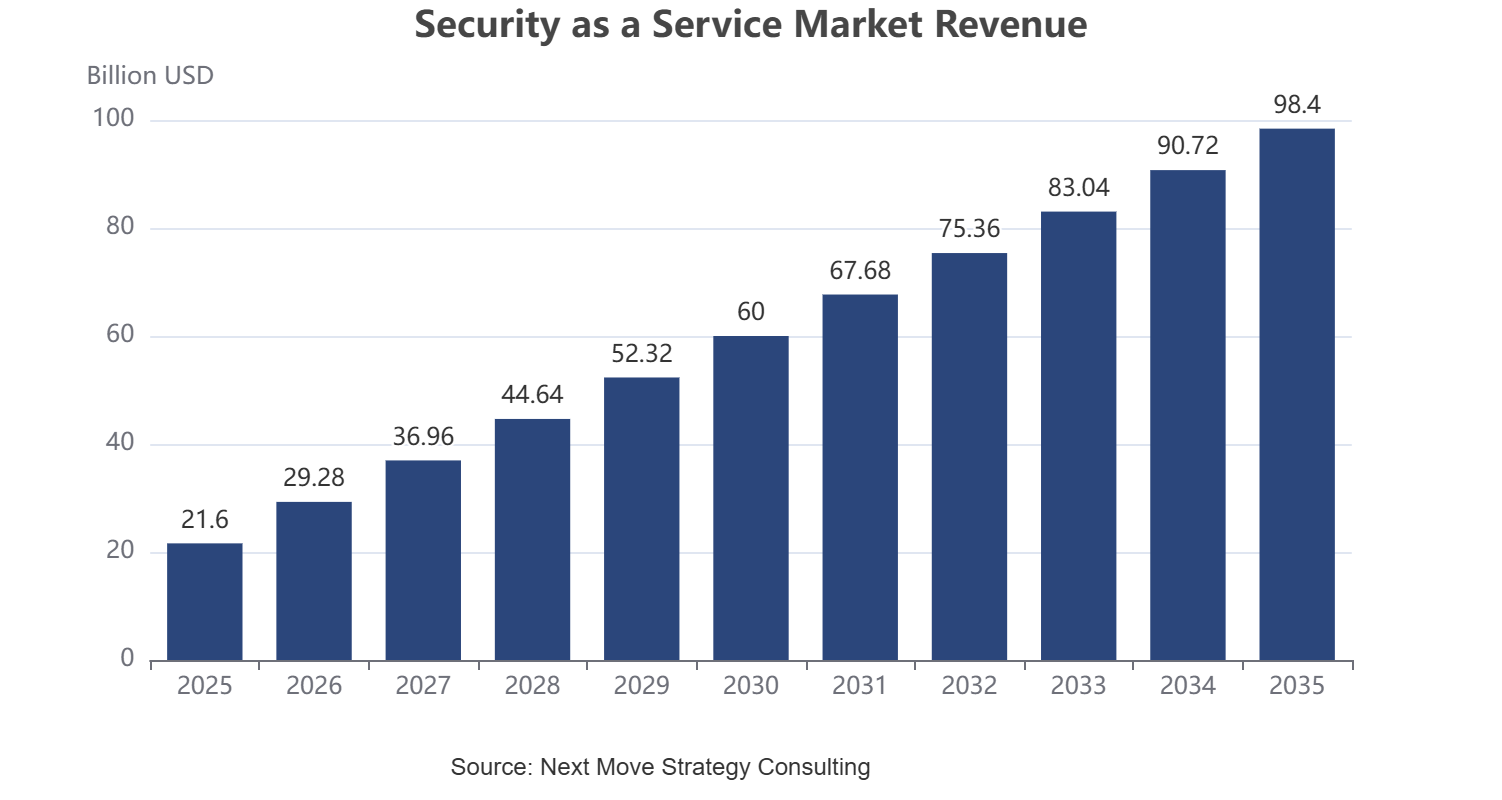
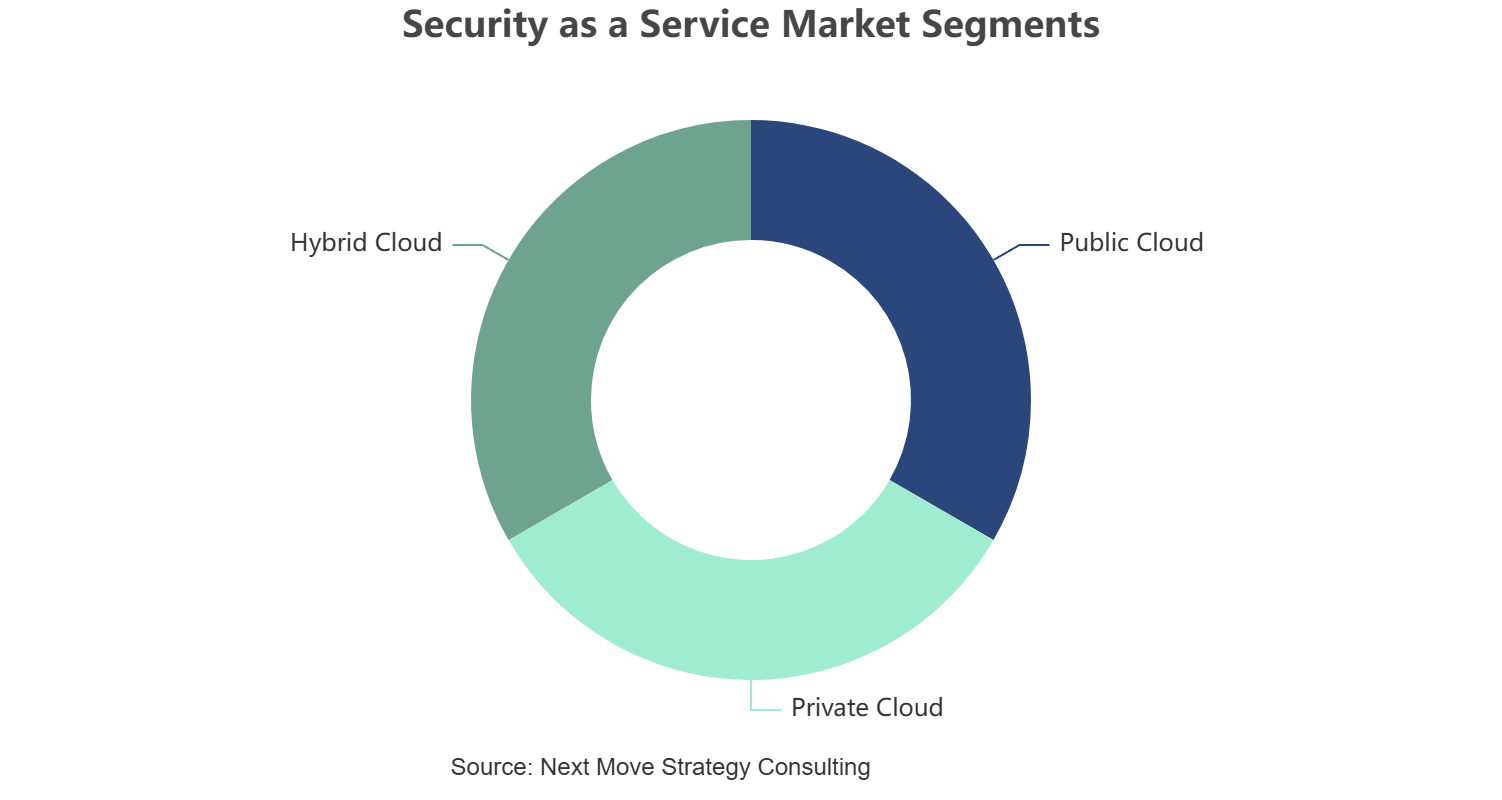
About the Author
 Liza Phukan
— Liza Phukan is Research Associate at Next Move Strategy Consulting, where she has covered emerging industries and market research across sectors for 3.5 years. Her work includes analyzing industry developments, validating market data, and developing structured business content from research findings. She uses secondary research and data-validation practices to turn complex market information into clear decision-useful market analysis for business audiences and support report development and B2B.
Liza Phukan
— Liza Phukan is Research Associate at Next Move Strategy Consulting, where she has covered emerging industries and market research across sectors for 3.5 years. Her work includes analyzing industry developments, validating market data, and developing structured business content from research findings. She uses secondary research and data-validation practices to turn complex market information into clear decision-useful market analysis for business audiences and support report development and B2B.
About the Reviewer
 Supradip Baul
— Supradip Baul is an accomplished business consultant and strategist with over a decade of rich experience in market intelligence, strategy, technology, and business transformation. His work has included rigorous qualitative and quantitative analysis across multiple industries, helping clients shape investment decisions and long-term roadmaps. Earlier in his career, he was associated with Gartner, where he contributed to industry-leading reports and market share analyses. He has worked with leading global companies and holds an MBA with a dual specialization in Marketing and Finance.
Supradip Baul
— Supradip Baul is an accomplished business consultant and strategist with over a decade of rich experience in market intelligence, strategy, technology, and business transformation. His work has included rigorous qualitative and quantitative analysis across multiple industries, helping clients shape investment decisions and long-term roadmaps. Earlier in his career, he was associated with Gartner, where he contributed to industry-leading reports and market share analyses. He has worked with leading global companies and holds an MBA with a dual specialization in Marketing and Finance.
At Next Move Strategy Consulting, we understand that insightful market research is the cornerstone of successful business decisions. That's why we employ a robust and multifaceted approach, combining various methodologies to deliver the most accurate and actionable data for our clients.

Research Landscape
We navigate the world of research with two primary approaches:
Qualitative Approach
Our qualitative research methodologies involve immersive techniques such as in-depth interviews, focus groups, and observational studies. By engaging directly with individuals and stakeholders, we uncover valuable insights that quantitative data alone may overlook.

Quantitative Research
In tandem with qualitative methodologies, NMSC leverages the power of Quantitative Research to provide a robust foundation of numerical insights. Through systematic data collection and analysis, we quantify patterns, preferences, and market trends, offering a comprehensive view of the business landscape.
Our quantitative research approach employs diverse tools, including surveys, experiments, and statistical modelling. These methodologies enable us to gather data from a large and representative sample, ensuring the statistical significance of our findings. By employing structured questionnaires and standardized data collection methods, we guarantee the reliability and validity of the information we present to our clients.
Quantitative research is particularly effective in measuring the prevalence of trends, assessing market size, and gauging the impact of various factors on consumer behavior. The numerical precision attained through this approach equips our clients with actionable insights, facilitating data-driven decision-making and strategy formulation.


Our Specialized Toolbox for Industry-Specific Market Research
We deploy a specialized arsenal of techniques tailored to meet your unique requirements. Here's a glimpse into our comprehensive toolbox:

Information Procurement
The stage entails acquiring market data or relevant information through various sources and methodologies.


Market Research Approach
We utilize both top-down and bottom-up approaches in market research analysis to achieve a comprehensive understanding of the market dynamics, leveraging the broad perspective of industry trends and macroeconomic factors alongside detailed insights from specific segments and individual companies.

Porters Five Forces Analysis
We conduct Porter's Five Forces analysis to evaluate the competitive landscape of an industry, providing us with insights into factors that affect profitability and strategic positioning.

SWOT Analysis

Forecasting
We utilize a forecasting model to predict future consumption by considering parameters like population, economics, regulations, market competition, drivers, constraints, technology, and pricing. We also employ statistical techniques such as multilinear regression, exponential smoothing, moving average, ARIMA, and Monte Carlo simulations for accurate predictions. In econometric forecasting, we analyzed short-term and long-term event impacts, attributing values based on regulatory frameworks, economic factors, and market events.





 Speak to Our Analyst