RNAi Pesticides Market Global Industry Analysis and Forecast (2026–2035)

The global RNAi Pesticides Market size was valued at USD 68 million in 2025 and is estimated at USD 82 million in 2026, forecast to reach USD 342 million by 2035, expanding at a 17.5% CAGR from 2026 to 2035. Key drivers include expanding regulatory approvals for sprayable RNAi active ingredients and rising pest resistance to conventional chemical pesticides, supported by regulatory precedents for foliar-applied RNAi biopesticides and increasing adoption of RNAi as a complementary resistance management tool, with North America leading the global market.

Download Free Sample PDF
Base Year (2025)
$68.0 Million
Forecast (2035)
$342.0 Million
CAGR (2026-2035)
17.5%
Top Region
North America

What Is the RNAi Pesticides Market Size?

The global RNAi pesticides market size was valued at USD 68 million in 2025 and is estimated at USD 82 million in 2026, forecast to reach USD 342 million by 2035, expanding at a 17.5% CAGR between 2026 and 2035. North America leads with approximately 44% share, while dsRNA-Based Pesticides dominate all other product types with approximately 82% share.

We observed that the growth is broad-based across every segmentation axis, with expanding regulatory approvals and scalable dsRNA production platforms driving the dominant structural shifts through 2035.

RNAi Pesticides Market Global Industry Analysis and Forecast (2026–2035) Revenue Forecast

Values in USD Million

2025 $68.0 Million
2025
2026 $79.9 Million
2026
2027 $93.9 Million
2027
2028 $110.3 Million
2028
2029 $129.6 Million
2029
2030 $152.3 Million
2030
2031 $179.0 Million
2031
2032 $210.3 Million
2032
2033 $247.1 Million
2033
2034 $290.3 Million
2034
2035 $342.0 Million
2035

Key Takeaways

By Product Type: dsRNA-Based Pesticides held the largest share of approximately 82% (USD 55.76 million) in 2025; siRNA-Based Pesticides is the fastest-growing sub-segment at 27.9% CAGR from 2026–2035.

By Formulation: Sprayable/Topical Formulations held the largest share of approximately 82% (USD 55.76 million) in 2025; Seed Treatment Formulations is the fastest-growing sub-segment at 21.7% CAGR from 2026–2035.

By Application: Insect Pest Control held the largest share of approximately 58% (USD 39.44 million) in 2025; Weed Management is an emerging sub-segment projected at 22.4% CAGR from 2026–2035, though commercial deployment remains far less mature than insect pest control.

By Production Technology: Microbial Expression Systems held the largest share of approximately 88% (USD 59.84 million) in 2025; Cell-Free Synthesis is the fastest-growing sub-segment at 24.9% CAGR from 2026–2035.

By Delivery Mechanism: Naked dsRNA Spray Delivery held the largest share of approximately 70% (USD 47.60 million) in 2025; Carrier-Assisted Delivery is the fastest-growing sub-segment at 22.4% CAGR from 2026–2035.

By Crop Type: Field Crops held the largest share of approximately 55% (USD 37.40 million) in 2025; Fruits and Vegetables is the fastest-growing sub-segment at 19.8% CAGR from 2026–2035.

Dominant Region: North America dominated with approximately 44% revenue share (USD 29.92 million) in 2025.

Fastest-Growing Region: Asia-Pacific is expected to register the highest CAGR of 20.7% during 2026–2035.

Dominant Country: U.S. led with approximately USD 22.44 million in 2025, an industry-derived estimate.

Fastest-Growing Country: India is the fastest-growing country at approximately 23.9% CAGR from 2026–2035.

Market Opportunity: The RNAi pesticides market is expected to create an absolute dollar opportunity of USD 260 million between 2026 and 2035, presenting significant investment potential across the sustainable, gene-silencing crop protection value chain.

According to Next Move Strategy Consulting analysis, agrochemical incumbents are increasingly pursuing licensing and co-development agreements with dsRNA production specialists to accelerate regulatory filings and field-scale manufacturing, a shift that favors companies with validated large-scale dsRNA synthesis platforms over early-stage discovery-only developers as commercialization accelerates through 2035.

What Does the RNAi Pesticides Market Encompass?

The RNAi pesticides market encompasses double-stranded RNA, small interfering RNA, and other RNA interference-based active ingredients formulated as sprayable, seed-applied, or soil-applied biopesticides that silence essential genes in target insects, pathogens, and weeds. This report defines market revenue as commercially marketed RNAi-based pesticide products and formulations sold to agricultural end users, distributors, and other commercial buyers, excluding research and development services, licensing revenue, agricultural biotechnology platform revenue, and genetically modified RNAi crop traits. Our assessment indicates that the scope spans discovery-stage dsRNA design, scalable microbial and cell-free production platforms, and formulated end-use products supplied to commercial growers across field crop and specialty crop segments for insect pest control, disease management, and emerging weed management applications worldwide.
Regulatory frameworks such as the U.S. Environmental Protection Agency's Federal Insecticide, Fungicide, and Rodenticide Act registration pathway and the European Food Safety Authority's ongoing risk assessment guidance shape commercialization timelines for RNAi active ingredients, while national biosafety authorities across Asia-Pacific increasingly reference these frameworks when evaluating novel gene-silencing pesticides. The analysis indicates that technology adoption is shifting toward lower-cost microbial and cell-free dsRNA manufacturing platforms that improve field-level cost competitiveness against conventional chemistries. Next Move Strategy Consulting's analysis indicates that this structural shift, combined with expanding regulatory precedent following the first U.S. sprayable RNAi product registration, is redefining commercialization criteria across the RNAi pesticides market report.

Market Drivers & Dynamics

Interactive Dataset
Expanding EPA and international regulatory approvals for sprayable RNAi actives driver Driver North America, Europe 2026-2035
Declining dsRNA production costs through microbial expression platforms driver Driver Global 2026-2035
Rising pest resistance to conventional chemical pesticides driver Driver Global 2026-2035
Growing grower demand for pollinator-safe, sequence-specific pest control driver Driver North America, Europe 2026-2032
Increasing agrochemical incumbent licensing and co-development partnerships driver Driver Global 2026-2035
Expanding field trials across specialty and row crop segments in Asia-Pacific driver Driver Asia-Pacific, Latin America 2026-2035
Regulatory uncertainty and evolving risk assessment frameworks in the EU restraint Restraint Europe 2026-2035
Limited environmental persistence data restraining grower confidence restraint Restraint Global 2026-2032
High initial development and field validation costs for new active ingredients restraint Restraint Global 2026-2035
Source: Next Move Strategy Consulting

Growth Drivers

What Is the Primary Growth Driver of the RNAi Pesticides Market?

Expanding regulatory approvals for sprayable RNAi active ingredients is the primary driver of the market. The U.S. Environmental Protection Agency registered ledprona, the active ingredient in GreenLight Biosciences' Calantha, in December 2023 following a review period exceeding four years. This registration established an important regulatory precedent for foliar-applied RNAi biopesticides under the Federal Insecticide, Fungicide, and Rodenticide Act. We observed that this regulatory precedent continues to inform subsequent product filings, though Calantha remains the only commercially registered sprayable RNAi pesticide in the United States as of this report.

How Is Rising Pest Resistance Driving RNAi Pesticides Market Growth?

Rising pest resistance to conventional chemical pesticides is accelerating grower and agrochemical company interest in RNAi as a complementary mode of action. The Insecticide Resistance Action Committee created a distinct Group 35 classification for ledprona's RNA interference mode of action, formally recognizing it as a resistance management tool distinct from conventional chemistries. Our assessment indicates that this classification, combined with expanding field validation across row and specialty crops, is compressing adoption timelines among growers managing resistant pest populations.

Growth Inhibitors

What Is Restraining RNAi Pesticides Market Expansion?

Regulatory uncertainty and evolving risk assessment frameworks in the European Union restrain broader market expansion, as the region continues reviewing whether existing pesticide regulations sufficiently address RNAi technology. The European Food Safety Authority continues to develop specific risk assessment guidance for RNAi-based plant protection products, extending review timelines relative to established chemical pesticide pathways. We found that this regulatory ambiguity, combined with limited long-term environmental persistence data, is moderating near-term commercialization pace across European markets despite strong underlying grower demand.

Segmentation Analysis

2025 (USD Million)
2035 (USD Million)
dsRNA-Based Pesticides 2025: $55.8 Million | 2035: $256.5 Million
dsRNA-Based
siRNA-Based Pesticides 2025: $4.1 Million | 2035: $47.9 Million
siRNA-Based
Other RNAi-Based Formulations 2025: $8.2 Million | 2035: $37.6 Million
Other RNAi-B
dsRNA-Based Pesticides $55.8 Million $256.5 Million 16.5%
siRNA-Based Pesticides $4.1 Million $47.9 Million 27.9%
Other RNAi-Based Formulations $8.2 Million $37.6 Million 16.5%

Which Product Type Dominates the RNAi Pesticides Market?

dsRNA-based pesticides, encompassing sprayable products such as GreenLight Biosciences' Calantha, led the market with USD 55.76 million in 2025, supported by their established regulatory precedent and broader validated pest target library relative to other RNAi molecule types. We observed that siRNA-based pesticides are the fastest-growing product type, expanding at a 27.9% CAGR from 2026 to 2035, as developers pursue this more precisely targeted gene-silencing approach for emerging pest and pathogen applications, though siRNA-based products remain at an earlier commercial stage than dsRNA-based pesticides. Other RNAi-Based Formulations comprise hairpin RNA constructs and other dsRNA derivative molecules that do not fall within the standard dsRNA or siRNA categories.

2025 (USD Million)
2035 (USD Million)
Sprayable/To
Seed Treatme
Soil-Applied
Segment Item 2025 (USD Million) 2035 (USD Million) CAGR
Sprayable/Topical Formulations $10.0 USD Million $40.0 USD Million 17.0%
Seed Treatment Formulations $17.1 USD Million $51.1 USD Million 11.0%
Soil-Applied Formulations $24.2 USD Million $62.2 USD Million 25.0%

Segment-wise data is locked

Unlock complete segment-wise numbers for By Formulation.

Unlock Full Data
2025 (USD Million)
2035 (USD Million)
Insect Pest
Disease and
Weed Managem
Resistance M
Others
Segment Item 2025 (USD Million) 2035 (USD Million) CAGR
Insect Pest Control $10.0 USD Million $40.0 USD Million 18.0%
Disease and Pathogen Management $17.1 USD Million $51.1 USD Million 16.0%
Weed Management $24.2 USD Million $62.2 USD Million 22.0%
Resistance Management $31.3 USD Million $73.3 USD Million 12.0%
Others $38.4 USD Million $84.4 USD Million 19.0%

Segment-wise data is locked

Unlock complete segment-wise numbers for By Application.

Unlock Full Data

Which Application Segment Leads RNAi Pesticides Market Demand?

Insect Pest Control remained the leading application, valued at USD 39.44 million in 2025 on sustained grower demand for sequence-specific alternatives to conventional insecticides. Weed management represents an emerging application area with significant development potential, projected at a 22.4% CAGR from 2026 to 2035 as herbicide resistance across major row crop regions accelerates developer interest in RNAi-based weed control as a new mode of action, although commercial deployment remains considerably less mature than insect pest control.

2025 (USD Million)
2035 (USD Million)
Microbial Ex
Bacterial-Ba
Yeast-Based
Cell-Free Sy
Segment Item 2025 (USD Million) 2035 (USD Million) CAGR
Microbial Expression Systems $10.0 USD Million $40.0 USD Million 16.0%
Bacterial-Based Expression $17.1 USD Million $51.1 USD Million 22.0%
Yeast-Based Expression $24.2 USD Million $62.2 USD Million 24.0%
Cell-Free Synthesis $31.3 USD Million $73.3 USD Million 14.0%

Segment-wise data is locked

Unlock complete segment-wise numbers for By Production Technology.

Unlock Full Data
2025 (USD Million)
2035 (USD Million)
Nanoparticle
Naked dsRNA
Carrier-Assi
Segment Item 2025 (USD Million) 2035 (USD Million) CAGR
Nanoparticle-Encapsulated Delivery $10.0 USD Million $40.0 USD Million 24.0%
Naked dsRNA Spray Delivery $17.1 USD Million $51.1 USD Million 10.0%
Carrier-Assisted Delivery $24.2 USD Million $62.2 USD Million 16.0%

Segment-wise data is locked

Unlock complete segment-wise numbers for By Delivery Mechanism.

Unlock Full Data
2025 (USD Million)
2035 (USD Million)
Field Crops
Fruits and V
Others
Segment Item 2025 (USD Million) 2035 (USD Million) CAGR
Field Crops $10.0 USD Million $40.0 USD Million 27.0%
Fruits and Vegetables $17.1 USD Million $51.1 USD Million 17.0%
Others $24.2 USD Million $62.2 USD Million 27.0%

Segment-wise data is locked

Unlock complete segment-wise numbers for By Crop Type.

Unlock Full Data

Which Crop Type Segment Is the Fastest-Growing in the RNAi Pesticides Market?

Field Crops remained the largest crop type category, valued at USD 37.40 million in 2025, reflecting the scale of row crop acreage addressed by Calantha and pipeline RNAi pesticide products targeting field crop pests. Based on research conducted by Next Move Strategy Consulting, we found that Fruits and Vegetables represent the fastest-growing crop type segment at a 19.8% CAGR from 2026 to 2035, driven by specialty crop growers seeking pollinator-safe alternatives to conventional chemical pesticides.

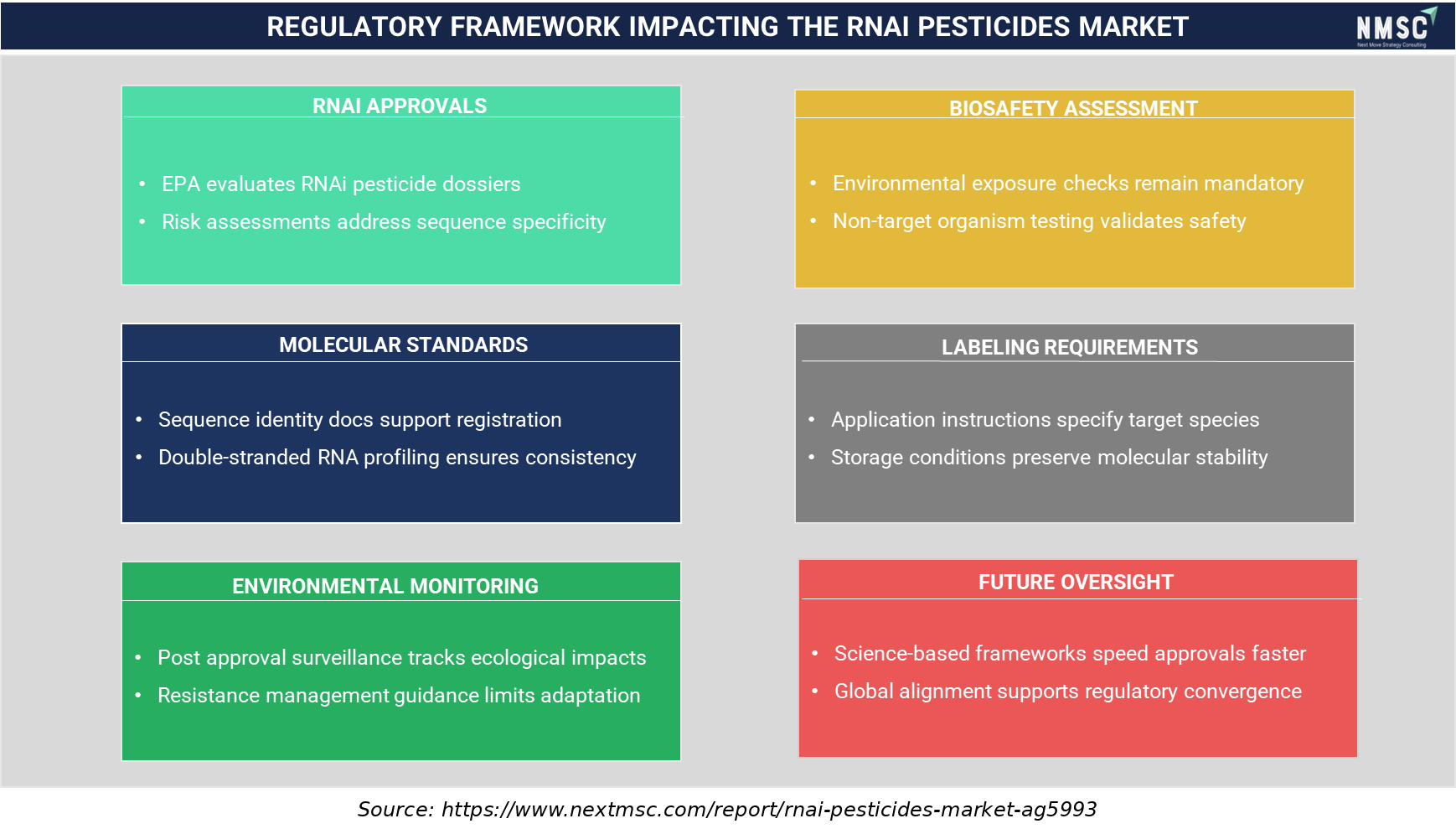
Regulatory Framework Impacting the RNAi Pesticides Market

The regulatory framework for the RNAi pesticides market emphasizes rigorous approvals, molecular characterization, biosafety assessment, and environmental monitoring. Requirements for sequence specificity, non-target organism testing, labeling, and post-approval surveillance support responsible commercialization. Science-based regulatory approaches and increasing global alignment may improve approval pathways while maintaining safety, environmental protection, and product consistency.

Growth Opportunities

Our analysis shows that three forward-looking opportunities stand out for stakeholders positioning within the RNAi pesticides market over the 2026–2035 forecast period.

How Can Licensing Partnerships Accelerate Specialty Crop Market Entry?

Licensing partnerships between dsRNA discovery specialists and established agrochemical distributors present a whitespace opportunity to accelerate specialty crop market entry. Companies that pair proprietary gene-silencing sequences with incumbent regulatory and distribution infrastructure stand to capture faster commercialization timelines, particularly for high-value fruit and vegetable segments where growers face limited chemical resistance management options.

Where Does Weed Management Create New RNAi Demand?

RNAi-based weed management represents an emerging, pre-commercial opportunity as herbicide resistance continues to expand across major row crop regions. Commercial deployment of RNAi herbicidal actives remains considerably less mature than insect-targeting products, and developers that successfully advance early-stage RNAi herbicidal candidates toward registration can secure early-mover advantage in a segment currently dominated by a narrow set of conventional chemistries.

How Can Low-Cost Microbial Production Benefit Emerging Market Growers?

Emerging market growers seeking affordable, sustainable pest control create an opportunity for suppliers scaling low-cost microbial dsRNA production platforms. Manufacturers that achieve sub-dollar-per-gram production costs can extend RNAi pesticide accessibility to price-sensitive row crop segments across Asia-Pacific and Latin America, benefiting from recurring seasonal application revenue as field-scale adoption expands.

Regional Outlook

2025 (USD Million)
2035 (USD Million)
North Americ
Europe
Asia-Pacific
Middle East
Latin Americ
Region 2025 (USD Million) 2035 (USD Million) CAGR (%)
North America $10.0 USD Million $40.0 USD Million 9.0%
Europe $17.1 USD Million $51.1 USD Million 27.0%
Asia-Pacific $24.2 USD Million $62.2 USD Million 25.0%
Middle East & Africa $31.3 USD Million $73.3 USD Million 23.0%
Latin America $38.4 USD Million $84.4 USD Million 12.0%

Regional data is locked

Unlock complete regional numbers for this market.

Unlock Full Data

Competitive Landscape

Our analysis shows that the competitive landscape is consolidating around agrochemical incumbents licensing proprietary dsRNA technology from specialized biotechnology developers to accelerate field-scale commercialization within the industry.

Dimension Description
Dimension Assessment
Market Structure The market remains highly concentrated at the discovery and early-commercial stage, reflecting the technical and regulatory barriers facing new entrants and the small number of companies with commercially registered products.
Innovation Focus Innovation centers on low-cost microbial and cell-free dsRNA production platforms, sequence-specific pest targeting, and expanding foliar registration pathways beyond initial insect pest control applications.
M&A Activity Licensing and intellectual property transactions are shaping competitive positioning, exemplified by GreenLight Biosciences' 2021 acquisition of Bayer's topical RNA application patent portfolio related to Varroa mite control.

Key Market Players

Our assessment identifies the following companies, ranked by market-specific revenue and scale of operations, as the leading participants shaping the RNAi pesticides market through 2026.

Bayer AG Syngenta Group Co., Ltd. Corteva, Inc. BASF SE GreenLight Biosciences, Inc. RNAissance Ag LLC AgroSpheres, Inc. Pebble Labs Inc. TRILLIUM AG, Inc. Renaissance BioScience Corp. Tropic Biosciences Ltd. APSE, Inc. RNAgri, Inc. Forrest Innovations Ltd. Bioceres Crop Solutions Corp. FMC Corporation Ginkgo Bioworks Holdings, Inc. PlantArcBio Ltd. STK Bio-Ag Technologies Ltd. BioDirect, Inc.

Latest Developments

We observed the following verified developments shaping competitive positioning across the RNAi pesticides market.

Date Event
Jul 2026 Renaissance received Genome BC funding to extend its yeast-based RNAi biopesticide platform from above-ground insects to soil-dwelling wireworms. The project targets Agriotes species affecting potatoes, corn, cereals and root vegetables, expanding RNAi pesticides into below-ground pest control where conventional options are often limited.
May 2026 Belgian authorities authorized Calantha for Colorado potato beetle control in potatoes during the 2026 growing season. The company said the authorization represented the first use of RNA technology for crop protection in the European Union, with a 120-day authorization covering the principal control window.
Apr 2025 GreenLight reported greenhouse and field results demonstrating consistent herbicidal activity from its RNA technology against hard-to-kill weeds. The company said RNA solutions can be combined with conventional herbicides to improve efficacy while reducing herbicide load, toxicity and farmer costs, with standalone products also being pursued.

Investment Opportunities

How Are Capital Inflows Shaping the RNAi Pesticides Market?

Growth capital continues to flow into specialized dsRNA production and discovery platforms, with developers pursuing public listings and strategic agrochemical partnerships to fund field-scale manufacturing capacity. Available regulatory evidence suggests that GreenLight Biosciences has structured its business as a public benefit corporation focused on making RNA products more affordable and accessible, reflecting the capital-intensive nature of scaling dsRNA production. Investor interest is concentrated among companies demonstrating validated regulatory pathways alongside cost-competitive production economics.

What Infrastructure Investment Is Required to Scale RNAi Pesticides Market Coverage?

Scaling RNAi pesticide coverage requires sustained investment in microbial or cell-free dsRNA fermentation capacity, formulation and stabilization technology, and field trial infrastructure across target geographies. Our findings suggest that developers pursuing multi-country regulatory submissions increasingly require regional field trial partnerships to generate geography-specific efficacy and safety data required by national regulatory authorities.

What ESG Considerations Are Relevant to RNAi Pesticides Market Investment?

Environmental, Social, and Governance considerations center on pollinator and non-target organism protection, reduced chemical pesticide residue in food and water systems, and transparent risk assessment disclosure. We observed that sequence-specific gene silencing technology's potential to reduce collateral harm to beneficial insects is becoming a differentiating governance factor for agricultural technology investors. Social considerations also extend to grower resistance management outcomes that support long-term farm productivity and food security.

Key Benefits for Stakeholders

How Does This Report Benefit Agricultural Industry Leaders?

Agricultural industry leaders gain a structured view of technology readiness, regulatory pathways, and competitive positioning across competing RNAi pesticide developers. Our analysis shows that benchmarking data on product type, application, and crop type segmentation supports more informed research and development investment decisions aligned with grower demand, while regional regulatory insights help companies anticipate registration timelines across major agricultural markets.

How Does This Report Benefit Investors and Financial Analysts?

Investors and financial analysts gain access to segmentation-level revenue forecasts, competitive positioning analysis, and identified whitespace opportunities across the RNAi pesticides market. We found that the report's regional and country-level growth projections support portfolio allocation decisions, while the competitive landscape section clarifies which archetypes are best positioned to capture long-term agricultural technology investment through 2035.

How Does This Report Benefit Technology Vendors and Product Teams?

Technology vendors and product teams gain visibility into segmentation trends, emerging application demand, and regional regulatory drivers that inform product development roadmap prioritization. Our findings suggest that granular data on formulation, delivery mechanism, and crop type demand helps research teams align development investment with the fastest-growing sub-segments, particularly weed management applications and nanoparticle-encapsulated delivery systems.

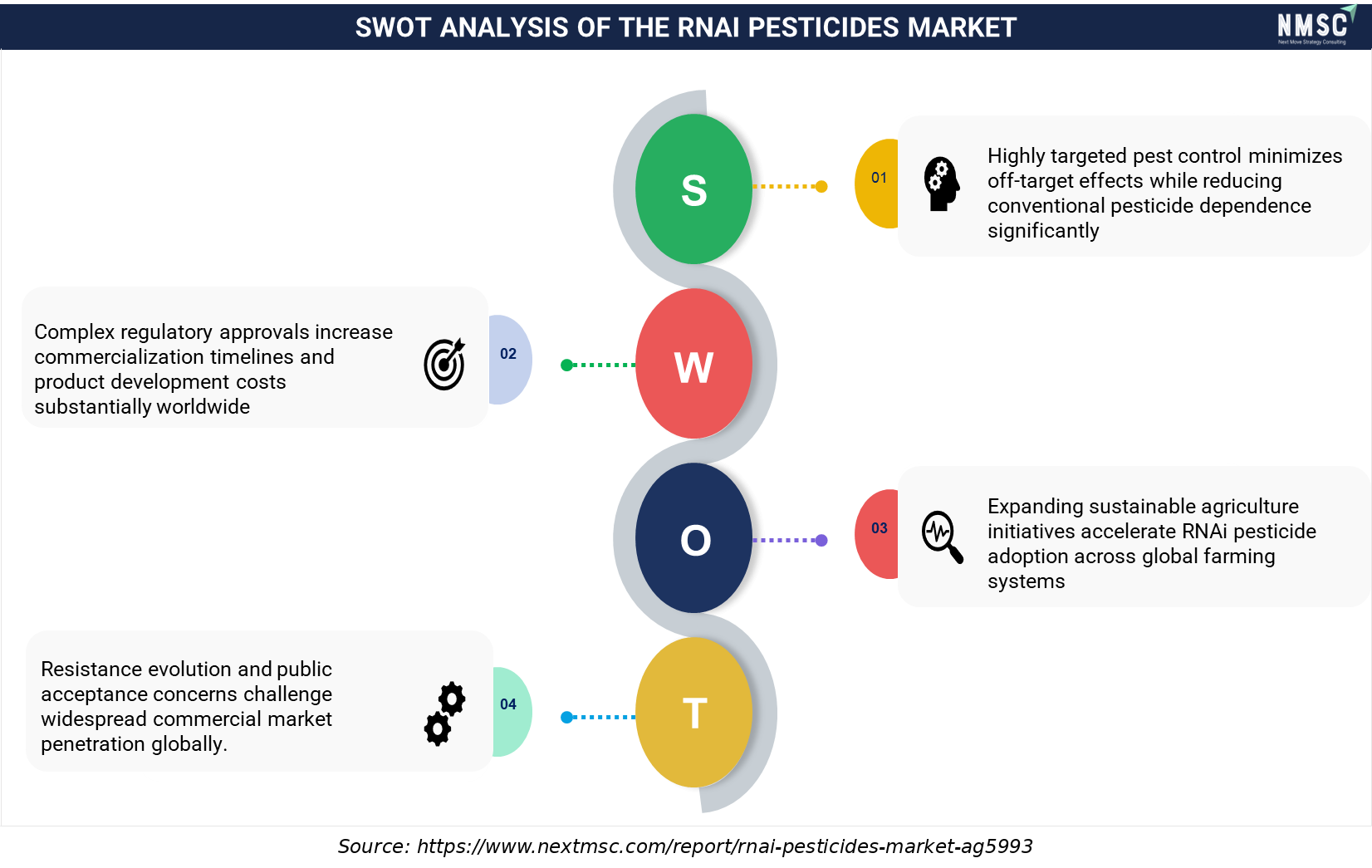
SWOT Analysis

This SWOT view highlights structural strengths, strategic gaps, expansion headroom, and external risks shaping outcomes in the RNAi Pesticides Market Global Industry Analysis and Forecast (2026–2035).

Strengths

Weaknesses

Opportunities

Threats

Key Market Segments Evaluated

By Product Type

  • dsRNA-Based Pesticides
  • siRNA-Based Pesticides
  • Other RNAi-Based Formulations

By Formulation

  • Sprayable/Topical Formulations
  • Seed Treatment Formulations
  • Soil-Applied Formulations

By Application

  • Insect Pest Control
  • Disease and Pathogen Management
  • Weed Management
  • Resistance Management
  • Others

By Production Technology

  • Microbial Expression Systems
  • Bacterial-Based Expression
  • Yeast-Based Expression
  • Cell-Free Synthesis

By Delivery Mechanism

  • Nanoparticle-Encapsulated Delivery
  • Naked dsRNA Spray Delivery
  • Carrier-Assisted Delivery

By Crop Type

  • Field Crops
  • Fruits and Vegetables
  • Others

Conclusion & Recommendations

The long-term outlook remains strongly positive, with the market projected to more than quadruple from USD 82 million in 2026 to USD 342 million by 2035 at a 17.5% CAGR. Our analysis shows that expanding regulatory precedent, declining dsRNA production costs, and rising pest resistance to conventional chemistries will continue to support broad-based growth across nearly every segmentation axis through the forecast period.

What Strategic Positioning Recommendations Apply to Manufacturers?

Manufacturers should pursue licensing and co-development partnerships that pair proprietary dsRNA production efficiency with established agrochemical regulatory and distribution infrastructure. We observed that developers combining validated low-cost manufacturing platforms with sequential target expansion strategies are best positioned to sustain commercialization momentum as additional pest, disease, and weed management registrations progress through regulatory review.

How Attractive Is the RNAi Pesticides Market for New Investment?

The RNAi pesticides industry presents an attractive investment case, supported by a USD 260 million absolute dollar opportunity between 2026 and 2035 and above-average growth in Asia-Pacific and siRNA-based product categories. We found that investment attractiveness is highest for companies combining regulatory registration expertise with scalable, cost-competitive dsRNA production, positioning them to serve both established North American and emerging Asia-Pacific and Latin American markets simultaneously.

What Market Shifts and Key Risks Should Stakeholders Monitor?

Stakeholders should monitor European Union regulatory ambiguity, limited long-term environmental persistence data, and high development costs for new active ingredients as key risks to the market. Our analysis shows that developers unable to generate comprehensive environmental safety data risk extended review timelines that could delay commercial launches, particularly within regulatory environments still developing RNAi-specific risk assessment frameworks.

What Are the Key Growth Pathways for the RNAi Pesticides Market?

Key growth pathways include expanding licensing partnerships between discovery specialists and agrochemical distributors, scaling low-cost microbial dsRNA production for price-sensitive emerging markets, and advancing weed management applications as herbicide resistance intensifies. Next Move Strategy Consulting's analysis indicates that suppliers pursuing these pathways while maintaining regulatory registration momentum will be best positioned to capture the RNAi pesticides market's projected growth through 2035.

FAQs

About the Author

Mihul Sharma

Mihul Sharma

Mihul Sharma is Research Associate at Next Move Strategy Consulting, where he has covered technology, industrial, and healthcare markets for 3 years. His work applies structured business research, market analysis, and secondary-source review to assess market trends, competitive developments, and growth opportunities. He supports report development by fully synthesizing industry data, company information, and market signals into concise findings for strategy and investment-focused research teams.

About the Reviewer

Debashree Dey

Debashree Dey

Debashree Dey is Assistant Manager at Next Move Strategy Consulting, where she supports cross-vertical market content and communications across diverse industries for 6 years. Her professional background includes senior content writing, communications, and published manuscript authorship, with experience developing audience-focused business narratives and maintaining clear, consistent messaging. Her role supports research-led content development and editorial quality across NextMSC publications.

Download Free Sample

Robert Sean Trevino

ROBERT SEAN TREVINO

Sr. Director, Head of Strategic Insights & Analytics

Foundation Medicine

I realized that it was a reliable source of information. These days, there are many people who are looking for authentic data, and this is one of the only sources that can offer them with what they need;

Mohit Agarwal

MOHIT AGARWAL

Chief Manager

DryChem India Pvt. Ltd.

Next Move Strategy Consulting is an amazing team of consultants. We required a market study report for our investors on top priority and the team went above and beyond our expectations to deliver the same with ample supporting data within a short time span enabling us to secure the investments and keep our project timeline maintained. Their professionalism, attention to detail, and timely delivery of actionable recommendations have left a lasting impression on our organization.

Diana Trejo

DIANA TREJO

Assistant Manager

Sumitomo Corporation de Mexico, S.A. de C.V.

Recently, we purchased a report on the Mexico Data Center Market from Next Move Strategy Consulting. The service has been excellent, with support that is always timely and thoroughly professional. The information provided is interesting, highly useful, and delivered with clarity. I would highly recommend NextMSC for anyone seeking insightful and dependable analysis.

Semih Kavaklioglu

SEMIH KAVAKLIOGLU

Co-Founder & Sales Manager

Decortie

I work a lot in the marketing industry and I know that research is an essential part of any campaign. I have used Market research reports for my own products and I found them to be very informative and well-researched. The team here produces insightful reports for a good price

Nishant Awate

NISHANT AWATE

Business Development Global Sales

Zehnder Group Deutschland GmbH

Our experience working with Next Move Strategy Consulting was positive. The team was responsive, professional, and open to incorporating our specific requirements throughout the project. The India AHU market study was comprehensive and well structured, covering market value and volume forecasts, product and application segments, and key industry trends. The inclusion of both AHU and residential MVHR market insights made the study particularly relevant for our strategic market assessment. Overall, the report provides a solid foundation for evaluating market potential, identifying priority segments, and supporting business-development decisions in India.

Custom Market Research Services

We will customize the research for you if the listed report does not fully match your requirements.

Get 30% Free Customization

Select License

This website uses cookies to ensure you get the best experience on our website. Learn more

✖