Saudi Arabia Aerospace Foam Market By Foam Chemistry (Polyurethane, Polyolefin, PMI, Polyimide, PVC, PET, and Others), By Product Form (Block, Sheet, Roll, Molded Part, Machined Part, Kit, and Other Form), By Application (Structural Core, Seating and Comfort, Cabin Insulation, Acoustic Damping, Sealing and Gasketing, and Others), By Aircraft Platform (Commercial, Military, Business, and Space), By Sales Channel (OEM Installation and Aftermarket) – Analysis & Forecast, 2025-2035
Industry: Materials and Chemical | Latest Edition: August 6, 2026 | No of Pages: 176 | No. of Tables: 65 | No. of Figures: 60 | Format: PDF | Report Code: MC5603
Saudi Arabia Aerospace Foam Market Size & Forecast
|
Parameters |
Details |
|
Market Size in 2026 |
USD 139 million |
|
Revenue Forecast in 2035 |
USD 257.5 million |
|
Growth Rate |
CAGR of 7.09% from 2026 to 2035 |
|
Analysis Period |
2025–2035 |
|
Base Year Considered |
2025 |
|
Forecast Period |
2026–2035 |
|
Market Size Estimation |
Million (USD) |
|
Companies Profiled |
10 |
|
Market Share |
Available for 10 companies |
Industry Outlook
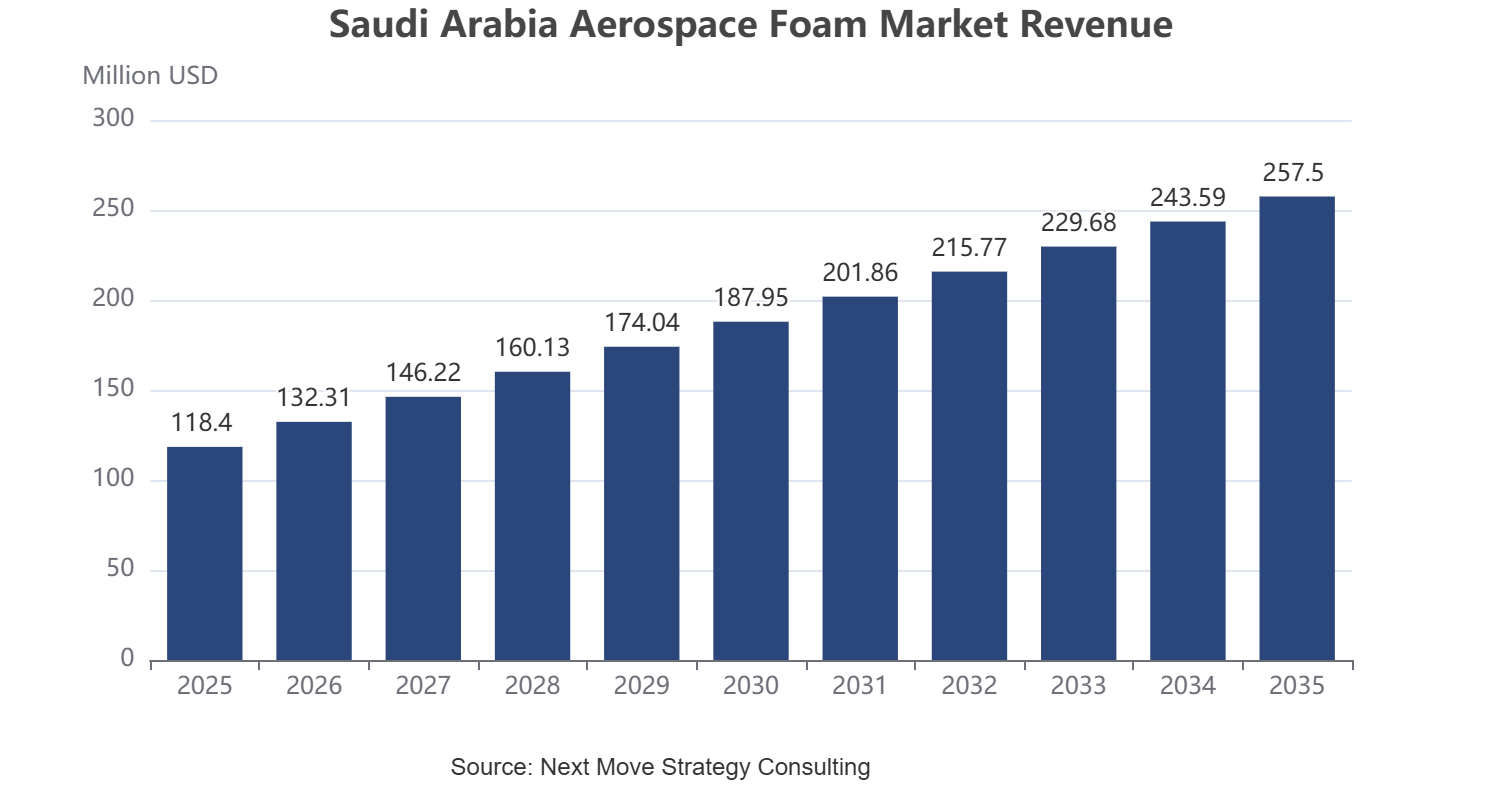
The Saudi Arabia Aerospace Foam Market size was valued at USD 118.4 million in 2025, and is expected to be valued at USD 139 million by the end of 2026. The industry is projected to grow, hitting USD 257.5 million by 2035, with a CAGR of 7.09% between 2026 and 2035.
Ecosystem Analysis of the Saudi Arabia Aerospace Foam Market
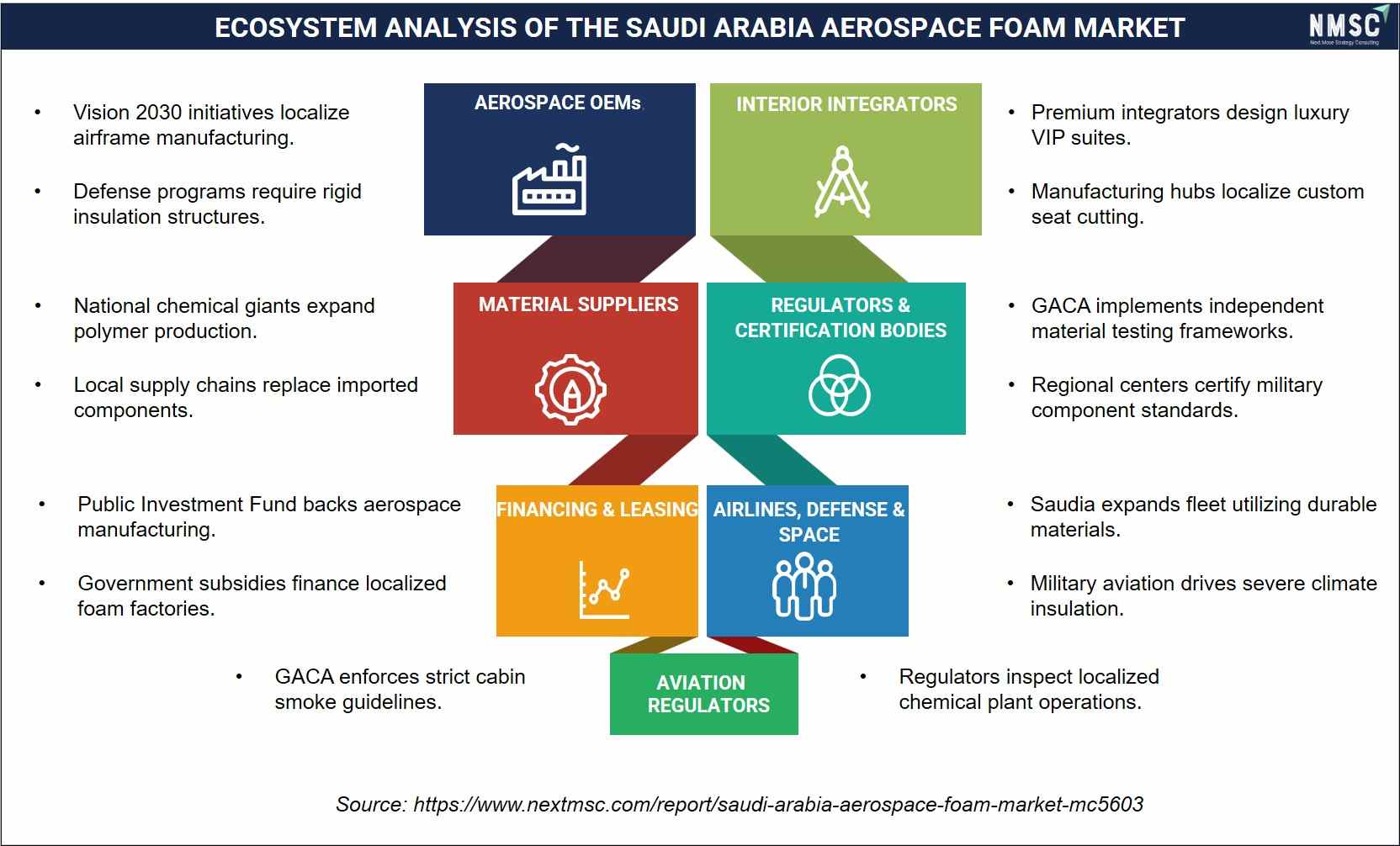
The infographic presents a structured ecosystem analysis of the Saudi Arabia aerospace foam market, illustrating how value and influence flow across interconnected stakeholders, shaping industry performance. We observed that aerospace OEMs and interior integrators sit at the core of demand creation, translating aircraft design and cabin integration requirements into precise material specifications. These requirements are fulfilled by material suppliers providing specialised aerospace foams engineered for lightweight construction, thermal and acoustic insulation, and strict safety compliance. Regulators and certification bodies establish the governance layer through GACA airworthiness standards and material qualification protocols, while financing and leasing entities support capital access and influence fleet procurement cycles. Airlines, defense operators, and space organisations further form the primary end-use demand base, supported by additional aviation regulators ensuring operational safety oversight. Together, these interconnected layers converge with Vision 2030-led diversification initiatives to shape market structure and innovation pathways across Saudi Arabia.
What are the Key Market Drivers, Breakthroughs, and Investment Opportunities that will Shape the Saudi Arabia Aerospace Foam Industry in the Next Decade?
Growth Catalyst & Risk Assessment Matrix
|
DRIVERS / TRENDS / RESTRAINTS |
(+/–) % IMPACT ON CAGR FORECAST |
GEOGRAPHIC RELEVANCE |
IMPACT TIMELINE |
|
Vision 2030 aerospace diversification driving aviation expansion, MRO growth, and local manufacturing development |
+4.88% |
Riyadh, Jeddah, NEOM, aviation economic zones |
Long term (4–8 years) |
|
Increasing defense procurement accelerating demand for high-performance aerospace foam systems in military aviation |
+4.62% |
Riyadh, Tabuk, Eastern Province defense hubs |
Medium to Long term (3–6 years) |
|
Aviation infrastructure expansion increasing aircraft utilization and interior refurbishment demand |
+4.21% |
Riyadh, Jeddah, Dammam |
Medium to Long term (3–6 years) |
|
Aerospace manufacturing localization strengthening supply chain integration and material procurement visibility |
+3.97% |
NEOM, King Abdullah Economic City, Riyadh aerospace clusters |
Long term (4–8 years) |
|
Heavy dependence on imports limiting local production capacity and increasing supply chain vulnerability |
-3.84% |
Saudi Arabia-wide aerospace ecosystem |
Short to Medium term (1–4 years) |
The Saudi Arabia aerospace foam market is evolving within a state-led aviation transformation framework shaped by Vision 2030 diversification, rising defense procurement intensity, continued dependence on imported aerospace materials, and accelerating localisation of aerospace manufacturing capabilities. We found that aerospace foams are becoming increasingly embedded across cabin interiors, seating systems, insulation structures, acoustic management layers, and lightweight aircraft interior assemblies as both commercial aviation expansion and defense modernization programs scale simultaneously. The aviation sector is undergoing structural expansion supported by fleet renewal initiatives, airport infrastructure megaprojects, and the development of integrated aerospace industrial zones. Despite this momentum, the market remains constrained by limited domestic production of certified aerospace materials, creating a strong import reliance across high-performance foam categories. Overall, the trajectory reflects a transition phase where demand expansion is outpacing localized supply maturity, positioning the market for sustained structural growth tied to industrial localization and defense-led aviation investment cycles.
Growth Driver:
How is Vision 2030 Aerospace Diversification Reshaping the Saudi Arabia Aerospace Foam Market?
Vision 2030-led aerospace diversification is fundamentally reshaping the demand structure of the Saudi Arabia aerospace foam market by repositioning aviation from a service-centric sector toward an integrated industrial ecosystem. The initiative is actively driving expansion in aircraft procurement, aviation infrastructure, MRO capabilities, and localised aerospace manufacturing zones. We observed that this transformation is translating into higher long-term demand for aerospace foams used in seating systems, cabin interiors, insulation layers, and acoustic control applications across both commercial and defense platforms. Large-scale aviation investments, including airline fleet expansion programs and aviation city developments, are reinforcing structured procurement pipelines for certified aerospace materials. In parallel, efforts to localize supply chains are gradually embedding material sourcing considerations within domestic industrial planning frameworks. This shift is strengthening visibility for aerospace foam demand across multi-year aviation development cycles, even though import dependence remains dominant in the near term.
How is Increasing Defense Procurement Accelerating Aerospace Foam Demand in Saudi Arabia?
Rising defense procurement activity is serving as a key structural growth driver for aerospace foam demand in Saudi Arabia, supported by ongoing modernization of military aviation fleets and expansion of advanced aerial capabilities. Procurement programs include next-generation fighter aircraft, transport platforms, and surveillance systems, all of which require high-performance interior materials engineered for extreme operational environments. Aerospace foams are widely used in these platforms for vibration absorption, thermal insulation, fire resistance, and lightweight cabin configuration, ensuring both performance efficiency and safety compliance. We also noted that defense procurement cycles are typically long-term and contract-based, which introduces a stable and predictable consumption pattern for certified aerospace materials. This reduces demand volatility compared to commercial aviation cycles and strengthens baseline material absorption across defense aviation applications. Over time, defense modernisation continues to reinforce a high-value, specification-driven demand segment within the broader aerospace foam market.
How is Aviation Infrastructure Expansion Reinforcing Aerospace Foam Demand?
Through NMSC's assessment, we found that aviation infrastructure expansion is emerging as an important incremental driver of aerospace foam demand in Saudi Arabia, driven by large-scale investments in airports, terminal capacity upgrades, and aviation logistics development. These infrastructure projects are increasing aircraft movement intensity and enabling higher fleet utilisation across domestic and international routes. As aircraft operating hours rise, interior wear accelerates, leading to more frequent replacement cycles for seating foams, insulation materials, and acoustic components. We also observed that the development of new aviation hubs and premium air travel corridors is raising expectations for cabin comfort and interior quality standards. This is prompting airlines to adopt more advanced foam-based solutions that balance lightweight performance with enhanced passenger experience. The combined effect of higher utilisation and elevated service expectations is strengthening recurring demand for aerospace foam materials across the aviation ecosystem.
Growth Inhibitor:
How is Dependence on Imports Constraining the Saudi Arabia Aerospace Foam Market?
Dependence on imports remains a persistent structural restraint in the Saudi Arabia aerospace foam market, primarily due to the limited domestic capability in producing certified aerospace-grade materials. The market continues to rely heavily on international suppliers for specialty polymers, engineered foams, and aviation-certified interior materials, which creates exposure to global price volatility and supply chain disruptions. This reliance also increases procurement lead times, particularly for materials requiring strict aviation certification and compliance validation. We observed that the absence of a fully integrated domestic supply chain limits local value addition and restricts the development of indigenous material innovation capabilities. As a result, most high-performance foam requirements are fulfilled through external sourcing rather than domestic production. While demand conditions are strengthening, supply-side dependence continues to constrain cost efficiency, procurement flexibility, and long-term industrial resilience.
Growth Opportunity:
How is Localisation of Aerospace Manufacturing Creating New Growth Opportunities in Saudi Arabia?
Localisation of aerospace manufacturing represents a major long-term structural opportunity for the Saudi Arabia aerospace foam market, driven by Vision 2030 industrial development priorities. The country is actively building aerospace industrial clusters that integrate aircraft assembly support, MRO expansion, and materials manufacturing capabilities. This transition is gradually opening participation opportunities for aerospace foam suppliers across interior systems, retrofit programs, and component manufacturing activities. We found increasing collaboration with global aerospace OEMs, which is enabling technology transfer and improving qualification pathways for locally integrated suppliers. In parallel, localisation policies are encouraging procurement diversification toward regionally based suppliers, strengthening demand visibility for aerospace materials within domestic supply chains. Over time, this shift is expected to reduce import dependence, improve supply chain resilience, and create sustained long-term demand growth for aerospace foam solutions within Saudi Arabia's evolving aviation ecosystem.
How is the Saudi Arabia Aerospace Foam Industry segmented in this report, and what are the key insights from the segmentation analysis?
By Foam Chemistry Insights
How does Foam Chemistry Influence Material Adoption in the Saudi Arabia Aerospace Foam Market?
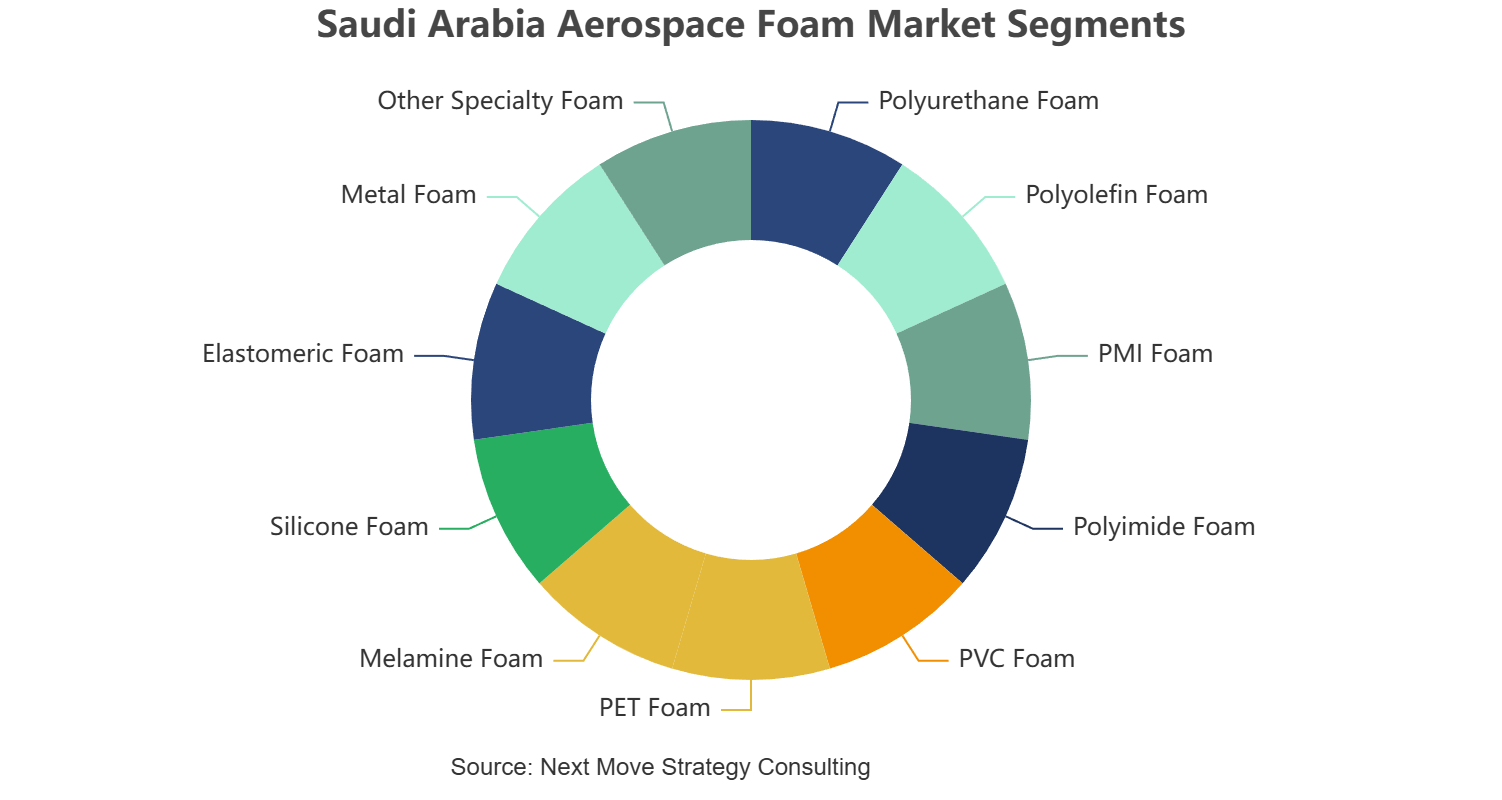
Based on foam chemistry, the Saudi Arabia Aerospace Foam Market is segmented into polyurethane foam, polyolefin foam, PMI foam, polyimide foam, PVC foam, PET foam, melamine foam, silicone foam, elastomeric foam, metal foam and other specialty foam.
Foam chemistry plays a pivotal role in shaping material selection in the Saudi Arabia aerospace foam market, where aviation expansion, defense modernisation, and high-performance aircraft programs drive stringent requirements for safety, durability, and efficiency. Through our market assessment, we observed that polyurethane and polyolefin foams are widely utilized in cabin interiors and insulation systems due to their lightweight characteristics, processability, and cost efficiency. In parallel, PMI and polyimide foams are increasingly deployed in structural and high-temperature applications where fire resistance and mechanical integrity are critical under harsh operating conditions. Additionally, PVC and PET foams support lightweight cabin configurations, while melamine and silicone foams are preferred for acoustic insulation and flame-retardant performance aligned with strict aviation safety standards. Elastomeric and metal foams, along with other specialty variants, are gaining traction in vibration damping, defense aviation systems, and advanced aerospace engineering applications. Overall, Saudi Arabia's strong investments in fleet expansion and defense aviation are accelerating diversified adoption of advanced foam chemistries across aircraft platforms.
By Product Form Insights
How does Product Form Shape Demand Structure in the Saudi Arabia Aerospace Foam Market?
Based on product form, the Saudi Arabia Aerospace Foam Market is segmented into block, sheet, roll, moulded part, machined part, kit, and other forms.
Our findings indicate that block and sheet foams are extensively used due to their adaptability in insulation, seating, and structural processing applications across commercial and military aircraft programs. In parallel, roll foams are widely adopted for cabin lining and acoustic treatment solutions that require efficient, high-coverage installation in large fleet operations. Moulded and machined parts are gaining stronger relevance as OEMs and suppliers emphasize precision-engineered components for complex cabin geometries and weight-optimized designs. Additionally, kit-based foam solutions are increasingly utilized to streamline maintenance workflows and reduce aircraft downtime in expanding MRO facilities, while other specialised forms support niche defense and advanced aerospace engineering applications. Saudi Arabia's accelerating fleet expansion and aviation infrastructure investments are steadily reinforcing demand for application-specific and high-precision foam formats.
PESTEL Analysis of the Saudi Arabia Aerospace Foam Market
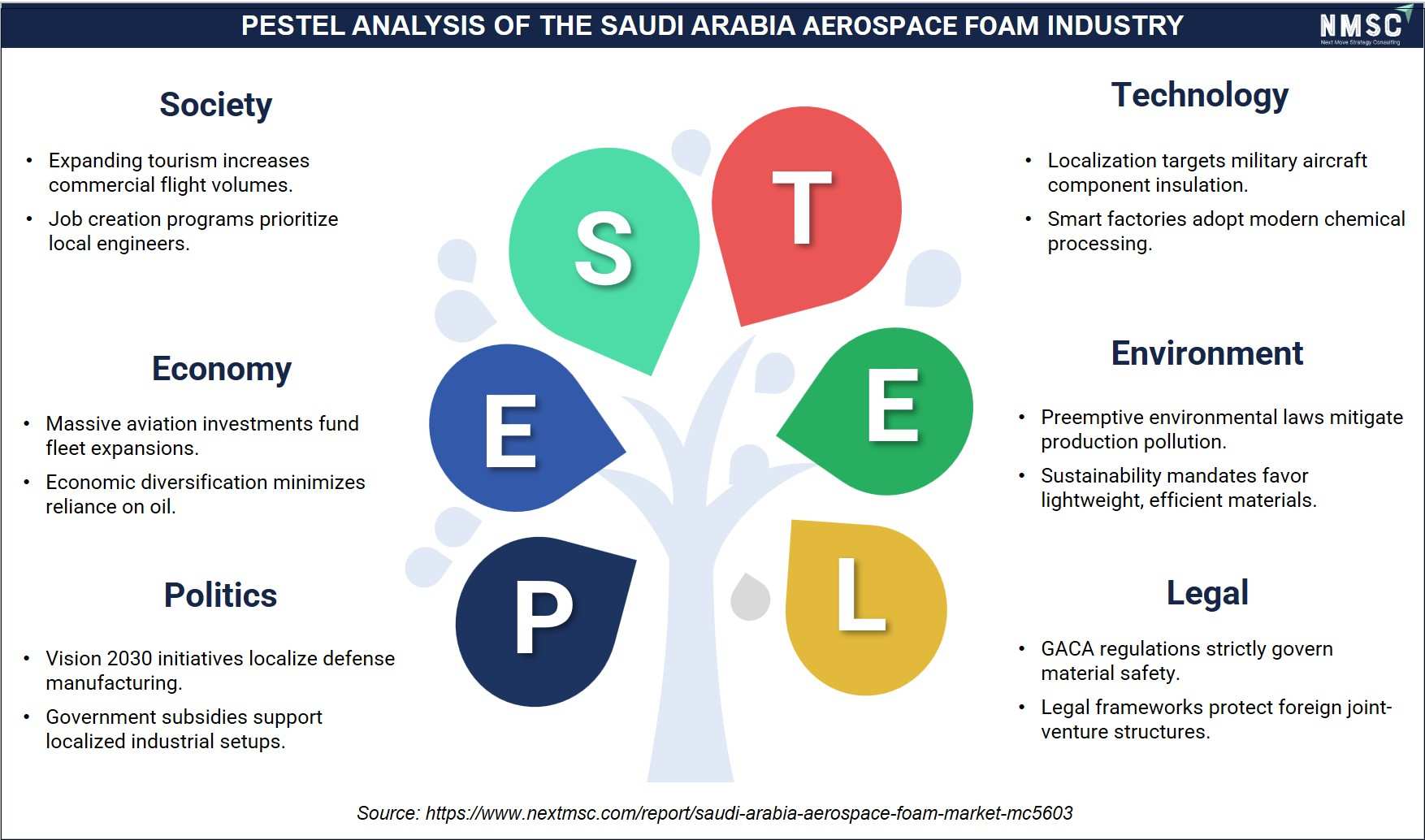
The infographic presents a PESTEL analysis framework, illustrating the major macro-environmental forces shaping industry and market development. It organizes external drivers into six interconnected dimensions, starting with political factors such as government policies, trade regulations, and geopolitical stability that influence the operating environment. Economic factors include market growth, inflation, currency fluctuations, and investment trends affecting business performance, while social factors reflect demographic shifts, consumer preferences, and workforce dynamics. We further observed that technological factors highlight innovation, automation, and digital transformation, whereas environmental factors focus on sustainability mandates and carbon regulations. Legal factors further define compliance, safety, and certification requirements. Together, these interconnected forces shape strategic planning, risk assessment, and long-term market positioning across the analysed sector.
Competitive Landscape
In our observation, the Saudi Arabia aerospace foam market is witnessing a steadily evolving competitive environment, driven by large-scale aviation expansion programs, defense sector modernisation, and ongoing efforts to strengthen domestic aerospace manufacturing capabilities under broader economic diversification initiatives. Market conditions are shaped by rising aircraft fleet additions, expanding maintenance and overhaul infrastructure, and increasing demand for lightweight, fire-resistant, and thermally efficient foam materials across cabin interiors, insulation systems, and structural aviation applications. Competitive intensity is further largely influenced by stringent aerospace qualification requirements, performance-driven material innovation, and the ability of suppliers to align with localisation priorities while maintaining dependable technical support and supply continuity.
Strategic Developments:
-
May 2026 - SABIC launched its new ULTEM reactive oligomer formulation, which won a 2026 Edison Award. This structural chemical innovation targets localised manufacturing under Saudi Vision 2030, enabling the domestic production of ultra-tough, flame-retardant composites and core matrices needed for lightweight aerospace structures and cabin interiors.
Key Players of the Saudi Arabia Aerospace Foam Market:
-
DuPont Saudi Arabia Limited
-
Solvay Saudi Arabia
-
Saudi Basic Industries Corporation (SABIC)
-
3M Saudi Arabia LLC
-
Boyd Saudi Arabia (Sales/Technical Office)
-
Huntsman APC (Arabian Polyurethane Co. Ltd.)
-
Saint-Gobain Saudi Arabia
-
Syensqo Saudi Arabia LLC
The supplier landscape features Evonik Saudi Arabia LLC, DuPont Saudi Arabia Limited, Solvay Saudi Arabia, BASF Saudi Arabia Co. Ltd., Saudi Basic Industries Corporation (SABIC), and 3M Saudi Arabia LLC, all of which operate through established aerospace material platforms tailored to regional requirements. Further, competitive strategies are increasingly shifting toward deeper in-country partnerships, localization of technical capabilities, and expanded aftermarket support to align with Saudi Arabia's aerospace industrial development agenda. Simultaneously, market participants are strengthening their focus on advanced lightweighting solutions and sustainability-aligned material innovations to support long-term efficiency improvements across both commercial and defense aviation segments.
Key Segments
By Foam Chemistry
-
Polyurethane Foam
-
Flexible Polyurethane
-
Rigid Polyurethane
-
Integral Skin Polyurethane
-
-
Polyolefin Foam
-
Polyethylene Foam
-
Polypropylene Foam
-
-
PMI Foam
-
Polyimide Foam
-
PVC Foam
-
PET Foam
-
Melamine Foam
-
Silicone Foam
-
Elastomeric Foam
-
Metal Foam
-
Aluminum Foam
-
Copper Foam
-
Other Metal Foam
-
-
Other Specialty Foam
By Product Form
-
Block
-
Sheet
-
Roll
-
Molded Part
-
Machined Part
-
Kit
-
Other Forms
By Application
-
Structural Core
-
Seating and Comfort
-
Cabin Insulation
-
Acoustic Damping
-
Sealing and Gasketing
-
Thermal Management
-
Dielectric and RF
-
Protection
-
Other Application
By Aircraft Platform
-
Commercial Aviation
-
Narrow-Body Aircraft
-
Wide-Body Aircraft
-
Regional Jets
-
-
Military Aviation
-
Fixed-Wing
-
Rotary-Wing
-
-
Business Aviation
-
Space
-
Launch Vehicles
-
Satellites
-
Space Habitats & Modules
-
By Sales Channel
-
OEM Installation
-
Aftermarket
Key Benefits for Stakeholders:
Next Move Strategy Consulting (NMSC) presents a comprehensive analysis of the Saudi Arabia Aerospace Foam Market, covering historical trends from 2020 through 2025 and offering detailed forecasts through 2035. Our study examines the market at regional and country levels, providing quantitative projections and insights into key growth drivers, challenges, and investment opportunities across all major aerospace foam segments.
Based on our assessment, we found that investors in the Saudi Arabia aerospace foam market benefit from ambitious aviation expansion initiatives, significant aircraft procurement programs tied to fleet modernisation, and strong government-led efforts to localize aerospace manufacturing, all of which reinforce long-term revenue visibility and strengthen overall market confidence. We also observed that the rapid development of aviation infrastructure and maintenance capabilities, supported by broader economic diversification strategies, is enhancing confidence in advanced aerospace production and supply chain integration opportunities. Moreover, airlines, OEMs, and MRO providers gain operational advantages through aerospace foam solutions that improve passenger comfort, optimize thermal and acoustic performance, and support aircraft lightweighting across commercial and defense aviation applications. In addition, adherence to stringent international aviation safety standards and the strengthening of regulatory frameworks are reinforcing product reliability, improving compliance assurance, and accelerating the adoption of advanced aerospace materials across the Kingdom's evolving aviation landscape.
|
Parameters |
Details |
|
Customization Scope |
Free customization (equivalent to up to 80 analyst-working hours) after purchase. |
|
Pricing and Purchase Options |
Avail customized purchase options to meet your exact research needs. |
|
Approach |
In-depth primary and secondary research; proprietary databases; rigorous quality control and validation measures. |
|
Analytical Tools |
Porter's Five Forces, SWOT, value chain, and Harvey ball analysis to assess competitive intensity, stakeholder roles, and relative impact of key factors. |
About the Author
 Mayurima Roy
— Mayurima Roy is Research Analyst at Next Move Strategy Consulting, where she has spent 4 years working across the firm's full industry coverage rather than a single fixed vertical. Her work centers on structured research, ongoing trend tracking, competitive assessment, and insight-led content development, translating complex market data into clear, decision-ready narratives that support informed client decision-making across diverse global industries, market sectors, and world regions every day.
Mayurima Roy
— Mayurima Roy is Research Analyst at Next Move Strategy Consulting, where she has spent 4 years working across the firm's full industry coverage rather than a single fixed vertical. Her work centers on structured research, ongoing trend tracking, competitive assessment, and insight-led content development, translating complex market data into clear, decision-ready narratives that support informed client decision-making across diverse global industries, market sectors, and world regions every day.
About the Reviewer
 Supradip Baul
— Supradip Baul is an accomplished business consultant and strategist with over a decade of rich experience in market intelligence, strategy, technology, and business transformation. His work has included rigorous qualitative and quantitative analysis across multiple industries, helping clients shape investment decisions and long-term roadmaps. Earlier in his career, he was associated with Gartner, where he contributed to industry-leading reports and market share analyses. He has worked with leading global companies and holds an MBA with a dual specialization in Marketing and Finance.
Supradip Baul
— Supradip Baul is an accomplished business consultant and strategist with over a decade of rich experience in market intelligence, strategy, technology, and business transformation. His work has included rigorous qualitative and quantitative analysis across multiple industries, helping clients shape investment decisions and long-term roadmaps. Earlier in his career, he was associated with Gartner, where he contributed to industry-leading reports and market share analyses. He has worked with leading global companies and holds an MBA with a dual specialization in Marketing and Finance.
At Next Move Strategy Consulting, we understand that insightful market research is the cornerstone of successful business decisions. That's why we employ a robust and multifaceted approach, combining various methodologies to deliver the most accurate and actionable data for our clients.

Research Landscape
We navigate the world of research with two primary approaches:
Qualitative Approach
Our qualitative research methodologies involve immersive techniques such as in-depth interviews, focus groups, and observational studies. By engaging directly with individuals and stakeholders, we uncover valuable insights that quantitative data alone may overlook.

Quantitative Research
In tandem with qualitative methodologies, NMSC leverages the power of Quantitative Research to provide a robust foundation of numerical insights. Through systematic data collection and analysis, we quantify patterns, preferences, and market trends, offering a comprehensive view of the business landscape.
Our quantitative research approach employs diverse tools, including surveys, experiments, and statistical modelling. These methodologies enable us to gather data from a large and representative sample, ensuring the statistical significance of our findings. By employing structured questionnaires and standardized data collection methods, we guarantee the reliability and validity of the information we present to our clients.
Quantitative research is particularly effective in measuring the prevalence of trends, assessing market size, and gauging the impact of various factors on consumer behavior. The numerical precision attained through this approach equips our clients with actionable insights, facilitating data-driven decision-making and strategy formulation.


Our Specialized Toolbox for Industry-Specific Market Research
We deploy a specialized arsenal of techniques tailored to meet your unique requirements. Here's a glimpse into our comprehensive toolbox:

Information Procurement
The stage entails acquiring market data or relevant information through various sources and methodologies.


Market Research Approach
We utilize both top-down and bottom-up approaches in market research analysis to achieve a comprehensive understanding of the market dynamics, leveraging the broad perspective of industry trends and macroeconomic factors alongside detailed insights from specific segments and individual companies.

Porters Five Forces Analysis
We conduct Porter's Five Forces analysis to evaluate the competitive landscape of an industry, providing us with insights into factors that affect profitability and strategic positioning.

SWOT Analysis

Forecasting
We utilize a forecasting model to predict future consumption by considering parameters like population, economics, regulations, market competition, drivers, constraints, technology, and pricing. We also employ statistical techniques such as multilinear regression, exponential smoothing, moving average, ARIMA, and Monte Carlo simulations for accurate predictions. In econometric forecasting, we analyzed short-term and long-term event impacts, attributing values based on regulatory frameworks, economic factors, and market events.





 Speak to Our Analyst