Saudi Arabia Healthcare Cybersecurity Market By Component (Software, Hardware, and Services), By Deployment Model (Cloud, On-Premises, and Hybrid), By Organization Size (Small, Medium, and Large), By Commercial Model (Subscription, Consumption Based, and Others), By Customer Type (Providers, Payers, and Others), By Buyer Type (CISO, CIO, and Others), By Sales Channel (Direct Sales, MSSPs, and Others) – Opportunity Analysis & Forecast, 2025–2035
Industry: Healthcare | Latest Edition: August 12, 2026 | No of Pages: 313 | No. of Tables: 163 | No. of Figures: 157 | Format: PDF | Report Code: HC5671
What Is the Saudi Arabia Healthcare Cybersecurity Market Size?
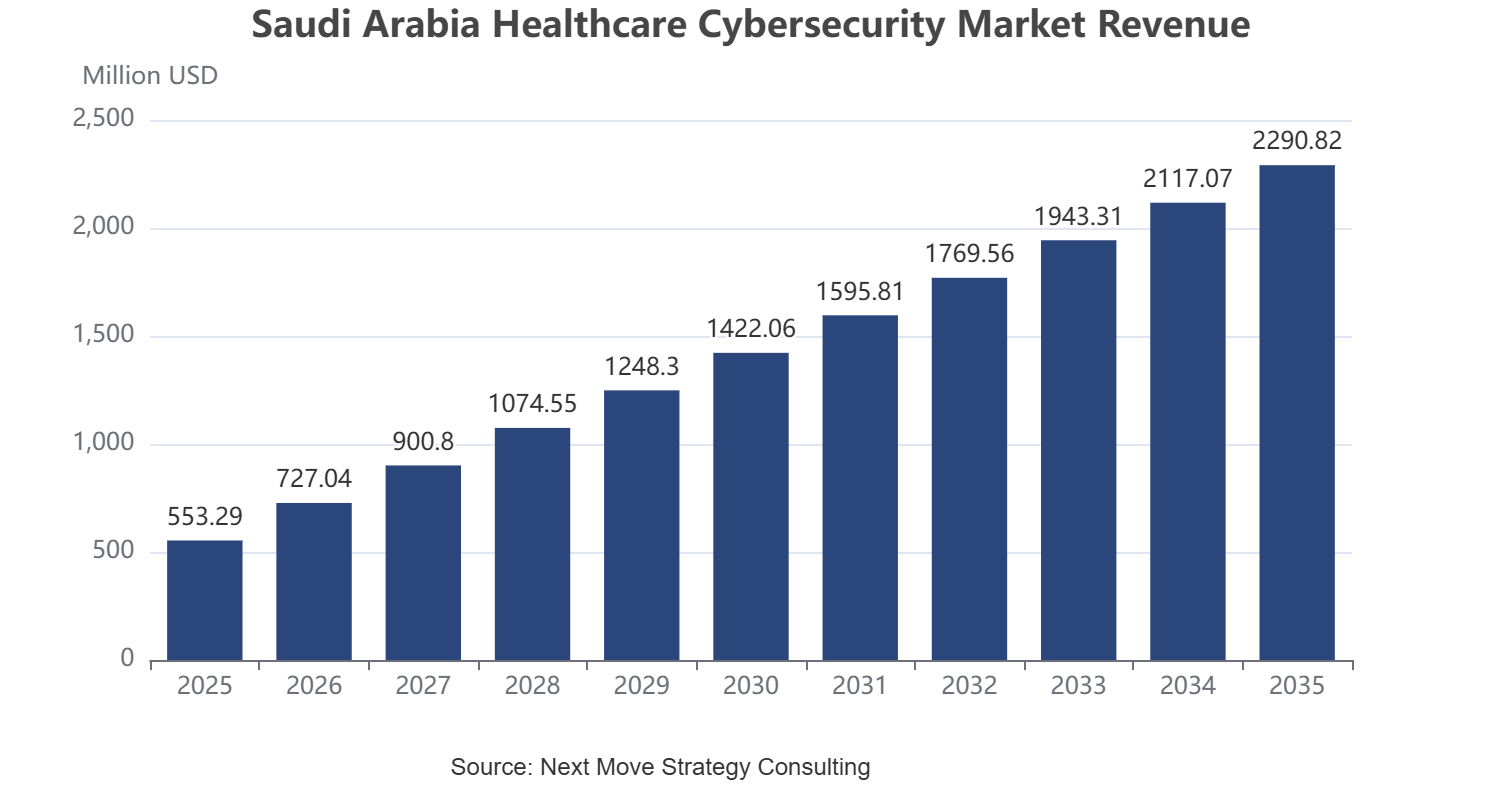
The Saudi Arabia healthcare cybersecurity market size was valued at USD 553.29 million in 2025 and is estimated at USD 722.20 million in 2026, forecast to reach USD 2,290.82 million by 2035, expanding at a 13.69% CAGR between 2026 and 2035. Software dominates the market by component, driven by rising demand for identity, endpoint, and network security across public and private hospital networks.
We observed that market growth is supported by full enforcement of the Personal Data Protection Law since September 2024, mandatory Essential Cybersecurity Controls for healthcare entities, and increasing adoption of cloud-based electronic health record security tools through 2035.
|
Key Takeaways |
|
By Component: Software is the dominant segment, while Services is the fastest-growing segment. |
|
By Deployment Model: On-Premises is the dominant segment, while Cloud is the fastest-growing segment. |
|
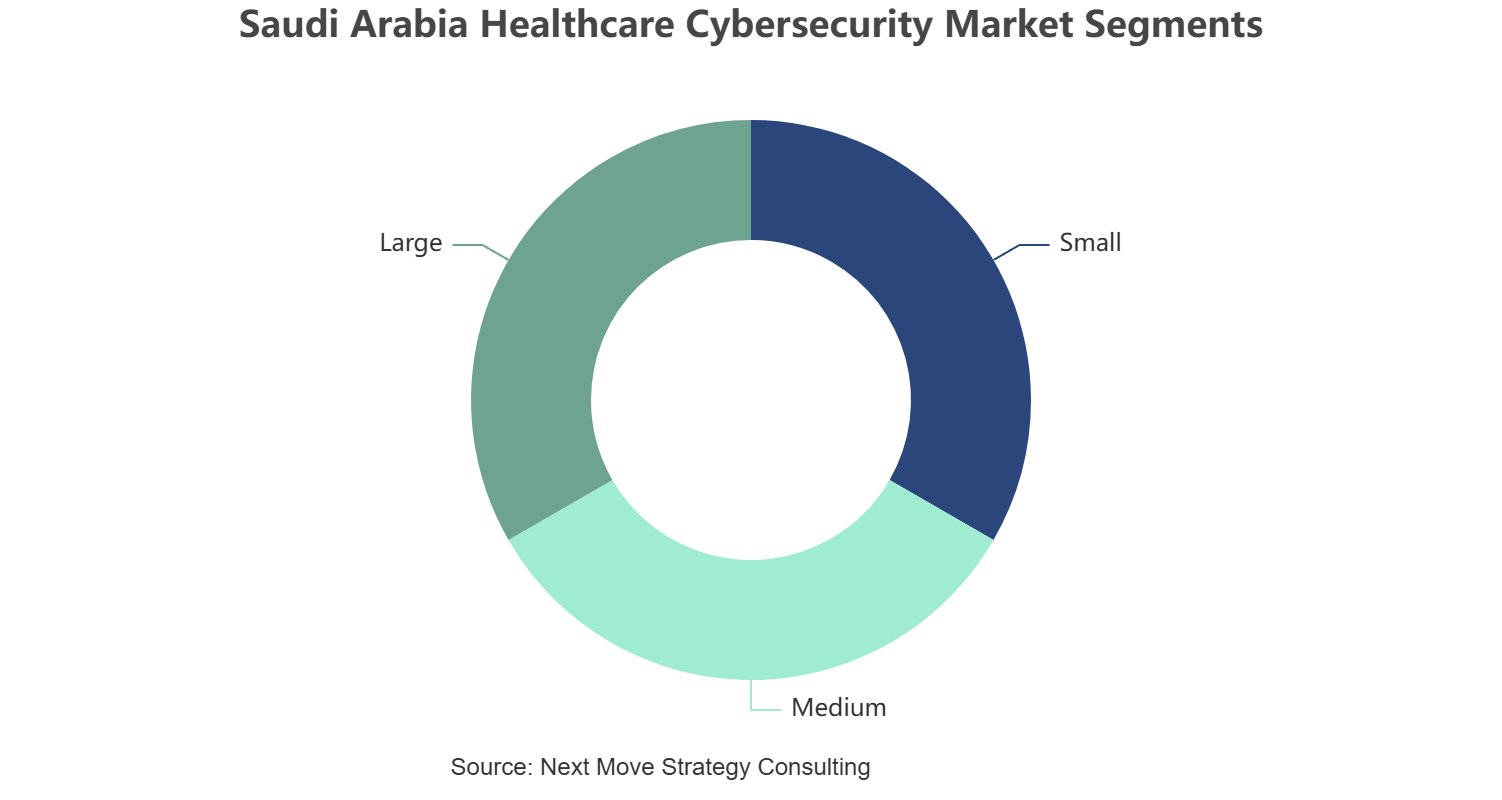
By Organization Size: Large is the dominant segment, while Medium is the fastest-growing segment. |
|
By Commercial Model: Subscription is the dominant segment, while Consumption Based is the fastest-growing segment. |
|
By Customer Type: Healthcare Providers is the dominant segment, while Medical Technology is the fastest-growing segment. |
|
By Buyer Type: Chief Information Security Officer is the dominant segment, while Biomedical Engineering is the fastest-growing segment. |
|
By Sales Channel: Direct Sales is the dominant segment, while Managed Security Service Providers is the fastest-growing segment. |
Market Opportunity: The Saudi Arabia healthcare cybersecurity market is expected to create an absolute dollar opportunity of USD 1,568.62 million between 2026 and 2035, presenting significant investment potential across identity security, cloud security, and managed security services segments.
According to NMSC's analysis, healthcare organizations aligning with the Kingdom's expanding cybersecurity control frameworks are accelerating procurement cycles, creating durable demand for compliance-aligned investment through 2035.
What Does the Saudi Arabia Healthcare Cybersecurity Market Encompass?
The Saudi Arabia healthcare cybersecurity market encompasses software, hardware, and services deployed to protect public and private hospital networks, healthcare payers, life sciences companies, and medical technology manufacturers against cyber threats targeting clinical, administrative, and connected medical device systems. Our assessment indicates that the market spans identity, endpoint, network, cloud, application, data, email, and operational technology security solutions delivered through direct sales, managed security service providers, systems integrators, and cloud marketplaces. The market has evolved from perimeter-focused antivirus deployments into an integrated security operations model addressing ransomware, medical device exploitation, and third-party supply chain risk within the broader healthcare cyber security market as the Kingdom pursues Vision 2030 healthcare transformation.
Regulatory frameworks, including the Personal Data Protection Law enforced by the Saudi Data and Artificial Intelligence Authority and the National Cybersecurity Authority's Essential Cybersecurity Controls, shape cybersecurity risk management and data-security obligations for hospitals, healthcare payers, and medical technology providers designated as essential service providers. We observed that healthcare providers are increasingly investing in cloud security posture management, medical device security, and managed detection and response to align with these mandatory frameworks. NMSC's analysis indicates that the growing digitization of clinical workflows, telehealth platforms, and connected medical devices continues to reshape investment priorities and competitive positioning across the Saudi Arabia healthcare cybersecurity market.
|
Parameter |
Details |
|
Market Size in 2025 |
USD 553.29 Million |
|
Market Size in 2026 |
USD 722.20 Million |
|
Revenue Forecast in 2035 |
USD 2,290.82 Million |
|
Growth Rate |
CAGR of 13.69% from 2026 to 2035 |
|
Analysis Period |
2025–2035 |
|
Base Year Considered |
2025 |
|
Forecast Period |
2026–2035 |
|
Market Size Estimation |
USD Million |
|
Companies Profiled |
15 |
|
Market Share |
Available for Top 10 Companies |
Key Emerging Trends
Based on research conducted by NMSC, we found that four structural trends are reshaping security architecture, vendor selection, and compliance strategy across the Saudi Arabia healthcare cybersecurity market.
How Is the Personal Data Protection Law Reshaping Healthcare Cybersecurity Investment?
The expiry of the compliance grace period for the Personal Data Protection Law in September 2024 brought full legal exposure for healthcare organizations processing patient data in the Kingdom. We observed that hospitals, healthcare payers, and medical technology providers are accelerating investment in encryption, access governance, and breach-notification tooling to align with the law's technical and organizational safeguard requirements. This regulatory transition continues to reshape vendor selection criteria across the Saudi Arabia healthcare cybersecurity market.
How Are Essential Cybersecurity Controls Reshaping Healthcare Security Operations?
The National Cybersecurity Authority's Essential Cybersecurity Controls designate healthcare among the essential service sectors subject to mandatory baseline cybersecurity requirements spanning governance, defense, and resilience. Our findings suggest that hospitals and healthcare payers are accelerating investment in endpoint detection and response, network segmentation, and security operations center capabilities to meet these binding obligations. Healthcare institutions are reinforcing sustained demand for managed detection and response services as they align with the framework's control requirements.
How Is Medical Device and Clinical IoT Security Gaining Priority?
The proliferation of connected imaging systems, infusion pumps, and patient monitors is expanding the clinical attack surface across Saudi hospitals supporting the Kingdom's Vision 2030 healthcare transformation program. We observed that biomedical and clinical engineering teams are increasingly collaborating with information security teams to inventory, segment, and monitor medical devices as healthcare institutions align with Essential Cybersecurity Controls requirements. Demand is rising for vendors offering passive network monitoring and asset discovery tailored to the IoT security in healthcare market, particularly among hospital networks prioritizing operational technology security.
How Is Cloud Migration of Health Data Reshaping Security Architecture?
Migration of electronic health records, telehealth platforms, and diagnostic imaging to cloud infrastructure is accelerating demand for cloud security posture management, workload protection, and cloud access security broker solutions across Saudi Arabia. Our analysis indicates that compliance with Personal Data Protection Law obligations is prompting healthcare providers and healthcare payers to prioritize encryption, access governance, and breach-notification readiness, a shift closely tied to growth in the healthcare cloud security market. This is reshaping vendor selection criteria toward platforms offering native compliance-reporting capabilities.
PESTEl Analysis of the Saudi Arabia Healthcare Cybersecurity Market
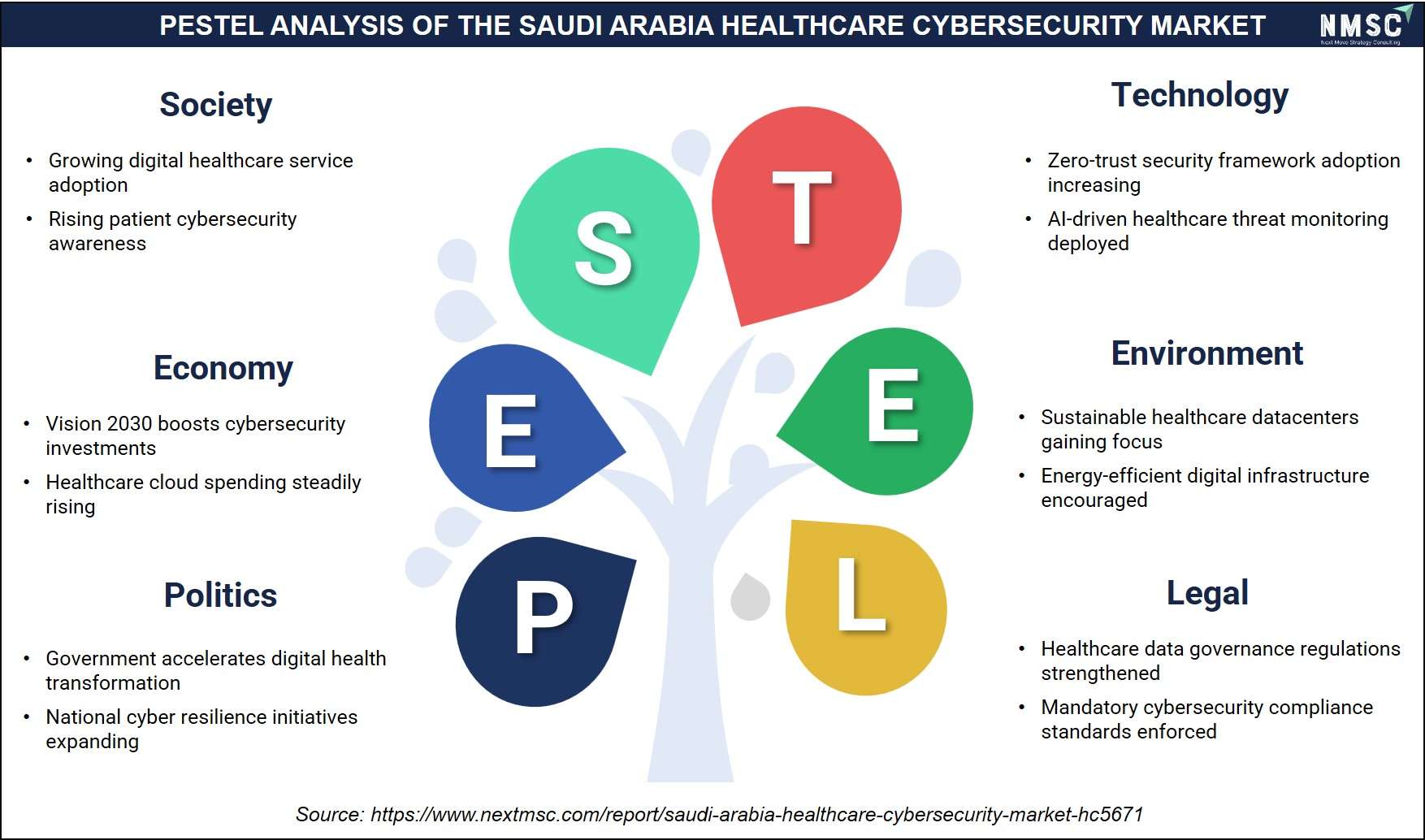
The infographic presents a PESTEL analysis of the Saudi Arabia Healthcare Cybersecurity Market, illustrating the six key external factors influencing market growth: Political, Economic, Social, Technological, Environmental, and Legal. These factors collectively shape cybersecurity investments, regulatory compliance, digital healthcare adoption, innovation, sustainability initiatives, and data protection strategies, helping stakeholders evaluate the macro-environment and identify opportunities, risks, and long-term market trends.
Growth Drivers and Restraints
Growth Catalyst and Risk Assessment Matrix
|
Factors |
Type |
(+/-) % Impact on CAGR |
Geographic Relevance |
Impact Timeline |
|
Full enforcement of the Personal Data Protection Law since September 2024 requiring hospitals and healthcare payers to strengthen data-security accountability |
Driver |
+3.85% |
Saudi Arabia (nationwide, public and private sector) |
Short to Medium term (1-4 years) |
|
National Cybersecurity Authority Essential Cybersecurity Controls designating healthcare as an essential service sector subject to mandatory baseline cybersecurity requirements |
Driver |
+3.20% |
Saudi Arabia (nationwide, essential service providers) |
Medium term (2-5 years) |
|
New NCA Cybersecurity Controls for private sector entities, published January 2026, extending baseline requirements to private healthcare providers not classified as critical infrastructure |
Driver |
+2.55% |
Saudi Arabia (nationwide, private sector healthcare) |
Medium term (2-5 years) |
|
Vision 2030 healthcare transformation program accelerating digitization of hospitals, telehealth platforms, and connected medical devices |
Driver |
+2.10% |
Saudi Arabia (strongest in Riyadh, Jeddah, Dammam) |
Medium to Long term (2-7 years) |
|
Growing adoption of cloud-based electronic health record systems requiring cloud security posture management and workload protection |
Driver |
+1.60% |
Saudi Arabia (particularly among private hospital networks) |
Medium to Long term (3-8 years) |
|
Shortage of skilled healthcare cybersecurity professionals limiting in-house security operations capacity across hospitals and clinics |
Restraint |
−1.70% |
Saudi Arabia (nationwide; most acute outside major cities) |
Short to Medium term (1-4 years) |
|
Compliance costs associated with overlapping Personal Data Protection Law and Essential Cybersecurity Controls obligations restricting smaller healthcare providers' investment capacity |
Restraint |
−1.25% |
Saudi Arabia (strongest among small and medium healthcare providers) |
Medium term (2-5 years) |
What Is the Primary Growth Driver of the Saudi Arabia Healthcare Cybersecurity Market?
Full enforcement of the Personal Data Protection Law represents the primary growth driver of the Saudi Arabia healthcare cybersecurity market. The law's compliance grace period concluded in September 2024, and it is now fully enforceable against controllers and processors in the Kingdom, including hospitals and healthcare payers that process sensitive patient data. We observed that this regulatory milestone is driving healthcare providers to prioritize encryption, access governance, and security operations investment across the country.
How Are Essential Cybersecurity Controls Driving Saudi Arabia Healthcare Cybersecurity Market Growth?
The National Cybersecurity Authority's Essential Cybersecurity Controls, which apply to essential service providers including healthcare, telecommunications, and financial services, are accelerating market growth. Our assessment indicates that hospitals and healthcare payers designated as essential service providers are formalizing cybersecurity budgets and governance structures to comply with the framework's controls spanning cybersecurity governance, defense, resilience, and third-party protection. This regulatory framework is compelling healthcare organizations to reassess vendor relationships across the sector.
What Is Restraining Saudi Arabia Healthcare Cybersecurity Market Expansion?
A shortage of skilled cybersecurity professionals and the compliance burden of overlapping regulatory obligations continue to restrain market expansion. We found that smaller healthcare providers face heightened difficulty navigating simultaneous obligations under the Personal Data Protection Law and Essential Cybersecurity Controls, limiting their capacity to operationalize advanced security tooling despite rising regulatory pressure. Providers outside major metropolitan centers face heightened difficulty competing for scarce security talent and capital against larger hospital networks.
Segmentation Analysis
By Component Insights
How Is the Saudi Arabia Healthcare Cybersecurity Market Segmented by Component?
Based on component, the Saudi Arabia healthcare cybersecurity market is segmented into software, hardware, and services. Software spans identity security, endpoint security, network security, cloud security, application security, data security, email security, security operations, exposure management, and operational technology security, while hardware includes network security appliances, identity security appliances, and OT security appliances. Services encompass managed security services, professional services, and support and maintenance offered to hospitals, payers, and life sciences organizations across the country.
Software dominates the component segment, supported by widespread deployment of identity, endpoint, and network security platforms across hospital networks responding to Essential Cybersecurity Controls obligations. Services represent the fastest-growing component, as healthcare providers facing persistent cybersecurity talent shortages increasingly outsource detection, response, and healthcare identity and access management monitoring to managed security service providers. This shift toward outsourced security operations is particularly pronounced among small and medium-sized healthcare providers lacking dedicated in-house security operations centers across the country.
By Deployment Model Insights
How Is the Saudi Arabia Healthcare Cybersecurity Market Segmented by Deployment Model?
Based on deployment model, the market is divided into cloud, on-premises, and hybrid deployment. On-premises deployment continues to serve hospitals maintaining legacy clinical applications and internal governance requirements, while cloud deployment supports software-as-a-service security tools, telehealth platforms, and electronic health record hosting adopted by private hospital networks. Hybrid deployment enables healthcare organizations to align sensitive workloads with governance obligations while adopting cloud-delivered detection, response, and identity capabilities.
On-premises deployment remains dominant, reflecting the persistence of legacy IT infrastructure across public hospitals and internal governance requirements under the Personal Data Protection Law. Cloud deployment is the fastest-growing model, driven by accelerating migration of electronic health records and telehealth platforms to cloud infrastructure among private hospital networks and rising adoption of cloud security posture management tools. Hospitals piloting cloud-first modernization strategies increasingly favor vendors offering integrated compliance-reporting capabilities across the country.
Growth Opportunities
Our analysis shows that three forward-looking opportunities stand out for stakeholders operating in the Saudi Arabia healthcare cybersecurity market over the 2026–2035 forecast period.
How Can Medical Device Security Platforms Unlock New Growth?
Rising connectivity of infusion pumps, imaging systems, and patient monitors creates a substantial opportunity for vendors offering passive network monitoring and asset discovery tailored to clinical environments. Vendors that combine operational technology security visibility with healthcare-specific risk scoring can capture growing demand from biomedical and clinical engineering buyers seeking to strengthen medical device oversight across Saudi hospital networks.
Where Does Managed Security Services Create Whitespace for Saudi Healthcare Providers?
Persistent shortages of skilled cybersecurity professionals create meaningful whitespace for managed security service providers offering detection, response, and security operations center capabilities tailored to hospitals and clinics. Providers that bundle Essential Cybersecurity Controls compliance reporting with continuous monitoring can capture demand from small and medium-sized healthcare providers unable to sustain dedicated in-house security operations teams.
How Can Cloud-Native Security Platforms Benefit Private Hospital Networks and Healthcare Payers?
Accelerating cloud migration of electronic health records, claims data, and diagnostic imaging creates opportunity for cloud security posture management and data security vendors serving private hospital networks, commercial health insurers, and life sciences companies. Vendors offering native compliance mapping to Personal Data Protection Law requirements can strengthen positioning among institutions expanding cross-institutional data-sharing infrastructure across the country.
Strategic Framework of the Saudi Arabia Healthcare Cybersecurity Market
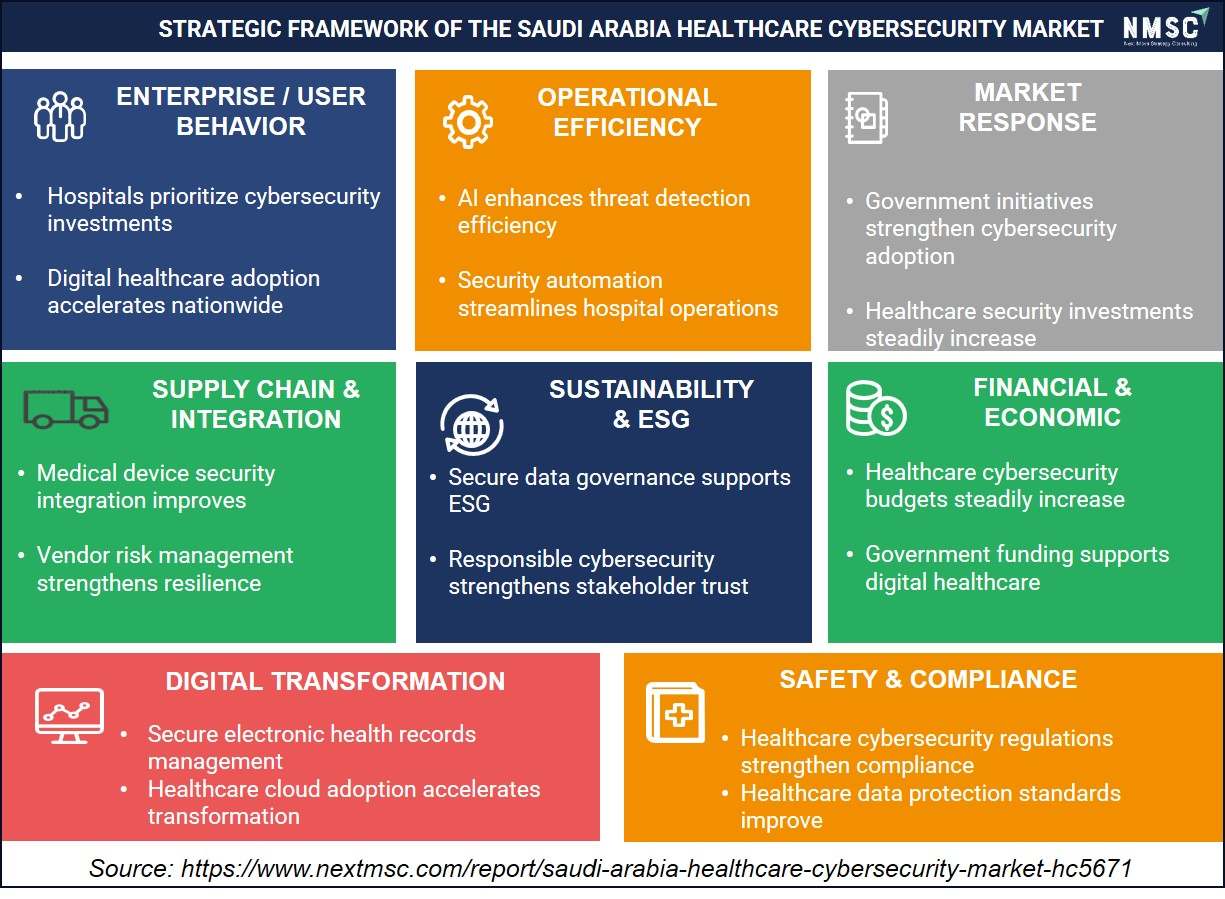
The infographic outlines the strategic framework of the Saudi Arabia Healthcare Cybersecurity Market, highlighting the key factors driving industry growth. It emphasizes enterprise cybersecurity adoption, AI-enabled operational efficiency, supportive government initiatives, secure supply chain integration, ESG-focused data governance, increasing healthcare cybersecurity investments, digital transformation through cloud and electronic health records, and stronger regulatory compliance. Together, these strategic pillars enhance healthcare resilience, improve patient data protection, and accelerate secure digital healthcare modernization across Saudi Arabia.
Competitive Landscape
We observed that the Saudi Arabia healthcare cybersecurity market features a highly competitive landscape, with Saudi subsidiaries of global cybersecurity platform vendors competing to serve public and private healthcare institutions.
Key Takeaways
|
Dimension |
Description |
|
Market Structure |
Highly competitive with the presence of Saudi subsidiaries of large diversified global cybersecurity vendors serving public and private healthcare institutions. Global technology vendors account for a significant share of the Saudi Arabia healthcare cybersecurity market, supported by established local channel and systems-integrator partnerships. |
|
Innovation Focus |
Artificial intelligence-enabled threat detection, medical device and clinical IoT security, identity governance, and managed detection and response capabilities dominate current product development strategies across leading vendors. |
|
M&A Activity |
Strategic partnerships, channel expansion, and localized service delivery investment continue to shape the competitive landscape as vendors strengthen their presence in managed security services and compliance-reporting capabilities across the country. |
How Do Companies Compete in the Saudi Arabia Healthcare Cybersecurity Market?
Companies compete primarily through platform breadth, local channel presence, and compliance-alignment features tailored to Personal Data Protection Law and Essential Cybersecurity Controls requirements. Global vendors such as Microsoft Arabia, Cisco Saudi Arabia, Fortinet Saudi Arabia, and Palo Alto Networks Saudi Arabia leverage extensive network and cloud security portfolios alongside established channel partnerships to maintain market leadership. Meanwhile, specialized providers including Darktrace Saudi Arabia and Armis Saudi Arabia differentiate themselves through AI-driven threat detection and connected device visibility tailored to Vision 2030 healthcare transformation.
Which Competitive Archetypes Dominate the Saudi Arabia Healthcare Cybersecurity Market?
Two primary competitive archetypes characterize the market. The first comprises Saudi subsidiaries of diversified global cybersecurity platform vendors offering comprehensive network, cloud, and endpoint security portfolios supported by international threat-intelligence resources, represented by companies such as Cisco Saudi Arabia, Microsoft Arabia, and IBM Saudi Arabia. The second includes specialized detection and exposure management providers such as Tenable Saudi Arabia, Armis Saudi Arabia, and Darktrace Saudi Arabia, which focus on vulnerability management, connected device visibility, and AI-driven anomaly detection tailored to healthcare environments.
How Are Companies Differentiating Through Innovation in Saudi Arabia Healthcare Cybersecurity?
Innovation strategies increasingly focus on artificial intelligence-enabled threat detection, medical device asset discovery, and zero trust security architectures tailored to Saudi clinical environments. Companies are investing in technologies incorporating behavioral analytics, automated incident response, and compliance-reporting tools aligned with Essential Cybersecurity Controls and Personal Data Protection Law requirements. Our analysis indicates that vendors capable of combining threat-detection accuracy with regulatory-reporting automation are strengthening their competitive positioning across the industry.
What Expansion Activity Is Shaping the Saudi Arabia Healthcare Cybersecurity Market?
Strategic partnerships, channel expansion, and investment in localized service capabilities continue to shape competition across the market. Leading companies are strengthening their positions through expanded managed detection and response offerings, deeper partnerships with Saudi systems integrators, and increased investment in local security operations center capacity. These initiatives enable vendors to broaden their healthcare-specific portfolios and respond more effectively to evolving compliance demand across the country.
Key Market Players
Our assessment indicates that the following 15 companies are actively shaping platform innovation, service delivery, and competitive dynamics within the Saudi Arabia healthcare cybersecurity market.
-
Microsoft Arabia Ltd.
-
Fortinet Saudi Arabia LLC
-
Trend Micro Saudi Arabia LLC
-
IBM Saudi Arabia LLC
-
Zscaler Saudi Arabia LLC
-
Proofpoint Saudi Arabia LLC
-
ESET Saudi Arabia LLC
-
Thales Saudi Arabia LLC
-
Darktrace Saudi Arabia LLC
-
Armis Saudi Arabia LLC
-
Akamai Technologies Saudi Arabia LLC
-
Rubrik Saudi Arabia LLC
-
Tenable Saudi Arabia LLC
Investment Opportunities
What Capital Inflows Are Targeting the Saudi Arabia Healthcare Cybersecurity Market?
Capital inflows into the Saudi Arabia healthcare cybersecurity market are increasingly directed toward AI-based security operations, medical device security, and managed detection and response capabilities. Global cybersecurity vendors continue to invest in local channel presence and threat-intelligence resources to strengthen their Saudi market positioning under Vision 2030. We observed that investors favor companies demonstrating strong local-market traction, compliance-alignment capabilities, and scalable managed-service models.
How Is Infrastructure Investment Supporting the Saudi Arabia Healthcare Cybersecurity Market?
Infrastructure investment is expanding security operations center capacity, cloud security tooling, and managed detection and response networks across Saudi healthcare institutions. Our findings suggest that vendors and healthcare providers are investing in local data-center capacity, threat-intelligence infrastructure, and automated compliance-reporting platforms to support alignment with Personal Data Protection Law and Essential Cybersecurity Controls requirements. In addition, companies are strengthening partnerships with local systems integrators to accelerate deployment across hospital networks.
What ESG Considerations Are Shaping Investment Decisions in the Saudi Arabia Healthcare Cybersecurity Market?
Environmental, social, and governance considerations are becoming integral to investment decisions, with patient-data protection, workforce cybersecurity training, and transparent governance emerging as key priorities. We found that investors increasingly favor vendors demonstrating measurable progress in reducing incident-response times, expanding cybersecurity workforce development programs, and maintaining transparent compliance reporting. These considerations are strengthening vendor reputation while supporting long-term value creation in an increasingly compliance-driven market.
Key Benefits for Stakeholders
How Does This Report Benefit Enterprise and Industry Leaders?
Enterprise and industry leaders gain access to validated market segmentation, competitive benchmarking, regulatory-trend analysis, and forecasts that support strategic planning, vendor selection, and security-budget allocation across the Saudi Arabia healthcare cybersecurity market. Our analysis shows that detailed assessments of component, deployment model, and customer-type trends help hospitals, payers, and life sciences companies identify high-priority investment areas and strengthen compliance positioning.
How Does This Report Benefit Investors and Financial Analysts?
Investors and financial analysts benefit from consistent market-size estimates, growth forecasts, competitive assessments, and regulatory-trend analysis that support investment evaluation and capital-allocation decisions across the Saudi Arabia healthcare cybersecurity market. We observed that the report's detailed analysis of identity, endpoint, cloud, and operational technology security segments enables stakeholders to identify vendors and market categories with the strongest long-term growth potential through 2035.
How Does This Report Benefit Technology Vendors and Product Teams?
Technology vendors and product development teams gain valuable insights into emerging innovation trends, including AI-enabled threat detection, medical device security, identity governance, and compliance-automation tools transforming the Saudi healthcare cybersecurity industry. Our findings suggest that this analysis helps research and development teams prioritize product roadmaps and align offerings with Personal Data Protection Law and Essential Cybersecurity Controls requirements.
Key Market Segments
By Component
-
Software
-
Identity Security
-
Identity Governance and Administration
-
Privileged Access Management
-
Multi-Factor Authentication
-
Single Sign-On
-
Identity Threat Detection and Response
-
-
Endpoint Security
-
Endpoint Protection
-
Endpoint Detection and Response
-
Extended Detection and Response
-
Mobile Threat Defense
-
-
Network Security
-
Network Firewall
-
Network Detection and Response
-
Network Access Control
-
Secure Remote Access
-
Network Segmentation
-
-
Cloud Security
-
Cloud Security Posture Management
-
Cloud Workload Protection
-
Cloud Access Security Broker
-
Container Security
-
Kubernetes Security
-
-
Application Security
-
Web Application Firewall
-
API Security
-
Runtime Application Protection
-
Application Security Testing
-
-
Data Security
-
Data Loss Prevention
-
Encryption
-
Database Security
-
File Security
-
Tokenization
-
-
Email Security
-
Secure Email Gateway
-
Anti-Phishing
-
Business Email Protection
-
Email Encryption
-
-
Security Operations
-
Security Information and Event Management
-
Automation and Response
-
Threat Intelligence
-
Log Management
-
Threat Hunting
-
-
Exposure Management
-
Vulnerability Management
-
Attack Surface Management
-
Configuration Compliance
-
Security Validation
-
-
Operational Technology Security
-
Medical Device Security
-
Clinical Internet of Things Security
-
Network Monitoring
-
Biomedical Asset Protection
-
-
Other Security Software
-
-
Hardware
-
Network Security Appliances
-
Firewall Appliances
-
Secure Web Gateways
-
Secure Remote Access Appliances
-
-
Identity Security Appliances
-
Hardware Security Modules
-
Authentication Appliances
-
-
OT Security Appliances
-
Passive Network Sensors
-
Dedicated Monitoring Appliances
-
-
Other Security Hardware
-
-
Services
-
Managed Security Services
-
Detection and Response
-
Security Operations Center
-
Firewall
-
Endpoint Security
-
Cloud Security
-
Exposure Management
-
Other Managed Security Services
-
-
Professional Services
-
Security Consulting
-
Risk Assessment
-
Compliance Advisory
-
Security Architecture
-
Deployment
-
System Integration
-
Incident Response
-
Digital Forensics
-
Security Awareness Training
-
Other Professional Services
-
-
Support and Maintenance
-
Technical Support
-
Software Maintenance
-
Hardware Maintenance
-
Premium Support
-
-
By Deployment Model
-
Cloud
-
On-Premises
-
Hybrid
By Organization Size
-
Small
-
Medium
-
Large
By Commercial Model
-
Subscription
-
Perpetual License
-
Consumption Based
-
Appliance Sale
-
Project-Based
-
Managed Service Contract
-
Support Contract
By Customer Type
-
Healthcare Providers
-
Integrated Delivery Networks
-
General Hospitals
-
Specialty Hospitals
-
Physician Practices
-
Ambulatory Surgery Centers
-
Diagnostic Imaging Centers
-
Long-Term Care Facilities
-
Home Healthcare Providers
-
-
Healthcare Payers
-
Commercial Health Insurers
-
Government Health Payers
-
-
Life Sciences
-
Pharmaceutical Companies
-
Biotechnology Companies
-
Contract Research Organizations
-
-
Medical Technology
-
Medical Device Manufacturers
-
Digital Health Companies
-
-
Healthcare Public Sector
-
Public Health Agencies
-
Academic Medical Centers
-
Research Institutes
-
By Buyer Type
-
Chief Information Officer
-
Chief Information Security Officer
-
Information Technology Infrastructure
-
Security Operations Center
-
Clinical Engineering
-
Biomedical Engineering
-
Risk and Compliance
-
Procurement
By Sales Channel
-
Direct Sales
-
Value-Added Resellers
-
Systems Integrators
-
Managed Security Service Providers
-
Cloud Marketplaces
-
Original Equipment Manufacturer Partners
Conclusion and Recommendations
What Is the Long-Term Outlook for the Saudi Arabia Healthcare Cybersecurity Market?
The long-term outlook for the Saudi Arabia healthcare cybersecurity market remains positive, supported by full enforcement of the Personal Data Protection Law, expanding Essential Cybersecurity Controls obligations, and continued digitization of clinical and administrative workflows under Vision 2030. We observed that growing adoption of managed detection and response, medical device security, and cloud security posture management will continue to drive market expansion across public and private healthcare institutions throughout the forecast period.
What Strategic Positioning Should Cybersecurity Vendors Pursue?
Vendors should prioritize investments in localized threat detection, medical device visibility, and automated compliance-reporting capabilities while strengthening managed security service and systems-integrator partnerships. Our assessment indicates that companies expanding their portfolios with operational technology security, identity governance, and cloud-native compliance tooling will be well positioned to strengthen customer retention and capture regulation-driven demand within the Saudi Arabia healthcare cybersecurity market.
How Attractive Is the Saudi Arabia Healthcare Cybersecurity Market for New Investment?
The Saudi Arabia healthcare cybersecurity market presents an attractive investment opportunity, supported by an actively expanding regulatory framework, sustained Vision 2030 healthcare digitization, and continued growth of hospital and clinical infrastructure. We found that investment potential is particularly strong for companies focused on medical device security, managed detection and response, and cloud compliance tooling, enabling them to capitalize on the Kingdom's regulatory momentum and long-term market growth.
What Market Shifts and Key Risks Should Stakeholders Monitor?
Stakeholders should closely monitor the implementation of the new NCNICC-1:2025 private sector controls, persistent cybersecurity talent shortages, and compliance costs stemming from overlapping regulatory frameworks. Our analysis shows that vendors unable to demonstrate measurable compliance value, scalable managed-service delivery, or local-market expertise may face increasing competitive pressure as healthcare institutions consolidate security vendor relationships across the country.
What Are the Key Growth Pathways for the Saudi Arabia Healthcare Cybersecurity Market?
Key growth pathways include expanding managed security service offerings, accelerating investment in medical device and operational technology security, strengthening cloud compliance capabilities, and enhancing AI-enabled threat detection. NMSC's analysis indicates that companies successfully combining regulatory-compliance automation, local-market expertise, and scalable managed-service delivery will be best positioned to capture the Saudi Arabia healthcare cybersecurity market's projected growth through 2035.
About the Author
 Liza Phukan
— Liza Phukan is Research Associate at Next Move Strategy Consulting, where she has covered emerging industries and market research across sectors for 3.5 years. Her work includes analyzing industry developments, validating market data, and developing structured business content from research findings. She uses secondary research and data-validation practices to turn complex market information into clear decision-useful market analysis for business audiences and support report development and B2B.
Liza Phukan
— Liza Phukan is Research Associate at Next Move Strategy Consulting, where she has covered emerging industries and market research across sectors for 3.5 years. Her work includes analyzing industry developments, validating market data, and developing structured business content from research findings. She uses secondary research and data-validation practices to turn complex market information into clear decision-useful market analysis for business audiences and support report development and B2B.
About the Reviewer
 Supradip Baul
— Supradip Baul is an accomplished business consultant and strategist with over a decade of rich experience in market intelligence, strategy, technology, and business transformation. His work has included rigorous qualitative and quantitative analysis across multiple industries, helping clients shape investment decisions and long-term roadmaps. Earlier in his career, he was associated with Gartner, where he contributed to industry-leading reports and market share analyses. He has worked with leading global companies and holds an MBA with a dual specialization in Marketing and Finance.
Supradip Baul
— Supradip Baul is an accomplished business consultant and strategist with over a decade of rich experience in market intelligence, strategy, technology, and business transformation. His work has included rigorous qualitative and quantitative analysis across multiple industries, helping clients shape investment decisions and long-term roadmaps. Earlier in his career, he was associated with Gartner, where he contributed to industry-leading reports and market share analyses. He has worked with leading global companies and holds an MBA with a dual specialization in Marketing and Finance.
At Next Move Strategy Consulting, we understand that insightful market research is the cornerstone of successful business decisions. That's why we employ a robust and multifaceted approach, combining various methodologies to deliver the most accurate and actionable data for our clients.

Research Landscape
We navigate the world of research with two primary approaches:
Qualitative Approach
Our qualitative research methodologies involve immersive techniques such as in-depth interviews, focus groups, and observational studies. By engaging directly with individuals and stakeholders, we uncover valuable insights that quantitative data alone may overlook.

Quantitative Research
In tandem with qualitative methodologies, NMSC leverages the power of Quantitative Research to provide a robust foundation of numerical insights. Through systematic data collection and analysis, we quantify patterns, preferences, and market trends, offering a comprehensive view of the business landscape.
Our quantitative research approach employs diverse tools, including surveys, experiments, and statistical modelling. These methodologies enable us to gather data from a large and representative sample, ensuring the statistical significance of our findings. By employing structured questionnaires and standardized data collection methods, we guarantee the reliability and validity of the information we present to our clients.
Quantitative research is particularly effective in measuring the prevalence of trends, assessing market size, and gauging the impact of various factors on consumer behavior. The numerical precision attained through this approach equips our clients with actionable insights, facilitating data-driven decision-making and strategy formulation.


Our Specialized Toolbox for Industry-Specific Market Research
We deploy a specialized arsenal of techniques tailored to meet your unique requirements. Here's a glimpse into our comprehensive toolbox:

Information Procurement
The stage entails acquiring market data or relevant information through various sources and methodologies.


Market Research Approach
We utilize both top-down and bottom-up approaches in market research analysis to achieve a comprehensive understanding of the market dynamics, leveraging the broad perspective of industry trends and macroeconomic factors alongside detailed insights from specific segments and individual companies.

Porters Five Forces Analysis
We conduct Porter's Five Forces analysis to evaluate the competitive landscape of an industry, providing us with insights into factors that affect profitability and strategic positioning.

SWOT Analysis

Forecasting
We utilize a forecasting model to predict future consumption by considering parameters like population, economics, regulations, market competition, drivers, constraints, technology, and pricing. We also employ statistical techniques such as multilinear regression, exponential smoothing, moving average, ARIMA, and Monte Carlo simulations for accurate predictions. In econometric forecasting, we analyzed short-term and long-term event impacts, attributing values based on regulatory frameworks, economic factors, and market events.





 Speak to Our Analyst