Sexual Wellness Products Market Global Industry Analysis and Forecast (2026–2035)

The global Sexual Wellness Products Market size was valued at USD 34.80 billion in 2025 and is estimated at USD 37.60 billion in 2026, forecast to reach USD 76.40 billion by 2035, expanding at an 8.20% CAGR from 2026 to 2035. Key drivers include expanding direct-to-consumer and marketplace distribution and sustained consumer adoption of app-connected and rechargeable pleasure devices, with North America leading the global market.

Download Free Sample PDF
Base Year (2025)
$34.80 Billion
Forecast (2035)
$76.40 Billion
CAGR (2026-2035)
8.2%
Top Region
North America

What Is the Sexual Wellness Products Market Size?

The global sexual wellness products market size was valued at USD 34.80 Billion in 2025 and is estimated at USD 37.60 Billion in 2026, forecast to reach USD 76.40 Billion by 2035, expanding at a 8.20% CAGR between 2026 and 2035. North America leads with approximately 34% share, while pleasure devices dominate all other product categories with approximately 36% share.

We observed that premiumization, expanding direct-to-consumer distribution, and rising app-connected device adoption are driving broad-based revenue growth across every segmentation axis, with accessories and consumables and Asia-Pacific registering the fastest growth through 2035.

Sexual Wellness Products Market Global Industry Analysis and Forecast (2026–2035) Revenue Forecast

Values in USD Billion

2025 $34.80 Billion
2025
2026 $37.65 Billion
2026
2027 $40.74 Billion
2027
2028 $44.08 Billion
2028
2029 $47.70 Billion
2029
2030 $51.61 Billion
2030
2031 $55.84 Billion
2031
2032 $60.42 Billion
2032
2033 $65.37 Billion
2033
2034 $70.73 Billion
2034
2035 $76.40 Billion
2035

Key Takeaways

By Product Category: Pleasure Devices held the largest share of approximately 36% (USD 12.53 Billion) in 2025; Accessories and Consumables is the fastest-growing sub-segment at 10.8% CAGR from 2026–2035.

By Material: Silicone held the largest share of approximately 28% (USD 9.74 Billion) in 2025; Mixed Materials is the fastest-growing sub-segment at 10.6% CAGR from 2026–2035.

By Technology: Manual held the largest share of approximately 34% (USD 11.83 Billion) in 2025; Smart Sensor is the fastest-growing sub-segment at 13.3% CAGR from 2026–2035.

By Pack Format: Multipack held the largest share of approximately 43% (USD 14.96 Billion) in 2025; Kit is the fastest-growing sub-segment at 9.9% CAGR from 2026–2035.

By Price Tier: Mid held the largest share of approximately 38% (USD 13.22 Billion) in 2025; Luxury is the fastest-growing sub-segment at 12.6% CAGR from 2026–2035.

By Distribution Channel: Marketplace held the largest share of approximately 27% (USD 9.40 Billion) in 2025; DTC is the fastest-growing channel at 11.3% CAGR from 2026–2035.

By End User: Men held the largest share of approximately 57% (USD 19.84 Billion) in 2025; Women is the fastest-growing end user at 9.2% CAGR from 2026–2035.

Dominant Region: North America dominated with approximately 34% revenue share (USD 11.83 Billion) in 2025.

Fastest-Growing Region: Asia-Pacific is expected to register the highest CAGR of 10.3% during 2026–2035.

Dominant Country: The U.S. led with approximately USD 8.20 Billion in 2025.

Fastest-Growing Country: China is the fastest-growing country at approximately 11.2% CAGR from 2026–2035.

Market Opportunity: The sexual wellness products market is expected to create an absolute dollar opportunity of USD 38.80 Billion between 2026 and 2035, presenting significant investment potential across pleasure device innovation, direct-to-consumer distribution, and premium and luxury product tiers.

According to Next Move Strategy Consulting analysis, manufacturers are increasingly directing product development investment toward app-connected and smart-sensor pleasure devices with discreet, direct-to-consumer packaging, a shift that favors digitally native brands over traditional specialty retail-first companies as competitive intensity increases through 2035.

What Does the Sexual Wellness Products Market Encompass?

The sexual wellness products market encompasses condoms and barrier products, lubricants and topicals, pleasure devices, and related accessories and consumables sold through direct-to-consumer, marketplace, pharmacy, mass retail, speciality adult retail, and institutional distribution channels. Our assessment indicates that the market report scope spans manufacturers of barrier contraceptives, lubricant formulators, and pleasure device developers serving both men and women across value, mid, premium, and luxury price tiers, with demand shaped by material innovation, discretion in packaging, and connected-device functionality.

We observed that the market has evolved from pharmacy-anchored barrier product distribution into a diversified category incorporating app-connected pleasure devices, premium silicone formulations, and direct-to-consumer subscription models. Regulatory frameworks such as U.S. Food and Drug Administration medical device classification for certain barrier products shape manufacturing and labeling standards, while technology adoption is shifting toward rechargeable and smart-sensor devices, and Next Move Strategy Consulting's analysis indicates that this convergence of discretion-focused retail and connected-device innovation is redefining competitive positioning across the sexual wellness products market.

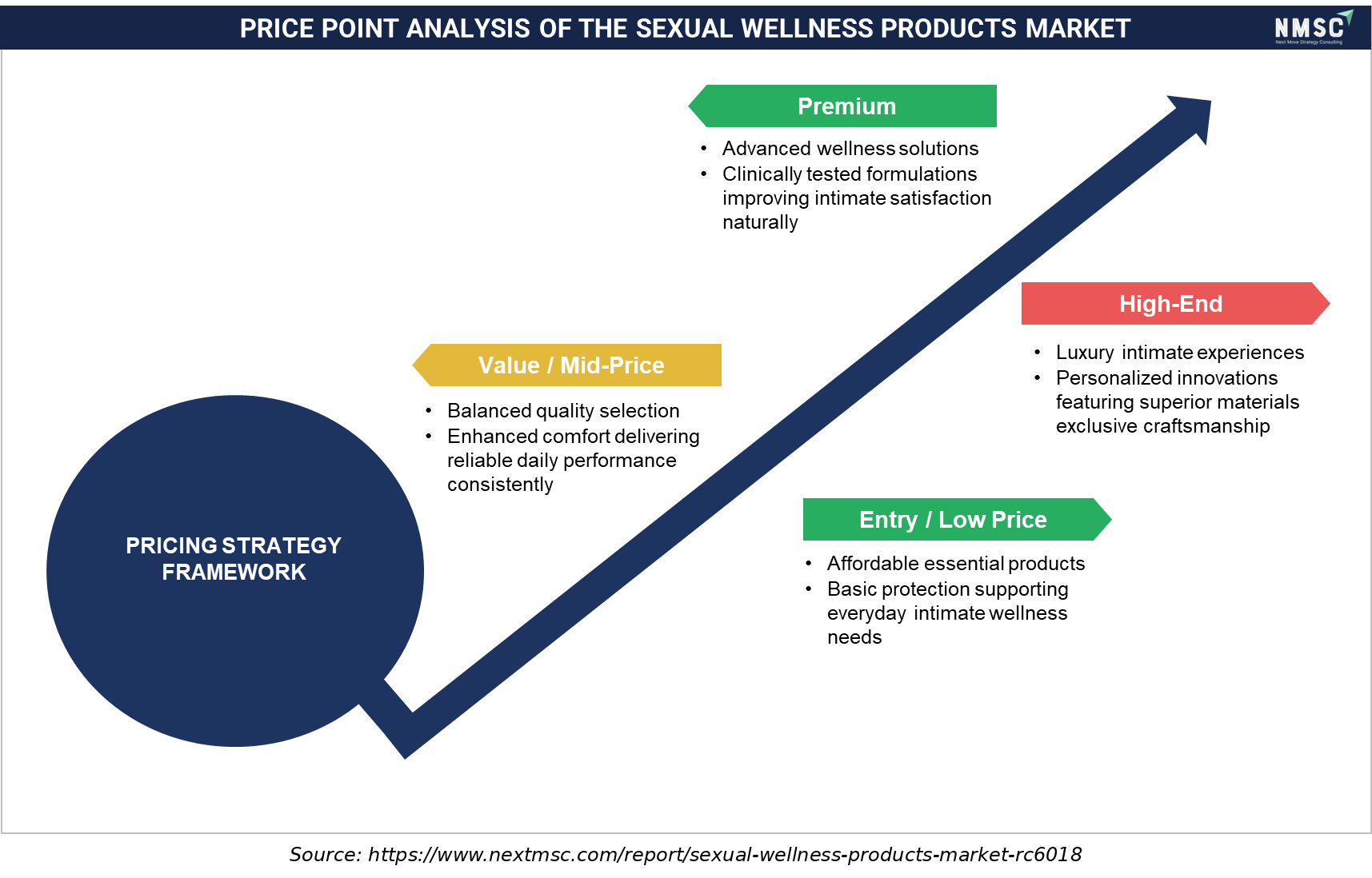
Price Point Analysis of the Sexual Wellness Products Market

Price Point Analysis of the Sexual Wellness Products Market

Based on our pricing assessment, we identified that the sexual wellness products market is segmented into entry-level, value, premium, and high-end categories based on product formulation, functionality, material quality, innovation, and brand positioning. Furthermore, our analysis indicates that entry-level products emphasize affordability and accessibility, value products balance quality with cost, premium offerings differentiate through advanced features and specialized formulations, while high-end products command higher prices through luxury branding, clinical innovation, and superior user experience.

Market Drivers & Dynamics

Interactive Dataset
Expanding direct-to-consumer and marketplace distribution driver +2.1% Global 2026-2035
Rising adoption of app-connected and rechargeable devices driver +1.6% North America, Europe, Asia-Pacific 2026-2035
Growing consumer awareness and destigmatization of the category driver +1.2% Global 2026-2035
Premiumization toward medical-grade silicone formulations driver +0.9% North America, Europe 2026-2033
Expansion of pharmacy and mass retail shelf presence driver +0.6% Asia-Pacific, Latin America 2026-2032
Growth of subscription-based lubricant and barrier product models driver +0.5% North America, Europe 2026-2032
Regulatory restrictions on product marketing in certain countries restraint -0.9% Middle East and Africa, parts of Asia 2026-2035
Persistent social stigma limiting mass retail visibility restraint -0.6% Middle East and Africa, Asia-Pacific 2026-2035
Price sensitivity in value-tier segments across emerging markets restraint -0.4% Latin America, Africa 2026-2032
Source: Next Move Strategy Consulting

Growth Drivers

What Is the Primary Growth Driver of the Sexual Wellness Products Market?

Expanding direct-to-consumer and marketplace distribution is the primary driver of the market. The U.S. Census Bureau's e-commerce retail sales data confirms sustained annual growth in online retail sales as a share of total retail spending. We observed that this steady shift toward digital purchasing channels is expanding the addressable customer base for sexual wellness brands by reducing the privacy friction historically associated with in-store purchases.

How Is Rising Device Technology Adoption Driving Market Growth?

Sustained consumer adoption of app-connected and rechargeable pleasure devices continues to expand category revenue at rates exceeding traditional manual product growth. The U.S. Federal Communications Commission's broadband deployment data confirms expanding household connectivity infrastructure supporting app-based device functionality. Our assessment indicates that this connectivity expansion is directly supporting adoption of smart-sensor and app-connected devices among technology-oriented consumer segments.

Growth Inhibitors

What Is Restraining Sexual Wellness Products Market Expansion?

Regulatory restrictions on product marketing and advertising in certain countries restrain market expansion by limiting brand visibility and consumer education channels. Government trade and customs authorities in several Middle Eastern and Asian markets maintain import restrictions applicable to certain pleasure device categories. We found that this regulatory fragmentation disproportionately affects companies without established regional compliance infrastructure, reinforcing the advantage held by larger, multi-region manufacturers.

What Are the Growth Opportunities?

Why Does Smart-Sensor Device Expansion Present a Growth Opportunity?

Manufacturers can capture value by expanding smart-sensor pleasure device lines with biometric feedback functionality, benefiting technology-oriented consumers seeking personalized, data-informed product experiences beyond conventional manual devices.

How Can DTC Subscription Models Unlock New Demand?

Brands can expand subscription-based direct-to-consumer models bundling lubricants, barrier products, and replacement parts, benefiting recurring consumers seeking discreet, predictable replenishment without repeat retail purchasing decisions.

What Opportunity Exists in Emerging-Market Pharmacy Expansion?

Manufacturers can pursue formal pharmacy and mass retail distribution partnerships in Asia-Pacific and Latin American markets, benefiting price-sensitive consumers in emerging economies seeking accessible, regulated points of purchase.

Segmentation Analysis

2025 (USD Billion)
2035 (USD Billion)
Condoms and Barrier Products 2025: $10.09 Billion | 2035: $18.34 Billion
Condoms and
Lubricants and Topicals 2025: $6.61 Billion | 2035: $12.99 Billion
Lubricants a
Pleasure Devices 2025: $12.53 Billion | 2035: $30.56 Billion
Pleasure Dev
Accessories and Consumables 2025: $3.83 Billion | 2035: $10.70 Billion
Accessories
Other Sexual Wellness Products 2025: $1.74 Billion | 2035: $3.81 Billion
Other Sexual
Condoms and Barrier Products $10.09 Billion $18.34 Billion 6.2%
Lubricants and Topicals $6.61 Billion $12.99 Billion 7.0%
Pleasure Devices $12.53 Billion $30.56 Billion 9.3%
Accessories and Consumables $3.83 Billion $10.70 Billion 10.8%
Other Sexual Wellness Products $1.74 Billion $3.81 Billion 8.2%

What Is Driving Segment Sizing By Product Category in the Sexual Wellness Products Market?

This axis separates the core product categories that define the market's scope. Pleasure devices dominate on the strength of premiumization and rising app-connected device adoption across both established and emerging markets. Accessories and consumables register the fastest growth as device-cleaning, storage, and replacement-part demand scales alongside the broader pleasure device installed base, while condoms and barrier products retain a substantial but comparatively slower-growing share anchored by consistent baseline demand.

2025 (USD Billion)
2035 (USD Billion)
Latex
Non-Latex Po
Silicone
TPE and TPR
ABS and Plas
Segment Item 2025 (USD Billion) 2035 (USD Billion) CAGR
Latex $10.0 USD Billion $40.0 USD Billion 16.0%
Non-Latex Polymer $17.1 USD Billion $51.1 USD Billion 22.0%
Silicone $24.2 USD Billion $62.2 USD Billion 24.0%
TPE and TPR $31.3 USD Billion $73.3 USD Billion 10.0%
ABS and Plastics $38.4 USD Billion $84.4 USD Billion 17.0%

Segment-wise data is locked

Unlock complete segment-wise numbers for By Material.

Unlock Full Data

By Material: Silicone held the largest share of approximately 28% (USD 9.74 Billion) in 2025; Mixed Materials is the fastest-growing sub-segment at 10.6% CAGR from 2026–2035.

2025 (USD Billion)
2035 (USD Billion)
Manual
Battery Powe
Rechargeable
App Connecte
Smart Sensor
Segment Item 2025 (USD Billion) 2035 (USD Billion) CAGR
Manual $10.0 USD Billion $40.0 USD Billion 16.0%
Battery Powered $17.1 USD Billion $51.1 USD Billion 22.0%
Rechargeable $24.2 USD Billion $62.2 USD Billion 16.0%
App Connected $31.3 USD Billion $73.3 USD Billion 26.0%
Smart Sensor $38.4 USD Billion $84.4 USD Billion 25.0%

Segment-wise data is locked

Unlock complete segment-wise numbers for By Technology.

Unlock Full Data

By Technology: Manual held the largest share of approximately 34% (USD 11.83 Billion) in 2025; Smart Sensor is the fastest-growing sub-segment at 13.3% CAGR from 2026–2035.

2025 (USD Billion)
2035 (USD Billion)
Single
Multipack
Kit
Bulk
Segment Item 2025 (USD Billion) 2035 (USD Billion) CAGR
Single $10.0 USD Billion $40.0 USD Billion 20.0%
Multipack $17.1 USD Billion $51.1 USD Billion 18.0%
Kit $24.2 USD Billion $62.2 USD Billion 16.0%
Bulk $31.3 USD Billion $73.3 USD Billion 18.0%

Segment-wise data is locked

Unlock complete segment-wise numbers for By Pack Format.

Unlock Full Data

By Pack Format: Multipack held the largest share of approximately 43% (USD 14.96 Billion) in 2025; Kit is the fastest-growing sub-segment at 9.9% CAGR from 2026–2035.

2025 (USD Billion)
2035 (USD Billion)
Value
Mid
Premium
Luxury
Segment Item 2025 (USD Billion) 2035 (USD Billion) CAGR
Value $10.0 USD Billion $40.0 USD Billion 26.0%
Mid $17.1 USD Billion $51.1 USD Billion 24.0%
Premium $24.2 USD Billion $62.2 USD Billion 14.0%
Luxury $31.3 USD Billion $73.3 USD Billion 12.0%

Segment-wise data is locked

Unlock complete segment-wise numbers for By Price Tier.

Unlock Full Data

By Price Tier: Mid held the largest share of approximately 38% (USD 13.22 Billion) in 2025; Luxury is the fastest-growing sub-segment at 12.6% CAGR from 2026–2035.

2025 (USD Billion)
2035 (USD Billion)
DTC
Marketplace
Pharmacy
Mass Retail
Speciality A
Segment Item 2025 (USD Billion) 2035 (USD Billion) CAGR
DTC $10.0 USD Billion $40.0 USD Billion 25.0%
Marketplace $17.1 USD Billion $51.1 USD Billion 19.0%
Pharmacy $24.2 USD Billion $62.2 USD Billion 25.0%
Mass Retail $31.3 USD Billion $73.3 USD Billion 19.0%
Speciality Adult Retail $38.4 USD Billion $84.4 USD Billion 20.0%

Segment-wise data is locked

Unlock complete segment-wise numbers for By Distribution Channel.

Unlock Full Data

Why Is DTC the Fastest-Growing Distribution Channel?

Marketplace retains the largest distribution share, reflecting established third-party e-commerce platform reach across mainstream consumer segments. DTC channels grow fastest as brands invest in proprietary, discreet-shipping platforms that reduce privacy friction and build direct customer relationships. Pharmacy and mass retail channels remain stable secondary channels anchored by consistent baseline demand for condoms and lubricants among less digitally engaged consumers.

2025 (USD Billion)
2035 (USD Billion)
Men
Women
Segment Item 2025 (USD Billion) 2035 (USD Billion) CAGR
Men $10.0 USD Billion $40.0 USD Billion 26.0%
Women $17.1 USD Billion $51.1 USD Billion 16.0%

Segment-wise data is locked

Unlock complete segment-wise numbers for By End User.

Unlock Full Data

Why Is the Women End User Segment Growing Faster Than Men?

Men retain the larger end-user share, anchored by established condom and barrier product purchasing patterns. Women register faster growth as expanding product ranges targeting female consumers, including pleasure devices and topical arousal products, gain broader retail and digital distribution. Our analysis shows that this narrowing gap reflects both destigmatization of female-oriented sexual wellness products and expanding marketplace and DTC channel access for women-focused brands.

Growth Opportunities

Beyond the core growth drivers, three forward-looking whitespace opportunities stand out for stakeholders positioning ahead of 2035 demand.

Why Does Smart-Sensor Device Expansion Present a Growth Opportunity?

Manufacturers can capture value by expanding smart-sensor pleasure device lines with biometric feedback functionality, benefiting technology-oriented consumers seeking personalized, data-informed product experiences beyond conventional manual devices.

How Can DTC Subscription Models Unlock New Demand?

Brands can expand subscription-based direct-to-consumer models bundling lubricants, barrier products, and replacement parts, benefiting recurring consumers seeking discreet, predictable replenishment without repeat retail purchasing decisions.

What Opportunity Exists in Emerging-Market Pharmacy Expansion?

Manufacturers can pursue formal pharmacy and mass retail distribution partnerships in Asia-Pacific and Latin American markets, benefiting price-sensitive consumers in emerging economies seeking accessible, regulated points of purchase.

Regional Outlook

2025 (USD Billion)
2035 (USD Billion)
North Americ
Europe
Asia-Pacific
Middle East
Latin Americ
Region 2025 (USD Billion) 2035 (USD Billion) CAGR (%)
North America $10.0 USD Billion $40.0 USD Billion 9.0%
Europe $17.1 USD Billion $51.1 USD Billion 27.0%
Asia-Pacific $24.2 USD Billion $62.2 USD Billion 25.0%
Middle East and Africa $31.3 USD Billion $73.3 USD Billion 23.0%
Latin America $38.4 USD Billion $84.4 USD Billion 12.0%

Regional data is locked

Unlock complete regional numbers for this market.

Unlock Full Data

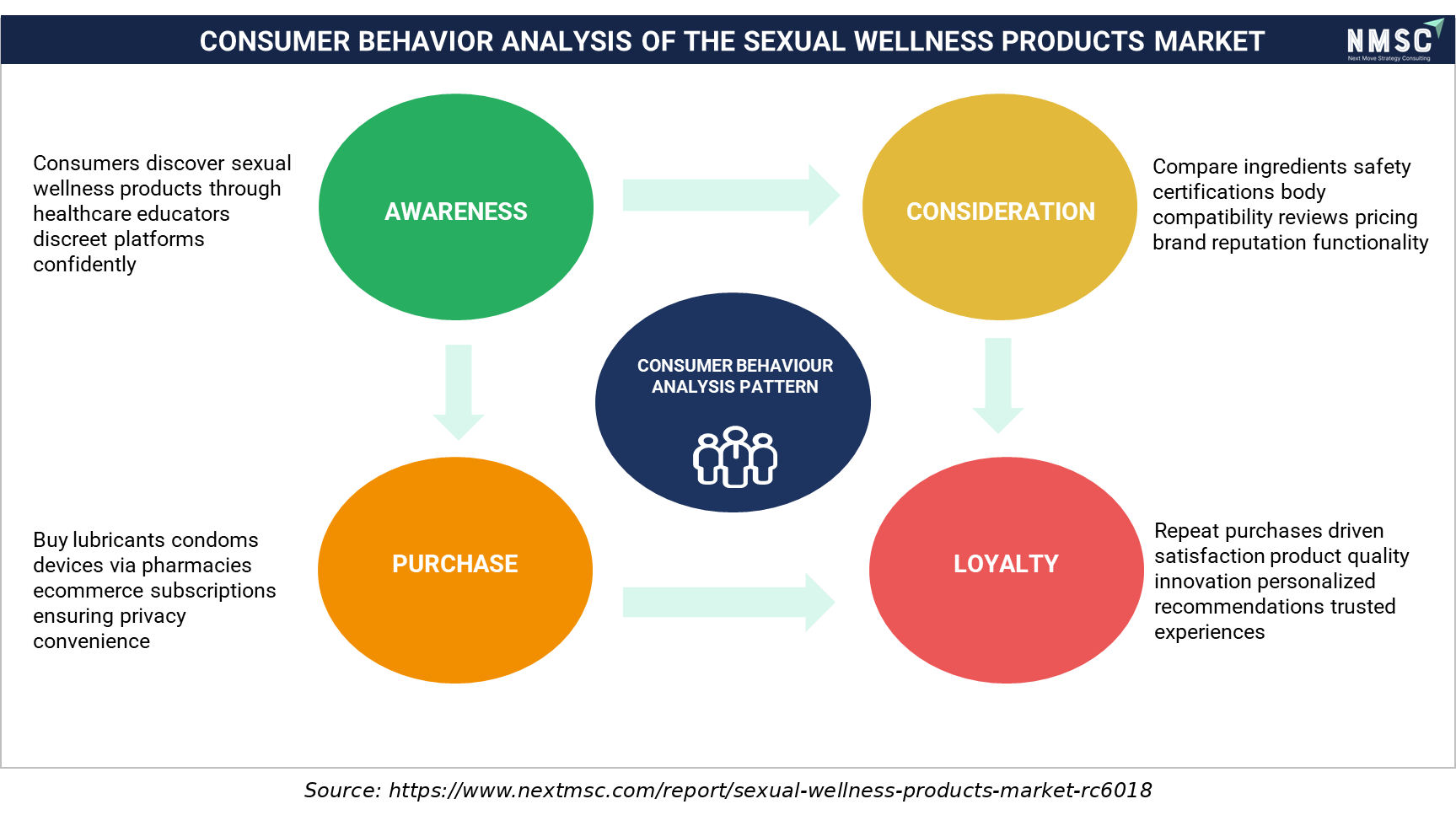
Consumer Behavior Analysis of the Sexual Wellness Products Market

Consumer Behavior Analysis of the Sexual Wellness Products Market

Based on our consumer behavior assessment, we identified that consumers evaluate sexual wellness products based on ingredient safety, certifications, body compatibility, functionality, pricing, reviews, and brand reputation before making purchase decisions. Furthermore, our analysis indicates that purchases primarily occur through pharmacies, e-commerce platforms, healthcare providers, and subscription services, while repeat purchases are driven by product satisfaction, innovation, personalized recommendations, trusted experiences, convenience, and consistent product quality.

Competitive Landscape

We observed that the sexual wellness products market remains moderately fragmented, with competitive intensity concentrated among large diversified consumer health companies and specialized pleasure device manufacturers.

Dimension Description
Aspect Details
Market Structure Moderately fragmented, with the Top 10 companies holding an available market share while a long tail of specialized regional brands serves localized demand.
Innovation Focus App-connected device functionality, medical-grade silicone formulations, and discreet direct-to-consumer packaging.
M&A Activity Selective acquisitions of specialized pleasure device brands and direct-to-consumer platforms to expand product and channel coverage.

How Do Companies Compete in the Sexual Wellness Products Market?

Companies compete primarily on brand trust, material safety credentials, and distribution channel breadth, since consumers select products based on discretion, documented safety, and ease of access. Our analysis shows that companies with established multi-channel distribution spanning DTC, marketplace, and pharmacy command stronger customer loyalty than narrow, single-channel manufacturers, while pricing strategies increasingly reflect premium positioning for medical-grade materials and app-connected functionality.

Which Competitive Archetypes Dominate the Sexual Wellness Products Market?

Three archetypes dominate: large diversified consumer health companies with extensive barrier-product manufacturing scale, specialized pleasure device brands with strong direct-to-consumer digital presence, and regional distributors with deep local retail relationships. We found that diversified consumer health companies compete on production scale and pharmacy channel breadth, while specialized device brands differentiate through product innovation and digital-first customer engagement.

What Innovation and Differentiation Strategies Are Companies Pursuing?

Manufacturers are investing in app-connected functionality and medical-grade material certification to differentiate premium product lines from value-tier alternatives. Our findings suggest that companies are increasingly publishing official material safety and clinical testing disclosures to build consumer trust, while some companies are piloting subscription-based replenishment models to strengthen recurring customer relationships.

What M&A Activity Is Shaping the Sexual Wellness Products Market?

Mergers and acquisitions activity centers on specialized pleasure device brand consolidation, as larger consumer health companies acquire digitally native brands and direct-to-consumer platforms to expand category coverage without ground-up product development. We observed that companies are also pursuing selective distribution partnerships with marketplace and pharmacy channel operators to expand geographic reach, reflecting a broader industry shift toward omnichannel distribution strategies.

Key Market Players

We found that the following companies represent the leading manufacturers and providers of sexual wellness products globally, ranked by market-specific scale of operations.

Reckitt Benckiser Group plc. Church & Dwight Co., Inc. Karex Berhad. LifeStyles Healthcare Pte. Ltd. Lovehoney Group. HLL Lifecare Limited. Mankind Pharma Limited. TTK Healthcare Limited. Cupid Limited. Okamoto Industries, Inc. TENGA Co., Ltd. California Exotic Novelties, LLC. Health Devices Inc. Interactive Life Forms, LLC. Pipedream Products, LLC. LELOiAB. FUN FACTORY Germany GmbH. EIS Inc. Ann Summers Ltd. SVAKOM DESIGN USA LIMITED.

Latest Developments

We observed several verifiable developments across product innovation and company expansion that are shaping near-term market direction.

Date Event
January 2026 TENGA began orders for the FLIP 360 Series on January 15, 2026, following its November 2025 pre-launch announcement as part of the company's 20th anniversary. The redesigned FLIP line features a futuristic helical body and 360° stimulation technology, representing a new evolution of TENGA's product portfolio.
September 2025 Karex Berhad planned to expand its synthetic nitrile condom production capacity from six lines to 16 lines by FY2026 to capitalize on rising global demand for non-latex alternatives. The company highlighted nitrile’s superior cost efficiency and expected stronger earnings from the segment as capacity increased.

Expert Insights

Kate Moyle

Kate Moyle

Psychosexual Therapist and Relationship Expert

"Commercially, it’s big business, but I think it makes a big statement when we see sex toys and pleasure products on high-street shelves like those in Boots and Selfridges."

Analyst Interpretation

The statement reflects the ongoing normalization of sexual wellness products as part of mainstream health and personal care. The increasing presence of intimate wellness products in major retail chains indicates a shift in consumer attitudes, with retailers responding to growing demand for products that support sexual health and wellbeing. This trend is reducing longstanding social stigma, improving product accessibility, and encouraging innovation across categories such as lubricants, intimate devices, and personal wellness solutions. As sexual wellness becomes increasingly integrated into everyday retail and healthcare conversations, manufacturers are expected to expand their product portfolios and distribution channels, supporting sustained growth in the global sexual wellness products market.

Investment Opportunities

Where Is Capital Flowing Within the Sexual Wellness Products Market?

Capital continues to concentrate in app-connected device development and direct-to-consumer platform expansion. We observed that Lovehoney Group has directed continued investment toward its digital retail infrastructure, per official company disclosures, signaling sustained investor confidence in digitally native distribution models.

How Is Infrastructure Investment Shaping the Market?

Infrastructure investment is concentrated in medical-grade material processing capacity and discreet fulfillment logistics that support direct-to-consumer order privacy. Our findings suggest that companies operating in North America and Europe are directing capital toward automated fulfillment infrastructure specifically to support expanding subscription-based replenishment models.

What ESG Considerations Are Relevant to Sexual Wellness Products Market Investment?

Environmental, social, and governance considerations center on recyclability of device packaging and battery components, alongside inclusive product design addressing diverse consumer needs. Social considerations include destigmatization and accurate sexual health education, while governance considerations relate to transparent material safety disclosure and compliance with regional product certification requirements.

Key Benefits for Stakeholders

How Does This Report Benefit Industry Leaders?

Industry leaders gain a validated market-sizing and segmentation framework to prioritize product investment across categories, materials, technologies, and regions. The report's country-level revenue and CAGR data support capital-allocation decisions for companies evaluating new product-line investment through 2035.

How Does This Report Benefit Investors and Financial Analysts?

Investors and financial analysts gain a fundamentals-based CAGR methodology, competitive landscape mapping, and a Top 20 company benchmark set, supporting valuation and portfolio-allocation decisions across barrier product, lubricant, and pleasure device manufacturing companies.

How Does This Report Benefit Technology Vendors and Product Teams?

Technology vendors and product teams gain segment-level demand signals, including the fastest-growing smart-sensor and accessories and consumables categories, to prioritize product roadmaps around app-connected functionality and direct-to-consumer digital distribution platforms.

Key Market Segments Evaluated

By Product Category

  • Condoms and Barrier Products
  • Lubricants and Topicals
  • Pleasure Devices
  • Accessories and Consumables
  • Other Sexual Wellness Products

By Material

  • Latex
  • Non-Latex Polymer
  • Silicone
  • TPE and TPR
  • ABS and Plastics
  • Metal and Glass
  • Mixed

By Technology

  • Manual
  • Battery Powered
  • Rechargeable
  • App Connected
  • Smart Sensor

By Pack Format

  • Single
  • Multipack
  • Kit
  • Bulk

By Price Tier

  • Value
  • Mid
  • Premium
  • Luxury

By Distribution Channel

  • DTC
  • Marketplace
  • Pharmacy
  • Mass Retail
  • Speciality Adult Retail
  • Institutional

By End User

  • Men
  • Women

Conclusion & Recommendations

The long-term outlook remains strongly positive, with the market projected to expand from USD 34.80 billion in 2025 to USD 76.40 billion by 2035 at an 8.20% CAGR. We observed that structural drivers, including destigmatization, expanding digital distribution, and rising device technology adoption, are durable rather than cyclical, supporting continued high-single-digit growth across most segments through the forecast period.

What Strategic Positioning Should Providers Pursue?

Providers should prioritize documented material safety and discreet distribution infrastructure over undifferentiated commodity positioning, since consumer trust and retention correlate strongly with verified product safety and purchase privacy. Our assessment indicates that companies integrating DTC and marketplace distribution alongside traditional pharmacy channels will differentiate as competitive intensity increases through 2035.

How Attractive Is the Market for New Investment?

Investment attractiveness is high across app-connected device development and direct-to-consumer platform expansion, given a USD 38.80 billion absolute dollar opportunity between 2026 and 2035. We found that accessories and consumables offer the strongest risk-adjusted entry point given their 10.8% segment CAGR and comparatively low existing competitive density relative to pleasure devices.

What Market Shifts and Key Risks Should Stakeholders Monitor?

Stakeholders should monitor regulatory restrictions on product marketing in certain countries, which could limit brand visibility, alongside persistent social stigma constraining mass retail shelf presence in select regions. Our analysis shows that companies with established multi-region compliance infrastructure and diversified distribution channels are better positioned to absorb these regulatory and cultural risks than narrowly focused regional brands.

What Are the Primary Growth Pathways Through 2035?

Primary growth pathways include expansion of smart-sensor device technology, deeper integration of subscription-based DTC distribution, and continued premiumization toward medical-grade silicone formulations. We observed that companies combining at least two of these pathways are best positioned to capture a disproportionate share of the USD 41.60 billion in incremental revenue generated between 2025 and 2035.

FAQs

About the Author

Saista Faiyaz

Saista Faiyaz

Saista Faiyaz is Research Associate at Next Move Strategy Consulting, where she has covered consumer markets and healthcare technologies for 3 years. Her work includes primary interview review, secondary-source validation, market sizing, and structured analysis of company and industry data. She supports research by comparing evidence across sources, organizing findings into market narratives, and documenting assumptions used in analysis. Her scope includes cross-market benchmarking, and reports.

About the Reviewer

Supradip Baul

Supradip Baul

Supradip Baul is an accomplished business consultant and strategist with over a decade of rich experience in market intelligence, strategy, technology, and business transformation. His work has included rigorous qualitative and quantitative analysis across multiple industries, helping clients shape investment decisions and long-term roadmaps. Earlier in his career, he was associated with Gartner, where he contributed to industry-leading reports and market share analyses. He has worked with leading global companies and holds an MBA with a dual specialization in Marketing and Finance.

Download Free Sample

Ross J Mckenzie

ROSS J MCKENZIE

Business Insight Manager

Staysure Group

“Next MSC have been incredibly helpful in providing detailed & robust information on our market, alongside quantifying growth by different segments. The process to procure was simple and easy, with sample reports and regular contact to ensure we had what we needed. Succinct detail on their sources & methodologies is also greatly received, allowing transparency in this respect helps build trust in the detail you pay for. Joseph in particular was fantastic, and helped ensure efficient provision of the insight pack – thank you NMSC!”.

Gustaf Hummel Burstrom

GUSTAF HUMMEL BURSTROM

Founder

Revline Tools AB

Joseph and the team at Next Move Strategy Consulting have been excellent to work with, in supplying us with relevant market data and forecasts for our specific category. We had some special requirements and they were able to do a custom package to suit our needs. We would definitely recommend them to any other company needing market data and forecasts

Amos Chang

AMOS CHANG

Strategy Consultant

Kardex Group

I have bought the intralogistics market reports from NMSC two times so far. Joseph and his team are always very helpful and flexible in responding to any customization requirements on the report. Their expertise in market reports really helps us steer the day-to-day business. I will definitely recommend and come back myself whenever there is a need.

Kishu Kanda

KISHU KANDA

Strategy Analyst

Accenture

We purchased the AI Consumer Market Report from this company. Not only did they customize the report to meet our specific requirements, but they also showed great flexibility in accommodating our budget. The report we received fully met our expectations. Additionally, they provided prompt and thorough responses to both our pre-purchase and follow-up questions. We look forward to working with this company again in the future.

Pratyush Kumar Das

PRATYUSH KUMAR DAS

Assistant Manager

Polycab India Limited

We would like to express our appreciation for the data and insights provided by nextmsc. We are very pleased with the quality and depth of the information, which has proven to be highly valuable and beneficial for our business decision-making.

Custom Market Research Services

We will customize the research for you if the listed report does not fully match your requirements.

Get 30% Free Customization

Select License

This website uses cookies to ensure you get the best experience on our website. Learn more

✖