Personalized Nutrition and Wellness Market Size, Share, Trends and Growth Analysis, By Offering (Personalized Nutrition Products, Nutrition Assessment Services, Digital Nutrition Solutions, and Nutrition Consulting Services), By Personalization Method (DNA-Based, Microbiome-Based, Blood Biomarker-Based, and Lifestyle-Based), By Product Form, By Health Goal, By Technology, By Distribution Channel, By End User, and Region — Global Industry Report and Forecast, 2026–2035
Industry: Retail and Consumer | Publishing Date: July 28, 2026 | Last Updated: September 30, 2026 | No of Pages: N/A | No. of Tables: N/A | No. of Figures: N/A | Format: PDF | Report Code: RC5445
What Is the Personalized Nutrition and Wellness Market Size?
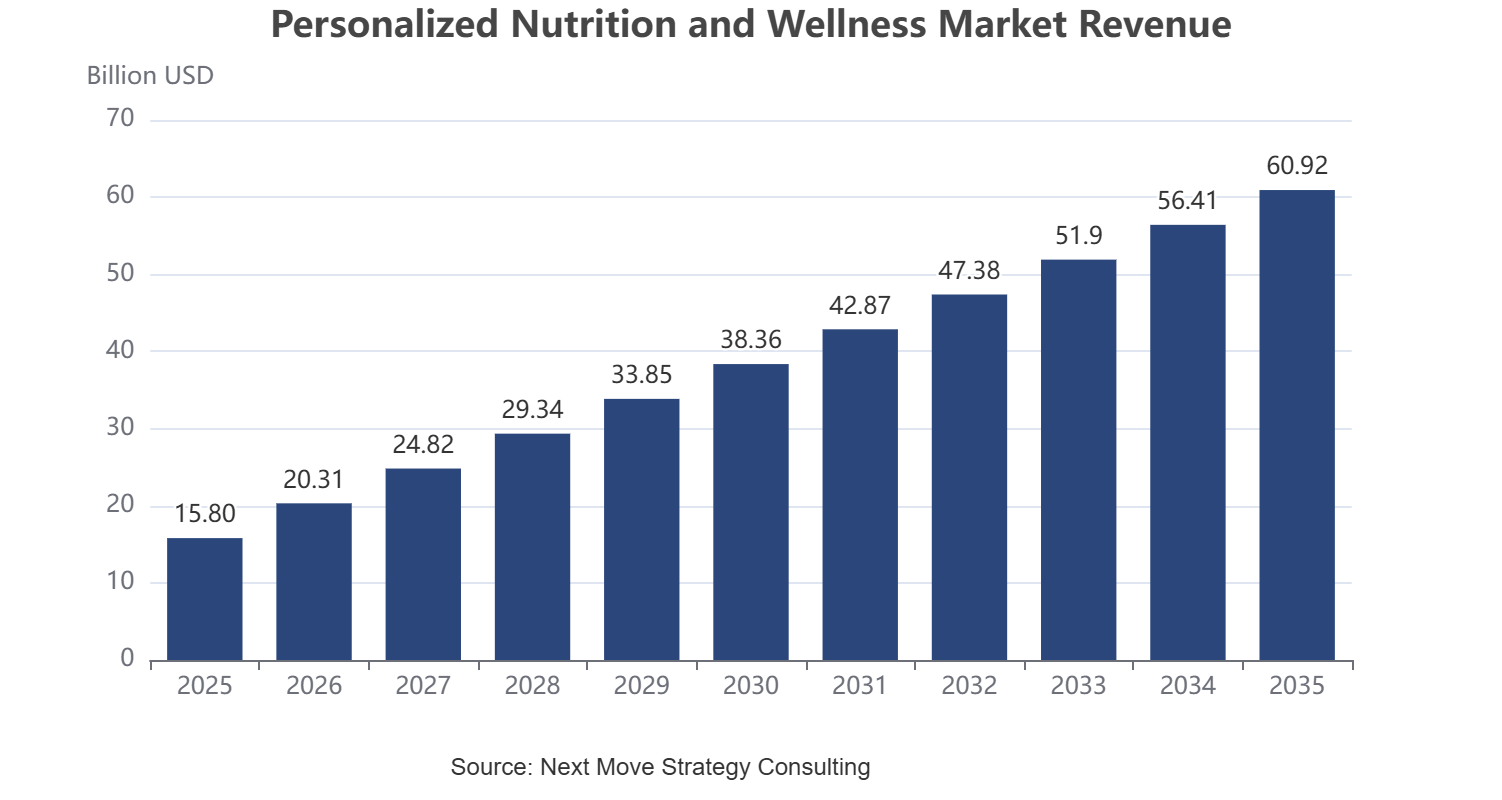
The global personalized nutrition and wellness market size was valued at USD 15.80 billion in 2025 and is estimated at USD 18.18 billion in 2026, forecast to reach USD 60.92 billion by 2035, expanding at a 15.04% CAGR between 2026 and 2035. North America leads with approximately 38% share, while personalized nutrition products dominate all other offerings with approximately 52% share.
We observed that growth is broad-based across every segmentation axis, with continuous glucose monitoring integration and digital nutrition platforms driving the dominant structural shifts through 2035.
|
Key Takeaways |
|
By Offering: Personalized Nutrition Products held the largest share of approximately 52% (USD 8.22 Billion) in 2025; Digital Nutrition Solutions is the fastest-growing sub-segment at 19.8% CAGR from 2026–2035. |
|
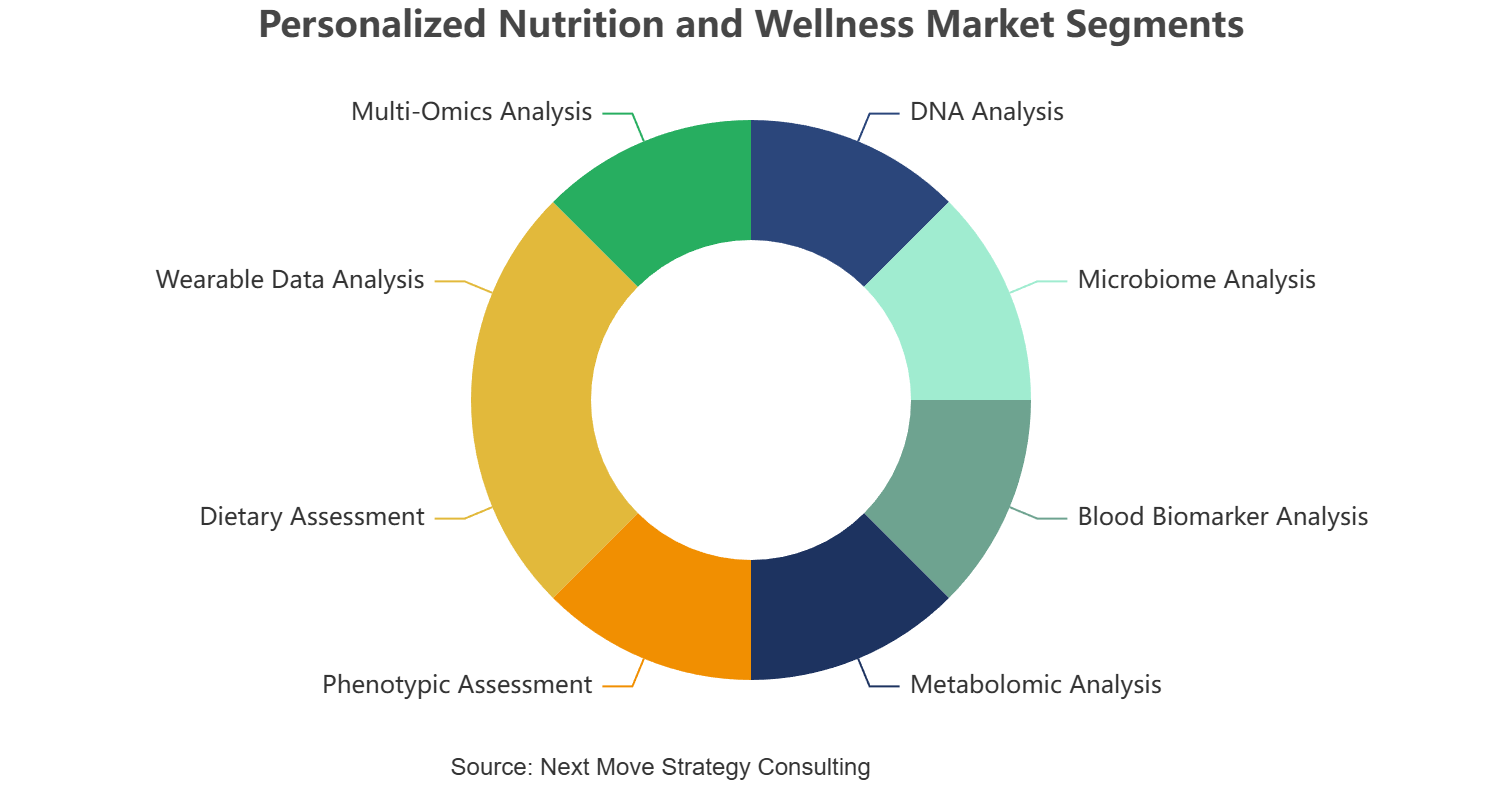
By Personalization Method: Blood Biomarker Analysis held the largest share of approximately 21% (USD 3.32 Billion) in 2025; Multi-Omics Analysis is the fastest-growing sub-segment at 21.1% CAGR from 2026–2035. |
|
By Product Form: Capsules held the largest share of approximately 24% (USD 3.79 Billion) in 2025; Gummies is the fastest-growing sub-segment at 17.1% CAGR from 2026–2035. |
|
By Health Goal: General Wellness held the largest share of approximately 17% (USD 2.69 Billion) in 2025; Weight Management is the fastest-growing sub-segment at 18.9% CAGR from 2026–2035. |
|
By Technology: AI Engine held the largest share of approximately 36% (USD 5.69 Billion) in 2025; CGM Integration is the fastest-growing sub-segment at 22.1% CAGR from 2026–2035. |
|
By Distribution Channel: Direct-to-Consumer held the largest share of approximately 41% (USD 6.48 Billion) in 2025; Online Marketplaces is the fastest-growing sub-segment at 17.8% CAGR from 2026–2035. |
|
By End User: Healthy Individuals held the largest share of approximately 61% (USD 9.64 Billion) in 2025; Athletes is the fastest-growing sub-segment at 14.8% CAGR from 2026–2035. |
|
Dominant Region: North America dominated with approximately 38% revenue share (USD 6.00 billion) in 2025. |
|
Fastest-Growing Region: Asia-Pacific is expected to register the highest CAGR of 17.8% during 2026–2035. |
|
Dominant Country: U.S. led with approximately USD 4.68 billion in 2025. |
|
Fastest-Growing Country: India is the fastest-growing country at approximately 22.9% CAGR from 2026–2035. |
Market Opportunity: The personalized nutrition and wellness market is expected to create an absolute dollar opportunity of USD 42.74 billion between 2026 and 2035, presenting significant investment potential across the precision health and consumer wellness value chain.
According to Next Move Strategy Consulting analysis, direct-to-consumer brands are increasingly bundling biomarker testing with subscription-based supplement fulfillment to raise customer lifetime value, a shift that favors integrated assessment-plus-product providers over single-category vendors as consumers seek continuous, data-driven wellness guidance through 2035.
Personalized Nutrition and Wellness Market Overview
What Does the Personalized Nutrition and Wellness Market Encompass?
The personalized nutrition and wellness market encompasses products, assessment services, digital platforms, and consulting offerings that tailor dietary and supplement recommendations to an individual's genetic, microbiome, biomarker, and lifestyle data. Our assessment indicates that the scope spans personalized vitamin and probiotic supplements, DNA and microbiome testing, AI nutrition platforms, and dietitian-led consulting supplied to healthy individuals, athletes, and patients seeking data-driven wellness guidance across general wellness, weight management, and healthy aging goals.
Regulatory frameworks such as the U.S. Food and Drug Administration's dietary supplement labeling requirements and genetic testing oversight shape how personalization claims reach consumers, while data privacy rules increasingly govern biomarker and DNA data handling. We observed that technology adoption is shifting toward AI-driven recommendation engines and continuous glucose monitor integration that generate real-time dietary guidance. Next Move Strategy Consulting's analysis indicates that this structural shift, combined with rising consumer interest in metabolic health following GLP-1 drug adoption, is redefining procurement criteria across the personalized nutrition and wellness market.
|
Field |
Details |
|
Market Size in 2025 |
USD 15.80 Billion |
|
Market Size in 2026 |
USD 18.18 Billion |
|
Revenue Forecast in 2035 |
USD 60.92 Billion |
|
Growth Rate |
CAGR of 15.04% from 2026 to 2035 |
|
Analysis Period |
2025–2035 |
|
Base Year Considered |
2025 |
|
Forecast Period |
2026–2035 |
|
Market Size Estimation |
USD Billion |
|
Companies Profiled |
14 |
|
Countries Covered |
33 |
|
Market Share |
Available for Top 10 Companies |
Key Emerging Trends in the Personalized Nutrition and Wellness Market
Based on research conducted by Next Move Strategy Consulting, we found that four structural trends are reshaping product design, consumer adoption, and stakeholder engagement across the industry.
How Is Microbiome and Blood Biomarker Testing Transforming Dietary Recommendations?
Microbiome and blood biomarker testing is transforming how dietary recommendations are generated, moving beyond generic advice toward individualized nutrition scoring. We observed that ZOE's PREDICT research programme, combining stool, blood lipid, and continuous glucose data from more than 120,000 members, has generated one of the largest in-house nutrition and microbiome datasets supporting its personalized dietary scoring. Direct-to-consumer brands and clinics are adopting similar genetic testing and biomarker panels to differentiate subscription offerings from generic supplement lines.
Why Are Continuous Glucose Monitors Expanding Beyond Diabetes Care?
Continuous glucose monitors are expanding beyond diabetes management into mainstream personalized nutrition applications. Our findings suggest that companies including Levels and ZOE integrate FDA-approved glucose sensors into consumer nutrition programmes to correlate food intake with real-time metabolic response. This trend is elevating demand for wearable data analysis and CGM integration technology among healthy individuals and weight management-focused consumers seeking continuous, actionable dietary feedback.
How Is AI-Driven Personalization Reshaping Digital Nutrition Platforms?
AI-driven personalization is reshaping digital nutrition platforms as vendors move from static meal plans toward adaptive, data-responsive recommendation engines. We observed that Vitaboom and GetHealthy formed a February 2025 strategic alliance leveraging AI and user data to deliver customized supplement recommendations and wellness plans. Enterprises and wellness apps providers are adopting similar machine learning-driven engines to differentiate subscription retention from static, one-time assessment models.
What Role Does M&A Consolidation Play in Reshaping the Competitive Landscape?
Mergers and acquisitions are consolidating personalized nutrition capability within larger consumer health portfolios. Our analysis shows that Nestlé Health Science acquired personalized vitamin business Persona to expand its Atrium Professional Brands portfolio, while L Catterton's ownership of Thorne HealthTech alongside its investments in Persona and Tally Health illustrates how private equity is concentrating capital across the personalized health testing and supplement value chain.
Consumer Behavior Analysis of the Personalized Nutrition And Wellness Market
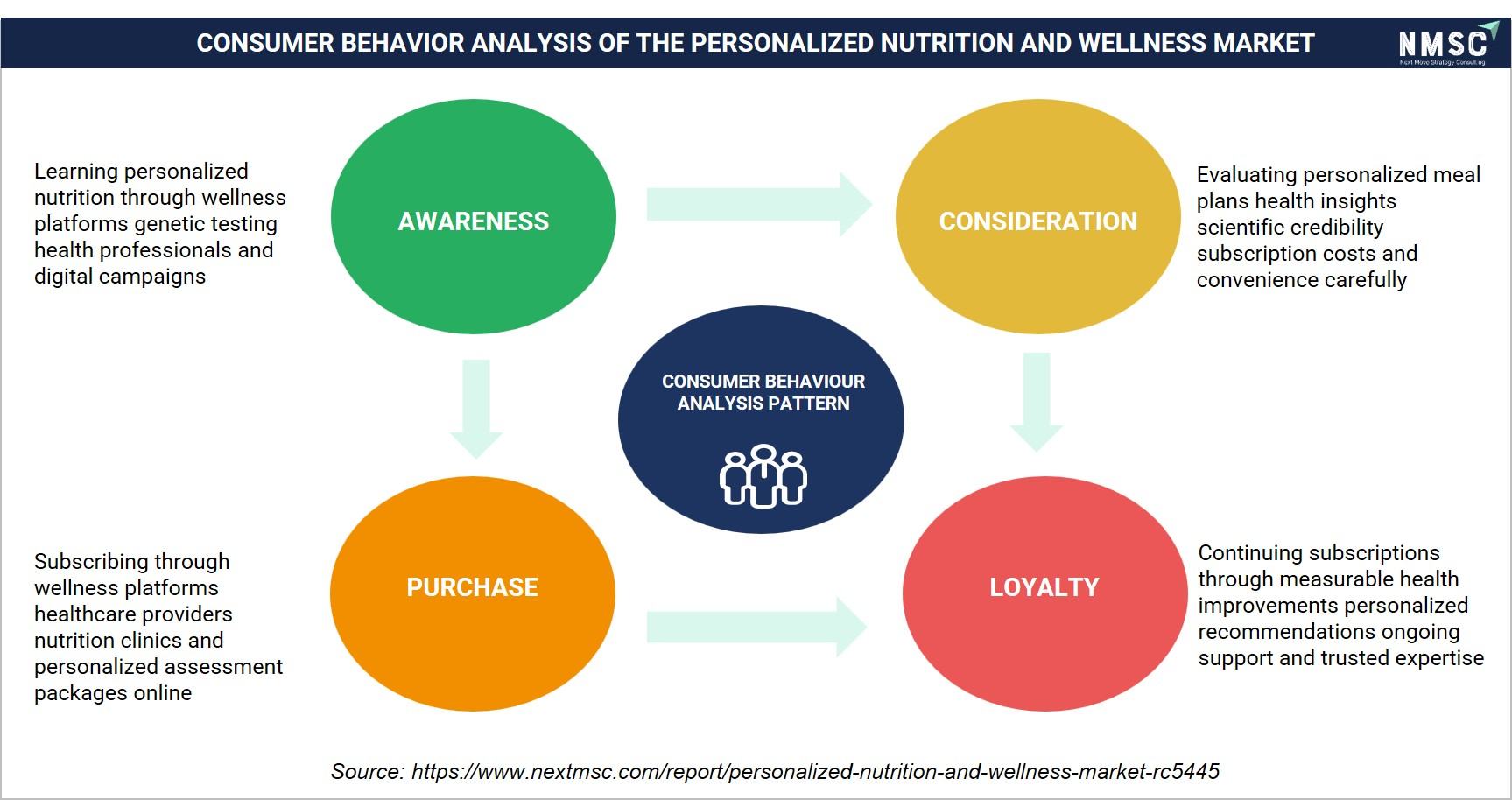
Consumer behavior in the personalized nutrition and wellness market follows a four-stage analytical pattern. The journey begins with Awareness, driven by digital campaigns, health professionals, and genetic testing platforms. Consumers then transition into Consideration by rigorously evaluating scientific credibility, customized meal plans, convenience, and subscription costs. The Purchase execution typically occurs through specialized nutrition clinics, healthcare providers, or digital wellness platforms. Ultimately, long-term Loyalty is secured and sustained through measurable health improvements, continuous personalized recommendations, and ongoing access to trusted expert support.
Growth Drivers and Restraints
Growth Catalyst and Risk Assessment Matrix
|
Factors |
Type |
(+/−) % Impact on CAGR |
Geographic Relevance |
Impact Timeline |
|
Rising consumer interest in metabolic health amid GLP-1 drug adoption |
Driver |
+3.1% |
North America, Europe |
2026–2035 |
|
Expanding direct-to-consumer biomarker and microbiome testing adoption |
Driver |
+2.6% |
Global |
2026–2035 |
|
Growing integration of AI recommendation engines into wellness platforms |
Driver |
+2.1% |
Global |
2026–2035 |
|
Rising continuous glucose monitor adoption beyond diabetes care |
Driver |
+1.8% |
North America, Asia-Pacific |
2026–2032 |
|
Expanding retail and healthcare channel distribution partnerships |
Driver |
+1.4% |
Global |
2026–2035 |
|
Growing consumer preference for subscription-based supplement fulfillment |
Driver |
+1.1% |
Global |
2026–2035 |
|
High cost of comprehensive genetic and biomarker testing panels |
Restraint |
−1.4% |
Global |
2026–2035 |
|
Data privacy concerns around genetic and health data handling |
Restraint |
−1.0% |
North America, Europe |
2026–2032 |
|
Limited clinical consensus on personalization algorithm efficacy |
Restraint |
−0.7% |
Global |
2028–2035 |
What Is the Primary Growth Driver of the Personalized Nutrition and Wellness Market?
Rising consumer interest in metabolic health amid GLP-1 drug adoption is the primary driver of the market. Industry commentary tracking the personalized nutrition space notes that gut health awareness rose sharply following the Covid-19 pandemic, compounding as weight loss drugs such as Ozempic and Wegovy became central to food and nutrition conversations. We observed that this metabolic health focus, reinforced by rising direct-to-consumer testing adoption, continues to anchor baseline demand for biomarker analysis and weight management-oriented products.
How Is Direct-to-Consumer Testing Driving Personalized Nutrition and Wellness Market Growth?
Expanding direct-to-consumer biomarker and microbiome testing adoption is accelerating market growth toward assessment-led business models. ZOE's expansion into the U.S. market, following revenue growth of 390% in its home UK market, illustrates the pace of consumer adoption for combined microbiome, blood lipid, and glucose testing programmes. Our assessment indicates that this adoption pace, combined with published clinical study results in peer-reviewed journals, is compressing adoption timelines for personalization method sub-segments across North America and Europe.
What Is Restraining Personalized Nutrition and Wellness Market Expansion?
High cost of comprehensive genetic and biomarker testing panels restrains adoption among price-sensitive consumers, with combined test-kit and subscription costs often exceeding several hundred dollars annually. Industry reporting on the sector documents this affordability barrier as a recurring theme in consumer adoption research. We found that retail and healthcare channel partnerships are beginning to offset this restraint by subsidizing testing costs, though full mainstream adoption beyond early adopters remains gradual.
Segmentation Analysis
Segment Sizing: By Offering
|
Segment |
2025 (USD) |
2035 (USD) |
CAGR% (2026–2035) |
|
Personalized Nutrition Products |
USD 8.22 Billion |
USD 27.56 Billion |
12.6% |
|
Nutrition Assessment Services |
USD 3.32 Billion |
USD 12.51 Billion |
14.1% |
|
Digital Nutrition Solutions |
USD 2.53 Billion |
USD 14.79 Billion |
19.8% |
|
Nutrition Consulting Services |
USD 1.74 Billion |
USD 6.06 Billion |
13.1% |
|
Total |
USD 15.80 Billion |
USD 60.92 Billion |
15.0% |
Which Offering Segment Dominates the Personalized Nutrition and Wellness Market?
Personalized Nutrition Products, encompassing personalized vitamin, mineral, probiotic, and functional food formulations, led the market with USD 8.22 billion in 2025, supported by consumers' preference for tangible, recurring supplement purchases over standalone assessment services. We observed that Digital Nutrition Solutions is the fastest-growing offering, expanding at a 19.8% CAGR from 2026 to 2035, as AI-powered recommendation platforms and mobile applications become the primary interface connecting consumers to personalized guidance.
Segment Sizing: By Health Goal
|
Segment |
2025 (USD) |
2035 (USD) |
CAGR% (2026–2035) |
|
General Wellness |
USD 2.69 Billion |
USD 8.64 Billion |
12.1% |
|
Immune Health |
USD 1.74 Billion |
USD 5.03 Billion |
10.8% |
|
Digestive Health |
USD 1.42 Billion |
USD 4.95 Billion |
13.1% |
|
Weight Management |
USD 2.53 Billion |
USD 13.83 Billion |
18.9% |
|
Sports Performance |
USD 1.26 Billion |
USD 4.30 Billion |
12.8% |
|
Healthy Aging |
USD 1.42 Billion |
USD 6.27 Billion |
16.1% |
|
Women's Health |
USD 0.95 Billion |
USD 3.49 Billion |
13.8% |
|
Men's Health |
USD 0.63 Billion |
USD 1.98 Billion |
11.8% |
|
Children's Health |
USD 0.47 Billion |
USD 1.38 Billion |
10.9% |
|
Cardiometabolic Health |
USD 0.79 Billion |
USD 3.22 Billion |
15.1% |
|
Cognitive Health |
USD 0.63 Billion |
USD 3.18 Billion |
17.8% |
|
Beauty Nutrition |
USD 0.47 Billion |
USD 1.89 Billion |
14.8% |
|
Sleep Health |
USD 0.32 Billion |
USD 1.47 Billion |
16.8% |
|
Clinical Nutrition |
USD 0.32 Billion |
USD 0.84 Billion |
9.8% |
|
Other Health Goals |
USD 0.16 Billion |
USD 0.43 Billion |
10.1% |
|
Total |
USD 15.80 Billion |
USD 60.92 Billion |
15.0% |
Which Health Goal Segment Leads Personalized Nutrition and Wellness Market Demand?
General Wellness remained the leading health goal segment, valued at USD 2.69 billion in 2025 as the broadest entry point for consumers exploring personalized supplementation. Based on research conducted by Next Move Strategy Consulting, we found that Weight Management is the fastest-growing health goal at an 18.9% CAGR from 2026 to 2035, reflecting rising consumer demand for metabolic health support alongside GLP-1 medication adoption and continuous glucose monitoring integration.
Segment Sizing: By Distribution Channel
|
Segment |
2025 (USD) |
2035 (USD) |
CAGR% (2026–2035) |
|
Direct-to-Consumer |
USD 6.48 Billion |
USD 27.40 Billion |
15.6% |
|
Healthcare Channel |
USD 3.00 Billion |
USD 11.32 Billion |
14.1% |
|
Retail Channel |
USD 3.79 Billion |
USD 10.98 Billion |
10.8% |
|
Online Marketplaces |
USD 1.90 Billion |
USD 9.53 Billion |
17.8% |
|
Direct Selling |
USD 0.63 Billion |
USD 1.69 Billion |
9.8% |
|
Total |
USD 15.80 Billion |
USD 60.92 Billion |
15.0% |
Which Distribution Channel Leads Personalized Nutrition and Wellness Adoption?
Direct-to-Consumer remained the dominant distribution channel, reaching USD 6.48 billion in 2025 due to its ability to bundle testing, subscription products, and digital coaching under a single brand relationship. Our findings suggest that Online Marketplaces is the fastest-growing distribution channel at a 17.8% CAGR from 2026 to 2035, reflecting rising consumer comfort purchasing personalized supplement subscriptions through established e-commerce platforms.
Growth Opportunities
Our analysis shows that three forward-looking opportunities stand out for stakeholders positioning within the personalized nutrition and wellness market over the 2026–2035 forecast period.
How Can CGM Integration Unlock Value for Weight Management Brands?
Continuous glucose monitor integration presents a whitespace opportunity for weight management-focused brands seeking to differentiate through real-time metabolic feedback. Suppliers that embed continuous glucose monitoring data into subscription nutrition platforms stand to capture recurring engagement revenue as consumers pursuing GLP-1-adjacent lifestyle changes seek continuous, actionable dietary guidance beyond periodic testing.
Where Does Cognitive Health Personalization Create New Demand?
Aging populations seeking to maintain mental sharpness represent an underpenetrated opportunity for vendors offering personalized brain health supplements informed by biomarker and lifestyle data. Suppliers that pair cognitive health assessment with tailored nutraceutical formulations can secure long-term subscription relationships with healthy aging-focused consumers, benefiting from recurring purchase cycles tied to sustained cognitive wellness goals.
How Can Healthcare Channel Partnerships Benefit Clinical Nutrition Providers?
Physicians and dietitians seeking evidence-based tools to support patient nutrition plans create an opportunity for vendors offering clinically validated assessment and consulting services through healthcare channels. Early movers that structure reimbursable or physician-endorsed personalized nutrition programmes can differentiate with patients and clinical nutrition buyers pursuing medically supervised dietary interventions beyond direct-to-consumer wellness products.
Price Point Analysis of the Personalized Nutrition And Wellness Market
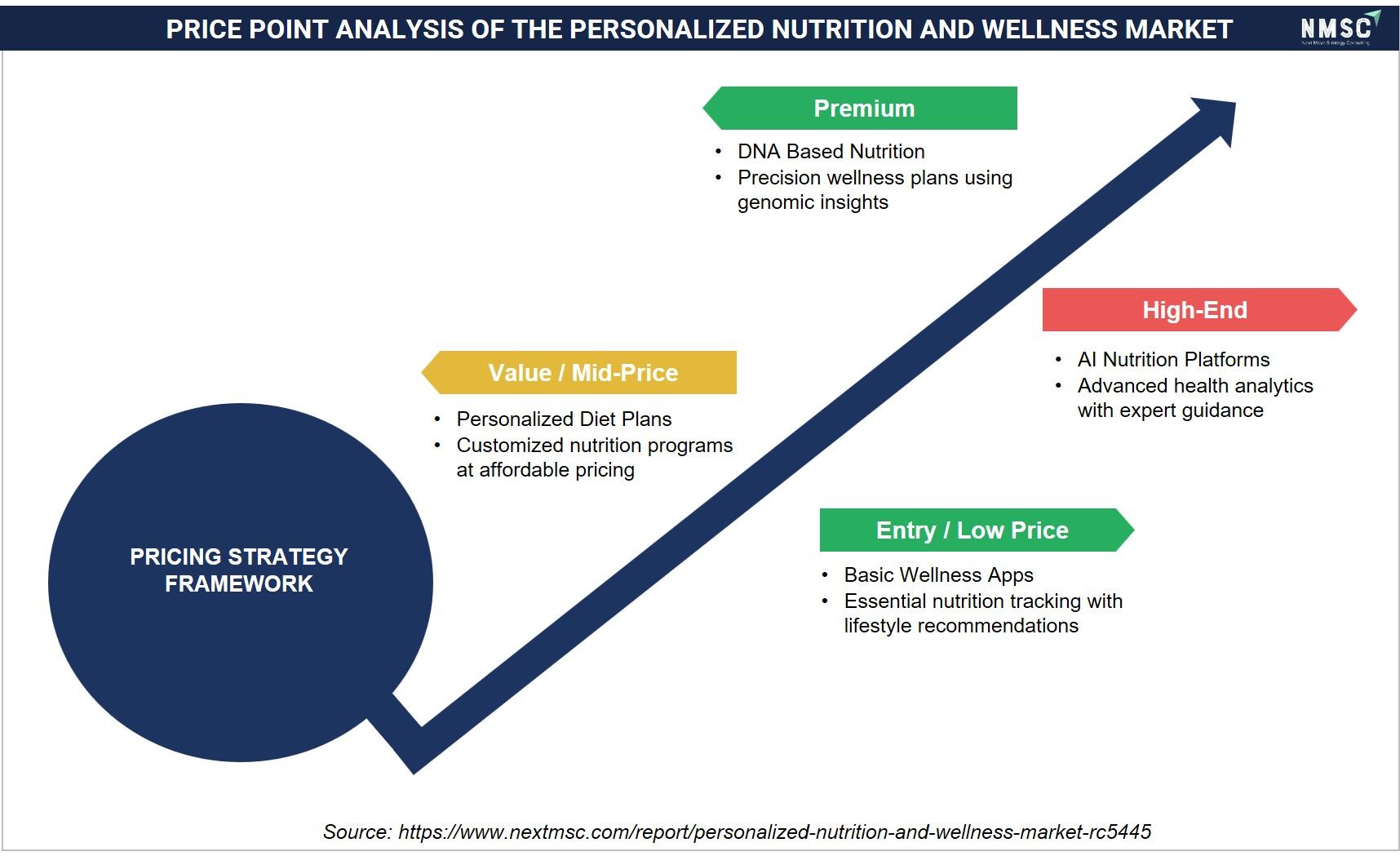
The personalized nutrition and wellness market follows a tiered pricing strategy based on the level of personalization, scientific validation, and digital health integration. Entry-level offerings include standard vitamins, nutrition apps, and basic wellness subscriptions targeted at cost-conscious consumers. Mid-price solutions incorporate AI-driven dietary recommendations, microbiome assessments, and personalized supplement plans. Premium and high-end products command significantly higher prices by combining genetic testing, continuous biomarker monitoring, one-on-one expert consultations, and customized nutrition programs. As consumers increasingly seek preventive healthcare and precision wellness, companies are differentiating their offerings through advanced diagnostics, data analytics, and subscription-based personalized health services, enabling premium pricing while expanding access across multiple consumer segments.
Regional Outlook
Geographic Performance Snapshot
|
Region |
2025 (USD) |
2035 (USD) |
CAGR% (2026–2035) |
Key Driver |
|
North America |
USD 6.00 Billion |
USD 21.45 Billion |
13.4% |
High consumer testing adoption and GLP-1-linked metabolic health awareness |
|
Europe |
USD 3.95 Billion |
USD 12.40 Billion |
11.8% |
Strong microbiome research base and expanding clinical validation studies |
|
Asia-Pacific |
USD 3.79 Billion |
USD 19.06 Billion |
17.8% |
Expanding middle-class wellness spending and rising digital health adoption |
|
Middle East & Africa |
USD 1.11 Billion |
USD 4.51 Billion |
15.1% |
Growing premium wellness retail expansion and rising health awareness |
|
Latin America |
USD 0.95 Billion |
USD 3.49 Billion |
13.8% |
Expanding direct-to-consumer wellness adoption and retail channel growth |
|
Total |
USD 15.80 Billion |
USD 60.92 Billion |
15.0% |
— |
North America Personalized Nutrition and Wellness Market Outlook
North America leads the personalized nutrition and wellness market with the deepest direct-to-consumer testing adoption and strongest metabolic health consumer awareness. We observed that GLP-1 medication adoption continues to elevate consumer interest in complementary nutrition guidance, while established supplement brands expand personalized product lines. Technology adoption remains advanced, with AI recommendation engines and continuous glucose monitor integration accelerating across the region's direct-to-consumer and healthcare channels.
Europe Personalized Nutrition and Wellness Market Outlook
Europe's personalized nutrition and wellness market reflects a scientifically mature landscape anchored by leading microbiome and nutrition research institutions. Our findings suggest that companies across the UK, Germany, and France are accelerating adoption of clinically validated testing programmes to differentiate from unregulated wellness claims. Technology adoption favors evidence-based digital platforms, supported by academic research partnerships underpinning personalization algorithms.
Asia-Pacific Personalized Nutrition and Wellness Market Outlook
Asia-Pacific is the fastest-growing personalized nutrition and wellness market region, propelled by expanding middle-class wellness spending in China and India alongside rising digital health platform adoption. We found that regulatory frameworks remain less harmonized than in Europe, giving digital nutrition platforms flexibility to scale rapidly across mobile-first consumer bases. Technology adoption is accelerating as regional providers expand personalized supplement and testing portfolios to serve growing domestic demand.
Middle East & Africa Personalized Nutrition and Wellness Market Outlook
The personalized nutrition and wellness market in Middle East & Africa is expanding as Gulf Cooperation Council economies invest in premium wellness retail and preventive health programmes. Our analysis shows that Saudi Arabia and the UAE are attracting personalized nutrition brand investment tied to rising health-conscious consumer spending. Regulatory influence remains moderate, while technology adoption is gradually shifting toward digital nutrition platforms as regional retailers expand premium wellness assortments.
Latin America Personalized Nutrition and Wellness Market Outlook
Latin America's personalized nutrition and wellness market is supported by growing direct-to-consumer wellness adoption in Brazil and Argentina and expanding retail channel distribution. We observed that regulatory frameworks are less stringent than in North America or Europe, though multinational supplement brands operating locally are introducing personalized product lines. Technology adoption remains centered on retail channel distribution, with competitive intensity increasing as regional distributors partner with global wellness brands.
U.S. Personalized Nutrition and Wellness Market
Based on our estimates, the U.S. market was valued at approximately USD 4.68 billion in 2025, projected to reach USD 14.70 billion by 2035 at a 11.8% CAGR. Demand structure is anchored by the deepest direct-to-consumer testing adoption and strongest GLP-1-linked metabolic health awareness globally. Technology penetration favors AI recommendation engines and CGM integration, and competitive intensity remains high among established supplement brands and specialized digital nutrition companies serving national consumer bases.
Canada Personalized Nutrition and Wellness Market
The market in Canada was valued at approximately USD 0.78 billion in 2025 and is projected to reach USD 2.66 billion by 2035, growing at a 12.8% CAGR. Demand is reflecting demand patterns similar to the U.S. market, while provincial health guidance shapes consumer adoption timelines. Technology penetration is rising as consumers request subscription-based digital nutrition platforms, with competitive intensity moderate given reliance on cross-border product supply from U.S.-based brands.
UK Personalized Nutrition and Wellness Market
As per our estimate, the UK market was valued at approximately USD 0.83 billion in 2025, projected to reach USD 2.56 billion by 2035 at a 11.6% CAGR. Demand structure is driven by strong academic microbiome research credentials and growing consumer trust in clinically validated testing. Regulatory influence from UK food standards guidance is significant, technology penetration favors evidence-based digital platforms, and competitive intensity remains steady among domestic and international wellness brands.
Germany Personalized Nutrition and Wellness Market
According to our analysis, the Germany market was valued at approximately USD 0.95 billion in 2025, projected to reach USD 3.05 billion by 2035 at a 12.1% CAGR. Demand structure is benefiting from a strong domestic wellness retail base and growing consumer interest in preventive health under national health awareness campaigns. Germany's supplement labeling requirements drive regulatory influence, while technology penetration favors clinically validated assessment services among leading wellness retailers.
France Personalized Nutrition and Wellness Market
Based on our estimates, the France market was valued at approximately USD 0.55 billion in 2025, projected to reach USD 1.61 billion by 2035 at a 10.9% CAGR. Demand structure is supported by France's strong nutraceutical manufacturing base and prominent research institutions shaping personalization credibility. Regulatory influence from French food safety authority guidelines is notable, and competitive intensity remains high given the concentration of premium supplement brands headquartered domestically.
China Personalized Nutrition and Wellness Market
The market in China was valued at approximately USD 1.10 billion in 2025 and is projected to reach USD 6.10 billion by 2035, growing at a 19.1% CAGR. Demand is fueled by expanding middle-class wellness spending and a dense base of regional digital health platform providers. Regulatory influence is increasing gradually under national health product guidelines, technology penetration is accelerating through mobile-first platform adoption, and competitive intensity remains elevated among numerous China-based wellness brands.
India Personalized Nutrition and Wellness Market
As per our estimate, the India market was valued at approximately USD 0.83 billion in 2025, projected to reach USD 6.14 billion by 2035 at a 22.9% CAGR. Demand structure is the fastest among covered countries, reflecting rapid wellness spending growth and expanding digital health platform adoption. Regulatory influence remains developing, while technology penetration is rising quickly as multinational brands localize personalized nutrition product sourcing to serve India's growing health-conscious consumer base.
Japan Personalized Nutrition and Wellness Market
According to our analysis, the Japan market was valued at approximately USD 0.57 billion in 2025, projected to reach USD 2.27 billion by 2035 at a 14.8% CAGR. Demand structure is supported by Japan's longstanding functional food heritage and strong consumer trust in scientifically validated supplements. Regulatory influence is well established through the Foods with Function Claims system, technology penetration is advanced, and competitive intensity remains high among long-standing domestic wellness brands.
South Korea Personalized Nutrition and Wellness Market
Based on our estimates, the South Korea market was valued at approximately USD 0.42 billion in 2025, projected to reach USD 2.10 billion by 2035 at a 17.8% CAGR. Demand structure is benefiting from the country's globally influential beauty and wellness industry and rising personalized nutrition investment. Technology penetration is high, with domestic brands supplying premium AI-driven recommendation platforms, and competitive intensity remains pronounced amid rapid product innovation cycles.
Australia Personalized Nutrition and Wellness Market
The market in Australia was valued at approximately USD 0.30 billion in 2025 and is projected to reach USD 1.34 billion by 2035, growing at a 16.1% CAGR. Demand is supported by a well-established wellness retail sector and growing consumer interest in evidence-based supplementation. Regulatory influence stems from Australia's therapeutic goods framework, while technology penetration favors imported digital nutrition platforms amid moderate competitive intensity.
UAE Personalized Nutrition and Wellness Market
As per our estimate, the UAE market was valued at approximately USD 0.30 billion in 2025, projected to reach USD 1.32 billion by 2035 at a 16.1% CAGR. Demand structure is shaped by the UAE's role as a regional premium wellness retail hub attracting health-conscious consumers. Regulatory influence remains moderate, technology penetration is improving through imported digital nutrition formats, and competitive intensity is rising as brands expand portfolios to serve Gulf wellness consumers.
Saudi Arabia Personalized Nutrition and Wellness Market
According to our analysis, the Saudi Arabia market was valued at approximately USD 0.32 billion in 2025, projected to reach USD 1.49 billion by 2035 at a 16.8% CAGR. Demand structure is driven by Vision 2030-linked preventive health investment and rising premium wellness retail expansion. Regulatory influence is developing under national food and drug authority guidelines, and technology penetration is advancing as domestic retailers scale personalized nutrition product availability.
South Africa Personalized Nutrition and Wellness Market
Based on our estimates, the South Africa market was valued at approximately USD 0.17 billion in 2025, projected to reach USD 0.58 billion by 2035 at a 13.1% CAGR. Demand structure is reflecting a growing formal wellness retail sector that continues to drive investment in personalized supplement offerings. Regulatory influence is moderate, technology penetration favors imported digital platform formats, and competitive intensity is increasing as regional distributors expand product breadth.
Brazil Personalized Nutrition and Wellness Market
The market in Brazil was valued at approximately USD 0.42 billion in 2025 and is projected to reach USD 1.66 billion by 2035, growing at a 14.8% CAGR. Demand is supported by growing direct-to-consumer wellness adoption and expanding retail channel distribution. We observed that regulatory frameworks are less stringent than in North America or Europe, though multinational supplement brands are introducing personalized product lines across major metropolitan wellness markets.
Argentina Personalized Nutrition and Wellness Market
As per our estimate, the Argentina market was valued at approximately USD 0.16 billion in 2025, projected to reach USD 0.56 billion by 2035 at a 13.1% CAGR. Demand structure is reflecting rising wellness consumer spending amid gradual digital nutrition platform adoption. Regulatory influence remains developing, technology penetration is gradually increasing through imported personalized supplement formats, and competitive intensity is moderate among regional distributors serving wellness-focused consumers.
Competitive Landscape
We observed that the personalized nutrition and wellness market remains moderately fragmented among diversified global consumer health groups and specialized direct-to-consumer testing companies competing for subscription-based consumer relationships.
|
Field |
Details |
|
Market Structure |
Moderately fragmented, led by diversified global consumer health groups and specialized DTC testing companies |
|
Innovation Focus |
AI-driven recommendation engines, microbiome and biomarker testing, and CGM-integrated platforms |
|
M&A Activity |
Active, concentrated in personalized nutrition brand and private equity-led testing company acquisitions |
How Do Companies Compete in the Personalized Nutrition and Wellness Market?
Companies compete primarily on testing accuracy, subscription retention, and breadth of personalized product portfolios across the industry. Global consumer health groups such as Nestlé Health Science S.A. and Abbott Laboratories leverage broad manufacturing and distribution scale to cross-sell personalized products, while specialized direct-to-consumer companies such as ZOE Limited and Viome Life Sciences, Inc. compete on proprietary testing science and clinical study credibility.
Which Competitive Archetypes Dominate the Personalized Nutrition and Wellness Market?
Two archetypes dominate the market: diversified global consumer health groups offering integrated supplement and nutrition portfolios, and specialized direct-to-consumer testing companies focused on proprietary personalization science. Herbalife Ltd. and Amway Corp. exemplify the diversified archetype through broad direct-selling supplement portfolios, while ZOE Limited and Viome Life Sciences, Inc. exemplify the specialized archetype through microbiome and biomarker testing-led subscription models.
How Are Companies Differentiating Through Innovation in Personalized Nutrition?
Innovation and differentiation strategy increasingly center on combining multiple data streams into unified personalization scores. ZOE's PREDICT research programme, integrating stool, blood lipid, and continuous glucose data, and Viome's RNA sequencing-based gut activity measurement both target deeper physiological insight than single-marker testing. Our analysis shows that vendors unable to demonstrate peer-reviewed clinical validation risk exclusion from increasingly research-literate consumer and healthcare channel procurement decisions.
What M&A and Expansion Activity Is Shaping the Personalized Nutrition and Wellness Market?
Acquisitions and private equity consolidation continue to reshape the industry. Nestlé Health Science's acquisition of personalized vitamin business Persona, integrated into its Atrium Professional Brands portfolio, illustrates how diversified consumer health groups are acquiring assessment-led capability, while L Catterton's ownership stakes spanning Thorne HealthTech, Persona, and Tally Health demonstrate how private equity is concentrating capital across the personalized health testing and supplement value chain.
Key Market Players
Our assessment indicates that the following 14 companies are actively shaping product innovation, testing science, and commercial strategy within the global personalized nutrition and wellness market.
-
Herbalife Ltd.
-
Amway Corp.
-
Abbott Laboratories
-
Nestlé Health Science S.A.
-
Bayer AG
-
Danone S.A.
-
Haleon plc
-
Thorne HealthTech, Inc.
-
Metagenics, Inc.
-
Viome Life Sciences, Inc.
-
Noom, Inc.
-
ZOE Limited
-
Prenetics Global Limited
-
Unilever PLC
Latest Developments
We found that recent activity within the personalized nutrition and wellness market is concentrated on strategic acquisitions, retail partnerships, and clinical research milestones, reflecting the industry's transition toward mainstream, science-backed adoption.
|
Date |
Event |
|
March 2026 |
Herbalife announced an agreement to acquire certain assets of Bioniq, a UK-based personalized supplements company. The acquisition is aimed at expanding Herbalife's personalized nutrition capabilities by integrating Bioniq's biomarker-driven supplement technology with Herbalife's global manufacturing and distribution network. The move strengthens Herbalife's strategy to become a technology-enabled, data-driven personalized wellness platform |
Expert Insights
 “Our mission is to improve the lives of millions through science-backed microbiome products that are powerful and efficacious, but with the safety and accessibility of a probiotic.”
— Colleen Cutcliffe, Ph.D., Co-founder & CEO, Pendulum Therapeutics
Statement during the launch of Pendulum's GLP-1 Probiotic (March 2024).
Market Interpretation:
The statement reflects the convergence of personalized nutrition, metabolic health, and microbiome therapeutics. Companies are increasingly developing evidence-based nutritional solutions targeting obesity, diabetes, and metabolic disorders, reinforcing the market's shift toward precision wellness and preventive healthcare supported by scientific validation.
Investment Opportunities
What Capital Inflows Are Targeting the Personalized Nutrition and Wellness Market?
Capital inflows into the personalized nutrition and wellness market are increasingly directed toward companies combining proprietary testing science with scalable subscription models. ZOE's continued funding rounds and Viome Life Sciences' USD 302 million raised across eight rounds illustrate how investors are funding both consumer-facing and diagnostics-oriented personalized nutrition companies. We observed that investors favor vendors demonstrating peer-reviewed clinical validation, viewing published research as a proxy for long-term consumer trust and retention.
How Is Infrastructure Investment Supporting Personalized Nutrition Platform Scaling?
Infrastructure investment is expanding testing laboratory capacity and digital platform infrastructure to support growing direct-to-consumer demand. Our findings suggest that ZOE's expansion into the U.S. market, building on revenue growth exceeding 390% in its home market, illustrates how personalized nutrition companies are scaling operational infrastructure alongside international market entry to support subscription-based testing and coaching delivery.
What ESG Considerations Are Shaping Personalized Nutrition and Wellness Investment Decisions?
Environmental, social, and governance considerations are increasingly relevant to investment decisions across the industry, with data privacy safeguards for genetic and health information and equitable access to testing as key criteria. U.S. Food and Drug Administration guidance on genetic testing oversight continues to inform governance disclosures. We found that investors increasingly favor companies with transparent data handling practices, treating consumer trust safeguards as a governance indicator alongside supply chain sustainability.
Key Benefits for Stakeholders
How Does This Report Benefit Enterprise and Industry Leaders?
Enterprise and industry leaders gain access to validated segmentation, competitive benchmarking, and regional demand forecasts that support product development and channel investment decisions across the personalized nutrition and wellness industry. Our analysis shows that detailed offering, personalization method, and health goal breakdowns help brand teams align product investment with consumer demand patterns while identifying underserved end-user segments for expansion.
How Does This Report Benefit Investors and Financial Analysts?
Investors and financial analysts benefit from consistent, single-point market size and CAGR estimates that support valuation and capital-allocation decisions across the personalized nutrition and wellness market supply chain. We observed that the report's regional and segment-level growth differentials help identify which consumer health groups and specialized testing companies are best positioned to capture above-market growth in digital nutrition and weight management categories through 2035.
How Does This Report Benefit Technology Vendors and Product Teams?
Technology vendors and product teams gain insight into emerging design requirements, including AI-driven recommendation engines, CGM integration, and multi-omics analysis, that are reshaping the industry. Our findings suggest that this analysis helps R&D teams prioritize development roadmaps around clinically validated personalization science and subscription-based digital platforms that are increasingly required by direct-to-consumer and healthcare channel procurement processes.
Key Market Segments
By Offering
-
Personalized Nutrition Products
-
Personalized Vitamin Supplements
-
Personalized Mineral Supplements
-
Personalized Botanical Supplements
-
Personalized Probiotics
-
Personalized Protein Supplements
-
Personalized Functional Foods
-
Personalized Functional Beverages
-
Personalized Meal Replacements
-
-
Nutrition Assessment Services
-
DNA Testing
-
Microbiome Testing
-
Blood Biomarker Testing
-
Metabolomic Testing
-
Phenotypic Assessment
-
-
Digital Nutrition Solutions
-
Nutrition Recommendation Platforms
-
Mobile Applications
-
AI Nutrition Platforms
-
Digital Coaching Platforms
-
-
Nutrition Consulting Services
-
Dietitian Consultation
-
Nutritionist Consultation
-
Physician-Led Nutrition Programs
-
Wellness Coaching
-
By Personalization Method
-
DNA Analysis
-
Microbiome Analysis
-
Blood Biomarker Analysis
-
Metabolomic Analysis
-
Phenotypic Assessment
-
Dietary Assessment
-
Wearable Data Analysis
-
Multi-Omics Analysis
By Product Form
-
Capsules
-
Tablets
-
Powders
-
Gummies
-
Softgels
-
Liquids
-
Bars
-
Ready-to-Drink Products
-
Sachets
By Health Goal
-
General Wellness
-
Immune Health
-
Digestive Health
-
Weight Management
-
Sports Performance
-
Healthy Aging
-
Women's Health
-
Men's Health
-
Children's Health
-
Cardiometabolic Health
-
Cognitive Health
-
Beauty Nutrition
-
Sleep Health
-
Clinical Nutrition
-
Other Health Goals
By Technology
-
AI Engine
-
Rules-Based Engine
-
Wearable Integration
-
CGM Integration
-
Digital Health Platform
By Distribution Channel
-
Direct-to-Consumer
-
Company Websites
-
Mobile Applications
-
Subscription Programs
-
-
Healthcare Channel
-
Hospitals
-
Clinics
-
Dietitian Practices
-
Pharmacies
-
-
Retail Channel
-
Supermarkets
-
Health Stores
-
Drug Stores
-
-
Online Marketplaces
-
Direct Selling
By End User
-
Healthy Individuals
-
Athletes
-
Patients
By Region
-
North America: U.S., Canada, Mexico
-
Europe: UK, Germany, France, Italy, Spain, Sweden, Denmark, Finland, Netherlands, Rest of Europe
-
Asia-Pacific: China, India, Japan, South Korea, Taiwan, Indonesia, Vietnam, Australia, Philippines, Malaysia, Rest of APAC
-
Middle East & Africa: Saudi Arabia, UAE, Egypt, Israel, Turkey, Nigeria, South Africa, Rest of MEA
-
Latin America: Brazil, Argentina, Chile, Colombia, Rest of LATAM
Conclusion and Recommendations
What Is the Long-Term Outlook for the Personalized Nutrition and Wellness Market?
The long-term outlook for the market remains strongly positive, with global revenue projected to nearly quadruple from USD 15.80 billion in 2025 to USD 60.92 billion by 2035 at a 15.04% CAGR. We observed that sustained consumer interest in metabolic health, expanding biomarker testing adoption, and AI-driven personalization will continue underpinning demand across direct-to-consumer, healthcare, and retail channels through the forecast period.
What Strategic Positioning Should Personalized Nutrition and Wellness Suppliers Pursue?
Suppliers should prioritize clinically validated testing science and AI-driven digital platforms while pursuing subscription-based commercial models to secure long-term consumer relationships. Our assessment indicates that companies investing early in continuous glucose monitor integration and multi-omics analysis will be best positioned to capture premium pricing within the personalized nutrition and wellness market.
How Attractive Is the Personalized Nutrition and Wellness Market for New Investment?
The personalized nutrition and wellness industry presents an attractive investment case, supported by a USD 42.74 billion absolute dollar opportunity between 2026 and 2035 and above-average growth in Asia-Pacific and digital nutrition categories. We found that investment attractiveness is highest for companies combining proprietary testing science with scalable subscription infrastructure, positioning them to serve both premium and mainstream wellness consumer segments simultaneously.
What Market Shifts and Key Risks Should Stakeholders Monitor?
Stakeholders should monitor testing affordability, data privacy regulation, and limited clinical consensus on personalization algorithm efficacy as key risks to the personalized nutrition and wellness market. Our analysis shows that vendors unable to demonstrate peer-reviewed validation risk losing consumer trust to competitors with published clinical research, particularly within North America's increasingly research-literate direct-to-consumer environment.
What Are the Key Growth Pathways for the Personalized Nutrition and Wellness Market?
Key growth pathways include expanding CGM-integrated digital platforms, scaling healthcare channel partnerships, and deepening penetration into weight management and healthy aging health goals. Next Move Strategy Consulting's analysis indicates that suppliers pursuing these pathways while maintaining clinical credibility in core testing categories will be best positioned to capture the personalized nutrition and wellness market's projected growth through 2035.
About the Author
 Liza Phukan
— Liza Phukan is Research Associate at Next Move Strategy Consulting, where she has covered emerging industries and market research across sectors for 3.5 years. Her work includes analyzing industry developments, validating market data, and developing structured business content from research findings. She uses secondary research and data-validation practices to turn complex market information into clear decision-useful market analysis for business audiences and support report development and B2B.
Liza Phukan
— Liza Phukan is Research Associate at Next Move Strategy Consulting, where she has covered emerging industries and market research across sectors for 3.5 years. Her work includes analyzing industry developments, validating market data, and developing structured business content from research findings. She uses secondary research and data-validation practices to turn complex market information into clear decision-useful market analysis for business audiences and support report development and B2B.
About the Reviewer
 Supradip Baul
— Supradip Baul is an accomplished business consultant and strategist with over a decade of rich experience in market intelligence, strategy, technology, and business transformation. His work has included rigorous qualitative and quantitative analysis across multiple industries, helping clients shape investment decisions and long-term roadmaps. Earlier in his career, he was associated with Gartner, where he contributed to industry-leading reports and market share analyses. He has worked with leading global companies and holds an MBA with a dual specialization in Marketing and Finance.
Supradip Baul
— Supradip Baul is an accomplished business consultant and strategist with over a decade of rich experience in market intelligence, strategy, technology, and business transformation. His work has included rigorous qualitative and quantitative analysis across multiple industries, helping clients shape investment decisions and long-term roadmaps. Earlier in his career, he was associated with Gartner, where he contributed to industry-leading reports and market share analyses. He has worked with leading global companies and holds an MBA with a dual specialization in Marketing and Finance.
At Next Move Strategy Consulting, we understand that insightful market research is the cornerstone of successful business decisions. That's why we employ a robust and multifaceted approach, combining various methodologies to deliver the most accurate and actionable data for our clients.

Research Landscape
We navigate the world of research with two primary approaches:
Qualitative Approach
Our qualitative research methodologies involve immersive techniques such as in-depth interviews, focus groups, and observational studies. By engaging directly with individuals and stakeholders, we uncover valuable insights that quantitative data alone may overlook.

Quantitative Research
In tandem with qualitative methodologies, NMSC leverages the power of Quantitative Research to provide a robust foundation of numerical insights. Through systematic data collection and analysis, we quantify patterns, preferences, and market trends, offering a comprehensive view of the business landscape.
Our quantitative research approach employs diverse tools, including surveys, experiments, and statistical modelling. These methodologies enable us to gather data from a large and representative sample, ensuring the statistical significance of our findings. By employing structured questionnaires and standardized data collection methods, we guarantee the reliability and validity of the information we present to our clients.
Quantitative research is particularly effective in measuring the prevalence of trends, assessing market size, and gauging the impact of various factors on consumer behavior. The numerical precision attained through this approach equips our clients with actionable insights, facilitating data-driven decision-making and strategy formulation.


Our Specialized Toolbox for Industry-Specific Market Research
We deploy a specialized arsenal of techniques tailored to meet your unique requirements. Here's a glimpse into our comprehensive toolbox:

Information Procurement
The stage entails acquiring market data or relevant information through various sources and methodologies.


Market Research Approach
We utilize both top-down and bottom-up approaches in market research analysis to achieve a comprehensive understanding of the market dynamics, leveraging the broad perspective of industry trends and macroeconomic factors alongside detailed insights from specific segments and individual companies.

Porters Five Forces Analysis
We conduct Porter's Five Forces analysis to evaluate the competitive landscape of an industry, providing us with insights into factors that affect profitability and strategic positioning.

SWOT Analysis

Forecasting
We utilize a forecasting model to predict future consumption by considering parameters like population, economics, regulations, market competition, drivers, constraints, technology, and pricing. We also employ statistical techniques such as multilinear regression, exponential smoothing, moving average, ARIMA, and Monte Carlo simulations for accurate predictions. In econometric forecasting, we analyzed short-term and long-term event impacts, attributing values based on regulatory frameworks, economic factors, and market events.





 Speak to Our Analyst