Shape-Shifting Robot Market Global Industry Analysis and Forecast (2026–2035)

The global Shape-Shifting Robot Market size was valued at USD 485 million in 2025 and is estimated at USD 565 million in 2026, forecast to reach USD 2,720 million by 2035, expanding at a 19.1% CAGR from 2026 to 2035. Key drivers include rising commercialization of transformable mecha and vehicle-form robots and expanding defense and reconnaissance funding for adaptive robotic platforms, with Asia-Pacific leading the global market.

Download Free Sample PDF
Base Year (2025)
$485.0 Million
Forecast (2035)
$2,720.0 Million
CAGR (2026-2035)
19.1%
Top Region
Asia-Pacific

What Is the Shape-Shifting Robot Market Size?

The global shape-shifting robot market size was valued at USD 485 million in 2025 and is estimated at USD 565 million in 2026, forecast to reach USD 2,720 million by 2035, expanding at a 19.1% CAGR between 2026 and 2035. Asia-Pacific leads with approximately 45% share, while Modular Self-Reconfigurable Robots dominate all other product types with approximately 38% share.

We observed that the growth is broad-based across every segmentation axis, with transformable mecha commercialization and defense-linked reconnaissance funding driving the dominant structural shifts through 2035.

Shape-Shifting Robot Market Global Industry Analysis and Forecast (2026–2035) Revenue Forecast
Values in USD Million

2025 $485.0 Million
2025
2026 $577.6 Million
2026
2027 $688.0 Million
2027
2028 $819.4 Million
2028
2029 $975.9 Million
2029
2030 $1,162.3 Million
2030
2031 $1,384.2 Million
2031
2032 $1,648.6 Million
2032
2033 $1,963.5 Million
2033
2034 $2,338.6 Million
2034
2035 $2,720.0 Million
2035

Key Takeaways

By Product Type: Modular Self-Reconfigurable Robots held the largest share of approximately 38% (USD 185 million) in 2025; Transformable Mecha and Vehicle-Form Robots is the fastest-growing sub-segment at 29.9% CAGR from 2026–2035.

By Application: Industrial Automation and Manufacturing held the largest share of approximately 34% (USD 165 million) in 2025; Defense and Aerospace is the fastest-growing sub-segment at 22.5% CAGR from 2026–2035.

By Actuation Technology: Electromechanical Actuation held the largest share of approximately 54% (USD 260 million) in 2025; Shape Memory Alloy Actuation is the fastest-growing sub-segment at 24.2% CAGR from 2026–2035.

Dominant Region: Asia-Pacific dominated with approximately 45% revenue share (USD 220 million) in 2025.

Fastest-Growing Region: North America is expected to register the highest CAGR of 20.4% during 2026–2035.

Dominant Country: U.S. led with approximately USD 115 million in 2025.

Fastest-Growing Country: India is the fastest-growing country at approximately 23.3% CAGR from 2026–2035.

Market Opportunity: The shape-shifting robot market is expected to create an absolute dollar opportunity of USD 2,155 million between 2026 and 2035, presenting significant investment potential across modular robotics, defense, and consumer mecha channels.

According to Next Move Strategy Consulting analysis, manufacturers are increasingly pairing modular hardware platforms with reconfiguration-planning software to differentiate beyond single-form robotics, a shift that favors vertically integrated developers over component-only suppliers as commercialization of transformable mecha and soft morphing platforms accelerates through 2035.

What Does the Shape-Shifting Robot Market Encompass?

The shape-shifting robot market encompasses modular, soft, and mechanically transformable robotic systems capable of autonomously altering their physical morphology to adapt to tasks, terrains, or damage. Our assessment indicates that the scope spans homogeneous and heterogeneous modular robot systems, pneumatic and tensegrity-based soft morphing robots, transformable mecha and vehicle-form platforms, shape-adaptive grippers, and reconfigurable educational kits supplied to research institutions, industrial enterprises, defense agencies, and consumer users. The category has evolved from laboratory-stage modular prototypes into commercially shipped platforms, exemplified by Unitree Robotics' May 2026 launch of its GD01 transformable mecha capable of shifting between bipedal and quadrupedal configurations.
Regulatory frameworks remain nascent, with safety certification for piloted transformable platforms still developing across major markets, while broader adoption of industrial robotics automation standards is shaping design and control-software requirements. We observed that technology adoption is shifting toward AI-driven reconfiguration planning, including graph-based strategies and reinforcement learning approaches that let robots autonomously select optimal morphologies. Next Move Strategy Consulting's analysis indicates that this structural shift, combined with falling actuator and sensor costs, is redefining sourcing criteria across the shape-shifting robot market.

Ecosystem Analysis of the Shape-Shifting Robot Market

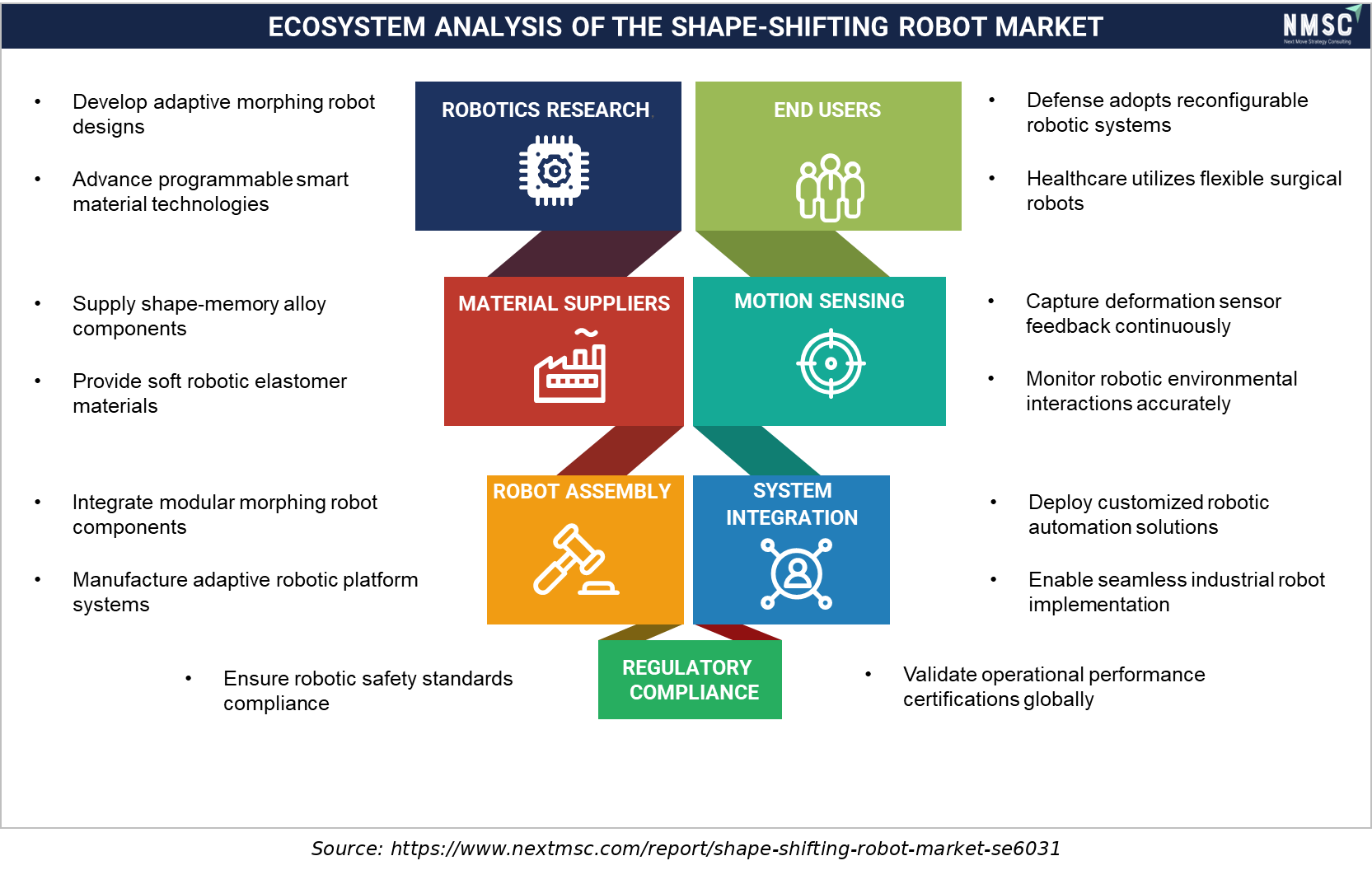
The ecosystem of the market comprises research institutions driving innovation in adaptive robotics, material suppliers providing smart materials and components, and motion sensing technology providers enabling real-time environmental awareness. Robot assembly and system integration companies transform these technologies into deployable solutions while ensuring compliance with regulatory standards. End users across defence, healthcare, industrial automation, logistics, and space exploration ultimately drive commercialization by adopting versatile, reconfigurable robotic systems for complex and dynamic applications.

Market Drivers & Dynamics

Interactive Dataset
Rising commercialization of transformable mecha and vehicle-form robots driver +3.5% Asia-Pacific 2026-2035
Expanding defense and reconnaissance funding for adaptive robots driver +2.8% North America, Europe 2026-2035
Growing adoption of modular robots in flexible manufacturing driver +2.2% Global 2026-2035
Advances in shape memory alloy and soft actuator materials driver +1.8% Global 2026-2032
Rising STEM education investment in reconfigurable robot kits driver +1.1% North America, Asia-Pacific 2026-2032
Growing search and rescue robotics procurement by disaster agencies driver +0.9% Global 2026-2035
High unit costs and limited production scale of shape-shifting platforms restraint −1.4% Global 2026-2032
Safety and regulatory uncertainty for piloted transformable robots restraint −1.1% Global 2026-2035
Technical complexity of reconfiguration control software restraint −0.7% Global 2026-2030
Source: Next Move Strategy Consulting

Growth Drivers

What Is the Primary Growth Driver of the Shape-Shifting Robot Market?

Rising commercialization of transformable mecha and vehicle-form robots is the primary driver of the market. Unitree Robotics reported revenue of approximately USD 235 million in 2025, representing 335% year-on-year growth, with its transformable and humanoid platforms overtaking quadrupedal robots as the primary revenue driver during the year. We observed that this commercialization pace, reinforced by the company's March 2026 initial public offering filing, continues to anchor investor confidence in transformable robot categories across Asia-Pacific and beyond.

How Is Defense Funding Driving Shape-Shifting Robot Market Growth?
Expanding defense and reconnaissance funding for adaptive robotic platforms is accelerating market growth toward ruggedized, mission-configurable systems. Our assessment indicates that government research agencies in the United States and Europe continue to fund modular and reconfigurable robotics programs aimed at extreme-environment and reconnaissance applications, as documented in publicly disclosed defense research budgets. This funding pathway, combined with rising procurement interest from disaster-response agencies, is compressing adoption timelines for soft and modular morphing platforms across North America and Europe.

Growth Inhibitors

What Is Restraining Shape-Shifting Robot Market Expansion?

High unit costs and limited production scale restrain broader adoption across the shape-shifting robot supply chain. We found that Unitree's GD01 transformable mecha carries a preliminary price near USD 650,000 per unit, a cost point that confines near-term demand to defense, research, and affluent early-adopter segments. Smaller developers face particular exposure, as limited manufacturing scale reduces their ability to lower unit costs compared with larger, vertically integrated robotics groups, delaying mainstream commercial adoption.

What Are the Growth Opportunities?

How Can Lower-Cost Transformable Platforms Unlock Mainstream Adoption?

Cost-reduced transformable mecha and vehicle-form robots present a whitespace opportunity for manufacturers seeking to move beyond defense and affluent early-adopter buyers. Suppliers that commercialize scaled production techniques stand to capture recurring component and service sales as transformable platforms shift from six-figure price points toward broader commercial and consumer accessibility.

Where Do Reconfiguration-Planning Software Platforms Create New Demand?

Developers of modular hardware create an opportunity for software providers offering AI-driven 3D printing-compatible reconfiguration-planning platforms that let robots autonomously select optimal morphologies. Early movers that secure validated planning algorithms can differentiate with industrial and defense buyers pursuing task-adaptive automation across their robotic fleets.

How Can Soft Morphing Robots Expand Access to Search and Rescue Operations?

Deployable, tensegrity-based soft robots represent an underpenetrated opportunity for disaster-response agencies seeking rubble-navigable, damage-resistant platforms. Suppliers that develop validated air-droppable morphing systems can secure long-term procurement contracts with government disaster agencies, benefiting from recurring maintenance and replacement-unit revenue tied to expanding search and rescue deployment.

Segmentation Analysis

2025 (USD Million)
2035 (USD Million)
Modular Self-Reconfigurable Robots 2025: $185.0 Million | 2035: $920.0 Million
Modular Self
Soft and Morphing Robots 2025: $95.0 Million | 2035: $520.0 Million
Soft and Mor
Transformable Mecha and Vehicle-Form Robots 2025: $45.0 Million | 2035: $610.0 Million
Transformabl
Shape-Adaptive Grippers and End Effectors 2025: $90.0 Million | 2035: $430.0 Million
Shape-Adapti
Reconfigurable Educational and Consumer Kits 2025: $70.0 Million | 2035: $240.0 Million
Reconfigurab
Modular Self-Reconfigurable Robots $185.0 Million $920.0 Million 17.6%
Soft and Morphing Robots $95.0 Million $520.0 Million 19.0%
Transformable Mecha and Vehicle-Form Robots $45.0 Million $610.0 Million 29.9%
Shape-Adaptive Grippers and End Effectors $90.0 Million $430.0 Million 17.0%
Reconfigurable Educational and Consumer Kits $70.0 Million $240.0 Million 13.1%

Which Product Type Segment Dominates the Shape-Shifting Robot Market?

Modular Self-Reconfigurable Robots, encompassing homogeneous and heterogeneous module systems, led the market with USD 185.0 million in 2025, supported by established use in research and flexible manufacturing applications. We observed that Transformable Mecha and Vehicle-Form Robots is the fastest-growing product type, expanding at a 29.9% CAGR from 2026 to 2035, as production-ready platforms such as Unitree's GD01 move from demonstration into commercial and defense procurement channels.

2025 (USD Million)
2035 (USD Million)
Industrial A
Education an
Consumer and
Search and R
Defense and
Segment Item 2025 (USD Million) 2035 (USD Million) CAGR
Industrial Automation and Manufacturing $10.0 USD Million $40.0 USD Million 25.0%
Education and STEM Training $17.1 USD Million $51.1 USD Million 11.0%
Consumer and Entertainment $24.2 USD Million $62.2 USD Million 25.0%
Search and Rescue and Disaster Response $31.3 USD Million $73.3 USD Million 11.0%
Defense and Aerospace $38.4 USD Million $84.4 USD Million 16.0%

Segment-wise data is locked

Unlock complete segment-wise numbers for By Application.

Unlock Full Data

Which Application Leads Shape-Shifting Robot Market Demand?

Industrial Automation and Manufacturing remained the leading application within the market, valued at USD 165.0 million in 2025 on sustained demand for modular robots that adapt to changing production-line configurations. Our findings suggest that Defense and Aerospace is the fastest-growing application, registering a 22.5% CAGR from 2026 to 2035, as reconnaissance and mission-configurable platform funding expands across government research programs.

2025 (USD Million)
2035 (USD Million)
Electromecha
Pneumatic an
Shape Memory
Magnetic and
Segment Item 2025 (USD Million) 2035 (USD Million) CAGR
Electromechanical Actuation $10.0 USD Million $40.0 USD Million 27.0%
Pneumatic and Hydraulic Actuation $17.1 USD Million $51.1 USD Million 9.0%
Shape Memory Alloy Actuation $24.2 USD Million $62.2 USD Million 19.0%
Magnetic and Soft Material Actuation $31.3 USD Million $73.3 USD Million 17.0%

Segment-wise data is locked

Unlock complete segment-wise numbers for By Actuation Technology.

Unlock Full Data

Which Actuation Technology Is Most Widely Used in Shape-Shifting Robots?

Electromechanical Actuation remained the dominant actuation technology, reaching USD 260.0 million in 2025 due to established use in modular robots and transformable mecha platforms requiring high force output. Based on research conducted by Next Move Strategy Consulting, we found that Shape Memory Alloy Actuation is the fastest-growing category at a 24.2% CAGR from 2026 to 2035, reflecting rising demand for lightweight, silent morphing mechanisms in soft and consumer-facing robots.

Growth Opportunities

Our analysis shows that three forward-looking opportunities stand out for stakeholders positioning within the shape-shifting robot market over the 2026-2035 forecast period.

How Can Lower-Cost Transformable Platforms Unlock Mainstream Adoption?

Cost-reduced transformable mecha and vehicle-form robots present a whitespace opportunity for manufacturers seeking to move beyond defense and affluent early-adopter buyers. Suppliers that commercialize scaled production techniques stand to capture recurring component and service sales as transformable platforms shift from six-figure price points toward broader commercial and consumer accessibility.

Where Do Reconfiguration-Planning Software Platforms Create New Demand?

Developers of modular hardware create an opportunity for software providers offering AI-driven 3D printing-compatible reconfiguration-planning platforms that let robots autonomously select optimal morphologies. Early movers that secure validated planning algorithms can differentiate with industrial and defense buyers pursuing task-adaptive automation across their robotic fleets.

How Can Soft Morphing Robots Expand Access to Search and Rescue Operations?

Deployable, tensegrity-based soft robots represent an underpenetrated opportunity for disaster-response agencies seeking rubble-navigable, damage-resistant platforms. Suppliers that develop validated air-droppable morphing systems can secure long-term procurement contracts with government disaster agencies, benefiting from recurring maintenance and replacement-unit revenue tied to expanding search and rescue deployment.

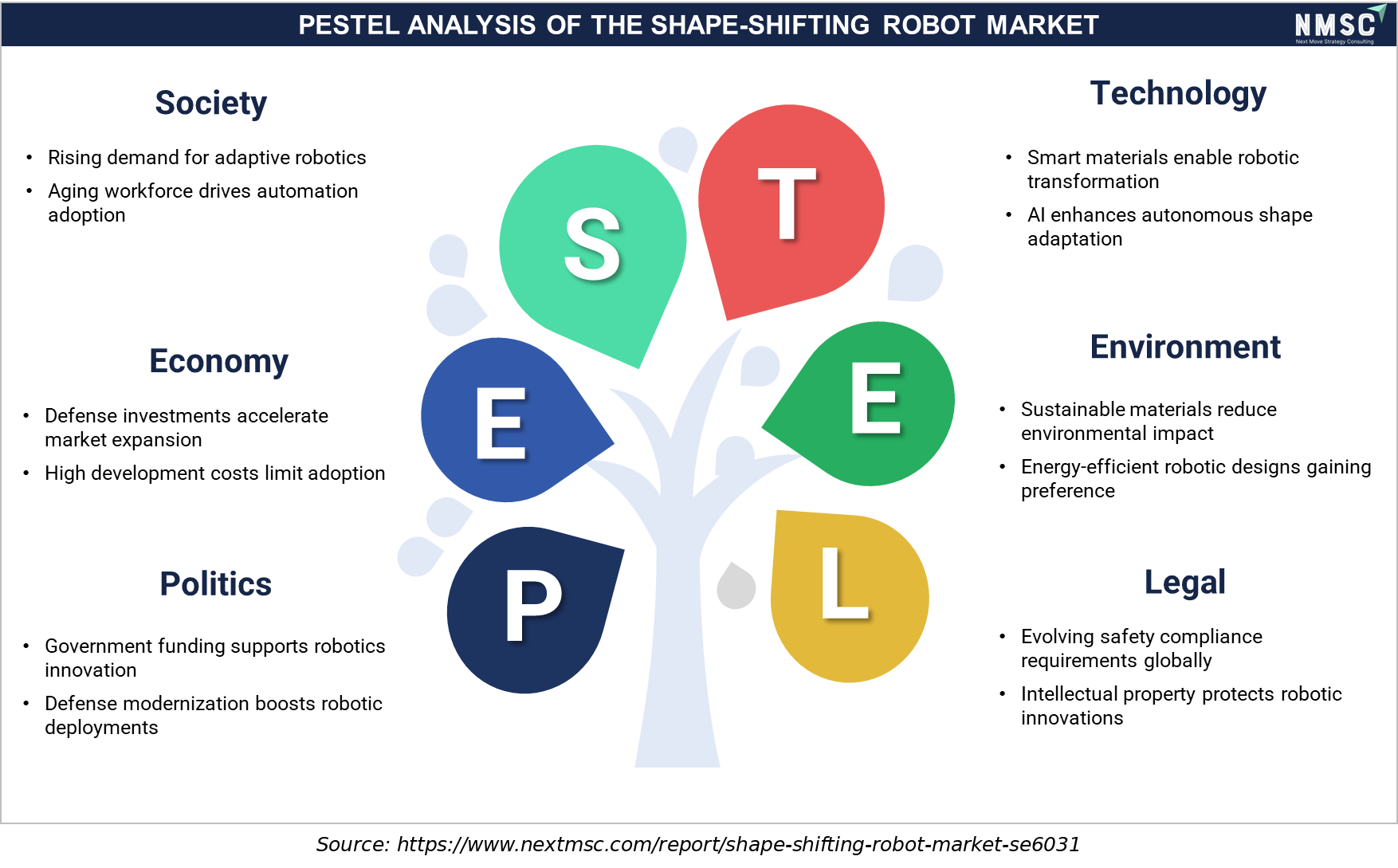
PESTEL Analysis of the Shape-Shifting Robot Market

Regional Outlook

2025 (USD Million)
2035 (USD Million)
North Americ
Europe
Asia-Pacific
Middle East
Latin Americ
Region 2025 (USD Million) 2035 (USD Million) CAGR (%)
North America $10.0 USD Million $40.0 USD Million 9.0%
Europe $17.1 USD Million $51.1 USD Million 27.0%
Asia-Pacific $24.2 USD Million $62.2 USD Million 25.0%
Middle East & Africa $31.3 USD Million $73.3 USD Million 23.0%
Latin America $38.4 USD Million $84.4 USD Million 12.0%

Regional data is locked

Unlock complete regional numbers for this market.

Unlock Full Data

Competitive Landscape

We observed that the shape-shifting robot market features a fragmented competitive landscape, with China-based transformable mecha developers competing alongside specialized modular robotics and soft robotics companies on morphology range, actuation technology, and commercialization speed.

Dimension Description
Market Structure Fragmented; a small number of China-based developers account for a disproportionate share of transformable mecha commercialization, while modular robotics, soft robotics, and educational kit specialists serve distinct application niches.
Innovation Focus Transformable mecha commercialization, AI-driven reconfiguration planning, and shape memory alloy actuator integration dominate current innovation pipelines across leading suppliers.
M&A Activity Early-stage capital raising and public listings rather than large acquisitions, exemplified by Unitree Robotics' March 2026 initial public offering filing on the Shanghai Stock Exchange.

How Do Companies Compete in the Shape-Shifting Robot Market?

Companies compete primarily on morphology range, commercialization speed, and actuation technology across the industry. China-based developers such as Unitree Robotics and LimX Dynamics leverage rapid iteration and aggressive pricing to reach commercial production ahead of peers, while specialized modular robotics companies compete on component reliability and reconfiguration-software sophistication for industrial and research buyers.

Which Competitive Archetypes Dominate the Shape-Shifting Robot Market?

Two archetypes dominate the market: China-based transformable mecha developers pursuing rapid commercialization at scale, and specialized modular or soft robotics companies focused on niche industrial, research, and educational applications. Unitree Robotics and UBTECH Robotics Corp Ltd exemplify the commercialization-first archetype through production-ready transformable platforms, while HEBI Robotics and Soft Robotics Inc. exemplify the specialist archetype serving industrial automation and research end users.

How Are Companies Differentiating Through Innovation in Shape-Shifting Robotics?

Innovation and differentiation strategy increasingly center on morphology breadth and reconfiguration intelligence. Unitree's GD01 bipedal-to-quadrupedal transformation and LimX Dynamics' three-in-one modular TRON 2 platform both extend shape-shifting capability into commercially deployable products. Developers unable to demonstrate credible commercialization pathways risk exclusion from defense and enterprise procurement shortlists as the category matures.

What M&A and Expansion Activity Is Shaping the Shape-Shifting Robot Market?

Capital raising, public listings, and cross-sector partnerships continue to shape the competitive landscape within the industry. Unitree Robotics' pursuit of a Shanghai Stock Exchange listing at a targeted USD 7 billion valuation, backed by major Chinese technology investors, illustrates how developers pursue geographic expansion and manufacturing scale-up across defense, industrial, and consumer end markets.

Key Market Players

Our assessment indicates that the following 15 companies are actively shaping morphology innovation, actuation technology, and commercialization strategy within the global shape-shifting robot market. Fewer than 20 companies met the eligibility criteria for independent development, production, or branding of shape-shifting robotic systems, so the verified count of 15 is used throughout this report.

Unitree Robotics Co., Ltd. LimX Dynamics Co., Ltd. UBTECH Robotics Corp Ltd Festo SE & Co. KG Modular Robotics Incorporated HEBI Robotics ROBOTIS Co., Ltd. Makeblock Co., Ltd. K-Team Corporation Soft Robotics Inc. Squishy Robotics, Inc. WowWee Group Limited Fable Robotics AB LEGO System A/S Modbot Inc.

Latest Developments

We found that recent product launches within the shape-shifting robot market are concentrated on transformable mecha commercialization and modular embodied AI platforms, reflecting the industry's broader lab-to-market transition.

Date Event
May 2024 Unitree launched the G1 humanoid robot, an AI-powered humanoid featuring 23–43 joint motors and a large range of joint motion. The robot demonstrates advanced dynamic capabilities, including dynamic standing, sitting and folding, and stick dancing, while its imitation- and reinforcement-learning-driven design enables continued AI-assisted development.

Investment Opportunities

What Capital Inflows Are Targeting the Shape-Shifting Robot Market?

Capital inflows into the market are increasingly directed toward transformable mecha commercialization and modular platform scale-up. Strategic and public-market investors continue to fund manufacturing capacity expansion, as seen in Unitree Robotics' March 2026 initial public offering filing backed by major Chinese technology capital. We observed that investors favor developers demonstrating validated commercialization pathways, viewing production-ready product launches as a proxy for long-term defense and enterprise contract retention.

How Is Infrastructure Investment Supporting Shape-Shifting Robot Manufacturing?

Infrastructure investment is expanding servomotor, sensor, and lightweight composite production capacity across Asia-Pacific to serve rising transformable and modular robot demand. Manufacturers are scaling actuator and chassis fabrication to support both modular self-reconfigurable and transformable mecha architectures. Our findings suggest that regional developers are investing in automated assembly lines to improve consistency for products ranging from educational kits to defense-grade transformable platforms.

What ESG Considerations Are Shaping Shape-Shifting Robot Investment Decisions?

Environmental, social, and governance considerations are increasingly relevant to investment decisions across the industry, with operator safety and responsible deployment of piloted transformable platforms as emerging criteria. Government research funding bodies continue to shape safety-testing expectations for defense and disaster-response applications. We found that investors increasingly favor developers with transparent safety-testing disclosures, treating it as a governance indicator alongside manufacturing quality control.

Key Benefits for Stakeholders

How Does This Report Benefit Enterprise and Industry Leaders?

Enterprise and industry leaders gain access to validated segmentation, competitive benchmarking, and regional demand forecasts that support product-portfolio decisions across the shape-shifting robot industry. Our analysis shows that detailed product-type, application, and actuation-technology breakdowns help R&D teams align development roadmaps with commercialization and regulatory requirements while identifying underserved segments for portfolio expansion.

How Does This Report Benefit Investors and Financial Analysts?

Investors and financial analysts benefit from consistent, single-point market size and CAGR estimates that support valuation and capital-allocation decisions across the shape-shifting robot supply chain. We observed that the report's regional and segment-level growth differentials help identify which developers are best positioned to capture above-market growth in transformable mecha and shape memory alloy actuation categories through 2035.

How Does This Report Benefit Technology Vendors and Product Teams?

Technology vendors and product teams gain insight into emerging design requirements, including AI-driven reconfiguration planning, shape memory alloy actuation, and modular chassis architectures, that are reshaping the industry. Our findings suggest that this analysis helps R&D teams prioritize development roadmaps around commercialization readiness and safety validation increasingly required by defense and enterprise procurement processes.

Key Market Segments Evaluated

By Product Type

  • Modular Self-Reconfigurable Robots
  • Soft and Morphing Robots
  • Transformable Mecha and Vehicle-Form Robots
  • Shape-Adaptive Grippers and End Effectors
  • Reconfigurable Educational and Consumer Kits

By Application

  • Industrial Automation and Manufacturing
  • Education and STEM Training
  • Consumer and Entertainment
  • Search and Rescue and Disaster Response
  • Defense and Aerospace
  • Healthcare and Rehabilitation

By Actuation Technology

  • Electromechanical Actuation
  • Pneumatic and Hydraulic Actuation
  • Shape Memory Alloy Actuation
  • Magnetic and Soft Material Actuation

Conclusion & Recommendations

The long-term outlook for the market remains positive, with global revenue projected to expand from USD 485 million in 2025 to USD 2,720 million by 2035 at a 19.1% CAGR. We observed that transformable mecha commercialization, defense-linked funding, and modular industrial adoption will continue underpinning demand across research, defense, and consumer applications through the forecast period.

What Strategic Positioning Should Shape-Shifting Robot Suppliers Pursue?

Suppliers should prioritize scaled manufacturing of transformable mecha platforms while pursuing shape memory alloy and soft actuation research to secure long-term defense and enterprise contracts. Our assessment indicates that companies investing early in AI-driven reconfiguration-planning software will be best positioned to capture premium pricing within the market.

How Attractive Is the Shape-Shifting Robot Market for New Investment?

The shape-shifting robot industry presents an attractive investment case, supported by a USD 2,155 million absolute dollar opportunity between 2026 and 2035 and above-average growth in Transformable Mecha and Vehicle-Form Robots and Defense and Aerospace categories. We found that investment attractiveness is highest for developers combining production-ready commercialization with scaled manufacturing, positioning them to serve both defense and consumer buyer segments simultaneously.

What Market Shifts and Key Risks Should Stakeholders Monitor?

Stakeholders should monitor high unit costs, safety and regulatory uncertainty for piloted platforms, and reconfiguration software complexity as key risks to the market. Our analysis shows that developers unable to reduce unit costs risk confining demand to defense and research niches, particularly as competing single-form robotics categories continue to benefit from greater manufacturing scale and lower price points.

What Are the Key Growth Pathways for the Shape-Shifting Robot Market?

Key growth pathways include scaling transformable mecha manufacturing, advancing shape memory alloy actuator commercialization, and deepening penetration into defense and disaster-response procurement channels. Next Move Strategy Consulting's analysis indicates that suppliers pursuing these pathways while maintaining cost competitiveness in modular self-reconfigurable robots will be best positioned to capture the shape-shifting robot market's projected growth through 2035.

FAQs

SWOT Analysis

This SWOT view highlights structural strengths, strategic gaps, expansion headroom, and external risks shaping outcomes in the Shape-Shifting Robot Market Global Industry Analysis and Forecast (2026–2035).

Strengths

Weaknesses

Opportunities

Threats

About the Author

Liza Phukan

Liza Phukan

Liza Phukan is Research Associate at Next Move Strategy Consulting, where she has covered emerging industries and market research across sectors for 3.5 years. Her work includes analyzing industry developments, validating market data, and developing structured business content from research findings. She uses secondary research and data-validation practices to turn complex market information into clear decision-useful market analysis for business audiences and support report development and B2B.

About the Reviewer

Debashree Dey

Debashree Dey

Debashree Dey is Assistant Manager at Next Move Strategy Consulting, where she supports cross-vertical market content and communications across diverse industries for 6 years. Her professional background includes senior content writing, communications, and published manuscript authorship, with experience developing audience-focused business narratives and maintaining clear, consistent messaging. Her role supports research-led content development and editorial quality across NextMSC publications.

Download Free Sample

Kevin Coker

KEVIN COKER

Founder, CEO and Board Diector

Proxima Clinical Research

I have been using Next MSC reports for product positioning in a new geography for a long time. They have by far the best reports I have found and the price is reasonable too!

Mohit Agarwal

MOHIT AGARWAL

Chief Manager

DryChem India Pvt. Ltd.

Next Move Strategy Consulting is an amazing team of consultants. We required a market study report for our investors on top priority and the team went above and beyond our expectations to deliver the same with ample supporting data within a short time span enabling us to secure the investments and keep our project timeline maintained. Their professionalism, attention to detail, and timely delivery of actionable recommendations have left a lasting impression on our organization.

Gaurav Jaiswal

GAURAV JAISWAL

Founder & CEO

Yano Charge Private Limited

The EV Charging market research report provided by the NextMSC was exceptionally detailed and insightful. It offered a comprehensive analysis that proved to be a game-changer for our strategic planning. Truly a testament to the NextMSC’s expertise and thoroughness in EV market landscape & analysis.

Semih Kavaklioglu

SEMIH KAVAKLIOGLU

Co-Founder & Sales Manager

Decortie

I work a lot in the marketing industry and I know that research is an essential part of any campaign. I have used Market research reports for my own products and I found them to be very informative and well-researched. The team here produces insightful reports for a good price

Melanie Samko

MELANIE SAMKO

Director of Marketing

TOSOH BIOSCIENCE, INC.

The information provided by NMSC is incredibly valuable, thank you so much for such a excellent work. I really appreciate it. I will make sure to reference all of it, in my summary document.

Custom Market Research Services

We will customize the research for you if the listed report does not fully match your requirements.

Get 30% Free Customization

Select License

This website uses cookies to ensure you get the best experience on our website. Learn more

✖