Silicone Sealants and Adhesives Market Global Industry Analysis and Forecast (2026–2035)

The global Silicone Sealants and Adhesives Market size was valued at USD 10.85 billion in 2025 and is estimated at USD 11.45 billion in 2026, with revenue projected to reach USD 20.02 billion by 2035, registering a 6.4% CAGR from 2026 to 2035. Key drivers include building-envelope regulation and rising electric vehicle production, with Asia Pacific leading the global market.

Download Free Sample PDF
Base Year (2025)
$10.85 Billion
Forecast (2035)
$20.02 Billion
CAGR (2026-2035)
6.4%
Top Region
Asia Pacific

What Is the Silicone Sealants and Adhesives Market Size?

The global Silicone Sealants and Adhesives Market size was valued at USD 10.85 billion in 2025 and is estimated at USD 11.45 billion in 2026, with revenue projected to reach USD 20.02 billion by 2035, registering a CAGR of 6.4% between 2026 and 2035. Asia Pacific led the market with an approximate 39% revenue share in 2025, while silicone sealants accounted for approximately 58% of 2025 revenue.

We observed that construction, automotive, and electronics manufacturers are increasingly specifying silicone-based bonding and sealing systems over legacy organic alternatives, supporting sustained market size and revenue growth across the forecast window.

Silicone Sealants and Adhesives Market Global Industry Analysis and Forecast (2026–2035) Revenue Forecast

Values in USD Billion

2025 $10.85 Billion
2025
2026 $11.54 Billion
2026
2027 $12.28 Billion
2027
2028 $13.07 Billion
2028
2029 $13.91 Billion
2029
2030 $14.80 Billion
2030
2031 $15.74 Billion
2031
2032 $16.75 Billion
2032
2033 $17.82 Billion
2033
2034 $18.96 Billion
2034
2035 $20.02 Billion
2035

Key Takeaways

By Product Type: Silicone Sealants held the largest share, expanding from USD 6.29 billion in 2025 to USD 11.22 billion by 2035; Silicone Adhesives is the fastest-growing product type at a 7.0% CAGR from 2026 to 2035.

By Application: Glazing and Weatherproofing held the largest share, expanding from USD 4.34 billion in 2025 to USD 7.42 billion by 2035; Electrical Insulation and Encapsulation is the fastest-growing application at a 7.9% CAGR from 2026 to 2035.

By End-Use Industry: Building and Construction held the largest share, expanding from USD 4.77 billion in 2025 to USD 8.28 billion by 2035; Electronics and Electrical is the fastest-growing end-use industry at a 7.8% CAGR from 2026 to 2035.

Dominant Region: Asia Pacific led the market with approximately 39% revenue share in 2025.

Fastest-Growing Region: Middle East and Africa is expected to register the highest CAGR of 7.6% during 2026–2035.

Dominant Country: China led the market with approximately USD 1.99 billion in 2025, representing approximately 18% of global revenue.

Fastest-Growing Country: Saudi Arabia is the fastest-growing covered country at an 8.3% CAGR from 2026 to 2035.

The Silicone Sealants and Adhesives Market presents an incremental revenue opportunity of approximately USD 8.57 billion between 2026 and 2035, an addition investors and manufacturers can capture through expanded glazing, automotive electrification, and electronics encapsulation demand.

According to NMSC analysis, demand growth is increasingly concentrated in applications that combine Bonding and Assembly with electrical or thermal insulation, a shift that rewards silicone formulators who can serve automotive and electronics customers alongside traditional construction channels.

What does the Silicone Sealants and Adhesives Market Encompass?

The Silicone Sealants and Adhesives Market report covers products formulated from silicone polymers used for bonding, sealing, gasketing, and encapsulating substrates across construction, automotive, electronics, industrial, and aerospace applications. Our assessment indicates that the market has evolved from single-purpose caulking compounds toward multifunctional systems that combine structural adhesion, weatherproofing, and electrical insulation, reflecting the broader shift toward performance-engineered building envelopes and vehicle platforms.
Regulatory frameworks, including volatile organic compound limits enforced by environmental agencies and European restrictions on cyclic siloxanes, are reshaping formulation chemistry industry-wide. We found that manufacturers are accelerating adoption of low-emission, bio-based, and recycled silicone feedstocks to remain compliant while meeting building-certification and automotive sustainability requirements, a trend that is increasingly influencing procurement decisions across the value chain.

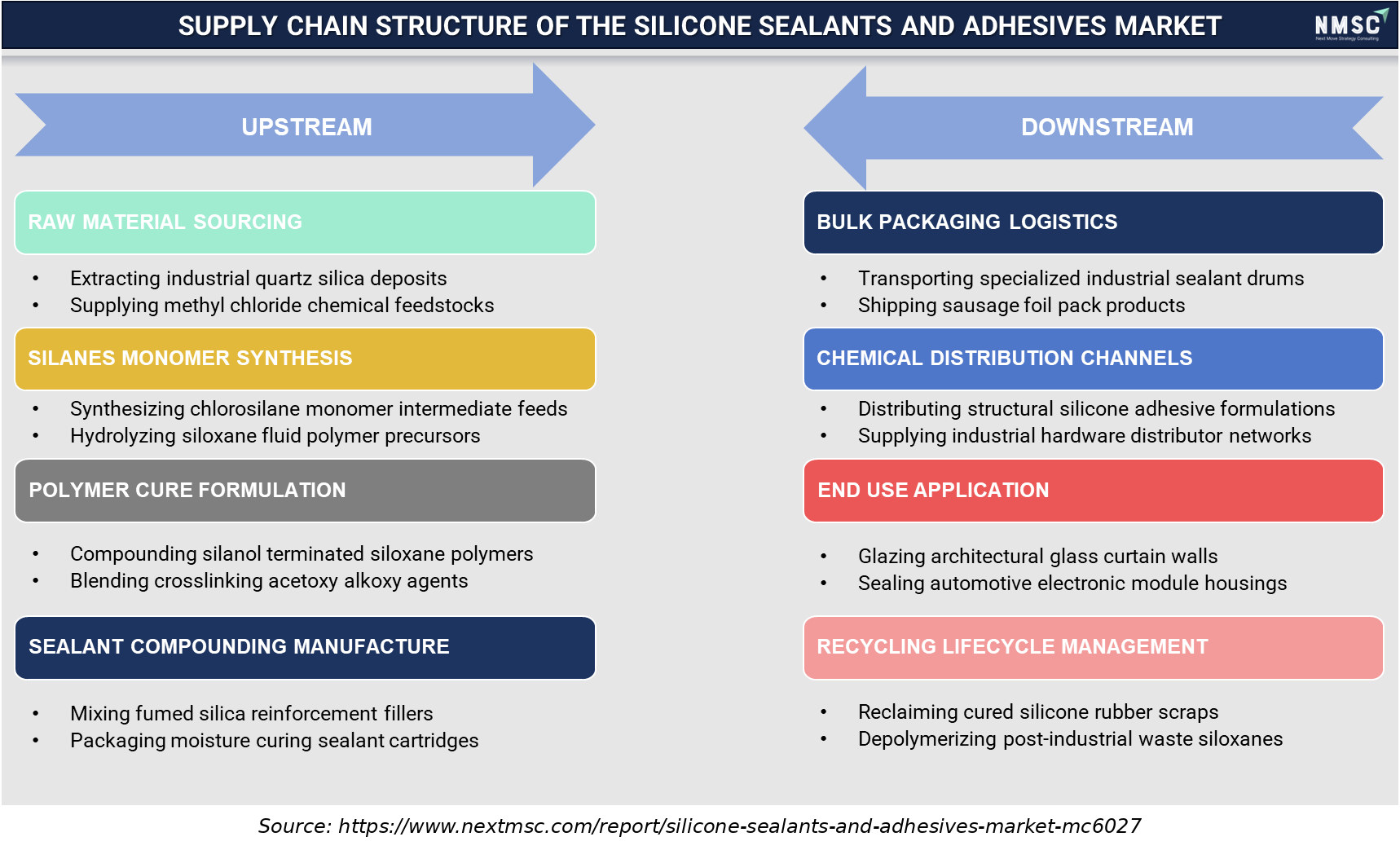
Supply Chain Structure of the Silicone Sealants and Adhesives Market

Market Drivers & Dynamics

Interactive Dataset
Green building codes mandating high-performance glazing sealants driver +1.4% North America, Europe 2026-2032
Electric vehicle production growth requiring thermal and electrical sealing driver +1.1% Asia Pacific, Europe 2026-2035
Infrastructure and mega-construction investment in Gulf states driver +0.8% Middle East and Africa 2026-2033
Rising semiconductor and data center construction activity driver +0.7% Asia Pacific, North America 2026-2035
Shift toward low-VOC and bio-based silicone formulations driver +0.5% Global 2026-2035
Volatile silicon metal and siloxane feedstock pricing restraint -0.6% Global 2026-2030
Evolving EU REACH restrictions and regulatory scrutiny of cyclic siloxanes D4, D5, and D6 restraint -0.5% Europe 2026-2028
Competition from silane-modified polymer sealants restraint -0.4% Asia Pacific, Europe 2026-2035
Source: Next Move Strategy Consulting

Growth Drivers

What is the primary growth driver for the Silicone Sealants and Adhesives market?

Building-envelope regulation is the leading growth driver, as energy-efficiency codes increasingly mandate airtight, high-performance glazing seals. We found that the U.S. Environmental Protection Agency enforces national volatile organic compound content limits for architectural sealants under 40 CFR Part 59, compelling manufacturers within the broader construction chemicals supply chain to reformulate toward compliant, low-emission chemistries. This regulatory push directly supports demand for silicone sealants market growth across renovation and new-construction channels alike.

How is electric vehicle production driving market growth?

Rising electric vehicle output is increasing per-vehicle silicone content as battery enclosures, power electronics, and control modules require simultaneous thermal management and dielectric sealing. NMSC's analysis indicates that automotive electronics gasketing represents one of the fastest-growing application pockets within the market, with tier-one suppliers standardizing rapid-cure silicone and silicone-hybrid systems to meet compressed production takt times across battery electric vehicle assembly lines globally.

Growth Inhibitors

What is restraining the Silicone Sealants and Adhesives market?

Feedstock cost volatility is the primary restraint, as silicon metal and siloxane monomer prices fluctuate with energy costs and polysilicon demand cycles. Elkem ASA announced a portfolio-wide silicone price increase of 10% to 30% across Europe and the Americas in April 2026, citing sustained inflation in raw materials, energy, and logistics. Such pricing pressure can compress downstream formulator margins and slow adoption among cost-sensitive industrial end users.

What Are the Growth Opportunities?

What opportunity does renewable energy infrastructure present?

Solar module lamination, wind turbine blade bonding, and battery energy storage enclosures require weatherable silicone adhesives capable of withstanding decades of thermal cycling. Suppliers serving renewable energy original equipment manufacturers can capture premium-priced, long-duration supply contracts as utility-scale solar and storage capacity additions accelerate across Asia Pacific and North America through the forecast period.

How does electronics miniaturization create opportunities for silicone encapsulants?

Shrinking form factors in smartphones, wearables, and power modules are increasing per-device silicone encapsulant volume even as overall unit footprints decline, benefiting formulators supplying thermally conductive and dielectric gel products. Electronics and electrical component manufacturers stand to benefit most, gaining reliability improvements that reduce field failure rates in compact, heat-dense assemblies.

What opportunity exists in retrofit and renovation construction?

Aging commercial building stock across North America and Europe requires re-sealing and re-glazing to meet updated energy codes, creating a recurring replacement-demand cycle independent of new construction starts. Facility owners and specialty sealant applicators are positioned to benefit as retrofit specifications increasingly favor long-life, low-maintenance silicone systems over shorter-lived organic alternatives requiring more frequent replacement.

Segmentation Analysis

2025 (USD Billion)
2035 (USD Billion)
Silicone Sealants 2025: $6.29 Billion | 2035: $11.22 Billion
Silicone Sea
Silicone Adhesives 2025: $3.58 Billion | 2035: $6.95 Billion
Silicone Adh
Silicone Adhesive Tapes and Films 2025: $0.98 Billion | 2035: $1.85 Billion
Silicone Adh
Silicone Sealants $6.29 Billion $11.22 Billion 6.0%
Silicone Adhesives $3.58 Billion $6.95 Billion 7.0%
Silicone Adhesive Tapes and Films $0.98 Billion $1.85 Billion 6.5%

Which product type dominates the Silicone Sealants and Adhesives market?

Silicone sealants dominate the product type axis, generating USD 6.29 billion in 2025 revenue on the strength of glazing, sanitary, and expansion-joint applications across construction. Silicone adhesives represent the fastest-growing product type at a 7.0% CAGR from 2026 to 2035, propelled by Bonding and Assembly demand in electric vehicle assembly and consumer electronics housings, where adhesive joints increasingly replace mechanical fasteners to reduce weight and improve sealing reliability.

2025 (USD Billion)
2035 (USD Billion)
Glazing and
Bonding and
Electrical I
Gasketing an
Others
Segment Item 2025 (USD Billion) 2035 (USD Billion) CAGR
Glazing and Weatherproofing $10.0 USD Billion $40.0 USD Billion 25.0%
Bonding and Assembly $17.1 USD Billion $51.1 USD Billion 11.0%
Electrical Insulation and Encapsulation $24.2 USD Billion $62.2 USD Billion 25.0%
Gasketing and Sealing $31.3 USD Billion $73.3 USD Billion 11.0%
Others $38.4 USD Billion $84.4 USD Billion 16.0%

Segment-wise data is locked

Unlock complete segment-wise numbers for By Application.

Unlock Full Data

Which application segment is expanding the fastest?

Glazing and weatherproofing remains the dominant application at USD 4.34 billion in 2025, reflecting silicone's role as the default sealing material for curtain wall and insulating glass systems. Electrical insulation and encapsulation is the fastest-growing application at a 7.9% CAGR, evidenced by rising silicone potting and conformal-coating demand from battery pack manufacturers and power electronics producers seeking dielectric protection alongside vibration and moisture resistance in compact enclosures.

2025 (USD Billion)
2035 (USD Billion)
Building and
Automotive a
Electronics
Industrial M
Aerospace an
Segment Item 2025 (USD Billion) 2035 (USD Billion) CAGR
Building and Construction $10.0 USD Billion $40.0 USD Billion 27.0%
Automotive and Transportation $17.1 USD Billion $51.1 USD Billion 9.0%
Electronics and Electrical $24.2 USD Billion $62.2 USD Billion 19.0%
Industrial Machinery $31.3 USD Billion $73.3 USD Billion 17.0%
Aerospace and Defense $38.4 USD Billion $84.4 USD Billion 18.0%

Segment-wise data is locked

Unlock complete segment-wise numbers for By End-Use Industry.

Unlock Full Data

Which end-use industry leads Silicone Sealants and Adhesives market demand?

Building and construction remains the leading end-use industry at USD 4.77 billion in 2025, supported by sustained global renovation and commercial glazing activity. Electronics and electrical is the fastest-growing end-use segment at a 7.8% CAGR, as silicone encapsulants and thermal interface adhesives become standard specifications for semiconductor packaging, 5G infrastructure, and consumer device assembly, where miniaturization increases the value of dielectric, moisture, and vibration protection per unit produced.

Growth Opportunities

Our analysis shows three concrete whitespace opportunities where suppliers can capture disproportionate share of incremental Silicone Sealants and Adhesives Market revenue through 2035.

What opportunity does renewable energy infrastructure present?

Solar module lamination, wind turbine blade bonding, and battery energy storage enclosures require weatherable silicone adhesives capable of withstanding decades of thermal cycling. Suppliers serving renewable energy original equipment manufacturers can capture premium-priced, long-duration supply contracts as utility-scale solar and storage capacity additions accelerate across Asia Pacific and North America through the forecast period.

How does electronics miniaturization create opportunities for silicone encapsulants?

Shrinking form factors in smartphones, wearables, and power modules are increasing per-device silicone encapsulant volume even as overall unit footprints decline, benefiting formulators supplying thermally conductive and dielectric gel products. Electronics and electrical component manufacturers stand to benefit most, gaining reliability improvements that reduce field failure rates in compact, heat-dense assemblies.

What opportunity exists in retrofit and renovation construction?

Aging commercial building stock across North America and Europe requires re-sealing and re-glazing to meet updated energy codes, creating a recurring replacement-demand cycle independent of new construction starts. Facility owners and specialty sealant applicators are positioned to benefit as retrofit specifications increasingly favor long-life, low-maintenance silicone systems over shorter-lived organic alternatives requiring more frequent replacement.

Ecosystem Analysis

Regional Outlook

2025 (USD Billion)
2035 (USD Billion)
Asia Pacific
North Americ
Europe
Latin Americ
Middle East
Region 2025 (USD Billion) 2035 (USD Billion) CAGR (%)
Asia Pacific $10.0 USD Billion $40.0 USD Billion 9.0%
North America $17.1 USD Billion $51.1 USD Billion 27.0%
Europe $24.2 USD Billion $62.2 USD Billion 25.0%
Latin America $31.3 USD Billion $73.3 USD Billion 23.0%
Middle East and Africa $38.4 USD Billion $84.4 USD Billion 12.0%

Regional data is locked

Unlock complete regional numbers for this market.

Unlock Full Data

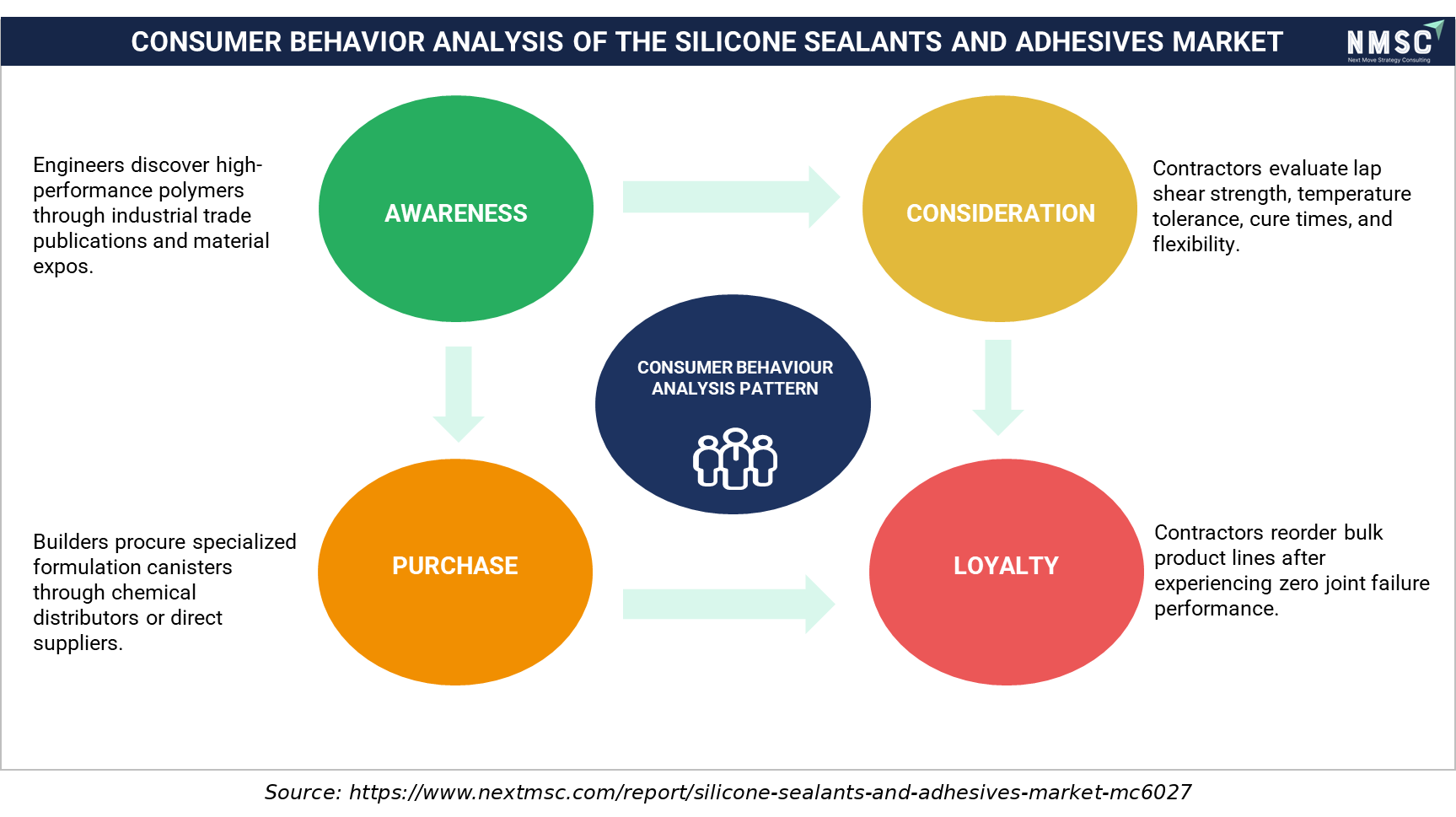
Consumer Behavior Analysis of the Silicone Sealants and Adhesives Industry

Consumer Behavior Analysis of the Silicone Sealants and Adhesives Industry

The above infographic presents a consumer behavior analysis of the silicone sealants and adhesives market, mapping the journey from awareness to loyalty. Engineers and builders discover high-performance formulations through trade publications and expos, leading contractors to evaluate lap shear strength, temperature tolerance, and cure times before purchasing through distributors or direct suppliers. Looking ahead, we observed that loyalty is reinforced by consistent performance and zero joint failure reliability, encouraging bulk reordering and long-term brand preference across the industry.

Competitive Landscape

We found that the Silicone Sealants and Adhesives Market Industry remains moderately consolidated, with a core group of vertically integrated chemical producers competing alongside specialty formulators serving niche aerospace and electronics applications.

Dimension Description
Market Structure Moderately consolidated; top producers hold upstream siloxane capacity, supporting scale advantages over non-integrated formulators
Innovation Focus Low-VOC, bio-based, and rapid-cure chemistries tailored to construction and automotive electronics applications
M&A Activity Portfolio realignment among diversified chemical groups, including divestiture processes for standalone silicones divisions

How do companies compete in the Silicone Sealants and Adhesives market?

Competition centers on formulation performance, regulatory compliance speed, and breadth of application-specific product lines rather than price alone. During our market evaluation, we noticed that vertically integrated producers with upstream siloxane and silicon metal capacity maintain cost advantages over formulators reliant on merchant feedstock purchases, particularly during periods of raw material price volatility affecting smaller regional competitors.

Which competitive archetypes dominate the Silicone Sealants and Adhesives market?

Two archetypes dominate: large diversified chemical groups offering full silicone value chains from monomer to finished sealant, and specialty formulators focused on high-margin aerospace, electronics, or medical-grade adhesives. The first archetype competes on scale and regulatory infrastructure, while the second competes on technical customization, and both have sustained profitable positions by avoiding direct commodity-grade price competition with each other.

How are companies pursuing innovation and differentiation?

Leading producers are differentiating through sustainability-certified product lines, rapid-cure automotive electronics chemistries, and digital dispensing integration. Our analysis shows that companies investing in bio-based and recycled feedstock capacity are positioning themselves to win specification battles with green building and automotive sustainability programs, creating a widening gap between early movers and formulators still reliant on conventional petrochemical-derived silicone inputs.

Key Market Players

Based on research conducted by NMSC, we identified twenty companies with verified design, production, or branding capability across the covered geography, ranked below by market-specific revenue and scale of operations.

Dow Inc. Wacker Chemie AG Shin-Etsu Chemical Co., Ltd. Momentive Performance Materials Inc. Henkel AG & Co. KGaA Sika AG H.B. Fuller Company 3M Company Arkema S.A. Elkem ASA Avery Dennison Corporation Nitto Denko Corporation Illinois Tool Works Inc. Huntsman Corporation CHT Group Soudal Group KCC Corporation Mapei S.p.A. Dongyue Group Limited Master Bond Inc.

Latest Developments

We observed a steady cadence of product launches and portfolio actions among leading producers over the past year, summarized below.

Date Event
June 2026 Master Bond launched MasterSil 981-LO, a two-component addition-cured silicone system for bonding, sealing, coating, and encapsulating applications. The product meets NASA low-outgassing specifications and features optical clarity, low modulus, high flexibility, and thermal shock resistance for aerospace, satellite, optical, and optoelectronic applications.
October 2025 Sika expanded and refreshed its construction sealants portfolio by launching the upgraded SikaSeal product range, featuring SikaSeal Construction Silicone, SikaSeal Construction Silicone+, and SikaSeal Construction Silicone Ultra. The low-modulus, fast-curing silicone sealants provide anti-fungal properties, waterproof protection, and expanded color selections for professional building and glazing applications.
September 2025 Henkel introduced a next-generation cardboard-based cartridge technology across its construction adhesives and sealants portfolio in Europe, starting with sanitary and multi-purpose silicone sealants. Featuring auto-opening top caps and recycled cardboard tubes, the sustainable packaging reduces non-recyclable plastic waste by at least 51 percent without compromising sealing performance.

Expert Insights

Christoph Ganz

Christoph Ganz

Regional Manager EMEA | Sika

"The acquisition of Akkim marks a major step in strengthening our position in the adhesives and sealants industry. Akkim’s strong growth platform, highly complementary product portfolio, and deep customer relationships offer significant growth opportunities and value creation. We look forward to welcoming the Akkim team into the Sika family and driving our joint success in the years ahead."

Analyst Interpretation

The statement highlights the accelerating demand for silicone-based materials across high-growth end-use industries, particularly electric vehicles, electronics, and data centers. As these sectors increasingly require high-performance bonding, sealing, thermal management, and electrical insulation solutions, demand for silicone sealants and adhesives is expected to rise. This trend supports continued innovation and adoption of specialty silicone formulations that offer enhanced durability, reliability, and performance in advanced industrial applications.

The statement highlights the accelerating demand for silicone-based materials across high-growth end-use industries, particularly electric vehicles, electronics, and data centers. As these sectors increasingly require high-performance bonding, sealing, thermal management, and electrical insulation solutions, demand for silicone sealants and adhesives is expected to rise. This trend supports continued innovation and adoption of specialty silicone formulations that offer enhanced durability, reliability, and performance in advanced industrial applications.

Investment Opportunities

Where are capital inflows concentrated in the Silicone Sealants and Adhesives market?

Capital is flowing toward capacity expansion in Asia Pacific, where domestic silicone producers are scaling polymerization and compounding assets to serve growing construction and electric vehicle demand. We found that vertically integrated producers with upstream silicon metal access are best positioned to attract expansion capital, given their reduced exposure to merchant feedstock price volatility relative to smaller formulators.

How is infrastructure investment shaping the market?

Public and private infrastructure spending, including Gulf Cooperation Council giga-projects and Asia Pacific transit and housing programs, is generating multi-year demand visibility for glazing and structural sealants. This investment pattern supports long-term supply agreements between silicone producers and construction conglomerates, providing revenue stability that underpins capacity investment decisions across the forecast period.

What ESG considerations affect investment decisions in this market?

Environmental, social, and governance criteria are increasingly embedded in silicone producer investment decisions, particularly around emissions from siloxane manufacturing and feedstock traceability. Elkem ASA's recycled silicone pilot facility in Saint Fons, France, illustrates how producers are directing capital toward lower-carbon process technology to meet customer and investor sustainability expectations, a pattern we expect to influence capital allocation industry-wide.

Key Benefits for Stakeholders

How does this report benefit building and construction industry leaders?

Construction executives gain segment-level revenue and CAGR data across product type, application, and end-use industry, enabling more precise specification and procurement planning. The report's regional and country-level forecasts support informed decisions on supplier partnerships and inventory planning across the 38 countries covered in this analysis.

How does this report benefit investors and financial analysts?

Investors and financial analysts gain access to consistent 2025 through 2035 market sizing, segment-level CAGR benchmarks, and a validated competitive landscape covering twenty companies, supporting more rigorous valuation and capital allocation analysis across the broader adhesives and sealants value chain.

How does this report benefit technology vendors and formulators?

Silicone formulators and equipment vendors gain visibility into fastest-growing application pockets, including electrical insulation and encapsulation, enabling more targeted research and development investment. Our findings suggest that this level of segmentation detail helps technology vendors prioritize product development toward the highest-growth end-use industries identified in this analysis.

Key Market Segments Evaluated

By Product Type

  • Silicone Sealants
  • Silicone Adhesives
  • Silicone Adhesive Tapes and Films

By Application

  • Glazing and Weatherproofing
  • Bonding and Assembly
  • Electrical Insulation and Encapsulation
  • Gasketing and Sealing
  • Others

By End-Use Industry

  • Building and Construction
  • Automotive and Transportation
  • Electronics and Electrical
  • Industrial Machinery
  • Aerospace and Defense
  • Others

Conclusion & Recommendations

The market is set to expand from USD 11.45 billion in 2026 to USD 20.02 billion by 2035, a trajectory supported by structural demand from construction renovation, electric vehicle electrification, and electronics miniaturization. We expect Asia Pacific to widen its revenue lead over the forecast period, while electronics-linked applications close the growth gap with traditional construction-led demand.

What strategic positioning should companies pursue?

Companies should pursue dual positioning across construction and electronics-automotive channels rather than relying on a single end-use industry, given the divergent but complementary growth rates identified across segments. Our assessment indicates that formulators investing in both low-VOC construction chemistries and rapid-cure electronics gasketing systems will be best positioned to capture cross-industry demand through 2035.

How attractive is the market for new investment?

Investment attractiveness is high in Asia Pacific and Middle East and Africa, where CAGRs of 7.2% and 7.6% respectively outpace the global 6.4% average. Capital directed toward regional capacity expansion and recycled feedstock capability is likely to generate above-average returns as construction and electronics demand scale simultaneously across these regions through the forecast period.

What are the key market shifts and risks to monitor?

Feedstock price volatility and tightening European regulatory restrictions on cyclic siloxanes represent the two most significant risks to monitor. NMSC's analysis indicates that companies unable to reformulate ahead of regulatory deadlines or absorb raw material price swings risk losing specification share to better-capitalized, vertically integrated competitors over the forecast period.

What are the primary growth pathways through 2035?

Primary growth pathways include capacity expansion in Asia Pacific, recycled and bio-based feedstock commercialization, and deeper penetration of automotive electronics gasketing applications. Companies that combine these three pathways are positioned to outperform the broader 6.4% market CAGR, capturing a disproportionate share of the USD 8.57 billion incremental revenue opportunity available between 2026 and 2035.

FAQs

About the Author

Mayurima Roy

Mayurima Roy

Mayurima Roy is Research Analyst at Next Move Strategy Consulting, where she has spent 4 years working across the firm's full industry coverage rather than a single fixed vertical. Her work centers on structured research, ongoing trend tracking, competitive assessment, and insight-led content development, translating complex market data into clear, decision-ready narratives that support informed client decision-making across diverse global industries, market sectors, and world regions every day.

About the Reviewer

Supradip Baul

Supradip Baul

Supradip Baul is an accomplished business consultant and strategist with over a decade of rich experience in market intelligence, strategy, technology, and business transformation. His work has included rigorous qualitative and quantitative analysis across multiple industries, helping clients shape investment decisions and long-term roadmaps. Earlier in his career, he was associated with Gartner, where he contributed to industry-leading reports and market share analyses. He has worked with leading global companies and holds an MBA with a dual specialization in Marketing and Finance.

Download Free Sample

Amos Chang

AMOS CHANG

Strategy Consultant

Kardex Group

I have bought the intralogistics market reports from NMSC two times so far. Joseph and his team are always very helpful and flexible in responding to any customization requirements on the report. Their expertise in market reports really helps us steer the day-to-day business. I will definitely recommend and come back myself whenever there is a need.

Melanie Samko

MELANIE SAMKO

Director of Marketing

TOSOH BIOSCIENCE, INC.

The information provided by NMSC is incredibly valuable, thank you so much for such a excellent work. I really appreciate it. I will make sure to reference all of it, in my summary document.

Robert Sean Trevino

ROBERT SEAN TREVINO

Sr. Director, Head of Strategic Insights & Analytics

Foundation Medicine

I realized that it was a reliable source of information. These days, there are many people who are looking for authentic data, and this is one of the only sources that can offer them with what they need;

Henri Knyphausen

HENRI KNYPHAUSEN

Partner at Singulier [Ex-BCG]

Singulier

I recently engaged NEXTMSC.com for a commercial due diligence project within the intralogistics sector, and I am pleased to provide a reference based on my experience. In utilizing NEXTMSC.com's services, I found their report to offer valuable insights into market dynamics and key industry players. The initial report provided a solid foundation for our analysis. However, as we were investigating a smaller target in the market, and I had specific customization requests requiring additional research. These requests included detailed information on product portfolios of various players and sub-market sizes, both inclusive and exclusive of certain product categories. NEXTMSC.com demonstrated commendable responsiveness and agility in accommodating these customization requests. Within a timeframe of 1-2 weeks, they delivered a revised report that met our specific needs. Furthermore, they were receptive to my follow-up inquiries, ensuring clarity and understanding of the data provided. The final deliverable significantly contributed to our due diligence efforts. One of NEXTMSC.com's notable strengths lies in their qualitative research capabilities. However, for future engagements, I would recommend the inclusion of a quantified market model in Excel format. Such a model would offer the ability to conduct in-depth analyses and explore various market segments, including country-specific data and subcomponent breakdowns. Based on my positive experience, I would not hesitate to work with NEXTMSC.com again. Their responsiveness, willingness to accommodate customization requests, and commitment to delivering actionable insights make them a reliable partner for commercial research projects.

Mohit Agarwal

MOHIT AGARWAL

Chief Manager

DryChem India Pvt. Ltd.

Next Move Strategy Consulting is an amazing team of consultants. We required a market study report for our investors on top priority and the team went above and beyond our expectations to deliver the same with ample supporting data within a short time span enabling us to secure the investments and keep our project timeline maintained. Their professionalism, attention to detail, and timely delivery of actionable recommendations have left a lasting impression on our organization.

Custom Market Research Services

We will customize the research for you if the listed report does not fully match your requirements.

Get 30% Free Customization

Select License

This website uses cookies to ensure you get the best experience on our website. Learn more

✖