Packaging Adhesives Market

Packaging Adhesives Market size was USD 11.20 Billion in 2025 and is projected to reach USD 20.05 Billion by 2035, growing at a 6.0% CAGR from 2026 to 2035.

Download Free Sample PDF
Base Year (2025)
$11.20 Billion
Forecast (2035)
$20.05 Billion
CAGR (2026-2035)
6.0%
Top Region
Asia-Pacific

What Is the Packaging Adhesives Market Size?

The global Packaging Adhesives Market size reached USD 11.20 Billion in 2025 and is estimated at USD 11.85 Billion in 2026, forecast to reach USD 20.05 Billion by 2035 at a CAGR of 6.0% between 2026 and 2035. Asia-Pacific leads with an approximate 40% share, while Water-Based Adhesives dominate the technology segment at approximately 42% share in 2025.
We observed that binding EU recyclability requirements are steadily converting formulation choices away from solvent-based systems toward water-based and reactive chemistries, a shift that is reinforcing steady, regulation-linked demand even as hot melt adhesives continue to scale fastest within flexible packaging applications.

Packaging Adhesives Market Revenue Forecast
Values in USD Billion

2025 $11.20 Billion
2025
2026 $11.87 Billion
2026
2027 $12.58 Billion
2027
2028 $13.34 Billion
2028
2029 $14.14 Billion
2029
2030 $14.99 Billion
2030
2031 $15.89 Billion
2031
2032 $16.84 Billion
2032
2033 $17.85 Billion
2033
2034 $18.92 Billion
2034
2035 $20.05 Billion
2035

Key Takeaways

By Technology: Water-Based Adhesives held the largest share, expanding from USD 4.70 billion in 2025 to USD 8.81 billion by 2035; Reactive Adhesives is the fastest-growing sub-segment at 8.16% CAGR from 2026–2035.

By Resin Type: Acrylic held the largest share, reflecting broad water-based and pressure-sensitive formulation use; Polyurethane is the fastest-growing sub-segment, driven by high-barrier laminate demand.

By Application: Flexible Packaging held the largest share, expanding from USD 3.80 billion in 2025 to USD 7.42 billion by 2035; Cartoning and Case Sealing is the fastest-growing sub-segment at 7.36% CAGR from 2026–2035.

By End-Use Industry: Food and Beverage held the largest share, expanding from USD 4.93 billion in 2025 to USD 8.22 billion by 2035; Industrial and E-Commerce is the fastest-growing sub-segment at 7.67% CAGR from 2026–2035.

Dominant Region: Asia-Pacific dominated with approximately 40% revenue share in 2025.

Fastest-Growing Region: Latin America is expected to register the highest CAGR of 7.57% during 2026–2035.

Dominant Country: China led the market, anchored by concentrated flexible packaging and food processing capacity.

Fastest-Growing Country: India is the fastest-growing country, supported by expanding packaged food and e-commerce volumes.

The market presents an absolute investment opportunity of approximately USD 8.20 Billion between 2026 and 2035, calculated as the difference between the 2035 forecast of USD 20.05 Billion and the 2026 base of USD 11.85 Billion, positioning water-based and reactive adhesive chemistries as a durable, regulation-linked investment category for specialty chemical producers.

According to NMSC analysis, the segment's resilience stems from binding EU recyclability targets that are compelling adhesive producers to reformulate around mono-material and de-inkable chemistries, converting regulatory compliance into a structural driver of premium-grade adhesive demand across flexible and label packaging.

What does the Packaging Adhesives Market Encompass?
The Packaging Adhesives Market covers water-based, solvent-based, hot melt, and reactive adhesive formulations used to bond flexible packaging laminates, corrugated and carton packaging, labels, and rigid packaging components across food, beverage, personal care, and pharmaceutical end uses. We observed that the market has evolved from solvent-based lamination systems into predominantly water-based and hot melt formulations as producers respond to volatile organic compound regulation and downstream recyclability requirements.
Our findings suggest that the EU's Packaging and Packaging Waste Regulation (EU) 2025/40, which entered into force in February 2025 and explicitly names adhesives as a factor affecting packaging recyclability classification, is structurally reshaping formulation strategy ahead of the regulation's 2030 recyclability thresholds. Technology adoption trends toward mono-material laminating adhesives and de-inkable label adhesives are further accelerating reformulation across converters supplying EU-facing brands.

Market Drivers & Dynamics

Interactive Dataset
EU Packaging and Packaging Waste Regulation recyclability targets driver +1.8% Europe 2026–2030
Rising flexible packaging and e-commerce case-sealing demand driver +1.6% Asia-Pacific, North America 2026–2035
Growth of packaged food and beverage consumption in emerging markets driver +1.4% Asia-Pacific, Latin America 2026–2035
Reformulation toward mono-material and de-inkable adhesives driver +0.9% Europe, North America 2026–2032
Expansion of high-barrier laminate demand for shelf-life extension driver +0.6% Global 2026–2033
Volatility in petrochemical feedstock and resin pricing restraint −0.9% Global 2026–2035
PFAS and VOC formulation restrictions raising compliance cost restraint −0.7% Europe, North America 2026–2030
Price competition from regional Asia-Pacific adhesive producers restraint −0.5% Asia-Pacific 2026–2035
Long qualification cycles for reformulated food-contact adhesives restraint −0.4% Global 2026–2031
Source: Next Move Strategy Consulting

Growth Drivers

What is the Primary Growth Driver in the Packaging Adhesives Market?

The primary growth driver is binding recyclability regulation under the EU Packaging and Packaging Waste Regulation (EU) 2025/40, which entered into force on February 11, 2025, and mandates that all packaging be recyclable by January 1, 2030, under recycling classes A through C. This regulation explicitly identifies adhesives as a factor determining packaging recyclability classification, directly compelling reformulation across converters and adhesive suppliers serving the EU market.

How is Rising Flexible Packaging Demand Driving the Packaging Adhesives Market Growth?
Our analysis shows that rising flexible packaging and e-commerce case-sealing volumes are directly driving adhesive demand, with Henkel's Adhesive Technologies business unit reporting sales of 5,416 million euros in the first half of 2025 alone. H.B. Fuller reported full-year net sales of approximately 3.47 billion U.S. dollars in fiscal 2025, evidencing sustained enterprise-scale demand across packaging, hygiene, and consumable adhesive applications despite a broader industrial demand slowdown.

Growth Inhibitors

What is Restraining the Packaging Adhesives Market?

We found that the primary restraint is volatility in petrochemical feedstock and resin pricing, which directly affects hot melt and solvent-based adhesive production costs and compresses producer margins during periods of raw material inflation. Industry-derived estimates suggest that long qualification cycles for reformulated food-contact adhesives, often extending 12 to 18 months per brand-owner approval, are also slowing the pace of mono-material reformulation relative to regulatory compliance deadlines.

What Are the Growth Opportunities?

Can Mono-Material Laminating Adhesives Unlock EU Compliance-Driven Demand?

Producers offering validated mono-material laminating adhesive systems can capture reformulation demand from converters racing to meet EU Packaging and Packaging Waste Regulation recyclability thresholds ahead of the 2030 deadline, benefiting the Reactive Adhesives and Flexible Packaging segments as brand owners lock in compliant supply chains early.

Does De-Inkable Label Adhesive Technology Create Value for Beverage Packaging?

Producers with proven de-inkable, water-based label adhesive chemistries can capture rising demand from beverage brand owners seeking PET bottle recycling compatibility, benefiting the Labels application segment as regulatory and retailer pressure pushes de-inkability from a premium feature toward a standard specification.

Can PFAS-Free Food Contact Adhesives Expand Share in Regulated Markets?

Producers that complete PFAS-free reformulation and documentation for food-contact adhesive grades ahead of competitors can capture preferential qualification with major food and beverage brand owners, benefiting the Food and Beverage end-use segment as regulatory scrutiny of food-contact chemical safety intensifies across Europe and North America.

Segmentation Analysis

2025 (USD Billion)
2035 (USD Billion)
Water-Based Adhesives 2025: $4.70 Billion | 2035: $8.81 Billion
Water-Based
Solvent-Based Adhesives 2025: $2.02 Billion | 2035: $2.41 Billion
Solvent-Base
Hot Melt Adhesives 2025: $3.36 Billion | 2035: $6.42 Billion
Hot Melt Adh
Reactive Adhesives 2025: $1.12 Billion | 2035: $2.41 Billion
Reactive Adh
Water-Based Adhesives $4.70 Billion $8.81 Billion 6.54%
Solvent-Based Adhesives $2.02 Billion $2.41 Billion 1.38%
Hot Melt Adhesives $3.36 Billion $6.42 Billion 6.80%
Reactive Adhesives $1.12 Billion $2.41 Billion 8.16%

Which Technology Segment Dominates the Packaging Adhesives Market?

Water-Based Adhesives lead with USD 4.70 Billion in 2025, expanding to USD 8.81 Billion by 2035, reflecting their established role in laminating and label applications favored for low VOC emissions and recyclability compatibility. Reactive Adhesives are the fastest-growing technology segment at an 8.16% CAGR, as high-barrier flexible packaging and mono-material laminate structures increasingly require the superior bond strength and chemical resistance that reactive polyurethane systems provide.

2025 (USD Billion)
2035 (USD Billion)
Flexible Pac
Corrugated a
Labels
Rigid Packag
Cartoning an
Segment Item 2025 (USD Billion) 2035 (USD Billion) CAGR
Flexible Packaging $10.0 USD Billion $40.0 USD Billion 25.0%
Corrugated and Carton Packaging $17.1 USD Billion $51.1 USD Billion 11.0%
Labels $24.2 USD Billion $62.2 USD Billion 25.0%
Rigid Packaging $31.3 USD Billion $73.3 USD Billion 11.0%
Cartoning and Case Sealing $38.4 USD Billion $84.4 USD Billion 16.0%

Segment-wise data is locked

Unlock complete segment-wise numbers for Flexible Packaging.

Unlock Full Data

Which Application Leads and Which Grows Fastest in the Packaging Adhesives Market?

Flexible Packaging dominates application demand at USD 3.80 Billion in 2025, growing to USD 7.42 Billion by 2035, underpinned by sustained laminate and pouch adoption across food and beverage packaging. Cartoning and Case Sealing is the fastest-growing application at a 7.36% CAGR, directly tied to rising e-commerce shipment volumes that require fast-setting hot melt adhesives on high-speed automated packaging lines.

2025 (USD Billion)
2035 (USD Billion)
Food and Bev
Personal Car
Pharmaceutic
Industrial a
Segment Item 2025 (USD Billion) 2035 (USD Billion) CAGR
Food and Beverage $10.0 USD Billion $40.0 USD Billion 27.0%
Personal Care and Household $17.1 USD Billion $51.1 USD Billion 9.0%
Pharmaceutical and Healthcare $24.2 USD Billion $62.2 USD Billion 19.0%
Industrial and E-Commerce $31.3 USD Billion $73.3 USD Billion 17.0%

Segment-wise data is locked

Unlock complete segment-wise numbers for Food and Beverage.

Unlock Full Data

Which End-Use Industry Dominates and Which is Fastest-Growing in the Packaging Adhesives Market?

Food and Beverage leads end-use demand at USD 4.93 Billion in 2025, supported by the sheer scale of flexible and rigid packaging volumes required across global food supply chains. Industrial and E-Commerce is the fastest-growing end-use industry at a 7.67% CAGR, reflecting sustained growth in parcel shipment volumes that require case-sealing and cartoning adhesives distinct from primary food-contact packaging applications.

Supply Chain Analysis of the Packaging Adhesives Industry

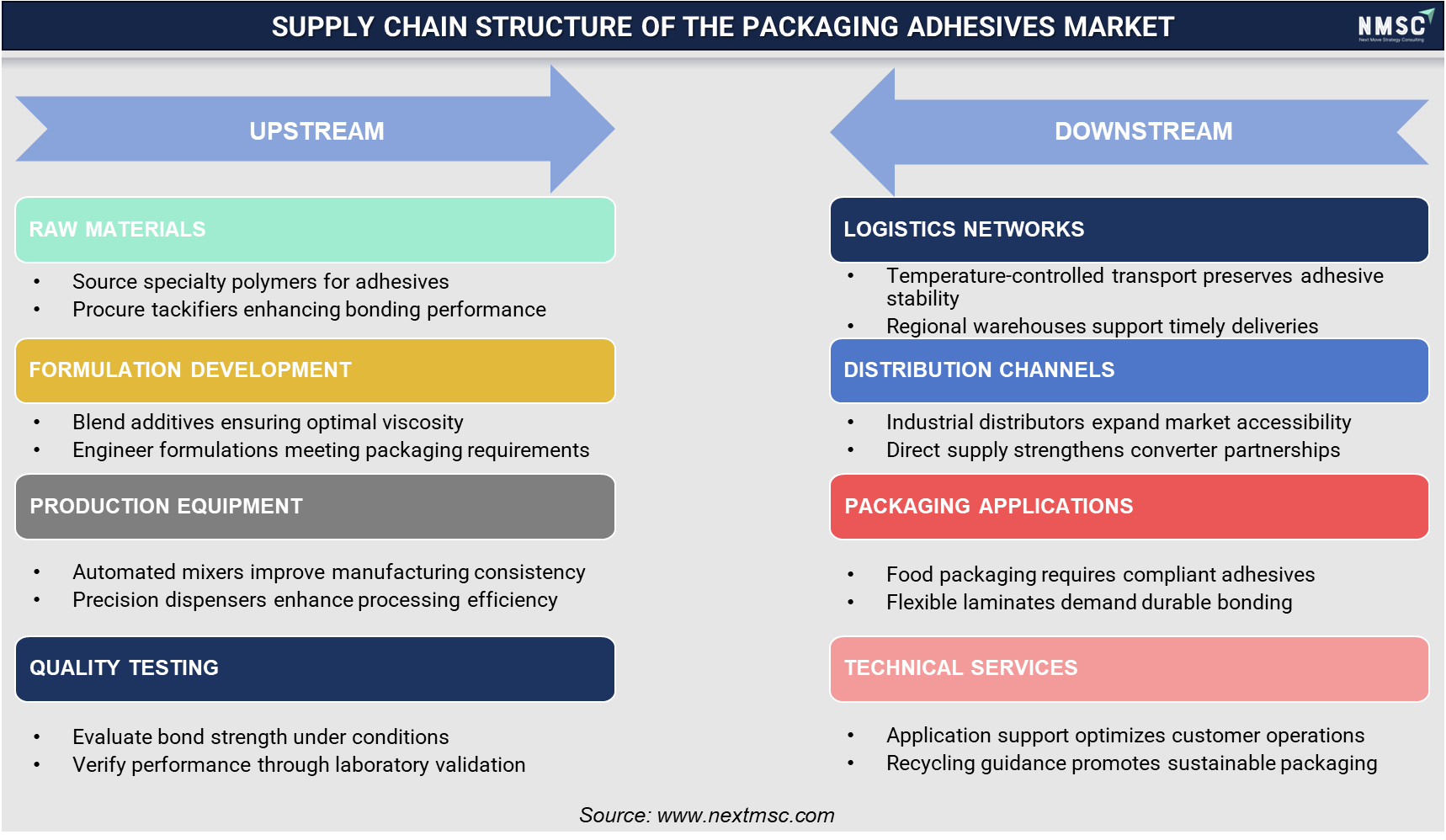
Supply Chain Analysis of the Packaging Adhesives Industry
The above infographic presents the supply chain structure of the packaging adhesives market, segmented into upstream and downstream activities. Upstream begins with sourcing specialty polymers and tackifiers, moving into formulation development and blending for optimal viscosity and performance. Automated mixers and dispensers improve production consistency, while quality testing validates bond strength and reliability. Moving downstream, temperature-controlled logistics and regional warehouses support distribution through industrial distributors and direct supply to packaging converters. End-use applications include food packaging and flexible laminates. Looking ahead, we observed that technical services, application support, and recycling guidance help optimize customer operations and promote sustainable packaging practices across the market.

Growth Opportunities

Our analysis shows that three whitespace opportunities stand out for producers positioning ahead of 2035 demand.

Can Mono-Material Laminating Adhesives Unlock EU Compliance-Driven Demand?

Producers offering validated mono-material laminating adhesive systems can capture reformulation demand from converters racing to meet EU Packaging and Packaging Waste Regulation recyclability thresholds ahead of the 2030 deadline, benefiting the Reactive Adhesives and Flexible Packaging segments as brand owners lock in compliant supply chains early.

Does De-Inkable Label Adhesive Technology Create Value for Beverage Packaging?

Producers with proven de-inkable, water-based label adhesive chemistries can capture rising demand from beverage brand owners seeking PET bottle recycling compatibility, benefiting the Labels application segment as regulatory and retailer pressure pushes de-inkability from a premium feature toward a standard specification.

Can PFAS-Free Food Contact Adhesives Expand Share in Regulated Markets?

Producers that complete PFAS-free reformulation and documentation for food-contact adhesive grades ahead of competitors can capture preferential qualification with major food and beverage brand owners, benefiting the Food and Beverage end-use segment as regulatory scrutiny of food-contact chemical safety intensifies across Europe and North America.

Regional Outlook

2025 (USD Billion)
2035 (USD Billion)
Asia-Pacific
North Americ
Europe
Latin Americ
Middle East
Region 2025 (USD Billion) 2035 (USD Billion) CAGR (%)
Asia-Pacific $10.0 USD Billion $40.0 USD Billion 9.0%
North America $17.1 USD Billion $51.1 USD Billion 27.0%
Europe $24.2 USD Billion $62.2 USD Billion 25.0%
Latin America $31.3 USD Billion $73.3 USD Billion 23.0%
Middle East & Africa $38.4 USD Billion $84.4 USD Billion 12.0%

Regional data is locked

Unlock complete regional numbers for this market.

Unlock Full Data

PESTEL Analysis of the Packaging Adhesives Industry

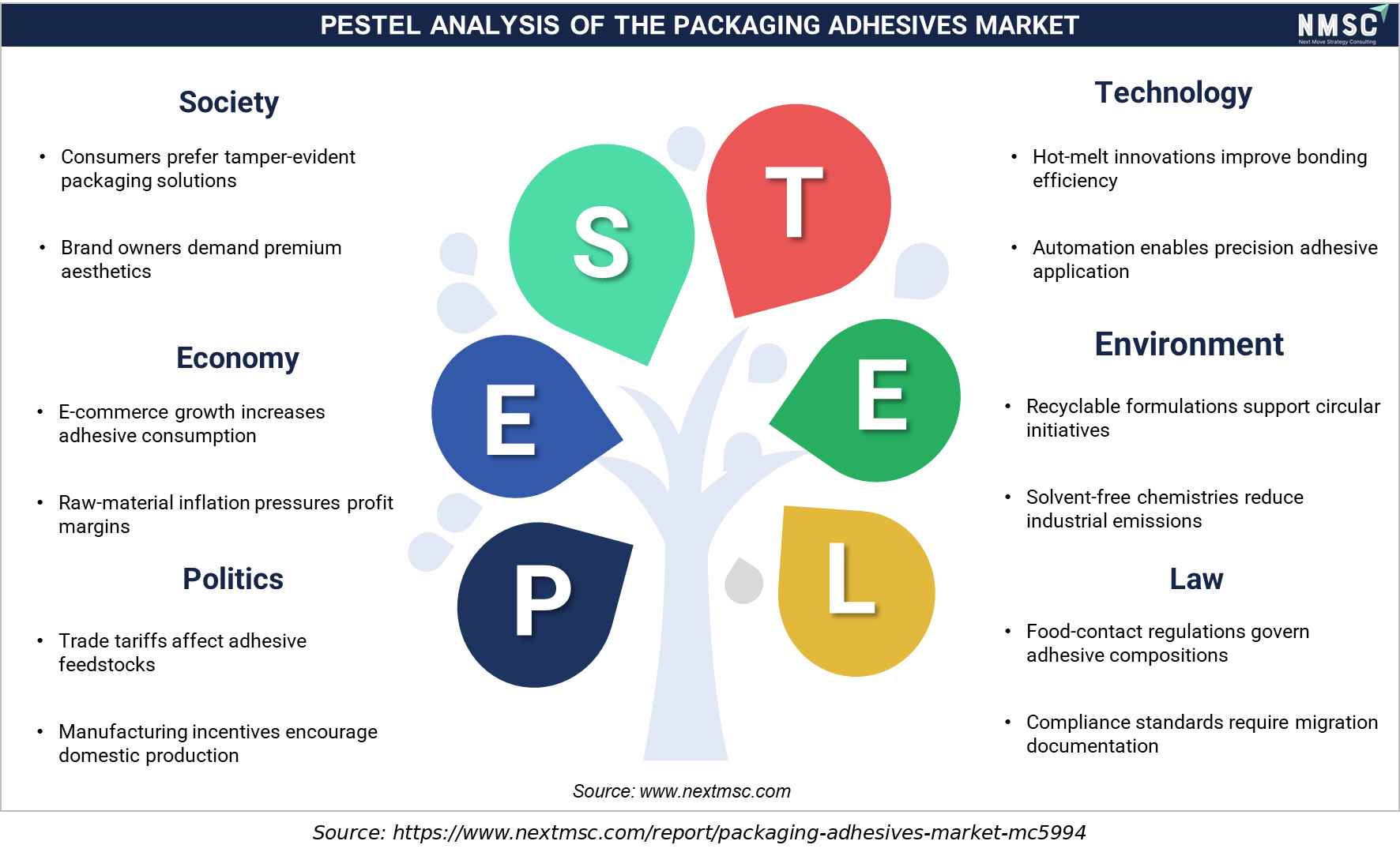
PESTEL Analysis of the Packaging Adhesives Industry
The above infographic presents a PESTEL analysis of the packaging adhesives market, where trade tariffs and manufacturing incentives are influencing raw material costs and domestic production. At the same time, raw material inflation is pressuring profit margins, while consumer demand for tamper-evident and premium packaging is shaping product development. Technological advancements such as hot-melt innovations are improving bonding efficiency, and solvent-free formulations are supporting environmental sustainability through recyclable solutions. All these developments are taking place within a legal framework of food-contact regulations and compliance standards that govern adhesive compositions and migration documentation. Looking ahead, we observed that these interconnected factors collectively shape the market's evolution across the packaging industry.

Competitive Landscape

Our assessment indicates that the competitive landscape spans diversified specialty chemical conglomerates, pure-play adhesive manufacturers, and regional resin producers, each competing on formulation breadth, regulatory compliance readiness, and converter technical service depth. Key Takeaways

Dimension Description
Dimension Assessment
Market Structure Moderately consolidated; top 10 companies hold the majority of Market Share, led by diversified specialty chemical producers and pure-play adhesive manufacturers
Innovation Focus Mono-material laminating adhesives, PFAS-free food-contact formulations, de-inkable label chemistries, and high-barrier reactive systems
M&A Activity Selective bolt-on acquisitions expanding specialty coating and tape capability rather than large-scale industry-wide consolidation

How Do Companies Compete in the Packaging Adhesives Market?

Companies compete primarily on formulation breadth across water-based, hot melt, and reactive chemistries, regulatory compliance readiness for EU recyclability requirements, and depth of technical service support for converter customers. Our findings suggest that vendors with established food-contact regulatory documentation hold a structural advantage over newer entrants, since qualification cycles for food-contact adhesives remain lengthy and brand owners favor suppliers with proven compliance track records.

Which Competitive Archetypes Dominate the Packaging Adhesives Market?

Diversified specialty chemical conglomerates such as Henkel AG & Co. KGaA and Arkema S.A. dominate through integrated resin, adhesive, and technical service platforms spanning multiple packaging applications, while pureplay manufacturers including H.B. Fuller Company differentiate through dedicated adhesive-only focus and converter relationship depth. Regional Asia-Pacific producers compete primarily on price within high-volume, price-sensitive flexible packaging segments.

What Innovation and Differentiation Strategies Are Companies Pursuing?

We observed that leading producers are investing in mono-material laminating adhesives and PFAS-free food-contact formulations to position ahead of EU Packaging and Packaging Waste Regulation compliance deadlines. Differentiation increasingly rests on documented sustainability performance and de-inkability credentials, since brand owners increasingly select adhesive suppliers based on recyclability compatibility rather than bond strength alone.

What M&A and Partnership Activity Is Shaping the Packaging Adhesives Market?

Recent activity favors targeted bolt-on acquisitions expanding specialty coating and tape capability, exemplified by Henkel's 2025 agreement to acquire ATP Adhesive Systems AG, a Swiss specialty tape producer with approximately 270 million euros in fiscal 2025 sales, and its February 2026 agreement to acquire Stahl Group. Our analysis shows that such deals let incumbents extend into adjacent specialty coating applications without the integration risk of large-scale industry consolidation.

Key Market Players

Based on research conducted by NMSC, the following companies represent the validated set of leading participants across water-based, solvent-based, hot melt, and reactive packaging adhesive formulation and manufacturing.

Henkel AG & Co. KGaA H.B. Fuller Company Arkema S.A. 3M Company Avery Dennison Corporation Dow Inc. Ashland Inc. Wacker Chemie AG Huntsman Corporation Mitsui Chemicals, Inc. DIC Corporation Sekisui Chemical Co., Ltd. Celanese Corporation Synthomer plc Jowat SE Sika AG Toyo Ink SC Holdings Co., Ltd. Paramelt B.V. Beardow Adams Group Nan Pao Resins Chemical Group

Latest Developments

We found that recent corporate activity reflects continued reformulation investment and targeted acquisitions even as the overall competitive landscape remains concentrated among established specialty chemical producers.

Date Event
April 2026 Henkel showcased sustainable packaging adhesive solutions at Interpack 2026, including TECHNOMELT SUPRA 130 COOL, which delivers a minimum 20% reduction in CO₂ emissions, and TECHNOMELT E-COM solutions for automated e-commerce packaging.

Expert Insights

Dr. Kathrin Hein

Dr. Kathrin Hein

Vice President Consumer Goods Adhesives EIMEA | Henkel

"“With solutions like Technomelt Supra 130 Cool, we demonstrate in a tangible way how we can further improve the sustainability performance of established products while maintaining consistently high quality.”"

Analyst Interpretation

The insight underscores the Packaging Adhesives Market's transition toward low-carbon, recycling-compatible adhesive technologies driven by tightening sustainability regulations and circular economy objectives. Manufacturers are increasingly developing packaging adhesives that reduce carbon emissions, utilize renewable raw materials, and enhance recyclability without compromising bonding performance. These innovations are expected to support compliance with regulations such as the EU Packaging and Packaging Waste Regulation (PPWR) while enabling brand owners and packaging converters to achieve their sustainability and operational efficiency goals.

Investment Opportunities

Where Are Capital Inflows Concentrating in the Packaging Adhesives Market?

Capital is concentrating in mono-material laminating adhesive development and specialty coating capability expansion, reflected in Henkel's 2025 and 2026 acquisitions of ATP Adhesive Systems and Stahl Group, together representing nearly one billion euros in combined acquired fiscal 2025 sales. This activity signals sustained capital allocation toward reformulation and adjacent specialty coating capability ahead of EU compliance deadlines.

How Is Infrastructure Investment Shaping Long-Term Capacity?

Our findings suggest that infrastructure investment is shifting toward regional manufacturing capacity expansion in Asia-Pacific, reflecting proximity to the fastest-growing flexible packaging and food processing demand base. This shift favors producers with existing local formulation and technical service infrastructure that can scale alongside rising converter capacity in China and India.

What ESG Considerations Are Influencing Investment Decisions?

Environmental, Social, and Governance considerations in this market center directly on packaging recyclability and PFAS-free formulation, given adhesives' explicit role in EU packaging recyclability classification. We found that investors increasingly favor producers demonstrating documented mono-material and de-inkable product portfolios as a proxy for durable, regulation-aligned growth ahead of 2030 compliance thresholds.

Key Benefits for Stakeholders

How Does This Report Benefit Industry Leaders?

Industry leaders gain segment-level revenue forecasts and CAGR benchmarks across technology, application, and end-use industry axes, enabling formulation-roadmap decisions grounded in the same 2025–2035 figures used consistently throughout this analysis. Our findings on regional growth differentials further support manufacturing-capacity and market-entry decisions.

How Does This Report Benefit Investors and Financial Analysts?

Investors and financial analysts gain a reconciled market-sizing model, competitive-landscape assessment, and named-company development tracking that supports valuation and capital-allocation decisions. The report's Growth Catalyst & Risk Assessment Matrix quantifies driver and restraint impact on CAGR, aiding scenario analysis for portfolio positioning.

How Does This Report Benefit Technology Vendors and Product Teams?

Technology vendors and product teams gain visibility into which technology and application segments, such as Reactive Adhesives and Cartoning and Case Sealing, are growing fastest, informing where to prioritize formulation research and go-to-market focus through 2035.

Key Market Segments Evaluated

By Technology

  • Water-based adhesives
  • Solvent-based adhesives
  • Hot melt adhesives
  • Reactive adhesives

By Resin Type

  • Acrylic
  • Polyurethane
  • Vinyl acetate ethylene
  • Rubber-based
  • Polyolefin

By Application

  • Flexible packaging
  • Corrugated and carton packaging
  • Labels
  • Rigid packaging
  • Cartoning and case sealing

By End-Use Industry

  • Food and beverage
  • Personal care and household
  • Pharmaceutical and healthcare
  • Industrial and e-commerce

By Region

  • North America 
    • U.S.
    • Canada
    • Mexico
  • Europe 
    • UK
    • Germany
    • France
    • Italy
    • Spain
    • Sweden
    • Denmark
    • Finland
    • Netherlands
    • Rest of Europe
  • Asia-Pacific 
    • China
    • India
    • Japan
    • South Korea
    • Taiwan
    • Indonesia
    • Vietnam
    • Australia
    • Philippines
    • Malaysia
    • Rest of APAC
  • Middle East & Africa 
    • Saudi Arabia
    • UAE
    • Egypt
    • Israel
    • Turkey
    • Nigeria
    • South Africa
    • Rest of MEA
  • Latin America 
    • Brazil
    • Argentina
    • Chile
    • Colombia
    • Rest of LATAM

Conclusion & Recommendations

The long-term outlook remains steadily positive, with the market expanding from USD 11.85 Billion in 2026 to USD 20.05 Billion by 2035 at a 6.0% CAGR, driven by EU recyclability regulation and rising flexible packaging demand. We observed that this growth trajectory is underpinned by durable regulatory and consumption-driven cycles rather than speculative adoption, supporting sustained formulation investment.

What Strategic Positioning Do We Recommend?

Our assessment indicates that producers should prioritize mono-material laminating adhesive development and PFAS-free food-contact reformulation to capture the fastest-growing Reactive Adhesives and Industrial and E-Commerce segments. Companies without established food-contact regulatory documentation should pursue accelerated qualification programs rather than delayed compliance given the market's clear shift toward recyclability-linked specification.

How Attractive Is the Market for Investment?

Investment attractiveness is high in Asia-Pacific and Latin America given superior CAGR profiles of 7.13% and 7.57% respectively, while Europe offers durable regulatory-driven reformulation demand tied to 2030 compliance deadlines. We found that reactive and water-based adhesive revenue streams offer stronger margin and growth profiles than mature solvent-based segments alone.

What Are the Key Market Shifts and Risks?

Key risks include petrochemical feedstock price volatility that directly affects hot melt and solvent-based production costs, alongside intensifying price competition from regional Asia-Pacific producers in high-volume flexible packaging segments. Our analysis shows that producers unable to complete PFAS-free reformulation ahead of regulatory deadlines risk losing qualification with major food and beverage brand owners.

What Are the Primary Growth Pathways Through 2035?

Primary growth pathways include mono-material laminating adhesive expansion, deeper PFAS-free food-contact formulation investment, and de-inkable label chemistry development serving beverage packaging recycling requirements. We observed that producers combining all three pathways are best positioned to capture a disproportionate share of the USD 8.20 Billion absolute opportunity created between 2026 and 2035.

FAQs

About the Author

Mayurima Roy

Mayurima Roy

Mayurima Roy is Research Analyst at Next Move Strategy Consulting, where she has spent 4 years working across the firm's full industry coverage rather than a single fixed vertical. Her work centers on structured research, ongoing trend tracking, competitive assessment, and insight-led content development, translating complex market data into clear, decision-ready narratives that support informed client decision-making across diverse global industries, market sectors, and world regions every day.

About the Reviewer

Supradip Baul

Supradip Baul

Supradip Baul is an accomplished business consultant and strategist with over a decade of rich experience in market intelligence, strategy, technology, and business transformation. His work has included rigorous qualitative and quantitative analysis across multiple industries, helping clients shape investment decisions and long-term roadmaps. Earlier in his career, he was associated with Gartner, where he contributed to industry-leading reports and market share analyses. He has worked with leading global companies and holds an MBA with a dual specialization in Marketing and Finance.

Download Free Sample

Kevin Coker

KEVIN COKER

Founder, CEO and Board Diector

Proxima Clinical Research

I have been using Next MSC reports for product positioning in a new geography for a long time. They have by far the best reports I have found and the price is reasonable too!

Diana Trejo

DIANA TREJO

Assistant Manager

Sumitomo Corporation de Mexico, S.A. de C.V.

Recently, we purchased a report on the Mexico Data Center Market from Next Move Strategy Consulting. The service has been excellent, with support that is always timely and thoroughly professional. The information provided is interesting, highly useful, and delivered with clarity. I would highly recommend NextMSC for anyone seeking insightful and dependable analysis.

Kishu Kanda

KISHU KANDA

Strategy Analyst

Accenture

We purchased the AI Consumer Market Report from this company. Not only did they customize the report to meet our specific requirements, but they also showed great flexibility in accommodating our budget. The report we received fully met our expectations. Additionally, they provided prompt and thorough responses to both our pre-purchase and follow-up questions. We look forward to working with this company again in the future.

Amos Chang

AMOS CHANG

Strategy Consultant

Kardex Group

I have bought the intralogistics market reports from NMSC two times so far. Joseph and his team are always very helpful and flexible in responding to any customization requirements on the report. Their expertise in market reports really helps us steer the day-to-day business. I will definitely recommend and come back myself whenever there is a need.

Gustaf Hummel Burstrom

GUSTAF HUMMEL BURSTROM

Founder

Revline Tools AB

Joseph and the team at Next Move Strategy Consulting have been excellent to work with, in supplying us with relevant market data and forecasts for our specific category. We had some special requirements and they were able to do a custom package to suit our needs. We would definitely recommend them to any other company needing market data and forecasts

Custom Market Research Services

We will customize the research for you if the listed report does not fully match your requirements.

Get 30% Free Customization

Select License

This website uses cookies to ensure you get the best experience on our website. Learn more

✖