Smart Elevator Market Global Industry Analysis and Forecast (2026–2035)

The global Smart Elevator Market size was valued at USD 18.50 billion in 2025 and is estimated at USD 20.30 billion in 2026, forecast to reach USD 45.60 billion by 2035, expanding at a 9.4% CAGR from 2026 to 2035. Key drivers include rising urbanization and high-rise construction activity and growing modernization demand across aging building stock, with Asia-Pacific leading the global market.

Download Free Sample PDF
Base Year (2025)
$18.50 Billion
Forecast (2035)
$45.60 Billion
CAGR (2026-2035)
9.4%
Top Region
Asia-Pacific

What Is the Smart Elevator Market Size?

The global smart elevator market size was valued at USD 18.50 billion in 2025 and is estimated at USD 20.30 billion in 2026, forecast to reach USD 45.60 billion by 2035, expanding at a 9.4% CAGR between 2026 and 2035. Asia-Pacific leads with approximately 41% share, while Control Systems dominate all other components with approximately 32% share.

We observed that the growth is broad-based across every segmentation axis, with expanding IoT connectivity and rising predictive maintenance adoption driving the dominant structural shifts through 2035.

Smart Elevator Market Global Industry Analysis and Forecast (2026–2035) Revenue Forecast

Values in USD Billion

2025 $18.50 Billion
2025
2026 $20.24 Billion
2026
2027 $22.14 Billion
2027
2028 $24.22 Billion
2028
2029 $26.50 Billion
2029
2030 $28.99 Billion
2030
2031 $31.72 Billion
2031
2032 $34.70 Billion
2032
2033 $37.96 Billion
2033
2034 $41.53 Billion
2034
2035 $45.60 Billion
2035

Key Takeaways

By Component: Control Systems held the largest share of approximately 32% (USD 5.92 billion) in 2025; Sensors and IoT Devices is the fastest-growing sub-segment at 12.77% CAGR from 2026–2035.

By Technology: Destination Control Systems held the largest share of approximately 34% (USD 6.29 billion) in 2025; Predictive Maintenance Technology is the fastest-growing sub-segment at 16.8% CAGR from 2026–2035.

By Service: Maintenance and Repair held the largest share of approximately 42% (USD 7.77 billion) in 2025; Monitoring and Predictive Analytics is the fastest-growing sub-segment at 17.33% CAGR from 2026–2035.

By Application: Commercial Buildings held the largest share of approximately 38% (USD 7.03 billion) in 2025; Transportation Hubs is the fastest-growing sub-segment at 13.97% CAGR from 2026–2035.

By Elevator Type: Traction Elevators held the largest share of approximately 54% (USD 9.99 billion) in 2025; Machine Room-Less Elevators is the fastest-growing sub-segment at 13.2% CAGR from 2026–2035.

By Speed: Medium Speed (1 to 2.5 m/s) held the largest share of approximately 46% (USD 8.51 billion) in 2025; Ultra-High Speed (Above 6 m/s) is the fastest-growing sub-segment at 15.6% CAGR from 2026–2035.

Dominant Region: Asia-Pacific dominated with approximately 41% revenue share (USD 7.58 billion) in 2025.

Fastest-Growing Region: North America is expected to register the highest CAGR of 10.7% during 2026–2035.

Dominant Country: China led with approximately USD 3.34 billion in 2025.

Fastest-Growing Country: U.S. is the fastest-growing country at approximately 11.2% CAGR from 2026–2035.

Market Opportunity: The smart elevator market is expected to create an absolute dollar opportunity of USD 25.30 billion between 2026 and 2035, presenting significant investment potential across the connected building and predictive maintenance value chain.

According to NMSC analysis, elevator manufacturers are increasingly monetizing recurring digital service subscriptions layered onto connected hardware, a shift that favors companies with large installed connected fleets over new entrants as building owners prioritize uptime guarantees and predictive maintenance contracts through 2035.

What Does the Smart Elevator Market Encompass?

The smart elevator market encompasses connected elevator hardware, control systems, sensors, and digital services that use IoT connectivity, cloud analytics, and artificial intelligence to optimize elevator performance, safety, and passenger experience. Our assessment indicates that the scope spans new installation, modernization, and maintenance services supplied to commercial, residential, institutional, industrial, transportation, and hospitality building owners seeking reduced downtime, improved energy efficiency, and enhanced passenger flow management across new and retrofitted vertical transportation systems worldwide.
Regulatory frameworks such as the American Society of Mechanical Engineers' A17.1 safety code and the European Committee for Standardization's EN 81 elevator standards shape design, installation, and inspection requirements across the industry, while national building codes increasingly reference energy efficiency and accessibility provisions relevant to smart elevator systems. We observed that technology adoption is shifting toward cloud-connected predictive maintenance platforms that reduce unplanned downtime and extend equipment service life. NMSC's analysis indicates that this structural shift, combined with expanding modernization demand across aging building stock, is redefining competitive positioning across the smart elevator market.

Market Drivers & Dynamics

Interactive Dataset
Rising urbanization and high-rise construction activity driver +2.6% Asia-Pacific, Middle East & Africa 2026-2035
Expanding IoT connectivity and cloud-based predictive maintenance adoption driver +2.1% Global 2026-2035
Growing modernization demand across aging building stock driver +1.7% North America, Europe 2026-2035
Increasing government energy efficiency and accessibility mandates driver +1.3% North America, Europe 2026-2032
Rising demand for touchless and voice-activated elevator controls driver +0.9% Global 2026-2032
Expanding transit and airport infrastructure investment driver +0.8% Asia-Pacific, Middle East & Africa 2026-2035
High upfront installation and retrofitting costs restraint -1.2% Global 2026-2035
Cybersecurity concerns over connected elevator control systems restraint -0.8% North America, Europe 2026-2032
Price competition from independent service providers on maintenance contracts restraint -0.6% Global 2026-2035
Source: Next Move Strategy Consulting

Growth Drivers

What Is the Primary Growth Driver of the Smart Elevator Market?

Rising urbanization and high-rise construction activity is the primary driver of the market. Government-backed housing and smart city programs continue to expand vertical construction pipelines in rapidly urbanizing economies, sustaining demand for elevator systems engineered for large-scale, high-density buildings. We observed that this construction momentum, combined with expanding IoT connectivity adoption, continues to anchor baseline demand for connected control systems and sensor packages across both new installations and modernization projects.

How Is Modernization Demand Driving Smart Elevator Market Growth?

Growing modernization demand across aging building stock is accelerating market growth as building owners upgrade conventional elevators with connected control and monitoring systems. We found that Otis Worldwide Corporation secured a government contract to modernize lifts for New South Wales Land and Housing Corporation in 2025, upgrading aging social housing infrastructure with improved safety and reliability. Our assessment indicates that this modernization pipeline, combined with tightening energy efficiency mandates, is compressing retrofit timelines across mature building markets.

Growth Inhibitors

What Is Restraining Smart Elevator Market Expansion?

High upfront installation and retrofitting costs restrain broader market expansion, as connected control systems, sensor packages, and cloud service integration add meaningful cost premiums over conventional elevator equipment. The U.S. Occupational Safety and Health Administration's elevator safety and inspection requirements add compliance costs that further increase total project expense for building owners. We found that these capital barriers, combined with price competition from independent service providers, are moderating near-term adoption among budget-constrained building owners outside premium commercial segments.

What Are the Growth Opportunities?

How Can Retrofit-Only Sensor Packages Unlock Value in Aging Buildings?

Retrofit-only sensor and connectivity packages present a whitespace opportunity for suppliers serving building owners unwilling to fund full elevator replacement. Companies that commercialize non-invasive IoT sensor add-ons compatible with legacy control systems stand to capture recurring monitoring subscription revenue from a much larger installed base than new equipment sales alone could reach.

Where Does Transit Infrastructure Investment Create New Demand?

Airport and metro rail expansion programs represent an underpenetrated opportunity for suppliers of high-capacity, high-reliability elevator systems engineered for continuous public use. Manufacturers that secure long-term transit authority service contracts can benefit from multi-decade maintenance revenue tied to critical infrastructure that cannot tolerate extended downtime.

How Can Independent Service Provider Partnerships Benefit Component Suppliers?

Independent service providers seeking access to proprietary diagnostic data create an opportunity for component suppliers offering open, interoperable IoT platforms. Suppliers that license sensor and connectivity technology to third-party maintenance firms can expand addressable revenue beyond original equipment manufacturer service contracts, particularly in markets where independent servicers hold significant installed base share.

Segmentation Analysis

2025 (USD Billion)
2035 (USD Billion)
Control Systems 2025: $5.92 Billion | 2035: $13.22 Billion
Control Syst
Communication Systems 2025: $4.07 Billion | 2035: $8.66 Billion
Communicatio
Sensors and IoT Devices 2025: $2.96 Billion | 2035: $9.58 Billion
Sensors and
Safety and Security Systems 2025: $2.59 Billion | 2035: $5.93 Billion
Safety and S
Display and Interface Units 2025: $1.67 Billion | 2035: $4.56 Billion
Display and
Power and Drive Systems 2025: $1.30 Billion | 2035: $3.65 Billion
Power and Dr
Control Systems $5.92 Billion $13.22 Billion 8.23%
Communication Systems $4.07 Billion $8.66 Billion 7.65%
Sensors and IoT Devices $2.96 Billion $9.58 Billion 12.77%
Safety and Security Systems $2.59 Billion $5.93 Billion 8.51%
Display and Interface Units $1.67 Billion $4.56 Billion 10.70%
Power and Drive Systems $1.30 Billion $3.65 Billion 11.04%

Which Component Dominates the Smart Elevator Market?

Control Systems led the market with USD 5.92 billion in 2025, supported by their central role in coordinating elevator dispatch, safety interlocks, and building management system integration across every installed unit. We observed that Sensors and IoT Devices are the fastest-growing component, expanding at a 12.77% CAGR from 2026 to 2035, as building owners increasingly retrofit existing elevators with connected sensor packages to enable predictive maintenance without full system replacement.

2025 (USD Billion)
2035 (USD Billion)
Machine Room
Destination
Predictive M
Regenerative
Touchless an
Segment Item 2025 (USD Billion) 2035 (USD Billion) CAGR
Machine Room-Less Technology $10.0 USD Billion $40.0 USD Billion 16.0%
Destination Control Systems $17.1 USD Billion $51.1 USD Billion 22.0%
Predictive Maintenance Technology $24.2 USD Billion $62.2 USD Billion 16.0%
Regenerative Drive Technology $31.3 USD Billion $73.3 USD Billion 26.0%
Touchless and Voice-Activated Controls $38.4 USD Billion $84.4 USD Billion 25.0%

Segment-wise data is locked

Unlock complete segment-wise numbers for By Technology.

Unlock Full Data
2025 (USD Billion)
2035 (USD Billion)
New Installa
Modernizatio
Maintenance
Monitoring a
Segment Item 2025 (USD Billion) 2035 (USD Billion) CAGR
New Installation $10.0 USD Billion $40.0 USD Billion 21.0%
Modernization and Retrofitting $17.1 USD Billion $51.1 USD Billion 11.0%
Maintenance and Repair $24.2 USD Billion $62.2 USD Billion 21.0%
Monitoring and Predictive Analytics $31.3 USD Billion $73.3 USD Billion 15.0%

Segment-wise data is locked

Unlock complete segment-wise numbers for By Service.

Unlock Full Data

Which Service Segment Leads Smart Elevator Market Demand?

Maintenance and Repair remained the leading service segment, valued at USD 7.77 billion in 2025, reflecting the elevator industry's long-established reliance on recurring service contracts as the primary revenue base for installed equipment fleets. Our findings suggest that Monitoring and Predictive Analytics is the fastest-growing service, registering a 17.33% CAGR from 2026 to 2035, as building owners increasingly subscribe to cloud-based fleet monitoring platforms that identify faults before they cause service disruptions.

2025 (USD Billion)
2035 (USD Billion)
Commercial B
Office Build
Retail and S
Residential
High-Rise Ap
Segment Item 2025 (USD Billion) 2035 (USD Billion) CAGR
Commercial Buildings $10.0 USD Billion $40.0 USD Billion 18.0%
Office Buildings $17.1 USD Billion $51.1 USD Billion 16.0%
Retail and Shopping Centers $24.2 USD Billion $62.2 USD Billion 22.0%
Residential Buildings $31.3 USD Billion $73.3 USD Billion 12.0%
High-Rise Apartments $38.4 USD Billion $84.4 USD Billion 19.0%

Segment-wise data is locked

Unlock complete segment-wise numbers for By Application.

Unlock Full Data

Which Application Segment Is the Fastest-Growing in the Smart Elevator Market?

Commercial Buildings remained the largest application, valued at USD 7.03 billion in 2025, reflecting sustained office, retail, and mixed-use construction activity across major metropolitan markets. Based on research conducted by NMSC, we found that Transportation Hubs represent the fastest-growing application at a 13.97% CAGR from 2026 to 2035, driven by expanding airport and metro rail infrastructure investment requiring high-capacity, high-reliability vertical transportation systems.

2025 (USD Billion)
2035 (USD Billion)
Traction Ele
Hydraulic El
Machine Room
Pneumatic Va
Segment Item 2025 (USD Billion) 2035 (USD Billion) CAGR
Traction Elevators $10.0 USD Billion $40.0 USD Billion 20.0%
Hydraulic Elevators $17.1 USD Billion $51.1 USD Billion 14.0%
Machine Room-Less Elevators $24.2 USD Billion $62.2 USD Billion 12.0%
Pneumatic Vacuum Elevators $31.3 USD Billion $73.3 USD Billion 10.0%

Segment-wise data is locked

Unlock complete segment-wise numbers for By Elevator Type.

Unlock Full Data
2025 (USD Billion)
2035 (USD Billion)
Low Speed (B
Medium Speed
High Speed (
Ultra-High S
Segment Item 2025 (USD Billion) 2035 (USD Billion) CAGR
Low Speed (Below 1 m/s) $10.0 USD Billion $40.0 USD Billion 20.0%
Medium Speed (1 to 2.5 m/s) $17.1 USD Billion $51.1 USD Billion 14.0%
High Speed (2.5 to 6 m/s) $24.2 USD Billion $62.2 USD Billion 24.0%
Ultra-High Speed (Above 6 m/s) $31.3 USD Billion $73.3 USD Billion 26.0%

Segment-wise data is locked

Unlock complete segment-wise numbers for By Speed.

Unlock Full Data

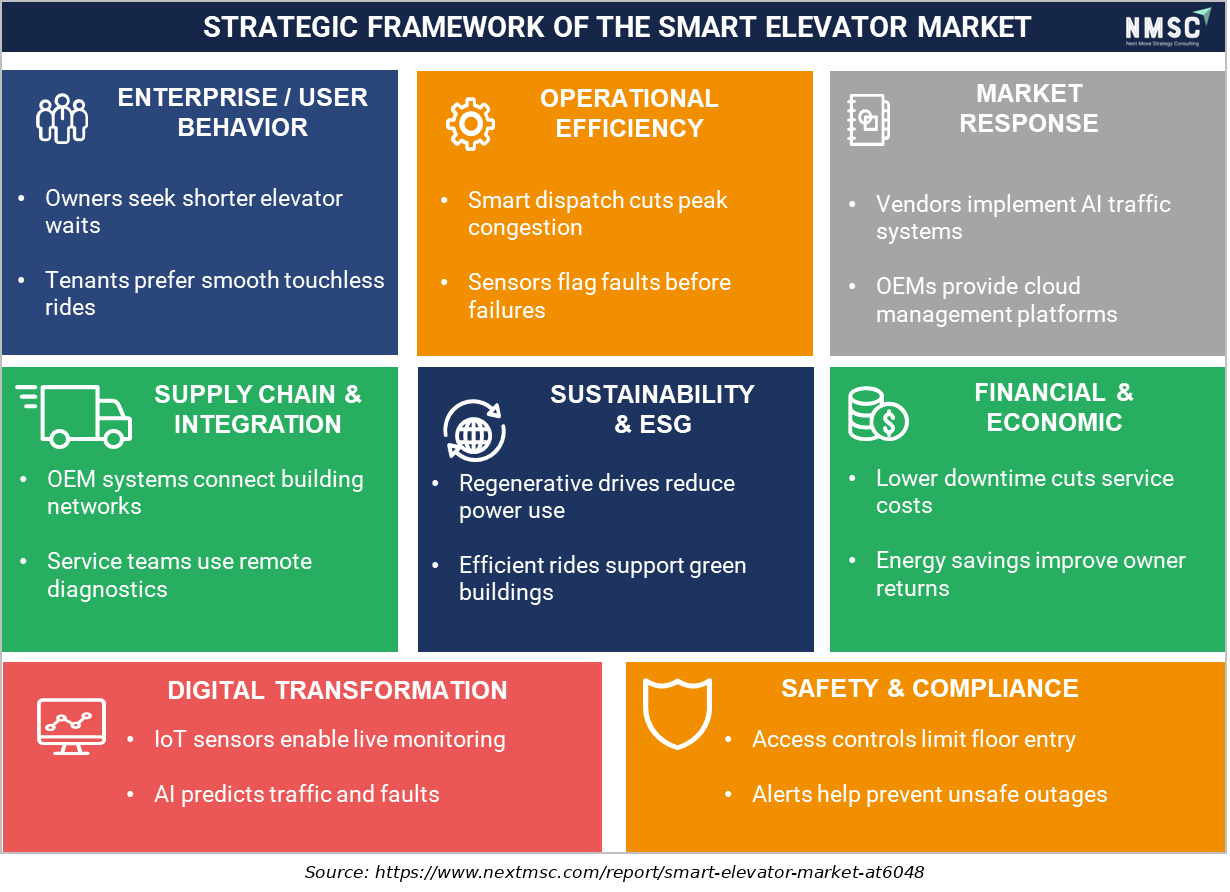
Strategic Framework of the Smart Elevator Market

Strategic Framework of the Smart Elevator Market
The smart elevator market is shaped by evolving user expectations, operational efficiency, digital transformation, sustainability, safety, and economic considerations. Building owners increasingly adopt smart dispatch, IoT monitoring, AI-based predictive maintenance, remote diagnostics, and access controls to reduce waiting times, downtime, energy consumption, and service costs while improving passenger experience and supporting connected, energy-efficient buildings.

Growth Opportunities

Our analysis shows that three forward-looking opportunities stand out for stakeholders positioning within the smart elevator market over the 2026–2035 forecast period.

How Can Retrofit-Only Sensor Packages Unlock Value in Aging Buildings?

Retrofit-only sensor and connectivity packages present a whitespace opportunity for suppliers serving building owners unwilling to fund full elevator replacement. Companies that commercialize non-invasive IoT sensor add-ons compatible with legacy control systems stand to capture recurring monitoring subscription revenue from a much larger installed base than new equipment sales alone could reach.

Where Does Transit Infrastructure Investment Create New Demand?

Airport and metro rail expansion programs represent an underpenetrated opportunity for suppliers of high-capacity, high-reliability elevator systems engineered for continuous public use. Manufacturers that secure long-term transit authority service contracts can benefit from multi-decade maintenance revenue tied to critical infrastructure that cannot tolerate extended downtime.

How Can Independent Service Provider Partnerships Benefit Component Suppliers?

Independent service providers seeking access to proprietary diagnostic data create an opportunity for component suppliers offering open, interoperable IoT platforms. Suppliers that license sensor and connectivity technology to third-party maintenance firms can expand addressable revenue beyond original equipment manufacturer service contracts, particularly in markets where independent servicers hold significant installed base share.

Regional Outlook

2025 (USD Billion)
2035 (USD Billion)
Asia-Pacific
North Americ
Europe
Middle East
Latin Americ
Region 2025 (USD Billion) 2035 (USD Billion) CAGR (%)
Asia-Pacific $10.0 USD Billion $40.0 USD Billion 9.0%
North America $17.1 USD Billion $51.1 USD Billion 27.0%
Europe $24.2 USD Billion $62.2 USD Billion 25.0%
Middle East & Africa $31.3 USD Billion $73.3 USD Billion 23.0%
Latin America $38.4 USD Billion $84.4 USD Billion 12.0%

Regional data is locked

Unlock complete regional numbers for this market.

Unlock Full Data

Competitive Landscape

Our analysis shows that the competitive landscape is consolidating around manufacturers with large connected installed fleets that monetize recurring digital service subscriptions across the industry.

Dimension Description
Dimension Assessment
Market Structure The market remains moderately concentrated, with the top 6 manufacturers accounting for an estimated 63% of 2025 revenue amid continued regional entry from domestic Asian manufacturers.
Innovation Focus Innovation centers on AI-driven predictive maintenance platforms, generative AI field service tools, and energy-efficient regenerative drive and machine room-less elevator designs.
M&A Activity Joint venture and capacity expansion activity continues to reshape competitive positioning, exemplified by TK Elevator's 2025 joint venture with Alat to manufacture elevators in Saudi Arabia.

How Do Companies Compete in the Smart Elevator Market?

Companies compete primarily on connected fleet scale, predictive maintenance accuracy, and breadth of digital service subscription offerings layered onto installed equipment. We observed that manufacturers with larger connected fleets can train more accurate predictive maintenance algorithms, creating a data-driven advantage that is difficult for smaller competitors and independent service providers to replicate quickly.

Which Competitive Archetypes Dominate the Smart Elevator Market?

Two prominent competitive archetypes characterize the market: global full-service manufacturers such as Otis Worldwide, KONE, and Schindler that combine proprietary hardware with large-scale connected service platforms; and regional manufacturers such as Canny Elevator, SJEC, and Johnson Lifts that compete on cost efficiency and localized manufacturing within specific geographies. Our assessment indicates that global manufacturers are extending their digital service advantage through generative AI investment, widening the gap with regionally focused competitors.

How Are Companies Differentiating Through Innovation?

Manufacturers are differentiating through cloud-based predictive maintenance platforms, generative AI field service tools, and energy-efficient drive systems engineered for high-rise and supertall buildings. We found that KONE Corporation's AWS-powered Technician Assistant and Otis Worldwide Corporation's Otis ONE IoT platform exemplify two distinct approaches to the same goal of reducing unplanned downtime across connected fleets. Continued investment in machine learning-based fault prediction is expected to remain the primary innovation battleground through 2035.

What M&A and Geographic Expansion Activity Is Shaping the Market?

Joint venture and capacity expansion activity is consolidating manufacturing footprint in high-growth construction markets, with TK Elevator's joint venture with Alat to manufacture elevators and escalators in Saudi Arabia exemplifying the trend toward localized production. Geographic expansion is concentrated in the Middle East and Asia-Pacific, where manufacturers are establishing regional manufacturing and service centers to support growing smart city and high-rise construction pipelines.

Key Market Players

Our assessment identifies the following companies, ranked by market-specific revenue and scale of operations, as the leading participants shaping the smart elevator market through 2026.

KONE Corporation Schindler Holding Ltd. TK Elevator Holdco GmbH Mitsubishi Electric Corporation Hitachi, Ltd. Hyundai Elevator Co., Ltd. Fujitec Co., Ltd. Toshiba Elevator and Building Systems Corporation Canny Elevator Co., Ltd. SJEC Corporation Orona S. Coop. Wittur Holding GmbH Express Lifts Ltd. Electra Elevator Ltd. EITA Elevator (M) Sdn. Bhd. Motion Control Engineering, Inc. Kleemann Hellas S.A. Sigma Elevator Company Johnson Lifts Private Limited

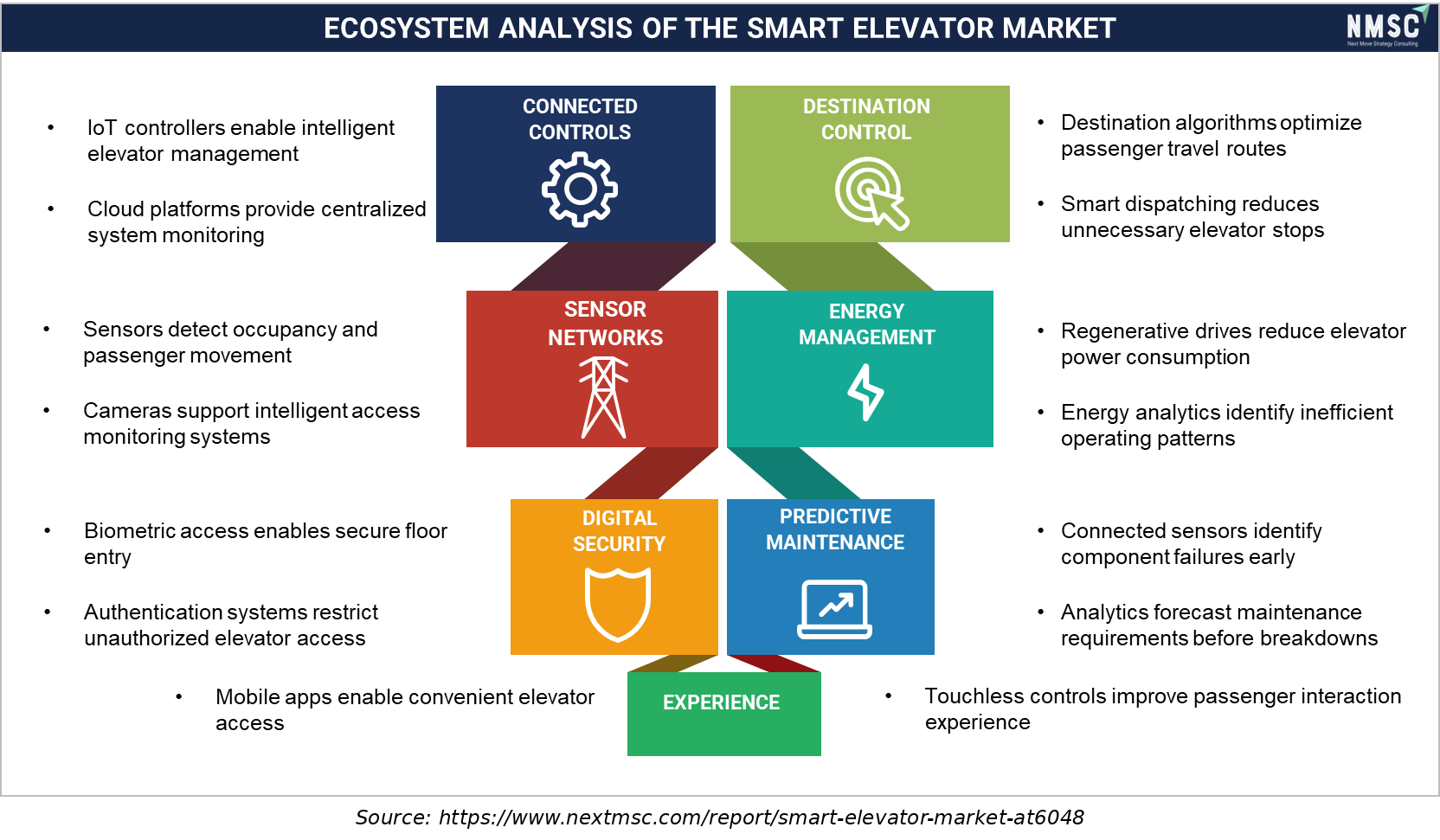
Ecosystem Analysis of the Smart Elevator Market

The smart elevator market ecosystem integrates connected controls, destination control systems, sensor networks, energy management, digital security, predictive maintenance, and user experience technologies. These interconnected components enable intelligent traffic management, real-time monitoring, energy optimization, and proactive servicing. Their integration supports more efficient elevator operations while improving passenger convenience, system reliability, security, and overall building performance.

Latest Developments

We observed the following verified developments shaping competitive positioning across the smart elevator market.

Date Event
August 2026 KONE’s Technician Assistant uses generative AI to help field technicians troubleshoot elevator faults, interpret equipment information and identify likely causes faster. The tool is designed to reduce downtime and support increasingly predictive maintenance by combining technician knowledge with connected elevator data and AI-based recommendations.
March 2026 TK Elevator launched HELIX as a new member of its Dynamic High-Rise portfolio. The platform combines cloud connectivity, integrated AI, open API integration with building-management systems and AGILE AI-driven destination dispatching, enabling adaptive traffic management, digital updates and more connected high-rise operations.
January 2026 KONE and Amazon Web Services extended their strategic collaboration for seven years to accelerate AI-powered digital innovation. The partnership is designed to advance cloud-based building intelligence, safety, efficiency and user experiences, supporting KONE’s connected-elevator ecosystem and its broader strategy for digitally enabled services.

Expert Insights

Hyun Shin Cho

Head of Digital Transformation | TK Elevator

"Digitally connected devices are already a critical part of every person’s daily life, and that type of user-friendly experience now applies to the elevators and escalators they rely on to safely transport them throughout buildings."

Analyst Interpretation

The statement reflects the transition of elevators from standalone mechanical transportation equipment toward connected digital building systems. Smartphone interfaces, cloud connectivity, predictive maintenance, and digital communication are expanding the functional scope of smart elevators beyond movement control. This is increasing demand for IoT-enabled controllers, communication systems, sensors, cloud platforms, predictive analytics, and digital passenger-experience technologies.

Investment Opportunities

How Are Capital Inflows Shaping the Smart Elevator Market?

Capital continues to flow into connected service platform development and regional manufacturing capacity, with TK Elevator's disclosed USD 185.3 million joint venture in Saudi Arabia reflecting broader industry investment in high-growth construction markets. We observed that investors appear to favor manufacturers demonstrating growing connected fleet penetration and recurring service revenue, viewing digital service attachment rates as a key indicator of long-term margin durability.

What Infrastructure Investment Is Required to Scale Smart Elevator Market Coverage?

Scaling smart elevator market coverage requires sustained investment in cloud computing infrastructure, IoT sensor manufacturing, and regional service and training centers to support growing connected fleets. Our findings suggest that manufacturers pursuing generative AI-based field service tools increasingly require substantial data infrastructure investment to train and maintain accurate predictive maintenance algorithms across geographically dispersed equipment installations.

What ESG Considerations Are Relevant to Smart Elevator Market Investment?

Environmental, Social, and Governance considerations center on energy consumption reduction through regenerative drive technology, extended equipment service life through predictive maintenance, and accessibility compliance for elevator systems serving the public. We observed that energy efficiency performance is becoming a differentiating governance factor for building technology investors, particularly as regenerative drive systems can meaningfully reduce building-level energy consumption. Social considerations also extend to passenger safety outcomes supported by predictive fault detection.

Key Benefits for Stakeholders

How Does This Report Benefit Building Technology Industry Leaders?

Building technology industry leaders gain a structured view of component, service, and application segmentation across competing smart elevator providers. Our analysis shows that benchmarking data on technology adoption and regional regulatory requirements supports more informed product development and go-to-market decisions aligned with building owner demand, while country-level insights help companies anticipate modernization and new construction opportunities across major markets.

How Does This Report Benefit Investors and Financial Analysts?

Investors and financial analysts gain access to segmentation-level revenue forecasts, competitive positioning analysis, and identified whitespace opportunities across the smart elevator market. We found that the report's regional and country-level growth projections support portfolio allocation decisions, while the competitive landscape section clarifies which archetypes are best positioned to capture long-term modernization and service contract revenue through 2035.

How Does This Report Benefit Technology Vendors and Product Teams?

Technology vendors and product teams gain visibility into segmentation trends, emerging application demand, and regional regulatory drivers that inform product roadmap prioritization. Our findings suggest that granular data on component, technology, and speed segment demand helps engineering teams align development investment with the fastest-growing sub-segments, particularly IoT sensor packages and predictive analytics platforms.

Key Market Segments Evaluated

By Component

  • Control Systems
  • Communication Systems
  • Sensors and IoT Devices
  • Safety and Security Systems
  • Display and Interface Units
  • Power and Drive Systems

By Technology

  • Machine Room-Less Technology
  • Destination Control Systems
  • Predictive Maintenance Technology
  • Regenerative Drive Technology
  • Touchless and Voice-Activated Controls

By Service

  • Maintenance and Repair
  • New Installation
  • Modernization and Retrofitting
  • Monitoring and Predictive Analytics

By Application

  • Commercial Buildings
  • Residential Buildings
  • Institutional Buildings
  • Transportation Hubs
  • Hospitality
  • Industrial Buildings

By Elevator Type

  • Traction Elevators
  • Hydraulic Elevators
  • Machine Room-Less Elevators
  • Pneumatic Vacuum Elevators

By Speed

  • Low Speed (Below 1 m/s)
  • Medium Speed (1 to 2.5 m/s)
  • High Speed (2.5 to 6 m/s)
  • Ultra-High Speed (Above 6 m/s)

Conclusion & Recommendations

The long-term outlook remains strongly positive, with the market projected to more than double from USD 20.30 billion in 2026 to USD 45.60 billion by 2035 at a 9.4% CAGR. Our analysis shows that sustained urbanization, expanding modernization demand, and rising predictive maintenance adoption will continue to support broad-based growth across nearly every segmentation axis through the forecast period.

What Strategic Positioning Recommendations Apply to Manufacturers?

Manufacturers should pursue expanded connected fleet penetration paired with generative AI-based field service tools to defend recurring service revenue against independent service provider competition. We observed that companies combining large installed connected fleets with proprietary predictive maintenance algorithms are best positioned to sustain premium service pricing as building owners increasingly evaluate suppliers on demonstrated uptime performance rather than equipment specifications alone.

How Attractive Is the Smart Elevator Market for New Investment?

The smart elevator industry presents an attractive investment case, supported by a USD 25.30 billion absolute dollar opportunity between 2026 and 2035 and above-average growth in North America and transportation hub applications. We found that investment attractiveness is highest for manufacturers combining regional manufacturing scale with proven digital service platforms, positioning them to serve both established modernization markets and emerging high-growth construction economies simultaneously.

What Market Shifts and Key Risks Should Stakeholders Monitor?

Stakeholders should monitor high upfront retrofitting costs, cybersecurity risk within connected control systems, and price competition from independent service providers as key risks to the market. Our analysis shows that manufacturers unable to demonstrate secure, reliable connected platforms risk losing modernization contracts to competitors with stronger cybersecurity track records, particularly within regulation-sensitive North American and European commercial building segments.

What Are the Key Growth Pathways for the Smart Elevator Market?

Key growth pathways include expanding retrofit-only sensor packages for aging buildings, scaling transportation hub service contracts, and advancing generative AI-based predictive maintenance platforms. NMSC's analysis indicates that suppliers pursuing these pathways while maintaining cost competitiveness in standard commercial installations will be best positioned to capture the smart elevator market's projected growth through 2035.

FAQs

About the Author

Mihul Sharma

Mihul Sharma

Mihul Sharma is Research Associate at Next Move Strategy Consulting, where he has covered technology, industrial, and healthcare markets for 3 years. His work applies structured business research, market analysis, and secondary-source review to assess market trends, competitive developments, and growth opportunities. He supports report development by fully synthesizing industry data, company information, and market signals into concise findings for strategy and investment-focused research teams.

About the Reviewer

Supradip Baul

Supradip Baul

Supradip Baul is an accomplished business consultant and strategist with over a decade of rich experience in market intelligence, strategy, technology, and business transformation. His work has included rigorous qualitative and quantitative analysis across multiple industries, helping clients shape investment decisions and long-term roadmaps. Earlier in his career, he was associated with Gartner, where he contributed to industry-leading reports and market share analyses. He has worked with leading global companies and holds an MBA with a dual specialization in Marketing and Finance.

Download Free Sample

Kishu Kanda

KISHU KANDA

Strategy Analyst

Accenture

We purchased the AI Consumer Market Report from this company. Not only did they customize the report to meet our specific requirements, but they also showed great flexibility in accommodating our budget. The report we received fully met our expectations. Additionally, they provided prompt and thorough responses to both our pre-purchase and follow-up questions. We look forward to working with this company again in the future.

Gaurav Jaiswal

GAURAV JAISWAL

Founder & CEO

Yano Charge Private Limited

The EV Charging market research report provided by the NextMSC was exceptionally detailed and insightful. It offered a comprehensive analysis that proved to be a game-changer for our strategic planning. Truly a testament to the NextMSC’s expertise and thoroughness in EV market landscape & analysis.

Pratyush Kumar Das

PRATYUSH KUMAR DAS

Assistant Manager

Polycab India Limited

We would like to express our appreciation for the data and insights provided by nextmsc. We are very pleased with the quality and depth of the information, which has proven to be highly valuable and beneficial for our business decision-making.

Rishabh Jogani

RISHABH JOGANI

Strategy Analyst

Accenture Japan

We are incredibly impressed with the market report on the real estate market in India provided by Next Move Strategy Consulting. The report was thorough, insightful, and well-structured, offering deep analysis and actionable recommendations. It not only captured the current trends and dynamics but also provided a forward-looking perspective that has been invaluable for our strategic planning. Their team demonstrated exceptional professionalism, attention to detail, and a profound understanding of the industry. The data-driven insights and clarity of presentation exceeded our expectations, making complex market trends easy to understand. We highly recommend Next Move Strategy Consulting to anyone looking for reliable and comprehensive market research services. Their expertise has given us the confidence to navigate the complexities of the Indian real estate market with clarity and foresight.

Nishant Awate

NISHANT AWATE

Business Development Global Sales

Zehnder Group Deutschland GmbH

Our experience working with Next Move Strategy Consulting was positive. The team was responsive, professional, and open to incorporating our specific requirements throughout the project. The India AHU market study was comprehensive and well structured, covering market value and volume forecasts, product and application segments, and key industry trends. The inclusion of both AHU and residential MVHR market insights made the study particularly relevant for our strategic market assessment. Overall, the report provides a solid foundation for evaluating market potential, identifying priority segments, and supporting business-development decisions in India.

Custom Market Research Services

We will customize the research for you if the listed report does not fully match your requirements.

Get 30% Free Customization

Select License

This website uses cookies to ensure you get the best experience on our website. Learn more

✖