Smart EV Market Size, Share, and Trends 2026–2035: Segmentation by Technology (ADAS & Autonomous Driving Systems, Smart Cockpit & Infotainment, & Others), Autonomy Level (Level 1 Driver Assistance, Level 2 Partial Automation, Level 2+ Advanced Partial Automation, & Others), Propulsion (Battery Electric Vehicles, Plug-in Hybrid Electric Vehicles, & Others), Vehicle Type (Passenger cars & Commercial vehicles), Price Tier, Sales Channel, and Region — Global Industry Report and Forecast, 2026–2035
Industry: Automotive & Transportation | Publishing Date: August 11, 2026 | Last Updated: August 11, 2026 | No of Pages: N/A | No. of Tables: N/A | No. of Figures: N/A | Format: PDF | Report Code: AT5669
What Is the Smart EV Market Size?
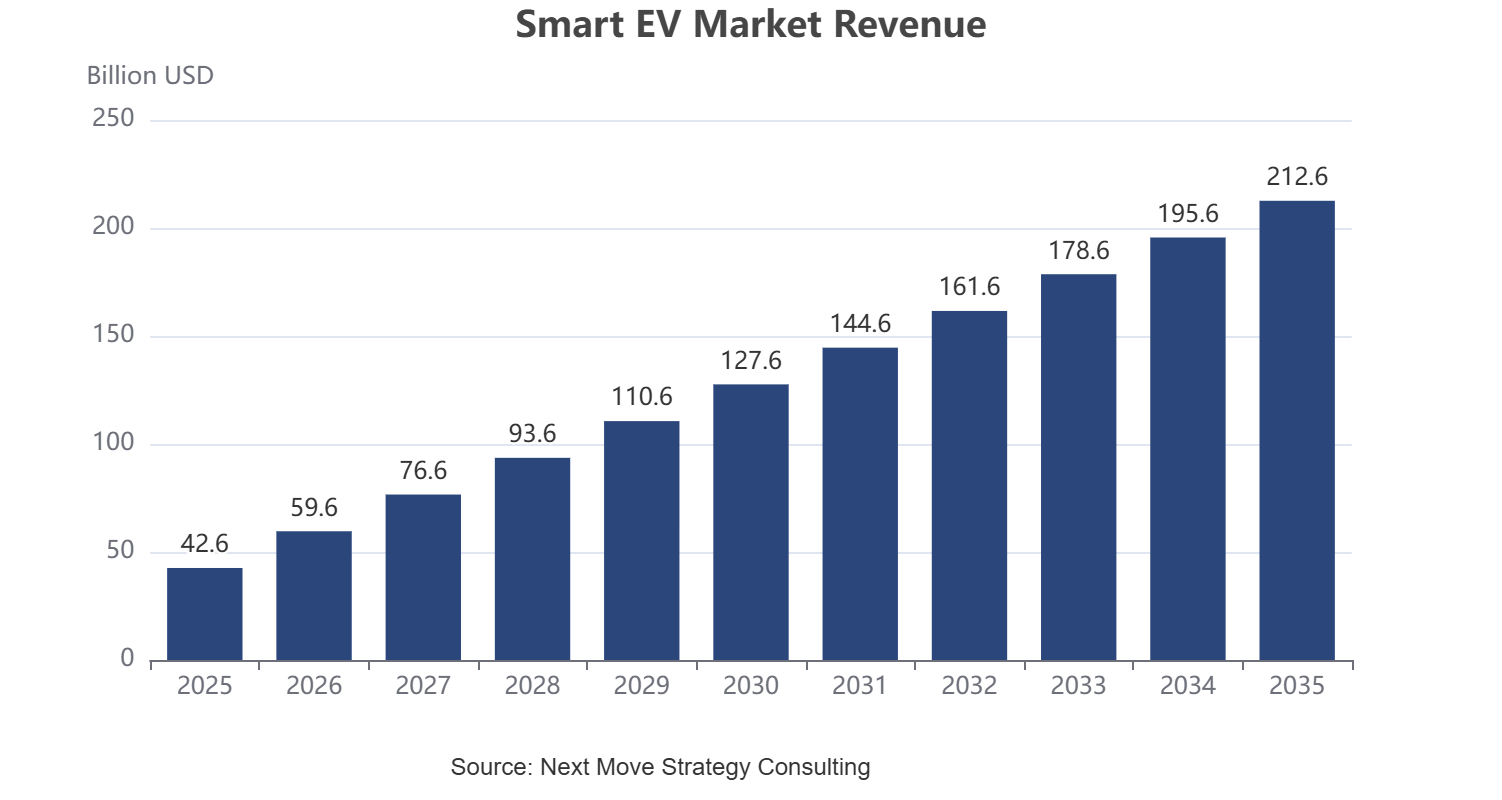
The global smart EV market size was valued at USD 42.6 billion in 2025 and is estimated at USD 49.8 billion in 2026, projected to reach USD 212.6 billion by 2035, growing at a CAGR of 17.5% from 2026 to 2035. Asia-Pacific led the market with an approximate 58% revenue share in 2025, while the ADAS and Autonomous Driving Systems technology segment dominated at roughly 42% share.
Our findings suggest that the following key takeaways summarize the smart EV market's segment-level and geographic dynamics as of 2025.
|
Key Takeaways |
|
By Technology: ADAS and Autonomous Driving Systems held the largest share, expanding from USD 17.89 billion in 2025 to USD 85.04 billion by 2035, representing approximately a 42% share; Over-the-Air Software Platforms is the fastest-growing sub-segment at 24.5% CAGR from 2026–2035. |
|
By Autonomy Level: Level 2 Partial Automation held the largest share, accounting for approximately 38% of the market with USD 16.19 billion in 2025; Level 4 High Automation is the fastest-growing sub-segment at 34.9% CAGR from 2026–2035. |
|
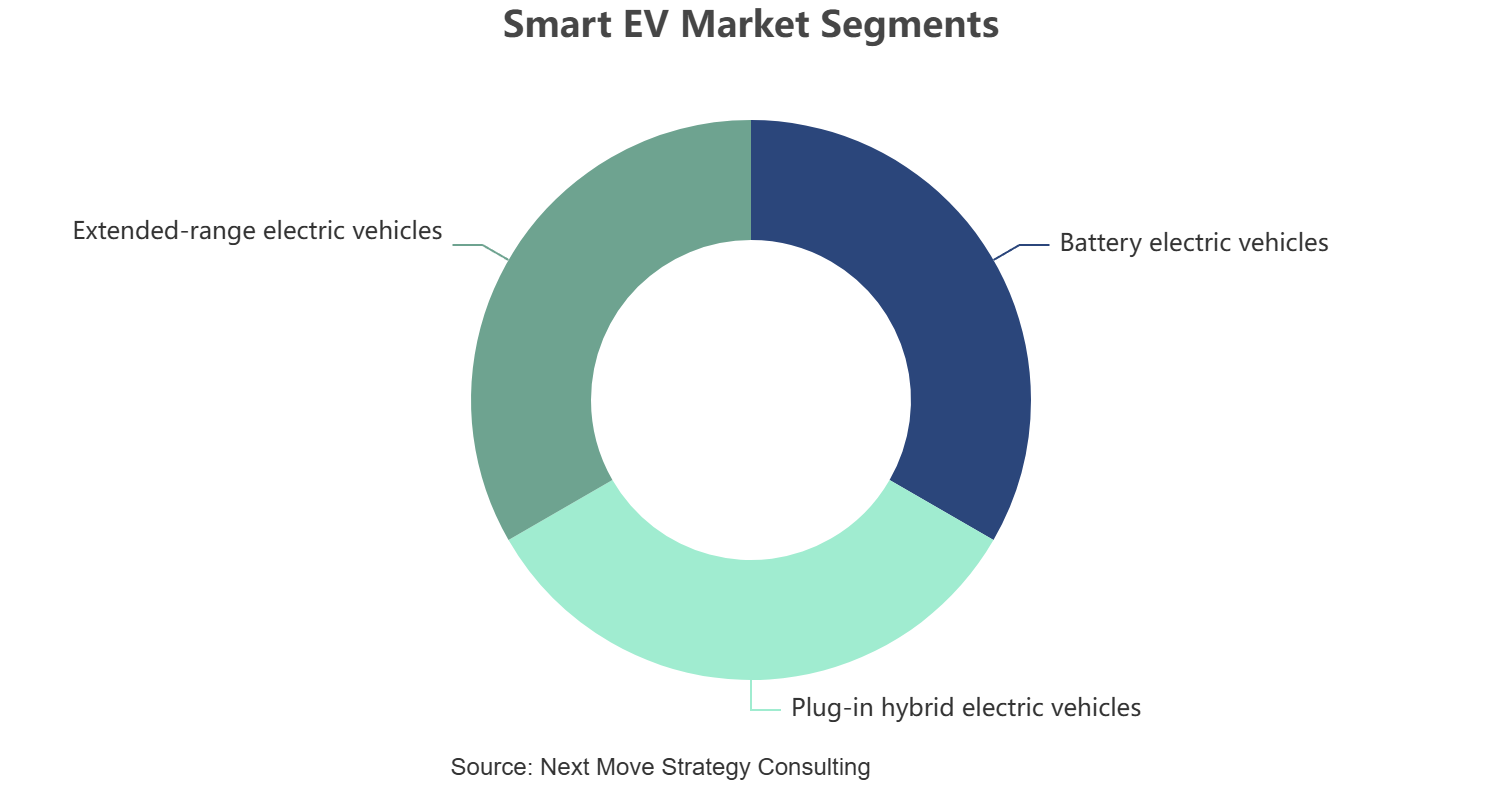
By Propulsion: Battery Electric Vehicles held the largest share, accounting for approximately 74% of the market with USD 31.52 billion in 2025; Extended-Range Electric Vehicles is the fastest-growing sub-segment at 25.9% CAGR from 2026–2035. |
|
By Vehicle Type: Passenger Cars held the largest share, accounting for approximately 88% of the market with USD 37.49 billion in 2025; Commercial Vehicles is the fastest-growing sub-segment at 21.6% CAGR from 2026–2035. |
|
By Price Tier: Mid-Range held the largest share, accounting for approximately 40% of the market with USD 17.04 billion in 2025; Economy is the fastest-growing sub-segment at 22.9% CAGR from 2026–2035. |
|
By Sales Channel: Direct-to-Consumer held the largest share, accounting for approximately 56% of the market with USD 23.86 billion in 2025; Direct-to-Consumer is also the fastest-growing sub-segment at 18.3% CAGR from 2026–2035. |
|
Dominant Region: Asia-Pacific dominated with approximately 58% revenue share in 2025. |
|
Fastest-Growing Region: Middle East & Africa is expected to register the highest CAGR of 20.9% during 2026–2035. |
|
Dominant Country: China led the market with USD 16.80 billion in 2025. |
|
Fastest-Growing Country: India is the fastest-growing country at a CAGR of 24.1% during 2026–2035. |
Market Opportunity: The smart EV market presents an absolute dollar opportunity of approximately USD 162.8 billion between 2026 and 2035, calculated as the difference between the 2035 forecast value and the 2026 base value, an investment window favoring vendors scaling software-defined vehicle platforms and subscription-based autonomy features.
According to NMSC analysis, we found that the gap between Level 2 driver-assistance penetration and validated Level 3 and Level 4 deployment is widening the addressable market for advanced perception hardware and reasoning software, even as intense pricing competition among Chinese smart EV brands compresses vehicle-level margins.
Ecosystem Analysis of the Smart EV Industry
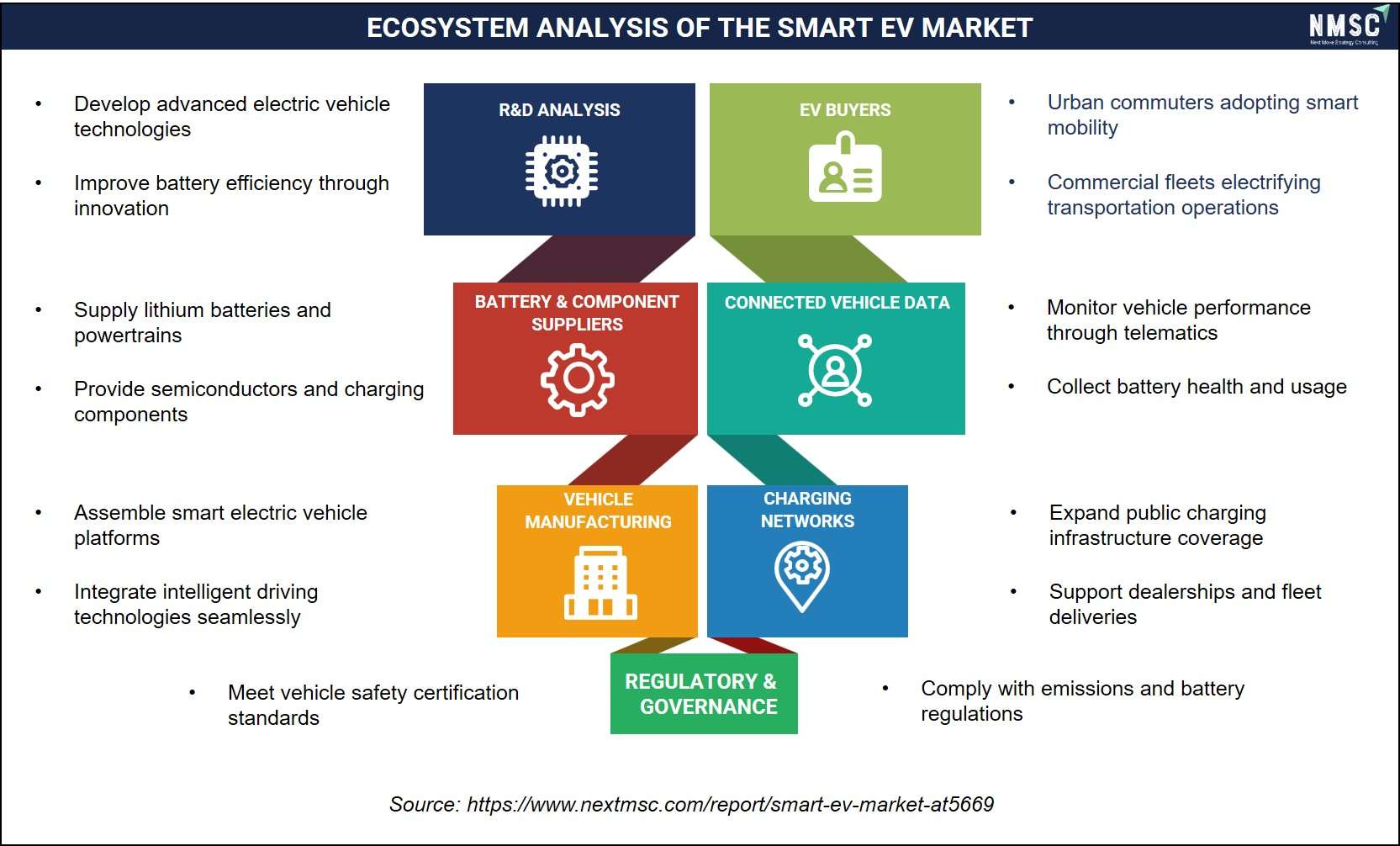
The above infographic presents an ecosystem analysis of the smart EV market, covering R&D, battery and component suppliers, vehicle manufacturing, and regulatory governance. Advanced electric vehicle technologies and battery innovations are driving performance improvements, supported by semiconductor and charging component suppliers. Vehicle assembly and intelligent driving integration are shaping platform development, while safety certifications ensure compliance. Looking ahead, we observed that continued innovation and regulatory alignment will remain essential for market growth and consumer adoption.
What does the Smart EV Market Encompass?
The smart EV market encompasses the advanced driver-assistance and autonomous driving systems, connectivity and telematics hardware, smart cockpit and infotainment platforms, and over-the-air software update systems integrated into electric vehicles, reflecting the vehicle-level technology stack rather than total vehicle sale price. We observed that the market has structurally evolved from basic Level 1 driver-assistance features toward end-to-end, reasoning-capable autonomous driving software, as demonstrated by NIO's Onvo sub-brand rolling out its Coconut 3.1.0 software update spanning assisted driving, smart cockpit, and voice control to more than 170,000 vehicles in 2026.
Regulatory environments vary substantially by market, with China's rapid smart EV commercialization contrasting against more conservative Level 3 and Level 4 approval pathways across the U.S. and Europe. During our market evaluation, we noticed that ADAS technology adoption is most advanced among Chinese smart EV brands including XPeng and BYD, while over-the-air software update cadence has become a defining competitive differentiator across the industry.
|
Parameters |
Details |
|
Market Size in 2025 |
USD 42.6 Billion |
|
Market Size in 2026 |
USD 49.8 Billion |
|
Revenue Forecast in 2035 |
USD 212.6 Billion |
|
Growth Rate |
CAGR of 17.5% from 2026 to 2035 |
|
Analysis Period |
2025–2035 |
|
Base Year Considered |
2025 |
|
Forecast Period |
2026–2035 |
|
Market Size Estimation |
Revenue (USD Billion) |
|
Companies Profiled |
20 |
|
Countries Covered |
38 |
|
Market Share |
Available for Top 10 Companies |
Key Emerging Trends
Our analysis shows that four structural trends are reshaping software architecture, autonomy strategy, and competitive positioning across the global smart EV market heading into 2035.
How Is High-Frequency OTA Software Delivery Transforming Vehicle Lifecycles?
High-frequency over-the-air software delivery is transforming vehicles from static hardware products into continuously improving platforms. BYD released approximately 200 software updates across its Ocean and Dynasty brands in 2025, using OTA delivery to introduce enhanced, end-to-end AI-driven driver assistance to vehicles already in customers' hands without requiring a dealership visit. Stakeholder impact is greatest for legacy automakers whose slower update cadence increasingly lags Chinese smart EV brands' software-first development culture.
Why Is Vision-Language-Action Model Adoption Accelerating in Autonomous Driving?
Vision-language-action model adoption is accelerating as smart EV makers move beyond rule-based perception toward reasoning-capable autonomous driving software. XPeng showcased its VLA 2.0 architecture alongside a dedicated robotaxi platform at its November 2025 AI Day, extending the same physical-AI reasoning approach across passenger vehicles and purpose-built autonomous fleets. We found that this VLA architecture shift is compressing development cycles for handling complex, unstructured driving scenarios.
How Is Global OTA Standardization Reshaping International Expansion Strategy?
Synchronized global over-the-air update rollouts are reshaping how smart EV makers expand internationally, allowing a single software release to reach vehicles across dozens of markets simultaneously. XPeng rolled out its XOS 5.8.0 software update globally in August 2025, its third major synchronized release of the year, while expanding local production through its Magna Steyr-assembled plant in Austria to avoid European Commission duties on Chinese-built vehicles. Our assessment indicates that unified software platforms are becoming as important as manufacturing footprint for international scaling.
Why Is Shared Autonomy Architecture Expanding Across Sub-Brand Portfolios?
Shared autonomous driving architecture across premium and mass-market sub-brands is expanding as smart EV makers seek to amortize development costs across broader vehicle lineups. NIO's Onvo sub-brand shares a unified autonomous driving technology architecture and common data closed-loop system with NIO's premium brand, allowing mass-market vehicles to benefit from flagship-level engineering investment. Based on research conducted by NMSC, we found that this shared-architecture strategy is lowering the cost of extending advanced autonomy features to lower price tiers.
Growth Drivers & Restraints
Growth Catalyst & Risk Assessment Matrix
|
Factors |
Type |
(+/−) % Impact on CAGR |
Geographic Relevance |
Impact Timeline |
|
Rapid Level 2+ and Level 3 ADAS commercialization in China |
Driver |
+5.4% |
Asia-Pacific |
2026–2032 |
|
Rising consumer expectation for continuous OTA software improvement |
Driver |
+3.6% |
Global |
2026–2035 |
|
Expanding smart EV price competition broadening mass-market access |
Driver |
+2.8% |
Asia-Pacific, Latin America |
2026–2033 |
|
Vision-language-action model adoption accelerating autonomy capability |
Driver |
+2.2% |
North America, Asia-Pacific |
2027–2035 |
|
Growing robotaxi and autonomous fleet pilot programs |
Driver |
+1.5% |
North America, Asia-Pacific |
2026–2033 |
|
Fragmented Level 3/4 regulatory approval pathways across regions |
Restraint |
−2.1% |
North America, Europe |
2026–2031 |
|
High R&D cost of proprietary autonomy stacks pressuring smaller OEMs |
Restraint |
−1.4% |
Global |
2026–2030 |
|
Consumer data privacy and cybersecurity compliance requirements |
Restraint |
−0.8% |
Europe, North America |
2026–2029 |
What Is the Primary Growth Driver of the Market?
Rapid Level 2+ and Level 3 ADAS commercialization among Chinese smart EV makers is the single largest driver of market growth, as brands including XPeng, NIO, and Li Auto compete intensely on autonomous driving capability as a primary purchase differentiator. XPeng reported an 85% to 86% monthly active user penetration rate for its urban autonomous driving feature among eligible customers through 2025, reflecting deep feature engagement once deployed. We observed that this high engagement is reinforcing continued R&D investment across the competitive set.
How Is OTA Software Delivery Driving Market Growth?
Continuous over-the-air software delivery is driving the Over-the-Air Software Platforms segment toward a 24.5% CAGR from 2026 to 2035, more than double the broader market average of 17.5%. BYD's roughly 200 software updates delivered in 2025 alone illustrate how OTA capability has become a recurring engineering investment rather than a one-time hardware feature. Our analysis shows that this software-centric growth is helping vendors build recurring engagement independent of new-vehicle sales cycles.
What Is Restraining Smart EV Market Growth?
Fragmented Level 3 and Level 4 regulatory approval pathways restrain the pace of advanced autonomy deployment, particularly across the U.S. and Europe where certification processes remain more conservative than China's faster commercialization environment. High research and development costs for proprietary autonomy stacks also restrain smaller automakers lacking the scale to match leading smart EV makers' software investment. We found that these pressures are accelerating industry consolidation around a smaller number of technology-leading platforms.
Segmentation Analysis
Segment Sizing: By Technology
|
Segment |
2025 (USD) |
2035 (USD) |
CAGR% (2026–2035) |
|
ADAS and Autonomous Driving Systems |
17.89 Billion |
85.04 Billion |
16.9% |
|
Smart Cockpit and Infotainment |
11.93 Billion |
53.15 Billion |
16.1% |
|
Connectivity and Telematics |
8.52 Billion |
36.14 Billion |
15.5% |
|
Over-the-Air Software Platforms |
4.26 Billion |
38.27 Billion |
24.5% |
|
Total |
42.60 Billion |
212.60 Billion |
17.5% |
Which Technology Segment Dominates the Market?
ADAS and Autonomous Driving Systems dominate the smart EV market with approximately a 42% share in 2025, valued at USD 17.89 billion, reflecting the high hardware and software cost of perception sensors, compute platforms, and driving-policy software relative to other technology categories. Over-the-Air Software Platforms are the fastest-growing technology segment at a 24.5% CAGR, as vendors including BYD and NIO shift toward continuous, in-car infotainment and driving-feature updates delivered without dealership visits.
Segment Sizing: By Autonomy Level
|
Segment |
2025 (USD) |
2035 (USD) |
CAGR% (2026–2035) |
|
Level 2 Partial Automation |
16.19 Billion |
51.02 Billion |
12.2% |
|
Level 2+ Advanced Partial Automation |
11.08 Billion |
63.78 Billion |
19.1% |
|
Level 1 Driver Assistance |
9.37 Billion |
17.01 Billion |
6.1% |
|
Level 3 Conditional Automation |
4.26 Billion |
46.77 Billion |
27.1% |
|
Level 4 High Automation |
1.70 Billion |
34.02 Billion |
34.9% |
|
Total |
42.60 Billion |
212.60 Billion |
17.5% |
Which Autonomy Level Segment Is Growing Fastest?
Level 2 Partial Automation leads the autonomy-level segmentation with approximately 38% share in 2025 at USD 16.19 billion, reflecting its status as the current mainstream standard across most smart EV models sold globally. Level 4 High Automation is the fastest-growing segment at a 34.9% CAGR, driven by expanding robotaxi pilot programs and validated urban autonomous driving deployment among leading Chinese and North American smart EV makers.
Segment Sizing: By Propulsion
|
Segment |
2025 (USD) |
2035 (USD) |
CAGR% (2026–2035) |
|
Battery Electric Vehicles |
31.52 Billion |
148.82 Billion |
16.8% |
|
Plug-in Hybrid Electric Vehicles |
7.67 Billion |
29.76 Billion |
14.5% |
|
Extended-Range Electric Vehicles |
3.41 Billion |
34.02 Billion |
25.9% |
|
Total |
42.60 Billion |
212.60 Billion |
17.5% |
Which Propulsion Segment Leads the Market?
Battery Electric Vehicles lead the propulsion segmentation with approximately 74% share in 2025 at USD 31.52 billion, anchored by leading smart EV brands' pure-electric product strategies across China, North America, and Europe. Extended-Range Electric Vehicles are the fastest-growing propulsion segment at a 25.9% CAGR, as brands including Li Auto scale range-extended platforms that pair smart driving software with reduced range anxiety for consumers in markets with developing charging infrastructure.
Growth Opportunities
Beyond the core drivers shaping overall demand, three whitespace opportunities stand out for smart EV makers positioning portfolios toward 2035.
How Can Automakers Capture Value from Autonomy Feature Subscriptions?
Subscription-based monetization of advanced autonomous driving features creates a mechanism for automakers to capture recurring software revenue independent of vehicle purchase price. Vendors with proven, continuously improving autonomy software are best positioned to capture this recurring-revenue opportunity as consumers grow accustomed to paying for capability upgrades.
What Opportunity Exists in Shared Sub-Brand Autonomy Architecture?
Extending flagship-grade autonomous driving architecture to mass-market sub-brands creates a mechanism for automakers to amortize R&D investment across broader vehicle lineups without duplicating engineering cost. Automakers with unified, multi-tier software platforms are best positioned to capture this opportunity as smart EV adoption broadens into more price-sensitive segments.
How Can Suppliers Benefit from Robotaxi and Autonomous Fleet Expansion?
Expanding robotaxi and purpose-built autonomous fleet programs create a mechanism for smart EV makers to generate mobility-service revenue beyond traditional vehicle sales. Vendors with validated Level 4 autonomy platforms and dedicated fleet vehicle architecture are best positioned to capture this fastest-growing autonomy-level opportunity.
Regional Outlook
|
Region |
2025 (USD) |
2035 (USD) |
CAGR% (2026–2035) |
Key Driver |
|
North America |
9.37 Billion |
53.15 Billion |
19.0% |
Robotaxi expansion and OTA-driven autonomy monetization |
|
Europe |
6.39 Billion |
29.76 Billion |
16.6% |
OEM software-defined vehicle investment and EV mandates |
|
Asia-Pacific |
24.71 Billion |
116.93 Billion |
16.8% |
Intense smart EV competition and rapid ADAS commercialization |
|
Middle East & Africa |
1.28 Billion |
8.50 Billion |
20.9% |
Smart city investment and premium smart EV adoption |
|
Latin America |
0.85 Billion |
4.25 Billion |
17.4% |
Rising EV adoption and expanding connected vehicle infrastructure |
|
Total |
42.60 Billion |
212.60 Billion |
17.5% |
— |
North America
North America's smart EV market is the fastest-growing major region globally, driven by expanding robotaxi deployment and strong consumer willingness to pay for autonomy feature subscriptions. Regulatory influence flows through both federal vehicle-safety frameworks and state-level autonomous vehicle pilot approvals, while technology adoption favors continuous OTA software delivery pioneered by Tesla. We observed that strategic outlook favors vendors with validated real-world autonomous driving mileage and proven software update cadence.
Europe
Europe's market is shaped by traditional automakers' accelerating software-defined vehicle investment alongside EU electric vehicle transition mandates. Technology adoption favors data-privacy-compliant connectivity and telematics platforms given the region's strict regulatory requirements, while Chinese smart EV brands including XPeng continue expanding local production to navigate import duties. Strategic outlook favors vendors combining proven autonomy software with strong regional manufacturing and compliance credentials.
Asia-Pacific
Asia-Pacific is the dominant regional market by absolute revenue, propelled by intense competition among Chinese smart EV makers including BYD, NIO, XPeng, and Li Auto, each racing to differentiate on autonomous driving capability and OTA update frequency. Technology adoption is the most advanced globally, with urban autonomous driving features reaching majority active-user penetration among eligible customers. Strategic outlook favors vendors able to sustain rapid software iteration while managing intense domestic price competition.
Middle East & Africa
The Middle East & Africa market is the fastest-growing region globally at a 20.9% CAGR, driven by premium smart EV adoption tied to Gulf smart-city investment and expanding connected vehicle infrastructure. Regulatory frameworks remain in earlier development relative to North America, Europe, and Asia-Pacific, giving automakers flexibility in market entry strategy. Strategic outlook favors vendors with strong regional distributor relationships and premium brand positioning.
Latin America
Latin America's smart EV market is expanding steadily as rising electric vehicle adoption and growing connected vehicle infrastructure investment in Brazil and Argentina create nascent regional demand. Technology adoption remains concentrated in Level 1 and Level 2 driver-assistance features relative to more advanced markets. Strategic outlook favors automakers building distributor and charging-infrastructure partnerships ahead of anticipated regional EV-adoption acceleration.
U.S.
Based on our estimates, the U.S. market was valued at approximately USD 7.50 billion in 2025 and is projected to reach USD 40.39 billion by 2035, growing at a 18.3% CAGR. Demand is anchored in continuous OTA-delivered autonomy improvements and expanding robotaxi programs, with Tesla, Rivian, and Lucid Group supporting a technology-forward strategic outlook shaped by evolving federal autonomous vehicle policy.
Canada
The market in Canada was valued at approximately USD 1.22 billion in 2025 and is forecast to reach USD 6.91 billion by 2035, expanding at a 19.0% CAGR. Demand structure mirrors the U.S. with strong OTA-driven feature adoption, moderate robotaxi pilot activity in major metropolitan corridors, and growing interest in software-defined vehicle platforms from both domestic and imported smart EV brands.
UK
As per our estimate, the UK smart EV market stood at approximately USD 958.5 million in 2025 and is projected to reach USD 4.17 billion by 2035, growing at a 15.8% CAGR. Demand structure favors premium smart EV adoption alongside growing Chinese smart EV brand market entry, with data protection regulation shaping connectivity and telematics platform design.
Germany
According to our analysis, Germany's market was valued at approximately USD 1.53 billion in 2025 and is expected to reach USD 6.55 billion by 2035, at a 15.6% CAGR. Demand is driven by domestic automakers' accelerating software-defined vehicle investment, with regulatory alignment to EU data protection and vehicle-automation frameworks shaping autonomy feature rollout timelines.
France
Based on our estimates, France's market was valued at approximately USD 830.7 million in 2025 and is projected to reach USD 3.87 billion by 2035, growing at a 16.6% CAGR. Demand structure is led by national EV adoption incentives and steady growth in connected vehicle feature adoption, with competitive intensity concentrated among European and Chinese smart EV brands.
China
The market in China was valued at approximately USD 16.80 billion in 2025 and is projected to reach USD 70.16 billion by 2035, growing at a 15.4% CAGR, the largest country-level market globally by a wide margin. Demand structure spans intense competition among BYD, NIO, XPeng, and Li Auto, supported by rapid urban autonomous driving feature deployment and among the world's highest OTA software update frequencies.
India
According to our analysis, India's market was valued at approximately USD 1.48 billion in 2025 and is projected to reach USD 12.86 billion by 2035, expanding at a 24.1% CAGR, the fastest growth rate among major economies covered in this report. Demand is driven by rapidly scaling domestic EV adoption and rising consumer interest in connected vehicle features, creating substantial new demand from a comparatively small existing base.
Japan
As per our estimate, Japan's smart EV market was valued at approximately USD 1.73 billion in 2025 and is projected to reach USD 7.02 billion by 2035, growing at a 15.0% CAGR. Demand structure is technology-mature, with domestic automakers gradually scaling advanced driver-assistance and connectivity feature adoption within a stable regulatory environment favoring incremental autonomy rollout.
South Korea
Based on our estimates, South Korea's market was valued at approximately USD 1.98 billion in 2025 and is projected to reach USD 9.35 billion by 2035, at a 16.8% CAGR. Demand structure closely resembles Japan's, with strong domestic automaker investment in connected and autonomous driving technology, alongside growing consumer familiarity with software-defined vehicle features.
Australia
The market in Australia was valued at approximately USD 494.2 million in 2025 and is projected to reach USD 3.51 billion by 2035, growing at a 21.7% CAGR. Demand structure is led by rapidly rising EV adoption and strong consumer interest in imported smart EV brands, supported by a regulatory environment favorable to autonomous driving feature trials.
UAE
According to our analysis, the UAE market was valued at approximately USD 332.3 million in 2025 and is projected to reach USD 2.04 billion by 2035, growing at a 19.9% CAGR. Demand structure is dominated by premium smart EV adoption tied to Dubai and Abu Dhabi's smart-city development initiatives, alongside growing interest in autonomous driving pilot programs.
Saudi Arabia
Based on our estimates, Saudi Arabia's market was valued at approximately USD 306.7 million in 2025 and is projected to reach USD 1.96 billion by 2035, growing at a 20.4% CAGR. Demand is driven by Vision 2030-linked smart-city and giga-project development, with strong regulatory support for connected vehicle infrastructure supporting premium smart EV adoption.
South Africa
As per our estimate, South Africa's smart EV market was valued at approximately USD 76.7 million in 2025 and is projected to reach USD 595.3 million by 2035, growing at a 22.7% CAGR. Demand structure combines gradually rising EV adoption with growing interest in connected vehicle features concentrated in major urban centers.
Brazil
The market in Brazil was valued at approximately USD 357.8 million in 2025 and is projected to reach USD 1.70 billion by 2035, growing at a 16.9% CAGR, the largest market in Latin America. Demand structure is led by rising EV adoption and growing consumer interest in connected vehicle features, with automakers expanding distribution to serve increasing urban demand.
Argentina
According to our analysis, Argentina's market was valued at approximately USD 153.4 million in 2025 and is projected to reach USD 765.4 million by 2035, growing at a 17.4% CAGR. Demand structure reflects gradually expanding EV adoption, with regional distributors serving as the primary channel for imported smart EV brands.
PESTEL Analysis of the Smart EV Industry
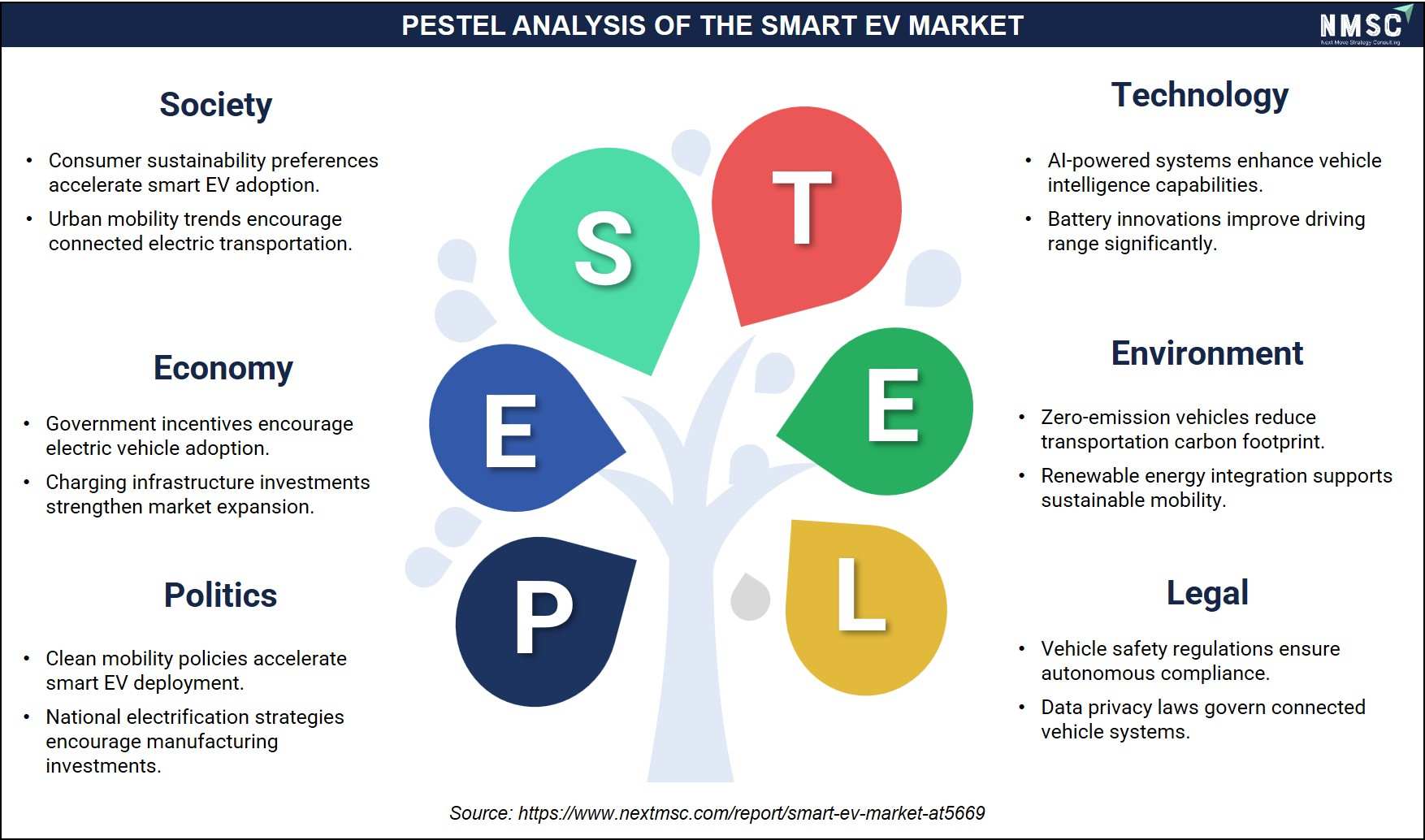
The above infographic presents a PESTEL analysis of the smart EV market, wherein clean mobility policies and national electrification strategies are driving manufacturing investments and deployment. Government incentives and charging infrastructure investments are accelerating adoption, while urban mobility trends are shaping consumer acceptance. Technological advancements, including AI-powered systems and battery innovations, are improving vehicle intelligence and driving range. Environmental benefits such as zero-emission mobility and renewable energy integration are further supporting sustainable transportation. Looking ahead, we observed that these interconnected factors will continue to shape the market's growth across the automotive ecosystem.
Competitive Landscape
Our assessment indicates that competitive intensity in the smart EV market is shaped by a mix of vertically integrated Chinese smart EV specialists and traditional global automakers accelerating software-defined vehicle transformation within the broader electric vehicle industry.
|
Key Takeaways |
Details |
|
Market Structure |
Moderately fragmented, with Chinese smart EV specialists competing intensely on autonomy and OTA cadence against traditional global automakers scaling software investment. |
|
Innovation Focus |
Vision-language-action reasoning models, high-frequency OTA software delivery, and shared multi-tier autonomy architecture. |
|
M&A Activity |
Strategic supply and technology partnerships alongside selective sub-brand and regional manufacturing expansion rather than large-scale consolidation. |
How Do Companies Compete in the Market?
Companies compete primarily on autonomous driving capability, OTA update frequency, smart cockpit user experience, and validated real-world deployment scale built through continuous customer data collection. Our analysis shows that Chinese smart EV specialists including XPeng and NIO compete on rapid autonomy iteration and vertically integrated software development, while traditional automakers including BMW and Mercedes-Benz compete on brand trust and integration with established dealer service networks.
Which Competitive Archetypes Dominate the Market?
Two archetypes dominate the market: vertically integrated smart EV specialists building proprietary, full-stack autonomy and software platforms, and traditional global automakers layering advanced software onto established vehicle engineering and manufacturing scale. XPeng exemplifies the vertically integrated specialist archetype through its in-house VLA autonomy stack, while Volkswagen exemplifies the traditional-automaker archetype through its software-defined vehicle transformation built atop decades of manufacturing scale.
How Are Companies Differentiating Through Innovation?
Innovation and differentiation increasingly center on reasoning-capable autonomy software and shared architecture spanning multiple vehicle tiers. XPeng's VLA 2.0 architecture extended across passenger vehicles and robotaxi platforms, and NIO's unified autonomous driving architecture shared between its premium and Onvo sub-brands, both illustrate how vendors are building platform-level differentiation that spans multiple products rather than single-model features.
What M&A and Expansion Activity Is Shaping the Smart EV Market?
Expansion activity is concentrated in regional manufacturing localization and technology partnerships rather than large-format acquisitions. XPeng's local vehicle production launch in Malaysia in December 2025 and continued European assembly through Magna Steyr both illustrate how Chinese smart EV makers are prioritizing regional manufacturing footprint to navigate trade barriers and accelerate international expansion.
Key Market Players
Our assessment indicates that the following 20 companies are actively shaping autonomous driving innovation, software platform development, and global expansion strategy within the market.
-
Tesla, Inc.
-
BYD Company Limited
-
NIO Inc.
-
XPeng Inc.
-
Li Auto Inc.
-
Xiaomi Corporation
-
Zhejiang Geely Holding Group
-
Seres Group Co., Ltd.
-
Rivian Automotive, Inc.
-
Lucid Group, Inc.
-
Hyundai Motor Company
-
Volkswagen AG
-
BMW AG
-
General Motors Company
-
Ford Motor Company
-
SAIC Motor Corporation Limited
-
Volvo Car AB
-
Nissan Motor Co., Ltd.
Latest Developments
We found that recent product launches and software updates within the smart EV market are concentrated on autonomy architecture advancement, global OTA rollout, and regional manufacturing expansion across 2025 and 2026.
|
Date |
Event |
|
May 2026 |
Xiaomi officially launched the YU7 Smart Electric SUV, integrating the company's HyperVision panoramic display, NVIDIA DRIVE AGX computing platform, LiDAR, and Xiaomi HyperOS to deliver advanced intelligent driving, smart cockpit, and connected vehicle capabilities. |
|
April 2026 |
NIO's sub-brand ONVO announced that cumulative deliveries of its L90 smart electric SUV surpassed 50,000 units, reflecting strong consumer adoption of intelligent electric vehicles. |
Expert Insights
 “Smart electric vehicles are trending towards integration of the automotive industry with consumer electronics and intelligent ecosystems. Integrating full-stack technologies is a necessary step for the industry's evolution.”
— Lei Jun, Founder, Chairman & Chief Executive Officer, Xiaomi Corporation
Statement made during the Xiaomi EV Technology Launch while introducing Xiaomi's smart EV strategy.
Market Interpretation
The statement underscores the rapid evolution of the smart EV market toward software-defined, AI-enabled, and highly connected vehicles. As automakers increasingly integrate artificial intelligence, intelligent cockpits, autonomous driving capabilities, cloud connectivity, and digital ecosystems, smart electric vehicles are transforming into intelligent mobility platforms. This convergence of automotive engineering and consumer technology is expected to accelerate innovation, enhance user experience, and strengthen the long-term growth potential of the global smart EV market.Investment Opportunities
What Capital Inflows Are Targeting the Market?
Capital inflows are increasingly directed toward autonomy software and reasoning-model development, with Chinese smart EV makers continuing substantial R&D investment in physical AI and vision-language-action architecture. We observed that investors favor smart EV makers demonstrating validated real-world autonomous driving mileage and consistent OTA delivery cadence, viewing software engagement metrics as a proxy for long-term platform stickiness.
How Is Infrastructure Investment Supporting Market Growth?
Infrastructure investment in regional manufacturing localization, including XPeng's Malaysia production launch and continued European assembly through Magna Steyr, continues to underwrite international expansion while navigating trade barriers. Our findings suggest that smart EV makers with early-mover regional manufacturing footprint are best positioned to capture international demand growth through 2035.
What ESG Considerations Are Shaping Investment Decisions?
Vehicle safety performance and data privacy compliance are central governance considerations shaping investment decisions, as autonomous driving features directly affect road safety outcomes and continuous connectivity raises data-handling obligations. We found that investors increasingly treat transparent safety-performance disclosure and privacy-compliant data architecture as governance indicators alongside conventional financial and environmental metrics when evaluating smart EV makers.
Key Benefits for Stakeholders
How Does This Report Benefit Enterprise and Industry Leaders?
Enterprise and industry leaders gain access to validated segmentation, competitive benchmarking, and regional demand forecasts that support technology-investment and partnership decisions across the smart EV industry. Our analysis shows that detailed technology, autonomy-level, and propulsion breakdowns help product and engineering teams align development roadmaps with the fastest-growing segments, including Over-the-Air Software Platforms and Level 4 High Automation.
How Does This Report Benefit Investors and Financial Analysts?
Investors and financial analysts benefit from consistent, single-point market size and CAGR estimates that support valuation and capital-allocation decisions across the smart EV supply chain. We observed that the report's regional and segment-level growth differentials help identify which automakers and technology vendors are best positioned to capture above-market growth in autonomy software and Middle East & Africa expansion through 2035.
How Does This Report Benefit Technology Vendors and Product Teams?
Technology vendors and product teams gain insight into emerging design requirements, including vision-language-action reasoning models, high-frequency OTA delivery, and shared multi-tier autonomy architecture, that are reshaping the industry. Our findings suggest that this analysis helps R&D teams prioritize development roadmaps around the Level 3 Conditional Automation and Extended-Range Electric Vehicles segments showing the strongest above-market growth trajectories.
Key Market Segments
By Technology
-
ADAS and autonomous driving systems
-
Smart cockpit and infotainment
-
Connectivity and telematics
-
Over-the-air software platforms
By Autonomy Level
-
Level 1 driver assistance
-
Level 2 partial automation
-
Level 2+ advanced partial automation
-
Level 3 conditional automation
-
Level 4 high automation
By Propulsion
-
Battery electric vehicles
-
Plug-in hybrid electric vehicles
-
Extended-range electric vehicles
By Vehicle Type
-
Passenger cars
-
Commercial vehicles
By Price Tier
-
Economy
-
Mid-range
-
Premium
-
Luxury
By Sales Channel
-
Direct-to-consumer
-
Dealership network
By Region
-
North America: U.S., Canada, Mexico
-
Europe: UK, Germany, France, Italy, Spain, Sweden, Denmark, Finland, Netherlands, Rest of Europe
-
Asia-Pacific: China, India, Japan, South Korea, Taiwan, Indonesia, Vietnam, Australia```html , Philippines, Malaysia, Rest of APAC
-
Middle East & Africa: Saudi Arabia, UAE, Egypt, Israel, Turkey, Nigeria, South Africa, Rest of MEA
-
Latin America: Brazil, Argentina, Chile, Colombia, Rest of LATAM
Conclusion and Recommendations
What Is the Long-Term Outlook for the Smart EV Market?
The long-term outlook for the smart EV market remains strongly positive, with global revenue projected to grow nearly fivefold from USD 42.6 billion in 2025 to USD 212.6 billion by 2035 at a 17.5% CAGR. We observed that rapid ADAS commercialization, continuous OTA software delivery, and expanding robotaxi deployment will continue underpinning demand across passenger and commercial applications through the forecast period.
What Strategic Positioning Should Smart EV Makers Pursue?
Smart EV makers should prioritize reasoning-capable autonomy architecture and high-frequency OTA delivery while maintaining shared software platforms across price tiers to broaden the addressable market. Our assessment indicates that vendors investing early in vision-language-action models will be best positioned to capture premium autonomy revenue while retaining mass-market access through shared-architecture sub-brands.
How Attractive Is the Market for New Investment?
The smart EV market presents a highly attractive investment case, supported by a USD 162.8 billion absolute dollar opportunity between 2026 and 2035 and above-average growth in Level 4 High Automation and Over-the-Air Software Platforms. We found that investment attractiveness is highest for smart EV makers combining validated autonomy deployment scale with proven software update cadence, positioning them to capture both vehicle sales and recurring software engagement.
What Market Shifts and Key Risks Should Stakeholders Monitor?
Stakeholders should monitor fragmented Level 3 and Level 4 regulatory approval pathways, high R&D costs pressuring smaller automakers, and intense Chinese domestic price competition as key risks to the market. Our analysis shows that automakers unable to sustain rapid software iteration risk losing customer engagement to better-resourced competitors offering more frequent, more capable OTA updates.
What Are the Key Growth Pathways for the Smart EV Market?
Key growth pathways include scaling reasoning-capable autonomy software, deepening shared multi-tier architecture across sub-brand portfolios, and expanding robotaxi and autonomous fleet programs beyond core passenger vehicle sales. Next Move Strategy Consulting's analysis indicates that automakers pursuing these pathways while managing regional regulatory complexity will be best positioned to capture the smart EV market's projected growth through 2035.
About the Author
 Mayurima Roy
— Mayurima Roy is Research Analyst at Next Move Strategy Consulting, where she has spent 4 years working across the firm's full industry coverage rather than a single fixed vertical. Her work centers on structured research, ongoing trend tracking, competitive assessment, and insight-led content development, translating complex market data into clear, decision-ready narratives that support informed client decision-making across diverse global industries, market sectors, and world regions every day.
Mayurima Roy
— Mayurima Roy is Research Analyst at Next Move Strategy Consulting, where she has spent 4 years working across the firm's full industry coverage rather than a single fixed vertical. Her work centers on structured research, ongoing trend tracking, competitive assessment, and insight-led content development, translating complex market data into clear, decision-ready narratives that support informed client decision-making across diverse global industries, market sectors, and world regions every day.
About the Reviewer
 Supradip Baul
— Supradip Baul is an accomplished business consultant and strategist with over a decade of rich experience in market intelligence, strategy, technology, and business transformation. His work has included rigorous qualitative and quantitative analysis across multiple industries, helping clients shape investment decisions and long-term roadmaps. Earlier in his career, he was associated with Gartner, where he contributed to industry-leading reports and market share analyses. He has worked with leading global companies and holds an MBA with a dual specialization in Marketing and Finance.
Supradip Baul
— Supradip Baul is an accomplished business consultant and strategist with over a decade of rich experience in market intelligence, strategy, technology, and business transformation. His work has included rigorous qualitative and quantitative analysis across multiple industries, helping clients shape investment decisions and long-term roadmaps. Earlier in his career, he was associated with Gartner, where he contributed to industry-leading reports and market share analyses. He has worked with leading global companies and holds an MBA with a dual specialization in Marketing and Finance.
At Next Move Strategy Consulting, we understand that insightful market research is the cornerstone of successful business decisions. That's why we employ a robust and multifaceted approach, combining various methodologies to deliver the most accurate and actionable data for our clients.

Research Landscape
We navigate the world of research with two primary approaches:
Qualitative Approach
Our qualitative research methodologies involve immersive techniques such as in-depth interviews, focus groups, and observational studies. By engaging directly with individuals and stakeholders, we uncover valuable insights that quantitative data alone may overlook.

Quantitative Research
In tandem with qualitative methodologies, NMSC leverages the power of Quantitative Research to provide a robust foundation of numerical insights. Through systematic data collection and analysis, we quantify patterns, preferences, and market trends, offering a comprehensive view of the business landscape.
Our quantitative research approach employs diverse tools, including surveys, experiments, and statistical modelling. These methodologies enable us to gather data from a large and representative sample, ensuring the statistical significance of our findings. By employing structured questionnaires and standardized data collection methods, we guarantee the reliability and validity of the information we present to our clients.
Quantitative research is particularly effective in measuring the prevalence of trends, assessing market size, and gauging the impact of various factors on consumer behavior. The numerical precision attained through this approach equips our clients with actionable insights, facilitating data-driven decision-making and strategy formulation.


Our Specialized Toolbox for Industry-Specific Market Research
We deploy a specialized arsenal of techniques tailored to meet your unique requirements. Here's a glimpse into our comprehensive toolbox:

Information Procurement
The stage entails acquiring market data or relevant information through various sources and methodologies.


Market Research Approach
We utilize both top-down and bottom-up approaches in market research analysis to achieve a comprehensive understanding of the market dynamics, leveraging the broad perspective of industry trends and macroeconomic factors alongside detailed insights from specific segments and individual companies.

Porters Five Forces Analysis
We conduct Porter's Five Forces analysis to evaluate the competitive landscape of an industry, providing us with insights into factors that affect profitability and strategic positioning.

SWOT Analysis

Forecasting
We utilize a forecasting model to predict future consumption by considering parameters like population, economics, regulations, market competition, drivers, constraints, technology, and pricing. We also employ statistical techniques such as multilinear regression, exponential smoothing, moving average, ARIMA, and Monte Carlo simulations for accurate predictions. In econometric forecasting, we analyzed short-term and long-term event impacts, attributing values based on regulatory frameworks, economic factors, and market events.





 Speak to Our Analyst