Smart Parking Solutions Market Size, Share, and Trends Analysis by Offering (Hardware, Software, & Services), Parking Site Type (On-Street & Off-Street Parking), Technology (Sensor-Based Detection, Camera-Based Detection, & Others), Deployment Mode (Cloud & On-Premises), End User (Municipal and Government, Commercial Real Estate, Airports, & Others), and Region — Global Industry Report and Forecast, 2026–2035
Industry: Automotive & Transportation | Publishing Date: August 5, 2026 | Last Updated: August 5, 2026 | No of Pages: N/A | No. of Tables: N/A | No. of Figures: N/A | Format: PDF | Report Code: AT5585
What Is the Smart Parking Solutions Market Size?
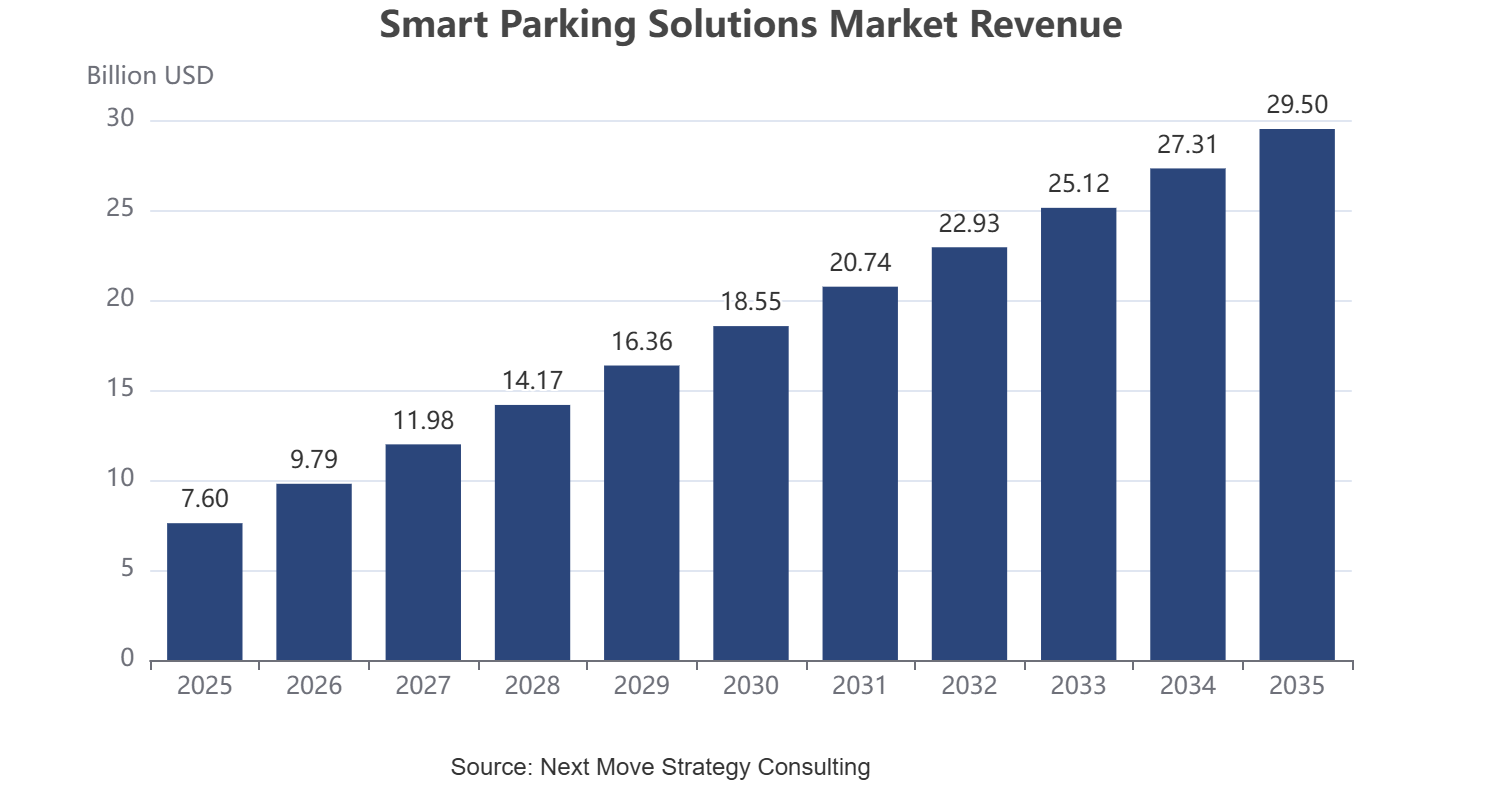
The global Smart Parking Solutions Market size reached USD 7.60 Billion in 2025 and is estimated at USD 8.70 Billion in 2026, forecast to reach USD 29.50 Billion by 2035 at a CAGR of 14.5% between 2026 and 2035. North America leads with an approximate 34% share, while Hardware dominates the offering segment at approximately 46% share in 2025.
We observed that municipal congestion-reduction mandates and smart city technology grants are steadily shifting demand from standalone sensor hardware toward integrated software platforms that combine occupancy detection, dynamic pricing, and mobile payment in a single deployment.
|
Key Takeaways |
|
By Offering: Hardware held the largest share, expanding from USD 3.50 billion in 2025 to USD 10.32 billion by 2035; Software is the fastest-growing sub-segment at 17.75% CAGR from 2026–2035. |
|
By Parking Site Type: Off-Street Parking held the largest share, expanding from USD 5.02 billion in 2025 to USD 21.53 billion by 2035; Off-Street Parking is also the fastest-growing sub-segment at 15.82% CAGR from 2026–2035. |
|
By Technology: Sensor-Based Detection held the largest share, reflecting broad ground and in-ground sensor deployment; Camera-Based Detection is the fastest-growing sub-segment, driven by increasing license plate recognition adoption. |
|
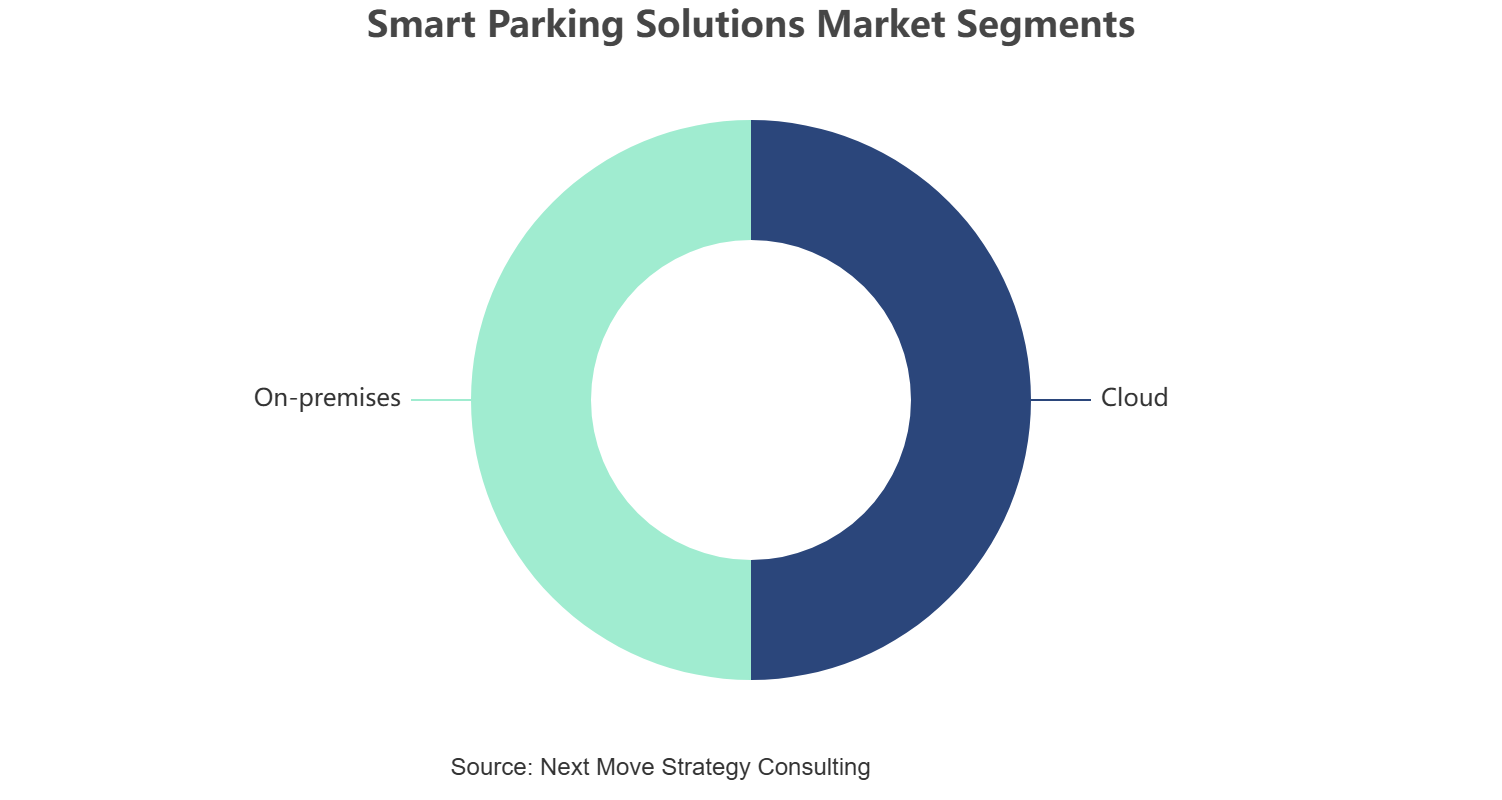
By Deployment Mode: Cloud held the largest share, reflecting the growing adoption of SaaS-based parking management platforms. |
|
By End User: Municipal and Government held the largest share, expanding from USD 2.28 billion in 2025 to USD 7.37 billion by 2035; Residential Complexes is the fastest-growing sub-segment at 20.83% CAGR from 2026–2035. |
|
Dominant Region: North America dominated with approximately 34% revenue share in 2025. |
|
Fastest-Growing Region: Asia-Pacific is expected to register the highest CAGR of 17.01% during 2026–2035. |
|
Dominant Country: The U.S. led the market, anchored by concentrated smart city technology grant funding. |
|
Fastest-Growing Country: India is the fastest-growing country, supported by rapid urban vehicle growth and municipal digitization. |
Market Opportunity: The market presents an absolute investment opportunity of approximately USD 20.80 Billion between 2026 and 2035, calculated as the difference between the 2035 forecast of USD 29.50 Billion and the 2026 base of USD 8.70 Billion, positioning integrated hardware-software parking platforms as a high-conviction category for municipal technology vendors and urban infrastructure investors.
According to NMSC analysis, the segment's momentum stems from the convergence of parking technology with broader curb-management and smart city data programs, which is expanding the addressable market beyond individual parking facilities into citywide mobility data platforms.
Ecosystem Analysis of the Smart Parking Solutions Industry
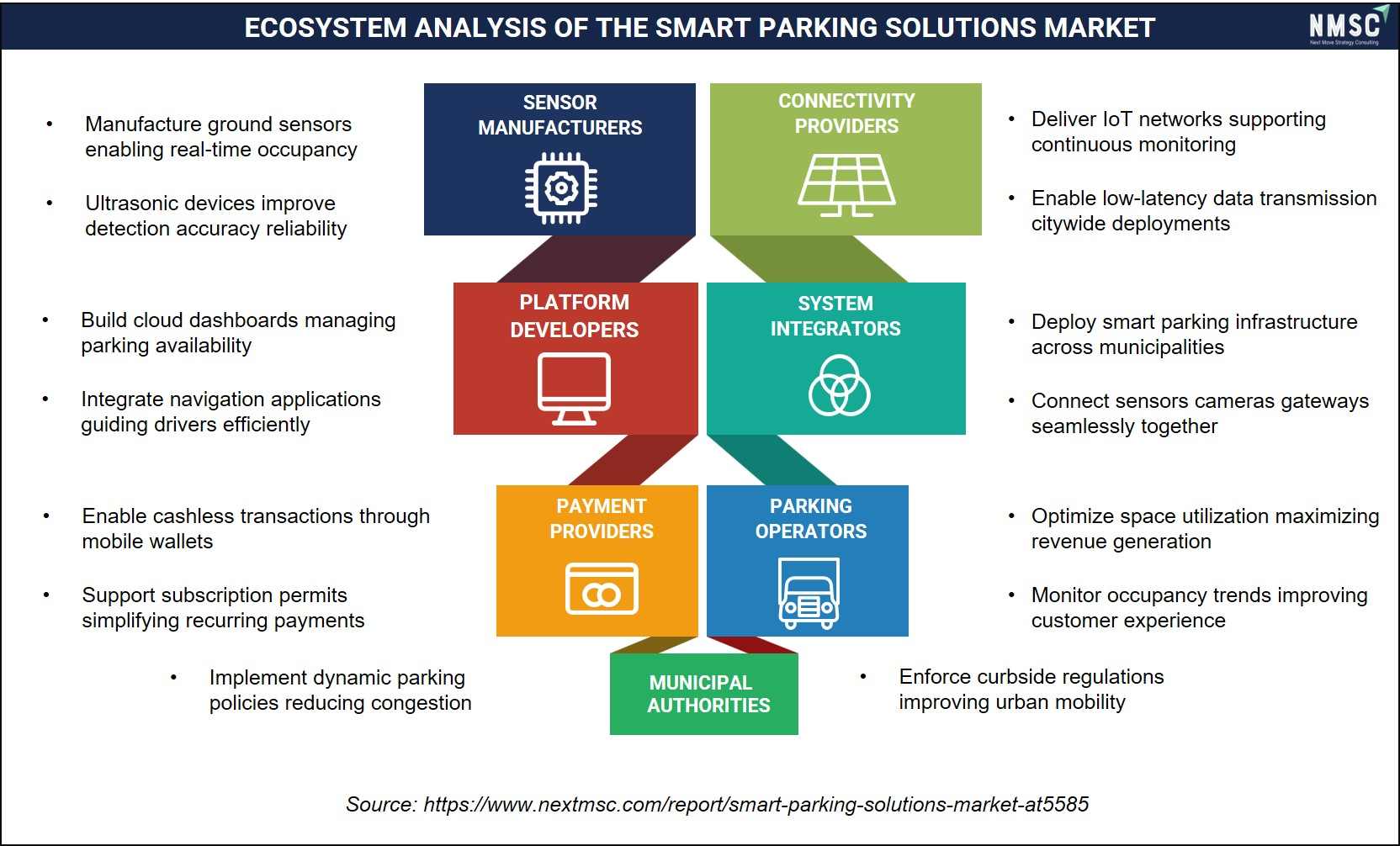
The above infographic maps the interdependent smart parking ecosystem, where sensor manufacturing and low-latency IoT connectivity establish foundational data reliability. Platform developers and system integrators ensure real-time monitoring and seamless infrastructure deployment across municipalities. Operational viability further depends on payment providers enabling frictionless transactions and operators optimizing space utilization. Ultimately, municipal authorities serve as the critical gatekeepers, enforcing dynamic curbside policies and mobility regulations that ensure scalable, congestion-reducing urban deployments.
What does the Smart Parking Solutions Market Encompass?
The Smart Parking Solutions Market covers sensor, camera, and license plate recognition hardware, cloud-based parking management software, and installation and managed services that together digitize on-street and off-street parking availability, payment, and enforcement for municipalities, commercial operators, and transportation hubs. We observed that the market has evolved from isolated sensor pilots into integrated curb-management platforms that combine occupancy data, dynamic pricing, and mobile payment across municipal, commercial, and institutional parking assets.
Our findings suggest that U.S. Department of Transportation SMART Grants funding, which provided up to USD 15 million per Stage 2 project for curb and parking digitization pilots in 2024 and 2025, is structurally reinforcing municipal technology adoption. Technology adoption trends toward camera-based license plate recognition and AI-driven occupancy analytics are further extending smart parking value beyond space-finding into enforcement and dynamic pricing use cases.
|
Parameter |
Details |
|
Market Size in 2025 |
USD 7.60 Billion |
|
Market Size in 2026 |
USD 8.70 Billion |
|
Revenue Forecast in 2035 |
USD 29.50 Billion |
|
Growth Rate |
CAGR of 14.5% from 2026 to 2035 |
|
Analysis Period |
2025–2035 |
|
Base Year Considered |
2025 |
|
Forecast Period |
2026–2035 |
|
Market Size Estimation |
USD Billion |
|
Companies Profiled |
20 |
|
Countries Covered |
38 |
|
Market Share |
Available for Top 10 Companies |
Key Emerging Trends
Based on research conducted by NMSC, we found that four structural trends are redefining how smart parking vendors compete, deploy, and expand their addressable applications through 2035.
How Is Curb Management Integration Transforming Municipal Parking Technology?
We found that curb management integration is transforming standalone parking technology into broader mobility data platforms covering loading zones, ride-hailing pickup, and delivery dwell time alongside traditional parking. The Seattle and Minneapolis SMART Grant Stage 2 curb management project, which received a USD 15 million USDOT award in December 2024, exemplifies this transformation, combining in-ground and camera-based sensors to track curb usage across an open-data platform shared between cities.
What Role Does Camera-Based License Plate Recognition Play in Smart Parking Solutions Market Adoption?
Our assessment indicates that camera-based license plate recognition is gaining adoption as municipalities shift from single-purpose occupancy sensors toward multi-function cameras that combine space detection with automated enforcement and access control. This adoption reduces per-space hardware cost for large facilities while enabling license-plate-based payment and permit verification without physical gates or meters.
How Are Stakeholders Responding to Dynamic Pricing Models?
We observed that municipal transportation departments and commercial operators are increasingly adopting demand-responsive dynamic pricing that adjusts parking rates in real time based on occupancy data. This stakeholder response reflects growing evidence that dynamic pricing improves space turnover and reduces circling-related congestion, pushing vendors to embed pricing engines directly within core parking management software rather than as separate add-ons.
Why Is Residential Complex Adoption Gaining Traction in the Smart Parking Solutions Market?
During our market evaluation, we noticed that residential and mixed-use developments are adopting smart parking systems to manage resident and visitor allocation more efficiently than manual permit systems. This traction reflects property managers' need to optimize limited on-site parking inventory as urban residential density increases, making automated allocation a practical amenity rather than a premium feature reserved for commercial facilities.
Growth Drivers & Restraints
Growth Catalyst & Risk Assessment Matrix
|
Factors |
Type |
(+/−) % Impact on CAGR |
Geographic Relevance |
Impact Timeline |
|
Municipal smart city and curb management technology grants |
Driver |
+3.6% |
North America, Europe |
2026–2032 |
|
Rising urban vehicle ownership and parking scarcity |
Driver |
+3.1% |
Asia-Pacific, Latin America |
2026–2035 |
|
Growing adoption of camera-based license plate recognition |
Driver |
+2.4% |
Global |
2026–2033 |
|
Integration of parking data with broader curb management platforms |
Driver |
+1.8% |
North America, Europe |
2026–2031 |
|
Expansion of contactless mobile payment infrastructure |
Driver |
+1.2% |
Global |
2026–2030 |
|
High upfront sensor installation and retrofit costs |
Restraint |
−1.9% |
Latin America, MEA, Asia-Pacific |
2026–2035 |
|
Municipal budget constraints limiting large-scale deployment |
Restraint |
−1.4% |
MEA, Latin America |
2026–2033 |
|
Data privacy and surveillance concerns around camera systems |
Restraint |
−1.0% |
Europe, North America |
2026–2032 |
|
Fragmented technology standards across municipal systems |
Restraint |
−0.7% |
Global |
2027–2035 |
What is the Primary Growth Driver in the Smart Parking Solutions Market?
The primary growth driver is municipal smart city and curb management technology funding, exemplified by the U.S. Department of Transportation's SMART Grants program, which appropriated USD 100 million for fiscal years 2022 through 2026 and awarded Stage 2 implementation grants of up to USD 15 million per project in December 2024. This sustained federal funding is directly underwriting municipal parking and curb digitization pilots that scale into permanent deployments.
How is Rising Urban Vehicle Ownership Driving the Smart Parking Solutions Market Growth?
Our analysis shows that rising urban vehicle ownership across Asia-Pacific and Latin America is directly driving demand for space-optimization technology, as parking supply growth structurally lags vehicle registration growth in dense metropolitan areas. Industry-derived estimates suggest this supply-demand imbalance is the single largest structural driver of hardware and software adoption across both municipal and commercial parking segments globally.
What is Restraining the Smart Parking Solutions Market?
We found that the primary restraint is the high upfront cost of sensor installation and retrofit relative to existing manual or ungated parking infrastructure, which limits adoption among budget-constrained municipalities and smaller commercial operators. Industry-derived estimates suggest that municipal capital budget cycles, which often extend beyond typical grant funding windows, are also slowing the pace of large-scale citywide deployment relative to pilot-stage adoption.
Segmentation Analysis
Segment Sizing: By Offering
|
Segment |
2025 (USD Bn) |
2035 (USD Bn) |
CAGR% (2026–2035) |
|
Hardware |
3.50 |
10.32 |
11.07% |
|
Software |
2.43 |
12.10 |
17.75% |
|
Services |
1.67 |
7.08 |
15.67% |
|
Total |
7.60 |
29.50 |
14.53% |
Which Offering Segment Dominates the Smart Parking Solutions Market?
Hardware leads with USD 3.50 Billion in 2025, expanding to USD 10.32 Billion by 2035, reflecting the foundational role of sensors, cameras, and payment terminals in every deployment. Software is the fastest-growing offering segment at a 17.75% CAGR, as vendors increasingly monetize recurring subscription access to parking management, analytics, and guidance platforms layered atop existing hardware installations.
Segment Sizing: By Parking Site Type
|
Segment |
2025 (USD Bn) |
2035 (USD Bn) |
CAGR% (2026–2035) |
|
On-Street Parking |
2.58 |
7.97 |
11.63% |
|
Off-Street Parking |
5.02 |
21.53 |
15.82% |
|
Total |
7.60 |
29.50 |
14.53% |
Which Parking Site Type Leads and Which Grows Fastest?
Off-Street Parking dominates at USD 5.02 Billion in 2025, reflecting concentrated technology deployment across surface lots and multi-level garages operated by commercial and institutional owners with clearer capital budgets than municipal on-street programs. Off-Street Parking is also the fastest-growing site type at a 15.82% CAGR, as commercial real estate and airport operators pursue integrated occupancy, payment, and guidance systems across large controlled-access facilities.
Segment Sizing: By End User
|
Segment |
2025 (USD Bn) |
2035 (USD Bn) |
CAGR% (2026–2035) |
|
Municipal and Government |
2.28 |
7.37 |
12.18% |
|
Commercial Real Estate |
1.37 |
5.02 |
13.79% |
|
Airports |
0.91 |
3.25 |
13.50% |
|
Transit and Rail Hubs |
0.76 |
3.83 |
17.90% |
|
Retail and Shopping Centers |
0.91 |
3.25 |
13.50% |
|
Healthcare and Educational Institutions |
0.61 |
2.65 |
15.94% |
|
Event Venues and Stadiums |
0.38 |
1.77 |
17.02% |
|
Residential Complexes |
0.38 |
2.36 |
20.83% |
|
Total |
7.60 |
29.50 |
14.53% |
Which End User Dominates and Which is Fastest-Growing in the Smart Parking Solutions Market?
Municipal and Government end users lead demand at USD 2.28 Billion in 2025, growing to USD 7.37 Billion by 2035, underpinned by sustained public congestion-management and curb-digitization funding. Residential Complexes are the fastest-growing end user at a 20.83% CAGR, as property managers increasingly deploy automated resident and visitor allocation systems to optimize constrained on-site parking inventory in dense urban developments.
Growth Opportunities
Our analysis shows that three whitespace opportunities stand out for vendors positioning ahead of 2035 demand.
Can Curb Management Data Platforms Unlock Recurring Municipal Revenue?
Vendors that extend parking sensor networks into broader curb management data platforms covering loading zones and ride-hailing pickup can capture recurring municipal software revenue beyond initial hardware installation, benefiting the Software offering and Municipal and Government end-user segments as cities formalize curb-data programs.
Does EV Charging Integration Create Value for Off-Street Operators?
Vendors that bundle EV charging session management with parking occupancy and payment systems can capture rising demand from commercial and airport operators seeking a single integrated platform, benefiting the Off-Street Parking and Airports segments as EV charging infrastructure scales alongside conventional parking.
Can Residential Allocation Software Expand Adoption in Dense Urban Markets?
Vendors offering affordable, easy-to-deploy resident and visitor parking allocation software can capture the large population of mixed-use residential developments currently underserved by enterprise-priced municipal platforms, benefiting the Software offering and Residential Complexes end-user segments.
Strategic Analysis of the Smart Parking Solutions Industry
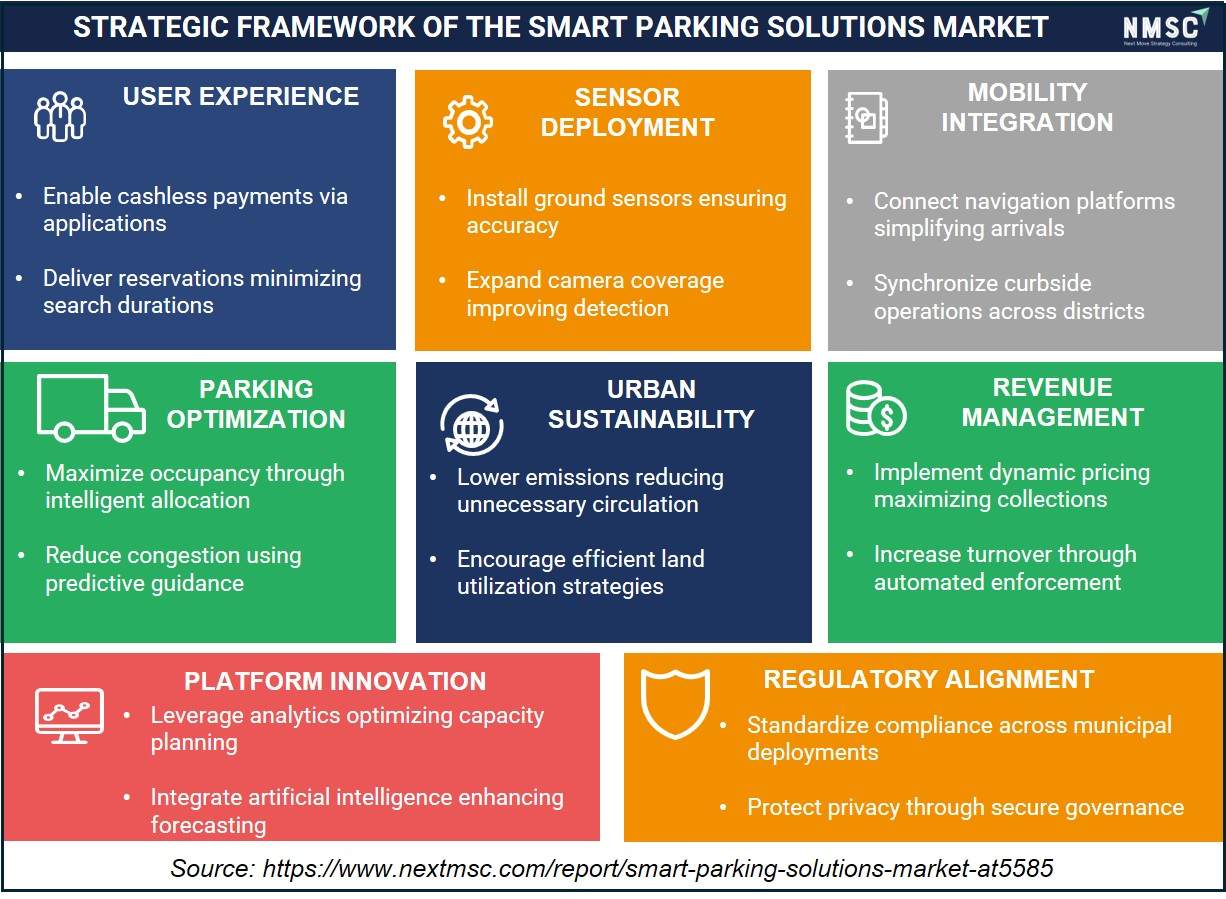
The above infographic presents a strategic framework for the Smart Parking Solutions Market, where precise sensor deployment and mobility integration establish reliable data collection. Expertise in data-driven platform innovation and parking optimization enables predictive capacity planning, directly reducing urban congestion. Market viability hinges on seamless user experiences and dynamic revenue management. Crucially, strong regulatory alignment ensures standardized municipal compliance and robust privacy governance, serving as the foundational pillar for sustainable, large-scale urban deployments.
Regional Outlook
|
Region |
2025 (USD Bn) |
2035 (USD Bn) |
CAGR% (2026–2035) |
Key Driver |
|
North America |
2.58 |
8.55 |
12.51% |
USDOT SMART Grants funding municipal curb and parking digitization |
|
Europe |
2.05 |
7.08 |
13.04% |
Low-emission zone enforcement and urban parking digitization |
|
Asia-Pacific |
2.13 |
10.03 |
17.01% |
Rapid urban vehicle growth and municipal smart city investment |
|
Latin America |
0.46 |
2.36 |
18.30% |
Expanding private parking operator investment |
|
Middle East & Africa |
0.38 |
1.48 |
14.72% |
Government-led smart city infrastructure programs |
|
Total |
7.60 |
29.50 |
14.53% |
|
North America Smart Parking Solutions Market
North America holds the largest regional share, supported by sustained USDOT SMART Grants funding and concentrated municipal curb-management pilots scaling into permanent deployments. We observed that public-private deployment models are most advanced in this region, positioning North America as both the largest revenue base and the primary proving ground for new curb-management technology.
Europe Smart Parking Solutions Market
Europe's market is shaped by urban low-emission zone enforcement requirements and dense historic city centers where on-street parking optimization carries outsized congestion-reduction value. Our findings suggest that regional adoption of camera-based enforcement technology is accelerating as municipalities balance parking digitization with data-privacy compliance obligations.
Asia-Pacific Smart Parking Solutions Market
Asia-Pacific is the fastest-growing region, driven by rapid urban vehicle ownership growth across China and India that structurally outpaces new parking supply. We found that domestic technology vendors are scaling deployment fastest in this region, reflecting government-backed smart city programs that bundle parking digitization with broader urban mobility infrastructure investment.
Middle East & Africa Smart Parking Solutions Market
The Middle East & Africa region remains an early-stage market, with the UAE and Saudi Arabia leading government-funded smart city programs that include parking digitization components. Industry-derived estimates suggest regional growth will track broader urban infrastructure investment rather than parking-specific regulatory mandates, given the comparatively nascent standalone parking technology environment in the region.
Latin America Smart Parking Solutions Market
Latin America is the fastest-growing region among all five at a 18.30% CAGR, led by Brazil's growing private parking operator investment in urban centers. We observed that Argentina's municipal sector offers latent demand for smart parking as cities begin formalizing on-street parking management previously handled through manual attendant systems.
U.S. Smart Parking Solutions Market
Based on our estimates, the U.S. market was valued at approximately USD 2.13 Billion in 2025 and is projected to reach USD 6.82 Billion by 2035 at a CAGR near 12.4%. Demand structure is anchored by USDOT SMART Grants funding and concentrated municipal deployment across major metropolitan areas, with high technology penetration and strong competitive intensity between Cisco Systems, IPS Group, and T2 Systems.
Canada Smart Parking Solutions Market
The market in Canada was estimated at around USD 0.45 Billion in 2025, forecast to reach USD 1.73 Billion by 2035 at roughly 14.6% CAGR. Canada's demand structure closely mirrors U.S. municipal adoption patterns, with growing curb-management pilots in major cities, supporting steady technology penetration and moderate competitive intensity.
UK Smart Parking Solutions Market
As per our estimate, the UK market stood near USD 0.62 Billion in 2025 and is expected to reach USD 2.19 Billion by 2035 at approximately 13.5% CAGR. Strong low-emission zone enforcement and dense urban centers support demand, with regulatory influence centered on local council parking policy rather than binding national mandates.
Germany Smart Parking Solutions Market
According to our analysis, Germany's market was valued at about USD 0.55 Billion in 2025, projected to reach USD 1.91 Billion by 2035 at a CAGR near 13.3%. Germany's demand structure benefits from strong municipal budgets and established vendors including SWARCO and Robert Bosch, supporting high technology penetration across on-street and off-street applications.
France Smart Parking Solutions Market
Based on our estimates, France's market reached approximately USD 0.31 Billion in 2025 and is forecast to grow to USD 1.06 Billion by 2035 at around 13.2% CAGR. Demand is supported by growing municipal parking digitization and the presence of Flowbird, headquartered domestically, with moderate competitive intensity among regional and global vendors.
China Smart Parking Solutions Market
The market in China was valued at nearly USD 0.68 Billion in 2025 and is projected to reach USD 3.72 Billion by 2035 at approximately 20.2% CAGR. China's growth reflects its enormous urban vehicle population and rapidly scaling government-backed smart city investment, with domestic technology developers competing intensely alongside global vendors for municipal contracts.
India Smart Parking Solutions Market
As per our estimate, India's market was close to USD 0.30 Billion in 2025, expected to reach USD 2.05 Billion by 2035 at roughly 24.0% CAGR, the fastest among covered countries. Rapid urban vehicle growth and municipal digitization programs are driving demand, though technology penetration remains moderate as formal parking management infrastructure continues to scale relative to established markets.
Japan Smart Parking Solutions Market
According to our analysis, Japan's market stood at about USD 0.32 Billion in 2025 and is forecast to reach USD 1.30 Billion by 2035 at approximately 15.6% CAGR. Japan's demand structure benefits from dense urban centers and the presence of Amano Corporation, headquartered domestically, supporting high technology penetration among established off-street parking operators.
South Korea Smart Parking Solutions Market
Based on our estimates, South Korea's market was valued at around USD 0.19 Billion in 2025, projected to reach USD 0.85 Billion by 2035 at around 17.6% CAGR. Rising urban vehicle density and growing municipal investment in smart city infrastructure support increasing technology adoption across the country's concentrated parking services sector.
Australia Smart Parking Solutions Market
As per our estimate, Australia's market reached approximately USD 0.13 Billion in 2025 and is expected to grow to USD 0.51 Billion by 2035 at roughly 15.5% CAGR. Australia's demand structure benefits from Smart Parking Limited's domestic headquarters and strong municipal adoption of sensor-based occupancy detection across major metropolitan centers.
UAE Smart Parking Solutions Market
Based on our estimates, the UAE market was valued at about USD 0.10 Billion in 2025 and is forecast to reach USD 0.41 Billion by 2035 at approximately 15.9% CAGR. Growing government-funded smart city investment and expanding commercial real estate support the UAE's emerging role as a regional smart parking hub.
Saudi Arabia Smart Parking Solutions Market
According to our analysis, Saudi Arabia's market stood at around USD 0.09 Billion in 2025, projected to reach USD 0.35 Billion by 2035 at around 15.7% CAGR. Vision 2030-linked urban development initiatives are supporting early-stage investment in parking digitization infrastructure, with competitive intensity currently limited to a small number of regional and global vendors.
South Africa Smart Parking Solutions Market
As per our estimate, South Africa's market was close to USD 0.05 Billion in 2025 and is expected to reach USD 0.19 Billion by 2035 at roughly 14.9% CAGR. A growing private commercial real estate sector gives South Africa the strongest technology penetration in the MEA region, supporting a strategic outlook centered on off-street parking adoption in urban centers.
Brazil Smart Parking Solutions Market
Based on our estimates, Brazil's market reached approximately USD 0.27 Billion in 2025 and is projected to reach USD 1.42 Billion by 2035 at around 19.6% CAGR. Rapid private parking operator expansion and growing urban vehicle density are driving demand structure, with strategic investment appeal strengthening as municipal formalization of on-street parking continues.
Argentina Smart Parking Solutions Market
According to our analysis, Argentina's market was valued at about USD 0.08 Billion in 2025, forecast to reach USD 0.40 Billion by 2035 at approximately 18.6% CAGR. A growing urban parking sector offers rising demand for smart parking technology, though competitive intensity remains moderate given the still-developing formal municipal digitization infrastructure relative to Brazil.
Competitive Landscape
Our assessment indicates that the competitive landscape spans diversified technology conglomerates, specialized parking hardware and software vendors, and regional mobile payment platforms, each competing on sensor accuracy, software integration breadth, and municipal contract depth.
Key Takeaways
|
Dimension |
Assessment |
|
Market Structure |
Fragmented; top 10 companies hold a meaningful but not dominant share of Market Share, reflecting a mix of global technology conglomerates and specialized regional parking vendors |
|
Innovation Focus |
Camera-based license plate recognition, curb-management data platforms, dynamic pricing engines, and EV charging integration |
|
M&A Activity |
Selective acquisitions of mobile payment and app-based platforms by larger parking technology groups rather than large-scale industry-wide consolidation |
How Do Companies Compete in the Smart Parking Solutions Market?
Companies compete primarily on sensor and camera detection accuracy, breadth of software integration across occupancy, payment, and enforcement functions, and depth of municipal and commercial contract relationships. Our findings suggest that vendors with established hardware installed bases hold a structural advantage over software-only entrants, since municipal customers favor proven detection reliability before committing to citywide deployment.
Which Competitive Archetypes Dominate the Smart Parking Solutions Market?
Diversified technology conglomerates such as Siemens AG and Cisco Systems, Inc. compete through broader smart city platform integration, while specialized vendors including IPS Group, Inc. and EasyPark Group differentiate through focused parking meter and mobile payment innovation. Regional players such as Amano Corporation and SWARCO AG compete on deep municipal relationships and localized service networks underserved by global platform vendors.
What Innovation and Differentiation Strategies Are Companies Pursuing?
We observed that leading vendors are investing in camera-based license plate recognition and cloud-connected curb management platforms to extend value beyond basic occupancy detection into enforcement and mobility data services. Differentiation increasingly rests on dynamic pricing and analytics capability, since municipal and commercial customers increasingly evaluate vendors on revenue-optimization outcomes rather than hardware specifications alone.
What M&A and Partnership Activity Is Shaping the Smart Parking Solutions Market?
Recent activity favors mobile payment platform consolidation, exemplified by EasyPark Group's portfolio combining ParkMobile, EasyPark, and RingGo under a single corporate structure serving multiple regional markets. Our analysis shows that such structures let incumbents expand geographic coverage and cross-sell payment infrastructure without the integration risk of large-scale hardware-vendor mergers.
Key Market Players
Based on research conducted by NMSC, the following companies represent the validated set of leading participants across smart parking hardware, software, and payment platforms.
-
Siemens AG
-
Cisco Systems, Inc.
-
Robert Bosch GmbH
-
Continental AG
-
Assa Abloy AB (SKIDATA)
-
Nedap N.V.
-
SWARCO AG
-
Amano Corporation
-
EasyPark Group
-
Flowbird SAS
-
IPS Group, Inc.
-
Parkopedia Limited
-
Smart Parking Limited
-
Urbiotica S.L.
-
Q-Free ASA
-
Cleverciti Systems GmbH
-
T2 Systems, Inc.
-
CivicSmart, Inc.
-
Worldsensing S.L.
Latest Developments
We found that recent activity reflects continued expansion of municipal curb and parking digitization pilots even as the overall competitive landscape remains fragmented among established vendors.
|
Date |
Event |
|
July 2026 |
Smart Parking Limited acquired U.S.-based American Parking, adding 54 managed parking locations across Oklahoma, Texas, and Arkansas. The acquisition expands Smart Parking's operational footprint and creates opportunities to deploy its parking-management technologies across additional U.S. locations. |
|
June 2026 |
Parkopedia and BYD showcased a next-generation ParkPay service designed to integrate parking discovery and in-car payment capabilities into BYD vehicles using Android Automotive OS with Google built-in. |
|
November 2025 |
Parkopedia and SoundHound AI introduced an in-vehicle voice AI parking agent that enables drivers to search for parking, compare real-time prices and availability, make recommendations, and complete payments through voice interaction. |
Expert Insights
 “Agentic voice commerce is redefining how drivers interact with their vehicles, allowing them to make hands-free purchases and complete transactions on the go. Parking is a natural next application. Together with Parkopedia, we’re giving drivers a fully conversational, hands-free way to find and pay for parking on the go. It's part of our broader vision to make everyday in-car tasks effortless, intelligent and connected.”
— Michael Zagorsek, COO at SoundHound AI
Statement made following the launch of the voice AI-powered parking search and payment agent developed by SoundHound AI and Parkopedia.
Market Interpretation
The insight highlights the growing integration of agentic AI, conversational interfaces, and digital payments into smart parking ecosystems. Voice-enabled parking solutions can reduce the time and effort associated with locating, reserving, and paying for parking while improving convenience and minimizing driver distraction. As connected vehicles become more intelligent, smart parking platforms are expected to increasingly incorporate AI-powered recommendations, real-time parking data, automated reservations, and frictionless in-car payment capabilities.
Investment Opportunities
Where Are Capital Inflows Concentrating in the Smart Parking Solutions Market?
Capital is concentrating in curb-management data platforms and camera-based enforcement technology, the two areas benefiting most directly from USDOT SMART Grants funding. The program's USD 100 million appropriation for fiscal years 2022 through 2026 signals sustained public capital allocation toward parking and curb digitization pilots that private vendors can scale into recurring software contracts.
How Is Infrastructure Investment Shaping Long-Term Capacity?
Our findings suggest that infrastructure investment is shifting toward multi-function camera systems that combine occupancy detection with enforcement and access control, reducing the need for separate single-purpose hardware deployments. This shift favors vendors with existing camera and analytics infrastructure that can be extended to new municipal and commercial applications without full system replacement.
What ESG Considerations Are Influencing Investment Decisions in the Smart Parking Solutions Market?
Environmental, Social, and Governance considerations in this market center on congestion-related emissions reduction and data-privacy governance around camera-based surveillance systems. We found that investors increasingly favor vendors demonstrating documented congestion and emissions reduction outcomes alongside transparent data-handling practices as a proxy for durable, policy-aligned growth.
Key Benefits for Stakeholders
How Does This Report Benefit Industry Leaders?
Industry leaders gain segment-level revenue forecasts and CAGR benchmarks across offering, parking site type, and end-user axes, enabling product-roadmap decisions grounded in the same 2025–2035 figures used consistently throughout this analysis. Our findings on regional growth differentials further support market-entry and municipal partnership decisions.
How Does This Report Benefit Investors and Financial Analysts?
Investors and financial analysts gain a reconciled market-sizing model, competitive-landscape assessment, and named-company development tracking that supports valuation and capital-allocation decisions. The report's Growth Catalyst & Risk Assessment Matrix quantifies driver and restraint impact on CAGR, aiding scenario analysis for portfolio positioning.
How Does This Report Benefit Technology Vendors and Product Teams?
Technology vendors and product teams gain visibility into which offerings and end-user segments, such as Software and Residential Complexes, are growing fastest, informing where to prioritize engineering investment and go-to-market focus through 2035.
Key Market Segments
By Offering
-
Hardware
-
Parking sensors
-
Cameras and vision systems
-
Smart meters and payment terminals
-
Gates and barriers
-
-
Software
-
Parking management software
-
Mobile payment and reservation apps
-
Data analytics and guidance platforms
-
-
Services
-
Installation and integration services
-
Maintenance and support services
-
Managed parking services
-
By Parking Site Type
-
On-street parking
-
Off-street parking
-
Surface lots
-
Multi-level garages
-
By Technology
-
Sensor-based detection
-
Camera-based detection
-
RFID and license plate recognition
-
Ultrasonic and radar detection
By Deployment Mode
-
Cloud
-
On-premises
By End User
-
Municipal and government
-
Commercial real estate
-
Airports
-
Transit and rail hubs
-
Retail and shopping centers
-
Healthcare and educational institutions
-
Event venues and stadiums
-
Residential complexes
-
By Region
-
North America: U.S., Canada, Mexico
-
Europe: UK, Germany, France, Italy, Spain, Sweden, Denmark, Finland, Netherlands, Rest of Europe
-
Asia-Pacific: China, India, Japan, South Korea, Taiwan, Indonesia, Vietnam, Australia,Philippines, Malaysia, Rest of APAC
-
Middle East & Africa: Saudi Arabia, UAE, Egypt, Israel, Turkey, Nigeria, South Africa, Rest of MEA
-
Latin America: Brazil, Argentina, Chile, Colombia, Rest of LATAM
Conclusion & Recommendations
What Is the Long-Term Outlook for the Smart Parking Solutions Market?
The long-term outlook remains structurally positive, with the market expanding from USD 8.70 Billion in 2026 to USD 29.50 Billion by 2035 at a 14.5% CAGR, driven by municipal technology funding and rising urban vehicle density. We observed that this growth trajectory is underpinned by durable public infrastructure investment cycles rather than speculative adoption, supporting sustained hardware and software investment.
What Strategic Positioning Do We Recommend?
Our assessment indicates that vendors should prioritize curb-management data platform expansion and camera-based enforcement technology to capture the fastest-growing Software and Residential Complexes segments. Companies without established municipal contract relationships should pursue grant-funded pilot partnerships rather than direct commercial sales given the market's clear reliance on public procurement cycles.
How Attractive Is the Market for Investment?
Investment attractiveness is high in Asia-Pacific and Latin America given superior CAGR profiles of 17.01% and 18.30%, respectively, while North America offers the largest absolute revenue base with durable grant-funded recurring demand. We found that software and services revenue streams materially de-risk vendor revenue relative to one-time hardware sales alone.
What Are the Key Market Shifts and Risks?
Key risks include high upfront sensor installation costs that constrain budget-limited municipal buyers and growing data-privacy scrutiny around camera-based enforcement systems in Europe and North America. Our analysis shows that vendors unable to demonstrate transparent data governance risk facing procurement delays in privacy-sensitive municipal markets.
What Are the Primary Growth Pathways Through 2035?
Primary growth pathways include curb-management data platform expansion, deeper camera-based enforcement integration, and residential allocation software targeting dense mixed-use developments. We observed that vendors combining all three pathways are best positioned to capture a disproportionate share of the USD 20.80 Billion absolute opportunity created between 2026 and 2035.
About the Author
 Mayurima Roy
— Mayurima Roy is Research Analyst at Next Move Strategy Consulting, where she has spent 4 years working across the firm's full industry coverage rather than a single fixed vertical. Her work centers on structured research, ongoing trend tracking, competitive assessment, and insight-led content development, translating complex market data into clear, decision-ready narratives that support informed client decision-making across diverse global industries, market sectors, and world regions every day.
Mayurima Roy
— Mayurima Roy is Research Analyst at Next Move Strategy Consulting, where she has spent 4 years working across the firm's full industry coverage rather than a single fixed vertical. Her work centers on structured research, ongoing trend tracking, competitive assessment, and insight-led content development, translating complex market data into clear, decision-ready narratives that support informed client decision-making across diverse global industries, market sectors, and world regions every day.
About the Reviewer
 Supradip Baul
— Supradip Baul is an accomplished business consultant and strategist with over a decade of rich experience in market intelligence, strategy, technology, and business transformation. His work has included rigorous qualitative and quantitative analysis across multiple industries, helping clients shape investment decisions and long-term roadmaps. Earlier in his career, he was associated with Gartner, where he contributed to industry-leading reports and market share analyses. He has worked with leading global companies and holds an MBA with a dual specialization in Marketing and Finance.
Supradip Baul
— Supradip Baul is an accomplished business consultant and strategist with over a decade of rich experience in market intelligence, strategy, technology, and business transformation. His work has included rigorous qualitative and quantitative analysis across multiple industries, helping clients shape investment decisions and long-term roadmaps. Earlier in his career, he was associated with Gartner, where he contributed to industry-leading reports and market share analyses. He has worked with leading global companies and holds an MBA with a dual specialization in Marketing and Finance.
At Next Move Strategy Consulting, we understand that insightful market research is the cornerstone of successful business decisions. That's why we employ a robust and multifaceted approach, combining various methodologies to deliver the most accurate and actionable data for our clients.

Research Landscape
We navigate the world of research with two primary approaches:
Qualitative Approach
Our qualitative research methodologies involve immersive techniques such as in-depth interviews, focus groups, and observational studies. By engaging directly with individuals and stakeholders, we uncover valuable insights that quantitative data alone may overlook.

Quantitative Research
In tandem with qualitative methodologies, NMSC leverages the power of Quantitative Research to provide a robust foundation of numerical insights. Through systematic data collection and analysis, we quantify patterns, preferences, and market trends, offering a comprehensive view of the business landscape.
Our quantitative research approach employs diverse tools, including surveys, experiments, and statistical modelling. These methodologies enable us to gather data from a large and representative sample, ensuring the statistical significance of our findings. By employing structured questionnaires and standardized data collection methods, we guarantee the reliability and validity of the information we present to our clients.
Quantitative research is particularly effective in measuring the prevalence of trends, assessing market size, and gauging the impact of various factors on consumer behavior. The numerical precision attained through this approach equips our clients with actionable insights, facilitating data-driven decision-making and strategy formulation.


Our Specialized Toolbox for Industry-Specific Market Research
We deploy a specialized arsenal of techniques tailored to meet your unique requirements. Here's a glimpse into our comprehensive toolbox:

Information Procurement
The stage entails acquiring market data or relevant information through various sources and methodologies.


Market Research Approach
We utilize both top-down and bottom-up approaches in market research analysis to achieve a comprehensive understanding of the market dynamics, leveraging the broad perspective of industry trends and macroeconomic factors alongside detailed insights from specific segments and individual companies.

Porters Five Forces Analysis
We conduct Porter's Five Forces analysis to evaluate the competitive landscape of an industry, providing us with insights into factors that affect profitability and strategic positioning.

SWOT Analysis

Forecasting
We utilize a forecasting model to predict future consumption by considering parameters like population, economics, regulations, market competition, drivers, constraints, technology, and pricing. We also employ statistical techniques such as multilinear regression, exponential smoothing, moving average, ARIMA, and Monte Carlo simulations for accurate predictions. In econometric forecasting, we analyzed short-term and long-term event impacts, attributing values based on regulatory frameworks, economic factors, and market events.





 Speak to Our Analyst