Smart Home Appliances Market Global Industry Analysis and Forecast (2026–2035)

The global Smart Home Appliances Market size was valued at USD 43.80 billion in 2025 and is estimated at USD 48.92 billion in 2026, forecast to reach USD 153.64 billion by 2035, expanding at a 13.56% CAGR from 2026 to 2035. Key drivers include rising smart-home ecosystem integration and voice-assistant adoption and government energy-efficiency mandates, with Asia-Pacific leading the global market.

Download Free Sample PDF
Base Year (2025)
$43.80 Billion
Forecast (2035)
$153.64 Billion
CAGR (2026-2035)
13.6%
Top Region
Asia-Pacific

What Is the Smart Home Appliances Market Size?

The global smart home appliances market size was valued at USD 43.80 Billion in 2025 and is estimated at USD 48.92 Billion in 2026, forecast to reach USD 153.64 Billion by 2035, expanding at a 13.56% CAGR between 2026 and 2035. Growth is propelled by rising smart-home ecosystem integration, expanding e-commerce appliance retail, government energy-efficiency mandates, and growing middle-class household formation across emerging economies.

From our research, we found that revenue growth is broad-based across product categories, with connected cleaning appliances and multi-protocol hub-based connectivity emerging as the fastest-scaling categories through 2035. Based on research conducted by NMSC, we found that Asia-Pacific's manufacturing scale and rising disposable income are reinforcing the region's position as both the largest and fastest-growing contributor to global market revenue.

Through our market assessment, we observed that consumer demand is shifting from single-function connected devices toward interoperable, subscription-enabled appliance ecosystems. Our analysis shows that appliance manufacturers are increasingly bundling predictive-maintenance software and usage analytics with hardware sales, reflecting a structural transition toward recurring, service-based revenue streams across the market report's forecast period.

Smart Home Appliances Market Global Industry Analysis and Forecast (2026–2035) Revenue Forecast

Values in USD Billion

2025 $43.80 Billion
2025
2026 $49.74 Billion
2026
2027 $56.48 Billion
2027
2028 $64.14 Billion
2028
2029 $72.84 Billion
2029
2030 $82.72 Billion
2030
2031 $93.93 Billion
2031
2032 $106.67 Billion
2032
2033 $121.14 Billion
2033
2034 $137.56 Billion
2034
2035 $153.64 Billion
2035

Key Takeaways

By Product Type: Smart Kitchen Appliances held the largest share of approximately 34% (USD 14.892 Billion) in 2025; Smart Cleaning Appliances is the fastest-growing sub-segment at 20.3% CAGR from 2026-2035.

By Connectivity Technology: Wi-Fi Enabled held the largest share of approximately 58% (USD 25.404 Billion) in 2025; Multi-Protocol and Hub-Based is the fastest-growing sub-segment at 24.8% CAGR from 2026-2035.

By Distribution Channel: Online Retail held the largest share of approximately 46% (USD 20.148 Billion) in 2025 and is also the fastest-growing channel at 17.0% CAGR from 2026-2035.

By End User: Residential held the largest share of approximately 84% (USD 36.792 Billion) in 2025; Commercial is the fastest-growing sub-segment at 17.9% CAGR from 2026-2035.

Dominant Region: Asia-Pacific dominated with approximately 38% revenue share (USD 16.644 Billion) in 2025.

Fastest-Growing Region: Asia-Pacific is expected to register the highest CAGR of 19.3% during 2026-2035.

Dominant Country: U.S. led with approximately USD 8.20 Billion in 2025.

Fastest-Growing Country: India is the fastest-growing country at approximately 23.5% CAGR from 2026-2035.

Market Opportunity: The smart home appliances market is expected to create an absolute dollar opportunity of USD 104.72 Billion between 2026 and 2035, presenting significant investment potential across the residential, commercial, and connected-appliance retail value chain.

According to Next Move Strategy Consulting analysis, manufacturers are increasingly bundling AI-based predictive maintenance and multi-protocol connectivity as standard features rather than premium add-ons, a shift that favors diversified appliance conglomerates with in-house software capability over hardware-only competitors as replacement cycles accelerate through 2035.

What Does the Smart Home Appliances Market Encompass?

The smart home appliances market encompasses internet-connected kitchen, laundry, climate control, and cleaning devices equipped with sensors, embedded processors, and app or voice-based control capability. Our assessment indicates that scope excludes non-connected conventional appliances and adjacent smart-home security or lighting device categories, focusing exclusively on appliances that perform a core household function while offering remote monitoring, automation, or usage-analytics capability to residential and commercial end users.

How Has the Smart Home Appliances Market Structurally Evolved?
The market has evolved from single-device Wi-Fi-enabled novelties into integrated ecosystems spanning multiple appliance categories linked through common hub platforms. In our observation, manufacturers have shifted from proprietary closed platforms toward interoperable standards, enabling cross-brand device communication. This structural evolution has expanded average revenue per household as consumers adopt multiple connected appliances rather than isolated single-device purchases.

What Regulatory Environment Shapes the Smart Home Appliances Market?

Regulatory frameworks from the U.S. Environmental Protection Agency's ENERGY STAR program and the European Commission's Ecodesign and Energy Labelling framework increasingly favor connected appliances capable of demand-response and usage-optimization features. Through NMSC's assessment, we found that these regulations are accelerating replacement-cycle demand in mature markets, as compliance-driven energy-efficiency requirements favor smart, sensor-equipped appliance models over conventional alternatives.

How Is Technology Adoption Progressing in the Smart Home Appliances Market?

Technology adoption is progressing toward AI-based predictive maintenance, voice-assistant integration, and multi-protocol hub-based connectivity that unifies previously fragmented device ecosystems. Based on our market evaluation, we noticed that consumers increasingly prioritize interoperability across Wi-Fi, Bluetooth, and Zigbee-based devices, prompting manufacturers to adopt open connectivity standards to remain competitive across the expanding smart home appliances industry landscape.

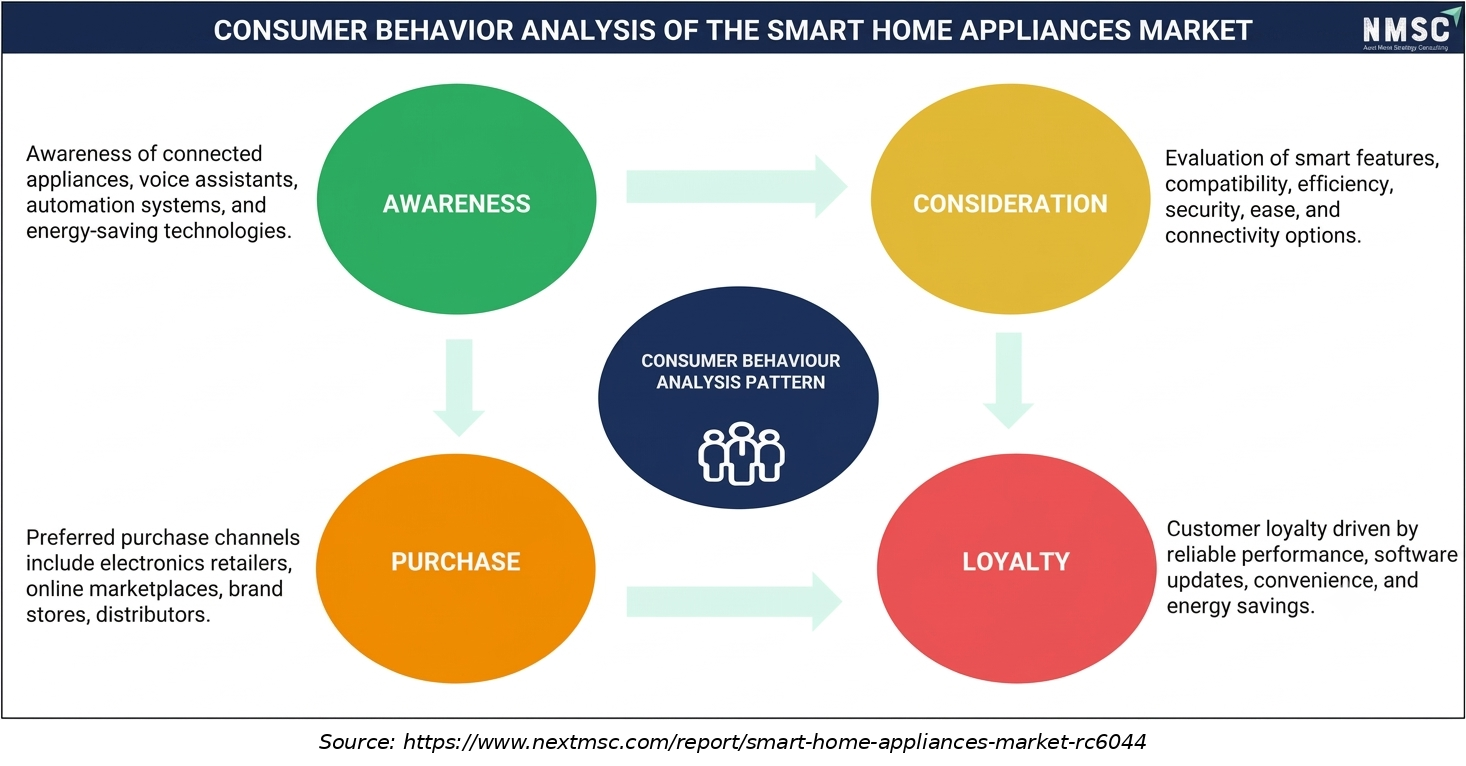
Consumer Behavior Analysis of the Smart Home Appliances Market
Consumer Behavior Analysis of the Smart Home Appliances Market
Based on our consumer behavior assessment, we identified that purchasing decisions for smart home appliances progress through awareness, evaluation, purchase, and long-term loyalty. Furthermore, our industry evaluation indicates that consumers prioritize smart functionality, device compatibility, energy efficiency, data security, ease of use, and seamless connectivity, while continued satisfaction is driven by reliable performance, regular software updates, convenient user experiences, and long-term energy savings.

Market Drivers & Dynamics

Interactive Dataset
Rising smart-home ecosystem and voice-assistant integration driver +3.6% Global 2026-2035
Expansion of e-commerce appliance retail penetration driver +2.8% Asia-Pacific, North America 2026-2035
Government energy-efficiency mandates favoring connected appliances driver +2.1% Europe, North America 2026-2032
Growing middle-class household formation in emerging economies driver +2.4% Asia-Pacific, Latin America 2026-2035
AI-based predictive maintenance and usage analytics adoption driver +1.9% Global 2027-2035
High upfront cost of connected appliances versus conventional units restraint -1.6% Latin America, MEA, Asia-Pacific 2026-2035
Data privacy and cybersecurity concerns around connected devices restraint -1.2% North America, Europe 2026-2030
Interoperability gaps between competing smart-home protocols opportunity +1.5% Global 2026-2033
Untapped replacement-cycle demand in rural and semi-urban markets opportunity +1.7% Asia-Pacific, MEA 2027-2035
Growth of subscription-based appliance-as-a-service models opportunity +1.3% North America, Europe 2028-2035
Source: Next Move Strategy Consulting

Growth Drivers

What Is the Primary Growth Driver of the Smart Home Appliances Market?

Rising smart-home ecosystem integration and voice-assistant adoption represent the primary growth driver. The Consumer Technology Association reported continued growth in connected-device household penetration through 2025, reinforcing sustained consumer demand for interoperable appliances. Our assessment indicates that this ecosystem-driven demand is accelerating multi-appliance adoption cycles within individual households across mature markets.

How Are Government Energy-Efficiency Mandates Driving Market Growth?

Government energy-efficiency mandates are driving adoption of connected appliances capable of demand-response functionality. The U.S. Environmental Protection Agency's ENERGY STAR program continues to expand connected-appliance certification criteria, incentivizing manufacturers to embed smart features. NMSC's analysis indicates that this regulatory tailwind is particularly pronounced across North America and Europe, where compliance requirements directly favor connected appliance categories.

How Is E-Commerce Expansion Driving Market Growth?

E-commerce expansion is driving market growth as online retail becomes the dominant distribution channel for connected appliances. Our findings suggest that online retail's 46% share in 2025 reflects consumers' growing comfort purchasing high-value connected appliances without in-store demonstration, supported by expanded return policies and virtual product-configuration tools offered by major online retailers.

Growth Inhibitors

What Is Restraining the Smart Home Appliances Market?

High upfront cost of connected appliances relative to conventional units restrains broader adoption, particularly across price-sensitive Latin American and African markets. Our analysis shows that this cost differential remains a meaningful barrier despite falling component costs, as connected appliances continue to command a premium over non-connected equivalents across most product categories.

How Do Data Privacy Concerns Restrain Market Growth?

Data privacy and cybersecurity concerns restrain adoption among privacy-conscious consumers wary of continuously connected household devices. Through NMSC's assessment, we found that this concern is most pronounced across North America and Europe, where data-protection regulation has heightened consumer awareness of connected-device vulnerabilities, prompting some consumers to delay smart appliance purchases.

What Are the Growth Opportunities?

What Opportunity Exists in Subscription-Based Appliance Services?

Subscription-based appliance-as-a-service models present opportunity for manufacturers to build recurring revenue atop hardware sales. This mechanism benefits appliance manufacturers and software platform providers capable of bundling predictive maintenance, filter replenishment, and usage-analytics subscriptions with connected appliance purchases across residential and commercial channels.

How Does Emerging-Market Replacement Demand Present a Growth Pathway?

Untapped replacement-cycle demand in rural and semi-urban emerging markets presents a growth pathway as rising disposable income supports first-time connected appliance purchases. This opportunity benefits manufacturers with established distribution networks across Asia-Pacific and Middle Eastern markets seeking to capture first-generation smart appliance adoption.

What Opportunity Exists in Multi-Protocol Hub Platforms?

Multi-protocol hub platforms present opportunity for software and platform vendors to capture value beyond hardware sales by unifying cross-brand device ecosystems. This mechanism benefits connectivity-technology providers and appliance manufacturers investing in open-standard compatibility to differentiate against closed-ecosystem competitors.

Segmentation Analysis

2025 (USD Billion)
2035 (USD Billion)
Smart Kitchen Appliances 2025: $14.89 Billion | 2035: $46.09 Billion
Smart Kitche
Smart Laundry Appliances 2025: $9.64 Billion | 2035: $27.66 Billion
Smart Laundr
Smart Climate Control Appliances 2025: $8.76 Billion | 2035: $26.12 Billion
Smart Climat
Smart Cleaning Appliances 2025: $7.88 Billion | 2035: $41.48 Billion
Smart Cleani
Other Smart Home Appliances 2025: $2.63 Billion | 2035: $12.29 Billion
Other Smart
Smart Kitchen Appliances $14.89 Billion $46.09 Billion 13.4%
Smart Laundry Appliances $9.64 Billion $27.66 Billion 12.4%
Smart Climate Control Appliances $8.76 Billion $26.12 Billion 12.9%
Smart Cleaning Appliances $7.88 Billion $41.48 Billion 20.3%
Other Smart Home Appliances $2.63 Billion $12.29 Billion 18.7%

Which Product Type Dominates the Smart Home Appliances Market?

Smart Kitchen Appliances dominate the market with approximately 34% share in 2025, reflecting sustained consumer demand for connected refrigerators, ovens, and dishwashers. Our findings suggest that Smart Cleaning Appliances represent the fastest-growing product type at a 20.3% CAGR, driven by falling robotic vacuum cleaner price points and expanding self-emptying and mapping capability across mainstream household segments.

2025 (USD Billion)
2035 (USD Billion)
Wi-Fi enable
Bluetooth en
Zigbee and Z
Multi-protoc
Segment Item 2025 (USD Billion) 2035 (USD Billion) CAGR
Wi-Fi enabled $10.0 USD Billion $40.0 USD Billion 25.0%
Bluetooth enabled $17.1 USD Billion $51.1 USD Billion 11.0%
Zigbee and Z-Wave enabled $24.2 USD Billion $62.2 USD Billion 25.0%
Multi-protocol and hub-based $31.3 USD Billion $73.3 USD Billion 11.0%

Segment-wise data is locked

Unlock complete segment-wise numbers for By Connectivity Technology.

Unlock Full Data

Which Connectivity Technology Leads the Smart Home Appliances Market?

Wi-Fi Enabled connectivity leads with approximately 58% share in 2025, reflecting its broad compatibility with existing home network infrastructure. Through our market assessment, we observed that Multi-Protocol and Hub-Based connectivity is the fastest-growing category at a 24.8% CAGR, as manufacturers increasingly adopt Matter-standard compatibility to unify previously fragmented device ecosystems.

2025 (USD Billion)
2035 (USD Billion)
Online retai
Multi-brand
Specialty st
Direct sales
Segment Item 2025 (USD Billion) 2035 (USD Billion) CAGR
Online retail $10.0 USD Billion $40.0 USD Billion 27.0%
Multi-brand electronics stores $17.1 USD Billion $51.1 USD Billion 9.0%
Specialty stores $24.2 USD Billion $62.2 USD Billion 19.0%
Direct sales $31.3 USD Billion $73.3 USD Billion 17.0%

Segment-wise data is locked

Unlock complete segment-wise numbers for By Distribution Channel.

Unlock Full Data

Which Distribution Channel Generates the Highest Revenue?

Online Retail generates the highest revenue, holding approximately 46% share in 2025 and simultaneously representing the fastest-growing channel at a 17.0% CAGR. Our analysis shows that expanding virtual product-configuration tools and flexible return policies are accelerating consumer comfort purchasing high-value connected appliances through online channels rather than traditional brick-and-mortar retail.

2025 (USD Billion)
2035 (USD Billion)
Residential
Commercial
Segment Item 2025 (USD Billion) 2035 (USD Billion) CAGR
Residential $10.0 USD Billion $40.0 USD Billion 14.0%
Commercial $17.1 USD Billion $51.1 USD Billion 24.0%

Segment-wise data is locked

Unlock complete segment-wise numbers for By End User.

Unlock Full Data

Which End User Segment Leads Market Demand?

Residential end users lead market demand, accounting for approximately 84% share in 2025 as household adoption of connected appliances continues to expand. Our assessment indicates that Commercial end users represent the fastest-growing segment at a 17.9% CAGR, driven by hospitality and corporate facility operators upgrading to connected, remotely monitorable appliance fleets.

Regional Outlook

2025 (USD Billion)
2035 (USD Billion)
North Americ
Europe
Asia-Pacific
Middle East
Latin Americ
Region 2025 (USD Billion) 2035 (USD Billion) CAGR (%)
North America $10.0 USD Billion $40.0 USD Billion 9.0%
Europe $17.1 USD Billion $51.1 USD Billion 27.0%
Asia-Pacific $24.2 USD Billion $62.2 USD Billion 25.0%
Middle East & Africa $31.3 USD Billion $73.3 USD Billion 23.0%
Latin America $38.4 USD Billion $84.4 USD Billion 12.0%

Regional data is locked

Unlock complete regional numbers for this market.

Unlock Full Data

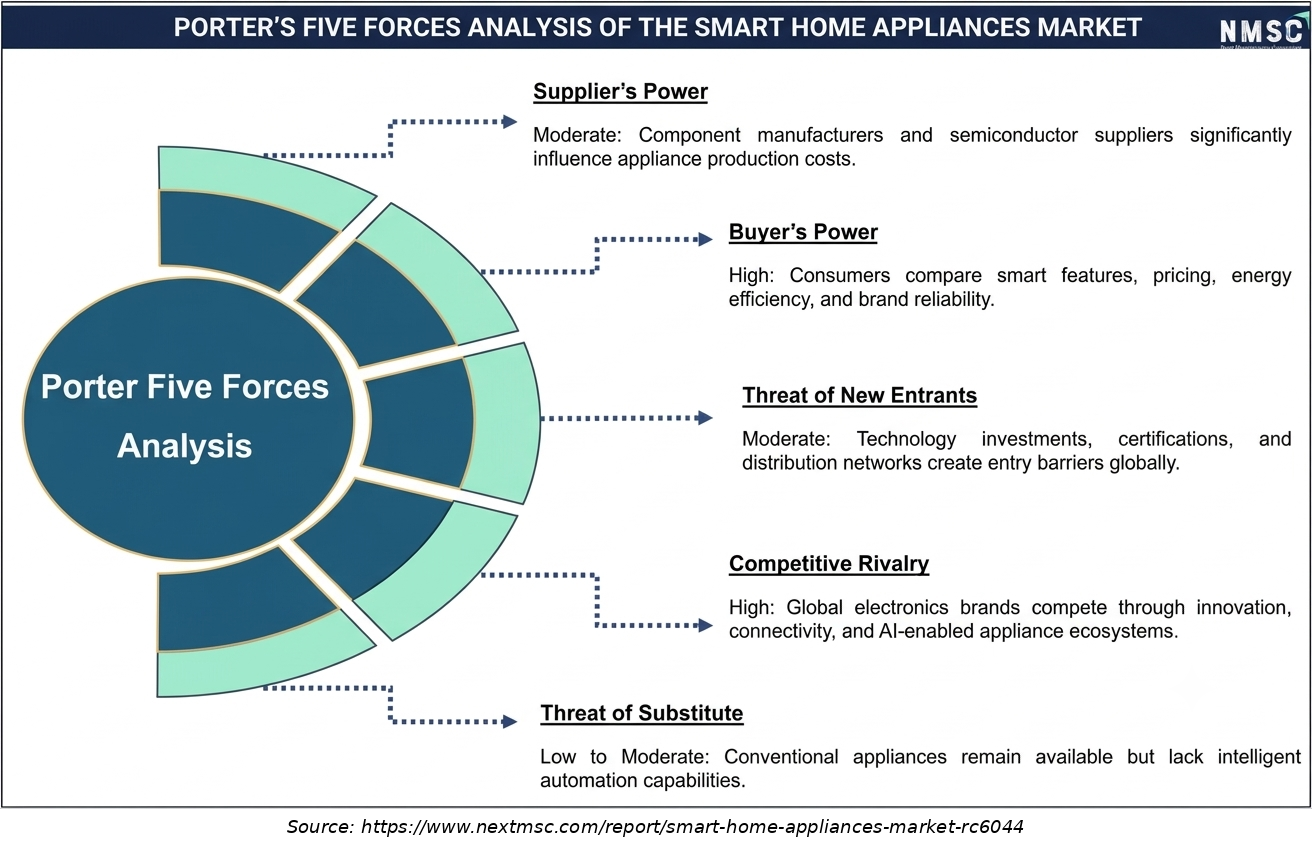
Porter’s Five Forces Analysis of the Smart Home Appliances Market
Based on our Porter’s Five Forces assessment, we identified that the smart home appliances market is influenced by intense competition among established brands, moderate supplier bargaining power, high buyer negotiating leverage, moderate threat of new entrants due to technology and brand requirements, and moderate substitution from conventional home appliances. Furthermore, our industry evaluation indicates that product innovation, ecosystem compatibility, pricing strategies, distribution networks, and after-sales support strengthen competitive positioning and drive sustained market growth.

Competitive Landscape

Dimension Description
Category Details
Market Structure Moderately consolidated, with diversified global appliance conglomerates and specialized connected-cleaning innovators competing across product categories
Innovation Focus AI-based predictive maintenance, multi-protocol interoperability, and voice-assistant integration
M&A Activity Steady acquisition activity as diversified appliance manufacturers acquire specialized connectivity and robotics startups

How Do Companies Compete in the Smart Home Appliances Market?

Companies compete primarily on connectivity breadth, energy-efficiency compliance, and depth of integrated appliance ecosystems. Our findings suggest that vendors offering cross-category connected portfolios secure stronger retail shelf positioning, while single-category specialists increasingly pursue platform partnerships to remain competitive against diversified global appliance conglomerates.

Which Competitive Archetypes Dominate the Smart Home Appliances Market?

Two archetypes dominate: diversified global conglomerates such as Samsung Electronics and LG Electronics leveraging manufacturing scale and cross-category brand recognition, and specialized innovators such as iRobot and Ecovacs Robotics differentiating through category-specific robotics and navigation technology. This dual structure shapes competitive intensity across both broad-portfolio and niche-category procurement channels.

What Innovation and Differentiation Strategies Are Companies Pursuing?

Companies are differentiating through proprietary AI-based diagnostics algorithms and open multi-protocol connectivity standards. Our analysis shows that manufacturers investing in Matter-standard compatibility are better positioned to win cross-brand ecosystem partnerships, particularly across markets where consumers increasingly demand interoperability between appliances from different manufacturers.

Key Market Players

NMSC's analysis indicates that the following companies represent the leading participants shaping the smart home appliances market.

Samsung Electronics Co., Ltd. LG Electronics Inc. Whirlpool Corporation Haier Smart Home Co., Ltd. Midea Group Co., Ltd. BSH Hausgerate GmbH Electrolux AB Panasonic Holdings Corporation Sharp Corporation Xiaomi Corporation iRobot Corporation Dyson Ltd. SharkNinja, Inc. Godrej Appliances Voltas Limited Hisense Group Holding Co., Ltd. TCL Electronics Holdings Limited Miele & Cie. KG Beijing Roborock Technology Co., Ltd. Ecovacs Robotics Co., Ltd.

Latest Developments

Based on our market evaluation, we noticed several notable developments reflecting accelerating innovation and investment across the smart home appliances market.

Date Event
May 2026 Samsung Electronics announced the expansion of its Vision AI Companion (VAC) across its 2026 AI TV and smart home appliance line-ups.
January 2026 LG Electronics unveiled LG CLOiD, an advanced AI-powered home robot, at CES 2026, marking a major milestone in its "Zero Labor Home" vision.
June 2025 Haier Smart Home Co., Ltd. completed the strategic acquisition of Hungarian HVAC provider KLIMA KFT via its Haier Europe subsidiary.

Expert Insights

Daejong Kang

Daejong Kang

Chief Engineer of Smart Home | LG Electronics

""Until now, the smart home was all about the connectivity of smart devices, but with the emergence of generative AI, it's time to move to the next chapter. Until now, we've been talking about technical readiness. Now, we are ready to provide solutions.""

Analyst Interpretation

The statement highlights the evolution of the smart home appliances industry from device connectivity toward AI-driven ecosystems capable of delivering personalized, proactive, and automated user experiences. As generative AI becomes increasingly integrated into home appliances, manufacturers are shifting their focus from connectivity to intelligent solutions that enhance convenience, energy efficiency, and interoperability. This transition is expected to accelerate consumer adoption of AI-enabled appliances, supporting the sustained growth of the global Smart Home Appliances Market.

Investment Opportunities

Where Are Capital Inflows Concentrated in the Smart Home Appliances Market?

Capital inflows are concentrated in robotics and AI-based diagnostics startups, reflecting investor confidence in scalable, software-differentiated appliance technology. Our findings suggest that investment activity has accelerated around connected cleaning appliance innovation, consistent with the segment's 20.3% CAGR and its position as the fastest-growing product category through 2035.

How Is Infrastructure Investment Shaping the Market?

Real estate developers are increasingly specifying connected appliances within new residential construction, particularly across Middle Eastern and Asia-Pacific smart-city development programs. Our analysis shows that this infrastructure-linked investment is creating durable, project-based demand independent of traditional retail replacement cycles.

What ESG Considerations Apply to Smart Home Appliances Investment?

Environmental, social, and governance considerations favor energy-efficient connected appliances that support demand-response grid integration. Through NMSC's assessment, we found that investors increasingly favor manufacturers demonstrating ENERGY STAR and Ecodesign compliance, particularly as regulatory frameworks in North America and Europe tighten efficiency requirements.

How Is Digital Transformation Shaping Investment in This Market?

Digital transformation is shaping investment as manufacturers build cloud-based platforms to support predictive maintenance and usage-analytics subscription services. Our assessment indicates that this software-layer investment is creating new recurring-revenue opportunities distinct from traditional one-time hardware sales across the connected appliance value chain.

What PE/VC and M&A Activity Is Shaping the Investment Landscape?

Private equity and venture capital activity remains concentrated on specialized robotics and connectivity software startups, while M&A activity favors diversified appliance manufacturers acquiring these capabilities directly. Our findings suggest that this dual investment pattern is expected to persist as established players seek to internalize software differentiation.

Key Benefits for Stakeholders

How Does This Report Benefit Enterprise Technology Leaders and CIOs?

Enterprise technology leaders and CIOs overseeing commercial facility operations gain data-backed segmentation insights from Section 7 to prioritize connected appliance procurement across hospitality and corporate facility upgrade programs, supported by the report's Commercial end-user growth analysis.

How Does This Report Benefit Investors and Financial Analysts?

Investors and financial analysts gain granular revenue forecasts and competitive landscape analysis from Sections 7 through 10 to evaluate capital allocation across product-type, connectivity, and regional categories, supported by the report's profiling of 20 key market participants.

How Does This Report Benefit Technology Vendors and Product Teams?

Technology vendors and product teams gain insight from Sections 5 and 6 into emerging trends and growth opportunities to inform product roadmap decisions, supported by the report's analysis of segment-level CAGR differentials and regional technology adoption patterns.

Key Market Segments Evaluated

By Product Type

  • Smart Kitchen Appliances
  • Smart Laundry Appliances
  • Smart Climate Control Appliances
  • Smart Cleaning Appliances
  • Other Smart Home Appliances

By Connectivity Technology

  • Wi-Fi Enabled
  • Bluetooth Enabled
  • Zigbee and Z-Wave Enabled
  • Multi-Protocol and Hub-Based

By Distribution Channel

  • Online Retail
  • Multi-Brand Electronics Stores
  • Specialty Stores
  • Direct Sales

By End User

  • Residential
  • Commercial

Conclusion & Recommendations

The smart home appliances market is expected to sustain double-digit growth through 2035, reaching USD 153.64 Billion at a 13.56% CAGR. Our analysis shows that long-term demand will increasingly shift from single-device purchases toward interoperable, multi-appliance ecosystems as consumers prioritize cross-brand connectivity and subscription-enabled maintenance services across residential and commercial channels. Asia-Pacific is expected to retain its position as the largest and fastest-growing regional contributor to global revenue throughout the forecast period.

Strategic Positioning Recommendations

Manufacturers should prioritize open, multi-protocol connectivity architectures capable of unifying kitchen, laundry, climate control, and cleaning appliance categories under common control platforms. Our assessment indicates that companies combining hardware manufacturing scale with proprietary AI-based diagnostics software will be best positioned to capture recurring-revenue opportunities and defend share against both diversified conglomerates and specialized category innovators.

Investment Attractiveness

The smart home appliances industry presents an attractive investment case, supported by a USD 104.72 Billion absolute dollar opportunity between 2026 and 2035 and above-average growth in Asia-Pacific and connected cleaning appliance categories. Our findings suggest that investment attractiveness is highest for companies combining robotics or connectivity software differentiation with scaled manufacturing and distribution capacity across emerging markets.

Market Shifts and Key Risks

Stakeholders should monitor high upfront cost barriers in price-sensitive markets, data privacy concerns limiting adoption in mature economies, and interoperability gaps between competing connectivity protocols. Our analysis shows that manufacturers unable to adapt to open connectivity standards risk losing share to competitors offering broader multi-brand compatibility across expanding smart-home ecosystems.

Growth Pathways

Key growth pathways include expanding subscription-based appliance-as-a-service offerings, scaling robotic cleaning appliance production, and deepening distribution penetration across rural and semi-urban emerging markets. NMSC's analysis indicates that companies pursuing these pathways while maintaining energy-efficiency compliance across mature markets will be best positioned to capture the market's projected growth through 2035.

FAQs

About the Author

Saista Faiyaz

Saista Faiyaz

Saista Faiyaz is Research Associate at Next Move Strategy Consulting, where she has covered consumer markets and healthcare technologies for 3 years. Her work includes primary interview review, secondary-source validation, market sizing, and structured analysis of company and industry data. She supports research by comparing evidence across sources, organizing findings into market narratives, and documenting assumptions used in analysis. Her scope includes cross-market benchmarking, and reports.

About the Reviewer

Supradip Baul

Supradip Baul

Supradip Baul is an accomplished business consultant and strategist with over a decade of rich experience in market intelligence, strategy, technology, and business transformation. His work has included rigorous qualitative and quantitative analysis across multiple industries, helping clients shape investment decisions and long-term roadmaps. Earlier in his career, he was associated with Gartner, where he contributed to industry-leading reports and market share analyses. He has worked with leading global companies and holds an MBA with a dual specialization in Marketing and Finance.

Download Free Sample

Semih Kavaklioglu

SEMIH KAVAKLIOGLU

Co-Founder & Sales Manager

Decortie

I work a lot in the marketing industry and I know that research is an essential part of any campaign. I have used Market research reports for my own products and I found them to be very informative and well-researched. The team here produces insightful reports for a good price

Ross J Mckenzie

ROSS J MCKENZIE

Business Insight Manager

Staysure Group

“Next MSC have been incredibly helpful in providing detailed & robust information on our market, alongside quantifying growth by different segments. The process to procure was simple and easy, with sample reports and regular contact to ensure we had what we needed. Succinct detail on their sources & methodologies is also greatly received, allowing transparency in this respect helps build trust in the detail you pay for. Joseph in particular was fantastic, and helped ensure efficient provision of the insight pack – thank you NMSC!”.

Kevin Coker

KEVIN COKER

Founder, CEO and Board Diector

Proxima Clinical Research

I have been using Next MSC reports for product positioning in a new geography for a long time. They have by far the best reports I have found and the price is reasonable too!

Rishabh Jogani

RISHABH JOGANI

Strategy Analyst

Accenture Japan

We are incredibly impressed with the market report on the real estate market in India provided by Next Move Strategy Consulting. The report was thorough, insightful, and well-structured, offering deep analysis and actionable recommendations. It not only captured the current trends and dynamics but also provided a forward-looking perspective that has been invaluable for our strategic planning. Their team demonstrated exceptional professionalism, attention to detail, and a profound understanding of the industry. The data-driven insights and clarity of presentation exceeded our expectations, making complex market trends easy to understand. We highly recommend Next Move Strategy Consulting to anyone looking for reliable and comprehensive market research services. Their expertise has given us the confidence to navigate the complexities of the Indian real estate market with clarity and foresight.

Diana Trejo

DIANA TREJO

Assistant Manager

Sumitomo Corporation de Mexico, S.A. de C.V.

Recently, we purchased a report on the Mexico Data Center Market from Next Move Strategy Consulting. The service has been excellent, with support that is always timely and thoroughly professional. The information provided is interesting, highly useful, and delivered with clarity. I would highly recommend NextMSC for anyone seeking insightful and dependable analysis.

Custom Market Research Services

We will customize the research for you if the listed report does not fully match your requirements.

Get 30% Free Customization

Select License

This website uses cookies to ensure you get the best experience on our website. Learn more

✖